Question 15 Marks
$\text{If}\cos^{-1}\frac{x}{\text{a}} + \cos^{-1}\frac{y}{\text{b}} = \alpha, \text{Prove that}\frac{{x}^{2}}{\text{a}^{2}} - 2\frac{xy}{\text{ab}}\cos\alpha +\frac{{y}^{2}}{\text{b}^{2}} = \sin^{2}\alpha$
AnswerFrom the equation: $\cos^{-1}\frac{\text{x}}{\text{a}} = \alpha - \cos^{-1}\frac{\text{y}}{\text{b}}$
$\frac{\text{x}}{\text{a}} = \cos\bigg(\alpha-\cos^{-1}\frac{\text{y}}{\text{b}}\bigg)\Rightarrow\frac{\text{x}}{\text{a}} = \cos\alpha. \cos\bigg(\cos^{-1}\frac{\text{y}}{\text{b}}\bigg) + \sin\alpha.\sin\bigg(\cos^{-1}\frac{\text{y}}{\text{b}}\bigg)$
$\Rightarrow\frac{\text{x}}{\text{a}} = \frac{\text{y}.\cos\alpha}{\text{b}} + \sin\alpha\sqrt{1 - \frac{\text{y}^{2}}{\text{b}^{2}}} \Rightarrow\frac{\text{x}}{\text{a}}- \frac{\text{y}}{\text{b}}\cos\alpha = \sin \alpha \sqrt{1 - \frac{\text{y}^{2}}{\text{b}^{2}}} $
$\Rightarrow\bigg(\frac{\text{x}}{\text{a}} - \text{y}\frac{\cos\alpha}{\text{b}}\bigg)^{2} = \bigg(\sin\alpha\sqrt{1 - \frac{\text{y}^{2}}{\text{b}^{2}}}\bigg)$
$\Rightarrow\frac{\text{x}^{2}}{\text{a}^{2}}- \frac{\text{2xy}}{\text{ab}}.\cos\alpha + \frac{\text{y}^{2}}{\text{b}^{2}} = \sin^{2}\alpha$
View full question & answer→Question 25 Marks
Find the general solution of the differential equation
$\frac{\text{dy}}{\text{dx}}-\text{y}=\sin\text{x}.$
AnswerGiven differential equation is $\frac{\text{dy}}{\text{dx}}-\text{y}=\sin\text{x}.$ ⇒ Integrating factor = $\text{e}^{-\text{x}}$ $\therefore\ $Solution is: $\lambda$e$^{–x} $=$\int\sin \text{e}^{-\text{x}}\text{dx}=\text{I}_1$ $\text{I}_1=-\sin \text{x}\text{e}^{-\text{x}}+\int\cos \text{x}\text{e}^{-\text{x}}\text{dx}$$=-\sin \text{x}\text{e}^{-\text{x}}+[-\cos \text{x}\text{e}^{-\text{x}}-\int+\sin\text{x}\text{e}^{-\text{x}}\text{dx}]$
$\text{I}_1=\frac{1}{2}[-\sin\text{x}-\cos\text{x}]\text{e}^{-\text{x}}$ $\therefore\ $Solution is: $\lambda$e–x $=\frac{1}{2}(-\sin\text{x}-\cos\text{x})\text{e}^{-\text{x}}+\text{c}$ $\text{or}\ \text{y}=-\frac{1}{2}(\sin\text{x}+\cos\text{x})+\text{ce}^\text{x}$
View full question & answer→Question 35 Marks
Find the particular solution of the differential equation $\text{(x - y)} \frac{\text{dy}}{\text{dx}} = \text{(x + 2y),}$ given that y = 0 when x = 1.
Answer$\frac{\text{dy}}{\text{dx}} = \frac{\text{x + 2y}}{\text{x - y}} = \frac{1 + \frac{\text{2y}}{\text{x}}}{1 - \frac{\text{y}}{\text{x}}}$
$\frac{\text{y}}{\text{x}} = \text{v} \Rightarrow \frac{\text{dy}}{\text{dx}} = \text{v + x} \frac{\text{dv}}{\text{dx}} \text{ }\text{ } \therefore \text{v + x} \frac{\text{dv}}{\text{dx}} = \frac{\text{1 + 2v}}{\text{1 -v}}$
$\Rightarrow \text{x} \frac{\text{dv}}{\text{dx}} = -\frac{\text{1 + 2v - v + v}^{2}}{\text{v - 1}} \Rightarrow \int \frac{\text{v - 1}}{\text{v}^{2} + \text{v + 1}} \text{dv} = - \frac{\text{dx}}{\text{x}}$
$\Rightarrow \int\frac{\text{2v + 1 - 3}}{\text{v}^{2} + \text{v + 1}} \text{dv} = \int - \frac{2}{\text{x}} \text{dx} \Rightarrow \int \frac{\text{2v + 1}}{\text{v}^{2} + \text{v + 1}} \text{dv - 3} \int \frac{1}{{\bigg(\text{v} + \frac{1}{2}\bigg)^{2} + \bigg(\frac{\sqrt{3}}{2}\bigg)^{2}}} = -\int \frac{2}{\text{x}} \text{dx}$
$\Rightarrow \log|\text{v}^{2} + \text{v} + 1| - 3. \frac{2}{\sqrt{3}} \tan^{-1} \bigg(\frac{\text{2v + 1}}{\sqrt{3}}\bigg) = \log |\text{x}|^{2} + \text{c}$
$\Rightarrow \log|\text{y}^{2} + \text{xy + x}^{2}| -2\sqrt{3}\tan^{-1} \bigg(\frac{\text{2y + x}}{\sqrt{3}\text{x}}\bigg) = \text{c}$
$\text{x = 1, y = 0} \Rightarrow \text{c} = -2\sqrt{3}. \frac{\pi}{6} = -\frac{\sqrt{3}}{3} \pi$
$\therefore \text{ } \log|\text{y}^{2} + \text{xy + x}^{2}| - 2\sqrt{3} \tan^{-1} \bigg(\frac{\text{2y + x}}{\sqrt{3x}}\bigg) + \frac{\sqrt{3}}{3} \pi = 0$
View full question & answer→Question 45 Marks
Find the equations of the tangent and normal to the curve$\frac{\text{x}^{2}}{\text{a}^{2}} - \frac{\text{y}^{2}}{\text{b}^{2}} = 1$ at the point ($\sqrt{2}$a, b).
Answer$\frac{\text{x}^{2}}{\text{a}^{2}} - \frac{\text{y}^{2}}{\text{b}^{2}} = 1 \Rightarrow\frac{2\text{x}}{\text{a}^{2}} - \frac{2\text{y}}{\text{b}^{2}}\frac{\text{dy}}{\text{dx}} = 0 \Rightarrow\frac{\text{dy}}{\text{dx}} =\frac{\text{b}^{2}\text{x}}{\text{a}^{2}\text{y}}$
slope of tangent at $(\sqrt{2}\text{ a, b }) = \frac{\sqrt{2}\text{b}}{\text{a}}$
slope of normal at $(\sqrt{2}\text{a , b }) = - \frac{\text{a}}{\sqrt{2}\text{b}}$
Equation of tangent is y – b $ = \frac{\sqrt{2}\text{b}}{\text{a}}(\text{x} - \sqrt{2}\text{a})$
i.e. $\sqrt{2}\text{ bx} - \text{ay} =\text{ab}$
and equation of normal is y – b = – $\frac{\text{a}}{\sqrt{2}\text{b}}(\text{x} - \sqrt{2}\text{ a})$
i.e. ax $ + \sqrt{2}\text{ by} = \sqrt{2}(\text{a}^{2} + \text{b}^{2}).$
View full question & answer→Question 55 Marks
If $y = P e^{ax}+ Q e^{bx},$ show that
$\frac{\text{d}^2\text{y}}{\text{dx}^2}-(\text{a}+\text{b})\frac{\text{dy}}{\text{dx}}+\text{aby}=0$
Answer$y = P e^{ax} + Q e^{bx}$^$\Rightarrow\frac{\text{dy}}{\text{dx}}$
$= a P e^{ax} + b Q e^{bx}$^
$\frac{\text{d}^2\text{y}}{\text{dx}^2}=$
$a2 p e_{ax} + b2 Q$ ebx
$\therefore\ \text{LHS}=$$\frac{\text{d}^2\text{y}}{\text{dx}^2}$– (a + b)$\frac{\text{dy}}{\text{dx}}$ +aby
$= a^2 P e^{ax} + b^2 Q e^{bx} – (a + b) {a P e^{ax} + b Q e^{bx}}+ ab {P e^{ax} + Q e^{bx}}$
$= P e^{ax} {a^2 – a^2 – ab + ab}+ Q e^{bx} {b^2 – ab – b^2 + ab}$
$= 0 + 0 = 0. = R.H.S.$
View full question & answer→Question 65 Marks
Find the particular solution of the differential equation log$\Big(\frac{\text{dy}}{\text{dx}}\Big)= 3x + 4y$, given that $y = 0$ when $x = 0$.
AnswerGiven differential equation can be written as
$\frac{\text{dy}}{\text{dx}}=\text{e}^{3\text{x}+4\text{y}}=\text{e}^{3\text{x}}.\text{e}^{4\text{y}}$
$\therefore\ \int\text{e}^{-4\text{y}}\text{dy}=\int\text{e}^{3\text{x}}\text{dx}$
$\frac{\text{e}^{-4\text{y}}}{-4}=\frac{\text{e}^{3\text{x}}}{3}+\text{c}$
$\therefore\ 4\text{e}^{3\text{y}}+3\text{e}^{-4\text{y}}+12\ \text{c}=0$
taking x = 0, y = 0 we get c = $-\frac{7}{12}$
$\therefore\ $The solution is 4 $e^{3x} + 3 e^{– 4y} – 7 = 0$
View full question & answer→Question 75 Marks
From the differential equation of the family of circles in the second quadrant and touching the coordinate axes.
AnswerLet radius of any of the circle touching coordinate axes in the second quadrant be “a” then centre is (–a, a)
$\therefore$ Equation of the family of circles is:
$\text{(x + a}^{2}) + \text{(y - a)}^{2} = \text{a}^{2}, \text{a} \in \text{R}$
$\Rightarrow\text{x}^{2} + \text{y}^{2} + \text{2ax - 2ay + a}^{2} = 0$
Differentiate w.r.t. $\text{“x”, 2x + 2yy}' + \text{2a – 2ay}{' = 0} \Rightarrow\text{a} =\frac{\text{x + yy}'}{\text{y}'{ - 1}}$
$\therefore$The differential equation is:
$\bigg(\text{x} + \frac{\text{x + yy}{'}}{\text{y}{' - 1}}\bigg)^{2}\bigg(\text{y} - \frac{\text{x + yy'}}{\text{y}{' - 1}}\bigg)^{2} = \bigg( \frac{\text{x + yy}{'}}{\text{y}{' - 1}}\bigg)^{2}$
$\Rightarrow\bigg(\frac{\text{xy}'{\text{ + yy}{'}}}{\text{y}{' - 1}}\bigg)^{2} + \bigg(\frac{\text{x + y}}{\text{y}{' - 1}}\bigg)^{2} = \bigg(\frac{\text{x + yy}{'}}{\text{y}{' - 1}}\bigg)^{2}$
View full question & answer→Question 85 Marks
Find the general solution of the differential equation
$y ~dx – (x + 2y^2) dy = 0$.
AnswerGiven differential equation can be written as $\text{y}\frac{\text{dx}}{\text{dy}}-\text{x}=2\text{y}^2\ \text{or}\ \frac{\text{dx}}{\text{dy}}-\frac{1}{\text{y}}.\text{x}=2\text{y}$ Integrating factor is${\text{e}^{-\log \text{y}}}$= $\frac{1}{\text{y}}$$\therefore\ \ \text{solution is}\ \text{x}.\frac{1}{\text{y}}=\int2\text{dy}=2\text{y}+\text{c}$
or $x = 2y^2 + cy$.
View full question & answer→Question 95 Marks
Find the particular solution of the differential equation x $(1 + y^2) dx – y (1 + x^2) dy = 0$, given that $y = 1$ when $x = 0$.
AnswerGiven equation can be written as $\frac{\text{x}}{1+\text{x}^2}\text{dx}-\frac{\text{y}}{1+\text{y}^2}\text{dy}=0$ Integrating to get $\frac{1}{2}\log(1+\text{x}^2)-\frac1 2\log(1+\text{y}^2)=\log \text{c}_1$
$\Rightarrow\ \log(1+\text{x}^2)-\log(1+\text{y}^2)=\log \text{c}_1^2=\log\text{c}$
$\therefore\frac{(1+\text{x}^2)}{(1+\text{y}^2)}=\text{c}$
x = 0 y = 1$\Rightarrow\ \text{c}=\frac{1}{2}$$\therefore\ 1+\text{y}^2=2(1+\text{x}^2)\ \ \ \text{or}\ \ \ \text{y}=\sqrt{2\text{x}^2+1}$
View full question & answer→Question 105 Marks
Solve the differential equation:
$y + x \frac{dy}{dx} = x - y \frac{dy}{dx}$
AnswerThe differential equation can be re-written as:
$\frac{\text{dy}}{\text{dx}} = \frac{\text{x -y}}{\text{x + y}}, \text{put y = vx,} \frac{\text{dy}}{\text{dx}} = \text{v + x} \frac{\text{dv}}{\text{dx}}$
$\Rightarrow\text{v + x}\frac{\text{dv}}{\text{dx}} = \frac{1 - \text{v}}{1 + \text{v}}\Rightarrow\frac{\text{1 + v}}{\text{1 - 2v - v}^{2}}\text{dv} = \frac{\text{1}}{\text{x}} \text{dx}$
integrating we get
$\Rightarrow\frac{1}{2}\int\frac{\text{2V + 2}}{\text{V}^{2} + \text{2V - 1}}\text{dv} = -\int\frac{1}{\text{x}} \text{dx}=\frac{1}{2}\log|\text{V}^{2} + \text{2V} - 1| = -\log\text{ x }+ \log \text{ C}$
$\therefore $ Solution of the differential equation is:
$\frac{1}{2}\log\bigg|\frac{\text{y}^{2}}{\text{x}^{2}} + \frac{\text{2y}}{\text{x}} - 1\bigg| = \log\text{C} - \log\text{x or,}\text{ y}^{2} + \text{2xy - x}^{2} = \text{C}^{2}$
View full question & answer→Question 115 Marks
$\text{If (ax + b)} \text{e}^{\text{y/x}} = \text{x},\text{then show that}$
$\text{x}^{3} \bigg(\frac{\text{d}^{2}\text{y}}{\text{dx}^{2}}\bigg) = \bigg(\text{x}\frac{\text{dy}}{\text{dx}}- \text{y}\bigg)^{2} $
Answer$\frac{\text{y}}{\text{x}} = \log\text{x} - \log (\text{ax + b)}$
differentiating w.r.t. x,
$=\frac {\text{x} {\frac{\text{dy}}{\text{dx}}- \text{y}}}{\text{x}^{2}} = \frac{1}{\text{x}}-\frac{\text{a}}{\text{ax + b}}=\frac{\text{b}}{\text{x ( ax + b)}}$
$= \text{x}. \frac{\text{dy}}{\text{dx}} - \text{y} = \frac{\text{bx}}{(\text{ax + b)}}\dots\dots\dots\dots\text{(1)} $
differentiating w.r.t. x, again
$\text{x} \frac{\text{d}^{2}\text{y}}{\text{dx}^{2}} + \frac{\text{dy}}{\text{dx}} -\frac{\text{dy}}{\text{dx}} = \frac{(\text{ax + b) b - abx}}{(\text{ax + b)}^{2}} $
$\text{x} \frac{\text{d}^{2}\text{y}}{\text{dx}^{2}} = \frac{\text{b}^{2}}{\text{(ax + b)}{2}}$
$\text{Writing}\Rightarrow \text{x}^{3}\ \frac{\text{d}^{2}\text{y}}{\text{dx}^{2}} = \bigg(\frac{\text{bx}}{\text{ax + b}} \bigg)^{2}\dots\dots\dots\text{(2)}$
From (1) and (2) $\Rightarrow$
$\text{x}^{3} \frac{\text{d}^{2}\text{y}}{\text{dx}^{2}} = \bigg(\text{x}. \frac{\text{dy}}{\text{dx}}- \text{y}\bigg)^{2}$
View full question & answer→Question 125 Marks
Show that the differential equation $\text{(x - y})\frac{\text{dy}}{\text{dx}} = \text{x + 2y}$ is homogeneous and solve it also.
Answer$\text{(x - y})\frac{\text{dy}}{\text{dx}} = \text{x + 2y}$
$\frac{\text{dy}}{\text{dx}} = \frac{\text{x } + 2\text{y}}{\text{x - y}}$
$\frac{\text{dy}}{\text{dx}} = \frac{1 + 2\frac{\text{y}}{\text{x}}}{1 - \frac{\text{y}}{\text{x}}} = \text{f}\bigg(\text{y}/\text{x}\bigg)\dots\dots\dots\dots\dots\dots\dots\dots\text{(1)}$
$\therefore$ differential equation is homogeneous Eqn.
$\text{y = vx to give}$
$\text{v + x}. \frac{\text{dv}}{\text{dx}} = \frac{1 + 2\text{v}}{1 - \text{v}}$
$\Rightarrow \int \frac{1 -\text{v}}{1 + \text{v + v}^{2}}\text{dv} = \int\frac{\text{dx}}{\text{x}}$
$\Rightarrow -\frac{1}{2}\int \frac{2 \text{v} + 1}{1 + \text{v + v}^{2}}\text{dv} + \frac{3}{2} \int\frac{\text{dv}}{\bigg(\text{v} +\frac{1}{2}\bigg)^{2} + \bigg(\frac{\sqrt{3}}{2}\bigg)^{2}} = \int\frac{\text{dx}}{\text{x}}$
$-\frac{1}{2}\log|1 +\text{ v + v}^{2}| + \sqrt{3}\tan^{-1}\bigg(\frac{2\text{v} + 1}{\sqrt{3}}\bigg) = \log|\text{x}| + \text{c}$
$- \frac{1}{2}\log\bigg|\frac{\text{x}^{2} + \text{xy + y}^{2}}{\text{x}^{2}}\bigg| + \sqrt{3}\tan^{-1} \bigg(\frac{2\text{y + x}}{x\sqrt{3}}\bigg)= \log|\text{|x| + c}$
View full question & answer→Question 135 Marks
Find the differential equation of the family of curves $\text{(x- h)}^{2} + \text{(y - k)}^{2} = \text{r}^{2}, $ where h and k are arbitrary constants.
Answer$\text{(x - h ) + (y -k)} \frac{\text{dy}}{\text{dx}} = 0$
$\text{and 1 + (y - k)} \frac{\text{d}^{2}\text{y}}{\text{dx}^{2}} + \bigg(\frac{\text{dy}}{\text{dx}}\bigg)^{2} = 0$
$\Rightarrow \text{(y - k)} = \frac{-\Bigg[1 +\bigg(\frac{\text{dy}}{\text{dx}}\bigg)^{2}\Bigg]}{\frac{\text{d}^{2}{\text{y}}}{\text{dx}^{2}}} $
$\text{(1)} \Rightarrow \text{(x - h)} = -\frac{1 +\bigg(\frac{\text{dy}}{\text{dx}}\bigg)^{2}}{\frac{\text{d}^{2}{\text{y}}}{\text{dx}^{2}}}\frac{\text{dy}}{\text{dx}}$
Putting in the given eqn.
$-\frac{\Bigg(1 +\bigg(\frac{\text{dy}}{\text{dx}}\bigg)^{2}\Bigg)^{2}}{\bigg(\frac{\text{d}^{2}{\text{y}}}{\text{dx}^{2}}\bigg)^{2}}.\bigg(\frac{\text{dy}}{\text{dx}}\bigg)^{2} + \frac{\Bigg(1 +\bigg(\frac{\text{dy}}{\text{dx}}\bigg)^{2}\Bigg)^{2}}{\bigg(\frac{\text{d}^{2}{\text{y}}}{\text{dx}^{2}}\bigg)^{2}} = \text{r}^{2} $
$\text{or} \Bigg[1 +\bigg(\frac{\text{dy}}{\text{dx}}\bigg)^{2}\Bigg]^{3} = \text{r}^{2} \bigg(\frac{\text{d}^{2}\text{y}}{\text{dx}^{2}}\bigg)^{2}$
View full question & answer→Question 145 Marks
Solve the differential equation $ (\tan^{–1} \text{x – y) dx = (1 + x}^{2}) \text{ dy}.$
AnswerGiven differential equation can be written as
$(1 + \text{x}^{2}) \frac{\text{dy}}{\text{dx}} + \text{y} = \tan^{-1} \text{x} \Rightarrow \frac{\text{dy}}{\text{dx}} + \frac{1} {1 + \text{x}^{2}} \text{y} = \frac{\tan^{-1} \text{x}}{\text{1 + x}^{2}}$
Integrating factor $ = \text{e}^{\tan^{-1}} \text{x}.$
$\therefore \text{Solution is y . e}^{\tan^{-1}}\text{x} = \int \tan^{-1} \text{x. e}^{\tan^{-1} \text{x}} \frac{1}{1 + \text{x}^{2}} \text{dx}$
$\Rightarrow \text{y. e}^{\tan^{-1}} \text{x} = \text{e}^{\tan^{-1}} \text{x} . (\tan^{-1}\text{x} - 1) + \text{c}$
$\text{ or } \text{ y} = (\tan^{-1} \text{x - 1)} + \text{c . e}^{-\tan^{-1_{\text{x}}}}$
View full question & answer→Question 155 Marks
Solve the differential equation $(1 + x^2) \frac{\text{dy}}{\text{dx}} + \text{y} = \text{e}^{\tan^{-1}\text{x}.}$
AnswerGiven differential equation can be written as
$\frac{\text{dy}}{\text{dx}} + \frac{1}{1 + \text{x}^{2}}.\text{y} = \frac{1}{1 + \text{x}^{2}}.\text{e}^{\tan^{-1}\text{x}}$
Integrating factor $\text{e}^{\int\frac{1}{1 + \text{x}^{2}}\text{dx}} = \text{e}^{\tan^{-1}\text{x}}$
$\therefore\text{ solution is, y.}\text{e}^{\tan^{-1}\text{x}} = \int\frac{1}{1 + \text{x}^{2}}\text{e}^{2\tan^{-1}\text{x}}\text{dx}$
$\Rightarrow\text{y .e}^{\tan^{-1}\text{x}} = \frac{1}{2}\text{e}^{2\tan^{-1}\text{x}} + \text{c}$
$\text{or } \text{y} = \frac{1}{2}\text{e}^{\tan^{-1}\text{x}} + \text{c}\text{e}^{-\tan^{-1}\text{x}}.$
View full question & answer→Question 165 Marks
If $y = P e^{ax} + Qe^{bx}$, show that
$\frac{\text{d}^{2}\text{y}}{\text{dx}^{2}} - (\text{a + b })\frac{\text{dy}}{\text{dx}} + \text{aby} = 0 .$
Answer$y = P e^{ax}+ Qe^{bx}$
$\Rightarrow\frac{\text{dy}}{\text{dx}} = \text{a P e}^{ax} + \text{b Q e}^{bx}$
$\frac{\text{d}^{2}\text{y}}{\text{dx}^{2}} = \text{a}^{2}\text{P e}^{ax} + \text{b}^{2} \text{Q e}^{bx}$
$\therefore\text{ LHS } =\frac{\text{d}^{2}\text{y}}{\text{dx}^{2}} - (\text{a + b })\frac{\text{dy}}{\text{dx}} + \text{ aby}$
$ =\text{a}^{2}\text{P e}^{ax} + \text{b}^{2}\text{ Q e}^{bx} -(\text{a + b })\left\{\text{a P e}^{ax} + \text{b Q e}^{bx}\right\} + \text{ab}\left\{\text{P e}^{ax} + \text{Q e}^{bx}\right\}$
$ = \text{P e}^{ax}\left\{\text{a}^{2} - \text{a}^{2} - \text{ab} + \text{ab}\right\} + \text{ Q e}^{bx}\left\{\text{b}^{2} - \text{ab} - \text{b}^{2} + \text{ab}\right\}$
= 0 + 0 = 0. = R.H.S.
View full question & answer→Question 175 Marks
Find the particular solution of the differential equation$\frac{\text{ dy}}{\text{dx}} = 1 +\text{x + y +xy},\text{ given that }\text{y} = 0 \text{ when x } = 1.$
Answer$\frac{\text{dy}}{\text{dx}} = 1 + \text{x + y + xy} = (1 + \text{x})( 1 + \text{y})$
$\therefore\int\frac{\text{dy}}{1 + \text{y}} = \int(1 + \text{x})\text{dx}$
$\log|1 + \text{y}| = \text{x} + \frac{\text{x}^{2}}{2} + \text{c}$
$\text{x} = 1 ,\text{y} = 0 \Rightarrow\text{c} = - \frac{3}{2}$
$\therefore\text{ solution is } \log|1 + \text{y} | = \text{x} + \frac{\text{x}^{2}}{2} - \frac{3}{2}.$
View full question & answer→Question 185 Marks
If $y^x = e^{y–x}$, prove that $\frac{\text{dy}}{\text{dx}} = \frac{(1 + \log\text{y})^{2}}{\log\text{y}}.$
AnswerGiven $y^x = e^{y-x}$Taking logarithm both sides we get
$\log y^x = \log e^{y-x}$
$\Rightarrow\text{x}.\log\text{y} = (\text{y} - \text{x}).\log e\Rightarrow\text{x}.\log\text{y} = (\text{y} - \text{x})$
$\Rightarrow\text{x}(1 + \log\text{y}) = \text{y}\Rightarrow\text{x} = \frac{\text{y}}{1 + \log\text{y}}$
Differentiating both sides w.r.t.y. We get
$\frac{\text{dx}}{\text{dy}} = \frac{(1 + \log\text{y}).1 - \text{y}.\bigg(0 + \frac{1}{\text{y}}\bigg)}{(1 + \log\text{y})^{2}}$
$ = \frac{1 + \log\text{y} - 1 }{(1 + \log\text{y})^{2}} = \frac{\log\text{y}}{(1 + \log\text{y})^{2}}\Rightarrow\frac{\text{dy}}{\text{dx}} = \frac{(1 + \log\text{y})^{2}}{\log\text{y}}$
$ \begin{bmatrix} \text{Note}:(i) \log_{e} \text{mn} = \log_{e}\text{m} + \log_{e}\text{n} \\ (ii)\log_{e}\frac{\text{m}}{\text{n}} = \log_{e}\text{m} - \log_{e}\text{n}\\ (iii)\log_{e } \text{ m}^{n} = \text{n}\log_{e}\text{m} \end{bmatrix}.$
View full question & answer→Question 195 Marks
If $x = a \cos^3 \theta$ and $y = a \sin^3 \theta$, then find the value of $\frac{\text{f}^{2}\text{y}}{\text{dx}}\text{at}\theta = \frac{\pi}{6}.$
AnswerGiven: $x = a \cos^3 \theta$
Differentiating both sides w.r.t. $\theta$we get
$\frac{\text{dx}}{\text{d}\theta} = - 3 \text{a}\cos^{2}\theta.\sin\theta$ - - - - - - - -(i)
Also $y = a \sin^3 \theta$
Differentiating both sides w.r.t. $\theta$we get
$\frac{\text{dy}}{\text{d}\theta} = 3\text{a}\sin^{2}\theta.\cos\theta$ - - - - - - - - (ii)
Now $\frac{\text{dy}}{\text{dx}} =\frac{\text{dy}/\text{d}\theta}{\text{dx}/\text{d}\theta} = \frac{3\text{a}\sin^{2}\theta.\cos\theta}{-3\text{a}\cos^{2}\theta.\sin\theta}$
$\Rightarrow\frac{\text{dy}}{\text{dx}} = - \tan\theta$
$\Rightarrow\frac{\text{d}^{2}\text{y}}{\text{dx}^{2}} = -\sec^{2}\theta.\frac{\text{d}\theta}{\text{dx}}$
$ = \frac{-\sec^{2}\theta}{-3\text{a}\cos^{2}\theta.\sin\theta} =\frac{1}{3\text{a}}\sec^{4}\theta.\text{cosec}\theta$
$\therefore\frac{\text{d}^{2}\text{y}}{\text{dx}^{2}}\bigg]_{\text{x} = \pi/6} = \frac{1}{3\text{a}}\sec^{4}\frac{\pi}{6}.\text{cosec}\frac{\pi}{6}$
$ = \frac{1}{3\text{a}}.\bigg(\frac{2}{\sqrt{3}}\bigg)^{4}\times2 =\frac{32}{27\text{a}}.$
View full question & answer→Question 205 Marks
Find the equations of tangents to the curve $3x^2 – y^2 = 8$, which pass through the point $\bigg(\frac{4}{3} , 0 \bigg).$
AnswerLet the point of contact be $(x_0 , y_0 )$
Now given curve is $3x^2 - y^2 = 8$
Differentiating w.r.t. x we get, 6x - 2y.$\frac{\text{dy}}{\text{dx}} = 0 $
$\Rightarrow\frac{\text{dy}}{\text{dx}} = \frac{6\text{x}}{2\text{y}} = \frac{3\text{x}}{\text{y}}\Rightarrow\frac{\text{dy}}{\text{dx}}\bigg]_{(\text{x}_{0} ,\text{y}_{0})} = \frac{3\text{x}_{0}}{\text{y}_{0}}$
Now, equation of required tangent is
$(\text{y} - \text{y}_{0}) = \frac{3\text{x}_{0}}{\text{y}_{0}}(\text{x} - \text{x}_{0}) - - - - - -(i)$
$\because\text{ (i) passes through }\bigg(\frac{4}{3} , 0 \bigg)$
$\therefore(0 - \text{y}_{0}) = \frac{3\text{x}_{0}}{\text{y}_{0}}\bigg(\frac{4}{3} - \text{x}_{0}\bigg)$
$\Rightarrow - \text{y}_{0}^{2} = 4\text{x}_{0} - 3\text{x}_{0}^{2}$ - - - - - - - - -(ii)
Also, $\therefore$$(x_0 , y_0 )$ lie on given curve $3x^2 - y^2 = 8$
$\Rightarrow3\text{x}_{0}^{2} - \text{y}_{0}^{2} = 8 \Rightarrow\text{y}_{0}^{2} = 3 \text{x}_{0}^{2} - 8 $
Putting $y_0^2$ in (ii) we get
$ -(3\text{x}_{0}^{2} - 8 ) = 4 \text{x}_{0} - 3\text{x}_{0}^{2}$
$\Rightarrow4\text{x}_{0} = 8 \Rightarrow\text{x}_{0} = 2 $
$\therefore\text{y}_{0} = \sqrt{3\times2^{2} - 8} = \sqrt{4} = \pm2$
Therefore equations of required tangents are
$(\text{y} - 2 ) = \frac{3\times2}{2}(\text{x} - 2)\text{ and }(\text{y} + 2 ) = \frac{3 \times 2}{-2}(\text{x} - 2)$
$\Rightarrow\text{y} - 2 = 3\text{x} - 6 \text{ and }\text{y} + 2 = - 3\text{x} + 6 $
$\Rightarrow3\text{x} - \text{y} - 4 = 0 \text{ and }3\text{x} + \text{y} - 4 = 0 .$
View full question & answer→Question 215 Marks
Find the particular solution of the differential equation $(\tan^{–1} y – x) dy =(1 + y^2 ) dx$, given that when $x = 0, y = 0$.
Answer$(\tan^{-1}\text{y} - \text{x})\text{dy} = (1 + \text{y}^{2})\text{dx}$
$\Rightarrow\frac{\text{dx}}{\text{dy}} = \frac{(\tan^{-1}\text{y} - \text{x})}{(1 + \text{y}^{2})}$
$\Rightarrow\frac{\text{dx}}{\text{dy}} + \frac{\text{x}}{1 + \text{y}^{2}} = \frac{\tan^{-1}\text{y}}{1 + \text{y}^{2}}$
$\text{ Integrating Factor } = \text{e}^{\int\frac{\text{dy}}{1 + \text{y}^{2}}} = \text{e}^{\tan^{-1}\text{y}}$
$\Rightarrow(\text{ integrating Factor } ) \times\text{x} = \int(\text{ integrating Factor }) \times\frac{\tan^{-1}\text{y}}{1 + \text{y}^{2}}\text{dy}$
$\Rightarrow\text{xe}^{\tan^{-1}\text{y}} = \int\text{e}^{\tan^{-1}\text{y}}\frac{\tan^{-1}\text{y}}{1 + \text{y}^{2}}\text{dy} - - - - - - -(1)$
$\text{I} = \int\text{e}^{\tan^{-1}\text{y}}\frac{\tan^{-1}\text{y}}{1 + \text{y}^{2}}\text{dy}$
Let, $\tan^{-1}\text{y} = \text{t}\Rightarrow\frac{\text{dy}}{1 + \text{y}^{2}} = \text{dt}$
$\text{I} = \int\text{te}'\text{dt} = \text{t}(\text{e}') - \int\text{e}'\times\frac{\text{d}}{\text{dt}}(\text{t})\text{dt} = \text{te}' - \text{e}' =\text{e}'(\text{t} - 1) + \text{c} = \text{e}^{\tan^{-1}\text{y}}(\tan^{-1}\text{y} - 1 ) + \text{c} - - - - - - (2)$
Putting the value of I from (2) in (1), we get:
$\text{xe}^{\tan^{-1}\text{y}} = \text{I} = \text{e}^{tan^{-1}\text{y}}(\tan^{-1}\text{y} - 1) + \text{c}$
$\Rightarrow\text{x} = (\tan^{-1}\text{y} - 1 ) + \text{ce}^{-\tan^{-1}\text{y}}$
$\text{ When}\text{ x} = 0,\text{y} = 0\Rightarrow0 = 0- 1 + \text{c}\Rightarrow\text{c} = 1 $
Therefore, Particular solution of the differential equation is $x = \tan^{-1} y - 1 + e \tan^{-1 y}$.
View full question & answer→Question 225 Marks
Solve the following differential equation:
$\left(1+x^2\right) d y+2 x y\ d x=\cot x\ d x ; x \neq 0$
AnswerThe given differential equation can be written as
$(1+\text{x}^2)\text{dy}+2\text{xy dx}=\cot\text{x dx}$
$(1+\text{x}^2)\frac{\text{dy}}{\text{dx}}+2\text{xy}=\cot\text{x}$
$\frac{\text{dy}}{\text{dx}}+\Big(\frac{2\text{x}}{1+\text{x}^2}\Big)\text{y}=\cot\text{x}$
$\text{here P}=\frac{2\text{x}}{1+\text{x}^2}$
$\text{I.F}=\text{e}^{\int\text{pdx}}$
$=\text{e}^{\int\frac{2\text{x}}{1+\text{x}^2}\text{dx}}$
$=\text{e}^{\log(1+\text{x}^2)}$
$\text{I.F}=1+\text{x}^2$
$\text{Y.I.F}=\int(1+\text{x}^2)\cdot\cot\text{x}\ \ \text{dx}$
$\text{y}.(1+\text{x}^2)=\log|\sin\text{x}|+\text{c}$
$\text{y}=(1+\text{x}^2)^{-1}\log|\sin\text{x}|+\text{c}(1+\text{x}^2)^{-1}$
View full question & answer→Question 235 Marks
Find the particular solution of the differential equation
$x (x^2 – 1) \frac{\text{dy}}{\text{dx}} = 1; y = 0$ when $x = 2$.
Answer$x (x^2 –1) \frac{\text{dy}}{\text{dx}}$ = 1$\Rightarrow\text{dy}=\frac{1}{\text{x(x}^{2}-1)}\text{dx}$
$\Rightarrow\int\text{dy}=\int\frac{1}{\Bigg(1-\frac{1}{\text{x}^{2}}\Bigg)}\frac{1}{\text{x}^{3}}\text{dx}$
$\Rightarrow\text{y}=\frac{1}{2}\log{\Bigg(1-\frac{1}{\text{x}^{2}}\Bigg)}+\text{C}$
x = 2, y = 0 $\Rightarrow\text{C}=-\frac{1}{2} \text{ }\log\text{ }\frac{3}{4}$
$\Rightarrow\text{y}=\frac{1}{2} \text{ }\log\text{ }\Bigg(1-\frac{1}{\text{x}^{2}}\Bigg)-\frac{1}{2}\text{ }\log\text{ }\frac{3}{4}$.
View full question & answer→Question 245 Marks
Form the differential equation of the family of circles in the second quadrant and touching the coordinate axes.
Answer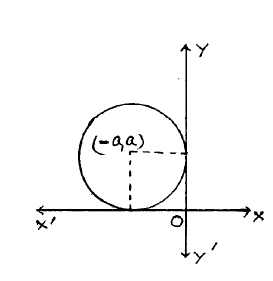
Equation of family of circle is
$(x + a)^2 + (y – a)^2 = a^2 or x^2 + y^2 + 2ax – 2ay + a^2 = 0.....(i)$
Differentiating we get $2x + 2y \frac{\text{dy}}{\text{dx}}$ 2a – 2a $\frac{\text{dy}}{\text{dx}}= 0$
$\Rightarrow\text{x+y }\frac{\text{dy}}{\text{dx}}=\text{a}\Bigg(\frac{\text{dy}}{\text{dx}}-1\Bigg)$
OR $\text{a}=\frac{\text{x+yy'}}{\text{y'-1}},\text{where y' }\frac{\text{dy}}{\text{dx}}$
substituting the value of a in (i) and simplifying
$(xy' – x + x + yy')^2 + (yy' – y – x – yy')^2 = (x + yy')^2$
OR $(x + y)^2 [(y')^2 +1]= (x + yy')^2.$ View full question & answer→Question 255 Marks
$\text{If x = }\sqrt{\text{a}^{\sin^{-1}t},}\text{ y}=\sqrt{\text{a}^{\text{cos}^{-1}}},\text{ show that }\frac{\text{dy}}{\text{dy}}=-\frac{\text{y}}{\text{x}}.$
Answer$\text{x}=\sqrt{\text{a}^{\text{sin}^{-1}t}}\Rightarrow\text{2 log x = sin}^{-1}\text{t }\text{log}\text{ a }\Rightarrow\frac{\text{dx}}{\text{dt}}=\frac{\text{x}}{2}\Bigg[\log \text{a}\frac{1}{\sqrt1-t^{2}}\Bigg]$
$\text{y}=\sqrt{\text{a}^{\text{cos}^{-1}t}}\Rightarrow\text{2}\log\text{y}=\log\text{a}\cos^{-1}\text{t}\Rightarrow\frac{\text{dy}}{\text{dt}}=-\frac{\text{y}}{2}\Bigg[\log\text{a}\cdot\frac{1}{\sqrt{\text{1-t}^{2}}}\Bigg]$
$\therefore\frac{\text{dy}}{\text{dx}}=-\frac{\text{y}}{2}\cdot\frac{2}{\text{x}}\frac{\sqrt{\text{1-t}^{2}}}{\sqrt{\text{1-t}^{2}}}=-\frac{\text{y}}{\text{x}}$.
View full question & answer→Question 265 Marks
Solve the following differential equation:
$\text{(y + 3x}^{2})\frac{\text{dx}}{\text{dy}}=\text{x}$.
AnswerGiven equation can be written as
$\text{x}\frac{\text{dy}}{\text{dx}}-\text{y}=\text{3x}^{2}$ OR $\frac{\text{dy}}{\text{dx}}-\frac{1}{\text{x}}\cdot\text{y}=\text{3x}$
$\text{I.F.}=\text{e}^{-\int\frac{1}{\text{x}}\text{dx}}=\text{e}^{-\log\text{x}}=\text{e}^{\log\frac{1}{\text{x}}}=\frac{1}{\text{x}}$
$\therefore\text{ solution is, y}\cdot\frac{1}{ \text{x}}=\int\text{3x}\cdot\frac{1}{\text{x}}\text{dx}=\text{3x + c}$
$\Rightarrow\text{y}=\text{3x}^{2}+\text{cx}$.
View full question & answer→Question 275 Marks
If $x^y = e^{x –y},$ show that $\frac{\text{dy}}{\text{dx}}=\frac{\text{log x}}{\left\{\text{log(x e)}\right\}^{2}}.$
Answer$x^y = e^{x–y} \Rightarrow y . \log x = (x – y) \log e = x – y$
$\text{y}=\frac{\text{x}}{\text{1 + log x}}$
$\frac{\text{dy}}{\text{dx}}=\frac{\text{(1 + log x)}\cdot\text{1 - x}\cdot\Big(\frac{1}{\text{x}}\Big)}{\text{(1 + log x)}^{2}}=\frac{\text{log x}}{\text{(1 + log x)}^{2}}$
$=\frac{\log\text{x}}{\text{(log e + log x)}^{2}}=\frac{\text{log x}}{\text{[log(xe)]}^{2}}$.
View full question & answer→Question 285 Marks
Solve the following differential equation:
x dy – y dx = $\sqrt{\text{x}^{2}+\text{y}^{2}}\text{ dx}$ .
AnswerGiven equation can be written as $\frac{\text{dy}}{\text{dx}}=\frac{\text{y}}{\text{x}}+\sqrt{1+\Big(\frac{\text{y}}{\text{x}}\Big)^{2}}$
$\Rightarrow\text{v + x }\frac{\text{dv}}{\text{dx}}=\text{v}+\sqrt{1+\text{v}^{2}}$ where $\frac{\text{y}}{\text{x}}=\text{v}$
$\Rightarrow\int\frac{\text{dv}}{\sqrt{1 + \text{v}^{2}}}=\int\frac{\text{dx}}{\text{x}}$
$\Rightarrow\log|\text{v}+\sqrt{1+\text{v}^{2}}|=\log\text{cx}$
$\Rightarrow\text{v}+\sqrt{1+\text{v}^{2}}=\text{cx}\therefore\text{y}+\sqrt{\text{x}^{2}+\text{y}^{2}}=\text{cx}^{2}$.
View full question & answer→Question 295 Marks
Solve the following differential equation:
${(\text{x}^{2}-1)}\frac{\text{dy}}{\text{dx}}+\text{2xy}=\frac{1}{\text{x}^{2}-1};|\text{x}|\neq1$.
AnswerGiven differential equation can be written as
$\frac{\text{dy}}{\text{dx}}+\frac{{\text{2x}}}{{\text{x}^{2}-1}}\cdot{\text{y}}=\frac{1}{(\text{x}^{2}-\text{1})^{2}}$
Which is of the form $\frac{\text{dy}}{\text{dx}}+\text{P(x)}\cdot\text{y = Q(x)}$
$\int\text{P(x) dx}=\int\frac{\text{2x}}{\text{x}^{2}-1}\text{dx}=\log|\text{x}^{2}-1|$
$\therefore$ Integrating factor = $\text{e}^{\int\text{p(x) dx}}=\text{(x}^{2}-1)$
$\therefore$ The solution is $(x^2 - 1).Y = \int\frac{1}{\text{(x}^{2}-1)^{2}}\text{(x}^{2}-1)\text{ dx}$
$\text{(x}^{2}-1)\cdot\text{y}=\frac{1}{2}\log\Bigg|\frac{\text{x - 1}}{\text{x + 1}}\Bigg|+\text{c}$.
View full question & answer→Question 305 Marks
Show that the differential equation (x – y) $\frac{\text{dy}}{\text{dx}}$ = x + 2y, is homogeneous and solve it.
AnswerGiven differential equation can be written as
$\frac{\text{dy}}{\text{dx}}=\frac{\text{x+2y}}{\text{x-y}}=\frac{1+2\ \text{y}/{\text{x}}}{1-\text{y}/\text{x}\ }=\text{f}(\text{y}/\text{x})$
hence, the differential equation is homogeneous.
$\text{Taking}\ \frac{\text{y}}{\text{x}}= \text{v}\ \text{OR}\ \text{y}=\ \text{vx}\Rightarrow \frac{\text{dy}}{\text{dx}}=\text{v+x}\frac{\text{dv}}{\text{dx}}$
$\therefore \text{v+x}\ \frac{\text{dv}}{\text{dx}}=\frac{1+2\text{v}}{1-\text{v}}\ \text{or}\ \text{x}\frac{\text{dv}}{\text{dx}}=\frac{1+2\text{v}}{1-\text{v}}-\text{v}=\frac{1+\text{v+v}^2}{1-\text{v}}$
$\Rightarrow\int\frac{\text{v}-1}{\text{v}^2+\text{v+1}}\text{dv}=-\int\frac{\text{dx}}{\text{x}}$
$\Rightarrow\frac{1}{2}\int\frac{2\text{v}+1-3}{\text{v}^2+\text{v}+1}\ \text{dv}=-\log |\text{x}|+\text{c}$
$\text{or}\ \frac{1}{2}\ \log\ |\text{v}^2+\text{v}+1|-\frac{3}{2}\int\frac{\text{dv}}{\bigg(\text{v}+\frac{1}{2}\bigg)^2+\bigg(\frac{\sqrt{3}}{2}\bigg)^2}= -\log |\text{x}|+\text{c}$
$\Rightarrow\log\ |\text{v}^2+\text{v}+1|+\log\text{x}^2=2\sqrt{3}\ \tan^{-1}\bigg(\frac{2\text{v}+1}{\sqrt{3}}\bigg)+\text{c}$
$\Rightarrow\log\ |\text{y}^2+\text{xy}+\text{x}^2|\ =2\sqrt{3}\ \tan^{-1}\bigg(\frac{2\text{y}+\text{x}}{\sqrt{3}\ \text{x}}\bigg)+\text{c}$
View full question & answer→Question 315 Marks
Solve the following differential equation:
$\sqrt{\text{1 + x}^{2}+\text{y}^{2}+\text{x}^{2}\text{y}^{2}}+\text{xy}\frac{\text{dy}}{\text{dx}}=0.$
AnswerGiven differential equation can be written as
$\sqrt{\text{(1 + x}^{2})}\sqrt{(\text{1 + y}^{2})}+\text{xy}\frac{\text{dy}}{\text{dx}}=0$
$\Rightarrow\frac{\text{y}}{\sqrt{\text{1 + y}^{2}}}\text{ dy}=-\frac{\sqrt{\text{1 + x}^{2}}}{\text{x}}\text{dx}$
Integrating both sides, we get
$\sqrt{\text{1 + y}^{2}}=-\int\frac{\sqrt{\text{1 + x}^{2}}}{\text{x}^{2}}\cdot\text{x dx}=-\int\frac{\text{t}^{2}\text{ dt}}{\text{t}^{2}-1}\text{where }(1+\text{x}^{2})=\text{t}^{2}$
$\Rightarrow\sqrt{\text{1 + y}^{2}}=-\int\Bigg(1+\frac{1}{\text{t}^{2}-1}\Bigg)\text{dt}=-\text{t}-\frac{1}{2}\log\frac{\text{t - 1}}{\text{t + 1}}\text{c}$
$=-\sqrt{\text{1 + x}^{2}}-\frac{1}{2}\log\Bigg|\frac{\sqrt{\text{1 + x}^{2}}-1}{\sqrt{\text{1 + x}^{2}}+1}\Bigg|+\text{c}$
OR $\sqrt{\text{1 + y}^{2}}+\sqrt{\text{1 + x}^{2}}-\frac{1}{2}\log\Bigg|\frac{\sqrt{\text{1 + x}^{2}}-1}{\sqrt{\text{1 + x}^{2}}+1}\Bigg|=\text{c}$.
View full question & answer→Question 325 Marks
If $y = e^{a \sin–1} x, –1 < x < 1,$ then show that
$\big(1-\text{x}^2\big)\frac{\text{d}^2\text{y}}{\text{dx}^2}-\text{a}^2\text{y}=0\dot{}$
Answer$\frac{\text{dy}}{\text{dx}}=\text{e}^\text{a}\;\sin^{-1}\text{x}\frac{a}{\sqrt{1-\text{x}^2}}=\frac{\text{ay}}{\sqrt{1-\text{x}^2}}$
$\Rightarrow\sqrt{1-\text{x}^2}\ \dot{}\ \frac{\text{dy}}{\text{dx}}=\text{ay}.............(\text{i})$
$\Rightarrow\sqrt{1-\text{x}^2}\ \dot{}\ \frac{\text{d}^2\text{y}}{\text{dx}^2}-\frac{\text{x}}{\sqrt{1-\text{x}^2}} \dot{}\ \ \frac{\text{dy}}{\text{dx}}=\ \text{a} \frac{\text{dy}}{\text{dx}}$
$\Rightarrow\big(1-\text{x}^2\big)\frac{\text{d}^2\text{y}}{\text{dx}^2}-\text{x}\frac{\text{dy}}{\text{dx}}-\text{a}\sqrt{1-\text{x}^2}\frac{\text{dy}}{\text{dx}}=0$
$\Rightarrow\big(1-\text{x}^2\big)\frac{\text{d}^2\text{y}} {\text{dx}^2}-\text{x}\frac{\text{dy}}{\text{dx}}-\text{a}^2\text{y}=0 \ [\text{Using (i)}]$
View full question & answer→Question 335 Marks
Solve the following differential equation:
$\text{x }\frac{\text{dy}}{\text{dx}}=\text{y - x}\tan\Bigg(\frac{\text{y}}{\text{ax}}\Bigg).$
Answer$\frac{\text{dy}}{\text{dx}}=\frac{\text{y}}{\text{x}}-\tan\Bigg(\frac{\text{y}}{\text{x}}\Bigg).........\text{(i)}$
Let y = vx $\Rightarrow$ $\frac{\text{dy}}{\text{dx}}=\text{v + x }\frac{\text{dv}}{\text{dx}}$
$\therefore\text{(i) becomes v + x }\frac{\text{dv}}{\text{dx}}=\text{v - tan v}$
$\Rightarrow-\cot\text{v dv}=\frac{\text{dx}}{\text{x}}$
log | cosec v | = log | cx |
$\Rightarrow\text{ c x }=\text{cosec }\Bigg(\frac{\text{y}}{\text{x}}\Bigg)$
$\text{OR }\Bigg(\text{x sin}\Bigg(\frac{\text{y}}{\text{x}}\Bigg)=\text{c}\Bigg).$
View full question & answer→Question 345 Marks
Solve the following differential equation:
$\text{x}^{2}\frac{\text{dy}}{\text{dx}}=\text{y}^{2}+\text{2xy}$
Given that y = 1, when x = 1.
Answer$\frac{\text{dy}}{\text{dx}}=\frac{\text{y}^{2}+\text{2xy}}{\text{x}^{2}}$
Let y = vx $\Rightarrow\frac{\text{dy}}{\text{dx}}=\text{v + x}\frac{\text{dv}}{\text{dx}}$
$\text{v + x}\frac{\text{dv}}{\text{dx}}=\text{v}^{2}+\text{2v}\Rightarrow\text{x}\frac{\text{dv}}{\text{dx}}=\text{v}^{2}+\text{v}$
$\Rightarrow\int\frac{\text{dv}}{\text{v(v+1)}}=\int\frac{\text{dx}}{\text{x}}$
$\Rightarrow\int\Bigg(\frac{1}{\text{v}}-\frac{1}{\text{v+1}}\Bigg)\text{dv}=\int\frac{\text{dx}}{\text{x}}$
$\log\frac{\text{v}}{\text{v+1}}=\log\text{cx}$
$\text{cx}=\frac{\frac{\text{y}}{\text{x}}}{\frac{\text{y}}{\text{x}}+1}=\frac{\text{y}}{\text{x+y}}$
When x = 1, y = 1, c = $\frac{1}{2}$
$\Rightarrow\frac{\text{x}}{2}=\frac{\text{y}}{\text{x+y}}\Rightarrow\text{x}^{2}+\text{xy - 2y}=0.$
View full question & answer→Question 355 Marks
Solve the following differential equation:
$(\text{x}^{2}+1)\frac{\text{dy}}{\text{dx}}+\text{2xy}=\sqrt{\text{x}^{2}+4}$.
Answer$(\text{x}^{2}+1)\frac{\text{dy}}{\text{dx}}+\text{2xy}=\sqrt{\text{x}^{2}+4}$
$\frac{\text{dy}}{\text{dx}}+\frac{\text{2x}}{\text{x}^{2}+1}\text{y}=\frac{\sqrt{\text{x}^{2}+4}}{\text{x}^{2}+1}$
$\text{I.F.}=\text{e}^{\int\frac{\text{2x}}{\text{x}^{2}+1}\text{dx}}=(\text{x}^{2}+1)$
Solution is $ y.(x^2 + 1) =\int\sqrt{\text{x}^{2}+4}\text{ dx + c}$
$y (x^2 + 1) =\frac{1}{2}\text{x}\sqrt{\text{x}^{2}+4}+2\log\Big(\text{x}+\sqrt{\text{x}^{2}+4}\Big)+\text{c.}$
View full question & answer→Question 365 Marks
Find the general solution of the differential equation $\text{x}\cos\Big(\frac{\text{y}}{\text{x}}\Big)\frac{\text{dy}}{\text{dx}}=\text{y}\cos\Big(\frac{\text{y}}{\text{x}}\Big)+\text{x}.$
AnswerGiven differential equation can be written as $\frac{\text{dy}}{\text{dx}} = \frac{\text{y}}{\text{x}} + \frac{1}{\cos\big(\frac{\text{y}}{\text{x}}\big)}$ $\text{put y = vx} \Rightarrow \frac{\text{dy}}{\text{dx}} = \text{v + x} \frac{\text{dv}}{\text{dx}}$ $\therefore \text{v + x} \frac{\text{dv}}{\text{dx}} = \text{v} + \frac{1}{\cos{\text{v}}}$ $\Rightarrow \int{\cos\text{v}}\ {\text{dv}} = \int \frac{\text{dx}}{\text{x}}$ $\Rightarrow \sin\text{v}=\log |\text{x}| +\text{c}$$\Rightarrow\ \sin\big(\frac{\text{y}}{\text{x}}\big)=\log|\text{x}|+\text{c}$
View full question & answer→Question 375 Marks
Find the particular solution of the differential equation $(1 + y^2) + (x – \text{e}^{\tan^{-1}}$y)$\frac{\text{dy}}{\text{dx}}=0$ given that $y = 0$ when $x=1.$
AnswerGiven differential equation can be written as
$\frac{\text{dx}}{\text{dy}}+\frac{\text{x}}{1+\text{y}^2}=\frac{\text{e}^{\tan^{-1}}\text{y}}{1+\text{y}^2}$
$\text{I.F.}=\text{e}^{\int\frac{\text{dy}}{1+\text{y}^2}}=\text{e}^{\tan^{-1}}\text{y}$
Solution is given by
$\text{x}\text{e}^{\tan^{-1}\text{y}}=\int\frac{\text{e}^{\tan^{-1}\text{y}}}{1+\text{y}^2}\times\text{e}^{\tan^{-1}\text{y}}\ \text{dy}=\int\frac{\text{e}^{2\tan{-1}\ \text{y}}}{1+\text{y}^2}\text{dy}$
$\Rightarrow\text{x}\text{e}^{\tan^{-1}\text{y}}=\int\frac{\text{e}^{2\tan^{-1}\text{y}}}{2}+\text{c}$
when $x = 1, y = 0 ⇒ c = \frac1 2$
$\therefore$ Solution is given by$\ \text{x}\text{e}^{\tan^{-1}\text{y}}=\frac1 2\text{e}^{2\tan^{-1}\text{y}}+\frac1 2\ \ \ \text{or}\ \ \ \text{x}=\frac1 2(\text{e}^{\tan^{-1}\text{y}}+\text{e}^{-\tan^{-1}\text{y}} )$
View full question & answer→Question 385 Marks
Solve the following differential equation:
$y^2dx + (x^2 – xy + y^2)dy = 0$
Answer$y^2 dx + (x^2– xy + y^2) dy = 0$
$\Rightarrow \frac{\text{dx}}{\text{dy}} = -\frac{(\text{x}^{2} - \text{xy + y}^{2})}{\text{y}^{2}}$
$\text{put x = vy} \Rightarrow \frac{\text{dx}}{\text{dy}} = \text{v + y} \frac{\text{dv}}{\text{dy}}$
$\text{v + y} \frac{\text{dv}}{\text{dy}} = \frac{\text{(v}^{2}\text{y}^{2} - \text{y}^{2} \text{v} + \text{y}^{2})}{\text{y}^{2}}$
$\Rightarrow \frac{\text{dv}}{\text{v}^{2} + 1} = -\frac{\text{dy}}{\text{y}}$
Integrating both sides
$\tan^{-1} \text{v} = -\log \text{y + c}$
$\Rightarrow \tan^{-1} \frac{\text{x}}{\text{y}} = -\log \text{y + c}$
View full question & answer→Question 395 Marks
Solve the following differential equation :
$(\cot^{–1}y + x) dy = (1 + y^2) dx$
Answer$\frac{\text{dx}}{\text{dy}}-\frac{\text{x}}{1+\text{y}^2}=\frac{\cot^{-1}}{1+\text{y}^{2}}$
$\text{I.F.}=\text{e}^{-\int\frac{\text{x}}{1+\text{y}^2}}=\text{e}^{\cot^{-1}\text{y}}$
$\text{x}.\text{e}^{\cot^{-1}\text{y}}=\int\frac{\cot^{-1}\text{y}\ \text{e}^{\cot^{-1}\text{y}}}{1+\text{y}^2}\text{dy}$
Integrating, we get
$\text{x}.\text{e}^{\cot^{-1}\text{y}}=\int\frac{\cot^{-1}\text{y}\ \text{e}^{\cot^{-1}\text{y}}}{1+\text{y}^2}\text{dy}$
put $\cot^{–1} y = t$
$=-\int\text{t }\text{e}^{\text{t}}\text{dt}$
$= (1 – t) e^t + c$
$\Rightarrow x = (1 – \cot^{–1}y) + ce^{–\cot–1 y}$
View full question & answer→Question 405 Marks
Find the particular solution of the differential equation dy = cos x (2 – y cosec x) dx, given that y = 2 when$\text{x} = \frac{\pi}{2}.$
AnswerGiven differential equation can be written as
$\frac{\text{dy}}{\text{dx}}+\text{y}\cot\text{x}=2\cos\text{x}$
$\text{I.F.}=\text{e}^{\int\cot\text{x}\ \text{dx}}=\text{e}^{\int\log\sin\text{x}}=\sin\text{x}$
Solution is given by
$\text{y}\sin\text{x}=\int2\sin\text{x}\cos\text{x}\ \text{dx}=\int\sin2\text{x}\ \text{dx}$
$=\frac{-\cos2\text{x}}{2}+\text{c}$
$\text{When}\ \text{x}=\frac{\pi}{2}\ ,\ \text{y}=2,\Rightarrow\text{c}=\frac{3}{2}$
Solution is given by y sin x $=-\frac{1}{2}\cos2\text{x}+\frac{3}{2}$or y = cosec x + sin x
View full question & answer→Question 415 Marks
Find the particular solution of the differential equation
$2y e^{x/y} dx + (y – 2x e^{x/y}) dy = 0,$ given that $x = 0$ when $y = 1.$
AnswerGiven differential equation can be written as
$\frac{\text{dx}}{\text{dy}} = \frac{\text{x}}{\text{y}} - \frac{1}{\text{2e}^{\text{x/y}}}$
$\text{put x = vy} \Rightarrow \frac{\text{dx}}{\text{dy}} = \text{v + y} \frac{\text{dv}}{\text{dy}}$
$\therefore \text{v + y} \frac{\text{dv}}{\text{dy}} = \text{v} - \frac{1}{\text{2e}^{\text{v}}}$
$\Rightarrow \int \frac{\text{dy}}{\text{y}} = -2 \int \text{e}^{\text{v}} \text{dv}$
$\Rightarrow \log |\text{y}| = -2\text{e}^{\text{v}} + \text{c} = -2 \text{e}^{\text{x/y}} + \text{c}$
$\text{when x = 0, y = 1} \Rightarrow \text{c} = 2$
$\therefore \log |\text{y}| = 2 (1 - \text{e}^{\text{x/y}})$
View full question & answer→Question 425 Marks
Find the particular solution of the differential equation $\frac{\text{dy}}{\text{dx}} - \text{3y} \cot \text{x} = \sin \text{2x}, $ given that y = 2 when $\text{x} = \frac{\pi}{2}.$
AnswerHere, $\text{I.F.} = \text{e}^{\int - 3\cot {\text{x dx}}} = \frac{1}{\sin^{3}\text{x}}$
Solution is given by, $\text{y} \bigg(\frac{1}{\sin^{3} \text{x}}\bigg) = \int \frac{\sin \text{2x}}{\sin^{3} \text{x}} \text{dx} = 2 \int \frac{\cos \text{x}}{\sin^{2}\text{x}} \text{dx}$
$\Rightarrow \frac{\text{y}}{\sin^{3} \text{x}} = \frac{-2}{\sin \text{x}} + \text{c}$
$\text{when x} = \frac{\pi}{2}, \text{y} = 2 \Rightarrow \text{c = 4}$
$\therefore \frac{\text{y}}{\sin^{3} \text{x}} = \frac{-2}{\sin \text{x}} + 4 \text{ } \text{or } \text{y} = -2 \sin^{2} \text{x} + \text{ 4 } \sin^{3} \text{x}$
View full question & answer→Question 435 Marks
Show that the family of curves for which $\frac{\text{dy}}{dx}=\frac{\text{x}^2+\text{y}^2}{2\text{xy}},\text{is given by}\ \text{x}^2-\text{y}^2=\text{c}x.$
Answer$\text{x}^2-\text{y}^2=\text{cx}\Rightarrow\frac{\text{x}^2-\text{y}^2}{\text{x}}=\text{c}$
$\Rightarrow\frac{\text{x}(2\text{x}-2\text{y}\frac{\text{dy}}{\text{dx}})-(\text{x}^2-\text{y}^2)}{\text{x}^2}=0$
$\Rightarrow2\text{x}^2-2\text{x}\text{y}\frac{\text{dy}}{\text{dx}}-\text{x}^2+\text{y}^2=0$
$\Rightarrow\frac{\text{dy}}{\text{dx}}=\frac{\text{x}^2+\text{y}^2}{2\text{xy}}$
Hence proved.
View full question & answer→Question 445 Marks
Find the particular solution of the differential equation
$\tan x.\frac{\text{dy}}{\text{dx}}=2x \tan x+x^2-\text{y};(\tan x\neq0)\text{given that y}=0 \ \text{when x}=\frac{\pi}{2}$
AnswerGiven equation can be written as
$\Rightarrow\ \frac{\text{dy}}{\text{dx}}+(\cot\text{x})\text{y}=2\text{x}+\text{x}^2\cot\ \text{x}$
$\text{I.F.}=\text{e}^{\int\cot\text{x dx}}=\text{e}^{\log \sin\text{x}}=\sin\text{x}$
Solution is, y × sin x$=\int(2\text{x}\sin\text{x}+\text{x}^2\cos\text{x})\text{dx}$
$\Rightarrow y \sin x = x^2 \sin x + C$
$\text{When x}=\frac{\pi}{2},\text{y}=0,\text{we get c}=\frac{-\pi^2}{4}$
$\therefore\ \text{Required solution is,}\ \ \ 4\text{y}\sin\text{x}=4\text{x}^2\sin\text{x}-\pi^2$
or,$ y = x^2– \pi^2/4\ cosec\ x$
View full question & answer→Question 455 Marks
Find the particular solution of the differential equation $\frac{dy}{dx} = \frac{xy}{x^{2} + y^{2}}$ given that $\text{y - 1, when x = 0.}$
AnswerGiven differential equation is $\frac{\text{dx}}{\text{dy}} = \frac{\text{y}/\text{x}}{1 + \bigg({\text{y/x}\bigg)^{2}}}$
$\text{Putting}\frac{\text{y}}{\text{x}} = \text{v to get v + x} \frac{\text{dv}}{\text{dx}} = \frac{\text{v}}{1 + \text{v}^{2}}$
$\therefore \text{x} \frac{\text{dv}}{\text{dx}} = \frac{\text{v}}{1 + \text{v}^{2}} -\text{v} = \frac{\text{-v}^{3}}{ 1 + \text{v}^{2}}$
$\Rightarrow \int \frac{\text{v}^{2} + 1}{\text{v}^{3}} \text{dv} = - \int\frac{\text{dx}}{\text{x}}$
$\Rightarrow \log| \text{v}| - \frac{1}{2\text{v}^{2}} = - \log|\text{x}| + \text{c}$
$\therefore \log \text{y} - \frac{\text{x}^{2}}{2\text{y}^{2}} = \text{c}$
$\text{x = 0, y = 1} \Rightarrow \text{c = 0} \therefore \log \text{y} - \frac{\text{x}^{2}}{2\text{y}^{2}} = 0$
View full question & answer→Question 465 Marks
Find the particular solution of the differential equation $\frac{\text{dy}}{\text{d}x}=\frac{x(2\log x +1)}{\sin y+y\cos y}$given that $\text{y}=\frac{\pi}{2}\text{ when } x=1.$
AnswerDifferential equation can bewritten as: $(\sin y+ y . \cos y) dy =x . (2 . \log x + 1) dx$
Integrating both sideswe get
$– \cos y + y \sin y + \cos y =2\bigg(\frac{\text{x}^2}{2}\log\text{x}-\frac{\text{x}^2}{4}\bigg)+\frac{\text{x}^2}{2}+\text{c}$
$\Rightarrow y \sin y = x^2 \log x + c$
At $x = 1$ and
$\text{y}=\frac{\pi}{2},\ \text{c}=\frac{\pi}{2}\ \ \therefore\ \ $ solution is : $y \sin y = x^2 \log x + \frac{\pi}{2}$
View full question & answer→Question 475 Marks
Prove that $x^2 – y^2 = c(x^2 + y^2)^2$ is the general solution of the differential equation $(x^3 – 3xy^2) dx = (y^3 – 3x^2y) dy,$ where $C$ is a parameter.
Answer$\text{x}^{2} – \text{y}^{2} = \text{C}(\text{x}^{2} + \text{y}^{2})^{2} \Rightarrow \text{2x – 2yy}' = \text{2C}(\text{x}^{2} + \text{y}^{2})(\text{2x + 2yy}')$
$\Rightarrow \text{(x - yy}') = \frac{\text{x}^{2} - \text{y}^{2}}{\text{y}^{2} + \text{x}^{2}} \text{(2x + 2yy}') \Rightarrow \text{(y}^{2} + \text{x}^{2}) \text{(x - yy}') = \text{(x}^{2} - \text{y}^{2}) \text{(2x + 2yy}')$
$\Rightarrow [ -\text{2y(x}^{2} - \text{y}^{2}) - \text{y}(\text{y}^{2} + \text{x}^{2})] \frac{\text{dy}}{\text{dx}} = \text{2x} \text{(x}^{2} - \text{y}^{2}) - \text{x} \text{(y}^{2} + \text{x}^{2}) $
$\Rightarrow \text{(y}^{3} - \text{3x}^{2}\text{y}) \frac{\text{dy}}{\text{dx}} = \text{(x}^{3} - \text{3xy}^{2})$
$\Rightarrow \text{y}^{3} - \text{3x}^{2}\text{y}) \text{dy} = \text{(x}^{3} - \text{3xy}^{2}) \text{dx}$
Hence $\text{x}^{2} - \text{y}^{2} = \text{C}\text{(x}^{2} + \text{y}^{2})^{2}$ is the solution of given differential equation.
View full question & answer→Question 485 Marks
Find the particular solution of the differential equation
$(1 -\text{y}^{2})(1 + \log x) \text{dx + 2xy dy} = \text{0, given that y = 0 when x = 1.} $
AnswerGiven differential equation can be written as
$\frac{(1 + \log\text{x)}}{\text{x}}\text{dx} + \frac{\text{2y}}{1 - \text{y}^{2}}\text{dy} = 0$
Integrating to get, $\frac{1}{2}(1 + \log\text{x})^{2}- \log| 1- \text{y}^{2}| = \text{C}$
$\text{x} = 1, \text{y} = 0 \Rightarrow\text{C} = \frac{1}{2}$
$\Rightarrow(1 + \log \text{x})^{2} - 2\log|1 - \text{y}^{2}| = 1$
View full question & answer→Question 495 Marks
Solve the following differential equation:$(\text{x}^{2} - 1 ) \frac{\text{dy}}{\text{dx}} + 2 \text{xy} = \frac{2}{\text{x}^{2} - 1 }.$
AnswerGiven differential equation can be written as
$\frac{\text{dy}}{\text{dx}} + \frac{2\text{x}}{\text{x}^{2} - 1 }\text{y} = \frac{2}{(\text{x}^{2} - 1 )^{2}}$
Integrating factor = $\text{e}^{\int\frac{2\text{x}}{\text{x}^{2} - 1}\text{dx}} = \text{e}^{\log(\text{x}^{2} - 1 )} = \text{x}^{2} - 1 $
$\therefore\text{ Solution is }\text{y}.(\text{x}^{2} - 1 ) =\int\frac{2}{(\text{x}^{2} - 1 )^{2}}.(\text{x}^{2} - 1 )\text{dx} + \text{c}$
$\Rightarrow\text{y}(\text{x}^{2} - 1 ) = 2 \int\frac{1}{\text{x}^{2} - 1}\text{ dx} + \text{c} $
$\Rightarrow\text{y}(\text{x}^{2} - 1 ) = \log\bigg|\frac{\text{x} - 1}{\text{x} + 1 }\bigg| + \text{c}.$
View full question & answer→Question 505 Marks
Solve the following differential equation:
$\text{cosec }x\ \log\text{ y}\frac{\text{dy}}{\text{d}x}+x^2\text{y}^2=0$
Answer$\text{cosec }x.\ \log\text{y}\frac{\text{dy}}{\text{d}x}=-x^2\text{y}^2$$\Rightarrow\frac{\log\text{ y}}{\text{y}^2}\text{ dy}=-\text{x}^2\sin\text{x dx}$
Integrating both sideswe get
$\Rightarrow-\frac{\log\text{ y}}{\text{y}}\frac{1}{\text{y}}=-[-\text{x}^2\cos\text{x}+2\int\text{x}\cos\text{x dx}]$
$=-[-\text{x}^2\cos\text{x}+2(\text{x}\sin\text{x}-\int1.\sin\text{x dx}]$
$\therefore\frac{\log\text{y}}{\text{y}}-\frac{1}{\text{y}}=-\text{x}^2\cos\text{x}+2\text{x}\sin\text{x}+2\cos\text{x}+\text{c}$
View full question & answer→Question 515 Marks
Solve the differential equation $x\frac{\text{dy}}{\text{d}x} + \text{y} = x \cos x + \sin x,$ given that y = 1 when $x = \frac{\pi}{2}.$
AnswerThe given equation can be written as
$\frac{\text{dy}}{\text{dx}} + \frac{\text{y}}{\text{x}} = \cos \text{x} + \frac{\sin \text{x}}{\text{x}}$
$\text{I.F.} = \text{e}^{\int \frac{1}{\text{x}} \text{dx}} = \text{e}^{\log \text{x}} = \text{x}$
$\therefore$ Solution is
$\text{y. x} = \int \text{(x} \cos \text{x} + \sin \text{x}) \text{dx + c}$
$\Rightarrow \text{x . y} = \text{x } \sin \text{x + c}$
$\text{or} \text{ y} = \sin \text{x} + \frac{\text{c}}{\text{x}}$
$\text{when x} = \frac{\pi}{2}, \text{y} = 1, \text{we get c = 0}$
Required solution is $\text{y} = \sin \text{x}$
View full question & answer→Question 525 Marks
Find the general solution of the following differential equation:
$( 1 + \text{y}^{2}) + x - e^{\tan-1}\text{y}) \frac{\text{dy}}{dx} = 0$
AnswerGiven differential equation can be written as
$\frac{\text{dx}}{\text{dy}} + \frac{1}{1 + \text{y}^{2}}\text{x} = \frac{e^{\tan-1}\text{y}}{1 + \text{y}^{2}}$
Integrating factor is $e^{\tan^{-1}}\text{y}$
$\therefore \text{Solution is x}.e^{\tan -1}\text{y} = \int\text{e}^{2\tan^{-1}\text{y}}\frac{1}{1 + \text{y}^{2}}\text{dy}$
$\therefore\text{x}e^{\tan -1}\text{y} = \frac{1}{2}e^{\tan-1}\text{y}\text{+C}$
View full question & answer→Question 535 Marks
Solve the differential equation:
$(\tan^{-1}\text{y} - x) \text{dy} = ( 1 + \text{y}^{2}) \text{dx}$
AnswerGiven differential equation can be writen as
$\frac{\text{dx}}{\text{dy}} + \frac{1}{1 + \text{y}^{2}} . \text{x} = \frac{\tan^{-1}\text{y}}{1 + \text{y}^{2}}$
$\therefore$ Intergrating factor is $e^{\tan^{-1}} \text{y}$
$\therefore$ Solution is: $\text{x}. e^{\tan^{-1}}\text{y} = \int \frac{\tan^{-1}{\text{y}}.e^{\tan^{-1}}\text{y}}{1 + \text{y}^{2}}\text{dy}$
$\Rightarrow \text{x .e}^{\tan^{-1}\text{y}} = \int \text{t}\text{ e}^{\text{t}}\text{ dt where } \tan^{-1}\text{y} = \text{t}$
$= \text{t e' - e' + c = e}^{\tan^{-1}\text{y}} (\tan^{-1}\text{y} - 1) + \text{c}$
$\text{or x} = \tan^{-1}\text{y} - 1 + \text{c e}^{-\tan^{-1}}\text{y}$
View full question & answer→Question 545 Marks
Find the particular solution of the differential equation$\text{e}^{x}\sqrt{1 - \text{y}^{2}} \text{ dx} + \frac{\text{y}}{\text{x}}\text{dy } = 0 $ given that y= 1 when x=0.
Answer$\text{e}^{x}\sqrt{1 - \text{y}^{2}}\text{ dx} = \frac{-\text{y}}{\text{x}}\text{ dy } \Rightarrow\text{xe}^{x}\text{dx} = \frac{-\text{y}}{\sqrt{1 - \text{y}^{2}}}\text{ dy }$
Integrating both sides
$\int\text{xe}^{x}\text{ dx} = \frac{1}{2}\int-\frac{-2\text{y}}{\sqrt{1- \text{y}^{2}}}\text{ dy}$
$\Rightarrow\text{xe}^{x} - \text{e}^{x} =\sqrt{1 - \text{y}^{2}}+\text{c}$
For x = 0, y = 1, c = – 1 $\therefore\text{ solution is: } \text{ e}^{x} (\text{x} - 1 ) = \sqrt{1 - \text{y}^{2}} - 1 .$
View full question & answer→Question 555 Marks
Show that the differential equation $2ye^{x/y} dx + (y - 2xe^{x/y} ) dy = 0$ is homogeneous. Find the particular solution of this differential equation, given that $x = 0$ when $y = 1.$
AnswerGiven: $2y. e^{x/y} dx +(y – 2x e^{x/y} ) dy = 0$
$\Rightarrow\frac{\text{dx}}{\text{dy}} = - \frac{\text{y} - 2\text{xe}^{\text{x/y}}}{2\text{y}.\text{e}^{x/y}}\Rightarrow\frac{\text{dx}}{\text{dy}} =\frac{2\text{xe}^{x/y} - \text{y}}{2\text{y.e}^{x/y}}$
Let $\text{F}(\text{x,y}) = \frac{2\text{x.e}^{x/y} - \text{y}}{2\text{y.e}^{x/y}}$
$\therefore\text{F}(\lambda\text{x},\lambda\text{y}) = \frac{2\lambda\text{x.e}^{\lambda\text{x}/\lambda\text{y}} - \lambda\text{y}}{2\lambda\text{y.e}^{\lambda\text{ x}/\lambda\text{ y}}} = \lambda^{0}\frac{2\text{xe}^{x/y} - \text{y}}{2\text{y.e}^{x/y}} = \lambda^{0}.\text{F}(\text{x,y})$
Hence, given differential equation is homogeneous.
Now, $\frac{\text{dx}}{\text{dy}} = \frac{2\text{x.e}^{x/y} - \text{y}}{2\text{y.e}^{x/y}} - - - - - - (i)$
Let $x =vy \Rightarrow\frac{\text{dx}}{\text{dy}} = v + \text{y}.\frac{\text{d}v}{\text{dy}}$
$\therefore\text{(i)}\Rightarrow v + \text{y}.\frac{\text{d}v}{\text{dy}} = \frac{2\text{vy}.\text{e}^{\frac{\text{vy} }{\text{y}} }- \text{y}}{2\text{y.e}^{\frac{\text{vy}}{\text{y}}}}$
$\Rightarrow\text{y}.\frac{\text{dv}}{\text{dy}} =\frac{\text{y}(2v\text{e}^{v} - 1 )}{2\text{y.e}^{v}} - v\Rightarrow\text{y}.\frac{\text{d}v}{\text{dy}} = \frac{2v.\text{e}^{v} - 1}{2\text{e}^{v}} - {v}$
$\Rightarrow\text{y}.\frac{\text{d}v}{\text{dy}} = - \frac{1}{2\text{e}^{v}}\Rightarrow2\text{y.e}^{v}\text{d}v = -\text{dy}$
$\Rightarrow2\int\text{e}^{v}\text{d}v = -\int\frac{\text{dy}}{\text{y}}\Rightarrow2\text{e}^{v} = -\log\text{ y + C}$
$\Rightarrow2\text{e}^{\frac{\text{x}}{\text{y}}} = \log\text{y= C}$
When $x = 0, y =1$
$\therefore2\text{e}^{0} + \log 1 =\text{C}\text{ or } \text{C} = 2 $
Hence, the required solution is
$2\text{e}^{x/y} + \log\text{ y} = 2 \Rightarrow\log\text{ C} = 2 .$
View full question & answer→Question 565 Marks
Find the particular solution of the following differential equation;
$\frac{\text{dx}}{\text{dy}} = 1 + x^2 + y^2 + x^2y^2, $ given that $y = 1$ when $x = 0$.
Answer$\frac{\text{dx}}{\text{dy}}= 1 + x^2 + y^2 + x^2y^2= (1 + x^2)(1 + y^2)$
$\Rightarrow\int\frac{\text{dy}}{\text{1+y}^{2}}=\int{\text{(1 + x}^{2})}\text{dx}$
$\Rightarrow\text{tan}^{-1}\text{y}=\text{x}+\frac{\text{x}^{3}}{3}+\text{c}$
$x = 0, y = 1 \Rightarrow c = \frac{\pi}{4}$
$\therefore\text{ tan}^{-1}\text{y}=\text{x}+\frac{\text{x}^{3}}{3}+\frac{\pi}{4}$ OR $y = \text{tan}\Bigg(\frac{\pi}{4}+\text{x}\frac{\text{x}^{3}}{{3}}\Bigg)$
View full question & answer→Question 575 Marks
If $y = (\tan^{–1}x)^2,$ show that $\text{(x}^{2}+\text{1})^{2}\frac{\text{d}^{2}\text{y}}{\text{dx}^{2}}+\text{2x}(\text{x}^{2}+{1)}\frac{\text{dy}}{\text{dx}}=2.$
Answer$\text{y}=(\tan^{-1}\text{x})^{2}\Rightarrow\frac{\text{dy}}{\text{dx}}=2\tan^{-1}\text{x}\cdot\frac{\text{1}}{\text{1+x}^{2}}.$
$\Rightarrow{(1}+\text{x}^{2})\frac{\text{dy}}{\text{dx}}=\text{2 tan}^{-1}\text{x}$
$\therefore\text{(1+x}^{2})\frac{\text{d}^{2}\text{y}}{\text{dx}^{2}}+\text{2x}\cdot\frac{\text{dy}}{\text{dx}}=\frac{\text{2}}{\text{1+x}^{2}}$
$\Rightarrow\text{(1+x}^{2})\frac{\text{d}^{2}\text{y}}{\text{dx}^{2}}+\text{2x}\text{ (1+x}^{2})\frac{\text{dy}}{\text{dx}}=2.$
View full question & answer→Question 585 Marks
Solve the following differential equation:
$\text{2x}^{2}\frac{\text{dy}}{\text{dx}}-\text{2 xy + y}^{2}=0$
Answer$\text{2x}^{2}\frac{\text{dy}}{\text{dx}}-\text{2 xy + y}^{2}=0\Rightarrow\frac{\text{dy}}{\text{dx}}=\frac{\text{2 xy - y}^{2}}{\text{2x}^{2}}=\frac{\text{2}\frac{\text{y}}{\text{x}}-\frac{\text{y}^{2}}{\text{x}^{2}}}{\text{2}}$Putting $\frac{\text{y}}{\text{x}}$ v so that y = vx and $\frac{\text{dy}}{\text{dx}}=\text{v} + \text{x}\ \frac{\text{dv}}{\text{dx}}$
$\therefore\text{v + x }\frac{\text{dv}}{\text{dx}}=\text{v}-\frac{1}{2}\text{v}^{2}\therefore \text{x}\frac{\text{dv}}{\text{dx}}=-\frac{1}{2}\text{v}^{2}$
$\Rightarrow 2\int\frac{\text{dv}}{\text{v}^{2}} = -\int\frac{\text{dx}}{\text{x}}\Rightarrow\frac{2}{\text{v}}=\log\text{ x + c}$
$\therefore 2 \frac{\text{x}}{\text{y}}=\log\text{ x + c or y}=\frac{\text{2x}}{\text{log x + c}}.$
View full question & answer→Question 595 Marks
If x = a ( θ – sin θ ), y = a (1 + cos θ ), find $\frac{\text{d}^{2}\text{y}}{\text{dx}^{2}}$.
Answer$\therefore\frac{\text{dx}}{\text{d}\theta}=\text{a(1 - cos}\theta)\text{ and }\frac{\text{dy}}{d\theta}=-\text{a sin}\theta$$\Rightarrow\frac{\text{dy}}{\text{dx}}=\frac{-\sin\theta}{(1-\cos\theta)}$
$\frac{\text{d}^{2}\text{y}}{\text{dx}^{2}}=\frac{\text{(1-cos}\theta)\text{(-cos}\theta)+\sin\theta(\sin\theta)}{(1-\cos\theta)^{2}}\cdot\frac{\text{d}\theta}{\text{dx}}$
= $\frac{(\text{1-cos}\theta)}{\text{(1 - cos}\theta)^{2}}\cdot\frac{1}{\text{a(1 - cos}\theta)}$
$= \frac{1}{\text{a(1- cos}\theta)^{2}}\text{ or }\frac{1}{\text{4a}}\text{cosec}^{4}\frac{\theta}{2}$
View full question & answer→Question 605 Marks
Solve the following differential equation:
$e^x \tan y\ dx + (1 – e^x) \sec^2 y\ dy = 0.$
AnswerGiven differential equation can be written as
$\frac{\text{e}^{\text{x}}}{\text{1-e}^{\text{x}}}\text{ dx}+\frac{\sec^{2}\text{y}}{\tan\text{y}}\text{ dy}=0$
Integrating to get -$ \log |1 - e^x|+\log|\tan y| = \log |c|$
$\log |\tan y| = \log|c (1-e^x)$
$\therefore \tan y = c (1 - e^x).$
View full question & answer→Question 615 Marks
Solve the following differential equation:
$\cos^{2}\text{x}\frac{\text{dy}}{\text{dx}}+\text{y}=\tan\text{x}.$
AnswerGiven differential equation can be written as
$\frac{\text{dy}}{\text{dx}}+\text{sec}^{2}\text{x}\cdot\text{y}=\tan\text{x}\cdot\sec^{2}\text{x}$
$\text{I.F.}=\text{e}^{\int{\text{sec}^{2}\text{x dx}}}=\text{e}^{\tan\text{x}}$
$\therefore$ The Solution is $\text{y}\cdot\text{e}^{\text{tan x}}=\int\tan\text{x }\cdot\text{e}^{\text{tan x}}\text{sec}^{2}\text{ x}\text{ dx}$
$=\int\text{t.e}^\text{t}\text{dt},$ where tan $x = 1.$
$\Rightarrow\text{y}\cdot\text{e}^{\text{tan x}}= (t - 1) e^t+ c$
$\Rightarrow\text{y}\cdot\text{e}^{\text{tan x}}= (\tan x - 1) e^{\tan x} + c.$
Alternate Answer
$y = (\tan x - 1) + \text{c}\cdot\text{c}^{\text{-tan x}}$.
View full question & answer→Question 625 Marks
Find the particular solution of the differential equation satisfying the given conditions:
$\frac{\text{dy}}{\text{dx}}$= y tan x, given that y = 1 when x = 0.
AnswerGiven differential equation can be written as
$\int\frac{\text{dy}}{\text{y}}=\int\tan\text{x dx}$
OR, log y = log sec x + c
when, x = 0, y = 1 $\Rightarrow$ c = 0
[Note : c = 1, if constant is taken as log c]
$\therefore$ log y = log sec x
OR y = sec x.
View full question & answer→Question 635 Marks
Find $\frac{\text{dy}}{\text{dx}},\text{if y = sin}^{-1}[\text{x}\sqrt{1 - x}-\sqrt{x}\sqrt{1 - x^{2}}]$.
Answer$\text{y}=\sin^{-1}\text[{x}\sqrt{1-x}-\sqrt{x}\sqrt{1 - x^{2}}]............(i)$
Let $x = \sin\alpha\text{ and }\sqrt{x}=\sin\theta$
$\therefore$ (i) Becomes $y = \sin^{-1}[\sin\alpha\cos\theta-\cos\alpha\sin\theta]$.
$=\sin^{-1}[\sin(\alpha-\theta)]=\alpha-\theta$
$=\sin^{-1}\text{x}-\sin^{-1}\sqrt{x}$
$\therefore\frac{\text{dy}}{\text{dx}}=\frac{1}{\sqrt{1}-x^2}-\frac{1}{2\sqrt{x}\sqrt{1-x}}$
View full question & answer→Question 645 Marks
Find the general solution of the differential equation
$\text{x}\log\text{x}.\frac{\text{dy}}{\text{dx}}+\text{y}=\frac{2}{\text{x}}\cdot\log\text{x}$.
AnswerThe given differential equation can be written as
$\frac{\text{dy}}{\text{dx}}+\frac{1}{\text{x log x}}\text{y}=\frac{2}{\text{x}^{2}}$
$\text{I.F.}=\text{e}^{\int\frac{1}{\text{x log x}}\text{dx}}=\text{e}^{\log(\log x)}=\log\text{x}$
The solution is $y . \log x = \int\frac{2}{\text{x}^{2}}\cdot\log\text{x dx + c}$
OR, $y . \log x = 2$
$\Bigg[\log\text{x}\cdot\Big(\frac{-1}{\text{x}}\Big)+\int\frac{\text{dx}}{{\text{x}}^{2}}\Bigg]+\text{c}=2\Bigg[\frac{-\log\text{x}}{\text{x}}-\frac{\text{1}}{\text{x}}\Bigg]+\text{c}$
$\Rightarrow\text{y}\cdot\log\text{x}=-\frac{2}{\text{x}}[1+\log\text{x}]+\text{c}$
View full question & answer→Question 655 Marks
Find the particular solution of the differential equation satisfying the given conditions:
$x^2dy + (xy + y^2) dx = 0 ; y = 1$ when $x = 1.$
AnswerThe given differential equation can be written as
$\frac{\text{dy}}{\text{dx}}+\frac{\text{xy+y}^{2}}{\text{x}^{2}}=0\text{ }\cdot\text{ }\text{Let y = vx}\Rightarrow\frac{\text{dy}}{\text{dx}}=\text{v + x}\frac{\text{dv}}{\text{dx}}$
$\Rightarrow\text{v + x}\frac{\text{dv}}{\text{dx}}+\text{(v + v}^{2})=0$
$\Rightarrow\text{x}\frac{\text{dv}}{\text{dx}}=-\text{ v (2 + v)}$
$\text{OR }\frac{\text{dv}}{\text{v(2+v)}}=-\frac{\text{dx}}{\text{x}}$
$\text{OR }\int\Bigg(\frac{1}{\text{v}}-\frac{1}{\text{2 + v}}\Bigg)\text{dx}=-2\int\frac{\text{dx}}{\text{x}}$
$\Rightarrow\log\frac{\text{v}}{\text{v+2}}=\log\frac{\text{c}}{\text{x}^{2}}$
$\text{OR }\frac{\text{y}}{\text{y+2}}=\frac{\text{c}}{\text{x}^{2}}$
when $x = 1, y = 1 \Rightarrow\text{c}=\frac{1}{3}$
$\therefore$ The solution becomes
$y + 2x = 3x^2y.$
View full question & answer→Question 665 Marks
Solve the following differential equation:$+ y = \cos x - \sin x.$
AnswerGetting integrating factor $ = e \int^{1 dx} = e^{x}$$\therefore \text{Solution is y.} e^{x} = \int(\cos x- \sin x) e^{x} dx$
$\text{Unsing} \int\text{[f(x) +f'(x)]} e^{x} + \text{c we get }$
$y.e^{x} = \cos \text{x e}^{x} + c$
$\text{or y} = \cos x + \text{c e}^{-x} $
View full question & answer→Question 675 Marks
Find the particular solution, satisfying the given condition, for the following differential equation:$\frac{\text{dy}}{\text{dx}} - \frac{\text{y}}{\text{x}} + \text{cosec} \bigg(\frac{\text{y}}{\text{x}}\bigg) = \text {0; y = 0 when x} = 1.$
Answer$\text{Putting} \frac{\text{y}}{\text{x}} = \text{v}\Rightarrow \text{y = vx} \Rightarrow \frac{\text{dy}}{\text{dx}} = \text{v + x} \frac{\text{dv}}{\text{dx}}$$\therefore \text{we get v + x} \frac{\text{dv}}{\text{dx}} -\text{v} + \text{cosec} \text{v} = \text{o}$
$\Rightarrow \sin \text{v dv} + \frac{\text{dx}}{\text{x}} = \text{o}$
$\Rightarrow - \cos \text{v} + \log|\text{x}| = \text{c}_{1} \text{or} \cos \frac{\text{y}}{\text{x}} = \log|\text{x}| + \text{c}$
$\text{When x = 1, y = o} \Rightarrow \text{c} = 1$
$\text{Hence the solution is} \cos \frac{y}{x} = 1 + \log|x|$
View full question & answer→Question 685 Marks
Solve the following differential equation: $\frac{\text{dy}}{\text{dx}} = \frac{\text{x}(\text{2y - x})}{\text{x}(\text{2y+ x)}}\text{If, y = 1 when x = 1} $
Answer$\frac{\text{dy}}{\text{dx}} = \frac{\text{x}(\text{2y - x})}{\text{x}(\text{2y+ x)}}$$\text{y = vx} \Rightarrow \frac{\text{dy}}{\text{dx}} = \text{v + x} \frac{\text{dv}}{\text{dx}}$
$\therefore \text{v + x} \frac{\text{dv}}{\text{dx}} = \frac{\text{x[2v - 1]}}{\text{x[2v + 1]}}$
$\Rightarrow x \frac{\text{dv}}{\text{dx}} = \frac{\text{2v -1}}{\text{2v + 1}} \text{- v} = \frac{\text{2v - 1 - 2v}^{2} \text{-v}}{\text{2v + 1}}$
$= - \frac{\text{2v}^{2} \text{- v + 1}}{\text{2v + 1}}$
$\frac{\text{2v + 1}}{\text{2v}^{2} \text{- v + 1}} \text{dv} = - \frac{\text{dx}}{\text{x}}$
$\frac{1}{2} \frac{\text{4v - 1 + 3}}{\text{2v}^{2}\text{ - v+ 1}} \text{dv} = \frac{\text{-dx}}{\text{x}}$
$\frac{1}{2} \frac{\text{4v - 1 + 3}}{\text{2v}^{2}\text{ - v+ 1}} \text{dv} + \frac{3}{4} \frac{\text{dv}}{\text{v}^{2}- \frac{1}{2} \text{v} + \frac{1}{2}} = -\frac{\text{dx}}{\text{x}}$
$\frac{1}{2} \log | \text{2v}^{2} \text{- v + 1}| + \frac{3}{4} \times \frac{4}{\sqrt{7}} \tan^{-1} \frac{\text{v}-\frac{1}{4}}{{\frac{\sqrt{7}}{4}}} = -\log\text{x + c}$
$\frac{1}{2} \log\bigg|\frac{\text{2y}^{2} \text{- xy} + \text{x}^{2}}{\text{x}^{2}}\bigg| + \frac{3}{\sqrt{7}} \tan^{-1} \frac{\text{4y - x}}{\sqrt{7}\text{x}} = -\log \text{x + c}$
$\text{when x = 1, y = 1} \Rightarrow \text{c}= \frac{1}{2} \log 2 + \frac{3}{\sqrt{7}} \tan^{-1} \frac{3}{\sqrt{7}} $
View full question & answer→Question 695 Marks
Solve the following differential equation: $\cos^{2} x \frac{dy}{dx} + y = \tan x$
AnswerThe given differential equation can be written as$\frac{\text{dy}}{\text{dx}} + \sec^{2} \text{x y} = \tan \text{x}.\sec^{2}\text{x}$
$\text{I.F} = \text{e}^{\int\text{pdx}}=\text{e}^{\int\sec^2\text{x dx}}=e^{\tan\text{x}}$
$\therefore$ The solution is
$\text{y} .e^{\tan{\text{x}}} = \int e^{\tan\text{x}} . \tan\text{x}.\sec^{2}\text{x dx + c}$
$\text{Let} \tan{\text{x}} = \text{z} \Rightarrow \sec^{2}\text{x dx = dz}$
$\therefore \int e^{\tan \text{x}} \tan \text{x} \sec^{2}\text{x dx} = \int {\text{z e}^{\text{z}} } \text{dz + c} $
$= \text{z}.e^{\text{z}} - e^{\text{z}} + \text{c} = e^{\text{z}} (\text(z - 1) + \text{c}$
$\text{y e}^{\tan\text{x}} = e^{\tan\text{x}} ( \tan{\text{x}} - 1) + \text{c}e^{-\tan\text{x}} $
View full question & answer→Question 705 Marks
Solve the following differential equation: $(\text{x}^{2} - \text{y}^{2}) \text{dx} + \text{2xy dy =0}$ given that $y = 1$ when $x = 1$
Answer$(\text{x}^{2} - \text{y}^{2}) \text{dx} + \text{2xy dy =0}$$\frac{\text{dy}}{\text{dx}} = \frac{\text{y}^{2} - \text{x}^{2}}{\text{2xy}}$
This is a homogeneous differential equation
$\text{Let y = vx} \Rightarrow \frac{\text{dy}}{\text{dx}} = \text{v + x} \frac{\text{dv}}{\text{dx}}$
$= \text{v + x} \frac{\text{dv}}{\text{dx}} = \frac{\text x^{2}(\text v^{2}-1)}{2\text v \text x^{2}} = \frac{\text v^{2} - 1}{2\text v}$
$\text{x}\frac{\text{dv}}{\text{dx}} = \frac{\text{v}^{2} - 1 - 2\text{v}^{2}}{2\text v} = \frac{1 + \text{v}^{2}}{2\text{v}}$
$\Rightarrow \frac{2\text{v}}{1 + \text{v}^{2}} \text{dv} = - \frac{\text{dx}}{\text{x}}$
$\log | 1 + \text{v}^{2}| = -\log| \text{x}| + \log \text{c} = \log\frac{\text{c}}{\text{x}}$
$1 + \text v^{2} = \frac{\text{c}}{\text{x}} \Rightarrow 1 + \frac{\text{y}^{2}}{\text{x}^{2}}= \frac{\text{c}}{\text{x}}$
$\Rightarrow \text{x}^{2} + \text{y}^{2} = \text{cx}$
$\text{when x = 1, y = 1,} \Rightarrow \text{c} = 2$
$\therefore \text{x}^{2} + \text{y}^{2} = \text{2x}$
View full question & answer→Question 715 Marks
Find the particular solution of the differential equation $\text{e}^\text{x}\tan\text{y dx}+(2-\text{e}^\text{x})\text{sec}^2\text{y dy}=0,$ given that $\text{y}=\frac{\pi}{4}\ \text{x} = 0.$
Answer$\text{e}^\text{x}\tan\text{y dx}+(2-\text{e}^\text{x})\text{sec}^2\text{y dy}=0$
$\text{e}^\text{x}\tan\text{y dx}+(\text{e}^\text{x}-2)\text{sec}^2\text{y dy}$
$\frac{\text{dy}}{\text{dx}}=\frac{\text{e}^\text{x}\tan\text{y}}{\text{e}^\text{x}\text{sec}^2\text{y}-2\text{sec}^2\text{y}}$
$\frac{\text{dx}}{\text{dy}}=\frac{\text{e}^\text{x}\text{sec}^2\text{y}-2\text{sec}^2\text{y}}{\text{e}^\text{x}\tan\text{y}}$
$\frac{\text{dx}}{\text{dy}}=\frac{\text{sec}^2\text{y}}{\tan\text{y}}-\frac{2\text{sec}^2\text{y}}{\tan\text{y}}\text{e}^{\text{-x}}$
$\frac{\text{dx}}{\text{dy}}=\frac{\text{sec}^2\text{y}}{\tan\text{y}}\big[1-2\text{e}^{-\text{x}}\big]$
$\int\frac{\text{sec}^2\text{y}}{\tan\text{y}}\text{dy}=\int\frac{1}{1-2\text{e}^{-\text{x}}}\text{dx}$
$\tan\text{y}=\text{t}$
$\text{sec}^2\text{y dy}=\text{dt}$
$\int\frac{\text{dt}}{\text{t}}=\int\frac{\text{e}^\text{x}}{\text{e}^\text{x}-2}\text{dx}$
$\text{e}^\text{x}-2=\text{u}$
$\text{e}^\text{x}\text{dx}=\text{du}$
$\log\text{t}=\log\text{u}+\log\text{C}$
$\log(\tan\text{y})=\log(\text{e}^\text{x}-2)\text{C}$
$\tan\text{y}=\text{C}(\text{e}^\text{x}-2)$
$\text{Put y }=\frac{\pi}{4},\ \text{x}=0\ \ \ \tan\frac{\pi}{4}=\text{C}(1-2)$
$\text{C}=-1$
$\tan\text{y}=-(\text{e}^\text{x}-2)$
View full question & answer→Question 725 Marks
Find the particular solution of the differential equation $\frac{\text{dy}}{\text{dx}}+2\text{y}\ \tan\text{x}=\sin\text{x},$ given that $\text{y}=0\ \text{when x}=\frac{\pi}{3}.$
Answer$\frac{\text{dy}}{\text{dx}}+2\text{y}\ \tan\text{x}=\sin\text{x}$
Differential equation is of the form
$\frac{\text{dy}}{\text{dx}}+\text{py}=\text{Q}$
$\frac{\text{dy}}{\text{dx}}+2\text{y}\ \tan\text{x}=\sin\text{x}\ \ ....(1 )$
$\text{Where P}=2\tan\text{x}\ \&\ \text{Q}=\sin\text{x}$
$\text{IF}=\text{e}^{\int\text{p dx}}$
$\text{IF}=\text{e}^{\int2\tan\text{x dx}}$
$\text{IF}=\text{e}^{2\log\sec\text{x}}$
$\text{IF}=\text{e}^{\log\sec^2\text{x}}$
$\text{IF}=\sec^2\text{x}$
$\text{y}(\text{IF})=\int(\text{Q}\times\text{IF})\text{dx}+\text{c}$
$\text{y}(\sec^2\text{x})=\int\sin\text{x}\sec^2\text{x dx}+\text{c}$
$\text{y}\sec^2\text{x}=\int\sin\text{x}\frac{1}{\cos^2\text{x}}\text{dx}+\text{C}$
$\text{y}\sec^2\text{x}=\int\frac{\sin\text{x}}{\cos\text{x}}\times\frac{1}{\cos\text{x}}\text{dx}+\text{C}$
$\text{y}\sec^2\text{x}=\int\tan\text{x}\sec\text{x dx}+\text{C}$
$\text{y}\sec^2\text{x}=\sec\text{x}+\text{C}$
$\text{y}=\frac{\sec\text{x}}{\sec^2\text{x}}+\frac{\text{c}}{\sec^2\text{x}}$
$\text{y}=\cos\text{x}+\text{C}\cos^2\text{x}\ \ ....(2)$
$\text{Putting x}=\frac{\pi}{3}\ \&\ \text{y}=0$
$0=\cos\frac{\pi}{3}+\text{C}\cos^2\frac{\pi}{3}$
$0=\frac{1}{2}+\text{C}\Big(\frac{1}{4}\Big)^2$
$\frac{-1}{2}=\text{C}\Big(\frac{1}{4}\Big)$
$\frac{-4}{2}=\text{C}$
$\text{C}=-2$
Putting value of C in (1)
$\text{y}=\cos\text{x}+\text{C}\cos^2\text{x}$
$\text{y}=\cos\text{x}-2\cos^2\text{x}$
View full question & answer→Question 735 Marks
$\text{If}\ \text{y}=\sin(\sin\text{x}),\ \text{prove that}\frac{\text{d}^2\text{y}}{\text{dx}^2}+\tan\text{x}\frac{\text{dy}}{\text{dx}}+\text{y}\cos^2\text{x}=0.$
Answer$\text{y}=\sin(\sin\text{x})$
$\frac{\text{dy}}{\text{dx}}=\cos(\sin\text{x})\cos\text{x}$
$\frac{\text{d}^2\text{y}}{\text{dx}^2}=\cos(\sin\text{x})(-\sin\text{x})+\cos^2\text{x}[-\sin(\sin\text{x})]$
$\frac{\text{d}^2\text{y}}{\text{dx}^2}=-\sin\text{x}\cos(\sin\text{x})-\cos^2\text{x}\sin(\sin\text{x})$
$\text{L.H.S}=\frac{\text{d}^2\text{y}}{\text{dx}^2}+\tan\text{x}\frac{\text{dy}}{\text{dx}}+\text{y}\cos^2\text{x}$
$=-\sin\text{x}\cos(\sin\text{x})-\cos^2\text{x}\sin(\sin\text{x})\\+\tan\text{x}\cos\text{x}\cos(\sin\text{x})+\cos^2\text{x}\sin\text{x}(\sin\text{x})$
$=-\sin\text{x}\cos(\sin\text{x})+\frac{\sin\text{x}}{\cos\text{x}}\cos\text{x}\cos(\sin\text{x})$
$=-\sin\text{x}\cos(\sin\text{x})+\sin\text{x}\cos(\sin\text{x})$
$=0=\text{R.H.S.}$
View full question & answer→Question 745 Marks
Solve the differential equation: $\frac{\text{dy}}{\text{dx}}-\frac{2\text{x}}{1+\text{x}^2}\text{y}=\text{x}^2+2$
AnswerThe given differential equation is
$\frac{\text{dy}}{\text{dx}}-\frac{2\text{x}}{1+\text{x}^2}\text{y}=\text{x}^2+2$
This equation is of the form $\frac{\text{dy}}{\text{dx}}+\text{Py}=\text{Q},$
where $\text{P}=\frac{-2\text{x}}{1+\text{x}^2}$ and $\text{Q}=\text{x}^2+2$
Now, $\text{l.F}=\text{e}^{\int\frac{2\text{x}}{1+\text{x}^2}\text{dx}}$
$=\text{e}^{-\log\Big(\frac{1}{1+\text{x}^2}\Big)}=\frac{1}{1+\text{x}^2}$
The general solution of the given differential equation is
$\text{y}\times\text{l.F}.=\int(\text{Q}\times\text{l.F.})\text{dx}+\text{C},$ where C is an aribatry contant
$\Rightarrow\frac{\text{y}}{1+\text{x}^2}=\int\frac{\text{x}^2+2}{1+\text{x}^2}\text{dx}+\text{C}$
$=\int\Big(1+\frac{1}{\text{x}^2+1}\Big)\text{dx}+\text{C}$
$=\int\text{dx}+\int\frac{1}{\text{x}^2+1}\text{dx}+\text{C}$
$=\text{x}+\tan^{-1}\text{x}+\text{C}$
$\text{y}=(1+\text{x}^2)(\text{x}+\tan^{-1})\text{x}+\text{C}$
View full question & answer→Question 755 Marks
Solve the differential equation: $(\text{x}+1)\frac{\text{dy}}{\text{dx}}=2\text{e}^{-\text{y}}-1;\ \text{y(0)}=0.$
Answer$(\text{x}+1)\frac{\text{dy}}{\text{dx}}=2\text{e}^{-\text{y}}-1$
$\Rightarrow\frac{\text{dy}}{2\text{e}^{-\text{y}}-1}=\frac{\text{dx}}{\text{x}+1}$
$\Rightarrow\frac{\text{e}^\text{y}\text{dy}}{2-\text{e}^\text{y}}=\frac{\text{dx}}{\text{x}+1}$
Integrating both sides, we get:
$\int\frac{\text{e}^\text{y}\text{dy}}{2-\text{e}^\text{y}}=\log|\text{x}+1|+\log\text{C}\ \dots(1)$
Let $2-\text{e}^\text{y}=\text{t}.$
$\therefore\frac{\text{d}}{\text{dy}}(2-\text{e}^{\text{y}})=\frac{\text{dt}}{\text{dy}}$
$\Rightarrow-\text{e}^\text{y}=\frac{\text{dt}}{\text{dy}}$
$\Rightarrow\text{e}^\text{y}\text{dy}=-\text{dt}$
Substituting this value in equation (1), we get
$\int\frac{-\text{dt}}{\text{t}}=\log|\text{x}+1|+\log\text{C}$
$\Rightarrow-\log|\text{t}|=\log|\text{C}(\text{x}+1)|$
$\Rightarrow-\log|2-\text{e}^\text{y}|=\log|\text{C}(\text{x}+1)|$
$\Rightarrow\frac{1}{2-\text{e}^\text{y}}=\text{C}(\text{x}+1)$
$\Rightarrow2-\text{e}^\text{y}=\frac{1}{\text{C}(\text{x}+1)}\ \dots(2)$
Now, at x = 0 and y = 0, equation (2) becames:
$\Rightarrow2-1=\frac{1}{\text{C}}$
$\Rightarrow\text{c}=1$
Substituting C = 1 in equation (2) we get:
$2-\text{e}^\text{y}=\frac{1}{\text{x}+1}$
$\Rightarrow\text{e}^\text{y}=2-\frac{1}{\text{x}+1}$
$\Rightarrow\text{e}^\text{y}=\frac{2\text{x}+2-1}{\text{x}+1}$
$\Rightarrow\text{e}^\text{y}=\frac{2\text{x}+1}{\text{x}+1}$
$\Rightarrow\text{y}=\log\Big|\frac{2\text{x}+1}{\text{x}+1}\Big|,(\text{x}\neq-1)$
This is the required particular solution of the given differential equaion.
View full question & answer→Question 765 Marks
Solve the differential equation: $\text{xdy}-\text{ydx}=\sqrt{\text{x}^2+\text{y}^2}\text{ dx},$ given that $\text{y}=0$ when $\text{x}=1.$
Answer$\text{xdy}-\text{ydx}=\sqrt{\text{x}^2+\text{y}^2}\text{ dx}$
$\Rightarrow\text{xdy}=\Big[\text{y}+\sqrt{\text{x}^2+\text{y}^2}\Big]\text{ dx}$
$\frac{\text{dy}}{\text{dx}}=\frac{\text{y}+\sqrt{\text{x}^2+\text{y}^2}}{\text{x}}\ \dots(1)$
Let $\text{F}(\text{x, y})=\frac{\text{y}+\sqrt{\text{x}^2+\text{y}^2}}{\text{x}}$
$\therefore\text{F}(\lambda\text{x},\lambda\text{y})=\frac{\lambda\text{x}\sqrt{(\lambda\text{x})^2+(\lambda\text{y}^2)}}{\lambda\text{x}}=\frac{\text{y}+\sqrt{\text{x}^2+\text{y}^2}}{\text{x}}=\lambda^0.\text{F}(\text{x},\ \text{y})$
Therefore, the given differential equation is a homogeneous equation.
To solve it, we make the substitution as:
$\text{y}=\text{vx}$
$\Rightarrow\frac{\text{d}}{\text{dx}}(\text{y})=\frac{\text{d}}{\text{dx}}(\text{vx})$
$\Rightarrow\frac{\text{dy}}{\text{dx}}=\text{v}+\text{x}\frac{\text{dv}}{\text{dx}}$
Substitution the values of v and $\frac{\text{dy}}{\text{dx}}$ in equation (1), we get
$\text{v}+\text{x}\frac{\text{dv}}{\text{dx}}=\frac{\text{vx}+\sqrt{\text{x}^2+(\text{vx})^2}}{\text{x}}$
$\Rightarrow\text{v}+\text{x}\frac{\text{dv}}{\text{dx}}=\text{v}+\sqrt{1+\text{v}^2}$
$\Rightarrow\frac{\text{dv}}{\sqrt{1+\text{v}^2}}=\frac{\text{dx}}{\text{x}}$
Integrating both sides, we get:
$\log\Big|\text{v}+\sqrt{1+\text{v}^2}\Big|=\log|\text{x}|+\log\text{C}$
$\Rightarrow\log\Bigg|\frac{\text{y}}{\text{x}}+\sqrt{1+\frac{\text{y}^2}{\text{x}^2}}\Bigg|=\log|\text{Cx}|$
$\Rightarrow\log\Bigg|\frac{\text{y}+\sqrt{\text{x}^2+\text{y}^2}}{\text{x}}\Bigg|=\log|\text{Cx}|$
$\Rightarrow\text{y}+\sqrt{\text{x}^2+\text{y}^2}=\text{Cx}^2$
This is the required solution of the given differential equation.
View full question & answer→Question 775 Marks
Solve the differential equation: $(1+\text{x}^2)\frac{\text{dy}}{\text{dx}}+2\text{xy}-4\text{x}^2+0,$ subject to the initial condition $\text{y}(0)=0.$
AnswerThe given differential equation can be written as:
$\frac{\text{dy}}{\text{dx}}+\frac{2\text{x}}{1+\text{x}^2}\text{y}=\frac{4\text{x}^2}{1+\text{x}^2}\ \dots(1)$
This is a linear differential equation of the form $\frac{\text{dy}}{\text{dx}}+\text{Py}=\text{Q}$
$\text{P}=\frac{2\text{x}}{1+\text{x}^2}$ and $\text{Q}=\frac{4\text{x}}{1+\text{x}^2}$
$\text{I.F}=\text{e}^{{\int}\text{Pdx}}=\text{e}^{{\int}\frac{2\text{x}}{1+\text{x}^2}\text{dx}}=\text{e}^{{\log}(1+\text{x}^2)}=1+\text{x}^2$
Multipying both sides of (1) by $\text{I.F}.=(1+\text{x}^2),$ we get
$(1+\text{x}^2)\frac{\text{dy}}{\text{dx}}+2\text{xy}=4\text{x}^2$
Integrating both sides with respect to x, we get
$\text{y}(1+\text{x}^2)=\int4\text{x}^2\text{dx}+\text{C}$
$\text{y}(1+\text{x}^2)=\frac{4\text{x}^3}{3}+\text{C}\ \dots(2)$
Given $\text{y}=0,$ when $\text{x}=0$
Substituting $\text{x}=0$ and $\text{y}=0$ in (1), we get
$0=0+\text{C}\Rightarrow\text{C}=0$
Substituting $\text{C}=0$ in (2), we get $\text{y}=\frac{4\text{x}^3}{3(1+\text{x}^2)},$ which is the required solution.
View full question & answer→Question 785 Marks
For the following differntial equations verify that the accompanying function is a solution:
| Differential equation |
Function |
| $\text{y}=\Big(\frac{\text{dy}}{\text{dx}}\Big)^2$ |
$\text{y}=\frac{1}{4}(\text{x}\pm\text{a})^2$ |
AnswerWe have
$\text{y}=\frac{1}{4}(\text{x}\pm\text{a})^2\ ...(1)$
Differentiating both sides of (1) with respect to x, we get
$\frac{\text{dy}}{\text{dx}}=\frac{1}{4}\times2(\text{x}\pm\text{a})$
$\Rightarrow\frac{\text{dy}}{\text{dx}}=\frac{1}{2}(\text{x}\pm\text{a})$
Squaring both sides we get
$\Rightarrow\Big(\frac{\text{dy}}{\text{dx}}\Big) ^2=\Big[\frac{1}{2}(\text{x}\pm\text{a})\Big]^2$
$\Rightarrow\Big(\frac{\text{d}\text{y}}{\text{dx}}\Big)=\frac{1}{4}(\text{x}\pm\text{a})^2$
$\Rightarrow\Big(\frac{\text{d}\text{y}}{\text{dx}}\Big)^2=\text{y}$
$\therefore\text{y}=\Big(\frac{\text{dy}}{\text{dx}}\Big)^2$
Hence, the given function is the solution to the given differential equation.
View full question & answer→Question 795 Marks
Find one-parameter families of solution curves of the following differential equation: (or solve the following differential equation)$\frac{\text{dy}}{\text{dx}}-\text{y}=\cos2\text{x}$
AnswerHere,
$\frac{\text{dy}}{\text{dx}}-\text{y}=\cos2\text{x}$
It is a linear differential equation. Comparing it with,
$\frac{\text{dy}}{\text{dx}}+\text{Py = Q}$
$\text{P}=-1,\text{Q}=\cos2\text{x}$
I.F. $=\text{e}^{\int\text{Pdx}}$
$=\text{e}^{-\int\text{dx}}$
$=\text{e}^{-\text{x}}$
Solution of the equation is given by,
$\text{y}\times(\text{I.F.})=\int\text{Q}\times(\text{I.F.})\text{dx + C}$
$\text{y}\times\text{e}^{-\text{x}}=\int\cos2\text{x}\times\text{e}^{-\text{x}}\text{dx + C}\ \dots(\text{i})$
$\text{I}=\int\cos2\text{x}\text{e}^{-\text{x}}\text{dx}=\cos2\text{x}\times(-\text{e}^{-\text{x}})-\int\Big(\frac{\sin2\text{x}}{2}\Big)\text{e}^{-\text{x}}\text{dx}$ [Using integration by parts]
$\text{I}=-\text{e}^{-\text{x}}\cos2\text{x}-\frac{1}2\Big[\big(-\sin2\text{x}\text{e}^{-\text{x}}\big)+\int\frac{\cos2\text{x}}{2}\text{e}^{-\text{x}}\text{dx}\Big]$
$\text{I}=-\text{e}^{-\text{x}}\cos2\text{x}+\frac{1}2\sin2\text{x}\text{e}^{-\text{x}}-\frac{1}4\text{I}$
$\frac{5}4\text{I}=\frac{\text{e}^{-\text{x}}}{2}(\sin2\text{x}-2\cos2\text{x})$
$\text{I}=\frac{2}5\text{e}^{-\text{x}}(\sin2\text{x}-2\cos2\text{x})$
So, solution of the equation is given by
$\text{y}=\frac{2}5(\sin2\text{x}-2\cos2\text{x})+\text{C}\text{e}^{-\text{x}}$
View full question & answer→Question 805 Marks
Solve the following differential equation:
$(\text{x + y})(\text{dx}-\text{dy})=\text{dx + dy}$
AnswerWe have,
$(\text{x + y})(\text{dx}-\text{dy})=\text{dx + dy}$
$\Rightarrow\text{x dx + y dx}-\text{x dy}-\text{y dy}=\text{dx + dy}$
$\Rightarrow(\text{x + y}-1)\text{dx}=(\text{x + y}+1)\text{dy}$
$\Rightarrow \frac{\text{dy}}{\text{dx}} = \frac{\text{x}+\text{y}-1}{\text{x}+\text{y}+1}$
Let $\text{ x} + \text{y} = \text{v}$
$\therefore 1+ \frac{\text{dy}}{\text{dx}} = \frac{\text{dv}}{\text{dx}}$
$\Rightarrow \frac{\text{dy}}{\text{dx}} = \frac{\text{dv}}{\text{dx}} - 1$
$\therefore\frac{\text{dv}}{\text{dx}}-1 = \frac{\text{v}-1}{\text{v}+1}$
$\Rightarrow \frac{\text{dv}}{\text{dx}} = \frac{\text{v}-1}{\text{v}+1}+1$
$\Rightarrow \frac{\text{dv}}{\text{dx}} = \frac{\text{v}-1+\text{v}+1}{\text{v}+1}$
$\Rightarrow \frac{\text{dv}}{\text{dx}} = \frac{2\text{v}}{\text{v}+1}$
$\Rightarrow \frac{\text{v}+1}{2\text{v}}\text{dv} = \text{dx}$
Integrating both sides, we get
$\int \frac{\text{v}+1}{2\text{v}}\text{dv} = \int\text{dx}$
$\Rightarrow \frac{1}{2}\int\text{dv}+\frac{1}{2}\int\frac{1}{\text{v}}\text{dv} = \int\text{dx}$
$\Rightarrow \frac{1}{2}\text{v}+\frac{1}{2}\log|\text{v}| = \text{x}+\text{C}$
$\Rightarrow \frac{1}{2}(\text{x}+\text{y})+\frac{1}{2}\log|\text{x}+\text{y}| = \text{x}+\text{C}$
$\Rightarrow \frac{1}{2}(\text{y}-\text{x})+\frac{1}{2}\log|\text{x}+\text{y}| = \text{C}$
View full question & answer→Question 815 Marks
Solve the following differential equations:$\cos\text{y}\frac{\text{dy}}{\text{dx}}=\text{e}^{\text{x}},\text{y}(0)=\frac{\pi}{2}$
Answer$\cos\text{y}\frac{\text{dy}}{\text{dx}}=\text{e}^{\text{x}},\text{y}(0)=\frac{\pi}{2}$
$\Rightarrow\cos\text{y dy = e}^{\text{x}}\text{ dx}$
Integrating both sides, we get
$\int\cos\text{y dy}=\int\text{e}^{\text{x}}\text{ dx}$
$\Rightarrow\sin\text{y}=\text{e}^{\text{x}}+\text{C}...(1)$
We know that at $\text{x}=0,\text{y}=\frac{\pi}{2}.$
Substituting the valuse of x and y in (1), we get
$1=1+\text{C}$
$\Rightarrow\text{C}=0$
Substituting the value of C in (1), we get
$\sin\text{y}=\text{e}^{\text{x}}$
$\Rightarrow\text{y}=\sin^{-1}(\text{e}^{\text{x}})$
Hence, $\text{y}=\sin^{-1}(\text{e}^{\text{x}})$ is the required solution.
View full question & answer→Question 825 Marks
Solve the following equation
$\text{x}\cos^2\text{y dx}=\text{y}\cos^2\text{x dx}$
AnswerWe have,$\text{x}\cos^2\text{y dx}=\text{y}\cos^2\text{x dx}$
$\Rightarrow\frac{\text{x}}{\cos^2\text{x}}\ \text{dx}=\frac{\text{y}}{\cos^2\text{y}}\ \text{dy}$
$\Rightarrow\text{x}\sec^2\text{x dx}=\text{y}\sec^2\text{y dy}$
Integrating both sides, we get
$\int\text{x}\sec^2\text{x dx}=\int\text{y}\sec^2\text{y dy}$
$\Rightarrow\text{x}\int\sec\text{x dx}-\int\Big\{\frac{\text{d}}{\text{dx}}(\text{x})\int\sec^2\text{x dx}\Big\}\text{dx}\\=\text{y}\int\sec^2\text{y dy}-\int\Big\{\frac{\text{d}}{\text{dy}}(\text{y})\int\sec^2\text{y dy}\Big\}\text{dy}$
$\Rightarrow\text{x}\tan\text{x}-\int\int\tan\text{x dx}=\text{y}\tan\text{y}-\int\tan\text{y dy}$
$\Rightarrow\text{x}\tan\text{x}-\log|\sec\text{x}|=\text{y}\tan\text{y}-\log|\sec\text{y}|+\text{C}$
$\Rightarrow\text{x}\tan\text{x}-\text{y}\tan\text{y}=\log|\sec\text{x}|-\log|\sec\text{y}|+\text{C}$
Hence, $\text{x}\tan\text{x}-\text{y}\tan\text{y}=\log|\sec\text{x}|-\log|\sec\text{y}|+\text{C}$ is the required solution.
View full question & answer→Question 835 Marks
Solve the following differential equation:
$\frac{\text{dy}}{\text{dx}}=\frac{\text{y}}{\text{x}}+\sin\Big(\frac{\text{y}}{\text{x}}\Big)$
Answer$\frac{\text{dy}}{\text{dx}}=\frac{\text{y}}{\text{x}}+\sin\Big(\frac{\text{y}}{\text{x}}\Big)$
This is a homogeneous differential equation.
Putting y = vx and $\frac{\text{dy}}{\text{dx}}=\text{v + x}\frac{\text{dv}}{\text{dx}}$, we get
$\text{v + x}\frac{\text{dv}}{\text{dx}}=\text{v}+\sin\text{v}$
$\Rightarrow\ \text{x}\frac{\text{dv}}{\text{dx}}=\text{v}+\sin\text{v}-\text{v}$
$\Rightarrow\ \frac{1}{\sin\text{v}}\text{dv}=\frac{1}{\text{x}}\text{dx}$
Integrating both sides, we get
$\int\frac{1}{\sin\text{v}}\text{dv}=\int\frac{1}{\text{x}}\text{dx}$
$\Rightarrow\ \int\text{cosec v dv}=\int\frac{1}{\text{x}}\text{dx}$
$\Rightarrow\ \log\Big|\tan\frac{\text{v}}{2}\Big|=\log|\text{x}|+\log\text{C}$
$\Rightarrow\ \log\Big|\tan\frac{\text{v}}{2}\Big|=\log|\text{Cx}|$
$\Rightarrow\ \tan\frac{\text{v}}{2}=\text{Cx}$
Putting $\text{v}=\frac{\text{y}}{\text{x}}$, we get
$\Rightarrow\ \tan\Big(\frac{\text{y}}{2\text{x}}\Big)=\text{Cx}$
Hence, $\tan\Big(\frac{\text{y}}{2\text{x}}\Big)=\text{Cx}$ is the required solution.
View full question & answer→Question 845 Marks
Find the particular solution of the differential equation $(\text{x}-\text{y})\frac{\text{dy}}{\text{dx}}=\text{x +2y},$ given that when x = 1, y = 0.
AnswerConsider the given equation $(\text{x}-\text{y})\frac{\text{dy}}{\text{dx}}=\text{x +2y}$ This is a homogeneous equation. Substituting y = vx and $\frac{\text{dy}}{\text{dx}}=\Big(\text{v + x}\frac{\text{dv}}{\text{dx}}\Big)$In the above equation, we have,
$(\text{x}-\text{vx})\Big(\text{v + x}\frac{\text{dv}}{\text{dx}}\Big)=\text{x +2vx}$ $\Rightarrow\ (1-\text{v})\Big(\text{v + x}\frac{\text{dv}}{\text{dx}}\Big)=1+2\text{v}$ $\Rightarrow\ \text{v + x}\frac{\text{dv}}{\text{dx}}=\frac{1+2\text{v}}{1-\text{v}}$ $\Rightarrow\ \text{x}\frac{\text{dv}}{\text{dx}}=\frac{1+2\text{v}}{1-\text{v}}-\text{v}$ $\Rightarrow\ \text{x}\frac{\text{dv}}{\text{dx}}=\frac{1+2\text{v}-\text{v}(1-\text{v})}{1-\text{v}}$ $\Rightarrow\ \text{x}\frac{\text{dv}}{\text{dx}}=\frac{1+2\text{v}-\text{v}+\text{v}^2}{1-\text{v}}$ $\Rightarrow\ \text{x}\frac{\text{dv}}{\text{dx}}=\frac{1+\text{v}+\text{v}^2}{1-\text{v}}$ $\Rightarrow\ \frac{(1-\text{v})\text{dv}}{(1+\text{v}+\text{v}^2)}=\frac{\text{dx}}{\text{x}}$ Integrating both sides, we have, $\Rightarrow\ \int\frac{(1-\text{v})\text{dv}}{(1+\text{v}+\text{v}^2)}=\int\frac{\text{dx}}{\text{x}}$ $\Rightarrow\ \frac{3}2\int\frac{\text{dv}}{(1+\text{v}+\text{v}^2)}-\int\frac{1}2\frac{(2\text{v}+1)\text{dv}}{(1+\text{v}+\text{v}^2)}=\int\frac{\text{dx}}{\text{x}}$ $\Rightarrow\ \frac{3}2\int\frac{\text{dv}}{\text{v}^2+\frac{1}4+\text{v}+\frac{3}4}-\int\frac{1}2\frac{(2\text{v}+1)\text{dv}}{(1+\text{v}+\text{v}^2)}=\int\frac{\text{dx}}{\text{x}}$ $\Rightarrow\ \frac{3}2\int\frac{\text{dv}}{\big(\text{v}+\frac{1}2\big)^2+\big(\frac{\sqrt3}2\big)^2}-\int\frac{1}2\frac{(2\text{v}+1)\text{dv}}{(1+\text{v}+\text{v}^2)}=\int\frac{\text{dx}}{\text{x}}$ $\Rightarrow\ \frac{3}2\times\frac{1}{\frac{\sqrt3}{2}}\tan^{-1}\frac{\text{v}+\frac{1}{2}}{\frac{\sqrt3}{2}}-\frac{1}2\log(1+\text{v}+\text{v}^2)=\log\text{x}+\text{C}$ $\Rightarrow\ \sqrt3\tan^{-1}\frac{2\text{v}+1}{\sqrt3}-\frac{1}2\log(1+\text{v}+\text{v}^2)=\log\text{x}+\text{C}$ $\Rightarrow\ \sqrt3\tan^{-1}\frac{2\big(\frac{\text{y}}{\text{x}}\big)+1}{\sqrt3}-\frac{1}{2}\log\Big(1+\Big(\frac{\text{y}}{\text{x}}\Big)+\Big(\frac{\text{y}}{\text{x}}\Big)^2\Big)=\log\text{x}+\text{C}\ \dots(1)$ Given that when x = 1, y = 0 Substituting the values, in the above equation, we get, $\Rightarrow\ \sqrt3\tan^{-1}\frac{2\times0+1}{\sqrt3}-\frac{1}2\log(1+0+0^2)=\log1+\text{C}$ $\Rightarrow\ \sqrt3\tan^{-1}\frac{1}{\sqrt3}-\frac{1}{2}\times0=0+\text{C}$ $\Rightarrow\ \text{C}=\sqrt3\times\frac{\pi}{6}$ $\Rightarrow\ \text{C}=\frac{\pi}{2\sqrt3}$ Thus equation (1) becomes, $\sqrt3\tan^{-1}\frac{2\big(\frac{\text{y}}{\text{x}}\big)+1}{\sqrt3}-\frac{1}2\log\Big(1+\Big(\frac{\text{y}}{\text{x}}\Big)+\Big(\frac{\text{y}}{\text{x}}\Big)^2\Big)=\log\text{x}+\frac{\pi}{2\sqrt3}$ $\Rightarrow\ \sqrt3\tan^{-1}\frac{2\text{y + x}}{\text{x}\sqrt3}-\frac{\pi}{2\sqrt3}=\log\text{x}+\frac{1}2\log\Big(1+\Big(\frac{\text{y}}{\text{x}}\Big)+\Big(\frac{\text{y}}{\text{x}}\Big)^2\Big)$ $\Rightarrow\ 2\sqrt3\tan^{-1}\frac{2\text{y + x}}{\text{x}\sqrt3}-\frac{\pi}{\sqrt3}=\log\text{x}^2+\log\Big(\frac{\text{x}^2+\text{xy}+\text{y}^2}{\text{x}^2}\Big)$ $\Rightarrow\ 2\sqrt3\tan^{-1}\frac{2\text{y + x}}{\text{x}\sqrt3}-\frac{\pi}{\sqrt3}=\log(\text{x}^2+\text{xy}+\text{y}^2)$
View full question & answer→Question 855 Marks
Solve the following differential equations:$(1+\text{x})(1+\text{y}^2)\text{dx}+(1+\text{y})(1+\text{x}^2)\text{dy}=0$
AnswerWe have,
$(1+\text{x})(1+\text{y}^2)\text{dx}+(1+\text{y})(1+\text{x}^2)\text{dy}=0$
$\Rightarrow(1+\text{x})(1+\text{y}^2)\text{dx}=-(1+\text{y})(1+\text{x}^2)\text{dy}$
$\Rightarrow\frac{1+\text{x}}{1+\text{x}^2}\text{dx}=-\frac{1+\text{y}}{1+\text{y}^2}\text{dy}$
Integrating both sides, we get
$\Rightarrow\frac{1+\text{x}}{1+\text{x}^2}\text{dx}=-\frac{1+\text{y}}{1+\text{y}^2}\text{dy}$
$\Rightarrow\int\frac{1}{1+\text{x}^2}\text{dx}+\int\frac{\text{x}}{1+\text{x}^2}\text{dx}=-\int\frac{1}{1+\text{y}^2}\text{dy}-\int\frac{\text{y}}{1+\text{y}^2}\text{dy}$
Substituting $1+\text{x}^2=\text{t}$ in the second integral of LHS and $1+\text{y}^2=\text{u}$ in the second integral of RHS, we get
$2\text{x dx = dt}$ and $2\text{y dy = du}$
$\therefore\int \frac{1}{1+\text{x}^2}\text{dx}+\frac{1}{2}\int\text{dt}=-\int\frac{1}{1+\text{y}^2}\text{dy}-\frac{1}{2}\int\frac{1}{\text{u}}\text{du}$
$\Rightarrow\tan^{-1}\text{x}+\frac{1}{2}\log|\text{t}|=-\tan^{-1}\text{y}-\frac{1}{2}\log|\text{u}|+\text{C}$
$\Rightarrow\tan^{-1}\text{x}+\frac{1}{2}\log|1+\text{x}^2|=-\tan^{-1}\text{y}-\frac{1}{2}\log|1+\text{y}^2|+\text{C}$
$\Rightarrow\tan^{-1}\text{x}+\tan^{-1}\text{y}+\frac{1}{2}\log|1+\text{x}^2|+\frac{1}{2}\log|1+\text{y}^2|=\text{C}$
$\Rightarrow\tan^{-1}\text{x}+\tan^{-1}\text{y}+\frac{1}{2}\log\big|(1+\text{x}^2)(1+\text{y}^2)\big|=\text{C}$
Hence, $\tan^{-1}\text{x}+\tan^{-1}\text{y}+\frac{1}{2}\log\big|(1+\text{x}^2)(1+\text{y}^2)\big|=\text{C}$ is the required solution.
View full question & answer→Question 865 Marks
The decay rate of radium at any time t is proportional to its mass at that time. Find the time when the mass will be halved of its intial mass.
AnswerLet A be the quantity of mass at any time t, So
$\frac{\text{dA}}{\text{dt}}\propto\text{A}$
$\frac{\text{dA}}{\text{dt}}=-\lambda\text{A}$
$\frac{\text{dA}}{\text{A}}=-\lambda\text{dt}$
$\int \frac{\text{dA}}{\text{A}}=-\lambda\int\text{dt}$
$\log\text{A}=-\lambda\text{t}+\text{C}\ ...(\text{i})$
Let intial of mass be A, So
$\log\text{A}_{0}=-\lambda(0)+\text{C}$
$\log(\text{A}_{0})=\text{C}$
Now, eq. (i),
$\log\text{A}=-\lambda\text{t}+\log\text{A}_{0}$
$\log\frac{\text{A}}{\text{A}_{0}}=-\lambda\text{t}$
Let be the time to half the mass $\text{A}=\frac{1}{2}\text{A}_{0}$
$\log\frac{\text{A}}{\text{A}_{0}}=-\lambda\text{t}$
$\log\frac{\text{A}}{\text{2A}}=-\lambda\text{t}$
$-\log2=-\lambda\text{t}$
$\frac{1}{\lambda}\log2=\text{t}$
Required time is $\frac{1}{\lambda}\log2$ units of proportion.
View full question & answer→Question 875 Marks
Solve the following differential equation
$\sin^4\text{x}\frac{\text{dy}}{\text{dx}}=\cos\text{x}$
AnswerWe have,
$\sin^4\text{x}\frac{\text{dy}}{\text{dx}}=\cos\text{x}$
$\Rightarrow\text{dy}=\frac{\cos\text{x}}{\sin^4\text{x}}\ \text{dx}$
Integrating both sides, we get
$\Rightarrow\int\text{dy}=\int\frac{\cos\text{x}}{\sin^4\text{x}}\ \text{dx}$
$\Rightarrow\text{y}=\int\frac{\cos\text{x}}{\sin^4\text{x}}\ \text{dx}$
Putting $\sin\text{x}=\text{t}$
$\Rightarrow\cos\text{x dx}=\text{dt}$
$\therefore\text{y}=\int\frac{1}{\text{t}^4}\ \text{dt}$
$=\frac{\text{t}^{-3}}{-3}+\text{C}$
$=\frac{-\sin^{-3}}{3}+\text{C}$
$=-\frac{1}{3}\text{cosec}^3\text{x}+\text{C}$
hence, $\text{y}=-\frac{1}{3}\text{cosec}^3\text{x}+\text{C}$ is the solution to the given differential equation.
View full question & answer→Question 885 Marks
Solve the following differential equation:$\frac{\text{dy}}{\text{dx}}+\frac{4\text{x}}{\text{x}^2+1}\text{y}+\frac{1}{(\text{x}^2+1)^2}=0$
AnswerWe have,
$\frac{\text{dy}}{\text{dx}}+\frac{4\text{x}}{\text{x}^2+1}\text{y}+\frac{1}{(\text{x}^2+1)^2}=0$
$\frac{\text{dy}}{\text{dx}}+\frac{4\text{x}}{\text{x}^2+1}\text{y}=-\frac{1}{(\text{x}^2+1)^2}\ \dots(1)$
Clearly, it is a linear differential equation of the form
$\frac{\text{dy}}{\text{dx}}+\text{Py}=\text{Q}$
where
$\text{P}=\frac{4\text{x}}{\text{x}^2+1}$
$\text{Q}=-\frac{1}{(\text{x}^2+1)^2}$
$\therefore$ I.F. $=\text{e}^{\int\text{Pdx}}$
$=\text{e}^{2\int\frac{2\text{x}}{\text{x}^2+1}\text{dx}}$
$=\text{e}^{2\log|\text{x}^2+1|}$
$=(\text{x}^2+1)^2$
Multiplying both sides of $(1)$ by $(x^2 + 1)^2,$ we get
$(\text{x}^2+1)^2\Big(\frac{\text{dy}}{\text{dx}}+\frac{4\text{x}}{\text{x}^2+1}\text{y}\Big)=(\text{x}^2+1)^2\Big[-\frac{1}{(\text{x}^2+1)^2}\Big]$
$\Rightarrow\ (\text{x}^2+1)^2\frac{\text{dy}}{\text{dx}}+4\text{x}(\text{x}^2+1)\text{y}=-1$
Integrating both sides with respect to x, we get
$(\text{x}^2+1)^2\text{y}=-\int\text{dx + C}$
$\Rightarrow\ (\text{x}^2+1)^2\text{y}=-\text{x + C}$
Hence, $(\text{x}^2+1)^2\text{y}=-\text{x + C}$ is the required solution.
View full question & answer→Question 895 Marks
Solve the following differential equations:
$\text{x}\frac{\text{dy}}{\text{dx}}+\cot\text{y}=0,$ given that $\text{y}=\frac{\pi}{4},$ when $\text{x}=\sqrt{2}.$
AnswerWe have,
$\text{x}\frac{\text{dy}}{\text{dx}}+\cot\text{y}=0$
$\Rightarrow\text{x}\frac{\text{dy}}{\text{dx}}=-\cot\text{y}$
$\Rightarrow\tan\text{y dy}=-\frac{1}{\text{x}}\text{dx}$
Integrating both sides, we get
$\int\tan\text{y dy}=-\int\frac{1}{\text{x}}\text{dx}$
$\Rightarrow\log|\sec\text{y}|=-\log|\text{x}|+\log\text{C}$
$\Rightarrow\log(|\text{x}||\sec\text{y}|)=\log\text{C}$
$\Rightarrow\text{x}\sec\text{y = C}...(1)$
Given: $\text{x}=\sqrt{2},\text{y}=\frac{\pi}{4}.$
Substituting the values of x and y in (1), we get
$\sqrt{2}\sec\frac{\pi}{4}=\text{C}$
$\Rightarrow\text{C}=2$
Substituting the value of C in (1), we get
$\text{x}\sec\text{y}=2$
$\Rightarrow\text{x}=2\cos\text{y}$
Hence, $\text{x}=2\cos\text{y}$ is the required solution.
View full question & answer→Question 905 Marks
Find the equation of the curve such that the portion of the x-axis cut off between the origin and the tangent at a point is twice the abscissa and which passes through the point (1, 2).
Answer
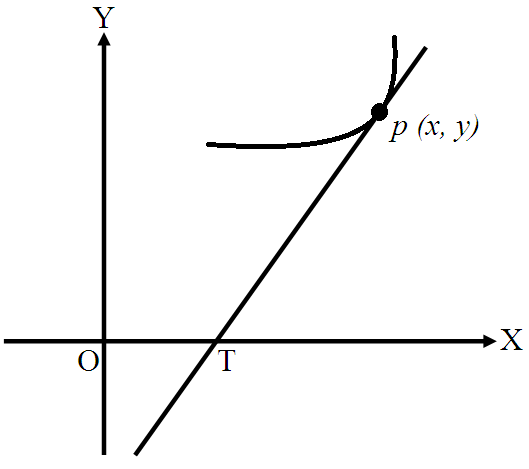 Portion of the x-axis cut off between the origin and tangent at a point $=\text{x}-\text{y}\frac{\text{dx}}{\text{dy}}=\text{OT}$
It is given, $\text{OT}=2\text{x}$
$\therefore \ \text{x}-\text{y}\frac{\text{dx}}{\text{dy}}=2\text{x}$
$-\text{x}=\text{y}\frac{\text{dx}}{\text{dy}}$
$-\int\frac{\text{dx}}{\text{dy}}=\int\frac{\text{dy}}{\text{y}}$
$\therefore\ \text{xy}=\text{k}$
Since the curve passes through the point (1, 2)
at $\text{x}=1, \text{y}=2$
$\therefore \text{k}=2$
$\therefore \text{xy}=2$ View full question & answer→Question 915 Marks
The normal to a given curve at each point (x, y) on the curve passes through the point (3, 0). If the curve contains the point (3, 4), find its equation.
AnswerEquation of normal on point (x, y) on the curve
$\text{y}-\text{y}=\frac{-\text{dx}}{\text{dy}}(\text{x}-\text{x})$
Its passing through (3, 0)
$\Rightarrow\text{0}-\text{y}=\frac{-\text{dx}}{\text{dy}}(3-\text{x})$
$\Rightarrow \text{y}=\frac{\text{dx}}{\text{dy}}(3-\text{x})$
$\Rightarrow \text{y}\ \text{dy}=(3-\text{x})\text{dx}$
$\Rightarrow \int\text{y}\ \text{dy}=\int(3-\text{x})\text{dx}$
$\Rightarrow \frac{\text{y}^{2}}{2}=3\text{x}-\frac{\text{x}^{2}}{2}+\text{C}\ ...(\text{i})$
It passing through (3, 4),
$\frac{16}{2}=9-\frac{9}{2}+\text{C}$
$\frac{16}{2}=\frac{9}{2}+\text{C}$
$\text{C}=7$
Put $\text{C}=7$ is equation (i)
$\frac{\text{y}^{2}}{2}=3\text{x}-\frac{\text{x}^{2}}{2}+\frac{7}{2}$
$\text{y}^{2}=6\text{x}-\text{x}^{2}+{7}$
View full question & answer→Question 925 Marks
Solve the following initial value problems:
$\text{x}\frac{\text{dy}}{\text{dx}}-\text{y}=\log\text{x},\text{ y}(1)=0$
AnswerWe have,
$\text{x}\frac{\text{dy}}{\text{dx}}-\text{y}=\log\text{x}$
$\Rightarrow\frac{\text{dy}}{\text{dx}}-\frac{\text{y}}{\text{x}}=\frac{\log\text{x}}{\text{x}}\ ...(\text{1})$
Clearly, it is a linear differential equation of the form
$\frac{\text{dy}}{\text{dx}}+\text{Py}=\text{Q}$
Where $\text{P}=-\frac{1}{\text{x}}$ and $\text{Q}=\frac{\log\text{x}}{\text{x}}$
$\therefore\text{I.F.}=\text{e}^{\int\text{Pdx}}$
$=\text{e}{-\int\frac{1}{\text{x}}}\text{ dx}$
$=\text{e}^{-\log\text{x}}$
$=\frac{1}{\text{x}}$
Multiplying both sides of (1) by $\text{I.F.}=\frac{1}{\text{x}},$ we get
$\frac{1}{\text{x}}\Big(\frac{\text{dy}}{\text{dx}}-\frac{1}{\text{x}}\text{y}\Big)=\frac{1}{\text{x}}\times\frac{\log\text{x}}{\text{x}}$
$\Rightarrow\frac{1}{\text{x}}\frac{\text{dy}}{\text{dx}}-\frac{1}{\text{x}^2}\text{y}=\frac{\log\text{x}}{\text{x}^2}$
Integrsting both sides with respect to x, we get
$\text{y}\frac{1}{\text{x}}=\int\frac{1}{\text{x}^2}\times\log\text{x dx}+\text{C}$
$\Rightarrow\frac{\text{y}}{\text{x}}=\log\text{x}\int\frac{1}{\text{x}^2}\text{dx}-\int\Big[\frac{\text{d}}{\text{dx}}(\log\text{x})\int\frac{1}{\text{x}^2}\text{dx}\Big]\text{dx}+\text{C}$
$\Rightarrow\frac{\text{y}}{\text{x}}=-\frac{\log\text{x}}{\text{x}}+\int\frac{1}{\text{x}^2}\text{dx}+\text{C}$
$\Rightarrow\frac{\text{y}}{\text{x}}=-\frac{\log\text{x}}{\text{x}}-\frac{1}{\text{x}}+\text{C}$
$\Rightarrow\text{y}=-\log\text{x}-1+\text{Cx}\ ...(\text{ii})$
Now,
$\text{y}(1)=0$
$\therefore\ 0=-0-1+\text{C}(1)$
$\Rightarrow\text{C}=1$
Putting the value of C in (2) we get
$\text{y}=-\log\text{x}-1+\text{x}$
$\Rightarrow\text{y}=\text{x}-1-\log\text{x}$
Hence, $\text{y}=\text{x}-1-\log\text{x}$ is the required solution.
View full question & answer→Question 935 Marks
Show that aii curve for which the slope at any point (x, y) on its is $\frac{\text{x}^{2}+\text{y}^{2}}{\text{2xy}}$ are rectangular hyperbola.
AnswerWe have,
$\frac{\text{dy}}{\text{dx}}=\frac{\text{x}^{2}+\text{y}^{2}}{\text{2xy}}$
Let y = vx
$\frac{\text{dy}}{\text{dx}}=\text{v}+\text{x}\frac{\text{dv}}{\text{dx}}$
$\therefore \text{v}+\text{x}\frac{\text{dv}}{\text{dx}}=\frac{\text{x}^{2}+\text{v}^{2}\text{x}^{2}}{2\text{vx}^{2}}$
$\Rightarrow \text{x}\frac{\text{dv}}{\text{dx}}=\frac{\text{1}+\text{v}^{2}}{2\text{v}}-\text{v}$
$\Rightarrow \text{x}\frac{\text{dv}}{\text{dx}}=\frac{\text{1}+\text{v}^{2}-2\text{v}^{2}}{2\text{v}}$
$\Rightarrow \text{x}\frac{\text{dv}}{\text{dx}}=\frac{\text{1}+\text{v}^{2}}{2\text{v}}$
$\Rightarrow\frac{2\text{v}}{1-\text{v}^{2}}\text{dv}=\frac{1}{\text{x}}\text{dx}$
Integrating both sides, we get
$\int\frac{2\text{v}}{1-\text{v}^{2}}\text{dv}=\int\frac{1}{\text{x}}\text{dx}$
$\Rightarrow-\log|1-\text{v}^{2}|=\log|\text{x}|-\log|\text{C}|$
$\Rightarrow-\log\Big|\frac{1-\text{v}^{2}}{\text{C}}\Big|=-\log|\text{x}|$
$\Rightarrow 1-\text{v}^{2}=\frac{\text{C}}{\text{x}}$
$\Rightarrow \frac{\text{x}^{2}-\text{y}^{2}}{\text{x}^{2}}=\frac{\text{C}}{\text{x}}$
$\Rightarrow \text{x}^{2}-\text{y}^{2}=\text{Cx}$
View full question & answer→Question 945 Marks
The volume of spherical balloon being inflated changes at a constant rate. If initially its radius is 3 units and after 3 seconds it is 6 units. Find the radius of balloon after t seconds.
AnswerLet v be volume of spherical balloon of radius r. $\therefore\ \text{v}=\frac{4}{3}\pi\text{r}^3\ ...(1)$From give condition,
$\frac{\text{dv}}{\text{dt}}=\text{k}\ \text{or}\ \frac{\text{d}}{\text{dt}}\bigg[\frac{4}{3}\pi\text{r}^3\bigg]=\text{k}\ \ [\because \text{of}\ (1)]$$\therefore\frac{4\pi}{3}.\ 3\ \text{r}^2\ \frac{\text{dr}}{\text{dt}}=\text{k}\ \ \text{or}\ \ 4\pi\text{r}^2\ \frac{\text{dr}}{\text{dt}}=\text{k}$
Separating the variables and integrating, we get.
$4\pi\int\text{r}^2\text{dr}=\text{k}\int\text{dt}\ \ \text{or}\ \ 4\pi \frac{\text{r}^3}{3}$ $=\text{k}\ \text{t}+\text{c}\ ...(2)$
Now t = 0 when r = 3 $\therefore\ 4\pi\frac{(3)^3}{3}=\text{k}\times0 +\text{c}\ \ \Rightarrow\ \ \text{c}=36\pi\ ...(3)$Again t = 3 when r = 6
$\therefore\ 4\pi\frac{(3)^3}{3}(6)^3=3\ \text{k}+36\pi\ \ [\because\ \text{of}\ (3)]$
$\therefore\ 288\pi=3\text{k}+36\pi\ \text{or}\ 3\text{k}=252\pi$
$\therefore\ \text{k}=84\pi$
$\text{Putting k}=84\pi,\ \text{c}=36\pi\ \text{in (2), we get}$
$\frac{4\pi}{3}\text{r}^3=84\pi\ \text{t}+36\pi\ \text{or}\ \frac{\text{r}^3}{3}=21\ \text{t}+9$
$\therefore\ \text{r}^3=63\ \text{t}+27\ \ \Rightarrow\ \ \text{r}=[9(7 \text{t}+3)]^\frac{1}{3}$
View full question & answer→Question 955 Marks
Solve the following differential equation
$\text{x}\frac{\text{dy}}{\text{dx}}+1=0;\text{y}(-1)=0$
Answer$\text{x}\frac{\text{dy}}{\text{dx}}+1=0,\text{y}(-1)=0$
$\text{x}\frac{\text{dy}}{\text{dx}}=-1$
$\text{dy}=-\frac{\text{dx}}{\text{x}}$
$\int\text{dy}=\int-\frac{\text{dx}}{\text{x}}$
$\text{y}=-\log|\text{x}|+\text{C}$
Put x = -1 and y = 0
0 = 0 + c
c = 0
put c = 0 in equation (1),
$\text{y}=-\log|\text{x}|,\text{x}<0$
View full question & answer→Question 965 Marks
Solve the following differential equation:
$\frac{\text{dy}}{\text{dx}}+\text{y}=\sin\text{x}$
AnswerWe have,
$\frac{\text{dy}}{\text{dx}}+\text{y}=\sin\text{x}\ \dots(1)$
Clearly, it is a linear differential equation of the form
$\frac{\text{dy}}{\text{dx}}+\text{Py}=\text{Q}$
where
$\text{P}=1$
$\text{Q}=\sin\text{x}$
$\therefore\ \text{I.F.}=\text{e}^{\int\text{Pdx}}=\text{e}^{\int\text{dx}}=\text{e}^{\text{x}}$
Multiplying both sides of (1) by $e^x,$ we get
$\text{e}^\text{x}\Big(\frac{\text{dy}}{\text{dx}}+\text{y}\Big)=\text{e}^\text{x}\sin \text{x}$
$\Rightarrow\ \text{e}^\text{x}\frac{\text{dy}}{\text{dx}}+\text{e}^{\text{x}}\text{y}=\text{e}^\text{x}\sin\text{x}$
Integrating both sides with respect to $x$, we get
$\text{y}\text{e}^{\text{x}}=\int\text{e}^{\text{x}}\sin\text{x dx + C}$
$\Rightarrow\ \text{y}\text{e}^{\text{x}}=\frac{\text{e}^{\text{x}}}{2}(\sin\text{x}-\cos{\text{x}})+\text{C}$
$\Rightarrow\ \text{y}=\text{Ce}^{-\text{x}}+\frac{1}{2}(\sin\text{x}-\cos{\text{x}})$
Hence, $\text{y}=\text{Ce}^{-\text{x}}+\frac{1}{2}(\sin\text{x}-\cos{\text{x}})$ is the required solution.
View full question & answer→Question 975 Marks
verify that $\text{y}^2=4\text{a}(\text{x}+\text{a})$ is a solution of the differential equation $\Big\{1-\Big(\frac{\text{dy}}{\text{dx}}\Big)^2\Big\}=2\text{x}\frac{\text{dy}}{\text{dx}}.$
Answer$\text{y}^2=4\text{a}(\text{x}+\text{a})\ ...(1)$
Differentiating both sides of (1) with respect to x, we get
$2\text{y}\frac{\text{dy}}{\text{dx}}=4\text{a}$
$\frac{\text{dy}}{\text{dx}}=\frac{2\text{a}}{\text{y}}\ ...(2)$
Now,
$\text{y}\Big\{1-\Big(\frac{\text{dy}}{\text{dx}}\Big)^2\Big\}$
$=\Big[\text{y}^2\Big\{1-\Big(\frac{\text{dy}}{\text{dx}}\Big)^2\Big\}\Big]\frac{1}{\text{y}}$
$=\Big[4\text{a}(\text{x}+\text{a})-4\text{a}(\text{x}+\text{a})\Big(\frac{2\text{a}}{\text{y}}\Big)^2\Big]\frac{1}{\text{y}}$
Using equation (1) and (2)
$=\Big[4\text{ax}+4\text{a}^2-\frac{16\text{a}3\text{x}}{\text{y}^2}-\frac{16\text{a}^4}{\text{y}^2}\Big]\frac{1}{\text{y}}$
$=\frac{4\text{a}}{\text{y}^3}[\text{xy}^2+\text{ay}^2-4\text{a}^2\text{x}-4\text{a}^3\Big]$
$=\frac{4\text{a}}{\text{y}^3}[\text{y}^2(\text{a}+\text{x})-4\text{a}^2(\text{x}+\text{a})]$
$\frac{4\text{a}}{\text{y}^3}(\text{a}+\text{x})(\text{y}^2-4\text{a}^2)$
View full question & answer→Question 985 Marks
Solve the following differential equation:
$\text{x}\frac{\text{dy}}{\text{dx}}=\text{y}-\text{x}\cos^2\Big(\frac{\text{y}}{\text{x}}\Big)$
AnswerHere, $\text{x}\frac{\text{dy}}{\text{dx}}=\text{y}-\text{x}\cos^2\Big(\frac{\text{y}}{\text{x}}\Big)$
$\Rightarrow\ \frac{\text{dy}}{\text{dx}}=\frac{\text{y}-\text{x}\cos^2\Big(\frac{\text{y}}{\text{x}}\Big)}{\text{x}}$
It is a homogeneous equation.
Put x = vy
and $\frac{\text{dy}}{\text{dx}}=\text{v + x}\frac{\text{dv}}{\text{dx}}$
So,
$\text{v + x}\frac{\text{dv}}{\text{dx}}=\frac{\text{vx}-\text{x}\cos^2\big(\frac{\text{vx}}{\text{x}}\big)}{\text{x}}$
$\text{v + x}\frac{\text{dv}}{\text{dx}}=\text{v}-\cos^2\text{v}$
$\text{x}\frac{\text{dv}}{\text{dx}}=\text{v}-\cos^2\text{v}-\text{v}$
$\text{x}\frac{\text{dv}}{\text{dx}}=-\cos^2\text{v}$
$\frac{\text{dv}}{\cos^2\text{v}}=-\frac{\text{dx}}{\text{x}}$
$\int\sec^2\text{vdv}=-\int\frac{\text{dx}}{\text{x}}$
$\tan\text{v}=-\log|\text{x}|+\log\text{C}$
$\tan\frac{\text{y}}{\text{x}}=\log\Big|\frac{\text{C}}{\text{x}}\Big|$
View full question & answer→Question 995 Marks
Solve the following differential equation:
$\text{y dx}+\Big\{\text{x}\log\Big(\frac{\text{y}}{\text{x}}\Big)\Big\}\text{dy}-2\text{x dy}=0$
AnswerWe have, $\text{y dx}+\Big\{\text{x}\log\Big(\frac{\text{y}}{\text{x}}\Big)\Big\}\text{dy}-2\text{x dy}=0$ $\Rightarrow\ \Big\{2\text{x}-\text{x}\log\Big(\frac{\text{y}}{\text{x}}\Big)\Big\}\text{dy}=\text{y dx}$ $\Rightarrow\ \frac{\text{dy}}{\text{dx}}=\frac{\text{y}}{2\text{x}-\text{x}\log\big(\frac{\text{y}}{\text{x}}\big)}$ This is a homogeneous differential equation. Put y = vx and $\frac{\text{dy}}{\text{dx}}=\text{v + x}\frac{\text{dv}}{\text{dx}},$ we get$\text{v + x}\frac{\text{dv}}{\text{dx}}=\frac{\text{vx}}{2\text{x}-\text{x}\log\text{v}}$
$\Rightarrow\ \text{v + x}\frac{\text{dv}}{\text{dx}}=\frac{\text{v}}{2-\log\text{v}}$ $\Rightarrow\ \text{x}\frac{\text{dv}}{\text{dx}}=\frac{\text{v}}{2-\log\text{v}}-\text{v}$ $\Rightarrow\ \text{x}\frac{\text{dv}}{\text{dx}}=\frac{\text{v}-2\text{v + v}\log\text{v}}{2-\log\text{v}}$ $\Rightarrow\ \text{x}\frac{\text{dv}}{\text{dx}}=\frac{\text{v}\log\text{v}-\text{v}}{2-\log\text{v}}$ $\Rightarrow\ \frac{2-\log\text{v}}{\text{v}\log\text{v}-\text{v}}\text{dv}=\frac{1}{\text{x}}\text{dx}$ integrating both sides, we get $\int\frac{2-\log\text{v}}{\text{v}\log\text{v}-\text{v}}\text{dv}=\int\frac{1}{\text{x}}\text{dx}$ $\Rightarrow\ \int\frac{1-(\log\text{v}-1)}{\text{v}(\log\text{v}-1)}\text{dv}=\int\frac{1}{\text{x}}\text{dx}$ Putting $\log\text{v}-1=\text{t}$ $\Rightarrow\ \frac{1}{\text{v}}\text{dv}=\text{dt}$ $\therefore\ \int\frac{1-\text{t}}{\text{t}}\text{dt}=\int\frac{1}{\text{x}}\text{dx}$ $\Rightarrow\ \int\Big(\frac{1}{\text{t}}-1\Big)\text{dt}=\int\frac{1}{\text{x}}\text{dx}$ $\Rightarrow\ \log|\text{t}|-\text{t}=\log|\text{x}|+\log\text{C}$ $\Rightarrow\ \log|\log\text{v}-1|-(\log\text{v}-1)=\log|\text{x}|+\log\text{C}$ $\Rightarrow\ \log|\log\text{v}-1|-\log\text{v}=\log|\text{x}|+\log\text{C}$ $\big($where, $\log\text{C}_1=\log\text{C}-1\big)$ $\Rightarrow\ \log\Big|\frac{\log\text{v}-1}{\text{v}}\Big|=\log|\text{C}_1\text{x}|$ $\Rightarrow\ \frac{\log\text{v}-1}{\text{v}}=\text{C}_1\text{x}$ $\Rightarrow\ \log\text{v}-1=\text{C}_1\text{xv}$ Putting $\text{v}=\frac{\text{y}}{\text{x}},$ we get $\log\frac{\text{y}}{\text{x}}-1=\text{C}_1\text{x}\times\frac{\text{y}}{\text{x}}$ $\Rightarrow\ \log\frac{\text{y}}{\text{x}}-1=\text{C}_1\text{y}$ Hence, $\log\frac{\text{y}}{\text{x}}-1=\text{C}_1\text{y}$ is the required solution.
View full question & answer→Question 1005 Marks
Solve the following differential equations:$\text{y}(1-\text{x}^2)\frac{\text{dy}}{\text{dx}}=\text{x}(1+\text{y}^2)$
AnswerWe have,
$\text{y}(1-\text{x}^2)\frac{\text{dy}}{\text{dx}}=\text{x}(1+\text{y}^2)$
$\Rightarrow\frac{\text{y}}{1+\text{y}^2}\text{dy}=\frac{\text{x}}{1-\text{x}^2}\text{dx}$
Integrating both sides,
$\int\frac{\text{y}}{1+\text{y}^2}\text{dy}=\int\frac{\text{x}}{1-\text{x}^2}\text{dx}$
Substituting $1+\text{y}^2=\text{t}$ and $1-\text{x}^2=\text{u}$
$2\text{ydy = dt}$ and $-2\text{x dx = du}$
$\therefore\frac{1}{2}\int\frac{1}{\text{t}}=\frac{-1}{2}\int\frac{1}{\text{u}}\text{du}$
$\Rightarrow\frac{1}2{}\log|\text{t}|=-\frac{1}{2}\log|\text{u}|+\log\text{C}$
$\Rightarrow\frac{1}{2}|1+\text{y}^2|=-\frac{1}{2}\log|1-\text{x}^2|+\log\text{C}$
$\Rightarrow\frac{1}{2}\big[\log|1+\text{y}^2|+\log|1-\text{x}^2|\big]=\log\text{C}$
$\Rightarrow\log(|1+\text{y}^2||1-\text{x}^2|)=2\log\text{C}$
$\Rightarrow(1+\text{y}^2)(1-\text{x}^2)=\text{C}^2$
$\Rightarrow(1+\text{y}^2)(1-\text{x}^2)=\text{C}_1,$ where $\text{C}_1=\text{C}^2$
Hence, $(1+\text{y}^2)(1-\text{x}^2)=\text{C}_1$ is the required solution.
View full question & answer→Question 1015 Marks
Solve the differential equation $\frac{\text{dy}}{\text{dx}}+2\text{xy}=\text{y}.$
AnswerWe have $\frac{\text{dy}}{\text{dx}}+2\text{xy}=\text{y}$
$\Rightarrow\frac{\text{dy}}{\text{dx}}+2\text{xy}-\text{y}=0$
$\Rightarrow\frac{\text{dy}}{\text{dx}}+(2\text{x}-1)\text{y}=0$
$\Rightarrow\frac{\text{dy}}{\text{dx}}=\text{y}(1-2\text{x})\text{dx}$
$\Rightarrow\frac{\text{dy}}{\text{y}}=(1-2\text{x})\text{dx}$
Integrating both sides we get,
$\int\frac{\text{dy}}{\text{y}}=\int(1-2\text{x})\text{dx}$
$\Rightarrow\log\text{y}=\text{x}-\text{x}^2+\log\text{C}$
$\Rightarrow\log\text{y}-\log\text{C}=\text{x}-\text{x}^2$
$\Rightarrow\log\frac{\text{y}}{\text{C}}=\text{x}-\text{x}^2$
$\Rightarrow\frac{\text{y}}{\text{C}}=\text{e}^{\text{x}-\text{x}^2}$
$\Rightarrow\text{y}=\text{C}\text{e}^{\text{x}-\text{x}^2}$
View full question & answer→Question 1025 Marks
Solve the following differential equation:
$\frac{\text{dy}}{\text{dx}}=\frac{\text{y}}{\text{x}}\{\log\text{y}-\log\text{x}+1\}$
AnswerHere, $\frac{\text{dy}}{\text{dx}}=\frac{\text{y}}{\text{x}}\{\log\text{y}-\log\text{x}+1\}$
$\Rightarrow\ \frac{\text{dy}}{\text{dx}}=\frac{\text{y}}{\text{x}}-\Big\{\log\Big(\frac{\text{y}}{\text{x}}\Big)+1\Big\}$
It is a homogeneous equation.
Put y = vx and $\frac{\text{dy}}{\text{dx}}=\text{v + x}\frac{\text{dv}}{\text{dx}}$
So,
$\text{v + x}\frac{\text{dv}}{\text{dx}}=\frac{\text{vx}}{\text{x}}\Big\{\log\Big(\frac{\text{vx}}{\text{x}}\Big)+1\Big\}$
$\text{v + x}\frac{\text{dv}}{\text{dx}}=\text{v}\log\text{v + v}$
$\text{x}\frac{\text{dv}}{\text{dx}}=\text{v}\log\text{v}$
$\int\frac{1}{\text{v}\log\text{v}}\text{dv}=\int\frac{\text{dx}}{\text{x}}$
$\log\log\text{v}=\log|\text{x}|+\log\text{C}$
$\log\text{v}=\text{xC}$
$\log\frac{\text{y}}{\text{x}}=\text{xC}$
$\frac{\text{y}}{\text{x}}=\text{e}^{\text{xC}}$
$\text{y}=\text{xe}^{\text{xC}}$
View full question & answer→Question 1035 Marks
Find the equation of the curve which passes through the point (2, 2) and satisfies the differential equation $\text{y}-\text{x}\frac{\text{dy}}{\text{dx}}=\text{y}^{2}+\frac{\text{dy}}{\text{dx}}.$
Answer$\text{y}-\text{x}\frac{\text{dy}}{\text{dx}}=\text{y}^{2}+\frac{\text{dy}}{\text{dx}}$
$\frac{\text{dy}}{\text{dx}}+\text{x}\frac{\text{dy}}{\text{dx}}=\text{y}-\text{y}^{2}$
$(1-\text{x})\frac{\text{dy}}{\text{dx}}=\text{y}-\text{y}^{2}$
$\frac{\text{dy}}{\text{y}-\text{y}^{2}}=\frac{\text{dx}}{1+\text{x}}$
$\frac{\text{dy}}{\text{y}(1-\text{y})}=\frac{\text{dx}}{1+\text{x}}$
$\int\Big(\frac{1}{\text{y}}+\frac{1}{1-\text{y}}\Big)\text{dx}=\int\frac{\text{dx}}{1+\text{x}}$
$\log|\text{y}|-\log|1-\text{y}|=\log|1+\text{x}|+\log|\text{c}|$
$\frac{\text{y}}{1-\text{y}}=\text{c}(1+\text{x})$
$\text{y}=(1-\text{y})\text{c}(1+\text{x})\ ...(\text{i})$
It is passing through (2, 2) so,
$2=(1-2)\text{c}(1+2)$
$2=-3\text{c}$
$\text{c}=-\frac{2}{3}$
from eq.(i)
$\text{y}=-\frac{2}{3}(1-\text{y})(1+\text{x})$
$3\text{y}=-2(1+\text{x}-\text{y}-\text{xy})$
$3\text{y}+2+2\text{x}-2\text{y}-2\text{xy}=0$
$\text{y}+2\text{y}-2\text{xy}+2=0$
$2\text{xy}+2\text{x}-2-\text{y}=0$
Chapter 22 Differential eq.
It is passing through $\Big(1, \frac{\pi}{4}\Big)$,
$\tan\Big(\frac{\pi}{4}\Big)=-\log|1|+\text{C}$
$1-0+\text{C}$
$\text{C}=1$
Now, eq. (i) become
$\tan\Big(\frac{\text{y}}{\text{x}}\Big)=-\log|\text{x}|+\text{1}$
Therefore,
$\tan\Big(\frac{\text{y}}{\text{x}}\Big)=\log|\frac{\text{e}}{\text{x}}|$
View full question & answer→Question 1045 Marks
Solve the following initial value problems:
$\frac{\text{dy}}{\text{dx}}+2\text{y}\tan\text{x}=\sin\text{x},\text{ y}=0,\text{ when x}=\frac{\pi}{3}$
AnswerWe have,
$\frac{\text{dy}}{\text{dx}}+2\text{y}\tan\text{x}=\sin\text{x}\ ...(1)$
Clearly, it is a linear differential equation of the form
$\frac{\text{dy}}{\text{dx}}+\text{Py}=\text{Q}$
Where $\text{P}=2\tan\text{x}$ and $\text{Q}=\sin\text{x}$
$\therefore\text{ I.F.}=\text{e}^{\int\text{Pdx}}$
$=\text{e}^{2\int\tan\text{x dx}}$
$=\text{e}^{2\log|\sec\text{x}|}$
$=\sec^2\text{x}$
Multiplying both sides of (1) by $\text{I.F.}=\sec^2\text{x},$ we get
$\sec^2\text{x}\Big(\frac{\text{dy}}{\text{dx}}+2\text{y}\tan\text{x}\Big)=\sec^2\text{x}\times\sin\text{x}$
$\sec^2\text{x}\Big(\frac{\text{dy}}{\text{dx}}+2\text{y}\tan\text{x}\Big)=\tan\text{x }\sec\text{x}$
Integrating both sides with respect to x, we get
$\text{y}\sec^2\text{x}=\int\tan\text{x}\sec\text{x dx}+\text{C}$
$\text{y}\sec^2\text{x}=\sec{\text{x}}+\text{C}\ ...(2)$
Now,
$\text{y}\Big(\frac{\pi}{3}\Big)=0$
$\therefore\ 0\Big(\sec\frac{\pi}{3}\Big)^2=\sec\frac{\pi}{3}+\text{C}$
$\Rightarrow\text{C}=-2$
Putting the value of C in (2), we get
$\text{y}\sec^2\text{x}=\sec\text{x}-2$
$\Rightarrow\text{y}=\cos\text{x}-2\cos^2\text{x}$
Hence, $\text{y}=\cos\text{x}-2\cos^2\text{x}$ is the required solution.
View full question & answer→Question 1055 Marks
Solve the following differential equations:$(1+\text{y}^2)\tan^{-1}\text{xdx}+2\text{y}(1+\text{x}^2)\text{dy}=0$
Answer$(1+\text{y}^2)\tan^{-1}\text{xdx}+2\text{y}(1+\text{x}^2)\text{dy}=0$
$(1+\text{y}^2)\tan^{-1}\text{xdx}=-2\text{y}(1+\text{x}^2)\text{dy}$
$-\frac{\tan^{-1}}{2(1+\text{x}^2)}\text{dx}=\frac{\text{y}}{(1+\text{y}^2)}\text{dy}$
Integrating on both the sides
$\int-\frac{\tan^{-1}\text{x}}{2(1+\text{x}^2)}\text{dx}=\int\frac{\text{y}}{(1+\text{y}^2)}\text{dy}$
$-\Big(\tan^{-1}\text{x}\Big(\frac{1}{2}\tan^{-1}\text{x}\Big)-\int\frac{1}{(1+\text{x}^2)}\Big(\frac{1}{2}\tan^{-1}\text{x}\Big)\text{dx}\Big)=\frac{1}{2}\ln(\text{y}^2+1)+\text{C}$
$-\frac{1}{4}(\tan^{-1}\text{x})^2=\frac{1}{2}\ln(\text{y}^2+1)+\text{C}_1$
$\frac{1}{2}(\tan^{-1}\text{x})^2+\ln(\text{y}^2+1)=\text{C}$
View full question & answer→Question 1065 Marks
Solve the following differential equations:$\frac{\text{dy}}{\text{dx}}=2\text{e}^{2\text{x}}\text{y}^2,\text{y}(0)=-1$
Answer$\frac{\text{dy}}{\text{dx}}=2\text{e}^{2\text{x}}\text{y}^2,\text{y}(0)=-1$
$\Rightarrow\frac{1}{\text{y}^2}\text{dy}=2\text{e}^{2\text{x}}\text{dx}$
Integrating both sides, we get
$\int\frac{1}{\text{y}^2}\text{dy}=2\int\text{e}^{2\text{x}}\text{dx}$
$\Rightarrow\frac{-1}{\text{y}}=\text{e}^{2\text{x}}+\text{C}...(1)$
We know that at $\text{x}=0,\text{y}=-1.$
Substituting the values of x and y in (1), we get
$1=1+\text{C}$
$\Rightarrow\text{C}=0$
Substituting the value of C in (1), we get
$-\frac{1}{\text{y}}=\text{e}^{2\text{x}}$
$\Rightarrow\text{y}=-\text{e}^{-2\text{x}}$
Hence, $\text{y}=-\text{e}^{-2\text{x}}$ is the required soluton.
View full question & answer→Question 1075 Marks
Find the equation of a curve passing through the point (0, 0) and whose differential equation is $\frac{\text{dy}}{\text{dx}}=\text{e}^{\text{x}}\sin\text{x.}$
AnswerThe differential equation of the curve is:
$\text{y}'=\text{e}^{\text{x}}\sin\text{x}$
$\Rightarrow\frac{\text{dy}}{\text{dx}}=\text{e}^{\text{x}}\sin\text{x}$
$\Rightarrow\text{dy}=\text{e}^{\text{x}}\sin\text{x}$
Integrating both sides, we get:
$\int\text{dy}=\int\text{e}^{\text{x}}\sin\text{x dx }...(1)$
Let $\text{I}=\int\text{e}^{\text{x}}\sin\text{x dx}.$
$\Rightarrow\text{I}=\sin\text{x}\int\text{e}^{\text{x}}\text{dx}-\int\Big(\frac{\text{d}}{\text{dx}}(\sin\text{x}).\int\text{e}^{\text{x}}\text{dx}\Big)\text{dx}$
$\Rightarrow\text{I}=\sin\text{x}\cdot\text{e}^{\text{x}}-\int\cos\text{x}\cdot\text{e}^{\text{x}}\text{dx}$
$\Rightarrow\text{I}=\sin\text{x}\cdot\text{e}^{\text{x}}-\Big[\cos\text{x}\cdot\int\text{e}^{\text{x}}\text{dx}-\int\Big(\frac{\text{d}}{\text{dx}}(\cos\text{x})\cdot\int\text{e}^{\text{x}}\text{dx}\Big)\text{dx}\Big]$
$\Rightarrow\text{I}=\sin\text{x}\cdot\text{e}^{\text{x}}-\big[\cos\text{x}\cdot\text{e}^{\text{x}}-\int(-\sin\text{x})\cdot\text{e}^{\text{x}}\text{dx}\big]$
$\Rightarrow\text{I}=\text{e}^{\text{x}}\sin\text{x}-\text{e}^{\text{x}}\cos\text{x}-\text{I}$
$\Rightarrow2\text{I}=\text{e}^{\text{x}}(\sin\text{x}-\cos\text{x})$
$\Rightarrow\text{I}=\frac{\text{e}^{\text{x}}(\sin\text{x}-\cos\text{x})}{2}$
View full question & answer→Question 1085 Marks
The x-intercept of the tangent line to a curve is equal to the ordinate of the point of contact. Find the particular curve through the point (1, 1).
AnswerLet P(x, y) be the point on the curve y = f(x) such that tangent at P cuts the coordinate axes at A and B.
The quation of tangent is,
$\text{y}-\text{y}=\frac{\text{dy}}{\text{dx}}(\text{x}-\text{x})$
Put y = 0
$-\text{y}=\frac{\text{dy}}{\text{dx}}(\text{x}-\text{x})$
$-\text{y}\frac{\text{dy}}{\text{dx}}+\text{x}=\text{x}$
Coording of $\text{B}=\Big(-\text{y}\frac{\text{dy}}{\text{dx}}+\text{x}, 0\Big)$
Here, x intercept of tangent = y
$-\text{y}\frac{\text{dy}}{\text{dx}}+\text{x}=\text{y}$
$\frac{\text{dy}}{\text{dx}}-\frac{\text{x}}{\text{y}}=-1$
It is a differential equation on it with $\text{P}=\frac{1}{\text{y}}, \text{Q}=-1$
$\text{I.F}=\text{e}^{\int\frac{1}{\text{y}}\text{dy}}$
$=\text{e}^{\log\text{y}}$
$=\frac{1}{\text{y}}$
Solution of the equation is given by,
$\text{x}(\text{I.F})=\int\text{Q}(\text{I.F})\text{dy}+\text{C}$
$\text{x}(\frac{1}{\text{y}})=\int\text{(-1)}(\frac{1}{\text{y}})\text{dy}+\text{C}$
$\text{x}(\frac{1}{\text{y}})=-\log\text{y}+\text{C}\ ...(\text{i})$
It is passing through (1, 1)
$\frac{1}{\text{1}}=-\log\text{1}+\text{C}$
$\text{C}=1$
Put C = 1 is equation (i)
$\frac{\text{x}}{\text{y}}=-\log\text{y}+\text{1}$
$\text{x}={\text{y}}-\text{y}\log\text{y}$
$\text{x}+\text{y}\log\text{y}=\text{y}$
View full question & answer→Question 1095 Marks
Solve the following differential equation:
$(\text{x}^2-2\text{xy})\text{dy}+(\text{x}^2-3\text{xy}+2\text{y}^2)\text{dx}=0$
AnswerHere, $(\text{x}^2-2\text{xy})\text{dy}+(\text{x}^2-3\text{xy}+2\text{y}^2)\text{dx}=0$
$\Rightarrow\ \frac{\text{dy}}{\text{dx}}=\frac{\text{x}^2-3\text{xy}+2\text{y}^2}{2\text{xy}-\text{x}^2}$
It is a homogeneous equation.
Put x = vy
and $\frac{\text{dy}}{\text{dx}}=\text{v + x}\frac{\text{dv}}{\text{dx}}$
So,
$\text{v + x}\frac{\text{dv}}{\text{dx}}=\frac{\text{x}^2-3\text{xvx}+2\text{v}^2\text{x}^2}{2\text{xvx}-\text{x}^2}$
$\text{x}\frac{\text{dv}}{\text{dx}}=\frac{1-3\text{v}+2\text{v}^2}{2\text{v}-1}-\text{v}$
$\text{x}\frac{\text{dv}}{\text{dx}}=\frac{1-3\text{v}+2\text{v}^2-2\text{v}^2+\text{v}}{2\text{v}-1}$
$\text{x}\frac{\text{dv}}{\text{dx}}=\frac{1-2\text{v}}{2\text{v}-1}$
$\frac{2\text{v}-1}{1-2\text{v}}\text{dv}=\frac{\text{dx}}{\text{x}}$
$\frac{1-2\text{v}}{1-2\text{v}}\text{dv}=-\int\frac{\text{dx}}{\text{x}}$
$\int\text{dv}=-\int\frac{\text{dx}}{\text{x}}$
$\text{v}=-\log|\text{x}|+\text{C}$
$\frac{\text{y}}{\text{x}}+\log\text{x}=\text{C}$
View full question & answer→Question 1105 Marks
Solve the following differential equation:
$\text{xy}\log\Big(\frac{\text{y}}{\text{x}}\Big)\text{dx}+\Big\{\text{y}^2-\text{x}^2\log\Big(\frac{\text{y}}{\text{x}}\Big)\Big\}\text{dy}=0$
Answer$\text{xy}\log\Big(\frac{\text{y}}{\text{x}}\Big)\text{dx}+\Big\{\text{y}^2-\text{x}^2\log\Big(\frac{\text{y}}{\text{x}}\Big)\Big\}\text{dy}=0$ $\Rightarrow\ \text{xy}\log\Big(\frac{\text{y}}{\text{x}}\Big)\text{dx}=-\Big\{\text{y}^2-\text{x}^2\log\Big(\frac{\text{y}}{\text{x}}\Big)\Big\}\text{dy}$$\Rightarrow\ \frac{\text{dx}}{\text{dy}}=\frac{-\big\{\text{y}^2-\text{x}^2\log\big(\frac{\text{y}}{\text{x}}\big)\big\}}{\text{xy}\log\big(\frac{\text{x}}{\text{y}}\big)}$
$=\frac{\text{x}^2\log\big(\frac{\text{x}}{\text{y}}\big)-\text{y}^2}{\text{xy}\log\big(\frac{\text{x}}{\text{y}}\big)}$
It is a homogeneous equation. We put x = vy $\frac{\text{dx}}{\text{dy}}=\text{v + y}\frac{\text{dv}}{\text{dy}}$ So, $\text{v + y}\frac{\text{dv}}{\text{dy}}=\frac{\text{v}^2\text{y}^2\log(\text{v})-\text{y}^2}{\text{vy}^2\log(\text{v})}$ $\text{v + y}\frac{\text{dv}}{\text{dy}}=\frac{\text{v}^2\log(\text{v})-1}{\text{v}\log(\text{v})}$ $\Rightarrow\ \text{y}\frac{\text{dv}}{\text{dy}}=\frac{\text{v}^2\log(\text{v})-1}{\text{v}\log(\text{v})}-\text{v}$ $\Rightarrow\ \text{y}\frac{\text{dv}}{\text{dy}}=\frac{\text{v}^2\log(\text{v})-1-\text{v}^2\log(\text{v})}{\text{v}\log(\text{v})}$ $\Rightarrow\ \text{y}\frac{\text{dv}}{\text{dy}}=\frac{-1}{\text{v}\log(\text{v})}$ $\Rightarrow\ \text{v}\log(\text{v})\text{dv}=\frac{-1}{\text{y}}\text{dy}$ On integrating both sides we get, $\int\text{v}\log(\text{v})\text{dv}=-\int\frac{1}{\text{y}}\text{dy}$ $\Rightarrow\ \frac{\text{v}^2}2\log(\text{v})-\int\frac{\text{v}}2\text{dv}=-\log\text{y + C}$ $\Rightarrow\ \frac{\text{v}^2}2\log(\text{v})-\frac{\text{v}^2}4=-\log\text{y + C}$ $\Rightarrow\ \frac{\text{v}^2}2\Big[\log(\text{v})-\frac{1}2\Big]=-\log\text{y + C}$ $\Rightarrow\ \text{v}^2\Big[\log(\text{v})-\frac{1}2\Big]=-2\log\text{y + C}$ Now putting back the values of v as $\frac{\text{x}}{\text{y}}$ we get, $\frac{\text{x}^2}{\text{y}^2}\Big[\log(\text{v})-\frac{1}2\Big]+\log\text{y}^2=\text{C}$
View full question & answer→Question 1115 Marks
Solve the following initial value problems:
$(\text{x}^2+\text{y}^2)\text{dx}=2\text{xy dy, y}(1)=0$
Answer$(\text{x}^2+\text{y}^2)\text{dx}=2\text{xy dy, y}(1)=0$ $\frac{\text{dy}}{\text{dx}}=\frac{\text{x}^2+\text{y}^2}{2\text{xy}}$ It is a homogeneous equation. Put y = vx
and $\frac{\text{dy}}{\text{dx}}=\text{v + x}\frac{\text{dv}}{\text{dx}},$ So,$\text{v + x}\frac{\text{dv}}{\text{dx}}=\frac{\text{x}^2+\text{v}^2\text{x}^2}{2\text{xvx}}$
$\text{x}\frac{\text{dv}}{\text{dx}}=\frac{1+\text{v}^2}{2\text{v}}-\text{v}$ $\text{x}\frac{\text{dv}}{\text{dx}}=\frac{1+\text{v}^2-2\text{v}^2}{2\text{v}}$ $\text{x}\frac{\text{dv}}{\text{dx}}=\frac{1-\text{v}^2}{2\text{v}}$ $\int\frac{2\text{v}}{1-\text{v}^2}=\int\frac{\text{dx}}{\text{x}}$ $\log|1-\text{v}^2|=-\log|\text{x}|+\log|\text{C}|$ $\log|1-\text{v}^2|=\log\Big|\frac{\text{C}}{\text{x}}\Big|$ $\Big|\frac{\text{x}^2-\text{y}^2}{\text{x}^2}\Big|=\Big|\frac{\text{C}}{\text{x}}\Big|$ $|\text{x}^2-\text{y}^2|=|\text{Cx}|\ \dots(\text{i})$ Put y = 0, x = 1 1 - 0 = C C = 1 Put the value of C in equation (i), $|\text{x}^2-\text{y}^2|=|\text{x}|$ $(\text{x}^2-\text{y}^2)^2=\text{x}^2$
View full question & answer→Question 1125 Marks
In each of the show that the given differential equation is homogeneous and solve each of them.
$\text{x}\frac{\text{dy}}{\text{dx}}-\text{y}+\text{x}\sin\bigg(\frac{\text{y}}{\text{x}}\bigg)=0$
AnswerGiven: Differential equation $\text{x}\frac{\text{dy}}{\text{dx}}-\text{y}+\text{x}\sin\bigg(\frac{\text{y}}{\text{x}}\bigg)=0$
$\Rightarrow\ \ \text{x}\frac{\text{dy}}{\text{dx}}-\text{y}+\text{x}\sin=0\bigg(\frac{\text{y}}{\text{x}}\bigg)$ $\Rightarrow\ \ \frac{\text{dy}}{\text{dx}}=\frac{\text{y}}{\text{x}}-\sin\bigg(\frac{\text{y}}{\text{x}}\bigg)=f\bigg(\frac{\text{y}}{\text{x}}\bigg)\ \ ...(\text{i})$
Therefore, the given differential equation is homogeneous.
$\text{Putting}\frac{\text{y}}{\text{x}}=\text{v}\ \ \Rightarrow\ \ \text{y}=\text{vx}\ \ $ $\Rightarrow\ \ \frac{\text{dy}}{\text{dx}}=\text{v}.1+\text{x}\frac{\text{dv}}{\text{dx}}=\text{v}+\text{x}\frac{\text{dv}}{\text{dx}}$
$\text{Putting these values of}\ \frac{\text{y}}{\text{x}}\ \text{and}\ \frac{\text{dy}}{\text{dx}}\ \text{in eq. (i), we get}$
$\text{v}+\text{x}\frac{\text{dv}}{\text{dx}}=\text{v}-\sin\text{v}\ \ \Rightarrow\ \ \text{x}\frac{\text{dv}}{\text{dx}}=-\sin\text{v}$ $\ \ \Rightarrow\ \ \text{x dv}=-\sin\text{v dx}$
$\Rightarrow\ \ \frac{\text{dv}}{\sin\text{v}}=\frac{-\text{dx}}{\text{x}}\ \ \Rightarrow\ \ \cos\text{ec v dv}=\frac{-\text{dx}}{\text{x}}$
$\text{Integrating both sides},\ \ \int\cos\text{ec v dv}=-\int\frac{1}{\text{x}}\text{dx}$
$\Rightarrow\ \ \log|\cos\text{ec v}-\cot\text{v}|=-\log|\text{x}|+\log|\text{c}|\ \ $$\Rightarrow\ \ \log|\cos\text{ec v}-\cot\text{v}|=\log\bigg|\frac{\text{c}}{\text{x}}\bigg|$
$\Rightarrow\ \ \cos\text{ec v}-\cot\text{v}=\pm\frac{\text{c}}{\text{x}}$ $\Rightarrow\ \ \cos\text{ec}\ \frac{\text{y}}{\text{x}}-\cot\frac{\text{y}}{\text{x}}=\pm\frac{\text{c}}{\text{x}}\ \ \big[\text{putting v}=\frac{\text{y}}{\text{x}}\big]$
$\Rightarrow\ \ \frac{1}{\sin\frac{\text{y}}{\text{x}}}-\frac{\cos\frac{\text{y}}{\text{x}}}{\sin\frac{\text{y}}{\text{x}}}=\frac{\text{C}}{\text{x}}$ $\Rightarrow\ \ \frac{1-\cos\frac{\text{y}}{\text{x}}}{\sin\frac{\text{y}}{\text{x}}}=\frac{\text{C}}{\text{x}}\ \ \text{where}\pm\text{c}=\text{C}$
$\Rightarrow\ \ \text{x}\bigg(1-\cos\frac{\text{y}}{\text{x}}\bigg)=\text{C}\sin\frac{\text{y}}{\text{x}}$
View full question & answer→Question 1135 Marks
In each of the show that the given differential equation is homogeneous and solve each of them.
$\text{x dy}-\text{y dx}=\sqrt{\text{x}^2+\text{y}^2}\ \text{dx}$
AnswerGiven: Differential equation $\text{x dy}-\text{y dx}=\sqrt{\text{x}^2+\text{y}^2}\ \text{dx}$
$\Rightarrow\ \ \text{x dy}=\text{y dx}+\sqrt{\text{x}^2+\text{y}^2}\text{dx}$ $\ \ \Rightarrow\ \ \text{x}\frac{\text{dy}}{\text{dx}}=\text{y}+\sqrt{\text{x}^2+\text{y}^2}$
$ \Rightarrow\ \ \text{x}\frac{\text{dy}}{\text{dx}}=\text{y}+\text{x}\sqrt{1+\Big(\frac{\text{y}}{\text{x}}\Big)^2}$ $ \Rightarrow\ \ \frac{\text{dy}}{\text{dx}}=\frac{\text{y}}{\text{x}}+\sqrt{1+\Big(\frac{\text{y}}{\text{x}}\Big)^2}=f\Big(\frac{\text{y}}{\text{x}}\Big)\ \ [\text{Dividing by x}]$
Therefore given differential equation is homogeneous.
$\text{Putting}\ \frac{\text{y}}{\text{x}}=\text{v}\ \ \Rightarrow\ \ \text{y}=\text{vx}\ \ $ $ \Rightarrow\ \ \frac{\text{dy}}{\text{dx}}=\text{v}.1+\text{x}\frac{\text{dv}}{\text{dx}}=\text{v}+\text{x}\frac{\text{dv}}{\text{dx}}$
$\text{Putting these values of}\ \frac{\text{y}}{\text{x}}\ \text{and}\ \frac{\text{dy}}{\text{dx}}\ \text{in eq. (i), we get}$
$\text{v}+\text{x}\frac{\text{dv}}{\text{dx}}=\text{v}+\sqrt{1+\text{v}^2}\ \ $ $\Rightarrow\ \ \text{x}\frac{\text{dv}}{\text{dx}}=\sqrt{1+\text{v}^2}\ \ \Rightarrow\ \ \frac{\text{dv}}{\sqrt{1+\text{v}^2}}=\frac{\text{dx}}{x}$
$\text{Integrating both sides},\ \ \int\frac{\text{dv}}{\sqrt{1+\text{v}^2}}=\int\frac{\text{dx}}{\text{x}}$ $\Rightarrow\ \ \log\big(\text{v}+\sqrt{1+\text{v}^2}\big)=\log\text{x}+\log\text{c}$
$\text{Putting}\ \frac{\text{y}}{\text{x}}=\text{v},$ $\log\bigg(\frac{\text{y}}{\text{x}}+\sqrt{1+\Big(\frac{\text{y}}{\text{x}}\Big)^2}\bigg)=\log\text{xc}$
$\Rightarrow\ \ \log\Bigg(\frac{\text{y}+\sqrt{\text{x}^2+\text{y}^2}}{\text{x}}\Bigg)=\log\text{cx}$ $\Rightarrow\ \ \text{y}+\sqrt{\text{x}^2+\text{y}^2}=\text{cx}^2$
View full question & answer→Question 1145 Marks
Solve the following differential equation
$\frac{\text{dy}}{\text{dx}}=\frac{1-\cos\text{x}}{1+\cos\text{x}}$
AnswerWe have,
$\frac{\text{dy}}{\text{dx}}=\frac{1-\cos\text{x}}{1+\cos\text{x}}$
$\Rightarrow\text{dy}=\frac{2\sin^2\frac{\text{x}}{2}}{2\cos^2\frac{\text{x}}{2}}$
$\Rightarrow\text{dy}=\tan^2\frac{\text{x}}{2}$
$\Rightarrow\text{dy}=\Big(\tan^2\frac{\text{x}}{2}\Big)\text{dx}$
Intergrating both sides, we get
$\Rightarrow\int\text{dy}=\int\Big(\tan^2\frac{\text{x}}{2}\Big)\text{dx}$
$\Rightarrow\int\text{dy}=\int\Big(\sec^2\frac{\text{x}}{2}-1\Big)\text{dx}$
$\Rightarrow\text{y}=2\tan\frac{\text{x}}{2}-\text{x}+\text{C}$
so, $\Rightarrow\text{y}=2\tan\frac{\text{x}}{2}-\text{x}+\text{C}$ is defined for all $\text{x}\in\text{R}$
Hence, $\Rightarrow\text{y}=\tan^{-1}\text{x}+\text{C}$, where $\text{x}\in\text{R}$ is the solution o the given differential equation.
View full question & answer→Question 1155 Marks
Solve the following differential equations:$(\text{xy}^2+2\text{x})\text{dx}+(\text{x}^2\text{y+2y})\text{dy}=0$
AnswerWe have,$(\text{xy}^2+2\text{x})\text{dx}+(\text{x}^2\text{y}+2\text{y})\text{dy}=0$
$\Rightarrow\text{x(y}^2+2)\text{dx+y}(\text{x}^2+2)\text{dy}=0$
$\Rightarrow\text{x(y}^2+2)\text{dx}=-\text{y}(\text{x}^2+2)\text{dy}$
$\Rightarrow\frac{\text{x}}{(\text{x}^2+2)}\text{dx}=-\frac{\text{y}}{(\text{y}^2+2)}\text{dy}$
Integration both sides, we get
$\int\frac{\text{x}}{\text{x}^2+2}\text{dx}=-\int\frac{\text{y}}{\text{y}^2+2}\text{dy}$
$\Rightarrow\frac{1}{2}\int\frac{2\text{x}}{\text{x}^2+2}\text{dx}=-\frac{1}{2}\frac{2\text{y}}{\text{y}^2+2}\text{dy}$
$\Rightarrow\frac{1}{2}\log|\text{x}^2+2|=-\frac{1}{2}\log|\text{y}^2+2|+\log\text{C}$
$\Rightarrow\frac{1}{2}\log|\text{x}^2+2|+\frac{1}{2}\log|\text{y}^2+2|=\log\text{C}$
$\Rightarrow\log|\text{x}^2+2|+\log|\text{y}^2+2|=2\log\text{C}$
$\Rightarrow\log\big(|\text{x}^2+2||\text{y}^2+2|\big)=\log\text{C}^2$
$\Rightarrow\big(|\text{x}^2+2||\text{y}^2+2|\big)=\text{C}^2$
$\Rightarrow(\text{x}^2+2)(\text{y}^2+2)=\text{K}$
$\Rightarrow\text{y}^2+2=\frac{\text{K}}{\text{x}^2+2}$
View full question & answer→Question 1165 Marks
Form the differential equation corresponding to $(\text{x}-\text{a})^2+(\text{y}-\text{b})^2=\text{r}^2$ by eliminating a and b.
AnswerThe equation of the family of curves is
$(\text{x}-\text{a})^2+(\text{y}-\text{b})^2=\text{r}^2\ ...(1)$
where a and b is a parameter.
This equation contains only one arbitrary constant, so we shall get a differential equation of first order.
Differentiating equation (1) with respect to x, we get
$2(\text{x}-\text{a})+2(\text{y}-\text{b})\frac{\text{dy}}{\text{dx}}=0\ ...(2)$
Differentiating equation (1) with respect to x, we get
$2+2\Big(\frac{\text{dy}}{\text{dx}}\Big)^2+2(\text{y}-\text{b})\frac{\text{d}^2\text{y}}{\text{dx}^2}=0$
$\Rightarrow1+\Big(\frac{\text{dy}}{\text{dx}}\Big)^2+(\text{y}-\text{b})\frac{\text{d}^2\text{y}}{\text{dx}^2}=0$
$\Rightarrow(\text{y}-\text{b})=\frac{1+\Big(\frac{\text{dy}}{\text{dx}}\Big)^2}{\frac{\text{d}^2\text{y}}{\text{dx}^2}}$
From (2) and (3), we get
$(\text{x}-\text{a})-\frac{1+\Big(\frac{\text{dy}}{\text{dx}}\Big)^2}{\frac{\text{d}^2\text{y}}{\text{dx}^2}}\frac{\text{dy}}{\text{dx}}=0\Rightarrow(\text{x}-\text{a})=\frac{\frac{\text{dy}}{\text{dx}}+\Big(\frac{\text{dy}}{\text{dx}}\Big)^3}{\frac{\text{d}^2\text{y}}{\text{dx}^2}}\ ...(4)$
From (1) and (3), we get
$\frac{\Big[\frac{\text{dy}}{\text{dz}}+\Big(\frac{\text{dy}}{\text{dz}}\Big)^2\Big]^2}{\Big(\frac{\text{d}^2\text{y}^2}{\text{dz}^2}\Big)^2}+\frac{\Big[1+\Big(\frac{\text{dy}}{\text{dx}}\Big)^2\Big]^2}{\Big(\frac{\text{d}^2\text{y}}{\text{dx}^2}\Big)^2}=\text{r}^2$
$\Rightarrow\frac{\Bigg[\Big(\frac{\text{dy}}{\text{dx}}\Big)^2+2\Big(\frac{\text{dy}}{\text{dx}}\Big)^4+\Big(\frac{\text{dy}}{\text{dx}}\Big)^6\Bigg]+\Bigg[1+2\Big(\frac{\text{dy}}{\text{dx}}\Big)^2+\Big(\frac{\text{dy}}{\text{dx}}\Big)^4\Bigg]}{\Big(\frac{\text{d}^2\text{y}}{\text{dx}}\Big)^2}$
$\Rightarrow\Big(\frac{\text{dy}}{\text{dx}}\Big)^2+2\Big(\frac{\text{dy}}{\text{dx}}\Big)^4+\Big(\frac{\text{dy}}{\text{dx}}\Big)^6+1+2\Big(\frac{\text{dy}}{\text{dx}}\Big)^2+\Big(\frac{\text{dy}}{\text{dx}}\Big)^4=\text{r}^2\Big(\frac{\text{d}^2\text{y}}{\text{dx}^2}\Big)$
$\Rightarrow1+3\Big(\frac{\text{dy}}{\text{dx}}\Big)^2+3\Big(\frac{\text{dy}}{\text{dx}}\Big)^4+\Big(\frac{\text{dy}}{\text{dx}}\Big)^6=\text{r}^2\Big(\frac{\text{d}^2\text{y}}{\text{dx}^2}\Big)$
$\Rightarrow\Bigg[1+\Big(\frac{\text{dy}}{\text{dx}}\Big)^2\Bigg]^3=\text{r}^3\Big(\frac{\text{d}^2\text{y}}{\text{dx}^2}\Big)^2$
It is the required differential equation.
View full question & answer→Question 1175 Marks
Solve the following differential equation:
$\Big(1+\text{e}^{\frac{\text{x}}{\text{y}}}\Big)\text{dx}+\text{e}^{\frac{\text{x}}{\text{y}}}\Big(1-\frac{\text{x}}{\text{y}}\Big)\text{dy}=0$
AnswerWe have,
$\Big(1+\text{e}^{\frac{\text{x}}{\text{y}}}\Big)\text{dx}+\text{e}^{\frac{\text{x}}{\text{y}}}\Big(1-\frac{\text{x}}{\text{y}}\Big)\text{dy}=0$
$\Rightarrow\ \frac{\text{dx}}{\text{dy}}=-\frac{\text{e}^{\frac{\text{x}}{\text{y}}}\Big(1-\frac{\text{x}}{\text{y}}\Big)}{1+\text{e}^{\frac{\text{x}}{\text{y}}}}$
This is a homogeneous differential equation.
Putting x = vy and $\frac{\text{dx}}{\text{dy}}=\text{v + y}\frac{\text{dv}}{\text{dy}}$, we get
$\text{v + y}\frac{\text{dv}}{\text{dy}}=-\frac{\text{e}^{\text{v}}(1-\text{v})}{1+\text{e}^{\text{v}}}$
$\Rightarrow\ \text{y}\frac{\text{dv}}{\text{dy}}=-\frac{\text{e}^{\text{v}}(1-\text{v})}{1+\text{e}^{\text{v}}}-\text{v}$
$\Rightarrow\ \text{y}\frac{\text{dv}}{\text{dy}}=\frac{-\text{e}^{\text{v}}+\text{e}^{\text{v}}\text{v}-\text{v}-\text{v}\text{e}^{\text{v}}}{1+\text{e}^{\text{v}}}$
$\Rightarrow\ \text{y}\frac{\text{dv}}{\text{dy}}=-\frac{\text{v}+\text{e}^{\text{v}}}{1+\text{e}^{\text{v}}}$
$\Rightarrow\ \frac{1+\text{e}^{\text{v}}}{\text{v}+\text{e}^{\text{v}}}\text{dv}=-\frac{1}{\text{y}}\text{dy}$
Integrating both sides, we get
$\int\frac{1+\text{e}^{\text{v}}}{\text{v}+\text{e}^{\text{v}}}\text{dv}=-\int\frac{1}{\text{y}}\text{dy}$
$\Rightarrow\ \log|\text{v}+\text{e}^{\text{v}}|=-\log|\text{y}|+\log\text{C}$
$\Rightarrow\ |\text{v}+\text{e}^{\text{v}}|=\Big|\frac{\text{C}}{\text{y}}\Big|$
$\Rightarrow\ \text{v}+\text{e}^{\text{v}}=\frac{\text{C}}{\text{y}}$
Putting $\text{v}=\frac{\text{x}}{\text{y}}$, we get
$\frac{\text{x}}{\text{y}}+\text{e}^{\frac{\text{x}}{\text{y}}}=\frac{\text{C}}{\text{y}}$
$\Rightarrow\ \text{x}+\text{ye}^{\frac{\text{x}}{\text{y}}}=\text{C}$
Hence, $\text{x}+\text{ye}^{\frac{\text{x}}{\text{y}}}=\text{C}$ is the required solution.
View full question & answer→Question 1185 Marks
Show that $\text{y}=\text{e}^\text{x}(\text{A}\cos\text{x}+\text{B}\sin\text{x})$ is a solution of the differential equation $\frac{\text{d}^2\text{y}}{\text{dx}^2}-2\frac{\text{dy}}{\text{dx}}+2\text{y}=0$
AnswerWe have,
$\text{y}=\text{e}^\text{x}(\text{A}\cos\text{x}+\text{B}\sin\text{x})\ ...(1)$
$\frac{\text{dy}}{\text{dx}}\text{e}^\text{x}(\text{A}\cos\text{x}+\text{B}\sin\text{x})\ ...(1)$
$\frac{\text{dy}}{\text{dx}}=\text{e}^\text{x}[(\text{A}+\text{B})\cos\text{x}-(\text{A}-\text{B})\sin\text{x}]\ ...(2)$
$\frac{\text{d}^2\text{y}}{\text{dx}^2}=\text{e}^\text{x}[(\text{A}+\text{B})\cos\text{x}-(\text{A}-\text{B})\sin\text{x}]+\text{e}^\text{x}[-(\text{A}-\text{B})\cos\text{x}]$
$\frac{\text{d}^2\text{y}}{\text{dx}^2}=2\text{e}^\text{x}[(\text{A}+\text{B})\cos\text{x}-(\text{A}-\text{B})\sin\text{x}]$
$2\text{y}+\frac{\text{d}^2\text{y}}{\text{dx}^2}=2\frac{\text{dy}}{\text{dx}}$
$\frac{\text{d}^2\text{y}}{\text{dx}^2}=2\frac{\text{dy}}{\text{dx}}+2\text{y}=0$
Hence, $\text{y}=\text{e}^\text{x}(\text{A}\cos\text{x}+\text{B}\sin\text{x})$ is the solution to the given differential equation.
$\frac{\text{d}^2\text{y}}{\text{dx}^2}-2\frac{\text{dy}}{\text{dx}}+2\text{y}=0$
View full question & answer→Question 1195 Marks
Find the differential equation of the family of curve $\text{y}=\text{Ae}^\text{2x}+\text{Be}^{-2\text{x}},$ where A and B are arbitrary constants.
AnswerThe equation of family of curves is
$\text{y}=\text{Ae}^\text{2x}+\text{Be}^{-2\text{x}}\ ...(1)$
where A and B is an arbitrary constant.
This equation contains only one arbitrary constant, so we shall get a differential equation of secound order.
Differentiating equation (1) with respect to x, we get
$\frac{\text{dy}}{\text{dx}}=2\text{Ae}^{2\text{x}}-2\text{Be}^{-2\text{x}}\ ...(2)$
Differentiating equation (2) with respect to x, we get
$\frac{\text{d}^2\text{y}}{\text{dx}}=4\text{Ae}^{2\text{x}}-2\text{Be}^{-2\text{x}}$
$\Rightarrow\frac{\text{d}^2\text{y}}{\text{dx}^2}=4(\text{Ae}^{2\text{x}}+\text{Be}^{-2\text{x}})$
$\Rightarrow\frac{\text{d}^2\text{y}}{\text{dx}^2}=4\text{y}$
It is the required differential equation.
View full question & answer→Question 1205 Marks
Solve the following differential equations:
$\text{y}\sqrt{1+\text{x}^2}+\text{x}\sqrt{1+\text{y}^2}\ \frac{\text{dy}}{\text{dx}}=0$
AnswerWe have,
$\text{y}\sqrt{1+\text{x}^2}+\text{x}\sqrt{1+\text{y}^2}\ \frac{\text{dy}}{\text{dx}}=0$
$\Rightarrow\text{x}\sqrt{1+\text{y}^2}\ \frac{\text{dy}}{\text{dx}}=-\text{y}\sqrt{1+\text{x}^2}$
$\Rightarrow\text{x}\sqrt{1+\text{y}^2}\ \frac{\text{dy}}{\text{dx}}=-\text{y}\sqrt{1+\text{x}^2}$
$\Rightarrow\frac{\sqrt{1+\text{y}^2}}{\text{y}}\ \text{dy}=-\frac{\sqrt{1+\text{x}^2}}{\text{x}}\ \text{dx}$
Integrating both sides, we get
$\int\frac{\sqrt{1+\text{y}^2}}{\text{y}}\ \text{dy}=-\int\frac{\sqrt{1+\text{x}^2}}{\text{x}}\ \text{dx}$
Putting $1 + y^2= t^2$ and $1 + x^2 = u^2$, we get
2y dy = 2t dt and 2x dx = 2u du
$\Rightarrow\text{dy}=\frac{\text{t}}{\text{y}}\ \text{dt}\ \text{and}\ \text{dx}=\frac{\text{u}}{\text{x}}\ \text{du}$
$\therefore\int\frac{\text{t}^2}{\text{y}^2}\ \text{dt}=-\int\frac{\text{u}^2}{\text{x}^2}\ \text{dx}$
$\Rightarrow\int\frac{\text{t}^2}{\text{t}^2-1}\ \text{dt}=-\int\frac{\text{u}^2}{\text{u}^2-1}\ \text{du}$
$\Rightarrow\int\frac{\text{t}^2-1+1}{\text{t}^2-1}\ \text{dt}=-\int\frac{\text{u}^2-1+1}{\text{u}^2-1}\ \text{du}$
$\int\text{dt}+\int\frac{1}{\text{t}^2-1}\ \text{dt}=-\int\text{du}-\int\frac{1}{\text{u}^2-1}\ \text{du}$
Substituting t by $\sqrt{1+\text{y}^2}$ and u by $\sqrt{1+\text{x}^2}$
$\sqrt{1+\text{y}^2}+\frac{1}{2}\log\Big|\frac{\sqrt{1+\text{y}^2}-1}{\sqrt{1+\text{y}^2}+1}\Big|=-\sqrt{1+\text{x}^2}\\-\frac{1}{2}\log\Big|\frac{\sqrt{1+\text{x}^2}-1}{\sqrt{1+\text{x}^2}+1}\Big|+\frac{1}{2}\log\Big|\frac{\sqrt{1+\text{y}^2}-1}{\sqrt{1+\text{y}^2}+1}\Big|+\text{C}$
$$$\Rightarrow\sqrt{1+\text{y}^2}+\sqrt{1+\text{x}^2}+\frac{1}{2}\log\Big|\frac{\sqrt{1+\text{x}^2}-1}{\sqrt{1+\text{x}^2}+1}\Big|+\frac{1}{2}\log\Big|\frac{\sqrt{1+\text{y}^2}-1}{\sqrt{1+\text{y}^2}+1}\Big|=\text{C}$
Hence, $\sqrt{1+\text{y}^2}+\sqrt{1+\text{x}^2}+\frac{1}{2}\log\Big|\frac{\sqrt{1+\text{x}^2}-1}{\sqrt{1+\text{x}^2}+1}\Big|+\frac{1}{2}\log\Big|\frac{\sqrt{1+\text{y}^2}-1}{\sqrt{1+\text{y}^2}+1}\Big|=\text{C}$ is the required solution.
View full question & answer→Question 1215 Marks
Form the differential equation of the family of circles touching the y-axis at origin.
AnswerThe centre of the circle touching the y-axis at origin lies on the x-axis. Let (a, 0) be the centre of the circle. Since it touches the y-axis at origin, its radius is a. Now, the equation of the circle with centre (a, 0) and radius (a) is $(\text{x}-\text{a})^2 + \text{y}^2=\text{a}^2.$ $\Rightarrow \text{x}^2+\text{y}^2=2\text{ax} \ ....(1)$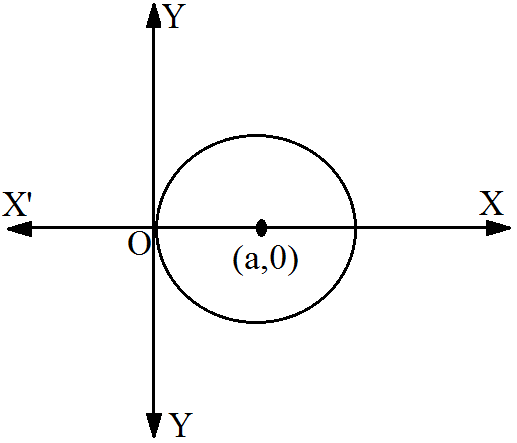
Differentiating equation (1) with respect to x, get: $2\text{x} + 2\text{yy}'=2\text{a}$ $\Rightarrow \text{x}+\text{yy}' = \text{a}$ Now, on substituting the value of a in equation (1), we get: $\text{x}^2+\text{y}^2 = 2 (\text{x+yy}')\text{x}$ $\Rightarrow \text{x}^2+\text{y}^2=2\text{x}^2+2\text{xyy}'$ $\Rightarrow 2\text{xyy}' + \text{x}^2=\text{y}^2$ This is the required differential equation. View full question & answer→Question 1225 Marks
Solve the following differential equation
$(\text{x}^2+1)\frac{\text{dy}}{\text{dx}}=1$
AnswerWe have,
$(\text{x}^2+1)\frac{\text{dy}}{\text{dx}}=1$
$\Rightarrow\text{dy}=\frac{1}{\text{x}^2+1}$
Intergrating both sides, we get
$\Rightarrow\int\text{dy}=\int\Big(\frac{1}{\text{x}^2+1}\Big)\text{dx}$
$\Rightarrow\text{y}=\tan^{-1}\text{x}+\text{C}$
so, $\Rightarrow\text{y}=\tan^{-1}\text{x}+\text{C}$ is defined for all $\text{x}\in\text{R}$ except x = 0
Hence, $\Rightarrow\text{y}=\tan^{-1}\text{x}+\text{C}$, where $\text{x}\in\text{R}-\{0\},$ is the solution o the given differential equation.
View full question & answer→Question 1235 Marks
For each of the differential equation in find the particular solution satisfying the given condition:$\text{x}^2\ \text{dy}+(\text{xy}+\text{y}^2)\ \text{dx}=0;\ \text{y}=1\ \text{when}\ \text{x}=1$
AnswerGiven: Differential equation $\text{x}^2\ \text{dy}+(\text{xy}+\text{y}^2)\ \text{dx}=0$ $\Rightarrow\ \ \text{x}^2\ \text{dy}-(\text{xy}+\text{y}^2)\ \text{dx}\ \ $ $\Rightarrow\ \ \frac{\text{dy}}{\text{dx}}=-\frac{\text{y}(\text{x}+\text{y})}{\text{x}^2}=-\frac{\text{xy}\Big(1+\frac{\text{y}}{\text{x}}\Big)}{\text{x}^2}$ $\Rightarrow\ \ \frac{\text{dy}}{\text{dx}}=-\frac{\text{y}}{\text{x}}\Big(1+\frac{\text{y}}{\text{x}}\Big)=f\Big(\frac{\text{y}}{\text{x}}\Big)\ \ ...\text{(i)}$ Therefore the given differential equation is homogeneous. $\text{Putting}\frac{\text{y}}{\text{x}}=\text{v}\ \ \Rightarrow\ \ \text{y}=\text{vx}\ \ $ $\Rightarrow\ \ \frac{\text{dy}}{\text{dx}}=\text{v}+\text{x}\frac{\text{dv}}{\text{dx}}$ $\text{Putting these values of}\ \frac{\text{y}}{\text{x}}\ \text{and}\ \frac{\text{dv}}{\text{dx}}\ \text{in eq. (ii), we have}$ $\text{v}+\text{x}\frac{\text{dv}}{\text{dx}}=-\text{v}(1+\text{v})=-\text{v}-\text{v}^2\ \ $ $\Rightarrow\ \ \text{x}\frac{\text{dv}}{\text{dx}}=-\text{v}^2-2\text{v}$ $\Rightarrow\ \ \text{x}\frac{\text{dv}}{\text{dx}}=-\text{v}(\text{v}+2)\ \ \Rightarrow\ \ \frac{\text{dv}}{\text{v}(\text{v}+2)}=-\frac{\text{dx}}{\text{x}}$ $\text{Integrating both sides,}$ $\ \ \int\frac{1} {\text{v}(\text{v}+2)}\text{dv}=-\int\frac{1}{\text{x}}\text{dx}$ $\Rightarrow\ \ \frac{1}{2}\int\frac{2} {\text{v}(\text{v}+2)}\text{dv}=-\log|\text{x}|+\log|\text{c}|\ \ $ $\Rightarrow\ \ \frac{1}{2}\int\frac{(\text{v}+2)-\text{v}}{\text{v}(\text{v}+2)}\ \text{dv}=-\log|\text{x}|+\log|\text{c}|$ $\Rightarrow\ \ \int\Big(\frac{1}{\text{v}}-\frac{1}{\text{v+2}}\Big)\text{dv}=-2\log|\text{x}|+\log|\text{c}|$ $\Rightarrow\ \ \log\Big|\frac{\text{v}}{\text{v}+2}\Big|=\log\big|\text{x}^{-2}\big|+\log|\text{c}|$ $\Rightarrow\ \ \log\Big|\frac{\text{v}}{\text{v}+2}\Big|=\log\big|\text{cx}^{-2}\big|\ \ $ $\Rightarrow\ \ \frac{\text{v}}{\text{v}+2}=\pm\text{cx}^{-2}$ $\text{Putting}\ \text{v}=\frac{\text{y}}{\text{x}},\ \ \frac{\frac{\text{y}}{\text{x}}}{\frac{\text{y}}{\text{x}}+2}=\pm\text{cx}^{-2}\ \ $ $\Rightarrow\ \ \frac{\text{y}}{\text{y}+2\text{x}}=\pm\text{cx}^{-2}$ $\Rightarrow\ \ \text{x}^{2}\text{y}=\text{C}(\text{y}+2\text{x})\ \ \text{where C}=\pm\text{c}\ \ .....(\text{ii})$ Now putting x = 1 and y = 1 in eq. (ii), we get $1=3\text{C}\ \ \Rightarrow\ \ \text{C}=\frac{1}{3}$Putting value of C in eq. (ii),
$\text{x}^{2}\text{y}=\frac{1}{3}(\text{y}+2\text{x})\ \ \Rightarrow\ \ 3\text{x}^2\text{y}=\text{y}+2\text{x}$
View full question & answer→Question 1245 Marks
The rate of growth of a population is proportional to the number present. If the population of a city doubled in the past 25 year, and the present population is 100000, when will the city have a population of 500000?
AnswerLet the origional population be N and the population at any time t be P.
Given: $\frac{\text{dP}}{\text{dt}}\propto\text{P}$
$\Rightarrow\frac{\text{dP}}{\text{dt}}=\text{aP}$
$\Rightarrow\frac{\text{dP}}{\text{P}}=\text{a}\text{dt}$
$\Rightarrow\log|\text{P}|=\text{at}+\text{C}\ ...(\text{i})$
Now,
$\text{P}=\text{N}$ at $\text{t}=0$
Putting $\text{P}=\text{N}$ at $\text{t}=0$ in (i), we get
$\log|\text{N}|=\text{C}$
Putting $\text{C}=\log|\text{N}|$ in (i), we get
$\log|\text{P}|=\text{at}+\log|\text{N}|$
$\Rightarrow \text{log}|\frac{\text{P}}{\text{N}}|=\text{at}\ ...(\text{ii})$
According to the question,
$\log|\frac{2\text{N}}{\text{N}}|=25\text{a}$
$\Rightarrow\ \text{a}=\frac{1}{25}\log|2|$
$=\frac{1}{25}\times0.6931=0.0277$
Putting $\text{a}=0.0277$ in (ii), we get
$\log|\frac{\text{P}}{\text{N}}|=0.0277 \text{t}\ ...(\text{iii})$
For $\text{P}=500000$ and $\text{N}=100000$
$\log|\frac{500000}{100000}|=0.0277 \text{t}$
$\Rightarrow \text{t}=\frac{\log\ 5}{0.0277}=\frac{1.609}{0.0277}$
$=58.08\ \text{year}$
View full question & answer→Question 1255 Marks
Solve the following differential equations:$\frac{\text{dy}}{\text{dx}}=\frac{\text{x}(2\log\text{x}+1)}{\sin\text{y + y}\cos\text{y}}$
Answerwe have, $\frac{\text{dy}}{\text{dx}}=\frac{\text{x}(2\log\text{x}+1)}{\sin\text{y + y}\cos\text{y}}$
$\Rightarrow(\sin\text{y+y}\cos\text{y})\text{dy = x}(2\log\text{x}+1)\text{dx}$
Integrating both sides, we get
$\int(\sin\text{y+y}\cos\text{y})\text{dy}=\int\text{x}(2\log\text{x}+1)\text{dx}$
$\Rightarrow\int\sin\text{y dy}+\int\text{y}\cos\text{y dy }=2\int\text{x}\log\text{x dx}+\int\text{x dx}$
$\Rightarrow-\cos\text{y}+\Big[\text{y}\int\cos\text{y dy}-\int\Big\{\frac{\text{d}}{\text{dy}}\text{(y)}\int\cos\text{y dy}\Big\}\text{dy}\Big]\\=2\Big[\log\text{x}\int\text{x dx}-\int\Big\{\frac{\text{d}}{\text{dx}}(\log\text{x})\int\text{x dx}\Big\}\text{dx}\Big]+\frac{\text{x}^2}{2}$
$\Rightarrow-\cos\text{y}+\Big[\text{y}\sin\text{y}-\int\sin\text{y dy}\Big]=2\Big[\log\text{x}\times\frac{\text{x}^2}{2}-\int\frac{1}{\text{x}}\times\frac{\text{x}^2}{2}\Big]+\frac{\text{x}^2}{2}$
$\Rightarrow-\cos\text{y+y}\sin\text{y}+\cos\text{y}=\text{x}^2\log\text{x}-\frac{\text{x}^2}{2}+\frac{\text{x}^2}{2}+\text{C}$
$\Rightarrow\text{y}\sin\text{y}=\text{x}^2\log\text{x + C}$
Hence, $\text{y}\sin\text{y = x}^2\log\text{x + C}$ is the required solution.
View full question & answer→Question 1265 Marks
At any point (x, y) of a curve, the slope of the tangent is twice the slope of the line segment joining the point of contact to the point (–4, –3). Find the equation of the curve given that it passes through (–2, 1).
AnswerLet y = f(x) be equation of curve. $\text{Now}\frac{\text{dy}}{\text{dx}}$ is the slope of the tangent to the curve at the point (x, y) From the given condition,$\frac{\text{dy}}{\text{dx}}=2\bigg[\frac{-3-\text{y}}{-4-\text{x}}\bigg]\ \text{or}\ \frac{\text{dy}}{\text{dx}}=2\bigg[\frac{\text{y}+3}{\text{x}+4}\bigg]$
Separating the variables, we get,$\frac{1}{\text{y}+3}\text{dy}=\frac{2}{\text{x}+4}\text{dx}$
$\text{Integrating},\ \int\frac{1}{\text{y}+3}\text{dy}=\int\frac{2}{\text{x}+4}\text{dx}$
$\therefore\ \log|\text{y}+3|=2\log|\text{x}+4|+\text{c}\ ...(1)$
Since curve passe through (-2, 1)$\therefore\ \log|1+3|=2\log|-2+4|+\text{c}$
$\therefore\log4=2\log2+\text{c}\ \ \Rightarrow\ \ 2\log2$ $=2\log2+\text{c}\ \ \Rightarrow\ \ \text{c}=0$
$\therefore\text{from}(1),\ \log|\text{y}+3|=2\log|\text{x}+4|$
$\text{or}\ \log|\text{y}+3|=\log|\text{x}+4|^2$
$\therefore\ |\text{y}+3|=|\text{x}+4|^2\ \text{or}\ \text{y}+3=(\text{x}+4)^2$
which is required equation of curve.
View full question & answer→Question 1275 Marks
Solve the following differential equations:$\tan\text{y}\frac{\text{dy}}{\text{dx}}=\sin(\text{x}+\text{y})+\sin(\text{x}-\text{y})$
Answer$\tan\text{y}\frac{\text{dy}}{\text{dx}}=\sin(\text{x}+\text{y})+\sin(\text{x}-\text{y})$
$\tan\text{y}\frac{\text{dy}}{\text{dx}}=2\sin\Big\{\frac{(\text{x + y})+(\text{x}-\text{y})}{2}\Big\}\cos\Big\{\frac{(\text{x + y})-(\text{x}-\text{y})}{2}\Big\}$
$=2\sin\Big(\frac{\text{x + y + x}-\text{y}}{2}\Big)\cos\Big(\frac{\text{x + y}-\text{ x}+\text{y}}{2}\Big)$
$\tan\text{y}\frac{\text{dy}}{\text{dx}}=2\sin\text{x}\cos\text{y}$
$\frac{\tan\text{y}}{\cos\text{y}}\text{dy}=2\sin\text{x dx}$
$\int\sec\text{y}\tan\text{y dy}=2\int\sin\text{x dx}$
$\sec\text{y}=-2\cos\text{x + C}$
$\sec\text{y}+2\cos\text{x = C}$
View full question & answer→Question 1285 Marks
The slope of a curve at each of its points is equal to the square of the abscissa of the point. Find the particular curve through the point $(−1, 1).$
AnswerGiven,
Slope of tangent at $(x, y) = x^2$
$\frac{\text{dy}}{\text{dx}}=\text{x}^{2}$
$\text{dy}=\text{x}^{2}\text{dx}$
$\int \text{dy}=\int\text{x}^{2}\text{dx}$
$\text{y}=\frac{\text{x}^{3}}{3}+\text{C}\ ...(\text{i})$
It is passing through $(-1, 1)$
$1=\frac{(-1)}{3}+\text{C}$
$1=-\frac{1}{3}+\text{C}$
$\text{C}=\frac{4}{3}$
Put is equation,
$\text{y}=\frac{\text{x}^{3}}{3}+\frac{4}{3}$
$3\text{y}=\text{x}^{3}+{4}$
View full question & answer→Question 1295 Marks
Solve the following differential equation:
$(\text{x}-\text{y})\frac{\text{dy}}{\text{dx}}=\text{x + 2y}$
AnswerHere, $(\text{x}-\text{y})\frac{\text{dy}}{\text{dx}}=\text{x + 2y}$
$\Rightarrow\ \frac{\text{dy}}{\text{dx}}=\frac{\text{x}+2\text{y}}{\text{x}-\text{y}}$
It is a homogeneous equation.
Put x = vy
and $\frac{\text{dy}}{\text{dx}}=\text{v + x}\frac{\text{dv}}{\text{dx}}$
So,
$\text{v + x}\frac{\text{dv}}{\text{dx}}=\frac{\text{x}+2\text{vx}}{\text{x}-\text{vx}}$
$\text{x}\frac{\text{dv}}{\text{dx}}=\frac{1+2\text{v}}{1+\text{v}}-\text{v}$
$\text{x}\frac{\text{dv}}{\text{dx}}=\frac{1+2\text{v}-\text{v + v}^2}{1-\text{v}}$
$\text{x}\frac{\text{dv}}{\text{dx}}=\frac{1+\text{v + v}^2}{1-\text{v}}$
$\frac{1-\text{v}}{\text{v}^2+\text{v}+1}\text{dv}=\frac{\text{dx}}{\text{x}}$
$-\frac{\text{v}-1}{\text{v}^2+\text{v}+1}\text{dv}=\frac{\text{dx}}{\text{x}}$
$\frac{1}2\times\frac{2\text{v}-2}{\text{v}^2+\text{v}+1}\text{dv}=\frac{-\text{dx}}{\text{x}}$
$\int\frac{(2\text{v}+1)-3}{\text{v}^2+\text{v}+1}\text{dv}=-\int\frac{2\text{dx}}{\text{x}}$
$\int\frac{2\text{v}+1}{\text{v}^2+\text{v}+1}\text{dv}-\int\frac{3}{\text{v}^2+2\text{v}\big(\frac{1}2\big)+\big(\frac{1}2\big)^2-\big(\frac{1}2\big)^2+1}=-2\int\frac{\text{dx}}{\text{x}}$
$\int\frac{2\text{v}+1}{\text{v}^2+\text{v}+1}\text{dv}-\int\frac{3}{\big(\text{v}+\frac{1}2\big)^2+\big(\frac{\sqrt3}2\big)^2}\text{dv}=-2\int\frac{\text{dx}}{\text{x}}$
$\log|\text{v}^2+\text{v}+1|-3\Big(\frac{2}{\sqrt3}\Big)\tan^{-1}\Bigg(\frac{\text{v}+\frac{1}2}{\frac{\sqrt3}{2}}\Bigg)=-2\log|\text{x}|+\text{C}$
$\log|\text{y}^2+\text{xy}+\text{x}^2|=2\sqrt3\tan^{-1}\Big(\frac{2\text{y + x}}{\text{x}\sqrt3}\Big)+\text{C}$
View full question & answer→Question 1305 Marks
If y(x) is a solution of the different equation $\Big(\frac{2+\sin\text{x}}{1+\text{y}}\Big)\frac{\text{dy}}{\text{dx}}=-\cos\text{x}$ and $\text{y}(0)=1,$ then find the value of $\text{y}\Big(\frac{\pi}{2}\Big).$
AnswerConsider the given equation
$\Big(\frac{2+\sin\text{x}}{1+\text{y}}\Big)\frac{\text{dy}}{\text{dx}}=-\cos\text{x}$
$\Rightarrow\frac{\text{dy}}{(1+\text{y})}=\frac{-\cos\text{x dx}}{(2+\sin\text{x})}$
Integrating both the sides,
$\Rightarrow\int\frac{\text{dy}}{(1+\text{y})}=\int\frac{-\cos\text{x dx}}{(2+\sin\text{x})}$
$\Rightarrow\log(1+\text{y})=-\log(2+\sin\text{x})+\log\text{C}$
$\Rightarrow\log(1+\text{y})+\log(2+\sin\text{x})=\log\text{C}$
$\Rightarrow\log(1+\text{y})(2+\sin)\text{x}=\log\text{C}$
$\Rightarrow(1+\text{y})(2+\sin\text{x})=\text{C}...(1)$
Given that $\text{y}(0)=1$
$\Rightarrow(1+1)(2+\sin0)=\text{C}$
$\Rightarrow\text{C}=4$
Substituting the value of C in equation (1) we have,
$\Rightarrow(1+\text{y})(2+\sin\text{x})=4$
$\Rightarrow(1+\text{y})=\frac{4}{(2+\sin\text{x})}$
$\Rightarrow\text{y}=\frac{4}{(2+\sin\text{x})}-1...(2)$
We need to find the value of $\text{y}\Big(\frac{\pi}{2}\Big)$
Substituting the value of $\text{x}=\frac{\pi}{2}$ in equation (2), we get,
$\text{y}=\frac{4}{\Big(2+\sin\frac{\pi}{2}\Big)}-1$
$\Rightarrow\text{y}=\frac{4}{(2+1)}-1$
$\Rightarrow\text{y}=\frac{4}{3}-1$
$\Rightarrow\text{y}=\frac{1}{3}$
Note: Answer given in the book is incorrect.
View full question & answer→Question 1315 Marks
Find the particular solution of $\text{e}^{\frac{\text{dy}}{\text{dx}}}=\text{x}+1,$ that $\text{y}=3,$ when $\text{x}=0.$
Answer$\text{e}^{\frac{\text{dy}}{\text{dx}}}=\text{x}+1$
$\frac{\text{dy}}{\text{dx}}=\log(\text{x}+1),\text{y}=3$ at $\text{x}=0$
$\int\text{dy}=\int\log(\text{x}+1)\text{dx}$
$\text{y}=\log|\text{x}+1|\times\int1\times\text{dx}-\int\Big(\frac{1}{\text{x}+1}\times\int1\text{dx}\Big)\text{dx}+\text{C}$
Using integration by parts
$\text{y = x}\log|\text{x}+1|-\int\frac{\text{x}}{\text{x}+1}\text{dx}+\text{C}$
$\text{y = x}\log|\text{x}+1|-\Big(\int\Big(1-\frac{1}{\text{x}+1}\Big)\text{dx}\Big)+\text{C}$
$=\text{x}\log|\text{x}+1|-(\text{x}-\log|\text{x}+1|)+\text{C}$
$\text{y = x}\log|\text{x}+1|-\text{x}+\log|\text{x}+1|+\text{C}$
$\text{y}=(\text{x}+1)\log|\text{x}+1|-\text{x + C}$
Put $\text{y}=3$ and $\text{x}=0$
$3=0-0+\text{C}$
$\text{C}=3$
Put $\text{C}=3$ in equation (1),
$\text{y}=(\text{x}+1)\log|\text{x}+1|-\text{x}+3$
View full question & answer→Question 1325 Marks
Find the solution of $\frac{\text{dy}}{\text{dx}}=2^\text{y-x}.$
AnswerGiven that, $\frac{\text{dy}}{\text{dx}}=2^\text{y-x}$
$\Big[\because\text{a}^\text{m-n}=\frac{\text{a}^\text{m}}{\text{a}^\text{n}}\Big]$
$\Rightarrow\frac{\text{dy}}{\text{dx}}=\frac{2^\text{y}}{2^\text{x}}$
$\Rightarrow\frac{\text{dy}}{2^\text{y}}=\frac{\text{dx}}{2^\text{x}}$
On integrating both sides, we get
$\int2^\text{-y}\text{dy}=\int2^\text{x}\text{dx}$
$\Rightarrow\frac{-2^\text{-y}}{\log2}=\frac{-2^\text{-x}}{\log2}+\text{C}$
$\Rightarrow-2^\text{-y}+2^\text{-x}=+\text{C}\log2$
$\Rightarrow-2^\text{-x}+2^\text{-x}=+\text{C}\log2$
$\Rightarrow2^\text{-x}-2^\text{-y}=-\text{C}\log2$
$\Rightarrow2^\text{-x}-2^\text{-y}=\text{K}$ $[\text{where}, \text{K} = +\text{C}\log2]$
View full question & answer→Question 1335 Marks
Form the differential equation of the family of circles in the first quadrant which touch the coordinate axes.
Answer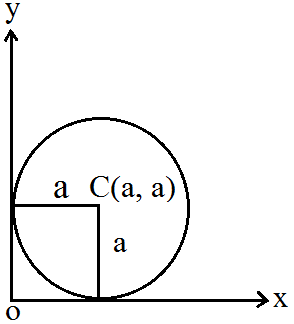 We know that the circle in the first quadrant which touches the co-ordinates axes has centre (a, a) where a is the radius of the circle.
$\therefore\ \ \text{Equation of the circle is}$
$(\text{x}-\text{a})^2+(\text{y}-\text{a})^2=\text{a}^2\ \ ....\text{(i)}$
$\Rightarrow\ \ \text{x}^2+\text{y}^2-2\text{ax}-2\text{ay}+\text{a}^2=0$
$\text{Differentiating with respect to x; 2x}+2\text{yy}'-2\text{a}-2\text{ay}'=0$
$\Rightarrow\ \ \text{x}+\text{yy}'-\text{a}-\text{ay}'=0$
$\Rightarrow\ \ \text{x}+\text{yy}'=\text{a}(1+\text{y}')\ \ \Rightarrow\ \ \text{a}=\frac{\text{x}+\text{yy}'}{1+\text{y}'}$
$\text{Substituting value of a in eq. (i),}$ $\Big(\text{x}-\frac{\text{x}+\text{yy}'}{1+\text{y}'}\Big)^2+\Big(\text{y}-\frac{\text{x}+\text{yy}'}{1+\text{y}'}\Big)^2=\Big(\frac{\text{x}+\text{yy}'}{1+\text{y}'}\Big)^2$
$\Rightarrow\ \ \Big(\frac{\text{x}+\text{xy}'-\text{x}+\text{yy}'}{1+\text{y}'}\Big)^2+\Big(\frac{\text{y}+\text{yy}'-\text{x}-\text{yy}'}{1+\text{y}'}\Big)^2=\Big(\frac{\text{x}+\text{yy}'}{1+\text{y}'}\Big)^2$
$\Rightarrow\ \ (\text{xy}'-\text{yy}')^2+(\text{y}-\text{x})^2=(\text{x}+\text{yy}')^2$ $\Rightarrow\ \ \text{y}'^2(\text{x}-\text{y})^2+(\text{x}-\text{y})^2=(\text{x}+\text{yy}')^2$
$\Rightarrow\ \ (\text{x}-\text{y})^2+(1+\text{y}'^2)=(\text{x}+\text{yy}')^2$ View full question & answer→Question 1345 Marks
Solve the following differential equation
$(\text{x}-1)\frac{\text{dy}}{\text{dx}}=2\text{xy}$
AnswerWe have
$(\text{x}-1)\frac{\text{dy}}{\text{dx}}=2\text{xy}$
$\Rightarrow(\text{x}-1)\text{dy}=2\text{xy dx}$
$\Rightarrow\frac{2\text{x}}{(\text{x}-1)}\ \text{dx}=\frac{1}{\text{y}}\text{ dy}$
Integrating both sides, we get
$2\int\frac{\text{x}}{(\text{x}-1)}\ \text{dx}=\int\frac{1}{\text{y}}\ \text{dy}$
$\Rightarrow2\int\frac{\text{x}-1+1}{\text{x}-1}\ \text{dx}=\int\frac{1}{\text{y}}\ \text{dx}$
$\Rightarrow2\int\text{dx}+2\int\frac{1}{\text{x}-1}\text{dx}=\int\frac{1}{\text{y}}\ \text{dy}$
$\Rightarrow2\text{x}+2\log|\text{x}-1|=\log|\text{y}|+\text{C}$
View full question & answer→Question 1355 Marks
For each of the differential equation in find the particular solution satisfying the given condition:$\Big[\text{x}\sin^{2}\Big(\frac{\text{y}}{\text{x}}\Big)-\text{y}\Big]\ \text{dx} +\text{x dy}=0;\text{y}=\frac{\pi}{4}\ \text{when x}=1$
AnswerGiven: Differential equation $\Big(\text{x}\sin^{2}\frac{\text{y}}{\text{x}}-\text{y}\Big)\ \text{dx} +\text{x dy}=0;\text{y}=\frac{\pi}{4},\ \text{x}=1$
$\Rightarrow\ \ \text{x dy}=-\Big(\text{x}\sin^{2}\frac{\text{y}}{\text{x}}-\text{y}\Big)\ \text{dx}\ \ $ $\Rightarrow\ \ \frac{\text{dy}}{\text{dx}}=-\sin^2\frac{\text{y}}{\text{x}}+\frac{\text{y}}{\text{x}}=f\Big(\frac{\text{y}}{\text{x}}\Big)\ \ ....(\text{i})$
Therefore, the given differential equation is homogeneous.
$\text{Putting}\frac{\text{y}}{\text{x}}=\text{v}\ \ \Rightarrow\ \ \text{y}=\text{vx}\ \ $ $\Rightarrow\ \ \frac{\text{dy}}{\text{dx}}=\text{v}+\text{x}\frac{\text{dv}}{\text{dx}}$
$\text{Putting these values of}\ \frac{\text{y}}{\text{x}}\ \text{and}\ \frac{\text{dv}}{\text{dx}}\ \text{in eq. (ii), we have}$
$\text{v}+\text{x}\frac{\text{dv}}{\text{dx}}=-\sin^2\text{v}+\text{v}\ \ \Rightarrow\ \ \text{x}\frac{\text{dv}}{\text{dx}}=-\sin^2\text{v}$
$\Rightarrow\ \ \frac{\text{dv}}{\sin^2\text{v}}=-\frac{\text{dx}}{\text{x}}\ \ \big[\text{Separating variables}\big]$
$\text{Integrating both sides,}$ $\int\cos\text{ec}^2\text{v dv}=-\int\frac{1}{\text{x}}\ \text{dx}\ \ $ $\Rightarrow\ \ -\cot\text{v}=-\log|\text{x}|+\text{c}$
$\Rightarrow\ \ \cot\text{v}=\log|\text{x}|-\text{c}\ \ $ $\Rightarrow\ \ \cot\frac{\text{y}}{\text{x}}=\log|\text{x}|+\text{c}\ \ \big[\text{Putting}\frac{\text{y}}{\text{x}}=\text{v}\big]\ \ .....\text{(ii)}$
$\text{Now putting y}=\frac{\pi}{4},\text{x}=1\ \text{in eq. (ii),}$ $\cot\frac{\pi}{4}=\log1-\text{c}\ \ \Rightarrow\ \ \text{c}=-1$
Putting the value of c in eq. (ii),
$\cot\frac{\text{y}}{\text{x}}=\log|\text{x}|+1\ \ $ $\Rightarrow\ \ \cot\frac{\text{y}}{\text{x}}=\log|\text{x}|+\log\text{e}\ \ \Rightarrow\ \ \cot\frac{\text{y}}{\text{x}}=\log\text{xe}$
View full question & answer→Question 1365 Marks
Show that $\text{y}=\text{A}\cos2\text{x}+\text{B}\sin2\text{x}$ is a solution of the differential equation $\frac{\text{d}^2\text{y}}{\text{dx}^2}+4\text{y}=0$
AnswerWe have,
$\text{y}=\text{A}\cos2\text{x}+\text{B}\sin2\text{x}\ ...(1)$
Differentiating both sides of equation (1) with respect to 3, we get
$\frac{\text{dy}}{\text{dx}}=-2\text{A}\sin2\text{x}-\text{B}\cos2\text{x}\ ...(2)$
Differentiating both sides of equation (2) with respect to 3, we get
$\frac{\text{d}^2\text{y}}{\text{dx}^2}=-4\text{A}\cos2\text{x}+4\text{B}\sin2\text{x}$
$\Rightarrow\frac{\text{d}^2\text{y}}{\text{dx}^2}=-4(\text{A}\cos2\text{x}+4\text{B}\sin2\text{x})$
$\Rightarrow\frac{\text{d}^2\text{y}}{\text{dx}^2}=-4\text{y}$
$\Rightarrow\frac{\text{d}^2\text{y}}{\text{dx}^2}+4\text{y}=0$
Hence, the given function is the solution to the given differential equation.
View full question & answer→Question 1375 Marks
For each of the differential equations given in find the general solution:
$\frac{\text{dy}}{\text{dx}}+2\text{y}=\sin\text{x}$
AnswerThe given differential equation is $\frac{\text{dy}}{\text{dx}}+2\text{y}=\sin\text{x}.$ This is in the form of $\frac{\text{dy}}{\text{dx}}+\text{py}=\text{Q}$ (where p = 2 and Q = sin x). $\text{Now, I.F}=\text{e}^{\int\text{pdx}}=\text{e}^{\int2\text{dx}}=\text{e}^{2\text{x}}.$The solution of the given differential equation is given by the relation,
$\text{y}(\text{I.F})=\int(\text{Q}\times\text{I.F})\text{dx}+\text{C}$ $\Rightarrow\ \text{ye}^{2\text{x}}=\int\sin\text{x}\cdot\text{e}^{2\text{x}}\text{dx}+\text{C}\ \ ....{(1)}$ $\text{Let}\ I=\int\sin\text{x}\cdot\text{e}^{2\text{x}}.$ $\Rightarrow\ I=\sin\text{x}\cdot\int\text{e}^{2\text{x}}\text{dx}-\int\bigg(\frac{\text{d}}{\text{dx}}(\sin\text{x})\cdot\int\text{e}^{2\text{x}}\text{dx}\bigg)\text{dx}$ $\Rightarrow\ I=\sin\text{x}\cdot\frac{\text{e}^{2\text{x}}}{2}-\int\bigg(\cos\text{x}\cdot\frac{\text{e}^{2\text{x}}}{2}\bigg)\text{dx}$ $\Rightarrow\ I=\frac{\text{e}^{2\text{x}}\sin\text{x}}{2}-\frac{1}{2}\bigg[\cos\text{x}\cdot\int\text{e}^{2\text{x}}-\int\bigg(\frac{\text{d}}{\text{dx}}(\cos\text{x})\cdot\int\text{e}^{2\text{x}}\text{dx}\bigg)\text{dx}\bigg]$ $\Rightarrow\ I=\frac{\text{e}^{2\text{x}}\sin\text{x}}{2}-\frac{1}{2}\bigg[\cos\text{x}\cdot\frac{\text{e}^{2\text{x}}}{2}-\int\bigg[(-\sin\text{x})\cdot\frac{\text{e}^{2\text{x}}}{2}\bigg]\text{dx}\bigg]$ $\Rightarrow\ I=\frac{\text{e}^{2\text{x}}\sin\text{x}}{2}-\frac{\text{e}^{2\text{x}}\cos\text{x}}{4}-\frac{1}{4}\int\big(\sin\text{x}.\text{e}^{2\text{x}}\big)\text{dx}$ $\Rightarrow\ I=\frac{\text{e}^{2\text{x}}}{4}(2\sin\text{x}-\cos\text{x})-\frac{1}{4}I$ $\Rightarrow\ \frac{5}{4}I=\frac{\text{e}^{2\text{x}}}{4}(2\sin\text{x}-\cos\text{x})$ $\Rightarrow\ I=\frac{\text{e}^{2\text{x}}}{5}(2\sin\text{x}-\cos\text{x})$ Therefore, equation (1) becomes: $\text{y}^{2\text{x}}=\frac{\text{e}^{2\text{x}}}{5}(2\sin\text{x}-\cos\text{x})+\text{C}$ $\Rightarrow\ \text{y}=\frac{1}{5}(2\sin\text{x}-\cos\text{x})+\text{C}\text{e}^{-2\text{x}}$ This is the required general solution of the given differential equation.
View full question & answer→Question 1385 Marks
In each of the form a differential equation representing the given family of curves by eliminating arbitrary constants a and b.
$y = ae^{3x} + be^{–2x}$
Answer$y = ae^{3x} + be^{–2x ....(1)}$
Differentiating both sides with respect to x, we get:
$y'= 3ae^{3x} - 2be^{-2x ....(2)}$
Again, differentiating both sides with respect to x, we get:
$y'' = 9ae^{3x} + 4be^{-2x ............(3)}$
Multiplying equation (1) with (2) and then adding it to equation (2), we get:
$(2ae^{3x} + 2be^{-2x}) + (3ae^{3x} - 2bc^{-2x}) = 2y + y'$
$\Rightarrow 5\text{ae}^{3\text{x}} = 2\text{y} + \text{y}'$
$\Rightarrow \text{ae}^{3\text{x}} = \frac{2\text{y}+\text{y}'}{5}$
Now, multiplying equation (1) with 3 and subtracting equation (2) from it, we get:
$(3ae^{3x} + 3be^{-2x}) - (3ae^{3x} - 2be^{-2x}) = 3y - y'$
$\Rightarrow 5\text{be}^{-2\text{x}}= 3\text{y}-\text{y}'$
$\Rightarrow \text{be}^{-2\text{x}} = \frac{3\text{y}-\text{y}'}{5}$
Substituting the values of $ae^{3x}$ and $be^{-2x}$ in equation (3), we get:
$\text{y}''=9\cdot\frac{(2\text{y+y}')}{5}+4\frac{(3\text{y-y}')}{5}$
$\Rightarrow \text{y}''= \frac{18\text{y}+9\text{y}'}{5}+\frac{12\text{y}-4\text{y}'}{5}$
$\Rightarrow{\text{y}''}=\frac{30\text{y}+5\text{y}}{5}'$
$\Rightarrow \text{y}'' = 6\text{y}+\text{y}'$
$\Rightarrow \text{y}'' -\text{y}'-6\text{y}=0$
This is the required differential equation of the given curve.
View full question & answer→Question 1395 Marks
Find the particular solution of the differential equation $\frac{\text{dy}}{\text{dx}}=-4\text{xy}^2$ given that $\text{y}=1.$ when $\text{x}=0.$
AnswerWe have,
$\frac{\text{dy}}{\text{dx}}=-4\text{xy}^2$
$\Rightarrow\frac{1}{\text{y}^2}\text{dy}=-4\text{x dx}$
Integrating both sides, we get
$\int\frac{1}{\text{y}^2}\text{dy}=-4\int\text{x dx}$
$\Rightarrow-\frac{1}{\text{y}}=-4\times\frac{\text{x}^2}{2}+\text{C}$
$\Rightarrow-\frac{1}{\text{y}}=-2\text{x}^2+\text{C}...(1)$
It is given that at $\text{x}=0,\text{y}=1.$
Substituting the valuse of x and y in (1), we get
$\text{C}=-1$
Therefore, substituting the value of C in (1), we get
$-\frac{1}{\text{y}}=-2\text{x}^2-1$
$\Rightarrow\text{y}=\frac{1}{2\text{x}^2+1}$
Hence, $\text{y}=\frac{1}{2\text{x}^2+1}$ is the required solution.
View full question & answer→Question 1405 Marks
Solve the following initial value problems:
$\frac{\text{dy}}{\text{dx}}+2\text{y}=\text{e}^{-2\text{x}}\sin\text{x},\text{ y}(0)=0$
AnswerWe have,
$\frac{\text{dy}}{\text{dx}}+2\text{y}=\text{e}^{-2\text{x}}\sin\text{x}\ ...(\text{i})$
Clearly, it is a linear differential equation of the form
$\frac{\text{dy}}{\text{dx}}+\text{Py}=\text{Q}$
Where $\text{P}=2$ and $\text{Q}=\text{e}^{-2\text{x}}\sin\text{x}$
$\therefore\text{ I.F.}=\text{e}^{\int\text{Pdx}}$
$=\text{e}^{\int2\text{dx}}$
$=\text{e}^{2\text{x}}$
Multiplying both sides of (1) by $\text{I.F.}=\text{e}^{2\text{x}},$ we get
$\text{e}^{2\text{x}}\Big(\frac{\text{dy}}{\text{dx}}+2\text{y}\Big)=\text{e}^{2\text{x}}\text{e}^-{2\text{x}}\sin\text{x}$
$\Rightarrow\text{e}^{2\text{x}}\Big(\frac{\text{dy}}{\text{dx}}+2\text{y}\Big)=\sin\text{x}$
Integrating both sides with respect to x, we get
$\text{y}\text{e}^{2\text{x}}=\int\sin\text{x dx}+\text{C}$
$\Rightarrow\text{y}\text{e}^{2\text{x}}=-\cos\text{x}+\text{C}\ ....(\text{ii})$
Now,
$\text{y}(0)=0$
$\therefore\ 0\times\text{e}^0=-\cos0+\text{C}$
$\Rightarrow\text{C}=1$
Putting the value of C in (2), we get
$\text{y}\text{e}^{2\text{x}}=-\cos\text{x}+1$
$\Rightarrow\text{y}\text{e}^{2\text{x}}=1-\cos\text{x}$
Hence, $\text{y}\text{e}^{2\text{x}}=1-\cos\text{x}$ is the required solution.
View full question & answer→Question 1415 Marks
Solve the differential equation $(\text{y}+3\text{x}^2)\frac{\text{dx}}{\text{dy}}=\text{x}$
AnswerWe have,
$(\text{y}+3\text{x}^2)\frac{\text{dx}}{\text{dy}}=\text{x}$
$\Rightarrow\frac{\text{dy}}{\text{dy}}=\frac{\text{y}+3{\text{x}^{\text{2}}}}{\text{x}}$
$\Rightarrow\frac{\text{dy}}{\text{dx}}-\frac{1}{\text{x}}{\text{y}}=3{\text{x}}\ ...(1)$
Clearly, it is a linear differential equation of the form
$\frac{\text{dy}}{\text{dx}}+\text{Py}=\text{Q}$
Where $\text{P}=-\frac{1}{\text{x}}$ and $\text{Q}=3\text{x}$
$\therefore \ \text{I}.\text{F}. = \text{e}^{\int{\text{P}\text{dx}}}$
$ =\text{e}^{-\int\frac{1}{\text{x}}\text{dx}}$
$=\text{e}^{-\log\text{x}}$
$=\frac{1}{\text{x}}$
Multiplying both sides of (1) by $\text{I.F.}=\frac{1}{\text{x}},$ we get
$\frac{1}{\text{x}}\Big(\frac{\text{dy}}{\text{dx}}-\frac{1}{\text{x}}{\text{y}}\Big)=\frac{1}{\text{x}}3\text{x}$
$\Rightarrow\frac{1}{\text{x}}\frac{\text{dy}}{\text{dx}}-\frac{1}{\text{x}^{2}}\text{y}=3$
Integrating both sides with respect to x, we get
$\frac{1}{\text{x}}\text{y}=3\int\text{dx}+\text{C}$
$\Rightarrow\frac{\text{y}}{\text{x}}=3\text{x}+\text{C}$
Hence, $\frac{\text{y}}{\text{x}}=3\text{x}+\text{C}$ is the required solution.
View full question & answer→Question 1425 Marks
Solve the following differential equations:$\text{x}\sqrt{1-\text{y}^2}\text{dx}+\text{y}\sqrt{1-\text{x}^2}\text{dy}=0$
AnswerWe have,
$\text{x}\sqrt{1-\text{y}^2}\text{dx}+\text{y}\sqrt{1-\text{x}^2}\text{dy}=0$
$\Rightarrow\text{y}\sqrt{1-\text{x}^2}\text{dy}=-\text{x}\sqrt{1-\text{y}^2}\text{dx}$
$\Rightarrow\frac{\text{y}}{\sqrt{1-\text{y}^2}}\text{dy}=-\frac{\text{x}}{\sqrt{1-\text{x}^2}}\text{dx}$
Integrating both sides, we get
$\int\frac{\text{y}}{\sqrt{1-\text{y}^2}}\text{dy}=-\int\frac{\text{x}}{\sqrt{1-\text{x}^2}}\text{dx}$
Substituting $1-\text{y}^2=\text{t}$ and $1-\text{x}^2=\text{u},$ we get
$-2\text{y dy = dt}$ and $-2\text{x dy = du}$
$\therefore\frac{-1}{2}\int\frac{1}{\sqrt{\text{t}}}\text{dt}=\frac{1}{2}\int\frac{1}{\sqrt{\text{u}}}\text{du}$
$\Rightarrow-\text{t}^{\frac{1}{2}}=\text{u}^{\frac{1}{2}}+\text{K}$
$\Rightarrow\sqrt{1-\text{x}^2}+\sqrt{1-\text{y}^2}=-\text{K}$
$\Rightarrow\sqrt{1-\text{x}^2}+\sqrt{1-\text{y}^2}=\text{C}$ (where, C = K)
Hence, $\sqrt{1-\text{x}^2}+\sqrt{1-\text{y}^2}=\text{C}$ is the required solution.
View full question & answer→Question 1435 Marks
Find one-parameter families of solution curves of the following differential equation: (or solve the following differential equation)$\text{e}^{-\text{y}}\sec^2\text{y dy}=\text{dx}+\text{x dy}$
AnswerWe have,
$\text{e}^{-\text{y}}\sec^2\text{y dy}=\text{dx}+\text{x dy}$
$\Rightarrow\text{dx}=\text{e}^{-\text{y}}\sec^2\text{y dy}-\text{x dy}$
$\Rightarrow\frac{\text{dx}}{\text{dy}}=\text{e}^{-\text{y}}\sec^2\text{y}-\text{x}$
$\Rightarrow\frac{\text{dx}}{\text{dy}}+\text{x}=\text{e}^{-\text{y}}\sec^2\text{y}\ ...(1)$
Clearly, it is a linear differential equation of tyhe form
$\frac{\text{dx}}{\text{dy}}+\text{Px}=\text{Q}$
Where
$\text{P}=1$
$\text{Q}=\text{e}^{-\text{y}}\sec^2\text{y}$
$\therefore\ \text{I.F.}=\text{e}^{\int\text{Pdy}}$
$=\text{e}^{\int\text{dy}}$
$=\text{e}^{\text{y}}$
Multiplying both sides of (1) by ey, we get
$\text{e}^{\text{y}}\Big(\frac{\text{dx}}{\text{dy}}+\text{x}\Big)=\text{e}^{\text{y}}\text{e}^{-\text{y}}\sec^2\text{y}$
$\Rightarrow\text{e}^{\text{y}}\frac{\text{dx}}{\text{dy}}+\text{e}^{\text{y}}\text{x}=\sec^2\text{y}$
Integrating both sides with respect to y, we get
$\text{e}^{\text{y}}\text{x}=\int\sec^2\text{y dy}+\text{C}$
$\Rightarrow\text{e}^{\text{y}}\text{x}=\tan\text{y}+\text{C}$
$\Rightarrow\text{x}=(\tan\text{y}+\text{C})\text{e}^{-\text{y}}$
Hence, $\text{x}=(\tan\text{y}+\text{C})\text{e}^{-\text{y}}$ is the required solution.
View full question & answer→Question 1445 Marks
Differential equation $\frac{\text{d}^2\text{y}}{\text{dx}^2}-\text{y}=0,\text{y}(0)=2,\text{y}'(0)=0$Function $\text{y}=\text{e}^\text{x}+\text{e}^{-\text{x}}$
AnswerWe have $\text{y}=\text{e}^{\text{x}}+\text{e}^{\text{-x}} ...(1)$ Differentiating both sides of (1) with respect to x, we get $\frac{\text{dy}}{\text{dx}}=\text{e}^{\text{x}}-\text{e}^{\text{x}} ...(2)$ Differentiating both sides of (2) with respect to x, we get $\frac{\text{d}^{2}\text{y}}{\text{dx}^{2}}=\text{e}^{\text{x}}+\text{e}^{\text{-x}}$
$\Rightarrow\frac{\text{d}^{2}\text{y}}{\text{dx}^{2}}=\text{y}$ [Using (1)]$\Rightarrow\frac{\text{d}^{2}\text{y}}{\text{dx}^{2}}-\text{y}=0$
It is the given differential equation.Therefore, $y = e^x+ e^{-x}$satisfies the given differential equation.
Also, when $x = 0; = e^0+ e^0= 1 + 1, i.e. y(0) = 2.$
And, when $x = 0; y_1= e^0- e^0= 1 - 1, i.e. y'(0) = 0$
Hence, $y = e^x+ e^{-x}$ is the solution to the given initial value problem.
View full question & answer→Question 1455 Marks
Solve the following differential equations:
$\frac{\text{dy}}{\text{dx}}=1+\text{x}+\text{y}^2+\text{xy}^2$ when $\text{y}=0,\text{x}=0$
Answer$\frac{\text{dy}}{\text{dx}}=1+\text{x}+\text{y}^2+\text{xy}^2$
$\frac{\text{dy}}{\text{dx}}=(1+\text{x})(1+\text{y}^2)$
$\frac{1}{(1+\text{y}^2)}\text{dy}=(1+\text{x})\text{dx}$
Integrating on both the sides we get
$\int\frac{1}{(1+\text{y}^2)}\text{dy}=\int(1+\text{x})\text{dx}$
$\tan^{-1}\text{y = x}+\frac{\text{x}^2}{2}+\text{C}...(1)$
Put $\text{y}=0,\text{x}=0$ then
$\tan^{-1}0=0+0+\text{C}$
$\text{C}=0$
From (1) we have
$\tan^{-1}\text{y = x}+\frac{\text{x}^2}{2}$
$\text{y}=\tan\Big(\text{x}+\frac{\text{x}^2}{2}\Big)$
View full question & answer→Question 1465 Marks
Write the minors and cofactors of element of the first column of the following matrices and hence evaluate the determinant in case:
$\text{A}=\begin{vmatrix}0&2&6\\1&5&0\\3&7&1 \end{vmatrix}$
AnswerLet $M_{ij}$ and $C_{ij}$ are respectively the minor and co-factor of the element $a_{ij}$.
Now,
$\text{M}_{11}=\begin{vmatrix}5&0\\7&1 \end{vmatrix}=5-0=5$
$\text{M}_{21}=\begin{vmatrix}2&6\\7&1 \end{vmatrix}=2-42=-40$
$\text{M}_{31}=\begin{vmatrix}2&6\\5&0 \end{vmatrix}=0-30=-30$
$\text{C}_{11}=(-1)^{1+1}\text{M}_{11}=5$
$\text{C}_{21}=(-1)^{2+1}\text{M}_{21}=(-1)(-40)=40$
$\text{C}_{31}=(-1)^{3+1}\text{M}_{31}=(-30)=-30$
Now, expanding the determinant along the first column.
$|\text{A}|=\text{a}_{11}\text{C}_{11}+\text{a}_{21}\text{C}_{21}+\text{a}_{31}\text{C}_{31}$
$=0\times5+1\times(40)+3\times(-30)$
$=40-90$
$=-50$
View full question & answer→Question 1475 Marks
In each of the form a differential equation representing the given family of curves by eliminating arbitrary constants a and b.
$y = e^x (acos\ x + bsin\ x)$
Answer$y = e^x (acos\ x + bsin\ x)$ ....(1)
Differentiating both sides with respect to x, we get:
$\text{y}'=\text{e}^\text{x}(\text{acos x + bsin x)} + \text{e}^\text{x}(-\text{asin x + bcos x})$
$\Rightarrow \text{y}'=\text{e}^\text{x} \big[(\text{a+b)cos x} -(\text{a}-\text{b) sin x} \big] \ ...(2)$
Again, differentiating with respect to x, we get:
$\text{y}''=\text{e}^\text{x}\big[(\text{a + b)cos x} - (\text{a}-\text{b})\text{sin x} \big] + \text{e}^\text{x} \big[-(\text{a+b)sin x} - (\text{a}-\text{b) cos x}\big]$
$\text{y}''=\text{e}^\text{x} [2\text{bcos x - 2asin x]}$
$\text{y}''=2\text{e}^\text{x} (\text{bcos x} - \text{asin x)}$
$\Rightarrow \frac{\text{y}''}{2}=\text{e}^\text{x} (\text{bcos x} - \text{asin x)} \ ....(3)$
Adding equations (1) and (3), we get:
$\text{y}+\frac{\text{y}''}{2}=\text{e}^\text{x}\big[(\text{a+b)cos x} -(\text{a}-\text{b)sin x} \big]$
$\Rightarrow \text{y}+ \frac{\text{y}''}{2}=\text{y}'$
$\Rightarrow 2\text{y}+\text{y}''=2\text{y}'$
$\Rightarrow \text{y}'' - 2\text{y}'+2\text{y}=0$
This is the required differential equation of the given curve.
View full question & answer→Question 1485 Marks
Solve the following differential equation:
$(\text{x}+2\text{y})\text{dx}-(2\text{x}-\text{y})\text{dy}=0$
Answer$(\text{x}+2\text{y})\text{dx}-(2\text{x}-\text{y})\text{dy}=0$$\Rightarrow\ \frac{\text{dy}}{\text{dx}}=\frac{\text{x}+2\text{y}}{2\text{x}-\text{y}}$
This is a homogeneous differential equation. Putting y = vx and $\frac{\text{dy}}{\text{dx}}=\text{v + x}\frac{\text{dv}}{\text{dx}}$, we get $\text{v + x}\frac{\text{dv}}{\text{dx}}=\frac{\text{x}+2\text{vx}}{2\text{x}-\text{vx}}$ $\Rightarrow\ \text{x}\frac{\text{dv}}{\text{dx}}=\frac{1+2\text{v}}{2-\text{v}}-\text{v}$ $\Rightarrow\ \text{x}\frac{\text{dv}}{\text{dx}}=\frac{1+\text{v}^2}{2-\text{v}}$ $\Rightarrow\ \frac{2-\text{v}}{1+\text{v}^2}\text{dv}=\frac{1}{\text{x}}\text{dx}$ Integrating both sides, we get $\int\frac{2-\text{v}}{1+\text{v}^2}\text{dv}=\int\frac{1}{\text{x}}\text{dx}\ \dots(1)$ $\Rightarrow\ \int\frac{2}{1+\text{v}^2}\text{dv}-\int\frac{\text{v}}{1+\text{v}^2}\text{dv}=\int\frac{1}{\text{x}}\text{dx}$ $\Rightarrow\ \int\frac{2}{1+\text{v}^2}\text{dv}-\frac{1}2\int\frac{2\text{v}}{1+\text{v}^2}\text{dv}=\int\frac{1}{\text{x}}\text{dx}$ $\Rightarrow\ 2\tan^{-1}\text{v}-\frac{1}2\log|1+\text{v}^2|=\log|\text{x}|+\log\text{C}$ $\Rightarrow\ 2\tan^{-1}\text{v}=\log|\text{x}|+\log\text{C}+\log\Big|(1+\text{v}^2)^{\frac{1}2}\Big|$ $\Rightarrow\ 2\tan^{-1}\text{v}=\log\Big|\text{Cx}\sqrt{1+\text{v}^2}\Big|$ $\Rightarrow\ \Big|\text{Cx}\sqrt{1+\text{v}^2}\Big|=\text{e}^{2\tan^{-1}\text{v}}$ Putting $\text{v}=\frac{\text{y}}{\text{x}}$, we get $\Rightarrow\ \Bigg|\text{Cx}\sqrt{1+\Big(\frac{\text{y}}{\text{x}}\Big)^2}\Bigg|=\text{e}^{2\tan^{-1}\big(\frac{\text{y}}{\text{x}}\big)}$ $\Rightarrow\ \text{C}\sqrt{\text{x}^2+\text{y}^2}=\text{e}^{2\tan^{-1}\big(\frac{\text{y}}{\text{x}}\big)}$ Hence, $\sqrt{\text{x}^2+\text{y}^2}=\text{Ke}^{2\tan^{-1}\big(\frac{\text{y}}{\text{x}}\big)}$ is the required solution.
View full question & answer→Question 1495 Marks
Form the differential equation of all circles which pass through origin and whose centres lie on Y-axis.
AnswerIt is given that, circles pass through origin and their centres lie on Y-axis. Let (0, k) be the centre of the circle and radius is k.
So, the equation of circle is
$(\text{x}-0)^2+(\text{y}-\text{k})^2=\text{k}^2$
$\Rightarrow\text{x}^2+(\text{y}-\text{k})^2=\text{k}^2$
$\Rightarrow\text{x}^2+\text{y}^2-2\text{ky}=0$
$\Rightarrow\frac{\text{x}^2+\text{y}^2}{2\text{y}}=\text{k}\ ......(\text{i})$
On differentiating Eq. (i) w.r.t.x, we get
$\frac{2\text{y}\Big(2\text{x}+2\text{y}\frac{\text{dy}}{\text{dx}}\Big)-({\text{x}^2+\text{y}^2})\frac{2\text{dy}}{\text{dx}}}{4\text{y}^2}=0$
$\Rightarrow4\text{y}\Big(\text{x}+\text{y}\frac{\text{dy}}{\text{dx}}\Big)-2(\text{x}^2+\text{y}^2)\frac{\text{dy}}{\text{dx}}=0$
$\Big[4\text{y}^2-2(\text{x}^2+\text{y}^2)\Big]\frac{\text{dy}}{\text{dx}}+4\text{xy}=0$
$\Rightarrow(4\text{y}^2-2\text{x}^2-2\text{y}^2)\frac{\text{dy}}{\text{dx}}+4\text{xy}=0$
$\Rightarrow(2\text{y}^2-2\text{x}^2)\frac{\text{dy}}{\text{dx}}+4\text{xy}=0$
$\Rightarrow(\text{y}^2-\text{x}^2)\frac{\text{dy}}{\text{dx}}+2\text{xy}=0$
$\Rightarrow(\text{x}^2-\text{y}^2)\frac{\text{dy}}{\text{dx}}-2\text{xy}=0$
View full question & answer→Question 1505 Marks
Find the curve for which the intercept cut-off by a tangent on x-axis is equal to four times the ordinate of the point of contact.
AnswerLet P(x, y) be the point of contact of tangent and curve y = f(x). It cuts axes at A and B equation P(x, y),
$\text{y}-\text{y}=\frac{\text{dy}}{\text{dx}}(\text{x}-\text{x})$
Put X = 0
$\text{y}-\text{y}=\frac{\text{dy}}{\text{dx}}(-\text{x})$
$\text{y}=\text{y}-\text{x}\frac{\text{dy}}{\text{dx}}$
So, $\text{A}=\big(0, \text{y}-\text{x}\frac{\text{dy}}{\text{dx}}\big)$
Put Y = 0
$\text{0}-\text{y}=\frac{\text{dy}}{\text{dx}}(\text{x}-\text{x})$
$-\text{y}\frac{\text{dx}}{\text{dy}}=\text{x}-\text{x}$
$\text{x}=\text{x}-\text{y}\frac{\text{dx}}{\text{dy}}$
So, $\text{B}=\big( \text{x}-\text{y}\frac{\text{dx}}{\text{dy}}, 0\big)$
Given, (intercepect on x-axis) = 4(ordinate)
$\text{x}-\text{y}\frac{\text{dx}}{\text{dy}}=4\text{y}$
$\text{y}\frac{\text{dx}}{\text{dy}}+4\text{y}=\text{x}$
$\frac{\text{dx}}{\text{dy}}+4=\frac{\text{x}}{\text{y}}$
$\frac{\text{dx}}{\text{dy}}-\frac{\text{x}}{\text{y}}=-4$
It is a linear different with $\frac{\text{dx}}{\text{dy}}+\text{Px}=\text{Q}$
$\text{P}=-\frac{1}{\text{y}}, \text{Q}=-4$
$\text{I.F}=\text{e}^{\int\text{pdy}}$
$=\text{e}^{-\int\frac{1}{\text{y}}\text{dy}}$
$=\text{e}^{-\log\text{y}}$
$=\frac{1}{\text{y}}$
Solution of the equation is given by,
$\text{x}(\text{I.F})=\int\text{Q}(\text{I.F})\text{dy}+\log\text{C}$
$\text{x}\Big(\frac{1}{\text{y}}\Big)=\int(\text{-4})\Big(\frac{1}{\text{y}}\Big)\text{dy}+\log\text{C}$
$\frac{\text{x}}{\text{y}}=-4\log\text{y}+\log\text{C}$
View full question & answer→Question 1515 Marks
Solve the following differential equation
$\frac{\text{dy}}{\text{dx}}=\tan^{-1}\text{x}$
AnswerWe have,
$\frac{\text{dy}}{\text{dx}}=\tan^{-1}\text{x}$
$\Rightarrow\text{dy}=(\tan^{-1}\text{x})\text{dx}$
Integrating both sides, we get
$\int\text{dy}=\int(\tan^{-1}\text{x})\text{dx}$
$\Rightarrow\text{y}=\int1\times\tan^{-1}\text{x}\text{ dx}$
$\Rightarrow\text{y}=\tan^{-1}\text{x}\int\int1\text{dx}-\int\Big[\frac{\text{d}}{\text{dx}}(\tan^{-1}\text{x})\int1\text{dx}\Big]\text{dx}$
$\Rightarrow\text{y}=\text{x}\tan^{-1}\text{x }-\int\frac{\text{x}}{1+\text{x}^2}\text{dx}$
$\Rightarrow\text{y}=\text{x}\tan^{-1}\text{x}-\frac{1}{2}\int\frac{2\text{x}}{1+\text{x}^2}\text{ dx}$
$\Rightarrow\text{y}=\text{x}\tan^{-1}\text{x}-\frac{1}{2}\log|1+\text{x}^2|+\text{C}$
So, $\text{y}=\text{x}\tan^{-1}\text{x}-\frac{1}{2}\log|1+\text{x}^2|+\text{C}$ is defined for all $\text{x}\in\text{R}$
Hence, $\text{y}=\text{x}\tan^{-1}\text{x}-\frac{1}{2}\log|1+\text{x}^2|+\text{C}$ is the solution o the given differential equation.
View full question & answer→Question 1525 Marks
Form the differential equation by eliminating A and B in $Ax^2 + By^2 = 1.$
AnswerGiven equation is $Ax^2 + By^2 = 1$
On differentiating both sides w.r.t.x, we get
$2\text{Ax}+2\text{By}\frac{\text{dy}}{\text{dx}}=0$
$\Rightarrow2\text{By}\frac{\text{dy}}{\text{dx}}=-2\text{Ax}$
$\Rightarrow\text{By}\frac{\text{dy}}{\text{dx}}=-\text{Ax}$
$\Rightarrow\frac{\text{y}}{\text{x}}.\frac{\text{dy}}{\text{dx}}=-\frac{\text{A}}{\text{B}}$
Again, differentiating w.r.t.x, we get
$\frac{\text{y}}{\text{x}}.\frac{\text{d}^2\text{y}}{\text{d}\text{x}^2}+\frac{\text{dy}}{\text{dx}}.\bigg(\frac{\text{x}\frac{\text{dy}}{\text{dx}}-\text{y}}{\text{x}^2}\bigg)=0$
$\Rightarrow\frac{\text{y}}{\text{x}}.\frac{\text{d}^2\text{y}}{\text{d}\text{x}^2}+\frac{\text{x}\Big(\frac{\text{dy}}{\text{dx}}\Big)^2-\text{y}\Big(\frac{\text{dy}}{\text{dx}}\Big)}{\text{x}^2}=0$
$\Rightarrow\text{xy}\frac{\text{d}^2\text{y}}{\text{dx}^2}+\text{x}\Big(\frac{\text{d}\text{y}}{\text{dx}}\Big)^2-\text{y}\Big(\frac{\text{d}\text{y}}{\text{dx}}\Big)=0$
$\Rightarrow\text{xy}\text{y}''+\text{x}(\text{y}')^2-\text{y}\text{y}'=0$
View full question & answer→Question 1535 Marks
Solve the following initial value problems:
$\text{x}\frac{\text{dy}}{\text{dx}}-\text{y + x}\sin\Big(\frac{\text{y}}{\text{x}}\Big)=0,\text{y}(2)=\text{x}$
Answer$\text{x}\frac{\text{dy}}{\text{dx}}-\text{y + x}\sin\Big(\frac{\text{y}}{\text{x}}\Big)=0,\text{y}(2)=\text{x}$
It is a homogeneous equation. put y = vx
and $\frac{\text{dy}}{\text{dx}}=\text{v + x}\frac{\text{dv}}{\text{dx}}$
So, $\text{v + x}\frac{\text{dv}}{\text{dx}}=\frac{\text{vx}}{\text{x}}-\sin\Big(\frac{\text{vx}}{\text{x}}\Big)$
$\text{x}\frac{\text{dv}}{\text{dx}}=-\sin\text{v}$
$\frac{\text{dv}}{\sin\text{v}}=-\frac{\text{dx}}{\text{x}}$
$\text{cosec(v)dv}=-\frac{\text{dx}}{\text{x}}$
integrating both sides we get,
$\log(\text{cosec(v)}-\cot(\text{v}))=-\log\text{x}+\log\text{c}$
$\log\Big(\text{cosec}\Big(\frac{\text{y}}{\text{x}}\Big)-\cot\Big(\frac{\text{y}}{\text{x}}\Big)\Big)=-\log\text{x}+\log\text{c}$
Putting the values $\text{x}=2$ and $\text{y}=\pi$
$\log\Big(\text{cosec}\Big(\frac{\pi}{2}\Big)-\cot\Big(\frac{\pi}{2}\Big)\Big)=-\log2+\log\text{C}$
$\text{C}=0$
$\log\Big(\text{cosec}\Big(\frac{\text{y}}{\text{x}}\Big)-\cot\Big(\frac{\text{y}}{\text{x}}\Big)\Big)=-\log\text{x}$
View full question & answer→Question 1545 Marks
Solve the following differential equations $\frac{\text{dy}}{\text{dx}}=\frac{2\text{x}(\log\text{x}+1)}{\sin\text{y+y}\cos\text{y}},$ given that $\text{y}=0,$ when $\text{x}=1.$
Answer$\frac{\text{dy}}{\text{dx}}=\frac{2\text{x}(\log\text{x}+1)}{\sin\text{y+y}\cos\text{y}},\text{y}=0$ at $\text{x}=1$
$\int(\sin\text{y+y}\cos\text{y})\text{dy}=\int2\text{x}(\log\text{x}+1)\text{dx}$
$\Rightarrow\int\sin\text{y dy}+\int\text{y}\cos\text{y dy}=\int2\text{x}\log\text{x dx}+2\int\text{x dx}$
$\Rightarrow-\cos\text{y}+\big[\text{y}\times\int\cos\text{y dy}-\int(1\times\int\cos\text{y dy})\text{dy}\big]\\=2\Big[\log\text{x}\int\text{x dx}-\int\Big(\frac{1}{\text{x}}\int\text{x dx}\Big)\text{dx}\Big]+\text{x}^2+\text{C}$
$\Rightarrow-\cos\text{y + y}\sin\text{y}-\int\sin\text{y dy}=2\frac{\text{x}^2}{2}\log\text{x}-2\int\frac{\text{x}}{2}\text{dx}+\text{x}^2+\text{C}$
$\Rightarrow-\cos\text{y + y}\sin\text{y}+\cos\text{y}=\text{x}^2\log\text{x}-\frac{\text{x}^2}{2}+\text{x}^2+\text{C}$
$\text{y}\sin\text{y}=\text{x}^2\log\text{x}+\frac{\text{x}^2}{2}+\text{C}$
Put $\text{y}=0,\text{x}=1$
$0=0+\frac{1}{2}+\text{C}$
$\text{C}=-\frac{1}{2}$
Put $\text{C}=-\frac{1}{2}$ in equation (1),
$\text{y}\sin\text{y = x}^2\log\text{x}+\frac{\text{x}^2}{2}-\frac{1}{2}$
$2\text{y}\sin\text{y}=2\text{x}^2\log\text{x + x}^2-1$
View full question & answer→Question 1555 Marks
Show that $\text{y}=\text{ae}^{2\text{x}}+\text{be}^{-\text{x}}$ is a solution of the differential equation $\frac{\text{d}^2\text{y}}{\text{dx}^2}-\frac{\text{dy}}{\text{dx}}-2\text{y}=0$
AnswerWe have,
$\text{y}=\text{ae}^{2\text{x}}+\text{be}^{-\text{x}}\ ...(1)$
Differentiating both sides of equation (1) with respect to 3, we get
$\frac{\text{dy}}{\text{dx}}=\text{ae}^{2\text{x}}+\text{be}^{-\text{x}}\ ...(2)$
Differentiating both sides of equation (2) with respect to 3, we get
$\frac{\text{d}^2\text{y}}{\text{dx}^2}=4\text{ae}^{2\text{x}}+\text{be}^{-\text{x}}$
$\Rightarrow\frac{\text{d}^2\text{y}}{\text{dx}^2}=2\text{ae}^{2\text{x}}-\text{be}^{-\text{x}}+2\text{ae}^{2\text{x}}+2\text{be}^{-\text{x}}$
$\Rightarrow\frac{\text{d}^2\text{y}}{\text{dx}^2}=\big(2\text{ae}^{2\text{x}}-\text{be}^{-\text{x}}\big)+2\big(\text{ae}^{2\text{x}}+2\text{be}^{-\text{x}}\big)$
$\Rightarrow\frac{\text{d}^2\text{y}}{\text{dx}^2}=\frac{\text{dy}}{\text{dx}}+2\text{y}$
$\Rightarrow\frac{\text{d}^2\text{y}}{\text{dx}^2}-\frac{\text{dy}}{\text{dx}}-2\text{y}=0$
Hence, the given function is the solution to the given differential equation.
View full question & answer→Question 1565 Marks
Solve the following differential equation:
$\big(\text{y}^2-2\text{xy}\big)\text{dx}=\big(\text{x}^2-2\text{xy}\big)\text{dy}$
AnswerHere, $\big(\text{y}^2-2\text{xy}\big)\text{dx}=\big(\text{x}^2-2\text{xy}\big)\text{dy}$
$\Rightarrow\ \frac{\text{dy}}{\text{dx}}=\frac{\text{y}^2-2\text{xy}}{\text{x}^2-2\text{xy}}$
It is a homogeneous equation.
Put y = vx and $\frac{\text{dy}}{\text{dx}}=\text{v + x}\frac{\text{dv}}{\text{dx}}$
So,
$\text{v + x}\frac{\text{dv}}{\text{dx}}=\frac{\text{v}^2\text{x}^2-2\text{xvx}}{\text{x}^2-2\text{xvx}}$
$\text{v + x}\frac{\text{dv}}{\text{dx}}=\frac{\text{v}^2-2\text{v}}{1-2\text{v}}$
$\text{x}\frac{\text{dv}}{\text{dx}}=\frac{\text{v}^2-2\text{v}}{1-2\text{v}}-\text{v}$
$=\frac{\text{v}^2-2\text{v}-\text{v}+2\text{v}^2}{1-2\text{v}}$
$\text{x}\frac{\text{dv}}{\text{dx}}=\frac{3\text{v}^2-3\text{v}}{1-2\text{v}}$
$\frac{1-2\text{v}}{3(\text{v}^2-\text{v})}\text{dv}=\frac{\text{dx}}{\text{x}}$
$\frac{-(2\text{v}-1)}{3(\text{v}^2-\text{v})}\text{dv}=\frac{\text{dx}}{\text{x}}$
$\int\frac{2\text{v}-1}{\text{v}^2-\text{v}}\text{dv}=-3\int\frac{\text{dx}}{\text{x}}$
$\log\big|\text{v}^2-\text{v}\big|-3\log|\text{x}|+\log\text{C}$
$\text{v}^2-\text{v}=\frac{\text{C}}{\text{x}^3}$
$\frac{\text{y}^2}{\text{x}^2}-\frac{\text{y}}{\text{x}}=\frac{\text{C}}{\text{x}^3}$
$\text{y}^2-\text{xy}=\frac{\text{C}}{\text{x}}$
$\text{x}\big(\text{y}^2-\text{xy}\big)=\text{C}$
View full question & answer→Question 1575 Marks
Solve the following differential equations:$\frac{\text{dy}}{\text{dx}}=\frac{\text{e}^{\text{x}}(\sin^2\text{x}+\sin2\text{x})}{\text{y}(2\log\text{y}+1)}$
Answer$\frac{\text{dy}}{\text{dx}}=\frac{\text{e}^{\text{x}}(\sin^2\text{x}+\sin2\text{x})}{\text{y}(2\log\text{y}+1)}$
$\Rightarrow\text{y}(2\log\text{y}+1)\text{dy}=\text{e}^{\text{x}}(\sin^2\text{x}+\sin2\text{x})\text{dx}$
$\Rightarrow(2\text{y}\log\text{y+y})\text{dy}=(\text{e}^{\text{x}}\sin^2\text{x + e}^{\text{x}}\sin2\text{x})\text{dx}$
$\Rightarrow2\text{y}\log\text{y}\text{ dy}+\text{y dy}=\text{e}^{\text{x}}\sin^2\text{x dx}+\text{e}^{\text{x}}\sin2\text{x}\text{ dx}$
Integrating both sides, we get
$2\int\text{y}\log\text{y dy}+\int\text{y dy}=\int\text{e}^{\text{x}}\sin^2\text{x dx}+\int\text{e}^{\text{x}}\sin2\text{x dx}$
$\Rightarrow2\Big[\log\text{y}\int\text{y dy}-\int\Big\{\frac{\text{d}}{\text{dy}}(\log\text{ y})\int\text{y dy}\Big\}\Big]\text{dy}+\int\text{y dy}\\=\sin^2\text{x}\int\text{e}^{\text{x}}\text{dx}-\int\Big[\frac{\text{d}}{\text{dx}}(\sin^2\text{x})\int\text{e}^{\text{x}}\text{dx}\Big]\text{dx}+\int\text{e}^{\text{x}}\sin2\text{x dx} $
$\Rightarrow2\Big[\log\text{y}\Big(\frac{\text{y}^2}{2}\Big)-\int\Big(\frac{1}{\text{y}}\Big)\frac{\text{y}^2}{2}\text{dy}\Big]+\int\text{y dy}\\=\sin^2\text{x }\text{e}^{\text{x}}-\int\big[2\sin\text{x}\cos\text{x}\text{ e}^{\text{x}}\big]\text{dx}+\int\text{e}^{\text{x}}\sin2\text{x dx + C}$
$\Rightarrow\text{y}^2\log\text{ y}-\int\text{y dy}+\int\text{y dy}\\=\text{e}^{\text{x}}\sin^2\text{x}-\int\text{e}^{\text{x}}\sin2\text{x dx}+\int\text{e}^{\text{x}}\sin2\text{x dx + C}$
$\Rightarrow\text{y}^2\log\text{y}=\text{e}^{\text{x}}\sin^2\text{x + C}$
View full question & answer→Question 1585 Marks
Solve the following initial value problems:
$\text{dy}=\cos\text{x}(2-\text{y cosecx})\text{dx}$
AnswerWe have,
$\text{dy}=\cos\text{x}(2-\text{y cosecx})\text{dx}$
$\Rightarrow\frac{\text{dy}}{\text{dx}}=2\cos\text{x}-\text{y}\cot\text{x}$
$\frac{\text{dy}}{\text{dx}}+\text{y}\cot\text{x}=2\cos\text{x}\ ...(1)$
Clearly, it is a linear differential equation of the form
$\frac{\text{dy}}{\text{dx}}+\text{Py}=\text{Q}$
Where $\text{P}=\cot\text{x}$ and $\text{Q}=2\cos\text{x}$
$\therefore\text{ I.F.}=\text{e}^{\int\text{Pdx}}$
$=\text{e}^{\int\cot\text{x dx}}$
$=\text{e}^{\log\sin\text{x}}$
$=\sin\text{x}$
Multiplying both sides of (1) by $\text{I.F.}=\sin\text{x},$ we get
$\sin\text{x}\Big(\frac{\text{dy}}{\text{dx}}+\text{y}\cot\text{x}\Big)=2\sin\text{x }\cos\text{x}$
$\Rightarrow\sin\text{x}\frac{\text{dy}}{\text{dx}}+\text{y}\cos\text{x}=\sin2\text{x}$
Integrating both sides with respect to x, we get
$\text{y}\sin\text{x}=\int\sin2\text{x dx}+\text{C}$
$\Rightarrow\text{y}\sin\text{x}=-\frac{\cos2\text{x}}{2}+\text{C}$
Hence, $\text{y}\sin\text{x}=-\frac{\cos2\text{x}}{2}+\text{C}$ is the required solution.
View full question & answer→Question 1595 Marks
The volume of a spherical balloon being inflated changes at a constant rate. If initially its radius is 3 units and after 3 seconds it is 6 units. Find the radius of the balloon after t seconds.
Answer$\text{V}=\frac{4}{3}\pi\text{r}^3$
Given:
$\frac{\text{dv}}{\text{dt}}=-\text{k}$ (where k > 0)
$\Rightarrow\frac{\text{d}}{\text{dt}}\Big(\frac{4}{3}\pi\text{r}^3\Big)=-\text{k}$
$\Rightarrow4\pi\text{r}^2\frac{\text{dr}}{\text{dt}}=-\text{k}$
$\Rightarrow4\pi\text{r}^{2}\text{dr}=-\text{kdt}$
Integrating both sides, we get
$\int4\pi\text{r}^2\text{dr}=-\int\text{kdt}$
$\frac{4}{3}\pi\text{r}^3=-\text{kt + C}...(1)$
It is given that at $\text{t}=0,\text{r}=3.$
$\text{C}=36\pi$
putting $\text{C}=36\pi$ in (1), we get
$\frac{4}{3}\pi\text{r}^3=-\text{kt}+36\pi...(2)$
It is also given that at $\text{t}=3,\text{r}=6.$
Putting $\text{t}=3$ and $\text{r}=6$ in (1), we get
$288\pi=-3\text{k}+36\pi$
$\Rightarrow\text{k}=-84\pi$
Putting $\text{k}=-84\pi$ in (2), we get
$\frac{4}{3}\pi\text{r}^3=84\pi\text{t}+36\pi$
$\Rightarrow\text{r}^3=63\text{t}+27$
$\Rightarrow\text{r}=(63\text{t}+27)^{\frac{1}{3}}$
View full question & answer→Question 1605 Marks
Solve the following differential equations:$\tan\text{y dx}+\sec^2\text{y}\tan\text{x dy}=0$
AnswerWe have,
$\tan\text{y dx}+\sec^2\text{y}\tan\text{x dy}=0$
$\Rightarrow\sec^2\text{y}\tan\text{x dy}=-\tan\text{y dx}$
$\Rightarrow\frac{\sec^2\text{y}}{\tan\text{y}}\text{dy}=-\frac{1}{\tan\text{x}}\text{dx}$
$\Rightarrow\frac{1}{\cos^2\text{y}}\times\frac{\cos\text{y}}{\sin\text{y}}\text{dy}=-\cot\text{x dx}$
$\Rightarrow\frac{1}{\sin\text{y}\cos\text{y}}\text{dy}=-\cot\text{x dx}$
$\Rightarrow\frac{2}{\sin2\text{y}}\text{dy}=-\cot\text{x dx}$
$\Rightarrow2\text{ cosec }2\text{y dy}=-\cot\text{x dx}$
Integrating both sides, we get
$2\int\text{cosec}\text{ 2y dy}=-\int\cot\text{x dx}$
$\Rightarrow\log\tan\text{x}=-\log\sin\text{x}=\log\text{C}$
$\Rightarrow\log \tan\text{x}+\log\sin\text{x}=\log\text{C}$
$\Rightarrow\log(\tan\text{ x}\times\sin\text{x})=\log\text{C}$
$\Rightarrow\tan\text{x}\times\sin\text{x}=\text{C}$
View full question & answer→Question 1615 Marks
In a bank principal increases at the rate of 5% per year. An amount of Rs $1000$ is deposited with this bank, how much will it worth after $10$ years $(e^{0.5_=}1.648).$
AnswerLet $p$ and t be the principal and time respectively.
It is given that the principal increases continuously at the rate of $5\%$ per year.
$\Rightarrow\frac{\text{dp}}{\text{dt}}=\Big(\frac{5}{100}\Big)\text{p}$
$\Rightarrow\frac{\text{dp}}{\text{dt}}=\frac{\text{P}}{20}$
$\Rightarrow\frac{\text{dp}}{\text{p}}=\frac{\text{dt}}{20}$
Integrating both sides, we get:
$\int\frac{\text{dp}}{\text{p}}=\frac{1}{20}\int\text{dt}$
$\Rightarrow\log\text{p}=\frac{\text{t}}{20}+\text{C}$
$\Rightarrow\text{p}=\text{e}^{\frac{\text{t}}{20}}+\text{C}...(1)$
Now, when $\text{t}=0,\text{P}=1000.$
$1000=\text{e}^{\text{C}}...(2)$
View full question & answer→Question 1625 Marks
The population of a city increases at a rate proportional to the number of inhabitants present at any time t. If the population of the city was 200000 in 1990 and 250000 in 2000, what will be the population in 2010?
AnswerLet the population at any time t be P.
Given: $\frac{\text{dP}}{\text{dt}}\propto\text{P}$
$\Rightarrow\frac{\text{dP}}{\text{dt}}=\beta\text{P}$
$\Rightarrow\frac{\text{dP}}{\text{P}}=\beta\text{dt}$
$\Rightarrow\log|\text{P}|=\beta\text{t}+\log\text{C}\ ...(\text{ii})$
Now,
At t = 1990, P = 200000 and at t = 2000, P = 250000
$\therefore \log 200000=1990\beta+\log\text{C}\ ...(\text{ii})$
$ \log 250000=2000\beta+\log\text{C}\ ...(\text{iii})$
Subtracting (iii) from (ii), we get
$\log 200000-\log25000=10\beta$
$\Rightarrow\beta=\frac{1}{10}\log(\frac{5}{4})$
Putting $\beta=\frac{1}{10}\log(\frac{5}{4})$ in (ii), we get
$\log200000=1990\times\frac{1}{10}\log(\frac{5}{4})+\log\text{C}$
$\Rightarrow\log200000=199\log(\frac{5}{4})+\log\text{C}$
$\Rightarrow\log\text{C}=\log200000-199\log(\frac{5}{4})$
Putting $\beta=\frac{1}{10}\log(\frac{5}{4}), \log\text{C}=\log200000-199\log(\frac{5}{4})$
$\log|\text{P}|=\frac{1}{10}\times2010\log(\frac{5}{4})+\log200000-199\log(\frac{5}{4})$
$\Rightarrow\log|\text{P}|=201\log(\frac{5}{4})+\log200000-199\log(\frac{5}{4})$
$\Rightarrow\log|\text{P}|=\log(\frac{5}{4})^{201}-\log(\frac{5}{4})^{199}+\log200000$
$\Rightarrow\log|\text{P}|=\log\left\{(\frac{5}{4})^{201}\log(\frac{5}{4})^{199}\right\}+\log200000$
$\Rightarrow\log|\text{P}|=\log\left\{(\frac{5}{4})^{2}\right\}+\log200000$
$\Rightarrow\log|\text{P}|=\log\big(\frac{25}{16}\times200000\big)$
$\Rightarrow\log|\text{P}|=\log312500$
$\Rightarrow \text{P}=312500$
View full question & answer→Question 1635 Marks
Solve the following differential equation:
$\text{x}\frac{\text{dy}}{\text{dx}}-\text{y + x}\sin\Big(\frac{\text{y}}{\text{x}}\Big)=0$
AnswerWe have, $\text{x}\frac{\text{dy}}{\text{dx}}-\text{y + x}\sin\Big(\frac{\text{y}}{\text{x}}\Big)=0$ $\Rightarrow\ \frac{\text{dy}}{\text{dx}}=\frac{\text{y + x}\sin\Big(\frac{\text{y}}{\text{x}}\Big)}{\text{x}}$ This is a homogeneous differential equation. Put y = vx and $\frac{\text{dy}}{\text{dx}}=\text{v +x}\frac{\text{dv}}{\text{dx}},$ we get$\text{v +x}\frac{\text{dv}}{\text{dx}}=\frac{\text{vx}-\text{x}\sin\text{v}}{\text{x}}$
$\Rightarrow\ \text{x}\frac{\text{dv}}{\text{dx}}=\text{v}-\sin\text{v}-\text{v}$
$\Rightarrow\ \text{x}\frac{\text{dv}}{\text{dx}}=-\sin\text{v}$
$\Rightarrow\ \text{cosec v dv}=-\frac{1}{\text{x}}\text{dx}$
Integrating both sides, we get$\int\text{cosec v dv}=-\int\frac{1}{\text{x}}\text{dx}$
$\Rightarrow\ -\int\text{cosec v dv}=\int\frac{1}{\text{x}}\text{dx}$
$\Rightarrow\ -\log|\text{cosec v}-\cot\text{v}|=\log|\text{x}|+\log\text{C}$
$\Rightarrow\ \log\Big|\frac{1}{\text{cosec v}-\cot\text{v}}\Big|=\log|\text{Cx}|$
$\Rightarrow\ \log|\text{cosec v}+\cot\text{v}|=\log|\text{Cx}|$
$\Rightarrow\ \log\Big|\frac{1+\cos\text{v}}{\sin\text{v}}\Big|=\log|\text{Cx}|$
$\Rightarrow\ \frac{1+\cos\text{v}}{\sin\text{v}}=\text{Cx}$
$\Rightarrow\ \text{x}\sin\text{v}=\frac{1}{\text{C}}(1+\cos\text{v})$
$\Rightarrow\ \text{x}\sin\text{v}=\text{K}(1+\cos\text{v})$ $\Big($where, $\text{K}=\frac{1}{\text{C}}\Big)$
Putting $\text{v}=\frac{\text{y}}{\text{x}},$ we get
$\Rightarrow\ \text{x}\sin\Big(\frac{\text{y}}{\text{x}}\Big)=\text{K}\Big[1+\cos\Big(\frac{\text{y}}{\text{x}}\Big)\Big]$
Hence, $\text{x}\sin\Big(\frac{\text{y}}{\text{x}}\Big)=\text{K}\Big[1+\cos\Big(\frac{\text{y}}{\text{x}}\Big)\Big]$ is the required solution.
View full question & answer→Question 1645 Marks
Form the differential equation representing the family of ellipses having centre at the origin and foci on x-axis.
Answerwe know that the equation of said family of ellopsis is
$\frac{\text{x}^2}{\text{a}^2}+\frac{\text{y}^2}{\text{b}^2}=1\ ...(1)$
Differentiating (1) w..r.t.x, we get
$\frac{2\text{x}}{\text{a}^2}+\frac{2\text{y}}{\text{b}^2}.\frac{\text{dy}}{\text{dx}}=0$
$\Rightarrow\frac{\text{y}}{\text{x}}\Big(\frac{\text{dy}}{\text{dx}}\Big)=\frac{-\text{b}^2}{\text{a}^2}\ ...(2)$
Differentiating (2) w..r.t.x, we get
$\frac{\text{y}}{\text{x}}\Big(\frac{\text{d}^2\text{y}}{\text{dx}^2}\Big)+\bigg(\frac{\text{x}\frac{\text{dy}}{\text{dx}}-\text{y}}{\text{x}^2}\bigg)\frac{\text{dy}}{\text{dx}}=0$
$\Rightarrow\text{xy}\frac{\text{d}^2\text{y}}{\text{dx}^2}+\text{x}\Big(\frac{\text{dy}}{\text{dx}}\Big)^2-\text{y}\frac{\text{dy}}{\text{dx}}$
Which is the required difeerential equation.
View full question & answer→Question 1655 Marks
Find the general solution of the differential equation $\frac{\text{dy}}{\text{dx}}-{\text{y}}=\cos\text{x}$
AnswerWe have,
$\frac{\text{dy}}{\text{dx}}-{\text{y}}=\cos\text{x}$
Clearly, it is a linear differential equation of the form
$\frac{\text{dy}}{\text{dx}}+\text{P}\text{y}=\text{Q}$
Where P = -1 and $\text{Q}=\cos\text{x}$
$\therefore\text{ I}.\text{F}.=\text{e}^{\int{\text{P}\text{dx}}}$
$=\text{e}^{-\int\text{dx}}$
$=\text{e}^{-\text{x}}$
Multiplying both sides of (1) by $\text{I.F.}=\text{e}^{-\text{x}},$ we get
$\text{e}^{-\text{x}}\Big(\frac{\text{dy}}{\text{dx}}-\text{y}\Big)=\text{e}^{-\text{x}}\cos\text{x}$
$\Rightarrow\text{e}^{-\text{x}}\frac{\text{dy}}{\text{dx}}-\text{e}^{-\text{x}}\text{y}=\text{e}^{-\text{x}}\cos\text{x}$
Integrating both sides with respect to x, we get
$\text{y}\text{e}^{-\text{x}}=\int \ \text{e}^{-\text{x}} \cos\text{x}\text{ dx} \ + \ \text{C}$
$\Rightarrow\text{ye}^{-\text{x}}=\text{I}+\text{C} \ ....(2)$
Here,
$\text{I}=\int\text{e}^{-\text{x}}\cos\text{x}\text{ dx}\ ..(3)$
$\Rightarrow\text{I}=\text{e}^{-\text{x}}\sin{\text{x}}-\int\big(-\text{e}^{-\text{x}}\sin\text{x}\big)\text{dx}$
$\Rightarrow\text{I}=\text{e}^{-\text{x}}\sin\text{x}+\int {\text{e}^{-\text{x}}}\sin\text{x}\text{ dx}$
$\Rightarrow\text{I}= \text{e}^{-\text{x}}\sin \text{x}-\text{e}^{-\text{x}}\cos\text{x}-\int[(-\text{e}^{-\text{x}})\times(-\cos\text{x})]\text{dx}$
$\Rightarrow\text{I}=\text{e}^{-\text{x}}\sin\text{x}-\text{e}^{-\text{x}}\cos\text{x}-\int\text{e}^{-\text{x}}\cos\text{x}\text{ dx}$
$\Rightarrow\text{I}=\text{e}^{-\text{x}}\sin\text{x} - \text{e}^{-\text{x}}\cos\text{x} - \text{I}$ [From (3)]
$ \Rightarrow2\text{I}=\text{e}^{-\text{x}}(\sin\text{x}-\cos\text{x})$
$\Rightarrow\text{I}=\frac{\text{e}^{-\text{x}}}{2}(\sin\text{x}-\cos{\text{x}})\ ...(4)$
From (2) and (4) we get
$\Rightarrow\text{y}\text{e}^{-\text{x}}=\frac{\text{e}^{-\text{x}}}{2}(\sin\text{x} - \cos\text{x})+\text{C}$
$\Rightarrow\text{y}=\frac{1}{2}(\sin\text{x} - \cos\text{x}) +\text{C}\text{e}^{\text{x}}$
Hence, $\text{y}=\frac{1}{2}(\sin\text{x} - \cos\text{x}) +\text{C}\text{e}^{\text{x}}$ is the requires solution.
View full question & answer→Question 1665 Marks
For each of the differential equations given in find the general solution: $\cos^2\text{x}\frac{\text{dy}}{\text{dx}}+\text{y}=\tan\text{x}\Big(0\leq\text{x}<\frac{\pi}{2}\Big)$
AnswerGiven: Differential equation $\cos^2\text{x}\frac{\text{dy}}{\text{dx}}+\text{y}=\tan\text{x}$
$\Rightarrow\ \ \frac{\text{dy}}{\text{dx}}=\frac{\text{y}}{\cos^2\text{x}}=\frac{\tan\text{x}}{\cos^2\text{x}}$ $\Rightarrow\ \ \frac{\text{dy}}{\text{dx}}+(\sec^2\text{x})\text{y}=\sec^2\text{x}\tan\text{x}$
$\text{Comparing with}\frac{\text{dy}}{\text{dx}}+\text{Py}=\text{Q},$ $\text{we have P}=\sec^2\text{x and Q}=\sec^2\text{x}\tan\text{x}.$
$\therefore\ \ \int\text{P dx}=\int\sec^2\text{x dx}=\tan\text{x}\ \ \text{I.F}=\text{e}^{\int\text{P dx}}=\text{e}^{\tan\text{x}}$
$\text{Solution is y (I.F)}=\int\text{Q (I.F.) dx}+\text{c}$ $\Rightarrow\ \ \text{ye}^{\tan\text{x}}=\int\sec^2\text{x}\tan\text{xe}^{\tan\text{x}}\text{dx}+\text{c}\ \ ...\text{(i)}$
$\text{Putting}\tan\text{x}=\text{t and differentiating}\sec^2\text{x dx}=\text{dt}$
$\Rightarrow\ \ \int\sec^2\text{x}\ \tan\text{xe}^{\tan\text{x}}\text{ dx}=\int\text{te}^\text{t}\ \text{dt}$
Applying product rule,
$\Rightarrow\ \ \int\sec^2\text{x}\tan\text{x e}^{\tan\text{x}}$ $\text{dx}=\text{t.e}^\text{t}-\int1.\text{e}^\text{t}\ \text{dt}=\text{t.}\text{e}^\text{t}-\text{e}^\text{t}=(\text{t}-1)\text{e}^\text{t}=(\tan\text{x}-1)\text{e}^{\tan\text{x}}$
Putting this value in eq. (i),
$\text{ye}^{\tan\text{x}}=(\tan\text{x}-1)\text{e}^{\tan\text{x}}+\text{C}$ $\ \ \Rightarrow\ \ \text{y}=(\tan\text{x}-1)\text{e}^{\tan\text{x}}+\text{ce}^{\tan\text{x}}$
View full question & answer→Question 1675 Marks
Solve the following initial value problems:
$\frac{\text{dy}}{\text{dx}}-3\text{y}\cot\text{x}=\sin2\text{x},\text{ y}=2,\text{ when x}=\frac{\pi}{2}$
AnswerWe have,
$\frac{\text{dy}}{\text{dx}}-3\text{y}\cot\text{x}=\sin2\text{x}\ ....(1)$
Clearly, it is a linear differential equation of the form
$\frac{\text{dy}}{\text{dx}}+\text{Py}=\text{Q}$
Where $\text{P}=-3\cot\text{x}$ and $\text{Q}=\sin2\text{x}$
$\therefore\text{ I.F.}=\text{e}^{\int\text{Pdx}}$
$=\text{e}^{-3\int\cot\text{x dx}}$
$=\text{e}^{-3\log|\sin\text{x}|}$
$=\text{cosec}^3\text{x}$
Multiplying both sides of (1) by $\text{I.F.}=\text{cosec}^3\text{x},$ we get
$\text{cosec}^3\text{x}\Big(\frac{\text{dy}}{\text{dx}}-3\text{y}\cot\text{x}\Big)=\sin2\text{x}(\text{cosec}^3\text{x})$
$\Rightarrow\text{cosec}^3\text{x}\Big(\frac{\text{dy}}{\text{dx}}-3\text{y}\cot\text{x}\Big)=2\cot\text{x cosec x}$
Integrating both sides with respect to x, we get
$\text{y }\text{cosec}^3\text{x}=2\int\cot\text{x}\text{ cosec}\text{ x dx}+\text{C}$
$\Rightarrow\text{y }\text{cosec}^3\text{x}=-2\text{cosec}\text{ x}+\text{C}$
$\Rightarrow\text{y}=-2\sin^2\text{x}+\text{C}\sin^3\text{x}\ ...(2)$
Now,
$\text{y}\Big(\frac{\pi}{2}\Big)=2$
$\therefore\ 2=-2\sin^2\frac{\pi}{2}+\text{C}\sin^3\frac{\pi}{2}$
$\Rightarrow\text{C}=4$
Putting the value of C in (2), we get
$\text{y}=-2\sin^2\text{x}+4\sin^3\text{x}$
$\Rightarrow\text{y}=4\sin^3\text{x}-2\sin^2\text{x}$
Hence, $\text{y}=4\sin^3\text{x}-2\sin^2\text{x}$ is the required solution.
View full question & answer→Question 1685 Marks
If the interest is compounded continuously at 6% per annum, how much worth Rs $100$ will be after 10 years? How long will it take to double Rs $1000?$
AnswerLet $P_0$ be the intial amount and $P$ be the amount at any time $t.$ Then,
$\frac{\text{dP}}{\text{dt}}=\frac{6\text{P}}{100}$
$\Rightarrow \frac{\text{dP}}{\text{dt}}=0.06\text{P}$
$\Rightarrow \frac{\text{dP}}{\text{P}}=0.06\text{dt}$
Integrating both sides with respect to t, we get
$\log \text{P}=0.06 \text{t}+\text{C}$
Now,
$\therefore \log\text{P}_{0}=0+\text{C}$
$\Rightarrow \text{C}=\log\text{P}_{0}$
$\log \text{P}=0.06\text{t}+\log\text{P}_{0}$
$\Rightarrow\log\frac{\text{P}}{\text{P}_{0}}=0.06\text{t}$
$\Rightarrow \text{e}^{0.06\text{t}}=\frac{\text{P}}{\text{P}_{0}}$
To find the amount $10$ years, we get
$\Rightarrow \text{e}^{0.06\text{t}\times10}=\frac{\text{P}}{\text{P}_{0}}$
$\Rightarrow \text{e}^{0.6}=\frac{\text{P}}{\text{P}_{0}}$
$\Rightarrow 1.822=\frac{\text{P}}{\text{P}_{0}}$
$\Rightarrow \text{P}=1.822\ \text{P}_{0}$
To find the time after which the amount will doble, we have
$\text{P}=2\text{P}_{0}$
$\therefore \log\frac{2\text{P}_{0}}{\text{P}_{0}}=0.06\text{t}$
$\Rightarrow \log2=0.06\text{t}$
$\Rightarrow \text{t}=\frac{0.6931}{0.06}=11.55 \ \text{years}$
View full question & answer→Question 1695 Marks
Solve the following differential equations:$\cos\text{x}\cos\text{y}\frac{\text{dy}}{\text{dx}}=-\sin\text{x}\sin\text{y}$
AnswerWe have,
$\cos\text{x}\cos\text{y}\frac{\text{dy}}{\text{dx}}=-\sin\text{x}\sin\text{y}$
$\Rightarrow\frac{\cos\text{y}}{\sin\text{y}}\text{dy}=\frac{-\sin\text{x}}{\cos\text{x}}\text{dx}$
$\Rightarrow\cot\text{y dy}=-\tan\text{x dx}$
Integrating both sides, we get
$\int\cot\text{y dy}=-\int\tan\text{x dx}$
$\Rightarrow\log|\sin\text{y}|=-\log|\sec\text{x}|+\log\text{C}$
$\Rightarrow\log |\sin\text{y}|=\log|\cos\text{x}|+\log\text{C}$
$\Rightarrow\sin\text{y}=\text{C}\cos\text{x}$
Hence, $\sin\text{y =C}\cos\text{x}$ is the reguired solution.
View full question & answer→Question 1705 Marks
Solve the following differential equations:$(\text{y + xy})\text{dx}+(\text{x}-\text{xy}^2)\text{dy}=0$
AnswerWe have,
$(\text{y + xy})\text{dx}+(\text{x}-\text{xy}^2)\text{dy}=0$
$\Rightarrow\text{y}(1+\text{x})\text{dx = x}(\text{y}^2-1)\text{dy}$
$\Rightarrow\frac{1+\text{x}}{\text{x}}\text{dx}=\frac{\text{y}^2-1}{\text{y}}\text{dy}$
Integrating both sides, we get
$\int\frac{1+\text{x}}{\text{x}}\text{dx}=\int\frac{\text{y}^2-1}{\text{y}}\text{dy}$
$\Rightarrow\int\frac{1}{\text{x}}\text{dx}+\int\text{dx}=\int\text{y dy}-\int\frac{1}{\text{y}}\text{dy}$
$\Rightarrow\log|\text{x}|+\text{x}=\frac{\text{y}^2}{2}-\log|\text{y}|+\text{C}$
$\Rightarrow\log|\text{x}|+\text{x}-\frac{\text{y}^2}{2}+\log|\text{y}|=\text{C}$
Hence, $\log|\text{x}|+\text{x}-\frac{\text{y}^2}{2}+\log|\text{y}|=\text{C}$ is the required solution.
View full question & answer→Question 1715 Marks
Find the particular solution of the differential equation$(1-\text{y}^2)(1+\log\text{x})\text{dx}+2\text{xy dy}=0,$ given that $\text{y}=0$ when $\text{x}=1.$
AnswerGiven:
$(1-\text{y}^2)(1+\log\text{x})\text{dx}+2\text{xy dy}=0$
$\Rightarrow(1-\text{y}^2)(1+\log\text{x})\text{dx}=-2\text{x y dy}$
$\Rightarrow\Big(\frac{1+\log\text{x}}{2\text{x}}\Big)\text{dx}=-\Big(\frac{\text{y}}{1-\text{y}^2}\Big)\text{dy}...(1)$
Let:
$1+\log\text{x = t}$
and
$(1-\text{y}^2)=\text{p}$
$\Rightarrow\frac{1}{\text{x}}\text{dx dt}$ and $-2\text{y dy = dp}$
Therefore, (1) becomes
$\int\frac{\text{t}}{2}\text{dt}=\int\frac{1}{2\text{p}}\text{dp}$
$\Rightarrow\frac{\text{t}^2}{4}=\frac{\log\text{p}}{2}+\text{C}...(2)$
Substituting the values of t and p in (2) we get
$\frac{(1+\log\text{x})^2}{4}=\frac{\log(1-\text{y}^2)}{2}+\text{C}...(3)$
At $\text{x}=1$ and $\text{y}=0,$ (3) becomes
$\text{C}=\frac{1}{4}$
Substituting the value of C in (3), we get
$\frac{(1+\log\text{x})^2}{4}=\frac{\log(1-\text{y}^2)}{2}+\frac{1}{4}$
$\Rightarrow(1+\log\text{x})^2=2\log(1-\text{y}^2)+1$
Or
$(\log\text{x})^2+\log\text{x}^2=\log(1-\text{y}^2)^2$
It is the required particular solution.
View full question & answer→Question 1725 Marks
Solve the following differential equations:$\text{xy}\frac{\text{dy}}{\text{dx}}=\text{y}+2,\text{y}(2)=0$
AnswerWe have,
$\text{xy}\frac{\text{dy}}{\text{dx}}=\text{y}+2,\text{y}(2)=0$
$\Rightarrow\frac{\text{y}}{\text{y}+2}\text{dy}=\frac{1}{\text{x}}\text{dx}$
Integrating both sides, we get
$\int\frac{\text{y}}{\text{y}+2}\text{dy}=\int\frac{1}{\text{x}}\text{dx}$
$\Rightarrow\int\frac{\text{y}+2-2}{\text{y}+2}\text{dy}=\int\frac{1}{\text{x}}\text{dx}$
$\Rightarrow\int\text{dy}-2\int\frac{1}{\text{y}+2}\text{dy}=\log\text{x + C}$
$\Rightarrow\text{y}-2\log|\text{y}+2|=\log|\text{x}|+\text{C}\dots(1)$
It is given that at $\text{x}=2,\text{y}=0.$
Substituting the valuse of x and y in (1), we get
$-2\log2-\log2=\text{C}$
$\Rightarrow-\log(2^2\times2)=\text{C}$
$\Rightarrow\text{C}=-\log8$
Substituting the value of C in (1), we get
$\text{y}-2\log|\text{y}+2|=\log|\text{x}|-\log8$
$\Rightarrow\text{y}-2\log|\text{y}+2|=\log\Big|\frac{\text{x}}{8}\Big|$
Hence, $\text{y}-2\log|\text{y}+2|=\log\Big|\frac{\text{x}}{8}\Big|$ is the required solution.
View full question & answer→Question 1735 Marks
Solve the following differential equation
$\frac{\text{dy}}{\text{dx}}-\text{x}\text{e}^\text{x}-\frac{5}{2}+\cos^2\text{x}$
Answer$\frac{\text{dy}}{\text{dx}}-\text{x}\text{e}^\text{x}-\frac{5}{2}+\cos^2\text{x}$
$\text{dy}=\Big(\text{xe}^\text{x}-\frac{5}{2}+\cos^2\text{x}\Big)\text{dx}$
$\int\text{dy}=\int\text{xe}^\text{x}\text{dx}-\frac{5}{2}\int\text{dx}+\cos^2\text{x dx}$
$\int\text{dy}=\int\text{xe}^\text{x}\text{dx}-\frac{5}{2}\int\text{dx}+\int\Big(\frac{1+\cos2\text{x}}{2}\Big)\text{dx}$
$=\int\text{xe}^\text{x}-\frac{5}{2}\int\text{dx}+\frac{1}{2}\int\text{dx}+\frac{1}{2}\int\cos2\text{x dx}$
$\int\text{dy}=\int\text{xe}^\text{x}-2\int\text{dx}+\frac{1}{2}\int\cos2\text{x dx}$
$\text{y}=[\text{x}\times\int\text{e}^\text{x}\text{dx}-\int(1\times\int\text{e}^\text{x}\text{dx})\text{dx}]-2\text{x}+\frac{1}{2}\frac{\sin2\text{x}}{2}+\text{C}$
Using integration by parts
$\text{y}=\text{xe}^\text{x}-\text{e}^\text{x}-2\text{x}+\frac{1}{4}\sin2\text{x}+\text{C}$
$\text{y}=\text{xe}^\text{x}-\text{e}^\text{x}-2\text{x}+\frac{1}{4}\sin2\text{x}+\text{C}$
View full question & answer→Question 1745 Marks
The slope of the tangent at a point P(x, y) on a curve is $\frac{-\text{x}}{\text{y}}$. If the curve passs es through the point (3, -4). Find the equation of the curve.
AnswerAccording to the question,
$\frac{\text{dy}}{\text{dx}}=\frac{-\text{x}}{\text{y}}$
$\text{y}\ \text{dy}=-\text{x}\ \text{dx}$
Integrating both sides with respect to x, we get
$\int\text{y}\ \text{dy}=-\int \text{x}\ \text{dx} $
$\Rightarrow \frac{\text{y}^{2}}{2}=-\frac{\text{x}^{2}}{2}+\text{C}$
Since the curve passes through (3, -4), it satisfies the above equation.
$\therefore \frac{(-4)^{2}}{2}=-\frac{3^{2}}{2}+\text{C}$
$\Rightarrow 8 = -\frac{9}{2}+\text{C}$
$\Rightarrow \text{C}=\frac{25}{2}$
Putting the value of C, we get
$\frac{\text{y}^{2}}{2}=-\frac{\text{x}^{2}}{2}+\frac{25}{2}$
$\Rightarrow \text{x}^{2}+\text{y}^{2}=25$
View full question & answer→Question 1755 Marks
Solve the following differential equations:
$\frac{\text{dy}}{\text{dx}}=\frac{\text{x + y}}{\text{x}-\text{y}}$
AnswerWe have,$\frac{\text{dy}}{\text{dx}}=\frac{\text{x + y}}{\text{x}-\text{y}}$
This is a homogeneous differential equation.
Put y = vx and $\frac{\text{dy}}{\text{dx}}=\text{v + x}\frac{\text{dv}}{\text{dx}}$, we get
$\text{v + x}\frac{\text{dv}}{\text{dx}}=\frac{{\text{x}}+\text{vx}}{\text{x}-\text{vx}}$
$\Rightarrow\ \text{v + x}\frac{\text{dv}}{\text{dx}}=\frac{1+\text{v}}{1-\text{v}}$
$\Rightarrow\ \text{x}\frac{\text{dv}}{\text{dx}}=\frac{1+\text{v}}{1-\text{v}}-\text{v}$
$\Rightarrow\ \text{x}\frac{\text{dv}}{\text{dx}}=\frac{1+\text{v}^2}{1-\text{v}}$
$\frac{1-\text{v}}{1+\text{v}^2}\text{dv}=\frac{1}{\text{x}}\text{dx}$
Integrating both sides, we get
$\int\frac{1-\text{v}}{1+\text{v}^2}\text{dv}=\int\frac{1}{\text{x}}\text{dx}$
$\Rightarrow\ \int\frac{1}{1+\text{v}^2}\text{dv}-\int\frac{\text{v}}{1+\text{v}^2}\text{dv}=\int\frac{1}{\text{x}}\text{dx}$
$\Rightarrow\ \int\frac{1}{1+\text{v}^2}\text{dv}-\frac{1}2\int\frac{2\text{v}}{1+\text{v}^2}\text{dv}=\int\frac{1}{\text{x}}\text{dx}$
$\tan^{-1}\text{v}-\frac{1}2\log\big|1+\text{v}^2\big|=\log|\text{x}|+\text{C}$
Putting $\text{v}=\frac{\text{y}}{\text{x}}$, we get
$\Rightarrow\ \tan^{-1}\Big(\frac{\text{y}}{\text{x}}\Big)-\frac{1}2\log\Big|1+\frac{\text{y}^2}{\text{x}^2}\Big|=\log|\text{x}|+\text{C}$
$\Rightarrow\ \tan^{-1}\Big(\frac{\text{y}}{\text{x}}\Big)=\frac{1}2\log\Big|1+\frac{\text{y}^2}{\text{x}^2}\Big|+\log|\text{x}|+\text{C}$
$\Rightarrow\ \tan^{-1}\Big(\frac{\text{y}}{\text{x}}\Big)=\frac{1}2\log\Big|\frac{\text{x}^2+\text{y}^2}{\text{x}^2}\Big|+\log|\text{x}|+\text{C}$
$\Rightarrow\ \tan^{-1}\Big(\frac{\text{y}}{\text{x}}\Big)=\frac{1}2\log\Big|\text{x}^2+\text{y}^2\Big|-\frac{1}2\log|\text{x}^2|+\log|\text{x}|+\text{C}$
$\Rightarrow\ \tan^{-1}\Big(\frac{\text{y}}{\text{x}}\Big)=\frac{1}2\log\Big|\text{x}^2+\text{y}^2\Big|-\log|\text{x}|+\log|\text{x}|+\text{C}$
$\Rightarrow\ \tan^{-1}\Big(\frac{\text{y}}{\text{x}}\Big)=\frac{1}2\log\Big|\text{x}^2+\text{y}^2\Big|+\text{C}$
Hence, $\tan^{-1}\Big(\frac{\text{y}}{\text{x}}\Big)=\frac{1}2\log\Big|\text{x}^2+\text{y}^2\Big|+\text{C}$ is the required solution.
View full question & answer→Question 1765 Marks
Find the equation of the curve which passes through the point (1, 2) and the distance between the foot of the ordinate of the point of contact and the point of intersection of the tangent with x-axis twice abscissa of the pont of contact.
Answer
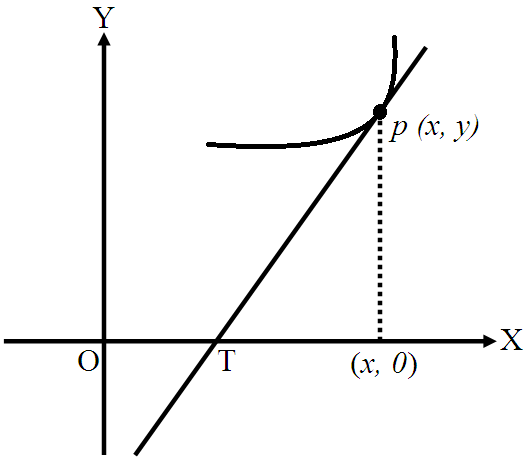 It is given that the distance between the foot of ordinate of point of contanct (A) and the point of intersection of tangent with x-axis (T) = 2x
Coordinate of $\text{T}=\big(\text{x}-\text{y}\frac{\text{dx}}{\text{dy}}, 0\big)$
$\text{AT}=\Big[\text{x}-\Big(\text{x}-\text{y}\frac{\text{dx}}{\text{dy}}, 0\Big)\Big]=2\text{x}$
Equation of tangent,
$\text{y}-\text{y}=\frac{\text{dy}}{\text{dx}}(\text{x}-\text{x})$
$\Rightarrow\text{y}-\text{0}=\frac{\text{dy}}{\text{dx}}\Big(\text{x}-\big(\text{x}-\text{y}\frac{\text{dx}}{\text{dy}}\big)\Big)$
$\Rightarrow \text{y}\frac{\text{dx}}{\text{dy}}=2\text{x}$
$\Rightarrow \int\frac{\text{dx}}{\text{x}}=2\int\frac{\text{dy}}{\text{y}}$
$\Rightarrow \log\text{x}=\log\text{y}^{2}+\log\text{C}$
$\text{x}=\text{Cy}^{2}$
As the circle passes through (1, 2)
$1=\text{C}\times2^{2}$
$\Rightarrow \text{C}=\frac{1}{4}$
$\Rightarrow 4\text{x}=\text{y}^{2}$ View full question & answer→Question 1775 Marks
Solve the following initial value problems:
$\frac{\text{dy}}{\text{dx}}+\text{y}\cot\text{x}=2\cos\text{x},\text{ y}\Big(\frac{\pi}{2}\Big)=0$
AnswerWe have,
$\frac{\text{dy}}{\text{dx}}+\text{y}\cot\text{x}=2\cos\text{x},\text{ y}\Big(\frac{\pi}{2}\Big)=0$
$\frac{\text{dy}}{\text{dx}}+\text{y}\cot\text{x}=2\cos\text{x}\ ...(1)$
Clearly, it is a linear differential equation of the form
$\frac{\text{dy}}{\text{dx}}+\text{Py}=\text{Q}$
Where $\text{P}=\cot\text{x}$ and $\text{Q}=2\cos\text{x}$
$\therefore\text{ I.F.}=\text{e}^{\int\text{Pdx}}$
$=\text{e}^{\int\cot\text{x dx}}$
$=\text{e}^{\log\sin\text{x}}$
$=\sin\text{x}$
Multiplying both sides of (1) by $\text{I.F.}=\sin\text{x},$ we get
$\sin\text{x}\Big(\frac{\text{dy}}{\text{dx}}+\text{y}\cot\text{x}\Big)=2\sin\text{x }\cos\text{x}$
$\Rightarrow\sin\text{x}\frac{\text{dy}}{\text{dx}}+\text{y}\cos\text{x}=\sin2\text{x}$
Integrating both sides with respect to x, we get
$\text{y}\sin\text{x}=\int\sin2\text{x dx}+\text{C}$
$\Rightarrow\text{y}\sin\text{x}=-\frac{\cos2\text{x}}{2}+\text{C}\ ...(2)$
Now,
$\text{y}\Big(\frac{\pi}{2}\Big)=0$
$\therefore\ 0\times\sin\frac{\pi}{2}=-\frac{\cos\pi}{2}+\text{C}$
$\Rightarrow\text{C}=-\frac{1}{2}$
Putting the value of C in (2), we get
$\text{y}\sin\text{x}=-\frac{\cos2\text{x}}{2}-\frac{1}{2}$
$\Rightarrow2\text{y}\sin\text{x}=-(1+\cos2\text{x})$
$\Rightarrow2\text{y}\sin\text{x}=-2\cos^2\text{x}$
$\Rightarrow\text{y}=-\cot\text{x}\cos\text{x}$
Hence, $\text{y}=-\cot\text{x}\cos\text{x}$ is the required solution.
View full question & answer→Question 1785 Marks
Solve the following differential equation:
$\text{x}\frac{\text{dy}}{\text{dx}}+2\text{y}=\text{x}\cos\text{x}$
AnswerHere, $\frac{\text{dy}}{\text{dx}}+\frac{2\text{y}}{\text{x}}=\cos\text{x}$ It is a linear differential equation. Comparing it with, $\frac{\text{dy}}{\text{dx}}+\text{Py}=\text{Q}$ $\text{P}=\frac{2}{\text{x}},\text{Q}=\cos\text{x}$ I.F. $=\text{e}^{\int\text{Pdx}}$ $=\text{e}^{2\int\frac{1}{\text{x}}\text{dx}}$ $=\text{e}^{2\log|\text{x}|}$ $=\text{x}^2$Solution of the equation is given by,
$\text{y}\times(\text{I.F.}=\int\text{Q}\times(\text{I.F.})\text{dx + C}$ $\text{y}(\text{x}^2)=\int\cos\text{x}(\text{x}^2)\text{dx + C}$ $\text{yx}^2=\int\text{x}^2\cos\text{xdx + C}$ $=\text{x}^2\int\cos\text{x}-\int(2\text{x}\times\int\cos\text{xdx})\text{dx + C}$ Usind integration by parts $\text{yx}^2=\text{x}^2\sin\text{x}-\int2\text{x}\sin\text{xdx + C}$ $=\text{x}^2\sin\text{x}-2\big[\text{x}\times\int\sin\text{xdx}-\int(1\times\int\sin\text{xdx})\text{dx}\big]+\text{C}$ $=\text{x}^2\sin\text{x}+2\text{x}\cos\text{x}-2\int\cos\text{xdx + C}$ $\text{yx}^2=\text{x}^2\sin\text{x}+2\text{x}\cos\text{x}-2\sin\text{x + C}$ $\text{y}=\sin\text{x}+\frac{2}{\text{x}}\cos\text{x}-\frac{2}{\text{x}^2}\sin\text{x}+\frac{\text{C}}{\text{x}^2}$
View full question & answer→Question 1795 Marks
Solve the following differential equation:
$\text{x}\frac{\text{dy}}{\text{dx}}-\text{y}=(\text{x}-1)\text{e}^{\text{x}}$
AnswerHere, $\text{x}\frac{\text{dy}}{\text{dx}}-\text{y}=(\text{x}-1)\text{e}^{\text{x}}$
$\frac{\text{dy}}{\text{dx}}-\frac{\text{y}}{\text{x}}=\Big(\frac{\text{x}-1}{\text{x}}\Big)\text{e}^{\text{x}}$
It is a linear differential equation. comparing the equation by,
$\frac{\text{dy}}{\text{dx}}+\text{Py}=\text{Q}$
$\text{P}=-\frac{1}{\text{x}},\text{Q}=\Big(\frac{\text{x}-1}{\text{x}}\Big)\text{e}^{\text{x}}$
I.F. $=\text{e}^{\int\text{Pdx}}=\text{e}^{-\int\frac{1}{\text{x}}\text{dx}}$
$\text{e}^{-\log|\text{x}|}=\frac{1}{\text{x}},\text{x}>0$
Solution of the equation is given by,
$\text{y}\times(\text{I.F.})=\int\text{Q}\times(\text{I.F.})\text{dx + C}$
$\text{y}\Big(\frac{1}{\text{x}}\Big)=\int\Big(\frac{\text{x}-1}{\text{x}}\Big)\text{e}^{\text{x}}\text{dx + C}$
$\frac{\text{y}}{\text{x}}=\int\Big(\frac{1}{\text{x}}-\frac{1}{\text{x}^2}\Big)\text{e}^{\text{x}}\text{dx + C}$
$\frac{\text{y}}{\text{x}}=\frac{1}{\text{x}}\text{e}^{\text{x}}+\text{C}$
Since $\int[\text{f(x)}+\text{f}'(\text{x})]\text{e}^{\text{x}}\text{dx}=\text{f(x)}\text{e}^{\text{x}}+\text{C}$
$\text{y}=\text{e}^{\text{x}}+\text{Cx},\text{x}>0$
View full question & answer→Question 1805 Marks
Solve the following differential equation:
$\frac{\text{dy}}{\text{dx}}+\text{y}\cot\text{x}=\text{x}^2\cot\text{x}+2\text{x}$
AnswerWe have,
$\frac{\text{dy}}{\text{dx}}+\text{y}\cot\text{x}=\text{x}^2\cot\text{x}+2\text{x}\ \dots(1)$
Clearly, it is a linear differential equation of the form
$\frac{\text{dy}}{\text{dx}}+\text{Py}=\text{Q}$
where
$\text{P}=\cot\text{x}$
$\text{Q}=\text{x}^2\cot\text{x}+2\text{x}$
$\therefore$ I.F. $=\text{e}^{\int\text{Pdx}}$
$=\text{e}^{\int\cot\text{xdx}}$
$=\text{e}^{\log|\sin\text{x}|}=\sin\text{x}$
Multiplying both sides of (1) by $\sin\text{x},$ we get
$\sin\text{x}\Big(\frac{\text{dy}}{\text{dx}}+\text{y}\cot\text{x}\Big)=\sin\text{x}(\text{x}^2\cot\text{x}+2\text{x})$
$\Rightarrow\ \sin\text{x}\frac{\text{dy}}{\text{dx}}+\text{y}\cos\text{x}=\text{x}^2\cos\text{x}+2\text{x}\sin\text{x}$
Integrating both sides with respect to x, we get
$\text{y}\sin\text{x}=\int\text{x}^2\cos\text{xdx}+\int2\text{x}\sin\text{xdx + C}$
$\Rightarrow\ \text{y}\sin\text{x}=\text{x}^2\int\cos\text{xdx}-\int\Big[\frac{\text{d}}{\text{dx}}(\text{x}^2)\int\cos\text{xdx}\Big]\text{dx}+\int2\text{x}\sin\text{x dx + C}$
$\Rightarrow\ \text{y}\sin\text{x}=\text{x}^2\sin\text{x}-\int2\text{x}\sin\text{xdx}+\int2\text{x}\sin\text{xdx + C}$
$\Rightarrow\ \text{y}\sin\text{x}=\text{x}^2\sin\text{x +C}$
Hence, $\Rightarrow\ \text{y}\sin\text{x}=\text{x}^2\sin\text{x +C}$ is the required solution.
View full question & answer→Question 1815 Marks
Solve the following differential equation
$\frac{\text{dy}}{\text{dx}}=\log\text{x}$
AnswerWe have,
$\frac{\text{dy}}{\text{dx}}=\log\text{x}$
$\Rightarrow\text{dy}=(\log\text{x})\text{dx}$
Integrating both sides, we get
$\int\text{dy}=\int(\log\text{x})\text{dx}$
$\Rightarrow\text{dy}=\int1\times\log\text{x}\text{ dx}$
$\Rightarrow\text{dy}=\log\text{x}\int\int1\text{dx}-\int\Big[\frac{\text{d}}{\text{dx}}(\log\text{x})\int1\text{dx}\Big]\text{dx}$
$\Rightarrow\text{y}=\text{x}\log\text{x }-\int\frac{\text{x}}{\text{x}}\text{dx}$
$\Rightarrow\text{y}=\text{x}\log\text{x}-\int1\text{dx}$
$\Rightarrow\text{y}=\text{x}\log\text{x}-\text{x}$
$\Rightarrow\text{y}=\text{x}(\log\text{x}-1)+\text{C}$
So, $\Rightarrow\text{y}=\text{x}(\log\text{x}-1)+\text{C}$ is defined for all $\text{x}\in\text{R}$ except x = 0
Hence, $\Rightarrow\text{y}=\text{x}(\log\text{x}-1)+\text{C}$ where $\text{x}\in\text{R}-\{0\}$ is the solution o the given differential equation.
View full question & answer→Question 1825 Marks
Solve the following differential equation:
$\frac{\text{dy}}{\text{dx}}\cos(\text{x}-\text{y})=1$
Answer$\frac{\text{dy}}{\text{dx}}\times\cos(\text{x}-\text{y})=1$
Let $\text{x}-\text{y}=\text{v}$
$1-\frac{\text{dy}}{\text{dx}}=\frac{\text{dv}}{\text{dx}}$
$\frac{\text{dy}}{\text{dx}}=1-\frac{\text{dv}}{\text{dx}}$
So,
$\Big(1-\frac{\text{dv}}{\text{dx}}\Big)\cos\text{v}=1$
$1-\frac{\text{dv}}{\text{dx}}=\sec\text{v}$
$1-\sec\text{v}=\frac{\text{dv}}{\text{dx}}$
$\text{dx}=\frac{\text{dv}}{1-\sec\text{v}}$
$\text{dx}=\frac{\cos\text{v}}{1-\cos\text{v}}\text{dv}$
$\int\text{dx}=\int\frac{\cos^{2}\frac{\text{v}}{2}-\sin^{2}\frac{\text{v}}{2}}{2\sin^{2}\frac{\text{v}}{2}}\text{dv}$
$\int\text{dx}=\int\frac{1}{2}\cot\big(\frac{\text{v}}{2}\big)\text{dv}-\frac{1}{2}\text{dv}$
$2\int\text{dx}=\int\cot^{2}\big(\frac{\text{v}}{2}\big)-\int\text{dv}$
$2\int\text{dx}=\int\Big(\text{cosec}^{2}\frac{\text{v}}{2}-1\Big)\text{dv}-\int\text{dv}$
$2\text{x}=-2\cot\big(\frac{\text{v}}{2}\big)\text{dv}-\text{v}-\text{v}+\text{C}_{1}$
$2(\text{x}+\text{v})=-2\cot\frac{\text{v}}{2}+\text{C}_{1}$
$\text{x}+\text{x}-\text{y}=-\cot\Big(\frac{\text{x}-\text{y}}{2}\Big)+\text{C}$
$\text{C}+\text{y}=\cot\Big(\frac{\text{x}-\text{y}}{2}\Big)$
View full question & answer→Question 1835 Marks
The surface area of a balloon being inflated, changes at a rate proportional to time t. If initially its radius is 1 unit and after 3 seconds it is 2 units, find the radius after time t.
AnswerLet A be the surface area of balloon, So
$\frac{\text{dA}}{\text{dt}}\propto\text{t}$
$\Rightarrow\frac{\text{dA}}{\text{dt}}=\lambda\text{t}$
$\Rightarrow\frac{\text{d}}{\text{dt}}(4\pi\text{r}^{2})=\lambda\text{t}$
$\Rightarrow 8\pi\text{r}\frac{\text{dr}}{\text{dt}}=\lambda\text{t}$
$\Rightarrow8\pi\text{r}\ \text{dr}=\lambda\text{t}$
$\Rightarrow 8\pi\int\limits_{}{}\text{r}\ \text{dr}=\lambda\int_{}^{}\text{t}\ \text{dt} $
$\Rightarrow 8\pi\frac{\text{r}^{2}}{2}=\frac{\lambda\text{t}^{2}}{2}+\text{c}$
$\Rightarrow 4\pi\text{r}^{2}=\frac{\lambda\text{t}^{2}}{2}+\text{c}\ ...(\text{i})$
Given r = 1 units When t = 0, so
$4\pi(1)^{2}=0+\text{c}$
$4\pi=\text{c}$
Using it is equation (i),
$\Rightarrow 4\pi\text{r}^{2}=\frac{\lambda\text{t}^{2}}{2}+4\pi\ ...(\text{ii})$
Also, given r = 2 units when t = 3 Sec.
$4\pi\text{(2)}^{2}=\frac{\lambda\text{(3)}^{2}}{2}+4\pi$
$ \Rightarrow16\pi=\frac{9}{2}\lambda+4\pi$
$\Rightarrow\frac{9}{2}\lambda=12\pi$
$\Rightarrow\lambda=\frac{24}{9}\pi$
$\Rightarrow\lambda=\frac{8}{3}\pi$
Now, equation (ii) becomes
$ 4\pi\text{r}^{2}=\frac{8\pi}{6}\text{t}^{2}+4\pi$
$\Rightarrow 4\pi(\text{r}^{2}-1)=\frac{4}{3}\pi\text{t}^{2}$
$\Rightarrow\text{r}^{2}-1=\frac{1}{3}\text{t}^{2}$
$\Rightarrow\text{r}^{2}=1+\frac{1}{3}\text{t}^{2}$
$\therefore\ \text{r}=\sqrt{(1+\frac{1}{3}\text{t}^{2}})$
View full question & answer→Question 1845 Marks
Solve the following differential equation:
$\text{xy}\frac{\text{dy}}{\text{dx}}=\text{x}^2-\text{y}^2$
AnswerWe have,
$\text{xy}\frac{\text{dy}}{\text{dx}}=\text{x}^2-\text{y}^2$
$\Rightarrow\ \frac{\text{dy}}{\text{dx}}=\frac{\text{x}^2-\text{y}^2}{\text{xy}}$
This is a homogeneous differential equation.
Putting y = vx and $\frac{\text{dy}}{\text{dx}}=\text{v + x}\frac{\text{dv}}{\text{dx}}$, we get
$\text{v + x}\frac{\text{dv}}{\text{dx}}=\frac{\text{x}^2-\text{v}^2\text{x}^2}{\text{vx}^2}$
$\Rightarrow\ \text{v + x}\frac{\text{dv}}{\text{dx}}=\frac{1-\text{v}^2}{\text{v}}$
$\Rightarrow\ \text{x}\frac{\text{dv}}{\text{dx}}=\frac{1-\text{v}^2}{\text{v}}-\text{v}$
$\Rightarrow\ \text{x}\frac{\text{dv}}{\text{dx}}=\frac{1-2\text{v}^2}{\text{v}}$
$\Rightarrow\ \frac{\text{v}}{1-2\text{v}^2}\text{dv}=\frac{1}{\text{x}}\text{dx}$
Integrating both sides, we get
$\int\frac{\text{v}}{1-2\text{v}^2}\text{dv}=\int\frac{1}{\text{x}}\text{dx}$
$\Rightarrow\ \frac{-1}4\log\big|1-2\text{v}^2\big|=\log|\text{x}|+\log\text{C}$
$\Rightarrow\ \log\big|1-2\text{v}^2\big|=-4\log|\text{x}|-4\log\text{C}$
$\Rightarrow\ \log\big|\big(1-2\text{v}^2\big)\big(\text{x}^4\big)\big|=\log\frac{1}{\text{C}^4}$
Putting $\text{v}=\frac{\text{y}}{\text{x}}$, we get
$\Rightarrow\ \log\big|\text{x}^2\big(\text{x}^2-2\text{y}^2\big)\big|=\log\frac{1}{\text{C}^4}$
$\Rightarrow\ \text{x}^2\big(\text{x}^2-2\text{y}^2\big)=\text{C}_1$
where
$\text{C}_1=\frac{1}{\text{C}^4}$
Hence, $\text{x}^2\big(\text{x}^2-2\text{y}^2\big)=\text{C}_1$ is the required solution.
View full question & answer→Question 1855 Marks
Given that $\frac{\text{dy}}{\text{dx}}=\text{e}^\text{-2y}$ and y = 0 when x = 5. Find the value of x when y = 3.
AnswerGiven that, $\frac{\text{dy}}{\text{dx}}=\text{e}^\text{-2y}$
$\Rightarrow\frac{\text{dy}}{\text{e}^\text{-2y}}=\text{dx}$
$\Rightarrow\int\text{e}^\text{2y}\text{dy}=\int\text{dx}$
$\Rightarrow\frac{\text{e}^\text{2y}}{2}=\text{x+C }....(\text{i})$
When x = 5 and y = 0, then substituting these values in equation (i), we get
$\frac{\text{e}^0}{2}=5+\text{C}$
$\Rightarrow\frac{1}{2}=5+\text{C}$
$\Rightarrow\text{C}=\frac{1}{2}-5$
$\Rightarrow\text{C}=-\frac{9}{2}$
Thus equation (i) becomes
$\text{e}^\text{2y}=2\text{x}-9$
When y = 3, then $\text{e}^6=2\text{x}-9$
$\Rightarrow2\text{x}=\text{e}^6+9$
$\Rightarrow\text{x}=\frac{(\text{e}^6+9)}{2}$
View full question & answer→Question 1865 Marks
Solve the following differential equations:
$2(\text{y}+3)-\text{xy}\frac{\text{dy}}{\text{dx}}=0,\text{y}(1)=-2$
Answer$2(\text{y}+3)-\text{xy}\frac{\text{dy}}{\text{dx}}=0$
$\Rightarrow2(\text{y}+3)=\text{xy}\frac{\text{dy}}{\text{dx}}$
$\Rightarrow\frac{2}{\text{x}}\text{dx}=\frac{\text{y}}{\text{y}+3}\text{dy}$
$\Rightarrow\frac{2}{\text{x}}\text{dx}=\frac{\text{y}+3-3}{\text{y}+3}\text{dy}$
$\Rightarrow\frac{2}{\text{x}}\text{dx}=\Big(1-\frac{3}{\text{y}+3}\Big)\text{dy}$
$\Rightarrow\int\frac{2}{\text{x}}\text{dx}=\int\Big(1-\frac{3}{\text{y}+3}\Big)\text{dy}$
$\Rightarrow2\log\text{x = y}-3\log|\text{y}+3|+\text{C}$
$\Rightarrow\log\text{x}^2+\log|(\text{y}+3)^3|=\text{y + C}$
$\Rightarrow\log|(\text{x}^2)(\text{y}+3)^3|=\text{y + C}...(1)$
$\Rightarrow\log|(1)^2(-2+3)^3|=-2+\text{C}$
$\Rightarrow\text{C}=2$
Substituting the value of C in (1), we get
$\log|(\text{x}^2)(\text{y}+3)^3|=\text{y}+2$
$\Rightarrow(\text{x}^2)(\text{y}+3)^3=\text{e}^{\text{y}+2}$
View full question & answer→Question 1875 Marks
Show that $\text{y}=\frac{\text{a}}{\text{x}}+\text{b}$ is a solution of the differential equation $\frac{\text{d}^2\text{y}}{\text{dx}^2}=\frac{2}{\text{x}}\Big(\frac{\text{dy}}{\text{dx}}\Big)=0$
AnswerWe have,
$\text{y}=\frac{\text{a}}{\text{x}}+\text{b}\ ...(1)$
Differentiating both sides of equation (1) with respect to 3, we get
$\frac{\text{dy}}{\text{dx}}=-\frac{\text{a}}{\text{x}^2}\ ...(2)$
Differentiating both sides of equation (2) with respect to 3, we get
$\frac{\text{d}^2\text{y}}{\text{dx}^2}=2\frac{\text{a}}{\text{x}^3}$
$\frac{\text{d}^2\text{y}}{\text{dx}^2}=-\frac{2}{\text{x}}\Big(-\frac{\text{a}}{\text{x}^2}\Big)$
$\frac{\text{d}^2\text{y}}{\text{dx}^2}=-\frac{2}{\text{x}}\Big(\frac{\text{dy}}{\text{dx}}\Big)$
$\Rightarrow\frac{\text{d}^2\text{y}}{\text{dx}^2}+\frac{2}{\text{x}}\Big(\frac{\text{dy}}{\text{dx}}\Big)=0$
Hence, the given function is the solution to the given differential equation.
View full question & answer→Question 1885 Marks
Solve the following differential equation:
$\cos^2(\text{x}-2\text{y}) = 1-2\frac{\text{dy}}{\text{dx}}$
AnswerWe have,
$\cos^2(\text{x}-2\text{y}) = 1-2\frac{\text{dy}}{\text{dx}}$
$\Rightarrow 2\frac{\text{dy}}{\text{dx}} = 1 - \cos^2(\text{x}-2\text{y} )$
Let $\text{x}-2\text{y}=\text{v}$
$\Rightarrow1-2\frac{\text{dy}}{\text{dx}}=\frac{\text{dv}}{\text{dx}}$
$\Rightarrow 2\frac{\text{dy}}{\text{dx}} = 1 -\frac{\text{dv}}{\text{dx}}$
$\therefore 1 - \frac{\text{dv}}{\text{dx}} = 1 - \cos^2\text{v}$
$\Rightarrow \frac{\text{dv}}{\text{dx}} = \cos^2\text{v}$
$\Rightarrow \sec^2 \text{v}\text{ dv} = \text{dx}$
Integrating both sides, we get
$\int\sec^2\text{v}\text{ dv} = \int \text{dx}$
$\Rightarrow \tan \text{v} = \text{x} - \text{C}$
$\Rightarrow \tan (\text{x}-2\text{y}) = \text{x}-\text{C}$
$\Rightarrow \text{x} = \tan (\text{x}-2\text{y})+\text{C}$
View full question & answer→Question 1895 Marks
In each of the show that the given differential equation is homogeneous and solve each of them.
$\text{y}'=\frac{\text{x}+\text{y}}{\text{x}}$
AnswerGiven: Differential equation $\text{y}'=\frac{\text{x}+\text{y}}{\text{x}}\ \ \Rightarrow\ \ \frac{\text{dy}}{\text{dx}}=\frac{\text{x}}{x}+\frac{\text{y}}{\text{x}}$$\Rightarrow\ \ \frac{\text{dy}}{\text{dx}}=1+\frac{\text{y}}{x}=f\Big(\frac{\text{y}}{\text{x}}\Big)\ \ ....(\text{i})$
Therefore, eq. (i) is homogeneous.
$\text{Putting}\ \frac{\text{y}}{\text{x}}=\text{v}\ \ \Rightarrow\ \ \text{y}=\text{vx}$ $\ \ \Rightarrow\ \ \frac{\text{dy}}{\text{dx}}=\text{v}.1+\text{x}\ \frac{\text{dv}}{\text{dx}}=\text{v}+\text{x}\frac{\text{dv}}{\text{dx}}$
$\text{Putting value of y and}\ \frac{\text{dy}}{\text{dx}}\ \text{in eq. (i)}$
$\text{v}+\text{x}\frac{\text{dv}}{\text{dx}}=1+\text{v}\ \ \Rightarrow\ \ \text{x}\frac{\text{dv}}{\text{dx}}=1$ $\ \ \Rightarrow\ \ \text{x dv = dx}$
$\Rightarrow\ \ \text{dv}=\frac{\text{dx}}{\text{x}}\ \ [\text{Separating variables}]$
$\text{Interating both sides},\ \ \int1\ \text{dv}=\int\frac{\text{dv}}{\text{x}}$ $\ \ \Rightarrow\ \ \text{v}=\log|\text{x}|+\text{c}$
$\text{Putting}\ \frac{\text{y}}{\text{x}}=\text{v,}\ \ \frac{\text{y}}{\text{x}}=\log|\text{x}|+\text{c}$ $\ \ \Rightarrow\ \ \text{y}=\text{x}\log|\text{x}|+\text{xc}$
View full question & answer→Question 1905 Marks
Solve the following differential equation:
$\text{y}^2\frac{\text{dx}}{\text{dy}}+\text{x}-\frac{1}{\text{y}}=0$
AnswerHere, $\text{y}^2\frac{\text{dx}}{\text{dy}}+\text{x}-\frac{1}{\text{y}}=0$
$\Rightarrow\ \frac{\text{dy}}{\text{dx}}+\frac{\text{x}}{\text{y}^2}=\frac{1}{\text{y}^3}$
It is a linear differential equation. Comparing the equation with,
$\frac{\text{dy}}{\text{dx}}+\text{Py}=\text{Q}$
$\text{P}=\frac{1}{\text{y}^2},\text{Q}=\frac{1}{\text{y}^3}$
I.F. $=\text{e}^{\int\text{Pdy}}$
$=\text{e}^{\int\frac{1}{\text{y}^2}\text{dy}}$
$=\text{e}^{-\frac{1}{\text{y}}}$
Solution of the equation is given by,
$\text{x}\times(\text{I.F.})=\int\text{Q}\times(\text{I.F.})\text{dy + C}$
$\text{x}\Big(\text{e}^{-\frac{1}{\text{y}}}\Big)=\int\frac{1}{\text{y}^3}\Big(\text{e}^{-\frac{1}{\text{y}}}\Big)\text{dy + C}$
Let $\text{e}^{-\frac{1}{\text{y}}}=\text{t}$
$\Rightarrow\frac{1}{\text{y}}=-\log\text{t}$
$\text{e}^{-\frac{1}{\text{y}}}\times\frac{1}{\text{y}^2}\text{dy = dt}$
$\text{x (t)}=\int\frac{1}{\text{y}}\text{dt + C}$
$=-\log+\text{dt + C}$
$=-\Big[\log\text{t}\times\int1\times\text{dt}-\int\Big(\frac{1}{\text{t}}\int1\times\text{dt}\Big)\text{dt}\Big]+\text{C}$
$=-\Big[\text{t}\log\text{t}-\int\frac{\text{t}}{\text{t}}\text{dt}\Big]+\text{C}$
$\text{x (t)}=-\text{t}\log\text{t + t + C}$
$\text{x (t)}=-\text{t}[\log\text{t}-1]+\text{C}$
$\text{x}=-\Big[-\frac{1}{\text{y}}-1\Big]\text{Ce}^{\frac{1}{\text{y}}}$
$\text{x}=\frac{1}{\text{y}}+1+\text{Ce}^{\frac{1}{\text{y}}}$
$\text{x}=\Big(\frac{1+\text{y}}{\text{y}}\Big)+\text{Ce}^{\frac{1}{\text{y}}}$
View full question & answer→Question 1915 Marks
For each of the differential equations given in find a particular solution satisfying the given condition:
$\frac{\text{dy}}{\text{dx}}-3\text{y}\cot\text{x}=\sin 2\text{x};\ \text{y}=2\ \text{when x}=\frac{\pi}{2}$
AnswerThe given differential equation is $\frac{\text{dy}}{\text{dx}}-3\text{y}\cot\text{x}=\sin\ 2\text{x}.$This is a linear differential equation of the form:
$\frac{\text{dy}}{\text{dx}}+\text{py}=\text{Q}\ (\text{where p}=-3\cot\text{x}\ \text{and}\ \text{Q}=\sin2\text{x})$
$\text{Now, I.F}=\text{e}^{\int\text{pdx}}=\text{e}^{-3\int\cot\text{x}\ \text{dx}}=\text{e}^{-3\log|\sin\text{x}|}=\text{e}^{\log|\frac{1}{\sin^3\text{x}}|}=\frac{1}{\sin^3\text{x}}.$
The general solution of the given differential equation is given by the relation,
$\text{y(I.F)}=\int(\text{Q}\times\text{I.F.})\text{dx}+\text{C}$
$\Rightarrow\text{y}\cdot\frac{1}{\sin^3\text{x}}=\int\Big[\sin2\text{x}.\frac{1}{\sin^3\text{x}}\text{dx}+\text{C}\Big]$
$\Rightarrow\text{y cosec}^3\ \text{x}=2\int(\cot\text{x}\ \text{cosec}\ \text{x})\text{dx}+\text{C}$
$\Rightarrow\text{y cosec}^3\ \text{x}=-2\text{cosec}\ \text{x}+\text{C}$
$\Rightarrow\text{y}=-\frac{2}{\text{cosec}^2\text{x}}+\frac{\text{C}}{\text{cosec}^3\text{x}}$
$\Rightarrow\text{y}=-2\sin^2\text{x}+\text{C}\sin^3\text{x}\ \ ...(1)$
$\text{Now,}\ \text{y}=2\ \text{at}\ \text{x}=\frac{\pi}{2}.$
Therefore, we get:
$2=-2+\text{C}$
$\Rightarrow\text{C}=4$
Substituting C = 4 in equation (1), we get:
$\text{y}=-2\sin^2\text{x}+4\sin^3\text{x}$
$\Rightarrow\text{y}=4\sin^3\text{x}-2\sin^2\text{x}$
This is the required particular solution of the given differential equation.
View full question & answer→Question 1925 Marks
For each of the differential equations in find a particular solution satisfying the given condition:
$(\text{x}^3+\text{x}^2+\text{x}+1) \frac{\text{dy}}{\text{dx}} = 2\text{x}^2+\text{x; y} =1 \ \text{when x = 0}$
AnswerThe given differential equation is
$(\text{x}^3+\text{x}^2+\text{x}+1)\frac{\text{dy}}{\text{dx}}=2\text{x}^2+\text{x}$
$\text{or} \ \ \ \frac{\text{dy}}{\text{dx}}=\frac{2\text{x}^2+\text{x}}{\text{x}^3+\text{x}^2+\text{x}+1}$
$\text{or} \ \ \ \frac{\text{dy}}{\text{dx}}=\frac{2\text{x}^2+\text{x}}{\text{x}^2(\text{x}+1)+1(\text{x}+1)}$
$\text{or} \ \ \ \ \frac{\text{dy}}{\text{dx}}=\frac{2\text{x}^2+\text{x}}{(\text{x}+1)(\text{x}^2+1)}$
Separting the variables, we get,
$\text{dy}=\frac{2\text{x}^2+\text{x}}{(\text{x}+1)(\text{x}^2+1)}\text{dx}$
Integrating, $\int\text{dy=} \ \int\frac{2\text{x}^2+\text{x}}{(\text{x}+1)(\text{x}^2+1)}\text{dx} \ \ ...(1)$
Put $\frac{2\text{x}^2+\text{x}}{\text{(x}-1)(\text{x}^2+1)}=\frac{\text{A}}{\text{x}+1}+\frac{\text{Bx}+\text{C}}{\text{x}^2+1} \ \ ...(2 )$
$\Rightarrow \ 2\text{x}^2 +\text{x}=\text{Ax}^2 + \text{A} +\text{Bx}^2 +\text{Cx + Bx + C}$
$\Rightarrow \ \ 2\text{x}^2 +\text{x} = (\text{A + B)x}^2+\ (\text{B + C)x + A + C} \ \ \ \ ......(3)$
Now comparing the coefficients of $x^2$ and $x$
$\Rightarrow \text{A + B} =2$
$\Rightarrow \text{B + C}=1$
$\Rightarrow \text{A + C}=0{}$
Solving tham we will get the values of $A, B, C$
$\text{A}= \frac{1}{2}, \text{B} =\frac{3}{2}-\frac{1}{2}$
Putting the values of $A,B,C$
$\therefore \text{from}(2), \frac{2\text{x}^2+\text{x}}{(\text{x}+1)(\text{x}^2+1)} = \frac{\frac{1}{2}}{\text{x}+1}+\frac{\frac{3}{2}\text{x}-\frac{1}{2}}{\text{x}^2+1}$
$\text{or}\ \ \frac{2\text{x}^2+\text{x}}{(\text{x}+1)(\text{x}^2+1)} \equiv \frac{1}{2(\text{x}+1)}+\frac{3}{2}\bigg(\frac{x}{x^2+1}\bigg)-\frac{1}{2}\bigg(\frac{1}{x^2+1}\bigg)$
$\therefore \text{from}(1), \ \int\text{dy}=\frac{1}{2} \int\frac{1}{x+1}\text{dx}+\frac{3}{2}\int\frac{\text{x}}{\text{x}^2+1}\text{dx}-\frac{1}{2}\int \frac{1}{\text{x}^2+1}\text{dx}$
$\therefore \ \int 1\ \text{dy}= \frac{1}{2}\int\frac{1}{\text{x}+1}\text{dx}+\frac{3}{4}\int\frac{2\text{x}}{\text{x}^2+1} \text{dx}-\frac{1}{2}\int\frac{1}{\text{x}^2+1}\text{dx}$
$\therefore \ \text{y}= \frac{1}{2}\text{log}|\text{x}+1|+ \frac{3}{4}\text{log}(\text{x}^2+1)-\frac{1}{2}\text{tan}^{-1}\text{x}+\text{c} \ \ \ \ \ .....(4)$
Now $y = 1$ when $x = 0$
$\therefore 1=\frac{1}{2}\text{log}(1)+\frac{3}{4}\text{log} \ 1-\frac{1}{2}\text{tan}^{-1} \text{0+c}$
$\therefore 1 =\frac{1}{2}(0)+\frac{3}{4}(0)-\frac{1}{2}(0)+\text{c} \ \ \Rightarrow\ \ \text{c}=1$
$\therefore \text{from}\ (4),\ \text{y}= \frac{1}{2}\text{log}|\text{x}+1|+\frac{3}{4}\text{log}(\text{x}^2+1)-\frac{1}{2}\text{tan}^{-1}\text{x}+1$
View full question & answer→Question 1935 Marks
Solve $\text{x}^2\frac{\text{dy}}{\text{dx}}=\text{x}^2+\text{xy}+\text{y}^2.$
AnswerGiven that, $\text{x}^2\frac{\text{dy}}{\text{dx}}=\text{x}^2+\text{xy}+\text{y}^2$
Dividing both sides by $x^2,$ we get
$\Rightarrow\frac{\text{dy}}{\text{dx}}=1+\frac{\text{y}}{\text{x}}+\frac{\text{y}^2}{\text{x}^2}\ ....(\text{i})$
Let $\text{f}(\text{x, y})=1+\frac{\text{y}}{\text{x}}+\frac{\text{y}^2}{\text{x}^2}$
$\text{f}(\lambda\text{x},\lambda\text{y})=1+\frac{\lambda\text{y}}{\lambda\text{x}}+\frac{\lambda^2\text{y}^2}{\lambda^2\text{x}^2}$
$\text{f}(\lambda\text{x},\lambda\text{y})=\lambda^0\Big(1+\frac{\text{y}}{\text{x}}+\frac{\text{y}^2}{\text{x}^2}\Big)$
$\text{f}(\lambda\text{x},\lambda\text{y})=\lambda^0\text{f}(\text{x},\text{ y})$
Which is homogeneous expression of degree 0.
Put $\text{y}=\text{vx}$
$\Rightarrow\frac{\text{dy}}{\text{dx}}=\text{v}+\text{x}\frac{\text{dy}}{\text{dx}}$
On substituting these values in Eq. (i), we get
$\Big(\text{v}+\text{x}\frac{\text{dv}}{\text{dx}}\Big)=1+\text{v}+\text{v}^2$
$\Rightarrow\text{x}\frac{\text{dv}}{\text{dx}}=1+\text{v}+\text{v}^2-\text{v}$
$\Rightarrow\text{x}\frac{\text{dv}}{\text{dx}}=1+\text{v}^2$
$\Rightarrow\frac{\text{dv}}{1+\text{v}^2}=\frac{\text{dx}}{\text{x}}$
On integrating both sides, we get
$\int\frac{\text{dv}}{1+\text{v}^2}=\int\frac{\text{dx}}{\text{x}}$
$\tan^{-1}\text{v}=\log|\text{x}|+\text{C}$
$\Rightarrow\tan^{-1}\Big(\frac{\text{y}}{\text{x}}\Big)=\log|\text{x}|+\text{c}$
View full question & answer→Question 1945 Marks
Solve the following differential equation:
$\text{x}\frac{\text{dy}}{\text{dx}}+\text{y}=\text{x}\log\text{x}$
AnswerWe have,
$\text{x}\frac{\text{dy}}{\text{dx}}+\text{y}=\text{x}\log\text{x}$
Dividing both sides by x, we get
$\frac{\text{dy}}{\text{dx}}+\frac{\text{y}}{\text{x}}=\log{\text{x}}$
Comparing with $\frac{\text{dy}}{\text{dx}}+\text{Py}=\text{Q},$ we get
$\text{P}=\frac{1}{\text{x}}$
$\text{Q}=\log\text{x}$
Now,
I.F. $=\text{e}^{\int\text{Pdx}}=\text{e}^{\int\frac{1}{\text{x}}\text{dx}}$
$\text{e}^{\log|\text{x}|}=\text{x}$
So, the solution is given by
$\text{y}\times\text{I.F.}=\int\text{Q}\times\text{I.F. dx + C}$
$\Rightarrow\ \text{xy}=\int\text{x}\log\text{x dx + C}$
$\Rightarrow\ \text{xy}=\log\text{x}\int\text{xdx}-\int\Big[\frac{\text{d}}{\text{dx}}(\log\text{x})\int\text{x dx}\Big]\text{ dx + C}$
$\Rightarrow\ \text{xy}=\frac{\text{x}^2\log\text{x}}{2}-\int\frac{\text{x}}2\text{dx + C}$
$\Rightarrow\ \text{xy}=\frac{\text{x}^2\log\text{x}}{2}-\frac{\text{x}^2}4+\text{C}$
$\Rightarrow\ 4\text{xy}=2\text{x}^2\log\text{x}-\text{x}^2+\text{K}$ (where, K = 2C)
View full question & answer→Question 1955 Marks
Solve the following differential equations:
$\frac{\text{dy}}{\text{dx}}=\frac{\text{y}^2-\text{x}^2}{2\text{xy}}$
AnswerHere, $\frac{\text{dy}}{\text{dx}}=\frac{\text{y}^2-\text{x}^2}{2\text{xy}}$It is homogeneous equation
Put y = vx
$\frac{\text{dy}}{\text{dx}}=\text{v + x}\frac{\text{dv}}{\text{dx}}$
So,
$\text{v + x}\frac{\text{dv}}{\text{dx}}=\frac{\text{v}^2\text{x}^2-\text{x}^2}{2\text{xvx}}$
$\text{x}\frac{\text{dv}}{\text{dx}}=\frac{\text{v}^2-1}{2\text{v}}-\frac{\text{v}}1$
$=\frac{\text{v}^2-1-2\text{v}^2}{2\text{v}}$
$\text{x}\frac{\text{dv}}{\text{dx}}=\frac{-1-\text{v}^2}{2\text{v}}$
$\int\frac{2\text{v}}{1+\text{v}^2}\text{dv}=-\int\frac{\text{dx}}{\text{x}}$
$\log\big|1+\text{v}^2\big|=-\log|\text{x}|+\log|\text{C}|$
$1+\text{v}^2=\frac{\text{C}}{\text{x}}$
$1+\frac{\text{y}^2}{\text{x}^2}=\frac{\text{C}}{\text{x}}$
$\text{x}^2+\text{y}^2=\text{Cx}$
View full question & answer→Question 1965 Marks
If $\vec{\text{a}}=\vec{\text{i}}+\vec{\text{j}}+2\vec{\text{k}}$ and $\vec{\text{b}}=2\vec{\text{i}}+\vec{\text{j}}-2\vec{\text{k}},$ find the unit vector in the direction of:
- $6\vec{\text{b}}$
- $2\vec{\text{a}}-\vec{\text{b}}$
AnswerHere, $\vec{\text{a}}=\vec{\text{i}}+\vec{\text{j}}+2\vec{\text{k}}$ and $\vec{\text{b}}=2\vec{\text{i}}+\vec{\text{j}}-2\vec{\text{k}}$
- $6\vec{\text{b}}=12\hat{\text{i}}+6\hat{\text{j}}-12\hat{\text{k}}$
$\therefore$ Unit vectors in the direction of $6\vec{\text{b}}=\frac{6\vec{\text{b}}}{|6\vec{\text{b}}|}$
$=\frac{12\hat{\text{i}}+6\hat{\text{j}}-12\hat{\text{k}}}{\sqrt{12^2+6^2+12^2}}$
$=\frac{6(12\hat{\text{i}}+\hat{\text{j}}-2\hat{\text{k}})}{\sqrt{324}}$
$=\frac{6(2\hat{\text{i}}+\hat{\text{j}}-2\hat{\text{k}})}{18}$
$=\frac{2\hat{\text{i}}+\hat{\text{j}}-2\hat{\text{k}}}{3}$
- $2\vec{\text{a}}-\vec{\text{b}}=2(\hat{\text{i}}+\hat{\text{j}}+2\hat{\text{k}})$
$=\hat{\text{j}}+6\hat{\text{k}}$
$\therefore$ Unit vectors in the direction of $2\vec{\text{a}}-\vec{\text{b}}$
$=\frac{2\vec{\text{a}}-\vec{\text{b}}}{|2\vec{\text{a}}-\vec{\text{b}}|}=\frac{\hat{\text{j}}+6\hat{\text{k}}}{\sqrt{1^2+6^2}}$
$=\frac{\hat{\text{j}}+6\hat{\text{k}}}{\sqrt{37}}$ View full question & answer→Question 1975 Marks
verify that $\text{y}=\text{e}^{\text{m}\cos^{-1}}$ is a solution of the differential equation $(1+\text{x}^2)\frac{\text{d}^2\text{y}}{\text{dx}^2}-\text{x}\frac{\text{dy}}{\text{dx}}-\text{m}^2\text{y}=0$
AnswerWe have,
$\text{y}=\text{e}^{\text{m}\cos^{-1}}\ ...(1)$
Differentiating both sides of (1) with respect to x, we get
$\frac{\text{dy}}{\text{dx}}=\text{me}^{\text{m}^{\cos^{-1}}}\Big(\frac{-1}{\sqrt{1-\text{x}^2}}\Big)$
$\Rightarrow\frac{\text{dy}}{\text{dx}}=-\frac{\text{me}^{\text{m}^{\cos^{-1}}}\text{x}}{\sqrt{1-\text{x}^3}}\ ...(2)$
Differentiating both sides of (2) with respect to x, we get
$\frac{\text{d}^2\text{y}}{\text{dx}^2}=\frac{\text{d}}{\text{dx}}\Big(-\frac{\text{me}^{\text{m}^{\cos^{-1}}}\text{x}}{\sqrt{1-\text{x}^2}}\Big)$
$\Rightarrow\frac{\text{d}^2\text{y}}{\text{dx}^2}=(-\text{m})\Bigg[\frac{\sqrt{1-\text{x}^2}\text{me}^{\text{m}^{\cos^{-1}}}\Big(-\frac{1}{\sqrt{1-\text{x}}}\Big)-\text{e}^{\text{m}^{\cos^{-1}}}\text{x}\frac{1}{2}\Big(-\frac{2\text{x}}{\sqrt{1-\text{x}^2}}\Big)}{(1-\text{x}^2)}\Bigg]$
$\Rightarrow(1-\text{x}^2)\frac{\text{d}^2\text{y}}{\text{dx}^2}=(-\text{m})\Big[-\text{me}^{\text{m}^{\cos^{-1}}}\text{x}+\frac{\text{xe}^{\text{m}^{\cos^{-1}}}\text{x}}{\sqrt{1-\text{x}^2}}$
$\Rightarrow(1-\text{x}^2)\frac{\text{d}^2\text{y}}{\text{dx}^2}=\text{m}^2\text{y}+\text{x}\frac{\text{dy}}{\text{dx}}$
$\Rightarrow(1-\text{x}^2)\frac{\text{d}^2\text{y}}{\text{dx}^2}\text{m}^2\text{y}+\text{x}\frac{\text{dy}}{\text{dx}}$
$\Rightarrow(1-\text{x}^2)\frac{\text{d}^2\text{y}}{\text{dx}^2}-\text{x}\frac{\text{dy}}{\text{dx}}-\text{m}^2\text{y}=0$
Hence, the given function is the solution to the given differential equation.
View full question & answer→Question 1985 Marks
Solve the following differential equation
$\cos\text{x }\frac{\text{dy}}{\text{dx}}-\cos2\text{x}=\cos3\text{x}$
AnswerWe have,
$\cos\text{x }\frac{\text{dy}}{\text{dx}}-\cos2\text{x}=\cos3\text{x}$
$\Rightarrow\text{dy}=\frac{\cos3\text{x}+\cos2\text{x}}{\cos\text{x}}\ \text{dx}$
$\Rightarrow\text{dy}=\frac{4\cos^2\text{x}-3\cos\text{x}+2\cos^2\text{x}-1}{\cos\text{x}}\ \text{dx}$
$\Rightarrow\text{dy}=(4\cos^2\text{x}-3+2\cos\text{x}-\sec\text{x})\text{dx}$
$\Rightarrow\text{dy}[2(2\cos^2\text{x}-1)-1+2\cos\text{x}-\sec\text{x}]\text{dx}$
$\Rightarrow\text{dy}(2\cos2\text{x}-1+2\cos\text{x}-\sec\text{x})\text{ dx}$
Integrating both sides, we get
$\int\text{dy}=\int(2\cos2\text{x}-1+2\cos\text{x}-\sec\text{x})\text{dx}$
$\Rightarrow\text{y}=\sin2\text{x}-\text{x}+2\sin\text{x}-\log|\sec\text{x}+\tan\text{x}|+\text{C}$
hence, $\text{y}=\sin2\text{x}-\text{x}+2\sin\text{x}-\log|\sec\text{x}+\tan\text{x}|+\text{C}$ is the solution to the given differential equation.
View full question & answer→Question 1995 Marks
For each of the differential equations given in find a particular solution satisfying the given condition:
$(1+\text{x}^2)\frac{\text{dy}}{\text{dx}}+2\text{xy}=\frac{1}{1+\text{x}^2};\text{y}=0\ \text{when x}=1$
Answer$(1+\text{x}^2)\frac{\text{dy}}{\text{dx}}+2\text{xy}=\frac{1}{1+\text{x}^2}$ $\Rightarrow\frac{\text{dy}}{\text{dx}}+\frac{2\text{xy}}{1+\text{x}^2}=\frac{1}{(1+\text{x}^2)^2}$ This is a linear differential equation of the form: $\frac{\text{dy}}{\text{dx}}+\text{py}=\text{Q}\ \Big(\text{where p}=\frac{2\text{x}}{1+\text{x}^2}\ \text{and}\ \text{Q}=\frac{1}{(1+\text{x}^2)^2}\Big)$ $\text{Now, I.F}=\text{e}^{\int\text{pdy}}=\text{e}^{\int\frac{2\text{x dx}}{1+\text{x}^2}}=\text{e}^{\log(1+\text{x}^2)}=1+\text{x}^2.$ The general solution of the given differential equation is given by the relation, $\text{y(I.F)}=\int(\text{Q}\times\text{I.F.})\text{dx}+\text{C}$ $\Rightarrow\text{y}(1+\text{x}^2)=\int\bigg[\frac{1}{(1+\text{x}^2)^2}\cdot(1+\text{x}^2)\bigg]\text{dx}+\text{C}$ $\Rightarrow\text{y}(1+\text{x}^2)=\int\frac{1}{1+\text{x}^2}\text{dx}+\text{C}$ $\Rightarrow\text{y}(1+\text{x}^2)=\tan^{-1}\text{x}+\text{C}\ \ ...(1)$ Now, y = 0 at x =1. Therefore, $0=\tan^{-1}1+\text{C}$$\Rightarrow\text{C}=-\frac{\pi}{4}$
$\text{Substituting C}=-\frac{\pi}{4}\ \text{in equation (1), we get:}$$\text{y}(1+\text{x}^2)=\tan^{-1}\text{x}-\frac{\pi}{4}$
This is the required general solution of the given differential equation.
View full question & answer→Question 2005 Marks
For each of the differential equation given in find the general solution:
$(1+\text{x}^2)\ \text{dy}+2\text{xy}\ \text{dx}=\cot\text{x}\ \text{dx}\ (\text{x}\neq0)$
Answer$(1+\text{x}^2)\ \text{dx}+2\text{xy}\ \text{dx}=\cot\text{xdx}$ $\Rightarrow\ \frac{\text{dy}}{\text{dx}}+\frac{2\text{xy}}{1+\text{x}^2}=\frac{\cot\text{xdx}}{1+\text{x}^2}$This equation is a linear dyfferential equation of the form:
$\frac{\text{dy}}{\text{dx}}+\text{py}=\text{Q}\ \big(\text{where p}=\frac{2\text{x}}{1+\text{x}^2}\ \text{and}\ \text{Q}=\frac{\cot\text{x}}{1+\text{x}^2}\big)$ $\text{Now, I.F}=\text{e}^{\int{\text{pdx}}}=\text{e}^{\int{\frac{2\text{x}}{1+\text{x}^2}\text{dx}}}=\text{e}^{\log(1+\text{x}^2)}=1+\text{x}^2.$ The general solution of the given differential equation is given by the relation, $\text{y}(\text{I.F})=\int(\text{Q}\times\text{I.F})\ \text{dx}+\text{C}$ $\Rightarrow\ \text{y}(1+\text{x}^2)=\int\Big[\frac{\cot\text{x}}{1+\text{x}}\times(1+\text{x}^2)\Big]\text{dx}+\text{C}$ $\Rightarrow\ \text{y}(1+\text{x}^2)=\int\cot\text{x dx}+\text{C}$ $\Rightarrow\ \text{y}(1+\text{x}^2)=\log|\sin\text{x}|+\text{C}$
View full question & answer→Question 2015 Marks
For each of the differential equation given in find the general solution:
$\text{x}\frac{\text{dy}}{\text{dx}}+2\text{y}=\text{x}^2\log\text{x}$
AnswerThe given differential equation is:
$\text{x}\frac{\text{dy}}{\text{dx}}+2\text{y}=\text{x}^2\log\text{x}$
$\Rightarrow\ \ \frac{\text{dy}}{\text{dx}}+\frac{2}{\text{x}}\text{y}=\text{x}\log\text{x}$
The equation is in the form of a linear differential equation as:
$\frac{\text{dy}}{\text{dx}}+\text{py}=\text{Q}\ \big(\text{where p}=\frac{2}{\text{x}}\ \text{and Q}=\text{x}\log\text{x}\big)$
$\text{Now, I.F}=\text{e}^{\int\text{pdx}}=\text{e}^{\int\frac{2}{\text{x}}\text{dx}}=\text{e}^{2\log\text{x}}=\text{e}^{\log\text{x}^2}=\text{x}^2.$
The general solution of the given differential equation is given by the relation,
$\text{y}(\text{I.F})=\int(\text{Q}\times\text{I.F})\text{dx}+\text{C}$
$\Rightarrow\ \ \text{y}\ \cdot\text{x}^2=\int(\text{x}\log\text{x}\cdot\text{x}^2)\text{dx}+\text{C}$
$\Rightarrow\ \text{x}^2\text{y}=\int(\text{x}^3\log\text{x})\text{dx}+\text{C}$
$\Rightarrow\ \text{x}^2\text{y}=\log\text{x}\cdot\int\text{x}^3 \text{dx}-\int\bigg[\frac{\text{d}}{\text{dx}}(\log\text{x})\cdot\int\text{x}^3\ \text{dx}\bigg]\text{dx}+\text{C}$
$\Rightarrow\ \text{x}^2\text{y}=\log\text{x}\cdot\frac{\text{x}^4}{4}-\int\bigg(\frac{1}{\text{x}}\cdot\frac{\text{x}^4}{4}\bigg)\text{dx}+\text{C}$
$\Rightarrow\ \text{x}^2\text{y}=\frac{\text{x}^{4}\log\text{x}}{4}-\frac{1}{4}\int\text{x}^3\text{dx}+\text{C}$
$\Rightarrow\ \text{x}^2\text{y}=\frac{\text{x}^{4}\log\text{x}}{4}-\frac{1}{4}\cdot\frac{\text{x}^4}{4}+\text{C}$
$\Rightarrow\ \text{x}^2\text{y}=\frac{1}{16}\text{x}^2(4\log\text{x}-1)+\text{Cx}$
$\Rightarrow\ \text{y}=\frac{1}{16}\text{x}^2(4\log\text{x}-1)+\text{Cx}^{-2}$
View full question & answer→Question 2025 Marks
Solve the following differential equation:
$\frac{\text{dy}}{\text{dx}}+2\text{y}=\text{xe}^{4\text{x}}$
AnswerWe have, $\frac{\text{dy}}{\text{dx}}+2\text{y}=\text{xe}^{4\text{x}}\ \dots(1)$ Clearly, it is a linear differential equation of the form $\frac{\text{dy}}{\text{dx}}+\text{Py}=\text{Q}$ where $\text{P}=2$
$\text{Q}=\text{xe}^{4\text{x}}$
$\therefore$ I.F. $=\text{e}^{\int\text{Pdx}}$
$=\text{e}^{\int2\text{dx}}$
$=\text{e}^{2\text{x}}$Multiplying both sides of (1) by $e^{2x}$, we get
$\text{e}^{2\text{x}}\Big(\frac{\text{dy}}{\text{dx}}+2\text{y}\Big)=\text{e}^{2\text{x}}\times\text{xe}^{4\text{x}}$$\Rightarrow\ \text{e}^{2\text{x}}\frac{\text{dy}}{\text{dx}}+2\text{e}^{2\text{x}}\text{y}=\text{xe}^{6\text{x}}$
Integrating both sides with respect to x, we get
$\text{e}^{2\text{x}}\text{y}=\int\text{e}^{6\text{x}}\text{xdx + C}$
$\Rightarrow\ \text{e}^{2\text{x}}\text{y}=\text{x}\int\text{e}^{6\text{x}}\text{dx}-\int\Big[\frac{\text{d}}{\text{dx}}(\text{x})\int\text{e}^{6\text{x}}\text{dx}\Big]\text{dx + C}$
$\Rightarrow\ \text{e}^{2\text{x}}\text{y}=\frac{\text{x}\text{e}^{6\text{x}}}{6}-\frac{\text{e}^{6\text{x}}}{36}+\text{C}$
$\Rightarrow\ \text{y}=\frac{\text{xe}^{4\text{x}}}{6}-\frac{\text{e}^{4\text{x}}}{36}+\text{Ce}^{-2\text{x}}$ Hence, $\text{y}=\frac{\text{xe}^{4\text{x}}}{6}-\frac{\text{e}^{4\text{x}}}{36}+\text{Ce}^{-2\text{x}}$ is the required solution.
View full question & answer→Question 2035 Marks
Find the equation of the curve passing through the point $\Big(0\frac{\pi}{4}\Big)$ whose differential equation is $\sin\text{x}\ \cos\text{y}\ \text{dx}+\cos\text{x}\ \sin\text{y}\ \text{dy}=0.$
AnswerGiven: Differential equation $\sin\text{x}\ \cos\text{y}\ \text{dx}+\cos\text{x}\ \sin\text{y}\ \text{dy}=0$
$\Rightarrow\ \ \sin\text{x}\cos\text{y}\ \text{dx}=-\cos\text{x}\sin\text{y}\ \text{dy}$ $\Rightarrow\ \ \frac{\sin\text{x}}{\cos\text{x}}\ \text{dx}=\frac{-\sin\text{y}}{\cos\text{y}}\text{dy}$
$\Rightarrow\ \ \tan\text{x}\ \text{dx}=-\tan\text{y}\ \text{dy}$
$\text{Integrating both sides,}\ \ \int\tan\text{x}\ \text{dx}=-\int\tan\text{y}\ \text{dy}$ $\Rightarrow\ \ \log|\sec\text{x}|=-\log|\sec\text{y}|+\log|\text{c}|$
$\Rightarrow\ \ \log|\sec\text{x}|+\log|\sec\text{y}|=\log|\text{c}|$ $\Rightarrow\ \ \log|\sec\text{x}\sec\text{y}|=\log|\text{c}|$
$\Rightarrow\ \ \sec\text{x}\sec\text{y}=\text{c}\ \ ....\text{(i)}$
$\text{Now, curve (i) passes through}\ \Big(0,\frac{\pi}{4}\Big).$
$\text{Therefore, putting x}=0,\ \text{y}=\frac{\pi}{4}\ \text{in eq. (i)},$ $\sec0\sec\frac{\pi}{4}=\text{c}\ \ \Rightarrow\ \ \text{c}=\sqrt{2}$
$\text{Putting c}=\sqrt{2}\ \text{in eq. (i)},\ \ \sec\text{x}\sec\text{y}=\sqrt{2}$
$\Rightarrow\ \ \frac{\sec\text{x}}{\cos\text{y}}=\sqrt{2}\ \ \Rightarrow\ \ \cos\text{y}=\frac{\sec\text{x}}{\sqrt{2}}$
View full question & answer→Question 2045 Marks
The population of a village increases continuously at the rate proportional to the number of its inhabitants present at any time. If the population of the village was $20, 000$ in $1999$ and $25000$ in the year $2004$, what will be the population of the village in $2009$?
AnswerLet y denote the population at any t,
Form the given condition,
$\frac{\text{dy}}{\text{dt}}=\text{ky.}$ where k is constant of proportionality.
Separating the variables and integrating,
$\int\frac{1}{\text{y}}\text{dy}=\text{k}\int\text{dt}$
$\therefore\ \ \log\text{y}=\text{k t}+\text{c}\ \ ...\text{(1)}$
$\text{Let y}_0=20000\ \text{be the population at t}=0.$
$\therefore\ \ \log\text{y}_0=0+\text{c}\ \ \Rightarrow\ \ \text{c}=\log\text{y}_0$
$\therefore\ \ \text{form}(1),\ \log\text{y}=\text{k t}+\log\ \text{y}_0$ $\Rightarrow\ \log\text{y}-\log\ \text{y}_0-\text{k t}$
$\therefore\ \ \log\frac{\text{y}}{\text{y}_0}=\text{k t}\ \ ....(2)$
$\text{Now y}=25000,\ \text{when t}=5$
$\therefore\ \log\Big(\frac{25000}{20000}\Big)=5\text{k}\ \ \Rightarrow\ \ \text{k}=\frac{1}{5}\log\Big(\frac{5}{4}\Big)$
$\therefore\ \text{form (2)},\ \log\Big(\frac{\text{y}}{\text{y}_0}\Big)=\frac{1}{5}\text{t}\log\Big(\frac{5}{4}\Big)$
Let $y_1$ be the population in 2004 i.e. after 10 years
$\therefore\ \log\Big(\frac{\text{y}_1}{\text{y}_0}\Big)=\frac{1}{5}\times10\times\log\Big(\frac{5}{4}\Big)$
$\therefore\ \log\Big(\frac{\text{y}_1}{\text{y}_0}\Big)=2\log\Big(\frac{5}{4}\Big)$ $\Rightarrow\ \ \log\Big(\frac{\text{y}_1}{\text{y}_0}\Big)=\log\frac{25}{16}$
$\therefore\ \ \frac{\text{y}_1}{\text{y}_0}=\frac{25}{16}\ \ \Rightarrow\ \ \text{y}_1=\frac{25}{16}\times20000=31250$
$\therefore$ required population in 2004 is 31250.
View full question & answer→Question 2055 Marks
Solve the following initial value problems:
$\text{y}'+\text{y}=\text{e}^{\text{x}},\text{ y}(0)=\frac{1}{2}$
AnswerWe have,
$\text{y}'+\text{y}=\text{e}^{\text{x}}$
$\Rightarrow\frac{\text{dy}}{\text{dx}}+\text{y}=\text{e}^{\text{x}}\ ...(\text{1})$
Clearly, it is a linear differential equation of the form
$\frac{\text{dy}}{\text{dx}}+\text{Py}=\text{Q}$
Where $P = 1$ and $Q = e^x$
$\therefore\ \text{I.F.}=\text{e}^{\int\text{Pdx}}$
$=\text{e}^{\int1\text{dx}}$
$=\text{e}^{\text{x}}$
Multiplying both sides of (1) by I.F. = $e^x$, we get
$\text{e}\Big(\frac{\text{dy}}{\text{dx}}+\text{y}\Big)=\text{e}^{\text{x}}\text{e}^{\text{x}}$
$\Rightarrow\text{e}^{\text{x}}\frac{\text{dy}}{\text{dx}}+\text{e}^{\text{x}}\text{y}=\text{e}^{2\text{x}}$
Integrating both sides with respect to x, we get
$\text{y}\text{e}^{\text{x}}=\int\text{e}^{2\text{x}}\text{dx}+\text{C}$
$\Rightarrow\text{y}\text{e}^{\text{x}}=\frac{\text{e}^{2\text{x}}}{2}+\text{C}\ ...(\text{ii})$
Now,
$\text{y}(0)=\frac{1}{2}$
$\therefore\ \frac{1}{2}\text{e}^0=\frac{\text{e}^0}{2}+\text{C}$
$\Rightarrow\text{C}=0$
Putting the value of C in (2), we get
$\text{y}\text{e}^{\text{x}}=\frac{\text{e}^{2\text{x}}}{2}$
$\Rightarrow\text{e}^{\text{x}}=\frac{\text{e}^{\text{x}}}{2}$
Hence, $\text{y}=\frac{\text{e}^{\text{x}}}{2}$ is the required solution.
View full question & answer→Question 2065 Marks
Solve the following differential equation
$\text{C}(\text{x})=2+0.15\text{x},\text{C}(0)=100$
Answer$\text{C}(\text{x})=2+0.15\text{x},\text{C}(0)=100$$\text{C}'(\text{x})\text{dx}=(2+0.15\text{x})\text{dx}$
$\int\text{C}'(\text{x})\text{dx}=\int2\text{dx}+0.15\int\text{x dx}$
$\text{C}(\text{x})=2\text{x}+0.15\frac{\text{x}^2}{2}+\text{C}\ ...(1)$
Put x = 0, c(x) = 100
100 = 2(0) + 0 + c
100 = c
Put c = 100 in equation 1
$\text{c}(\text{x})=2\text{x}+(0.15)\frac{\text{x}^2}{2}+100$
View full question & answer→Question 2075 Marks
Solve the following differential equation:
$\frac{\text{dy}}{\text{dx}} = \tan(\text{x}+\text{y})$
Answer$\frac{\text{dy}}{\text{dx}} = \tan(\text{x}+\text{y})$
Let $\text{x}+\text{y} = \text{v}$
$1+\frac{\text{dy}}{\text{dx}} = \frac{\text{dv}}{\text{dx}}$
$\frac{\text{dv}}{\text{dx}}-1 = \tan\text{v}$
$\frac{\text{dv}}{\text{dx}} = 1+\tan\text{v}$
$1+\frac{1}{1+\tan\text{v}}\text{dv} = \text{dx}$
$\frac{\cos\text{v}}{\cos\text{v}+\sin\text{v}}\text{dv} = \text{dx}$
$\Big(\frac{2\cos\text{v}}{\cos\text{v}+\sin\text{v}}\Big)\text{dv} = 2\text{dx}$
$\big(\frac{\cos\text{v}+\sin\text{v}+\cos\text{v}-\sin\text{v}}{\cos\text{v}+\sin\text{v}}\big)\text{dv} = 2\text{dx}$
$\int\text{dv}+\int\big(\frac{\cos\text{v}-\sin\text{v}}{\cos\text{v}+\sin\text{v}}\big)\text{dv}=2\int\text{dx}$
$\text{v}+\log|\cos\text{v}+\sin\text{v}| = 2\text{x}+\text{C}$
$\text{x}+\text{y}+\log|\cos(\text{x}+\text{y})+\sin(\text{x}+\text{y})| = 2\text{x}+\text{C}$
$\text{y}-\text{x}+\log|\cos(\text{x}+\text{y})+\sin(\text{x}+\text{y})|=\text{C}$
View full question & answer→Question 2085 Marks
For each of the differential equation in find the particular solution satisfying the given condition:$(\text{x}+\text{y})\ \text{dy}+(\text{x}-\text{y})\ \text{dx}=0;\ \text{y}=1\ \text{when}\ \text{x}=1$
AnswerGiven: Differential equation $(\text{x}+\text{y})\ \text{dy}+(\text{x}-\text{y})\ \text{dx}=0;\ \text{y}=1\ \text{when}\ \text{x}=1\ \ ...(\text{i})$ $\Rightarrow\ \ (\text{x}+\text{y})\ \text{dy}+(\text{x}-\text{y})\ \text{dx}=0\ \ $$\Rightarrow\ \ \frac{\text{dy}}{\text{dx}}=\frac{-(\text{x}-\text{y})}{(\text{x}+\text{y})}\ \ \Rightarrow\ \ \frac{\text{dy}}{\text{dx}}=\frac{\text{y}-\text{x}}{\text{y}+\text{x}}$ $\Rightarrow\ \ \frac{\text{dy}}{\text{dx}}=\frac{\text{x}\Big(\frac{\text{y}}{\text{x}}-1\Big)}{\text{x}\Big(\frac{\text{y}}{\text{x}}+1\Big)}$ $\ \ \Rightarrow\ \ \frac{\text{dy}}{\text{dx}}=\frac{\Big(\frac{\text{y}}{\text{x}}-1\Big)}{\Big(\frac{\text{y}}{\text{x}}+1\Big)}=f\Big(\frac{\text{y}}{\text{x}}\Big)\ \ .....(\text{ii})$ Therefore the given differential equation is homogeneous because each coefficient of dx and dy is same i.e., degree 2.$\text{Putting}\frac{\text{y}}{\text{x}}=\text{v}\ \ \Rightarrow\ \ \text{y}=\text{vx}\ \ $ $\Rightarrow\ \ \frac{\text{dy}}{\text{dx}}=\text{v}+\text{x}\frac{\text{dv}}{\text{dx}}$
$\text{Putting these values of}\ \frac{\text{y}}{\text{x}}\ \text{and}\ \frac{\text{dy}}{\text{dx}}\ \text{in eq. (ii), we have}$ $\text{v}+\text{x}\frac{\text{dv}}{\text{dx}}=\frac{\text{v}-1} {\text{v}+1}\ \ \Rightarrow\ \ \text{x}\frac{\text{dv}}{\text{dx}}=\frac{\text{v}-1} {\text{v}+1}-\text{v}\ \ $ $\Rightarrow\ \ \text{x}\frac{\text{dv}}{\text{dx}}=\frac{\text{v}-1-\text{v}^2-\text{v}} {\text{v}+1}=\frac{-\text{v}^2-1}{\text{v}+1}$ $\Rightarrow\ \ \text{x}\frac{\text{dv}}{\text{dx}}=\frac{\text{v}^2+1} {\text{v}+1}\ \ \Rightarrow\ \ \text{x}(\text{v}+1)\ \text{dv}=-(\text{v}^2+1)\ \text{dx}$ $\Rightarrow\ \ \frac{\text{v}+1} {\text{v}^2+1}\text{dv}=-\frac{\text{dx}}{\text{x}}\ \ \big[\text{Separating variables}\big]$ $\text{Integrating both sides,}$$\ \ \int\frac{\text{v}} {\text{v}^2+1}\cdot\text{dv}+ \int\frac{1} {\text{v}^2+1}\text{dv}=-\int\frac{1}{\text{x}}\text{dx}$ $\Rightarrow\ \ \frac{1}{2}\int\frac{2\text{v}}{\text{v}^2+1}\ \text{dv}+\tan^{-1}\ \text{v}=-\log\text{x}+\text{c}\ \ $ $\Rightarrow\ \ \frac{1}{2}\log(\text{v}^2+1)+\tan^{-1}\text{v}=-\log\text{x}+\text{c}$ $\text{Now putting v}=\frac{\text{y}}{\text{x}},\ \ $ $\frac{1}{2}\log\bigg(\Big(\frac{\text{y}}{\text{x}}\Big)^2+1\bigg)+\tan^{-1}\frac{\text{y}}{\text{x}}=-\log\text{x}+\text{c}$ $\Rightarrow\ \ \frac{1}{2}\log\bigg(\frac{\text{y}^2+\text{x}^2}{\text{x}^2}\bigg)+\tan^{-1}\frac{\text{y}}{\text{x}}=-\log\ \text{x}+\text{c}$ $\Rightarrow\ \ \frac{1}{2}\log(\text{y}^2+\text{x}^2)-\frac{1}{2}\log\ \text{x}^2+\tan^{-1}\frac{\text{y}}{\text{x}}=-\log\ \text{x}+\text{c}$ $\Rightarrow\ \ \frac{1}{2}\log\big(\text{y}^2+\text{x}^2\big)-\frac{1}{2}.2\log\ \text{x}+\tan^{-1}\frac{\text{y}}{\text{x}}=-\log\ \text{x}+\text{c}$ $\Rightarrow\ \ \frac{1}{2}\log\big(\text{y}^2+\text{x}^2\big)+\tan^{-1}\frac{\text{y}}{\text{x}}=\text{c}\ \ ....\text{(iii)}$Now again given y = 1 when x = 1, therefore putting these values in eq. (iii),
$\frac{1}{2}\log\big(1+1\big)+\tan^{-1}1=\text{c}\ \ \Rightarrow\ \ \text{c}=\frac{1}{2}\log2+\frac{\pi}{4}$ Putting this value of c in eq. (iii), we get $\frac{1}{2}\log\big(\text{y}^2+\text{x}^2\big)+\tan^{-1}\frac{\text{y}}{\text{x}}=\frac{1}{2}\log2+\frac{\pi}{4}$ $\Rightarrow\ \ \log\big(\text{x}^2+\text{y}^2\big)+2\tan^{-1}\frac{\text{y}}{\text{x}}=\log2+\frac{\pi}{4}$
View full question & answer→Question 2095 Marks
Solve the following differential equation:
$\frac{\text{dy}}{\text{dx}}+\text{y}=\cos\text{x}$
AnswerHere, $\frac{\text{dy}}{\text{dx}}+\text{y}=\cos\text{x}$
It is a linear differential equation. Comparing the equation by,
$\frac{\text{dy}}{\text{dx}}+\text{Py}=\text{Q}$
$\text{P}=1,\text{Q}=\cos\text{x}$
I.F. $=\text{e}^{\int\text{Pdx}}$
$=\text{e}^{\int\text{dx}}$
$=\text{e}^{\text{x}}$
Solution of the equation is given by,
$\text{y}\times(\text{I.F.})=\int\text{Q}\times(\text{I.F.})\text{dx + C}$
$\text{y}(\text{e}^{\text{x}})=\int(\cos\text{x})(\text{e}^{\text{x}})+\text{C}_1\ \dots(\text{i})$
Let $\text{I}=\int\text{e}^{\text{x}}\cos\text{xdx}$
$=\cos\text{x}\times\int\text{e}^{\text{x}}\text{dx}\int(\sin\text{x}\int\text{e}^{\text{x}}\text{dx})\text{dx + C}_2$
Using integration by parts
$\text{I}=\text{e}^{\text{x}}\cos{\text{x}}+\int\sin\text{xe}^{\text{x}}\text{dx + C}$
$=\text{e}^{\text{x}}\cos\text{x}+\big[\sin\text{x}\int\text{e}^{\text{x}}\text{dx}-\int(\cos\text{x}\int\text{e}^{\text{x}}\text{dx})\text{dx}\big]+\text{C}_2$
$\text{I}=\text{e}^{\text{x}}\cos\text{x}+\sin\text{e}^\text{x}-\text{I}+\text{C}_2$
$2\text{I}=\text{e}^{\text{x}}(\cos\text{x}+\sin\text{x})+\text{C}_2$
$\text{I}=\frac{\text{e}^{\text{x}}}{2}(\cos\text{x}+\sin\text{x})+\frac{\text{C}_2}{2}$
$\text{I}=\frac{\text{e}^{\text{x}}}{2}(\cos\text{x}+\sin\text{x})+\text{C}_3$
Putting I in equation (i),
$\text{ye}^{\text{x}}=\frac{\text{e}^{\text{x}}}{2}(\cos\text{x}+\sin{\text{x}})+\text{C}_1+\text{C}_3$
$\text{ye}^{\text{x}}=\frac{\text{e}^{\text{x}}}2(\cos\text{x}+\sin\text{x})+\text{C}$
$\text{y}=\frac{1}2(\cos\text{x}+\sin\text{x})+\text{Ce}^{-\text{x}}$
View full question & answer→Question 2105 Marks
For each of the differential equations given in find the general solution:
$\text{x}\frac{\text{dy}}{\text{dx}}+\text{y}-\text{x}+\text{xy}\cot\text{x}=0\ (\text{x}\neq0)$
Answer$\text{x}\frac{\text{dy}}{\text{dx}}+\text{y}-\text{x}+\text{xy}\cot\text{x}=0$ $\Rightarrow\text{x}\frac{\text{dy}}{\text{dx}}+\text{y}(1+\text{x}\cot\text{x})=\text{x}$ $\Rightarrow\text{x}\frac{\text{dy}}{\text{dx}}+\Big(\frac{1}{\text{x}}+\cot\text{x}\Big)\text{y}=1$ The equation is a linear differential equation of the form: $\frac{\text{dy}}{\text{dx}}+\text{py}=\text{Q}\ (\text{where p} )=\frac{1}{\text{x}}+\cot\text{x}\ \text{and}\ \text{Q}=1$ $\text{Now, I.F}=\text{e}^{\int\text{pdx}}=\text{e}^{\int\Big(\frac{1}{\text{x}}+\cot\text{x}\Big)\text{dx}}=\text{e}^{\log\text{x}+\log(\sin\text{x})}=\text{e}^{\log(\text{x}\sin\text{x})}=\text{x}\sin\text{x}.$The general solution of the given differential equation is given by the relation,
$\text{y(I.F)}=\int(\text{Q}\times\text{I.F})\text{dx}+\text{C}$ $\Rightarrow\text{y}(\text{x}\sin\text{x})=\int(1\times\text{x}\sin\text{x})\text{dx}+\text{C}$ $\Rightarrow\text{y}(\text{x}\sin\text{x})=\int(\text{x}\sin\text{x})\text{dx}+\text{C}$ $\Rightarrow\text{y}(\text{x}\sin\text{x})=\text{x}\int\sin\text{x}\ \text{dx}-\int\Big[\frac{\text{d}}{\text{dx}}(\text{x}\cdot\int\sin\text{x}\ \text{dx})\Big]+\text{C}$ $\Rightarrow\text{y}(\text{x}\sin\text{x})=\text{x}(-\cos\text{x})-\int1\cdot(-\cos\text{x})\text{dx}+\text{C}$ $\Rightarrow\text{y}(\text{x}\sin\text{x})=-\text{x}\cos\text{x}+\sin\text{x}+\text{C}$ $\Rightarrow\text{y}=\frac{-\text{x}\cos\text{x}}{\text{x}\sin\text{x}}+\frac{\sin\text{x}}{\text{x}\sin\text{x}}+\frac{\text{C}}{\text{x}\sin\text{x}}$ $\Rightarrow\text{y}=-\cot\cdot\text{x}+\frac{1}{\text{x}}+\frac{\text{C}}{\text{x}\sin\text{x}}$
View full question & answer→Question 2115 Marks
Solve the following differential equation
$\frac{1}{\text{x}}\frac{\text{dy}}{\text{dx}}=\tan^{-1}\text{x},\text{x}\neq0$
Answer$\frac{1}{\text{x}}\frac{\text{dy}}{\text{dx}}=\tan^{-1}\text{x},$$\text{dy}=\text{x}\tan^{-1}\text{x dx}$
$\int\text{dy}=\int\text{x}\tan^{-1}\text{x dx}$
$\text{y}-\tan^{-1}\text{x}\int\text{x dx}-\int\Big(\frac{1}{1+\text{x}^2}\int\text{x dx}\Big)\text{dx}+\text{C}$
Using intregration by part
$\text{y}=\frac{\text{x}^2}{2}\tan^{-1}\text{x}-\int\frac{\text{x}^2}{2(1+\text{x}^2)}\text{dx}+\text{C}$
$=\frac{\text{x}^2}{2}\tan^{-1}\text{x}-\frac{1}{2}\int\frac{\text{x}^2}{1+\text{x}^2}\text{dx}+\text{C}$
$=\frac{\text{x}^2}{2}\tan^{-1}\text{x}-\frac{1}{2}\int\Big(1-\frac{1}{\text{x}^2+1}\Big)\text{dx}+\text{C}$
$=\frac{\text{x}^2}{2}\tan^{-1}\text{x}-\frac{1}{2}\text{x}+\frac{1}{2}\tan^{-1}\text{x}+\text{C}$
$\text{y}=\frac{1}{2}(\text{x}^2+1)\tan^{-1}\text{x}-\frac{1}{2}\text{x}+\text{C}$
View full question & answer→Question 2125 Marks
For the differential equation $\text{xy}\frac{\text{dy}}{\text{dx}}=(\text{x}+2)(\text{y}+2),$ find the solution curve passing through the point (1, - 1).
AnswerThe given differential equation is $\text{xy}\frac{\text{dy}}{\text{dx}}=(\text{x}+2)(\text{y}+2),$ Separating the variables, we get, $\frac{\text{y}}{\text{y}+2}\text{dy}=\frac{\text{x}+2}{\text{x}}\text{dx}$ $\text{Integrating},\ \int\frac{\text{y}}{\text{y}+2}\text{dy}=\int\frac{\text{x}+2}{\text{x}}\text{dx}$ $\therefore\ \int\frac{(\text{y}+2)-2}{\text{y}+2}\text{dy}=\int\bigg[\frac{\text{x}}{\text{x}}+\frac{2}{\text{x}}\bigg]\text{dx}$ $\therefore\ \int\bigg[1-\frac{1}{\text{y}+2}\bigg]\text{dy}=\int\bigg[1+\frac{2}{\text{x}}\bigg]\text{dx}$ $\therefore\ \text{y}-2\log|\text{y}+2|=\text{x}+2\log|\text{x}|+\text{c}\ ...(1)$ Since the curve passes through (1, - 1) $\therefore\ -1-2\log|-1+2|=1+2\log|1|+\text{c}$ $\therefore\ -1-2\log|1|=1+2\log|1|+\text{c}$ $\therefore\ -1-2(0)=1+2(0)+\text{c}\ \Rightarrow\ \text{c}=-2$ $\therefore\ \text{from}(1),\ \text{y}-2\log|\text{y}+2|=\text{x}+2\log|\text{x}|-2$ $\text{or}\ \text{y}-\text{x}+2=2\log|\text{x}(\text{y}+2)|$ $\text{or}\ \text{y}-\text{x}+2=\log|\text{x}(\text{y}+2)|^2$ $\text{or}\ \text{y}-\text{x}+2=\log[\text{x}^2(\text{y}+2)^2]$is the required solution.
View full question & answer→Question 2135 Marks
Solve the following differential equation
$(\sin\text{x}+\cos\text{x})\text{dy}+(\cos\text{x}+\sin\text{x})\text{dx}=0$
AnswerWe have,$(\sin\text{x}+\cos\text{x})\text{dy}+(\cos\text{x}+\sin\text{x})\text{dx}=0$
$\Rightarrow{\text{dy}}=-\Big(\frac{\cos\text{x}-\sin\text{x}}{\sin\text{x}-\cos\text{x}}\Big)\text{dx}$
Integrating both sides, we get
$\int{\text{dy}}=-\int\Big(\frac{\cos\text{x}-\sin\text{x}}{\sin\text{x}-\cos\text{x}}\Big)\text{dx}$
$\Rightarrow\text{y}=-\int\Big(\frac{\cos\text{x}-\sin\text{x}}{\sin\text{x}-\cos\text{x}}\Big)\text{dx}$
Putting $\sin\text{x}+\cos\text{x}=\text{t}$
$\Rightarrow(\cos\text{x}-\sin\text{x})\text{dx}=\text{dt}$
$\therefore\text{y}=-\int\frac{\text{dt}}{\text{t}}$
$\Rightarrow\text{y}=-\log|\text{t}|+\text{C}$
$\Rightarrow\text{y}=-\log|\sin\text{x}+\cos\text{x}|+\text{C}$
$\Rightarrow\text{y}=+\log|\sin\text{x}+\cos\text{x}|=\text{C}$
Hence, $\text{y}=+\log|\sin\text{x}+\cos\text{x}|=\text{C}$ is the solution to the given differential equation.
View full question & answer→Question 2145 Marks
Solve the following differential equations:
$\text{x}\frac{\text{dy}}{\text{dx}}=\text{x + y}$
AnswerWe have,
$\text{x}\frac{\text{dy}}{\text{dx}}=\text{x + y}$
$\Rightarrow\ \frac{\text{dy}}{\text{dx}}=\frac{\text{x + y}}{\text{x}}$
This is a homogeneous differential equation.
Putting y = vx and $\frac{\text{dy}}{\text{dx}}=\text{v + x}\frac{\text{dv}}{\text{dx}}$, we get
$\text{v + x}\frac{\text{dv}}{\text{dx}}=\frac{\text{x + vx}}{\text{x}}$
$\Rightarrow\ \text{v + x}\frac{\text{dv}}{\text{dx}}=1+\text{v}$
$\Rightarrow\ \text{x}\frac{\text{dv}}{\text{dx}}=1+\text{v}-\text{v}$
$\Rightarrow\ \text{x}\frac{\text{dv}}{\text{dx}}=1$
$\Rightarrow\ \text{dv}=\frac{1}{\text{x}}\text{dx}$
Integrating both sides, we get
$\int\text{dv}=\int\frac{1}{\text{x}}\text{dx}$
$\Rightarrow\ \text{v}=\log|\text{x}|+\text{C}$
Putting $\text{v}=\frac{\text{y}}{\text{x}}$, we get
$\Rightarrow\ \frac{\text{y}}{\text{x}}=\log|\text{x}|+\text{C}$
$\Rightarrow\ \text{y}=\text{x}\log|\text{x}|+\text{Cx}$
Hence, $\text{y}=\text{x}\log|\text{x}|+\text{Cx}$ is the required solution.
View full question & answer→Question 2155 Marks
Solve the following differential equation
$\sqrt{\text{a}+\text{x}}\text{dy}+\text{x dx}=0$
AnswerWe have,
$\sqrt{\text{a}+\text{x}}\text{dy}+\text{x dx}=0$
$\Rightarrow\sqrt{\text{a}+\text{x dy}}=-\text{x dx}$
$\Rightarrow\text{dy}=\frac{-\text{x}}{\sqrt{\text{a}+\text{x}}}\ \text{dx}$
$\Rightarrow\text{dy}=-\frac{(\text{x}+\text{a}-\text{a})}{\sqrt{\text{a}+\text{x}}}\ \text{dx}$
$\Rightarrow\text{dy}=-\Big(\sqrt{\text{a}+\text{x}}-\frac{\text{a}}{\sqrt{\text{a}+\text{x}}}\Big)\text{dx}$
Integrating both sides, we get
$\int\text{dy}=\int\Big(\sqrt{\text{a}+\text{x}}-\frac{\text{a}}{\sqrt{\text{a}+\text{x}}}\Big)\text{dx}$
$\Rightarrow\text{y}=-\frac{2(\text{a}+\text{x})^{\frac{3}{2}}}{3}+2\text{a}\sqrt{\text{a}+\text{x}}+\text{C}$
$\Rightarrow\text{y}+\frac{2}{3}(\text{a}+\text{x})^{\frac{3}{2}}-2\text{a}\sqrt{\text{a}+\text{x}}=\text{C}$
hence, $\text{y}+\frac{2}{3}(\text{a}+\text{x})^{\frac{3}{2}}-2\text{a}\sqrt{\text{a}+\text{x}}=\text{C}$ is the solution to the given differential equation.
View full question & answer→Question 2165 Marks
Find the equation of the curve satisfying $\text{x}(\text{x}+1)\frac{\text{dy}}{\text{dx}}-\text{y}=\text{x}(\text{x}+1)$ and passing through (1, 0).
Answer$\text{x}(\text{x}+1)\frac{\text{dy}}{\text{dx}}-\text{y}=\text{x}(\text{x}+1)$
$\frac{\text{dy}}{\text{dx}}-\frac{\text{y}}{\text{x}(\text{x}+1)}=\frac{\text{x}(\text{x}+1)}{\text{x}(\text{x}+1}$
$\frac{\text{dy}}{\text{dx}}-\frac{\text{y}}{\text{x}(\text{x}+1)}=1$
It is linear diffrential equation coparing it with $\frac{\text{dy}}{\text{dx}}+\text{Py}=\text{Q}$
$\text{P}=-\frac{1}{\text{x}(\text{x}+1)}, \text{Q}=1$
$\text{I.F}=\text{e}^{\int\frac{1}{\text{x}(\text{x}+1)}\text{dx}}$
$=\text{e}^{\int\big(\frac{1}{\text{x}}-\frac{1}{(\text{x}+1)}\big)\text{dx}}$
$=\text{e}^{-\log|\text{x}|+\log|\text{x}+1|}$
$=\text{e}^{\log(\frac{\text{x}+1}{\text{x}})}$
$=\frac{\text{x}+1}{\text{x}}$
Solution of the equation is given by
$\text{y}(\text{I.F})=\int\text{Q}(\text{I.F})\text{dx}+\text{C}$
$=\text{y}\big(\frac{\text{x}+1}{\text{x}}\big)=\int\big(\frac{\text{x}+1}{\text{x}}\big)\text{dx}+\text{C}$
$=\text{y}\big(\frac{\text{x}+1}{\text{x}}\big)=\int\big(1+\frac{1}{\text{x}}\big)\text{dx}+\text{C}$
$=\text{y}\big(\frac{\text{x}+1}{\text{x}}\big)=\text{x}+\log|\text{x}|+\text{C}\ ...(\text{i})$
It is passing through (1, 0), So
$0=1+\log(1)+\text{C}$
$-1=\text{C}$
Now, equation (i),
$=\text{y}\big(\frac{\text{x}+1}{\text{x}}\big)=\text{x}+\log|\text{x}|+\text{1}$
View full question & answer→Question 2175 Marks
The rate of increase of bacteria in a culture is proportional to the number of bacteria present and it is found that the number doubles in 6 hours. Prove that the bacteria becomes 8 times at the end of 18 hours.
AnswerLet the original count of bacteria be N and the count of bacteria at any time t be P.
Given: $\frac{\text{dP}}{\text{dt}}\propto\text{P}$
$\Rightarrow \frac{\text{dP}}{\text{dt}}=\alpha\text{P}$
$\Rightarrow \frac{\text{dP}}{\text{P}}=\alpha\text{dt}$
$\Rightarrow\log|{\text{P}}|=\alpha\text{dt}+\text{C}\ ...(\text{i})$
NOw,
$\text{P}=\text{N}, \text{t}=0 $
PUtting $\text{P}=\text{N}, \text{t}=0 $ in (i),
$\log|\text{N}|=\text{C}$
Putting $\text{C}=\log|\text{N}|$ in (i),
$\Rightarrow\log|{\text{P}}|=\alpha\text{t}+\log|\text{N}|$
$\Rightarrow\log|\frac{\text{P}}{\text{N}}|=\alpha\text{t}\ ...(\text{ii})$
$\Rightarrow\alpha=\frac{1}{6}\log|2|$
Putting $\alpha=\frac{1}{6}\log|2|$ in (ii),
$\Rightarrow\log|\frac{\text{P}}{\text{N}}|=\frac{\text{t}}{6}\log|2| ...(\text{iii})$
Putting $\text{t}=18$ in (iii) to find
$\Rightarrow\log|\frac{\text{P}}{\text{N}}|=\frac{\text{18}}{6}\log|2|$
$\Rightarrow\log|\frac{\text{P}}{\text{N}}|=3\log|2|$
$\Rightarrow\log|\frac{\text{P}}{\text{N}}|=\log|2|$
$\Rightarrow\frac{\text{P}}{\text{N}}=8$
$\Rightarrow\text{P}=8\text{N}$
View full question & answer→Question 2185 Marks
In a bank principal increases at the rate of $r \%$ par year. Find the value of $r$ if $₹ 100$ double it self in $10$ years $\left(\log _e 2=\right.$ 0.6931 ).
AnswerLet P be the principal at any instant t.
Given:
$\frac{\text{dp}}{\text{dt}}=\frac{\text{r}}{100}\text{P}$
$\Rightarrow\frac{\text{dP}}{\text{P}}=\frac{\text{r}}{100}\text{dt}$
Integrating both sides, we get
$\int\frac{\text{dP}}{\text{P}}=\int\frac{\text{r}}{100}\text{dt}$
$\Rightarrow\log\text{P}=\frac{\text{rt}}{100}+\text{C}...(1)$
Initially, i.e. at $\text{t}=0,$ let $\text{P = P}_0.$
Putting $\text{P = P}_0,$ we get
$\log\text{p}_0=\text{C},$
Putting $\text{C}=\log\text{P}_0$ in (1), we get
$\log\text{P}=\frac{\text{rt}}{100}+\log\text{P}_0$
$\Rightarrow\log\frac{\text{P}}{\text{P}_0}=\frac{\text{rt}}{100}$
Substituting $\text{P}_0=100,\text{P}=2\text{P}_0=200$ and $\text{t}=10$ in (2), we get
$\log2=\frac{\text{r}}{10}$
$\therefore\text{r}=10\log2$
$=10\times0.6931$
$=6.931$
View full question & answer→Question 2195 Marks
Find the differential equation of system of concentric circles with centre (1, 2).
AnswerThe family of concentric circles with centre (1, 2) and radius a is given by
$(\text{x}-1)^2+(\text{y}-2)^2=\text{a}^2$
$\Rightarrow\text{x}^2+1-2\text{x}+\text{y}^2+4-4\text{y}=\text{a}^2$
$\Rightarrow\text{x}^2+\text{y}^2-2\text{x}-4\text{y}+5=\text{a}^2\ ......(\text{i})$
On differentiating Eq. (i) w.r.t.x, we get
$2\text{x}+2\text{y}\frac{\text{dy}}{\text{dx}}-2-4\frac{\text{dy}}{\text{dx}}=0$
$\Rightarrow(2\text{x}-4)\frac{\text{dy}}{\text{dx}}+2\text{x}-2=0$
$\Rightarrow(\text{y}-2)\frac{\text{dy}}{\text{dx}}+(\text{x}-1)=0$
View full question & answer→Question 2205 Marks
Show that $\text{y}=\text{A}\cos\text{x}+\text{B}\sin\text{x}$ is a solution of the differential equation $\frac{\text{d}^2\text{y}}{\text{dx}^2}+\text{y}=0$
AnswerWe have,
$\text{y}=\text{A}\cos\text{x}+\text{B}\sin\text{x}\ ...(1)$
Differentiating both sides of equation (1) with respect to 3, we get
$\frac{\text{dy}}{\text{dx}}=\text{A}\cos\text{x}+\text{B}\sin\text{x}\ ...(2)$
Differentiating both sides of equation (2) with respect to 3, we get
$\frac{\text{d}^2\text{y}}{\text{dx}^2}=\text{A}\cos\text{x}-\text{B}\sin\text{x}$
$\frac{\text{d}^2\text{y}}{\text{dx}^2}=(\text{A}\cos\text{x}+\text{B}\sin\text{x})$
$\Rightarrow\frac{\text{d}^2\text{y}}{\text{dx}^2}=-\text{y}$
$\Rightarrow\frac{\text{d}^2\text{y}}{\text{dx}^2}+\text{y}=0$
Hence, the given function is the solution to the given differential equation.
View full question & answer→Question 2215 Marks
In a simple circult of resistance R, self inductance L and voltage E, the current i at any times t is given by $\text{L}\frac{\text{di}}{\text{dt}}+\text{R}\text{i}=\text{E}.$ If E is constant and initially no current throught the circuit, prove that $\text{i}=\frac{\text{E}}{\text{R}}\left\{1-\text{e}^-(\frac{\text{R}}{\text{L}})\text{t}\right\}.$
AnswerHere, $\text{L}\frac{\text{di}}{\text{dt}}+\text{R}\text{i}=\text{E} $
$\frac{\text{di}}{\text{dt}}+\frac{\text{R}}{\text{L}}\text{i}=\frac{\text{E}}{\text{L}}$
It is a linear differential equation. compound it with $\frac{\text{dy}}{\text{dx}}+\text{Py}=\text{Q}$
$\text{P}=\frac{\text{R}}{\text{L}}, \text{Q}=\frac{\text{E}}{\text{L}}$
$\text{I.F}=\text{e}^{\int\text{p}\ \text{dt} }$
$=\text{e}^{\int\frac{\text{p}}{\text{L}}\text{dt} }$
$\text{I.F}=\text{e}^{(\frac{\text{R}}{\text{L}})\text{t}}$
Solution of the eq. is given by
$\text{i}(\text{I.F})=\int\text{Q}(\text{I.F})\text{dt}+\text{C} $
$\text{i}\Big(\text{e}^{\big(\frac{\text{R}}{\text{L}}\big)\text{t}}\Big)=\int\frac{\text{E}}{\text{L}}\Big(\text{e}^{\big(\frac{\text{R}}{\text{L}}\big)\text{t}}\Big) \text{dt}+\text{C}$
$\text{i}\Big(\text{e}^{\big(\frac{\text{R}}{\text{L}}\big)\text{t}}\Big)=\frac{\text{E}}{\text{L}}\times\frac{\text{L}}{\text{R}}\Big(\text{e}^{\big(\frac{\text{R}}{\text{L}}\big)\text{t}}\Big)+\text{C}$
$\text{i}\Big(\text{e}^{\big(\frac{\text{R}}{\text{L}}\big)\text{t}}\Big)=\frac{\text{E}}{\text{L}}\Big(\text{e}^{\big(\frac{\text{R}}{\text{L}}\big)\text{t}}\Big)+\text{C}$
$\text{i}=\frac{\text{E}}{\text{L}}+\text{C}\Big(\text{e}^{\big(\frac{\text{R}}{\text{L}}\big)\text{t}}\Big)\ ...(\text{i})$
Initiatially there was no current So,
$0=\frac{\text{F}}{\text{R}}+\text{Ce}^{0}$
$0=\frac{\text{F}}{\text{R}}+\text{C}$
$\text{C}=-\frac{\text{F}}{\text{R}}$
Using eq. (i)
$\text{i}=\frac{\text{F}}{\text{R}}-\frac{\text{F}}{\text{R}}\text{e}^{\big(\frac{\text{R}}{\text{L}}\big)\text{t}}$
View full question & answer→Question 2225 Marks
Solve the following differential equation:
$(1+\text{x}^2)\frac{\text{dy}}{\text{dx}}+\text{y}=\tan^{-1}\text{x}$
AnswerHere, $(1+\text{x}^2)\frac{\text{dy}}{\text{dx}}+\text{y}=\tan^{-1}\text{x}$
$\frac{\text{dy}}{\text{dx}}+\frac{\text{y}}{1+\text{x}^2}=\frac{\tan^{-1}\text{x}}{1+\text{x}^2}$
It is a linear differential equation. Comparing the equation by,
$\frac{\text{dy}}{\text{dx}}+\text{Py}=\text{Q}$
$\text{P}=\frac{1}{1+\text{x}^2},\text{Q}=\frac{\tan^{-1}\text{x}}{1+\text{x}^2}$
I.F. $=\text{e}^{\int\text{Pdx}}$
$=\text{e}^{\int\frac{1}{1+\text{x}^2}\text{dx}}$
$=\text{e}^{\tan^{-1}\text{x}}$
Solution of the equation is given by,
$\text{y}\times(\text{I.F.})=\int\text{Q}\times(\text{I.F.})\text{dx + C}$
$\text{y}\big(\text{e}^{\tan^{-1}\text{x}}\big)=\int\frac{\tan^{-1}\text{x}}{1+\text{x}^2}\text{e}^{\tan^{-1}\text{x}}\text{dx + C}$
Let $\tan^{-1}\text{x}=\text{t}$
$\frac{1}{1+\text{t}^2}\text{dx}=\text{dt}$
So,
$\text{ye}^{\text{t}}=\int\text{t}\times\text{e}^{\text{t}}\text{dt + C}$
$=\text{t}\times\int\text{e}^{\text{t}}\text{dt}-\int\big(1\times\text{e}^{\text{t}}\text{dt}\big)\text{dt + C}$
Using integration by parts
$\text{ye}^{\text{t}}=\text{te}^{\text{t}}-\text{e}^{\text{t}}+\text{C}$
$\text{y}=(\text{t}-1)\text{Ce}^{-\text{t}}$
$\text{y}=(\tan^{-1}\text{x}-1)+\text{Ce}^{-\tan^{-1}\text{x}}$
View full question & answer→Question 2235 Marks
Solve the following differential equation:
$\text{x}^2\frac{\text{dy}}{\text{dx}}=\text{x}^2-2\text{y}^2+\text{xy}$
AnswerConsider the given differential equation
$\text{x}^2\frac{\text{dy}}{\text{dx}}=\text{x}^2-2\text{y}^2+\text{xy}$
$\Rightarrow\ \frac{\text{dy}}{\text{dx}}=\frac{\text{x}^2-2\text{y}^2+\text{xy}}{\text{x}^2}$
This is a homogeneous differential equation.
Substituting y = vx and $\frac{\text{dy}}{\text{dx}}=\text{v + x}\frac{\text{dv}}{\text{dx}}$, we have
$\text{v + x}\frac{\text{dv}}{\text{dx}}=\frac{\text{x}^2-2\text{v}^2\times\text{x}^2+\text{x}\times\text{v}\times\text{x}}{\text{x}^2}$
$\Rightarrow\ \text{v + x}\frac{\text{dv}}{\text{dx}}=1-2\text{v}^2+\text{v}$
$\Rightarrow\ \text{x}\frac{\text{dv}}{\text{dx}}=1-2\text{v}^2$
$\Rightarrow\ \frac{\text{dv}}{1-2\text{v}^2}=\frac{\text{dx}}{\text{x}}$
$\Rightarrow\ \frac{\text{dv}}{\text{v}^2-\frac{1}2}=-2\frac{\text{dx}}{\text{x}}$
$\Rightarrow\ \int\frac{\text{dv}}{\big(\frac{1}{\sqrt2}\big)^2-\text{v}^2}=2\int\frac{\text{dx}}{\text{x}}$
$\Rightarrow\ \frac{\sqrt2}2\log\bigg(\frac{\frac{1}{\sqrt2}+\text{v}}{\frac{1}{\sqrt2}-\text{v}}\bigg)=2\log\text{x}+\log\text{C}$
$\Rightarrow\ \frac{1}{\sqrt2}\log\Bigg(\frac{\frac{1}{\sqrt2}+\frac{\text{y}}{\text{x}}}{\frac{1}{\sqrt2}-\frac{\text{y}}{\text{x}}}\Bigg)2\log\text{x}+\log\text{C}$
$\Rightarrow\ \frac{1}{\sqrt2}\log\Big(\frac{\text{x + y}\sqrt2}{\text{x}-\text{y}\sqrt2}\Big)2\log\text{x}+\log\text{C}$
$\Rightarrow\ \frac{1}{\sqrt2}\log\Big(\frac{\text{x + y}\sqrt2}{\text{x}-\text{y}\sqrt2}\Big)\log\text{x}^2+\log\text{C}$
$\Rightarrow\ \log\Big(\frac{\text{x + y}\sqrt2}{\text{x}-\text{y}\sqrt2}\Big)^{\frac{1}{\sqrt2}}=\log\text{Cx}^2$
$\Rightarrow\ \Big(\frac{\text{x + y}\sqrt2}{\text{x}-\text{y}\sqrt2}\Big)^{\frac{1}{\sqrt2}}=\text{Cx}^2$
$\Rightarrow\ \Big(\frac{\text{x + y}\sqrt2}{\text{x}-\text{y}\sqrt2}\Big)=\big(\text{Cx}^2\big)^{\sqrt2}$
View full question & answer→Question 2245 Marks
Find one-parameter families of solution curves of the following differential equation: (or solve the following differential equation)$\frac{\text{dy}}{\text{dx}}\cos^2\text{x}=\tan\text{x}-\text{y}$
AnswerWe have
$\frac{\text{dy}}{\text{dx}}\cos^2\text{x}=\tan\text{x}-\text{y}$
$\Rightarrow\frac{\text{dy}}{\text{dx}}\frac{1}{\cos^2}\text{y}=\tan\text{x }\sec^2\text{x}$
$\Rightarrow\frac{\text{dy}}{\text{dx}}+\text{y}\sec^2\text{x}=\tan\text{x}\sec^2\text{x}\ ....(\text{1})$
Clearly, it is a linear differential equation of the form
$\frac{\text{dy}}{\text{dx}}+\text{py}=\text{Q}$
Where
$\text{P}=\sec^2\text{x}$
$\text{Q}=\tan\text{x}\sec^2\text{x}$
$\text{I.F}=\text{e}^{\int\text{Pdx}}$
$=\text{e}^{\int\sec^2\text{x dx}}$
$=\text{e}^{\tan\text{x}}$
Multiplying both sides of (1) by $\text{e}^{\tan\text{x}},$ we get
$\text{e}^{\tan\text{x}}\Big(\frac{\text{dy}}{\text{dx}}+\text{y}\sec^2\text{x}\Big)=\text{e}^{\tan\text{x}}\tan\text{x }\sec^2\text{x}$
$\text{e}^{\tan\text{x}}\frac{\text{dy}}{\text{dx}}+\text{y}\text{e}^{\tan\text{x}}\sec^2\text{x}=\text{e}^{\tan\text{x}}\tan\text{x}\sec^2\text{x}$
Integrating both sides with respect to x, we get
$\text{e}^{\tan\text{x}}\text{y}=\int\text{e}^{\tan\text{x}}\tan\text{x}\sec^2\text{x dx}+\text{c}$
$\text{e}^{\tan\text{x}}\text{y}=\text{I}+\text{C}\ ...(\text{ii})$
Where,
$\text{I}=\int\text{e}^{\tan\text{x}}\tan\text{x}\sec^2\text{x dx}$
Putting $\text{t}=\tan\text{x},$ we get
$\text{dt}=\sec^2\text{x dx}$
$\therefore\ \text{I}=\int\text{t e}^{\text{t}}\text{dt}$
$=\text{t}\int\text{e}^{\text{t}}\text{dt}-\int\Big[\frac{\text{d}}{\text{dt}}(\text{t})\int\text{e}^{\text{t}}\text{ dt}\Big]\text{dt}$
$=\text{t}\text{e}^{\text{t}}-\text{e}^{\text{t}}$
$=(\text{t}-1)\text{e}^{\text{t}}$
$=(\tan\text{x}-1)\text{e}^{\tan\text{x}}$
Putting the value of I in (2), we get
$\text{e}^{\tan\text{x}}\text{y}=(\tan\text{x}-1)\text{e}^{\tan\text{x}}+\text{C}$
$\text{y}=(\tan\text{x}-1)+\text{C}\text{e}^{-\tan\text{x}}$
Hence, $\text{y}=(\tan\text{x}-1)+\text{C}\text{e}^{-\tan\text{x}}$ is the required solution.
View full question & answer→Question 2255 Marks
Solve the following differential equation
$\sin\Big(\frac{\text{dy}}{\text{dx}}\Big)=\text{K};\text{y}(0)=1$
Answer$\sin\Big(\frac{\text{dy}}{\text{dx}}\Big)=\text{K};\text{y}(0)=1$
$\frac{\text{dy}}{\text{dx}}=\sin^{-1}\text{K}$
$\text{dy}=\sin^{-1}\text{k dx}$
$\int\text{dy}=\int\sin^{-1}\text{K dx}$
$\text{y}=\text{x}\sin^{-1}\text{K}+\text{C}$
Put x = 0, y = 1
1 = 0 + C
1 = C
Put C = 1 in equation (1),
$\text{y}=\text{x}\sin^{-1}\text{K}+1$
$\text{y}-1=\text{x}\sin^{-1}\text{k}$
View full question & answer→Question 2265 Marks
Find the equation of the curve which passes through the point $(1, \frac{\pi}{4})$ and tangent at any point 0f which makes an angle $\tan^{-1}\Big(\frac{\text{y}}{\text{x}}-\cos^{2}\frac{\text{y}}{\text{x}}\Big)$ with x-axis.
AnswerThe slope of the curve is given as $\frac{\text{dy}}{\text{dx}}=\tan\theta$
Here,
$\theta=\tan^{-1}\Big(\frac{\text{y}}{\text{x}}-\cos^{2}\frac{\text{y}}{\text{x}}\Big)$
$\therefore \ \frac{\text{dy}}{\text{dx}}=\tan\left\{\tan^{-1}\Big(\frac{\text{y}}{\text{x}}-\cos^{2}\frac{\text{y}}{\text{x}}\Big)\right\}$
$\Rightarrow\ \frac{\text{dy}}{\text{dx}}=\frac{\text{y}}{\text{x}}-\cos^{2}\frac{\text{y}}{\text{x}}$
Let $\text{y}=\upsilon\text{x}$
$\Rightarrow\frac{\text{dy}}{\text{dx}}=\upsilon+\text{x}\frac{\text{d}\upsilon}{\text{dx}}$
$\therefore\ \upsilon+\text{x}\frac{\text{d}\upsilon}{\text{dx}}=\upsilon-\cos^{2}\upsilon$
$\Rightarrow\ \text{x}\frac{\text{d}\upsilon}{\text{dx}}=-\cos^{2}\upsilon$
$\Rightarrow\ \sec^{2}\upsilon\ \text{d}\upsilon=-\frac{1}{\text{x}}\text{dx}$
Integrating both side with respect to x, we get
$\Rightarrow\ \tan\upsilon = -\log|\text{x}|+\text{C}$
$\Rightarrow\ \tan\frac{\text{y}}{\text{x}} = -\log|\text{x}|+\text{C}$
Since the curve passes through $(1, \frac{\pi}{4})$, it satisfies the above equation.
$\therefore\ \tan\frac{\pi}{4}=-\log|1|+\text{C}$
$\Rightarrow \text{C}=1$
Putting the value of C, we get
$\Rightarrow\ \tan\frac{\text{y}}{\text{x}} = -\log|\text{x}|+\text{1}$
$\Rightarrow\ \tan\frac{\text{y}}{\text{x}} = -\log|\text{x}|+\log\text{e}$
$\Rightarrow\ \tan\frac{\text{y}}{\text{x}} = -\log|\frac{\text{e}}{\text{x}}|$
View full question & answer→Question 2275 Marks
Form the differential equation corresponding to $\text{y}=\text{e}^{\text{mx}}$ by eliminating m.
AnswerThe equation of the family of curves is
$\text{y}=\text{e}^{\text{mx}}...(1) $
where m is a parameter.
This equation contains only one parameter, so we shall get a differential equation of first order. Differentiating equation (1) with respect to x, we get
$\frac{\text{dy}}{\text{dx}}=\text{me}^\text{mx}$
$\Rightarrow\frac{\text{dy}}{\text{dx}}=\text{my}$
$\Rightarrow\text{m}=\frac{1}{\text{y}}\frac{\text{dy}}{\text{dx}}\ ...(2)$
Now, from equation (1), we get
$\int\text{y}=\text{Ine}^{\text{mx}}$
$\Rightarrow\int\text{y}=\text{mx Ine}$
$\Rightarrow\int\text{y}=\text{mx}$
$\Rightarrow\text{m}=\frac{1}{\text{x}}\int\text{y}$
Compairing equation (2) and (3), we get
$\frac{1}{\text{x}}\int\text{y}=\frac{1}{\text{y}}\frac{\text{dy}}{\text{dx}}$
$\Rightarrow\text{x}\frac{\text{dy}}{\text{dx}}=\text{y}\int\text{y}$
View full question & answer→Question 2285 Marks
Solve the following differential equation:
$\frac{\text{dy}}{\text{dx}}=\text{y}\tan\text{x}-2\sin\text{x}$
AnswerHere,$\frac{\text{dy}}{\text{dx}}=\text{y}\tan\text{x}-2\sin\text{x}$
It is a linear differential equation. Comparing the equation by,
$\text{P}=-\tan\text{x},\text{Q}=-\sin\text{x}$
I.F. $=\text{e}^{\int\text{Pdx}}$
$=\text{e}^{-\int\tan\text{xdx}}$
$=\text{e}^{-\log\sec\text{x}}$
$=\frac{1}{\sec\text{x}}$
Solution of the equation is given by,
$\text{y}\times(\text{I.F.})=\int\text{Q}\times(\text{I.F.})\text{dx + C}$
$\frac{\text{y}}{\sec\text{x}}=\int-\frac{2\sin\text{x}}{\sec\text{x}}\text{dx+ C}$
$\text{y}\cos\text{x}=-\int2\sin\text{x}\cos\text{xdx + C}$
$\text{y}\cos\text{x}=-\int\sin2\text{xdx + C}$
$\text{y}\cos\text{x}=\frac{\cos2\text{x}}{2}+\text{C}$
$\text{y}=\frac{\cos2\text{x}}{2\cos\text{x}}+\frac{\text{C}}{\cos\text{x}}$
View full question & answer→Question 2295 Marks
Solve the following differential equation:
$\big[\text{x}\sqrt{\text{x}^2+\text{y}^2}-\text{y}^2\big]\text{dx}+\text{xy dy}=0$
AnswerWe have,
$\text{y}^2\text{dx}+(\text{x}^2-\text{xy}+\text{y}^2)\text{dy}=0$
$\Rightarrow\ \frac{\text{dy}}{\text{dx}}=\frac{\text{y}^2-\text{x}\sqrt{\text{x}^2+\text{y}^2}}{\text{xy}}$
This is a homogeneous differential equation.
Putting y = vx and $\frac{\text{dy}}{\text{dx}}=\text{v + x}\frac{\text{dv}}{\text{dx}}$, we get
$\text{v + x}\frac{\text{dv}}{\text{dx}}=\frac{\text{v}^2\text{x}^2-\text{x}\sqrt{\text{x}^2+\text{v}^2\text{x}^2}}{\text{vx}^2}$
$\Rightarrow\ \text{v + x}\frac{\text{dv}}{\text{dx}}=\frac{\text{v}^2-\sqrt{1+\text{v}^2}}{\text{v}}$
$\Rightarrow\ \text{v + x}\frac{\text{dv}}{\text{dx}}=\text{v}-\frac{\sqrt{1+\text{v}^2}}{\text{v}}$
$\Rightarrow\ \text{x}\frac{\text{dv}}{\text{dx}}=\frac{-\sqrt{1+\text{v}^2}}{\text{v}}$
$\Rightarrow\ \frac{\text{v}}{\sqrt{1+\text{v}^2}}\text{dv}=-\frac{1}{\text{x}}\text{dx}$
Putting $1 + v^2 = t$, we get
$\text{v dv}=\frac{\text{dt}}2$
$\therefore\ \frac{1}{2\sqrt{\text{t}}}\text{dt}=-\frac{1}{\text{x}}\text{dx}$
Integrating both sides, we get
$\int\frac{1}{2\sqrt{\text{t}}}\text{dt}=-\int\frac{1}{\text{x}}\text{dx}$
$\Rightarrow\ \sqrt{\text{t}}=-\log|\text{x}|+\log\text{C}\ \dots(1)$
Substituting the value of t in (1), we get
$\sqrt{1+\text{v}^2}=\log\Big|\frac{\text{C}}{\text{x}}\Big|$
Putting $\text{v}=\frac{\text{y}}{\text{x}}$, we get
$\Rightarrow\ \sqrt{\text{x}^2+\text{y}^2}=\text{x}\log\Big|\frac{\text{C}}{\text{x}}\Big|$
Hence, $\sqrt{\text{x}^2+\text{y}^2}=\text{x}\log\Big|\frac{\text{C}}{\text{x}}\Big|$ is the required solution.
View full question & answer→Question 2305 Marks
Solve the following differential equation:
$\text{dx + xdy}=\text{e}^{-\text{y}}\sec^2\text{y dy}$
AnswerHere, $\text{dx + xdy}=\text{e}^{-\text{y}}\sec^2\text{y dy}$
$\Rightarrow\ \frac{\text{dx}}{\text{dy}}+\text{x}=\text{e}^{-\text{y}}\sec^2\text{y}$
It is a linear differential equation. Comparing it with,
$\frac{\text{dy}}{\text{dx}}+\text{Py}=\text{Q}$
$\text{P}=1,\text{Q}=\text{e}^{-\text{y}}\sec^2\text{y}$
I.F. $=\text{e}^{\int\text{Pdy}}$
$=\text{e}^{\int\text{dy}}$
$=\text{e}^{\text{y}}$
Solution of the question is given by,
$\text{x}\times(\text{I.F.})=\int\text{Q}\times(\text{I.F.})\text{dy + C}$
$\text{xe}^{\text{y}}=\int\text{e}^{-\text{y}}\sec^2\text{ye}^{\text{y}}\text{dy + C}$
$=\int\sec^2\text{ydy}+\text{C}$
$\text{xe}^{\text{y}}=\int\tan\text{y + C}$
$\text{x}=\text{e}^{-{\text{y}}}(\tan\text{y + C})$
View full question & answer→Question 2315 Marks
Solve the following differential equations:$\text{y}(1+\text{e}^{\text{x}})\text{dy}=(\text{y}+1)\text{e}^{\text{x}}\text{ dx}$
AnswerWe have,
$\text{y}(1+\text{e}^{\text{x}})\text{dy}=(\text{y}+1)\text{e}^{\text{x}}\text{ dx}$
$\Rightarrow\frac{\text{y}}{\text{y}+1}\text{dy}=\frac{\text{e}^{\text{x}}}{1+\text{e}^{\text{x}}}\text{dx}$
Integrating both sides, we get
$\int\frac{\text{y}}{\text{y}+1}\text{dy}=\int\frac{\text{e}^{\text{x}}}{1+\text{e}^{\text{x}}}\text{dx}$
Substituting $1+\text{e}^{\text{x}}=\text{t},$ we get
$\text{e}^{\text{x}}\text{dx = dt}$
$\therefore\int\frac{\text{y}}{\text{y}+1}\text{dy}=\int\frac{1}{\text{t}}\text{dt}$
$\Rightarrow\int\frac{\text{y}+1-1}{\text{y}+1}\text{dy}=\int\frac{1}{\text{t}}\text{dt}$
$\Rightarrow\int\text{dy}-\int\frac{1}{\text{y}+1}\text{dy}=\int\frac{1}{\text{t}}\text{dt}$
$\Rightarrow\text{y}-\log|\text{y}+1|=\log|\text{t}|+\text{C}$
$\Rightarrow\text{y}-\log|\text{y}+1|=\log|1+\text{e}^{\text{x}}|+\text{C}$
View full question & answer→Question 2325 Marks
Solve the following differential equation
$\frac{\text{dy}}{\text{dx}}-\text{x}\log\text{x}$
AnswerWe have
$\frac{\text{dy}}{\text{dx}}-\text{x}\log\text{x}$
$\Rightarrow\text{dy}=(\text{x}\log\text{x})$
Integrating boh sides we get,
$\int\text{dy}=\int(\text{x}\log\text{x})\text{dx}$
$\Rightarrow\text{y}=\int\text{x}\times\log\text{x dx}$
$\Rightarrow\text{y}=\log\text{x}\int\text{x dx}-\int\Big[\frac{\text{d}}{\text{dx}}(\log\text{x})\int\text{x dx}\Big]\text{dx}$
$\Rightarrow\text{y}=\log\text{x}\times\frac{\text{x}^2}{2}-\int\Big(\frac{1}{\text{x}}\times\frac{\text{x}^2}{2}\Big)\text{dx}$
$\Rightarrow\text{y}=\frac{1}{2}\text{x}^2\log\text{x}-\int\frac{\text{x}}{2}\text{ dx}$
$\Rightarrow\text{y}=\frac{1}{2}\text{x}^2\log\text{x}-\frac{\text{x}^2}{4}+\text{C}$
hence, $\text{y}=\frac{1}{2}\text{x}^2\log\text{x}-\frac{\text{x}^2}{4}+\text{C}$ is the solutin to the given differential equation.
View full question & answer→Question 2335 Marks
Radium decomposes at a rate proportional to the quantity of radium present. It is found that in 25 years, approximately 1.1% of a certain quantity of radium has decomposed. Determine approximately how long it will take for one-half of the original amount of radium to decompose?
AnswerLet A be the quantity of radium present at time t and A be the intial quantity of radium.
$\frac{\text{dA}}{\text{dt}}\propto\text{A}$
$\frac{\text{dA}}{\text{dt}}=-\lambda\text{A}$
$\frac{\text{dA}}{\text{A}}=-\lambda\ \text{dt}$
$\int\frac{\text{dA}}{\text{A}}=-\lambda\ \int\text{dt}$
$\log\text{A}=-\lambda\text{t}+\text{C}\ ...(\text{i})$
NOw, when t = 0
$\log\text{A}_{0}=\text{0}+\text{C}$
$\text{C}=\log\text{A}_{0}$
Put values of C in equation
$\log\text{A}=-\lambda\text{t}+\log\text{A}_{0}$
$\log\Big(\frac{\text{A}}{\text{A}_{0}}\Big)=-\lambda\text{t}\ ...(\text{iii})$
Given that,
In 25 year decomposses 1.1%, So
$\text{A}=(100-1.1\%)=98.9\%=0.989, \text{t}=5$
$\log\Big(\frac{\text{0.989}}{\text{A}_{0}}\Big)=-25\lambda$
$\log({\text{0.989})}=-25\lambda$
$\lambda=-\frac{1}{25}\log(0.989)$
Now, equation (ii)
$\log\Big(\frac{\text{A}}{\text{A}_{0}}\Big)=-\frac{1}{25}\log(0.989)\text{t}$
Now, $\text{A}=\frac{1}{2}\text{A}_{0}$
$\log\Big(\frac{\text{A}}{2\text{A}}\Big)=-\frac{1}{25}\log(0.989)\text{t}$
$\frac{-\log2\times25}{\log(0.989)}=\text{t}$
$\frac{0.6931\times25}{0.01106}=\text{t}$
$\text{t}=1567\ \text{year}.$
View full question & answer→Question 2345 Marks
Solve the following differential equation:
$(\text{x}^2+\text{y}^2)\frac{\text{dy}}{\text{dx}}=8\text{x}^2-3\text{xy}+2\text{y}^2$
AnswerWe have, $(\text{x}^2+\text{y}^2)\frac{\text{dy}}{\text{dx}}=8\text{x}^2-3\text{xy}+2\text{y}^2$ $\Rightarrow\ \frac{\text{dy}}{\text{dx}}=\frac{8\text{x}^2-3\text{xy}+2\text{y}^2}{\text{x}^2+\text{y}^2}$ This is a homogeneous differential equation. Putting x = vy and $\frac{\text{dy}}{\text{dx}}=\text{v + x}\frac{\text{dv}}{\text{dx}}$, we get $\text{v + x}\frac{\text{dv}}{\text{dx}}=\frac{8\text{x}^2-3\text{vx}^2+2\text{v}^2\text{x}^2}{\text{x}^2+\text{v}^2\text{x}^2}$ $\Rightarrow\ \text{x}\frac{\text{dv}}{\text{dx}}=\frac{8-3\text{v}+2\text{v}^2}{1+\text{v}^2}-\text{v}$ $\Rightarrow\ \text{x}\frac{\text{dv}}{\text{dx}}=\frac{8-4\text{v}+2\text{v}^2-\text{v}^3}{1+\text{v}^2}$ $\Rightarrow\ \text{x}\frac{\text{dv}}{\text{dx}}=\frac{4(2-\text{v})+\text{v}^2(2-\text{v})}{1+\text{v}^2}$ $\Rightarrow\ \text{x}\frac{\text{dv}}{\text{dx}}=\frac{(4+\text{v}^2)(2-\text{v})}{1+\text{v}^2}$ $\Rightarrow\ \frac{1+\text{v}^2}{(4+\text{v}^2)(2-\text{v})}\text{dv}=\frac{1}{\text{x}}\text{dx}$ Integrating both sides, we get $\int\frac{1+\text{v}^2}{(4+\text{v}^2)(2-\text{v})}\text{dv}=\int\frac{1}{\text{x}}\text{dx}\ \dots(1)$ Let us consider the left hand side of (1). Using partial fraction, Let $\frac{1+\text{v}^2}{(4+\text{v}^2)(2-\text{v})}=\frac{\text{Av + B}}{4+\text{v}^2}+\frac{\text{C}}{2-\text{v}}$ $\Rightarrow\ 1+\text{v}^2=\text{Av}(2-\text{v})+\text{B}(2-\text{v})+\text{C}(4+\text{v}^2)$ $\Rightarrow\ 1+\text{v}^2=2\text{Av}-\text{Av}^2+2\text{B}-\text{Bv}+4\text{C}+\text{Cv}^2$ Comparing the co-efficients of both sides, we get 2A - B = 0 -A + C = 1 & 2B + 4C = 1 Solving these three equations, we get $\text{A}=\frac{-3}8,\ \text{B}=\frac{-3}4$ and $\text{C}=\frac{5}8$ $\therefore\ \frac{1+\text{v}^2}{(4+\text{v}^2)(2-\text{v})}=\frac{-\frac{3}{8}\text{v}-\frac{3}{4}}{4+\text{v}^2}+\frac{\frac{5}{8}}{2-\text{v}}\ \dots(2)$ From (1) and (2), we get $\int\frac{-\frac{3}{8}\text{v}-\frac{3}{4}}{4+\text{v}^2}+\frac{\frac{5}{8}}{2-\text{v}}=\int\frac{1}{\text{x}}\text{dx}$ $\Rightarrow\ -\frac{3}8\int\frac{\text{v}}{\text{v}^2+4}\text{dv}-\frac{3}4\int\frac{1}{\text{v}^2+4}\text{dv}+\frac{5}8\int\frac{1}{2-\text{v}}\text{dv}=\int\frac{1}{\text{x}}\text{dx}$ $\Rightarrow\ \frac{-3}{16}\log|\text{v}^2+4|-\frac{3}{4\times2}\tan^{-1}\frac{\text{v}}2-\frac{5}8\log|2-\text{v}|=\log|\text{x}|+\log\text{C}$ $\Rightarrow\ -\frac{3}{4\times2}\tan^{-1}\frac{\text{v}}2=\log\bigg|\text{Cx}(2-\text{v})^{\frac{5}8}(\text{v}^2+4)^{\frac{3}{16}}\bigg|$ $\Rightarrow\ \text{e}^{-\frac{3}8\tan^{-1}\frac{\text{v}}2}=\text{C}\bigg|\text{x}(2-\text{v})^{\frac{5}8}(\text{v}^2+4)^{\frac{3}{16}}\bigg|$ Putting $\text{v}=\frac{\text{y}}{\text{x}}$, we get $\Rightarrow\ \text{e}^{-\frac{3}8\tan^{-1}\frac{\text{y}}{2\text{x}}}=\text{C}\Bigg|\text{x}\Big(2-\frac{\text{y}}{\text{x}}\Big)^{\frac{5}8}\Big(\frac{\text{y}^2}{\text{x}^2}+4\Big)^{\frac{3}{16}}\Bigg|$ $\Rightarrow\ \text{e}^{-\frac{3}8\tan^{-1}\frac{\text{y}}{2\text{x}}}=\text{C}\bigg|\text{x}\times\frac{1}{\text{x}}(2\text{x}-\text{y})^{\frac{5}8}(\text{y}^2+4\text{x}^2)^{\frac{3}{16}}\bigg|$ $\Rightarrow\ \text{e}^{-\frac{3}8\tan^{-1}\frac{\text{y}}{2\text{x}}}=\text{C}|2\text{x}-\text{y}|^{\frac{5}8}(\text{y}^2+4\text{x}^2)^{\frac{3}{16}}$ Hence, $\text{e}^{-\frac{3}8\tan^{-1}\frac{\text{y}}{2\text{x}}}=\text{C}|2\text{x}-\text{y}|^{\frac{5}8}(\text{y}^2+4\text{x}^2)^{\frac{3}{16}}$ is the required solution.
View full question & answer→Question 2355 Marks
Show that the equation of the curve whose slope at any point is equal to y + 2x and which passes through the origin is $\text{y}+2(\text{x}+1)=2\text{e}^{2\text{x}}.$
AnswerAccording to the quation,
$\frac{\text{dy}}{\text{dx}}=\text{y}+2\text{x}$
$\Rightarrow\frac{\text{dy}}{\text{dx}}-\text{y}=2\text{x}\ ...(\text{i})$
Cleary, it is a liner diffreential equation of the from
$\frac{\text{dy}}{\text{dx}}+\text{Py}=\text{Q}$
When $\text{P}=-1, \text{Q}=2\text{x}$
$\therefore\ \text{I.F}=\text{e}^{\int\text{P}\text{dx}}$
$=\text{e}^{-\int\text{dx}}$
$=\text{e}^{-\text{x}}$
Multiplying both sides of (i) by,
$\text{e}^{-\text{x}}\Big(\frac{\text{dy}}{\text{dx}}-\text{y}\Big)=\text{e}^{-\text{x}}\ 2\text{x}$
$\text{e}^{-\text{x}}\frac{\text{dy}}{\text{dx}}-\text{e}^{-\text{x}}\ \text{y}=\text{e}^{-\text{x}}\ 2\text{x}$
Interating both sides with respect to x,
$\text{y}\text{e}^{-\text{x}}=2\int\text{e}^{-\text{x}}\ \text{x}\ \text{dx}+\text{C}$
$\Rightarrow \text{y}\text{e}^{-\text{x}}=2\text{x}\int\text{e}^{-\text{x}}\ \text{dx}-2\int\Big[\frac{\text{d}}{\text{dx}}(\text{x})\int\text{e}^{-\text{x}}\Big]\text{dx}+\text{C}$
$\Rightarrow \text{y}\text{e}^{-\text{x}}=-2\text{x}\text{e}^{-\text{x}}\ -2\text{e}^{-\text{x}}+\text{C}\ ...(\text{ii})$
Since the curve passesthrough origin, we have
$\Rightarrow \text{0}\text{e}^{-\text{0}}=-2\text{0}\text{e}^{-\text{0}}\ -2\text{e}^{-\text{0}}+\text{C}$
$\Rightarrow \text{C}=2$
Putting the value of C in (ii),
$\Rightarrow \text{y}\text{e}^{-\text{x}}=-2\text{x}\text{e}^{-\text{x}}\ -2\text{e}^{-\text{x}}+\text{2}$
$\Rightarrow \text{y}=-2\text{x}-2+2\text{e}^{-\text{x}}$
$\Rightarrow \text{y}+2(\text{x}+1)=2\text{e}^{-\text{x}}$
View full question & answer→Question 2365 Marks
Solve the following differential equation:
$\frac{\text{dy}}{\text{dx}}+\text{y}\tan\text{x}=\cos\text{x}$
AnswerWe have,
$\frac{\text{dy}}{\text{dx}}+\text{y}\tan\text{x}=\cos\text{x}\ \dots(1)$
Clearly, it is a linear differential equation of the form
$\frac{\text{dy}}{\text{dx}}+\text{Py}=\text{Q}$
where
$\text{P}=\tan\text{x}$
$\text{Q}=\cos\text{x}$
$\therefore$ I.F. $=\text{e}^{\int\text{Pdx}}$
$=\text{e}^{\int\tan\text{xdx}}$
$=\text{e}^{\log|\sec\text{x}|}=\sec\text{x}$
Multiplying both sides of (1) by $\sec\text{x},$ we get
$\sec\text{x}\Big(\frac{\text{dy}}{\text{dx}}+\text{y}\tan\text{x}\Big)=\cos\text{x}\times\sec\text{x}$
$\Rightarrow\ \sec\text{x}\frac{\text{dy}}{\text{dx}}+\text{y}\sec\text{x}\tan\text{x}=1$
Integrating both sides with respect to x, we get
$\text{y}\sec\text{x}=\int\text{dx + C}$
$\Rightarrow\ \text{y}\sec\text{x}=\text{x + C}$
Hence, $\text{y}\sec\text{x}=\text{x + C}$ is the required solution.
View full question & answer→Question 2375 Marks
In a culture, the bacteria count is 1,00,000. The number is increased by 10% in 2 hours. In how many hours will the count reach 2,00,000, if the rate of growth of bacteria is proportional to the number present?
AnswerLet y be the number of bacteria at any instant t. Given that the rate of growth of bacteria is proportional to the number present $\therefore\frac{\text{dy}}{\text{dt}}\propto\text{y}$ $\Rightarrow\frac{\text{dy}}{\text{dt}}=\text{ky}\ (\text{k is a constant})$ Separating variables, $\Rightarrow\frac{\text{dy}}{\text{d}}=\text{kdt}$ Intergrating both sides, $\Rightarrow\int\frac{\text{dy}}{\text{y}}=\text{k}\int\text{dt}$ $\Rightarrow\log\text{y}=\text{kt}+\text{c}\ \ ....\text{(i)}$ Let y' be the number of bacteria at t = 0. $\Rightarrow\log\text{y}'=\text{c}$ Substituting the value of c in ...(i) $\Rightarrow\log\text{y}=\text{kt}+\log\text{y'}$ $\Rightarrow\log\text{y}-\log\text{y'}=\text{kt}$ $\Rightarrow\log\frac{\text{y}}{\text{y'}}=\text{kt}\ ...(\text{ii})$Also, given that number of bacteria increases by 10% in 2 hours.
$\Rightarrow\text{y}=\frac{110}{100}\text{y}'$ $\Rightarrow\frac{\text{y}}{\text{y}'}=\frac{11}{10}\ ...\text{(iii)}$ Substituting this value in ...(ii) $\Rightarrow\text{k}\times2=\log\frac{11}{10}$ $\Rightarrow\text{k}=\frac{1}{2}\log\frac{11}{10}$ So, (ii) becomes $\Rightarrow\frac{1}{2}\log\frac{11}{10}\times\text{t}=\log\frac{\text{y}}{\text{y}'}$ $\Rightarrow\text{t}=\frac{2\log\frac{\text{y}}{\text{y}'}}{\log\frac{11}{10}}\ ...\text{(iv)}$ Now, let the time when number of bacteria increase from 100000 to 200000 be t'. $\Rightarrow\text{y}=2\text{y}'\ \text{at t}=\text{t}'$ So from (iv) $\Rightarrow\text{t}=\frac{2\log\frac{\text{y}}{\text{y}'}}{\log\frac{11}{10}}=\frac{2\log2}{\log\frac{11}{10}}$ So bacteria increases from 100000 to 200000 $\text{in}\frac{2\log2}{\log\frac{11}{10}}\text{hours}.$
View full question & answer→Question 2385 Marks
A population grows at the rate of $5\%$ per year. How long does it take for the population to double?
AnswerLet $P_0$ be the initial population and P be the population at any time t. Then,
$\frac{\text{dP}}{\text{dt}}=\frac{5\text{P}}{100}$
$\Rightarrow \frac{\text{dP}}{\text{dt}}=0.05\ \text{P}$
$\Rightarrow \frac{\text{dP}}{\text{P}}=0.05\ \text{dt}$
Integrating both sides with respect to t, we get
$\int\frac{\text{dP}}{P}=\int0.05\ \text{dt} $
$\log\text{P}=0.05\ \text{t}+\text{C}$
Now,
$\text{P}=\text{P}_{0}$ at $\text{t}=0$
$\therefore\ \text{log}\ \text{P}_{0}=0+\text{C}$
$\Rightarrow \text{C}=\text{log} \ \text{P}_{0}$
Putting the value of C, we get
$\text{log} \ \text{P}=0.05 \ \text{t}+\text{log}\ \text{P}_{0}$
$\Rightarrow \text{log}\frac{\text{P}}{\text{P}_{0}}=0.05\ \text{t}$
To find the time when the population will double, we have
$\text{P}=2\text{P}_{0}$
$\therefore\ \text{log}\frac{2\text{P}_{0}}{\text{P}_{0}}=0.05\ \text{t}$
$\Rightarrow\ \text{log}\ 2= 0.05 \ \text{t}$
$\Rightarrow\text{t}=\frac{\text{log} 2}{0.05}=20\ \text{log}\ \text{2 year}$
View full question & answer→Question 2395 Marks
Form the differential equation of the family of parabolas having vertex at origin and axis along positive y-axis.
AnswerThe equation of the parabola having the vertex at origin and the axis along the positive y-axis is: $\text{x}^2=4\text{ay} \ ...(1)$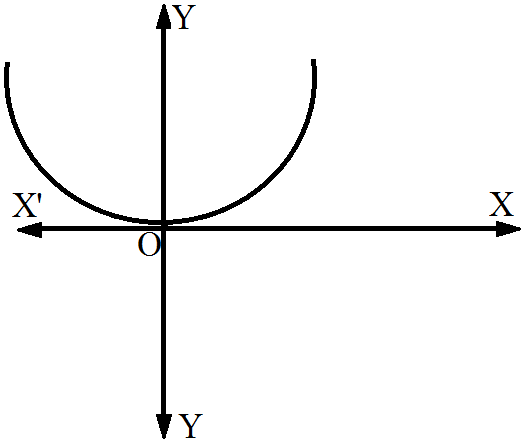
Differentiating equation (1) with respect to x, we get: $2\text{x} = 4\text{ay}'\ \ ...(2)$ Dividing equation (2) by equation (1), we get: $\frac{2\text{x}}{\text{x}^2}=\frac{4\text{ay}'}{4\text{ay}}$ $\Rightarrow \frac{2}{\text{x}} = \frac{\text{y}'}{\text{y}}$ $\Rightarrow \text{xy}'=2\text{y}$ $\Rightarrow \text{xy}'-2\text{y}=0$ This is the required differential equation. View full question & answer→Question 2405 Marks
For each of the differential equations given in find the general solution:
$(\text{x}+\text{y})\frac{\text{dy}}{\text{dx}}=1$
Answer$(\text{x}+\text{y})\frac{\text{dy}}{\text{dx}}=1$
$\Rightarrow\frac{\text{dy}}{\text{dx}}=\frac{1}{\text{x}+\text{y}}$
$\Rightarrow\frac{\text{dx}}{\text{dy}}=\text{x}+\text{y}$
$\Rightarrow\frac{\text{dx}}{\text{dy}}-\text{x}=\text{y}$
This is a linear differential equation of the form:
$\frac{\text{dy}}{\text{dx}}+\text{px}=\text{Q}\ (\text{where p}=-1\ \text{and}\ \text{Q}=\text{y})$
$\text{Now, I.F}=\text{e}^{\int\text{pdy}}=\text{e}^{\int-\text{dy}}=\text{e}^{-\text{y}}.$
The general solution of the given differential equation is given by the relation,
$\text{x(I.F)}=\int(\text{Q}\times\text{I.F.})\text{dy}+\text{C}$
$\Rightarrow\text{xe}^{-\text{y}}=\int(\text{y}\cdot\text{e}^{-\text{y}})\text{dy}+\text{C}$
$\Rightarrow\text{xe}^{-\text{y}}=\text{y}\cdot\int\text{e}^{-\text{y}}\text{dy}-\int\Big[\frac{\text{d}}{\text{dy}}(\text{y})\int\text{e}^{-\text{y}}\text{dy}\Big]\text{dy}+\text{C}$
$\Rightarrow\text{xe}^{-\text{y}}=\text{y}(-\text{e}^{-\text{y}})-\int(-\text{e}^{-\text{y}})\text{dy}+\text{C}$
$\Rightarrow\text{xe}^{-\text{y}}=-\text{ye}^{-\text{y}}+\int\text{e}^{-\text{y}}\text{dy}+\text{C}$
$\Rightarrow\text{xe}^{-\text{y}}=-\text{ye}^{-\text{y}}-\text{e}^{-\text{y}}+\text{C}$
$\Rightarrow\text{x}=-\text{y}-1+\text{Ce}^{\text{y}}$
$\Rightarrow\text{x}+\text{y}+1=\text{Ce}^{\text{y}}$
View full question & answer→Question 2415 Marks
Represent the following families of curves by forming the corresponding differential equation:
$\text{x}^2+\text{y}^2=\text{ax}^3$
AnswerThe equation of the family of curves is
$\text{x}^2+\text{y}^2=\text{ax}^3\ ...(1)$
where a is a parameter.
As this equation has only one arbitrary constant, we shall get a differential equation of first order.
Differentiating (1) with respect to x, we get
$2\text{x}+2\text{y}\frac{\text{dy}}{\text{dx}}=3\text{ax}^2$
$\Rightarrow2\text{x}+2\text{y}\frac{\text{dy}}{\text{dx}}=3\Big(\frac{\text{x}^2+\text{y}^2}{\text{x}^3}\Big)\text{x}^2$
$\Rightarrow2\text{x}+2\text{y}\frac{\text{dy}}{\text{dx}}=3\frac{\text{x}^2+\text{y}^2}{\text{x}^3}$
$\Rightarrow2\text{x}^2+2\text{xy}=3\text{x}^2+3\text{y}^2$
$2\text{xy}=\text{x}^2+3\text{y}^2$
It is the required differential equation.
View full question & answer→Question 2425 Marks
Show that the general solution of the differential equation $\frac{\text{dy}}{\text{dx}}+\frac{\text{y}^2+\text{y}+1}{\text{x}^2+\text{x}+1}=0$ is given by $(\text{x}+\text{y}+1)=\text{A}(1-\text{x}-\text{y}-2\text{xy},)$ where A is parameter.
AnswerThe given differential equation is
$\frac{\text{dy}}{\text{dx}}+\frac{\text{y}^2+\text{y}+1}{\text{x}^2+\text{x}+1}=0\ \ $ $\text{or}\ \ \frac{\text{dy}}{\text{dx}}=-\Big(\frac{\text{y}^2+\text{y}+1}{\text{x}^2+\text{x}+1}\Big)=1$
Integrating, we get
$\int\frac{\text{dy}}{\text{y}^2+\text{y}+1}=-\int\frac{\text{dx}}{\text{x}^2+\text{x}+1}$
$\int\frac{\text{dy}}{\text{y}^2+\text{y}+1}+\int\frac{\text{dx}}{\text{x}^2+\text{x}+1}=0$
$\Rightarrow\ \ \int\frac{\text{dy}}{\Big(\text{y}+\frac{1}{2}\Big)^2+\Big(1-\frac{1}{4}\Big)}+\int\frac{\text{dx}}{\Big({\text{x}+\frac{1}{2}\Big)^2+1-\frac{1}{4}}}=0$
$\Rightarrow\ \ \int\frac{\text{dy}}{\Big(\text{y}+\frac{1}{2}\Big)^2+\Big(\frac{\sqrt{3}}{2}\Big)^2}+\int\frac{\text{dx}}{\Big({\text{x}+\frac{1}{2}\Big)^2+\Big(\frac{\sqrt{3}}{2}}\Big)^2}=0$
$\Rightarrow\ \ \frac{2}{\sqrt{3}}\tan^{-1}\Bigg(\frac{\text{y}+\frac{1}{2}}{\frac{\sqrt{3}}{2}}\Bigg)+\frac{2}{\sqrt{3}}\tan^{-1}\Bigg(\frac{\text{x}+\frac{1}{2}}{\frac{\sqrt{3}}{2}}\Bigg)=0$
$\Rightarrow\ \ \tan^{-1}\Big(\frac{2\text{y}+1}{\sqrt{3}}\Big)+\tan^{-1}\Big(\frac{2\text{x}+1}{\sqrt{3}}\Big)$ $=\frac{\sqrt{3}\text{C}}{2}=\text{A}_{1}\ (\text{say})$
Taking tangents on the two sides, we get
$\frac{\frac{2\text{y}+1}{\sqrt{3}}+\frac{2\text{x}+1}{\sqrt{3}}}{1-\Big(\frac{2\text{y}+1}{\sqrt{3}}\Big)\Big(\frac{2\text{x}+1}{\sqrt{3}}\Big)}=\tan\text{A}_1$ $\Rightarrow\ \ \frac{2\sqrt{3}(\text{x}+\text{y}+1)}{3-(4\text{xy}+2\text{x}+2\text{y}+1)}=\tan\text{A}_1$
$\Rightarrow\ \ \frac{2\sqrt{3}(\text{x}+\text{y}+1)}{2-(1-\text{x}-\text{y}-2\text{xy})}=\tan\text{A}_1$
$\Rightarrow\ \ \text{x}+\text{y}+1=\frac{1}{\sqrt{3}}\tan\text{A}_1(1-\text{x}-\text{y}-2\text{xy})$
$\Rightarrow\ \ \text{x}+\text{y}+1=\text{A}(1-\text{x}-\text{y}-2\text{xy}),$
$\text{where A}=\frac{1}{\sqrt{3}}\tan\text{A}_1\ \text{is an arbitrary constant}.$
View full question & answer→Question 2435 Marks
Solve the following differential equation
$\frac{\text{dy}}{\text{dx}}=\frac{\text{x e }^\text{x}\log\text{x}+\text{e}^\text{x}}{\text{x}\cos\text{y}}$
AnswerWe have,$\frac{\text{dy}}{\text{dx}}=\frac{\text{x e }^\text{x}\log\text{x}+\text{e}^\text{x}}{\text{x}\cos\text{y}}$
$\Rightarrow\text{x}\cos\text{y dy}=(\text{x e}^\text{x}\log\text{x}+\text{e}^\text{x})\ \text{dx}$
$\Rightarrow\cos\text{y dy}=\Big(\text{e}^\text{x}\log\text{x}+\frac{1}{\text{x}}\text{e}^\text{x}\Big)\ \text{dx}$
Integrating both sides, we get
$\int\cos\text{y dy}=\int\Big(\text{e}^\text{x}\log\text{x}+\frac{1}{\text{x}}\text{e}^\text{x}\Big)\text{dx}$
$\Rightarrow\sin\text{y}=\log\text{x}\int\text{e} ^\text{x}\text{dx}-\int\frac{1}{\text{x}}\text{e}^\text{x}\text{dx}+\int\frac{1}{\text{x}}\text{e}^\text{x}\text{dx}$
$\Rightarrow\sin\text{y}=\text{e}^\text{x}\log\text{x}+\text{C}$
Hence, $\sin\text{y}=\text{e}^\text{x}\log\text{x}+\text{C}$ is the required solution.
View full question & answer→Question 2445 Marks
If the marginal cost of maufacturing a certain item is given by $\text{C}(\text{x})=\frac{\text{dC}}{\text{dx}}=2+0.15\text{x}$. Find the total cost function C(x), given that C(0) = 100.
AnswerGiven, $\text{C'}(\text{x})=\frac{\text{dC}}{\text{dx}}=2+0.15\text{x}$
$\text{dC}=(2+0.15\text{x})\text{dx}$
$\int \text{dC}=\int(2+0.15\text{x})\text{dx}$
$\text{C}=2\text{x}+\frac{0.15\text{x}^{2}}{2}+\lambda\ ...(\text{i})$
Given, C = 100 when x = 0, so
$100=0+0+\lambda$
$\lambda=100$
Put the value of eq. (i)
$\text{C}(\text{x})=2\text{x}+\frac{0.15\text{x}^{2}}{2}+100$
$\text{C}(\text{x})=2\text{x}+0.075\text{x}^{2}+100$
View full question & answer→Question 2455 Marks
In a culture, the bacteria count is 100000. The number is increased by 10% in 2 hours. In how many hours will the count reach 200000, if the rate of growth of bacteria is proportional to the number present?
AnswerLet C be the count of bacteria at ant time t.
It is given that $\frac{\text{dC}}{\text{dt}}\propto\text{C}$
$\Rightarrow\frac{\text{dC}}{\text{dt}}=\lambda\text{C}$
$\Rightarrow\frac{\text{dC}}{\text{C}}=\lambda\text{dt}$
$\Rightarrow\int \frac{\text{dC}}{\text{C}}=\lambda\int \text{dt}$
$\Rightarrow\log\text{C}=\lambda\text{t}+\log\text{K}\ ...(\text{i})$
Initially, at t = 0, C = 100000
Thus, we have,
$\Rightarrow\log 100000=\lambda\ \times\text{0}+\log\text{K}\ ...(\text{ii})$
$\Rightarrow \log 100000=\ \log \text{K}\ ...(\text{iii})$
At t = 2,
$\text{C}=100000+100000\times\frac{10}{100}=110000$
Thus, From (i), we have
$\log 110000=\lambda\times2+\text{logK}\ ...(\text{iv})$
Subtracting equation (ii) from (iv), we have
$\log110000-\log100000=2\lambda$
$\Rightarrow11\times10000-\log10\times100000=2\lambda$
$\Rightarrow \log\frac{11\times10000}{10\times10000}=2\lambda$
$\Rightarrow\ \log\frac{11}{10}=2\lambda$
$\Rightarrow \lambda=\frac{1}{2}\log\frac{11}{10}\ ...(\text{v})$
We need to find the time t in which the count reaches 200000.
Substituting the values of from (iii) and (v)
$\log200000=\frac{1}{2}\log\frac{11}{10}\text{t}+\log 100000$
$\Rightarrow\frac{1}{2}\log\frac{11}{10}\text{t}=\log200000-\log100000$
$\Rightarrow\frac{1}{2}\log\frac{11}{10}\text{t}=\log\frac{200000}{100000}$
$\Rightarrow\frac{1}{2}\log\frac{11}{10}\text{t}=\log2$
$\Rightarrow\text{t}=\frac{2 \log2}{\log\frac{11}{10}} \ \text{hours}$
View full question & answer→Question 2465 Marks
For the differential equaton $\text{xy}\frac{\text{dy}}{\text{dx}}=(\text{x}+2)(\text{y}+2).$ Find the solution curve passing through the point (1, -1).
AnswerWe have,
$\text{xy}\frac{\text{dy}}{\text{dx}}=(\text{x}+2)(\text{y}+2)$
$\Rightarrow\frac{\text{y}}{\text{y}+2}\text{dy}=\frac{(\text{x}+2)}{\text{x}}\text{dx}$
Integrating both sides, we get
$\int\frac{\text{y}}{\text{y}+2}\text{dy}=\int\frac{(\text{x}+2)}{\text{x}}\text{dx}$
$\Rightarrow\int\text{dy}-2\int\frac{1}{\text{y}+2}\text{dy}=\int\text{dx}+2\int\frac{1}{\text{x}}\text{dx}$
$\Rightarrow\text{y}-2\log|\text{y}+2|=\text{x}+2\log|\text{x}|+\text{C}...(1)$
This equation represents the family of solution curves of the given differential equation.
We have to find a particular member of the family, which passes through the point (1, -1).
Substituting $\text{x}=1$ and $\text{y}=-1$ in (1), we get
$-1-2\log|1|=1+2\log|1|+\text{C}$
$\Rightarrow\text{C}=-2$
Putting $\text{C}=-2$ in (1), we get
$\text{y}-2\log|\text{y}+2|=\text{x}+2\log|\text{x}|-2$
$\Rightarrow\text{y}-\text{x}+2=\log\Big\{\text{x}^2(\text{y}+2)^2\Big\}$
Hence, $\text{y}-\text{x}+2=\log\Big\{\text{x}^2(\text{y}+2)^2\Big\}$ is the equation of the required curve.
View full question & answer→Question 2475 Marks
The slope of the tangent at each point of a curve is equal to the sum of the coordinates of the point. Find the curve that passes through the origin.
AnswerGiven,
Slop of tangent at (x, y) = x + y
$\frac{\text{dy}}{\text{dx}}=\text{x}+\text{y}$
$\frac{\text{dy}}{\text{dx}}-\text{y}=\text{x}$
It is a liner differential equation. Comparing it with $\text{P}=-1, \text{Q}=\text{x}$
$\text{I.F}=\text{e}^{\int\text{P}\text{dx}}$
$=\text{e}^{\int\text{(-1)}\text{dx}}$
$=\text{e}^{-\text{x}}$
Solution of equation is given by,
$\text{y}(\text{I.F})=\int\text{Q}(\text{I.F})\text{dx}+\text{C}$
$\text{y}(\text{e}^{-\text{x}})=\int\text{x}(\text{e}^{-\text{x}})\text{dx}+\text{C}$
$\text{y}\text{e}^{-\text{x}}=\text{x}(\text{e}^{-\text{x}})+\int(1\times\text{e}^{-\text{x}})\text{dx}+\text{C}$
It ispassing through origin
$0=0-1+\text{Ce}^{0}$
$1=\text{C}$
Put $\text{C}=1$ is equation,
$\text{y}=-\text{x}-1+\text{e}^{\text{x}}$
$\text{y}+\text{x}+1=\text{e}^{\text{x}}$
View full question & answer→Question 2485 Marks
Differential equation $\frac{\text{d}^2\text{y}}{\text{dx}^2}+\text{y}=0,\text{y}(0)=1,\text{y}'(0)=1$Function $\text{y}=\sin\text{x}+\cos\text{x}$
AnswerWe have,
$\text{y}=\sin\text{x}+\cos\text{x}\ ....(1)$
Differentiating both sides of (1) with respect to x, we get
$\frac{\text{dy}}{\text{dx}}=\cos\text{x}-\sin{\text{x}}...(2)$
Differentiating both sides of (2) with respect to x, we get
$\frac{\text{d}^{2}\text{y}}{\text{dx}^{2}}=-\sin\text{x}-\cos\text{x}$
$\Rightarrow\frac{\text{d}^{2}\text{y}}{\text{dx}^{2}}=-(\sin\text{x}+\cos\text{x})$
$\Rightarrow\frac{\text{d}^{2}\text{y}}{\text{dx}^{2}}=-\text{y}$ [Using (1)]
$\Rightarrow\frac{\text{d}^{2}\text{y}}{\text{dx}^{2}}+\text{y}=0$
It is the given differential equation.
Therefore, $\text{y}=\sin\text{x}+\cos\text{x}$ satiesfies the given differential equation.
Also, when $\text{x}=0;\text{y}=\sin0+\cos0=1,\text{i.e.y}(0)=1.$
And, when $\text{x}=0;\text{y}'=\cos0-\sin0=1,\text{i.e.y'}(0)=1$
Hence $\text{y}=\sin\text{x}+\cos\text{x}$ is the solution to the given initial value problem.
View full question & answer→Question 2495 Marks
Solve the following differential equation:
$(2\text{x}-10\text{y}^3)\frac{\text{dx}}{\text{dy}}+\text{y}=0$
AnswerWe have, $(2\text{x}-10\text{y}^3)\frac{\text{dx}}{\text{dy}}+\text{y}=0$
$\Rightarrow\ (2\text{x}-10\text{y}^3)\frac{\text{dx}}{\text{dy}}=-\text{y}$
$\Rightarrow\ \frac{\text{dx}}{\text{dy}}=-\frac{1}{\text{y}}(2\text{x}-10\text{y}^3)$
$\Rightarrow\ \frac{\text{dx}}{\text{dy}}+\frac{2}{\text{y}}\text{x}=10\text{y}^2\ \dots(1)$ Clearly, it is a linear differential equation of the form $\frac{\text{dy}}{\text{dx}}+\text{Py}=\text{Q}$ where $\text{P}=\frac{2}{\text{y}}$
$\text{Q}=10\text{y}^2$
$\therefore$ I.F. $=\text{e}^{\int\text{Pdy}}$
$=\text{e}^{\int\frac{2}{\text{y}}\text{dy}}$
$=\text{e}^{2\log{\text{y}}}=\text{y}^2$ Multiplying both sides of (1) by $y^2$, we get $\text{y}^2\Big(\frac{\text{dx}}{\text{dy}}+\frac{2}{\text{y}}\text{x}\Big)=\text{y}^2\times10\text{y}^2$
$\Rightarrow\ \text{y}^2\frac{\text{dx}}{\text{dy}}+\frac{2}{\text{y}}\text{xy}^2=10\text{y}^2$ Integrating both sides with respect to y, we get $\text{xy}^2=\int10\text{y}^4\text{dy + C}$
$\Rightarrow\ \text{xy}^2=2\text{y}^5+\text{C}$
$\Rightarrow\ \text{x}=2\text{y}^3+\text{Cy}^{-2}$Hence, $\text{x}=2\text{y}^3+\text{Cy}^{-2}$ is the required solution.
View full question & answer→Question 2505 Marks
Experiments show that radium disintegrates at a rate proportional to the amount of radium present at the moment. Its half - life is 1590 years. What percentage will disappear in one year?
AnswerLet A be the quantity of mass at any time t, So
$\frac{\text{dA}}{\text{dt}}\propto\text{A}$
$\frac{\text{dA}}{\text{dt}}=-\lambda\text{A}$
$\frac{\text{dA}}{\text{A}}=-\lambda\text{dt}$
$\int \frac{\text{dA}}{\text{A}}=-\lambda\int\text{dt}$
$\log\text{A}=-\lambda\text{t}+\text{C}\ ...(\text{i})$
Let intial of mass be A, So
$\log\text{A}_{0}=-\lambda(0)+\text{C}$
$\log(\text{A}_{0})=\text{C}$
Now, eq. (i),
$\log\text{A}=-\lambda\text{t}+\log\text{A}_{0}$
$\log\frac{\text{A}}{\text{A}_{0}}=-\lambda\text{t}\ ...(\text{ii})$
Given, its half - life is 1590 years,
$\log\Big(\frac{\frac{1}{2}\text{A}_{0}}{\text{A}_{0}}\Big)=-\lambda(1590)$
$\log\Big(\frac{1}{2}\Big)=-\lambda(1590)$
$-\log2=-\lambda(1590)$
$\frac{\log2}{1590}=\lambda$
Now, eq.(i) becomes
$\log\Big(\frac{\text{A}}{\text{A}_{0}}\Big)=-\frac{\log2}{1590}\text{t}$
View full question & answer→Question 2515 Marks
Find the solution of the differential equation $\cos\text{ y dy}+\cos\text{x}\sin\text{ y dx}=0$ given that $\text{y}=\frac{\pi}{2},$ when $\text{x}=\frac{\pi}{2}.$
AnswerWe have,
$\cos\text{y dy}+\cos\text{x}\sin\text{ y dx}=0$
$\Rightarrow\cos\text{ y dy}=-\cos\text{x}\sin\text{ y dx}$
$\Rightarrow\cot\text{y dy}=-\cos\text{ x dx}$
Integrating both sides, we get
$\int\cot\text{y dy}=-\int\cos\text{x dx}$
$\Rightarrow\log|\sin\text{y}|=-\sin\text{x + C}$
$\Rightarrow\log|\sin\text{y}|+\sin\text{x = C} ...(1)$
It is given that at $\text{x}=\frac{\pi}{2},\text{y}=\frac{\pi}{2}.$
Substituting the valuse of x and y in (1), we get
$\log|\sin\frac{\pi}{2}|+\sin\frac{\pi}{2}=\text{C}$
$\Rightarrow\text{C}=1$
Therefore, substituting the value of C in (1), we get
$\log|\sin\text{y}|+\sin\text{x}=1$
Hence, $\log|\sin\text{y}|+\sin\text{x}=1$ is the required solution.
View full question & answer→Question 2525 Marks
Solve $2(\text{y}+3)-\text{xy}\frac{\text{dy}}{\text{dx}}=0,$ given that y(1) = -2.
AnswerWe have, $2(\text{y}+3)-\text{xy}\frac{\text{dy}}{\text{dx}}=0$
$\Rightarrow2(\text{y}+3)=\text{xy}\frac{\text{dy}}{\text{dx}}$
$\Rightarrow2\frac{\text{dy}}{\text{dx}}=\frac{\text{y}}{\text{y}+3}\text{dy}$
$\Rightarrow2\int\frac{\text{dy}}{\text{x}}=\int\Big(1-\frac{3}{\text{y}+3}\Big)\text{dy}$
$\Rightarrow2\log\text{x}=\text{y}-3\log(\text{y}+3)+\text{C}\ ......({\text{i}})$
Given that when x = 1 and y = -2
$\Rightarrow2\log1=-2-3\log(-2+3)+\text{C}$
$\Rightarrow\text{C}=2$
Thus, from Eq. (i)
$2\log\text{x}=\text{y}-3\log(\text{y}+3)+2$
$\Rightarrow2\log\text{x}+3\log(\text{y}+3)=\text{y}+2$
$\Rightarrow\log\text{x}^2(\text{y}+3)^3=\text{y}+2$
$\Rightarrow\text{x}^2(\text{y}+3)^3=\text{e}^{\text{y}+2}$
View full question & answer→Question 2535 Marks
Solve the following differential equations $(1+\text{x}^2)\frac{\text{dy}}{\text{dx}}+(1+\text{y}^2)=0,$ given that $\text{y}=1,$ when $\text{x}=0.$
AnswerWe have,
$(1+\text{x}^2)\frac{\text{dy}}{\text{dx}}+(1+\text{y}^2)=0,\text{y}=1$ when $\text{x}=0.$
$\Rightarrow(1+\text{x}^2)\frac{\text{dy}}{\text{dx}}=-(1+\text{y}^2)$
$\Rightarrow\frac{1}{1+\text{y}^2}\text{dy}=-\frac{1}{(1+\text{x}^2)}\text{dx}$
Integrating both sides, we get
$\int \frac{1}{1+\text{y}^2}\text{dy}=-\int\frac{1}{(1+\text{x}^2)}\text{dx}$
$\Rightarrow\tan^{-1}\text{y}=-\tan^{-1}\text{x + C}$
$\Rightarrow\tan^{-1}\text{y}+\tan^{-1}\text{x = C}...(1)$
Given: $\text{x}=0,\text{y}=1.$
Substituting the valuse of x and y in (1), we get
$\frac{\pi}{4}+0=\text{C}$
$\Rightarrow\text{C}=\frac{\pi}{4}$
Substituting the value of C in (1), we get
$\tan^{-1}\text{y}+\tan^{-1}\text{x}=\frac{\pi}{4}$
$\Rightarrow\tan^{-1}\text{x}+\tan^{-1}\text{y}=\frac{\pi}{4}$
$\Rightarrow\tan^{-1}\Big(\frac{\text{x + y}}{1-\text{xy}}\Big)=\frac{\pi}{4}$
$\Rightarrow\frac{\text{x}+\text{y}}{1-\text{xy}}=1$
$\Rightarrow\text{x+y}=1-\text{xy}$
Hence, $\text{x+y}=1-\text{xy}$ is the required solution.
View full question & answer→Question 2545 Marks
Form the differential equation of all the circle which pass through the origin and whose centres lies in x-axis.
AnswerThe equation of the family of circles that pass through the origin (0, 0) and whose centres lie on the x-axis is given by
$(\text{x}-\text{a})^2+\text{y}^2=\text{a}^2\ ...(1)$
where a are arbitrary constants.
As this equation has only one arbitrary constant, we shall get a first order differential equation.
Differentiating (1) with respect to x, we get
$2(\text{x}-\text{a})+2\text{y}\frac{\text{dy}}{\text{dx}}=0$
$\Rightarrow\text{x}-\text{a}+\text{y}\frac{\text{dy}}{\text{dx}}=0$
$\Rightarrow\text{x}+\text{y}\frac{\text{dy}}{\text{dx}}=\text{a}$
Substituting the value of a in equation (2), we get
$\Big(\text{x}-\text{x}-\text{y}\frac{\text{dy}}{\text{dx}}\Big)^2+\text{y}^2=\Big(\text{x}+\text{y}\frac{\text{dy}}{\text{dx}}\Big)^2$
$\Rightarrow\text{y}^2\Big(\frac{\text{dy}}{\text{dx}}\Big)^2+\text{y}^2=\text{x}^2+2\text{xy}\frac{\text{dy}}{\text{dx}}+\text{y}^2\Big(\frac{\text{dy}}{\text{dx}}\Big)^2$
$\Rightarrow2\text{xy}\frac{\text{dy}}{\text{dx}}+\text{x}^2=\text{y}^2$
It is the required differential equation.
View full question & answer→Question 2555 Marks
Solve the following differential equation:$4\frac{\text{dy}}{\text{dx}}+8\text{y}=5\text{e}^{-3\text{x}}$
Answer$4\frac{\text{dy}}{\text{dx}}+8\text{y}=5\text{e}^{-3\text{x}}$
$\Rightarrow\ \frac{\text{dy}}{\text{dx}}+2\text{y}=\frac{5}4\text{e}^{-3\text{x}}\ \dots(1)$
Clearly, it is a linear differential equation of the form
$\frac{\text{dy}}{\text{dx}}+\text{Py}=\text{Q}$
$\text{P}=2$
$\text{Q}=\frac{5}4\text{e}^{-3\text{x}}$
$\therefore$ I.F. $=\text{e}^{\int\text{Pdx}}$
$=\text{e}^{\int2\text{dx}}$
$=\text{e}^{2\text{x}}$
Multiplying both sides of (1) by $\text{e}^{2\text{x}},$ we get
$\text{e}^{2\text{x}}\Big(\frac{\text{dy}}{\text{dx}}+2\text{y}\Big)=\frac{5}4\text{e}^{2\text{x}}\text{e}^{-3\text{x}}$
$\Rightarrow\ \text{e}^{2\text{x}}\frac{\text{dy}}{\text{dx}}+2\text{e}^{2\text{x}}\text{y}=\frac{5}4\text{e}^{-\text{x}}$
Integrating both sides with respect to x, we get
$\text{y}\text{e}^{2\text{x}}=\frac{5}4\int\text{e}^{-\text{x}}\text{dx + C}$
$\Rightarrow\ \text{y}\text{e}^{2\text{x}}=-\frac{5}4\text{e}^{-\text{x}}+\text{C}$
$\Rightarrow\ \text{y}=\frac{5}4\text{e}^{-3\text{x}}+\text{C}\text{e}^{-2\text{x}}$
Hence, $\text{y}=\frac{5}4\text{e}^{-3\text{x}}+\text{C}\text{e}^{-2\text{x}}$ is the required solution.
View full question & answer→Question 2565 Marks
Solve the following differential equations:
$\frac{\text{dy}}{\text{dx}}=1-\text{x + y}-\text{xy}$
AnswerWe have,
$\frac{\text{dy}}{\text{dx}}=1-\text{x + y}-\text{xy}$
$\Rightarrow\frac{\text{dy}}{\text{dx}}=1+\text{y}-\text{x}(1+\text{y})$
$\Rightarrow\frac{\text{dy}}{\text{dx}}=(1+\text{y})(1-\text{x})$
$\Rightarrow\frac{1}{1+\text{y}}\text{dy}=(1-\text{x})\text{dx}$
Integrating both sides, we get
$\int\frac{1}{1+\text{y}}\text{dy}=\int(1-\text{x})\text{dx}$
$\Rightarrow\log|1+\text{y}|=\text{x}-\frac{\text{x}^2}{2}+\text{C}$
Hence, $\log|1+\text{y}|=\text{x}-\frac{\text{x}^2}{2}+\text{C}$ is the required solution.
View full question & answer→Question 2575 Marks
Solve the following differential equation
$\frac{\text{dy}}{\text{dx}}=\text{x}^5\tan^{-1}(\text{x}^3)$
Answer$\frac{\text{dy}}{\text{dx}}=\text{x}^5\tan^{-1}(\text{x}^3)$$\text{dy}=\text{x}^5\tan^{-1}(\text{x}^3)\text{dx}$
$\int\text{dy}=\int\text{x}^5\tan^{-1}(\text{x}^3)\text{dx}$
put $\text{x}^3=\text{t}$
$\Rightarrow3\text{x}^2\text{dx}=\text{dt}$
$\Rightarrow\text{x}^2\text{dx}=\frac{\text{dt}}{3}$
So,
$\int\text{dy}=\frac{1}{3}\Big[\tan^{-1}\text{t}\int\text{t dt}=\int\Big(\frac{1}{1+\text{t}^2}\Big)\times\int\text{t dx}\Big)\Big]\text{dt}+\text{C}$
Using integration by parts
$\text{y}=\frac{1}{3}\Big[\frac{\text{t}^2}{2}+\tan^{-1}-\int\frac{\text{t}^2}{2(\text{t}^2+1)}\text{dt}\Big]+\text{C}$
$=\frac{1}{6}\text{t}^2\tan^{-1}\text{t}-\frac{1}{6}\int\Big(\frac{\text{t}^2}{\text{t}^2+1}\Big)\text{dt}+\text{C}$
$\text{y}=\frac{1}{6}\text{t}^2\tan^{-1}\text{t}-\frac{1}{6}\int\Big(1-\frac{1}{\text{t}^2+1}\Big)\text{dt}+\text{C}$
$=\frac{1}{6}\text{t}^2\tan^{-1}\text{t}-\frac{1}{6}\text{t}+\frac{1}{6}\tan^{-1}\text{t}+\text{C}$
$\text{y}=\frac{1}{6}(\text{t}^2+1)\tan^{-1}\text{t}-\frac{1}{6}\text{t}+\text{C}$
$\text{y}=\frac{1}{6}[(\text{t}^2+1)\tan^{-1}\text{t}-\text{t}]+\text{C}$
So,
$\text{y}=\frac{1}{6}[(\text{x}^6+1)\tan^{-1}(\text{x}^3)-\text{x}^3]+\text{C}$
View full question & answer→Question 2585 Marks
Solve the following differential equation:
$\frac{\text{dy}}{\text{dx}} = (\text{x}+\text{y})^2$
AnswerWe have,
$\frac{\text{dy}}{\text{dx}} = (\text{x}+\text{y})^2$
Let $\text{ x} + \text{y} = \text{v}$
$\Rightarrow 1 + \frac{\text{dy}}{\text{dx}} = \frac{\text{dv}}{\text{dx}}$
$\Rightarrow \frac{\text{dy}}{\text{dx}} = \frac{\text{dv}}{\text{dx}} - 1$
$\therefore \frac{\text{dv}}{\text{dx}} - 1 = \text{v}^2$
$\Rightarrow \frac{\text{dv}}{\text{dx}} = \text{v}^2 + 1$
$\Rightarrow \frac{1}{\text{v}^2+1}\text{dv} = \text{dx}$
Integrating both sides, we get
$\int\frac{1}{\text{v}^2+1}\text{dv} = \int\text{dx}$
$\Rightarrow \tan^{-1}\text{v} = \text{x} + \text{C}$
$\Rightarrow \text{v} = \tan(\text{x}+\text{C})$
$\Rightarrow \text{x}+\text{y} = \tan (\text{x}+\text{C})$
View full question & answer→Question 2595 Marks
At every point on a curve the slope is the sum of the abscissa and the product of the ordinate and the abscissa, and the curve passes through (0, 1). Find the equation of the curve.
AnswerAccording to the question,
$\frac{\text{dy}}{\text{dx}}=\text{x}+\text{xy}$
$\Rightarrow \frac{\text{dy}}{\text{dx}}=\text{x}(1+\text{y})$
$\Rightarrow \frac{1}{1+\text{y}}\text{dy}=\text{x}\ \text{dx}$
Integrating both sides with respect to x, we get
$\int\frac{1}{1+\text{y}}\text{dy}=\int\text{x}\ \text{dx}$
$\Rightarrow \log|1+\text{y}|=\frac{\text{x}^{2}}{2}+\text{C}$
Since the curve passes through (0, 1), it satisfies the above equation.
$\Rightarrow \log|1+\text{1}|=\frac{\text{0}^{2}}{2}+\text{C}$
$\Rightarrow \text{C}=\log2$
Putting the value of C, we get
$\Rightarrow \log|1+\text{y}|=\frac{\text{x}^{2}}{2}+\log2$
$\Rightarrow \log|\frac{1+\text{y}}{2}|=\frac{\text{x}^{2}}{2}$
$\Rightarrow\frac{1+\text{y}}{2}=\text{e}^\frac{\text{x}^{2}}{2}$
$\Rightarrow{\text{y}+1}=2\text{e}^\frac{\text{x}^{2}}{2}$
View full question & answer→Question 2605 Marks
Solve the following differential equation
$(1+\text{x}^2)\text{dy}=\text{xy dx}$
AnswerWe have$(1+\text{x}^2)\text{dy}=\text{xy dx}$
$\Rightarrow\frac{1}{\text{y}}\text{dy}=\frac{\text{x}}{1+\text{x}^2}\ \text{dx}$
Integrating both sides, we get
$\int\frac{1}{\text{y}}\text{dy}=\int\frac{\text{x}}{1+\text{x}^2}\ \text{dx}$
Substituting $1+ x^2 = t$, we get
$2\text{x dx}=\text{dt}$
$\therefore\int\frac{1}{\text{y}}\text{dy}=\frac{1}{2}\int\frac{1}{\text{t}}\text{dt}$
$\Rightarrow\log|\text{y}|=\frac{1}{2}\log|\text{t}|+\log\text{C}$
$\Rightarrow\log|\text{y}|=\frac{1}{2}\log|1+\text{x}^2|+\log\text{C}$
$\Rightarrow\log|\text{y}|=\log\Big[\text{C}\sqrt{1+\text{x}^2}\Big]$
$\Rightarrow\text{y}=\text{C}\sqrt{1+\text{x}^2}$
Hence, $\text{y}=\text{C}\sqrt{1+\text{x}^2}$ is the required solution.
View full question & answer→Question 2615 Marks
Solve the following differential equations:
$(\text{x}-1)\frac{\text{dy}}{\text{dx}}=2\text{x}^3\text{y}$
AnswerWe have,
$(\text{x}-1)\frac{\text{dy}}{\text{dx}}=2\text{x}^3\text{y}$
$\Rightarrow\frac{1}{\text{y}}\text{dy}=\frac{2\text{x}^3}{\text{x}-1}\text{dx}$
Integrating both sides, we get
$\int\frac{1}{\text{y}}\text{dy}=\int\frac{2\text{x}^3}{\text{x}-1}\text{dx}$
$\Rightarrow\log|\text{y}|=2\int\frac{\text{x}^3-1+1}{\text{x}-1}\text{dx}$
$\Rightarrow\log|\text{y}|=2\Big[\int\frac{\text{x}^3-1}{\text{x}-1}\text{dx}+\int\frac{1}{\text{x}-1}\text{dx}\Big]$
$\Rightarrow\log|\text{y}|=2\Big[\int\frac{(\text{x}-1)(\text{x}^2+\text{x}+1)}{\text{x}-1}\text{dx}+\int\frac{1}{\text{x}-1}\text{dx}\Big]$
$\Rightarrow\log|\text{y}|=2\Big[\int(\text{x}^2+\text{x}+1)\text{dx}+\int\frac{1}{\text{x}-1}\text{dx}\Big]$
$\Rightarrow\log|\text{y}|=2\Big[\frac{\text{x}^3}{3}+\frac{\text{x}^2}{2}+\text{x}+\log|\text{x}-1|\Big]+\text{C}$
$\Rightarrow\log|\text{y}|=\frac{2}{3}\text{x}^3+\text{x}^2+2\text{x}+\log|\text{x}-1|^2+\text{C}$
$\Rightarrow\text{y}=\text{e}^{\frac{2}{3}}\text{x}^3+\text{x}^2+2\text{x}+\log|\text{x}-1|^2+\text{C}$
$\Rightarrow\text{y}=\text{e}^{\text{C}}\times\text{e}^{\log|\text{x}-1|^2}\times\text{e}^{\frac{2}{3}}\text{x}^3+\text{x}^2+2\text{x}$
$\Rightarrow\text{y = C}_1|\text{x}-1|^2\text{e}^{\frac{2}{3}}\text{x}^3+\text{x}^2+2\text{x}$ $\big[\because\text{e}^{\text{In x}}=\text{x}\text{and where, C}_1=\text{e}^{\text{c}}\big]$
$\therefore\text{y}=\text{C}_1|\text{x}-1|^2\text{e}^{\frac{2}{3}}\text{x}^3+\text{x}^2+2\text{x}$ is required solution.
View full question & answer→Question 2625 Marks
Assume that a rain drop evaporates at a rate proportional to its surface area. Form a differential equation involving the rate of change of the radius of the rain drop.
AnswerLet A be the surface area of rain drain, v be its volume, and r be the radius of rain drop.
Given:
$\frac{\text{dV}}{\text{dt}}=\text{A}$
$\frac{\text{dV}}{\text{dt}}=-\text{KA}$ [negative because V decrease with increase in t]
Where K is the constant of proportionality.
So,
$\frac{\text{d}}{\text{dt}}\Big(\frac{4\pi}{3}\text{r}^3\Big)=-\text{K}(4\pi\text{r}^2)$
$4\pi\text{r}^2\frac{\text{dr}}{\text{dt}}=-\text{K}(4\pi\text{r}^2)$
$\frac{\text{dr}}{\text{dt}}=-\text{K}$
View full question & answer→Question 2635 Marks
show that the differential equation of which $\text{y}=2(\text{x}^2-1)+\text{ce}^{-\text{x}^{2}}$ is a solution, is $\frac{\text{dy}}{\text{dx}}+2\text{xy}=4\text{x}^3$
AnswerThe given equation is
$\text{y}=2(\text{x}^2-1)+\text{ce}^{-\text{x}^{2}} ...(1)$
Where c is a parameter.
As this equation has one arbitrary constant, we shall get a differential equation of first order.
Differentiating equation (1) with respect to x, we get
$\frac{\text{dy}}{\text{dx}}=2(2\text{x})+\text{ce}^{-\text{x}^{2}}(-2\text{x})$
$\Rightarrow\frac{\text{dy}}{\text{dx}}=4\text{x}-2\text{xce}^{-\text{x}^{2}}$
From (1) and (2), we get
$\frac{\text{dy}}{\text{dx}}=4\text{x}-2\text{x}[\text{y}-2\text{x}^2+2]$
$\Rightarrow\frac{\text{dy}}{\text{dx}}=4\text{x}-2\text{xy}+4\text{x}^3-4\text{x}$
$\Rightarrow\frac{\text{dy}}{\text{dx}}+2\text{xy}=4\text{x}^3$
Hence, $\text{y}=2(\text{x}^2-1)+\text{ce}^{-\text{x}^{2}}$ is the solution to the differential equation $\frac{\text{dy}}{\text{dx}}+2\text{xy}=4\text{x}^3.$
View full question & answer→Question 2645 Marks
The tangent at any point (x, y) of a curve makes an angle $\tan^{-1}(2\text{x}+3\text{y})$ with x-axis. Find equation of the curve if it passes through (1, 2).
AnswerGiven, tangent makes on $\tan^{-1}(2\text{x}+3\text{y})$ with x-axis,
Slope of tangent $=\tan \theta$
$\frac{\text{dy}}{\text{dx}}=\tan(\tan^{-1}(2\text{x}+3\text{y}))$
$\frac{\text{dy}}{\text{dx}}=2\text{x}+3\text{y}$
$\frac{\text{dy}}{\text{dx}}-3\text{y}=2\text{x}$
It is a linear differetial equation comparing it with $\frac{\text{dy}}{\text{dx}}+\text{Py}=\text{Q}$
$\text{P}=-3, \text{Q}=2\text{x}$
$\text{I.F}=\text{e}^{\int\text{Pdx}}$
$=\text{e}^{-\int3\text{dx}}$
$=\text{e}^{-3\text{x}}$
Solution of the equation on given by
$\text{y}(\text{I.F})=\int\text{Q}(\text{I.F})\text{dx}+\text{C}$
$\text{y}(\text{e}^{-3\text{x}})=\int2\text{x}(\text{e}^{-3\text{x}})\text{dx}+\text{C}$
$=2\big[\text{x}\big(\frac{-\text{e}^{-3\text{x}}}{3}\big)-\int1.\big(\frac{-\text{e}^{-3\text{x}}}{3}\big)\text{dx}\big]+\text{C}$
$=-\frac{2}{3}\text{xe}^{-3\text{x}}+\frac{2}{3}\int\text{e}^{-3\text{x}}\text{dx}+\text{C}$
$=\text{y}(\text{e}^{-3\text{x}})=-\frac{2}{3}\text{xe}^{-3\text{x}}+\frac{2}{9}\text{e}^{-3\text{x}}+\text{C}$
$=\text{y}=-\frac{2}{3}\text{x}+\frac{2}{9}+\text{C}\text{e}^{3\text{x}}\ ...\text{(i)}$
It is passing through (1, 2),
$2=-\frac{2}{3}-\frac{2}{9}+\text{Ce}^{3}$
$2=-\frac{8}{9}+\text{Ce}^{3}$
$\frac{26}{9}=\text{Ce}^{3}$
$\text{C}=\frac{26}{9}\text{e}^{3}$
Now, equation (i) becomes,
$=\text{ye}^{-3\text{x}}=\big(-\frac{2}{3}\text{x}+\frac{2}{9}\big)\text{e}^{-3\text{x}}+\frac{26}{9}\text{e}^{-3}$
View full question & answer→Question 2655 Marks
Find the general solution of the differential equation $\text{x}\frac{\text{dy}}{\text{dx}}+2{\text{y}}=\text{x}^2$
AnswerWe have,
$\text{x}\frac{\text{dy}}{\text{dx}}+2{\text{y}}=\text{x}^2$
$\Rightarrow\frac{\text{dy}}{\text{dx}}+\frac{2}{\text{x}}\text{y}=\text{x}\ ...(1)$
Clearly, it is a linear differential equation of the form
$\frac{\text{dy}}{\text{dx}}+\text{Py}=\text{Q}$
Where $\text{P}=\frac{2}{\text{x}}$ and $\text{Q}=\text{x}$
$\therefore \ \text{I}.\text{F}.=\text{e}^{\int{\text{P}{\text{dx}}}}$
$=\text{e}^{\int\frac{2}{\text{x}}{\text{dx}}}$
$={\text{e}^{2\log\text{x}}}$
$=\text{x}^2$
Multiplying both sides of (1) by I.F. = $x^2$, we get
$\text{x}^2\Big(\frac{\text{dy}}{\text{dy}}+\frac{2}{\text{x}}{\text{y}}\Big)={\text{x}^2{\text{x}}}$
$\Rightarrow{\text{x}^2}\frac{{\text{dy}}}{\text{dx}}+2{\text{x}}{\text{y}}={\text{x}^3}$
Integrating both sides with respect to x, we get
$ {\text{x}^2}{\text{y}}=\int{\text{x}^3} \ {\text{dx}}+\text{C}$
$\Rightarrow\text{x}^2\text{y}=\frac{\text{x}^4}{4}+\text{C}$
$\Rightarrow\text{y}=\frac{\text{x}^2}{4}+\text{C}\text{x}^{-2}$
Hence, $\text{y}=\frac{\text{x}^2}{4}+\text{C}\text{x}^{-2}$ is the required solution.
View full question & answer→Question 2665 Marks
Solve the following differential equation
$\text{x}(\text{x}^{2} - 1)\frac{\text{dy}}{\text{dx}} = 1, \text{y}(2) = 0$
AnswerWe have
$\text{x}(\text{x}^{2} - 1)\frac{\text{dy}}{\text{dx}} = 1$
$\Rightarrow \frac{\text{dy}}{\text{dx}} = \frac{1}{\text{x}(\text{x}^{2} - 1)}$
$\Rightarrow\text{dy} = \bigg\{\frac{1}{\text{x}(\text{x}^{2} - 1)}\bigg\} \text{dx}$
Integrating both sides, we get
$\int \text{dy} = \int \bigg\{\frac{1}{\text{x}(\text{x}^{2} - 1)}\bigg\} \text{dx}$
$\Rightarrow \text{y} = \int\bigg\{\frac{1}{\text{x}(\text{x}^{2} - 1)}\bigg\} \text{dx}$
$\Rightarrow \text{y} = \int \frac{1}{\text{x}(\text{x} - 1)(\text{x} + 1)} \text{dx}$
$$Let $\frac{1}{\text{x}(\text{x} - 1)(\text{x} + 1)} = \frac{\text{A}}{\text{x}} + \frac{\text{B}}{\text{x}-1} + \frac{\text{C}}{\text{x}+ 1}$
$\Rightarrow 1 = \text{A} (\text{x}^{2} - 1)+\text{B} (\text{x}^{2} +\text{x) } + \text{C} (\text{x}^{2} - \text{x})$
$\Rightarrow 1 = (\text{A + B + C}) \text{x}^{2} + (\text{B} - \text{C}) \text{x} - \text{A}$
Equating the coefficients on both sides we get
A + B + C = 0 .....(1)
B - C = 0 .....(2)
A = -1 .....(3)
Solving (1), (2) and (3), we get
$\text{A} = -1$
$\text{B} = \frac{1}{2}$
$\text{C} = \frac{1}{2}$
$\therefore \text{y} = \frac{1}{2} \int \frac{1}{\text{x} - 1} \text{dx} - \int \frac{1}{\text{x}} \text{dx} + \frac{1}{2} \int \frac{1}{\text{x + 1}} \text{dx}$
$= \frac{1}{2} \log |\text{x } - 1| - \log|\text{x}| + \frac{1}{2}\log|\text{x + 1}| + \text{C}$
$= \frac{1}{2} \log |\text{x} - 1| + \frac{1}{2} \log | \text{x + 1} | - \log |\text{x}| + \text{C}$
It is given that y(2) = 0.
$\therefore 0 = \frac{1}{2} \log |2 - 1| + \frac{1}{2}\log|2+1|-\log|2|+\text{C}$
$\text{C}=\log|2|-\frac{1}{2}-\frac{1}{2}\log|3|$
Substituting the value of C, we get
$\text{y}=\frac{1}{2}\log|\text{x}-1|+\frac{1}{2}\log|\text{x}+1|-\log|\text{x}|+\log|2|-\frac{1}{2}\log|3|$
$\Rightarrow2\text{y}=\log|\text{x}-1|+\log|\text{x}+1|-2\log|\text{x}|+2\log|2|-\log|3|$
$\Rightarrow2\text{y}=\log|\text{x}-1+\log|\text{x}+1|-\log|\text{x}^3|+\log4-\log3$
$\Rightarrow2\text{y}=\log\frac{4(\text{x}-1)(\text{x}+1)}{3\text{x}^2}$
$\Rightarrow\text{y}=\frac{1}{2}\log\frac{4(\text{x}^2-1)}{3\text{x}^2}$
Hence, $\text{y}=\frac{1}{2}\log\frac{4(\text{x}^2-1)}{3\text{x}^2}$ is the solution to the given differerntial equation.
View full question & answer→Question 2675 Marks
verify that $\text{y}=\text{-x}-1$ is a solution of the differential equation $(\text{y}-\text{x})\text{dy}-(\text{y}^2-\text{x}^2)\text{dx}=0.$
AnswerWe have,
$\text{y}=-\text{x}-1\ ...(1)$
Differentiating both sides of (1) with respect to x, we get
$\frac{\text{dy}}{\text{dx}}=-1\ ...(2)$
Now,
$\frac{\text{dy}}{\text{dx}}-\frac{\text{y}^2-\text{x}^2}{\text{y}-\text{x}}$
$=\frac{\text{dy}}{\text{dx}}-(\text{y}+\text{x})$
$=--1-(-\text{x}-1+\text{x})$
$=-1+1=0$
$\Rightarrow\frac{\text{dy}}{\text{dx}}=\frac{\text{y}^2-\text{x}^2}{\text{y}-\text{x}}$
$\Rightarrow(\text{y}-\text{x})\text{dy}=(\text{y}^2-\text{x}^2 )\text{dx}$
$\Rightarrow(\text{y}-\text{x})\text{dy}-(\text{y}^2-\text{x}^2)\text{dx}=0$
Hence, the given is the solution to the given differential equation.
View full question & answer→Question 2685 Marks
Solve the following differential equation
$\sqrt{1-\text{x}^4}\text{dy}=\text{x dx}$
AnswerWe have,
$\sqrt{1-\text{x}^4}\text{dy}=\text{x dx}$
$\Rightarrow\text{dy}=\frac{\text{x}}{\sqrt{1-\text{x}^4}}\ \text{dx}$
Integrating both sides, we get
$\int\text{dy}=\int\frac{\text{x}}{\sqrt{1-\text{x}^4}}\text{ dx}$
$\Rightarrow\text{y}=\int\frac{\text{x}}{\sqrt{1-\text{x}^4}}\ \text{dx}$
Putting $x^2 = t$
$\Rightarrow2\text{x dx}=\text{dt}$
$\therefore\text{y}=\frac{1}{2}\int\frac{\text{dt}}{\sqrt{1-\text{t}^2}}$
$=\frac{\sin^{-1}}{2}+\text{C}$
$=\frac{1}{2}\sin^{-1}(\text{x}^2)+\text{C}$
hence, $\text{y}=\frac{1}{2}\sin^{-1}(\text{x}^2)+\text{C}$ is the solution to the given differential equation.
View full question & answer→Question 2695 Marks
Solve the following differential equation:
$(1+\text{x}^2)\frac{\text{dy}}{\text{dx}}+\text{y}=\text{e}^{\tan^{-1}\text{x}}$
AnswerWe have,
$(1+\text{x}^2)\frac{\text{dy}}{\text{dx}}+\text{y}=\text{e}^{\tan^{-1}\text{x}}$
$\Rightarrow\ \frac{\text{dy}}{\text{dx}}+\frac{\text{y}}{1+\text{x}^2}=\frac{\text{e}^{\tan^{-1}\text{x}}}{1+\text{x}^2}\ \dots(1)$
Clearly, it is a linear differential equation of the form
$\frac{\text{dy}}{\text{dx}}+\text{Py}=\text{Q}$
where
$\text{P}=\frac{1}{1+\text{x}^2}$
$\text{Q}=\frac{\text{e}^{\tan^{-1}\text{x}}}{1+\text{x}^2}$
$\therefore$ I.F. $=\text{e}^{\int\text{Pdx}}$
$=\text{e}^{\int\frac{1}{1+\text{x}^2}\text{dx}}$
Multiplying both sides of (1) by $\text{e}^{\tan^{-1}\text{x}},$ we get
$\text{e}^{\tan^{-1}\text{x}}\Big(\frac{\text{dy}}{\text{dx}}+\frac{\text{y}}{1+\text{x}^2}\Big)=\text{e}^{\tan^{-1}\text{x}}\frac{\text{e}^{\tan^{-1}\text{x}}}{1+\text{x}^2}$
$\Rightarrow\ \text{e}^{\tan^{-1}\text{x}}\frac{\text{dy}}{\text{dx}}+\frac{\text{y}\text{e}^{\tan^{-1}\text{x}}}{1+\text{x}^2}=\text{e}^{\tan^{-1}\text{x}}\frac{\text{e}^{\tan^{-1}\text{x}}}{1+\text{x}^2}$
Integrating both sides with respect to x, we get
$\text{y}\text{e}^{\tan^{-1}\text{x}}=\int\frac{\text{e}^{2\tan^{-1}\text{x}}}{1+\text{x}^2}\text{dx + C}$
$\Rightarrow\ \text{y}\text{e}^{\tan^{-1}\text{x}}=\text{I + C}\ \dots(2)$
Here,
$\text{I}=\int\frac{\text{e}^{2\tan^{-1}\text{x}}}{1+\text{x}^2}\text{dx}$
Putting $\tan^{-1}\text{x}=\text{t},$ we get
$\frac{1}{1+\text{x}^2}\text{dx}=\text{dt}$
$\therefore\ \text{I}=\int\text{e}^{2\text{t}}\text{dt}$
$=\frac{\text{e}^{2\text{t}}}{2}$
$=\frac{\text{e}^{2\tan^{-1}\text{x}}}{2}$
Putting the value of I in (2), we get
$\text{y}\text{e}^{\tan^{-1}\text{x}}=\frac{{\text{e}^{2\tan^{-1}\text{x}}}}2+\text{C}$
$\Rightarrow\ 2\text{y}\text{e}^{\tan^{-1}\text{x}}=\text{e}^{2\tan^{-1}\text{x}}+2\text{C}$
$\Rightarrow\ 2\text{y}\text{e}^{\tan^{-1}\text{x}}=\text{e}^{2\tan^{-1}\text{x}}+\text{K}$ (where K = 2C)
Hence, $2\text{y}\text{e}^{\tan^{-1}\text{x}}=\text{e}^{2\tan^{-1}\text{x}}+\text{K}$ is the required solution.
View full question & answer→Question 2705 Marks
For each of the differential equations given in find a particular solution satisfying the given condition:
$\frac{\text{dy}}{\text{dx}}+2\text{y}\tan\text{x}=\sin\text{x};\text{y}=0\ \text{when x}=\frac{\pi}{3}$
AnswerThe given differential equation is $\frac{\text{dy}}{\text{dx}}+2\text{y}\tan\text{x}=\sin\text{x}.$ This is a linear equation of the form: $\frac{\text{dy}}{\text{dx}}+\text{py}=\text{Q}\ (\text{where p}=2\tan\text{x}\ \text{and} \ \text{Q}=\sin\text{x})$ $\text{Now, I.F}=\text{e}^{\int\text{pdy}}=\text{e}^{\int2\tan\text{x}\ \text{dx}}=\text{e}^{2\log|\sec\text{x}|}=\text{e}^{\log(\sec^2\text{x})}=\sec^2\text{x}.$ The general solution of the given differential equation is given by the relation, $\text{y(I.F.)}=\int(\text{Q}\times\text{I.F.})\text{dx}+\text{C}$ $\Rightarrow\text{y}(\sec^2\text{x})=\int(\sin\text{x}\cdot\sec^2\text{x})\text{dx}+\text{C}$ $\Rightarrow\text{y}\sec^2\text{x}=\int(\sec\text{x}\cdot\tan\text{x})\text{dx}+\text{C}$ $\Rightarrow\text{y}\sec^2\text{x}=\sec\text{x}+\text{C}\ \ ....(1)$ $\text{Now, y}=0\ \text{at x} =\frac{\pi}{3}\cdot$ Therefore, $0\times\sec^2\frac{\pi}{3}=\sec\frac{\pi}{3}+\text{C}$ $\Rightarrow0=2+\text{C}$ $\Rightarrow\text{C}=-2$Substituting C = -2 in equation (1), we get:
$\text{y}\sec^2\text{x}=\sec\text{x}-2$ $\Rightarrow\text{y}=\cos\text{x}-2\cos^2\text{x}$Hence, the required solution of the given differential equation is $\text{y}=\cos\text{x}-2\cos^2\text{x}.$
View full question & answer→Question 2715 Marks
Solve the following differential equations:
$(\text{x}^2-\text{y}^2)\text{dx}-2\text{xy dy}=0$
AnswerWe have, $(\text{x}^2-\text{y}^2)\text{dx}-2\text{xy dy}=0$ This is a homogeneous differential equation. Putting y = vx and $\frac{\text{dy}}{\text{dx}}=\text{v + x}\frac{\text{dv}}{\text{dx}}$, we get $\text{v + x}\frac{\text{dv}}{\text{dx}}=\frac{\text{x}^2-(\text{vx})^2}{2\text{x(vx)}}$ $\Rightarrow\ \text{v + x}\frac{\text{dv}}{\text{dx}}=\frac{\text{x}^2-\text{v}^2\text{x}^2}{2\text{vx}^2}$ $\Rightarrow\ \text{v + x}\frac{\text{dv}}{\text{dx}}=\frac{1-\text{v}^2}{2\text{v}}$ $\Rightarrow\ \text{x}\frac{\text{dv}}{\text{dx}}=\frac{1-\text{v}^2}{2\text{v}}-\text{v}$ $\Rightarrow\ \text{x}\frac{\text{dv}}{\text{dx}}=\frac{1-3\text{v}^2}{2\text{v}}$ $\Rightarrow\ \frac{2\text{v}}{1-3\text{v}^2}\text{dv}=\frac{1}{\text{x}}\text{dx}$ Integrating both sides, we get $\int\frac{2\text{v}}{1-3\text{v}^2}\text{dv}=\int\frac{1}{\text{x}}\text{dx}$ $\Rightarrow\ -\frac{1}3\int\frac{-6\text{v}}{1-3\text{v}^2}\text{dv}=\int\frac{1}{\text{x}}\text{dx}$ $\Rightarrow-\frac{1}3\log\big|1-3\text{v}^2\big|=\log|\text{x}|+\log|\text{C}|$ $\Rightarrow\ \log\big|1-3\text{v}^2\big|=-3\log|\text{Cx}|$ $\Rightarrow\ \log\big|1-3\text{v}^2\big|=\log\bigg|\frac{1}{(\text{Cx})^3}\bigg|$ $\Rightarrow\ 1-3\text{v}^2=\frac{1}{(\text{Cx})^3}$ Putting $\text{v}=\frac{\text{y}}{\text{x}}$, we get $1-3\Big(\frac{\text{y}}{\text{x}}\Big)^2=\frac{1}{(\text{Cx})^3}$ $\Rightarrow\ \frac{\text{x}^2-3\text{y}^2}{\text{x}^2}=\frac{1}{\text{C}^3\text{x}^3}$ $\Rightarrow\ \text{x}(\text{x}^2-3\text{y}^2)=\frac{1}{\text{C}^3}$ $\Rightarrow\ \text{x}(\text{x}^2-3\text{y}^2)=\text{K}$ $\Big($where, $\text{K}=\frac{1}{\text{C}^3}\Big)$
View full question & answer→Question 2725 Marks
Find the equation of the curve that passes through the point (0, a) and is such that at any point (x, y) on it, the product of its slope and the ordinate is equal to the abscissa.
AnswerAccording to the quation,
$\text{y}\frac{\text{dy}}{\text{dx}}=\text{x}$
$\Rightarrow \text{y}\ \text{dy}=\text{x}\ \text{dx}$
Integrating both sides with respect to x, we get
$\int\text{y}\ \text{dy}=\int\text{x}\ \text{dx}$
$\frac{\text{y}^{2}}{2}=\frac{\text{x}^{2}}{2}+\text{C}$
It is passing through (0, a)
$\frac{\text{a}^{2}}{2}=\frac{(0)}{2}+\text{C}$
$\text{C}=\frac{\text{a}^{2}}{2}$
Put is equation,
$\frac{\text{y}^{2}}{2}=\frac{\text{x}^{2}}{2}+\frac{\text{a}^{2}}{2}$
$\text{x}^{2}-{\text{y}^{2}}=-\text{a}^{2}$
View full question & answer→Question 2735 Marks
Solve the following differential equation:
$\frac{\text{dy}}{\text{dx}}=\frac{\text{y}}{\text{x}}-\sqrt{\frac{\text{y}^2}{\text{x}^2}-1}$
AnswerHere, $\frac{\text{dy}}{\text{dx}}=\frac{\text{y}}{\text{x}}-\sqrt{\frac{\text{y}^2}{\text{x}^2}-1}$
It is a homogeneous equation.
Put y = vx and $\frac{\text{dy}}{\text{dx}}=\text{v + x}\frac{\text{dv}}{\text{dx}}$
So,
$\text{v + x}\frac{\text{dv}}{\text{dx}}=\frac{\text{vx}}{\text{x}}-\sqrt{\frac{\text{v}^2\text{x}^2}{\text{x}^2}-1}$
$\text{v + x}\frac{\text{dv}}{\text{dx}}=\text{v}-\sqrt{\text{v}^2-1}$
$\text{x}\frac{\text{dv}}{\text{dx}}=\text{v}-\sqrt{\text{v}^2-1}-\text{v}$
$\text{x}\frac{\text{dv}}{\text{dx}}=-\sqrt{\text{v}^2-1}$
$\int\frac{\text{dv}}{\sqrt{\text{v}^2-1}}=-\int\frac{\text{dx}}{\text{x}}$
$\log\big|\text{v}+\sqrt{\text{v}^2-1}\big|=-\log|\text{x}|+\log\text{C}$
$\Big(\frac{\text{y}}{\text{x}}+\sqrt{\text{v}^2-1}\Big)=\frac{\text{C}}{\text{x}}$
$\text{y}+\sqrt{\text{y}^2-\text{x}^2}=\text{C}$
View full question & answer→Question 2745 Marks
Solve the following differential equation:
$\text{y e}^{\frac{\text{x}}{\text{y}}}\text{dx}=\big(\text{xe}^{\frac{\text{x}}{\text{y}}}+\text{y}\big)\text{dy}$
AnswerWe have,
$\text{y e}^{\frac{\text{x}}{\text{y}}}\text{dx}=\big(\text{xe}^{\frac{\text{x}}{\text{y}}}+\text{y}\big)\text{dy}$
$\Rightarrow\ \frac{\text{dy}}{\text{dx}}=\frac{\text{xe}^{\frac{\text{x}}{\text{y}}}+\text{y}}{\text{y e}^{\frac{\text{x}}{\text{y}}}}$
$\Rightarrow\ \frac{\text{dy}}{\text{dx}}=\frac{\frac{\text{x}}{\text{y}}\text{e}^{\frac{\text{x}}{\text{y}}}+1}{\text{e}^{\frac{\text{x}}{\text{y}}}}$
$\Rightarrow\ \frac{\text{dy}}{\text{dx}}=\frac{\text{x}}{\text{y}}+\text{e}^{\frac{-\text{x}}{\text{y}}}$
This is a homogeneous differential equation.
Putting y = vx and $\frac{\text{dy}}{\text{dx}}=\text{v + y}\frac{\text{dv}}{\text{dx}}$, we get
$\text{v + y}\frac{\text{dv}}{\text{dx}}=\text{v + e}^{-\text{v}}$
$\Rightarrow\ \text{y}\frac{\text{dv}}{\text{dy}}=\text{e}^{-\text{v}}$
$\Rightarrow\ \text{e}^{\text{v}}\text{dv}=\frac{1}{\text{y}}\text{dy}$
Integrating both sides, we get
$\int\text{e}^{\text{v}}\text{dv}=\int\frac{1}{\text{y}}\text{dy}$
$\Rightarrow\ \text{e}^{\text{v}}=\log|\text{y}|+\text{C}$
Putting $\text{v}=\frac{\text{y}}{\text{x}}$, we get
$\Rightarrow\ \text{e}^{\frac{\text{x}}{\text{y}}}=\log|\text{y}|+\text{C}$
Hence, $\text{e}^{\frac{\text{x}}{\text{y}}}=\log|\text{y}|+\text{C}$ is the required solution.
View full question & answer→Question 2755 Marks
Solve the following differential equation:
$\frac{\text{dy}}{\text{dx}}+\text{y}\tan\text{x}=\text{x}^2\cos^2\text{x}$
AnswerWe have,
$\frac{\text{dy}}{\text{dx}}+\text{y}\tan\text{x}=\text{x}^2\cos^2\text{x}$
Comparing with $\frac{\text{dy}}{\text{dx}}+\text{Py}=\text{Q},$ we get
$\text{P}=\tan\text{x}$
$\text{Q}=\text{x}^2\cos^2\text{x}$
Now,
I.F. $=\text{e}^{\int\text{Pdx}}$
$=\text{e}^{\int\tan\text{xdx}}$
$=\text{e}^{\log|\sec\text{x}|}=\sec\text{x}$
Therefore, solution is given by,
$\text{y}\times\text{I.F.}=\int\text{x}^2\cos^2\text{x}\times\text{I.F.}\text{dx + C}$
$\Rightarrow\ \text{y}\sec\text{x}=\int\text{x}^2\cos\text{x dx + C}$
$\Rightarrow\ \text{y}\sec\text{x}=\text{I + C}$
Where,
$\text{I}=\int\text{x}^2\cos\text{xdx + C}$
$\Rightarrow\ \text{I}=\text{x}^2\int\cos\text{xdx}-\int\Big[\frac{\text{d}}{\text{dx}}(\text{x}^2)\int\cos\text{xdx}\Big]\text{dx}$
$\Rightarrow\ \text{I}=\text{x}^2\sin\text{x}-2\int\text{x}\sin\text{xdx}$
$\Rightarrow\ \text{x}^2\sin\text{x}-2\text{x}\int\sin\text{xdx}+2\int\Big[\frac{\text{d}}{\text{dx}}(\text{x})\int\sin\text{xdx}\Big]\text{dx}$
$\Rightarrow\ \text{I}=\text{x}^2\sin\text{x}+2\text{x}\cos\text{x}-2\int\cos\text{xdx}$
$\Rightarrow\ \text{I}=\text{x}^2\sin\text{x}+2\text{x}\cos\text{x}-2\sin\text{x}$
$\therefore\ \text{y}\sec\text{x}=\text{x}^2\sin\text{x}+2\text{x}\cos\text{x}-2\sin\text{x + C}$
View full question & answer→Question 2765 Marks
Solve the following differential equation
$\text{x}\cos\text{y dy}=(\text{xe}^\text{x}\log\text{x}+\text{e}^\text{x})\text{dx}$
AnswerWe have $\text{x}\cos\text{y dy}=(\text{xe}^\text{x}\log\text{x}+\text{e}^\text{x})\text{dx}$ $\Rightarrow\cos\text{y dy}\Big(\text{e}^\text{x}\log\text{x}+\frac{1}{\text{x}}\text{e}^\text{x}\Big)\text{dx}$Integrating both sides, we get
$\int\cos\text{y dy}\int\Big(\text{e}^\text{x}\log\text{x}+\frac{1}{\text{x}}\text{e}^\text{x}\Big)\text{dx}$ $\sin\text{y}=\log\text{x}\int\text{e}^\text{ x dx} -\int\frac{1}{\text{x}}\text{e}^\text{x}\text{dx}+\int\frac{1}{\text{x}}\text{e}^\text{x}\text{dx}$ $\Rightarrow\sin\text{y}=\text{e}^\text{x}\log\text{x}+\text{C}$ Hence, $\sin\text{y}=\text{e}^\text{x}\log\text{x}+\text{C}$ is the required solution.
View full question & answer→Question 2775 Marks
For the following differntial equations verify that the accompanying function is a solution:
| Differential equation |
Function |
| $\text{x}\frac{\text{dy}}{\text{dx}}+\text{y}=\text{y}^2$ |
$\text{y}=\frac{\text{a}}{\text{x}+\text{a}}$ |
AnswerWe have
$\text{y}=\frac{\text{a}}{\text{x}+\text{a}}$
$\Rightarrow\text{xy}+\text{ay}=\text{a}$
$\Rightarrow\text{xy}=\text{a}(1-\text{y})$
$\Rightarrow\frac{\text{xy}}{1-\text{y}}=\text{a}$
Given differential equation $\text{x}\frac{\text{dy}}{\text{dx}}+\text{y}=\text{y}^2$
Differentiating both sides of (1) with respect to x, we get
$\frac{\text{xy}\Big(0-\frac{\text{dy}}{\text{dx}}\Big)-(1-\text{y})\Big(\text{x}\frac{\text{dy}}{\text{dx}}+\text{y}\Big)}{(\text{xy})^2}=0$
$\Rightarrow\text{xy}\Big(-\frac{\text{dy}}{\text{dx}}\Big)-(1-\text{y})\Big(\text{x}\frac{\text{dy}}{\text{dx}}+\text{y}\Big)=0$
$\Rightarrow-\text{xy}\frac{\text{dy}}{\text{dx}}-\text{x}\frac{\text{dy}}{\text{dx}}-\text{y}+\text{xy}\frac{\text{dy}}{\text{dx}}+\text{y}^2=0$
$\Rightarrow-\text{x}\frac{\text{dy}}{\text{dx}}-\text{y}+\text{y}^2=0$
$\Rightarrow\text{x}\frac{\text{dy}}{\text{dx}}+\text{y}=\text{y}^2$
Hence, the given function is the solution to the given differential equation.
View full question & answer→Question 2785 Marks
Solve the following differential equation:
$(\text{x}+\text{y})^2\frac{\text{dy}}{\text{dx}} = 1$
Answer$(\text{x}+\text{y})^2\frac{\text{dy}}{\text{dx}} = 1$
Let $\text{x}+\text{y} = \text{v}$
$1 + \frac{\text{dy}}{\text{dx}} = \frac{\text{dv}}{\text{dx}}$
$\frac{\text{dy}}{\text{dx}} = \frac{\text{dv}}{\text{dx}} - 1$
So,
$\text{v}^2\Big(\frac{\text{dv}}{\text{dx}}-1\Big) = 1$
$\frac{\text{dv}}{\text{dx}} = \frac{1}{\text{v}^2}+1$
$\frac{\text{dv}}{\text{dx}} = \frac{\text{v}^2+1}{\text{v}^2}$
$\frac{\text{v}^2}{\text{v}^2+1}\text{dv} = \text{dx}$
$\int\frac{\text{v}^2+1-1}{\text{v}^2+1}\text{dv} = \int \text{dx}$
$\int\Big(1-\frac{1}{\text{v}^2+1}\Big)\text{dv} = \int\text{dx}$
$\text{v}-\tan^{-1}(\text{v}) = \text{x} + \text{C}$
$\text{x}+\text{y}-\tan^{-1}(\text{x}+\text{y}) = \text{x}+\text{C}$
$\text{y}-\tan^{-1}(\text{x}+\text{y}) = \text{C}$
View full question & answer→Question 2795 Marks
For each of the differential equation in find the particular solution satisfying the given condition:.$\frac{\text{dy}}{\text{dx}}-\frac{\text{y}}{\text{x}}+\text{cosec}\Big(\frac{\text{y}}{\text{x}}\Big)=0;\ \text{y}=0\ \text{when x}=1$
AnswerGiven: Differential equation $\frac{\text{dy}}{\text{dx}}-\frac{\text{y}}{\text{x}}+\cos\text{ec}\ \frac{\text{y}}{\text{x}}=0;\text{y}=0,\text{x}=1$
$\Rightarrow\ \ \frac{\text{dy}}{\text{dx}}=\frac{\text{y}}{\text{x}}-\cos\text{ec}\ \frac{\text{y}}{\text{x}}=f\Big(\frac{\text{y}}{\text{x}}\Big)\ \ ....(\text{i})$
Therefore, the given differential equation is homogeneous.
$\text{Putting}\frac{\text{y}}{\text{x}}=\text{v}\ \ \Rightarrow\ \ \text{y}=\text{vx}\ \ $ $\Rightarrow\ \ \frac{\text{dy}}{\text{dx}}=\text{v}+\text{x}\frac{\text{dv}}{\text{dx}}$
$\text{Putting these values of}\ \frac{\text{y}}{\text{x}}\ \text{and}\ \frac{\text{dy}}{\text{dx}}\ \text{in eq. (ii), we have}$
$\text{v}+\text{x} \frac{\text{dv}}{\text{dx}}=\text{v}-\cos\text{ec v}\ \ \Rightarrow\ \ \text{x}\frac{\text{dv}}{\text{dx}}=\frac{-1}{\sin\text{v}}$
$\Rightarrow\ \ \sin\text{v dv}=-\frac{\text{dx}}{\text{x}}\ \ \big[\text{Separating variables}\big]$
$\text{Integrating both sides,}$ $\int\sin\text{v dv}=-\int\frac{1}{\text{x}}\text{dx}\ \ \Rightarrow\ \ -\cos\text{v}=-\log|\text{x}|+\text{c}$
$\Rightarrow\ \ \cos\text{v}=\log|\text{x}|-\text{c}\ \ $ $\Rightarrow\ \ \cos\frac{\text{y}}{\text{x}}=\log|\text{x}|+\text{c}\ \ \big[\text{Putting}\ \frac{\text{y}}{\text{x}}=\text{v}\big]\ \ ...\text{(ii)}$
Now putting y = 0, x = 1 in eq. (ii), $\cos0=\log1-\text{c}\ \ \Rightarrow\ \ \text{c}=-1$
Putting the value of C in eq. (ii),
$\cos\frac{\text{y}}{\text{x}}=\log|\text{x}|+1\ \ $ $\Rightarrow\ \ \cos\frac{\text{y}}{\text{x}}=\log|\text{x}|+\log\text{e}\ \ \Rightarrow\ \ \cos\frac{\text{y}}{\text{x}}=\log\text{xe}$
View full question & answer→Question 2805 Marks
Show that $\text{y}=4\text{ax}$ is a solution of the differential equation $\text{y}=\text{x}\frac{\text{d}\text{y}}{\text{dx}}+\text{a}\frac{\text{dx}}{\text{dy}}.$
AnswerWe have,
$\text{y}=4\text{ax}\ ...(1)$
Differentiating both sides of equation (1) with respect to 3, we get
$2\text{y}\frac{\text{dy}}{\text{dx}}=4\text{a}$
$\Rightarrow\frac{\text{dy}}{\text{dx}}=\frac{2\text{a}}{\text{y}}\ ...(2)$
now, differentiating both sided of (1) with respect to y, we get
$2\text{y}=4\text{a}\frac{\text{dy}}{\text{dx}}$
$\Rightarrow\frac{\text{dy}}{\text{dx}}=\frac{\text{y}}{2\text{a}}\ ...(3)$
$\therefore\text{x}\frac{\text{dy}}{\text{dx}}+\text{a}\frac{\text{dy}}{\text{dx}}=\text{x}\Big(\frac{2\text{a}}{\text{y}}\Big)+\text{a}\Big(\frac{\text{y}}{2\text{a}}\Big)$
$\Rightarrow\text{x}\frac{\text{dy}}{\text{dx}}+\text{a}\frac{\text{dy}}{\text{dx}}=\frac{2\text{ax}}{\text{y}}+\frac{\text{y}}{2}$
$\Rightarrow\text{x}\frac{\text{dy}}{\text{dx}}+\text{a}\frac{\text{dy}}{\text{dx}}=\frac{\text{y}^2}{2\text{y}}+\frac{\text{y}}{2}$
$\Rightarrow\text{x}\frac{\text{dy}}{\text{dx}}+\text{a}\frac{\text{dy}}{\text{dx}}=\frac{\text{y}}{2}+\frac{\text{y}}{2}$
$\Rightarrow\text{x}\frac{\text{dy}}{\text{dx}}+\text{a}\frac{\text{dy}}{\text{dx}}=\text{y}$
$\Rightarrow\text{y}=\text{x}\frac{\text{dy}}{\text{dx}}+\text{a}\frac{\text{dy}}{\text{dx}}$
Hence, the given function is the solution to the given differential equation.
View full question & answer→Question 2815 Marks
Solve the following differential equation
$\text{xy}(\text{y}+1)\text{dy}=(\text{x}^2+1)\text{dx}$
AnswerWe have $\text{xy}(\text{y}+1)\text{dy}=(\text{x}^2+1)\text{dx}$$\Rightarrow\{\text{y}(\text{y}+1)\}\text{dy}=\frac{\text{x}^2+1}{\text{x}}\ \text{dx}$
$\Rightarrow(\text{y}^2+\text{y})\text{dy}=\Big(\text{x}+\frac{1}{\text{x}}\Big)\text{dx}$
Integrating both sides, we get
$\int(\text{y}^2+\text{y})\text{dy}=\int\Big(\text{x}+\frac{1}{\text{x}}\Big)\text{dx}$ $=\int\text{y}^2\text{dy}+\int\text{y dy}=\int\text{x dx}+\int\frac{1}{\text{x}}\text{ dx}$ $\Rightarrow\frac{\text{y}^3}{3}+\frac{\text{y}^3}{2}=\frac{\text{x}^2}{2}+\log|\text{x}|+\text{C}$ Hence, $\frac{\text{y}^3}{3}+\frac{\text{y}^3}{2}=\frac{\text{x}^2}{2}+\log|\text{x}|+\text{C}$ is the required solution.
View full question & answer→Question 2825 Marks
Find the general solution of $(\text{x}+2\text{y}^3)\frac{\text{dy}}{\text{dx}}=\text{y}.$
AnswerWe have, $(\text{x}+2\text{y}^3)\frac{\text{dy}}{\text{dx}}=\text{y}$
$\Rightarrow\text{y}.\frac{\text{dx}}{\text{dy}}=\text{x}+2\text{y}^3$
$\Rightarrow\frac{\text{dx}}{\text{dy}}=\frac{\text{x}}{\text{y}}+2\text{y}^2$ [Dividing both sides by y]
$\Rightarrow\frac{\text{dx}}{\text{dy}}-\frac{\text{x}}{\text{y}}=2\text{y}^2$
which is a linear differential equation.
On comparing it with $\frac{\text{dy}}{\text{dx}}+\text{P}\text{x}=\text{Q},$ we get
$\text{P}=-\frac{1}{\text{y}},\text{Q}=2\text{y}^2$
$\text{I.F}=\text{e}^{\int-\frac{1}{\text{y}}\text{dy}}$
$\text{I.F}=\text{e}^{-\int\frac{1}{\text{y}}\text{dy}}$
$\therefore\text{I.F.}=\text{e}^{-\log\text{y}}$
$\text{I.F.}=\frac{1}{\text{y}}$
The general solution is,
$\text{x}.\frac{1}{\text{y}}=\int2\text{y}^2.\frac{1}{\text{y}}\text{dy}+\text{C}$
$\Rightarrow\frac{\text{x}}{\text{y}}=\frac{2\text{y}^2}{2}+\text{C}$
$\Rightarrow\frac{\text{x}}{\text{y}}=\text{y}^2+\text{C}$
$\Rightarrow\text{x}=\text{y}^3+\text{Cy}$
View full question & answer→Question 2835 Marks
A bank pays interest by continuous compounding, that is, by treating the interest rate as the instantaneous rate of change of principal. Suppose in an account interest accrues at $8\%$ per year, compounded continuously. Calculate the percentage increase in such an account over one year.
AnswerLet $P_0$ be the intial amount and P be the amount at any time t. we have
$\frac{\text{dP}}{\text{dt}}=\frac{8\text{P}}{100}$
$\Rightarrow\frac{\text{dP}}{\text{dt}}=\frac{2\text{P}}{25}$
$\Rightarrow\frac{\text{dP}}{\text{P}}=\frac{2}{25}\text{dt}$
Intergrating both sides with respect to t, We get
$\log\text{P}=\frac{2}{25}\text{t}+\text{C}\ ...(\text{i})$
Now,
$\therefore \log\text{P}_{0}=0+\text{C}$
$\Rightarrow \text{C}=\log\text{P}_{0}$
Putting the value of C in (i), we get
$\log\text{P}=\frac{2}{25}\text{t}+\log\text{P}_{0}$
$\Rightarrow \log\frac{\text{P}}{\text{P}_{0}}=\frac{2}{25}\text{t}$
$\Rightarrow \text{e}^\frac{2}{25}\text{t}=\frac{\text{P}}{\text{P}_{0}}$
To find the amount after 1 year, we have
$ \text{e}^\frac{2}{25}=\frac{\text{P}}{\text{P}_{0}}$
$\Rightarrow \text{e}^{0.08}=\frac{\text{P}}{\text{P}_{0}}$
$\Rightarrow 1.0833=\frac{\text{P}}{\text{P}_{0}}$
$\Rightarrow \text{P}=1.0833\text{P}_{0}$
Percentage increase $=\Big(\frac{\text{P}-\text{P}_{0}}{\text{P}_{0}}\Big)\times100\%$
$=\Big(\frac{1.0833 \text{P}_{0}-\text{P}_{0}}{\text{P}_{0}}\Big)\times100\%$
$=0.0833\times100\%$
$=8.33\%$
View full question & answer→Question 2845 Marks
Solve the following initial value problems:
$(\text{xy}-\text{y}^2)\text{dx}-\text{x}^2\text{dy}=0,\text{y}(1)=1$
Answer$(\text{xy}-\text{y}^2)\text{dx}-\text{x}^2\text{dy}=0,\text{y}(1)=1$
It is a homogeneous equation
Put y = vx
and $\frac{\text{dy}}{\text{dx}}=\text{v + x}\frac{\text{dv}}{\text{dx}}$
So,
$\text{v + x}\frac{\text{dv}}{\text{dx}}=\frac{\text{xvx}-\text{v}^2\text{x}^2}{\text{x}^2}$
$\text{x}\frac{\text{dv}}{\text{dx}}=\text{v}-\text{v}^2-\text{v}$
$\text{x}\frac{\text{dv}}{\text{dx}}=-\text{v}^2$
$-\int\frac{1}{\text{v}^2}\text{dv}=\int\frac{\text{dx}}{\text{x}}$
$-\Big(-\frac{1}{\text{v}}\Big)=\log|\text{x}|+\text{C}$
$\frac{\text{x}}{\text{y}}=\log|\text{x}|+\text{C}\ \dots(\text{i})$
Put y = 1, x = 1
1 = C
Using equation (1),
$\text{x}=\text{y}\big[\log|\text{x}|+1\big]$
$\text{y}=\frac{\text{x}}{\big[\log|\text{x}|+1\big]}$
View full question & answer→Question 2855 Marks
Solve the differential equation $\text{dy}=\cos\text{x}(2-\text{y}\text{cosesx})\text{dx}$ given that $\text{y}=2$ when $\text{x}=\frac{\pi}{2}.$
AnswerWe have
$\text{dy}=\cos\text{x}(2-\text{y}\text{cosesx})\text{dx}$
$\Rightarrow\frac{\text{dy}}{\text{dx}}=2\cos\text{x}-\text{y}\text{cosec}\text{x}.\cos\text{x}$
$\Rightarrow\frac{\text{dy}}{\text{dx}}+\text{y}\cot\text{x}=2\cos\text{x}$
This is a linear differential equation.
On comparinvg it with $\frac{\text{dy}}{\text{dx}}+\text{Py}=\text{Q},$ we get
$\text{P}=\cot\text{x},\text{Q}=2\cos\text{x}$
$\text{I.F.}=\text{e}^{\int\text{Pdx}}=\text{e}^{\int\cot\text{xdx}}$
$=\text{e}^{\log\sin\text{x}}=\sin\text{x}$
Thus, the general solution is,
$\text{y}.\sin\text{x}=\int2.\cos\text{x}.\sin\text{x}\text{dx}+\text{C}$
$\Rightarrow\text{y}.\sin\text{x}=\int\sin2\text{x}\text{dx}+\text{C}$
$\Rightarrow\text{y}.\sin\text{x}=-\frac{\cos2\text{x}}{2}+\text{C}$
Given that when $\text{x}=\frac{\pi}{2}$ and y = 2
$\Rightarrow2.\sin\frac{\pi}{2}=-\frac{\cos\pi}{2}+\text{C}$
$\Rightarrow2=\frac{1}{2}+\text{C}$
$\Rightarrow\text{C}=\frac{3}{2}$
On substituting the value of C in Eq. (i), we get
$\text{y}\sin\text{x}=-\frac{1}{2}\cos2\text{x}+\frac{3}{2}$
View full question & answer→Question 2865 Marks
Solve the following differential equation
$\frac{\text{dy}}{\text{dx}}+\frac{1+\text{y}^2}{\text{y}}=0$
AnswerWe have
$\frac{\text{dy}}{\text{dx}}+\frac{1+\text{y}^2}{\text{y}}=0$
$\Rightarrow\frac{\text{dy}}{\text{dx}}=-\Big(\frac{(1+\text{y}^2}{\text{y}}\Big)$
$\Rightarrow\frac{\text{dx}}{\text{dy}}=-\frac{\text{y}}{1+\text{y}^2}$
$\Rightarrow\text{dx}=\Big(-\frac{\text{y}}{1+\text{y}^2}\Big)\text{dy}$
Integrating both sides, we get
$\int\text{dx}=\int\Big(-\frac{\text{y}}{1+\text{y}^2}\Big)\text{dy}$
$\Rightarrow\text{x}=\int\Big(-\frac{\text{y}}{1+\text{y}^2}\Big)\text{dy}$
Putting $1 + y^2 = t$ we get
$2y\ dy\ dt$
$\therefore\text{x}=-\frac{1}{2}\int\frac{1}{\text{t}}\text{dt}$
$\Rightarrow\text{x}=-\frac{1}{2}\log|\text{t}|+\text{C}$
$\Rightarrow\text{x}=-\frac{1}{2}\log|1+\text{y}^2|+\text{C}$
$\Rightarrow\text{x}+\frac{1}{2}\log|1+\text{y}^2|=\text{C}$
Hence, $\text{x}+\frac{1}{2}\log|1+\text{y}^2|=\text{C}$ is the required solution.
View full question & answer→Question 2875 Marks
Solve the following differential equations:$\frac{\text{dy}}{\text{dx}}=\text{y}\tan\text{ x, y}(0)=1$
Answer$\frac{\text{dy}}{\text{dx}}=\text{y}\tan\text{ x, y}(0)=1$
$\Rightarrow\frac{1}{\text{y}}\text{dy}=\tan\text{ x dx}$
Integrating both sides, we get
$\int \frac{1}{\text{y}}\text{dy}=\int\tan\text{ x dx}$
$\Rightarrow\log|\text{y}|=\log|\sec\text{x}|+\text{C}...(1)$
We know that at $\text{x}=0$ and $\text{y}=1.$
Substituting the values of x and y in (1), we get
$\log|1|=\log|1|+\text{C}$
$\Rightarrow\text{C}=0$
substituting the value of C in (1), we get
$\log|\text{y}|=\log|\sec\text{x}|+0$
$\Rightarrow\text{y}=\sec\text{x}$
Hence, $\text{y}=\sec\text{x},$ where $\text{x}\in\Big(\frac{-\pi}{2},\frac{\pi}{2}\Big),$ is the required solution.
View full question & answer→Question 2885 Marks
Solve the following equation:
$\text{x}\frac{\text{dy}}{\text{dx}}+\text{y}=\text{y}^2$
AnswerWe have,
$\text{x}\frac{\text{dy}}{\text{dx}}+\text{y}=\text{y}^2$
$\Rightarrow\text{x}\frac{\text{dy}}{\text{dx}}=\text{y}^2-\text{y}$
$\Rightarrow\frac{1}{\text{y}^2-\text{y}}\ \text{dy}=\frac{1}{\text{x}}\ \text{dx}$
integrating both sides, we get
$\int\frac{1}{\text{y}^2-\text{y}}\text{dy}=\int\frac{1}{\text{x}}\text{dx}$
$\Rightarrow\int\frac{1}{\text{y}(\text{y}-1)}=\text{dy}=\int\frac{1}{\text{x}}\text{dx}\ ...(1)$
Let $\frac{1}{(\text{y}-1)}=\frac{\text{A}}{\text{y}}+\frac{\text{B}}{\text{y}-1}$
$\Rightarrow1=\text{A}(\text{y}-1)+\text{B}(\text{y})$
putting y = 0, we get
1 = -A
⇒ A = -1
putting y = 1, we get
1 = B
$\therefore\frac{1}{\text{y}(\text{y}-1)}=\frac{-1}{\text{y}}+\frac{1}{\text{y}-1}$
$\Rightarrow\int\frac{1}{\text{y}(\text{y}-1)}\text{dy}=\int\frac{-1}{\text{y}}\text{dy}+\int\frac{1}{\text{y}-1}\text{dy}\ ...(2)$
From (1) & (2) , we get
$\int\frac{-1}{\text{y}}\text{dy}+\int\frac{1}{\text{y}-1}\text{dy}=\int\frac{1}{\text{x}}\text{dx}$
$\Rightarrow-\log|\text{y}|+\log|\text{y}-1|=\log|\text{x}|+\log\text{C}$
$\Rightarrow\log\Big|\frac{\text{y}-1}{\text{y}}\Big|-\log|\text{x}|=\log\text{C}$
$\Rightarrow\log\Big|\frac{\text{y}-1}{\text{xy}}\Big|=\log\text{C}$
$\Rightarrow\frac{\text{y}-1}{\text{xy}}=\text{C}$
$\Rightarrow\text{y}-1=\text{Cxy}$
hence, $\text{y}-1=\text{Cxy}$ is the required solution.
View full question & answer→Question 2895 Marks
If y(x) is a solution of $\Big(\frac{2+\sin\text{x}}{1+\text{y}}\Big)\frac{\text{dy}}{\text{dx}}=-\cos\text{x}$ and y(0) = 1, then find the value of $\text{y}\big(\frac{\pi}{2}\big).$
Answerwe have, $\Big(\frac{2+\sin\text{x}}{1+\text{y}}\Big)\frac{\text{dy}}{\text{dx}}=-\cos\text{x}$
$\Rightarrow\frac{\text{dy}}{1+\text{y}}=\frac{\cos\text{x}}{2+\sin\text{x}}\text{dx}$
Integrating both sides, we get
$\int\frac{1}{1+\text{y}}\text{dy}=\int\frac{\cos\text{x}}{2+\sin\text{x}}\text{dx}$
$\Rightarrow\log(1+\text{y})=-\log(2+\sin\text{x})+\log\text{C}$
$\Rightarrow\log(1+\text{y})+\log(2+\sin\text{x})=\log\text{C}$
$\Rightarrow\log(1+\text{y})(2+\sin\text{x})=\log\text{C}$
$\Rightarrow(1+\text{y})(2+\sin\text{x})=\text{C}$
$\Rightarrow1+\text{y}=\frac{\text{C}}{2+\sin\text{x}}$
$\Rightarrow\text{y}=\frac{\text{C}}{2+\sin\text{x}}-1\ ......(\text{i})$
when x = 0 and y = 1, then
$1=\frac{\text{C}}{2}-1$
$\Rightarrow\text{C}=4$
Putting C = 4 in equation (i), we get
$\text{y}=\frac{4}{2+\sin\text{x}}-1$
$\therefore\text{y}\Big(\frac{\pi}{2}\Big)=\frac{4}{2+\sin\frac{\pi}{2}}-1$
$\frac{4}{2+1}-1=\frac{4}{3}-1=\frac{1}{3}$
View full question & answer→Question 2905 Marks
Find the equation of a curve passing through origin and satisfying the differential equation $(1+\text{x}^2)\frac{\text{dy}}{\text{dx}}+2\text{xy}=4\text{x}^2.$
AnswerWe have, $(1+\text{x}^2)\frac{\text{dy}}{\text{dx}}+2\text{xy}=4\text{x}^2$
$\Rightarrow\frac{\text{dy}}{\text{dx}}+\frac{2\text{x}}{1+\text{x}^2}.\text{y}=\frac{4\text{x}^2}{1+\text{x}^2}$
This is a linear differential equation.
On comparing it with $\frac{\text{dy}}{\text{dx}}+\text{Py}=\text{Q},$ we get
$\text{P}=\frac{2\text{x}}{1+\text{x}^2},\text{Q}=\frac{4\text{x}^2}{1+\text{x}^2}$
$\therefore\text{I.F.}=\text{e}^{\int\text{P}\text{dx}}$
$=\text{e}^{\int\frac{2\text{x}}{1+\text{x}^2}\text{dx}}$
Put $1+\text{x}^2=\text{t}$
$\Rightarrow2\text{x}\text{dx}=\text{dt}$
$\Rightarrow\text{I.F.}=1+\text{x}^2=\text{e}^{\int\frac{\text{dt}}{\text{t}}}$
$=\text{e}^{\log\text{t}}=\text{e}^{\log(1+\text{x}^2)}$
$\therefore$ the general solution is,
$\text{y}.(1+\text{x}^2)=\int\frac{4\text{x}^2}{1+\text{x}^2}(1+\text{x}^2)\text{dx}+\text{C}$
$\Rightarrow\text{y}.(1+\text{x}^2)=\int4\text{x}^2\text{dx}+\text{C}$
$\Rightarrow\text{y}.(1+\text{x}^2)=4\frac{\text{x}^3}{3}+\text{C}\ .......(\text{i})$
Since, the curve passes through origin, then putting x = 0 and y = 0 in equation (i), we get
$\text{C}=0$
Therefore, the required equation of curve is,
$\text{y}(1+\text{x}^2)=\frac{4\text{x}^3}{3}$
$\Rightarrow\text{y}=\frac{4\text{x}^3}{3(1+\text{x}^2)}$
View full question & answer→Question 2915 Marks
Solve the following differential equations:$\frac{\text{dy}}{\text{dx}}=\text{y}\tan2\text{x, y}(0)=2$
AnswerWe have,
$\frac{\text{dy}}{\text{dx}}=\text{y}\tan2\text{x, y}(0)=2$
$\Rightarrow\frac{1}{\text{y}}\text{dy}=\tan2\text{x dx}$
Integrating both sides, we get
$\int\frac{1}{\text{y}}\text{dy}=\int\tan2\text{x dx}$
$\Rightarrow\log|\text{y}|=\frac{1}{2}\log|\sec2\text{x}|+\frac{1}{2}\log\text{C}$
$\Rightarrow\text{y}^2=\text{C}\sec2\text{x}\dots(1)$
It is given that at $\text{x}=0,\text{y}=2.$
$\therefore\text{C}=4$
Substituting the value of C in (1), we get
$\therefore\text{y}^2=\frac{4}{\cos2\text{x}}$
$\Rightarrow\text{y}=\frac{2}{\sqrt{\cos2\text{x}}}$
Hence, $\text{y}=\frac{2}{\sqrt{\cos2\text{x}}}$ is the required solution.
View full question & answer→Question 2925 Marks
Find the general solution of the differential equation $(1+\text{y}^2)+(\text{x}-\text{e}^{{\tan^{-1}\text{y}}})\frac{\text{dy}}{\text{dx}}=0.$
AnswerGiven, differential equation is
$(1+\text{y}^2)+(\text{x}-\text{e}^{\tan^{-1}\text{y}})\frac{\text{dy}}{\text{dx}}=0$
$\Rightarrow(1+\text{y}^2)\frac{\text{dy}}{\text{dx}}+\text{x}-\text{e}^{\tan^{-1}\text{y}}=0$
$\Rightarrow\frac{\text{dy}}{\text{dx}}+\frac{\text{x}}{1+\text{y}^2}=\frac{\text{e}^{\tan^{-1}\text{y}}}{1+\text{y}^2}$
This is a linear differential equation.
On comparing it with $\frac{\text{dy}}{\text{dx}}+\text{Px}=\text{Q},$ we get
$\text{P}=\frac{1}{1+\text{y}^2},\text{Q}=\frac{\text{e}^{\tan^{-1}\text{y}}}{1+\text{y}^2}$
$\text{I.F.}=\text{e}^{\int\text{P}\text{dx}}$
$=\text{e}^{\int\frac{1}{1+\text{y}^2}\text{dx}}$
$=\text{e}^{\tan^{-1}\text{y}}$
So, the general solution is,
$\text{x}.\text{e}^{\tan^{-1}\text{y}}=\int\frac{\text{e}^{\tan^{-1}\text{y}}}{1+\text{y}^2}.\text{e}^{\tan^{-1}\text{y}}\text{dx}+\text{C}$
Put $\text{e}^{\tan^{-1}\text{y}}=\text{t}$
$\Rightarrow\frac{\text{e}^{\tan^{-1}\text{y}}}{1+\text{y}^2}\text{dy}=\text{dt}$
$\therefore\text{x}.\text{e}^{\tan^{-1}\text{y}}=\int\text{t}\text{dt}+\text{C}$
$\Rightarrow\text{x}\text{e}^{\tan^{-1}\text{y}}=\frac{\text{t}^2}{2}+\text{C}$
View full question & answer→Question 2935 Marks
verify that $\text{y}=\log(\text{x}+\sqrt{\text{x}^2+\text{a}^2})^2$ is a solution of the differential equation $(\text{a}^2+\text{x}^2)\frac{\text{d}^2\text{y}}{\text{dx}^2}+\text{x}\frac{\text{dy}}{\text{dx}}=0$
Answer$\text{y}=\log(\text{x}+\sqrt{\text{x}^2+\text{a}^2})^2$
Differentiating both sides of (1) with respect to x, we get
$\frac{\text{dy}}{\text{dx}}\frac{1}{(\text{x}+\sqrt{\text{a}^2+\text{x}^2})^2}\times2(\text{x}+\sqrt{\text{x}^2+\text{a}^2})\frac{\text{d}}{\text{dx}}(\text{x}+\sqrt{\text{x}^2+\text{a}^2})$
$=\frac{2}{(\text{x}+\sqrt{\text{a}^2+\text{x}^2})}\times\Big(1+\frac{1}{2\sqrt{\text{x}^2+\text{a}^2}}(2\text{x})\Big)$
$=\frac{2}{(\text{x}+\sqrt{\text{a}^2+\text{x}^2})}\Big(\frac{\sqrt{\text{x}2+\text{a}^2}+\text{x}}{2\sqrt{\text{x}^2+\text{a}^2}}\Big)$
$\frac{\text{dy}}{\text{dx}}=\frac{1}{\sqrt{\text{a}^2+\text{x}^2}}$
$\sqrt{\text{a}^2+\text{x}^2}\frac{\text{dy}}{\text{dx}}=1$
Again differentiating it with respect to x,
$\sqrt{1-\text{x}^2}\frac{\text{d}^2\text{y}^2}{\text{dx}^2}+\frac{1}{2\sqrt{1-\text{x}^2}}(-2\text{x})\frac{\text{dy}}{\text{dx}}=-\text{m}\frac{\text{dy}}{\text{dx}}$
$\sqrt{1-\text{x}^2}\frac{\text{d}^2\text{y}^2}{\text{dx}^2}-\frac{\text{x}}{\sqrt{1-\text{x}^2}}\frac{\text{dy}}{\text{dx}}-\Big(\frac{-\text{e}^{\text{m}^{\cos^{-1}}}\text{m}}{\sqrt{1-\text{x}^2}}\Big)=0$
Using equation (1)
$\sqrt{\text{a}^2+\text{x}^2}\frac{\text{d}^2\text{y}}{\text{dx}^2}+\frac{2\text{x}}{2\sqrt{\text{a}^2+\text{x}^2}}\frac{\text{dy}}{\text{dx}}=0$
$(\text{a}^2+\text{x}^2)\frac{\text{d}^2\text{y}}{\text{dx}^2}+\text{x}\frac{\text{dy}}{\text{dx}}=0$
View full question & answer→Question 2945 Marks
Find the equation of the curve passing through the point (0, 1) if the slope of the tangent to the curve at each of its point is equal to the sum of the abscissa and the product of the abscissa and the ordinate of the point.
AnswerAccording to the quation,
$\frac{\text{dy}}{\text{dx}}=\text{x}+\text{xy}$
$\frac{\text{dy}}{\text{dx}}-\text{xy}=\text{x}$
Comparing it with $\text{P}=-\text{x}, \text{Q}=\text{x}$
$\text{I.F}=\text{e}^{\int\text{x}\text{dx}}$
$=\text{e}^{-\int\text{(x)}\text{dx}}$
$=\text{e}^{\frac{-\text{x}^{2}}{2}}$
Solution of equation is given by,
$\text{y}(\text{I.F})=\int\text{Q}(\text{I.F})\text{dx}+\text{C}$
$\text{y}\text{e}^{\frac{\text{x}^{2}}{2}}=\int\text{x}(\text{e}^{\frac{\text{x}^{2}}{2}})\text{dx}+\text{C}$
$\text{y}\text{e}^{\frac{\text{x}^{2}}{2}}=\text{I}+\text{C}$
Now,
$\text{I}=\int\text{xe}^{-\frac{\text{x}^{2}}{2}}\text{dx}$
Putting $\frac{-\text{x}^{2}}{2}=\text{t}$, we get
$-\text{x}\ \text{dx}=\text{dt}$
$\text{I}=\int\text{e}^{\text{t}}\text{dt}$
$\Rightarrow \text{I}=-\text{e}^{\text{t}}$
$\Rightarrow \text{I}=\text{e}^{-\frac{\text{x}^{2}}{2}}$
Since the curve passes through the point (0, 1)
$1\text{e}_{0}=-\text{e}_{0}+\text{C}$
$\text{C}=2$
PUtting the value of C in the curve, we get
$\text{ye}^{\frac{-\text{x}}{2}}=-\text{e}^{\frac{-\text{x}^{2}}{2}}+2$
$\text{y}=-1+2\text{e}^{\frac{\text{x}^{2}}{2}}$
View full question & answer→Question 2955 Marks
Solve the following initial value problems:
$\frac{\text{dy}}{\text{dx}}-\frac{\text{y}}{\text{x}}+\text{cosec}\frac{\text{y}}{\text{x}}=0,\text{y}(1)=0$
Answer$\frac{\text{dy}}{\text{dx}}-\frac{\text{y}}{\text{x}}+\text{cosec}\frac{\text{y}}{\text{x}}=0,\text{y}(1)=0$
This is a homogeneous equation, Put y = vx
$\frac{\text{dy}}{\text{dx}}=\text{v + x}\frac{\text{dv}}{\text{dx}}$
$\text{v + x}\frac{\text{dv}}{\text{dx}}-\text{v + cosec v}=0$
$\text{x}\frac{\text{dv}}{\text{dx}}=\text{cosec v}$
$\frac{\text{dv}}{\text{cosec v}}=\frac{\text{dx}}{\text{x}}$
$\sin\text{v dv}=\frac{\text{dx}}{\text{x}}$
On integrating both sides, we get
$\int\sin\text{v dv}=\int\frac{\text{dx}}{\text{x}}$
$-\cos\text{v}=\log_{\text{e}}\text{x + C}$
$-\cos\text{v}+\log_{\text{e}}\text{x}=\text{C}$
$\cos\text{v}+\log_{\text{e}}\text{x}=-\text{C}$
$\cos\Big(\frac{\text{y}}{\text{x}}\Big)+\log_{\text{e}}\text{x}=-\text{C}$
As y(1) = 0
$\cos\Big(\frac{0}1\Big)=0+\log_{\text{e}}1=-\text{C}$
$1+0=-\text{C}$
$\Rightarrow\ \text{C}=-1$
$\Rightarrow\ \cos\Big(\frac{\text{y}}{\text{x}}\Big)+\log_{\text{e}}\text{x}=1$
View full question & answer→Question 2965 Marks
Solve the differential equation $(\text{x}^2-1)\frac{\text{dy}}{\text{dx}}+2\text{xy}=\frac{1}{\text{x}^2-1}.$
AnswerGiven differential equation is
$(\text{x}^2-1)\frac{\text{dy}}{\text{dx}}+2\text{xy}=\frac{1}{\text{x}^2-1}$
divide on both sides by $(\text{x}^2-1)$
$\Rightarrow\frac{\text{dy}}{\text{dx}}+\Big(\frac{2\text{x}}{\text{x}^2-1}\Big)\text{y}=\frac{1}{(\text{x}^2-1)^2}$
Which is a linear differential equation.
On Comparing it with $\frac{\text{dy}}{\text{dx}}+\text{Py}=\text{Q},$ we get
$\text{P}=\frac{2\text{x}}{\text{x}^2-1},\text{Q}=\frac{1}{(\text{x}^2-1)^2}$
$\text{I.F.}=\text{e}^{\int\text{pdx}}$
$\text{I.F.}=\text{e}^{\int{\big(\frac{2\text{x}}{\text{x}^2-1}\big)}\text{dx}}$
Put $\text{x}^2-1=\text{t}$
$\Rightarrow2\text{xdx}=\text{dt}$
$\therefore\text{I.F.}=\text{e}^{\int\frac{\text{dt}}{\text{t}}}=\text{e}^{\log\text{t}}$
$\text{I.F.}=\text{t}=(\text{x}^2-1)$
The complete solution is
$\text{y}\text{I.F.}=\int\text{Q}\text{I.F.}+\text{k}$
$\Rightarrow\text{y.}(\text{x}^2-1)=\int\frac{1}{(\text{x}^2-1)^2}.(\text{x}^2-1)\text{dx}+\text{k}$
$\Rightarrow\text{y.}(\text{x}^2-1)=\int\frac{\text{dx}}{(\text{x}^2-1)}$
$\Rightarrow\text{y.}(\text{x}^2-1)=\frac{1}{2}\log\Big(\frac{\text{x}-1}{\text{x}+1}\Big)+\text{k}$
View full question & answer→Question 2975 Marks
Solve the following differential equations:
$\frac{\text{dy}}{\text{dx}}=2\text{e}^{\text{x}}\text{y}^3,\text{y}(0)=\frac{1}{2}$
AnswerWe have,
$\frac{\text{dy}}{\text{dx}}=2\text{e}^{\text{x}}\text{y}^3,\text{y}(0)=\frac{1}{2}$
$\Rightarrow\frac{1}{\text{y}^3}\text{dy}=2\text{e}^{\text{x}}\text{dx}$
Integrating both sides, we get
$\int\frac{1}{\text{y}^3}\text{dy}=\int2\text{e}^{\text{x}}\text{dx}$
$\Rightarrow-\frac{1}{2\text{y}^3}=2\text{e}^{\text{x}}+\text{C}...(1)$
Given: at $\text{x}=0,\text{y}=\frac{1}{2}$
Substituting the valuse of x and y in (1), we get
$-\frac{1}{2\times\frac{1}{4}}=2\text{e}^{0}+\text{C}$
$\Rightarrow\text{C}=-2-2$
$\Rightarrow\text{C}=-4$
Substituting the value of C in (1), we get
$\Rightarrow-\frac{1}{2\text{y}^2}=2\text{e}^{\text{x}}-4$
$\Rightarrow\text{y}^{2}(8-4\text{e}^{\text{x}})=1$
Hence, $\text{y}^{\text{x}}(8-4\text{e}^{\text{x}})=1$ is the required solution.
View full question & answer→Question 2985 Marks
Solve the following initial value problems:
$\text{xe}^{\frac{\text{y}}{\text{x}}}-\text{y + x}\frac{\text{dy}}{\text{dx}}=0,\text{y(e)}=0$
Answer$\text{xe}^{\frac{\text{y}}{\text{x}}}-\text{y + x}\frac{\text{dy}}{\text{dx}}=0,\text{y(e)}=0$
This is also a homogeneous equation.
Put y = vx
$\frac{\text{dy}}{\text{dx}}=\text{v + x}\frac{\text{dv}}{\text{dx}}$
$\text{xe}^{\text{v}}-\text{vx + x}\Big(\text{v + x}\frac{\text{dv}}{\text{dx}}\Big)=0$
$\text{xe}^{\text{v}}-\text{vx + xv}+\text{x}^2\frac{\text{dv}}{\text{dx}}=0$
$\text{xe}^{\text{v}}+\text{x}^2\frac{\text{dv}}{\text{dx}}=0$
$\text{e}^{\text{v}}=-\text{x}\frac{\text{dv}}{\text{dx}}$
$\frac{\text{dx}}{\text{x}}=-\frac{1}{\text{e}^{\text{v}}}\text{dv}$
On integrating both sides we get,
$\int\frac{\text{dx}}{\text{x}}=-\int\frac{1}{\text{e}^{\text{v}}}\text{dv}$
$\log_{\text{e}}\text{x}=-\int\text{e}^{-\text{v}}\text{dv}$
$\Rightarrow\ \log_{\text{e}}\text{x}=\text{e}^{-\frac{\text{y}}{\text{x}}}+\text{C}$ $(\because\ \text{y}=\text{vx})$
As given y(e) = 0
$\log_{\text{e}}\text{e}=\text{e}^{-\frac{0}{\text{e}}}+\text{C}$
$1=1+\text{C}$
$\Rightarrow\ \text{C}=0$
$\therefore \log_{\text{e}}\text{x}=\text{e}^{-\frac{\text{y}}{\text{x}}}$
View full question & answer→Question 2995 Marks
Find the differential equation of the family of curve $\text{x}=\text{A}\cos\text{nt}+\text{B}\sin\text{nt},$ where A and B are arbitrary constants.
AnswerThe equation of family of curves is
$\text{x}=\text{A}\cos\text{nt}+\text{B}\sin\text{nt}\ ...(1)$
where A and B is an arbitrary constant.
This equation contains only one arbitrary constant, so we shall get a differential equation of secound order.
Differentiating equation (1) with respect to x, we get
$\frac{\text{dy}}{\text{dx}}=-\text{An}\sin\text{nt}+\text{Bn}\cos\text{nt}\ ...(2)$
Differentiating equation (1) with respect to x, we get
$\frac{\text{d}^2\text{x}}{\text{dt}^2}=-\text{An}^2\cos\text{nt}-\text{Bn}^2\sin\text{nt}$
$\Rightarrow\frac{\text{d}^2\text{x}}{\text{dt}^2}=-\text{n}^2(\text{A}\cos\text{nt}+\text{B}\sin\text{nt})$
$\Rightarrow\frac{\text{d}^2\text{x}}{\text{dt}^2}=-\text{n}^2\text{x}$
$\Rightarrow\frac{\text{d}^2\text{x}}{\text{dy}^2}+\text{n}^2\text{x}=0$
It is the required differential equation.
View full question & answer→Question 3005 Marks
Find one-parameter families of solution curves of the following differential equation: (or solve the following differential equation)$(\text{x}\log\text{x})\frac{\text{dy}}{\text{dx}}+\text{y}=\log\text{x}$
AnswerHere, $(\text{x}\log\text{x})\frac{\text{dy}}{\text{dx}}+\text{y}=\log\text{x}$ $\frac{\text{dy}}{\text{dx}}+\frac{\text{y}}{\text{x}\log\text{x}}=\frac{1}{\text{x}}$ It is a linear differential equation.Comparing it with, $\frac{\text{dy}}{\text{dx}}+\text{Py = Q}$ $\text{P}=\frac{1}{\text{x}\log\text{x}},\text{Q}=\frac{1}{\text{x}}$ I.F. $=\text{e}^{\int\text{Pdx}}$ $=\text{e}^{\int\frac{1}{\text{x}\log\text{x}}\text{dx}}$ $=\text{e}^{\log|\log\text{x}|}$ $=\log\text{x}$Solution of the equaion is given by,
$\text{y}\times(\text{I.F.})=\int\text{Q}\times(\text{I.F.})\text{dx + C}$ $\text{y}(\log\text{x})=\int\frac{1}{\text{x}}(\log\text{x})\text{dx + C}$ $\text{y}(\log\text{x})=\frac{(\log\text{x})^2}{2}+\text{C}$ $\text{y}=\frac{1}{2}\log\text{x}+\frac{\text{C}}{\log\text{x}},\text{x}>0,\text{x}\neq1$
View full question & answer→Question 3015 Marks
Form the differential equation of the family of curve represented by $y^2 = (x - c)^3$
AnswerThe equation of the family of curves is
$y^2 = (x - c)^3$ ...(1)
where $\text{c}\in\text{R}$ is a parameter.
This equation contains only one parameter, so we shall obtain a differential equation of first order.
Differentiating equation (1) with respect to x, we get
$2\text{y}\frac{\text{dy}}{\text{dx}}=3(\text{x}-\text{c})^2\ ...(2)$
Dividing equation (1) by equation (2), we get
$\frac{\text{y}^2}{2\text{y}\frac{\text{dy}}{\text{dx}}}=\frac{(\text{x}-\text{c})^3}{3(\text{x}-\text{c})^2}$
$\Rightarrow\frac{\text{y}}{2\frac{\text{dy}}{\text{dx}}}=\frac{(\text{x}-\text{c})}{3}$
$\Rightarrow\frac{3\text{y}}{2\frac{\text{dy}}{\text{dx}}}=\text{x}-\text{c}$
$\Rightarrow\text{c}=\text{x}-\frac{3\text{y}}{2\frac{\text{dy}}{\text{dx}}}$
Substituting the value of c in equation (1), we get
$\text{y}^2=\bigg(\text{x}-\text{x}+\frac{3\text{y}}{2\frac{\text{dy}}{\text{dx}}}\bigg)^3$
$\Rightarrow\text{y}^2=\frac{27\text{y}^3}{8\Big(\frac{\text{dy}}{\text{dx}}\Big)^3}$
$\Rightarrow8\text{y}^2\Big(\frac{\text{dy}}{\text{dx}}\Big)^3=27\text{y}^3$
$\Rightarrow8\text{y}^2\Big(\frac{\text{dy}}{\text{dx}}\Big)^3-27\text{y}=0$
It is the required differential equation.
View full question & answer→Question 3025 Marks
show that the differential equation of which $\text{y}=2(\text{x}^2-1)+\text{ce}^{-\text{x}^2}$ is a solution of the differential equation $\frac{\text{dy}}{\text{dx}}+2\text{xy}=4\text{x}^3$
Answer$\text{y}=2(\text{x}^2-1)+\text{ce}^{-\text{x}^2}\ ...(1)$
Differentiating both sides of (1) with respect to x, we get
$\frac{\text{dy}}{\text{dx}}=4-\text{ce}^{-\text{x}^{2}}2\text{x}$
$=2\text{x}[2\text{ce}^{-\text{x}^{2}}]$
$=-2\text{x}\big[2\text{x}^2-2+\text{ce}^{\text{x}^{2}}-2\text{x}\big]$
$=-2\text{x}\big[2(\text{x}^2-1)+\text{ce}^{\text{x}^{2}}-2\text{x}^2\big]$
$=2\text{x}[\text{y}-2\text{x}^2]$
$\Rightarrow\frac{\text{dy}}{\text{dx}}=-2\text{xy}+4\text{x}^3$
$\Rightarrow\frac{\text{dy}}{\text{dx}}+2\text{xy}=4\text{x}^3$
Hence, the given function is the solution to the given differential equation.
View full question & answer→Question 3035 Marks
Differential equation $\frac{\text{d}^2\text{y}}{\text{dx}^2}-2\frac{\text{dy}}{\text{dx}}+\text{y}=0,\text{y}(0)=1,\text{y}(0)=2$
Function $\text{y}=\text{xe}^\text{x}+\text{e}^{\text{x}}$
AnswerWe have,
$\text{y}=\text{xe}^\text{x}+\text{e}^{\text{x}}\ ...(1)$
Differentiating both sides of (1) with respect to x, we get
$\frac{\text{dy}}{\text{dx}}=\text{xe}^{\text{x}}+\text{e}^{\text{x}}+\text{e}^{\text{x}}$
$\Rightarrow\frac{\text{dy}}{\text{dx}}=\text{xe}^{\text{x}}+2\text{e}^{\text{x}}...(2)$
Differentiating both sides of (2) with respect to x, we get
$\frac{\text{d}^{2}\text{y}}{\text{dx}^{2}}=\text{xe}^{\text{x}}+\text{e}^{\text{x}}+2\text{e}^{\text{x}}$
$\Rightarrow\frac{\text{d}^{2}\text{y}}{\text{dx}^{2}}=\text{xe}^{\text{x}}+3\text{e}^{\text{x}}$
$\Rightarrow\frac{\text{d}^{2}\text{y}}{\text{dx}^{2}}=2(\text{xe}^{\text{x}}+2\text{e}^{\text{x}})(\text{xe}^{\text{x}}+\text{e}^{\text{x}})$
$\Rightarrow\frac{\text{d}^{2}\text{y}}{\text{dx}^{2}}=2\frac{\text{dy}}{\text{dx}}-\text{y}$ [Using(1)and(2)]
$\Rightarrow\frac{\text{d}^{2}\text{y}}{\text{dx}^{2}}-2\frac{\text{dy}}{\text{dx}}+\text{y}=0$
$\frac{\text{d}^{2}\text{y}}{\text{dx}^{2}}-2\frac{\text{dy}}{\text{dx}}+\text{y}=0$
It is the given differential equation.
Thus, $y = xe^x + e^x$
satisfies the given differential equation.
Also, when $x = 0, y = 0 + 1 = 1$, i.e. $y(0) = 1$
And, when $x = 0, y' = 0 + 2 = 2$, i.e. $y'(0) = 2$
Hence, $y = xe^x + e^x$ is the solution to the given initialvalue problem.
View full question & answer→Question 3045 Marks
If y(t) is a solution of $(1+\text{t})\frac{\text{dy}}{\text{dt}}-\text{ty}=1$ and y(0) = -1, then show that $\text{y}(1)=-\frac{1}{2}.$
AnswerWe have, $(1+\text{t})\frac{\text{dy}}{\text{dt}}-\text{ty}=1$
$\Rightarrow\frac{\text{dy}}{\text{dt}}-\Big(\frac{\text{t}}{1+\text{t}}\Big) \text{y}$
$\Rightarrow\frac{1}{1+\text{t}}$
This is a linear differential equation.
On comparing it with $\frac{\text{dy}}{\text{dt}}+\text{Py}=\text{Q},$ we get
$\text{P}=-\frac{\text{t}}{1+\text{t}},\text{Q}=\frac{\text{t}}{1+\text{t}}$
$\text{I.F.}=\text{e}^{-\int\frac{\text{t}}{1+\text{t}}}=\text{e}^{-\int\big(1-\frac{1}{1+\text{t}}\big)\text{dt}}$
$=\text{e}^{-\text{t}}.\text{e}^{\log(1+\text{t})}$
$=\text{e}^{-\text{t}}(1+\text{t})$
So, the general solutions is,
$\text{y}(\text{t})\frac{1+\text{t}}{\text{e}^\text{t}}=\int\frac{(1+\text{t}).\text{e}^{-\text{t}}}{(1+\text{t})}\text{dt}+\text{C}$
$\Rightarrow\text{y}(\text{t})\frac{1+\text{t}}{\text{e}^\text{t}}=-\text{e}^{-\text{t}}+\text{C}\ .....(\text{i})$
Given when t = 0 and y = -1, then
$\Rightarrow-1.\frac{1+0}{\text{e}^0}=-\text{e}^0+\text{C}$
$\Rightarrow\text{C}=0$
So, Eq. (i) reduces to
$\text{y}(\text{t})\frac{1+\text{t}}{\text{e}^\text{t}}=-\text{e}^{-\text{t}}$
$\Rightarrow\text{y}(\text{t})=-\frac{1}{1+\text{t}}$
$\Rightarrow\text{y}(1)=-\frac{1}{2}$
View full question & answer→Question 3055 Marks
verify that $\text{y}=\text{ce}^{\tan^{-1}}$ is a solution of the differential equation $(1+\text{x}^2)\frac{\text{d}^2\text{y}}{\text{dx}^2}+(2\text{x}-1)\frac{\text{dy}}{\text{dx}}=0.$
AnswerWe have,
$\text{y}=\text{ce}^{\tan^{-1}}\ ...(1)$
Differentiating both sides of (1) with respect to x, we get
$\frac{\text{dy}}{\text{dx}}=\text{ce}^{\tan^{1}\text{x}}\frac{1}{1+\text{x}^2}\ ...(2)$
Differentiating both sides of (2) with respect to x, we get
$\frac{\text{d}^2\text{y}}{\text{dx}^2}=\text{c}\frac{(1+\text{x}^2)\text{e}^{\tan^{1}}\text{x}\frac{1}{1+\text{x}^2}-\text{e}^{\tan^{1}}\text{x}(2\text{x})}{(1+\text{x}^2)^2}$
$\Rightarrow\frac{\text{d}^2\text{y}}{\text{dx}^2}=\text{c}\frac{\text{e}^{\tan^{-1}}\text{x}-2\text{xe}^{\tan^{-1}}\text{x}}{(1+\text{x}^2)^2}$
$\Rightarrow\frac{\text{d}^2\text{y}}{\text{dx}^2}=\text{c}\frac{(1-2\text{x})\text{e}^{\tan^{-1}}\text{x}}{(1+\text{x}^2)^2}$
$\Rightarrow(1+\text{x}^2)\frac{\text{d}^2\text{y}}{\text{dx}^2}=\text{c}(1-2\text{x})\frac{\text{e}^{\tan^{-1}}}{(1+\text{x}^2)}$
$\Rightarrow(1+\text{x}^2)\frac{\text{d}^2\text{y}}{\text{dx}^2}=(1-2\text{x})\frac{\text{dy}}{\text{dx}}$
$\Rightarrow(1+\text{x}^2)\frac{\text{d}^2\text{y}}{\text{dx}^2}+(2\text{x}-1)\frac{\text{dy}}{\text{dx}}=0$
Hence, the given function is the solution to the given differential equation.
View full question & answer→Question 3065 Marks
Solve the following differential equations:$\text{cosec x}\log\text{y}\frac{\text{dy}}{\text{dx}}+\text{x}^2\text{y}^2=0$
Answer$\text{cosec x}\log\text{y}\frac{\text{dy}}{\text{dx}}+\text{x}^2\text{y}^2=0$
$\Rightarrow\text{cosec x }\log\text{y}\frac{\text{dy}}{\text{dx}}=-\text{x}^2\text{y}^2$
$\Rightarrow\frac{1}{\text{y}^2}\log\text{ y dy}=-\frac{\text{x}^2}{\text{cosec x}}\text{dx}$
$\Rightarrow\frac{1}{\text{y}^2}\log\text{ y dy}=-\text{x}^2\sin\text{x dx}$
$\Rightarrow\int\frac{1}{\text{y}^2}\log\text{ y dy}=-\int\text{x}^2\sin\text{x dx}$
$\Rightarrow-\frac{\log\text{y}}{\text{y}}+\int\frac{1}{\text{y}}\times\frac{1}{\text{y}}=-\Big[-\text{x}^2\cos\text{x}+\int2\text{x}\cos\text{x dx}\Big]+\text{C}$
$\Rightarrow-\frac{\log\text{y}}{\text{y}}-\frac{1}{\text{y}}=-\Big[-\text{x}^2\cos\text{x}+2\text{x}\sin\text{x}-2\int\sin\text{x dx}\Big]+\text{C}$
$\Rightarrow-\Big(\frac{1+\log\text{y}}{\text{y}}\Big)=-\big[-\text{x}^2\cos\text{x}+2\text{x}\sin\text{x}+2\cos\text{x dx}\big]+\text{C}$
$\Rightarrow-\Big(\frac{1+\log\text{y}}{\text{y}}\Big)-\text{x}^2\cos\text{x}+2(\text{x}\sin\text{x}+\cos\text{x})=\text{C}$
View full question & answer→Question 3075 Marks
Form the differential equation corresponding to $\text{y}^2-2\text{ay}+\text{x}^2=\text{a}^2$ by eliminating a.
AnswerThe equation of the family of curves is
$y2 - 2ay + 2+ = a^2$ ...(1)
where a is a parameter.
This equation contains only one arbitrary constant, so we shall get a differential equation of first order.
Differentiating equation (1) with respect to x, we get
$2\text{y}\frac{\text{dy}}{\text{dx}}-2\text{a}\frac{\text{dy}}{\text{dx}}+2\text{x}=0$
$\Rightarrow2\text{y}\frac{\text{dy}}{\text{dx}}+2\text{x}=2\text{a}\frac{\text{dy}}{\text{dx}}$
$\Rightarrow\text{y}+\frac{\text{x}}{\frac{\text{dy}}{\text{dx}}}=\text{a}$
Substituting the value of a in equation (2), we get
$\text{y}^2-2\Bigg(\text{y}+\frac{\text{x}}{\frac{\text{dy}}{\text{dx}}}\Bigg)\text{y}+\text{x}^2=\Bigg(\text{y}+\frac{\text{x}}{\frac{\text{dy}}{\text{dx}}}\Bigg)^2$
$\Rightarrow\frac{\text{y}^2\frac{\text{dy}}{\text{dx}}-2\Big(\text{y}\frac{\text{dy}}{\text{dx}}+\text{x}\Big)\text{y}+\text{x}^2\frac{\text{dy}}{\text{dx}}}{\frac{\text{dy}}{\text{dx}}}=\frac{\Big(\text{y}\frac{\text{dy}}{\text{dx}}+\text{x}\Big)}{\Big(\frac{\text{dy}}{\text{dx}}\Big)^2}$
$\Rightarrow\text{y}^2\Big(\frac{\text{dy}}{\text{dx}}\Big)^2-2\text{y}^2\Big(\frac{\text{dy}}{\text{dx}}\Big)^2-2\text{xy}\Big(\frac{\text{dy}}{\text{dx}}\Big)+\text{x}\Big(\frac{\text{dy}}{\text{dx}}\Big)^2\\=\text{y}^2\Big(\frac{\text{dy}}{\text{dx}}\Big)^2+2\text{xy}\Big(\frac{\text{dy}}{\text{dx}}\Big)+\text{x}^2$
$\Rightarrow(\text{x}^2-2\text{y}^2)\Big(\frac{\text{dy}}{\text{dx}}\Big)^2-4\text{xy}\Big(\frac{\text{dy}}{\text{dx}}\Big)-\text{x}^2=0$
It is the required differential equation.
View full question & answer→Question 3085 Marks
Solve the differential equation $(1 + y^2) \tan^{-1}x\ dx + 2y (1 + x^2) dy = 0$.
AnswerGiven differential equation is
$(1+\text{y}^2)\tan^{-1}\text{x}\text{dx}+2\text{y}(1+\text{x}^2)\text{dy}=0$
$\Rightarrow(1+\text{y}^2)\tan^{-1}\text{x}\text{dx}=-2\text{y}(1+\text{x}^2)\text{dy}=0$
$\Rightarrow\frac{\tan^{-1}\text{xdx}}{1+\text{x}^2}=-\frac{2\text{y}}{1+\text{y}^2}\text{dy}$
On integrating both sides, we get,
$\int\frac{\tan^{-1}\text{x}}{1+\text{x}^2}\text{dx}=-\int\frac{2\text{y}}{1+\text{y}^2}\text{dy}$
Put $\tan^{-1}=\text{t}$ in L.H.S. we get,
$\frac{1}{1+\text{x}^2}\text{dx}=\text{dt}$
And put $1 +\text{ y}^2 =\text{u}$ in R.H.S. we get,
$2\text{y}\text{dy}=\text{du}$
Putting $\tan^{-1}=\text{t}$ and $1 +\text{ y}^2 =\text{u}$ in equation (i) we get:
$\int\text{t}\text{dt}=-\int\frac{1}{\text{u}}\text{du}$
$\Rightarrow\frac{\text{t}^2}{2}=-\log\text{u}+\text{C}$
$\Rightarrow\frac{1}{2}(\tan^{-1}\text{x})^2=-\log(1+\text{y}^2)+\text{C}$
$\Rightarrow\frac{1}{2}(\tan^{-1}\text{x})^2+\log(1+\text{y}^2)=\text{C}$
View full question & answer→Question 3095 Marks
Solve the differential equation $\frac{\text{dy}}{\text{dx}}=1+\text{x}+\text{y}^2+\text{x}\text{y}^2,$ when y = 0, x = 0.
AnswerGiven that, $\frac{\text{dy}}{\text{dx}}=1+\text{x}+\text{y}^2+\text{x}\text{y}^2$
$\Rightarrow\frac{\text{dy}}{\text{dx}}=(1+\text{x})+\text{y}^2(1+\text{x})$
$\Rightarrow\frac{\text{dy}}{\text{dx}}=(1+\text{y}^2)(1+\text{x})$
$\Rightarrow\frac{\text{dy}}{1+\text{y}^2}=(1+\text{x})\text{dx}$
On integrating both sides, we get
$\tan^{-1}\text{y}=\text{x}+\frac{\text{x}^2}{2}+\text{K}\ .....(\text{i})$
When y = 0 and x = 0. then substituting these values in Eq. (i), we get,
$\tan^{-1}(0)=0+0+\text{K}$
$\Rightarrow\text{K}=0$
$\Rightarrow\tan^{-1}\text{y}=\text{x}+\frac{\text{x}^2}{2}$
$\Rightarrow\text{y}=\tan\Big(\text{x}+\frac{\text{x}^2}{2}\Big)$
View full question & answer→Question 3105 Marks
Differential equation $\frac{\text{d}^2\text{y}}{\text{dx}^2}-3\frac{\text{dy}}{\text{dx}}+2\text{y}=0,\text{y}(0)=1,\text{y}(0)=3$
Function $\text{y}=\text{e}^\text{x}+\text{e}^{2\text{x}}$
Answer$\text{y}=\text{e}^{\text{x}}+\text{e}^{2\text{x}} ...(\text{i})$ Differentiating it with respect to x, $\frac{\text{dy}}{\text{dx}}=\text{e}^{\text{x}}+2\text{e}^{2\text{x}} ...\text{(ii)}$
Again, differentiating it with respect to x, $\frac{\text{d}^{2}\text{y}}{\text{dx}^{2}}=\text{e}^{\text{x}}+4\text{e}^{2\text{x}}$
$=(3-2)\text{e}^{\text{x}}+(6-2)\text{e}^{2\text{x}}$
$=3\text{e}^{\text{x}}+6\text{e}^{2\text{x}}-2\text{e}^{\text{x}}-2\text{e}^{2\text{x}}$
$=3(\text{e}^\text{x}+2\text{e}^{2\text{x}})-2 (\text{e}^{\text{x}}+\text{e}^{2\text{x}})$
$\frac{\text{d}^{2}\text{y}}{\text{dx}^{2}}=3\frac{\text{dy}}{\text{dx}}-2\text{y}$
$\frac{\text{d}^{2}\text{y}}{\text{dx}^{2}}-3\frac{\text{dy}}{\text{dx}}+2\text{y}=0$ It is the given equation, so $y - e^x + 2e^{2x}$^ is the solution of the given equation. put x = 0 in equation (i)$,y = e^0+ e^0$
$y = 1 + 1$
$y = 2$
so,
$y(0) = 2$
put x - 0 in equation (ii),
$\frac{\text{dy}}{\text{dx}}=\text{e}^{0}+2\text{e}^{0}$$y' = 1 + 2$
$y' = 3$
so,
$y'(0) = 3$
View full question & answer→Question 3115 Marks
Solve the following differential equation:
$\frac{\text{dy}}{\text{dx}}+\frac{\text{y}}{\text{x}}=\text{x}^3$
AnswerWe have,
$\frac{\text{dy}}{\text{dx}}+\frac{\text{y}}{\text{x}}=\text{x}^3\ \dots(1)$
Clearly, it is a linear differential equation of the form
$\frac{\text{dy}}{\text{dx}}+\text{Py}=\text{Q}$
where
$\text{P}=-\frac{1}{\text{x}}$
$\text{Q}=\text{x}^3$
$\therefore$ I.F. $=\text{e}^{\int\text{Pdx}}=\text{e}^{\int\frac{1}{\text{x}}\text{dx}}$
$\text{e}^{\log|\text{x}|}=\text{x}$
Multiplying both sides of (1) by x, we get
$\text{x}\Big(\frac{\text{dy}}{\text{dx}}+\frac{1}{\text{x}}\text{y}\Big)=\text{x x}^3$
$\Rightarrow\ \text{x}\frac{\text{dy}}{\text{dx}}+\text{y}=\text{x}^4$
Integrating both sides with respect to x, we get
$\text{xy}=\int\text{x}^4\text{dx + C}$
$\Rightarrow\ \text{xy}=\frac{\text{x}^5}{5}+\text{C}$
$\Rightarrow\ 5\text{xy}=\text{x}^5+5\text{C}$
$\Rightarrow\ 5\text{xy}=\text{x}^5+\text{K}$ (where, K = 5C)
Hence, $5\text{xy}=\text{x}^5+\text{K}$ is the required solution.
View full question & answer→Question 3125 Marks
Find the differential equation of all the parabolas with latus rectum '4a' and whose axes are parallel to x-axis.
AnswerThe equation of the family of parabolas with latus rectum 4a and axis parallel to the x-axis is given by
$(\text{y}-\beta)^2=4\text{a}(\text{x}-\text{a})\ ...(1)$
where a and Bare two arbitrary constants.
As this equation has two arbitrary constants, we shall get second order differential equation.
Differentiating equation (1) with respect to x, we get
$2(\text{y}-\beta)\frac{\text{dy}}{\text{dx}}=4\text{a}\ ...(2)$
Differentiating equation (2) with respect to x, we get
$(\text{y}-\beta)\frac{\text{d}^2\text{y}}{\text{dx}^2}+\Big(\frac{\text{dy}}{\text{dx}}\frac{\text{dy}}{\text{dx}}\Big)=0$
Now, from equation (2) we get,
$(\text{y}-\beta)=\frac{4\text{a}}{\frac{\text{dy}}{\text{dx}}}$
From (3) and (4), we get
$\frac{2\text{a}}{\frac{\text{dy}}{\text{dx}}}\frac{\text{d}^2\text{y}}{\text{dx}^2}+\Big(\frac{\text{dy}}{\text{dx}}\Big)^2=0$
$\Rightarrow2\text{a}\frac{\text{d}^2\text{y}}{\text{dx}^2}+\Big(\frac{\text{dy}}{\text{dx}}\Big)^3=0$
It is the required differential equation.
View full question & answer→Question 3135 Marks
Solve the following differential equation:
$\big(\cot^{-1}\text{y} + \text{x}\big)\text{dy}= \big(1 + \text{y}^2\big) \text{dx}$
AnswerThe given differential equation is $\big(\cot^{-1}\text{y} + \text{x}\big)\text{dy}= \big(1 + \text{y}^2\big) \text{dx}$
This differential equation can be written as
$\frac{\text{dx}}{\text{dy}} = \frac{\cot^{-1}\text{y}+\text{x}}{1+\text{y}^2}$
$\Rightarrow\frac{\text{dx}}{\text{dy}} + \Big(-\frac{1}{1+\text{y}^2}\Big)\text{x}= \frac{\cot^{-1}\text{y}}{1+\text{y}^2}$
This is a linear differential equation with $\text{P}=-\frac{1}{1+\text{y}^2}$ and $\text{Q}= \frac{\cot^{-1}\text{y}}{1+\text{y}^2}$
$\text{I}.\text{F}.=\text{e}^{-\int\frac{1}{1+\text{y}2}\text{dy}}=\text{e}^{\cot{^{-1}{\text{y}}}}$
Multiply the differential equation by integration factor (I.F.), we get
$\frac{\text{dx}}{\text{dy}}\text{e}^{\cot{^{-1}\text{y}}}-\frac{\text{x}}{\big(1+\text{y}^2\big)}\text{e}^{\cot{^{-1}\text{y}}}=\frac{\cot^{-1}\text{y}}{\big(1+\text{y}^2\big)}\text{e}^{\cot{^{-1}\text{y}}}$
$\Rightarrow\frac{\text{d}}{\text{dy}}\Big(\text{xe}^{\cot{^{-1}\text{y}}}\Big)=\frac{\cot^{-1}\text{y}}{\big(1+\text{y}^2\big)}\text{e}^{\cot{^{-1}\text{y}}}$
Integrating both sides with respect y, we get
$\text{xe}^{\cot{^{-1}\text{y}}}=\int\frac{\cot^{-1}\text{y}}{\big(1+{\text{y}^2\big)}}\text{e}^{\cot{^{-1}\text{y}}} \text{dy}+\text{C}$
Putting $\text{t}=\cot^{-1}\text{y}$ and $\text{dt}=-\frac{1}{1+\text{y}^2}\text{dy},$ we get
$\text{xe}^{\cot{^{-1}\text{y}}}=-\int \text{te}^{\text{t}}\text{dt}+\text{C}$
$\Rightarrow\text{xe}^{\cot{^{-1}\text{y}}}=-\text{e}\big(\text{t}-1\big)+\text{C}$
$\Rightarrow\text{xe}^{\cot{^{-1}\text{y}}}=\text{e}^{\cot{^{-1}\text{y}}}\big(1-\cot^{-1}\text{y}\big) + \text{C}$
View full question & answer→Question 3145 Marks
Evaluate the following integrals:
$\int\limits^{\frac{\pi}{4}}_{-\frac{\pi}{4}}\frac{\cos^{2}\text{x}}{1+\text{e}^{\text{x}}}\text{ dx}$
AnswerWe know,$\int\limits_{\text{a}}^{\text{b}}\text{f}\text{(x)}\text{dx}=\int\limits_{\text{a}}^{\text{b}}\text{f}(\text{a}+\text{b}-\text{x})\text{dx}$
Hence,
$\int\limits_{-\frac{\pi}{2}}^{\frac{\pi}{2}}\frac{\cos^2\text{x}}{1+\text{e}^\text{x}}\text{dx}=\int\limits_{-\frac{\pi}{2}}^{\frac{\pi}{2}}\frac{\cos^2\text{(-x)}}{1+\text{e}^\text{-x}}\text{dx}$
$\int\limits_{-\frac{\pi}{2}}^{\frac{\pi}{2}}\frac{\cos^2\text{x}}{1+\text{e}^\text{x}}\text{dx}=\int\limits_{-\frac{\pi}{2}}^{\frac{\pi}{2}}\frac{\cos^2\text{x}}{1+\text{e}^\text{-x}}\text{dx}$
If,
$\text{I}=\int\limits_{-\frac{\pi}{2}}^{\frac{\pi}{2}}\frac{\cos^2\text{x}}{1+\text{e}^\text{x}}\text{dx}$
Then
$\text{I}=\int\limits_{-\frac{\pi}{2}}^{\frac{\pi}{2}}\frac{\cos^2\text{x}}{1+\text{e}^\text{x}}\text{dx}$
So,
$2\text{I}=\int\limits_{-\frac{\pi}{2}}^{\frac{\pi}{2}}\frac{\cos^2\text{x}}{1+\text{e}^\text{x}}+\frac{\cos^2\text{x}}{1+\text{e}^\text{-x}}\text{dx}$
$2\text{I}=\int\limits_{-\frac{\pi}{2}}^{\frac{\pi}{2}}\frac{\cos^2\text{x}}{1+\text{e}^\text{x}}+\frac{\text{e}^\text{x}\cos^2\text{x}}{1+\text{e}^\text{-x}}\text{dx}$
$2\text{I}=\int\limits_{-\frac{\pi}{2}}^{\frac{\pi}{2}}\frac{(1+\text{e}^\text{x})\cos^2\text{x}}{1+\text{e}^\text{x}}$
$2\text{I}=\int\limits_{-\frac{\pi}{2}}^{\frac{\pi}{2}}\cos^2\text{x}\text{dx}$
$2\text{I}=\int\limits_{-\frac{\pi}{2}}^{\frac{\pi}{2}}\frac{1+\cos2\text{x}}{2}\text{dx}$
$\text{I}=\int\limits_{-\frac{\pi}{2}}^{\frac{\pi}{2}}\frac{1}{4}\bigg\{\text{x}+\frac{\sin2\text{x}}{2}\bigg\}^\frac{\pi}{2}_{-\frac{\pi}{2}}$
$\text{I}=\frac{1}{4}\bigg\{\bigg(\frac{\pi}{2}\bigg)-\bigg(-\frac{\pi}{2}\bigg)\bigg\} $
$\text{I}=\frac{\pi}{4}$
View full question & answer→Question 3155 Marks
Find the equation of a curve passing through the point (1, 1). If the tangent drawn at any point P (x, y) on the curve meets the co-ordinate axes at A and B such that P is the mid-point of AB.
AnswerLet the coordinate of the point P is (x, y).
It is given that, P is mid-point of AB.
So, the coordinates of points A and B are (2x, 0) and (0, 2y), respectively.
slope of $\text{AB}=\frac{0-2\text{y}}{2\text{x}-0}=-\frac{\text{y}}{\text{x}}$
Since the segment AB is a tangent to the curve at P.
$\therefore\frac{\text{dy}}{\text{dx}}=-\frac{\text{y}}{\text{x}}$
$\Rightarrow\frac{\text{dy}}{\text{y}}=-\frac{\text{dx}}{\text{x}}$
On integrating both sides, we get
$\log\text{y}=-\log\text{x}+\log\text{C}$
$\log\text{y}=\log\frac{\text{C}}{\text{x}}\ .....(\text{i})$
Since, the given curve passes through (1, 1), we have
$\log1=\log\frac{\text{C}}{1}$
$\Rightarrow0=\log\text{C}$
$\Rightarrow\text{C}=1$
On substituting the value of C in equation (i), we get
$\therefore\log\text{y}=\log\frac{1}{\text{x}}$
$\Rightarrow\text{y}=\frac{1}{\text{x}}$
$\Rightarrow\text{xy}=1$
View full question & answer→Question 3165 Marks
Represent the following families of curves by forming the corresponding differential equation:
$\frac{\text{x}^2}{\text{a}^2}-\frac{\text{y}^2}{\text{b}^2}=1$
AnswerThe equation of the family of curves is
$\frac{\text{x}^2}{\text{a}^2}-\frac{\text{y}^2}{\text{b}^2}=1$
where a is a parameter.
As this equation has only one arbitrary constant, we shall get a differential equation of first order.
Differentiating (1) with respect to x, we get
$\frac{2\text{x}}{\text{a}^2}-\frac{2\text{y}}{\text{b}^2}\frac{\text{dy}}{\text{dx}}=0\ ...(2)$
Differentiating (2) with respect to x, we get
$\frac{2}{\text{a}^2}-\frac{2}{\text{b}^2}\Big(\frac{\text{dy}}{\text{dx}}\Big)^2-\frac{2\text{y}}{\text{b}^2}\frac{\text{d}^2\text{y}}{\text{dx}^2}=0$
$\Rightarrow\frac{2}{\text{a}^2}=\frac{2}{\text{b}^2}\Big[\text{y}\frac{\text{d}^2\text{y}}{\text{dx}^2}+\Big(\frac{\text{dy}}{\text{dx}}\Big)^2\Big]$
$\Rightarrow\frac{\text{b}^2}{\text{a}^2}=\Big[\text{y}\frac{\text{d}^2\text{y}}{\text{dx}^2}+\Big(\frac{\text{dy}}{\text{dx}}\Big)^2\Big]\ ...(3)$
Now, from (2), we get
$\frac{2\text{x}}{\text{a}^2}=\frac{2\text{y}}{\text{b}^2}\frac{\text{dy}}{\text{dx}}$
$\Rightarrow\frac{\text{b}^2}{\text{a}^2}=\frac{\text{y}^2}{\text{x}}\frac{\text{dy}}{\text{dx}}$
From (3), (4), we get
$\frac{\text{y}}{\text{x}}\frac{\text{dy}}{\text{dx}}=\Big[\text{y}\frac{\text{d}^2\text{y}}{\text{dx}^2}+\Big(\frac{\text{dy}}{\text{dx}}\Big)^2\Big]$
$\Rightarrow\text{x}\Big[\text{y}\frac{\text{d}^2\text{y}}{\text{dx}^2}+\Big(\frac{\text{dy}}{\text{dx}}\Big)^2\Big]=\text{y}\frac{\text{dy}}{\text{dx}}$
It is the required differential equation.
View full question & answer→Question 3175 Marks
Form the differential equation of the family of circle in the secound qudrant and touching the coordinate axes.
AnswerLet C denote the family of circles in the second qwdrant and touching the coordinate axes.
Let (-a, a) be the coordinate of the centre of any member of this family,
Equation representing the family C is
$(\text{x}+\text{a})^2+(\text{y}-\text{a})^2=\text{a}^2\ ...(1)$
$\text{x}^2+\text{y}^2+2\text{ax}-2\text{ay}+\text{a}^2=0\ ...(2)$
Differentiating eqn (i) w.r.t.x, we get
$2\text{x}+2\text{y}\frac{\text{dy}}{\text{dx}}+2\text{a}-2\text{a}\frac{\text{dy}}{\text{dx}}=0$
$\Rightarrow\text{x}+\text{y}\frac{\text{dy}}{\text{dx}}=\text{a}\Big(\frac{\text{dy}}{\text{dx}}-1\Big)$
$\Rightarrow\text{a}=\frac{\text{x}+\text{yy'}}{\text{y}-1}$
Substituting the value of a in (ii), we get
$\Big[\text{x}+\frac{\text{x}+\text{yy}'}{\text{y}-1}\Big]^2+\Big[\text{y}-\frac{\text{x}+\text{yy}'}{\text{y}-1}\Big]^2=\Big[\frac{\text{x}+\text{yy}'}{\text{y}-1}\Big]^2$
$\Rightarrow[\text{xy}-\text{x}+\text{x}+\text{yy'}]^2+[\text{yy}'-\text{y}-\text{x}-\text{yy}']^2=[\text{x}+\text{yy'}]^2$
$\Rightarrow(\text{x}+\text{y})^2\text{y}^2+(\text{x}+\text{y})^2=[\text{x}+\text{yy'}]$
$(\text{x}+\text{y})^2\Big[(\text{y})^2+1\Big]=[\text{x}+\text{yy'}]^2$
which is the differential equation representing the given family of circles.
View full question & answer→Question 3185 Marks
Solve the following initial value problems:
$(1+\text{y}^2)\text{dx}+(\text{x}-\text{e}^{\tan^{-1}\text{y}})\text{dy}=0,\text{ y}(0)=0$
AnswerWe have,
$(1+\text{y}^2)\text{dx}+(\text{x}-\text{e}^{\tan^{-1}\text{y}})\text{dy}=0$
$\Rightarrow(\text{x}-\text{e}^{\tan^{-1}\text{y}})\frac{\text{dy}}{\text{dx}}=-(1+\text{y}^2)$
$\Rightarrow(1+\text{y}^2)\frac{\text{dx}}{\text{dy}}=-(\text{x}-\text{e}^{\tan^{-1}\text{y}})$
$\Rightarrow\frac{\text{dx}}{\text{dy}}+\frac{\text{x}}{1+\text{y}^2}=\frac{\text{e}^{-\tan^{-1}\text{y}}}{1+\text{y}^2}\ ...(1)$
Clearly, it is a linear differential equation of the form
$\frac{\text{dy}}{\text{dx}}+\text{Px}=\text{Q}$
Where $\text{P}=\frac{1}{1+\text{y}^2}$ and $\text{Q}=\frac{\text{e}^{-\tan^{-1}\text{y}}}{1+\text{y}^2}$
$\therefore\text{ I.F.}=\text{e}^{\int\text{Pdy}}$
$=\text{e}^{\int\frac{1}{1+\text{y}^2}\text{dy}}$
$=\text{e}^{\tan^{-1}\text{y}}$
Multiplying both sides of (1) by $\text{I.F.}=\text{e}^{\tan^{-1}\text{y}},$ we get
$\text{e}^{\tan^{-1}\text{y}}\Big(\frac{\text{dx}}{\text{dy}}+\frac{\text{x}}{1+\text{y}^2}\Big)=\text{e}^{\tan^{-1}\text{y}}\frac{\text{e}^{-\tan^{-1}\text{y}}}{1+\text{y}^2}$
$\Rightarrow\text{e}^{\tan^{-1}\text{y}}\Big(\frac{\text{dx}}{\text{dy}}+\frac{\text{x}}{1+\text{y}^2}\Big)=\frac{1}{1+\text{y}^2}$
Integrating both sides with respect to y, we get
$\text{e}^{\tan^{-1}\text{y}}\text{x}=\int\frac{1}{1+\text{y}^2}\text{dy}+\text{C}$
$\Rightarrow\text{x}\text{e}^{\tan^{-1}\text{y}}=\tan^{-1}\text{y}+\text{C}\ ...(2)$
Now,
$\text{y}(0)=0$
$\therefore\ 0\times\text{e}^{0}=0+\text{C}$
$\Rightarrow\text{C}=0$
Putting the value of C in (2), we get
$\text{x}\text{e}^{\tan^{-1}\text{y}}=\tan^{-1}\text{y}+0$
$\Rightarrow\text{x}\text{e}^{\tan^{-1}\text{y}}=\tan^{-1}\text{y}$
Hence, $\text{x}\text{e}^{\tan^{-1}\text{y}}=\tan^{-1}\text{y}$ is the required solution.
View full question & answer→Question 3195 Marks
Evaluate the following integrals:
$\int\limits^{\frac{\pi}{4}}_{-\frac{\pi}{4}}\frac{\tan^{2}\text{x}}{1+\text{e}^{\text{x}}}\text{ dx}$
AnswerWe now $\int_\limits{a}^{b}\text{f}\text{(x)}\text{dx}=\int_\limits{a}^{b} \text{f}(\text{a}+\text{b}-\text{x}) \text{dx}$
Hence,
$\int_\limits{-\frac{\pi}{4}}^{\frac{\pi}{4}}\frac{\tan^2\text{x}}{{1}+\text{e}^\text{x}}\text{dx}=\int_\limits{-\frac{\pi}{4}}^{\frac{\pi}{4}}\frac{\tan^2\text{(-x)}}{1-\text{e}^\text{-x}}\text{dx}$
$\int_\limits{-\frac{\pi}{4}}^{\frac{\pi}{4}}\frac{\tan^2\text{x}}{{1}+\text{e}^\text{x}}\text{dx}=\int_\limits{-\frac{\pi}{4}}^{\frac{\pi}{4}}\frac{\tan^2\text{x}}{1-\text{e}^\text{-x}}\text{dx}$
If,
$\text{I}=\int_\limits{-\frac{\pi}{4}}^{\frac{\pi}{4}}\frac{\tan^2\text{x}}{{1}+\text{e}^\text{x}}\text{dx}$
Then
$\text{I}=\int_\limits{-\frac{\pi}{4}}^{\frac{\pi}{4}}\frac{\tan^2\text{x}}{{1}+\text{e}^\text{-x}}\text{dx}$
So,
$2\text{I}=\int_\limits{-\frac{\pi}{4}}^{\frac{\pi}{4}}\frac{\tan^2\text{x}}{{1}+\text{e}^\text{x}}+\frac{\tan^2\text{x}}{1+\text{e}^\text{-x}}\text{dx}$
$2\text{I}=\int_\limits{-\frac{\pi}{4}}^{\frac{\pi}{4}}\frac{\tan^2\text{x}}{{1}+\text{e}^\text{x}}+\frac{\tan^2\text{x}}{1+\text{e}^\text{-x}}\text{dx}$
$2\text{I}=\int_\limits{-\frac{\pi}{4}}^{\frac{\pi}{4}}\frac{\tan^2\text{x}}{{1}+\text{e}^\text{x}}+\frac{\text{e}^x\tan^2\text{x}}{1+\text{e}^\text{x}}\text{dx}$
$2\text{I}=\int_\limits{-\frac{\pi}{4}}^{\frac{\pi}{4}}\frac{\tan^2\text{x}}{1+\text{e}^\text{x}}+\frac{\text{e}^\text{x}\tan^2\text{x}}{1+\text{e}^2}\text{dx}$
$2\text{I}=\int_\limits{\frac{\pi}{4}}^{\frac{\pi}{4}}\frac{\tan^2\text{x}+\text{e}^\text{x}\tan^2\text{x}}{1+\text{e}^\text{x}}\text{dx}$
$2\text{I}=\int_\limits{\frac{\pi}{4}}^{\frac{\pi}{4}}\frac{(1+\text{e}^\text{x})\tan^2\text{x}}{1+\text{e}^\text{x}}\text{dx}$
$2\text{I}=\int_\limits{\frac{\pi}{4}}^{\frac{\pi}{4}}\frac{\tan^2\text{x}+\text{e}^\text{x}\tan^2\text{x}}{1+\text{e}^\text{x}}\text{dx}$
$2\text{I}=\int_\limits{\frac{\pi}{4}}^{\frac{\pi}{4}}\frac{(1+\text{e}^\text{x})\tan^2\text{x}}{1+\text{e}^\text{x}}\text{dx}$
$2\text{I}=\int_\limits{-\frac{\pi}{4}}^{\frac{\pi}{4}}\tan^2\text{x}\text{dx}$.
$\text{I}=\frac{1}{2}\int_\limits{-\frac{\pi}{4}}^{\frac{\pi}{4}}\tan^2\text{x}\text{dx}$
We know
If f(x)is even
$\int_\limits{-a}^{a} \text{f}\text{(x)}\text{dx}=2\int_\limits{0}^{a}\text{f}\text{(x)}\text{dx}$
If f(x)is odd
$\int_\limits{-a}^{a} \text{f}\text{(x)}\text{dx}=0$
Here
$\text{f}\text{(x)}=\tan^2\text{x}$
f(x)is even,hence
$\text{I}=\int\limits_{0}^{\frac{\pi}{4}}\tan^2\text{x}\text{dx}$
$\text{I}=\int\limits_{0}^{\frac{\pi}{4}}\sec^2\text{x}-1\text{dx}$.
$\text{I}=\big\{\tan\text{x}-\text{x}\big\}\frac{\frac{\pi}{4}}{0 }$
$\text{I}=1-\frac{\pi}{4}$
View full question & answer→Question 3205 Marks
Find a particular solution of the differential equation $(\text{x}-\text{y})(\text{dx}+\text{dy})=\text{dx}-\text{dy},\ \text{given that y}=-1,$ $\text{when x}=0. \ (\text{Hint: put x}-\text{y}=\text{t})$
AnswerGiven: Differential equation $(\text{x}-\text{y})(\text{dx}+\text{dy})=\text{dx}-\text{dy}$
$\Rightarrow\ \ (\text{x}-\text{y})\text{dx}+(\text{x}-\text{y})\text{dy}=\text{dx}-\text{dy}$ $\Rightarrow\ \ (\text{x}-\text{y})\text{dx}-\text{dx}+(\text{x}-\text{y})\text{dy}+\text{dy}=0$
$\Rightarrow\ \ (\text{x}-\text{y}-1)\text{dx}+(\text{x}-\text{y}+1)\text{dy}=0$ $\Rightarrow\ \ (\text{x}-\text{y}-1)\text{dx}=-(\text{x}-\text{y}+1)\text{dy}$
$\Rightarrow\ \ \frac{\text{dy}}{\text{dx}}=-\frac{(\text{x}-\text{y}-1)}{\text{x}-\text{y}+1}\ \ ...\text{(i)}$
$\text{Putting x}-\text{y}=\text{t}\ \ \Rightarrow\ \ 1-\frac{\text{dy}}{\text{dx}}=\frac{\text{dt}}{\text{dx}}$ $\Rightarrow\ \ \frac{\text{dy}}{\text{dx}}=\frac{\text{dt}}{\text{dx}}-1\ \ \Rightarrow\ \ \frac{\text{dy}}{\text{dx}}=\frac{-\text{dt}}{\text{dx}}+1$
$\text{Putting this value in eq. (i),}\ \ \frac{-\text{dt}}{\text{dx}}+1=-\Big(\frac{\text{t}-1}{\text{t}+1}\Big)$ $ \Rightarrow\ \ \frac{-\text{dt}}{\text{dx}}=-1-\Big(\frac{\text{t}-1}{\text{t}+1}\Big)$
$\Rightarrow\ \ \frac{\text{dt}}{\text{dx}}=1+\Big(\frac{\text{t}-1}{\text{t}+1}\Big)=\frac{\text{t}+1+\text{t}-1}{\text{t}+1}$ $ \Rightarrow\ \ \frac{\text{dt}}{\text{dx}}=\frac{2\text{t}}{\text{t}+1}$
$\Rightarrow\ \ (\text{t}+1)\text{dt}=2\text{t}\ \text{dx}\ \ \Rightarrow\ \ \frac{\text{t}+1}{\text{t}}\text{dt}=2\ \text{dx}$
$\text{Integrating both sides,}\ \ \int\Big(\frac{\text{t}+1}{\text{t}}\Big)\text{dt}=2\int1\ \text{dx}$ $\Rightarrow\ \ \int\Big(\frac{\text{t}}{\text{t}}+\frac{1}{\text{t}}\Big)\text{dt}=2\text{x}+\text{c}$
$\Rightarrow\ \ \int\Big(1+\frac{1}{\text{t}}\Big)\text{dt}=2\text{x}+\text{c}$ $\Rightarrow\ \ \text{t}+\log|\text{t}|=2\text{x}+\text{c}$
$\text{Putting x}-\text{y}=\text{t},\ \ \text{x}-\text{y}+\log|\text{x}-\text{y}|=2\text{x}+\text{c}$ $\Rightarrow\ \ \log|\text{x}-\text{y}|=\text{x}+\text{y}+\text{c}\ \ .....\text{(ii)}$
$\text{Now putting y}=-1,\ \text{x}=0\ \text{in eq. (ii)},$ $\log1=0-1+\text{c}\ \ \Rightarrow\ \ 0=-1+\text{c}\ \ \Rightarrow\ \ \text{c}=1$
$\text{Putting c}=1\ \text{in eq. (ii)},\ \ \log|\text{x}-\text{y}|=\text{x}+\text{y}+1$
View full question & answer→Question 3215 Marks
A curve is such that the length of the perpendicular from the origin on the tangent at any point P of the curve is equal to the abscissa of P. Prove that the differential equation of the curve is $\text{y}^{2}-2\text{xy}\frac{\text{dy}}{\text{dx}}-\text{x}^{2}=0$ and hence find the curve.
Answer$\text{y}^{2}-2\text{xy}\frac{\text{dy}}{\text{dx}}-\text{x}^{2}=0$
$\frac{\text{dy}}{\text{dx}}=\frac{\text{y}^{2}-\text{x}^{2}}{2\text{xy}}$
It is a homeganeous equation,
Put, $\text{y}=\text{vx}$
$\frac{\text{dy}}{\text{dx}}=\text{v}+\text{x}\frac{\text{dv}}{\text{dx}}$
Now,
$\text{x}\frac{\text{dv}}{\text{dx}}+\text{v}=\frac{\text{v}^{2}\text{x}^{2}-\text{x}^{2}}{2\text{xvx}}$
$\text{x}\frac{\text{dv}}{\text{dx}}=\frac{\text{v}^{2}-\text{1}}{2\text{v}}-\text{v}$
$\text{x}\frac{\text{dv}}{\text{dx}}=\frac{\text{v}^{2}-\text{1}-2\text{v}^{2}}{2\text{v}}$
$\text{x}\frac{\text{dv}}{\text{dx}}=\frac{-\text{v}^{2}-\text{1}}{2\text{v}}$
$\int\frac{2\text{v}}{\text{v}^{2}+1}\text{dv}=-\int\frac{\text{dx}}{\text{x}}$
$\log|\text{v}^{2}+1|=\log|\text{x}|+\log|\text{C}|$
$\text{v}^{2}+1=\frac{\text{C}}{\text{x}}$
$\frac{\text{y}^{2}+\text{x}^{2}}{\text{x}^{2}}=\frac{\text{C}}{\text{x}}$
$\text{y}^{2}+\text{x}^{2}=\text{Cx}$
$\text{y}^{2}+\text{x}^{2}-\text{Cx}=0$
Differntiating it with respect to X,
$2\text{x}+2\text{y}\frac{\text{dy}}{\text{dx}}-\text{C}=0$
$\frac{\text{dy}}{\text{dx}}=\frac{\text{C}-2\text{x}}{2\text{y}}$
Let (h, k) be the point where tangent passes through origin and length is equal to h, So, equation of tangent at (h, k) is,
$(\text{y}-\text{k})=\Big(\frac{\text{dy}}{\text{dx}}\Big)_{(\text{h},\text{k})}(\text{x}-\text{h})$
$(\text{y}-\text{k})=\Big(\frac{\text{C}-2\text{h}}{2\text{k}}\Big)(\text{x}-\text{h})$
$2\text{ky}-2\text{k}^{2}=\text{xC}-2\text{hx}-\text{hC}+2\text{h}^{2}$
$\text{x}(\text{C}-2\text{h})-2\text{ky}+2\text{k}^{2}-\text{hc}+2\text{h}^{2}=0$
$\text{x}(\text{C}-2\text{h})-2\text{ky}+2(\text{k}^{2}+\text{h}^{2})-\text{hc}=0$
$\text{x}(\text{C}-2\text{h})-2\text{ky}+2(\text{Ch})-\text{hC}=0$
$\text{x}(\text{C}-2\text{h})-2\text{ky}+\text{hC}=0$
Lenght of perpendicular as tangent feom origin is
$\text{L}=\Big|\frac{\text{ax}_{1}+\text{by}_{1}+\text{C}}{\sqrt{\text{a}^{2}+\text{b}^{2}}}\Big|$
$\text{L}=\Big|\frac{(0)(\text{C}-2\text{h})+(0)(-2\text{k})+\text{hc}}{\sqrt{(\text{C}-2\text{h})^{2}+(-2\text{k})^{2}}}\Big|$
$\text{L}=\Big|\frac{\text{hc}}{\sqrt{\text{C}^{2}+4\text{h}^{2}+4\text{k}^{2}-4\text{Ch}}}\Big|$
$\text{L}=\frac{\text{hc}}{\sqrt{\text{C}^{2}+4(0)}}$
$\text{L}=\frac{\text{hC}}{\text{C}}$
Hence,
$\text{x}^{2}+\text{y}^{2}=\text{Cx}$ is the required curve.
View full question & answer→Question 3225 Marks
In each of the show that the given differential equation is homogeneous and solve each of them. $\text{x}^2\ \frac{\text{dy}}{\text{dx}}=\text{x}^2-2\text{y}^2+\text{xy}$
AnswerGiven: Differential equation $\text{x}^2\ \frac{\text{dy}}{\text{dx}}=\text{x}^2-2\text{y}^2+\text{xy}$ $\Rightarrow\ \ \frac{\text{dy}}{\text{dx}}=\frac{\text{x}^2}{\text{x}^2}-\frac{2\text{y}^2}{\text{x}^2}+\frac{\text{xy}}{\text{x}^2}\ \ $ $\Rightarrow\ \ \frac{\text{dy}}{\text{dx}}=1-2\bigg(\frac{\text{y}}{\text{x}}\bigg)^2+\bigg(\frac{\text{y}}{\text{x}}\bigg)=f\bigg(\frac{\text{y}}{\text{x}}\bigg)\ \ .....(\text{i})$ Therefore, the given differential equation is homogeneous as all terms of x and y are of same degree i.e., degree 2. $\text{Putting}\ \frac{\text{y}}{\text{x}}=\text{v}\ \ \Rightarrow\ \ \text{y}=\text{vx}$ $\Rightarrow\ \ \frac{\text{dy}}{\text{dx}}=\text{v}.1+\text{x}\frac{\text{dv}}{\text{dx}}=\text{v}+\text{x}\frac{\text{dv}}{\text{dx}}$ $\text{Putting these values of}\ \frac{\text{y}}{\text{x}}\ \text{and}\ \frac{\text{dy}}{\text{dx}}\ \text{in eq. (i), we get}$ $\text{v}+\text{x}\frac{\text{dv}}{\text{dx}}=1-2\text{v}^2+\text{v}$ $\Rightarrow\ \ \text{x}\frac{\text{dv}}{\text{dx}}=1-2\text{v}^2\ \ \Rightarrow\ \ \text{x dv}=(1-2\text{v}^2)\ \text{dx}$ $\Rightarrow\ \ \frac{\text{dv}}{1-2\text{v}^2}=\frac{\text{dx}}{\text{x}}\ \ [\text{Separating variables]}$ $\text{Integrating both sides},\ \ \int\frac{1}{1-2\text{v}^2}\ \text{dv}=\int\frac{1}{\text{x}}\text{dx}$ $\Rightarrow\ \ \int\frac{1}{(1)^2-\big(\sqrt{2\text{v}}\big)^2}\text{dv}=\int\frac{1}{\text{x}}\ \text{dx}$ $\Rightarrow\ \ \frac{1}{2.1}\frac{\log\bigg|\frac{1+\sqrt{2}\text{v}}{1+\sqrt{2}\text{v}}\bigg|}{\sqrt{2}\rightarrow\text{Cofficient of v}}=\log|\text{x}|+\text{c}$ $\bigg[\because\int\frac{1}{\text{a}^{2}-\text{x}^2}\ \text{dx}=\frac{1}{2\text{a}}\log\bigg|\frac{\text{a}+\text{x}}{\text{a}-\text{x}}\bigg|\bigg]$ $\text{Putting}\frac{\text{y}}{\text{x}}=\text{v},\ \ \frac{1}{2\sqrt{2}}\log\left|\frac{1+\sqrt{2}\frac{\text{y}}{\text{x}}}{1-\sqrt{2}\frac{\text{y}}{\text{x}}}\right|\log|\text{x}|+\text{c}$$\text{Multiplying within logs by x in L.H.S.,}$ $\frac{1}{2\sqrt{2}}\log\left|\frac{1+\sqrt{2}\text{y}}{1-\sqrt{2}\text{y}}\right|=\log|\text{x}|+\text{c}$
View full question & answer→Question 3235 Marks
Find a particular solution of the differential equation $(\text{x+1})\frac{\text{dy}}{\text{dx}}=2\text{e}^{-\text{y}}-1,\ \text{given that y}=0\ \text{when x}=0.$
AnswerGiven: Differential equation $(\text{x+1})\frac{\text{dy}}{\text{dx}}=2\text{e}^{-\text{y}}-1$
$\Rightarrow\ \ (\text{x}+1)\frac{\text{dy}}{\text{dx}}=\frac{2}{\text{e}^{\text{y}}}-1=\frac{2-\text{e}^{\text{y}}}{\text{e}^\text{y}}$ $\Rightarrow\ \ (\text{x}+1)\text{e}^\text{y}\ \text{dy}=(2-\text{e}^\text{y})\text{dx}$
$\Rightarrow\ \ \frac{\text{e}^\text{y}\text{dy}}{2-\text{e}^\text{y}}=\frac{\text{dx}}{\text{x}+1}$
$\text{Integrating both sides,}\ \ \int\frac{\text{e}^\text{y}}{2-\text{e}^\text{y}}\text{dy}=\int\frac{1}{\text{x}+1}\text{dx}$
$\text{Putting}\ \ \text{e}^\text{y}=\text{t}\ \ \Rightarrow\ \ \text{e}^\text{y}=\frac{\text{dt}}{\text{dy}}\ \ \Rightarrow\ \ \text{e}^\text{y}\ \text{dy}=\text{dt}$
$\therefore\ \ \int\frac{\text{dt}}{2-\text{t}}=\log|\text{x}+1|$ $\Rightarrow\ \ \frac{\log|2-\text{t}|}{-1}=\log|\text{x}+1|+\text{c}$
$\text{Putting e}^\text{y}=\text{t},\ \ -\log|2-\text{e}^\text{y}|=\log|\text{x}+1|+\text{c}$
$\Rightarrow\ \ \log|\text{x}+1|+\log|2-\text{e}^\text{y}|=-\text{c}$ $\Rightarrow\ \ \log|\text{x}+1||2-\text{e}^\text{y}|=-\text{c}$
$\Rightarrow\ \ |\text{x}+1||2-\text{e}^\text{y}|=-\text{c}$ $\Rightarrow\ \ (\text{x}+1)(2-\text{e}^\text{y})=\pm\text{e}^{-\text{c}}$
$\Rightarrow\ \ (\text{x}+1)(2-\text{e}^\text{y})=\text{C}\ \ \text{where C}=\pm\text{e}^{-\text{c}}\ \ ...\text{(i)}$
$\text{Putting x}=0,\ \text{y}=0\ \text{in eq. (i),} \ \ (1)(2-1)=\text{C}$ $\Rightarrow\ \ \text{C}=1$
$\text{Putting C}=1\ \text{in eq. (i),}\ \ (\text{x}+1)(2-\text{e}^\text{y})=1$
$\text{This solution may be written as}\ \ 2-\text{e}^\text{y}=\frac{1}{\text{x}+1}$ $\Rightarrow\ \ \text{e}^\text{y}=2-\frac{1}{\text{x}+1}=\frac{2\text{x}+1}{\text{x}+1}$
$\Rightarrow\ \ \log\text{e}^\text{y}=\log\Big(\frac{2\text{x}+1}{\text{x}+1}\Big)\ \ \Rightarrow\ \ \text{y}=\log\Big(\frac{2\text{x}+1}{\text{x}+1}\Big)$
where expresses y as an explicit function of x.
View full question & answer→Question 3245 Marks
Solve the following initial value problems $\tan\text{x}\Big(\frac{\text{dy}}{\text{dx}}\Big)=2\text{x}\tan\text{x}+\text{x}^2-\text{y},\tan\text{x}\neq0$ given that y = 0 when $\text{x}=\frac{\pi}{2}$
AnswerWe have,
$\tan\text{x}\Big(\frac{\text{dy}}{\text{dx}}\Big)=2\text{x}\tan\text{x}+\text{x}^2-\text{y}$
$\Rightarrow\frac{\text{dy}}{\text{dx}}+\frac{1}{\tan\text{x}}\text{y}=\frac{2\text{x}\tan\text{x}+\text{x}^2}{\tan\text{x}}$
$\Rightarrow\frac{\text{dy}}{\text{dx}}+(\cot\text{x})\text{y}=2\text{x}+\text{x}^2\cot\text{x}$
This is a linear differential equation of the form $\frac{\text{dy}}{\text{dx}}+\text{Py}=\text{Q}$
Integrating factor,
$\text{ I.F.}=\text{e}^{\int\text{Pdx}}$
$=\text{e}^{\int\cot\text{x dx}}$
$=\text{e}^{\log\sin\text{x}}$
$=\sin\text{x}$
The solution of the given differential equation is given by
$\text{y}\times(\text{I.F.})=\int\text{Q}\times(\text{I.F.})\text{ dx}+\text{C}$
$\Rightarrow\text{y}\times\sin\text{x}=\int(2\text{x}+\text{x}^2\cot\text{x})\sin\text{x dx}+\text{C}$
$\Rightarrow\text{y}\sin\text{x}=\int2\text{x}\sin\text{x dx}+\int\text{x}^2\cos\text{x dx}+\text{C}$
$\Rightarrow\text{y}\sin\text{x}=\int2\text{x}\sin\text{x dx}+\Big[\text{x}^2\int\cos\text{x dx}-\int\Big(\frac{\text{d}}{\text{dx}}\text{x}^2\times\int\cos\text{x dx} \Big)\text{dx}\Big]$
$\Rightarrow\text{y}\sin\text{x}=\int2\text{x}\sin\text{x dx} +\text{x}^2\sin\text{x}-\int2\text{x}\sin\text{x dx}+\text{C}$
$\Rightarrow\text{y}\sin\text{x}=\text{x}^2\sin\text{x}+\text{C}$
$\Rightarrow\text{y}=\text{x}^2+\text{coses x}\times\text{C}\ ....(1)$
It is given that y = 0 when $\text{x}=\frac{\pi}{2}$
$\therefore\ 0=\big(\frac{\pi}{2}\Big)^2+\text{coses}\frac{\pi}{2}\times\text{C}$
$\Rightarrow\text{C}=-\frac{\pi^2}{4}$
Puttuing $\text{C}=-\frac{\pi^2}{4}$ in (1) we get
$\text{y}=\text{x}^2-\frac{\pi^2}{4}\text{coses x}$
Hence, $\text{y}=\text{x}^2-\frac{\pi^2}{4}\text{coses x}$ is the required solution.
View full question & answer→Question 3255 Marks
Solve the following initial value problems:
$\frac{\text{dy}}{\text{dx}}+\text{y}\tan\text{x}=2\text{x}+\text{x}^2\tan\text{x},\text{ y}(0)=1$
AnswerWe have,
$\frac{\text{dy}}{\text{dx}}+\text{y}\tan\text{x}=2\text{x}+\text{x}^2\tan\text{x}\ ...(1)$
Clearly, it is a linear differential equation of the form
$\frac{\text{dy}}{\text{dx}}+\text{Px}=\text{Q}$
Where $\text{P}=\tan\text{x}$ and $\text{Q}=\text{x}^2\cot\text{x}+2\text{x}$
$\therefore\text{ I.F.}=\text{e}^{\int\text{Pdx}}$
$=\text{e}^{\int\tan\text{x dx}}$
$=\text{e}^{\log|\sec\text{x}|}$
$=\sec\text{x}$
Multiplying both sides of (1) by $\text{I.F.}=\sec\text{x},$ we get
$\sec\text{x}\Big(\frac{\text{dy}}{\text{dx}}+\text{y}\tan\text{x}\Big)=\sec\text{x}(\text{x}^2\tan\text{x}+2\text{x})$
$\Rightarrow\sec\text{x}\Big(\frac{\text{dy}}{\text{dx}}+\text{y}\tan\text{x}\Big)=\text{x}^2\tan\text{x }\sec\text{x}+2\text{x}\sec\text{x}$
Integrating both sides with respect to x, we get
$\text{y}\sec\text{x}=\int\text{x}^2\tan\text{x }\sec\text{x dx}+2\int\text{x}\sec\text{x dx}\\+2\int\text{x}\sec\text{x dx} +\text{C}$
$\Rightarrow\text{y}\sec\text{x}=\int\text{x}^2\tan\text{x }\sec\text{x dx}+2\sec\text{x}\int\text{x dx}\\-2\int\Big[\frac{\text{d}}{\text{dx}}(\sec\text{x})\int\text{x dx}\Big]\text{dx}+\text{C}$
$\Rightarrow\text{y}\sec\text{x}=\int\text{x}^2\tan\text{x }\sec\text{x dx}+\text{x}^2\sec\text{x}\\-\int\text{x}^2\tan\text{x }\sec\text{x dx} +\text{C}$
$\Rightarrow\text{y}\sec\text{x}=\text{x}^2\sec\text{x}+\text{C}$
$\Rightarrow\text{y}=\text{x}^2+\text{C}\cos\text{x}\ ...(2)$
Now,
$\text{y}(0)=1$
$\therefore\ 1=0+\text{C}\cos0$
$\Rightarrow\text{C}=1$
Putting the value of C in (2), we get
$\text{y}=\text{x}^2+\cos\text{x}$
Hence, $\text{y}=\text{x}^2+\cos\text{x}$ is the required solution.
View full question & answer→Question 3265 Marks
In each of the show that the given differential equation is homogeneous and solve each of them. $(\text{x}-\text{y})\ \text{dy}- (\text{x}+\text{y})\ \text{dx}=0$
AnswerGiven: Differential equation $(\text{x}-\text{y})\ \text{dy}- (\text{x}+\text{y})\ \text{dx}=0\ \ ....\text{(i)}$This given equation is homogeneous because each coefficients of dx and dy is of degree 1.
$\Rightarrow\ \ \frac{\text{dy}}{\text{dx}}=\frac{\text{x}+\text{y}}{\text{x}-\text{y}}\ \ \Rightarrow\ \ \frac{\text{dy}}{\text{dx}}=\frac{\text{x}\Big(1+\frac{\text{y}}{\text{x}}\Big)}{\text{x}\Big(1-\frac{\text{y}}{\text{x}}\Big)}$ $=\frac{\text{dy}}{\text{dx}}=\frac{1+\frac{\text{y}}{\text{x}}}{1-\frac{\text{y}}{\text{x}}}=f\Big(\frac{\text{y}}{\text{x}}\Big)$
$\text{Putting}\frac{\text{y}}{\text{x}}=\text{v}\ \ \Rightarrow\ \ \text{y}=\text{vx}\ \ $ $\Rightarrow\ \ \frac{\text{dy}}{\text{dx}}=\text{v}.1+\text{x}\frac{\text{dv}}{\text{dx}}=\text{v}+\text{x}\frac{\text{dv}}{\text{dx}}\ \ ....\text{(ii)}$
$\text{Putting value of y and}\ \frac{\text{dy}}{\text{dx}}\ \text{in eq. (ii)}$
$\text{v}+\text{x}\frac{\text{dv}}{\text{dx}}=\frac{1+\text{v}}{1-\text{v}}\ \ \Rightarrow\ \ \text{x}\frac{\text{dv}}{\text{dx}}=\frac{1+\text{v}}{1-\text{v}}-\text{v}$ $\ \ \Rightarrow\ \ \text{x}\frac{\text{dv}}{\text{dx}}=\frac{1+\text{v}-\text{v}+\text{v}^2}{1-\text{v}}$
$\Rightarrow\ \ \text{x}\frac{\text{dv}}{\text{dx}}=\frac{1+\text{v}^2}{1-\text{v}}\ \ \Rightarrow\ \ \text{x}(1-\text{v})\ \text{dv}=(1+\text{v}^2)\ \text{dx}$
$\Rightarrow\ \ \frac{(1-\text{v})}{1+\text{v}^2}\ \text{dv}=\frac{\text{dx}}{\text{x}}\ \ [\text{Separating variables]}$
$\text{Integrating both sides,}\ \ \int\frac{(1-\text{v})}{1+\text{v}^2}\ \text{dv}=\int\frac{1}{\text{x}}\ \text{dx}$.
$\Rightarrow \ \ \int\frac{1}{1+\text{v}^2}\ \text{dv}-\int\frac{\text{v}}{1+\text{v}^2}\ \text{dv}=\int\frac{1}{\text{x}}\ \text{dx}+\text{c}$ $\Rightarrow \ \ \tan^{-1}\ \text{v}-\frac{1}{2}\int\frac{2\text{v}}{1+\text{v}^2}\ \text{dv}=\int\frac{1}{\text{x}}\ \text{dx}+\text{c}$
$\Rightarrow \ \ \tan^{-1}\ \text{v}-\frac{1}{2}\log(1+\text{v}^2)=\log\text{x}+\text{c}$
$\text{Putting v}=\frac{\text{y}}{\text{x}},$ $\ \ \tan^{-1}\ \frac{\text{y}}{\text{x}}-\frac{1}{2}\log\Big(1+\frac{\text{y}^2}{\text{x}^2}\Big)=\log\text{x}+\text{c}$
$\Rightarrow\ \ \tan^{-1}\ \frac{\text{y}}{\text{x}}-\frac{1}{2}\log\bigg(\frac{\text{x}^2+\text{y}^2}{\text{x}^2}\bigg)=\log\text{x}+\text{c}$
$\Rightarrow\ \ \tan^{-1}\ \frac{\text{y}}{\text{x}}-\bigg[\frac{1}{2}\log(\text{x}^2+\text{y}^2)-\log\text{x}^2\bigg]=\log\text{x}+\text{c}$
$\Rightarrow\ \ \tan^{-1}\ \frac{\text{y}}{\text{x}}-\frac{1}{2}\log(\text{x}^2+\text{y}^2)+\frac{1}{2}\log\text{x}^2=\log\text{x}+\text{c}$
$\Rightarrow\ \ \tan^{-1}\ \frac{\text{y}}{\text{x}}-\frac{1}{2}\log(\text{x}^2+\text{y}^2)+\frac{1}{2}.2\log\text{x}=\log\text{x}+\text{c}$
$\Rightarrow\ \ \tan^{-1}\ \frac{\text{y}}{\text{x}}-\frac{1}{2}\log(\text{x}^2+\text{y}^2)=\text{c}$
$\Rightarrow\ \ \tan^{-1}\ \frac{\text{y}}{\text{x}}=\frac{1}{2}\log(\text{x}^2+\text{y}^2)+\text{c}$
View full question & answer→Question 3275 Marks
Find the equation of a curve passing through (2, 1) if the slope of the tangent to the curve at any points (x, y) is $\frac{\text{x}^2+\text{y}^2}{2\text{xy}}.$
AnswerIt is given that, the slope of tangent to the curve at point (x, y) is $\frac{\text{x}^2+\text{y}^2}{2\text{xy}}.$
$\therefore\Big(\frac{\text{dy}}{\text{dx}}\Big)_{\text{x},\text{ y}}=\frac{\text{x}^2+\text{y}^2}{2\text{xy}}$
$\Rightarrow\frac{\text{dy}}{\text{dx}}=\frac{1}{2}\Big(\frac{\text{x}}{\text{y}}+\frac{\text{y}}{\text{x}}\Big)\ .....({\text{i}})$
Equation (i) represents a homogeneous differential equation.
Put $\text{y}=\text{vx}$
$\Rightarrow\frac{\text{dy}}{\text{dx}}=\text{v}+\text{x}\frac{\text{dv}}{\text{dx}}$
On substituting these values in equation (i), we get
$\text{v}+\text{x}\frac{\text{dv}}{\text{dx}}=\frac{1}{2}\Big(\frac{1}{\text{v}}+\text{v}\Big)$
$\Rightarrow\text{v}+\text{x}\frac{\text{dv}}{\text{dx}}=\frac{1}{2}\Big(\frac{1+\text{v}^2}{\text{v}}\Big)$
$\Rightarrow\text{x}\frac{\text{dv}}{\text{dx}}=\frac{1+\text{v}^2}{2\text{v}}-\text{v}$
$\Rightarrow\text{x}\frac{\text{dv}}{\text{dx}}=\frac{1+\text{v}^2-2\text{v}^2}{2\text{v}}$
$\Rightarrow\text{x}\frac{\text{dv}}{\text{dx}}=\frac{1-\text{v}^2}{2\text{v}}$
$\Rightarrow\frac{2\text{v}}{1+\text{v}}\text{dv}=\frac{\text{dx}}{\text{x}}$
On integrating both sides, we get
$\int\frac{2\text{v}}{1+\text{v}}\text{dv}=\int\frac{\text{dx}}{\text{x}}\ .....(\text{ii})$
Put $1-\text{v}^2=\text{t}$
$\Rightarrow-2\text{vdv}=\text{dt}$
Putting these values in equation (ii) we get
$\Rightarrow-\int\frac{\text{dt}}{\text{t}}=\int\frac{\text{dx}}{\text{x}}$
$\Rightarrow-\log\text{t}=\log\text{x}+\log\text{C}$
$\Rightarrow-\log(1-\text{v}^2)=\log\text{x}+\log\text{C}$
$\Rightarrow-\log\Big(1-\frac{\text{y}^2}{\text{x}^2}\Big)=\log\text{x}+\log\text{C}$
$\Rightarrow-\log\Big(\frac{\text{x}^2-\text{y}^2}{\text{x}^2}\Big)=\log\text{x}+\log\text{C}$
$\Rightarrow\log\Big(\frac{\text{x}^2}{\text{x}^2-\text{y}^2}\Big)=\log\text{x}+\log\text{C}$
$\Rightarrow\frac{\text{x}^2}{\text{x}^2-\text{y}^2}=\text{Cx}\ .......(\text{iii})$
Since, the curve passes through the point (2, 1)
$\therefore$ at (2, 1) equation (iii) becomes
$\frac{(2)^2}{(2)^2-(1)^2}=\text{C}(2)$
$\Rightarrow\text{C}=\frac{2}{3}$
So, the required solution is $2(\text{x}^2-\text{y}^2)=3\text{x}.$
View full question & answer→Question 3285 Marks
In each of the show that the given differential equation is homogeneous and solve each of them.
$\text{y dx}+\text{x}\log\bigg(\frac{\text{y}}{\text{x}}\bigg)\text{dy}-2\text{x}\ \text{dy}=0$
AnswerGiven: Differential equation $\text{y dx}+\text{x}\Big(\log\frac{\text{y}}{\text{x}}\Big)\text{dy}-2\text{x}\ \text{dy}=0$ $\Rightarrow\ \ \text{y dx}=2\text{x dy}-\text{x}\Big(\log\frac{\text{y}}{\text{x}}\Big)\text{dy}\ \ $ $\Rightarrow\ \ \text{y dx}=\text{x}\Big(2-\log\frac{\text{y}}{\text{x}}\Big)\ \text{dy}$ $\Rightarrow\ \ \frac{\text{dy}}{\text{dx}}=\frac{\frac{\text{y}}{\text{x}}}{2-\log\frac{\text{y}}{\text{x}}}=f\Big(\frac{\text{y}}{\text{x}}\Big)\ \ ...(\text{i})$ Therefore, the given differential equation is homogeneous.$\text{Putting}\frac{\text{y}}{\text{x}}=\text{v}\ \ \Rightarrow\ \ \text{y}=\text{vx}$ $\Rightarrow\ \ \frac{\text{dy}}{\text{dx}}=\text{v}.1+\text{x}\frac{\text{dv}}{\text{dx}}=\text{v}+\text{x}\frac{\text{dv}}{\text{dx}}$
$\text{Putting these values of}\ \frac{\text{y}}{\text{x}}\ \text{and} \ \frac{\text{dy}}{\text{dx}}\text{in eq. (i), we get}$ $\text{v}+\text{x}\frac{\text{dv}}{\text{dx}}=\frac{\text{v}}{2-\log\text{v}}\ \ $ $\Rightarrow\ \ \text{x}\frac{\text{dv}}{\text{dx}}=\frac{\text{v}}{2-\log\text{v}}-\text{v}=\frac{\text{v}-2\text{v}+\text{v}\log\text{v}}{2-\log\text{v}}$ $\Rightarrow\ \ \text{x}\frac{\text{dv}}{\text{dx}}=\frac{-\text{v}+\text{v}\log\text{v}}{2-\log\text{v}}$ $\ \ \Rightarrow\ \ \text{x}\frac{\text{dv}}{\text{dx}}=\frac{\text{v}(\log\text{v}-1)}{2-\log\text{v}}$ $\Rightarrow\ \ \text{x}(2-\log\text{v})\ \text{dv}=\text{v}(\log\text{v}-1)\ \text{dx}\ \ $ $ \Rightarrow\ \ \frac{2-\log\text{v}}{\text{v}(\log\text{v}-1)}\text{dv}=\frac{\text{dx}}{\text{x}}$ $\Rightarrow\ \ \frac{1-(\log\text{v}-1)}{\text{v}(\log\text{v}-1)}\ \text{dv}=\frac{\text{dx}}{\text{x}}\ \ $ $\Rightarrow\ \ \bigg[\frac{1}{\text{v}(\log\text{v}-1)}-\frac{1}{\text{v}}\bigg]\ \text{dv}=\frac{\text{dx}}{\text{x}}$ $\text{Integrating both sides}\int\bigg[\frac{1}{\text{v}(\log\text{v}-1)}-\frac{1}{\text{v}}\bigg]\ \text{dv}=\int\frac{\text{1}}{\text{x}}\ \text{dx}$ $\Rightarrow\ \ \log|\log\text{v}-1|-\log|\text{v}|=\log|\text{x}|+\log|\text{c}|$ $\Rightarrow\ \ \log\bigg|\frac{\log\text{v}-1}{\text{v}}\bigg|=\log|\text{cx}|\ \ \Rightarrow\ \ \bigg|\frac{\log\text{v}-1}{\text{v}}\bigg|=|\text{cx}|$ $\Rightarrow\ \ \frac{\log\text{v}-1}{\text{v}}=\pm\text{cx}=\text{Cx}\ \ \text{where C}=\pm\text{c}$ $\Rightarrow\ \ \log\text{v}-1=\text{Cxv}\ \ $ $\Rightarrow\ \ \log\frac{\text{y}}{\text{x}}-1=\text{Cx}\frac{\text{y}}{\text{x}}\ \ \big[\text{Putting v}=\frac{\text{y}}{\ \text{x}}\big]$ $\Rightarrow\ \ \log\frac{\text{y}}{\text{x}}-1=\text{Cy}$
View full question & answer→Question 3295 Marks
Form the differential equation of the family of ellipses having foci on y-axis and centre at origin.
AnswerThe equation of the family of ellipses having foci on the y-axis and the centre at origin is as follows: $\frac{\text{x}^2}{\text{b}^2}+\frac{\text{y}^2}{\text{a}^2}=1 \ ..(1)$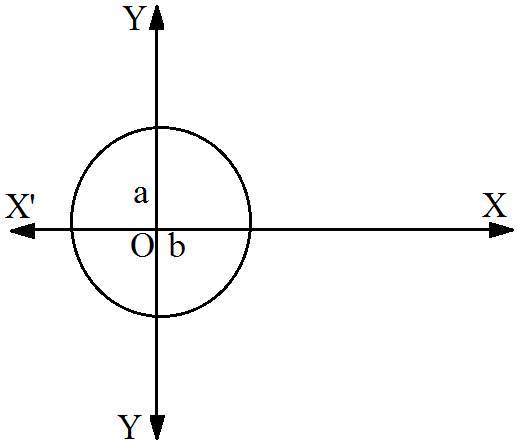
Differentiating equation (1) with respect to x, we get: $\frac{2\text{x}}{\text{b}^2}+\frac{2\text{yy}'}{\text{b}^2}=0$ $\Rightarrow \frac{\text{x}}{\text{b}^2}+\frac{\text{yy}'}{\text{a}^2}=0 \ ...(2)$ Again, differentiating with respect to x, we get: $\frac{1}{\text{b}^2} + \frac{\text{y}'.\text{y}'+\text{y}.\text{y}''}{\text{a}^2}=0$ $\Rightarrow \frac{1}{\text{b}^2}+\frac{1}{\text{a}^2}\big(\text{y}'^2+\text{yy}''\big) =0$ $\Rightarrow \frac{1}{\text{b}^2}=-\frac{1}{\text{a}^2}\big(\text{y}'^2+\text{yy}''\big)$ Substituting this value in equation (2), we get: $\text{x}\Bigg[-\frac{1}{\text{a}^2} \bigg(\big(\text{y}'\big)^2+\text{yy}''\bigg)\Bigg]+\frac{\text{yy}'}{\text{a}^2}=0$ $\Rightarrow - \text{x}\big(\text{y}'\big)^2-\text{xyy}''+\text{yy}'=0$ $\Rightarrow \text{xyy}''+\text{x}\big(\text{y}'\big)^2-\text{yy}'=0$ This is the required differential equation. View full question & answer→Question 3305 Marks
Solve the following initial value problems:
$\Big\{\text{x}\sin^2\Big(\frac{\text{y}}{\text{x}}\Big)-\text{y}\Big\}\text{dx + x dy}=0,\text{y}(1)=\frac{\pi}4$
Answer$\Big\{\text{x}\sin^2\Big(\frac{\text{y}}{\text{x}}\Big)-\text{y}\Big\}\text{dx + x dy}=0,\text{y}(1)=\frac{\pi}4$
It is a homogeneous equation. so, we put y = vx
$\frac{\text{dy}}{\text{dx}}=\text{v + x}\frac{\text{dv}}{\text{dx}}$
So, $\text{v + x}\frac{\text{dv}}{\text{dx}}=-\sin^2\Big(\frac{\text{vx}}{\text{x}}\Big)+\frac{\text{vx}}{\text{x}}$
$\text{x}\frac{\text{dv}}{\text{dx}}=-\sin^2\text{v}$
$\frac{\text{dv}}{\sin^2\text{v}}=-\frac{\text{dx}}{\text{x}}$
integrating both sides, we get
$\cot\Big(\frac{\text{y}}{\text{x}}\Big)=\log|\text{Cx}|$
Putting the values of x = 1 and $\text{y}=\frac{\pi}4$
$\cot\Big(\frac{\pi}{4}\Big)=\log\text{C}$
$1=\log\text{C}$
$\text{C}=\text{e}$
Hence, $\cot\Big(\frac{\text{y}}{\text{x}}\Big)=\log(\text{ex})$
View full question & answer→Question 3315 Marks
Solve (x + y) (dx - dy) = dx + dy.
[Hint: Substitute x + y = z after seperating dx and dy]
AnswerGiven differential equation is
$(\text{x}+\text{y})(\text{dx}-\text{dy})=\text{dx}+\text{dy}$
$\Rightarrow(\text{x}+1)\Big(1-\frac{\text{dy}}{\text{dx}}\Big)=1+\frac{\text{dy}}{\text{dx}_1}\ ......(\text{i})$
put $\text{x}+\text{y}=\text{z}$
$\Rightarrow1+\frac{\text{dy}}{\text{dx}}=\frac{\text{dz}}{\text{dx}}$
On substituting these values in equation (i), we get
$\text{z}\Big(1-\frac{\text{dz}}{\text{dx}}+1\Big)=\frac{\text{dz}}{\text{dx}}$
$\Rightarrow\text{z}\Big(2-\frac{\text{dz}}{\text{dx}}\Big)=\frac{\text{dz}}{\text{dx}}$
$\Rightarrow2\text{z}-\text{z}\frac{\text{dz}}{\text{dx}}-\frac{\text{dz}}{\text{dx}}=0$
$\Rightarrow2\text{z}-(\text{z+1})\frac{\text{dz}}{\text{dx}}=0$
$\Rightarrow\frac{\text{dz}}{\text{dx}}=\frac{2\text{z}}{\text{z+1}}$
$\Rightarrow\Big(\frac{\text{z+1}}{\text{z}}\Big)\text{dz}=2\text{dx}$
On integrating both sides, we get
$\int\Big(1+\frac{1}{\text{z}}\Big)\text{dz}=2\int\text{dx}$
$\Rightarrow\text{z}+\log\text{z}=2\text{x}-\log\text{C}$
$\Rightarrow(\text{x}+\text{y})+\log(\text{x}+\text{y})=2\text{x}-\log\text{C}$ $[\because\text{z}=\text{x+y}]$
$\Rightarrow2\text{x}-\text{x}-\text{y}=\log\text{C}+\log(\text{x}+\text{y})$
$\Rightarrow\text{x}-\text{y}=\log|\text{C}(\text{x}+\text{y})|$
$\Rightarrow\text{e}^{\text{x}-\text{y}}=\text{C}(\text{x}+\text{y})$
$\Rightarrow(\text{x}+\text{y})=\frac{1}{\text{C}}\text{e}^{\text{x}-\text{y}}$
$\Rightarrow\text{x}+\text{y}=\text{k}\text{e}^{\text{x}-\text{y}}$ $\Big[\because\text{k}=\frac{1}{\text{C}}\Big]$
View full question & answer→Question 3325 Marks
Solve the following differential equations:
$\sqrt{1+\text{x}^2+\text{y}^2+\text{x}^2\text{y}^2}+\text{xy}\ \frac{\text{dy}}{\text{dx}}=0$
AnswerWe have,$\sqrt{1+\text{x}^2+\text{y}^2+\text{x}^2\text{y}^2}+\text{xy}\ \frac{\text{dy}}{\text{dx}}=0$
$\Rightarrow\sqrt{(1+\text{x}^2)(1+\text{y}^2)}+\text{xy}\ \frac{\text{dy}}{\text{dx}}=0$
$\Rightarrow\text{xy}\ \frac{\text{dy}}{\text{dx}}=-\sqrt{(1+\text{x}^2)(1+\text{y}^2)}$
$\Rightarrow\text{xy}\frac{\text{dy}}{\text{dx}}=-\sqrt{(1+\text{x}^2)}\sqrt{1+\text{y}^2)}$
$\Rightarrow\frac{\text{y}}{\sqrt{(1+\text{y}^2)}}\ \text{dy}=-\int\frac{\sqrt{(1+\text{x}^2)}}{\text{x}}\ \text{dx}$
$\Rightarrow\frac{\text{y}}{\sqrt{(1+\text{y}^2)}}\ \text{dy}=-\int\frac{\text{x}\sqrt{(1+\text{x}^2)}}{\text{x}^2}\ \text{dx}$
Putting $1 + y^2 = t$ and $1 + x^2 = u^2 \Rightarrow 2y dy = dt$ and $2x\ dx$ = 2udu$\Rightarrow\text{y dy}=\frac{\text{dt}}{2}$
and x dx = udu$\therefore$ intregals become,
$\frac{1}{2}\int\frac{\text{dt}}{\sqrt{\text{t}}}=-\int\frac{\text{u}\times\text{u}}{\text{u}^2-1}\ \text{du}$
$\Rightarrow\sqrt{\text{t}}=-\int\frac{\text{u}^2}{\text{u}^2-1}\ \text{du}$
$\Rightarrow\sqrt{\text{t}}=-\int1+\frac{1}{\text{u}^2-1}\ \text{du}$
$\Rightarrow\sqrt{\text{t}}-\int(1)\text{du}-\int\frac{1}{\text{u}^2-1}\ \text{du}$
$\Rightarrow\sqrt{\text{t}}=-\text{u}-\frac{1}{2}\log\Big|\frac{\text{u}-1}{\text{u}+1}\Big|+\text{C}$
$\Rightarrow\sqrt{1+\text{y}^2}=-\sqrt{1+\text{x}^2}-\frac{1}{2}\log\Big|\frac{\sqrt{1+\text{x}^2}-1}{\sqrt{1+\text{x}^2}+1}\Big|+\text{C}$
$\Rightarrow\sqrt{1+\text{y}^2}+\sqrt{1+\text{x}^2}+\frac{1}{2}\log\Big|\frac{\sqrt{1+\text{x}^2}-1}{\sqrt{1+\text{x}^2}+1}\Big|=\text{C}$
View full question & answer→Question 3335 Marks
Solve the following differential equation:
$\text{x dy}=(2\text{y}+2\text{x}^4+\text{x}^2)\text{dx}$
AnswerHere, $\text{x dy}=(2\text{y}+2\text{x}^4+\text{x}^2)\text{dx}$
$\text{x}\frac{\text{dy}}{\text{dx}}=2\text{y}+2\text{x}^4+\text{x}^2$
$\frac{\text{dy}}{\text{dx}}-\frac{2}{\text{x}}\text{y}=2\text{x}^3+\text{x}$
It is a linear differential equation. Comparing it with equation,
$\frac{\text{dy}}{\text{dx}}+\text{Py}=\text{Q}$
$\text{P}=-\frac{2}{\text{x}},\text{Q}=2\text{x}^3+\text{x}$
I.F. $=\text{e}^{\int\text{Pdx}}$
$=\text{e}^{-2\int\frac{1}{1+\text{x}}\text{dx}}$
$=\text{e}^{-2\log|\text{x}|}$
$=\text{e}^{\log\big(\frac{1}{\text{x}^2}\big)}$
$=\frac{1}{\text{x}^2}$
Solution of the equation is given by,
$\text{y}\times(\text{I.F.})=\int\text{Q}\times(\text{I.F.})\text{dx + C}$
$\text{y}\Big(\frac{1}{\text{x}^2}\Big)=\int\big(2\text{x}^3+\text{x}\big)\Big(\frac{1}{\text{x}^2}\Big)\text{dx + C}$
$\frac{\text{y}}{\text{x}^2}=\int\Big(2\text{x}+\frac{1}{\text{x}}\Big)\text{dx + C}$
$\frac{\text{y}}{\text{x}^2}=2\frac{\text{x}^2}2+\log|\text{x}|+\text{C}$
$\text{y}=\text{x}^4+\text{x}^2\log|\text{x}|+\text{Cx}^2$
View full question & answer→Question 3345 Marks
In each of the show that the given differential equation is homogeneous and solve each of them.
$(\text{x}^2-\text{y}^2)\ \text{dx}+2\text{xy}\ \text{dy}=0$
AnswerGiven: Differential equation $(\text{x}^2-\text{y}^2)\ \text{dx}+2\text{xy}\ \text{dy}=0$
This equation is homogeneous because degree of each coefficient of dx and dy is same i.e., 2
$\Rightarrow\ \ 2\text{xy dy}=-(\text{x}^{2}-\text{y}^{2})\ \text{dy}$ $\Rightarrow\ \ \frac{\text{dy}}{\text{dx}}=\frac{(\text{x}^2-\text{y}^2)}{2\text{xy}}=\frac{\text{y}^2-\text{x}^2}{2\text{xy}}$
$\Rightarrow\ \ \frac{\text{dy}}{\text{dx}}=\frac{\Big(\frac{\text{y}}{\text{x}}\Big)^2-1}{2\frac{\text{y}}{\text{x}}}=f\Big(\frac{\text{y}}{\text{x}}\Big)\ \ ....(\text{ii})$
Therefore, the given equation is homogeneous.
$\text{Put}\frac{\text{y}}{\text{x}}=\text{v}\ \ \Rightarrow\ \ \text{y}=\text{vx}$ $\Rightarrow\ \ \frac{\text{dy}}{\text{dx}}=\text{v}.1+\text{x}\frac{\text{dv}}{\text{dx}}=\text{v}+\text{x}\frac{\text{dv}}{\text{dx}}$
$\text{Putting these values of}\ \frac{\text{y}}{\text{x}}=\text{and}\frac{\text{dy}}{\text{dx}}\text{in eq. (ii), we get}$
$\text{v}+\text{x}\frac{\text{dv}}{\text{dx}}=\frac{\text{v}^2-1}{2\text{v}}\ \ $ $\Rightarrow\ \ \text{x}\frac{\text{dv}}{\text{dx}}=\frac{\text{v}^2-1}{2\text{v}}-\text{v}=\frac{\text{v}^2-1-2\text{v}^2}{2\text{v}}$
$\Rightarrow\ \ \text{x}\frac{\text{dv}}{\text{dx}}=\frac{-\text{v}^2-1}{2\text{v}}$
$\Rightarrow\ \ \text{x}\frac{\text{dv}}{\text{dx}}=\frac{(-\text{v}^2+1)}{2\text{v}}$
$\Rightarrow\ \ \text{x}\ 2\text{v}\ \text{dv}=-(\text{v}^2+1)\ \text{dx}$
$\Rightarrow\ \ \frac{2\text{v}\ \text{dv}}{\text{v}^2+1}=\frac{-\text{dx}}{\text{x}}$
$\text{Integrating both sides,}\ \ \int\frac{2\text{v}}{\text{v}^2+1}\ \text{dv}=-\int\frac{1}{\text{x}}\ \text{dx}$
$\Rightarrow\ \ \log(\text{v}^2+1)+\log\text{x}=\log\text{c}\ \ $ $\Rightarrow\ \ \log(\text{v}^2+1)\text{x}=\log\text{c}\ \ \Rightarrow\ \ (\text{v}^2+1)\text{x}=\text{c}$
$\text{Put}\frac{\text{y}}{\text{x}}=\text{v},\ \ \Big(\frac{\text{y}^2}{\text{x}^2}+1\Big)\text{x}=\text{c}$ $\Rightarrow\ \ \Big(\frac{\text{y}^2+\text{x}^2}{\text{x}^2}\Big)\text{x}=\text{c}$
$\Rightarrow\ \ \frac{\text{y}^2+\text{x}^2}{\text{x}}=\text{c}\ \ \Rightarrow\ \ \text{x}^2+\text{y}^2=\text{cx}$
View full question & answer→Question 3355 Marks
Form the differential equation of the family of circles having centre on y-axis and radius 3 units.
AnswerLet the centre of the circle on y-axis be (0, b). The differential equation of the family of circles with centre at (0, b) and radium 3 is as follows: $\text{x}^2 + (\text{y}-\text{b})^2=3^2$ $\Rightarrow \text{x}^2+(\text{y}-\text{b})^2=9 \ ...(1)$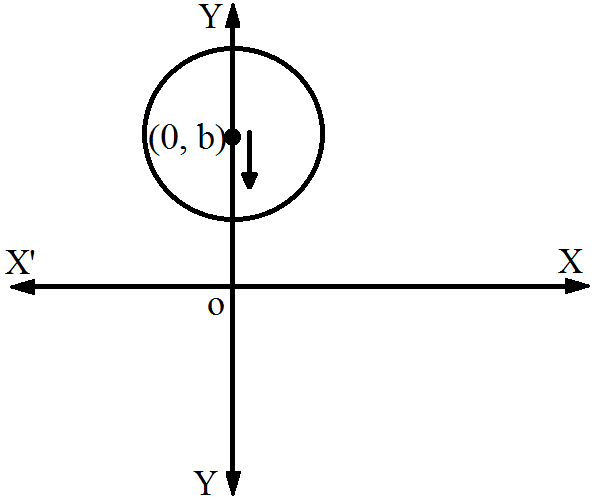
Differentiating equation (1) with respect to x, we get: $2\text{x}+2(\text{y}-\text{b})\cdot\text{y}'=0$ $\Rightarrow (\text{y}-\text{b})\cdot\text{y}'=-\text{x}$ $\Rightarrow \text{y}-\text{b}=\frac{-\text{x}}{\text{y}'}$ Substituting the value of $(\text{y}-\text{b})$ in equation (1), we get: $\text{x}^2+\bigg(\frac{-\text{x}}{\text{y}'}\bigg)^2=9$ $\Rightarrow \text{x}^2\bigg[1+\frac{1}{(\text{y}')^2}\bigg]=9$ $\Rightarrow \text{x}^2 \Big((\text{y}')^2+1\Big)=9(\text{y}')^2$ $\Rightarrow \Big(\text{x}^2-9\Big)(\text{y}')^2 +\text{x}^2=0$ This is the required differential equation. View full question & answer→Question 3365 Marks
Find the general solution of (1 + tany) (dx - dy) + 2xdy = 0.
AnswerGiven difference equation is (1 + tan y) (dx - dy) + 2xdy = 0
Dividing both sides of above equation by dy, we get
$(1+\tan\text{y})\Big(\frac{\text{dx}}{\text{dy}}-1\Big)+2\text{x}=0$
$\Rightarrow(1+\tan\text{y})\frac{\text{dx}}{\text{dy}}-(1+\tan\text{y})+2\text{x}=0$
$\Rightarrow(1+\tan\text{y})\frac{\text{dx}}{\text{dy}}+2\text{x}=(1+\tan\text{y})$
$\Rightarrow\frac{\text{dx}}{\text{dy}}+\frac{2\text{x}}{1+\tan\text{y}}=1$
This is a linear differential equation.
On comparing it with $\frac{\text{dx}}{\text{dy}}+\text{Px}=\text{Q}, $ we get
$\text{P}-\frac{2}{1+\tan\text{y}},\text{Q}=1$
$\text{I.F.}=\text{e}^{\int\frac{2}{1+\tan\text{y}}\text{dy}}=\text{e}^{\int\frac{2\cos\text{y}}{\cos\text{y}+\sin\text{y}}\text{dy}}$
$=\text{e}^{\frac{\cos\text{y}6\sin\text{y}+\cos\text{y}-\sin\text{y}}{\cos\text{y}+\sin\text{y}}\text{dy}}$
$=\text{e}^{\Big(1+\frac{\cos\text{y}-\sin\text{y}}{\cos\text{y}+\sin\text{y}}\Big)\text{dy}}$
$=\text{e}^{\text{y}+\log(\cos\text{y}+\sin\text{y})}$
$=\text{e}^\text{y}.(\cos\text{y}+\sin\text{y})$
Thus, the general solution is,
$\text{x}.\text{e}^\text{y}(\cos\text{y}+\sin\text{y})=\int1.\text{e}^\text{y}(\cos\text{y}+\sin\text{y})\text{dy}+\text{C}$
$\Rightarrow\text{x}.\text{e}^\text{y}(\cos\text{y}+\sin\text{y})=\int\text{e}^\text{y}(\sin\text{y}+\cos\text{y})\text{dy}+\text{C}$
$\Rightarrow\text{x}.\text{e}^\text{y}(\cos\text{y}+\sin\text{y})=\text{e}^\text{y}\sin\text{y}+\text{C}$ $\Big[\because\int\text{e}^\text{x}\left\{\text{f}(\text{x})+\text{f}'(\text{x})\right\}\text{dx}=\text{e}^{\text{x}}\text{f}(\text{x})\Big]$
$\Rightarrow\text{x}(\sin\text{y}+\cos\text{y})=\sin\text{y}+\text{C}\text{e}^{-\text{y}}$
View full question & answer→Question 3375 Marks
Solve $\text{x}\frac{\text{dy}}{\text{dx}}=\text{y}(\log{\text{y}-\log\text{x}+1}).$
AnswerGiven, $\text{x}\frac{\text{dy}}{\text{dx}}=\text{y}(\log{\text{y}-\log\text{x}+1})$
$\Rightarrow \text{x}\frac{\text{dy}}{\text{dx}}=\text{y}\log\Big(\frac{\text{y}}{\text{x}} + 1\Big)$
$\Rightarrow\frac{\text{dy}}{\text{dx}}=\frac{\text{y}}{\text{x}}\Big(\log\frac{\text{y}}{\text{x}} + 1\Big)\ .....(\text{i})$
Which is a homogeneous equation.
Put $\frac{\text{y}}{\text{x}}=\text{v}$ or $\text{y}=\text{vx}$
$\therefore\frac{\text{dy}}{\text{dx}}=\text{v}+\text{x}\frac{\text{dv}}{\text{dx}}$
On substituting these values in Eq. (i), we get
$\text{v}+\text{x}\frac{\text{dv}}{\text{dx}}=\text{v}(\log\text{v}+1)$
$\Rightarrow\text{x}\frac{\text{dv}}{\text{dx}}=\text{v}(\log\text{v}+1-1)$
$\Rightarrow\text{x}\frac{\text{dv}}{\text{dx}}=\text{v}(\log\text{v})$
$\Rightarrow\frac{\text{dv}}{\text{v}\log\text{v}}=\frac{\text{dx}}{\text{x}}$
On integrating both sides, we get
$\Rightarrow\int\frac{\text{dv}}{\text{v}\log\text{v}}=\int\frac{\text{dx}}{\text{x}}$
On putting $\log\text{v}=\text{u}$ in LHS integral, we get
$\frac{1}{\text{v}}.\text{dv}=\text{du}$
$\int\frac{\text{du}}{\text{u}}=\int\frac{\text{dx}}{\text{x}}$
$\Rightarrow\log\text{u}=\log\text{x}+\log\text{C}$
$\Rightarrow\log\text{u}=\log\text{C}\text{x}$
$\Rightarrow\text{u}=\text{C}\text{x}$
$\Rightarrow\log\text{v}=\text{C}\text{x}$
$\Rightarrow\log\Big(\frac{\text{y}}{\text{x}}\Big)=\text{C}\text{x}$
View full question & answer→Question 3385 Marks
Find one-parameter families of solution curves of the following differential equation: (or solve the following differential equation)$\text{x}\frac{\text{dy}}{\text{dx}}-\text{y}=(\text{x}+1)\text{e}^{-\text{x}}$
AnswerWe have,
$\text{x}\frac{\text{dy}}{\text{dx}}-\text{y}=(\text{x}+1)\text{e}^{-\text{x}}$
$\Rightarrow\ \frac{\text{dy}}{\text{dx}}-\frac{1}{\text{x}}\text{y}=\Big(\frac{\text{x}+1}{\text{x}}\Big)\text{e}^{-\text{x}}\ \dots(1)$
Clearly, it is a linear differential equation of the form
$\frac{\text{dy}}{\text{dx}}+\text{Py = Q}$
where
$\text{P}=-\frac{1}{\text{x}}$
$\text{Q}=\Big(\frac{\text{x}+1}{\text{x}}\Big)\text{e}^{-\text{x}}$
$\therefore$ I.F. $=\text{e}^{\int\text{Pdx}}$
$=\text{e}^{-\int\frac{1}{\text{x}}\text{dx}}$
$=\text{e}^{-\log\text{x}}$
$=\frac{1}{\text{x}}$
Multiplying both sides of (1) by $\frac{1}{\text{x}},$ we get
$\frac{1}{\text{x}}\Big(\frac{\text{dy}}{\text{dx}}-\frac{1}{\text{x}}\text{y}\Big)=\frac{1}{\text{x}}\Big(\frac{\text{x}+1}{\text{x}}\Big)\text{e}^{-\text{x}}$
$\Rightarrow\ \frac{1}{\text{x}}\frac{\text{dy}}{\text{dx}}-\frac{1}{\text{x}^2}\text{y}=\Big(\frac{\text{x}+1}{\text{x}^2}\Big)\text{e}^{-\text{x}}$
Integrating both sides with respect to x, we get
$\frac{1}{\text{x}}\text{y}=\int\Big(\frac{1}{\text{x}}+\frac{1}{\text{x}^2}\Big)\text{e}^{-\text{x}}\text{dx + C}\ \dots(2)$
Putting $\frac{1}{\text{x}}\text{e}^{-\text{x}}=\text{t}$
$\Rightarrow\ \Big(-\frac{1}{\text{x}}\text{e}^{-\text{x}}-\frac{1}{\text{x}^2}\text{e}^{-\text{x}}\Big)\text{dx = dt}$
$\Rightarrow\ \Big(\frac{1}{\text{x}}+\frac{1}{\text{x}^2}\Big)\text{e}^{-\text{x}}\text{dx}=-\text{dt}$
Therefore (2) becomes
$\frac{1}{\text{x}}\text{y}=-\int\text{dt + C}$
$\Rightarrow\frac{1}{\text{x}}\text{y}=-\text{t + C}$
$\Rightarrow\ \frac{1}{\text{x}}\text{y}=-\frac{1}{\text{x}}\text{e}^{-\text{x}}+\text{C}$
$\Rightarrow\ \text{y}=-\text{e}^{-\text{x}}+\text{Cx}$
Hence, $\text{y}=-\text{e}^{-\text{x}}+\text{Cx}$ is the required solution.
View full question & answer→Question 3395 Marks
Solve the following differential equation:
$\text{x}\frac{\text{dy}}{\text{dx}}-\text{y}=2\sqrt{\text{y}^2-\text{x}^2}$
AnswerWe have,
$\text{x}\frac{\text{dy}}{\text{dx}}-\text{y}=2\sqrt{\text{y}^2-\text{x}^2}$
$\Rightarrow\ \frac{\text{dy}}{\text{dx}}=\frac{2\sqrt{\text{y}^2-\text{x}^2}+\text{y}}{\text{x}}$
This is a homogeneous differential equation.
Putting x = vy and $\frac{\text{dy}}{\text{dx}}=\text{v + x}\frac{\text{dv}}{\text{dx}}$, we get
$\text{v + x}\frac{\text{dv}}{\text{dx}}=\frac{2\sqrt{\text{v}^2\text{x}^2-\text{x}^2}+\text{vx}}{\text{x}}$
$\Rightarrow\ \text{v + x}\frac{\text{dv}}{\text{dx}}=2\sqrt{\text{v}^2-1}+\text{v}$
$\Rightarrow\ \text{x}\frac{\text{dv}}{\text{dx}}=2\sqrt{\text{v}^2-1}+\text{v}-\text{v}$
$\Rightarrow\ \text{x}\frac{\text{dv}}{\text{dx}}=2\sqrt{\text{v}^2-1}$
$\Rightarrow\ \frac{1}{2\sqrt{\text{v}^2-1}}\text{dv}=\frac{1}{\text{x}}\text{dx}$
Integrating both sides, we get
$\int\frac{1}{2\sqrt{\text{v}^2-1}}\text{dv}=\int\frac{1}{\text{x}}\text{dx}$
$\Rightarrow\ \int\frac{1}{2\sqrt{\text{v}^2-1}}\text{dv}=2\int\frac{1}{\text{x}}\text{dx}$
$\Rightarrow\ \log\Big|\text{v}+\sqrt{\text{v}^2-1}\Big|=2\log|\text{x}|+\log\text{C}$
$\Rightarrow\ \text{v}+\sqrt{\text{v}^2-1}=\text{Cx}^2$
Putting $\text{v}=\frac{\text{y}}{\text{x}}$, we get
$\therefore\ \frac{\text{y}}{\text{x}}+\sqrt{\frac{\text{y}^2}{\text{x}^2}-1}=\text{Cx}^2$
$\Rightarrow\ \text{y}+\sqrt{\text{y}^2-\text{x}^2}=\text{Cx}^3$
Hence, $\text{y}+\sqrt{\text{y}^2-\text{x}^2}=\text{Cx}^3$ is the required solution.
View full question & answer→Question 3405 Marks
Find one-parameter families of solution curves of the following differential equation: (or solve the following differential equation)$(\text{x + y})\frac{\text{dy}}{\text{dx}}=1$
AnswerWe have,
$(\text{x + y})\frac{\text{dy}}{\text{dx}}=1$
$\Rightarrow\ \frac{\text{dy}}{\text{dx}}=\frac{1}{\text{x + y}}$
$\Rightarrow\ \frac{\text{dx}}{\text{dy}}=\text{x + y}$
$\Rightarrow\ \frac{\text{dx}}{\text{dy}}-\text{x}=\text{y}\ \dots(1)$
Clearly, it is a linear differential equation of the form
$\frac{\text{dx}}{\text{dy}}+\text{Px = Q}$
where
$\text{P}=-1$
$\text{Q}=\text{y}$
$\therefore$ I.F. $=\text{e}^{\int\text{Pdx}}$
$=\text{e}^{\int-1\text{dy}}$
$=\text{e}^{-\text{y}}$
Multiplying both sides of (1) by $\text{e}^{-\text{y}},$ we get
$\text{e}^{-\text{y}}\Big(\frac{\text{dx}}{\text{dy}}-\text{x}\Big)=\text{e}^{-\text{y}}\text{y}$
$\Rightarrow\ \text{e}^{-\text{y}}\frac{\text{dx}}{\text{dy}}-\text{e}^{-\text{y}}\text{x}=\text{e}^{-\text{y}}\text{y}$
Integrating both sides with respect to x, we get
$\text{e}^{-\text{y}}\text{x}=\int\text{ye}^{-\text{y}}\text{dy + C}$
$\Rightarrow\ \text{e}^{-\text{y}}\text{x}=\text{y}\int\text{e}^{-\text{y}}\text{dy}-\int\Big[\frac{\text{d}}{\text{dy}}(\text{y})\int\text{e}^{-\text{y}}\text{dy}\Big]\text{dy + C}$
$\Rightarrow\ \text{e}^{-\text{y}}\text{x}=-\text{ye}^{-\text{y}}-\text{e}^{-\text{y}}+\text{C}$
$\Rightarrow\ \text{e}^{-\text{y}}\text{x}+\text{ye}^{-\text{y}}+\text{e}^{-\text{y}}=\text{C}$
$\Rightarrow\ (\text{x + y}+1)\text{e}^{-\text{y}}=\text{C}$
$\Rightarrow\ (\text{x + y}+1)=\text{Ce}^{\text{y}}$
Hence, $(\text{x + y}+1)=\text{Ce}^{\text{y}}$ is the required solution.
View full question & answer→Question 3415 Marks
Form the differential equation of the family of hyperbolas having foci on x-axis and centre at origin.
AnswerThe equation of the family of hyperbolas with the centre at origin and foci along the x-axis is: $\frac{\text{x}^2}{\text{a}^2} - \frac{\text{y}^2}{\text{b}^2}=1 \ ...(1)$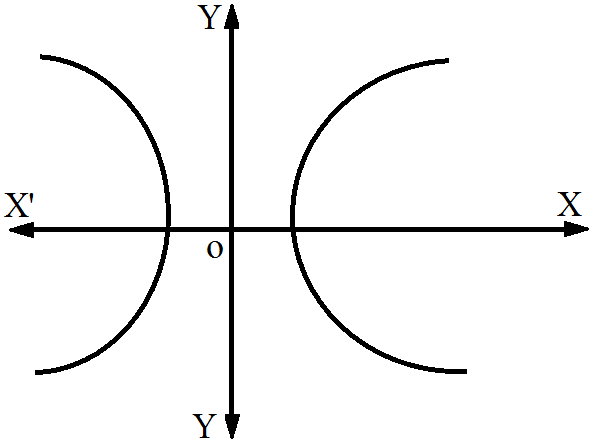
Differentiating both sides of equation (1) with respect to x, we get: $\frac{2\text{x}}{\text{a}^2}-\frac{2\text{yy}'}{\text{b}^2}=0$ $\Rightarrow \frac{\text{x}}{\text{a}^2}-\frac{\text{yy}'}{\text{b}^2}=0 \ ...(2)$ Again, differentiating both sides with respect to x, we get: $\frac{1}{\text{a}^2}-\frac{\text{y}'\cdot\text{y}'\ +\ \text{yy}''}{\text{b}^2}=0$ $\Rightarrow \frac{1}{\text{a}^2}=\frac{1}{\text{b}^2}\Big((\text{y}')^2+\text{yy}''\Big)$ Substituting this value of $\frac{1}{\text{a}^2}$ in equation (2), we get: $\frac{\text{x}}{\text{b}^2}\Big((\text{y}')^2+\text{yy}''\Big)-\frac{\text{yy}'}{\text{b}^2} =0$ $\Rightarrow \text{x(y}')^2+\text{xyy}''-\text{yy}'=0$ $\Rightarrow\text{xyy}''+\text{x}(\text{y}')^2-\text{yy}'=0$ This is the required differential equation. View full question & answer→Question 3425 Marks
In each of the show that the given differential equation is homogeneous and solve each of them.
$(\text{x}^2+\text{xy})\ \text{dy}=({\text{x}^{2}+\text{y}^{2}})\ \text{dx}$
AnswerGiven: Differential equation $(\text{x}^2+\text{xy})\text{dy}=(\text{x}^2+\text{y}^2)\text{dx}\ \ ....\text{(i)}$ Here degree of each coefficients of dx and dy is same therefore, it is homogenous. $\Rightarrow\ \ \frac{\text{dy}}{\text{dx}}=\frac{\text{x}^2+\text{y}^2}{\text{x}^2+\text{xy}}\ \ \Rightarrow\ \ \frac{\text{dy}}{\text{dx}}=\frac{\text{x}^2\Big(1+\frac{\text{y}^2}{\text{x}^2}\Big)}{\text{x}^2\Big(1+\frac{\text{y}}{\text{x}}\Big)}$ $\Rightarrow\ \ \frac{\text{dy}}{\text{dx}}=\frac{1+\Big(\frac{\text{y}}{\text{x}}\Big)^2}{1+\Big(\frac{\text{y}}{\text{x}}\Big)}\ \ ....\text{(ii)}$ $\Rightarrow\ \text{F}\Big(\frac{\text{y}}{\text{x}}\Big),$ therefore the given differential equation is homogeneous. $\text{Putting}=\frac{\text{y}}{\text{x}}=\text{v}\ \Rightarrow\ \ \text{y}= \text{vx}$ $\ \Rightarrow\ \ \frac{\text{dy}}{\text{dx}}\text{v}.1+\text{x}\frac{\text{dy}}{\text{dx}}=\text{v}+\text{x}\frac{\text{dy}}{\text{dx}}$$\text{Putting value of}\ \frac{\text{y}}{\text{x}}\ \text{and}\ \frac{\text{dy}}{\text{dx}}\ \text{in eq. (ii)},$ $\text{v}+\text{x}\frac{\text{dv}}{\text{dx}}=\frac{1+\text{v}^2}{1+\text{v}}$
$\Rightarrow\ \ \text{x}\frac{\text{dv}}{\text{dx}}=\frac{1+\text{v}^2}{1+\text{v}}-\text{v}$ $\ \ \Rightarrow\ \ \text{x}\frac{\text{dv}}{\text{dx}}=\frac{1+\text{v}^2-\text{v}-\text{v}^2}{1+\text{v}}=\frac{1-\text{v}}{1+\text{v}}$
$\Rightarrow\ \ \text{x}(1+\text{v})\ \text{dv}=(1-\text{v})\ \text{dx}$ $\Rightarrow\ \ \frac{1+\text{v}}{1-\text{v}}\ \text{dv}=\frac{\text{dx}}{\text{x}}\ \ [\text{Separating variables}]$
Integrating both sides, $\int\frac{1+\text{v}}{1-\text{v}}\ \text{dv}=\int\frac{1}{\text{x}}\ \text{dx}\ \ \Rightarrow\ \ \int\frac{1+1-1+\text{v}}{1-\text{v}}\ \text{dv}=\int\frac{1}{\text{x}\ }\text{dx}$ $\Rightarrow\ \ \int\frac{2-(1-\text{v})}{1-\text{v}}\ \text{dv}=\log\ \text{x}+\text{c}$ $\Rightarrow\ \ \int\Big(\frac{2}{1-\text{v}}-1\Big)\text{dv}=\log\text{x}+\text{c}$ $\Rightarrow\ \ \frac{2\log(1-\text{v})}{-1}-\text{v}=\log\text{x}+\text{c}$ $\Rightarrow\ \ -2\log(1-\text{v})-\text{v}=\log\text{x}+\text{c}$ $\text{Putting}\ \text{v}=\frac{\text{y}}{\text{x}}\ \ -2\log\Big(1-\frac{\text{y}}{\text{x}}\Big)-\frac{\text{y}}{\text{x}}=\log\text{x}+\text{c}$ $\Rightarrow\ \ 2\log\Big(1-\frac{\text{y}}{\text{x}}\Big)+\frac{\text{y}}{\text{x}}=-\log\text{x}-\text{c}$ $\ \ \Rightarrow\ \ \log\Big(\frac{\text{x}-\text{y}}{\text{x}}\Big)^2+\log\text{x}=-\frac{\text{y}}{\text{x}}-\text{c}$ $\Rightarrow\ \ \log\Big(\frac{\text{x}-\text{y}}{\text{x}}\Big)^2\text{.x}=-\frac{\text{y}}{\text{x}}-\text{c}$ $\ \Rightarrow\ \ \frac{(\text{x}-\text{y})^2}{\text{x}}=\text{e}^{\frac{-\text{y}}{\text{x}}- \text{c}}$ $\Rightarrow\ \ \frac{(\text{x}-\text{y})^2}{\text{x}}=\text{e}^{\frac{-\text{y}}{\text{x}}}.\text{e}^{-\text{c}}$ $\ \ \Rightarrow\ \ (\text{x}-\text{y})^2=\text{Cx.e}^\frac{-\text{y}}{\text{x}}\ \text{where C}=\text{e}^{-\text{c}}$
View full question & answer→Question 3435 Marks
Solve $\text{y}+\frac{\text{d}}{\text{dx}}(\text{xy})=\text{x}(\sin\text{x}+\log\text{x}).$
AnswerWe have
$\text{y}+\frac{\text{d}}{\text{dx}}(\text{xy})=\text{x}(\sin\text{x}+\log\text{x})$
$\Rightarrow\text{y}+\text{x}\frac{\text{dy}}{\text{dx}}\text{y}=\text{x}(\sin\text{x}+\log\text{x}).$
$\Rightarrow\text{x}\frac{\text{dy}}{\text{dx}}+2\text{y}=\text{x}(\sin\text{x}+\log\text{x})$
$\Rightarrow\frac{\text{dy}}{\text{dx}}+\frac{2}{\text{x}}\text{y}=\sin\text{x}+\log\text{x}$
This is a linear differential equation.
On comparing it with $\frac{\text{dy}}{\text{dx}}+\text{Py}=\text{Q},$ we get
$\text{P}=\frac{2}{\text{x}},\text{Q}=\sin\text{x}+\log\text{x}$
$\text{I.F.}=\text{e}^{\int\frac{2}{\text{x}}\text{dx}}=\text{e}^{2\log\text{x}}$
$\text{e}^{\log\text{x}^2}=\text{x}^2$
So, the reneral solition is,
$\text{y}.\text{x}^2=\int(\sin\text{x}+\log\text{x})\text{x}^2\text{dx}+\text{C}$
$\Rightarrow\text{y}.\text{x}^2=\int\text{x}^2\sin\text{x}\text{dx}+\int\text{x}^2\log\text{x}\text{dx}+\text{C}\ .....(\text{i})$
Now $\int\text{x}^2\sin\text{x}\text{dx}=\text{x}^2(-\cos\text{x})+\int2\cos\text{xdx}$
$=-\text{x}^2\cos\text{x}+[2\text{x}(\sin\text{x})-\int2\sin\text{x}\text{dx}]$
$=-\text{x}^2\cos\text{x}+2\text{x}\sin\text{x}+2\cos\text{x}\ ......(\text{ii})$
and $\int\text{x}^2\log\text{xdx}$
$=\log\text{x}.\frac{\text{x}^3}{3}-\int\frac{1}{\text{x}}.\frac{\text{x}^3}{3}\text{dx}$
$=\frac{\text{x}^3}{3}\log\text{x}-\frac{1}{3}\int\text{x}^2\text{dx}$
$=\frac{\text{x}^3}{3}\log\text{x}-\frac{\text{x}^3}{9}\ ......(\text{iii})$
On substituting the values from Eqs. (ii) and (iii) in Eq. (i), we get
$\text{y}.\text{x}^2=-\text{x}^2\cos\text{x}+2\text{x}\sin\text{x}+2\cos\text{x}+\frac{\text{x}^3}{3}\log\text{x}-\frac{1}{9}\text{x}^3+\text{C}$
$\therefore\text{y}=-\cos\text{x}+\frac{2\sin\text{x}}{\text{x}}+\frac{2\cos\text{x}}{\text{x}^2}+\frac{\text{x}}{3}\log\text{x}-\frac{\text{x}}{9}+\text{C}\text{x}^{-2}$
View full question & answer→Question 3445 Marks
Find the particular solution of the differential equation $\frac{\text{dx}}{\text{dy}} + \text{x}\cot \text{y}=2\text{y} + \text{y}^{2} \cot \text{y},\text{ y}\neq0$ given that x = 0 when $\text{y}=\frac{\pi}{2}$
AnswerWe have,
$\frac{\text{dx}}{\text{dy}} + \text{x}\cot \text{y}=2\text{y} + \text{y}^{2} \cot \text{y}\ ...(1)$
Clearly, it is a linear differential equation of the form
$\frac{\text{dx}}{\text{dy}}+\text{Px}=\text{Q}$
Where $\text{P}=\cot\text{y}$ and $\text{Q}=2\text{y} + \text{y}^{2} \cot \text{y}$
$\therefore\ \text{I}.\text{F}.=\text{e}^{\int\text{P}\text{dy}}$
$=\text{e}^{\int\cot\text{y}\text{ dy}}$
$=\text{e}^{\log|\sin\text{y}|}$
$=\sin\text{y}$
Multiplying both sides of (1) by $\text{I.F.}=\sin\text{y},$ we get
$\sin\text{y}\Big(\frac{\text{dx}}{\text{dy}}+\text{x}\cot\text{y}\Big)=\sin\text{y}\big(\text{y}^2\cot\text{y} + 2\text{y}\big)$
$\Rightarrow\sin \text{y}\frac{\text{dx}}{\text{dy}}+\text{x}\cos\text{y}=\text{y}^2\cos\text{y}+2\text{y}\sin\text{y}$
Integrating both sides with respect to y, we get
$\text{x}\sin \text{y}=\int\text{y}^{2}\cos\text{y}\text{ dy}+\int2\text{y}\sin\text{y}\text{ dy}+\text{C}$
$\Rightarrow\text{x}\sin\text{y}=\text{y}^2\int\cos\text{y dy}-\int\Big[\frac{\text{d}}{\text{dy}}(\text{y}^2)\int\cos\text{y dy}\Big]\text{dy}+\int2\text{y}\sin\text{y dy}+\text{C}$
$ \Rightarrow\text{x} \sin\text{y}=\text{y}^2 \sin\text{y}-\int2\text{y}\sin\text{y} + \int2\text{y}\sin\text{y}\text{ dy} + \text{C}$
$\Rightarrow\text{x}\sin \ \text{y}=\text{y}^2 \sin \ \text{y} + \text{C}$
Now,
$\therefore 0\times\sin \frac{\pi}{2}=\frac{\pi^2}{4} \sin \frac{\pi}{2}+\text{C}$
$\Rightarrow\text{C}=-\frac{\pi^2}{4}$
Putting the value of C, we get
$\text{x}\sin \ \text{y}=\text{y}^2\sin \text{y}-\frac{\pi^2}{4}$
Hence, $\text{x}\sin \ \text{y}=\text{y}^2\sin \text{y}-\frac{\pi^2}{4}$ is the required solution.
View full question & answer→Question 3455 Marks
Solve the following differential equation:
$\frac{\text{dy}}{\text{dx}}+\text{y}\cos\text{x}=\sin\text{x}\cos\text{x}$
AnswerWe have,
$\frac{\text{dy}}{\text{dx}}+\text{y}\cos\text{x}=\sin\text{x}\cos\text{x}\ \dots(1)$
Clearly, it is a linear differential equation of the form
$\frac{\text{dy}}{\text{dx}}+\text{Py}=\text{Q}$
where
$\text{P}=\cos\text{x}$
$\text{Q}=\sin\text{x}\cos\text{x}$
$\therefore$ I.F. $=\text{e}^{\int\text{Pdx}}$
$=\text{e}^{\int\cos\text{xdx}}$
$=\text{e}^{\sin\text{x}}$
Multiplying both sides of (1) by $\text{e}^{\sin\text{x}}$ we get
$\text{e}^{\sin\text{x}}\Big(\frac{\text{dy}}{\text{dx}}+\text{y}\cos\text{x}\Big)=\text{e}^{\sin\text{x}}\sin\text{x}\cos\text{x}$
$\Rightarrow\ \text{e}^{\sin\text{x}}\frac{\text{dy}}{\text{dx}}+\text{e}^{\sin\text{x}}\text{y}\cos\text{x}=\text{e}^{\sin\text{x}}\sin\text{x}\cos\text{x}$
Integrating both sides with respect to x, we get
$\text{y}\text{e}^{\sin\text{x}}=\int\text{e}^{\sin\text{x}}\sin\text{x}\cos\text{x dx + C}$
$\Rightarrow\ \text{y}\text{e}^{\sin\text{x}}=\text{I + C}\ \dots(2)$
where
$\text{I}=\int\text{e}^{\sin\text{x}}\sin\text{x}\cos\text{x dx}$
Putting $\text{t}=\sin\text{x},$ we get
$\text{dt}=\cos\text{x dx}$
$\therefore\ \text{I}=\int\text{e}^{\text{t}}\text{t dt}$
$=\text{t}\int\text{e}^{\text{t}}\text{dt}-\int\Big[\frac{\text{d}}{\text{dt}}(\text{t})\int\text{e}^{\text{t}}\text{dt}\Big]\text{dt}$
$=\text{te}^{\text{t}}-\text{e}^{\text{t}}$
$=\text{e}^{\text{t}}(\text{t}-1)$
$=\text{e}^{\sin\text{x}}(\sin\text{x}-1)$
Putting the value of I in (2), we get
$\text{ye}^{\sin\text{x}}=\text{e}^{\sin\text{x}}(\sin\text{x}-1)+\text{C}$
$\Rightarrow\ \text{y}=\sin\text{x}-1+\text{Ce}^{-\sin\text{x}}$
Hence, $\text{y}=\sin\text{x}-1+\text{Ce}^{-\sin\text{x}}$ is the required solution.
View full question & answer→Question 3465 Marks
Find one-parameter families of solution curves of the following differential equation: (or solve the following differential equation)$\text{x}\frac{\text{dy}}{\text{dx}}+\text{y}=\text{x}^4$
AnswerWe have,
$\text{x}\frac{\text{dy}}{\text{dx}}+\text{y}=\text{x}^4$
$\Rightarrow\ \frac{\text{dy}}{\text{dx}}+\frac{1}{\text{x}}\text{y}=\text{x}^3\ \dots(1)$
Clearly, it is a linear differential equation of the form
$\frac{\text{dy}}{\text{dx}}+\text{Py = Q}$
where
$\text{P}=\frac{1}{\text{x}}$
$\text{Q}=\text{x}^3$
$\therefore$ I.F. $=\text{e}^{\int\text{Pdx}}$
$=\text{e}^{\int\frac{1}{\text{x}}\text{dx}}$
$=\text{e}^{\log\text{x}}$
$={\text{x}}$
Multiplying both sides of (1) by x, we get
${\text{x}}\Big(\frac{\text{dy}}{\text{dx}}+\frac{1}{\text{x}}\text{y}\Big)=\text{x}.\text{x}^3$
$\Rightarrow\ {\text{x}}\frac{\text{dy}}{\text{dx}}+\text{x}=\text{x}^4$
Integrating both sides with respect to x, we get
$\text{xy}=\int\text{x}^4\text{dx + C}$
$\Rightarrow\ \text{xy}=\frac{\text{x}^5}{5}+\text{C}$
$\Rightarrow\ \text{y}=\frac{\text{x}^4}{5}+\frac{\text{C}}{\text{x}}$
Hence, $\text{y}=\frac{\text{x}^4}{5}+\frac{\text{C}}{\text{x}}$ is the required solution.
View full question & answer→Question 3475 Marks
Solve the following differential equation $(\text{x}+2\text{y}^2)\frac{\text{dy}}{\text{dx}}=\text{y},$ given that when x = 2, y = 1.
AnswerWe have, $(\text{x}+2\text{y}^2)\frac{\text{dy}}{\text{dx}}=\text{y}$ $\Rightarrow\ \frac{\text{dx}}{\text{dy}}=\frac{1}{\text{y}}(\text{x}+2\text{y}^2)$ $\Rightarrow\ \frac{\text{dx}}{\text{dy}}-\frac{1}{\text{y}}\text{x}=2\text{y}\ \dots(1)$ Clearly, it is a linear differential equation of the form $\frac{\text{dx}}{\text{dy}}+\text{Px = Q}$ where $\text{P}=-\frac{1}{\text{y}}$ $\text{Q}=2\text{y}$ $\therefore$ I.F. $=\text{e}^{\int\text{Pdy}}$ $=\text{e}^{-\int\frac{1}{\text{y}}\text{dy}}$ $=\text{e}^{-\log\text{y}}$ $=\frac{1}{\text{y}}$Multiplying both sides of (1) by $\frac{1}{\text{y}},$ we get
$\frac{1}{\text{y}}\Big(\frac{\text{dx}}{\text{dy}}-\frac{1}{\text{y}}\text{x}\Big)=\frac{1}{\text{y}}\times2\text{y}$ $\Rightarrow\ \frac{1}{\text{y}}\frac{\text{dx}}{\text{dy}}-\frac{1}{\text{y}^2}\text{x}=2$ Integrating both sides with respect to y, we get $\text{x}\frac{1}{\text{y}}=\int2\text{dy + C}$ $\Rightarrow\ \text{x}\frac{1}{\text{y}}=2\text{y + C}$ $\Rightarrow\ \text{x}=2\text{y}^2+\text{Cy}\ \dots(2)$ Now, $\text{y}=1$ at $\text{x}=2$ $\therefore\ 2=2+\text{C}$ $\Rightarrow\ \text{C}=0$ Putting the value of C in (2), we get $\text{x}=2\text{y}^2$ Hence, $\text{x}=2\text{y}^2$ is the required solution.
View full question & answer→Question 3485 Marks
In a bank, principal increases continuously at the rate of $5\%$ per year. An amount of Rs $1000$ is deposited with this bank, how much will it worth after $10$ years $(e^{0.5}= 1.648).$
AnswerLet p and t be principal and time respectively.
Given that principal increases continuously at rate of 5% per year.
$\therefore\frac{\text{dp}}{\text{dt}}=\Big(\frac{5}{100}\Big)\text{p}$
Separating variables,
$\Rightarrow\frac{\text{dp}}{\text{p}}=\frac{1}{20}\text{dt}$
Integrating both sides,
$\Rightarrow\int\frac{\text{dp}}{\text{p}}=\frac{1}{20}\int\text{dt}$
$\Rightarrow\log\text{p}={\frac{\text{t}}{20}\cdot\text{t} + \text{c}}\ ...(\text{i})$
$\Rightarrow\text{P}=\text{e}^{\frac{\text{t}}{20}+\text{c}}$
When t = 0, p = 1000
$\Rightarrow1000=\text{e}^{\text{c}}$
At t = 10
$\Rightarrow\text{P}=\text{e}^{\frac{1}{2}+\text{c}}$
$\Rightarrow\text{P}=\text{e}^{0.5}\times\text{e}^\text{c}$
$\Rightarrow\text{P}=1.648\times1000(\text{e}^{0.5}=1.648)$
$\Rightarrow\text{P}=1648$
So after 10 years the total amount would be Rs.1648
View full question & answer→Question 3495 Marks
Form the differential equation of the family of curves represented by the equation (a being the perimeter):$(2\text{x}+\text{a})^2+\text{y}^2=\text{a}^2$
AnswerThe equation of the family of curves is
$(2\text{x}+\text{a})^2+\text{y}^2=\text{a}^2\ ...(1)$
where a is a parameter.
As this equation has only one parameter, we shall get a differential equation of first order.
Differentiating (1) with respect to x, we get
$2(2\text{x}+\text{a})\times2+2\text{y}\frac{\text{dy}}{\text{dx}}=0\ ...(2)$
Now, from (1), we get
$4\text{x}^2+4\text{ax}+\text{a}^2+\text{y}^2=\text{a}^2$
$\Rightarrow4\text{ax}=-\text{y}^2-4\text{x}^2$
$\Rightarrow\text{a}=-\frac{(4\text{x}^2+\text{y}^2)}{4\text{x}}$
putting the value of a in (2), we get
$4\Big(2\text{x}-\frac{4\text{x}^2+\text{y}^2}{4\text{x}}\Big)+2\text{y}\frac{\text{dy}}{\text{dx}}=0$
$\Rightarrow4\Big(\frac{8\text{x}^2-4\text{x}^2-\text{y}^2}{4\text{x}}\Big)+2\text{y}\frac{\text{dy}}{\text{dx}}=0$
$\Rightarrow4\text{x}^2-\text{y}^2+2\text{xy}\frac{\text{dy}}{\text{dx}}=0$
$\Rightarrow\text{y}^2-4\text{x}^2-2\text{xy}\frac{\text{dy}}{\text{dx}}=0$
It is the required differential equation.
View full question & answer→Question 3505 Marks
Solve the following differential equation
$\frac{\text{dy}}{\text{dx}}-\text{x}\sin^2\text{x}=\frac{1}{\text{x}\log\text{x}}$
Answer$\frac{\text{dy}}{\text{dx}}-\text{x}\sin^2\text{x}=\frac{1}{\text{x}\log\text{x}}$
$\frac{\text{dy}}{\text{dx}}=\frac{1}{\text{x}\log\text{x}}+\text{x}\sin^2\text{x}$
$\text{dy}=\Big(\frac{1}{\text{x}\log\text{x}}+\text{x}\sin^2\text{x}\Big)\text{dx}$
$\int\text{dy}=\int\frac{1}{\text{x}\log\text{x}}\text{dx}+\int\text{x}\sin^2\text{x dx}$
$\text{y}=\text{I}_1+\text{I}_2$
$\text{I}_1=\int\frac{1}{\text{x}\log\text{x}}\text{ dx}$
Let $\log\text{x}=\text{t}$
$\frac{1}{\text{x}}\ \text{dx}=\text{dt}$
$\text{I}_1=\int\frac{\text{dt}}{\text{t}}$
$=\log|\text{t}|+\text{C}_1$
$\text{I}_1=\log|\log\text{x}|+\text{C}_1$
$\text{I}_2=\int\text{x}\sin^2\text{x dx}$
$=\int\text{x}\frac{(1-\cos2\text{x})}{2}\ \text{dx}$
$=\frac{1}{2}\int(\text{x}-\text{x}\cos2\text{x})\text{dx}$
$=\frac{1}{2}\int\text{x dx}-\frac{1}{2}\int\text{x}\cos2\text{x dx}$
$=\frac{1}{2}\Big(\frac{\text{x}^2}{2}\Big)-\frac{1}{2}[\text{x}\int\cos2\text{x dx}-\int(1\times\int\cos2\text{x dx})\text{dx}]+\text{C}_2$
$=\frac{\text{x}^2}{4}-\frac{1}{2}\Big[\frac{\text{x}\sin\text{x}}{2}+\frac{\cos2\text{x}}{4}\Big]+\text{C}_2$
$\text{I}_2=\frac{\text{x}^2}{4}-\frac{\text{x}\sin2\text{x}}{4}-\frac{\cos2\text{x}}{8}+\text{C}_2$
Put the values of $I_1$ and $I_2$ in equation (1)
$\text{y}=\text{I}_1+\text{I}_2$
$\text{y}=\log|\log\text{x}|+\frac{\text{x}^2}{4}-\frac{\text{x}\sin2\text{x}}{4}-\frac{\cos2\text{x}}{8}+\text{C}\text{ as}\text{ C}_1+\text{C}_2=\text{C}$
View full question & answer→Question 3515 Marks
Find one-parameter families of solution curves of the following differential equation: (or solve the following differential equation)$\frac{\text{dy}}{\text{dx}}+\text{y}\cos\text{x}=\text{e}^{\sin\text{x}}\cos\text{x}$
AnswerWe have,
$\frac{\text{dy}}{\text{dx}}+\text{y}\cos\text{x}=\text{e}^{\sin\text{x}}\cos\text{x}\ \dots(1)$
Clearly, it is a linear differential equation of the form
$\frac{\text{dy}}{\text{dx}}+\text{Py = Q}$
where
$\text{P}=\cos\text{x}$
$\text{Q}=\text{e}^{\sin\text{x}}\cos\text{x}$
$\therefore$ I.F. $=\text{e}^{\int\text{Pdx}}$
$=\text{e}^{\int\cos\text{xdx}}$
$=\text{e}^{\sin\text{x}}$
Multiplying both sides of (1) by $\text{e}^{\sin\text{x}},$ we get
$\text{e}^{\sin\text{x}}\Big(\frac{\text{dy}}{\text{dx}}+\text{y}\cos\text{x}\Big)=\text{e}^{\sin\text{x}}\times\text{e}^{\sin\text{x}}\cos\text{x}$
$\Rightarrow\ \text{e}^{\sin\text{x}}\frac{\text{dy}}{\text{dx}}+\text{y}\text{e}^{\sin\text{x}}\cos\text{x}=\text{e}^{2\sin\text{x}}\cos\text{x}$
Integrating both sides with respect to x, we get
$\text{e}^{\sin\text{x}}\text{y}=\int\text{e}^{\sin\text{x}}\cos \text{x}\text{dx + C}$
$\Rightarrow\ \text{e}^{\sin\text{x}}\text{y}=\text{I + C}\ \dots(2)$
where,
$\text{I}=\int\text{e}^{\sin\text{x}}\cos\text{xdx}$
Putting $\text{t}=\sin\text{x},$ we get
$\text{dt}=\cos\text{xdx}$
$\therefore\ \text{I}=\int\text{e}^{2\text{t}}\text{dt}$
$=\frac{\text{e}^{2\text{t}}}{2}$
$=\frac{\text{e}^{2\sin\text{x}}}{2}$
Putting the value of I in (2), we get
$\text{e}^{\sin\text{x}}\text{y}=\frac{\text{e}^{2\sin\text{x}}}{2}+\text{C}$
$\Rightarrow\ \text{y}=\frac{\text{e}^{\sin\text{x}}}{2}+\text{C}\text{e}^{-\sin\text{x}}$
Hence, $\text{y}=\frac{\text{e}^{\sin\text{x}}}{2}+\text{C}\text{e}^{-\sin\text{x}}$ is the required solution.
View full question & answer→Question 3525 Marks
Find the equation of a curve passing through origin if the slope of the tangent to the curve at any point (x, y) is equal to the square of the difference of the abcissa and ordinate of the point.
AnswerSlope of tangent to the curve at point (x, y) is $\frac{\text{dy}}{\text{dx}}.$
According to the question $\frac{\text{dy}}{\text{dx}}=(\text{x}-\text{y}^2)\ .......(\text{i})$
Put $\text{x}-\text{y}=\text{z}$
$\Rightarrow1-\frac{\text{dy}}{\text{dx}}=\frac{\text{dz}}{\text{dx}}$
On substituting these values in Eq. (i), we get
$1-\frac{\text{dz}}{\text{dx}}=\text{z}^2$
$\Rightarrow1-\text{z}^2=\frac{\text{dz}}{\text{dx}}$
$\Rightarrow\text{dx}=\frac{\text{dz}}{1-\text{z}^2}$
$\Rightarrow\int\text{dx}=\int\frac{\text{dz}}{1-\text{z}^2}$
$\Rightarrow\text{x}=\frac{1}{2}\Big|\log\frac{1 + \text{z}}{1 - \text{z}}\Big| + \text{C}\ ......({\text{ii}})$
Since the curve passes through the origin, we have
$0=\frac{1}{2}\log1+\text{C}$
$\Rightarrow\text{C}=0$
On substituting the value of C in Eq. (ii), we get
$\text{x}=\frac{1}{2}\log\Big|\frac{1+\text{x}-\text{y}}{1-\text{x}+\text{y}}\Big|$
$\Rightarrow2\text{x}=\log\Big|\frac{1+\text{x}-\text{y}}{1-\text{x}+\text{y}}\Big|$
$\Rightarrow\text{e}^{2\text{x}}=\log\Big|\frac{1+\text{x}-\text{y}}{1-\text{x}+\text{y}}\Big|$
View full question & answer→Question 3535 Marks
Solve the following differential equation:
$\frac{\text{dy}}{\text{dx}} = \sec(\text{x}+\text{y})$
AnswerWe have,
$\frac{\text{dy}}{\text{dx}} = \sec(\text{x}+\text{y})$
$\frac{\text{dy}}{\text{dx}} = \frac{1}{\cos(\text{x}+\text{y})}$
Let $\text{ x}+\text{y} = \text{v}$
$\Rightarrow 1+\frac{\text{dy}}{\text{dx}} = \frac{\text{dv}}{\text{dx}}$
$\Rightarrow \frac{\text{dv}}{\text{dx}} = \frac{\text{dv}}{\text{dx}}-1$
$\therefore\frac{\text{dv}}{\text{dx}}-1 = \frac{1}{\cos\text{v}}$
$\Rightarrow\frac{\text{dv}}{\text{dx}} = \frac{\cos\text{v}+1}{\cos\text{v}}$
$\Rightarrow \frac{\cos \text{v}}{\cos\text{v}+1}\text{dv} = \text{dx}$
Integrating both sides, we get
$\int \frac{\cos\text{v}}{\cos\text{v}+1}\text{dv} = \int\text{dx}$
$\Rightarrow \int\frac{\cos\text{v}(1-\cos\text{v})}{1-\cos^2\text{v}}\text{dv} = \int\text{dx}$
$\Rightarrow \int\frac{\cos\text{v}(1-\cos\text{v})}{\sin^2\text{v}}\text{dv} = \int\text{dx}$
$\Rightarrow \int\frac{\cos\text{v}-\cos^2\text{v}}{\sin^2\text{v}}\text{dv} = \int\text{dx}$
$\Rightarrow\int(\cot\text{v}\text{ cosec}\text{ v}-\cot^2\text{v})\text{dv} = \int\text{dx}$
$\Rightarrow \int(\cot\text{v}\text{ cosec }\text{v}-\text{cosec}^2\text{v}+1)\text{dv} = \int\text{dx}$
$\Rightarrow -\text{cosec }\text{v}+\cot\text{v}+\text{v} = \text{x}+\text{C}$
$\Rightarrow -\text{cosec}(\text{x}+\text{y})+\cot(\text{x}+\text{y})+\text{x}+\text{y} = \text{x}+\text{C}$
$\Rightarrow -\text{cosec}(\text{x}+\text{y})+\cot(\text{x}+\text{y})+\text{y} = \text{C}$
$\Rightarrow \frac{-1+\cos(\text{x}+\text{y})}{\sin(\text{x}+\text{y})}+\text{y}=\text{C}$
$\Rightarrow -\tan\Big(\frac{\text{x}+\text{y}}{2}\Big)+\text{y} = \text{C}$
$\Rightarrow \text{y} = \tan\Big(\frac{\text{x}+\text{y}}{2}\Big)+\text{C}$
View full question & answer→Question 3545 Marks
For each of the differential equation in find the particular solution satisfying the given condition:$2\text{xy}+\text{y}^2-2\text{x}^2\frac{\text{dy}}{\text{dx}}=0;\ \text{y}=2\ \text{when x}=1$
AnswerGiven: Differential equation $2\text{xy}+\text{y}^2-2\text{x}^2\frac{\text{dy}}{\text{dx}}=0\ \ ....\text{(i)}$
$\Rightarrow\ \ -2\text{x}^2\frac{\text{dy}}{\text{dx}}=-2\text{xy}-\text{y}^2\ \ $ $\Rightarrow\ \ \frac{\text{dy}}{\text{dx}}=\frac{-2\text{xy}}{-2\text{x}^2}-\frac{\text{y}^2}{-2\text{x}^2}$
$\Rightarrow\ \ \frac{\text{dy}}{\text{dx}}=\frac{\text{y}}{\text{x}}+\frac{1}{2}\Big(\frac{\text{y}}{\text{x}}\Big)^2=f\Big(\frac{\text{y}}{\text{x}}\Big)\ \ ....(\text{ii})$
Therefore the given differential equation is homogeneous because each coefficient of dx and dy is same i.e., degree 2.
$\text{Putting}\frac{\text{y}}{\text{x}}=\text{v}\ \ \Rightarrow\ \ \text{y}=\text{vx}\ \ $ $\Rightarrow\ \ \frac{\text{dy}}{\text{dx}}=\text{v}+\text{x}\frac{\text{dv}}{\text{dx}}$
$\text{Putting these values of}\ \frac{\text{y}}{\text{x}}\ \text{and}\ \frac{\text{dv}}{\text{dx}}\ \text{in eq. (ii), we have}$
$\text{v}+\text{x}\frac{\text{dv}}{\text{dx}}=\text{v}+\frac{1}{2}\text{v}^2\ \ $ $\Rightarrow\ \ \text{x}\frac{\text{dv}}{\text{dx}}=\frac{1}{2}\text{v}^2\ \ \Rightarrow\ \ 2\text{x dv}=\text{v}^2\ \text{dx}$
$\Rightarrow\ \ 2\frac{\text{dv}}{\text{v}^2}=\frac{\text{dx}}{\text{x}}\ \ \big[\text{Separating variables}\big]$
$\text{Interating both sides},\ \ 2\int\text{v}^{-2}\ \text{dv}=\int\frac{1}{\text{x}}\ \text{dx}\ \ $$\Rightarrow\ \ 2\frac{\text{v}^{-1}}{-1}=\log|\text{x}|+\text{c}$
$\ \Rightarrow\ \ \frac{-2}{\text{v}}=\log|\text{x}|+\text{c}\ \ \Rightarrow\ \ \frac{-2}{\Big(\frac{\text{y}}{\text{x}}\Big)}=\log|\text{x}|+\text{c}$ $\ \ \Rightarrow\ \ \frac{-2\text{x}}{\text{y}}=\log|\text{x}|+\text{c}\ \big[\text{Putting}\frac{\text{y}}{\text{x}}=\text{v}\big]$
$\text{Now putting}\ \text{y}=2,\text{x}=1\ \text{in}\frac{-2\text{x}}{\text{y}}=\log|\text{x}|+\text{c,}$ $\ \ \frac{-2}{2}=\log1+\text{c}\ \ \Rightarrow\ \ \text{c}=-1$
$\text{Again putting}\ \text{c}=-1,\ \text{in}\frac{2\text{x}}{\text{y}}=\log|\text{x}|+\text{c, we get}$
$\frac{-2\text{x}}{\text{y}}=\log|\text{x}|-1\ \ \Rightarrow\ \ \text{y}(\log|\text{x}|-1)=-2\text{x}$ $\ \ \Rightarrow\ \ \text{y}=\frac{-2\text{x}}{\log|\text{x}|-1}$
$\Rightarrow\ \ \text{y}=\frac{2\text{x}}{1-\log|\text{x}|}$
View full question & answer→Question 3555 Marks
Find the general solution of $\frac{\text{dy}}{\text{dx}}-3\text{y}=\sin2\text{x}.$
AnswerWe have, $\frac{\text{dy}}{\text{dx}}-3\text{y}=\sin2\text{x}$
This is a linear differential equation.
On comparing it with $\frac{\text{dy}}{\text{dx}}+\text{Py}=\text{Q},$ we get
$\text{P}=-3,\text{Q}=\sin2\text{x}$
$\text{I.F.}=\text{e}^{-3\text{x}}$
So, the general solution is,
$\text{y}.\text{e}^{-3}\text{x}=\int\text{e}^{-3\text{x}}\sin2\text{xdx}+\text{c}\ ......(\text{i})$
Now $\int\text{e}^{-3\text{x}}\sin2\text{xdx}=-\text{e}^{-3\text{x}}\frac{\cos2\text{x}}{2}-\int3\text{e}^{-3\text{x}}\frac{\cos2\text{x}}{2}\text{dx}$
$=\text{e}^{-3\text{x}}\frac{\cos2\text{x}}{2}-\frac{3}{2}\Big[\text{e}^{-3\text{x}}\frac{\sin2\text{x}}{2}+\int3\text{e}^{-3\text{x}}\frac{\sin2\text{x}}{2}\text{dx}\Big]+\text{C}$
$=\text{e}^{-3\text{x}}\frac{\cos2\text{x}}{2}-\frac{3}{4}\text{e}^{-3\text{x}}\sin2\text{x}-\frac{9}{4}\int\text{e}^{-3\text{x}}\sin2\text{xdx}+\text{C}$
$\Rightarrow-\log(1-\text{y})^2=\log\text{x}+\log\text{C}$
$\Rightarrow-\log\Big(1-\frac{\text{y}^2}{\text{x}^2}\Big)=\log\text{Cx}$
$\Rightarrow-\log\Big(\frac{\text{x}^2-\text{y}^2}{\text{x}^2}\Big)=\log\text{Cx}$
$\Rightarrow-\log\Big(\frac{\text{x}^2}{\text{x}^2-\text{y}^2}\Big)=\log\text{Cx}$
$\Rightarrow\frac{\text{x}^2}{\text{x}^2-\text{y}^2}=\text{Cx}\ ......(\text{ii})$
since the curve passes through the point (2, 1), we have
$\frac{4}{4-1}=2\text{C}$
$\Rightarrow\text{C}=\frac{2}{3}$
So, the required solution is $2(\text{x}^2-\text{y}^2)=3\text{x}.$
View full question & answer→Question 3565 Marks
Solve the following differential equation:
$(\text{x}+\tan\text{y})\text{dy}=\sin2\text{y dx}$
AnswerWe have,
$(\text{x}+\tan\text{y})\text{dy}=\sin2\text{y dx}$
$\Rightarrow\ \frac{\text{dx}}{\text{dy}}=\text{x cosec }2\text{y}+\frac{1}2\sec^2\text{y}$
$\Rightarrow\ \frac{\text{dx}}{\text{dy}}-\text{x cosec }2\text{y}=\frac{1}2\sec^2\text{y}\ \dots(1)$
Clearly, it is a linear differential equation of the form
$\frac{\text{dy}}{\text{dx}}+\text{Py}=\text{Q}$
where
$\text{P}=-\text{cosec }2\text{y}$
$\text{Q}=\frac{1}2\sec^2\text{y}$
$\therefore$ I.F. $=\text{e}^{\int\text{Pdy}}$
$=\text{e}^{-\int\text{cosec }2\text{y }\text{dy}}$
$=\text{e}^{-\frac{1}2\log|\tan{\text{y}}|}=\frac{1}{\sqrt{\tan\text{y}}}$
Multiplying both sides of (1) by $\frac{1}{\sqrt{\tan\text{y}}},$ we get
$\frac{1}{\sqrt{\tan\text{y}}}\Big(\frac{\text{dx}}{\text{dy}}-\text{x cosec 2y}\Big)=\frac{1}2\frac{1}{\sqrt{\tan\text{y}}}\times\sec^2\text{y}$
$\Rightarrow\ \frac{1}{\sqrt{\tan\text{y}}}\frac{\text{dx}}{\text{dy}}-\text{x cosec 2y}\frac{1}{\sqrt{\tan\text{y}}}=\frac{1}2\frac{1}{\sqrt{\tan\text{y}}}\times\sec^2\text{y}$
Integrating both sides with respect to y, we get
$\frac{1}{\sqrt{\tan\text{y}}}\text{x}=\int\frac{1}2\frac{1}{\sqrt{\tan\text{y}}}\times\sec^2\text{y dy + C}$
$\Rightarrow\ \frac{\text{x}}{\sqrt{\tan\text{y}}}=\text{I + C}\ \dots(2)$
where $\text{I}=\int\frac{1}2\frac{1}{\sqrt{\tan\text{y}}}\times\sec^2\text{y dy}$
Putting $\text{t}=\tan\text{y},$ we get
$\text{dt}=\sec^2\text{y dy}$
$\therefore\ \text{I}=\frac{1}2\int\frac{1}{\sqrt{\text{t}}}\times\text{dt}$
$=\sqrt{\text{t}}$
$=\sqrt{\tan\text{y}}$
Putting the value of I in (2), we get
$\frac{\text{x}}{\sqrt{\tan\text{y}}}=\sqrt{\tan\text{y}}+\text{C}$
$\Rightarrow\ \text{x}=\tan\text{y + C}\sqrt{\tan\text{y}}$
Hence, $\text{x}=\tan\text{y + C}\sqrt{\tan\text{y}}$ is the required solution.
View full question & answer→Question 3575 Marks
Solve the following differential equation:
$(\text{x}^2+3\text{xy}+\text{y}^2)\text{dx}-\text{x}^2\text{dy}=0$
AnswerWe have,
$(\text{x}^2+3\text{xy}+\text{y}^2)\text{dx}-\text{x}^2\text{dy}=0$
$\Rightarrow\ \frac{\text{dy}}{\text{dx}}=\frac{\text{x}^2+3\text{xy}+\text{y}^2}{\text{x}^2}$
This is a homogeneous differential equation.
Putting x = vy and $\frac{\text{dy}}{\text{dx}}=\text{v + x}\frac{\text{dv}}{\text{dx}}$, we get
$\text{v + x}\frac{\text{dv}}{\text{dx}}=\frac{\text{x}^2+3\text{vx}^2+\text{v}^2\text{x}^2}{\text{x}^2}$
$\Rightarrow\ \text{x}\frac{\text{dv}}{\text{dx}}=1+3\text{v}+\text{v}^2-\text{v}$
$\Rightarrow\ \text{x}\frac{\text{dv}}{\text{dx}}=1+\text{v}^2+2\text{v}$
$\Rightarrow\ \frac{1}{1+\text{v}^2+2\text{v}}\text{dv}=\frac{1}{\text{x}}\text{dx}$
Integrating both sides, we get
$\int\frac{1}{1+\text{v}^2+2\text{v}}\text{dv}=\int\frac{1}{\text{x}}\text{dx}$
$\Rightarrow\ \int\frac{1}{(1+\text{v})^2}\text{dv}=\int\frac{1}{\text{x}}\text{dx}$
$\Rightarrow\ -\frac{1}{(1+\text{v})}=\log|\text{x}|+\text{C}$
$\Rightarrow\ \log|\text{x}|+\frac{1}{(1+\text{v})}=-\text{C}$
Putting $\text{v}=\frac{\text{y}}{\text{x}}$, we get
$\therefore\ \log|\text{x}|+\frac{\text{x}}{(\text{x + y})}=\text{C}_1$
where
$C_1 = -C$
Hence, $\log|\text{x}|+\frac{\text{x}}{(\text{x + y})}=\text{C}_1$ is the required solution.
View full question & answer→Question 3585 Marks
Solve $\frac{\text{dy}}{\text{dx}}=\cos(\text{x}+\text{y})+\sin(\text{x}+\text{y}).$
[Hint: Substitute x + y = z]
AnswerGiven, $\frac{\text{dy}}{\text{dx}}=\cos(\text{x}+\text{y})+\sin(\text{x}+\text{y})\ .......(\text{i})$
Put $\text{x}+\text{y}=\text{z}$
$\Rightarrow1+\frac{\text{dy}}{\text{dx}}=\frac{\text{dz}}{\text{dx}}$
On substituting these values in Eq. (i), we get
$\Rightarrow\Big(\frac{\text{dz}}{\text{dx}}-1\Big)=\cos\text{z}+\sin\text{z}$
$\Rightarrow\frac{\text{dz}}{\text{dx}}=(\cos\text{z}+\sin\text{z}+1)$
$\Rightarrow\frac{\text{dz}}{\cos\text{z}+\sin\text{z} +1}=\text{dx}$
On integrating both sides, we get
$\Rightarrow\int\frac{\text{dz}}{\cos\text{z}+\sin\text{z} +1}=\int1\text{dx}$
$\Rightarrow\int\frac{\text{dz}}{\frac{1-\tan^2\frac{\text{z}}{2}+2\tan\frac{\text{z}}{2}+1+\tan^2\frac{\text{z}}{2}}{\Big(1+\tan^2\frac{\text{z}}{2}\Big)}}=\int\text{dx}$
$\Rightarrow\int\frac{\Big(1+\tan^2\frac{\text{z}}{2}\Big)\text{dz}}{2+2\tan^2\frac{\text{z}}{2}}=\int\text{dx}$
$\Rightarrow\int\frac{\sec^2\frac{\text{z}}{2}\text{dz}}{2\Big(1+\tan\frac{\text{z}}{2}\Big)}=\int\text{dx}$
Put $1+\tan\frac{\text{z}}{2}=\text{t}$
$\Rightarrow\Big(\frac{1}{2}\sec^2\frac{\text{z}}{2}\Big)\text{dz}=\text{dt}$
$\Rightarrow\int\frac{\text{dt}}{\text{t}}=\int\text{dx}$
$\Rightarrow\log|\text{t}|=\text{x}+\text{C}$
$\Rightarrow\log|1+\tan\frac{\text{z}}{2}|=\text{x}+\text{C}$
$\Rightarrow\log\begin{vmatrix}1+\tan\frac{(\text{x}+\text{y})}{2} \end{vmatrix}=\text{x}+\text{ C}$
View full question & answer→Question 3595 Marks
Solve the following initial value problems:
$\frac{\text{dy}}{\text{dx}}=\frac{\text{y}(\text{x}+2\text{y})}{\text{x}(2\text{x}+\text{y})},\text{y}(1)=2$
Answer$\frac{\text{dy}}{\text{dx}}=\frac{\text{y}(\text{x}+2\text{y})}{\text{x}(2\text{x}+\text{y})},\text{y}(1)=2$
This is a homogeneous equation, put y = vx
$\Rightarrow\ \frac{\text{dy}}{\text{dx}}=\text{v + x}\frac{\text{dv}}{\text{dx}}$
$\Rightarrow\ \text{v + x}\frac{\text{dv}}{\text{dx}}=\frac{\text{v}(\text{x}+2\text{vx})}{(2\text{x + vx})}$
$\Rightarrow\ \text{v + x}\frac{\text{dv}}{\text{dx}}=\frac{\text{v}(1+2\text{v})}{(2+\text{v})}$
$\Rightarrow\ \text{x}\frac{\text{dv}}{\text{dx}}=\frac{\text{v}+2\text{v}^2-2\text{v}-\text{v}^2}{(2+\text{v})}$
$\Rightarrow\ \text{x}\frac{\text{dv}}{\text{dx}}=\frac{\text{v}^2-\text{v}}{(2+\text{v})}$
$\Rightarrow\ \frac{(2+\text{v})\text{dv}}{(\text{v}^2-\text{v})}=\frac{\text{dx}}{\text{x}}$
On integrating both sides of the equation we get,
$\int\frac{2+\text{v}}{(\text{v}^2-\text{v})}\text{dv}=\int\frac{\text{dx}}{\text{x}}$
$\Rightarrow\ \int\frac{2}{\text{v}(\text{v}-1)}\text{dv}+\int\frac{\text{v}}{\text{v}(\text{v}-1)}\text{dv}=\int\frac{\text{dx}}{\text{x}}$
$\Rightarrow\ 2\Big[\int\frac{1}{(1-\text{v})}\text{dv}-\int\frac{1}{\text{v}}\text{dv}\Big]+\int\frac{1}{\text{v}-1}\text{dv}=\log_{\text{e}}\text{x + C}$
$\Rightarrow\ 2\big[\log_{\text{e}}(\text{v}-1)-\log_{\text{e}}\text{v}\big]+\log_{\text{e}}(\text{v}-1)=\log_{\text{e}}\text{x + C}$
$2\Big[\log_{\text{e}}\Big(\frac{\text{v}-1}{\text{v}}\Big)\Big]+\log_{\text{e}}(\text{v}-1)=\log_{\text{e}}\text{x + C}$
$2\log_{\text{e}}\Big(\frac{\text{y}-\text{x}}{\text{y}}\Big)+\log_{\text{e}}\Big(\frac{\text{y}-\text{x}}{\text{x}}\Big)=\log_{\text{e}}\text{x + C}$
As y(1) = 2
$2\log_{\text{e}}\Big(\frac{2-1}{2}\Big)+\log_{\text{e}}\Big(\frac{2-1}{1}\Big)=\log_{\text{e}}1+\text{C}$
$2\log_{\text{e}}\frac{1}2+\log_{\text{e}}1=\log_{\text{e}}1+\text{C}$
$-2\log_{\text{e}}2+0=0+\text{C}$
$-2\log_{\text{e}}2=\text{C}$
$\therefore\ 2\log_{\text{e}}\Big(\frac{\text{y}-\text{x}}{\text{y}}\Big)+\log_{\text{e}}\Big(\frac{\text{y}-\text{x}}{\text{x}}\Big)=\log_{\text{e}}\text{x}-2\log_{\text{e}}2$
View full question & answer→Question 3605 Marks
The rate of increase in the number of bacteria in a certain bacteria culture is proportional to the number present. Given the number triples in $5$ hrs, find how many bacteria will be present after $10$ hours. Also find the time necessary for the number of bacteria to be $10$ times the number of initial present.
AnswerLet A be the amount of bacteria present at time t and A be the initial amount of bacteria. Here,
$\frac{\text{dA}}{\text{dt}}\propto\text{A}$
$\frac{\text{dA}}{\text{dt}}=\lambda\text{A}$
$\int \frac{\text{dA}}{\text{A}}=\int\lambda\text{dt}$
$\log\text{A}=\lambda\text{t}+\text{C}\ ...(\text{i})$
When t = 0, A = A0
$\log(\text{A}_{0})=0+\text{C}$
$\text{C}=\log\text{A}_{0}$
Using equation (i)
$\log\text{A}=\lambda\text{t}+\log\text{A}_{0}$
$\log\big(\frac{\text{A}}{\text{A}_{0}}\big)=\lambda\text{t}\ ...(\text{ii})$
Given, bacteria triples is 5 hours, so
$\log\big(\frac{3\text{A}_{0}}{\text{A}_{0}}\big)=5\lambda$
$\log3=5\lambda$
$\lambda=\frac{\log3}{5}$
Putting the values of eq. (ii)
$\log\big(\frac{\text{A}}{\text{A}_{0}}\big)=\frac{\log3}{5}\text{t}$
Case I = let $A_1$ be the number of 10 hours,
$\log\big(\frac{\text{A}_1}{\text{A}_{0}}\big)=\frac{\log3}{5}\times10$
$\log\big(\frac{\text{A}_1}{\text{A}_{0}}\big)=2\log3$
$\log\big(\frac{\text{A}_1}{\text{A}_{0}}\big)=2(1.0986)$
$\log\big(\frac{\text{A}_1}{\text{A}_{0}}\big)=2.1972$
Thus, There will 9 times the present is 10 hours.
Case II = let $t_1$ be the number of 10 hours,
$\log\big(\frac{\text{A}}{\text{A}_{0}}\big)=\frac{\log3}{5}\times\text{t}_{1}$
$\log\big(\frac{\text{10A}}{\text{A}_{0}}\big)=\frac{\log3}{5}\times\text{t}_{1}$
$5\log10= \log3 \text{t}_{1}$
$\frac{5\log10}{\log3}=\text{t}_{1}$
Required time is $\frac{5\log10}{\log3}\ \text{hours}$.
View full question & answer→Question 3615 Marks
Find the general solution of $\text{y}^2\text{dx}+(\text{x}^2-\text{xy}+\text{y}^2)\text{dy}=0.$
AnswerGiven, differential equation is
$\text{y}^2\text{dx}+(\text{x}^2-\text{xy}+\text{y}^2)\text{dy}=0$
$\Rightarrow\text{y}^2\text{dx}=-(\text{x}^2-\text{xy}+\text{y}^2)\text{dy}$
$\Rightarrow\text{y}^2\frac{\text{dy}}{\text{dx}}=-(\text{x}^2-\text{xy}+\text{y}^2)$
Dividing both sides by $y^2$,we get
$\Rightarrow\frac{\text{dy}}{\text{dx}}=-\Big(\frac{\text{x}^2}{\text{y}^2}-\frac{\text{x}}{\text{y}}+1\Big)\ ....(\text{i})$
Which is a homogeneous differential equation.
Put $\frac{\text{x}}{\text{y}}=\text{v}$ or $\text{x}=\text{vy}$
$\Rightarrow\frac{\text{dy}}{\text{dx}}=\text{v}+\text{y}\frac{\text{dy}}{\text{dx}}$
On substituting these values in Eq. (i), we get
$\text{v}+\text{y}\frac{\text{dy}}{\text{dx}}=-[\text{v}^2-\text{v}+1]$
$\Rightarrow\text{y}\frac{\text{dy}}{\text{dx}}=\text{v}^2+\text{v}-1-\text{v}$
$\Rightarrow\text{y}\frac{\text{dy}}{\text{dx}}=-\text{v}^2-1$
$\Rightarrow\frac{\text{dv}}{\text{v}^2+1}=-\frac{\text{dy}}{\text{y}}$
On integrating both sides, we get
$\frac{\text{dv}}{\text{v}^2+1}=-\frac{\text{dy}}{\text{y}}$
$\tan^{-1}(\text{v})=-\log\text{y}+\text{C}$
$\Rightarrow\tan^{-1}\Big(\frac{\text{x}}{\text{y}}\Big)+\log\text{y}=\text{C}$ $\Big[\because\text{v}=\frac{\text{x}}{\text{y}}\Big]$
View full question & answer→Question 3625 Marks
Solve the following differential equation:
$(\sin\text{x})\frac{\text{dy}}{\text{dx}}+\text{y}\cos\text{x}=2\sin^2\text{x}\cos\text{x}$
AnswerWe have,
$(\sin\text{x})\frac{\text{dy}}{\text{dx}}+\text{y}\cos\text{x}=2\sin^2\text{x}\cos\text{x}$
$\frac{\text{dy}}{\text{dx}}+\text{y}\cot\text{x}=2\sin\text{x}\cos\text{x}\ \dots(1)$
Clearly, it is a linear differential equation of the form
$\frac{\text{dy}}{\text{dx}}+\text{Py}=\text{Q}$
where
$\text{P}=\cot\text{x}$
$\text{Q}=2\sin\text{x}\cos\text{x}$
$\therefore$ I.F. $=\text{e}^{\int\text{Pdx}}$
$=\text{e}^{\int\cot\text{xdx}}$
$=\text{e}^{\log|\sin\text{x}|}=\sin\text{x}$
Multiplying both sides of (1) by $\sin\text{x},$ we get
$\sin\text{x}\Big(\frac{\text{dy}}{\text{dx}}+\text{y}\cot\text{x}\Big)=\sin\text{x}\times2\sin\text{x}\cos\text{x}$
$\sin\text{x}\frac{\text{dy}}{\text{dx}}+\text{y}\cos\text{x}=2\sin^2\text{x}\cos\text{x}$
Integrating both sides with respect to x, we get
$\text{y}\sin\text{x}=2\int\sin^2\text{x}\cos\text{x dx + C}\ \dots(2)$
Putting $\sin\text{x}=\text{t}$
$\Rightarrow\ \cos\text{x dx = dt}$
Therefore, (2) becomes
$\text{y}\sin\text{x}=2\int\text{t}^2\text{dt + C}$
$\Rightarrow \text{y}\sin\text{x}=\frac{2}3\text{t}^3+\text{C}$
$\Rightarrow \text{y}\sin\text{x}=\frac{2}3\sin^3\text{x}+\text{C}$
Hence, $\text{y}\sin\text{x}=\frac{2}3\sin^3\text{x}+\text{C}$ is the required solution.
View full question & answer→Question 3635 Marks
Find the particular solution of the differential equation $\frac{\text{dy}}{\text{dx}}=\frac{\text{xy}}{\text{x}^2+\text{y}^2}$ given that y = 1 when x = 0.
Answer$\frac{\text{dy}}{\text{dx}}=\frac{\text{xy}}{\text{x}^2+\text{y}^2}\ \dots(1)$
Let y = xv
$\Rightarrow\ \frac{\text{dy}}{\text{dx}}=\text{v + x}\frac{\text{dv}}{\text{dx}}$
Substituting the value of y = xv and $\frac{\text{dy}}{\text{dx}}=\text{v + x}\frac{\text{dv}}{\text{dx}}$ in (1), we get
$\therefore\ \text{v + x}\frac{\text{dv}}{\text{dx}}=\frac{\text{x}^2\text{v}}{\text{x}^2+\text{x}^2\text{v}^2}$
$\Rightarrow\ \text{x}\frac{\text{dv}}{\text{dx}}=\frac{\text{v}}{1+\text{v}^2}-\text{v}$
$\Rightarrow\ \text{x}\frac{\text{dv}}{\text{dx}}=\frac{-\text{v}^3}{1+\text{v}^2}$
$\Rightarrow\ \frac{1+\text{v}^2}{-\text{v}^3}\text{dv}=\frac{1}{\text{x}}\text{dx}$
$\Rightarrow\ \int\frac{1+\text{v}^2}{-\text{v}^3}\text{dv}=\int\frac{1}{\text{x}}\text{dx}$
$\Rightarrow\ \frac{1}{2\text{v}^2}-\log\text{v}=\log\text{x +C}$
$\Rightarrow\ \frac{1}{2\big(\frac{\text{y}}{\text{x}}\big)^2}-\log\frac{\text{y}}{\text{x}}=\log\text{x +C}$
$\Rightarrow\ \frac{\text{x}^2}{2\text{y}^2}-\log\frac{\text{y}}{\text{x}}=\log\text{x + C}\ \dots(2)$
$\Rightarrow\ \frac{0}2-\log\frac{1}0=\log0+\text{C}$
$\Rightarrow\ \text{C}=0$
Substituting the value of C in (2), we get
$\frac{\text{x}^2}{2\text{y}^2}-\log\frac{\text{y}}{\text{x}}=\log{\text{x}}$
$\Rightarrow\ \frac{\text{x}^2}{2\text{y}^2}=\log{\text{x}}+\log\frac{\text{y}}{\text{x}}$
$\Rightarrow\ \frac{\text{x}^2}{2\text{y}^2}=\log{\text{y}}$
View full question & answer→Question 3645 Marks
Solve the following differential equation:
$\frac{\text{y}}{\text{x}}\cos\Big(\frac{\text{y}}{\text{x}}\Big)\text{dx}-\Big\{\frac{\text{x}}{\text{y}}\sin\Big(\frac{\text{y}}{\text{x}}\Big)+\cos\Big(\frac{\text{y}}{\text{x}}\Big)\Big\}\text{dy}=0$
AnswerHere, $\frac{\text{y}}{\text{x}}\cos\Big(\frac{\text{y}}{\text{x}}\Big)\text{dx}-\Big\{\frac{\text{x}}{\text{y}}\sin\Big(\frac{\text{y}}{\text{x}}\Big)+\cos\Big(\frac{\text{y}}{\text{x}}\Big)\Big\}\text{dy}=0$
$\frac{\text{dy}}{\text{dx}}=\frac{\frac{\text{y}}{\text{x}}\cos\big(\frac{\text{y}}{\text{x}}\big)}{\frac{\text{x}}{\text{y}}\sin\big(\frac{\text{y}}{\text{x}}\big)+\cos\big(\frac{\text{y}}{\text{x}}\big)}$
It is a homogeneous equation
Put y = vx
and $\frac{\text{dy}}{\text{dx}}=\text{v + x}\frac{\text{dv}}{\text{dx}}$
So,
$\text{v + x}\frac{\text{dv}}{\text{dx}}=\frac{\frac{\text{vx}}{\text{x}}\cos\big(\frac{\text{vx}}{\text{x}}\big)}{\frac{\text{x}}{\text{vx}}\sin\big(\frac{\text{vx}}{\text{x}}\big)+\cos\big(\frac{\text{vx}}{\text{x}}\big)}$
$=\frac{\text{v}\cos\text{v}}{\frac{1}{\text{v}}\sin\text{v}+\cos\text{v}}$
$\text{v + x}\frac{\text{dv}}{\text{dx}}=\frac{\text{v}^2\cos\text{v}}{\sin\text{v}+\text{v}\cos\text{v}}$
$\text{x}\frac{\text{dv}}{\text{dx}}=\frac{\text{v}^2\cos\text{v}}{\sin\text{v}+\text{v}\cos\text{v}}-\text{v}$
$$$\text{x}\frac{\text{dv}}{\text{dx}}=\frac{\text{v}^2\cos\text{v}-\text{v}\sin\text{v}-\text{v}^2\cos\text{v}}{\sin\text{v}+\text{v}\cos\text{v}}$
$\text{x}\frac{\text{dv}}{\text{dx}}=\frac{-\text{v}\sin\text{v}}{\sin\text{v}+\text{v}\cos\text{v}}$
$\frac{\sin\text{v}+\text{v}\cos\text{v}}{\text{v}\sin\text{v}}\text{dv}=-\frac{\text{dx}}{\text{x}}$
$\int\Big(\frac{1}{\text{v}}+\cot\text{v}\Big)\text{dv}=-\log|\text{x}|+\log|\text{C}|$
$\log|\text{v}|+\log|\sin\text{v}|=\log\Big|\frac{\text{C}}{\text{x}}\Big|$
$\log|\text{v}\sin\text{v}|=\log\Big|\frac{\text{C}}{\text{x}}\Big|$
$|\text{v}\sin\text{v}|=\Big|\frac{\text{C}}{\text{x}}\Big|$
$\Big|\text{x}\Big(\frac{\text{y}}{\text{x}}\Big)\sin\Big(\frac{\text{y}}{\text{x}}\Big)\Big|=|\text{C}|$
$\Big|\text{y}\sin\frac{\text{y}}{\text{x}}\Big|=\text{C}$
View full question & answer→Question 3655 Marks
Find the equation of a curve passing through the point (0, 2) given that the sum of the coordinates of any point on the curve exceeds the magnitude of the slope of the tangent to the curve at that point by 5.
AnswerLet F (x, y) be the curve and let (x, y) be a point on the curve. The slope of the tangent to the curve at (x, y) is $\frac{\text{dy}}{\text{dx}}.$ According to the given information: $\frac{\text{dy}}{\text{dx}}+5=\text{x}+\text{y}$ $\Rightarrow\frac{\text{dy}}{\text{dx}}-\text{y}=\text{x}-5$ This is a linear differential equation of the form: $\frac{\text{dy}}{\text{dx}}+\text{py}=\text{Q}\ (\text{where p}=-1\ \text{and}\ \text{Q}=\text{x}-5)$ $\text{Now, I.F}=\text{e}^{\int\text{pdx}}=\text{e}^{\int(-1)\text{dx}}=\text{e}^{-\text{x}}.$ The general equation of the curve is given by the relation, $\text{y(I.F)}=\int(\text{Q}\times\text{I.F.})\text{dx}+\text{C}$ $\Rightarrow\text{y}\cdot\text{e}^{-\text{x}}=\int(\text{x}-5)\text{e}^{-\text{x}}\text{dx}+\text{C}\ \ ...(1)$ $\text{Now},\int(\text{x}-5)\text{e}^{-\text{x}}\ \text{dx}=(\text{x}-5)\int\text{e}^{-\text{x}}\ \text{dx}-\int\Big[\frac{\text{d}}{\text{dx}}(\text{x}-5).\int\text{e}^{-\text{x}}\text{dx}\Big]\text{dx}.$ $=(\text{x}-5)(-\text{e}^{-\text{x}})-\int(-\text{e}^{-\text{x}})\text{dx}$ $=(5-\text{x})\text{e}^{-\text{x}}+(-\text{e}^{-\text{x}})$ $=(4-\text{x})\text{e}^{-\text{x}}$ Therefore, equation (1) becomes: $\text{ye}^{-\text{x}}=(4-\text{x})\text{e}^{-\text{x}}+\text{C}$ $\Rightarrow\text{y}=4-\text{x}+\text{C e}^\text{x}$ $\Rightarrow\text{y}=4-\text{x}+\text{C e}^\text{x}$ $\Rightarrow\text{x}+\text{y}-4=\text{C e}^\text{x}\ \ (2)$ The curve passes through point (0, 2). Therefore, equation (2) becomes: $0+2-4=\text{C e}^0$ $\Rightarrow -2=\text{C}$ $\Rightarrow\text{C}=- 2$Substituting C = -2 in equation (2), we get:
$\text{x}+\text{y}-4=-2\text{e}^\text{x}$ $\Rightarrow\text{y}=4-\text{x}-2\text{e}^\text{x}$ This is the required equation of the curve.
View full question & answer→Question 3665 Marks
Show that $\text{y}=\frac{\text{c}-\text{x}}{1+\text{cx}}$ is a solution of the differential equation $(1+\text{x}^2)\frac{\text{dy}}{\text{dx}}+(1+\text{y}^2)=0.$
AnswerWe have,
$\text{y}=\frac{\text{c}-\text{x}}{1+\text{cx}}\ ...(1)$
Differential both sides of (1) with respect to x, we get
$\frac{\text{dy}}{\text{dx}}=\frac{(1+\text{cx})(-1)-(\text{c}-\text{x})(\text{c})}{(1+\text{cx})^2}$
$\Rightarrow\frac{\text{dy}}{\text{dx}}=\frac{-1-\text{cx}-\text{c}^2+\text{cx}}{(1+\text{cx})^2}$
$\Rightarrow\frac{\text{dy}}{\text{dx}}=\frac{1+\text{c}^2}{(1+\text{cx})^2}\ ...(2)$
Now,
$(1+\text{x}^2)\frac{\text{dy}}{\text{dx}}+(1+\text{y}^2)$
$=-(1+\text{x}^2)\frac{(1+\text{c}^2)}{(1+\text{cx})^2}+\Big\{1+\frac{(1+\text{c}^2)}{(1+\text{cx})^2}\Big\}$
$=-\frac{(1+\text{x}^2)(1+\text{c}^2)}{(1+\text{cx})^2}+\frac{(1+\text{cx})^2+(\text{c}-\text{x})^2}{(1+\text{cx})^2}$
$=-\frac{(1+\text{x}^2)(1+\text{c}^2)}{(1+\text{cx})^2}+\frac{1+2\text{cx}+\text{c}^2\text{x}^2+\text{c}^2-2\text{cx}+\text{x}^2}{(1+\text{cx})^2}$
$=-\frac{(1+\text{x}^2)(1+\text{c}^2)}{(1+\text{cx})^2}+\frac{(1+\text{x})^2+\text{c}^2(1+\text{x})^2}{(1+\text{cx})^2}$
$=-\frac{(1+\text{x}^2)(1+\text{c}^2)}{(1+\text{cx})^2}+\frac{(1+\text{x}^2)(1+\text{c}^2)}{(1+\text{cx})^2}=0$
Hence, the given function is the solution to the given differential equation.
View full question & answer→Question 3675 Marks
Find one-parameter families of solution curves of the following differential equation: (or solve the following differential equation)$\frac{\text{dy}}{\text{dx}}+3\text{y}=\text{e}^{\text{mx}},$ m is given real number.
AnswerWe have, $\frac{\text{dy}}{\text{dx}}+3\text{y}=\text{e}^{\text{mx}}\ \dots(1)$ Clearly, it is a linear differential equation of the form $\frac{\text{dy}}{\text{dx}}+\text{Py = Q}$ where $\text{P}=3$
$\text{Q}=\text{e}^{\text{mx}}$
$\therefore$ I.F. $=\text{e}^{\int\text{Pdx}}$
$=\text{e}^{\int3\text{dx}}$
$=\text{e}^{3\text{x}}$Multiplying both sides of (1) by $e^{3x}$, we get
$\text{e}^{3\text{x}}\Big(\frac{\text{dx}}{\text{dy}}+3\text{y}\Big)=\text{e}^{3\text{x}}\text{e}^{\text{mx}}$
$\Rightarrow\ \text{e}^{\text{3x}}\frac{\text{dx}}{\text{dy}}+3\text{e}^{3\text{x}}\text{y}=\text{e}^{(\text{m}+3)\text{x}}$ Integrating both sides with respect to x, we get $\text{ye}^{\text{3x}}=\int\text{e}^{(\text{m}+3)\text{x}}\text{dx + C}$ (when $\text{m}+3\neq0$) $\Rightarrow\ \text{ye}^{\text{3x}}=\frac{\text{e}^{(\text{m}+3)\text{x}}}{\text{m}+3}+\text{C}$
$\Rightarrow\ \text{y}=\frac{\text{e}^{\text{mx}}}{\text{m}+3}+\text{Ce}^{-3\text{x}}$
$\text{ye}^{3\text{x}}=\int\text{e}^{0\times\text{x}}\text{dx + C}$ (when $\text{m}+3=0$) $\Rightarrow\ \text{ye}^{3\text{x}}=\int\text{dx + C}$
$\Rightarrow\ \text{ye}^{3\text{x}}=\text{x + C}$
$\Rightarrow\ \text{y}=(\text{x + C})\text{e}^{-3\text{x}}$ Hence, $\text{y}=\frac{\text{e}^{\text{mx}}}{\text{m}+3}+\text{Ce}^{-3\text{x}},$ where $\text{m}+3\neq0$ and $\text{y}=(\text{x + C})\text{e}^{-3\text{x}},$ where $\text{m}+3=0$ are required solutions.
View full question & answer→Question 3685 Marks
Show that the family of curves for which $\frac{\text{dy}}{\text{dx}}=\frac{\text{x}^2+\text{y}^2}{2\text{xy}},$ is given by $\text{x}^2-\text{y}^2=\text{Cx}$
AnswerThe given differential equation is
$\frac{\text{dy}}{\text{dx}}=\frac{\text{x}^2+\text{y}^2}{2\text{xy}}\ \dots(1)$
This is a homogeneous differential equation.
Putting y = vx and $\frac{\text{dy}}{\text{dx}}=\text{v + x}\frac{\text{dv}}{\text{dx}}$ in (1), we get
$\text{v + x}\frac{\text{dv}}{\text{dx}}=\frac{\text{x}^2+\text{v}^2\text{x}^2}{2\text{vx}^2}$
$\Rightarrow\ \text{v + x}\frac{\text{dv}}{\text{dx}}=\frac{1+\text{v}^2}{2\text{v}}$
$\Rightarrow\ \frac{1+\text{v}^2}{2\text{v}}-\text{v}=\text{x}\frac{\text{dv}}{\text{dx}}$
$\Rightarrow\ \frac{1-\text{v}^2}{2\text{v}}=\text{x}\frac{\text{dv}}{\text{dx}}$
$\Rightarrow\ \frac{2\text{v}}{1-\text{v}^2}\text{dv}=\frac{\text{dx}}{\text{x}}$
Integrating on both sides, we get
$\int\frac{2\text{v}}{1-\text{v}^2}\text{dv}=\int\frac{\text{dx}}{\text{x}}$
$\Rightarrow\ \int\frac{-2\text{v}}{1-\text{v}^2}\text{dv}=-\int\frac{\text{dx}}{\text{x}}$
$\Rightarrow\ \log(1-\text{v}^2)=-\log\text{x}+\log\text{C}$
$\Rightarrow\ \log(1-\text{v}^2)+\log\text{x}=\log\text{C}$
$\Rightarrow\ \log(1-\text{v}^2)\text{x}=\log\text{C}$
$\Rightarrow\ (1-\text{v}^2)\text{x}=\text{C}$
$\Rightarrow\ \Big(1-\frac{\text{y}^2}{\text{x}^2}\Big)\text{x}=\text{C}$
$\Rightarrow\ \text{x}^2-\text{y}^2=\text{Cx}$
Thus, the family of curves for which $\frac{\text{dy}}{\text{dx}}=\frac{\text{x}^2+\text{y}^2}{2\text{xy}},$ is given by $\text{x}^2-\text{y}^2=\text{Cx}$
View full question & answer→Question 3695 Marks
Solve the following differential equation:
$\text{x}\cos\Big(\frac{\text{y}}{\text{x}}\Big).(\text{y dx + x dy})=\text{y}\sin\Big(\frac{\text{y}}{\text{x}}\Big).(\text{x dy}-\text{y dx})$
AnswerWe have,
$\text{x}\cos\Big(\frac{\text{y}}{\text{x}}\Big).(\text{y dx + x dy})=\text{y}\sin\Big(\frac{\text{y}}{\text{x}}\Big).(\text{x dy}-\text{y dx})$
$\Rightarrow\ \text{xy}\cos\Big(\frac{\text{y}}{\text{x}}\Big)\text{dx}+\text{x}^2\cos\Big(\frac{\text{y}}{\text{x}}\Big)\text{dy}=\text{xy}\sin\Big(\frac{\text{y}}{\text{x}}\Big)\text{dy}-\text{y}^2\sin\Big(\frac{\text{y}}{\text{x}}\Big)\text{dx}$
$\Rightarrow\ \Big[\text{xy}\cos\Big(\frac{\text{y}}{\text{x}}\Big)+\text{y}^2\sin\Big(\frac{\text{y}}{\text{x}}\Big)\Big]\text{dx}=\Big[\text{xy}\sin\Big(\frac{\text{y}}{\text{x}}\Big)-\text{x}^2\cos\Big(\frac{\text{y}}{\text{x}}\Big)\Big]\text{dy}$
$\Rightarrow\ \frac{\text{dy}}{\text{dx}}=\frac{\text{xy}\cos\Big(\frac{\text{y}}{\text{x}}\Big)+\text{y}^2\sin\Big(\frac{\text{y}}{\text{x}}\Big)}{\text{xy}\sin\Big(\frac{\text{y}}{\text{x}}\Big)-\text{x}^2\cos\Big(\frac{\text{y}}{\text{x}}\Big)}$
This is a homogeneous differential equation.
Putting x = vy and $\frac{\text{dy}}{\text{dx}}=\text{v + x}\frac{\text{dv}}{\text{dx}}$, we get
$\text{v + x}\frac{\text{dv}}{\text{dx}}=\frac{\text{vx}^2\cos\text{v}+\text{v}^2\text{x}^2\sin\text{v}}{\text{vx}^2\sin\text{v}-\text{x}^2\cos\text{v}}$
$\Rightarrow\ \text{v + x}\frac{\text{dv}}{\text{dx}}=\frac{\text{v}\cos\text{v}+\text{v}^2\sin\text{v}}{\text{v}\sin\text{v}-\cos\text{v}}$
$\Rightarrow\ \text{x}\frac{\text{dv}}{\text{dx}}=\frac{\text{v}\cos\text{v}+\text{v}^2\sin\text{v}}{\text{v}\sin\text{v}-\cos\text{v}}-\text{v}$
$\Rightarrow\ \text{x}\frac{\text{dv}}{\text{dx}}=\frac{\text{v}\cos\text{v}+\text{v}^2\sin\text{v}-\text{v}^2\sin\text{v}+\text{v}\cos\text{v}}{\text{v}\sin\text{v}-\cos\text{v}}$
$\Rightarrow\ \text{x}\frac{\text{dv}}{\text{dx}}=\frac{2\text{v}\cos\text{v}}{\text{v}\sin\text{v}-\cos\text{v}}$
$\Rightarrow\ \frac{\text{v}\sin\text{v}-\cos\text{v}}{2\text{v}\cos\text{v}}\text{dv}=\frac{1}{\text{x}}\text{dx}$
Integrating both sides, we get
$\int\frac{\text{v}\sin\text{v}-\cos\text{v}}{2\text{v}\cos\text{v}}\text{dv}=\int\frac{1}{\text{x}}\text{dx}$
$\Rightarrow\ \int\frac{\text{v}\sin\text{v}-\cos\text{v}}{\text{v}\cos\text{v}}\text{dv}=2\int\frac{1}{\text{x}}\text{dx}$
$\Rightarrow\ \int\frac{\text{v}\sin\text{v}}{\text{v}\cos\text{v}}\text{dv}-\int\frac{\cos\text{v}}{\text{v}\cos\text{v}}\text{dv}=2\int\frac{1}{\text{x}}\text{dx}$
$\Rightarrow\ \int\tan\text{v dv}-\int\frac{1}{\text{v}}\text{dv}=2\int\frac{1}{\text{x}}\text{dx}$
$\Rightarrow\ \log|\sec\text{v}|-\log|\text{v}|=2\log|\text{x}|+\log\text{C}$
$\Rightarrow\ \log\Big|\frac{\sec\text{v}}{\text{v}}\Big|=\log\big|\text{Cx}^2\big|$
$\Rightarrow\ \frac{\sec{\text{v}}}{\text{v}}=\text{Cx}^2$
Putting $\text{v}=\frac{\text{y}}{\text{x}}$, we get
$\sec\Big(\frac{\text{y}}{\text{x}}\Big)=\frac{\text{y}}{\text{x}}\times\text{C}\times\text{x}^2$
$\Rightarrow\ \sec\Big(\frac{\text{y}}{\text{x}}\Big)=\text{Cxy}$
Hence, $\sec\Big(\frac{\text{y}}{\text{x}}\Big)=\text{Cxy}$ is the required solution.
View full question & answer→Question 3705 Marks
Form the differential equation of the family of hyperebolas having foci on x- axis and centre at the origine.
AnswerThe equation of the family of hyperbolas having the centre at the origin and foci on the x-axis is
$\frac{\text{x}^2}{\text{a}^2}-\frac{\text{y}^2}{\text{b}^2}=1\ ...(1)$
where a and b are parameters. As this equation contains two parameters, we shall get a second-order differential equation.
Differentiating equation (1) with respect to x, we get
$\frac{2\text{x}}{\text{a}^2}-\frac{2\text{y}}{\text{b}^2}\frac{\text{dy}}{\text{dx}}=0\ ...(2)$
Differentiating equation (2) with respect to x, we get
$\frac{2}{\text{a}^2}-\frac{2}{\text{b}^2}\Big[\text{y}\frac{\text{d}^2\text{y}}{\text{dx}^2}+\Big(\frac{\text{dy}}{\text{dx}}\Big)^2\Big]=0$
$\Rightarrow\frac{1}{\text{a}^2}=\frac{1}{\text{b}^2}\Big[\text{y}\frac{\text{d}^2\text{y}}{\text{dx}^2}+\Big(\frac{\text{dy}}{\text{dx}}\Big)^2\Big]$
$\Rightarrow\frac{\text{b}^2}{\text{a}^2}=\Big[\text{y}\frac{\text{d}^2\text{y}}{\text{dx}^2}+\Big(\frac{\text{dy}}{\text{dx}}\Big)^2\Big]$
Now, from equation (2), we get
$\frac{2\text{x}}{\text{a}^2}=\frac{2\text{y}}{\text{b}^2}\frac{\text{dy}}{\text{dx}}$
$\Rightarrow\frac{\text{b}^2}{\text{a}^2}=\frac{\text{y}}{\text{x}}\frac{\text{dy}}{\text{dx}}\ ...(4)$
From (3) and (4), we get
$\frac{\text{y}}{\text{x}}\frac{\text{dy}}{\text{dx}}=\Big[\text{y}\frac{\text{d}^2\text{y}}{\text{dx}^2}+\Big(\frac{\text{dy}}{\text{dx}}\Big)^2\Big]$
$\Rightarrow\text{y}\frac{\text{dy}}{\text{dx}}=\text{xy}\frac{\text{d}^2\text{y}}{\text{dx}^2}+\text{x}\Big(\frac{\text{dy}}{\text{dx}}\Big)^2$
$\Rightarrow\text{xy}\frac{\text{d}^2\text{y}}{\text{dx}^2}+\text{x}\Big(\frac{\text{dy}}{\text{dx}}\Big)^2-\text{y}\frac{\text{dy}}{\text{dx}}=0$
It is the required differential equation.
View full question & answer→Question 3715 Marks
Find the equation of the curve through the point (1, 0) if the slope of the tangent to the curve at any point (x, y) is $\frac{\text{y}-1}{\text{x}^2+\text{x}}.$
AnswerIt is given that, slope of tangent to the curve at any point (x, y) is $\frac{\text{y}-1}{\text{x}^2+\text{x}}.$
$\therefore\Big(\frac{\text{dy}}{\text{dx}}\Big)_{(\text{x},\text{y})}=\frac{\text{y}-1}{\text{x}^2+\text{x}}$
$\Rightarrow\frac{\text{dy}}{\text{dx}}=\frac{\text{y}-1}{\text{x}^2+\text{x}}$
$\Rightarrow\frac{\text{dy}}{\text{y}-1}=\frac{\text{dx}}{\text{x}^2+\text{x}}$
On integrating both sides, we get
$\int\frac{\text{dy}}{\text{y}-1}=\int\frac{\text{dx}}{\text{x}^2+\text{x}}$
$\Rightarrow\int\frac{\text{dy}}{\text{y}-1}=\int\frac{\text{dx}}{\text{x}(\text{x}+1)}$
$\Rightarrow\int\frac{\text{dy}}{\text{y}-1}=\int\Big(\frac{1}{\text{x}}-\frac{1}{\text{x}+1}\Big)\text{dx}$
$\Rightarrow\log(\text{y}-1)=\log\text{x}-\log(\text{x+1})+\log\text{C}$
$\Rightarrow\log(\text{y}-1)=\log\Big(\frac{\text{x}\text{C}}{\text{x}+1}\Big)$
Since, the given curve passes through point (1, 0)
$\therefore0-1=\frac{1.\text{C}}{1+1}$
$\Rightarrow\text{C}=-2$
The particular solution is
$\text{y}-1=\frac{-2\text{x}}{\text{x}+1}$
$\Rightarrow(\text{y}-1)(\text{x}+1)=-2\text{x}$
$\Rightarrow(\text{y}-1)(\text{x}+1)+2\text{x}=0$
View full question & answer→Question 3725 Marks
Find one-parameter families of solution curves of the following differential equation: (or solve the following differential equation)$\text{x}\frac{\text{dy}}{\text{dx}}+2\text{y}=\text{x}^2\log\text{x}$
AnswerWe have$\text{x}\frac{\text{dy}}{\text{dx}}+2\text{y}=\text{x}^2\log\text{x}$
Dividing both sides by x, we get$\frac{\text{dy}}{\text{dx}}+\frac{2\text{y}}{\text{x}}=2\log\text{x}$
Comparing with $\frac{\text{dy}}{\text{dx}}+\text{Py}=\text{Q},$ we get
$\text{P}=\frac{2}{\text{x}}$
$\text{Q}=\text{x}\log\text{x}$
Now,$\text{I.F}=\text{e}^{\int\text{Pdx}}$
$=\text{e}^{\int\frac{2\text{}}{\text{x}}}\text{ dx}$
$=\text{e}^{2\log|\text{x}|}$
$=\text{x}^2$
So, the solution is given by$\text{y}\times\text{I.F.}=\int\text{Q}\times\text{I.F.}\text{ dx}+\text{C}$
$\Rightarrow\text{x}^2\text{y}=\int\text{x}^3\log\text{x dx}+\text{C}$
$\Rightarrow\text{x}^2\text{y}=\log\text{x}\int\text{x}^3\text{dx}-\int\Big[\frac{\text{d}}{\text{dx}}(\log\text{x})\int\text{x}^3\text{dx}\Big]\text{dx}+\text{C}$
$\Rightarrow\text{x}^2\text{y}=\frac{\text{x}^4\log\text{x}}{4}-\int\frac{\text{x}^3}{4}\text{dx}+\text{C}$
$\Rightarrow\text{x}^2\text{y}=\frac{\text{x}^4\log\text{x}}{4}-\frac{\text{x}^3}{16}\text{dx}+\text{C}$
$\Rightarrow\text{y}=\frac{\text{x}^2\log\text{x}}{4}-\frac{\text{x}^2}{16}+\frac{\text{C}}{\text{x}^2}$
$\Rightarrow\text{y}=\frac{\text{x}^2}{16}(4\log\text{x}-1)+\frac{\text{C}}{\text{x}^2}$
View full question & answer→Question 3735 Marks
In each of the show that the given differential equation is homogeneous and solve each of them.$\Big(1+\text{e}^\frac{\text{x}}{\text{y}}\Big)\ \text{dx}+\text{e}^\frac{\text{x}}{\text{y}} \Big(1-\frac{\text{x}}{\text{y}}\Big)\ \text{dy}=0$
AnswerGiven: Differential equation $\Big(1+\text{e}^\frac{\text{x}}{\text{y}}\Big)\ \text{dx}+\text{e}^\frac{\text{x}}{\text{y}} \Big(1-\frac{\text{x}}{\text{y}}\Big)\ \text{dy}=0$
$\Rightarrow\ \ \bigg(1+\text{e}^\frac{\text{x}}{\text{y}}\bigg)\ \frac{\text{dx}}{\text{dy}}+\text{e}^\frac{\text{x}}{\text{y}} \bigg(1-\frac{\text{x}}{\text{y}}\bigg)$ $=0\ \ \big[\text{Dividing by dy}\big]$
$\Rightarrow\ \ \bigg(1+\text{e}^\frac{\text{x}}{\text{y}}\bigg)\ \frac{\text{dx}}{\text{dy}}=-\text{e}^\frac{\text{x}}{\text{y}} \bigg(1-\frac{\text{x}}{\text{y}}\bigg)$ $\Rightarrow\ \ \frac{\text{dx}}{\text{dy}}=\frac{-\text{e}^\frac{\text{x}}{\text{y}} \Big(1-\frac{\text{x}}{\text{y}}\Big)}{\Big(1+\text{e}^{\frac{\text{x}}{\text{y}}}\Big)}=f\Big(\frac{\text{x}}{\text{y}}\Big)\ \ .....\text{(i)}$
Therefore, it is a homogeneous.
$\text{Now}\ \ \text{putting}\ \frac{\text{x}}{\text{y}}=\text{v}\ \ \Rightarrow\ \ \text{x}=\text{vy}\ \ $ $\Rightarrow\ \ \frac{\text{dx}}{\text{dy}}=\text{v}+\text{y}\frac{\text{dv}}{\text{dy}}$
$\text{Putting thes values of}\ \frac{\text{x}}{\text{y}} \ \text{and}\ \frac{\text{dx}}{\text{dy}}\ \text{in eq. (i), we have}$
$\text{v}+\text{y}\frac{\text{dv}}{\text{dy}}=\frac{\text{e}^\text{v}(\text{v}-1)}{1+\text{e}^\text{v}}\ \ \Rightarrow\ \ \text{y}\frac{\text{dv}}{\text{dy}}=\frac{\text{e}^\text{v}(\text{v}-1)}{1+\text{e}^\text{v}}-\text{v}$
$\Rightarrow\ \ \text{y}\frac{\text{dv}}{\text{dy}}=\frac{\text{ve}^\text{v}-\text{e}^\text{v}-\text{v}-\text{ve}^\text{v}}{1+\text{e}^\text{v}}=\frac{-\text{e}^\text{v}-\text{v}}{1+\text{e}^\text{v}}$ $\ \ \Rightarrow\ \ \text{y}(1+\text{e}^\text{v})\ \text{dv}=-(\text{e}^\text{v}+\text{v})\ \text{dy}$
$\Rightarrow\ \ \frac{1+\text{e}^\text{v}}{\text{v}+\text{e}^\text{v}}\ \text{dv}=-\frac{\text{dy}}{\text{y}}\ \ \big[\text{Separating variables}\big]$
$\text{Integrating both sides,}\ \ \int\frac{1+\text{e}^\text{v}}{\text{v}+\text{e}^\text{v}}\ \text{dv}=-\int\frac{\text{1}}{\text{y}}\ \text{dy}$
$\Rightarrow\ \ \log|\text{v}+\text{e}^\text{v}|=-\log|\text{y}|+\log|\text{c}|$
$\text{Now putting v}=\frac{\text{x}}{\text{y}},\ \ \log\bigg|\frac{\text{x}}{\text{y}}+\text{e}^{\frac{\text{x}}{\text{y}}}\bigg|$ $=-\log|\text{y}|+\log|\text{c}|$
$\Rightarrow\ \ \log\bigg|\frac{\text{x}}{\text{y}}+\text{e}^{\frac{\text{x}}{\text{y}}}\bigg|=\log\Big|\frac{\text{c}}{\text{y}}\Big|\ \ $$\Rightarrow\ \ \log\bigg|\frac{\text{x}}{\text{y}}+\text{e}^{\frac{\text{x}}{\text{y}}}\bigg|=\ \ \Rightarrow\ \ \frac{\text{x}}{\text{y}}+\text{e}^\frac{\text{x}}{\text{y}}=\pm\frac{\text{x}}{\text{y}}$
$\Rightarrow\ \ \text{x}+\text{ye}^\frac{\text{x}}{\text{y}}=\text{C}\ \ \text{where C}=\pm\text{c}$
View full question & answer→Question 3745 Marks
Solve the following initial value problems:
$\text{x}\frac{\text{dy}}{\text{dx}}+\text{y}=\text{x}\cos\text{x}+\sin\text{x},\text{ y}\Big(\frac{\pi}{2}\Big)=1$
AnswerWe have,
$\text{x}\frac{\text{dy}}{\text{dx}}+\text{y}=\text{x}\cos\text{x}+\sin\text{x}$
$\Rightarrow\frac{\text{dy}}{\text{dx}}+\frac{1}{\text{x}}\text{y}=\cos\text{x}+\frac{\sin\text{x}}{\text{x}}\ ...(1)$
Clearly, it is a linear differential equation of the form
$\frac{\text{dy}}{\text{dx}}+\text{Px}=\text{Q}$
Where $\text{P}=\tan\text{x}$ and $\text{Q}=\text{x}^2\cot\text{x}+2\text{x}$
$\therefore\text{ I.F.}=\text{e}^{\int\text{Pdx}}$
$=\text{e}^{\int\frac{1}{\text{x}}\text{dx}}$
$=\text{e}^{\log\text{x}}$
$=\text{x}$
Multiplying both sides of (1) by $\text{I.F.}=\text{x},$ we get
$\text{x}\Big(\frac{\text{dy}}{\text{dx}}+\frac{1}{\text{x}}\text{y}\Big)=\text{x}\Big(\cos\text{x}+\frac{\sin\text{x}}{\text{x}}\Big)$
$\Rightarrow\text{x}\Big(\frac{\text{dy}}{\text{dx}}+\frac{1}{\text{x}}\text{y}\Big)=\text{x}\cos\text{x}+\sin\text{x}$
Integrating both sides with respect to x, we get
$\text{xy}=\int\text{x}\cos\text{x dx}+\int\sin\text{x dx}+\text{C}$
$\Rightarrow\text{xy}=\Big[\text{x}\sin\text{x}-\int1(\sin\text{x})\text{dx}\Big]-\cos\text{x}+\text{C}$
$\Rightarrow\text{xy}=\text{x}\sin\text{x}+\cos\text{x}-\cos\text{x}+\text{C}$
$\Rightarrow\text{xy}=\text{x}\sin\text{x}+\text{C}\ ...(2)$
Now,
$\text{y}\Big(\frac{\pi}{2}\Big)=1$
$\therefore\ 1\times\frac{\pi}{2}=\frac{\pi}{2}\sin\frac{\pi}{2}+\text{C}$
$\Rightarrow\text{C}=0$
Putting the value of C in (2), we get
$\text{xy}=\text{x}\sin\text{x}$
$\Rightarrow\text{y}=\sin\text{x}$
Hence, $\text{y}=\sin\text{x}$ is the required solution.
View full question & answer→Question 3755 Marks
Find one-parameter families of solution curves of the following differential equation: (or solve the following differential equation)$\frac{\text{dy}}{\text{dx}}-\frac{2\text{xy}}{1+\text{x}^2}=\text{x}^2+2$
AnswerWe have,
$\frac{\text{dy}}{\text{dx}}-\frac{2\text{xy}}{1+\text{x}^2}=\text{x}^2+2\ \dots(1)$
Clearly, it is a linear differential equation of the form
$\frac{\text{dy}}{\text{dx}}+\text{Py = Q}$
where
$\text{P}=-\frac{2\text{x}}{1+\text{x}^2}$
$\text{Q}=\text{x}^2+2$
$\therefore$ I.F. $=\text{e}^{\int\text{Pdx}}$
$=\text{e}^{-\int\frac{2\text{x}}{1+\text{x}^2}\text{dx}}$
$=\text{e}^{-\log|1+\text{x}^2|}$
$=\frac{1}{1+\text{x}^2}$
Multiplying both sides of (1) by $\frac{1}{1+\text{x}^2},$ we get
$\frac{1}{1+\text{x}^2}\Big(\frac{\text{dy}}{\text{dx}}-\frac{2\text{xy}}{1+\text{x}^2}\Big)=\frac{1}{1+\text{x}^2}(\text{x}^2+2)$
$\Rightarrow\ \frac{1}{1+\text{x}^2}\frac{\text{dy}}{\text{dx}}-\frac{2\text{xy}}{(1+\text{x}^2)^2}=\frac{\text{x}^2+2}{\text{x}^2+1}$
Integrating both sides with respect to x, we get
$\frac{1}{1+\text{x}^2}\text{y}=\int\frac{\text{x}^2+2}{\text{x}^2+1}\text{dx + C}$
$\Rightarrow\ \frac{1}{1+\text{x}^2}\text{y}=\int\frac{\text{x}^2+1+1}{\text{x}^2+1}\text{dx + C}$
$\Rightarrow\ \frac{1}{1+\text{x}^2}\text{y}=\int\text{dx}+\int\frac{1}{\text{x}^2+1}\text{dx + C}$
$\Rightarrow\ \frac{1}{1+\text{x}^2}\text{y}=\text{x}+\tan^{-1}\text{x}+\text{C}$
$\Rightarrow\ \text{y}=(1+\text{x}^2)(\text{x}+\tan^{-1}+\text{C})$
Hence, $\text{y}=(1+\text{x}^2)(\text{x}+\tan^{-1}+\text{C})$ is the required solution.
View full question & answer→Question 3765 Marks
Solve the following initial value problems:
$\text{x}(\text{x}^2+3\text{y}^2)\text{dx}+\text{y}(\text{y}^2+3\text{x}^2)\text{dy}=0,\text{y}(1)=1$
Answer$\text{x}(\text{x}^2+3\text{y}^2)\text{dx}+\text{y}(\text{y}^2+3\text{x}^2)\text{dy}=0,\text{y}(1)=1$
$\frac{\text{dy}}{\text{dx}}=-\frac{\text{x}(\text{x}^2+3\text{y}^2)}{\text{y}(\text{y}^2+3\text{x}^2)}$
It is a homogeneous equation
put y = vx
$\frac{\text{dy}}{\text{dx}}=\text{v + x}\frac{\text{dv}}{\text{dx}}$
So,
$\text{v + x}\frac{\text{dv}}{\text{dx}}=-\frac{\text{x}(\text{x}^2+3\text{v}^2\text{x}^2)}{\text{vx}(\text{v}^2\text{x}^2+3\text{x}^2)}$
$\text{x}\frac{\text{dv}}{\text{dx}}=\frac{(1+3\text{v}^2)}{\text{v}(\text{v}^2+3)}-\text{v}$
$\text{x}\frac{\text{dv}}{\text{dx}}=\frac{-1-3\text{v}^2-\text{v}^4-3\text{v}^2}{\text{v}(\text{v}^2+3)}$
$=\frac{-\text{v}^4-6\text{v}^2-1}{\text{v}(\text{v}^2+3)}$
$\frac{\text{v}(\text{v}^2+3)}{\text{v}^4+6\text{v}^2+1}\text{dv}=-\frac{\text{dx}}{\text{x}}$
$\int\frac{4\text{v}^3+12\text{v}}{\text{v}^4+6\text{v}^2+1}\text{dv}=-4\int\frac{\text{dx}}{\text{x}}$
$\log|\text{v}^4+6\text{v}^2+1|=\log\Big|\frac{\text{C}}{\text{x}^4}\Big|$
$|\text{v}^4+6\text{v}^2+1|=\Big|\frac{\text{C}}{\text{x}^4}\Big|\ \dots(\text{i})$
Put y = 1, x = 1
(1+6+1) = C
⇒ C = 8
Put C = 8 in equation (i),
$(\text{y}^4+\text{x}^4+6\text{x}^2\text{y}^2)=8$
View full question & answer→Question 3775 Marks
Solve the following initial value problems:
$\text{x}\frac{\text{dy}}{\text{dx}}-\text{y}=(\text{x}+1)\text{e}^{\text{x}},\text{ y}(1)=0$
AnswerWe have,
$\text{x}\frac{\text{dy}}{\text{dx}}-\text{y}=(\text{x}+1)\text{e}^{\text{x}}$
$\Rightarrow\frac{\text{dy}}{\text{dx}}-\frac{1}{\text{x}}\text{y}=\Big(\frac{\text{x}+1}{\text{x}}\Big)\text{e}^{\text{x}}\ ....(1)$
Clearly, it is a linear differential equation of the form
$\frac{\text{dy}}{\text{dx}}+\text{Py}=\text{Q}$
Where $\text{P}=-\frac{1}{\text{x}}$ and $\text{Q}=\frac{\text{x}+1}{\text{x}}\text{e}^{-\text{x}}$
$\therefore\text{ I.F.}=\text{e}^{\int\text{Pdx}}$
$=\text{e}^{-\int\frac{1}{\text{x}}\text{dx}}$
$=\text{e}^{\log\text{x}}$
$=\frac{1}{\text{x}}$
Multiplying both sides of (1) by $\text{I.F.}=\frac{1}{\text{x}},$ we get
$\frac{1}{\text{x}}\Big(\frac{\text{dy}}{\text{dx}}-\frac{1}{\text{x}}\text{y}\Big)=\Big(\frac{\text{x}+1}{\text{x}^2}\Big)\text{e}^{-\text{x}}$
Integrating both sides with respect to x, we get
$\frac{1}{\text{x}}\text{y}=\int\Big(\frac{1}{\text{x}}+\frac{1}{\text{x}^2}\Big)\text{e}^{-\text{x}}\text{dx}+\text{C}$
Putting $\frac{1}{\text{x}}\text{e}^{-\text{x}}=\text{t}$
$\Rightarrow\Big(-\frac{1}{\text{x}}\text{e}^{-\text{x}}-\frac{1}{\text{x}^2}\text{e}^{-\text{x}}\Big)\text{dx}=\text{dt}$
$\Rightarrow\Big(\frac{1}{\text{x}}+\frac{1}{\text{x}^2}\Big)\text{e}^{-\text{x}}\text{dx}=-\text{dt}$
$\therefore\ \frac{1}{\text{x}}\text{y}=\int-\text{dt}+\text{C}$
$\Rightarrow\frac{\text{y}}{\text{x}}=-\text{t}+\text{C}$
$\Rightarrow\frac{\text{y}}{\text{x}}=-\frac{\text{e}^{\text{x}}}{\text{x}}+\text{C}$
$\Rightarrow\text{y}=-\text{e}^{-\text{x}}+\text{Cx}\ ...(2)$
Now,
$\text{y}(1)=0$
$\therefore0=-\text{e}^{-1}+\text{C}$
$\Rightarrow\text{y}=\text{xe}^{-1}-\text{e}^{-\text{x}}$
Hence, $\text{y}=\text{xe}^{-1}-\text{e}^{-\text{x}}$ is the required solution.
View full question & answer→Question 3785 Marks
In each of the show that the given differential equation is homogeneous and solve each of them. $\Bigg\{\text{x}\cos\bigg(\frac{\text{y}}{\text{x}}\bigg)+\text{y sin}\bigg(\frac{\text{y}}{\text{x}}\bigg)\Bigg\}\text{y dx}$ $=\Bigg\{\text{y}\sin\bigg(\frac{\text{y}}{\text{x}}\bigg)-\text{x cos}\bigg(\frac{\text{y}}{\text{x}}\bigg)\Bigg\}\text{x dy}$
AnswerGiven: Differential equation $\Bigg\{\text{x}\cos\bigg(\frac{\text{y}}{\text{x}}\bigg)+\text{y sin}\bigg(\frac{\text{y}}{\text{x}}\bigg)\Bigg\}\text{y dx}$ $=\Bigg\{\text{y}\sin\bigg(\frac{\text{y}}{\text{x}}\bigg)-\text{x cos}\bigg(\frac{\text{y}}{\text{x}}\bigg)\Bigg\}\text{x dy}$
$\Rightarrow\ \ \frac{\text{dy}}{\text{dx}}=\frac{\Big(\text{x cos}\frac{\text{y}}{\text{x}}+\text{y sin}\frac{\text{y}}{\text{x}}\Big)\text{y}}{\Big(\text{y sin}\frac{\text{y}}{\text{x}}-\text{x cos}\frac{\text{y}}{\text{x}}\Big)\text{x}}=\frac{\text{xy cos}\frac{\text{y}}{x}+\text{y}^2\sin\frac{\text{y}}{\text{x}}}{\text{xy sin}\frac{\text{y}}{x}-\text{x}^2\cos\frac{\text{y}}{\text{x}}}$
$\Rightarrow\ \ \frac{\text{dy}}{\text{dx}}=\frac{\frac{\text{y}}{\text{x}}\cos\frac{\text{y}}{\text{x}}+\Big(\frac{\text{y}}{\text{x}}\Big)^2\sin\frac{\text{y}}{\text{x}}}{\frac{\text{y}}{\text{x}}\sin\frac{\text{y}}{\text{x}}-\cos\frac{\text{y}}{\text{x}}}=f\Big(\frac{\text{y}}{\text{x}}\Big)\ \ .....(\text{i})$
Therefore, the given differential equation is homogeneous.
$\text{Putting}\frac{\text{y}}{\text{x}}=\text{v}\ \ \Rightarrow\ \ \text{y}=\text{vx}\ \ $ $\Rightarrow\ \ \frac{\text{dy}}{\text{dx}}=\text{v}.1+\text{x}\frac{\text{dv}}{\text{dx}}=\text{v}+\text{x}\frac{\text{dv}}{\text{dx}}$
$\text{Putting these values of}\ \frac{\text{y}}{\text{x}}\ \text{and}\ \frac{\text{dy}}{\text{dx}}\ \text{in eq. (i), we get}$
$\text{v}+\text{x}\frac{\text{dv}}{\text{dx}}=\frac{\text{v cos v}+\text{v}^2\sin\text{v}}{\text{v}\sin\text{v}-\cos\text{v}}\ \ $ $\Rightarrow\ \ \text{x}\frac{\text{dv}}{\text{dx}}=\frac{\text{v cos v}+\text{v}^2\sin\text{v}}{\text{v sin v}-\cos\text{v}}-\text{v}$
$\Rightarrow\ \ \text{x}\frac{\text{dv}}{\text{dx}}=\frac{\text{v cos v}+\text{v}^2\sin\text{v}-\text{v}^2\sin\text{v}+\text{v}\cos\text{v}}{\text{v}\sin\text{v}-\cos\text{v}}$
$\Rightarrow\ \ \text{x}\frac{\text{dv}}{\text{dx}}=\frac{2\text{v}\cos\text{v}}{\text{v}\sin\text{v}-\cos\text{v}}$ $\Rightarrow\ \ \text{x}(\text{v}\sin\text{v}-\cos\text{v})\ \text{dv}=2\text{v}\cos\text{v}\ \text{dx}$
$\Rightarrow\ \ \frac{\text{v}\sin\text{v}-\cos\text{v}}{\text{v}\cos\text{v}}\text{dv}=2\frac{\text{dx}}{\text{x}}$ $[\text{Separating variables}]$
$\text{Integrating both sides},\ \ \frac{\text{v}\sin\text{v}-\cos\text{v}}{\text{v}\cos\text{v}}\ \text{dv}=2\int\frac{1}{\text{x}}\ \text{dx}$
$\Rightarrow\ \ \bigg(\frac{\text{v}\sin\text{v}}{\text{v}\cos\text{v}}-\frac{\cos\text{v}}{\text{v}\cos\text{v}}\bigg)\ \text{dv}=2\int\frac{1}{\text{x}}\text{dx}\ \ $ $\Rightarrow\ \ \int\bigg(\tan\text{v}-\frac{1}{\text{v}}\bigg)\ \text{dv}=2\int\frac{1}{\text{x}}\ \text{dx}$
$\Rightarrow\ \ \log|\text{sec v}|-\log|\text{v}|=2\log|\text{x}|+\log|\text{c}|\ \ $ $\Rightarrow\ \ \log\bigg|\frac{\text{sec v}}{\text{v}}\bigg|=\log|\text{x}^2|+\log|\text{c}|=\log|\text{c}|\text{x}^2$
$\Rightarrow\ \ \bigg|\frac{\text{sec v}}{\text{v}}\bigg|=\log|\text{c}|\text{x}^2\ \ \Rightarrow\ \ \frac{\text{sec v}}{\text{v}}=\pm|\text{c}|\text{x}^2$
$\Rightarrow\ \text{sec}\ {\text{v}}=\pm|\text{c}|\text{x}^2\ \text{v}$
$\text{Putting v}=\frac{\text{y}}{\text{x}},\ \ \sec\frac{\text{y}}{\text{x}}=\text{Cx}^2\frac{\text{y}}{\text{x}}\ \ \text{where}\ \text{C}=\pm\text{c}$
$\Rightarrow\ \ \sec\frac{\text{y}}{\text{x}}=\text{Cxy}\ \ \Rightarrow\ \ \frac{1}{\cos\frac{\text{y}}{\text{x}}}=\text{Cxy}$ $\Rightarrow\ \ \text{Cxy.}\cos\frac{\text{y}}{\text{x}}=1$
$\Rightarrow\ \ \text{xy.}\cos\frac{\text{y}}{\text{x}}=\frac{1}{\text{C}}$
View full question & answer→Question 3795 Marks
Solve the following initial value problems:
$\frac{\text{dy}}{\text{dx}}+\text{y}\cot\text{x}=4\text{x }\text{cosec x},\text{ y}\Big(\frac{\pi}{2}\Big)=0$
AnswerWe have,
$\frac{\text{dy}}{\text{dx}}+\text{y}\cot\text{x}=4\text{x }\text{cosec x}\ ...(1)$
Clearly, it is a linear differential equation of the form
$\frac{\text{dy}}{\text{dx}}+\text{Py}=\text{Q}$
Where $\text{P}=\cot\text{x}$ and $\text{Q}=4\text{x cosec x}$
$\therefore\text{ I.F.}=\text{e}^{\int\text{Pdx}}$
$=\text{e}^{\int\cos\text{x dx}}$
$=\text{e}^{\log|\sin\text{x}|}$
$=\sin\text{x}$
Multiplying both sides of (1) by $\text{I.F.}=\sin\text{x},$ we get
$\sin\text{x}\Big(\frac{\text{dy}}{\text{dx}}+\text{y}\cot\text{x}\Big)=\sin\text{x}(4\text{x cosec x})$
$\Rightarrow\sin\text{x}\Big(\frac{\text{dy}}{\text{dx}}+\text{y}\cot\text{x}\Big)=4\text{x}$
Integrating both sides with respect to x, we get
$\text{y}\sin\text{x}=4\int\text{x dx}+\text{C}$
$\Rightarrow\text{y}\sin\text{x}=2\text{x}^2+\text{C}\ ...(2)$
Now,
$\text{y}\Big(\frac{\pi}{2}\Big)=0$
$\therefore\ 0\times\sin\Big(\frac{\pi}{2}\Big)=2\Big(\frac{\pi}{2}\Big)^2+\text{C}$
$\Rightarrow\text{C}=-\frac{\pi^2}{2}$
Putting the value of C in (2) we get
$\text{y}\sin\text{x}=2\text{x}^2-\frac{\pi^2}{2}$
Hence, $\text{y}\sin\text{x}=2\text{x}^2-\frac{\pi^2}{2}$ is the required solution.
View full question & answer→Question 3805 Marks
Solve the following differential equation:
$2\text{xy dx}+(\text{x}^2+2\text{y}^2)\text{dy}=0$
AnswerHere, $2\text{xy dx}+(\text{x}^2+2\text{y}^2)\text{dy}=0$
$\Rightarrow\ \frac{\text{dy}}{\text{dx}}=\frac{2\text{xy}}{\text{x}^2-2\text{y}^2}$
It is a homogeneous equation.
Put y = vx and $\frac{\text{dy}}{\text{dx}}=\text{v + x}\frac{\text{dv}}{\text{dx}}$
So,
$\text{v + x}\frac{\text{dv}}{\text{dx}}=\frac{2\text{xvx}}{\text{x}^2+2\text{v}^2\text{x}^2}$
$\text{v + x}\frac{\text{dv}}{\text{dx}}=\frac{2\text{v}}{1+2\text{v}^2}$
$\text{x}\frac{\text{dv}}{\text{dx}}=\frac{2\text{v}}{1-2\text{v}^2}-\text{v}$
$=\frac{2\text{v}-\text{v}+2\text{v}^3}{1+2\text{v}^2}$
$\text{x}\frac{\text{dv}}{\text{dx}}=\frac{\text{v}-2\text{v}^3}{1+2\text{v}^2}$
$\int\frac{1+2\text{v}^2}{\text{v}-2\text{v}^3}\text{dv}=\int\frac{\text{dx}}{\text{x}}\ \dots(\text{i})$
$\frac{1+2\text{v}^2}{\text{v}-2\text{v}^3}=\frac{1+2\text{v}^2}{\text{v}(1-2\text{v}^2)}$
$\frac{1+2\text{v}^2}{\text{v}(1-2\text{v}^2)}=\frac{\text{A}}{\text{v}}+\frac{\text{Bv + C}}{1-2\text{v}^2}$
$\frac{1+2\text{v}^2}{\text{v}(1-2\text{v}^2)}=\frac{\text{A}(1-2\text{v}^2)+(\text{Bv + C)}\text{v}}{\text{v}(1-2\text{v}^2)}$
$1+2\text{v}^2=\text{A}-2\text{Av}^2+\text{Bv}^2+\text{Cv}$
$1+2\text{v}^2=\text{v}^2(-2\text{A + B})+\text{Cv + A}$
Comparing the co-efficients of like powers of v,
A = 1
C = 0
-2A + B = 2
-2 + B = 0
B = 4
$\frac{1+2\text{v}^2}{\text{v}-2\text{v}^3}=\frac{1}{\text{v}}+\frac{4\text{v}}{1-2\text{v}^2}$
$\frac{1+2\text{v}^2}{\text{v}-2\text{v}^3}=\frac{1}{\text{v}}-\frac{(-4\text{v})}{(1-2\text{v}^2)}$
View full question & answer→Question 3815 Marks
Find the particular solution of the differential equation $\text{x}\cos\Big(\frac{\text{y}}{\text{x}}\Big)\frac{\text{dy}}{\text{dx}}=\text{y}\cos\Big(\frac{\text{y}}{\text{x}}\Big)+\text{x},$ given that when $\text{x}=1,\text{y}=\frac{\pi}4$.
Answer$\text{x}\cos\Big(\frac{\text{y}}{\text{x}}\Big)\frac{\text{dy}}{\text{dx}}=\text{y}\cos\Big(\frac{\text{y}}{\text{x}}\Big)+\text{x}$
$\Rightarrow\ \frac{\text{dy}}{\text{dx}}=\frac{\text{y}\cos\Big(\frac{\text{y}}{\text{x}}\Big)+\text{x}}{\text{x}\cos\Big(\frac{\text{y}}{\text{x}}\Big)}$
This is a homogeneous differential equation.
puttuing y = vx and $\frac{\text{dy}}{\text{dx}}=\text{v + x}\frac{\text{dv}}{\text{dx}},$ we get
$\text{v + x}\frac{\text{dv}}{\text{dx}}=\frac{\text{vx}+\cos\text{v + x}}{\text{x}\cos\text{v}}$
$\Rightarrow\ \text{v + x}\frac{\text{dv}}{\text{dx}}=\frac{\text{v}+\cos\text{v + 1}}{\cos\text{v}}$
$\Rightarrow\ \text{x}\frac{\text{dv}}{\text{dx}}=\frac{\text{v}\cos\text{v}+1-\text{v}\cos\text{v}}{\cos{\text{v}}}$
$\Rightarrow\ \text{x}\frac{\text{dv}}{\text{dx}}=\frac{1}{\cos\text{v}}$
$\Rightarrow\ \cos\text{v dv}=\frac{1}{\text{x}}\text{dx}$
Integrating both sides, we get
$\int\cos\text{v dv}=\int\frac{1}{\text{x}}\text{dx}$
$\Rightarrow\ \sin\text{v}=\log|\text{x}|+\text{C}$
Putting $\text{v}=\frac{\text{y}}{\text{x}},$ we get
$\sin\frac{\text{y}}{\text{x}}=\log|\text{x}|+\text{C}\ \dots(1)$
At $\text{x}=1,\text{y}=\frac{\pi}4$ (Given)
Putting $\text{x}=1$ and $\text{y}=\frac{\pi}4$ in (1), we get
$\text{C}=\frac{1}{\sqrt2}$
Putting $\text{C}=\frac{1}{\sqrt2}$ in (1), we get
$\sin\frac{\text{y}}{\text{x}}=\log|\text{x}|+\frac{1}{\sqrt2}$
Hence, $\sin\frac{\text{y}}{\text{x}}=\log|\text{x}|+\frac{1}{\sqrt2}$ is the required solution.
View full question & answer→Question 3825 Marks
Solve the following differential equation:
$(1+\text{y}^2)+(\text{x}-\text{e}^{\tan^{-1}\text{y}})\frac{\text{dy}}{\text{dx}}=0$
AnswerWe have, $(1+\text{y}^2)+(\text{x}-\text{e}^{\tan^{-1}\text{y}})\frac{\text{dy}}{\text{dx}}=0$ $\Rightarrow\ (\text{x}-\text{e}^{\tan^{-1}\text{y}})\frac{\text{dy}}{\text{dx}}=-(1+\text{y}^2)$ $\Rightarrow\ \frac{\text{dy}}{\text{dx}}=-\frac{(1+\text{y}^2)}{(\text{x}-\text{e}^{\tan^{-1}\text{y}})}$$\Rightarrow\ \frac{\text{dx}}{\text{dy}}=-\frac{\text{x}-\text{e}^{\tan^{-1}\text{y}}}{1+\text{y}^2}$
$\Rightarrow\ \frac{\text{dx}}{\text{dy}}+\frac{\text{x}}{1+\text{y}^2}=\frac{\text{e}^{\tan^{-1}\text{y}}}{1+\text{y}^2}\ \dots(1)$
Clearly, it is a linear differential equation of the form $\frac{\text{dy}}{\text{dx}}+\text{Py}=\text{Q}$ where $\text{P}=\frac{1}{1+\text{y}^2}$ $\text{Q}=\frac{\text{e}^{\tan^{-1}\text{y}}}{1+\text{y}^2}$ $\therefore$ I.F. $=\text{e}^{\int\text{Pdy}}$ $=\text{e}^{\int\frac{1}{1+\text{y}^2}\text{dy}}$ $=\text{e}^{{\tan^{-1}\text{y}}}$ Multiplying both sides of (1) by $\text{e}^{\tan^{-1}\text{y}},$ we get $\text{e}^{\tan^{-1}\text{y}}\Big(\frac{\text{dx}}{\text{dy}}+\frac{\text{x}}{1+\text{y}^2}\Big)=\text{e}^{\tan^{-1}\text{y}}\frac{\text{e}^{\tan^{-1}\text{y}}}{1+\text{y}^2}$ $\Rightarrow\ \text{e}^{\tan^{-1}\text{y}}\frac{\text{dx}}{\text{dy}}+\frac{\text{x}\text{e}^{\tan^{-1}\text{x}}}{1+\text{y}^2}=\frac{\text{e}^{\tan^{-1}\text{y}}}{1+\text{y}^2}$ Integrating both sides with respect to y, we get $\text{x}\text{e}^{\tan^{-1}\text{y}}=\int\frac{\text{e}^{2\tan^{-1}\text{y}}}{1+\text{y}^2}\text{dy + C}$ $\Rightarrow\ \text{x}\text{e}^{\tan^{-1}\text{y}}=\text{I + C}\ \dots(2)$ Here, $\text{I}=\int\frac{\text{e}^{2\tan^{-1}\text{y}}}{1+\text{y}^2}\text{dy}$ Putting $\tan^{-1}\text{y = t},$ we get $\frac{1}{1+\text{y}^2}\text{dy = dt}$ $\therefore\ \text{I}=\int\text{e}^{2\text{t}}\text{dt}$ $=\frac{\text{e}^{2\text{t}}}{2}$ $=\frac{\text{e}^{2\tan^{-1}\text{y}}}{2}$ Putting the value of I in (2), we get $\text{x}\text{e}^{\tan^{-1}\text{y}}=\frac{\text{e}^{2\tan^{-1}\text{y}}}{2}+\text{C}$ $\Rightarrow\ 2\text{x}\text{e}^{\tan^{-1}\text{y}}=\text{e}^{2\tan^{-1}\text{y}}+2\text{C}$ $\Rightarrow\ 2\text{x}\text{e}^{\tan^{-1}\text{y}}=\text{e}^{2\tan^{-1}\text{y}}+\text{K}$ (where K = 2C) Hence, $2\text{x}\text{e}^{\tan^{-1}\text{y}}=\text{e}^{2\tan^{-1}\text{y}}+\text{K}$ is the required solution.
View full question & answer→Question 3835 Marks
Find the equation of a curve passing through the origin given that the slope of the tangent to the curve at any point (x, y) is equal to the sum of the coordinates of the point.
AnswerLet F(x, y) be the curve passing through the origin. At point (x, y), the slope of the curve will be $\frac{\text{dy}}{\text{dx}}.$ According to the given infirmation: $\frac{\text{dy}}{\text{dx}}=\text{x}+\text{y}$ $\Rightarrow\frac{\text{dy}}{\text{dx}}-\text{y}=\text{x}$ This is a linear differential equation of the form: $\frac{\text{dy}}{\text{dx}}+\text{py}=\text{Q}\ (\text{where p}=-1\ \text{and}\ \text{Q}=\text{x})$ $\text{Now, I.F}=\text{e}^{\int\text{pdx}}=\text{e}^{\int(-1)\text{dx}}=\text{e}^{-\text{x}}.$ The general solution of the given differential equation is given by the relation, $\text{y(I.F)}=\int(\text{Q}\times\text{I.F.})\text{dx}+\text{C}$ $\Rightarrow\text{ye}^{-\text{x}}=\int\text{xe}^{-\text{x}}\text{dx}+\text{C}\ \ ...(1)$ $\text{Now},\int\text{xe}^{-\text{x}}\text{dx}=\text{x}\int\text{e}^{-\text{x}}\text{dx}-\int\Big[\frac{\text{d}}{\text{dx}}(\text{x})\cdot\int\text{e}^{-\text{x}}\text{dx}\Big]\text{dx}.$ $=-\text{xe}^{-\text{x}}+\int-\text{e}^{-\text{x}}\text{dx}$ $=-\text{xe}^{-\text{x}}+(-\text{e}^{-\text{x}})$ $=-\text{e}^{-\text{x}}(\text{x}+1)$ Substituting in equation (1), we get: $\text{ye}^{\text{x}}=-\text{e}^{-\text{x}}(\text{x}+1)+\text{C}$ $\Rightarrow\text{y}=-(\text{x}+1)+\text{Ce}^{\text{x}}$ $\Rightarrow\text{x}+\text{y}+1=\text{Ce}^\text{x}\ \ ...(2)$ The curve passes through the origin.Therefore, equation (2) becomes:
$1=\text{C}$
$\Rightarrow\text{C}=1$
Substituting C = 1 in equation (2), we get: $\text{x}+\text{y}+1=\text{e}^\text{x}$ Hence, the required equation of curve passing through the origin is $\text{x}+\text{y}+1=\text{e}^\text{x}.$
View full question & answer→Question 3845 Marks
Solve the following differential equation
$\frac{\text{dy}}{\text{dx}}=\cos^3\text{x}\sin^2\text{x}+\text{x}\sqrt{2\text{x}+1}$
AnswerWe have,
$\frac{\text{dy}}{\text{dx}}=\cos^3\text{x}\sin^2\text{x}+\text{x}\sqrt{2\text{x}+1}$
$\Rightarrow\frac{\text{dy}}{\text{dx}}=(\cos^3\text{x}\sin^2\text{x}+\text{x}\sqrt{2\text{x}+1})\text{dx}$
Integrating both sides, we get
$\int\frac{\text{dy}}{\text{dx}}=\int(\cos^3\text{x}\sin^2\text{x}+\text{x}\sqrt{2\text{x}+1})\text{dx}$
$\Rightarrow\text{y}=\int\cos^3\text{x}\sin^2\text{x dx}+\int\text{x}\sqrt{2\text{x}+1}\text{dx}$
$\Rightarrow\text{y}=\text{I}_1+\text{I}_2\ ...(1)$
Where
$\text{I}_1=\int\cos^3\text{x}\sin^2\text{x dx}$
$\text{I}_2=\int\text{x}\sqrt{2\text{x}+1}\text{dx}$
Now,
$\text{I}_1=\int\cos^3\text{x}\sin^2\text{x dx}$
$=\int\sin^2\text{x}(1-\sin^2\text{x})\cos\text{x dx}$
Putting $\text{t}=\sin\text{x},$ we get
$\text{dt}=\cos\text{x dx}$
$\Rightarrow\text{I}_1=\int\text{t}^2(1-\text{t}^2)\text{dt}$
$=\int(\text{t}^2-\text{t}^4)\text{dt}$
$=\frac{\text{t}^3}{3}-\frac{\text{t}^5}{5}+\text{C}_1$
$=\frac{\sin^3\text{x}}{3}-\frac{\sin^5\text{x}}{5}+\text{C}_1$
$\text{I}_2=\int\text{x}\sqrt{2\text{x}+1}\text{dx}$
Putting $\text{t}^2=2\text{x}+1$ we get,
$2\text{t dt}=2\text{dx}$
$\Rightarrow\text{t dt}=\text{dx}$
Now,
$\text{I}_2=\int\Big(\frac{\text{t}^2-1}{2}\Big)\text{t}\times\text{t}\text{ dt}$
$=\frac{1}{2}\int(\text{t}^4-\text{t}^2)\text{dt}$
$=\frac{\text{t}^5}{10}-\frac{\text{t}^3}{6}+\text{C}_2$
$=\frac{(2\text{x}+1)\frac{5}{2}}{10}-\frac{(2\text{x}+1)^{\frac{3}{2}}}{6}+\text{C}_2$
Putting the value of $I_1$ and $I_2$ in (1), we get
$\text{y}=\frac{\sin^3\text{x}}{3}-\frac{\sin^5\text{x}}{5}+\text{C}_1+\frac{(2\text{x}+1)^{\frac{5}{2}}}{6}+\text{C}_2$
$\text{y}=\frac{\sin^3\text{x}}{3}-\frac{\sin^5\text{x}}{5}+\frac{(2\text{x}+1)^{\frac{5}{2}}}{10}-\frac{(2\text{x}+1)^{\frac{3}{2}}}{6}+\text{C}$
Hence, $\text{y}=\frac{\sin^3\text{x}}{3}-\frac{\sin^5\text{x}}{5}+\frac{(2\text{x}+1)^{\frac{5}{2}}}{10}-\frac{(2\text{x}+1)^{\frac{3}{2}}}{6}+\text{C}$ is the solution to the given differential equation.
View full question & answer→