Question 13 Marks
Find the vector and cartesian equations of the planes:
That passes through the point (1, 4, 6) and the normal vector to the plane is $\hat{\text{i}}-2\hat{\text{j}}+\hat{\text{k}}.$
AnswerThe position vector of point (1, 4, 6) is $\vec{\text{a}}=\hat{\text{i}}+4\hat{\text{j}}+6\hat{\text{k}}$
The normal vector $\vec{\text{N}}$ perpendicular to the plane is $\vec{\text{N}}=\hat{\text{i}}-2\hat{\text{j}}+\hat{\text{k}}$
The vector equation of the plane is given by, $\Big(\vec{\text{r}}-\vec{\text{a}}\Big).\vec{\text{N}}=0$
$\Rightarrow\Big[\vec{\text{r}}-\Big(\hat{\text{i}}+4\hat{\text{j}}+6\hat{\text{k}}\Big)\Big].\Big(\hat{\text{i}}-2\hat{\text{j}}+\hat{\text{k}}\Big)=0\ \ \ ....(1)$
$\vec{\text{r}}$ is the position vector of any point P(x, y, z) in the plane.
$\therefore\ \ \vec{\text{r}}=\text{x}\hat{\text{i}}+\text{y}\hat{\text{j}}+\text{z}\hat{\text{k}}$
Therefore, equation (1) becomes
$\Big[\Big(\text{x}\hat{\text{i}}+\text{y}\hat{\text{j}}+\text{z}\hat{\text{k}}\Big)-\Big(\hat{\text{i}}+4\hat{\text{j}}+6\hat{\text{k}}\Big)\Big].\Big(\hat{\text{i}}-2\hat{\text{j}}+\hat{\text{k}}\Big)=0$
$\Rightarrow\Big[(\text{x}-1)\hat{\text{i}}+(\text{y}-4)\hat{\text{j}}+(\text{z}-6)\hat{\text{k}}\Big].\Big(\hat{\text{i}}-2\hat{\text{j}}+\hat{\text{k}}\Big)=0$
⇒ (x - 1) - 2(y - 4) + (z - 6) = 0
⇒ x - 2y + z +1 = 0
This is the Cartesian equation of the required plane.
View full question & answer→Question 23 Marks
Find the direction cosines of the line passing through two points $(-2, 4, -5)$ and $(1, 2, 3)$.
AnswerThe direction consines of the line passing through two points $P x_1, y_1, z_1$, and $Q (x_2, y_2, z_2)$ are $\frac{\text{x}_2-\text{x}_1}{\text{PQ}},\frac{\text{y}_2-\text{y}_1}{\text{PQ}},\frac{\text{z}_2-\text{z}_1}{\text{PQ}}.$
Here,
$\text{PQ}=\sqrt{(\text{x}_2-\text{x}_1)^2+(\text{y}_2-\text{y}_1)^2+(\text{z}_2-\text{z}_1)^2}$
$\text{P}=2,4,-5$
$\text{Q}=1,2,3$
$\therefore\text{PQ}=1-(-2)^2+(2-4)^2+[3-(-5)]^2=\sqrt{77}$
Thus, the direction cosines of the line joining two points are
$\frac{1-(-2)}{\sqrt{77}},\frac{2-4}{\sqrt{77}},\frac{3-(-5)}{\sqrt{77}},\text{i.e.}\frac{3}{\sqrt{77}}77,\frac{-2}{\sqrt{77}}77,\frac{8}{\sqrt{77}}.$
View full question & answer→Question 33 Marks
Find the angle between the given planes.
$\vec{\text{r}}\cdot(2\hat{\text{i}}-\hat{\text{j}}+2\hat{\text{k}})=6$ and $\vec{\text{r}}\cdot(3\hat{\text{i}}+6\hat{\text{j}}-2\hat{\text{k}})=9$
AnswerWe know that the angle between the planes $\vec{\text{r}}\cdot\vec{\text{n}}_1=\text{d}_1,\vec{\text{ r}}\cdot\vec{\text{n}}_2=\text{d}_2$ is given by
$\cos\theta=\frac{\vec{\text{n}}_1\cdot\vec{\text{n}}_2}{|\vec{\text{n}}_1||\vec{\text{n}}_2|}$
Here, $\vec{\text{n}}_1=2\hat{\text{i}}-\hat{\text{j}}+2\hat{\text{k}}$
$\vec{\text{n}}_2=3\hat{\text{i}}+6\hat{\text{j}}-2\hat{\text{k}}$
So, $\cos\theta=\frac{(2\hat{\text{i}}-\hat{\text{j}}+2\hat{\text{k}})\cdot(3\hat{\text{i}}+6\hat{\text{j}}-2\hat{\text{k}})}{\big|2\hat{\text{i}}-3\hat{\text{j}}+4{\hat{\text{k}}\big|}\big|3\hat{\text{i}}+6\hat{\text{j}}-2\hat{\text{k}}\big|}$
$=\frac{6-6-4}{\sqrt{4+1+4}\sqrt{9+36+4}}$
$=\frac{-4}{(3)(7)}$
$=\frac{-4}{21}$
$\theta=\cos^{-1}\Big(\frac{-4}{21}\Big)$
View full question & answer→Question 43 Marks
If the coordinates of the points A, B, C, D be (1, 2, 3), (4, 5, 7), (-4, 3, -6) and (2, 9, 2) respectively, then find the angle between the lines AB and CD.
AnswerThe coordinates of A, B, C, and D are (1, 2, 3), (4, 5, 7), (-4, 3, -6), and (2, 9, 2) respectively.
The direction ratios of AB are (4 - 1) = 3, (5 - 2) = 3, and (7 - 3) = 4
The direction ratios of CD are (2 - (-4)) = 6, (9 - 3) = 6, and (2 - (-6)) = 8
It can be seen that, $\frac{\text{a}_1}{\text{a}_2}=\frac{\text{b}_1}{\text{b}_2}=\frac{\text{c}_1}{\text{c}_2}=\frac{1}{2}$
Therefore, AB is parallel to CD.
Thus, the angle between AB and CD is either 0° or 180°.
View full question & answer→Question 53 Marks
Two systems of rectangular axis have the same origin. If a plane cuts them at distances a, b, c and a′, b′, c′, respectively, from the origin, prove that $\frac{1}{\text{a}^2}+\frac{1}{\text{b}^2}+\frac{1}{\text{c}^2}=\frac{1}{\text{a}'^2}+\frac{1}{\text{b}'^2}+\frac{1}{\text{c}'^2}.$
AnswerConsider OX, OY, OZ and ox, oy, oz are two system of rectangular axes. Let their corresponding equation of plane be
$\frac{\text{x}}{\text{a}}+\frac{\text{y}}{\text{b}}+\frac{\text{z}}{\text{c}}=1\ ....(\text{i})$
And $\frac{\text{x}}{\text{a}'}+\frac{\text{y}}{\text{b}'}+\frac{\text{z}}{\text{c}'}=1\ ....(\text{ii})$
Also the length of perpendicular from origin to equations (i) and (ii) must be same.
$\therefore\frac{\frac{0}{\text{a}}+\frac{0}{\text{b}}+\frac{0}{\text{c}}-1}{\sqrt{\frac{1}{\text{a}^2}+\frac{1}{\text{b}^2}+\frac{1}{\text{c}^2}}}=\frac{\frac{0}{\text{a}'}+\frac{0}{\text{b}'}+\frac{0}{\text{c}'}-1}{\sqrt{\frac{1}{\text{a}'^2}+\frac{1}{\text{b}'^2}+\frac{1}{\text{c}'^2}}}$
$\frac{1}{\text{a}^2}+\frac{1}{\text{b}^2}+\frac{1}{\text{c}^2}=\frac{1}{\text{a}'^2}+\frac{1}{\text{b}'^2}+\frac{1}{\text{c}'^2}$
View full question & answer→Question 63 Marks
Find the vector equation of the line passing through (1, 2, 3) and perpendicular to the plane $\vec{\text{r}}.\Big(\hat{\text{i}}+2\hat{\text{j}}-5\hat{\text{k}}\Big)+9=0.$
AnswerThe required line passes through the point P(1, 2, 3).
$\therefore$ Position vector $\vec{\text{a}}$ (say) of point P is (1, 2, 3)
$\Rightarrow\ \ \vec{\text{a}}=\hat{\text{i}}+2\hat{\text{j}}+3\hat{\text{k}}$
Equation of the given plane is $\vec{\text{r}}.\Big(\hat{\text{i}}+2\hat{\text{j}}+3\hat{\text{k}}\Big)+9=0$
$\vec{\text{r}}.\Big(\hat{\text{i}}+2\hat{\text{j}}+3\hat{\text{k}}\Big)=-9$
Comparing with $\vec{\text{r}}.\vec{\text{n}}=\vec{\text{d}},\ \ \ \vec{\text{n}}=\hat{\text{i}}+2\hat{\text{j}}-5\hat{\text{k}}$
Since, the required line is perpendicular to the given plane, therefore, vector $\vec{\text{b}}$ along the required line is $\vec{\text{b}}=\vec{\text{n}}=\hat{\text{i}}+2\hat{\text{j}}+-5\hat{\text{k}}$
$\because$ Equation of the required line is $\vec{\text{r}}=\vec{\text{a}}+\lambda\vec{\text{b}}$
$\therefore\ \ \vec{\text{r}}=\hat{\text{i}}+2\hat{\text{j}}+3\hat{\text{k}}+\lambda\Big(\hat{\text{i}}+2\hat{\text{j}}-5\hat{\text{k}}\Big)$
View full question & answer→Question 73 Marks
The cartesian equations of a line are x = ay + b, z = cy + d. Find its direction ratios and reduce it to vector form.
Answer$\text{x}=\text{ay+b},$
$\text{z}=\text{cy+d}$
$\frac{\text{x}-\text{b}}{\text{a}}=\frac{\text{y}}{1}=\frac{\text{z}-\text{d}}{\text{c}}=\lambda$ (say)
So DR's of line are (a, 1, c)
from above equation, we can write
$\text{x}=\text{a}\lambda+\text{b}$
$\text{y}=\lambda$
$\text{z}=\text{c}\lambda+\text{d}$
So vector equation of line is
$\text{x}\hat{\text{i}}+\text{y}\hat{\text{j}}+\text{z}\hat{\text{k}}=(\text{b}\hat{\text{i}}+\text{d}\hat{\text{k}})+\lambda(\text{a}\hat{\text{i}}+\text{x}\hat{\text{j}}+\text{c}\hat{\text{k}}\big)$
View full question & answer→Question 83 Marks
Find the distance of the plane 2x- 3y + 4z - 6 = 0 from the origin.
AnswerThe given equation of the plane is,
2x - 3y + 4z = 6 .....(i)
Now, $\sqrt{2^2+(-3)^2+4^2}$
$=\sqrt{4+9+16}$
$=\sqrt{29}$
Dividing (i) by $\sqrt{29},$ we get
$\frac{2}{\sqrt{29}}\text{x}-\frac{3}{\sqrt{29}}\text{y}+\frac{4}{\sqrt{29}}\text{z}=\frac{6}{\sqrt{29}},$ which is the normal form of plane (i)
So, the length of the perpendicular from the origin to the plane $=\frac{6}{\sqrt{29}}$
View full question & answer→Question 93 Marks
Write the direction cosines of the line $\frac{\text{x}-2}{2}=\frac{2\text{y}-5}{-3},\text{z}=2.$
AnswerWe have$\frac{\text{x}-2}{2}=\frac{2\text{y}-5}{-3},\text{z}=2$
The equation of given line can be re-written as
$\frac{\text{x}-2}{2}=\frac{\text{y}-\frac{5}{2}}{-\frac{3}{2}}=\frac{\text{z}-2}{0}$
$\frac{\text{x}-2}{4}=\frac{\text{y}-\frac{5}{2}}{-3}=\frac{\text{z}-2}{0}$
The direction ratios of the given line are proportional to 4, -3, 0.
Hence, the direction cosines of the given line are proportional to
$\frac{4}{\sqrt{4^2+(-3)^2+0^2}},\frac{-3}{\sqrt{4^2+(-3)^2+0^2}},\frac{0}{\sqrt{4^2+(-3)^2+0^2}}$
$=\frac{4}{5},\frac{-3}{5},0$
View full question & answer→Question 103 Marks
Find the equation of the line passing through the points (2, 1, 3) and perpendicular to the lines $\frac{\text{x}-1}{1}=\frac{\text{y}-2}{2}=\frac{\text{z}-3}{3}$ and $\frac{\text{x}}{-3}=\frac{\text{y}}{2}=\frac{\text{z}}{5}$
AnswerLet:
$\vec{\text{b}}_1=\hat{\text{i}}+2\hat{\text{j}}+3\hat{\text{k}}$
$\vec{\text{b}}_2=-3\hat{\text{i}}+2\hat{\text{j}}+5\hat{\text{k}}$
Since the required line is perpendicular to the lines parallel to the vectors
$\vec{\text{b}}_1=\hat{\text{i}}+2\hat{\text{j}}+3\hat{\text{k}}$ and $\vec{\text{b}}_2=-3\hat{\text{i}}+2\hat{\text{j}}+5\hat{\text{k}},$ it is parallel to the vector $\vec{\text{b}}=\vec{\text{b}}_1\times\vec{\text{b}}_2.$
Now,
$\vec{\text{b}}=\vec{\text{b}}_1\times\vec{\text{b}}_2$
$=\begin{vmatrix}\hat{\text{i}}&\hat{\text{j}}&\hat{\text{k}}\\1&2&3\\-3&2&5\end{vmatrix}$
$=4\hat{\text{i}}-14\hat{\text{j}}+8\hat{\text{k}}$
$=2\big(2\hat{\text{i}}-7\hat{\text{j}}+4\hat{\text{k}}\big)$
Thus, the diraction ratios of the required line are proportional to 2, -7, 4.
The equation of the required line passing through the point (2, 1, 3) and having direction ratios proportional to 2, -7, 4 is $\frac{\text{x}-2}{2}=\frac{\text{y}-1}{-7}=\frac{\text{z}-3}{4}.$
View full question & answer→Question 113 Marks
Find the distance of the point $(2, 3, -5)$ from the plane $x + 2y - 2z - 9 = 0$.
AnswerWe know that the distance of the point $(x_1, y_1, z_1)$ from the plane $ax + by + cz + d = 0$ is given by
$\frac{\text{ax}_1+\text{by}_1+\text{cz}_1+\text{d}}{\sqrt{\text{a}^2+\text{b}^2+\text{c}^2}}$
So, the required distance
$=\frac{|(2)+2(3)-2(-5)-9|}{\sqrt{1^2+2^2+(-2)^2}}$
$=\frac{|2+6+10-9|}{\sqrt{1+4+4}}$
$=\frac{9}{3}$
$=3\text{ units}$
View full question & answer→Question 123 Marks
In the following cases, determine whether the given planes are parallel or perpendicular, and in case they are neither, find the angles between them.
$2x - y + 3z - 1 = 0$ and $2x - y + 3z + 3 = 0$
AnswerThe direction ratios of normal to the plane, $L_1: a_1x + b_1y + c_1z = 0$,
are $a_1, b_1, c_1$ and $L_2: a_2x + b_2y + c_2z = 0$ are $a_2, b_2, c_2$
$\text{L}_1||\text{L}_2,\ \text{if }\frac{\text{a}_1}{\text{a}_2}=\frac{\text{b}_1}{\text{b}_2}=\frac{\text{c}_1}{\text{c}_2}$
$\text{L}_1\perp\text{L}_2,\ \text{if}\ \text{a}_1\text{a}_2+\text{b}_1\text{b}_2+\text{c}_1\text{c}_2=0$
The angle between $L_1$ and $L_2$ is given by,
$\text{Q}=\cos^{-1}\Bigg|\frac{\text{a}_1\text{a}_2+\text{b}_1\text{b}_2+\text{c}_1\text{c}_2}{\sqrt{\text{a}_1^2+\text{b}_1^2+\text{c}_1^2}.\sqrt{\text{a}_2^2+\text{b}_2^2+\text{c}_2^2}}$
The equations of the planes are $2x - y + 3z - 1 = 0$ and $2x - y + 3z + 3 = 0$
Here, $a_1 = 2, b_1 = -1, c_1 = 3$ and $a_2 = 2, b_2 = -1, c_2 = 3$
$\frac{\text{a}_1}{\text{a}_2}=\frac{2}{2}=1,\ \frac{\text{b}_1}{\text{b}_2}=\frac{-1}{-1}=1\text{ and } \frac{\text{c}_1}{\text{c}_2}=\frac{3}{3}=1$
$\therefore\ \ \frac{\text{a}_1}{\text{a}_2}=\frac{\text{b}_1}{\text{b}_2}=\frac{\text{c}_1}{\text{c}_2}$
Thus, the given lines are parallel to each other.
View full question & answer→Question 133 Marks
Find the equation of the plane through the untersection of the planes 3x - y + 2z = 4 and x + y + z = 2 and the point (2, 2, 1).
AnswerThe equation of the family of planes through the intersection of planes 3x - y + 2z = 4 and x + y + z = 2 is,
$(3\text{x}-\text{y}+2\text{z}-4)+\lambda(\text{x}+\text{y}+\text{z}-2)=0\ ....(\text{i})$
If it passes through (2, 2, 1), then
$(6-2+2-4)+\lambda(2+2+1-2)=0$
$\lambda=-\frac{2}{3}$
Substituting $\lambda=-\frac{2}{3}$ in (i) we get, 7x - 5y + 4z = 0 as the equation of the required plane.
View full question & answer→Question 143 Marks
Reduce the equation of the following planes to intercept from and find the intercepts on the coordinate axes:
4x + 3y - 6z - 12 = 0
AnswerEquation of the given plane is,
4x + 3y - 6z - 12 = 0
⇒ 4x + 3y - 6z = 12
Dividng both sides by 12, we get
$\frac{4\text{x}}{12}+\frac{3\text{y}}{12}+\frac{(6\text{z})}{12}=\frac{12}{12}$
$\Rightarrow\frac{4\text{x}}{12}+\frac{3\text{y}}{12}-\frac{6\text{z}}{12}=\frac{12}{12}$
$\Rightarrow\frac{\text{x}}{3}+\frac{\text{y}}{4}+\frac{\text{z}}{-2}=1\ ...(\text{i})$
We know that the equation of the plane whose intercepts on the coordianate axes are a, b and c is,
$\frac{\text{x}}{\text{a}}+\frac{\text{y}}{\text{b}}+\frac{\text{z}}{\text{c}}=1\ ...(\text{ii})$
Comparing (i) and (ii) we get
$\text{a}=3;\text{ b}=4;\text{ c}=-2$
View full question & answer→Question 153 Marks
Determine the value of $\lambda$ for which the following planes are perpendicular to other.
$3\text{x}-6\text{y}-2\text{z}=7$ and $2\text{x}+\text{y}-\lambda\text{z}=5$
AnswerWe know that the planes $a_1x + b_1y + c_1z + d_1 = 0$ and $a_2x + b_2y + c_2z + d_2 = 0$ are perperndicular to each other only if
$a_1a_2 + b_1b_2 + c_1c_2= 0$
The given planes are $3x - 6y - 2z = 7 $and $2\text{x}+\text{y}-\lambda\text{z}=5$
$\Rightarrow a_1 = 3; b_1 = -6; c_1 = -2; a_2 = 2; b_2 = 1$; $\text{c}_2=-\lambda$
It is given that the given planes are perpendicular.
$\Rightarrow a_1a_2 + b_1b_2 + c_1c_2 = 0$
$\Rightarrow(3)(2)+(-6)(1)+(-2)(-\lambda)=0$
$\Rightarrow6-6+2\lambda=0$
$\Rightarrow2\lambda=0$
$\Rightarrow\lambda=0$
View full question & answer→Question 163 Marks
Find the coordinates of the point where the line through (5, 1, 6) and (3, 4, 1) crosses the:
yz-plane
AnswerDirection ratios of the given line are
(5 - 3, 1 - 4, 6 - 1) = (2, -3, 5)
Hence, equation of the line is
$\frac{\text{x}-5}{2}=\frac{\text{y}-1}{-3}=\frac{\text{z}-6}{5}=\text{r}$
$\Rightarrow\text{x}=2\text{r}+5,\text{ y}=-3\text{r}+1,\text{ z}=5\text{r}+6$
For any point on the yz-plane x = 0
$\Rightarrow2\text{r}+5=0$
$\Rightarrow\text{r}=-\frac{5}{2}$
$\Rightarrow\text{y}=-3\Big(-\frac{5}{2}\Big)+1=\frac{17}{2}$
$\Rightarrow\text{z}=5\Big(-\frac{5}{2}\Big)+6=-\frac{13}{2}$
Hence, the corrdinates of the point are $\Big(0,\frac{17}{2},-\frac{13}{2}\Big)$
View full question & answer→Question 173 Marks
Find the angle between the plane:
x + y - 2z = 3 and 2x - 2y + z = 5
AnswerWe know that the angle between the planes,
$\text{a}_1\text{x}+\text{b}_1\text{y}+\text{c}_1\text{z}+\text{d}_1=0$ and $\text{a}_2\text{x}+\text{b}_2\text{y}+\text{c}_2\text{z}+\text{d}_2=0$ is given by
$\cos\theta=\frac{\text{a}_1\text{a}_2+\text{b}_1\text{b}_2+\text{c}_1\text{c}_2}{\sqrt{\text{a}_1^2+\text{b}_1^2+\text{c}_1^2}\sqrt{\text{a}_2^2+\text{b}_2^2+\text{c}^2_2}}$
So, the angle between x + y - 2z = 3 and 2x - 2y + z = 5 is given by
$\cos\theta=\frac{(1)(2)+(1)(-2)+(-2)(1)}{\sqrt{1^2+1^2+(-2)^2}\sqrt{2^2+(-2)^2+1^2}}$
$=\frac{2-2-2}{\sqrt{1+1+4}\sqrt{4+4+1}}=\frac{-2}{\sqrt{6}\sqrt{9}}$
$=\frac{-2}{\sqrt{6}\sqrt{9}}=\frac{-2}{3\sqrt{6}}$
$\theta=\cos^{-1}\Big(\frac{-2}{3\sqrt{6}}\Big)$
View full question & answer→Question 183 Marks
Find the angle between the line $\frac{\text{x}+1}{2}=\frac{\text{y}}{3}=\frac{\text{z}-3}{6}$ and the plane 10x + 2y - 11z = 3.
AnswerThe given line is parallel to the vector $\vec{\text{b}}=2\hat{\text{i}}+3\hat{\text{j}}+6\hat{\text{k}}$ and the given plane is normal to the vector $\vec{\text{n}}=10\hat{\text{i}}+2\hat{\text{j}}-11\hat{\text{k}}$
We know that the angle $\theta$ between the line and the plane is given by.
$\sin\theta=\frac{\vec{\text{b}}\cdot\vec{\text{n}}}{|\vec{\text{b}}||\vec{\text{n}}|}$
$=\frac{(2\hat{\text{i}}+3\hat{\text{j}}+6\hat{\text{k}})\cdot(10\hat{\text{i}}+2\hat{\text{j}}-11\hat{\text{k}})}{|2\hat{\text{i}}+3\hat{\text{j}}+6\hat{\text{k}}||10\hat{\text{i}}+2\hat{\text{j}}-11\hat{\text{k}}|}$
$=\frac{20+6-66}{\sqrt{4+9+36}\sqrt{100+4+121}}$
$=\frac{-40}{(7)(15)}=\frac{-8}{21}$
$\theta=\sin^{-1}\Big(\frac{-8}{21}\Big)$
View full question & answer→Question 193 Marks
Find the coordinates of the point where the line through (3, -4, -5) and (2, -3, 1) corsses the plane 2x + y + z = 7.
AnswerThe equation of the through the points (3, -4, -5) and (2, -3, 1) is
$\frac{\text{x}-3}{2-3}=\frac{\text{y}+4}{-3+4}=\frac{\text{z}+5}{1+5}$
$\Rightarrow\frac{\text{x}-3}{-1}=\frac{\text{y}+4}{1}=\frac{\text{z}+5}{6}$
The coordinates of any point on this line are of the form
$\frac{\text{x}-3}{-1}=\frac{\text{y}+4}{1}=\frac{\text{z}+5}{6}=\lambda$
$\Rightarrow\text{x}=-\lambda+3,\text{ y}=\lambda-4,\text{ z}=6\lambda-5$
$\Rightarrow5\lambda=10$
$\Rightarrow\lambda=2$
So, the coordinates of the point are
$(-\lambda+3,\lambda-4,6\lambda-5)$
$=(-2+3,2-4,6(2)-5)$
$=(1,-2,7)$
View full question & answer→Question 203 Marks
Find the angle between the following pairs of lines:
-
$\vec{\text{r}}=2\hat{\text{i}}-5\hat{\text{j}}+\hat{\text{k}}+\lambda\Big(3\hat{\text{i}}+2\hat{\text{j}}+6\hat{\text{k}}\Big)\ \text{and}$
$\vec{\text{r}}=7\hat{\text{i}}-6\hat{\text{k}}+\mu\Big(\hat{\text{i}}+2\hat{\text{j}}+2\hat{\text{k}}\Big)$
Answer
- Equation of the first line is $\vec{\text{r}}=2\hat{\text{i}}-5\hat{\text{j}}+\hat{\text{k}}+\lambda\Big(3\hat{\text{i}}+2\hat{\text{j}}+6\hat{\text{k}}\Big)$
Comparing with $\Big(\vec{\text{r}}=\vec{\text{a}}+\lambda\vec{\text{b}}\Big),$
$ \vec{\text{a}_1}=2\hat{\text{i}}-5\hat{\text{j}}+\hat{\text{k}}\ \text{and}\ \vec{\text{b}_1}=3\hat{\text{i}}+2\hat{\text{j}}+6\hat{\text{k}}$
(Vector $\vec{\text{a}}$ is the position vector of a point on line $\vec{\text{b}}$ is a vector along the line)
Again, equation of the second line is $\vec{\text{r}}=7\hat{\text{i}}-6\hat{\text{k}}+\mu\Big(\hat{\text{i}}+2\hat{\text{j}}+2\hat{\text{k}}\Big)$
Comparing with $\Big(\vec{\text{r}}=\vec{\text{a}}+\mu\vec{\text{b}}\Big),$
$\vec{\text{a}_2}=7\hat{\text{i}}-6\hat{\text{k}}\ \text{and}\ \vec{\text{b}_2}=\hat{\text{i}}+2\hat{\text{j}}+2\hat{\text{k}}$
(Vector $\vec{\text{a}}$ is the position vector of a point on line $\vec{\text{b}}$ is a vector along the line)
Let $\theta$ be the angle between these two lines, then
$\cos\theta=\frac{\vec{\text{b}_1}.\vec{\text{b}_2}}{\Big|\vec{\text{b}_1}\Big|.\Big|\vec{\text{b}_2}\Big|} =\frac{3(1)+2(2)+6(2)}{\sqrt{9+4+36}\sqrt{1+4+4}}=\frac{3+4+12}{\sqrt{49}\sqrt{9}}=\frac{19}{7\times3}$
$\cos\theta=\frac{19}{21}\ \ \ \ \ \ \ \Rightarrow\ \theta=\cos^{-1}\frac{19}{21}$ View full question & answer→Question 213 Marks
Cartesian equations of a line AB are $\frac{2\text{x}-1}{2}=\frac{4-\text{y}}{7}=\frac{\text{z}+1}{2}.$ Write the direction ratios of a parallel to AB.
Answer$\frac{2\text{x}-1}{2}=\frac{4-\text{y}}{7}=\frac{\text{z}+1}{2}$The equation of the line AB can be re-written as
$\frac{\text{x}-\frac{1}{2}}{1}=\frac{\text{y}-4}{-7}=\frac{\text{z}+1}{2}$
The direction ratios of the line parallel to AB are proportional to 1, -7, 2.
Also, the diraction cosines of the line parallel to AB are proportional to
$\frac{1}{\sqrt{1^2+(-7)^2+2^2}},\frac{-7}{\sqrt{1^2+(-7)^2+2^2}},\frac{2}{\sqrt{1^2+(-7)^2+2^2}}$
$=\frac{1}{\sqrt{54}},\frac{-7}{\sqrt{54}},\frac{2}{\sqrt{54}}$
View full question & answer→Question 223 Marks
Find the equation of the plane through the intersection of the planes 3x - y + 2z - 4 = 0 and x + y + z - 2 = 0 and the point (2, 2, 1).
AnswerThe equation of any plane through the intersection of the planes,
3x - y + 2z - 4 = 0 and x + y + z - 2 = 0, is
$(3\text{x}-\text{y}+2\text{z}-4)+\alpha(\text{x}+\text{y}+\text{z}-2)=0,\text{ where }\alpha\in\text{R}\ \ ....(1)$
The plane passes through the point (2, 2, 1).
Therefore, this point will satisfy equation (1)
$\therefore\ (3\times2-2+2\times1-4)+\alpha(2+2+1-2)=0$
$\Rightarrow\ 2+3\alpha=0$
$\Rightarrow\ \alpha=-\frac{2}{3}$
Substituting $\alpha=-\frac{2}{3}$ in equation (1), we obtain
$(3\text{x}-\text{y}+2\text{z}-4)-\frac{2}{3}(\text{x}+\text{y}+\text{z}-2)=0,$
⇒ 3(3x - y + 2z - 4) - 2(x + y + z - 2) = 0
⇒ (9x - 3y + 6z - 12) - 2(x + y + z - 2) = 0
⇒ 7x - 5y + 4z - 8 = 0
This is the required equation of the plane.
View full question & answer→Question 233 Marks
Find the distance of the point $(2, 3, 5)$ from the xy-plane.
AnswerWe know that, the distance (D) of a the point $(x_1, y_1, z_1)$ from the plane $ax + by + cz + d = 0$ is given by
$\text{D}=\frac{\text{ax}_1+\text{by}_1+\text{cz}_1+\text{d}}{\sqrt{\text{a}^2+\text{b}^2+\text{c}^2}}\ ...(\text{i})$
So, distance of point (2, 3, 5) from xy-plane (we know that equation of xy-plane is z = 0) is
$=\Bigg|\frac{(2)(0)+(3)(0)+(5)(1)+0}{\sqrt{(0)^2+(0)^2+(1)^2}}\Bigg|$ [Using (i)]
$=\frac{0+0+5}{\sqrt{0+0+1}}$
$=5\text{ unit}$
Distance of the point (2, 3, 5) from xy-plane = 5 unit
View full question & answer→Question 243 Marks
Find the angle between the following pair of lines:
- $\frac{\text{x}}{2}=\frac{\text{y}}{2}=\frac{\text{z}}{1}\ \text{and}\ \frac{\text{x}-5}{4}=\frac{\text{y}-2}{1}=\frac{\text{z}-3}{8}$
Answer
- Given: Equation of first line is $\frac{\text{x}}{2}=\frac{\text{y}}{2}=\frac{\text{z}}{1}$
The direction ratios of this line i.e., a vector along the line is
$\vec{\text{b}_1}=(2,\ 2,\ 1)=2\hat{\text{i}}+2\hat{\text{j}}+\hat{\text{k}}$
Now equation of second line is $\frac{\text{x}-5}{4}=\frac{\text{y}-2}{1}=\frac{\text{z}-3}{8}$
The direction ratios of this line i.e., a vector along the line is
$\vec{\text{b}_2}=(4,\ 1,\ 8)=4\hat{\text{i}}+\hat{\text{j}}+8\hat{\text{k}}$
Let $\theta$ be the angle between these two lines, then
$\cos\theta=\frac{\vec{\text{b}_1}.\vec{\text{b}_2}}{\Big|\vec{\text{b}_1}\Big|.\Big|\vec{\text{b}_2}\Big|} =\frac{2(4)+(2)(1)+(1)(8)}{\sqrt{4+4+1}\sqrt{16+1+64}}=\frac{8+2+8}{\sqrt{9}\sqrt{81}}=\frac{18}{3\times9}=\frac{2}{3}$
$\Rightarrow\ \ \ \theta=\cos^{-1}\frac{2}{3}$ View full question & answer→Question 253 Marks
Find the coordinates of the point where the line through (3, -4, -5) and (2, -3, 1) crosses the plane 2x + y + z = 7.
AnswerDirection ratios of the line joining the points A(3, -4, -5) and B(2, -3, 1) are 2 - 3, -3 - (-4), 1 - (-5) ⇒ -1, 1, 6
$\therefore$ Equation of the line AB are
$\frac{\text{x}-3}{-1}=\frac{\text{y}+4}{1}=\frac{\text{z}+5}{6}\ \ \ .....(\text{i})$
Equation of the plane is 2x + y + z = 7 ...(ii)
Now to find the point where line (i) crosses plane (ii),
From eq. (i) $\frac{\text{x}-3}{-1}=\frac{\text{y}+4}{1}=\frac{\text{z}+5}{6}=\lambda\ (\text{say})$
$\Rightarrow\ \ \text{x}-3=-\lambda,\ \text{y}+4=\lambda,\ \text{z}+5=6\lambda$
$\Rightarrow\ \ \text{x}=3-\lambda,\ \text{y}=-4+\lambda,\ \text{z}=-5+6\lambda\ \ \ ....(\text{iii})$
Putting the values of x, y, z in eq. (ii), we get
$2(3-\lambda)+(-4+\lambda)+(-5+6\lambda)=7$
$\Rightarrow\ \ 6-2\lambda-4+\lambda-5+6\lambda=7\ \ \Rightarrow\ 5\lambda=10\ \ \Rightarrow\ \lambda=2$
Putting $\lambda=2$ in eq. (iii), point of intersection of line (i) and plane (ii) is
x = 3 - 2 = 1, y = -4 + 2 = -2, z = -5 + 12 = 7
Thus, required point of intersection is (1, -2, 7).
View full question & answer→Question 263 Marks
Reduce the equation of the following planes to intercept from and find the intercepts on the coordinate axes:
2x + 3y - z = 6
AnswerThe equation of the given plane is,2x + 3y - z = 6
Dividng both sides by 6, we get
$\frac{2\text{x}}{6}+\frac{3\text{y}}{6}-\frac{\text{z}}{6}=\frac{6}{6}$
$\Rightarrow\frac{\text{x}}{3}+\frac{\text{y}}{2}+\frac{\text{z}}{-6}=1\ ...(\text{i})$
We know that the equation of the plane whose intercepts on the coordianate axes are a, b and c is,
$\frac{\text{x}}{\text{a}}+\frac{\text{y}}{\text{b}}+\frac{\text{z}}{\text{c}}=1\ ...(\text{ii})$
Comparing (i) and (ii) we get
$\text{a}=3;\text{ b}=2;\text{ c}=-6$
View full question & answer→Question 273 Marks
Find the angle between the line $\vec{\text{r}}=(2\hat{\text{i}}+3\hat{\text{j}}+9\hat{\text{k}})+\lambda(2\hat{\text{i}}+3\hat{\text{j}}+4\hat{\text{k}})$ and the plane $\vec{\text{r}}\cdot(\hat{\text{i}}+\hat{\text{j}}+\hat{\text{k}})=5$
AnswerWe know that the angle $\theta$ between the line $\vec{\text{r}}=\vec{\text{a}}+\lambda\vec{\text{b}}$ and the plane $\vec{\text{r}}\cdot\vec{\text{n}}=\text{d}$ is given by
$\sin\theta=\frac{\vec{\text{b}}\cdot\vec{\text{n}}}{|\vec{\text{b}}||\vec{\text{n}}|}$
Here,
$\vec{\text{b}}=2\hat{\text{i}}+3\hat{\text{j}}+4\hat{\text{k}}$ and $\vec{\text{n}}=\hat{\text{i}}+\hat{\text{j}}+\hat{\text{k}}$
So, $\sin\theta=\frac{(2\hat{\text{i}}+3\hat{\text{j}}+4\hat{\text{k}})\cdot(\hat{\text{i}}+\hat{\text{j}}+\hat{\text{k}})}{|2\hat{\text{i}}+3\hat{\text{j}}+4\hat{\text{k}}||\hat{\text{i}}+\hat{\text{j}}+\hat{\text{k}}|}$
$=\frac{2+3+4}{\sqrt{4+9+16}\sqrt{1+1+1}}$
$=\frac{9}{\sqrt{29}\sqrt{3}}=\frac{3\sqrt{3}}{\sqrt{29}}$
$\theta=\sin^{-1}\Big(\frac{3\sqrt{3}}{\sqrt{29}}\Big)$
View full question & answer→Question 283 Marks
Find the angle between the plane:
2x + y - 2z = 5 and 3x - 6y - 2z = 7
AnswerWe know that the angle between the planes,
$\text{a}_1\text{x}+\text{b}_1\text{y}+\text{c}_1\text{z}+\text{d}_1=0$ and $\text{a}_2\text{x}+\text{b}_2\text{y}+\text{c}_2\text{z}+\text{d}_2=0$ is given by
$\cos\theta=\frac{\text{a}_1\text{a}_2+\text{b}_1\text{b}_2+\text{c}_1\text{c}_2}{\sqrt{\text{a}_1^2+\text{b}_1^2+\text{c}_1^2}\sqrt{\text{a}_2^2+\text{b}_2^2+\text{c}^2_2}}$
So, the angle between 2x + y - 2z = 5 and 3x - 6y - 2z = 7 is given by
$\cos\theta=\frac{(2)(3)+(1)(-6)+(-2)(-2)}{\sqrt{2^2+1^2+(-2)^2}\sqrt{3^2+(-6)^2+(-2)^2}}$
$=\frac{6-6+4}{\sqrt{4+1+4}\sqrt{9+36+4}}$
$=\frac{4}{(3)(7)}=\frac{4}{21}$
$\theta=\cos^{-1}\Big(\frac{4}{21}\Big)$
View full question & answer→Question 293 Marks
Determine the value of $\lambda$ for which the following planes are perpendicular to other.
$2\text{x}-4\text{y}+3\text{z}=5$ and $\text{x}+2\text{y}+\lambda\text{z}=5$
AnswerWe know that the planes $a_1x + b_1y + c_1z + d_1 = 0$ and $a_2x + b_2y + c_2z + d_2 = 0$ are perperndicular to each other only if
$a_1a_2 + b_1b_2 + c_1c_2= 0$
The given planes are $2x - 4y + 3z = 5$ and $\text{x}+2\text{y}+\lambda\text{z}=5$
$\Rightarrow a_1 = 2; b_1 = -4; c_1 = 3; a_2 = 1; b_2 = 2$; $\text{c}_2=\lambda$
It is given that the given planes are perpendicular.
$\Rightarrow a_1a_2 + b_1b_2 + c_1c_2 = 0$
$\Rightarrow(2)(1)+(-4)(2)+(3)+(\lambda)=0$
$\Rightarrow2-8+3\lambda=0$
$\Rightarrow3\lambda=6$
$\Rightarrow\lambda=2$
View full question & answer→Question 303 Marks
If $l_1, m_1, n_1$ and $l_2, m_2, n_2$ are the direction cosines of two mutually perpendicular lines, show that the direction cosines of the line perpendicular to both of these are $m_1n_2 - m_2n_1, l_1n_2 - l_2n_1, l_1m_2 - l_2m_1$.
Answer$l_1, m_1, n_1$ and $l_2, m_2, n_2$ are direction cosines of two mutually perpendicular of two given lines $L_1$ and $L_2$.(say)
Let $\hat{\text{n}}_1\ \text{and}\ \hat{\text{n}}_2$ be the unit vectors along these lines $L_1$ and $L_2$.
$\therefore\ \ \vec{\text{n}}_1=\text{l}_1\hat{\text{i}}+\text{m}_1\hat{\text{j}}+\text{n}_1\hat{\text{k}}\ \text{and}\ \vec{\text{n}}_2=\text{l}_2\hat{\text{i}}+\text{m}_2\hat{\text{j}}+\text{n}_2\hat{\text{k}}$
Let L be the line perpendicular to both the lines $L_1$ and $L_2$ and let $\hat{\text{n}}$ be a unit vector along line L perpendicular both lines $L_1$ and $L_2$.
$\therefore$ Cross product of two vectors
$=\hat{\text{n}}_1\times\hat{\text{n}}_2=\Big|\hat{\text{n}}_1\Big|.\Big|\hat{\text{n}}_2\Big|\sin90^{\circ}\hat{\text{n}}$ $\Big[\because\ \text{L}_1\perp\text{L}_2\ (\text{given},\ \therefore\ \text{angle between them is }90^{\circ}\Big]$
$\Rightarrow\ \ \hat{\text{n}}_1\times\hat{\text{n}}_2=\hat{\text{n}}$
$ \Rightarrow\ \hat{\text{n}}=\hat{\text{n}}_1\times\hat{\text{n}}_2=\begin{vmatrix}\hat{\text{i}}&\hat{\text{j}}&\hat{\text{k}}\\\text{l}_1&\text{m}_1&\text{n}_1\\\text{l}_2&\text{m}_2&\text{n}_2\end{vmatrix}$
$\Rightarrow\ \ \hat{\text{n}}=(\text{m}_1\text{n}_2-\text{m}_2\text{n}_1)\hat{\text{i}}-(\text{l}_1\text{n}_2-\text{l}_2\text{n}_1)\hat{\text{j}}+(\text{l}_1\text{m}_2-\text{l}_2\text{m}_1)\hat{\text{k}}$
Since, $\hat{\text{n}}$ is a unit vector, therefore its components are its direction cosines.
Thus, direction cosines of $\hat{\text{n}}$ are $m_1n_2 - m_2n_1, l_1n_2 - l_2n_1, l_1m_2 - l_2m_1$
⇒ direction cosines of line L are $m_1n_2 - m_2n_1, l_1n_2 - l_2n_1, l_1m_2 - l_2m_1$.
View full question & answer→Question 313 Marks
Find the equation of the plane passing through the following points:
(2, 1, 0), (3, -2, -2) and (3, 1, 7)
AnswerThe equation of the plane passing through points (2, 1, 0), (3, -2, -2) and (3, 1, 7) is given by,$\begin{vmatrix}\text{x}-2&\text{y}-1&\text{z}-0\\3-2&-2-1&-2-0\\3-2&1-1&7-0\end{vmatrix}=0$
$\Rightarrow\begin{vmatrix}\text{x}-2&\text{y}-1&\text{z}-0\\1&-3&-2\\1&0&7\end{vmatrix}=0$
$\Rightarrow-21(\text{x}-2)-9(\text{y}-1)+3\text{z}=0$
$\Rightarrow-21\text{x}+42-9\text{y}+9+3\text{z}=0$
$\Rightarrow-21\text{x}-9\text{y}+3\text{z}+51=0$
$\Rightarrow21\text{x}+9\text{y}-3\text{z}=51$
$\Rightarrow7\text{x}+3\text{y}-\text{z}=17$
View full question & answer→Question 323 Marks
Show that the line through the points (4, 7, 8) and (2, 3, 4) is parallel to the line through the points (-1, -2, 1) and, (1, 2, 5).
AnswerThe diraction ratios of a line passing through the points (4, 7, 8) and (2, 3, 4) are
(4 - 2, 7 - 3, 8 - 4)
= (2, 4, 4)
The direction ratios of a line passing through the points
(-1, -2, 1) and (1, 2, 5)are
(-1 -1, -2 -2, 1 - 5)
= (-2, -4, -4)
The direction ratios are proportional.
$\frac{2}{-2}=\frac{4}{-4}=\frac{4}{-4}$
Hence, the lines are mutually parallel.
View full question & answer→Question 333 Marks
Find the vector equation of the line which is parallel to the vector $3\hat{\text{i}}-2{\hat{\text{j}}}+6\hat{\text{k}}$ and which passes throught the point (1, -2, 3).
AnswerLet $\vec{\text{a}}=3\hat{\text{i}}-2{\hat{\text{j}}}+6\hat{\text{k}}$ and $\vec{\text{b}}=\hat{\text{i}}-2{\hat{\text{j}}}+3\hat{\text{k}}$
So, vector equation of the line, which is parallel to the vector $\vec{\text{a}}=3\hat{\text{i}}-2{\hat{\text{j}}}+6\hat{\text{k}}$ and passes through the vector $\vec{\text{b}}=\hat{\text{i}}-2{\hat{\text{j}}}+3\hat{\text{k}}$ is $\vec{\text{r}}=\vec{\text{b}}+\lambda\vec{\text{a}}.$
$\therefore\vec{\text{r}}=\hat{\text{i}}-2{\hat{\text{j}}}+3\hat{\text{k}}+\lambda(3\hat{\text{i}}-2{\hat{\text{j}}}+6\hat{\text{k}})$
$\Rightarrow(\text{x}\hat{\text{i}}+\text{y}{\hat{\text{j}}}+\text{z}\hat{\text{k}})-(\hat{\text{i}}-2{\hat{\text{j}}}+3\hat{\text{k}})=\lambda(3\hat{\text{i}}-2{\hat{\text{j}}}+6\hat{\text{k}})$
$\Rightarrow(\text{x}-1)\hat{\text{i}}+(\text{y}+2)\hat{\text{j}}+(\text{z}-3)\hat{\text{k}}=\lambda(3\hat{\text{i}}-2{\hat{\text{j}}}+6\hat{\text{k}})$
View full question & answer→Question 343 Marks
Find the angle between the lines $2\text{x}=3\text{y}=-\text{z}$ and $6\text{x}=-\text{y}=-4\text{z}.$
AnswerThe equations of the given lines can be re-writen as
$\frac{\text{x}}{3}=\frac{\text{y}}{2}=\frac{\text{z}}{-6}$ and $\frac{\text{x}}{2}=\frac{\text{y}}{-12}=\frac{\text{z}}{-3}$
We know that angle between the lines $\frac{\text{x}-\text{x}_1}{\text{a}_1}=\frac{\text{y}-\text{y}_1}{\text{b}_1}=\frac{\text{z}-\text{z}_1}{\text{c}_1}$ and $\frac{\text{x}-\text{x}_2}{\text{a}_2}=\frac{\text{y}-\text{y}_2}{\text{b}_2}=\frac{\text{z}-\text{z}_2}{\text{c}_2}$ is given by $\cos\theta=\frac{\text{a}_1\text{a}_2+\text{b}_1\text{b}_2+\text{c}_1\text{c}_2}{\sqrt{\text{a}^2_1+\text{b}^2_1+\text{c}^2_1}\sqrt{\text{a}^2_2+\text{b}^2_2+\text{c}^2_2}}.$
Let $\theta$ be the angle between the given lines.
$\therefore\cos\theta=\frac{3\times2+2\times(-12)+(-6)\times(-3)}{\sqrt{3^2+2^2+(-6)^2}\sqrt{2^2+(-12)^2+(-3)^2}}$
$=\frac{6-24+18}{\sqrt{49}\sqrt{157}}$
$=0$
$\Rightarrow\theta=\frac{\pi}{2}$
Thus, the angle between the given lines is $\frac{\pi}{2}.$
View full question & answer→Question 353 Marks
It the lines $\frac{\text{x}-1}{-3}=\frac{\text{y}-2}{2\lambda}=\frac{\text{z}-3}{2}$ and $\frac{\text{x}-1}{3\lambda}=\frac{\text{y}-2}{1}=\frac{\text{z}-6}{-5}$ are perpendicular, find the value of $\lambda.$
AnswerThe diraction of ratios of the lines, $\frac{\text{x}-1}{-3}=\frac{\text{y}-2}{2\lambda}=\frac{\text{z}-3}{2}$ and $\frac{\text{x}-1}{3\lambda}=\frac{\text{y}-2}{1}=\frac{\text{z}-6}{-5},$ are -3, 2k, 2 and 3k, 1, -5 respectiveiy.
It is know that two lines with direction ratios, $a_1, b_1, c_1$ and $a_2, b_2, c_2$, are perpendicular, if $a_1a_2+ b_1b_2+ c_1c_2= 0$
$\therefore -3 (3k) + 2k \times 1 + 2 (-5) = 0$
$\Rightarrow -9k + 2k - 10 = 0$
$\Rightarrow 7k = - 10$
$\Rightarrow\text{k}=\frac{-10}{7}$
Therefore, for $\text{k}=-\frac{10}{7},$ the given lines are perpendicular to each other.
View full question & answer→Question 363 Marks
Show that the line joining the origin to the point $(2, 1, 1)$ is perpendicular to the line determined by the points $(3, 5, -1)$ and $(4, 3, -1).$
AnswerHere,
A(0, 0, 0) and B(2, 1, 1)
C(3, 5, -1) and D(4, 3, -1)
Direction ratios of line $AB$
$a_1 = 2, b_1 = 1, c_1= 1$
Direction ratios of line $CD$
$a_2 = 2, b_2 = -2, c_2= 0$
Now,
$a_1a_2+ b_1b_2+ c_1c_2$
$= (2)(1) + (1)(-2) + (1)(0)$
$= 2 - 2 + 0$
$= 0$
Since, $a_1a_2+ b_1b_2+ c_1c_2= 0$, lines are perpendicular.
View full question & answer→Question 373 Marks
Find the vector and cartesian equations of a plane passing through the point (1, -1, 1) and normal to the line joining the points (1, 2, 5) and (-1, 3, 1)
AnswerSince the given plane passes through the point (1, -1, 1) and is normal to the line joining A(1, 2, 5) and B(-1, 3, 1)
$\overrightarrow{\text{n}}=\overrightarrow{\text{AB}}=\overrightarrow{\text{OB}}-\overrightarrow{\text{OA}}$
$=(-\hat{\text{i}}+3\hat{\text{j}}+\hat{\text{k}})-(\hat{\text{i}}+2\hat{\text{j}}+5\hat{\text{k}})$
$=-2\hat{\text{i}}+\hat{\text{j}}-4\hat{\text{k}}$
We know that the vector equation of the passing through a point $\overrightarrow{\text{a}}$ and normal to $\overrightarrow{\text{n}}$ is,
$\overrightarrow{\text{r}}\cdot\overrightarrow{\text{n}}=\overrightarrow{\text{a}}\cdot\overrightarrow{\text{n}}$
Substituting $\overrightarrow{\text{a}}=\hat{\text{i}}-\hat{\text{j}}+\hat{\text{k}}$ and $\overrightarrow{\text{n}}=-2\hat{\text{i}}+\hat{\text{j}}-4\hat{\text{k}},$ we get
$\overrightarrow{\text{r}}\cdot(-2\hat{\text{i}}+\hat{\text{j}}-4\hat{\text{k}})=(\hat{\text{i}}-\hat{\text{j}}+\hat{\text{k}})\cdot(-2\hat{\text{i}}+\hat{\text{j}}-4\hat{\text{k}})$
$\Rightarrow\overrightarrow{\text{r}}\cdot(-2\hat{\text{i}}+\hat{\text{j}}-4\hat{\text{k}})=-2-1-4$
$\Rightarrow\overrightarrow{\text{r}}\cdot\big[-(2\hat{\text{i}}-\hat{\text{j}}+4\hat{\text{k}})\big]=-7$
$\Rightarrow\overrightarrow{\text{r}}\cdot(-2\hat{\text{i}}+\hat{\text{j}}-4\hat{\text{k}})=7$
For cartesian form, we need to substitute $\overrightarrow{\text{r}}=\text{x}\hat{\text{i}}+\text{y}\hat{\text{j}}+\text{z}\hat{\text{k}}$ in the vector equation.
Then, we get
$(\text{x}\hat{\text{i}}+\text{y}\hat{\text{j}}+\text{z}\hat{\text{k}})\cdot(2\hat{\text{i}}-\hat{\text{j}}+4\hat{\text{k}})=7$
$\Rightarrow2\text{x}-\text{y}+4\text{z}=7$
View full question & answer→Question 383 Marks
Write the equation of a plane which is at a distance of $5\sqrt{3}$ units from origin and the normal to which is equally inclined to coordinate axes.
AnswerLet $\alpha,\beta$ and $\gamma$ be the angles made by $\vec{\text{n}}$ with x, y and z-axes, respectively.
It is given that
$\alpha=\beta=\gamma$
$\Rightarrow\cos\alpha=\cos\beta=\cos\gamma$
$\Rightarrow\text{l}=\text{m}=\text{n},$ where l, m, n are direction cosines of $\vec{\text{n}}$.
But $\text{l}^2+\text{m}^2+\text{n}^2=1$
$\Rightarrow\text{l}^2+\text{l}^2+\text{l}^2=1$
$\Rightarrow3\text{l}^2=1$
$\Rightarrow\text{l}^2=\frac{1}{3}$
$\Rightarrow\text{l}^2=\frac{1}{\sqrt{3}}$
So, $\text{l}=\text{m}=\text{n}=\frac{1}{\sqrt{3}}$
It is given that the length of the perpendicular of the plane from the origin, $\text{p}=5\sqrt{3}$
The normal form of the plane is $\text{lx}+\text{my}+\text{nz}=\text{p}$
$\Rightarrow\frac{1}{\sqrt{3}}\text{x}+\frac{1}{\sqrt{3}}\text{y}+\frac{1}{\sqrt{3}}\text{z}=5\sqrt{3}$
$\Rightarrow\text{x}+\text{y}+\text{z}=5\sqrt{3}\ (\sqrt{3})$
$\Rightarrow\text{x}+\text{y}+\text{z}=15.$
View full question & answer→Question 393 Marks
Find the distance of the point P(-1, -5, -10) from the point of intersection of the line joining the points A(2, -1, 2) and B(5, 3, 4) with the plane x - y + z = 5.
AnswerEquation of the line through the points A(2, -1, 2) and B(5, 3, 4) is $\frac{\text{x}-2}{5-2}=\frac{\text{y}+1}{3+1}=\frac{\text{z}-2}{4-2}=\text{r}$
$\Rightarrow\frac{\text{x}-2}{3}=\frac{\text{y}+1}{4}=\frac{\text{z}-2}{2}=\text{r}$
$\Rightarrow\text{x}=3\text{r}+2,\text{ y}=4\text{r}-1,\text{ z}=2\text{r}+2$
Substituting these in the plane equation we get
$(3\text{r}+2)-(4\text{r}-1)+(2\text{r}+2)=5$
$\Rightarrow\text{r}=0$
$\Rightarrow\text{x}=2,\text{ y}=-1,\text{ z}=2$
Distance of (2, -1, 2) from (-1, -5, -10) is
$=\sqrt{(2-(-1))^2+(-1-(-5))^2+(2-(-10))^2}=\sqrt{3^2+4^2+12^2}$
$=\sqrt{169}=13$
View full question & answer→Question 403 Marks
Write the vector equation of the line passing through the point (1, -2, -3) and normal to the plane $\vec{\text{r}}.(2\hat{\text{i}}+\hat{\text{j}}+2\hat{\text{k}})=5.$
AnswerThe required line is normal to the plane $\vec{\text{r}}.(2\hat{\text{i}}+\hat{\text{j}}+2\hat{\text{k}})=5$ and it is parallel to the normal vector of the plane.
So, the required line is parallel to the vector $\vec{\text{b}}=2\hat{\text{i}}+\hat{\text{j}}+2\hat{\text{k}}$
It is given that the line passes through the point (1, -2, -3) whose position vector is given by $\vec{\text{a}}=\hat{\text{i}}-2\hat{\text{j}}-3\hat{\text{k}}$
We know that the equation of the line passing through the point whose position vector is $\vec{\text{a}}$ and parrallel to the vector $\vec{\text{b}}$ is given by
$\vec{\text{r}}=\vec{\text{a}}+\lambda\vec{\text{b}}$
$\Rightarrow\vec{\text{r}}=\big(\hat{\text{i}}-2\hat{\text{j}}-3\hat{\text{k}}\big)+\lambda\big(2\hat{\text{i}}+\hat{\text{j}}+2\hat{\text{k}}\big)$
View full question & answer→Question 413 Marks
Write the distance between the parallel planes $2x − y + 3z = 4$ and $2x − y + 3z = 18$.
AnswerThe given equation are
$2x − y + 3z = 4$ ....(1)
The second equation of the plane is
$2x − y + 3z = 18$ .....(2)
We know that distance between two planes $ax + by + cz = d_1$ and $ax + by + cz = d_2$ is $\frac{|\text{d}_2-\text{d}_1|}{\sqrt{\text{a}^2+\text{b}^2+\text{c}^2}}$
So, the required distance is
$\frac{|18-4|}{\sqrt{2^2+(-1)^2+3^2}}$
$=\frac{|14|}{\sqrt{4+1+9}}$
$=\frac{14}{\sqrt{14}}$
$=\sqrt{14}\text{ units}$
View full question & answer→Question 423 Marks
The plane ax + by = 0 is rotated about its line of intersection with the plane z = 0 through an angle $\alpha.$ Prove that the equation of the plane in its new position is $\text{ax}+\text{by}\pm\bigg(\sqrt{\text{a}^2+\text{b}^2}\tan\alpha\bigg)\text{z}=0.$
AnswerEquation of the plane is ax + by = 0 .....(i)
$\therefore$ Equation of the plane after new position is
$\frac{\text{ax}\cos\alpha}{\sqrt{\text{a}^2+\text{b}^2}}+\frac{\text{by}\cos\alpha}{\sqrt{\text{b}^2+\text{a}^2}}\pm\text{z}\sin\alpha=0$
Dividing both sides of above equation by cos $\alpha,$ we get
$\Rightarrow\frac{\text{ax}}{\sqrt{\text{a}^2+\text{b}^2}}+\frac{\text{by}}{\sqrt{\text{b}^2+\text{c}^2}}+\text{z}\tan\alpha=0$
$\Rightarrow\text{ax}+\text{by}\pm\text{z}\tan\alpha\sqrt{\text{a}^2+\text{b}^2}=0$ $\big($On multiplying with $\sqrt{\text{a}^2+\text{b}^2}\big)$
Hence proved.
View full question & answer→Question 433 Marks
Find the equation of the line passing through the points (1, 2, -4) and parallel to the line $\frac{\text{x}-3}{4}=\frac{\text{y}-5}{2}=\frac{\text{z}+1}{3}.$
AnswerThe direction ratios of the line parallel to line $\frac{\text{x}-3}{4}=\frac{\text{y}-5}{2}=\frac{\text{z}+1}{3}$ are proportional to 4, 2, 3.
Equation of the required line passing through the point (1, 2, -4) having direction ratios proportional to 4, 2, 3 is
$\frac{\text{x}-1}{4}=\frac{\text{y}-2}{2}=\frac{\text{z}-(-4)}{3}$
$=\frac{\text{x}-1}{4}=\frac{\text{y}-2}{2}=\frac{\text{z}+4}{3}$
View full question & answer→Question 443 Marks
Find the equation of a plane which meets the axes at A, B and C, given that the centroid of the triangle ABC is the point $(\alpha,\beta,\gamma)$
AnswerLet a, b and c be the intercepts of the given plane on the coordinate axes.
Then the plane meets the coordinate axes at
A(a, 0, 0), B(0, b, c) and C(0, 0, c)
Given that the centroid of the triangle $=(\alpha,\beta,\gamma)$
$\Rightarrow\Big(\frac{\text{a}+0+0}{3},\frac{0+\text{b}+0}{3},\frac{0+0+\text{c}}{3}\Big)=(\alpha,\beta,\gamma)$
$\Rightarrow\Big(\frac{\text{a}}{3},\frac{\text{b}}{3},\frac{\text{c}}{3}\Big)=(\alpha,\beta,\gamma)$
$\Rightarrow\frac{\text{a}}{3}=\alpha,\frac{\text{b}}{3}=\beta,\frac{\text{c}}{3}=\gamma$
$\Rightarrow\text{a}=3\alpha,\text{b}=3\beta,\text{c}=3\gamma\ ...(\text{i})$
The equation of the plane whose intercepts on the coordinate axes are a, b and c are
$\frac{\text{x}}{\text{a}}+\frac{\text{y}}{\text{b}}+\frac{\text{z}}{\text{c}}=1$
$\Rightarrow\frac{\text{x}}{3\alpha}+\frac{\text{y}}{3\beta}+\frac{\text{z}}{3\gamma}=1$ [From (i)]
$\Rightarrow\frac{\text{x}}{\alpha}+\frac{\text{y}}{\beta}+\frac{\text{z}}{\gamma}=3$
View full question & answer→Question 453 Marks
If the line drawn from the point (-2, -1, -3) meets a plane at right angle at the point (1, -3, 3), find the equation of the plane.
AnswerSince, the line drawn from the point (-2, -1, -3) meets a plane at right angle at the point (1, -3, 3) so, the plane passes through the point (1, -3, 3).
Also normal to plane is $(-3\hat{\text{i}}+2{\hat{\text{j}}}-6\hat{\text{k}})$
$\Rightarrow\vec{\text{a}}=\hat{\text{i}}-3{\hat{\text{j}}}+3\hat{\text{k}}$
And $\vec{\text{N}}=-3\hat{\text{i}}+2{\hat{\text{j}}}-6\hat{\text{k}}$
So, the equation of required plane is $(\vec{\text{r}}-\vec{\text{a}})\cdot\vec{\text{N}}=0$
$\Rightarrow\Big[(\text{x}\hat{\text{i}}+\text{y}\hat{\text{j}}+\text{z}\hat{\text{k}})-(\hat{\text{i}}-3\hat{\text{j}}+3\hat{\text{k}})\Big]\cdot(3\hat{\text{i}}+2\hat{\text{j}}-6\hat{\text{k}})=0$
$\Rightarrow\Big[(\text{x}-1)\hat{\text{i}}+(\text{y}+3)\hat{\text{j}}+(\text{z}-3)\hat{\text{k}}\Big]\cdot(3\hat{\text{i}}+2\hat{\text{j}}-6\hat{\text{k}})=0$
$\Rightarrow-3\text{x}+3+2\text{y}+6-6\text{z}+18=0$
$\Rightarrow-3\text{x}+2\text{y}-6\text{z}=-27$
$\Rightarrow-3\text{x}+2\text{y}-6\text{z}-27=0$
View full question & answer→Question 463 Marks
Find the distance of the point (2, 4, -1) from the line $\frac{\text{x}+5}{1}=\frac{\text{y}+3}{4}=\frac{\text{z}-6}{-9}.$
AnswerLet P = (2, 4, -1)
In order to find the distance we need to find a point Q on the line.
So, let take this point as required point.
Also line is parallel to the vector $\vec{\text{b}}=\hat{\text{i}}+4\hat{\text{j}}-9\hat{\text{k}}.$
Now, $\overrightarrow{\text{PQ}}=\big(-5\hat{\text{i}}-3\hat{\text{j}}+6\hat{\text{k}}\big)-\big(2\hat{\text{i}}+4\hat{\text{j}}-\hat{\text{k}}\big)=-7\hat{\text{i}}-7\hat{\text{j}}+7\hat{\text{k}}$
$\vec{\text{b}}\times\overrightarrow{\text{PQ}}=\begin{bmatrix}\hat{\text{i}}&\hat{\text{j}}&\hat{\text{k}}\\1&4&-9\\-7&-7&7 \end{bmatrix}=-35\hat{\text{i}}+56\hat{\text{j}}+21\hat{\text{k}}$
$\big|\vec{\text{b}}\times\overrightarrow{\text{PQ}}\big|=\sqrt{1225+3136+441}=\sqrt{4802}$
$\big|\vec{\text{b}}\big|=\sqrt{1+16+81}=\sqrt{98}$
$\text{d}=\frac{\big|\vec{\text{b}}\times\overrightarrow{\text{PQ}}\big|}{\big|\vec{\text{b}}\big|}=\frac{\sqrt{4802}}{\sqrt{98}}=7$
View full question & answer→Question 473 Marks
Find the angle between the plane:
2x - y + z = 4 and x + y + 2z = 3
AnswerWe know that the angle between the planes,
$\text{a}_1\text{x}+\text{b}_1\text{y}+\text{c}_1\text{z}+\text{d}_1=0$ and $\text{a}_2\text{x}+\text{b}_2\text{y}+\text{c}_2\text{z}+\text{d}_2=0$ is given by
$\cos\theta=\frac{\text{a}_1\text{a}_2+\text{b}_1\text{b}_2+\text{c}_1\text{c}_2}{\sqrt{\text{a}_1^2+\text{b}_1^2+\text{c}_1^2}\sqrt{\text{a}_2^2+\text{b}_2^2+\text{c}^2_2}}$
So, the angle between 2x - y + z = 4 and x + y + 2z = 3 is given by
$\cos\theta=\frac{(2)(1)+(-1)(1)+(1)(2)}{\sqrt{2^2+(-1)^2+1^2}\sqrt{1^2+1^2+1^2}}$
$=\frac{2-1+2}{\sqrt{4+1+1}\sqrt{1+1+4}}=\frac{3}{\sqrt{6}\sqrt{6}}$
$=\frac{3}{6}=\frac{1}{2}$
$\theta=\cos^{-1}\Big(\frac{1}{2}\Big)=\frac{\pi}{3}$
View full question & answer→Question 483 Marks
Show that the lines $\frac{\text{x}-5}{7}=\frac{\text{y}+2}{-5}=\frac{\text{z}}{1}$ and $\frac{\text{x}}{1}=\frac{\text{y}}{2}=\frac{\text{z}}{3}$ are perpendicular to each
Answerwe have
$\frac{\text{x}-5}{7}=\frac{\text{y}+2}{-5}=\frac{\text{z}}{1}$ and $\frac{\text{x}}{1}=\frac{\text{y}}{2}=\frac{\text{z}}{3}$
These equations can be-written as
$\frac{\text{x}-5}{7}=\frac{\text{y}-(-2)}{-5}=\frac{\text{z}-0}{1}\dots(1)$
$\frac{\text{x}-0}{1}=\frac{\text{y}-0}{2}=\frac{\text{z}-0}{3}\dots(2)$
$\therefore\vec{\text{m}_1}=$ vector parallel to line (1) $=7\hat{\text{i}}-5\hat{\text{j}}+\hat{\text{k}}$
$\vec{\text{m}}_2=$ vector parallel to line (2) $=\hat{\text{i}}+2\hat{\text{j}}+3\hat{\text{k}}$
Now,
$\vec{\text{m}}_1\vec{\text{m}}_2=\big(7\hat{\text{i}}-5\hat{\text{j}}+\hat{\text{k}}\big).\big(\hat{\text{i}}+2\hat{\text{j}}+3\hat{\text{k}}\big)$
$=7-10+3$
$=0$
Hence, the given two lines are perpendicular to each other.
View full question & answer→Question 493 Marks
Find the vector and the cartesian equations of the line that passes through the points (3, -2, -5), (3, -2, 6).
AnswerLet $\vec{\text{a}}\ \text{and}\ \vec{\text{b}}$ be the position vectors of the points A(3, -2, -5) and B(3, -2, 6) respectively.
$\therefore\ \ \vec{\text{a}}=3\hat{\text{i}}-2\hat{\text{j}}-5\hat{\text{k}}\ \text{and}\ \vec{\text{b}}=3\hat{\text{i}}-2\hat{\text{j}}+6\hat{\text{k}}$
$\therefore$ A vector along the line $=\overrightarrow{\text{AB}}=$ Position vector of point B - Position vector of point A
$\Rightarrow\ \ \overline{\text{AB}}=\vec{\text{b}}-\vec{\text{a}}=3\hat{\text{i}}-2\hat{\text{j}}+6\hat{\text{k}}-3\hat{\text{i}}+2\hat{\text{j}}+5\hat{\text{k}}$
$\because$ Vector equation of the line is $\Big(\vec{\text{r}}=\vec{\text{a}}+\lambda\vec{\text{b}}\Big)$
$\therefore\ \ \vec{\text{r}}=3\hat{\text{i}}-2\hat{\text{j}}-5\hat{\text{k}}+\lambda\Big(11\hat{\text{k}}\Big)$
And another vector equation for the same line is $\vec{\text{r}}=\vec{\text{a}}+\lambda\vec{\text{AB}}= \vec{\text{r}}=3\hat{\text{i}}-2\hat{\text{j}}+6\hat{\text{k}}+\lambda\Big(11\hat{\text{k}}\Big)$
Cartesian equation
Direction ratios of line AB are 3 - 3, -2 + 2, 6 + 5 = 0, 0, 11
$\therefore$ Equation of the line is $\frac{\text{x}-\text{x}_1}{\text{a}}=\frac{\text{y}-\text{y}_1}{\text{b}}=\frac{\text{z}-\text{z}_1}{\text{c}}=\frac{\text{x}-3}{0}=\frac{\text{}\text{y}+2}{0}=\frac{\text{z}+5}{11}$
View full question & answer→Question 503 Marks
The cartesian equation of a line AB are $\frac{2\text{x}-1}{\sqrt{3}}=\frac{\text{y}+2}{2}=\frac{\text{z}-3}{3}.$ Find the direction cosines of a line parallel to AB.
AnswerWe have
$\frac{2\text{x}-1}{\sqrt{3}}=\frac{\text{y}+2}{2}=\frac{\text{z}-3}{3}$
The equation of the line AB can be re-written as
$\frac{\text{x}-\frac{1}{2}}{\frac{\sqrt{3}}{2}}=\frac{\text{y}+2}{2}=\frac{\text{z}-3}{3}$
$=\frac{\text{x}-\frac{1}{2}}{\sqrt{3}}=\frac{\text{y}+2}{4}=\frac{\text{z}-3}{6}$
Thus, the direction ratios of the line parallel to AB are proportional to 3, 4, 6.
Hence, the direction cosines of the line parallel to AB are proportional to
$\frac{\sqrt{3}}{\sqrt{(\sqrt{3})^2+4^2+6^2}},\frac{4}{\sqrt{(\sqrt{3})^2+4^2+6^2}},\frac{6}{\sqrt{(\sqrt{3})^2+4^2+6^2}}$
$=\frac{\sqrt{3}}{\sqrt{55}},\frac{4}{\sqrt{55}},\frac{6}{\sqrt{55}}$
View full question & answer→Question 513 Marks
Find the distance of the point $2\hat{\text{i}}-\hat{\text{j}}-4\hat{\text{k}}$ from the plane $\vec{\text{r}}\cdot(3\hat{\text{i}}-4\hat{\text{j}}+12\hat{\text{k}})-9=0$
AnswerWe know that the perpendicular distance of a point P of position vector $\vec{\text{a}}$ from the plane $\vec{\text{r}}\cdot\hat{\text{n}}=\text{d}$ is given by
$\text{p}=\frac{\big|\vec{\text{a}}\cdot\vec{\text{n}}-\text{d}\big|}{|\vec{\text{n}}|}$
Here, $\vec{\text{a}}=-2\hat{\text{i}}-\hat{\text{j}}-4\hat{\text{k}}; \vec{\text{n}}=3\hat{\text{i}}-4\hat{\text{j}}+12\hat{\text{k}};\text{d}=9$
So, the required distance, p
$=\frac{\big|(2\hat{\text{i}}-\hat{\text{j}}-4\hat{\text{k}})\cdot(3\hat{\text{i}}-4\hat{\text{j}}+12\hat{\text{k}})-9\big|}{\big|3\hat{\text{i}}-4\hat{\text{j}}+12\hat{\text{k}}-9\big|}$
$=\frac{6+4-48-9}{\sqrt{9+16+144}}$
$=\frac{|-47|}{13}$
$=\frac{47}{13}\text{ units}$
View full question & answer→Question 523 Marks
Find the equation of the plane passing through (a, b, c) and parallel to the plane $\vec{\text{r}}.\Big(\hat{\text{i}}+\hat{\text{j}}+\hat{\text{k}}\Big)=2.$
AnswerEquation of any plane parallel to the plane $\vec{\text{r}}.\Big(\hat{\text{i}}+\hat{\text{j}}+\hat{\text{k}}\Big)=2$ is $\vec{\text{r}}.\Big(\hat{\text{i}}+\hat{\text{j}}+\hat{\text{k}}\Big)=\lambda\ \ ....(\text{i})$ Plane (i) passes through (a, b, c) $\therefore$ Putting $\vec{\text{r}}=(\text{a},\ \text{b},\ \text{c})=\text{a}\hat{\text{i}}+\text{b}\hat{\text{j}}+\text{c}\hat{\text{k}}$ in eq. (i), we get $\Big(\text{a}\hat{\text{i}}+\text{b}\hat{\text{j}}+\text{c}\hat{\text{k}}\Big).\Big(\hat{\text{i}}+\hat{\text{j}}+\hat{\text{k}}\Big)=\lambda$$\Rightarrow\ \ \text{a}(1)+\text{b}(1)+\text{c}(1)=\lambda$
$\Rightarrow\ \ \lambda=\text{a}+\text{b}+\text{c}$ Putting the value of $\lambda$ in eq. (i), to get the required plane is$\vec{\text{r}}.\Big(\hat{\text{i}}+\hat{\text{j}}+\hat{\text{k}}\Big)=\text{a}+\text{b}+\text{c}.$
View full question & answer→Question 533 Marks
Find the equation of the plane passing through the origin and perpendicular to each of the planes x + 2y - z = 1 and 3x - 4y + z = 5.
AnswerThe equation of any plane passing through the origin (0, 0, 0) is,
a(x - 0) + b(y - 0) + c(z - 0) = 0
ax + by + cz = 0 ...(i)
It is given that (i) is perpendicular to the planes x + 2y - z = 1 and 3x - 4y + z = 5. Then,
a + 2b - c = 0 ....(ii)
3a - 4b + c = 0 .....(ii)
Solving (i), (ii) and (iii) we get,
$\begin{vmatrix}\text{x}&\text{y}&\text{z}\\1&2&-1\\3&-4&1\end{vmatrix}=0$
⇒ -2x - 4y - 10z = 0
⇒ x + 2y + 5z = 0
View full question & answer→Question 543 Marks
Find the equation of a passing through the point (-1, -1, 2) and perpendicular to the planes 3x + 2y - 3z = 1 and 5x - 4y + z = 5.
AnswerThe equation of any plane passing through (-1, -1, 2) is,
a(x + 1) + b(y + 1) + c(z - 2) = 0 ....(i)
It is given that (i) is perpendicular to each of the planes 3x + 2y - 3z = 1 and 5x - 4y + z = 5. Then,
3a + 2b - 3c = 0 ....(i)
5a - 4b + c = 0 .....(ii)
Solving (i), (ii) and (iii) we get,
$\begin{vmatrix}\text{x}+1&\text{y}+1&\text{z}-2\\3&2&-3\\5&-4&1\end{vmatrix}=0$
⇒ -10(x + 1) - 18(y + 1) - 22(z - 2) = 0
⇒ 5(x + 1) + 9(y + 1) + 11(z - 2) = 0
⇒ 5x + 5 + 9y + 9 + 11z - 22 = 0
⇒ 5x + 9y + 11z - 8 = 0
View full question & answer→Question 553 Marks
Find the coordinates of the point where the line
$\frac{\text{x + 1}}{2}=\frac{\text{y + 2}}{3}=\frac{\text{z + 3}}{4}$
meets the plane x + y + 4z = 6.
AnswerAny Point of the line $\frac{\text{x + 1}}{2}=\frac{\text{y + 2}}{3}=\frac{\text{z + 3}}{4}\text{ is (2}\lambda-1,3\lambda-2,4\lambda-3)$If the line meets the plane, then this point must satisfy the equation of plane for some value of $\lambda$
$\therefore(2\lambda-1)+(3\lambda-2)+4(4\lambda-3)=6\text{ }\text{ }\Rightarrow\lambda=1$
$\therefore$Coordinates of required point are (1, 1, 1).
View full question & answer→Question 563 Marks
Find the vector and cartesian equations of the planes:
That passes through the point (1, 0, -2) and the normal to the plane is $\hat{\text{i}}+\hat{\text{j}}-\hat{\text{k}}.$
AnswerThe position vector of point (1, 0, -2) is $\vec{\text{a}}=\hat{\text{i}}-2\hat{\text{k}}$
The normal vector $\vec{\text{N}}$ perpendicular to the plane is $\vec{\text{N}}=\hat{\text{i}}+\hat{\text{j}}-\hat{\text{k}}$
The vector equation of the plane is given by, $\Big(\vec{\text{r}}-\vec{\text{a}}\Big).\vec{\text{N}}=0$
$\Rightarrow\Big[\vec{\text{r}}-\Big(\hat{\text{i}}-2\hat{\text{k}}\Big)\Big].\Big(\hat{\text{i}}+\hat{\text{j}}-\hat{\text{k}}\Big)=0\ \ \ ....(1)$
$\vec{\text{r}}$ is the position vector of any point P(x, y, z) in the plane.
$\therefore\ \ \vec{\text{r}}=\text{x}\hat{\text{i}}+\text{y}\hat{\text{j}}+\text{z}\hat{\text{k}}$
Therefore, equation (1) becomes
$\Big[\Big(\text{x}\hat{\text{i}}+\text{y}\hat{\text{j}}+\text{z}\hat{\text{k}}\Big)-\Big(\hat{\text{i}}-2\hat{\text{k}}\Big)\Big].\Big(\hat{\text{i}}+\hat{\text{j}}-\hat{\text{k}}\Big)=0$
$\Rightarrow\Big[(\text{x}-1)\hat{\text{i}}+\text{y}\hat{\text{j}}+(\text{z}+2)\hat{\text{k}}\Big].\Big(\hat{\text{i}}+\hat{\text{j}}-\hat{\text{k}}\Big)=0$
⇒ (x - 1) + y - (z + 2) = 0
⇒ x + y - z - 3 = 0
⇒ x + y - z = 3
This is the Cartesian equation of the required plane.
View full question & answer→Question 573 Marks
Find the angle between the given planes.
$\vec{\text{r}}\cdot(2\hat{\text{i}}+3\hat{\text{j}}-6\hat{\text{k}})=5$ and $\vec{\text{r}}\cdot(\hat{\text{i}}-2\hat{\text{j}}+2\hat{\text{k}})=9$
AnswerWe know that the angle between the planes $\vec{\text{r}}\cdot\vec{\text{n}}_1=\text{d}_1,\vec{\text{ r}}\cdot\vec{\text{n}}_2=\text{d}_2$ is given by
$\cos\theta=\frac{\vec{\text{n}}_1\cdot\vec{\text{n}}_2}{|\vec{\text{n}}_1||\vec{\text{n}}_2|}$
Here, $\vec{\text{n}}_1=2\hat{\text{i}}+3\hat{\text{j}}-6\hat{\text{k}}$
$\vec{\text{n}}_2=\hat{\text{i}}-2\hat{\text{j}}+2\hat{\text{k}}$
So, $\cos\theta=\frac{(2\hat{\text{i}}+3\hat{\text{j}}-6\hat{\text{k}})\cdot(\hat{\text{i}}-2\hat{\text{j}}+2\hat{\text{k}})}{\big|2\hat{\text{i}}+3\hat{\text{j}}-6{\hat{\text{k}}\big|}\big|\hat{\text{i}}-2\hat{\text{j}}+2\hat{\text{k}}\big|}$
$=\frac{2-16-12}{\sqrt{4+9+36}\sqrt{1+4+4}}$
$=\frac{-16}{(7)(3)}$
$=\frac{-16}{21}$
$\theta=\cos^{-1}\Big(\frac{-16}{21}\Big)$
View full question & answer→Question 583 Marks
If $O$ be the origin and the coordinates of P be $(1, 2, -3)$, then find the equation of the plane passing through $P$ and perpendicular to $OP.$
AnswerGiven: Origin $O(0, 0, 0)$ and point $P(1, 2, -3)$
To find: Equation of the plane passing through $P(1, 2, - 3) = (x_1, y_1, z_1)$
$\therefore$ Direction ratios of normal OP to the plane are $1 - 0, 2 - 0, -3 - 0$
$\Rightarrow 1, 2, -3 = (a, b, c)$
$\therefore$ Equation of the required plane is $a(x - x_1) + b(y - y_1) + c(z - z_1) = 0$
$\Rightarrow 1(x - 1) + 2(y - 2) - 3(z + 3) = 0$
$\Rightarrow x - 1 + 2y - 4 - 3z - 9 = 0$
$\Rightarrow x + 2y - 3z - 14 = 0.$
View full question & answer→Question 593 Marks
Show that the line through the points $(4, 7, 8), (2, 3, 4)$ is parallel to the line through the points $(-1, -2, 1), (1, 2, 5).$
AnswerWe know that direction ratios of the line joining the points $A(4, 7, 8)$ and $B(2, 3, 4)$ are
$x_2 - x_1, y_2 - y_1, z_2 - z_1$
$\Rightarrow 2 - 4, 3 - 7, 4 - 8$
$\Rightarrow -2, -4, -4 = a_1, b_1, c_{1 (say)}$
Again, direction ratios of the line joining the points $C(-1, -2, 1)$ and $D(1, 2, 5)$ are
$x_2 - x_1, y_2 - y_1, z_2 - z_1$
$\Rightarrow 1 - (-1), 2 - (-2), 5 - 1$
$\Rightarrow 2, 4, 4 = a_2, b_2, c_2$ (say)
For lines AB and CD,
$\frac{\text{a}_1}{\text{a}_2}=\frac{-2}{2},\ \frac{\text{b}_1}{\text{b}_2}=\frac{-4}{4},\ \frac{\text{c}_1}{\text{c}_2}=\frac{-4}{4}=-1$
$\therefore\ \ \ \frac{\text{a}_1}{\text{a}_2}=\frac{\text{b}_1}{\text{b}_2}=\frac{\text{c}_1}{\text{c}_2}$
Therefore, line $AB$ is parallel to line $CD.$
View full question & answer→Question 603 Marks
Find the equation of a line parallel to x-axis and passing through the origin.
AnswerWe know that a unit vector along x-axis is $\hat{\text{i}}=\hat{\text{i}}+0\hat{\text{j}}+0\hat{\text{k}}$
$\therefore$ Direction cosines of x-axis are coefficient of $\hat{\text{i}},\ \hat{\text{j}},\ \hat{\text{k}}$ in the unit vector i.e., 1, 0, 0 = l, m, n
$\therefore$ Equation of the required line passing through the origin (0, 0, 0) and parallel to x-axis is
$\frac{\text{x}-0}{1}=\frac{\text{y}-0}{0}=\frac{\text{z}-0}{0}\ \Rightarrow\ \frac{\text{x}}{1}=\frac{\text{y}}{0}=\frac{\text{z}}{0}$
Vector equation of the required line is $\vec{\text{r}}=\vec{\text{a}}+\lambda\vec{\text{b}}$
$\Rightarrow\ \ \vec{\text{r}}=\vec{0}+\lambda\hat{\text{i}}\ \ \ \ \ [\vec{\text{a}}=\vec{0}\ \text{and}\ \vec{\text{b}}=\hat{\text{i}}]$
$\Rightarrow\ \ \ \vec{\text{r}}=\lambda\hat{\text{i}}$
View full question & answer→Question 613 Marks
Find the coordinates of the foot of the perpendicular drawn from the origin.
$3y + 4z - 6 = 0$
AnswerLet the coordinates of the foot of perpendicular P from the origin to the plane $b(x_1, y_1, z_1)$.
$3y + 4z - 6 = 0$
$\Rightarrow 0x + 3y + 4z = 6$ ....(1)
The direction ratios of the normal are 0, 3, and 4.
$\therefore\ \ \sqrt{0+3^2+4^2}=5$
Dividing both sides of equation (1) by 5, we obtain
$0\text{x}+\frac{3}{5}\text{y}+\frac{4}{5}\text{z}=\frac{6}{5}$
This equation is of the form lx + my + nz = d, where l, m, n are the direction cosines of
normal to the plane and d is the distance of normal from the origin.
The coordinates of the foot of the perpendicular are given by (ld, md, nd).
Therefore, the coordinates of the perpendicular are
$\Big(0,\ \frac{3}{5}.\frac{6}{5},\ \frac{4}{5}.\frac{6}{5}\Big)\ \text{i.e.},\ \Big(0,\ \frac{18}{25},\ \frac{24}{25}\Big).$
View full question & answer→Question 623 Marks
Find the equation of the plane which passes through the point (3, 4, -1) and is parallel to the plane 2x - 3y + 5z + 7 = 0. Also, find the distance between the two planes.
AnswerEquation of plane is parallel to 2x - 3y + 5z + 7 = 0 is of the form 2x - 3y + 5z = d
Above plane is passing through (3, 4, -1)
So, substitute above point in the equation, we get
6 - 12 - 5 = d
d = -11
So, palne equation is 2x - 3y + 5z = -11
Distance between planes is given by
$\Big|\frac{-7+11}{\sqrt{4+9+25}}\Big|=\frac{4}{\sqrt{38}}$
View full question & answer→Question 633 Marks
Find the vector equation of the line passing through (1, 2, 3) and parallel to the planes $\vec{\text{r}}.\Big(\hat{\text{i}}-\hat{\text{j}}+2\hat{\text{k}}\Big)=5\ \text{and}\ \vec{\text{r}}.\Big(3\hat{\text{i}}+\hat{\text{j}}+\hat{\text{k}}\Big)=6.$
AnswerThe required line passes through the point $\text{A}(1, 2, 3) =\vec{\text{a}}$
$\therefore\ \vec{\text{a}}=\text{Position vector of point A}=\hat{\text{i}}+2\hat{\text{j}}+3\hat{\text{k}}$
Let $\vec{\text{b}}$ be any vector along the required line.
$\therefore$ Vector equation of required line is $\vec{\text{r}}=\vec{\text{a}}+\lambda\vec{\text{b}}$
$\Rightarrow\ \vec{\text{r}}=\hat{\text{i}}+2\hat{\text{j}}+3\hat{\text{k}}+\lambda\vec{\text{b}}\ \ \ ...(\text{i})$
Since required line is parallel to the plane $\vec{\text{r}}.\Big(\hat{\text{i}}-\hat{\text{j}}+2\hat{\text{k}}\Big)=5$
$\therefore\ \vec{\text{b}}.\vec{\text{n}_1}=0\ \text{and}\ \vec{\text{b}}.\vec{\text{n}_2}=0$
Comparing with $\vec{\text{r}}.\vec{\text{n}_1}=\text{d}_1$ we have, $\vec{\text{n}_1}=\hat{\text{i}}-\hat{\text{j}}+2\hat{\text{k}}$
And Comparing with $\vec{\text{r}}.\vec{\text{n}_2}=\text{d}_2$ we have, $\vec{\text{n}_2}=3\hat{\text{i}}+\hat{\text{j}}+\hat{\text{k}}$
Since $\vec{\text{b}}$ isperpendicular to both $\vec{\text{n}_1}\ \text{and}\ \vec{\text{n}_2}$
$\therefore\ \vec{\text{b}}=\vec{\text{n}_1}\times\vec{\text{n}_2}=\begin{vmatrix}\hat{\text{i}}&\hat{\text{j}}&\hat{\text{k}}\\1&-1&2\\3&1&1\end{vmatrix}$
Expanding along first row,
$\vec{\text{b}}=\hat{\text{i}}(-1-2)-\hat{\text{j}}(1-6)+\hat{\text{k}}(1+3)=-3\hat{\text{i}}+5\hat{\text{j}}+4\hat{\text{k}}$
Putting this value of $\vec{\text{b}}$ in eq. (i), vector equation of required line,
$\vec{\text{r}}=\hat{\text{i}}+2\hat{\text{j}}+3\hat{\text{k}}+\lambda\Big(-3\hat{\text{i}}+5\hat{\text{j}}+4\hat{\text{k}}\Big).$
View full question & answer→Question 643 Marks
Write the plane $\vec{\text{r}}.(2\hat{\text{i}}+3\hat{\text{j}}-6\hat{\text{k}})=14$ in normal form.
AnswerThe given equation of the plane is
$\vec{\text{r}}.(2\hat{\text{i}}+3\hat{\text{j}}-6\hat{\text{k}})=14$ or $\vec{\text{r}}.\vec{\text{n}}=14$, where $\vec{\text{n}}=2\hat{\text{i}}+3\hat{\text{j}}-6\hat{\text{k}}$
$|\vec{\text{n}}|=\sqrt{4+9+36}=7$
For reducing the given equation to normal form, we need to divide it by $|\vec{\text{n}}|$.
Then, we get $\vec{\text{r}}.\frac{\vec{\text{n}}}{|\vec{\text{n}}|}=\frac{14}{|\vec{\text{n}}|}$
$=\vec{\text{r}}.\Big(\frac{2\hat{\text{i}}+3\hat{\text{j}}-6\hat{\text{k}}}{7}\Big)=\frac{14}{7}$
$\Rightarrow\vec{\text{r}}.\Big(\frac{2}{7}\hat{\text{i}}+\frac{3}{7}\hat{\text{j}}-\frac{6}{7}\hat{\text{k}}\Big)=2,$ which is the required normal form.
View full question & answer→Question 653 Marks
Find the angle between the given planes.
$\vec{\text{r}}\cdot(2\hat{\text{i}}-3\hat{\text{j}}+4\hat{\text{k}})=1$ and $\vec{\text{r}}\cdot(-\hat{\text{i}}+\hat{\text{j}})=4$
AnswerWe know that the angle between the planes $\vec{\text{r}}\cdot\vec{\text{n}}_1=\text{d}_1,\vec{\text{ r}}\cdot\vec{\text{n}}_2=\text{d}_2$ is given by
$\cos\theta=\frac{\vec{\text{n}}_1\cdot\vec{\text{n}}_2}{|\vec{\text{n}}_1||\vec{\text{n}}_2|}$
Here, $\vec{\text{n}}_1=2\hat{\text{i}}-3\hat{\text{j}}+4\hat{\text{k}}$
$\vec{\text{n}}_2=-\hat{\text{i}}+\hat{\text{j}}+0\hat{\text{k}}$
So, $\cos\theta=\frac{(2\hat{\text{i}}-3\hat{\text{j}}+4\hat{\text{k}})\cdot(-\hat{\text{i}}+\vec{\text{j}}+0\hat{\text{k}})}{\big|2\hat{\text{i}}-3\hat{\text{j}}+4{\hat{\text{k}}\big|}\big|\hat{\text{i}}-3\hat{\text{j}}+4\hat{\text{k}}\big|}$
$=\frac{-2-3}{\sqrt{4+9+16}\sqrt{1+1+0}}$
$=\frac{-5}{\sqrt{29}\sqrt{2}}$
$=\frac{-5}{\sqrt{58}}$
$\theta=\cos^{-1}\Big(\frac{-5}{\sqrt{58}}\Big)$
View full question & answer→Question 663 Marks
A plabne makes intercepts -6, 3, 4 respectively on the coordinate axes. Find the length of the perpendicular from the origin on it.
AnswerWe know that the equation of the plane which makes intercepts a, b and c on the coordinate axes is
$\frac{\text{x}}{\text{a}}+\frac{\text{y}}{\text{b}}+\frac{\text{z}}{\text{c}}=1$
So, the equation of the plane which makes intercepts -6, 3, 4 on the x-axis, y-axis and z-axis, respecticely is,
$\frac{\text{x}}{-6}+\frac{\text{y}}{3}+\frac{\text{z}}{4}=1$
$\Rightarrow-2\text{x}+4\text{y}+3\text{z}=12$
$\Rightarrow-2\text{x}+4\text{y}+3\text{z}+12=0$
$\therefore$ Length of the perpendicular from (0, 0, 0) to the plane 2x - 4y - 3z + 12 = 0
$=\Bigg|\frac{2\times0-4\times0-3\times0+12}{\sqrt{12^2+(-4)^2+(-3)^2}}\Bigg|$
$=\bigg|\frac{12}{\sqrt{4+16+9}}\bigg|$
$=\frac{12}{\sqrt{29}}\text{ units}$
Thus, the length of the perpendicular from the origin to the plane is $\frac{12}{\sqrt{29}}\text{ units}.$
View full question & answer→Question 673 Marks
Find the equation of the plane passing through (a, b, c) and parallel to the plane $\vec{\text{r}}\cdot(\text{i}+\hat{\text{j}}+\hat{\text{k}})=2$
AnswerThe equation of the family of plane parallel to $\vec{\text{r}}\cdot(\text{i}+\hat{\text{j}}+\hat{\text{k}})=2$ is,
$\vec{\text{r}}\cdot(\text{i}+\hat{\text{j}}+\hat{\text{k}})=\text{d}\ ...(\text{i})$
If it passes through (a, b, c) then
$(\text{a}\hat{\text{i}}+\text{b}\hat{\text{j}}+\text{c}\hat{\text{k}})(\hat{\text{i}}-\hat{\text{j}}+\hat{\text{k}})=\text{d}$
$=\text{a}+\text{b}+\text{c}$
Substituting a + b + c = d in (i) we get
$\vec{\text{r}}\cdot(\text{i}+\hat{\text{j}}+\hat{\text{k}})=\text{a}+\text{b}+\text{c}$
$\text{x}+\text{y}+\text{z}=\text{a}+\text{b}+\text{c}$ as the equation of the required plane.
View full question & answer→Question 683 Marks
A line passes throuth the point with position vector $2\hat{\text{i}}-3\hat{\text{j}}+4\hat{\text{k}}$ and is in the direction of $3\hat{\text{i}}+4\hat{\text{j}}-5\hat{\text{k}}.$ Find equations of the line in vector and cartesian form.
AnswerWe know that the vector equation of a line passing through a point with position vector $\vec{\text{a}}$ and parallel to the vector $\vec{\text{b}}$ is $\vec{\text{r}}=\vec{\text{a}}+\lambda\vec{\text{b}}.$
Here,
$\vec{\text{a}}=2\hat{\text{i}}-3\hat{\text{j}}+4\hat{\text{k}}$
$\vec{\text{b}}=3\hat{\text{i}}+4\hat{\text{j}}-5\hat{\text{k}}$
So, the vector equation of the required line is
$\vec{\text{r}}=\big(2\hat{\text{i}}-3\hat{\text{j}}+4\hat{\text{k}}\big)+\lambda\big(3\hat{\text{i}}+4\hat{\text{j}}-5\hat{\text{k}}\big)$
Here, $\lambda$ is a parameter.
View full question & answer→Question 693 Marks
Show that the points $(\hat{\text{i}}-\hat{\text{j}}+3\hat{\text{k}})$ and $3(\hat{\text{i}}+\hat{\text{j}}+4\hat{\text{k}})$ are equidistant from the plane $\vec{\text{r}}\cdot(5\hat{\text{i}}+2\hat{\text{j}}-7\hat{\text{k}})+9=0$ and lies on opposite side of it.
AnswerTo show that these given points $(\hat{\text{i}}-\hat{\text{j}}+3\hat{\text{k}})$ and $3(\hat{\text{i}}+\hat{\text{j}}+4\hat{\text{k}})$ are equidistant from the plane
$\vec{\text{r}}\cdot(5\hat{\text{i}}+2\hat{\text{j}}-7\hat{\text{k}})+9=0,$ we first find out the mid-point of the points which is $(2\hat{\text{i}}-\hat{\text{j}}+3\hat{\text{k}}).$
On substituting $\vec{\text{r}}$ by the mid-point in plane, we get
$\text{L.H.S.}=(2\hat{\text{i}}+\hat{\text{j}}+3\hat{\text{k}})\cdot(5\hat{\text{i}}+\hat{\text{j}}-7\hat{\text{k}})+9$
$=10+2-21+9=0$
$=\text{R.H.S.}$
Hence, the two points lie on opposite sides of the plane are equidistant from the plane.
View full question & answer→Question 703 Marks
Find a unit normal vector to the plane x + 2y + 3z - 6 = 0
AnswerThe given equation of the plane is
x + 2y + 3z - 6 = 0
x + 2y + 3z = 6
$\Rightarrow\vec{\text{r}}\cdot(\hat{\text{i}}+2\hat{\text{j}}+3\hat{\text{k}})=6$
Or $\vec{\text{r}}\cdot\vec{\text{n}}=6$
When, $\vec{\text{n}}=\hat{\text{i}}+2\hat{\text{j}}+3\hat{\text{k}}\ ...(\text{i})$
Now, $|\vec{\text{n}}|=\sqrt{1^2+2^2+3^2}$
$=\sqrt{1+4+9}$
$=\sqrt{14}$
Unit vector to the plane, $\hat{\text{n}}=\frac{\vec{\text{n}}}{|\vec{\text{n}}|}$
$=\frac{\hat{\text{i}}+2\hat{\text{j}}+3\hat{\text{k}}}{\sqrt{14}}$
$=\frac{1}{\sqrt{14}}\hat{\text{i}}+\frac{2}{\sqrt{14}}\hat{\text{j}}+\frac{3}{\sqrt{14}}\hat{\text{k}}$
View full question & answer→Question 713 Marks
Find the angle between the following pairs of lines:
- $\vec{\text{r}}=3\hat{\text{i}}+\hat{\text{j}}-2\hat{\text{k}}+\lambda\Big(\hat{\text{i}}-\hat{\text{j}}-2\hat{\text{k}}\Big)\ \text{and}$
$\vec{\text{r}}=2\hat{\text{i}}-\hat{\text{j}}-56\hat{\text{k}}+\mu\Big(3\hat{\text{i}}-5\hat{\text{j}}-4\hat{\text{k}}\Big)$ Answer
- Comparing the first and second equation with $\Big(\vec{\text{r}}=\vec{\text{a}}+\lambda\vec{\text{b}}\Big)\ \text{and}\ \Big(\vec{\text{r}}=\vec{\text{a}}+\mu\vec{\text{b}}\Big)$ resp.
$ \vec{\text{b}_1}=\hat{\text{i}}-\hat{\text{j}}-2\hat{\text{k}}\ \text{and}\ \vec{\text{b}_2}=3\hat{\text{i}}-5\hat{\text{j}}-4\hat{\text{k}}$
Let $\theta$ be the angle between these two lines, then
$\cos\theta=\frac{\vec{\text{b}_1}.\vec{\text{b}_2}}{\Big|\vec{\text{b}_1}\Big|.\Big|\vec{\text{b}_2}\Big|} =\frac{1(3)+(-1)(-5)+(-2)(-4)}{\sqrt{1+1+4}\sqrt{9+25+16}}=\frac{3+5+8}{\sqrt{6}\sqrt{50}}=\frac{16}{\sqrt{300}}$
$\cos\theta=\frac{16}{10\sqrt{3}}=\frac{8}{5\sqrt{3}}\ \ \ \ \ \ \ \Rightarrow\ \theta=\cos^{-1}\frac{8}{5\sqrt{3}}.$ View full question & answer→Question 723 Marks
If a line has the direction ratios -18, 12, -4, then what are its direction cosines?
AnswerWe know that if a, b, c are direction ratios of a line, then direction cosines of the line are:
$\frac{\text{a}}{\sqrt{\text{a}^2+\text{b}^2+\text{c}^2}},\ \frac{\text{b}}{\sqrt{\text{a}^2+\text{b}^2+\text{c}^2}},\ \frac{\text{c}}{\sqrt{\text{a}^2+\text{b}^2+\text{c}^2}}\ \ \ ....(\text{i})$
Here direction ratios of the line are -18, 12, -4
Putting the values in eq. (i),
$\frac{-18}{\sqrt{(-18)^2+(12)^2+(-4)^2}},\ \frac{12}{\sqrt{(-18)^2+(12)^2+(-4)^2}},\ \frac{\text{-4}}{\sqrt{(-18)^2+(12)^2+(-4)^2}}$
$\Rightarrow\ \frac{-18}{\sqrt{324+144+16}},\ \frac{12}{\sqrt{324+144+16}},\ \frac{\text{-4}}{\sqrt{324+144+16}}$
$\Rightarrow\ \frac{-18}{\sqrt{484}},\ \frac{12}{\sqrt{484}},\ \frac{\text{-4}}{\sqrt{484}}\ \Rightarrow\ \frac{-18}{22},\ \frac{12}{22},\ \frac{-4}{22}$
$\Rightarrow\ \frac{-9}{11},\ \frac{6}{11},\ \frac{-2}{11}$
Hence, direction cosines of required lines are $\frac{-9}{11},\ \frac{6}{11},\ \frac{-2}{11}.$
View full question & answer→Question 733 Marks
Show that the line through the points (1, -1, 2) and (3, 4, -2) is perpendicular to the through the points (0, 3, 2) and (3, 5, 6).
AnswerSuppose vector $\vec{\text{a}}$ is passing through the points (1, -1, 2) and (3, 4, -2) and $\vec{\text{b}}$ passing through the points (0, 3, 2) and (3, 5, 6).
Then,
$\vec{\text{a}}=2\hat{\text{i}}+5\hat{\text{j}}-4\hat{\text{k}}$
$\vec{\text{b}}=3\hat{\text{i}}+2\hat{\text{j}}+4\hat{\text{k}}$
Now,
$\vec{\text{a}}.\vec{\text{b}}=\big(2\hat{\text{i}}+5\hat{\text{j}}-4\hat{\text{k}}\big).\big(3\hat{\text{i}}+2\hat{\text{j}}+4\hat{\text{k}}\big)=0$
Hence, the given lines are perpendicular to each other.
View full question & answer→Question 743 Marks
Find the vector equation of the plane with intercepts 3, -4 and 2 on x, y and z-axis respectively.
AnswerThe equation of the plane in the intercept form is $\frac{\text{x}}{\text{a}}+\frac{\text{y}}{\text{b}}+\frac{\text{z}}{\text{c}}=1,$ where a, b and c are the intercepts on the x, y and z-axis, respectively.
It is given that intercepts made by the plane on the X, Y and Z-axis are 3, -4 and 2, respectively.
$\therefore$ a = 3, b = -4, c = 2
Thus, the equation of the plane is
$\frac{\text{x}}{3}+\frac{\text{y}}{(-4)}+\frac{\text{z}}{2}=1$
$\Rightarrow4\text{x}-3\text{y}+6\text{z}=12$
$\Rightarrow(\text{x}\hat{\text{i}}+\text{y}\hat{\text{j}}+\text{z}\hat{\text{k}})\cdot(4\hat{\text{i}}-3\hat{\text{j}}+6\hat{\text{k}})=12$
This is the vector form of the equation of the given plane.
View full question & answer→Question 753 Marks
Find the coordinates of the foot of the perpendicular drawn from the origin.
$x + y + z = 1$
AnswerLet the coordinates of the foot of perpendicular P from the origin to the plane be $(x_1, y_1, z_1)$.
$x + y + z = 1$
The direction ratios of the normal are 1, 1, and 1.
$\therefore\ \ \sqrt{1^2+1^2+1^2}=\sqrt{3}$
Dividing both sides of equation (1) by $\sqrt{3},$ we obtain
$\frac{1}{\sqrt{3}}\text{x}+\frac{1}{\sqrt{3}}\text{y}+\frac{1}{\sqrt{3}}\text{z}=\frac{1}{\sqrt{3}}$
This equation is of the form lx + my + nz = d, where l, m, n are the direction cosines of
normal to the plane and d is the distance of normal from the origin.
The coordinates of the foot of the perpendicular are given by (ld, md, nd).
Therefore, the coordinates of the foot of the perpendicular are
$\Big(\frac{1}{\sqrt{3}}.\frac{1}{\sqrt{3}},\ \frac{1}{\sqrt{3}}.\frac{1}{\sqrt{3}},\ \frac{1}{\sqrt{3}}.\frac{1}{\sqrt{3}}\Big)\ \text{i.e.},\ \Big(\frac{1}{{3}},\ \frac{1}{{3}},\ \frac{1}{{3}}\Big).$
View full question & answer→Question 763 Marks
Find the equation of a plane which bisects perpendicularly the line joining the points A(2, 3, 4) and B(4, 5, 8) at right angles.
AnswerSince, the equation of a plane is bisecting perpendicular the line joining the points A (2, 3, 4) and B (4, 5, 8) at right angles.
So, mid-point of AB is $\Big(\frac{2+4}{2},\frac{3+5}{2},\frac{4+8}{2}\Big)$ i.e., (3, 4, 6)
Also, normal to the plane, $\vec{\text{N}}=(4-2)\hat{\text{i}}+(5-3)\hat{\text{j}}+(8-4)\hat{\text{k}}$
$=2\hat{\text{i}}+2\hat{\text{j}}+4\hat{\text{k}}$
So, the required equation of the plane is $(\vec{\text{r}}-\vec{\text{a}})\cdot\vec{\text{N}}=0 $
$\Rightarrow\Big[(\text{x}-3)\vec{\text{i}}+(\text{y}-4)\vec{\text{j}}(\text{z}-6)\vec{\text{k}}\Big]\cdot(2\hat{\text{i}}+2\hat{\text{j}}+4\hat{\text{k}})=0$ $\Big[\because\vec{\text{a}}=3\hat{\text{i}}+4\hat{\text{j}}+6\hat{\text{k}}\Big]$
$\Rightarrow2\text{x}-6+2\text{y}-8+4\text{z}-24=0$
$\Rightarrow2\text{x}+2\text{y}+4\text{z}=38$
$\Rightarrow\text{x}+\text{y}+2\text{z}=19$
View full question & answer→Question 773 Marks
Reduce the equation of the following planes to intercept from and find the intercepts on the coordinate axes:
2x - y + z = 5
AnswerEquation of the given plane is,2x - y + z = 5
Dividng both sides by 5, we get
$\frac{2\text{x}}{5}+\frac{-\text{y}}{5}+\frac{\text{z}}{5}=\frac{5}{5}$
$\Rightarrow\frac{\text{x}}{\big(\frac{5}{2}\big)}+\frac{\text{y}}{-5}+\frac{\text{z}}{5}=1\ ...(\text{i})$
We know that the equation of the plane whose intercepts on the coordianate axes are a, b and c is,
$\frac{\text{x}}{\text{a}}+\frac{\text{y}}{\text{b}}+\frac{\text{z}}{\text{c}}=1\ ...(\text{ii})$
Comparing (i) and (ii) we get
$\text{a}=\frac{5}{2};\text{ b}=-5;\text{ c}=5$
View full question & answer→Question 783 Marks
O is the origin and A is (a, b, c).Find the direction cosines of the line OA and the equation of plane through A at right angle to OA.
AnswerHere, Direction Cosines of line OA are $\frac{\text{a}}{\sqrt{\text{a}^2+\text{b}^2+\text{c}^2}},\frac{\text{b}}{\sqrt{\text{a}^2+\text{b}^2+\text{c}^2}}$ and $\frac{\text{c}}{\sqrt{\text{a}^2+\text{b}^2+\text{c}^2}}$
Also $\vec{\text{n}}=\overrightarrow{\text{OA}}$
$=\vec{\text{a}}=\text{a}\vec{\text{i}}+\text{b}\vec{\text{j}}+\text{c}\vec{\text{k}}$
The equation of plane passes through (a, b, c) and perpendicular to OA is given by
$\big[\vec{\text{r}}-\vec{\text{a}}\big]\cdot\vec{\text{n}}=0$
$\Rightarrow\vec{\text{r}}\cdot\vec{\text{n}}=\vec{\text{a}}\cdot\vec{\text{n}}$
$\Rightarrow\Big[(\text{x}\vec{\text{i}}+\text{y}\vec{\text{j}}+\text{z}\vec{\text{k}})\cdot(\text{a}\vec{\text{i}}+\text{b}\vec{\text{j}}+\text{c}\vec{\text{k}})\Big]$ $=(\text{a}\vec{\text{i}}+\text{b}\vec{\text{j}}+\text{c}\vec{\text{k}})\cdot({\text{a}\vec{\text{i}}+\text{b}\vec{\text{j}}+\text{c}\vec{\text{k}}})$
$\Rightarrow\text{ax}+\text{by}+\text{cz}=\text{a}^2+\text{b}^2+\text{c}^2$
View full question & answer→Question 793 Marks
Find the angle between the following pair of lines:
- $\frac{\text{x}-2}{2}=\frac{\text{y}-1}{5}=\frac{\text{z}+3}{-3}\ \text{and}\ \frac{\text{x}+2}{-1}=\frac{\text{y}-4}{8}=\frac{\text{z}-5}{4}$
Answer
- Given: Equation of first line is $\frac{\text{x}-2}{2}=\frac{\text{y}-1}{5}=\frac{\text{z}+3}{-3}$
The direction ratios of this line i.e., a vector along the line is
$\vec{\text{b}_1}=(2,\ 5,-3)=2\hat{\text{i}}+5\hat{\text{j}}-3\hat{\text{k}}$
Now equation of second line is $\frac{\text{x}+2}{-1}=\frac{\text{y}-4}{8}=\frac{\text{z}-5}{4}$
The direction ratios of this line i.e., a vector along the line is
$\vec{\text{b}_2}=(-1,\ 8,\ 4)=-\hat{\text{i}}+8\hat{\text{j}}+4\hat{\text{k}}$
Let $\theta$ be the angle between these two lines, then
$\cos\theta=\frac{\vec{\text{b}_1}.\vec{\text{b}_2}}{\Big|\vec{\text{b}_1}\Big|.\Big|\vec{\text{b}_2}\Big|} =\frac{2(-1)+(5)(8)+(-3)(4)}{\sqrt{4+25+9}\sqrt{1+64+16}}=\frac{-2+40-12}{\sqrt{38}\sqrt{81}}=\frac{26}{9\sqrt{38}}$
$\Rightarrow\ \ \ \theta=\cos^{-1}\frac{26}{9\sqrt{38}}.$ View full question & answer→Question 803 Marks
Find the coordinates of the foot of the perpendicular drawn from the origin.
$5y + 8 = 0$.
AnswerLet the coordinates of the foot of perpendicular P from the origin to the plane be $(x_1, y_1, z_1)$.
$5y + 8 = 0$
$⇒ 0x - 5y + 0z = 8 ....(1)$
The direction ratios of the normal are 0, -5, and 0.
$\therefore\ \ \sqrt{0+(-5)^2+0}=5$
Dividing both sides of equation (1) by 5, we obtain
$-\text{y}=\frac{8}{5}$
This equation is of the form lx + my + nz = d, where l, m, n are the direction cosines of
normal to the plane and d is the distance of normal from the origin.
The coordinates of the foot of the perpendicular are given by (ld, md, nd).
Therefore, the coordinates of the foot of the perpendicular are
$\Big(0,\ -1\Big(\frac{8}{5}\Big),\ 0\Big)\ \text{i.e.}\ \Big(0,\ -\frac{8}{5},\ 0\Big).$
View full question & answer→Question 813 Marks
Find the angle between the planes whose vector equations are:
$\vec{\text{r}}.\Big(2\hat{\text{i}}+2\hat{\text{j}}-3\hat{\text{k}}\Big)=5\ \text{and}\ \vec{\text{r}}.\Big(3\hat{\text{i}}-3\hat{\text{j}}+5\hat{\text{k}}\Big)=3.$
AnswerThe equations of the given planes are
$\vec{\text{r}}.\Big(2\hat{\text{i}}+2\hat{\text{j}}-3\hat{\text{k}}\Big)=5\ \text{and}\ \vec{\text{r}}.\Big(3\hat{\text{i}}-3\hat{\text{j}}+5\hat{\text{k}}\Big)=3$
It is known that if $\vec{\text{n}}_1\ \text{and}\ \vec{\text{n}}_2$ are normal to the planes, $\vec{\text{r}}.\vec{\text{n}}_1=\vec{\text{d}}_1\ \text{and}\ \vec{\text{r}}.\vec{\text{n}}_2=\vec{\text{d}}_2,$ then the angle between them, Q is given by,
$\cos\text{Q}=\Bigg|\frac{\vec{\text{n}}_1.\vec{\text{n}}_2}{|\vec{\text{n}}_1||\vec{\text{n}}_2|}\Bigg|\ \ ...(1)$
Here, $\vec{\text{n}}_1=2\hat{\text{i}}+2\hat{\text{j}}-3\hat{\text{k}}\ \text{and }\vec{\text{n}}_2=3\hat{\text{i}}-3\hat{\text{j}}+5\hat{\text{k}}$
$\therefore\ \ \vec{\text{n}}_1.\vec{\text{n}}_2=\Big(2\hat{\text{i}}+2\hat{\text{j}}-3\hat{\text{k}}\Big)\Big( 3\hat{\text{i}}-3\hat{\text{j}}+5\hat{\text{k}}\Big)$
= 2.3 + 2.(-3) + (-3).5 = -15
$|\vec{\text{n}}_1|=\sqrt{(2)^2+(2)^2+(-3)^2}=\sqrt{17}$
$|\vec{\text{n}}_2|=\sqrt{(3)^2+(-3)^2+(5)^2}=\sqrt{43}$
$\cos\text{Q}=\Big|\frac{-15}{\sqrt{17}.\sqrt{43}}\Big|$
$\Rightarrow\ \cos\text{Q}=\frac{15}{\sqrt{731}}$
$\Rightarrow\ \text{Q}=\cos^{-1}\Big(\frac{15}{\sqrt{731}}\Big).$
View full question & answer→Question 823 Marks
Find the vector equation of the line passing through the point A(1, 2, -1) and parallel to the line 5x - 25 = 14 - 7y = 35z.
AnswerThe equation of the line 5x - 25 = 14 - 7y = 35z can be re-written as
$\frac{\text{x}-5}{\frac{1}{5}}=\frac{\text{y}-2}{\frac{-1}{7}}=\frac{\text{z}}{\frac{1}{35}}$
$\Rightarrow\frac{\text{x}-5}{7}=\frac{\text{y}-2}{-5}=\frac{\text{z}}{1}$
Since the required line is parallel to the given line, so the direction ration of the required line are proportional to 7, -5, 1.
The vector equation of the required line passing through the point (1, 2, -1) and having direction ratios proportional to 7, -5, 1 is
$\vec{\text{r}}=\big(\hat{\text{i}}+2\hat{\text{j}}-\hat{\text{k}}\big)+\lambda\big(7\hat{\text{i}}-5\hat{\text{j}}+\hat{\text{k}}\big).$
View full question & answer→Question 833 Marks
Find the vector equation of the line passing through the point (2, -1, -1) which is parallel to the line 6x - 2 = 3y +1 =2z - 2.
AnswerThe equation of the line 6x - 2 = 3y + 1 = 2z - 2 can be re-written as
$\frac{\text{x}-\frac{1}{3}}{\frac{1}{6}}=\frac{\text{y}+\frac{1}{3}}{\frac{1}{3}}=\frac{\text{z}-1}{\frac{1}{2}}$
$=\frac{\text{x}-\frac{1}{3}}{1}=\frac{\text{y}+\frac{1}{3}}{2}=\frac{\text{z}-1}{3}$
Since the reqired line is parallel to the given line, the direction ratios of the recuired line are proportional to 1, 2, 3.
The vector equation of the required line passing through the point (2, -1, -1) and having direction ratios proportional to 1, 2, 3 is $\vec{\text{r}}=\big(2\hat{\text{i}}-\hat{\text{j}}-\hat{\text{k}}\big)+\lambda\big(\hat{\text{i}}+2\hat{\text{j}}+3\hat{\text{k}}\big).$
View full question & answer→Question 843 Marks
Find the direction cosines of a line which makes equal angles with the coordinate axes.
AnswerLet a line make equal angles $\alpha,\ \alpha,\ \alpha$ with the co-ordinate axes.
$\therefore$ Direction cosines of the line are $\cos\alpha,\ \cos\alpha,\ \cos\alpha\ \ .....(\text{i})$
$\therefore\ \cos^2\alpha+\cos^2\alpha+\cos^2\alpha=1\ \ \ [\because\ \cos^2\alpha+\cos^2\beta+\cos^2\gamma=1]$
$\Rightarrow\ 3\cos^2\alpha\ \Rightarrow\ \cos^2\alpha=\frac{1}{3}\ \Rightarrow\ \cos\alpha=\pm\frac{1}{\sqrt{3}}$
Putting $\cos\alpha=\pm\frac{1}{\sqrt{3}}$ in eq.(i), direction cosines of the required line making equal angles with the co-ordinator axes are $\pm\frac{1}{\sqrt{3}},\pm\frac{1}{\sqrt{3}},\pm\frac{1}{\sqrt{3}}$
Direction cosines of a line making equal angles with the co-ordinate axes in the positive i.e., first octant are $\frac{1}{\sqrt{3}},\frac{1}{\sqrt{3}},\frac{1}{\sqrt{3}}.$
View full question & answer→Question 853 Marks
Find the cartesian equation of the line which passes through the point $(-2, 4, -5)$ and parallel to the line given by $\frac{\text{x}+3}{3}=\frac{\text{y}-4}{5}=\frac{\text{z}+8}{6}.$
AnswerGiven: A point on the line is $(-2, 4, -5) = (x_1, y_1, z_1)$
Equation of the given line in Cartesian form is $\frac{\text{x}+3}{3}=\frac{\text{y}-4}{5}=\frac{\text{z}+8}{6}$
$\therefore$ Direction ratios of the given line are its denominators $3, 5, 6 = a, b, c$
$\therefore$ Equation of the required line is $\frac{\text{x}-\text{x}_1}{\text{a}}=\frac{\text{y}-\text{y}_1}{b}=\frac{\text{z}-\text{z}_1}{c}$
$\Rightarrow\ \ \ \frac{\text{x}-(-2)}{3}=\frac{\text{y}-4}{5}=\frac{\text{z}-(-5)}{6}=\frac{\text{x}+2}{3}=\frac{\text{y}-4}{5}=\frac{\text{z}+5}{6}$
View full question & answer→Question 863 Marks
If the lines $\frac{\text{x}-1}{-3}=\frac{\text{y}-2}{2\text{k}}=\frac{\text{z}-3}{2}\ \text{and}\ \frac{\text{x}-1}{3\text{k}}=\frac{\text{y}-1}{1}=\frac{\text{z}-6}{-5}$ are perpendicular, find the value of k.
AnswerThe given lines are
$\frac{\text{x}-1}{-3}=\frac{\text{y}-2}{2\text{k}}=\frac{\text{z}-3}{3}$
and $\frac{\text{x}-1}{3\text{k}}=\frac{\text{y}-1}{1}=\frac{\text{z}-6}{-5}$
Direction ratios of two lines are -3, 2k, 2 and 3k, 1, -5
Since the lines are perpendicular
$\therefore$ (-3)(3k) + (2k)(1) + (2)(-5) = 0
$\therefore$ -9k + 2k - 10 = 0
⇒ -7k = 10
$\therefore\ \text{k}=-\frac{10}{7}$
View full question & answer→Question 873 Marks
Find the coordinates of the foot of the perpendicular drawn from the point $(5, 4, 2)$ to the line $\frac{\text{x}+1}{2}=\frac{\text{y}-3}{2}=\frac{\text{z}-1}{-1}.$ Hence, of otherwise, deduce the length of the perpendicular.
AnswerLet M be the foot of the perpendicular of the point P(5, 4, 2) on the line $\frac{\text{x}+1}{2}=\frac{\text{y}-3}{2}=\frac{\text{z}-1}{-1}$
Therefore, its equation is
$\frac{\text{x}+1}{2}=\frac{\text{y}-3}{2}=\frac{\text{z}-1}{-1}=\text{r}$
Then, M is in the form $(2r - 1, 3r + 3, -r + 1)$
Direction ratios of MP are $2r - 1 - 5, 3r + 3 - 4, -r + 1 - 2 or 2r - 6, 3r - 1, -r - 1.$
Since MP is perpendicular to the given line $(2, 3, -1), 2 (2r - 6) + 3(3r - 1) -1(-r - 1) = 0$ (Because $a_1, a_2, + b_1, b_2, + c_1, c_2, = 0)$
$\Rightarrow 4r - 12 + 9r - 3 + 1 + 1 = 0$
$\Rightarrow 14r - 14 = 0$
$\Rightarrow r = 1$
So, $M = (2r - 1, 3r + 3, -r + 1) = (2 (1) - 1, 3(1) + 3, -1 + 1) = (1, 6, 0)$
Length of the perperndicular,
$\text{MP}=\sqrt{(1-5)^2+(6-4)^2+(0-2)^2}\\=\sqrt{16+4+4}=\sqrt{24}=2\sqrt{6}\text{ units}$
View full question & answer→Question 883 Marks
Determine the value of $\lambda$ for which the following planes are perpendicular to other.
$\vec{\text{r}}\cdot(\hat{\text{i}}+2\hat{\text{j}}+3\hat{\text{k}})=7$ and $\vec{\text{r}}\cdot(\lambda\hat{\text{i}}+2\hat{\text{j}}-7\hat{\text{k}})=26$
AnswerWe know that the planes $\vec{\text{r}}\cdot\vec{\text{n}}_1=\text{d}_1,\vec{\text{ r}}\cdot\vec{\text{n}}_2=\text{d}_2$ are perpendicular to each other only if $\vec{\text{n}}_1\cdot\vec{\text{n}}_2=0$
Here, $\vec{\text{n}}_1=\hat{\text{i}}+2\hat{\text{j}}+3\hat{\text{k}}, \vec{\text{n}}_2=\lambda\hat{\text{i}}+2\hat{\text{j}}-7\hat{\text{k}}$
The given planes are perpendicular.
$\Rightarrow\vec{\text{n}}_1\cdot\vec{\text{n}}_2=0$
$\Rightarrow(\hat{\text{i}}+2\hat{\text{j}}+3\hat{\text{k}})\cdot(\lambda\hat{\text{i}}+2\hat{\text{j}}-7\hat{\text{k}})=0$
$\Rightarrow\lambda+4-21=0$
$\Rightarrow\lambda-17=0$
$\Rightarrow\lambda=17$
View full question & answer→Question 893 Marks
Reduce the equation 2x - 3y - 6z = 14 to the normal form and, hence, find the length of the perpendicular from the origin to the plane. Also, find the direction cosines of the normal to the plane.
AnswerGiven equation of plane is,
2x - 3y - 6z = 14
$(\text{x}\hat{\text{i}}+\text{y}\hat{\text{j}}+\text{z}\hat{\text{k}})(2\hat{\text{i}}-3\hat{\text{j}}-6\hat{\text{k}})=14$
Dividing the equation by $\sqrt{(2)^2+(-3)^2+(-6)^2}$
$\vec{\text{r}}\cdot\frac{(2\hat{\text{i}}-3\hat{\text{j}}-6\hat{\text{k}})}{\sqrt{4+9+36}}=\frac{14}{\sqrt{4+9+36}}$
$\vec{\text{r}}\Big(\frac{2}{7}\hat{\text{i}}-\frac{3}{7}\hat{\text{j}}-\frac{6}{7}\hat{\text{k}}\Big)=\frac{14}{7}$
$\vec{\text{r}}\Big(\frac{2}{7}\hat{\text{i}}-\frac{3}{7}\hat{\text{j}}-\frac{6}{7}\hat{\text{k}}\Big)=2\ ...(\text{i})$
We know that the vector equation of a plane with distance d from origin and normal to unit vector $\hat{\text{n}}$ is given by
$\vec{\text{r}}\cdot\vec{\text{n}}=\vec{\text{d}}\ ...(\text{ii})$
Comparing (i) and (ii),
d = 2 and
$\hat{\text{n}}=\frac{2}{7}\hat{\text{i}}-\frac{3}{7}\hat{\text{j}}-\frac{6}{7}\hat{\text{k}}$
So, distance of plane from origin = 2 unit
Direction cosine of normal to plane $=\frac{2}{7},-\frac{3}{7},\frac{6}{7}$
View full question & answer→Question 903 Marks
Find the coordinates of the point where the line through (5, 1, 6) and (3, 4, 1) crosses the:
zx-plane
AnswerDirection ratios of the given line are
(5 - 3, 1 - 4, 6 - 1) = (2, -3, 5)
Hence, equation of the line is
$\frac{\text{x}-5}{2}=\frac{\text{y}-1}{-3}=\frac{\text{z}-6}{5}=\text{r}$
$\Rightarrow\text{x}=2\text{r}+5,\text{ y}=-3\text{r}+1,\text{ z}=5\text{r}+6$
For any point on the zx-plane y = 0
$\Rightarrow-3\text{r}+1=0$
$\Rightarrow\text{r}=\frac{1}{3}$
$\Rightarrow\text{x}=2\Big(\frac{1}{3}\Big)+5=\frac{17}{3}$
$\Rightarrow\text{z}=5\Big(\frac{1}{3}\Big)+6=\frac{23}{3}$
Hence, the corrdinates of the point are $\Big(\frac{17}{3},0,\frac{23}{3}\Big)$
View full question & answer→Question 913 Marks
Write the ratio in which the plane $4x + 5y − 3z = 8$ divides the line segment joining the points $(−2, 1, 5)$ and $(3, 3, 2)$.
AnswerWe know that the ratio in which the plane $ax + by + cz + d = 0$ divides the line sebment joining
$(x_1, y_1, z_1)$ and $(x_2, y_2, z_2)$ is $\frac{-(\text{ax}_1+\text{by}_1+\text{cz}_1+\text{d})}{\text{ax}_2+\text{by}_2+\text{cz}_2+\text{d}}$
Here, $a = 4,b = 5,c = -3,d = -8,x_1 = -2,y_1 = 1,z_1 = 5,x_2 = 3,y_2 = 3,z_2 = 2$
So, the required ratio
$=\frac{-(4(-2)+5(1)-3(5)-8)}{4(3)+5(3)-3(2)-8}$
$=\frac{-(-8+5-15-8)}{12+15-6-8}$
$=\frac{26}{13}$
$=\frac{2}{1}$ or $2 :1.$
View full question & answer→Question 923 Marks
Find the equation of the line which passes through the point $(1, 2, 3)$ and is parallel to the vector $3\hat{\text{i}}+2\hat{\text{j}}-2\hat{\text{k}}.$
AnswerA point on the required line is $A(1, 2, 3) = x_1, y_1, z_1$
⇒ Positive vector of a point on the required line is
$\vec{\text{a}}=\overrightarrow{\text{OA}}=(1,2,3)=\hat{\text{i}}+2\hat{\text{j}}+3\hat{\text{k}}$
The required line is parallel to the vector $\vec{\text{b}}=3\hat{\text{i}}+2\hat{\text{j}-2\hat{\text{k}}}$
$\therefore$ direction ratios of the required line are coefficient of $\hat{\text{i}},\ \hat{\text{j}},\ \hat{\text{k}}\ \text{in}\ \vec{\text{b}}$ are 3, 2, -2 = a, b, c
$\therefore$ Vector equation of the required line is
$\vec{\text{r}}=\vec{\text{a}}+\lambda\vec{\text{b}}$
$\Rightarrow\ \vec{\text{r}}=\Big(\hat{\text{i}}+2\hat{\text{j}}+3\hat{\text{k}}\Big)+\lambda\Big(3\hat{\text{i}}+2\hat{\text{j}}-2\hat{\text{k}}\Big)$
Where $\lambda$ is a real number.
Cartesian equation of this equation is $\frac{\text{x}-1}{3}=\frac{\text{y}-2}{2}=\frac{\text{z}-3}{-2}.$
View full question & answer→Question 933 Marks
Find the direction cosines of the unit vector perpendicular to the plane $\vec{\text{r}}.\big(6\hat{\text{i}}-3\hat{\text{j}}-2\hat{\text{k}}\big)+1=0$ passing through the origin.
AnswerGiven equation of the plane $\vec{\text{r}}.\big(6\hat{\text{i}}-3\hat{\text{j}}-2\hat{\text{k}}\big)+1=0$
Thus, the direction ratios normal to the plane are 6, -3 and -2
Hence, the direction cosines to the normal to the plane are
$=\frac{6}{\sqrt{6^2+(-3)^2+(-2)^2}},\frac{-3}{\sqrt{6^2+(-3)^2+(-2)^2}},\frac{-2}{\sqrt{6^2+(-3)^2+(-2)^2}}$
$=\frac{6}{7},\frac{-3}{7},\frac{-2}{7}$
$=\frac{-6}{7},\frac{3}{7},\frac{2}{7}$
The direction cosines of the unit vector perpendicular to the plane are same as the direction cosines of the normal to the plane.
Thus, the direction cosined of the unit vector perpendicular to the plane are: $\frac{-6}{7},\frac{3}{7},\frac{2}{7}$
View full question & answer→Question 943 Marks
Show that the three lines with direction cosines $\frac{12}{13},\ \frac{-3}{13},\ \frac{-4}{13},\ \frac{4}{13},\ \frac{12}{13},\ \frac{3}{13},\ \frac{3}{13},\ \frac{-4}{13},\ \frac{12}{13}$ are mutually perpendicular.
AnswerGiven: Direction cosines of three lines are
$\frac{12}{13},\ \frac{-3}{13},\ \frac{-4}{13}=\text{l}_1,\ \text{m}_1,\ \text{n}_1,$
$\frac{4}{13},\ \frac{12}{13},\ \frac{3}{13}=\text{l}_2,\ \text{m}_2,\ \text{n}_2,$
$\frac{3}{13},\ \frac{-4}{13},\ \frac{12}{13}=\text{l}_3,\ \text{m}_3,\ \text{n}_3,$
For first two lines,
$\text{l}_1\text{l}_2+\text{m}_1\text{m}_2+\text{n}_1\text{n}_2=\Big(\frac{12}{13}\Big)\Big(\frac{4}{13}\Big)+\Big(\frac{-3}{13}\Big)\Big(\frac{12}{13}\Big)+\Big(\frac{-4}{13}\Big)\Big(\frac{3}{13}\Big)$
$=\frac{48}{169}-\frac{36}{169}-\frac{12}{169}=\frac{48-36-12}{169}=\frac{0}{169}=0$
Therefore, the first two lines are perpendicular to each other.
For second and third lines,
$\text{l}_2\text{l}_3+\text{m}_2\text{m}_3+\text{n}_2\text{n}_3=\Big(\frac{4}{13}\Big)\Big(\frac{3}{13}\Big)+\Big(\frac{12}{13}\Big)\Big(\frac{-4}{13}\Big)+\Big(\frac{3}{13}\Big)\Big(\frac{12}{13}\Big)$
$=\frac{12}{169}-\frac{48}{169}+\frac{36}{169}=\frac{12-48+36}{169}=\frac{0}{169}=0$
Therefore, second and third lines are perpendicular to each other.
For First and third lines,
$\text{l}_1\text{l}_3+\text{m}_1\text{m}_3+\text{n}_1\text{n}_3=\Big(\frac{12}{13}\Big)\Big(\frac{3}{13}\Big)+\Big(\frac{-3}{13}\Big)\Big(\frac{-4}{13}\Big)+\Big(\frac{-4}{13}\Big)\Big(\frac{12}{13}\Big)$
$=\frac{36}{169}+\frac{12}{169}-\frac{48}{169}=\frac{36+12-48}{169}=\frac{0}{169}=0$
Therefore, first and third lines are also perpendicular to each other.
Hence, given three lines are mutually perpendicular to each other.
View full question & answer→Question 953 Marks
Write the intercepts made by the plane 2x − 3y + 4z = 12 on the coordinate axes.
AnswerThe given equation of the plane is
2x − 3y + 4z = 12
Dividing both sides by 12, we get
$\Rightarrow\frac{2\text{x}}{\text{12}}+\frac{-3\text{y}}{\text{12}}+\frac{4\text{z}}{\text{12}}=\frac{12}{12}$
$\Rightarrow\frac{\text{x}}{\text{6}}+\frac{\text{y}}{-\text{4}}+\frac{\text{z}}{\text{3}}=1\ ....(1)$
We know that the equation of the plane whose intercepts on the coordianate axes are a, b and c is
$\frac{\text{x}}{\text{a}}+\frac{\text{y}}{\text{b}}+\frac{\text{z}}{\text{c}}=1\ ....(2)$
Comparing (1) and (2), we get
a = 6, b = -4 and c = 3.
View full question & answer→Question 963 Marks
Find the angle between the lines whose direction ratios are a, b, c and b - c, c - a, a - b.
AnswerDirection ratios of one line are a, b, c
⇒ A vector along this line is $\vec{\text{b}_1}=\text{a}\hat{\text{i}}+\text{b}\hat{\text{j}}+\text{c}\hat{\text{k}}$
Direction ratios of second line are b - c, c - a, a - b
⇒ A vector along second line is $\vec{\text{b}_2}=(\text{b - c})\hat{\text{i}}+(\text{c - a})\hat{\text{j}}+(\text{a - b})\hat{\text{k}}$
Let $\theta$ be the angle between the two lines, then
$\cos\theta=\frac{\big|\vec{\text{b}_1}.\vec{\text{b}_2}\big|}{\big|\vec{\text{b}_1}\big|.\big|\vec{\text{b}_2}\big|}=\frac{\text{a}(\text{b - c})+\text{b}(\text{c - a})+\text{c}(\text{a - b})}{\sqrt{\text{a}^2+\text{b}^2+\text{c}^2}\sqrt{(\text{b - c})^2+(\text{c - a})^2+(\text{a - b})^2}}$
$=\frac{\text{ab - ac}+\text{bc - ab}+\text{ac - bc}}{\sqrt{\text{a}^2+\text{b}^2+\text{c}^2}\sqrt{(\text{b - c})^2+(\text{c - a})^2+(\text{a - b})^2}}=0=\cos90^{\circ}$
$\Rightarrow\ \ \theta=90^{\circ}$
View full question & answer→Question 973 Marks
Show that the following planes are at right angles.
$\vec{\text{r}}\cdot(2\hat{\text{i}}-\hat{\text{j}}+\hat{\text{k}})=5$ and $\vec{\text{r}}\cdot(-\hat{\text{i}}-\hat{\text{j}}+\hat{\text{k}})=3$
AnswerWe know that the planes $\vec{\text{r}}\cdot\vec{\text{n}}_1=\text{d}_1,\vec{\text{ r}}\cdot\vec{\text{n}}_2=\text{d}_2$ are perpendicular to each other only if $\vec{\text{n}}_1\cdot\vec{\text{n}}_2=0$
Here, $\vec{\text{n}}_1=2\hat{\text{i}}-\hat{\text{j}}+\hat{\text{k}},\vec{\text{n}}_2=-\hat{\text{i}}-\hat{\text{j}}+\hat{\text{k}}$
Now,
$\vec{\text{n}}_1\cdot\vec{\text{n}}_2=\big(2\hat{\text{i}}-\hat{\text{j}}+\hat{\text{k}}\big)\cdot\big(-\hat{\text{i}}-\hat{\text{j}}+\hat{\text{k}}\big)$
$=-2+1+1=0$
So, the given planes are perpendicular.
View full question & answer→Question 983 Marks
Find the equation of the plane passing throught the point (2, 4, 6) and making equal intercepts on the coordinate axes.
AnswerIntercepts on the coordinate axes are equal.
We know that, if a, b, c are Intercepts on coordinate axes by a plane, then equationb of the plane is given by,
$\frac{\text{x}}{\text{a}}+\frac{\text{y}}{\text{b}}+\frac{\text{z}}{\text{c}}=1$
Here, it is given that a = b = c = p (say)
$\frac{\text{x}}{\text{p}}+\frac{\text{y}}{\text{p}}+\frac{\text{z}}{\text{p}}=1$
$\frac{\text{x}+\text{y}+\text{z}}{\text{p}}=1$
$\text{x}+\text{y}+\text{z}=\text{p}\ ...(\text{i})$
It is given that plane is passing through the point (2, 4, 6), so using equation (i)
x + y + z = p
2 + 4 + 6 = p
12 = p
Put, value of p in equation (i)
x + y + z = 12
So, the required equation of the plane is given by,
x + y + z = 12
View full question & answer→Question 993 Marks
In the following cases, determine whether the given planes are parallel or perpendicular, and in case they are neither, find the angles between them.
$2x + y + 3z - 2$ and $x - 2y + 5 = 0$
AnswerThe direction ratios of normal to the plane,$ L_1: a_1x + b_1y + c_1z = 0,$
are $a_1, b_1, c_1$ and $L_2: a_2x + b_2y + c_2z = 0$ are $a_2, b_2, c_2$
$\text{L}_1||\text{L}_2,\ \text{if }\frac{\text{a}_1}{\text{a}_2}=\frac{\text{b}_1}{\text{b}_2}=\frac{\text{c}_1}{\text{c}_2}$
$\text{L}_1\perp\text{L}_2,\ \text{if}\ \text{a}_1\text{a}_2+\text{b}_1\text{b}_2+\text{c}_1\text{c}_2=0$
The angle between $L_1$ and $L_2$ is given by,
$\text{Q}=\cos^{-1}\Bigg|\frac{\text{a}_1\text{a}_2+\text{b}_1\text{b}_2+\text{c}_1\text{c}_2}{\sqrt{\text{a}_1^2+\text{b}_1^2+\text{c}_1^2}.\sqrt{\text{a}_2^2+\text{b}_2^2+\text{c}_2^2}}$
The equations of the planes are $2x + y + 3z - 2 = 0$ and $x - 2y + 5 = 0$
Here, $a_1 = 2, b_1 = 1, c_1 = 3$ and $a_2 = 1, b_2 = -2, c_2 = 0$
$\therefore\ \text{a}_1\text{a}_2+\text{b}_1\text{b}_2+\text{c}_1\text{c}_2=2\times1+1\times(-2)+3\times0=0$
Thus, the given planes are perpendicular to each other.
View full question & answer→Question 1003 Marks
Show that the line through points $(4, 7, 8)$ and $(2, 3, 4)$ is parallel to the line throught the points $(-1, -2, 1)$ and $(1, 2, 5).$
AnswerSuppose the points are $A(2,3,4), B(-1,-2,1)$ and $C(5,8,7)$.
We know that the direction ratios of the line passing through the points $\left(x_1, y_1, z_1\right)$ and $\left(x_2, y_2, z_2\right)$ are $x_2-x_1, y_2-y_1, z_2$ - $z _1$.
Let the first two points be $A(4,7,8)$ and $B(2,3,4)$.
Thus, the direction ratios of $A B$ are $(2-4),(3-7),(4-8)$, i.e. $-2,-4,-4$.
Similarly, Let the other two points be $C(-1,-2,1)$ and $D(1,2,5)$.
Thus, the direction ratios of $C D$ are $[1-(-1)],[2-(-2)],(5-1)$, i.e. $2,4,4$.
It can be seen that the direction ratios of $C D$ are -1 times that of $A B$, i.e. they are proportional. Therefore, $A B$ and $C D$ are parallel lines.
View full question & answer→Question 1013 Marks
Find the cartesian equation of the line which passes through the point (-2, 4, -5) and parallel to the line given by $\frac{\text{x}+3}{3}=\frac{\text{y}-4}{5}=\frac{\text{z}+8}{6}.$
AnswerWe know that the cartesian equation of a line passing with position vector $\vec{\text{a}}$ and parallel to the vector $\vec{\text{b}}$ is $\frac{\text{x}-\text{x}_1}{\text{a}}=\frac{\text{y}-\text{y}_2}{\text{b}}=\frac{\text{z}-\text{z}_3}{\text{c}}.$
Here,
$\vec{\text{a}}=-2\hat{\text{i}}+4\hat{\text{j}}-5\hat{\text{k}}$
$\vec{\text{b}}=3\hat{\text{i}}+5\hat{\text{j}}-6\hat{\text{k}}$
The cartesian equation of the required line is
$\frac{\text{x}-(-2)}{3}=\frac{\text{y}-4}{5}=\frac{\text{z}-(-5)}{6}$
$=\frac{\text{x}+2}{3}=\frac{\text{y}-4}{5}=\frac{\text{z}+5}{6}$
View full question & answer→Question 1023 Marks
Write the angle between the lines 2x = 3y = -z and 6x = -y = -4z.
AnswerWe have
2x = 3y = -z
6x = -y = -4z
The given lines can be re-written as
$\frac{\text{x}}{\frac{1}{2}}=\frac{\text{y}}{\frac{1}{3}}=\frac{\text{z}}{-1}$ and $\frac{\text{x}}{\frac{1}{6}}=\frac{\text{y}}{-1}=\frac{\text{z}}{-\frac{1}{4}}$
$\Rightarrow\frac{\text{x}}{3}=\frac{\text{y}}{2}=\frac{\text{z}}{-6}$ and $\frac{\text{x}}{2}=\frac{\text{y}}{-12}=\frac{\text{z}}{-3}$
These lines are parallel to vectors $\vec{\text{b}}_1=3\hat{\text{i}}+2\hat{\text{j}}-6\hat{\text{k}}$ and $\vec{\text{b}}_2=2\hat{\text{i}}-12\hat{\text{j}}-3\hat{\text{k}}$
Let $\theta$ be the angle between these lines.
Now,
$\cos\theta=\frac{\vec{\text{b}}_1.\vec{\text{b}}_2}{\big|\vec{\text{b}}_1\big|\big|\vec{\text{b}}_2\big|}$
$=\frac{\big(3\hat{\text{i}}+2\hat{\text{j}}-6\hat{\text{k}}\big).\big(2\hat{\text{i}}-12\hat{\text{j}}-3\hat{\text{k}}\big)}{\sqrt{3^2+2^2+(-6)^2}\sqrt{2^2+(-12)^2+(-3)^2}}$
$=\frac{6-24+18}{\sqrt{9+4+36}\sqrt{4+144+9}}$
$=0$
$\Rightarrow\theta=\frac{\pi}{2}$
View full question & answer→Question 1033 Marks
Find the vector equation of a line passing through (2, -1, 1) and parallel to the line whose equations are $\frac{\text{x}-3}{2}=\frac{\text{y}+1}{7}=\frac{\text{z}-2}{-3}.$
AnswerWe know that the vector equation of a line passing through a point with position vector $\vec{\text{a}}$ and parallel to the vector $\vec{\text{b}}$ is $\vec{\text{r}}=\vec{\text{a}}+\lambda\vec{\text{b}}$
Here,
$\vec{\text{a}}=2\hat{\text{i}}-\hat{\text{j}}+\hat{\text{k}}$
$\vec{\text{b}}=2\hat{\text{i}}+7\hat{\text{j}}-3\hat{\text{k}}$
Vector equation of the required line is
$\vec{\text{r}}=\big(2\hat{\text{i}}-\hat{\text{j}}+\hat{\text{k}}\big)+\lambda\big(2\hat{\text{i}}+7\hat{\text{j}}-3\hat{\text{k}}\big)$
Here, $\lambda$ is a parameter.
View full question & answer→Question 1043 Marks
Find the vector equations of the following planes in scalar product form $(\vec{\text{r}}\cdot\vec{\text{n}}=\text{d}):$
$\vec{\text{r}}=\hat{\text{i}}-\hat{\text{j}}+\lambda(\hat{\text{i}}+\hat{\text{j}}+\hat{\text{k}})+\mu(4\hat{\text{i}}-2\hat{\text{j}}+3\hat{\text{k}})$
Answer$\vec{\text{r}}=\hat{\text{i}}-\hat{\text{j}}+\lambda(\hat{\text{i}}+\hat{\text{j}}+\hat{\text{k}})+\mu(4\hat{\text{i}}-2\hat{\text{j}}+3\hat{\text{k}})$
Plane is passing through $(\hat{\text{i}}-\hat{\text{j}})$ and parallel to
$\text{b}(\hat{\text{i}}+\hat{\text{j}}+\hat{\text{k}})$ and $\text{c}(4\hat{\text{i}}-2\hat{\text{j}}+3\hat{\text{k}})$
$\vec{\text{n}}=\vec{\text{b}}\times\vec{\text{c}}$
$=\begin{vmatrix}\hat{\text{i}}&\hat{\text{j}}&\hat{\text{k}}\\1&1&1\\4&-2&3\end{vmatrix}$
$\text{n}=5\hat{\text{i}}+\hat{\text{j}}-6\hat{\text{k}}$
$\vec{\text{r}}\cdot\text{n}=(\hat{\text{i}}-\hat{\text{j}})\cdot(5\hat{\text{i}}+\hat{\text{j}}-6\hat{\text{k}})$
$=5-1=4$
$\text{r}\cdot(5\hat{\text{i}}+\hat{\text{j}}-6\hat{\text{k}})=4$
View full question & answer→Question 1053 Marks
Write the normal form of the equation of the plane 2x - 3y + 6z + 14 = 0
AnswerThe given equation of the plane is,
2x - 3y + 6z + 14 = 0
2x - 3y + 6z + 14 = 0 ...(i)
Now, $\sqrt{2^2+(-3)^2+(6)^2}$
$=\sqrt{4+9+36}$
$=\sqrt{49}$
$=7$
Dividing (i) by 7, we get
$\frac{2}{7}\text{x}-\frac{3}{7}\text{y}+\frac{6}{7}\text{z}=2$
This is the normal form of the given equation of the plane.
View full question & answer→Question 1063 Marks
Find the perpendicular distence of the point (3, -1, 11) from the line $\frac{\text{x}}{2}=\frac{\text{y}-2}{-3}=\frac{\text{z}-3}{4}.$
AnswerLet the point (3, -1, 11) be P and the point through which the line passes be Q (0, 2, 3).
The line is parallel to the vector $\vec{\text{b}}=2\hat{\text{i}}-3\hat{\text{j}}+4\hat{\text{k}}$
Now,
$\therefore\vec{\text{b}}\times\overrightarrow{\text{PQ}}=\begin{vmatrix}\hat{\text{i}}&\hat{\text{j}}&\hat{\text{k}}\\2&-3&4\\-3&3&-8\end{vmatrix}$
$=12\hat{\text{i}}+4\hat{\text{j}}+15\hat{\text{k}}$
$\Rightarrow|\vec{\text{b}}\times\overrightarrow{\text{PQ}}|=\sqrt{12^2+4^2+15^2}$
$=\sqrt{144+16+225}$
$=\sqrt{385}$
$\text{d}=\frac{\big|\vec{\text{b}}\times\overrightarrow{\text{PQ}}\big|}{\big|\vec{\text{b}}\big|}$
$=\frac{\sqrt{385}}{\sqrt{29}}$
$=\frac{\sqrt{385}}{\sqrt{29}}$
View full question & answer→Question 1073 Marks
If the coordinates of the points $A, B, C, D$ be $(1, 2, 3), (4, 5, 7), (–4, 3, –6)$ and $(2, 9, 2)$ respectively, then find the angle between the lines $AB$ and $CD.$
AnswerGiven: Points $A(1, 2, 3), B(4, 5, 7), C(-4, 3, -6)$ and $D(2, 9, 2).$
$\therefore$ Direction ratios of line AB are $x_2 - x_1, y_2 - y_1, z_2 - z_1$
$\Rightarrow 4 - 1, 5 - 2, 7 - 3 = 3, 3, 4 = a_1, b_1, c_1$
$\therefore$ A vector along the line AB is $\vec{\text{b}_1}=3\hat{\text{i}}+3\hat{\text{j}}+4\hat{\text{k}}$
Similarly, direction ratios of line CD are $x_2 - x_1, y_2 - y_1, z_2 - z_1$
$\Rightarrow 2 - (-4), 9 - 3, 2 - (-6) = 6, 6, 8 = a_1, b_1, c_1$
$\therefore$ A vector along the line AB is $\vec{\text{b}_2}=6\hat{\text{i}}+6\hat{\text{j}}+8\hat{\text{k}}$
Let $\theta$ be the angle between the two lines, then
$\cos\theta=\frac{\Big|\vec{\text{b}_1}.\vec{\text{b}_2}\big|}{\big|\vec{\text{b}_1}\big|.\big|\vec{\text{b}_2}\big|}=\frac{|3(6)+3(6)+4(8)|}{\sqrt{9+9+16}\sqrt{36+36+64}}$
$=\frac{|18+18+32|}{\sqrt{34}\sqrt{136}}=\frac{68}{\sqrt{34\times34\times4}}=\frac{68}{34\times2}=1$
$=\cos0^{\circ}$
$\Rightarrow\ \ \ \theta=0^{\circ}$
Therefore, lines AB and CD are parallel.
View full question & answer→Question 1083 Marks
Find the equations of the planes that passes through three points.
$(1, 1, 0), (1, 2, 1), (-2, 2, -1)$
AnswerThe given points are A(1, 1, 0), B(1, 2, 1), and c(-2, 2, -1).
$\begin{vmatrix}1&1&0\\1&2&1\\-2&2&-1\end{vmatrix}$
$= (-2 - 2) - 1(-1 + 2) = -5\neq0$
Therefore, a plane will pass through the points A, B, and C.
It is known that the equation of the plane through the points, $(x_1, y_1, z_1), (x_2, y_2, z_2)$ and $(x_3, y_3, z_3)$ is
$\begin{vmatrix}\text{x}-\text{x}_1&\text{y}-\text{y}_1&\text{z}-\text{z}_1\\\text{x}_2-\text{x}_1&\text{y}_2-\text{y}_1&\text{z}_2-\text{z}_1\\\text{x}_3-\text{x}_1&\text{y}_3-\text{y}_1&\text{z}_3-\text{z}_1\end{vmatrix}=0$
$\Rightarrow\begin{vmatrix}\text{x}-1&\text{y}-1&\text{z}\\0&1&1\\-3&1&-1\end{vmatrix}=0$
$\Rightarrow (-2)(x - 1) - 3(y - 1) + 3z = 0$
$\Rightarrow -2x - 3y + 3z + 2 + 3 = 0$
$\Rightarrow -2x - 3y + 3z = -5$
$\Rightarrow 2x + 3y - 3z = 5$
This is the Cartesian equation of the required plane.
View full question & answer→Question 1093 Marks
Find the angle between two lines, one of which has direction ratios 2, 2, 1 while the other one is obtained by joining the points (3, 1, 4) and (7, 2, 12).
AnswerThe direction ratios of the line joining the points (3, 1, 4) and (7, 2, 12) are proportional to 4, 1, 8.
Let $\vec{\text{m}}_1$ and $\vec{\text{m}}_2$ be vectors parallel to the lines having direction ratios proportional to 2, 2, 1 and 4, 1, 8.
Now,
$\vec{\text{b}}_1=2\hat{\text{i}}+2\hat{\text{j}}+\hat{\text{k}}$
$\vec{\text{b}}_2=4\hat{\text{i}}+\hat{\text{j}}+8\hat{\text{k}}$
If $\theta$ is the angle between the given lines, then
$\cos\theta=\frac{\vec{\text{m}}_1.\vec{\text{m}}_2}{|\vec{\text{m}}_1||\vec{\text{m}}_2|}$
$=\frac{\big(2\hat{\text{i}}+2\hat{\text{j}}+\hat{\text{k}}\big).\big(4\hat{\text{i}}+\hat{\text{j}}+8\hat{\text{k}}\big)}{\sqrt{2^2+2^2+1^2}\sqrt{4^2+1^2+8^2}}$
$=\frac{8+2+8}{3\times9}$
$=\frac{2}{3}$
$\Rightarrow\theta=\cos^{-1}\big(\frac{2}{3}\big)$
View full question & answer→Question 1103 Marks
A line makes an angle of 60° with each of X-axis and Y-axis. Find the acute angle made by the line with Z-axis.
AnswerIt is given that a line makes an angle of 60° with both x-axis and y-axis.
Suppose the line makes an angle of $\alpha$ with the z-axis.
$\Rightarrow\text{l}=\cos60^\circ=\frac{1}{2}\text{m}$
$=\cos60^\circ=\frac{1}{2}\text{n}=\cos\alpha$
We know $\text{l}^2+\text{m}^2+\text{n}^2=1$
$\Rightarrow\Big(\frac{1}{2}\Big)^2+\Big(\frac{1}{2}\Big)^2+(\cos\alpha)^2=1$
$\Rightarrow\frac{1}{4}+\frac{1}{4}+\cos ^2\alpha=1$
$\Rightarrow\cos\alpha=\frac{1}{\sqrt{2}}$
$\Rightarrow\alpha=45^\circ$
Thus, the line makes an angle of 45° with the z-axis.
View full question & answer→Question 1113 Marks
If a unit vector $\vec{\text{a}}$ makes an angle $\frac{\pi}{3}$ with $\hat{\text{i}},\frac{\pi}{4}$ with $\hat{\text{j}}$ and an acute angle $\theta$ with $\hat{\text{k}}$, and ,then find the value of $\theta$.
AnswerScince a unit vector makes an angle of $\frac{\pi}{3}$ with$\hat{\text{i}}$, $\frac{\pi}{4}$ with $\hat{\text{j}}$ andan acute angle $\theta$ with $\hat{\text{k}},\text{l}=\cos\frac{\pi}{3}$ or $\frac{\pi}{4}$ or $\frac{1}{\sqrt{2}}$and $\text{n}=\cos\theta$.
We know
$\text{l}^2+\text{m}^2+\text{n}^2=1$
$\Rightarrow\Big(\frac{1}{2}\Big)^2+\Big(\frac{1}{\sqrt{2}}\Big)^2+\cos^2\theta=1$
$\Rightarrow\frac{1}{4}+\frac{1}{2}+\cos^2\theta$
$\Rightarrow\cos^2\theta=\frac{1}{4}$
$\Rightarrow\cos^2\theta=\frac{1}{2}$
$\Rightarrow\frac{\pi}{3}$
Thus, the vector $\vec{\text{a}}$ makes an angle of $\frac{\pi}{3}$ with $\hat{\text{k}}$.
View full question & answer→Question 1123 Marks
Write the angle between the lines $\frac{\text{x}-5}{7}=\frac{\text{y}+2}{-5}=\frac{\text{z}-2}{1}$ and $\frac{\text{x}-1}{1}=\frac{\text{y}}{2}=\frac{\text{z}-1}{3}.$
AnswerWe have
$\frac{\text{x}-5}{7}=\frac{\text{y}+2}{-5}=\frac{\text{z}-2}{1}$
$\frac{\text{x}-1}{1}=\frac{\text{y}}{2}=\frac{\text{z}-1}{3}$
The given lines are parallel to the vectors $\vec{\text{b}}_1=7\hat{\text{i}}-5\hat{\text{j}}+\hat{\text{k}}$ and $\vec{\text{b}}_2=\hat{\text{i}}+2\hat{\text{j}}+3\hat{\text{k}}$
Let $\theta$ be the angle between the given lines.
Now,
$\cos\theta=\frac{\vec{\text{b}}_1.\vec{\text{b}}_2}{\big|\vec{\text{b}}_1\big|\big|\vec{\text{b}}_2\big|}$
$=\frac{\big(7\hat{\text{i}}-5\hat{\text{j}}+\hat{\text{k}}\big).\big(\hat{\text{i}}+2\hat{\text{j}}+3\hat{\text{k}}\big)}{\sqrt{7^2+(-5)^2+1^2}\sqrt{1^2+2^2+3^2}}$
$=\frac{7-10+3}{\sqrt{49+25+1}\sqrt{1+4+9}}$
$=0$
View full question & answer→Question 1133 Marks
Find the equation of rthe planes parallel to the plane x + 2y - 2z + 8 = 0 that are at a distance of 2 units from the point (2, 1, 1).
AnswerThe equation of the plane parallel to the given plane is
x + 2y - 2z + k = 0 ....(i)
It is given that plane (i) is at a distance of 2 unit from (2, 1, 1).
$\Rightarrow\frac{|2+2-2+\text{k}|}{\sqrt{1^2+2^2+(-2)^2}}=2$
$\Rightarrow\frac{|2+\text{k}|}{3}=2$
$\Rightarrow|2+\text{k}|=6$
$\Rightarrow2+\text{k}=6,{ 2}+\text{k}=-6$
$\Rightarrow\text{k}=4,\text{k}=-8$
Substi9tuting these two values one by one in (i) we get
x + 2y - 2z + 4 = 0 and x + 2y - 2z - 8 = 0, which are the equatioms of the required planes.
View full question & answer→Question 1143 Marks
Find the angle between the plane:
x - y + z = 5 and x + 2y + z = 9
AnswerWe know that the angle between the planes,
$\text{a}_1\text{x}+\text{b}_1\text{y}+\text{c}_1\text{z}+\text{d}_1=0$ and $\text{a}_2\text{x}+\text{b}_2\text{y}+\text{c}_2\text{z}+\text{d}_2=0$ is given by
$\cos\theta=\frac{\text{a}_1\text{a}_2+\text{b}_1\text{b}_2+\text{c}_1\text{c}_2}{\sqrt{\text{a}_1^2+\text{b}_1^2+\text{c}_1^2}\sqrt{\text{a}_2^2+\text{b}_2^2+\text{c}^2_2}}$
So, the angle between x - y + z = 5 and x + 2y + z = 9 is given by
$\cos\theta=\frac{(1)(1)+(-1)(2)+(1)(1)}{\sqrt{1^2+(-1)^2+1^2}\sqrt{1^2+2^2+1^2}}$
$=\frac{1-2+1}{\sqrt{1+1+1}\sqrt{1+4+1}}$
$=\frac{0}{\sqrt{3}\sqrt{6}}=0$
$\theta=\cos^{-1}(0)=\frac{\pi}{2}$
View full question & answer→Question 1153 Marks
Find the length of the perpendicular drow from the point (5, 4, -1) to the line $\vec{\text{r}}=\hat{\text{i}}+\lambda\big(2\hat{\text{i}}+9\hat{\text{j}}+5\hat{\text{k}}\big).$
AnswerLet the point (5, 4, -1) be P and the point through which the line passes be Q(1, 0, 0).The line is parallel to the vector $\vec{\text{b}}=2\hat{\text{i}}+9\hat{\text{k}}+5\hat{\text{k}}.$
Now,
$\therefore\vec{\text{b}}\times\overrightarrow{\text{PQ}}=\begin{vmatrix}\hat{\text{i}}&\hat{\text{j}}&\hat{\text{k}}\\2&9&5\\-4&-4&1\end{vmatrix}$
$=29\hat{\text{i}}-22\hat{\text{j}}+28\hat{\text{k}}$
$\Rightarrow\big|\vec{\text{b}}\times\overrightarrow{\text{PQ}}\big|=\sqrt{29^2+(-22)^2+28^2}$
$=\sqrt{841+484+784}$
$=\sqrt{2109}$
$\big|\vec{\text{b}}\big|=\sqrt{2^+9^2+5^2}$
$=\sqrt{4+81+25}$
$=\sqrt{110}$
$\text{d}=\frac{\big|\vec{\text{b}}\times\overrightarrow{\text{PQ}}\big|}{\big|\vec{\text{b}}\big|}$
$=\frac{\sqrt{2109}}{\sqrt{110}}$
View full question & answer→Question 1163 Marks
Show that the lines $\frac{\text{x}-5}{7}=\frac{\text{y}+2}{-5}=\frac{\text{z}}{1}\ \text{and}\ \frac{\text{x}}{1}=\frac{\text{y}}{2}=\frac{\text{z}}{3}$ are perpendicular to each other.
AnswerEquation of one line $\frac{\text{x}-5}{7}=\frac{\text{y}+2}{-5}=\frac{\text{z}}{3}$
$\therefore$ Direction ratios of this line are $7, -5, 1 = a_1, b_1, c_1$
$\Rightarrow\ \ \vec{\text{b}_1}= 7\hat{\text{i}}-5\hat{\text{j}}+\hat{\text{k}}$
Again equation of another line $\frac{\text{x}}{1}=\frac{\text{y}}{2}=\frac{\text{z}}{3}$
$\therefore$ Direction ratios of this line are $1, 2, 3 = a_2, b_2, c_2$
$\Rightarrow\ \ \vec{\text{b}_2}= \hat{\text{i}}+2\hat{\text{j}}+3\hat{\text{k}}$
$= 7 × 1 + (-5) × 2 + 1 × 3$
$= 7 - 10 + 3 = 0$
Hence, the given two lines are perpendicular to each other.
View full question & answer→Question 1173 Marks
Find the angle between the plane:
2x - 3y + 4z = 1 and -x + y = 4
AnswerWe know that the angle between the planes,
$\text{a}_1\text{x}+\text{b}_1\text{y}+\text{c}_1\text{z}+\text{d}_1=0$ and $\text{a}_2\text{x}+\text{b}_2\text{y}+\text{c}_2\text{z}+\text{d}_2=0$ is given by
$\cos\theta=\frac{\text{a}_1\text{a}_2+\text{b}_1\text{b}_2+\text{c}_1\text{c}_2}{\sqrt{\text{a}_1^2+\text{b}_1^2+\text{c}_1^2}\sqrt{\text{a}_2^2+\text{b}_2^2+\text{c}^2_2}}$
So, the angle between 2x - 3y + 4z = 1 and -x + y + 0z = 4 is given by
$\cos\theta=\frac{(2)(-1)+(-3)(1)+(4)(0)}{\sqrt{2^2+(-3)^2+4^2}\sqrt{(-1)^2+1^2+0^2}}$
$=\frac{-2-3+0}{\sqrt{4+9+16}\sqrt{1+1+0}}$
$=\frac{-5}{\sqrt{29}\sqrt{2}}=\frac{-5}{\sqrt{58}}$
$\theta=\cos^{-1}\Big(\frac{-5}{\sqrt{58}}\Big)$
View full question & answer→Question 1183 Marks
The line $\vec{\text{r}}=\hat{\text{i}}+\lambda(2\hat{\text{i}}-\text{m}\hat{\text{j}}-3\hat{\text{k}})$ is parallel to the plane $\vec{\text{r}}\cdot(\text{m}\hat{\text{i}}+3\hat{\text{j}}+\hat{\text{k}})=4.$ Find m.
AnswerThe given line is parallel to the vector $\vec{\text{b}}=2\hat{\text{i}}-\text{m}\hat{\text{j}}-3\hat{\text{k}}$ and the given plane is normal to the vector $\vec{\text{n}}=\text{m}\hat{\text{i}}+3\hat{\text{j}}+\hat{\text{k}}$
If the line is parallel to the plane, the normal to the plane is perpendicular to the line.
$\Rightarrow\vec{\text{b}}\perp\vec{\text{n}}$
$\Rightarrow\vec{\text{b}}\cdot\vec{\text{n}}=0$
$\Rightarrow(2\hat{\text{i}}-\text{m}\hat{\text{j}}-3\hat{\text{k}})\cdot(\text{m}\hat{\text{i}}+3\hat{\text{j}}+\hat{\text{k}})=0$
$\Rightarrow2\text{m}-3\text{m}-3=0$
$\Rightarrow-\text{m}-3=0$
$\Rightarrow\text{m}=-3$
View full question & answer→Question 1193 Marks
Write the equation of the plane whose intercepts on the coordinate axes are 2, -3 and 4
AnswerGiven, intercepts on the coordinate axes are 2, -3 and 4
We know that,
The equation of a plane whose intercept onb the coordinate axes are a, b and c
$\frac{\text{x}}{\text{a}}+\frac{\text{y}}{\text{b}}+\frac{\text{z}}{\text{c}}=1\ ...(\text{i})$
Here, a = 2, b = -3, c = 4
So,
Equation of required plane is,
$\frac{\text{x}}{2}+\frac{\text{y}}{-3}+\frac{\text{z}}{4}=1$
$\frac{6\text{x}-4\text{y}+3\text{z}}{12}=1$
${6\text{x}-4\text{y}+3\text{z}=}{12}$
View full question & answer→Question 1203 Marks
Find the values of p so that the lines $\frac{1-\text{x}}{3}=\frac{7\text{y}-14}{2\text{p}}=\frac{\text{z}-3}{2}\ \text{and}\ \frac{7-7\text{x}}{3\text{p}}=\frac{\text{y}-5}{1}=\frac{6-\text{z}}{5}$ are at right angles.
AnswerGiven: Equation of one line $\frac{1-\text{x}}{3}=\frac{7\text{y}-14}{2\text{p}}=\frac{\text{z}-3}{2}$
$\Rightarrow\ \ \frac{-(\text{x}-1)}{3}=\frac{7(\text{y}-2)}{2\text{p}}=\frac{\text{z}-3}{2}$
$\Rightarrow\ \ \frac{-(\text{x}-1)}{3}=\frac{\text{y}-2}{\frac{2\text{p}}{7}}=\frac{\text{z}-3}{2}$
$\therefore$ Direction ratios of this line are $-3,\ \frac{2\text{p}}{7},\ 2=\text{a}_1,\ \text{b}_1,\ \text{c}_1$
Again, equation of another line $\frac{7-7\text{x}}{3\text{p}}=\frac{\text{y}-5}{1}=\frac{6-\text{z}}{5}$
$\Rightarrow\ \ \frac{-7(\text{x}-1)}{3\text{p}}=\frac{\text{y}-5}{1}=\frac{-(\text{z}-6)}{5}$
$\Rightarrow\ \ \frac{\text{x}-1}{\frac{-3\text{p}}{7}}=\frac{\text{y}-5}{1}=\frac{\text{z}-6}{-5}$
$\therefore$ Direction ratios of this line are $\frac{-3\text{p}}{7},\ 1,-5=\text{a}_2,\ \text{b}_2,\ \text{c}_2$
Since, these two lines are perpendicular.
Therefore, $a_1a_2 + b_1b_2 + c_1c_2 = 0$
$\Rightarrow\ \ (-3)\Big(\frac{-3\text{p}}{7}\Big)+\Big(\frac{2\text{p}}{7}\Big)(1)+(2)(-5)=0$
$\Rightarrow\ \ \frac{9\text{p}}{7}+\frac{2\text{p}}{7}-10=0$
$\Rightarrow\ \ \frac{11\text{p}}{7}=10$
$\Rightarrow\ \ \text{p}=\frac{70}{11}$
View full question & answer→Question 1213 Marks
Find the value of $\lambda$ so that the following lines are perpendicular to each other.$\frac{\text{x}-5}{5\lambda+2}=\frac{2-\text{y}}{5}=\frac{1-\text{z}}{-1},\frac{\text{x}}{1}=\frac{2\text{y}+1}{4\lambda}=\frac{1-\text{z}}{-3}$
AnswerThe equation of the given lines $\frac{\text{x}-5}{5\lambda+2}=\frac{2-\text{y}}{5}=\frac{1-\text{z}}{-1}$ and $\frac{\text{x}}{1}=\frac{2\text{y}+1}{4\lambda}=\frac{1-\text{z}}{-3}$ can be re-written as $\frac{\text{x}-5}{5\lambda+2}=\frac{\text{y}-2}{-5}=\frac{\text{z}-1}{1}$ and $\frac{\text{x}}{1}=\frac{\text{y}+\frac{1}{2}}{2\lambda}=\frac{\text{z}-1}{3}$
Since the given lines are pependicular to each other, we have
$(5\lambda+2)1-5(2\lambda)+1(3)=0$
$\Rightarrow5\lambda=5$
$\Rightarrow\lambda=1$
View full question & answer→Question 1223 Marks
A plane meets the coordinate axes at A, B and C, respectively, such that the centriod of triangle ABC is (1, -2, 3). Find the equation of the plane.
AnswerLet a, b and c be the intercepts of the given plane on the coordinate axes.
Then the plane meets the coordinate axes at
A(a, 0, 0), B(0, b, 0) and C(0, 0, c)
Given that the centroid of the triangle is (1, -2, 3)
$\Rightarrow\Big(\frac{\text{a}+0+0}{3},\frac{0+\text{b}+0}{3},\frac{0+0+\text{c}}{3}\Big)=(1,-2,3)$
$\Rightarrow\Big(\frac{\text{a}}{3},\frac{\text{b}}{3},\frac{\text{c}}{3}\Big)=(1,-2,3)$
$\Rightarrow\frac{\text{a}}{3}=1,\frac{\text{b}}{3}=-2,\frac{\text{c}}{3}=3$
$\Rightarrow\text{a}=3,\text{b}=-6,\text{c}=9\ ...(\text{i})$
Equation of the plane whose intercepts on the coordinate axes a, b and c is,
$\frac{\text{x}}{\text{a}}+\frac{\text{y}}{\text{b}}+\frac{\text{z}}{\text{c}}=1$
$\Rightarrow\frac{\text{x}}{3}+\frac{\text{y}}{-6}+\frac{\text{z}}{9}=1$ [From (i)]
$\Rightarrow6\text{x}-3\text{y}+2\text{x}=18$
View full question & answer→Question 1233 Marks
Find the equation of the line in vector and in cartesian form that passes through the point with position vector $2\hat{\text{i}}-\hat{\text{j}}+4\hat{\text{k}}$ and is in the direction $\hat{\text{i}}+2\hat{\text{j}}-\hat{\text{k}}.$
AnswerPosition vector of a point on the required line is$\vec{\text{a}}=2\hat{\text{i}}-\hat{\text{j}}+4\hat{\text{k}}=(2,-1,\ 4)=(\text{x}_1,\ \text{y}_1,\ \text{z}_1)$
The required line is in the direction of the vector $\hat{\text{b}}=\hat{\text{i}}+2\hat{\text{j}-\hat{\text{k}}}$
$\therefore$ Direction ratios of the required line are coefficients of $\hat{\text{i}},\ \hat{\text{j}},\ \hat{\text{k}}\ \text{in}\ \vec{\text{b}}=1,\ 2,-1=\text{a},\ \text{b},\ \text{c}$
$\therefore$ Equation of the required line in vector form is $\vec{\text{r}}=\vec{\text{a}}+\lambda\vec{\text{b}}$
$\Rightarrow\ \ \vec{\text{r}}=\Big(2\hat{\text{i}}-\hat{\text{j}}+4\hat{\text{k}}\Big)+\lambda\Big(\hat{\text{i}}+2\hat{\text{j}}-\hat{\text{k}}\Big)$
Where $\lambda$ is a real number.
Cartesian equation of this equation is $\frac{\text{x}-2}{1}=\frac{\text{y}+1}{2}=\frac{\text{z}-4}{1}.$
View full question & answer→Question 1243 Marks
Show that the line joining the origin to the points (2, 1, 1) is perpendicular to the line detarmined by the points (3, 5, -1) and (4, 3, -1).
AnswerThe direction ratios of the line joining the origin to the point (2, 1, 1) are 2, 1, 1.
Let $\vec{\text{b}}_1=2\hat{\text{i}}+\hat{\text{j}}+\hat{\text{k}}$
The direction ratios ot the line joining the points (3, 5, -1) and (4, 3, -1) are 1, -2, 0.
Let $\vec{\text{b}}_2=\hat{\text{i}}-2\hat{\text{j}}+0\hat{\text{k}}$
Now,
$\vec{\text{b}}_1.\vec{\text{b}}_2=\big(2\hat{\text{i}}+\hat{\text{j}}+\hat{\text{k}}\big).\big(\hat{\text{i}}-2\hat{\text{j}}+0\hat{\text{k}}\big)$
$=2-2+0$.
$=0$
$\therefore\vec{\text{b}}_1\perp\vec{\text{b}}_2$
Hence, the two lines joining the given points are perpendicular to each other.
View full question & answer→Question 1253 Marks
Show that the normals to the following parirs of planes are perpendicular other.
x - y + z - 2 = 0 and 3x + 2y - z + 4 = 0
AnswerLet $\vec{\text{n}_1}$ and $\vec{\text{n}_2}$ be the vectors which are normals to the planes x - y + z = 2 and 3x + 2y - z = -4 respectively.
The given equations of the planes are
x + y + z = 2
3x + 2y - z = -4
$\Rightarrow(\text{x}\hat{\text{i}}+\text{y}\hat{\text{j}}+\text{z}\hat{\text{k}})\cdot(\hat{\text{i}}-\hat{\text{j}}+\hat{\text{k}})=8,$
$\Rightarrow(\text{x}\hat{\text{i}}+\text{y}\hat{\text{j}}+\text{z}\hat{\text{k}})\cdot(3\hat{\text{i}}+2\hat{\text{j}}-\hat{\text{k}})=-4$
$\Rightarrow\vec{\text{n}_1}=\hat{\text{i}}-\hat{\text{j}}+\hat{\text{k}}$
$\Rightarrow\vec{\text{n}_2}=3\hat{\text{i}}+2\hat{\text{j}}-\hat{\text{k}}$
Now, $\vec{\text{n}_1}\cdot\vec{\text{n}_2}=(\hat{\text{i}}-\hat{\text{j}}+\hat{\text{k}})\cdot(3\hat{\text{i}}+2\hat{\text{j}}-\hat{\text{k}})$
$=3-2-1=0$
So, the normals to the given planes are perpendicular to each other.
View full question & answer→Question 1263 Marks
Find the image of the point (1, 2, 3) in the plane x + 2y + 4z = 38.
Answer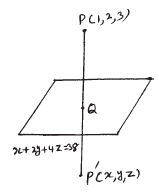
Let P' (x, y, z) be the image of P in the given plane.
$\therefore$ Equation of line PP' is $\frac{\text{x - 1}}{1}=\frac{\text{y - 2}}{2}=\frac{\text{z - 3}}{4}.........\text{(i)}$
Any point on this line is ($\lambda$ + 1, 2$\lambda$ + 2, 4$\lambda$ + 3)
If this point is Q, then ($\lambda$ + 1) + 2 (2$\lambda$ + 2) + 4 (4$\lambda$ + 3) = 38
$\Rightarrow$ $\lambda$ = 1 $\Rightarrow$ Q (2, 4, 7)
Q is the mid-point of PP'
$\therefore\text{ }\frac{1+\text{x}}{2}=2\Rightarrow\text{x}=3,\text{ }\frac{2+\text{y}}{2}=4\Rightarrow\text{y}=6,\text{ }\frac{3+\text{z}}{2}=7,\text{ }\Rightarrow\text{z}=11$
$\therefore$ Image (P') is (3, 6, 11). View full question & answer→Question 1273 Marks
Show that the following point are coplanar:
(0, 4, 3), (-1, -5, -3), (-2, -2, 1) and (1, 1, -1)
AnswerThe equation of the plane passing through points (0, 4, 3), (-1, -5, -3), (-2, -2, 1) is, $\begin{vmatrix}\text{x}-0&\text{y}-4&\text{z}-3\\-1-0&-5-4&-3-3\\-2-0&-2-4&1-3\end{vmatrix}=0$ $\Rightarrow\begin{vmatrix}\text{x}&\text{y}-4&\text{z}-3\\-1&-9&-6\\-2&-6&-2\end{vmatrix}=0$ $\Rightarrow-18\text{x}+10(\text{y}-4)-12(\text{z}-3)=0$ $\Rightarrow9\text{x}-5(\text{y}-4)+6(\text{z}-3)=0$ $\Rightarrow9\text{x}-5\text{y}+\text{z}+2=0$ Substituting the last points (1, 1, -1) (it means x = 1; y = 1; z = -1) in this plane equation, we get9(1) - 5(1) + 6(-1) + 2 = 0
⇒ 4 - 4 = 0 ⇒ 0 = 0 So, the plane equation is satisfied by the points (1, 1, -1) So, the given pointsa are coplanar.
View full question & answer→Question 1283 Marks
Write the value of $\lambda$ for which the lines $\frac{\text{x}-3}{-3}=\frac{\text{y}+2}{2\lambda}=\frac{\text{z}+4}{2}$ and $\frac{\text{x}+1}{3\lambda}=\frac{\text{y}-2}{1}=\frac{\text{z}+6}{-5}$ are perpendicular to each other.
AnswerWe have
$\frac{\text{x}-3}{-3}=\frac{\text{y}+2}{2\lambda}=\frac{\text{z}+4}{2}$
$\frac{\text{x}+1}{3\lambda}=\frac{\text{y}-2}{1}=\frac{\text{z}+6}{-5}$
The given lines are parallel to vector $\vec{\text{b}}_1=-3\hat{\text{i}}+2\lambda\hat{\text{j}}+2\hat{\text{k}}$ and $\vec{\text{b}}_2=3\lambda\hat{\text{i}}+\hat{\text{j}}-5\hat{\text{k}}.$
For $\vec{\text{b}}_1\perp\vec{\text{b}}_2,$ we must have
$\vec{\text{b}}_1.\vec{\text{b}}_2=0$
$\Rightarrow\big(-3\hat{\text{i}}+2\lambda\hat{\text{j}}+2\hat{\text{k}}\big).\big(3\lambda\hat{\text{i}}+\hat{\text{j}}-5\hat{\text{k}}\big)=0$
$\Rightarrow-7\lambda-10=0$
$\Rightarrow\lambda=-\frac{10}7{}$
View full question & answer→Question 1293 Marks
Obtain the equation of the plane passing through the point (1, - 3, -2) and perpendicular to the planes x + 2y + 2z = 5 and 3x + 3y + 2z = 8.
AnswerThe equation of any plane passing through (1, -3, -2) is,
a(x - 1) + b(y + 3) + c(z + 2) = 0 ....(i)
It is given that (i) is perpendicular to each of the planes x + 2y + 2z = 5 and 3x + 3y + 2z = 8. Then,
a + 2b + 2c = 0 ....(ii)
3a + 3b + 2c = 0 .....(ii)
Solving (i), (ii) and (iii) we get,
$\begin{vmatrix}\text{x}-1&\text{y}+3&\text{z}+2\\1&2&2\\3&3&2\end{vmatrix}=0$
⇒ -2(x - 1) + 4(y + 3) - 3(z + 2) = 0
⇒ -2x + 2 + 4y + 12 - 3z - 6 = 0
⇒ 2x - 4y + 3z - 8 = 0
View full question & answer→Question 1303 Marks
Find in vector form as wel as in cartesian form, the equation of the line passing through the points $A(1, 2, -1)$ and $B(2, 1, 1)$.
AnswerWe know that, equation of line passing through two points $(x_1, y_1, z_1)$ and $(x_2, y_2, z_2)$ is
$\frac{\text{x}-\text{x}_1}{\text{x}_2-\text{x}_1}=\frac{\text{y}-\text{y}_1}{\text{y}_2-\text{y}_1}=\frac{\text{z}-\text{z}_1}{\text{z}_2-\text{z}_1}\dots(1)$
Here, $\big(\text{x}_1,\text{y}_1,\text{z}_1\big)=\text{A}(1,2,-1)$
$\big(\text{x}_2,\text{y}_2,\text{z}_2\big)=\text{B}(2,1,1)$
Using equation (1), equation of line AB
$\frac{\text{x}-1}{2-1}=\frac{\text{y}-2}{1-2}=\frac{\text{z}+1}{1+1}$
$\frac{\text{x}-1}{1}=\frac{\text{y}-2}{-1}=\frac{\text{z}+1}{2}=\lambda$ (Say)
$\text{x}=\lambda+1,\text{y}=-\lambda+2,\text{z}=2\lambda-1$
vector form of equation of line Ab is,
$\text{x}\hat{\text{i}}+\text{y}\hat{\text{j}}+\text{z}\hat{\text{k}}=(\lambda+1)\hat{\text{i}}+(-\lambda+2)\hat{\text{j}}+(2\lambda-1)\hat{\text{k}}$
$\vec{\text{r}}=\big(\hat{\text{i}}+2\hat{\text{j}}-\hat{\text{k}}\big)+\lambda\big(\hat{\text{i}}-\hat{\text{j}}+2\hat{\text{k}}\big)$
View full question & answer→Question 1313 Marks
Show that the line through points $(1, -1, 2)$ and $(3, 4, -2)$ is perpendicular to the line throught the points $(0, 3, 2)$ and $(3, 5, 6).$
AnswerWe know that two lines with direction ratios $a_1, b_1, c_2$ and $a_2, b_2, c_2$ are pependicular if $a_1 a_2+b_1 b_2+c_1 c_2=0$. The direction ratios of the line passing through the points $(1,-1,2)$ and $(3,4,-2)$ are $(3-1),[4-(-1)],(-2-2)$,
$\text { i.e. } \Rightarrow a_1=2, b_1=2, c_1=-4$
Similarly, the direction ratios of the line passing through the points $(0,3,2)$ and $(3,5,6)$ and $(3-0),(5-3),(6-2)$, i.e. $\Rightarrow a_2=3, b_2=2, c_2=4$
$\therefore a_1 a_2+b_1 b_2+c_1 c_2=2 \times 3+5 \times 2(-4) \times 4=6+10-16=0$
Thus the line through the points $(1,-1,2)$ and $(3,4,-2)$ is perpendicular to the line throught the points $(0,3,2)$ and $(3,5,6)$
View full question & answer→Question 1323 Marks
Find the coordinates of the foot of the perpendicular drawn from the origin.
$2x + 3y + 4z - 12 = 0$
AnswerLet the coordinates of the foot of perpendicular P from the origin to the plane be $(x_1, y_1, z_1)$.
$2x + 3y + 4z - 12 = 0$
$\Rightarrow 2x + 3y + 4z = 12$ .....(1)
The direction ratios of normal are $2, 3$, and $4$.
$\therefore\ \ \sqrt{(2)^2+(3)^2+(4)^2}=\sqrt{29}$
Dividing both sides of equation (1) by $\sqrt{29},$ we obtain
$\frac{2}{\sqrt{29}}\text{x}+\frac{3}{\sqrt{29}}\text{y}+\frac{4}{\sqrt{29}}\text{z}=\frac{12}{\sqrt{29}}$
This equation is of the form lx + my + nz = d, where l, m, n are the direction cosines of
normal to the plane and d is the distance of normal from the origin.
The coordinates of the foot of the perpendicular are given by
(ld, md, nd).
Therefore, the coordinates of the foot of the perpendicular are
$\Big(\frac{2}{\sqrt{29}}.\frac{12}{\sqrt{29}},\ \frac{3}{\sqrt{29}}.\frac{12}{\sqrt{29}},\ \frac{4}{\sqrt{29}}.\frac{12}{\sqrt{29}}\Big)\ \text{i.e.},\ \Big(\frac{24}{29},\ \frac{36}{29},\ \frac{48}{29}\Big).$
View full question & answer→Question 1333 Marks
Find the angle between the line $\frac{\text{x}-2}{3}=\frac{\text{y}+1}{-1}=\frac{\text{z}-3}{2}$ and the plane 3x + 4y + z + 5 = 0
AnswerThe given line is parallel to the vector $\vec{\text{b}}=3\hat{\text{i}}-\hat{\text{j}}+2\hat{\text{k}}$ and the given plane id normal to the vector $\vec{\text{n}}=3\hat{\text{i}}+4\hat{\text{j}}+\hat{\text{k}}$
We know that the angle $\theta$ between the line and the plane is given by
$\sin\theta=\frac{\vec{\text{b}}\cdot\vec{\text{n}}}{|\vec{\text{b}}|\vec{|\text{n}}|}$
$=\frac{(3\hat{\text{i}}-\hat{\text{j}}+2\hat{\text{k}})\cdot(3\hat{\text{i}}+4\hat{\text{j}}+\hat{\text{k}})}{|3\hat{\text{i}}-\hat{\text{j}}+2\hat{\text{k}}||3\hat{\text{i}}+4\hat{\text{j}}+\hat{\text{k}}|}$
$=\frac{9-4+2}{\sqrt{9+1+4}\sqrt{9+16+1}}=\frac{7}{\sqrt{14}\sqrt{26}}$
$=\frac{7}{\sqrt{2}\sqrt{7}\sqrt{2}\sqrt{13}}=\frac{\sqrt{7}}{\sqrt{52}}=\sqrt{\frac{7}{52}}$
$\theta=\sin^{-1}\Big(\sqrt{\frac{7}{52}}\Big)$
View full question & answer→Question 1343 Marks
Find the points on the line $\frac{\text{x}+2}{3}=\frac{\text{y}+1}{2}=\frac{\text{z}-3}{2}$ at a distance of 5 units from the point P(1, 3, 3).
AnswerThe coordinates of any point on the line $\frac{\text{x}+2}{3}=\frac{\text{y}+1}{2}=\frac{\text{z}-3}{2}$ are given by
$\frac{\text{x}+2}{3}=\frac{\text{y}+1}{2}=\frac{\text{z}-3}{2}=\lambda$
$\Rightarrow\text{x}=3\lambda-2,\text{y}=2\lambda-1,\text{z}=2\lambda+3\dots(1)$
Let the coordinates of the desired point be $(3\lambda-2,2\lambda-1,2\lambda+3)$
The distance between this point and (1, 3, 3) is 5 units.
$\therefore\sqrt{(3\lambda-2-1)^2+(2\lambda-1-3)^2+(2\lambda+3-3)^2}=5$
$\Rightarrow(3\lambda-3)^2+(2\lambda-4)^2+(2\lambda)^2=25$
$\Rightarrow17\lambda^2-34\lambda=0$
$\Rightarrow\lambda(\lambda-2)=0$
$\Rightarrow\lambda=0$ or $2$
Substituting the values of $\lambda$ in (1), we get the coordinates of the desired point as (-2, -1, 3) and (4, 3, 7).
View full question & answer→Question 1353 Marks
Show that the lines $\frac{\text{x}-5}{7}=\frac{\text{y}+2}{-5}=\frac{\text{z}}{1}$ and $\frac{\text{x}}{1}=\frac{\text{y}}{2}=\frac{\text{z}}{3}$ are perpendicular to each other.
AnswerThe direction ratios of the lines $\frac{\text{x}-5}{7}=\frac{\text{y}+2}{-5}=\frac{\text{z}}{1}$ and $\frac{\text{x}}{1}=\frac{\text{y}}{2}=\frac{\text{z}}{3}$ are proportional to 7, -5, 1 and 1, 2, 3, respectiveiy.
Let:
$\vec{\text{b}}_1=7\hat{\text{i}}-5\hat{\text{j}}+\hat{\text{k}}$
$\vec{\text{b}}_2=\hat{\text{i}}+2\hat{\text{j}}+3\hat{\text{k}}$
Now,
$\vec{\text{b}}_1.\vec{\text{b}}_2=\big(7\hat{\text{i}}-5\hat{\text{j}}+\hat{\text{k}}\big).\big(\hat{\text{i}}+2\hat{\text{j}}+3\hat{\text{k}}\big)$
$=7-10+3$
$=0$
$\therefore\vec{\text{b}}_1\perp\vec{\text{b}}_2$
Hence, the given lines are perpendicular to each other.
View full question & answer→Question 1363 Marks
Write the direction cosines of the line whose cartesian equations are 6x -2 = 3y + 1 =2z - 4.
AnswerWe have
6x -2 = 3y + 1 =2z - 4
The equation of given line can be re-written as
$\frac{\text{x}-\frac{1}{3}}{\frac{1}{6}}=\frac{\text{y}+\frac{1}{3}}{\frac{1}{3}}=\frac{\text{z}-2}{\frac{1}{2}}$
$\Rightarrow\frac{\text{x}-\frac{1}{3}}{1}=\frac{\text{y}+\frac{1}{3}}{2}=\frac{\text{z}-2}{3}$
The direction ratios of the line parallel to AB are proportional to 1, 2, 3.
Hence, the direction cosines of the line parallel to AB are proportional to
$\frac{1}{\sqrt{1^2+2^2+3^2}},\frac{2}{\sqrt{1^2+2^2+3^2}},\frac{3}{\sqrt{1^2+2^2+3^2}}$
$=\frac{1}{\sqrt{14}},\frac{2}{\sqrt{14}},\frac{3}{\sqrt{14}}$
View full question & answer→Question 1373 Marks
Prove that the lines x = py + q, z = ry + s and x = p′y + q′, z = r′y + s′ are perpendicular if pp′ + rr′ + 1 = 0.
AnswerWe have line $\text{x}=\text{py}+\text{q},\ \text{z}=\text{ry}+\text{s}$
$\Rightarrow\text{y}=\frac{\text{x}-\text{q}}{\text{p}}$ and $\text{y}=\frac{\text{z}-\text{s}}{\text{r}}$
$\Rightarrow\frac{\text{x}-\text{q}}{\text{p}}=\frac{\text{y}}{1}=\frac{\text{z}-\text{s}}{\text{r}}\ .....(\text{i})$
Similarly line $\text{x}=\text{p}'\text{y}+\text{q}',\ \text{z}=\text{r}'\text{y}+\text{s}'$
$\Rightarrow\frac{\text{x}-\text{q}'}{\text{p}}=\frac{\text{y}}{1}=\frac{\text{z}-\text{s}'}{\text{r}}\ ....(\text{ii})$
Line (i) is parallel tpo the vector $\text{p}\hat{\text{i}}+\hat{\text{j}}+\text{r}\hat{\text{k}}.$
Line (ii) is parallel tpo the vector $\text{p}'\hat{\text{i}}+\hat{\text{j}}+\text{r}'\hat{\text{k}}.$
Line are perpendicular,
$\therefore(\text{p}\hat{\text{i}}+\hat{\text{j}}+\text{r}\hat{\text{k}})\cdot(\text{p}'\hat{\text{i}}+\hat{\text{j}}+\text{r}'\hat{\text{k}})$
$\therefore\text{p}\text{p}'+1+\text{r}'\text{r}=0.$
View full question & answer→Question 1383 Marks
Find the equation of the plane passing through the following point:
(-5, 0, -6), (-3, 10, -9) and (-2, 6, -6)
AnswerThe equation of the plane passing through points (-5, 0, -6), (-3, 10, -9) and (-2, 6, -6) is given by,
$\begin{vmatrix}\text{x}+5&\text{y}-0&\text{z}+6\\-3+5&10-0&-9+6\\-2+5&6-0&-6+6\end{vmatrix}=0$
$\Rightarrow\begin{vmatrix}\text{x}+5&\text{y}&\text{z}+6\\2&10&-3\\3&6&0\end{vmatrix}=0$
$\Rightarrow18(\text{x}+5)-\text{y}-18(\text{z}+6)=0$
$\Rightarrow2(\text{x}+5)-\text{y}-2(\text{z}+6)=0$
$\Rightarrow2\text{x}+10-\text{y}-2\text{z}-12=0$
$\Rightarrow2\text{x}-\text{y}-2\text{z}-2=0$
View full question & answer→Question 1393 Marks
Write the angle between the lines whose direction ratios are perportional to 1, -2, 1 and 4, 3, 2.
AnswerThe direction ratios of the first line are 1, -2, 1 and the direction ratios of the second line are 4, 3, 2.
Let $\theta$ be the angle between these two lines.
Now,
$\cos\theta =\Bigg|\frac{1(4)+(-2)(3)+1(2)}{\sqrt{(1)^2+(-2)^2+(1)^2}\sqrt{(4)^2+(3)^2+(2)^2}}\Bigg|$
$=\Bigg|\frac{4+6+2}{\sqrt{1+4+1}\sqrt{16+9+4}}\Bigg|$
$=\frac{0}{\sqrt{6}\sqrt{29}}$
$=0$
$\Rightarrow\theta=\frac{\pi}{2}$
Hence, the required angle is$\frac{\pi}{2}$.
View full question & answer→Question 1403 Marks
Find the equation of the plane with intercept 3 on the y-axis and parallel to the ZOX plane.
AnswerThe equation of the plane parallel to the plane ZOX is,
y = b ....(i), where b is a constant.
It is given that this plane passes through (0, 3, 0). So,
3 = b
Substituting this value in (i), we get
y = 3, which is the required equation of the plane.
View full question & answer→Question 1413 Marks
Show that the following point are coplanar:
(0, -1, 0), (2, 1, -1), (1, 1, 1) and (3, 3, 0)
AnswerThe equation of the plane passing through points (0, -1, 0), (2, 1, -1) and (1, 1, 1) is given by, $\begin{vmatrix}\text{x}-0&\text{y}+1&\text{z}-0\\2-0&1+1&-1-0\\1-0&1+1&1-0\end{vmatrix}=0$ $\Rightarrow\begin{vmatrix}\text{x}&\text{y}+1&\text{z}\\2&2&-1\\1&2&1\end{vmatrix}=0$ $\Rightarrow4\text{x}-3(\text{y}+1)+2\text{z}=0$ $\Rightarrow4\text{x}-3\text{y}+2\text{z}-3=0$ Substituting the last points (3, 3, 0) (it means x = 3; y = 3; z = 0) in this plane equation, we get4(3) - 3(3) + 2(0) - 3 = 0
⇒ 12 - 12 = 0 ⇒ 0 = 0 So, the plane equation is satisfied by the points (3, 3, 0) So, the given pointsa are coplanar.
View full question & answer→Question 1423 Marks
Show that the following planes are at right angles.
$x - 2y + 4z = 10$ and $18x + 17y + 4z = 49$
AnswerWe know that the planes $a_1x + b_1y + c_1z + d_1 = 0$ and $a_2x + b_2y + c_2z + d_2 = 0$ are perperndicular to each other only if
$a_1a_2 + b_1b_2 + c_1c_2= 0$
The given planes are $x - 2y + 4z = 10$ and $18x + 17y + 4z = 49$
$\Rightarrow a_1 = 1; b_1 = -2; c_1 = 4; a_2 = 18; b_2 = 17; c_2 = 4$
Now,
$a_1a_2 + b_1b_2 + c_1c_2$
$= (1)(18) + (-2)(17) + (4)(4)$
$= 18 - 34 + 16$
$= 0$
So, the given planes are perpendicular.
View full question & answer→Question 1433 Marks
Show that the normals to the following parirs of planes are perpendicular other.
$\vec{\text{r}}\cdot(2\hat{\text{i}}-\hat{\text{j}}+3\hat{\text{k}})=5$ and $\vec{\text{r}}\cdot(2\hat{\text{i}}-\hat{\text{j}}-2\hat{\text{k}})=5$
AnswerLet $\vec{\text{n}_1}$ and $\vec{\text{n}_2}$ be the vectors which are normals to the planes $\vec{\text{r}}\cdot(2\hat{\text{i}}-\hat{\text{j}}+3\hat{\text{k}})=5$ and $\vec{\text{r}}\cdot(2\hat{\text{i}}-\hat{\text{j}}-2\hat{\text{k}})=5$ respectively.The given equations of the planes are
$\vec{\text{r}}\cdot(2\hat{\text{i}}-\hat{\text{j}}+3\hat{\text{k}})=5$
$\vec{\text{r}}\cdot(2\hat{\text{i}}-\hat{\text{j}}-2\hat{\text{k}})=5$
$\Rightarrow\vec{\text{n}_1}=(2\hat{\text{i}}-\hat{\text{j}}+3\hat{\text{k}}),$
$\Rightarrow\vec{\text{n}_2}=(2\hat{\text{i}}-\hat{\text{j}}-2\hat{\text{k}})$
Now, $\vec{\text{n}_1}\cdot\vec{\text{n}_2}=(2\hat{\text{i}}-\hat{\text{j}}+3\hat{\text{k}})\cdot(2\hat{\text{i}}-\hat{\text{j}}-2\hat{\text{k}})$
$=4+2-6=0$
So, the normals to the given planes are perpendicular to each other.
View full question & answer→