Questions

Case study (4 Marks)

Take a timed test

11 questions · self-marked practice — reveal the answer and mark yourself.

Question 14 Marks
Read the following passage and answer the questions given below:

Teams A,B,C went for playing a tug of war game. Teams A,B,C have attached a rope to a metal ring and is trying to pull the ring into their own area.

TeamApulls with force $F_1=6 \hat{i}+0 \hat{j} k N$

TeamBpulls with force $F_2=-4 \hat{i}+4 \hat{j} k N$

TeamCpulls with force $F_3=-3 \hat{i}-3 \hat{j} k N$,
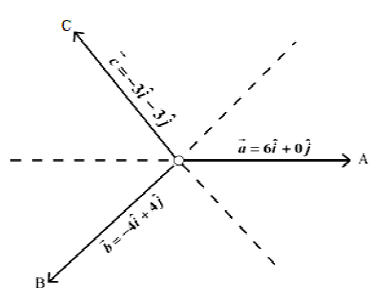
Image

(i) What is the magnitude of the force of Team A?
(ii) Which team will win the game?
(iii) Find the magnitude of the resultant force exerted by the teams.

OR

(iii) In what direction is the ring getting pulled?

Answer
We have ,
$\left|\overrightarrow{F_1}\right|=\sqrt{6^2+0^2}=6 k N,\left|\overrightarrow{F_2}\right|=\sqrt{(-4)^2+4^2}=\sqrt{32}=4 \sqrt{2} k N,\left|\overrightarrow{F_3}\right|=\sqrt{(-3)^2+(-3)^2}=\sqrt{18}=3 \sqrt{2} k N$.

(i) Magnitude of force of Team $A=6 k N$.

(ii) Since, 6kN is largest so, team Awill win the game.

(iii) $\begin{aligned} & \vec{F}=\overrightarrow{F_1}+\overrightarrow{F_2}+\overrightarrow{F_3}=6 \hat{i}+0 \hat{j}-4 \hat{i}+4 \hat{j}-3 \hat{i}-3 \hat{j}=-\hat{i}+\hat{j} \\ & \therefore|\vec{F}|=\sqrt{(-1)^2+(1)^2}=\sqrt{2} k N \\ & \quad \text { OR } \\ & \vec{F}=-\hat{i}+\hat{j}\end{aligned}$

$\therefore \theta=\pi-\tan ^{-1}\left(\frac{1}{1}\right)=\pi-\frac{\pi}{4}=\frac{3 \pi}{4} ;$ where $^{\prime} \theta^{\prime}$ is the angle made by the resultant force with the $+v e$ direction of the $x$-axis.
View full question & answer
Question 24 Marks
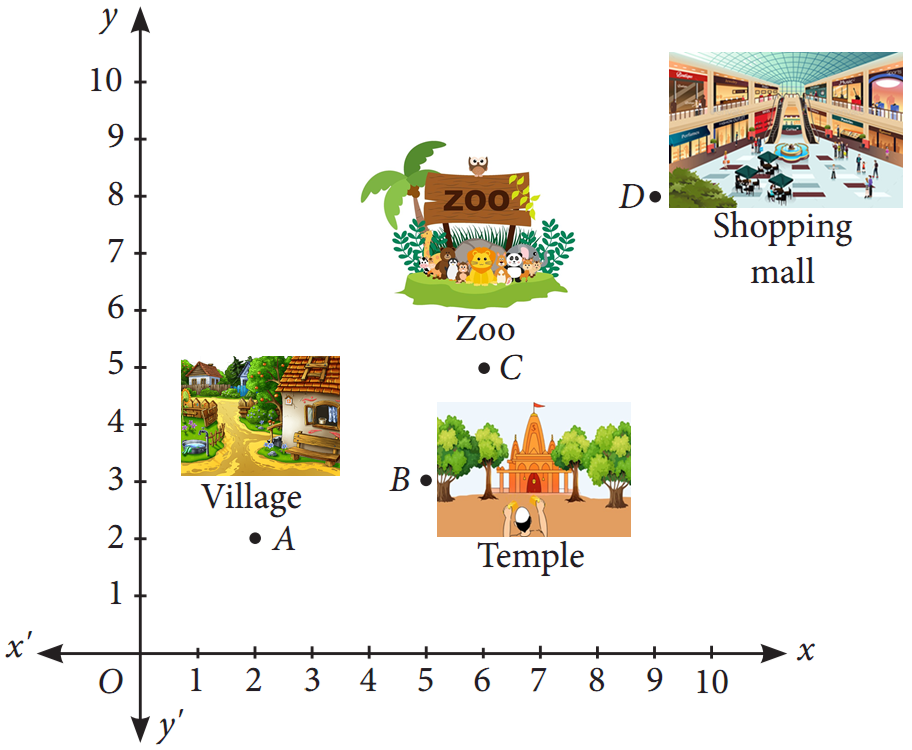
Ishaan left from his village on weekend. First, he travelled up to temple. After this, he left for the zoo. After this, he left for shopping in a mall. The positions of Jshaan at different places is given in the following graph.

Based on the above information, answer the following questions.
  1. Position vector of B is:
  1. $3\hat{\text{i}}+5\hat{\text{j}}$
  2. $5\hat{\text{i}}+3\hat{\text{j}}$
  3. $-5\hat{\text{i}}-3\hat{\text{j}}$
  4. $-5\hat{\text{i}}+3\hat{\text{j}}$
  1. Position vector of D is:
  1. $5\hat{\text{i}}+3\hat{\text{j}}$
  2. $3\hat{\text{i}}+5\hat{\text{j}}$
  3. $8\hat{\text{i}}+9\hat{\text{j}}$
  4. $9\hat{\text{i}}+8\hat{\text{j}}$
  1. Find the vector $\overline{\text{BC}}$ in terms of $\hat{\text{i}},\hat{\text{j}}.$
  1. $\hat{\text{i}}-2\hat{\text{j}}$
  2. $\hat{\text{i}}+2\hat{\text{j}}$
  3. $2\hat{\text{i}}+\hat{\text{j}}$
  4. $2\hat{\text{i}}-\hat{\text{j}}$
  1. Length of vector $\overline{\text{AB}}$ is:
  1. $\sqrt{67}\text{ units}$
  2. $\sqrt{85}\text{ units}$
  3. 90 units
  4. 100 units
  1. If $\vec{\text{M}}=4\hat{\text{j}}+3\hat{\text{k}},$ then its unit vector is:
  1. $\frac{4}{5}\hat{\text{j}}+\frac{3}{5}\hat{\text{k}}$
  2. $\frac{4}{5}\hat{\text{j}}-\frac{3}{5}\hat{\text{k}}$
  3. $-\frac{4}{5}\hat{\text{j}}+\frac{3}{5}\hat{\text{k}}$
  4. $-\frac{4}{5}\hat{\text{j}}-\frac{3}{5}\hat{\text{k}}$
Answer
  1. (b) $5\hat{\text{i}}+3\hat{\text{j}}$
​​​​​​​​​​​​​​Solution:

Here (5, 3) are the coordinates of B.

$\therefore\text{P.V of }\text{B}=5\hat{\text{i}}+3\hat{\text{j}}$
  1. (d) $9\hat{\text{i}}+8\hat{\text{j}}$
​​​​​​​​​​​​​​​​​​​​​​​​​​​​​​​​​​​Solution:

Here (9, 8) are the coordinates of D.

$\therefore\text{P.V of }\text{D}=9\hat{\text{i}}+8\hat{\text{j}}$
  1. (b) $\hat{\text{i}}+2\hat{\text{j}}$
​​​​​​​​​​​​​​​​​​​​​​​​​​​​​​​​​​​Solution:

$\text{P.V of }\text{B}=5\hat{\text{i}}+3\hat{\text{j}}$ and $\text{P.V of }\text{C}=6\hat{\text{i}}+5\hat{\text{j}}$

$\therefore\overline{\text{BC}}=(6-5)\hat{\text{i}}+(5-3)\hat{\text{j}}=\hat{\text{i}}+2\hat{\text{j}}$
  1. (b) $\sqrt{85}\text{ units}$
​​​​​​​​​​​​​​​​​​​​​​​​​​​​​​​​​​​Solution:

Since $\text{P.V of }\text{A}=2\hat{\text{i}}+2\hat{\text{j}},\text{ P.V of }\text{D}=9\hat{\text{i}}+8\hat{\text{j}}$

$\therefore\overline{\text{AD}}=(9-2)\hat{\text{i}}+(8-2)\hat{\text{j}}=7\hat{\text{i}}+6\hat{\text{j}}$

$|\overline{\text{AD}}|^2=7^2+6^2=49+36=85$

$\Rightarrow|\overline{\text{AD}}|=\sqrt{85}\text{ units}$
  1. (a) $\frac{4}{5}\hat{\text{j}}+\frac{3}{5}\hat{\text{k}}$
​​​​​​​​​​​​​​​​​​​​​​​​​​​​​​​​​​​Solution:

We have, $\vec{\text{M}}=4\hat{\text{j}}+3\hat{\text{k}},$

$\therefore|\vec{\text{M}}|=\sqrt{4^2+3^2}=\sqrt{16+9}$

$=\sqrt{25}=5$​​​​​​​

$\therefore|\vec{\text{M}}|=\frac{\vec{\text{M}}}{|\vec{\text{M}}|}=\frac{4\hat{\text{j}}+3\hat{\text{k}}}{5}$

$=\frac{4}{5}\hat{\text{j}}+\frac{3}{5}\hat{\text{k}}.$
View full question & answer
Question 34 Marks
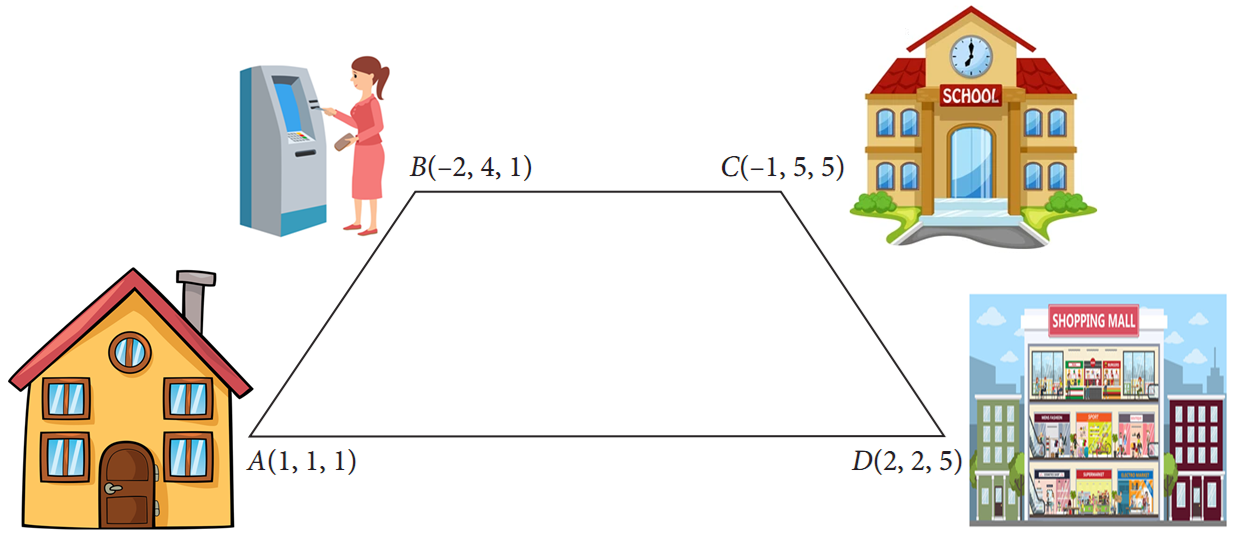
Ritika starts walking from his house to shopping mall. Instead of going to the mall directly, she first goes to a ATM, from there to her daughter's school and then reaches the mall. ln the diagram, A, B, C, and D represent the coordinates of House, ATM, School and Mall respectively.

Based on the above information, answer the following questions.
  1. Distance between House (A) and ATM (B) is:
  1. $3\text{ units}$
  2. $3\sqrt{2}\text{ units}$
  3. $\sqrt{2}\text{ units}$
  4. $4\sqrt{2}\text{ units}$
  1. Distance between ATM (B) and School (C) is:
  1. $\sqrt{2}\text{ units}$
  2. $2\sqrt{2}\text{ units}$
  3. $3\sqrt{2}\text{ units}$
  4. $4\sqrt{2}\text{ units}$
  1. Distance between School (C) and Shopping mall (D) is:
  1. $3\sqrt{2}\text{ units}$
  2. $5\sqrt{2}\text{ units}$
  3. $7\sqrt{2}\text{ units}$
  4. $10\sqrt{2}\text{ units}$
  1. What is the total distance travelled by Ritika:
  1. $4\sqrt{2}\text{ units}$
  2. $6\sqrt{2}\text{ units}$
  3. $8\sqrt{2}\text{ units}$
  4. $9\sqrt{2}\text{ units}$
  1. What is the extra distance travelled by Ritika in reaching the shopping mall?
  1. $3\sqrt{2}\text{ units}$
  2. $5\sqrt{2}\text{ units}$
  3. $6\sqrt{2}\text{ units}$
  4. $7\sqrt{2}\text{ units}$
Answer
  1. (b) $3\sqrt{2}\text{ units}$
Solution:

$\overline{\text{AB}}=(-2\hat{\text{i}}+4\hat{\text{j}}+\hat{\text{k}})-(\hat{\text{i}}+\hat{\text{j}}+\hat{\text{k}})=-3\hat{\text{i}}+3\hat{\text{j}}$

$\overline{\text{AB}}=\sqrt{(-3)^2+3^2}=\sqrt{9+9}=\sqrt{18}=3\sqrt{12}$

Distance between House (A) and ATM (B) is $3\sqrt{2}\text{ units}.$
  1. (c) $3\sqrt{2}\text{ units}$
Solution:

$\overline{\text{BC}}=(-\hat{\text{i}}+5\hat{\text{j}}+5\hat{\text{k}})-(-2\hat{\text{i}}+4\hat{\text{j}}+\hat{\text{k}})=\hat{\text{i}}+\hat{\text{j}}+4\hat{\text{k}}$

$\therefore|\overline{\text{BC}}|=\sqrt{1^2+1^2+4^2}=\sqrt{1+1+16}$

$=\sqrt{18}=3\sqrt{2}$

Distance between ATM (B) and School ( C) is $3\sqrt{2}\text{ units}.$
  1. (a) $3\sqrt{2}\text{ units}$
Solution:

$\overline{\text{CD}}=(2\hat{\text{i}}+2\hat{\text{j}}+5\hat{\text{k}})-(-\hat{\text{i}}+5\hat{\text{j}}+5\hat{\text{k}})=3\hat{\text{i}}-3\hat{\text{j}}$

$\therefore|\overline{\text{CD}}|=\sqrt{3^2+(-3)^2}=\sqrt{9+9}=3\sqrt{2}$

Distance between School (C) and Shopping mall (D) is $3\sqrt{2}\text{ units}.$
  1. (d) $9\sqrt{2}\text{ units}$
Solution:

Total distance travelled by Ritika

$=|\overline{\text{AB}}|+|\overline{\text{BC}}|+|\overline{\text{CD}}|$

$=(3\sqrt{2}+3\sqrt{2}+3\sqrt{2})\text{ units}$

$9\sqrt{2}\text{ units}.$
  1. (c) $6\sqrt{2}\text{ units}$
Solution:

Distance between house and shopping mall is

$|\overline{\text{AD}}|.$

Now, $\overline{\text{AD}}=\hat{\text{i}}+\hat{\text{j}}+4\hat{\text{k}}$

$\therefore|\overline{\text{CD}}|=\sqrt{1^2+1^2+4^2}=\sqrt{1+1+16}=\sqrt{18}$

$=3\sqrt{2}$

Thus, extra distance travelled by Ritika in reaching

shopping mall $=9\sqrt{2}-=3\sqrt{2}\text{ units}=6\sqrt{2}\text{ units}.$
View full question & answer
Question 44 Marks
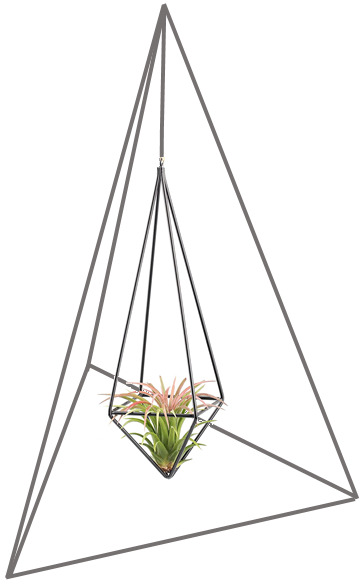
Ginni purchased an air plant holder which is in the shape of a tetrahedron.
Let A, B, C, and Dare the coordinates of the air plant holder where $\text{A}\equiv(1,1,1),\text{B}\equiv(2,1,3),\text{C}\equiv(3,2,2)$ and $\text{D}\equiv(3,3,4).$

Based on the above information, answer the following questions.
  1. Find the position vector of $\overline{\text{AB}}.$
  1. $-\hat{\text{i}}-2\hat{\text{k}}$
  2. $2\hat{\text{i}}+\hat{\text{k}}$
  3. $\hat{\text{i}}+2\hat{\text{k}}$
  4. $-2\hat{\text{i}}-\hat{\text{k}}$
  1. Find the position vector of $\overline{\text{AC}}.$
  1. $2\hat{\text{i}}-\hat{\text{j}}-\hat{\text{k}}$
  2. $2\hat{\text{i}}+\hat{\text{j}}+\hat{\text{k}}$
  3. $-2\hat{\text{i}}-\hat{\text{j}}+\hat{\text{k}}$
  4. $\hat{\text{i}}+2\hat{\text{j}}+\hat{\text{k}}$
  1. Find the position vector of $\overline{\text{AD}}.$
  1. $2\hat{\text{i}}-2\hat{\text{j}}-3\hat{\text{k}}$
  2. $\hat{\text{i}}+\hat{\text{j}}-3\hat{\text{k}}$
  3. $3\hat{\text{i}}+2\hat{\text{j}}+2\hat{\text{k}}$
  4. $2\hat{\text{i}}+2\hat{\text{j}}+3\hat{\text{k}}$
  1. Area of $\triangle\text{ABC}=$
  1. $\frac{\sqrt{11}}{2}\text{sq}.\text{units}$
  2. $\frac{\sqrt{14}}{2}\text{sq}.\text{units}$
  3. $\frac{\sqrt{13}}{2}\text{sq}.\text{units}$
  4. $\frac{\sqrt{17}}{2}\text{sq}.\text{units}$
  1. Find the unit vector along $\overline{\text{AD}}.$
  1. $\frac{1}{\sqrt{17}}(2\hat{\text{i}}+2\hat{\text{j}}+3\hat{\text{k}})$
  2. $\frac{1}{\sqrt{17}}(3\hat{\text{i}}+3\hat{\text{j}}+2\hat{\text{k}})$
  3. $\frac{1}{\sqrt{11}}(2\hat{\text{i}}+2\hat{\text{j}}+3\hat{\text{k}})$
  4. $(2\hat{\text{i}}+2\hat{\text{j}}+3\hat{\text{k}})$
Answer
  1. (c) $\hat{\text{i}}+2\hat{\text{k}}$
Solution:

Position vector of $\overline{\text{AB}}$

$=(2-1)\hat{\text{i}}+(1-1)\hat{\text{j}}+(3-1)\hat{\text{k}}$

$=\hat{\text{i}}+2\hat{\text{k}}$
  1. (b) $2\hat{\text{i}}+\hat{\text{j}}+\hat{\text{k}}$
Solution:

Position vector of $\overline{\text{AC}}$

$=(3-1)\hat{\text{i}}+(2-1)\hat{\text{j}}+(2-1)\hat{\text{k}}$

$=2\hat{\text{i}}+\hat{\text{j}}+\hat{\text{k}}$
  1. (d) $2\hat{\text{i}}+2\hat{\text{j}}+3\hat{\text{k}}$
Solution:

Position vector of $\overline{\text{AD}}$

$=(3-1)\hat{\text{i}}+(3-1)\hat{\text{j}}+(4-1)\hat{\text{k}}$

$=2\hat{\text{i}}+2\hat{\text{j}}+3\hat{\text{k}}$
  1. (b) $\frac{\sqrt{14}}{2}\text{sq}.\text{units}$
Solution:

Area of $\triangle\text{ABC}=\frac{1}{2}|\overline{\text{AB}}\times\overline{\text{AC}}|$

$\overline{\text{AB}}\times\overline{\text{AC}}=\begin{vmatrix}\hat{\text{i}}&\hat{\text{j}}&\hat{\text{k}}\\1&0&2\\2&1&1\end{vmatrix}$

$=\hat{\text{i}}(0-2)-\hat{\text{j}}(1-4)+\hat{\text{k}}(1-0)$

$=-2\hat{\text{i}}+3\hat{\text{j}}+\hat{\text{k}}$

$\Rightarrow|\overline{\text{AB}}\times\overline{\text{AC}}|=\sqrt{(-2)^2+3^2+1^2}$

$=\sqrt{4+9+1}=\sqrt{14}$

$\therefore$ Area of $\triangle\text{ABC}=\frac{1}{2}\sqrt{14}\text{sq}.\text{units}.$
  1. (a) $\frac{1}{\sqrt{17}}(2\hat{\text{i}}+2\hat{\text{j}}+3\hat{\text{k}})$
Solution:

Unit vector along $\overline{\text{AD}}=\frac{\overline{\text{AD}}}{|\overline{\text{AD}|}}$

$\frac{2\hat{\text{i}}+2\hat{\text{j}}+3\text{k}}{\sqrt{2^2+2^2+3^2}}=\frac{2\hat{\text{i}}+2\hat{\text{j}}+3\hat{\text{k}}}{\sqrt{4+4+9}}$

$=\frac{1}{\sqrt{17}}(2\hat{\text{i}}+2\hat{\text{j}}+3\hat{\text{k}})$
View full question & answer
Question 54 Marks
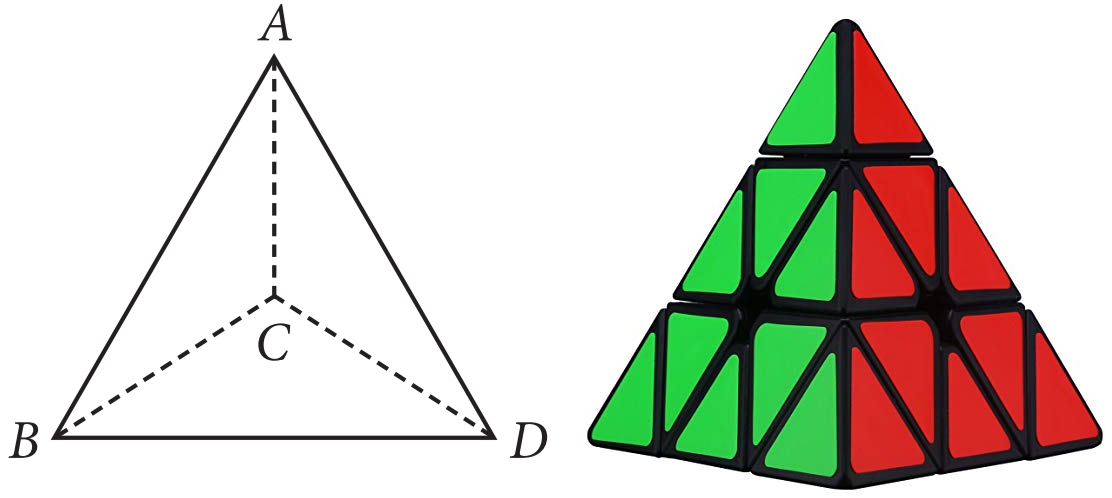
A building is to be constructed in the form of a triangular pyramid, ABCD as shown in the figure.

Let its angular points are A(0, 1, 2), B(3, 0, 1), C(4, 3, 6), and D(2, 3, 2), and G be the point of intersection of the medians of $\triangle\text{BCD}.$
Based on the above information, answer the following questions.
  1. The coordinates of point Gare:
  1. (2, 3, 3)
  2. (3, 3, 2)
  3. (3, 2, 3)
  4. (0, 2, 3)
  1. The length of vector $\overline{\text{AG}}$ is:
  1. $\sqrt{17}\text{ units}$
  2. $\sqrt{11}\text{ units}$
  3. $\sqrt{13}\text{ units}$
  4. $\sqrt{19}\text{ units}$
  1. Area of $\triangle\text{ABC}$ (in sq. units) is:
  1. $\sqrt{10}$
  2. $2\sqrt{10}$
  3. $3\sqrt{10}$
  4. $5\sqrt{10}$
  1. The sum of lengths of $\overline{\text{AB}}$ and $\overline{\text{AC}}$ is:
  1. 5 units
  2. 9.32 units
  3. 10 units
  4. 11 units
  1. The length of the perpendicular from the vertex D on the opposite face is:
  1. $\frac{6}{\sqrt{10}}\text{ units}$
  2. $\frac{2}{\sqrt{10}}\text{ units}$
  3. $\frac{3}{\sqrt{10}}\text{ units}$
  4. $8\sqrt{10}\text{ units}$
Answer
  1. (c) (3, 2, 3)
Solution:

Clearly, G be the centroid of $\triangle\text{BCD},$ therefore coordinates of G are

$\Big(\frac{3+4+2}{3},\frac{0+3+3}{3},\frac{1+6+2}{3}\Big)$

= (3, 2, 3)
  1. (b) $\sqrt{11}\text{ units}$
​​​​​​​​​​​​​​Solution:

Since, $\text{A}\equiv(0,1,2)$ and G = (3, 2, 3)

$\therefore\overline{\text{AG}}=(3-0)\hat{\text{i}}+(2-1)\hat{\text{j}}+(3-2)\hat{\text{k}}=3\hat{\text{i}}+\hat{\text{j}}+\hat{\text{k}}$

$\Rightarrow|\overline{\text{AG}}|^2=3^2+1^2+1^2=9+1+1=11$

$\Rightarrow|\overline{\text{AG}}|=\sqrt{11}$
  1. (c) $3\sqrt{10}$
​​​​​​​​​​​​​​​​​​​​​Solution:

Clearly, area of $\triangle\text{ABC}=\frac{1}{2}|\overline{\text{AB}}\times\overline{\text{AC}}|$

Here, $\overline{\text{AB}}\times\overline{\text{AC}}=\begin{vmatrix}\hat{\text{i}}&\hat{\text{j}}&\hat{\text{k}}\\3-0&0-1&1-2\\4-0&3-1&6-2\end{vmatrix}$

$=\begin{vmatrix}\hat{\text{i}}&\hat{\text{j}}&\hat{\text{k}}\\3&-1&-1\\4&2&4\end{vmatrix}$

$=\hat{\text{i}}(-4+2)-\hat{\text{j}}(12+4)+\hat{\text{k}}(6+4)$

$=-2\hat{\text{i}}-16\hat{\text{j}}+10\hat{\text{k}}$

$\therefore|\overline{\text{AB}}\times\overline{\text{AC}}|=\sqrt{(-2)^2+(-16)^2+10^2}$

$=\sqrt{4+256+100}=\sqrt{360}=6\sqrt{10}$

Hence, area of $\triangle\text{ABC}=\frac{1}{2}\times6\sqrt{10}=3\sqrt{10}\text{sq}.\text{units}.$
  1. (b) 9.32 units
​​​​​​​​​​​​​​​​​​​​​​​​​​​​Solution:

Here,​​​​​​​ $\overline{\text{AB}}=3\hat{\text{i}}-\hat{\text{j}}-\hat{\text{k}}$

$\Rightarrow|\overline{\text{AB}}|=\sqrt{9+1+1}=\sqrt{11}$

Also, $\overline{\text{AC}}=4\hat{\text{i}}+2\hat{\text{j}}+4\hat{\text{k}}$

$\Rightarrow|\overline{\text{AC}}|=\sqrt{16+4+16}=\sqrt{36}=6$

Now, $|\overline{\text{AB}}|+\overline{\text{AC}}|=\sqrt{11}+6$

= 3.32 + 6 = 9.32 units.
  1. (a) $\frac{6}{\sqrt{10}}\text{ units}$
​​​​​​​​​​​​​​​​​​​​​​​​​​​​Solution:

The length of the perpendicular from the vertex D on the opposite face

$=|\text{Projection of }\overline{\text{AC}}\text{ on}\overline{\text{ AB}}\times\overline{\text{AC}}|$

$=\begin{vmatrix}\frac{(2\hat{\text{i}}+2\hat{\text{j}})\cdot(-2\hat{\text{i}}+16\hat{\text{j}}+10\hat{\text{k}})}{\sqrt{(-2)^2+(-6)^2+10^2}}\\\end{vmatrix}$

$=\begin{vmatrix}\frac{-4-32}{\sqrt{360}}\\\end{vmatrix}=\frac{36}{6\sqrt{10}}$

$=\frac{6}{\sqrt{10}}\text{ units}.$
View full question & answer
Question 64 Marks
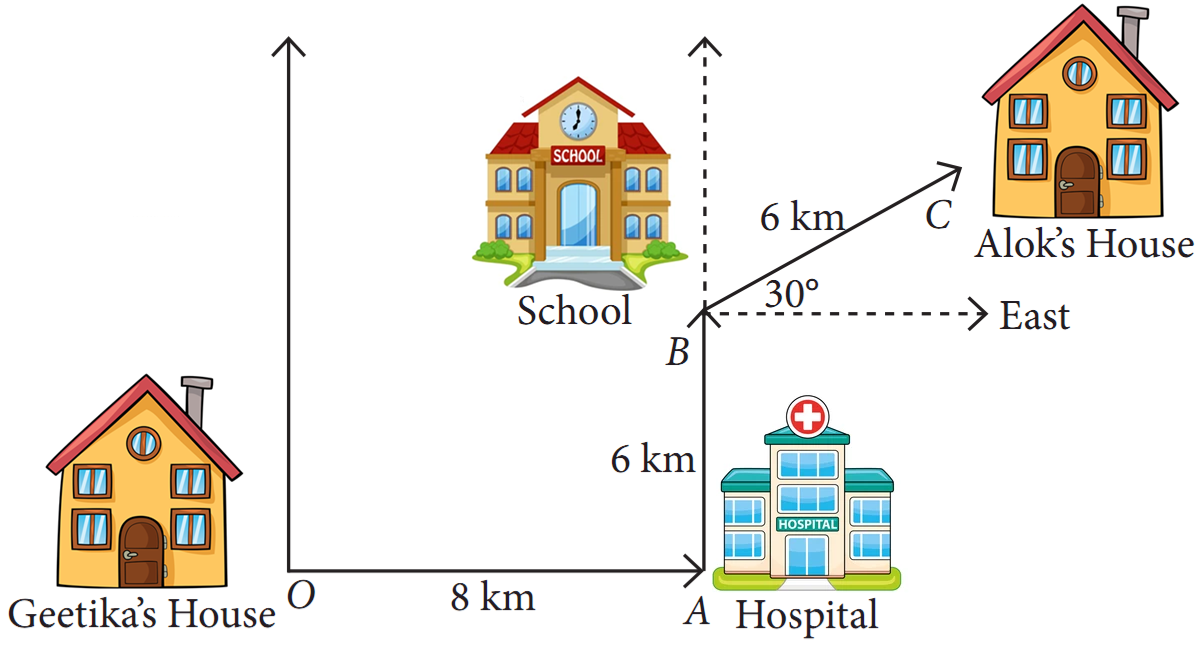
Geetika's house is situated at Shalimar Bagh at point O, for going to Alok's house she first travels 8km by bus in the East. Here at point A, a hospital is situated. From Hospital, Geetika takes an auto and goes 6km in the North, here at point B school is situated. From school, she travels by bus to reach Alok's house which is at 30º East, 6km from point B.

Based on the above information, answer the following questions.
  1. What is the vector distance between Geetika's house and school?
  1. $8\hat{\text{i}}-6\hat{\text{j}}$
  2. $8\hat{\text{i}}+6\hat{\text{j}}$
  3. $8\hat{\text{i}}$
  4. $6\hat{\text{j}}$
  1. How much distance Geetika travels to reach school?
  1. 14km
  2. 15km
  3. 16km
  4. 17km
  1. What is the vector distance from school to Alok's house?
  1. $\sqrt{3}\hat{\text{i}}+\hat{\text{j}}$
  2. $3\sqrt{3}\hat{\text{i}}+3\hat{\text{j}}$
  3. $6\hat{\text{i}}$
  4. $6\hat{\text{j}}$
  1. What is the vector distance from Geetika's house to Alok's house?
  1. $(8+3\sqrt{3})\hat{\text{i}}+9\hat{\text{j}}$
  2. $4\hat{\text{i}}+6\hat{\text{j}}$
  3. $15\hat{\text{i}}$
  4. $16\hat{\text{j}}$
  1. What is the total distance travelled by Geetika from her house to Alok's house?
  1. 19km
  2. 20km
  3. 21km
  4. 22km
Answer
  1. (b) $8\hat{\text{i}}+6\hat{\text{j}}$
​​​​​​​Solution:

We have $\overline{\text{OA}}=8\hat{\text{i}}$ and $\overline{\text{AB}}=6\hat{\text{j}}$

$\therefore\overline{\text{OB}}=\overline{\text{OA}}+\overline{\text{AB}}=8\hat{\text{i}}+6\hat{\text{j}}$
  1. (a) 14km
​​​​​​​​​​​​​​​​​​​​​Solution:

To reach school Geetika travels = (8 + 6)km = 14km.
  1. (b) $3\sqrt{3}\hat{\text{i}}+3\hat{\text{j}}$
​​​​​​​​​​​​​​​​​​​​​Solution:

Vector distance from school to Alok's house

$=6\cos30^\circ\hat{\text{i}}+6\sin30^\circ\hat{\text{j}}$

$=6\times\frac{\sqrt{3}}{2}\hat{\text{i}}+6\times\frac{1}{2}\hat{\text{j}}$

$=3\sqrt{3}\hat{\text{i}}+3\hat{\text{j}}$
  1. (a) $(8+3\sqrt{3})\hat{\text{i}}+9\hat{\text{j}}$
​​​​​​​​​​​​​​​​​​​​​Solution:

Vector distance from Geetika's house to Alok's house

$8\hat{\text{i}}+6\hat{\text{j}}+3\sqrt{3}\hat{\text{i}}+3\hat{\text{j}}$

$=(8+3\sqrt{3})\hat{\text{i}}+9\hat{\text{j}}$
  1. (b) 20km
​​​​​​​​​​​​​​​​​​​​​Solution:​​​​​​​

Total distance travelled by Geetika from her house to Alok's house = (8 + 6 + 6)km = 20km.
View full question & answer
Question 74 Marks
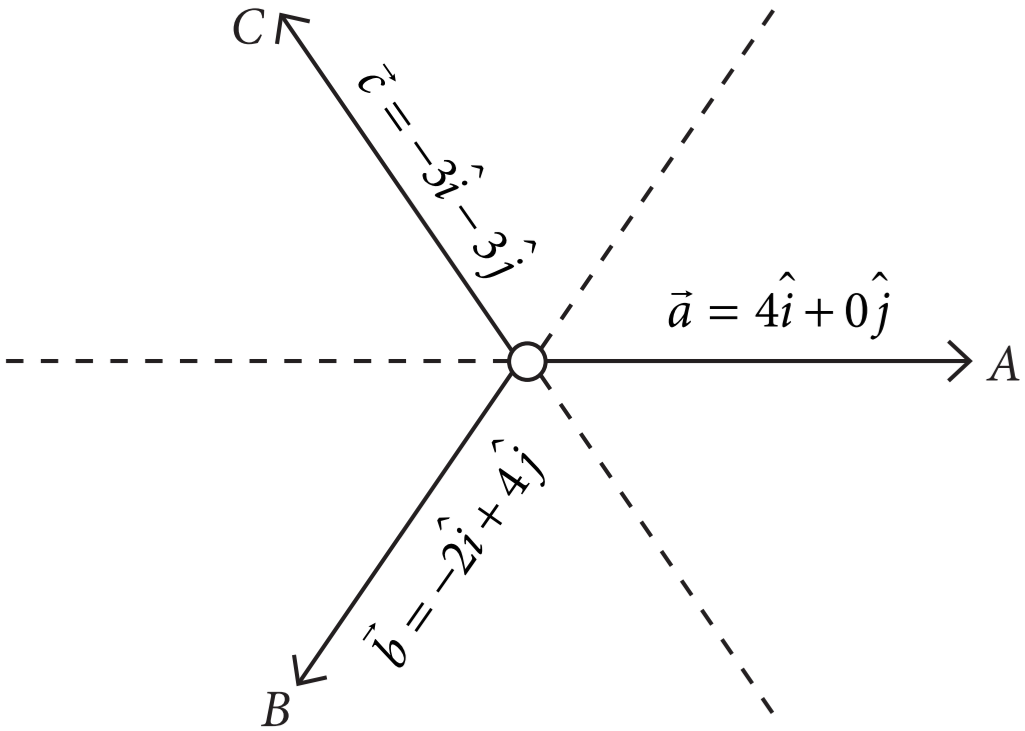
Teams A, B, Cwent for playing a tug of war game. Teams A, B, C have attached a rope to a metal ring and is trying to pull the ring into their own area ( team areas shown below).
Team A pulls with force $\text{F}_1=4\hat{\text{i}}+0\hat{\text{j}}\text{KN}$
Team $\text{B}\rightarrow\text{F}_2=-2\hat{\text{i}}+4\hat{\text{j}}\text{KN}$
Team $\text{C}\rightarrow\text{F}_3=-3\hat{\text{i}}+3\hat{\text{j}}\text{KN}$

Based on the above information, answer the following questions.
  1. Which team will win the game?
  1. Team B
  2. Team A
  3. Team C
  4. No one
  1. What is the magnitude of the teams combined force?
  1. 7KN
  2. 1.4KN
  3. 1.5KN
  4. 2KN
  1. In what direction is the ring getting pulled?
  1. 2.0 radian
  2. 2.5 radian
  3. 2.4 radian
  4. 3 radian
  1. What is the magnitude of the force of Team B?
  1. $2\sqrt{5}\text{KN}$
  2. 6 KN
  3. 2 KN
  4. $\sqrt{6}\text{KN}$
  1. How many KN force is applied by Team A?
  1. 5KN
  2. 4KN
  3. 2KN
  4. 16KN
Answer
Here, $|\vec{\text{F}}_1|=\sqrt{(4)^2+0^2}=4\text{KN}$
$|\vec{\text{F}}_2|=\sqrt{(-2)^2+4^2}=\sqrt{20}\text{KN}$
$|\vec{\text{F}}_3|=\sqrt{(-3)^2+(-3)^2}=\sqrt{18}\text{KN}$
  1. (a) Team B
​​​​​​​​​​​​​​​​​​​​​Solution:

Since, $\sqrt{20}$ is larger. So, team B will win the game
  1. .(b) 1.4KN
​​​​​​​​​​​​​​​​​​​​​​​​​​​​​​​​​​​Solution:

Let $\vec{\text{F}}$ be the combined force.

$\therefore\vec{\text{F}}=\vec{\text{F}}_1+\vec{\text{F}}_2+\vec{\text{F}}_3$

$=4\hat{\text{i}}+0\hat{\text{j}}-3\hat{\text{i}}-3\hat{\text{j}}-2\hat{\text{i}}+4\hat{\text{j}}$

$=-\hat{\text{i}}+\hat{\text{j}}$

$\therefore|\vec{\text{F}}|=\sqrt{(-1)^2+1^2}=\sqrt{2}=1.4\text{KN}$
  1. (c) 2.4 radian
​​​​​​​​​​​​​​​​​​​​​​​​​​​​​​​​​​​​​​​​​​Solution:

We have, $\vec{\text{F}}=-\hat{\text{i}}+\hat{\text{j}}$

$\therefore\theta=\tan^{-1}\Big(\frac{\text{F}_\text{y}}{\text{F}_\text{x}}\Big)=\tan^{-1}\Big(\frac{1}{-1}\Big)$

$=\frac{3\pi}{4}\text{radian}$

= 0. 75 × 3.14 radian = 2.3555 radian = 2.4 radian
  1. (a) $2\sqrt{5}\text{KN}$​​​​​​​
​​​​​​​​​​​​​​​​​​​​​​​​​​​​​​​​​​​​​​​​​​Solution:

Magnitude of force of Team $\text{B}=\sqrt{20}\text{KN}=2\sqrt{5}\text{KN}$
  1. (b) 4KN
​​​​​​​​​​​​​​​​​​​​​​​​​​​​​​​​​​​​​​​​​​​​​​​​​Solution:

4KN force is applied by team A.
View full question & answer
Question 84 Marks
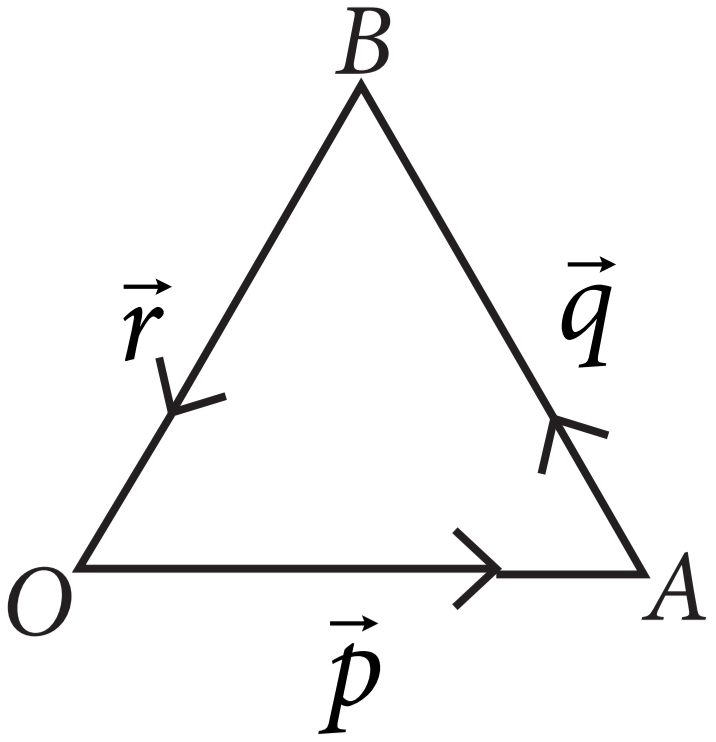
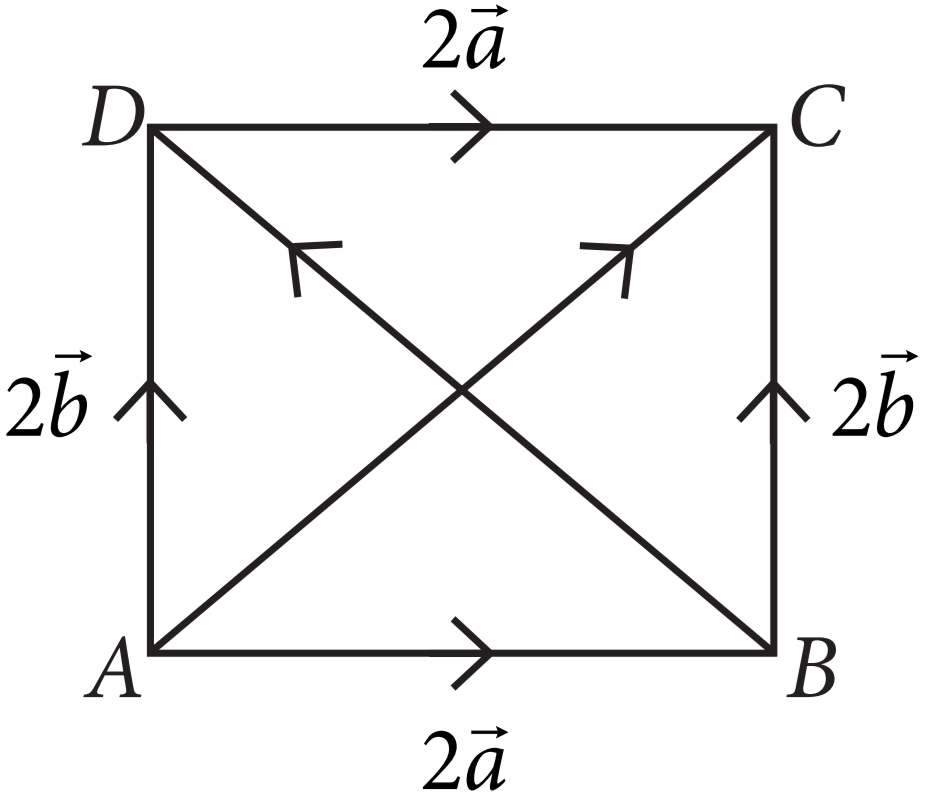
If two vectors are represented by the two sides of a triangle taken in order, then their sum is represented by the third side of the triangle taken in opposite order and this is known as triangle law of vector addition. Based on the above information, answer the following questions.
  1. If $\vec{\text{p}},\vec{\text{q}},\vec{\text{r}}$ are the vectors represented by the sides of a triangle taken in order, then $\vec{\text{q}},+\vec{\text{r}}=$
  1. $\vec{\text{p}}$
  2. $2\vec{\text{p}}$
  3. $-\vec{\text{p}}$
  4. None of these
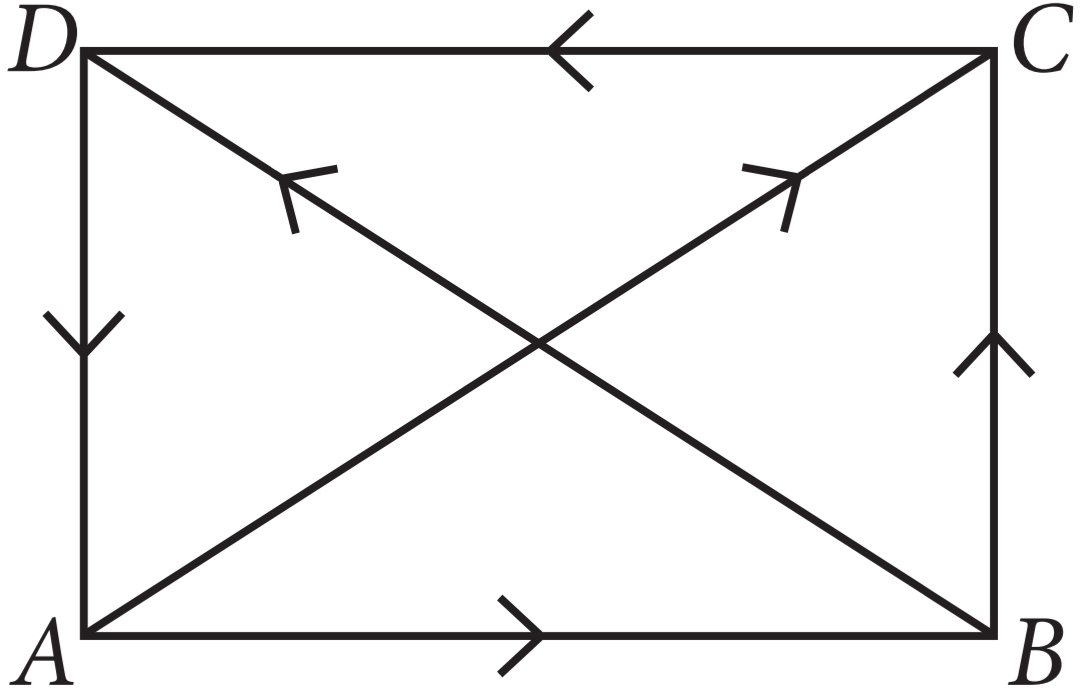
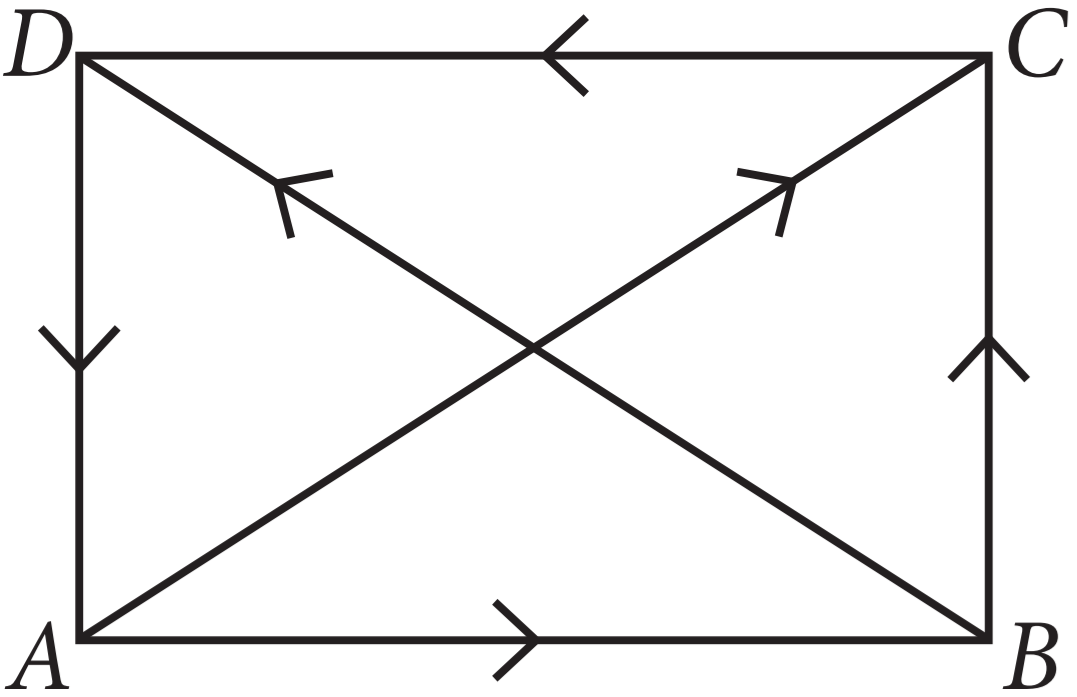
  1. If ABCD is a parallelogram and AC and BD are its diagonals, then $\overline{\text{AC}}+\overline{\text{BD}}=$
  1. $2\overline{\text{DA}}$
  2. $2\overline{\text{AB}}$
  3. $2\overline{\text{BC}}$
  4. $2\overline{\text{BD}}$
  1. If ABCD is a parallelogram, where $\overline{\text{AB}}=2\vec{\text{a}}$ and $\overline{\text{BC}}=2\vec{\text{b}},$ then $\overline{\text{AC}}-\overline{\text{BD}}=$
  1. $3\vec{\text{a}}$
  2. $4\vec{\text{a}}$
  3. $2\vec{\text{b}}$
  4. $4\vec{\text{b}}$
  1. If ABCD is a quadrilateral whose diagonals are $\overline{\text{AC}}$ and $\overline{\text{BD}},$ then $\overline{\text{BA}}+\overline{\text{DC}}=$
  1. $\overline{\text{AC}}+\overline{\text{DB}}$
  2. $\overline{\text{AC}}+\overline{\text{BD}}$
  3. $\overline{\text{BC}}+\overline{\text{AD}}$
  4. $\overline{\text{BD}}+\overline{\text{CA}}$
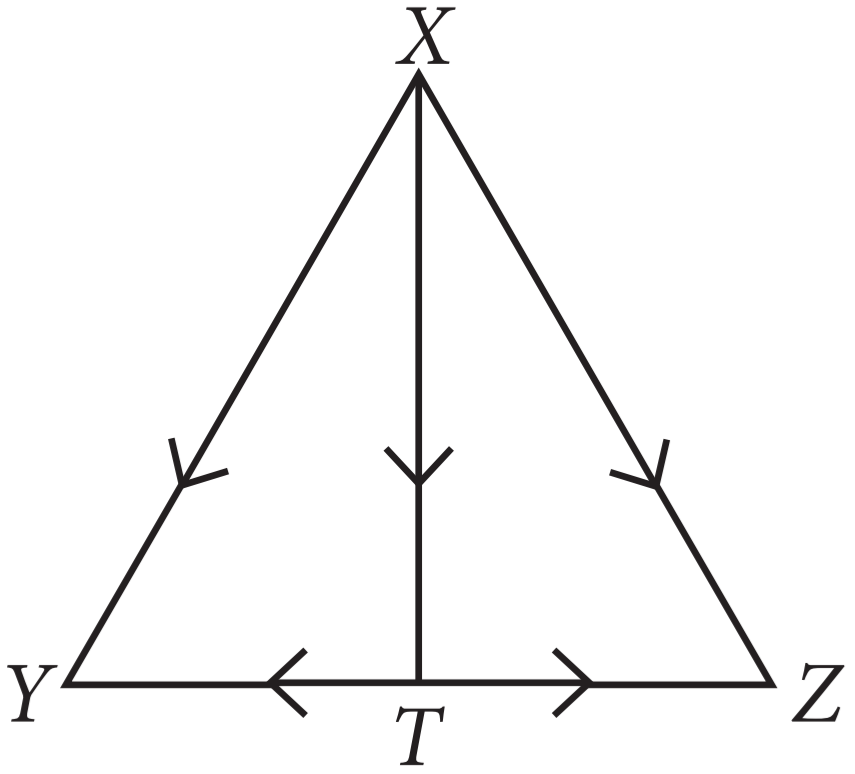
  1. If T is the mid point of side YZ of $\triangle\text{XYZ},$ then $\overline{\text{XY}}+\overline{\text{XZ}}=$
  1. $2\overline{\text{YT}}$
  2. $2\overline{\text{XT}}$
  3. $2\overline{\text{TZ}}$
  4. None of these
Answer
  1. (c) $-\vec{\text{p}}$
Solution:

Let OAB be a triangle such that,


$\overline{\text{AO}}=\vec{\text{p}},\overline{\text{AB}}=\vec{\text{q}},\overline{\text{BO}}=\vec{\text{r}}$

Now, $\vec{\text{q}}+\vec{\text{r}}=\overline{\text{AB}}+\overline{\text{BO}}=\overline{\text{AO}}=-\vec{\text{p}}$
  1. (c) $2\overline{\text{BC}}$
​​​​​​​​​​​​​​Solution:

From triangle law of vector addition,

$\overline{\text{AC}}+\overline{\text{BD}}=\overline{\text{AB}}+\overline{\text{BC}}+\overline{\text{BC}}+\overline{\text{CD}}$


$=\overline{\text{AB}}+2\overline{\text{BC}}+\overline{\text{CD}}$

$=\overline{\text{AB}}+2\overline{\text{BC}}-\overline{\text{AB}}=2\overline{\text{BC}}$

$[\because\overline{\text{AB}}=-\overline{\text{CD}}]$
  1. (b) $4\vec{\text{a}}$
​​​​​​​​​​​​​​​​​​​​​Solution:

In $\triangle\text{ABC},\overline{\text{AC}}=2\vec{\text{a}}+2\vec{\text{b}}\ ...(\text{i})$​​​​​​​


And in $\triangle\text{ABC},2\vec{\text{b}}=2\vec{\text{a}}+\overline{\text{BD}}\ ...(\text{ii})$

[By triangle law of addition]

Adding (i) and (ii), we have

$\overline{\text{AC}}+2\vec{\text{b}}=4\vec{\text{a}}+\overline{\text{BD}}+2\vec{\text{b}}$

$\Rightarrow\overline{\text{AC}}-\overline{\text{BD}}=4\vec{\text{a}}$
  1. (d) $\overline{\text{BD}}+\overline{\text{CA}}$
​​​​​​​​​​​​​​​​​​​​​Solution:

In $\triangle\text{ABC},\overline{\text{BA}}+\overline{\text{AC}}=\overline{\text{BC}}\ ...(\text{i})$

[By triangle law]

In $\triangle\text{BCD},\overline{\text{BC}}+\overline{\text{CD}}=\overline{\text{BD}}\ ...(\text{ii})$

From (i) and (ii), $\overline{\text{BA}}+\overline{\text{AC}}=\overline{\text{BD}}-\overline{\text{CD}}$

$\Rightarrow\overline{\text{BA}}+\overline{\text{CD}}=\overline{\text{BD}}-\overline{\text{AC}}=\overline{\text{BD}}+\overline{\text{CA}}$
  1. (b) $2\overline{\text{XT}}$
​​​​​​​​​​​​​​​​​​​​​Solution:

Since T is the mid point of YZ.

So, $\overline{\text{YT}}=\overline{\text{TZ}}$

Now, $\overline{\text{YT}}+\overline{\text{XZ}}=(\overline{\text{XT}}+\overline{\text{TY}})+(\overline{\text{XT}}+\overline{\text{TZ}})$

[By triangle law]

$=2\overline{\text{XT}}+\overline{\text{TY}}+\overline{\text{TZ}}=2\overline{\text{XT}}$

$[\because\overline{\text{TY}}+\overline{\text{YT}}]$
View full question & answer
Question 94 Marks
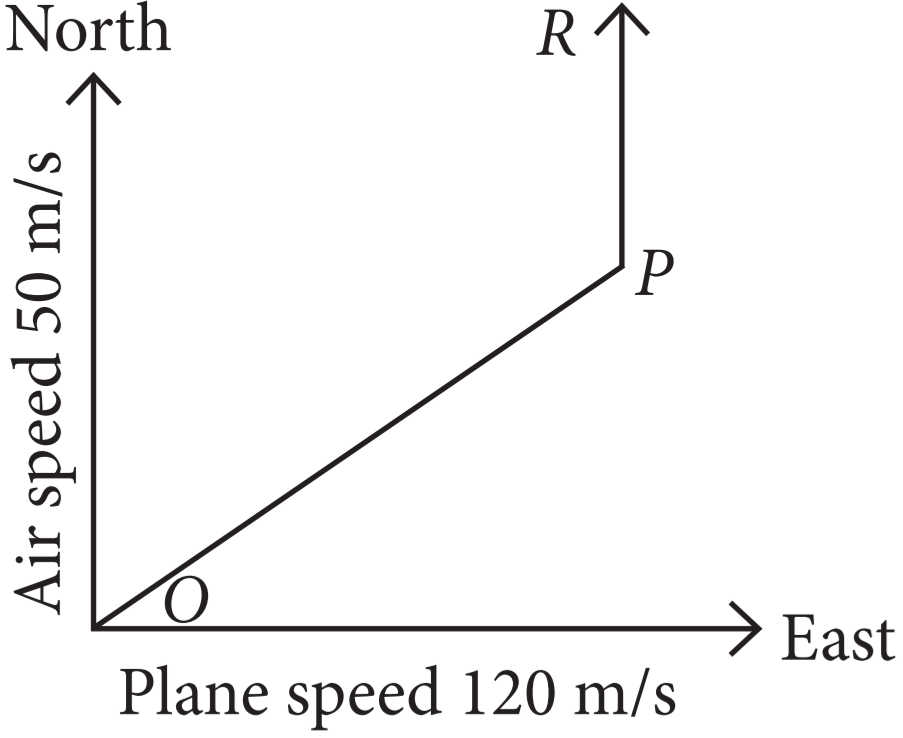
A plane started from airport situated at O with a velocity of 120m/s towards east. Air is blowing at a velocity of 50m/ s towards the north as shown in the figure.
The plane travelled 1hr in OP direction with the resultant velocity. From P to R the plane travelled 1hr keeping velocity of 120m/s and finally landed at R.

Based on the above information, answer the following questions.
  1. What is the resultant velocity from O to P?
  1. 100m/ s
  2. 130m/ s
  3. 126m/ s
  4. 180m/ s
  1. What is the direction of travel of plane from O to P with East?
  1. $\tan^{-1}\Big(\frac{5}{12}\Big)$
  2. $\tan^{-1}\Big(\frac{12}{3}\Big)$
  3. 50
  4. 80
  1. What is the displacement from O to P?
  1. 600km
  2. 468km
  3. 532km
  4. 500km
  1. What is the resultant velocity from P to R?
  1. 120m/ s
  2. 70m/ s
  3. 170m/ s
  4. 200m/ s
  1. What is the displacement from P to R?
  1. 450km
  2. 532km
  3. 610km
  4. 612km
Answer
  1. (b) 130m/ s
​​​​​​​​​​​​​​​​​​​​​​​​​​​​​​​​​​​Solution:

Resultant velocity from to O to P

$=\sqrt{120^2+50^2}$

$=\sqrt{14400+2500}=\sqrt{16900}$

= 130m/ s.
  1. (a) $\tan^{-1}\Big(\frac{5}{12}\Big)$
​​​​​​​​​​​​​​​​​​​​​​​​​​​​​​​​​​​​​​​​​​Solution:

Direction of travel of plane from O to P with east is $\tan^{-1}\Big(\frac{5}{12}\Big).$
  1. (b) 468km
​​​​​​​​​​​​​​​​​​​​​​​​​​​​​​​​​​​​​​​​​​​​​​​​​Solution:

Resultant velocity from O to A = 130m/ s

$=\Big(\frac{130\times3600}{1000}\Big)\text{km/ h}$

Time = 1hr

$\therefore$ Displacement $=\frac{130\times3600}{1000}=468\text{km}$
  1. (c) 170m/ s
​​​​​​​​​​​​​​​​​​​​​​​​​​​​​​​​​​​​​​​​​​​​​​​​​​​​​​​​Solution:

Resultant velocity from P to R = (120 + 50) = 170m/ s.
  1. (d) 612km
​​​​​​​​​​​​​​​​​​​​​​​​​​​​​​​​​​​​​​​​​​​​​​​​​​​​​​​​​​​​​​​Solution:

Displacement from P to R

$=\Big(\frac{170\times3600}{1000}\Big)$

= 612km.
View full question & answer
Question 104 Marks
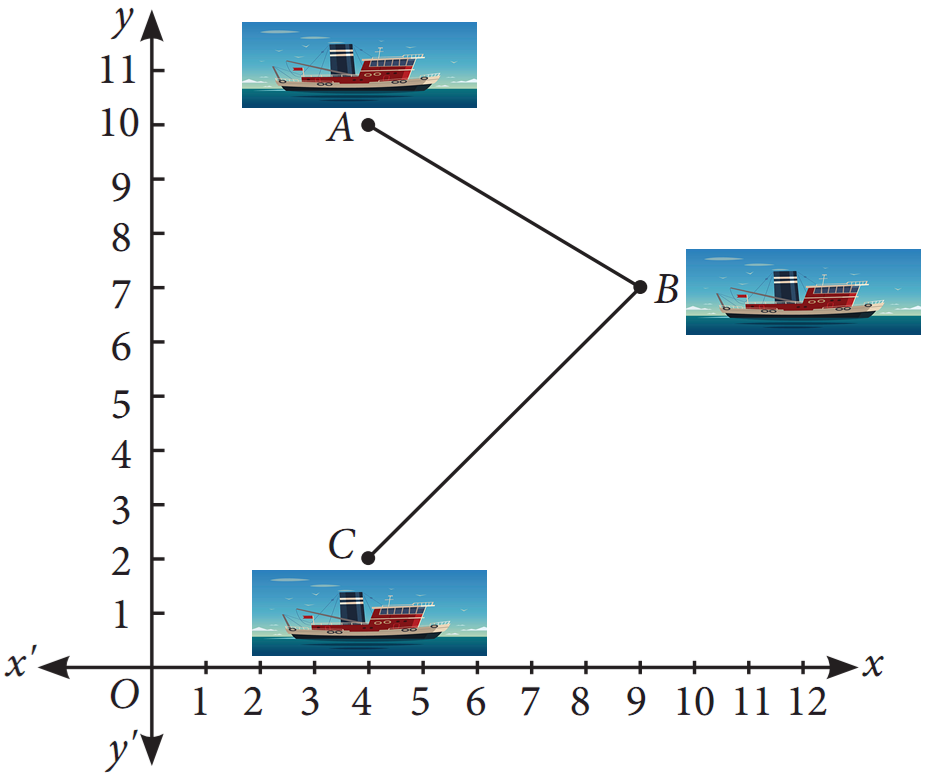
A barge is pulled into harbour by two tug boats as shown in the figure.
Based on the above information, answer the following questions.
  1. Position vector of A is:
  1. $4\hat{\text{i}}+2\hat{\text{j}}$
  2. $4\hat{\text{i}}+10\hat{\text{j}}$
  3. $4\hat{\text{i}}-10\hat{\text{j}}$
  4. $4\hat{\text{i}}-2\hat{\text{j}}$
  1. Position vector of B is:
  1. $4\hat{\text{i}}+4\hat{\text{j}}$
  2. $6\hat{\text{i}}+6\hat{\text{j}}$
  3. $9\hat{\text{i}}+7\hat{\text{j}}$
  4. $3\hat{\text{i}}+3\hat{\text{j}}$
  1. Find the vector $\overline{\text{AC}}$ in terms of $\hat{\text{i}},\hat{\text{j}}.$
  1. $8\hat{\text{j}}$
  2. $-8\hat{\text{j}}$
  3. $8\hat{\text{i}}$
  4. None of these
  1. If $\vec{\text{A}}=\hat{\text{i}}+2\hat{\text{j}}+3\hat{\text{k}},$ then its unit vector is:
  1. $\frac{\hat{\text{i}}}{\sqrt{14}}+\frac{2\hat{\text{j}}}{\sqrt{14}}+\frac{3\hat{\text{k}}}{\sqrt{14}}$
  2. $\frac{3\hat{\text{i}}}{\sqrt{14}}+\frac{2\hat{\text{j}}}{\sqrt{14}}+\frac{\hat{\text{k}}}{\sqrt{14}}$
  3. $\frac{2\hat{\text{i}}}{\sqrt{14}}+\frac{3\hat{\text{j}}}{\sqrt{14}}+\frac{\hat{\text{k}}}{\sqrt{14}}$
  4. None of these
  1. If $\vec{\text{A}}=4\hat{\text{i}}+3\hat{\text{j}}$ and $\vec{\text{B}}=3\hat{\text{i}}+4\hat{\text{j}},$ then $|\vec{\text{A}}|+|\vec{\text{B}}|=$
  1. 12
  2. 13
  3. 14
  4. 10
Answer
  1. (b) $4\hat{\text{i}}+10\hat{\text{j}}$
Solution:

Here, (4, 10) are the coordinates of A.

$\therefore\text{P.V of }\text{A}=4\hat{\text{i}}+10\hat{\text{j}}$
  1. (c) $9\hat{\text{i}}+7\hat{\text{j}}$
Solution:

Here, (9, 7) are the coordinates of B.

$\therefore\text{P.V of }\text{B}=9\hat{\text{i}}+7\hat{\text{j}}$
  1. (b) $-8\hat{\text{j}}$
Solution:

Here, P.V. of $\text{A}=4\hat{\text{i}}+10\hat{\text{j}}$ and P.V. of

$\text{C}=4\hat{\text{i}}+2\hat{\text{j}}$

$\therefore\overline{\text{AC}}=(4-4)\hat{\text{i}}+(2-10)\hat{\text{j}}=-8\hat{\text{j}}$
  1. (a) $\frac{\hat{\text{i}}}{\sqrt{14}}+\frac{2\hat{\text{j}}}{\sqrt{14}}+\frac{3\hat{\text{k}}}{\sqrt{14}}$
Solution:

Here, $\vec{\text{A}}=\hat{\text{i}}+2\hat{\text{j}}+3\hat{\text{k}}$

$\therefore|\vec{\text{A}}|=\sqrt{1^2+2^2+3^2}=\sqrt{1+4+9}=\sqrt{14}$

$\therefore\vec{\text{A}}=\frac{\vec{\text{A}}}{|\vec{\text{A}}|}=\frac{\hat{\text{i}}+2\hat{\text{j}}+3\hat{\text{k}}}{\sqrt{14}}$

$=\frac{1}{\sqrt{14}}\hat{\text{i}}+\frac{2}{\sqrt{14}}\hat{\text{j}}+\frac{3}{\sqrt{14}}\hat{\text{k}}$
  1. (d) 10
Solution:

We have, $\vec{\text{A}}=4\hat{\text{i}}+3\hat{\text{j}}$ and $\vec{\text{B}}=3\hat{\text{i}}+4\hat{\text{j}}$

$\therefore|\vec{\text{A}}|=\sqrt{4^2+3^2}=\sqrt{16+9}=\sqrt{25}=5$

And $|\vec{\text{B}}|=\sqrt{3^2+4^2}=\sqrt{9+16}=\sqrt{25}=5$

Thus, $|\vec{\text{A}}|+|\vec{\text{B}}|=5+5=10.$
View full question & answer
Question 114 Marks
Three slogans on chart papers are to be placed on a school bulletin board at the points A, Band C displaying A (Hub of Learning), B (Creating a better world for tomorrow) and C (Education comes first). The coordinates of these points are (1, 4, 2), (3, -3, -2) and (-2, 2, 6) respectively.

Based on the above information, answer the following questions.
  1. Let $\vec{\text{a}},\vec{\text{b}}$ and $\vec{\text{c}}$ be the position vectors of points A, B and C respectively, then $\vec{\text{a}}+\vec{\text{b}}+\vec{\text{c}}$ is equal to:
  1. $2\hat{\text{i}}+3\hat{\text{j}}+6\hat{\text{k}}$
  2. $2\hat{\text{i}}-3\hat{\text{j}}-6\hat{\text{k}}$
  3. $2\hat{\text{i}}+8\hat{\text{j}}+3\hat{\text{k}}$
  4. $2(7\hat{\text{i}}+8\hat{\text{j}}+3\hat{\text{k}})$
  1. Which of the following is not true?
  1. $\overline{\text{AB}}+\overline{\text{BC}}+\overline{\text{CA}}=\vec{0}$
  2. $\overline{\text{AB}}+\overline{\text{BC}}-\overline{\text{AC}}=\vec{0}$
  3. $\overline{\text{AB}}+\overline{\text{BC}}-\overline{\text{CA}}=\vec{0}$
  4. $\overline{\text{AB}}-\overline{\text{CB}}+\overline{\text{CA}}=\vec{0}$
  1. Area of $\triangle\text{ABC}$ is:
  1. 19 sq. units
  2. $\sqrt{1937}\text{sq}.\text{units}$
  3. $\frac{1}{2}\sqrt{1937}\text{sq}.\text{units}$
  4. $\sqrt{1837}\text{sq}.\text{units}$
  1. Suppose, if the given slogans are to be placed on a straight line, then the value of $|\vec{\text{a}}\times\vec{\text{b}}+\vec{\text{b}}\times\vec{\text{c}}+\vec{\text{c}}\times\vec{\text{a}}|$ will be equal to:
  1. -1
  2. -2
  3. 2
  4. 0
  1. If $\vec{\text{a}}=2\hat{\text{i}}+3\hat{\text{j}}+6\hat{\text{k}},$ then unit vector in the direction of vector $\vec{\text{a}}$ is:
  1. $\frac{2}{7}\hat{\text{i}}-\frac{3}{7}\hat{\text{j}}-\frac{6}{7}\hat{\text{k}}$
  2. $\frac{2}{7}\hat{\text{i}}+\frac{3}{7}\hat{\text{j}}+\frac{6}{7}\hat{\text{k}}$
  3. $\frac{3}{7}\hat{\text{i}}+\frac{2}{7}\hat{\text{j}}+\frac{6}{7}\hat{\text{k}}$
  4. None of these
Answer
  1. (a) $2\hat{\text{i}}+3\hat{\text{j}}+6\hat{\text{k}}$
Solution:

$\vec{\text{a}}=\hat{\text{i}}+4\hat{\text{j}}+2\hat{\text{k}},\vec{\text{ b}}=3\hat{\text{i}}-3\hat{\text{j}}-2\hat{\text{k}}$

And $\vec{\text{c}}=2\hat{\text{i}}+2\hat{\text{j}}+6\hat{\text{k}}$

$\therefore\vec{\text{a}}+\vec{\text{b}}+\vec{\text{c}}=2\hat{\text{i}}+3\hat{\text{j}}+6\hat{\text{k}}$
  1. (c) $\overline{\text{AB}}+\overline{\text{BC}}-\overline{\text{CA}}=\vec{0}$
Solution:

Using triangle law of addition in $\triangle\text{ABC},$ we get $\overline{\text{AB}}+\overline{\text{BC}}-\overline{\text{CA}}=\vec{0}$ which can be rewritten as,

$\overline{\text{AB}}+\overline{\text{BC}}-\overline{\text{CA}}=\vec{0}$ or $\overline{\text{AB}}-\overline{\text{CB}}+\overline{\text{CA}}=\vec{0}$
  1. (c) $\frac{1}{2}\sqrt{1937}\text{sq}.\text{units}$
Solution:

We have, A(1 ,4, 2), B(3, -3, -2) and C(-2, 2, 6)

Now, $\overline{\text{AB}}=\vec{\text{b}}-\vec{\text{a}}=2\hat{\text{i}}-7\hat{\text{j}}-4\hat{\text{k}}$

And $\overline{\text{AC}}=\vec{\text{c}}-\vec{\text{a}}=-3\hat{\text{i}}-2\hat{\text{j}}+4\hat{\text{k}}$

$\therefore\overline{\text{AB}}\times\overline{\text{AC}}=\begin{vmatrix}\hat{\text{i}}&\hat{\text{j}}&\hat{\text{k}}\\2&-7&-4\\-3&-2&4\end{vmatrix}$

$=\hat{\text{i}}(-28-8)-\hat{\text{j}}(8-12)+\hat{\text{k}}(-4-21)$

$=-36\hat{\text{i}}+4\hat{\text{j}}-25\hat{\text{k}}$

Now, $|\overline{\text{AB}}\times\overline{\text{AC}}|=\sqrt{(-36)^2+4^2+(-25)^2}$

$=\sqrt{1296+16+625}=\sqrt{1937}$

$\therefore$ Area of $\triangle\text{ABC}=\frac{1}{2}|\overline{\text{AB}}\times\overline{\text{AC}}|$

$=\frac{1}{2}\sqrt{1937}\text{sq}.\text{units}.$
  1. (d) 0
Solution:

If the given points lie on the straight line, then the points will be collinear and so area of $\triangle\text{ABC}=0.$

$\Rightarrow|\vec{\text{a}}\times\vec{\text{b}}+\vec{\text{b}}\times\vec{\text{c}}+\vec{\text{c}}\times\vec{\text{a}}|=0$

[$\because$ If $\vec{\text{a}},\vec{\text{b}},\vec{\text{c}}$ are the position vectors of the three vertices A, B and C of $\triangle\text{ABC},$ then area of triangle

$=\frac{1}{2}|\vec{\text{a}}\times\vec{\text{b}}+\vec{\text{b}}\times\vec{\text{c}}+\vec{\text{c}}\times\vec{\text{a}}|]$
  1. (b) $\frac{2}{7}\hat{\text{i}}+\frac{3}{7}\hat{\text{j}}+\frac{6}{7}\hat{\text{k}}$
Solution:

Here, $|\vec{\text{a}}|=\sqrt{2^2+3^2+6^2}=\sqrt{4+6+36}$

$=\sqrt{49}=7$

$\therefore$ Unit vector in the direction of vector $\vec{\text{a}}$ is

$\hat{\text{a}}=\frac{2\hat{\text{i}}+3\hat{\text{j}}+6\hat{\text{k}}}{7}$

$=\frac{2}{7}\hat{\text{i}}+\frac{3}{7}\hat{\text{j}}+\frac{6}{7}\hat{\text{k}}$
View full question & answer