Questions · Page 1 of 2

2 Marks Questions

Take a timed test

50 questions · self-marked practice — reveal the answer and mark yourself.

Question 12 Marks
Answer the following questions:
A low voltage supply from which one needs high currents must have very low internal resistance. Why?
Answer
According to Ohm's law, the relation for the potential is V = IR
Voltage (V) is directly proportional to current (I).
R is the internal resistance of the source.
$\text{I}=\frac{\text{V}}{\text{R}}$
If V is low, then R must be very low, so that high current can be drawn from the source.
View full question & answer
Question 22 Marks
At room temperature (27.0°C) the resistance of a heating element is $100\ \Omega.$ What is the temperature of the element if the resistance is found to be $117\ \Omega,$ given that the temperature coefficient of the material of the resistor is $1.70\times10^{-4}\ ^\circ\text{C}^{-1}.$
Answer
Given,
Resistance of the element, $\text{R}=117\ \Omega$
Resistance of heating element at room temperature, $\text{R}_{\text{T}}=100\ \Omega$
Temperature coeffient of the material of resistor, $\alpha=1.70\times10^{-4}\ ^\circ\text{C}^{-1}$
Now, using the relation
$\text{R}=\text{R}_\text{T}[1+\alpha(\text{t}-27)]$
we get,
$117=100[1+1.70\times10^{-4}(\text{t}-27)]$
$\text{t}=1000+27=1027\ ^\circ\text{C}$
is the required temperature of the element.
View full question & answer
Question 32 Marks
A silver wire has a resistance of $2.1\ \Omega\ \text{at}\ 27.5^\circ\text{C},$ and a resistance of $2.7\ \Omega\ \text{at}\ 100^\circ\text{C}.$ Determine the temperature coefficient of resistivity of silver.
Answer
Given,
Resitance of silver wire, $\text{R}_1=2.1\ \Omega$
Room temperature, $\text{t}_1=27.5^\circ\text{C}$
Resistance of wire at temperature $100^\circ\text{C},\ \text{R}_2=2.7\ \Omega$
Using the relation,
$\text{R}_2=\text{R}_1[1+\alpha(\text{t}_2-\text{t}_1)]$
$\text{where, t}_2=100^\circ\text{C}$
Therefore, temperature coefficient of resistivity of silver is given by,
$\alpha=\frac{\text{R}_2-\text{R}_1}{\text{R}_1(\text{t}_2-\text{t}_1)}$
$=\frac{2.7-2.1}{2.1(100-27.5)}$
$=\frac{0.6}{2.1\times72.5}$
$=\frac{0.6}{152.25}=0.0039^\circ\text{C}^{-1}$
View full question & answer
Question 42 Marks
Answer the following questions:
A high tension (HT) supply of, say, 6 kV must have a very large internal resistance. Why?
Answer
In order to prohibit the current from exceeding the safety limit, a high tension supply must have a very large internal resistance. If the internal resistance is not large, then the current drawn can exceed the safety limits in case of a short circuit.
View full question & answer
Question 52 Marks
Answer the following questions:
A steady current flows in a metallic conductor of non-uniform cross-section. Which of these quantities is constant along the conductor: current, current density, electric field, drift speed?
Answer
When a steady current flows in a metallic conductor of non-uniform cross-section, the current flowing through the conductor is constant. Current density, electric field, and drift speed are inversely proportional to the area of cross-section. Therefore, they are not constant.
View full question & answer
Question 62 Marks
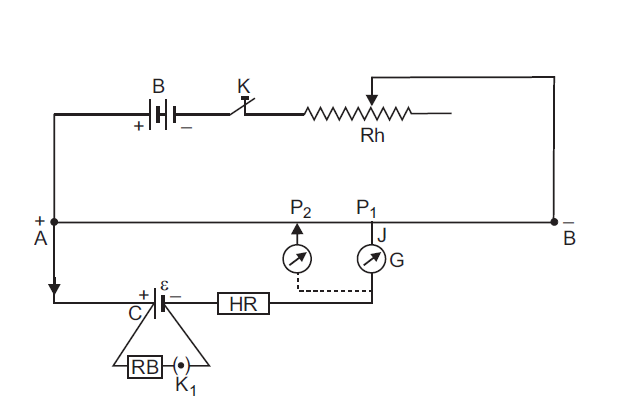
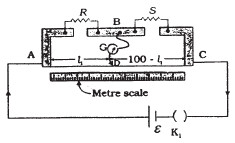
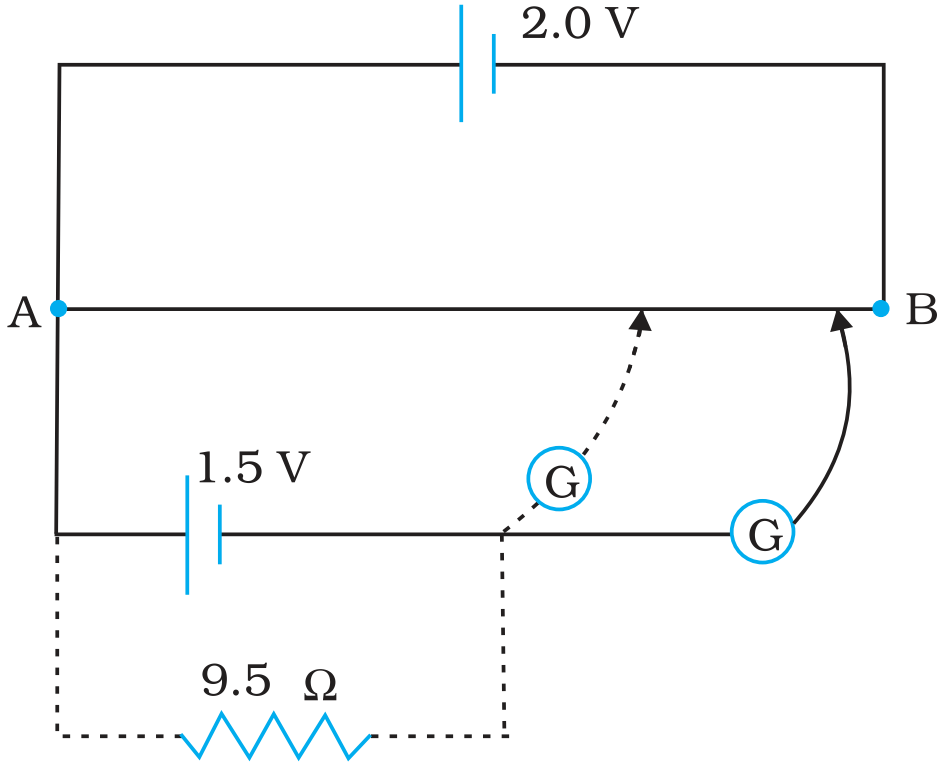
Figure shows a 2.0 V potentiometer used for the determination of internal resistance of a 1.5 V cell. The balance point of the cell in open circuit is 76.3 cm. When a resistor of $9.5\ \Omega$ is used in the external circuit of the cell, the balance point shifts to 64.8 cm length of the potentiometer wire. Determine the internal resistance of the cell.
Answer
Internal resistance of the cell = rBalance point of the cell in open circuit, $l_1= 76.3\ cm$
An external resistance (R) is connected to the circuit with $\text{R}=9.5\ \Omega$
New balance point of the circuit, $l_2= 64.8\ cm$
Current flowing through the circuit $= I$
The relation connecting resistance and emf is,
$\text{r}=\Big(\frac{l_1-l_2}{l_2}\Big)\text{R}$
$\frac{76.3-64.8}{64.8}\times9.5=1.68\ \Omega$
Therefore, the internal resistance of the cell is $1.68\ \Omega.$
View full question & answer
Question 72 Marks
What conclusion can you draw from the following observations on a resistor made of alloy manganin?
Current A
Voltage V
Current A
Voltage V
0.2
0.4
0.6
0.8
1.0
2.0
3.94
7.87
11.8
15.7
19.7
39.4
3.0
4.0
5.0
6.0
7.0
8.0
59.2
78.8
98.6
118.5
138.2
158.0
Answer
It can be inferred from the given table that the ratio of voltage with current is a constant, which is equal to 19. 7. Hence, manganin is an ohmic conductor i.e., the alloy obeys Ohm's law. According to Ohm's law, the ratio of voltage with current is the resistance of the conductor. Hence, the resistance of manganin is $19.7\ \Omega.$
View full question & answer
Question 82 Marks
In a potentiometer arrangement, a cell of emf 1.25 V gives a balance point at 35.0 cm length of the wire. If the cell is replaced by another cell and the balance point shifts to 63.0 cm, what is the emf of the second cell?
Answer
Emf of the cell $=\mathrm{E}_1=1.25 \mathrm{~V}$
Balance point of the potentiometer, $\mathrm{l}_1=35 \mathrm{~cm}$
The cell is replaced by another cell of emf $\mathrm{E}_2$.
New balance point of the potentiometer, $\mathrm{l}_2=63 \mathrm{~cm}$
The balance condition is given by the relation,
$\frac{\text{E}_1}{\text{E}_2}=\frac{l_1}{l_2}$
$\text{E}_2=\text{E}_1\times\frac{l_2}{l_1}$
$=1.25\times\frac{63}{35}=2.25\ \text{V}$
Therefore, emf of the second cell is $2.25\ V.$
View full question & answer
Question 92 Marks
A negligibly small current is passed through a wire of length 15m and uniform cross-section $6.0\times10^{-7}\ \text{m}^2,$ and its resistance is measured to be $5.0\ \Omega.$ What is the resistivity of the material at the temperature of the experiment?
Answer
Given,
Resistance of the wire, $\text{R}=5\ \Omega$
Length of wire, $l = 15m$
Uniform area of cross section, $A=6 \times 10^{-7} \mathrm{~m}^2$
Now, using the formula is given by,
Resistivity,
$\text{P}=\frac{\text{RA}}{1}$
$=\frac{5\times6.0\times10^{-7}}{15}$
$=2.0\times10^{-7}\ \Omega\ \text{m}.$
View full question & answer
Question 102 Marks
The storage battery of a car has an emf of 12 V. If the internal resistance of the battery is $0.4\ \Omega,$ what is the maximum current that can be drawn from the battery?
Answer
Maximum current is drawn from a battery when the external resistance in the circuit is zero i.e., R = 0.
Given,
E.m.f of the battery, $\varepsilon=12\ \text{V}$
Internal resistamce of the battery, $\text{r}=0.4$
Therefore, using the formula for maximum current drawn we get,
$\text{I}_{\text{max}}=\frac{\varepsilon}{\text{r}}$
$=\frac{12}{0.4}$
$=30\ \text{A}.$
View full question & answer
Question 112 Marks
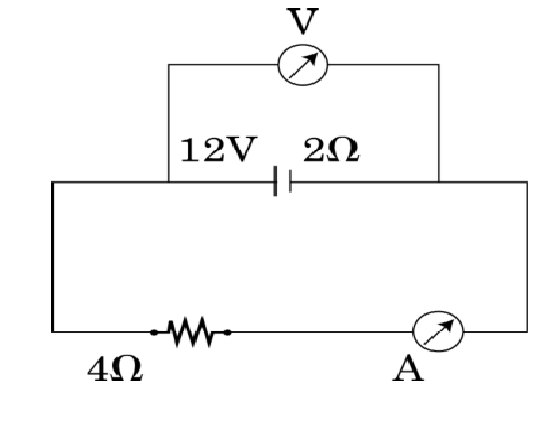
A battery of emf 12V and internal resistance 2 $\Omega$ is connected to a 4 $\Omega$ resistor as shown in the figure.
  1. Show that a voltmeter when placed across the cell and across the resistor, in turn, given the same reading.
  2. To record the voltage and the current in the circuit, why is voltmeter placed in parallel and ammeter in series in the circuit?
Answer
  1. Effective resistance of the circuit $\text{R}_{E} =6 \Omega$
$\therefore\text{I} = \frac{12\text{A}}{6} = 2 \text{A}$

Terminal potential difference across the cell, V=E-ir

Also, p.d. across 4 Ω resistor =4X2V= 8V

Hence the voltmeter gives the same reading in the two cases.
  1. In series - current same.
In parallel – potential same.
View full question & answer
Question 122 Marks
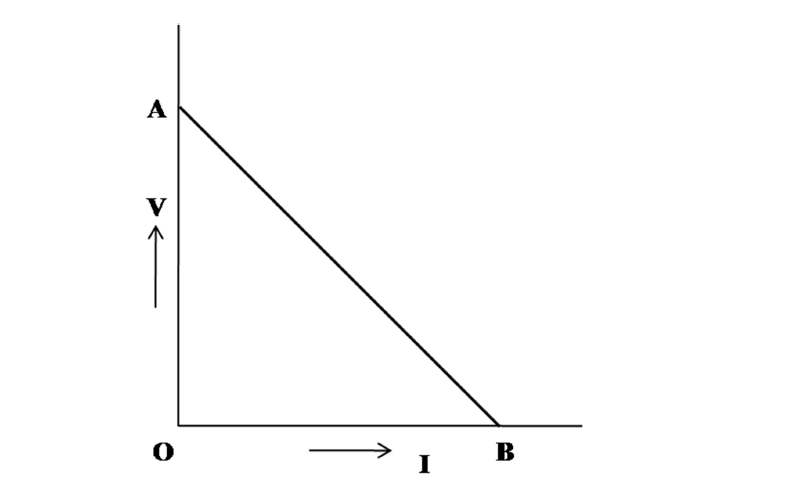
A cell of emf ‘E’ and internal resistance ‘r’ is connected across a variable resistor ‘R’. Plot a graph showing variation of terminal voltage ‘V’ of the cell versus the current ‘I’. Using the plot, show how the emf of the cell and its internal resistance can be determined.
Answer
The relation between V and I is
$V = E – Ir$
Hence, the graph, between V and I, has the form shown below.

For point $A, I=0$, Hence, $V_A= E$
For point B, V=0, Hence, $E=I_Br$
Therefore, $\text{r} =\frac{\text{E}}{\text{I}_{B}}$
Alternate Answer
Emf (E) equals the intercept on the vertical axis. Internal resistance (r) equals the negative of the slope of the graph.
View full question & answer
Question 132 Marks
Estimate the average drift speed of conduction electrons in a copper wire of cross-sectional area $1.0 \times 10^{-7} \mathrm{~m}^2$ carrying a current of 1.5 A . Assume the density of conduction electrons to be $9 \times 10^{28} \mathrm{~m}^{-3}$.
Answer
$\text{I} = \text{neA}\text{V}_{d}$
$\text{V}_{d} = \frac{\text{I}}{\text{neA}} = \frac{1.5}{9\times10^{28}\times1.6\times10^{-19}\times1.0\times10^{-7}}\text{m/s}$
$= 1.048\times10^{-3}\text{m/s} ( \approx 1 \text{mm/s}).$
View full question & answer
Question 142 Marks
Describe briefly, with the help of a circuit diagram, how a potentiometer is used to determine the internal resistance of a cell.
Answer

If key $k_1$ is closed, (while key $k_2$ is open), galvanometer shows null deflection at balancing length $\mathrm{l}_1$.
So, $E=k\ \mathrm{l}_1$
If both keys $\mathrm{k}_1$ and $\mathrm{k}_2$ are closed and R is the resistance of resistance box, galvanometer now shows null deflection at balancing length $\mathrm{l}_2\left(\mathrm{l}_2 1\right)$.
So, $V=\mathrm{kl}_2 \quad$
From relation, $\text{r = R}\bigg(\frac{\text{E}}{\text{V}} - 1\bigg)$
We have, $\text{r = R}\bigg(\frac{\text{l}_{1}}{\text{l}_{2}} - 1 \bigg).$
View full question & answer
Question 152 Marks
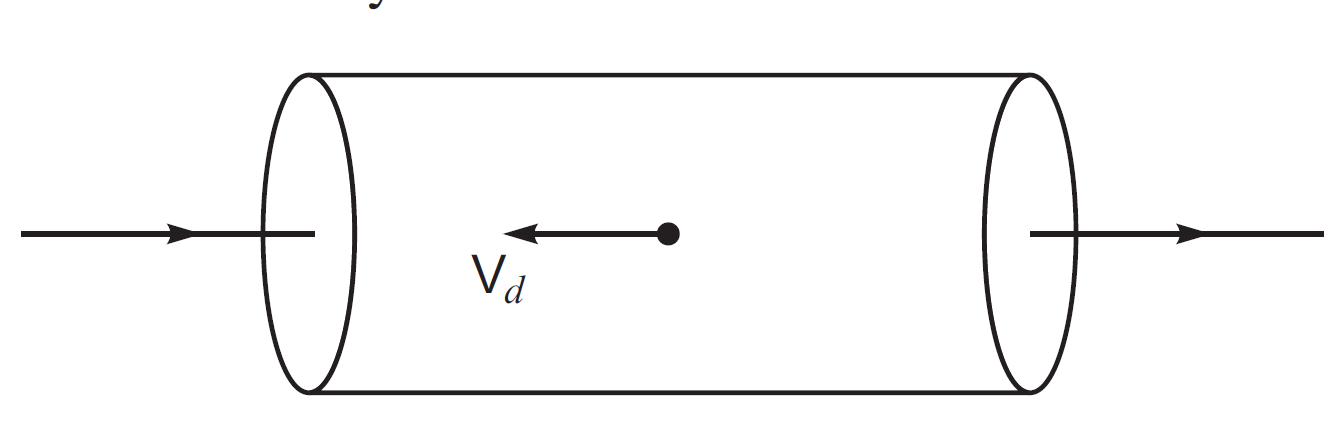
Explain the term ‘drift velocity’ of electrons in a conductor. Hence obtain the expression for the current through a conductor in terms of ‘drift velocity’.
Answer
The modified velocity gained by the accelerating electrons in uniform electric field inside the conductor is called drift velocity.

The average velocity, acquired by free electrons along the length of a metallic conductor, due to existing electric field is called drift velocity.
Let n be the number density of free electrons in a conductor of length l and area of cross-section ‘A’.
Total charge in the conductor, Q=Ne
=(n Al) e
Time taken at average velocity $v_d$ is $\text{t} = \frac{\text{l}}{\text{v}_{d}}$
So, by definition, $\text{I} = \frac{\text{Q}}{\text{t}} = \frac{(\text{nA}l)e}{\bigg(\frac{\text{l}}{\text{v}_{d}}\bigg)}$
$I = neAv_d$.
View full question & answer
Question 162 Marks
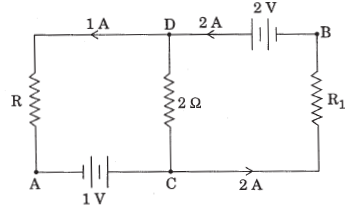
In the given circuit, assuming point A to be at zero potential, use Kirchhoff's rules to determine the potential at point B.
Answer
Current division applying Kirchhoff's law
Along the path ACDB,
$V_B= 1 + 2(1) - 2 = 1 volt.$
View full question & answer
Question 172 Marks
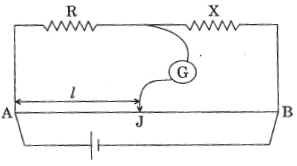
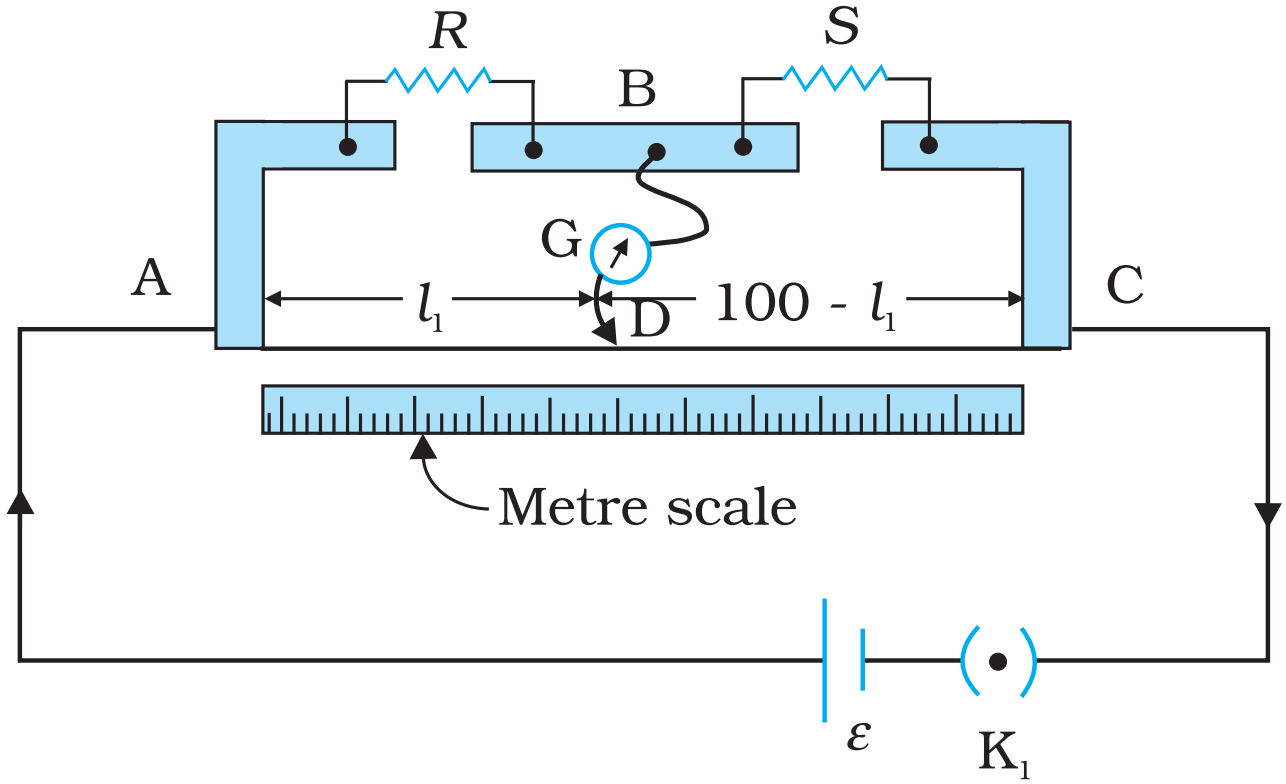
In the metre bridge experiment, balance point was observed at J with AJ = l.
  1. The values of R and X were doubled and then interchanged. What would be the new position of balance point?
  2. If the galvanometer and battery are interchanged at the balance position, how will the balance point get affected?
​​​​​​​​​​​​​​
Answer
  1. $\frac{\text{R}}{\text{X}} = \frac{l}{100- l}$When R and X are doubled and interchanged, new balance point is
$l' = ( 100- l ).$
  1. No change in the position of balance point.
View full question & answer
Question 182 Marks
A wire of 15 $\Omega$ resistance is gradually stretched to double its original length. It is then cut into two equal parts. These parts are then connected in parallel across a 3.0 volt battery. Find the current drawn from the battery.
Answer
$\text{R}' = \text{n}^{2}\text{R} =4\text{R}$
$ = 4\times15 =60\Omega$
NOTE:- $\text{R}\propto l$
$\text{R}\propto\frac{1}{\it{\text{A}}}$

$\therefore\text{R}' = \frac{2l}{\it{\text{A}}\bigg/2}$

$ = \text{4 }l\bigg/\it{\text{A}}$

$ = 4\text{R}$
$\text{R}_{p} = \frac{\text{R}_{1}\text{R}_{2}}{\text{R}_{1} + \text{R}_{2}}=\frac{30\times30}{30 + 30} = 15\Omega$
$\text{I} = \frac{\text{E}}{\text{R}_{1}} =\frac{3}{15} = 0.2\text{A}.$
View full question & answer
Question 192 Marks
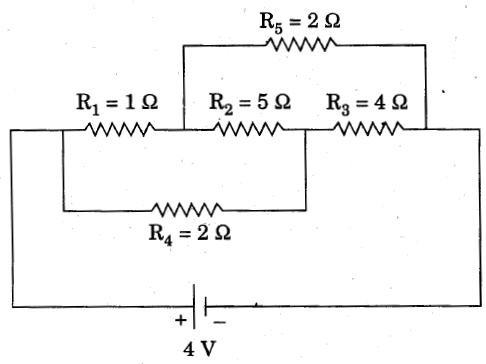
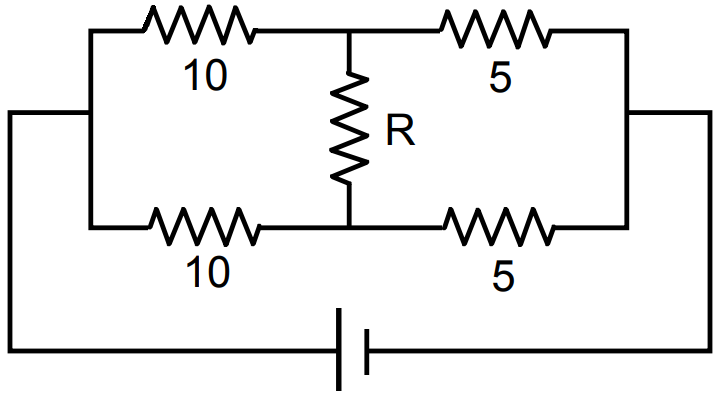
Calculate the current drawn from the battery in the given network.
Answer

$\text{R}_{\text{equivalent}} = 2\Omega$
$\text{I} = \frac{\text{V}}{\text{R}} = 2\it\text{A}.$
View full question & answer
Question 202 Marks
Two metallic wires of the same material have the same length but cross-sectional areas are in the ratio 1 : 2. They are connected (i) in series and (ii) in parallel. Compare the drift velocities of electrons in the two wires in both the cases (i) and (ii).
Answer
  1. $\text{Formula} = \text{v}_{d} = \frac{\text{I}}{\text{neA}}$
$ \text{v}_{d_1}:\text{v}_{d_2} = 2:1 $
  1. $\text{Formula} \text{v}_{d} = \frac{\text{eV}\tau}{\text{m}l}$
$\text{v}_{d_1}:\text{v}_{d_2} = 1:1.$
View full question & answer
Question 212 Marks
Derive an expression for the resistivity of a good conductor, in terms of the relaxation time of electrons.
Answer
I = neA$v_d$
$\text{v}_{d} = \frac{\text{e}\tau}{\text{m}}\frac{\text{V}}{l}$
$\text{I} = \frac{\text{ne}^{2}\text{Ar}}{\text{m}l}.\text{V}$
$\text{R} = \frac{\text{m}}{\text{ne}^{2}\tau}.\frac{l}{\text{A}}$
$\therefore\rho = \frac{\text{m}}{\text{ne}^{2}\tau}.$
View full question & answer
Question 222 Marks
A voltage of 30 V is applied across a carbon resistor with first, second and third rings of blue, black and yellow colours respectively. Calculate the value of current, in mA, through the resistor.
Answer
Calculation of $'\text{R}' =60\times10^{4} \Omega$
Calculation of I; $\text{I} = \frac{\text{V}}{\text{R}} = 0.5\times 10^{-4}\text{A}$
In mA, I = 0.05 mA.
View full question & answer
Question 232 Marks
Draw a circuit diagram using a metre bridge and write the necessary mathematical relation used to determine the value of an unknown resistance. Why cannot such an arrangement be used for measuring very low resistances?
Answer

$\text{R} = \frac{\ell_{1}}{\big(100 - \ell_{1}\big)}$
End correction can be comparable with the low resistance used or unknown contact resistance (strips of connecting wires) becomes comparable with low resistance to be measured.
View full question & answer
Question 242 Marks
You are given ‘n’ resistors, each of resistance 'r'. These are first connected to get minimum possible resistance. In the second case, these are again connected differently to get maximum possible resistance. Compute the ratio between the minimum and maximum values of resistance so obtained.
Answer
$\text{R}_{min} = \frac{\text{r}}{\text{n}}$
$\text{R}_{max} = \text{nr}$
$\frac{\text{R}_{min}}{\text{R}_{max}} = \frac{1}{\text{n}^{2}}$.
View full question & answer
Question 252 Marks
Two metallic wires P and Q of the same material and same length but different cross-sectional areas A1 and A2 are joined together and then connected to a source of emf. Find the ratio of the drift velocities of free electrons in the wires P and Q, if the wires are connected (i) in series, and (ii) in parallel.
Answer
In series, the current remains the same. $ I=ne{A}_1{V}_{d1}=ne{A}_2{V}_{d2}$ $\therefore\frac{V_{d1}}{V_{d2}}=\frac{A_2}{A_1}$ In parallel potential difference is same but currents are different. $V=I_1{R}_1=ne{A}_1{V}_{d1}\frac{{\varrho}l}{A_1}=ne{\varrho}V_{d1}l$Similarly, $V=I_2{R}_2=ne{\varrho}V_{d2}l$
$I_1{R}_1=I_2{R}_2$
$ \therefore\frac{V_{d1}}{V_{d2}}=1$
View full question & answer
Question 262 Marks
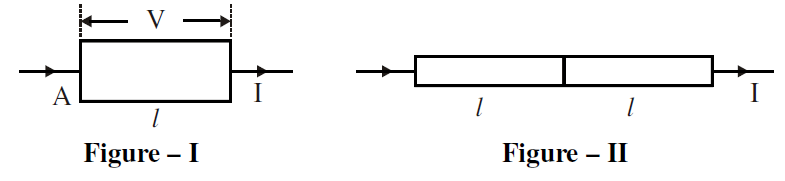
A metal rod of square cross-sectional area A having length l has current I flowing through it when a potential difference of V volt is applied across its ends (figure I). Now the rod is cut parallel to its length into two identical pieces and joined as shown in figure II. What potential difference must be maintained across the length 2l so that the current in the rod is still I?
Answer
$R_1=\rho\frac{l}{A}$
$R_2=\rho\frac{2l}{A/2}=4R_1$
$I=\frac{V}{R_1}=\frac{V_2}{R_2}$
$\Longrightarrow\frac{V}{R_1}=\frac{V_2}{4R_1}$
$\Longrightarrow{V_2}=4V$
View full question & answer
Question 272 Marks
State Kirchhoff's rules. Explain briefly how these rules are justified.
Answer
Junction rule: At any junction, the sum of the currents entering the junction is equal to the sum of currents leaving the junction.
Alternate Answer
$\sum\text{i} = 0 $
Justification: Conservation of charge.
Loop rule: The Algebraic sum of changes in the potential around any closed loop involving resistors and cells in the loop is zero.

Alternate Answer
$\sumΔ \text{V} =0,$ where Δ V is the changes in potential.
Justification: Conservation of energy.
View full question & answer
Question 282 Marks
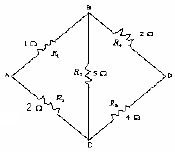
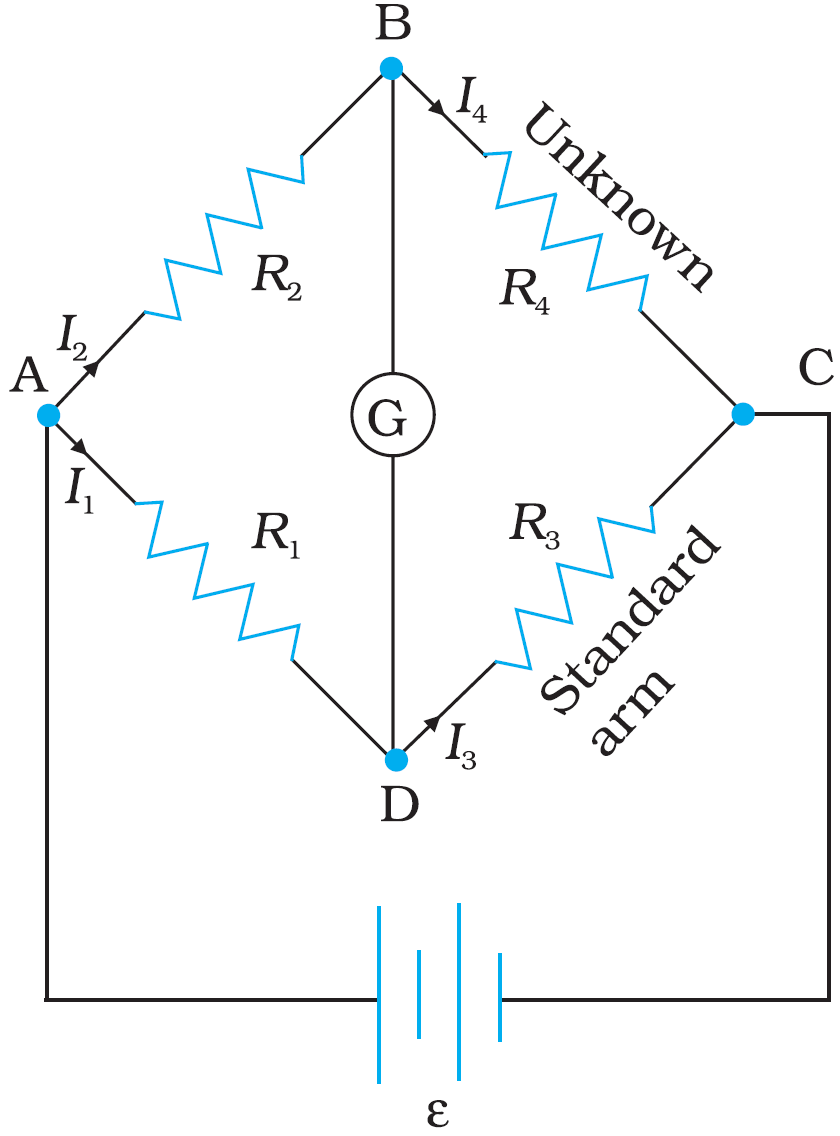
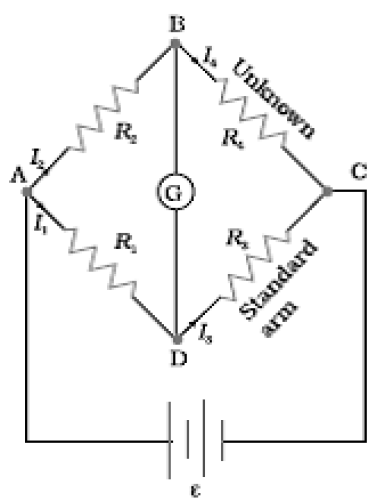
Use Kirchhoff's rules to obtain conditions for the balance condition in a Wheatstone bridge.
Answer

Applying Kirchoff's loop rule to closed loop ADBA
$-\text{I}_{1}\text{R}_{1} + 0 + \text{I}_{2}\text{R}_{2} = 0 (\text{I}_{g} = 0 )$................(i)
For loop CBDC
$-\text{I}_{2}\text{R}_{4} + 0 + \text{I}_{1}\text{R}_{3} = 0 $.........................(ii)
=> from equation (i)
$\frac{I_1}{\text{I}_{2}} = \frac{\text{R}_{1}}{\text{R}_{2}}$
From equation (ii)
$\frac{I_1}{\text{I}_{2}} = \frac{\text{R}_{4}}{\text{R}_{3}}$
$\therefore\frac{\text{R}_1}{\text{R}_{2}} = \frac{\text{R}_{4}}{\text{R}_{3}}$.
View full question & answer
Question 292 Marks
Two cells of emfs 1.5 V and 2.0 V having internal resistances 0.2 $\Omega$ and 0.3 $\Omega$respectively are connected in parallel. Calculate the emf and internal resistance of the equivalent cell.
Answer
$\text{emf} = \frac{\text{E}_{1}\text{r}_{2} + \text{E}_{2}\text{r}_{1}}{\text{r}_{1} + \text{r}_{2}}$
$ = \frac{1.5\times0.3 + 2 \times0.2}{0.2+0.3}\text{V}$
$ =\frac{0.45 + 0.40}{0.5}\text{V} = 1.7\text{V}$
$\text{r} = \frac{\text{r}_{1}\text{r}_{2}}{\text{r}_{2} + \text{r}_{2}}$
$ = \frac{0.2\times0.3}{02 + 0.3}\Omega$
$ = \frac{0.06}{0.5}\Omega$
$ = 0.12\Omega$.
View full question & answer
Question 302 Marks
A cell of emf $E$ and internal resistance $r$ is connected to two external resistances $R_1$ and $R_2$ and a perfect ammeter.The current in the circuit is measured in four different situations:
i. Without any external resistance in the circuit.
ii. With resistance $\mathrm{R}_1$ only.
iii. With $R_1$ and $R_2$ in series combination.
iv. With $R_1$ and $R_2$ in parallel combination.
The currents measured in the four cases are 0.42 A, 1.05 A, 1.4 A and 4.2 A, but not necessarily in that order. Identify the currents corresponding to the four cases mentioned above.
Answer
  1. i = 4.2 A.
  2. i = 1.05 A.
  3. i = 0.42 A.
  4. i = 1.4 A.
    1. $\text{i} = \frac{\varepsilon}{\text{r}}.$
    2. $\text{i} = \frac{\varepsilon}{\text{r + R}_{1}}.$
    3. $\text{i} = \frac{\varepsilon}{\text{r + R}_{1} + \text{R}_{2}}.$
    4. $\text{i} = \frac{\varepsilon}{\text{r} +\frac{\text{R}_{1}\text{R}_{2}}{\text{R}_{1}+ \text{R}_{2}}}.$
View full question & answer
Question 312 Marks
Derive an expression for drift velocity of free electrons in a conductor in terms of relaxation time.
Answer
$\overrightarrow{a} = \frac{-\text{e}\overrightarrow{\text{E}}}{\text{m}}$From $\overrightarrow{\text{v}} = \overrightarrow{u} + \overrightarrow{a}\text{t}$
$\therefore\overrightarrow{\text{v}}_{d} = \overrightarrow{\text{u}_{AV}} + \overrightarrow{a}\text{t}_{AV}$
$ =\text{O} +\frac{-e\overrightarrow{\text{E}}}{\text{m}} \tau$
$\overrightarrow{\text{v}}_{d} = \frac{-e\overrightarrow{\text{E}}}{\text{m}}\tau$
View full question & answer
Question 322 Marks
A cell of emf ‘E’ and internal resistance ‘r’ is connected across a variable resistor ‘R’. Plot a graph showing the variation of terminal potential ‘V’ with resistance R. Predict from the graph the condition under which ‘V’ becomes equal to ‘E’.
Answer
$\text{V} = \text{IR} = \frac{\text{ER}}{\text{R}+ \text{r}}= \frac{\text{E}}{\frac{\text{r}}{\text{R}}+ 1}$
When R approaches infinity (or for $\text{R}\to\infty$) V becomes equal to E.
View full question & answer
Question 332 Marks
A cylindrical metallic wire is stretched to increase its length by 5%. Calculate the percentage change in its resistance.
Answer
$\text{R} = \rho\frac{1}{\text{A}}$$\text{A1} = \text{A}'{\ell}{'}$
$\text{A} = \frac{105}{100}\text{A}'$
$\frac{R_1}{R_2} = \frac{1\text{A}}{1\text{A}}$
$\therefore \text{R}_{2} = \big(1.05\big)^{2}\text{R}_{1}$
% Change $= \frac{\text{R}_{2}-\text{R}_{1}}{\text{R}_{1}}\times 100 = 10.25$
View full question & answer
Question 342 Marks
Write the mathematical relation between mobility and drift velocity of charge carriers in a conductor. Name the mobile charge carriers responsible for conduction of electric current in (i) an electrolyte (ii) an ionised gas.
Answer
  1. $\mu=\frac{V_{d}}{E}$
  2. .
    1. Ions/Positive and negative ions.
    2. Electrons/Positive ions/Electrons and positive ions.
View full question & answer
Question 352 Marks
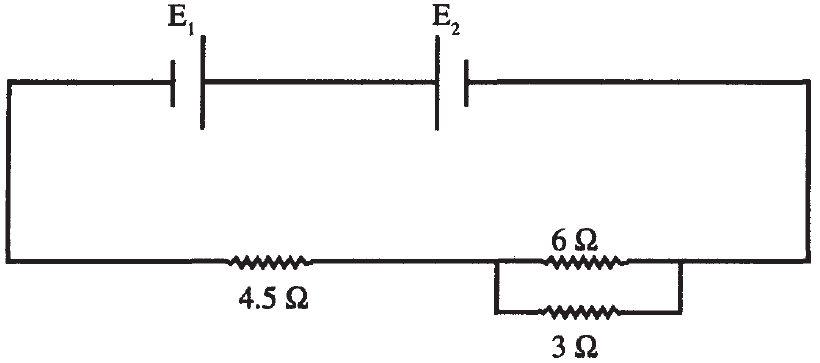
Two cells $E_1$ and $E_2$ in the given circuit diagram have an emf of 5 V and 9 V and internal resistance of 0.3 $\Omega$ and 1.2 $\Omega$ respectively.
Calculate the value of current flowing through the resistance of 3 $\Omega$.
Answer
Net emf of Combination of Cell $=9\text{V} - 5\text{V}=4\text{V}$Net resistance of the circuit $=0.3+1.2+\frac{6\times3}{6+3}+4.5$
$=0.3+1.2+2+4.5$
$=8\Omega$
Current I $= \frac{E_{net}}{R_{net}}=\frac{4}{8}=0.5\text{A}$
Let the current through $3\Omega$ resistance be $I_1$
$3 I_1= 6 ( I - I_1)$
$\text{I}_{1}=\frac{1}{3} \text{A} =0.333\text{A}$
View full question & answer
Question 362 Marks
In a potentiometer arrangement for determining the emf of a cell, the balance point of the cell in open circuit is 350cm. When a resistance of $9\Omega$ is used in the external circuit of the cell, the balance point shifts to 300cm. Determine the internal resistance of the cell.
Answer
$\text{l}=350\text{cm}$$\text{R}=9\Omega$
$\text{l}_2=300\text{cm}$
$\text{r}=\Big(\frac{\in-\text{V}}{\text{V}}\Big)\text{R}$
$\text{r}=\Big(\frac{\text{l}_1-\text{l}_2}{\text{l}_2}\Big)\text{R}$
$=\frac{350-300}{300}\times9$
$\text{r}=1.5\Omega$
View full question & answer
Question 372 Marks
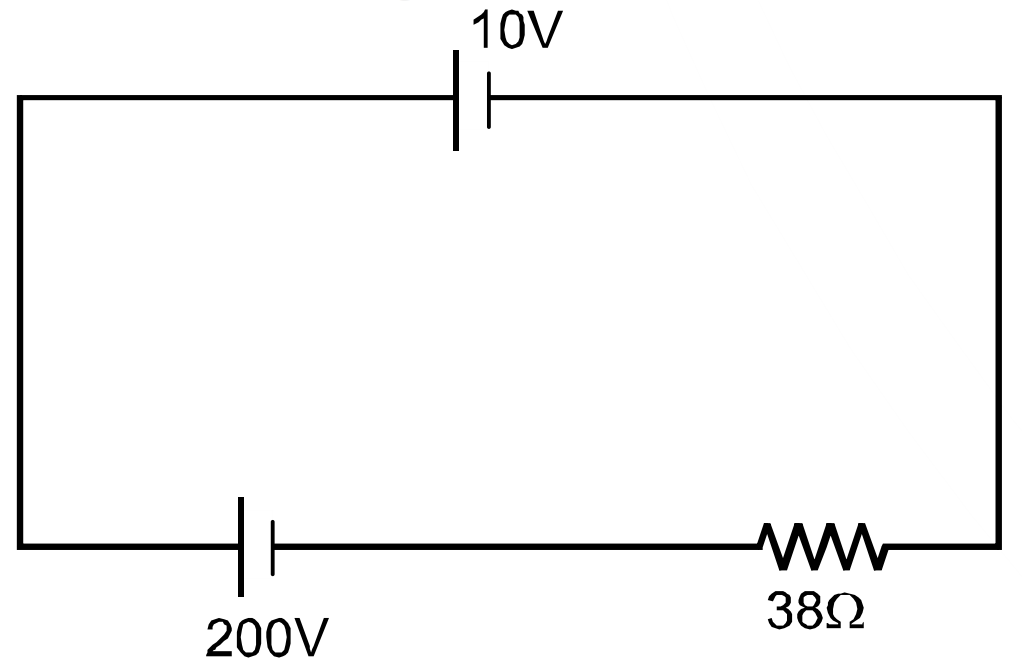
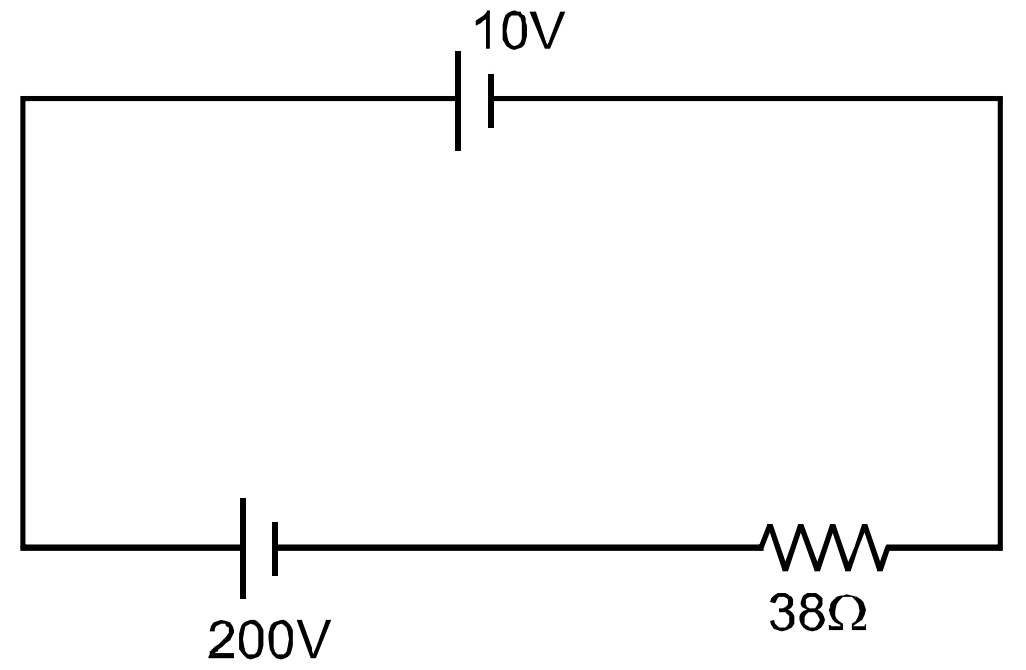
A 10V cell of negligible internal resistance is connected in parallel across a battery of emf 200V and internal resistance $38\Omega$ as shown in the figure. Find the value of current in the circuit.
Answer
$\text{I}=\frac{\text{net emf}}{\text{total resistance}}$
$=\frac{200-10}{38}$
$=\frac{190}{38}=5\text{A}$
View full question & answer
Question 382 Marks
Two electric bulbs P and Q have their resistances in the ratio of 1 : 2. They are connected in series across a battery. Find the ratio of the power dissipation in these bulbs.
Answer
Power dissipation is given by (for series)
$P=I^2 R$
Now, For bulb P
$ P_1=I^2 \times R_1$
$ P_1=I^2 R_1$
For bulb Q
$P_2   =I^2 \times R_2 $
$P_2    =2I^2 R_1$
$\frac{\text{P}_2}{\text{P}_1}=\frac{2}{1}\Rightarrow\ 2:1$
Or, $\frac{\text{P}_1}{\text{P}_2}=\frac{1}{2}$
View full question & answer
Question 392 Marks
Explain the principle of working of a meter bridge. Draw the circuit diagram for determination of an unknown resistance using it.
Answer
The circuit diagram of the meter bridge is as shown below:

Working Principle: The working principle of the meter bridge is the same as that of a Wheatstone bridge. The Wheatstone bridge gets balanced when,
$\frac{\text{R}_2}{\text{R}_1}=\frac{\text{R}_4}{\text{R}_3}$
For the meter bridge, circuit shown above, this relation takes the form,

Determination of unknown Resistance (R): In the circuit diagram shown above, S is taken as a known standard resistance.
We find the value of the balancing length $l_1$, corresponding to a given value of S. We then use the relation,
$\frac{\text{R}}{\text{S}}=\frac{\text{l}_1}{(100-\text{l}_1)}$
To calculate R.
By choosing (at least three) different value of S, we calculate R each time. The average of these values of R gives the value of the unknown resistance.
View full question & answer
Question 402 Marks
Two bulbs are rated $(P_1, V)$ and $(P_2, V)$. If they are connected in series in parallel across a supply V.
Find the power dissipated in the two combinations in terms of $P_1$ and $P_2$.
Answer
Given Bulbs are rated as $(P_1, V) \& (P_2, V)$ respectively.
The resistance of 1st bulb, $\text{R}_1=\frac{\text{V}^2}{\text{P}_1}$
The resistance of 2nd bulb, $\text{R}_2=\frac{\text{V}^2}{\text{P}_2}$
  1. When Both are connected in Series with a power supply of voltage V.
As both the bulbs are in series connection hence both will have the same amount of current flowing through them.

$\text{i}=\frac{\text{V}}{\text{R}_1+\text{R}_2}=\frac{\text{V}}{\frac{\text{v}^2}{\text{P}_1}+\frac{\text{v}^2}{\text{P}_2}}=\frac{1}{\text{V}}\Big(\frac{\text{P}_1\text{P}_2}{\text{P}_1+\text{P}_2}\Big)$

Power dissipated in the circuit,

$\text{P}_\text{d}=\text{i}^2\big(\text{R}_1+\text{R}_2\big)=\frac{1}{\text{V}^2}\Big(\frac{\text{P}_1\text{P}_2}{\text{P}_1+\text{P}_2}\Big)^2\Big(\frac{\text{V}^2}{\text{P}_1}+\frac{\text{V}^2}{\text{P}_2}\Big)$

$\text{P}_\text{d}=\frac{\text{P}_1\text{P}_2}{\text{P}_1+\text{P}_2}$
  1. When both are connected in paralle
In this case, Both bulbs will get the same voltage supply.

Hence Power dissipated,

$\text{P}_\text{d}=\frac{\text{V}^2}{\text{R}_1}+\frac{\text{V}^2}{\text{R}_2}=\text{V}^2\Big(\frac{\text{P}_1}{\text{V}^2}+\frac{\text{P}_2}{\text{V}^2}\Big)$

$\text{P}_\text{d}=\text{P}_1+\text{P}_2$
View full question & answer
Question 412 Marks
Two bulbs are rated $\left(\mathrm{P}_1, \mathrm{~V}\right)$ and $\left(\mathrm{P}_2, \mathrm{~V}\right)$. If they are connected (i) in series and (ii) in parallel across a supply V . Find the power dissipated in the two combinations in terms of $P_1$ and $P_2$.
Answer
Given Bulbs are rated as $(P_1, V) \& (P_2, V)$ respectively.
The resistance of 1st bulb, $\text{R}_1=\frac{\text{V}^2}{\text{P}_1}$
The resistance of 2nd bulb, $\text{R}_2=\frac{\text{V}^2}{\text{P}_2}$
  1. When Both are connected in Series with a power supply of voltage V.
As both the bulbs are in series connection hence both will have the same amount of current flowing through them.

$\text{i}=\frac{\text{V}}{\text{R}_1+\text{R}_2}=\frac{\text{V}}{\frac{\text{v}^2}{\text{P}_1}+\frac{\text{v}^2}{\text{P}_2}}=\frac{1}{\text{V}}\Big(\frac{\text{P}_1\text{P}_2}{\text{P}_1+\text{P}_2}\Big)$

Power dissipated in the circuit,

$\text{P}_\text{d}=\text{i}^2\big(\text{R}_1+\text{R}_2\big)=\frac{1}{\text{V}^2}\Big(\frac{\text{P}_1\text{P}_2}{\text{P}_1+\text{P}_2}\Big)^2\Big(\frac{\text{V}^2}{\text{P}_1}+\frac{\text{V}^2}{\text{P}_2}\Big)$

$\text{P}_\text{d}=\frac{\text{P}_1\text{P}_2}{\text{P}_1+\text{P}_2}$
  1. When both are connected in paralle
In this case, Both bulbs will get the same voltage supply.

Hence Power dissipated,

$\text{P}_\text{d}=\frac{\text{V}^2}{\text{R}_1}+\frac{\text{V}^2}{\text{R}_2}=\text{V}^2\Big(\frac{\text{P}_1}{\text{V}^2}+\frac{\text{P}_2}{\text{V}^2}\Big)$

$\text{P}_\text{d}=\text{P}_1+\text{P}_2$
View full question & answer
Question 422 Marks
An electron gun emits $2\times10^{16}$ electrons per second. What electric current does this correspond to?
Answer
No. of electrons per second = $=2\times10^{16}$ electrons/ sec.
Charge passing per second $=2\times10^{16}\times1.6\times10^{-9}\frac{\text{coulomb}}{\text{sec}}$
$=3.2\times10^{-9}$ Coulomb/ sec
Current $=3.2\times10^{-3}\text{A}.$
View full question & answer
Question 432 Marks
Can the potential difference across a battery be greater than its emf?
Answer
In general potential difference can be equal or less than the emf.
E.m.f can never exceed the potential difference.
If the emf of a battery is E Volt, the potential difference across a battery is given by,
V = E - I r where I is the current in the circuit and r is the internal resistance.
View full question & answer
Question 442 Marks
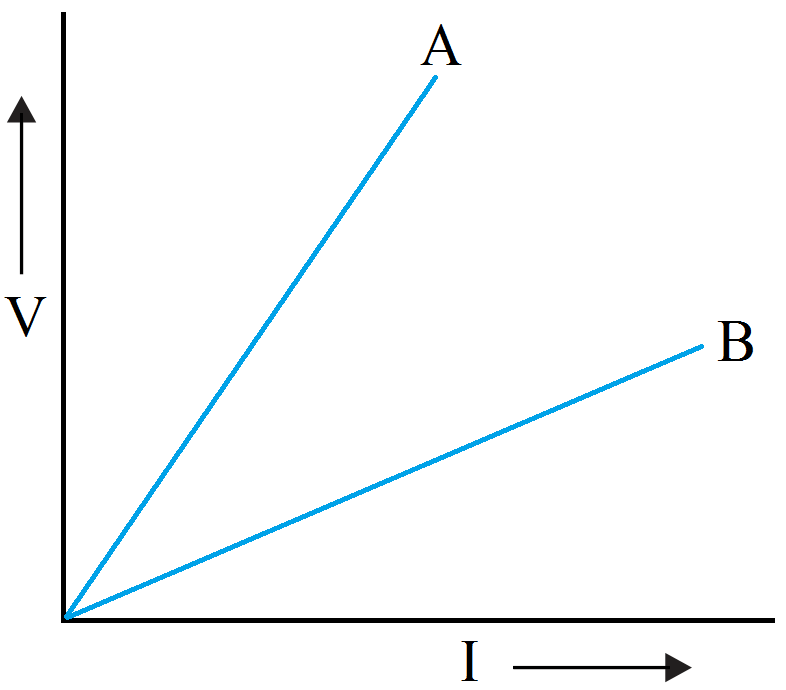
V-I graphs for parallel and series combinations of two metallic resistors are shown in figure. Which graph represents parallel combination? Justify your answer.
Answer
Graph ‘A’ represents parallel combination.
Reason: In series combination the effective resistance, $\text{R}=\frac{\text{V}}{\text{I}}$ is more than parallel combination.
The slope of a line of V-I graph represents resistance. The slope of B is more than A.
Therefore B represents series combination and A represents parallel combination.
View full question & answer
Question 452 Marks
Consider a circuit containing an ideal battery connected to a resistor. Do "work done by the battery" and "the thermal energy developed" represent two names of the same physical quantity?
Answer
No as the work done by the battery is work done by the battery like ouput. and the thermal energy developed is due to lesser efficiency of battery. In case of ideal battery there would be no thermal energy developed.
View full question & answer
Question 462 Marks
A brass plate having surface area $200cm^2$ on one side is electroplated with 0·10mm thick silver layers on both sides using a 15A current. Find the time taken to do the job. The specific gravity of silver is 10.5 and its atomic weight is 107.9 g/mol.
Answer
$I = 15A$
Surface area $= 200cm^2,$
Thickness $= 0.1mm$
Volume of Ag deposited $= 200 × 0.01 = 2cm^3$ for one side
For both sides, Mass of Ag $= 4 × 10.5 = 42g$
$\text{Z}_{\text{Ag}}=\frac{\text{E}}{\text{F}}=\frac{107.9}{96500}$
$\text{m}=\text{ZIT}$
$\Rightarrow42=\frac{107.9}{96500}\times15\times\text{T}$
$\Rightarrow\text{T}=\frac{42\times96500}{107.9\times15}=2504.17\text{sec}=41.73\text{min}\approx42\text{min}$
View full question & answer
Question 472 Marks
Two electric bulbs whose resistances are in the ratio 1 : 2 are connected in parallel to a source of constant voltage. What will be the ratio of power dissipation in these wires?
Answer
Power $\text{P}=\frac{\text{V}^2}{\text{R}}\propto\frac{1}{\text{R}}$ For same valtage, the bulbs being in parallel.
$\frac{\text{P}_1}{\text{P}_2}=\frac{\text{R}_2}{\text{R}_1}=\frac{2}{1}.$
Thus, ratio of power dissipated is 2 : 1.
View full question & answer
Question 482 Marks
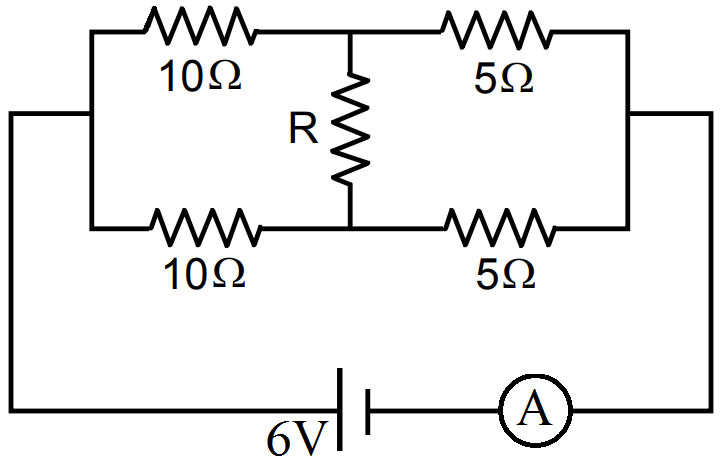
What should be the value of R in the figure. for which the current in it is zero?
Answer

For an value of R, the current in the branch is 0.
View full question & answer
Question 492 Marks
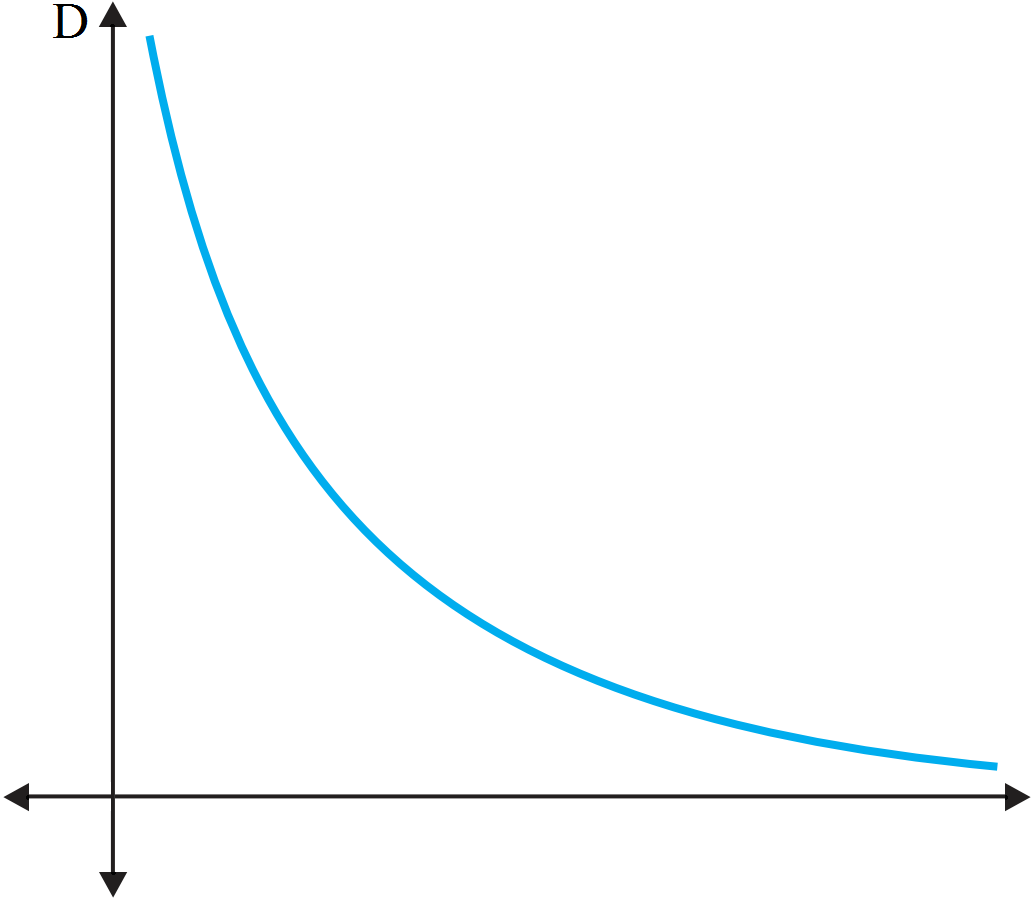
Draw a graph to show a variation of resistance of a metal wire as a function of its diameter keeping its length and material constant.
Answer
$\text{R}=\rho\frac{1}{\text{A}}\Rightarrow\rho\frac{\text{l}}{\pi\text{r}^2}=\rho\frac{4\text{l}}{\pi\text{D}^2}$
i.e. $\text{R}\ \alpha\ \frac{1}{\text{D}^2}\Rightarrow$ R is inversely proportional to diameter.
Hence, graph of resistance (R) versus diameter (D) is of the following form.
View full question & answer
Question 502 Marks
A parallel-plate capacitor is filled with a dielectric material of resistivity ρ and dielectric constant K. The capacitor is charged and disconnected from the charging source. The capacitor is slowly discharged through the dielectric. Show that the time constant of the discharge is independent of all geometrical parameters like the plate area or separation between the plates. Find this time constant.
Answer
Equation of discharging capacitor
$=\text{q}_0\text{e}^{\frac{-\text{t}}{\text{RC}}}=\frac{\text{K}\in_0\text{AV}}{\text{d}}\text{e}^{\frac{-1}{\frac{(\rho\text{dK}\in_0\text{A})}{\text{Ad}}}}=\frac{\text{K}\in_0\text{AV}}{\text{d}}\text{e}^{\frac{-\text{t}}{\rho\text{K}\in_0}}$
$\therefore\tau=\rho\text{K}\in_0$
$\therefore$ Time constant is $\rho\text{K}\in_0$ is independent of plate area or separation between the plate.
View full question & answer
2 Marks Questions - Physics STD 12 Science Questions - Vidyadip