Questions · Page 1 of 7

M.C.Q (1 Marks)

🎯

Test yourself on this topic

50 questions · timed · auto-graded

MCQ 11 Mark
If the net electric flux through a closed surface is zero, then we can infer:
  • No net charge is enclosed by the surface.
  • B
    Uniform electric field exists within the surface.
  • C
    Electric potential varies from point to point inside the surface.
  • D
    Charge is present inside the surface.
Answer
Correct option: A.
No net charge is enclosed by the surface.
View full question & answer
MCQ 21 Mark
Which group among the following is insulator?
  • A
    Silver, copper, gold
  • Paper, glass, cotton
  • C
    The human body, wood, iron
  • D
    Glass, copper, paper
Answer
Correct option: B.
Paper, glass, cotton
View full question & answer
MCQ 31 Mark
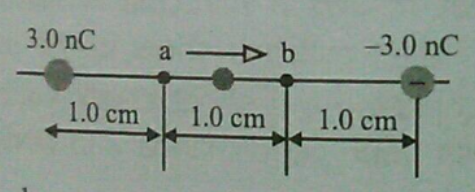
As shown in figure a dust particle with mass $m =5.0 \times 10^{-9} kg$ and charge $q ^{\circ}=2.0 nC$ starts from rest at point a and moves in a straight line to point $b.$ What is its speed $v$ at point $b\ ? $
  • A
    $26 ms^{-1}$
  • B
    $34 ms^{-1}$
  • $46 ms^{-1}$
  • D
    $14 ms^{-1}$
Answer
Correct option: C.
$46 ms^{-1}$
View full question & answer
MCQ 41 Mark
The law, governing the force between electric charges is known as.
  • A
    Ampere's law.
  • B
    Ohm's law.
  • C
    Faraday's law.
  • Coulomb's law.
Answer
Correct option: D.
Coulomb's law.
View full question & answer
MCQ 51 Mark
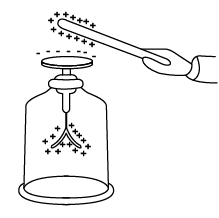
Why is gold used in the Gold$-$leaf electroscope?
  • A
    Gold is easily available in nature.
  • Gold is malleable.
  • C
    Gold is conducting in nature.
  • D
    Gold is cheap.
Answer
Correct option: B.
Gold is malleable.
Though gold is a costly metal it is used in electroscope because of the property malleability. This means very thin and light sheets can be formed from gold simply by hammering or rolling and hence the deflection of the light gold plates increases.
View full question & answer
MCQ 61 Mark
The dimensions of surface charge density is:
  • $[L-2 T A].$
  • B
    $[L-1 T A].$
  • C
    $[L T A].$
  • D
    None.
Answer
Correct option: A.
$[L-2 T A].$
View full question & answer
MCQ 71 Mark
An electric dipole will experience a net force when it is placed in.
  • A
    A uniform electric field.
  • A non$-$uniform electric field.
  • C
    Both $(a)$ and $(b).$
  • D
    None of these.
Answer
Correct option: B.
A non$-$uniform electric field.
View full question & answer
MCQ 81 Mark
$........$ Charge is produced by friction.
  • Stationary
  • B
    No
  • C
    Attractive
  • D
    All
Answer
Correct option: A.
Stationary
The stationary charge $($i.e static electricity$)$ is produced by friction
View full question & answer
MCQ 91 Mark
If a body is charged by rubbing it, its weight:
  • A
    Always decreases slightly.
  • B
    Always increases slightly.
  • May increase slightly or may decrease slightly.
  • D
    Remains precisely the same.
Answer
Correct option: C.
May increase slightly or may decrease slightly.
If a body is charged by rubbing it, then it may lose or gain electrons. Since electrons have a mass of ( $\left.9.1 \times 10^{-31} kg\right)$. So, a slight weight may increase or decrease slightly.
View full question & answer
MCQ 111 Mark
The dimensions of electric field are:
  • $[M L T-3 A-1].$
  • B
    $[M L T-2 A-1].$
  • C
    $[M L T-3 A-2].$
  • D
    None.
Answer
Correct option: A.
$[M L T-3 A-1].$
View full question & answer
MCQ 121 Mark
An electric field can deflect:
  • A
    $\text{Neutrons.}$
  • B
    $\text{X}-\text{rays}.$
  • C
    $\gamma-\text{rays}.$
  • $\alpha-\text{particles}.$
Answer
Correct option: D.
$\alpha-\text{particles}.$
View full question & answer
MCQ 131 Mark
The dimensions of volume charge density is:
  • A
    $[L T A].$
  • B
    $[L-1 T A].$
  • C
    $[L-2 T A].$
  • $[L-3 T A].$
Answer
Correct option: D.
$[L-3 T A].$
View full question & answer
MCQ 141 Mark
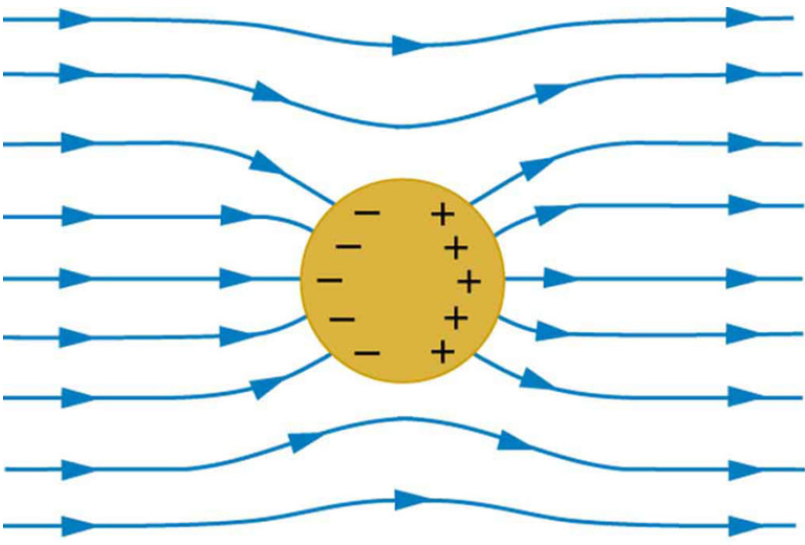
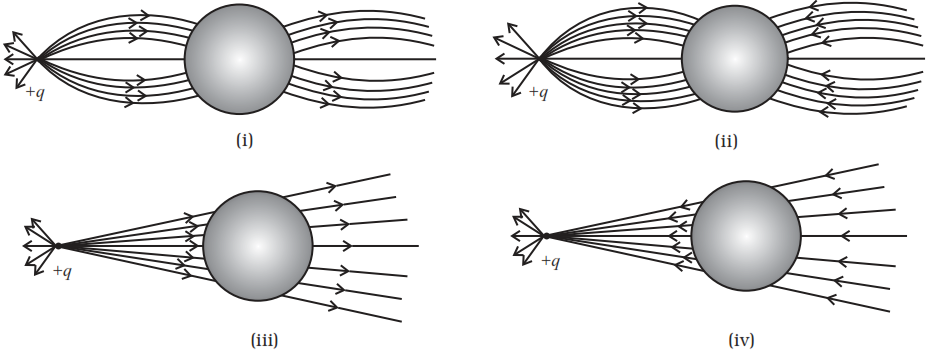
A point positive charge is brought near an isolated conducting sphere. The electric field is best given by:
  • Fig $(i).$
  • B
    Fig $(ii).$
  • C
    Fig $(iii).$
  • D
    Fig $(iv).$
Answer
Correct option: A.
Fig $(i).$
Key concept:
  1. Electric field lines come out of positive charge and go into the negative charge.
  2. Tangent to the field line at any point gives the direction of the field at that point.
  3. Field lines are always normal to the conducting surface.
  4. Field lines do not exist inside a conductor.
The explanation to this problem$-$can be done by keeping two things in mind.
  1. Concept of induction.
  2. The electric field lines interact with a conducting body normally.
Let us discuss the phenomenon of induction involved in this case. When a positive point charge is brought near an isolated conducting sphere without touching the sphere, then the free electrons in the sphere are attracted towards the positive charge. Thus, the left surface of sphere has an excess of negative charge and the right surface of sphere has an excess of positive charge. It should be noted that both kinds of charges are bound in the metal sphere and cannot escape. They, therefore, reside on the surface of the sphere.

An electric field lines start from a positive point charge and ends at negative charge induced on the left surface of sphere. Also, electric field line emerges from a positive charge, in case of single charge and ends at infinity.
Here, all these conditions are fulfilled in Fig. $(i).$
View full question & answer
MCQ 151 Mark
An electron revolves around the nucleus of hydrogen atom in a circle of radius $5 \times 10^{-11} m$. The intensity of electric field at a point in the orbit of the electron is:
  • $5.76 \times 10^{11} N / C$
  • B
    $9.216 \times 10^{-8} N / C$
  • C
    $0$
  • D
    $4 N/C$
Answer
Correct option: A.
$5.76 \times 10^{11} N / C$
We know hydrogen atom consist of one proton and one electron $R=5 \times 10^{-11} m$
We know attractive force $=\frac{ kq _1\left( q _2\right)}{ r ^2}=\frac{9 \times 10^9 \times\left(1.6 \times 10^{-19}\right)^2}{\left(5 \times 10^{-11}\right)^2}$
We know $F=E q$
$\therefore E =\frac{ F }{ q }$
$\therefore E =\frac{9 \times 10^9 \times\left(1.6 \times 10^{-19}\right)}{\left(5 \times 10^{-11}\right)^2}=5.76 \times 10^{11} N / C$
View full question & answer
MCQ 161 Mark
A lightning arrester must have the following property.
  • A
    Discontinuity.
  • B
    Poor conductivity.
  • Needle end.
  • D
    Low melting point.
Answer
Correct option: C.
Needle end.

Needle end can arrest the lightning easily. Besides, the device must provide a continuous path to electricity so that current passes to ground. It must have a high melting point else it will meltdown due to the heat generated during carrying lightning current.

View full question & answer
MCQ 181 Mark
Four charges are kept at the corner points of a square. The net force on a charge kept at the center of the square is $........$?
  • A
    Along diagonal.
  • B
    Zero.
  • C
    Along one side.
  • Depends on the nature of the charges.
Answer
Correct option: D.
Depends on the nature of the charges.
Depending on the nature and quantity of charges, the net force on the central charge may vary its magnitude and direction. If all the charges are the same the net force will be zero.
View full question & answer
MCQ 191 Mark
The electric field at a point on equatorial line of a dipole and direction of the dipole moment:
  • A
    Will be parallel.
  • Will be in opposite direction.
  • C
    Will be perpendicular.
  • D
    Are not relate.
Answer
Correct option: B.
Will be in opposite direction.
View full question & answer
MCQ 201 Mark
The tangent at any point of field line gives the direction of:
  • Electric field at that point.
  • B
    Electric force on positive charge at that point.
  • C
    Both $(1)\ \&\ (2).$
  • D
    Rotation of charge.
Answer
Correct option: A.
Electric field at that point.
A target is present at any point of field line.
The target at any point of the field lines generaly gives the elective field at that point.
View full question & answer
MCQ 221 Mark
When a comb rubbed with dry hair attracts pieces of paper. This is because the.
  • Comb polarizes the piece of paper.
  • B
    Comb induces a net dipole moment opposite to the direction of field.
  • C
    Electric field due to the comb is uniform.
  • D
    Comb induces a net dipole moment perpendicular to the direction of field.
Answer
Correct option: A.
Comb polarizes the piece of paper.
View full question & answer
MCQ 231 Mark
If a comb is rubbed on dry hairs, and then brought near paper pieces, it:
  • Attracts paper.
  • B
    Repels paper.
  • C
    Remains indifferent to paper.
  • D
    Either attracts or repels paper.
Answer
Correct option: A.
Attracts paper.
If we bring small bits of paper near a rubber $($or plastic$)$ comb, it is found that the comb does not attract the bits of paper. But if the same comb is first rubbed on dry hairs and then it is brought near the paper pieces, it attracts them.
View full question & answer
MCQ 241 Mark
Dipole moment depends on $........$?
  • A
    Charge only.
  • Charge and length of a dipole.
  • C
    Charge, length of a dipole and dielectric constant of the medium.
  • D
    Charge and dielectric constant of the medium.
Answer
Correct option: B.
Charge and length of a dipole.
Dipole is defined as two equal but opposite charges, kept at a small distance and having a dipole moment. The dipole moment is simply the product of the electric charge and length of the dipole. The dielectric constant of the medium doesn’t affect the dipole moment i.e. dipole moment of an electric dipole will be the same in water as well as in the air.
View full question & answer
MCQ 251 Mark
Electric field lines of force:
  • A
    Exist everywhere.
  • B
    Exist only in the immediate vicinity of electric charges.
  • C
    Exist only when both positive and negative charges are near one another.
  • Are imaginary.
Answer
Correct option: D.
Are imaginary.
Electric lines of force are imaginary.
View full question & answer
MCQ 261 Mark
Superconductors have $........?$
  • Almost zero resistivity
  • B
    Very high resistivity
  • C
    Temperature$-$dependent resistivity
  • D
    Moderate value of resistivity
Answer
Correct option: A.
Almost zero resistivity
Semiconductors are those which carry current with almost zero resistivity at a very low temperature $($example: Lead at $-272 -$ degree centigrade$)$. So, they have a very huge amount of current flow through them.
View full question & answer
MCQ 271 Mark
In the thunderstorm, the charges accumulate near the upper edges of clouds are:
  • A
    Negatively charged.
  • Positively charged.
  • C
    Neutral.
  • D
    None of these.
Answer
Correct option: B.
Positively charged.
We have to find the nature of charges on upper edges of clouds in a thunderstorm, the air currents move upwards while the water droplets move downward. This vigorous movement causes separation of charges. This leads to the positive charges collected near the upper edges of clouds and the negative charges to accumulate near the lower edges of the clouds.
View full question & answer
MCQ 291 Mark
The black shapes in the figure are closed surfaces. The electric field lines are in red. For which case the net flux through the surfaces is non$-$zero?
  • A
    In all cases net flux is non-zero
  • B
    Only $(c)$ and $(d)$
  • Only $(a)$ and $(b)$
  • D
    Only $(b), (c)$ and $(d)$
Answer
Correct option: C.
Only $(a)$ and $(b)$
As charge is enclosed in $a, b,$ so by Gauss's Law there will be a flux enclosed by the given surface.
View full question & answer
MCQ 301 Mark
The nature of charge on the object can be detected by:
  • A
    Microscope
  • Electroscope
  • C
    Electrometer
  • D
    Telescope
Answer
Correct option: B.
Electroscope
A pre$-$charged electroscope detects the nature of charge on a charged body.

View full question & answer
MCQ 311 Mark
When the object has no electric charge then the object is said to be:
  • A
    Charged.
  • B
    Electrified.
  • Electrically neutral.
  • D
    None.
Answer
Correct option: C.
Electrically neutral.
View full question & answer
MCQ 321 Mark
$1 \ emu =.......... C$
  • $10$
  • B
    $3 \times 10^9$
  • C
    $4.8 \times 10^{-10}$
  • D
    $0.1$
Answer
Correct option: A.
$10$
$1$ emu charge is equal to $10$ -coulomb charge while $1$ coulomb is equal to $3 \times 10^9$ esu charge. Emu and C both are the units of charge and hence their conversion formula is necessary for many numerical problems.
View full question & answer
MCQ 331 Mark
Electric charges are distributed in a small volume. The flux of the electric field through a spherical surface of radius $10 \ cm$ surrounding the total charge is $25 V- m$. The flux over a concentric sphere of radius $20 \ cm$ will be:
  • $25V-m$
  • B
    $50V-m$
  • C
    $100V-m$
  • D
    $200V-m$
Answer
Correct option: A.
$25V-m$
$F$ is not depend on the shape $\&$ size of the closed volume surface. $q_m P q_m$ is the net charge inside the closed volume surface.
View full question & answer
MCQ 341 Mark
Electric switches and appliances should be tested only with:
  • A
    Right hand
  • B
    Left hand
  • C
    Both hands
  • Electric tester
Answer
Correct option: D.
Electric tester
We should not touch the electric appliance with bare hands. To check the supply in the circuit, the electric tester should be used.
View full question & answer
MCQ 351 Mark
Complete the following statements with an appropriate word/ term be filled in the blank space$(s).$ The force of attraction or repulsion between two charges is given by $........$
  • A
    Gauss's law
  • B
    Kepler's law
  • Coulomb's law
  • D
    Gravitational law
Answer
Correct option: C.
Coulomb's law
Coulomb's law: The force exerted by one point charge is proportional to the product of the charge and varies inversely as the sure of the distance separating the charges.
View full question & answer
MCQ 361 Mark
Which among the following cannot be the charge of a charged body?
  • A
    $4.8 \times 10^{-14}$ Coulomb
  • B
    $6.4 \times 10^{-15}$ Coulomb
  • $5 \times 10^{-14}$ Coulomb
  • D
    $3.2 \times 10^{-10}$ Coulomb
Answer
Correct option: C.
$5 \times 10^{-14}$ Coulomb
Charge of a body must be an integral multiple of charge of an electron. $5 \times 10^{-14}$ is not an integral multiple of $( 1.602 \times 10^{-19}$ Coulomb$)$ which is equal to the charge of an electron. But we can see that $4.8,6.4,3.2$ are integral multiples of $1.6 .$
View full question & answer
MCQ 371 Mark
The materials which allow to pass electricity through them easily are called as:
  • A
    Insulators.
  • Conductors.
  • C
    Semiconductors.
  • D
    Superconductors.
Answer
Correct option: B.
Conductors.
View full question & answer
MCQ 381 Mark
Coulomb’s Law is valid for $........$?
  • Only point charge.
  • B
    For both point charge and distributed charge.
  • C
    Only distributed charges.
  • D
    Neither distributed nor point charge.
Answer
Correct option: A.
Only point charge.
Coulomb’s Law explains the force between two point charges only. A distributed charge can be considered as the sum of infinite point charges and thus the force between two distributed charge systems can be explained.
View full question & answer
MCQ 391 Mark
For a single charge the field lines start or ends at:
  • A
    Positive charge.
  • B
    Negative charge.
  • Infinity.
  • D
    None.
Answer
Correct option: C.
Infinity.
View full question & answer
MCQ 401 Mark
The dimensions of linear charge density is:
  • A
    $[L T A].$
  • $[L-1 T A].$
  • C
    $[L-1 T-1 A-1].$
  • D
    None.
Answer
Correct option: B.
$[L-1 T A].$
View full question & answer
MCQ 411 Mark
Two negative charges are kept at a certain distance in the air medium. What will happen if a dielectric slab is inserted between them?
  • A
    The slab will get heated.
  • B
    Current will flow through the slab.
  • C
    Two charges will attract each other.
  • The net force between the charges will be reduced.
Answer
Correct option: D.
The net force between the charges will be reduced.
Force between two charges is inversely proportional to the relative permittivity of the medium between them. A dielectric slab has relative permittivity more than that of air. So the force between the charges decreases. No current or heating will be noticed.
View full question & answer
MCQ 421 Mark
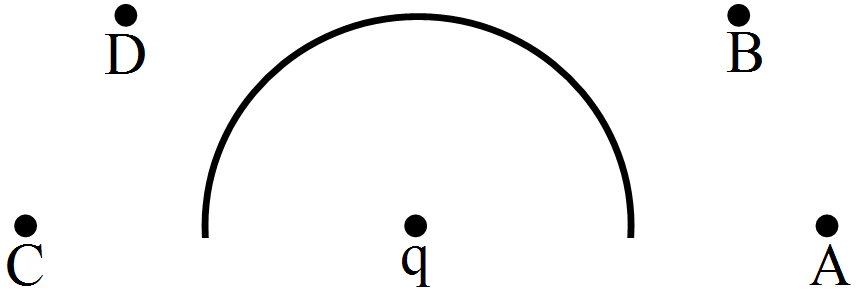
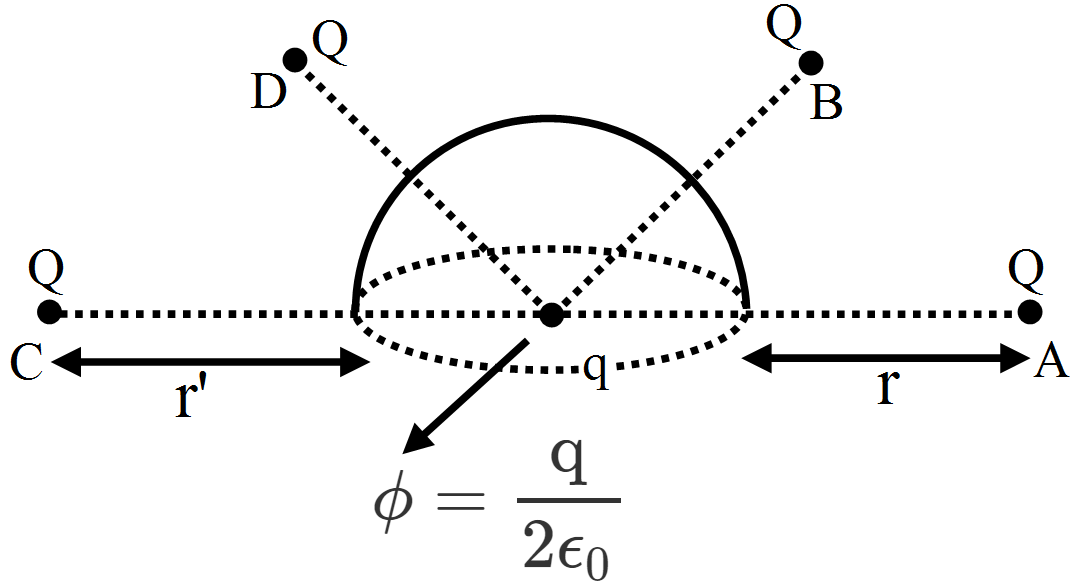
Figure shows a charge q placed at the centre of a hemisphere. A second charge $Q$ is placed at one of the positions $A, B, C$ and $D.$ In which position$($s$)$ of this second charge, the flux of the electric field through the hemisphere remains unchanged?
 
  • A
    $A$
  • B
    $B$
  • C
    $C$
  • $A$ and $C$ both
Answer
Correct option: D.
$A$ and $C$ both

The flux of electric field through the hemishpere remains unchanged dur to $'A\ \&\ C'$ point because these point lies on the line joining the centre of hemisphere.
View full question & answer
MCQ 431 Mark
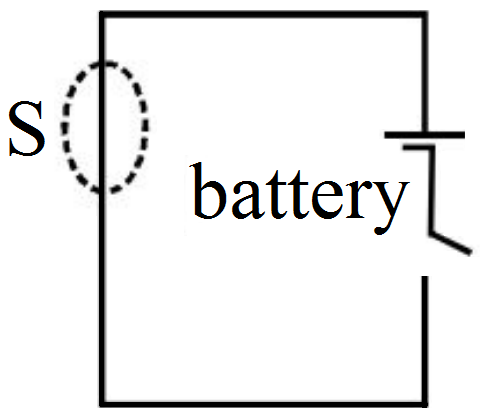
A closed surface S is constructed around a conducting wire connected to a battery and a switch $($figure$)$. As the switch is closed, the free electrons in the wire start moving along the wire. In any time interval, the number of electrons entering the closed surface $S$ is equal to the number of electrons leaving it. On closing the switch, the flux of the electric field through the closed surface:
  • A
    Is increased.
  • B
    Is decreased.
  • Remains unchanged.
  • D
    Remains zero.
Answer
Correct option: C.
Remains unchanged.

The flux of the electric field through the closed surface is remain unchanged.
Because the no. of electric field lines enter in the closed path $=$ no. of electric field lines existsin the closed path.
View full question & answer
MCQ 441 Mark
A charged conductor has its charge only on its outer surface. This statement is true for which of the following?
  • For all conductors.
  • B
    Only for spherical conductors.
  • C
    For hollow conductors.
  • D
    For those conductors which don’t have sharp edges.
Answer
Correct option: A.
For all conductors.

Charge remains on the outer surface of a conductor, irrespective of the shape and size of the conductor and also for hollow and solid conductors both. But if there is a sharp edge in the conductor, surface charge density will be more at that point. The surface charge density is uniform in the case of a sphere.

View full question & answer
MCQ 451 Mark
If a glass rod is rubbed on silk cloth and then brought near the bits of paper it $........$ then.
  • Attracts
  • B
    Repel
  • C
    Both
  • D
    None
Answer
Correct option: A.
Attracts

If a ordinary glass rod is rubbed on the silk cloth is brought near bits of paper, it is found that they have acquired the attractive property. The glass rod get charged on rubbing.

View full question & answer
MCQ 471 Mark
Two charges of $10C$ and $-15C$ are separated in air by 1m.The ratio of force exerted by one on the other is:
  • A
    $1 : 2$
  • B
    $2 : 1$
  • $1 : 1$
  • D
    None of these
Answer
Correct option: C.
$1 : 1$
c. $1: 1$
Explanation:
From Coulomb's law, the forces exerted by one on the other are equal and opposite direction i.e $\left|F_{12}\right|=\left|-F_{21}\right|$ Thus the required ration will be $1: 1$
View full question & answer
MCQ 481 Mark
A hemisphere shell is uniformly charged positively. The electric field at a point on a diameter away from the centre $($inside the boundary of hemisphere shell$)$ is directed:
  • Perpendicular to the diameter.
  • B
    Parallel to the diameter.
  • C
    At an angle tilted towards the diameter.
  • D
    At an angle tilted away from the diameter.
Answer
Correct option: A.
Perpendicular to the diameter.

It has to be perpendicular as when you join the other half to make complete sphere, only this orientation of the electric field will give a vector sum equal to $0$, inside the sphere.

View full question & answer
MCQ 491 Mark
An electron enters an electric field with its velocity in the direction of the electric lines of field then:
  • A
    The path of the electron will be a circle.
  • B
    The path of the electron will be a parabola.
  • The velocity of the electron will decrease just after entry.
  • D
    The velocity of the electron will increase just after entry.
Answer
Correct option: C.
The velocity of the electron will decrease just after entry.
When an electron enters an electric field with its velocity in the direction of the electric lines of field, then the velocity of the electron will decrease just after entry due to the lines of force of the electric field.
View full question & answer
MCQ 501 Mark
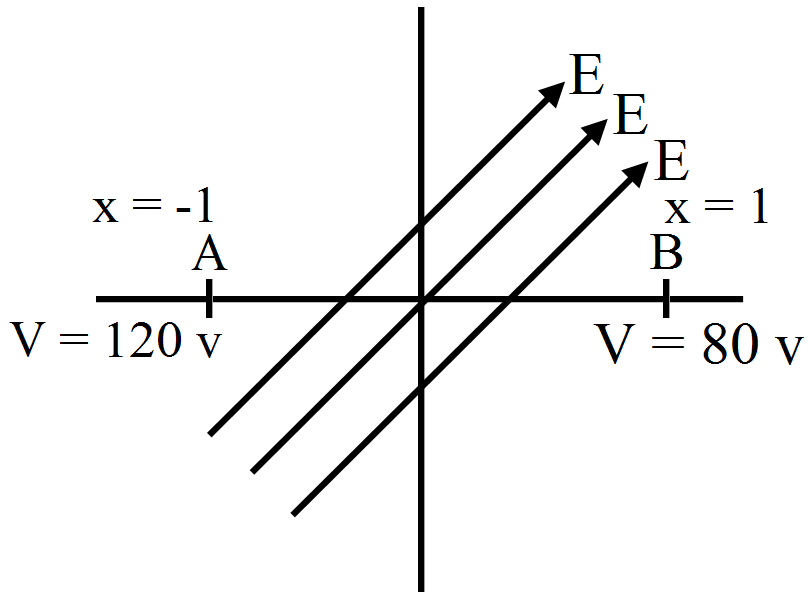
The electric potential decreases uniformly from $120V$ to $80V$ as one moves on the x-axis from $x = -1cm$ to $x = + 1cm.$ The electric field at the origin.
  • A
    Must be equal to $20 Vcm ^{-1}$
  • B
    May be equal to $20 Vcm ^{-1}$
  • C
    May be greater than $20 Vcm ^{-1}$
  • B and c both
Answer
Correct option: D.
B and c both
Explanation:

$\triangle\text{V}=-\text{E}.\text{dr}$
$(\text{V}_\text{f}-\text{V}_\text{i})=-\text{E}.\text{dr}=\text{E}_\text{x}(\text{B}-\text{A})$
$(80-120)=-\text{E}_\text{x}.(2)$
$\text{E}_\text{x}=\frac{40}{2}=20\text{v/m}$
If electric field lines lies in 'x ' direction than it may be equal to 20v/cm.
If Electric field lines liesin 'x - y' direction than it may be greater than 20v/cm.
View full question & answer