Questions · Page 4 of 14

M.C.Q (1 Marks)

MCQ 1511 Mark
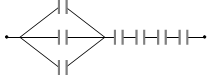
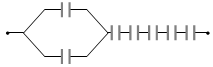
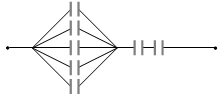
Three identical capacitors are combined differently. For the same voltage to each combination, the one that stores the greatest energy is
  • A
    Two in parallel and the third in series with it
  • B
    Three in series
  • Three in parallel
  • D
    Two in series and third in parallel with it
Answer
Correct option: C.
Three in parallel
Three in parallel
View full question & answer
MCQ 1521 Mark
In the adjoining figure, four capacitors are shown with their respective capacities and the P.D. applied. The charge and the P.D. across the 4μF capacitor will be
  • A
    600 μC; 150 volts
  • B
    300 μC; 75 volts
  • C
    800 μC; 200 volts
  • 580 μC; 145 volts
Answer
Correct option: D.
580 μC; 145 volts
(d) 580 μC; 145 volts
View full question & answer
MCQ 1531 Mark
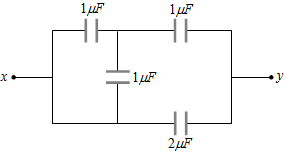
Four capacitors are connected as shown in the figure. Their capacities are indicated in the figure. The effective capacitance between points x and y is (in μF)
  • A
    $\frac{5}{6}$
  • B
    $\frac{7}{6}$
  • $\frac{8}{3}$
  • D
    2
Answer
Correct option: C.
$\frac{8}{3}$
(c) $\frac{8}{3}$
View full question & answer
MCQ 1541 Mark
Three capacitors of 2.0, 3.0 and 6.0 μF are connected in series to a 10 V source. The charge on the 3.0 μF capacitor is
  • A
    5 μC
  • 10 μC
  • C
    12 μC
  • D
    15 μC
Answer
Correct option: B.
10 μC
10 μC
View full question & answer
MCQ 1551 Mark
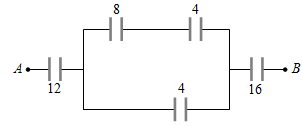
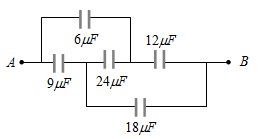
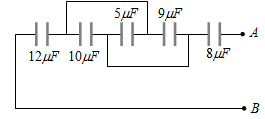
Four capacitors are connected in a circuit as shown in the figure. The effective capacitance in μF between points A and B will be
  • A
    $\frac{28}{9}$
  • B
    4
  • 5
  • D
    18
Answer
Correct option: C.
5
(c) 5
View full question & answer
MCQ 1561 Mark
Three capacitors each of 6μF are available. The minimum and maximum capacitances which may be obtained are
  • A
    6 μF, 18 μF
  • B
    3 μF, 12 μF
  • C
    2 μF, 12 μF
  • 2 μF, 18 μF
Answer
Correct option: D.
2 μF, 18 μF
2 μF, 18 μF
View full question & answer
MCQ 1571 Mark
A condenser of capacity $C_1$ is charged to a potential $V_0$. ThVe electrostatic energy stored in it is $U_0$. It is connected to another uncharged condenser of capacity $C_2$ in parallel. The energy dissipated in the process is
  • $\frac{{c}_2}{{c}_1+{c}_2} {U}_0$
  • B
    $\frac{{c}_1}{{c}_1+{c}_2} {U}_0$
  • C
    $\left(\frac{C_1-C_2}{C_1+C_2}\right) U_0$
  • D
    $\frac{\mathrm{C}_1 \mathrm{C}_2}{2\left(\mathrm{C}_1+\mathrm{C}_2\right)} \mathrm{U}_0$
Answer
Correct option: A.
$\frac{{c}_2}{{c}_1+{c}_2} {U}_0$
(a) $\frac{{c}_2}{{c}_1+{c}_2} {U}_0$
View full question & answer
MCQ 1581 Mark
The total capacity of the system of capacitors shown in the adjoining figure between the points A and B is
  • A
    1 μF
  • 2 μF
  • C
    3 μF
  • D
    4 μF
Answer
Correct option: B.
2 μF
(b) 2 μF
View full question & answer
MCQ 1591 Mark
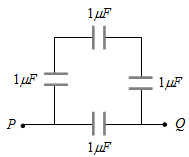
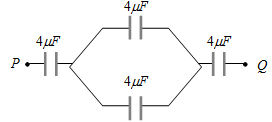
Four capacitors are connected as shown in the equivalent capacitance between the points P and Q is
  • A
    4 μF
  • B
    $\frac{1}{4}\mu F$
  • C
    $\frac{3}{4}\mu F$
  • $\frac{4}{3}\mu F$
Answer
Correct option: D.
$\frac{4}{3}\mu F$
(d) $\frac{4}{3}\mu F$
View full question & answer
MCQ 1601 Mark
Two identical parallel plate capacitors are connected in series to a battery of 100 V. A dielectric slab of dielectric constant 4.0 is inserted between the plates of second capacitor. The potential difference across the capacitors will now be respectively
  • A
    50 V, 50 V
  • 80 V, 20 V
  • C
    20 V, 80 V
  • D
    75 V, 25 V
Answer
Correct option: B.
80 V, 20 V
80 V, 20 V
View full question & answer
MCQ 1611 Mark
Two capacitors of 3pF and 6pF are connected in series and a potential difference of 5000 V is applied across the combination. They are then disconnected and reconnected in parallel. The potential between the plates is
  • A
    2250 V
  • 2222 V
  • C
    2.25 $\times 10^6 \ V$
  • D
    1.1 $\times 10^6\ V$
Answer
Correct option: B.
2222 V
(b) 2222 V
View full question & answer
MCQ 1621 Mark
A capacitor 4 μF charged to 50 V is connected to another capacitor of 2 μF charged to 100 V with plates of like charges connected together. The total energy before and after connection in multiples of ($10^{-2}J$) is
  • 1.5 and 1.33
  • B
    1.33 and 1.5
  • C
    3.0 and 2.67
  • D
    2.67 and 3.0
Answer
Correct option: A.
1.5 and 1.33
(a) 1.5 and 1.33
View full question & answer
MCQ 1631 Mark
A condenser of capacitance 10 μF has been charged to 100 volts. It is now connected to another uncharged condenser in parallel. The common potential becomes 40 volts. The capacitance of another condenser is
  • 15 μF
  • B
    5 μF
  • C
    10 μF
  • D
    16.6 μF
Answer
Correct option: A.
15 μF
15 μF
View full question & answer
MCQ 1641 Mark
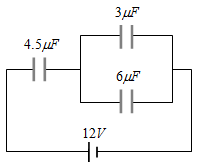
In the circuit shown in the figure, the potential difference across the 4.5mF capacitor is
  • A
    $\frac{8}{3}$ volts
     
  • B
    4 volts
  • C
    6 volts
  • 8 volts
Answer
Correct option: D.
8 volts
(d) 8 volts
View full question & answer
MCQ 1651 Mark
0.2 Fcapacitor is charged to 600 V by a battery. On removing the battery, it is connected with another parallel plate condenser of 1F. The potential decreases to
  • 100 volts
  • B
    120 volts
  • C
    300 volts
  • D
    600 volts
Answer
Correct option: A.
100 volts
100 volts
View full question & answer
MCQ 1661 Mark
A condenser having a capacity of 6mF is charged to 100 V and is then joined to an uncharged condenser of 14 μF and then removed. The ratio of the charges on 6mF and 14mF and the potential of 6mF will be
  • A
    $\frac{6}{14}$ and 50 volt
  • B
    $\frac{14}{6}$ and 30 volt
  • $\frac{6}{14}$ and 30 volt
  • D
    $\frac{14}{6}$ and 0 volt
Answer
Correct option: C.
$\frac{6}{14}$ and 30 volt
(c) $\frac{6}{14}$ and 30 volt
View full question & answer
MCQ 1671 Mark
What is the equivalent capacitance between A and B in the given figure (all are in farad)
  • A
    $\frac{13}{18} F$
  • B
    $\frac{48}{13} F$
  • C
    $\frac{1}{31} F$
  • $\frac{240}{71} F$
Answer
Correct option: D.
$\frac{240}{71} F$
(d) $\frac{240}{71} F$
View full question & answer
MCQ 1681 Mark
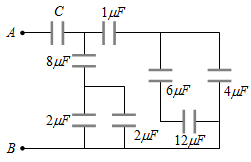
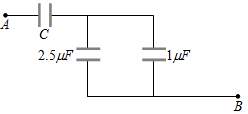
In the following circuit, the resultant capacitance between A and B is 1mF. Then value of C is
(a) (b) (c) (d)
       
  • A
    $\frac{32}{11}$ μF
  • B
    $\frac{11}{32}$ μF
  • C
    $\frac{23}{32}$ μF
  • $\frac{32}{23}$ μF
Answer
Correct option: D.
$\frac{32}{23}$ μF
(d) $\frac{32}{23}$ μF
View full question & answer
MCQ 1691 Mark
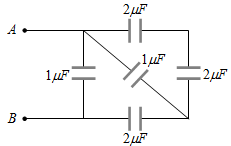
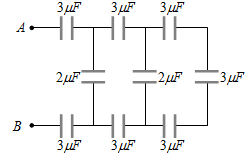
The resultant capacitance between A and B in the following figure is equal to
  • 1 μF
  • B
    3 μF
  • C
    2 μF
  • D
    1.5 μF
Answer
Correct option: A.
1 μF
(a) 1 μF
View full question & answer
MCQ 1701 Mark
In the connections shown in the adjoining figure, the equivalent capacity between A and B will be
  • A
    10.8 μF
  • B
    69 μF
  • C
    15 μF
  • 10 μF
Answer
Correct option: D.
10 μF
(d) 10 μF
View full question & answer
MCQ 1711 Mark
A capacitor having capacitance C is charged to a voltage V. It is then removed and connected in parallel with another identical capacitor which is uncharged. The new charge on each capacitor is now
  • A
    CV
  • CV / 2
  • C
    2 CV
  • D
    CV / 4
Answer
Correct option: B.
CV / 2
CV / 2
View full question & answer
MCQ 1721 Mark
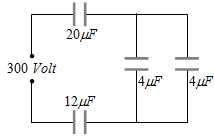
A 4 μF condenser is connected in parallel to another condenser of 8 μF. Both the condensers are then connected in series with a 12 μF condenser and charged to 20 volts. The charge on the plate of 4 μF condenser is
  • A
    3.3 μC
  • 40 μC
  • C
    80 μC
  • D
    240 μC
Answer
Correct option: B.
40 μC
40 μC
View full question & answer
MCQ 1731 Mark
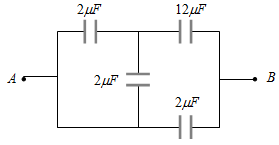
Two capacitors each of capacity 2 μF are connected in parallel. This system is connected in series with a third capacitor of 12 μF capacity. The equivalent capacity of the system will be
  • A
    16 μF
  • B
    13 μF
  • C
    4 μF
  • 3 μF
Answer
Correct option: D.
3 μF
3 μF
View full question & answer
MCQ 1741 Mark
A parallel plate capacitor is made by stacking n equally spaced plates connected alternately. If the capacitance between any two plates is C then the resultant capacitance is
  • A
    C
  • B
    nC
  • (n – 1)C
  • D
    (n + 1)C
Answer
Correct option: C.
(n – 1)C
(n – 1)C
View full question & answer
MCQ 1751 Mark
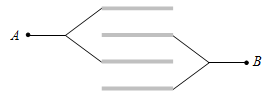
Four plates of the same area of cross-section are joined as shown in the figure. The distance between each plate is d. The equivalent capacity across A and B will be
  • A
    $\frac{2 \varepsilon_0 A}{d}$
  • $\frac{3 \varepsilon_0 A}{d}$
  • C
    $\frac{3 \varepsilon_0 A}{2d}$
  • D
    $\frac{ \varepsilon_0 A}{d}$
Answer
Correct option: B.
$\frac{3 \varepsilon_0 A}{d}$
(b) $\frac{3 \varepsilon_0 A}{d}$
View full question & answer
MCQ 1761 Mark
The capacities and connection of five capacitors are shown in the adjoining figure. The potential difference between the points A and B is 60 volts . Then the equivalent capacity between A and B and the charge on 5μF capacitance will be respectively
  • A
    44 μF, 300 μC
  • B
    16 μF, 150 μC
  • C
    15 μF, 200 μC
  • 4 μF, 50 μC
Answer
Correct option: D.
4 μF, 50 μC
(d) 4 μF, 50 μC
View full question & answer
MCQ 1771 Mark
Two condensers of capacities 1μF and 2 μF are connected in series and the system is charged to 120 volts. Then the P.D. on 1 μF capacitor (in volts) will be
  • A
    40
  • B
    60
  • 80
  • D
    120
Answer
Correct option: C.
80
80
View full question & answer
MCQ 1781 Mark
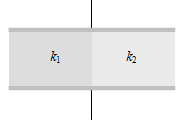
A parallel plate condenser is filled with two dielectrics as shown. Area of each plate is $A \ metre^2$ and the separation is t metre . The dielectric constants are $k_1$ and $k_2$ respectively. Its capacitance in farad will be
  • A
    $\frac{\varepsilon_0{A}}{t}\left({k}_1+{k}_2\right)$
  • $\frac{z_0 \mathrm{~A}}{\mathrm{t}} \cdot \frac{\mathrm{k}_1+\mathrm{k}_2}{2}$
  • C
    $\frac{2 \varepsilon_0 \mathrm{~A}}{t}\left(k_1+k_2\right)$
  • D
    $\frac{z_0 \mathrm{~A}}{\mathrm{t}} \cdot \frac{\mathrm{k}_1-\mathrm{k}_2}{2}$
Answer
Correct option: B.
$\frac{z_0 \mathrm{~A}}{\mathrm{t}} \cdot \frac{\mathrm{k}_1+\mathrm{k}_2}{2}$
(b) $\frac{z_0 \mathrm{~A}}{\mathrm{t}} \cdot \frac{\mathrm{k}_1+\mathrm{k}_2}{2}$
View full question & answer
MCQ 1791 Mark
The capacities of two conductors are $C_1$ and $C_2$ and their respective potentials are $V_1$ and $V_2$. If they are connected by a thin wire, then the loss of energy will be given by 
  • A
    $\frac{C_1 C_2\left(V_1+V_2\right)}{2\left(C_1+C_2\right)}$
  • B
    $\frac{C_1 C_2\left(V_1-V_2\right)}{2\left(C_1+C_2\right)}$
  • $\frac{C_1 C_2\left(V_1-V_2\right)^2}{2\left(C_1+C_2\right)}$
  • D
    $\frac{\left(C_1+C_2\right)\left(V_1-V_2\right)}{C_1 C_2}$
Answer
Correct option: C.
$\frac{C_1 C_2\left(V_1-V_2\right)^2}{2\left(C_1+C_2\right)}$
(c) $\frac{C_1 C_2\left(V_1-V_2\right)^2}{2\left(C_1+C_2\right)}$
View full question & answer
MCQ 1801 Mark
The equivalent capacitance between A and B in the figure is 1 μF. Then the value of capacitance C is


  • 1.4 μF
  • B
    2.5 μF
  • C
    3.5 μF
  • D
    1.2 μF
Answer
Correct option: A.
1.4 μF
(a) 1.4 μF
View full question & answer
MCQ 1811 Mark
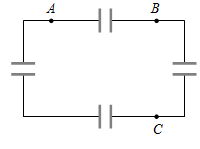
Four capacitors of each of capacity 3μF are connected as shown in the adjoining figure. The ratio of equivalent capacitance between A and B and between A and C will be


  • 4 : 3
  • B
    3 : 4
  • C
    2 : 3
  • D
    3 : 2
Answer
Correct option: A.
4 : 3
(a) 4 : 3
View full question & answer
MCQ 1821 Mark
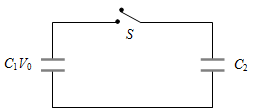
A capacitor of capacity $C_1$ is charged to the potential of $V_0$. On disconnecting with the battery, it is connected with a capacitor of capacity $C_2$ as shown in the adjoining figure. The ratio of energies before and after the connection of switch S will be
  • $(C_1+C_2) / C_1$
  • B
    $C_1/(C_1+C_2)$
  • C
    $C_1C_2$
  • D
    $C_1/C_2$
Answer
Correct option: A.
$(C_1+C_2) / C_1$
(a) $(C_1+C_2) / C_1$
View full question & answer
MCQ 1831 Mark
Two capacitors of capacities $C_1$ and $C_2$ are charged to voltages $V_1$ and $V_2$ respectively. There will be no exchange of energy in connecting them in parallel, if
  • A
    $C_1=C_2$
  • B
    $C_1V_1=C_2V_2$
  • $V_1=V_2$
  • D
    $\frac{C_1}{V_1}=\frac{C_2}{V_2}$
Answer
Correct option: C.
$V_1=V_2$
(c) $V_1=V_2$
View full question & answer
MCQ 1841 Mark
2Two capacitors connected in parallel having the capacities $C_1$ and $C_1$ are given ‘q’ charge, which is distributed among them. The ratio of the charge on $C_1$ and $C_2$ will be
  • $\frac{C_1}{C_2}$
  • B
    $\frac{C_2}{C_1}$
  • C
    $C_1C_2$
  • D
    $\frac{1}{C_1C_2}$
Answer
Correct option: A.
$\frac{C_1}{C_2}$
(a) $\frac{C_1}{C_2}$
View full question & answer
MCQ 1851 Mark
Two capacitors of equal capacity are first connected in parallel and then in series. The ratio of the total capacities in the two cases will be
  • A
    2 : 1
  • B
    1 : 2
  • 4 : 1
  • D
    1 : 4
Answer
Correct option: C.
4 : 1
4 : 1
View full question & answer
MCQ 1861 Mark
Three capacitors of capacity $C_1,C_2,C_3$ are connected in series. Their total capacity will be
  • A
    $C_1+C_2+C_3$
  • B
    $1/C_1+C_2+C_3$
  • $(C_1^{-1}+C_2^{-1}+C_3^{-1})^{-1}$

     
  • D
    None of these
Answer
Correct option: C.
$(C_1^{-1}+C_2^{-1}+C_3^{-1})^{-1}$

 
(c) $(C_1^{-1}+C_2^{-1}+C_3^{-1})^{-1}$
View full question & answer
MCQ 1871 Mark
Three capacitances of capacity 10 μF, 5 μF and 5 μF are connected in parallel. The total capacity will be
  • A
    10 μF
  • B
    5 μF
  • 20 μF
  • D
    None of the above
Answer
Correct option: C.
20 μF
20 μF
View full question & answer
MCQ 1881 Mark
Two capacitances of capacity $C_1$ and $C_2$ are connected in series and potential difference V is applied across it. Then the potential difference across $C_1$ will be
  • A
    ${V} \frac{C_2}{C_1}$
  • B
    $V \frac{C_1+C_2}{C_1}$
  • $V \frac{C_2}{C_1+C_2}$
  • D
    $V \frac{C_1}{C_1+C_2}$
Answer
Correct option: C.
$V \frac{C_2}{C_1+C_2}$
(c) $V \frac{C_2}{C_1+C_2}$
View full question & answer
MCQ 1891 Mark
The capacitor of capacitance 4 μF and 6 μF are connected in series. A potential difference of 500 volts is applied to the outer plates of the two capacitor system. The potential difference across the plates of capacitor of 4 μF capacitance is
  • A
    500 volts
  • 300 volts
  • C
    200 volts
  • D
    250 volts
Answer
Correct option: B.
300 volts
300 volts
View full question & answer
MCQ 1901 Mark
Two condensers of capacity 0.3 μF and 0.6 μF respectively are connected in series. The combination is connected across a potential of 6 volts . The ratio of energies stored by the condensers will be 
  • A
    $\frac{1}{2}$
  • 2
  • C
    $\frac{1}{4}$
  • D
    4
Answer
Correct option: B.
2
(b) 2
View full question & answer
MCQ 1911 Mark
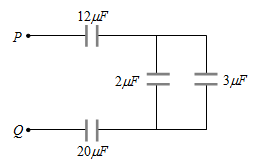
In the circuit diagram shown in the adjoining figure, the resultant capacitance between P and Q is
  • A
    47 μF
  • 3 μF
  • C
    60 μF
  • D
    10 μ F
Answer
Correct option: B.
3 μF
(b) 3 μF
View full question & answer
MCQ 1921 Mark
2μF capacitance has potential difference across its two terminals 200 volts. It is disconnected with battery and then another uncharged capacitance is connected in parallel to it, then P.D. becomes 20 volts. Then the capacity of another capacitance will be
  • A
    2 μF
  • B
    4 μF
  • 18 μF
  • D
    10 μF
Answer
Correct option: C.
18 μF
18 μF
View full question & answer
MCQ 1931 Mark
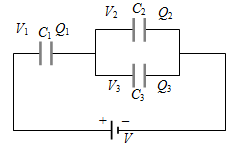
In an adjoining figure are shown three capacitors $C_1,C_2$ and $C_3$ joined to a battery. The correct condition will be (Symbols have their usual meanings)
  • A
    $Q_1=Q_2=Q_3$ and $V_1=V_2=V_3=V$
  • B
    $Q_1=Q_2+Q_3$ and $V=V_1+V_2+V_3$
  • $Q_1=Q_2+Q_3$ and $V=V_1+V_2$
  • D
    $Q_2=Q_3$ and $V_2=V_3$
Answer
Correct option: C.
$Q_1=Q_2+Q_3$ and $V=V_1+V_2$
(c) $Q_1=Q_2+Q_3$ and $V=V_1+V_2$
View full question & answer
MCQ 1941 Mark
Two capacitors each of 1μF capacitance are connected in parallel and are then charged by 200 volts d.c. supply. The total energy of their charges (in joules) is
  • A
    0.01
  • B
    0.02
  • 0.04
  • D
    0.06
Answer
Correct option: C.
0.04
0.04
View full question & answer
MCQ 1951 Mark
Four condensers each of capacity 4μF are connected as shown in figure. $V_P-V_Q=15$ $volts$. The energy stored in the system is
  • A
    2400 ergs
  • 1800 ergs
  • C
    3600 ergs
  • D
    5400 ergs
Answer
Correct option: B.
1800 ergs
(b) 1800 ergs
View full question & answer
MCQ 1961 Mark
Three capacitors of capacitances 3 μF, 9μF and 18 μF are connected once in series and another time in parallel. The ratio of equivalent capacitance in the two cases $\left(\frac{\mathrm{C}_8}{\mathrm{C}_{\mathrm{p}}}\right)$ will be
  • 1 : 15
  • B
    15 : 1
  • C
    1 : 1
  • D
    1 : 3
Answer
Correct option: A.
1 : 15
(a) 1 : 15
View full question & answer
MCQ 1971 Mark
The condensers of capacity $C_1$ and $C_2$ are connected in parallel, then the equivalent capacitance is
  • $C_1+C_2$
  • B
    $\frac{C_1C_2}{C_1+C_2}$
  • C
    $\frac{C_1}{C_2}$
  • D
    $\frac{C_2}{C_1}$
Answer
Correct option: A.
$C_1+C_2$
(a) $C_1+C_2$
View full question & answer
MCQ 1981 Mark
A capacitor is charged to 200 volt it has 0.1 coulomb charge. When it is discharged, energy will be
  • A
    1 J
  • B
    4 J
  • 10 J
  • D
    20 J
Answer
Correct option: C.
10 J
10 J
View full question & answer
MCQ 1991 Mark
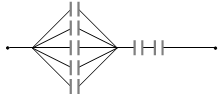
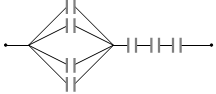
Seven capacitors each of capacity 2μF are to be so connected to have a total capacity $\frac{10}{11}\mu F$. Which will be the necessary figure as shown 
  • B
  • C
  • D
Answer
Correct option: A.
(a)
View full question & answer
MCQ 2001 Mark
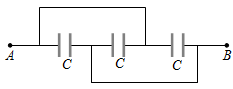
Three equal capacitors, each with capacitance $C$ are connected as shown in figure. Then the equivalent capacitance between $A$ and $B$ is
  • A
    $C$
  • $3C$
  • C
    $\frac{C}{3}$
  • D
    $\frac{3C}{2}$
Answer
Correct option: B.
$3C$
(b) $3C$
View full question & answer