Questions

2 Marks Questions

Take a timed test

5 questions · self-marked practice — reveal the answer and mark yourself.

Question 12 Marks
Show that there can be no net charge in a region m which the electric field is uniform at all points.
Answer
It is given that the electric field is uniform. If we consider a surface perpendicular to the electric field, we find that it is an equipotential surface. Hence, if a test charge is introduced on the surface, then work done will be zero in moving the test charge on it.
But if there is some net charge in this region, the test charge introduced on the surface will experience a force due to this charge. This force has a component parallel to the surface; thus, work has to be done in moving this test charge. Thus, the surface cannot be said to be equipotential. This implies that the net charge in the region with uniform electric field is zero.
View full question & answer
Question 22 Marks
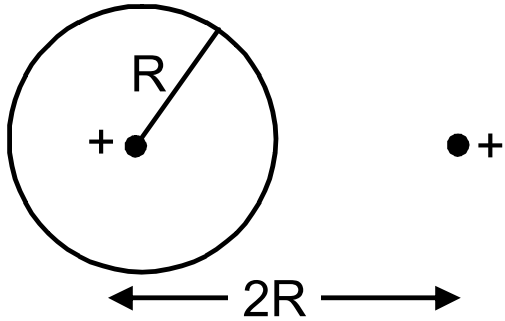
Find the flux of the electric field through a spherical surface of radius R due to a charge of $10^{-7}$ C at the centre and another equal charge at a point 2R away from the centre.
Answer
Given:
Let charge Q be placed at the centre of the sphere and Q' be placed at a distance 2R from the centre.
Magnitude of the two charges $= 10^{-7}$C
According to Gauss's Law, the net flux through the given sphere is only due to charge Q that is enclosed by it and not by the charge Q' that is lying outside.
So, only the charge located inside the sphere will contribute to the flux passing through the sphere.
Thus,
$\phi=\int{\text{E}}.\text{d}{\text{s}}=\frac{\text{Q}}{\in_0}=\frac{10^{-7}}{8.85\times10^{-12}}$
$\Rightarrow\phi=1.1\times10^{4}\text{Nm}^2\text{C}^{-1}$
View full question & answer
Question 32 Marks
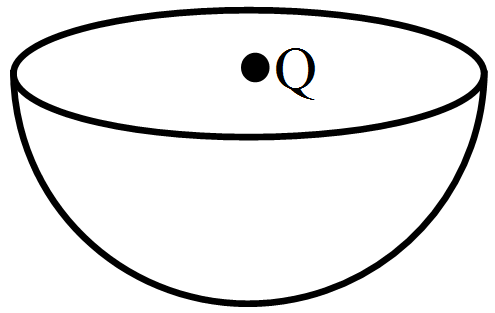
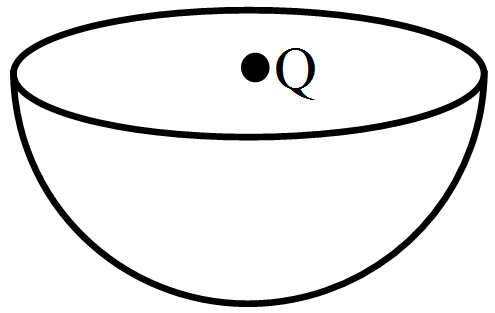
A charge Q is placed at the centre of an imaginary hemispherical surface. Using symmetry arguments and the Gauss's law, find the flux of the electric field due to this charge through the surface of the hemisphere (figure).
Answer
From Guass's law, flux through a closed surface, $\phi=\frac{\text{Q}_{\text{en}}}{\in_0},$ where $Q_{en} =$ charge enclosed by the closed surface Let us assume that a spherical closed surface in which the charge is enclosed is Q. The flux through the sphere, $\phi=\frac{\text{Q}}{\in_0}$

Hence for a hemisphere(open bowl), total flux through its curved surface, $\phi'=\frac{\text{Q}}{\in}\times\frac{1}{2}=\frac{\text{Q}}{2\in_0}$
View full question & answer
Question 42 Marks
A charge Q is placed at the centre of a cube. Find the flux of the electric field through the six surfaces of the cube.
Answer
According to Gauss's Law, flux passing through any closed surface is equal to $\frac{1}{\in_0}$ times the charge enclosed by that surface.
$\Rightarrow\phi=\frac{\text{q}}{\in_0},$
where $\phi$ is the flux through the closed surface and q is the charge enclosed by that surface.
The charge is placed at the centre of the cube and the electric field is passing through the six surfaces of the cube. So, we can say that the total electric flux passes equally through these six surfaces.
Thus, flux through each surface,
$\phi'=\frac{\text{Q}}{6\in_0}$
View full question & answer
Question 52 Marks
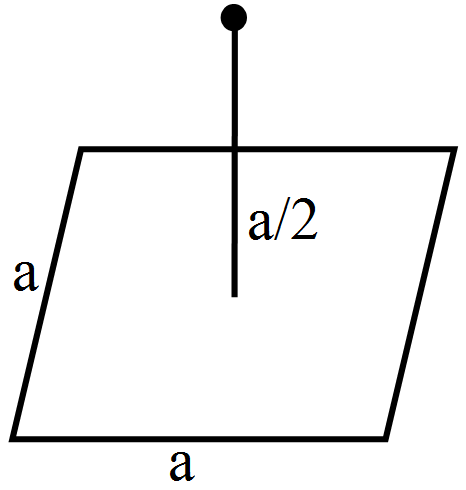
A charge Q is placed at a distance $\frac{\text{a}}{2}$ above the centre of a horizontal, square surface of edge a as shown in figure. Find the flux of the electric field through the square surface.
Answer
Given:
Edge length of the square surface $= a$
Distance of the charge Q from the square surface $=\frac{\text{a}}2{}$
Area of the plane $= a^2$
Assume that the given surface is one of the faces of the imaginary cube.
Then, the charge is found to be at the centre of the cube.
A charge is placed at a distance of about $a^2a^2$ from the centre of the surface.
The electric field due to this charge is passing through the six surfaces of the cube.
Hence flux through each surface,
$\phi=\frac{\text{Q}}{\in_0}\times\frac{1}{6}=\frac{\text{Q}}{6\in_0}$
Thus, the flux through the given surface is $\frac{\text{Q}}{6\in_0}.$
View full question & answer