Questions

2 Marks Questions

Take a timed test

33 questions · self-marked practice — reveal the answer and mark yourself.

Question 12 Marks
Prove that $\vec{\text{A}}.(\vec{\text{A}}\times\vec{\text{B}})=0.$
Answer
$\vec{\text{A}}.(\vec{\text{A}}\times\vec{\text{B}})=0$ (claim)As, $\vec{\text{A}}\times\vec{\text{B}}=\text{AB}\sin\theta \ \hat{\text{n}}$
$\text{AB}\sin\theta \ \hat{\text{n}}$ is a vector which is perpendicular to the plane containing $\vec{\text{A}}$ and $\vec{\text{B}},$ this implies that it is also perpendicular to $\vec{\text{A}}.$ As dot product of two perpendicular vector is zero.
Thus $\vec{\text{A}}.(\vec{\text{A}}\times\vec{\text{B}})=0.$
View full question & answer
Question 22 Marks
A metre scale is graduated at every millimetre. How many significant digits will be there in a length measurement with this scale?
Answer
The metre scale is graduated at every millimeter.
1m = 100mm
The minimum no. of significant digit may be 1 (e.g. for measurements like 5mm, 7mm etc) and the maximum no. of significant digits may be 4 (e.g.1000mm)
So, the no. of significant digits may be 1, 2, 3 or 4.
View full question & answer
Question 32 Marks
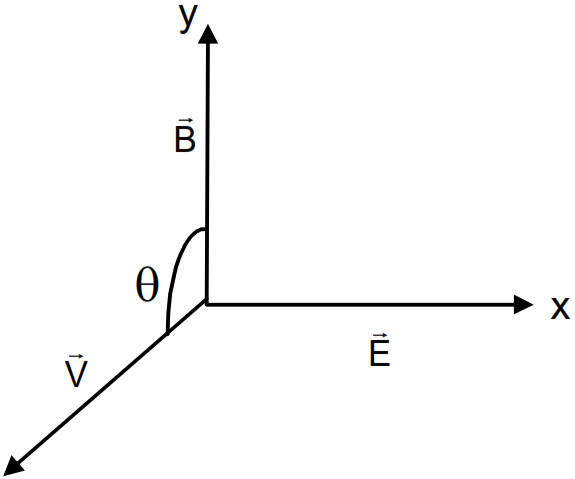
The force on a charged particle due to electric and magnetic fields is given by $\overrightarrow{\text{F}}=\text{q}\overrightarrow{\text{E}}+\text{q}\overrightarrow{\text{v}}\times\overrightarrow{\text{B}}.$ Suppose $\overrightarrow{\text{E}}$ is along the X-axis and $\overrightarrow{\text{B}}$ along the Y-axis. In what direction and with what minimum speed v should a positively charged particle be sent so that the net force on it is zero?
Answer
Given $\overrightarrow{\text{F}}=\text{q}\overrightarrow{\text{E}}+\text{q}(\overrightarrow{\text{v}}\times\overrightarrow{\text{B}})=0$$\Rightarrow\overrightarrow{\text{E}}=-(\overrightarrow{\text{v}}\times\overrightarrow{\text{B}})$
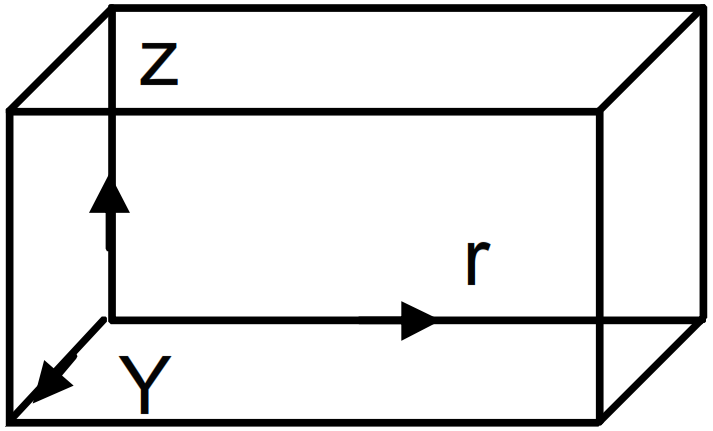
So, the direction of $\overrightarrow{\text{v}}\times\overrightarrow{\text{B}}$ should be opposite to the direction of $\overrightarrow{\text{E}}.$ Hence, $\overrightarrow{\text{v}}$ should be in the positive yz-plane. Again, $\text{E = vB}\sin\theta\Rightarrow\text{v}=\frac{\text{E}}{\text{B}\sin\theta}$ For v to be minimum, $\theta=90^{\circ}$ and so $\text{v}_{\text{min}}=\frac{\text{F}}{\text{B}}$ So, the particle must be projected at a minimum speed of E/B along +ve z-axis$(\theta=90^{\circ})$ as shown in the figure, so that the force is zero.
View full question & answer
Question 42 Marks
Let $\overrightarrow{\text{A}}=5\vec{\text{i}}-4\vec{\text{j}}$ and $\overrightarrow{\text{B}}=-7.5\vec{\text{i}}+6\vec{\text{j}}.$
  1. Do we have $\overrightarrow{\text{B}}\text{k}\vec{\text{A}}?$
  2. Can we say $\frac{\overrightarrow{\text{B}}}{\overrightarrow{\text{A}}}=\text{k}?$
Answer
  1. yes, If you multiply (-1.5) to A you get B
⇒ B = -1.5A
  1. But that doesn’t mean $-1.5=\frac{\text{B}}{\text{A}},$ Because division of a vector with another vector is not defined.
View full question & answer
Question 52 Marks
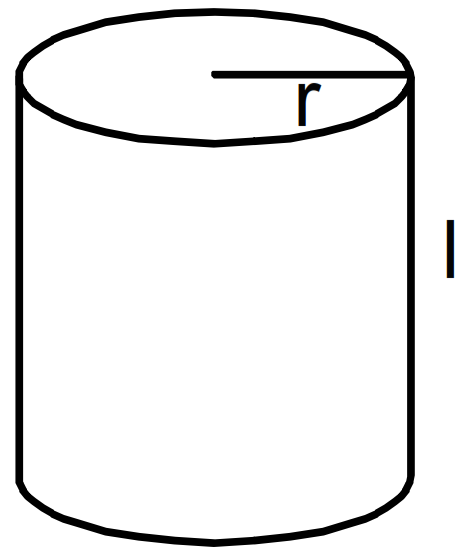
The length and the radius of a cylinder measured with a slide callipers are found to be 4.54cm and 1.75cm respectively. Calculate the volume of the cylinder.
Answer
Given that, for the cylinder Length = l = 4.54cm, radius = r = 1.75cm Volume $=\pi\text{r}^2\text{I}=\pi\times(4.54)\times(1.75)^2$ Since, the minimum no. of significant digits on a particular term is 3, the result should have 3 significant digits and others rounded off. So, volume $\text{V}=\pi\text{r}^2\text{I}=(3.14)\times(1.75)\times(1.75)\times(4.54)=43.6577\text{cm}^3$ Since, it is to be rounded off to 3 significant digits, $\text{V}=43.7\text{cm}^3.$
View full question & answer
Question 62 Marks
Can you have $\overrightarrow{\text{A}}\times\overrightarrow{\text{B}}=\overrightarrow{\text{A}}\cdot\overrightarrow{\text{B}}$ with $\text{A}\neq0$ and $\text{B}\neq0?$ What if one of the two vectors is zero?
Answer
Never, because $\overrightarrow{\text{A}}\times\overrightarrow{\text{B}}=\overrightarrow{\text{A}}\cdot\overrightarrow{\text{B}}$ is a vector quantity and $\overrightarrow{\text{A}}.\overrightarrow{\text{B}}$ is a scalar quantity and a vector can never be equated to a scalar, even if their magnitudes are zero. So even if one of the two vectors is zero $\overrightarrow{\text{A}}\times\overrightarrow{\text{B}}$ gives a null vector and $\overrightarrow{\text{A}}.\overrightarrow{\text{B}}$ is simply zero.
View full question & answer
Question 72 Marks
Can a vector have zero component along a line and still have nonzero magnitude?
Answer
Yes, any vector has zero component along the direction perpendicular to it. Like, A vector along x-axis has zero component along Y-axis.
View full question & answer
Question 82 Marks
Let $\vec{\text{a}}=2\vec{\text{i}}+3\vec{\text{j}}+4\vec{\text{k}}$ and $\vec{\text{b}}=3\vec{\text{i}}+4\vec{\text{j}}+5\vec{\text{k}}.$ Find the angle between them.
Answer
$\Rightarrow\vec{\text{a}}=2\vec{\text{i}}+3\vec{\text{j}}+4\vec{\text{k}};\vec{\text{b}}=3\vec{\text{i}}+4\vec{\text{j}}+5\vec{\text{k}}$$\Rightarrow\vec{\text{a}}.\vec{\text{b}}=\text{ ab}\cos\theta\Rightarrow\theta=\cos^{-1}\frac{\vec{\text{a}}.\vec{\text{b}}}{\text{ab}}$
$\Rightarrow\cos^{-1}\frac{2\times3+3\times4+4\times5}{\sqrt{2^2+3^3+4^4}\sqrt{3^2+4^2+5^2}}=\cos^{-1}\Big(\frac{38}{\sqrt{1450}}\Big)$
View full question & answer
Question 92 Marks
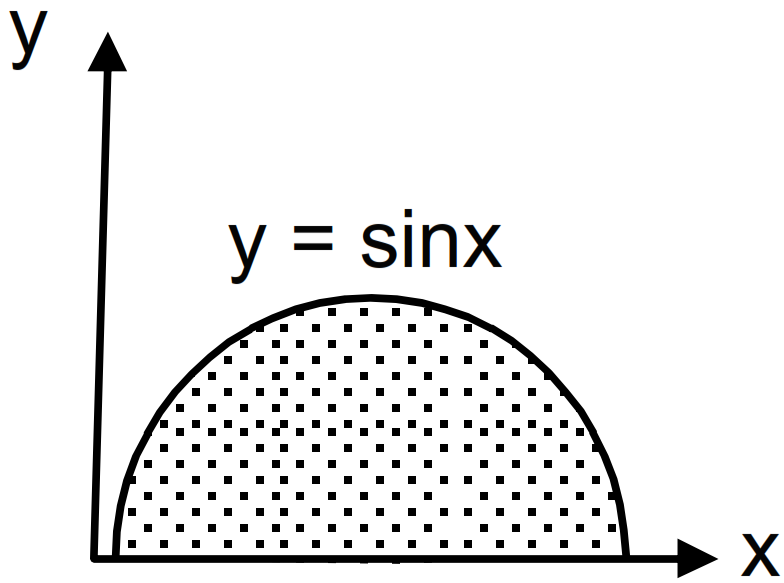
Find the area enclosed by the curve $\text{y}=\sin\text{x}$ and the X-axis between $\text{x}=0$ and $\text{x}=\pi.$
Answer
$\text{Area}=\int\limits^{\text{y}}_{0}\text{dy}=\int\limits^{\pi}_0\sin\text{x dx}=-[\cos\text{x}]^\pi_0=2$
View full question & answer
Question 102 Marks
Suppose $\vec{\text{a}}$ is a vector of magnitude 4.5 unit due north. What is the vector:
  1. $3\vec{\text{a}}$
  2. $-4 \ \vec{\text{a}}?$
Answer
$\vec{\text{a}}$ is a vector of magnitude 4.5 unit due north.
  1. $3|\vec{\text{a}}|=3\times4.5=13.5$
$3 \ \vec{\text{a}}$ is along north having magnitude 13.5 units.
  1. $-4|\vec{\text{a}}|=-4\times1.5=-6\text{ unit}$
$-4 \ \vec{\text{a}}$ is a vector of magnitude 6 unit due south.
View full question & answer
Question 112 Marks
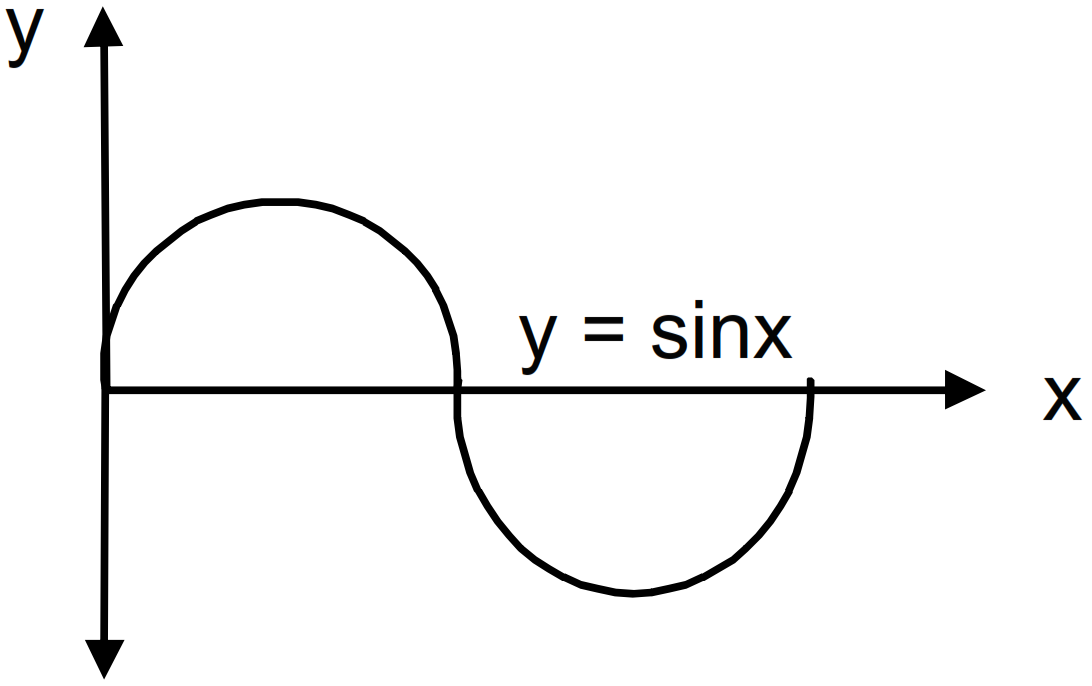
A curve is represented by $\text{y}=\sin\text{x}.$ If x is changed from $\frac{\pi}{3}$ to $\frac{\pi}{3}+\frac{\pi}{100},$ find approximately the change in y.
Answer
$\text{y}=\sin\text{x}$So, $\text{y}+\triangle\text{y}=\sin(\text{x}+\triangle\text{x})$
$\triangle\text{y}=\sin(\text{x}+\triangle\text{x})-\sin\text{x}$
$=\Big(\frac{\pi}{3}+\frac{\pi}{100}\Big)-\sin\frac{\pi}{3}=0.0157$
View full question & answer
Question 122 Marks
The changes in a function y and the independent dy variable x are related as $\frac{\text{dy}}{\text{dx}}=\text{x}^2.$ Find y as a function of x.
Answer
The change in a function of y and the independent variable x are related as $\frac{\text{dy}}{\text{dx}}=\text{x}^2.$$\Rightarrow\text{dy}=\text{x}^2\text{dx}$
Taking integration of both sides,$\int\text{dy}=\int\text{x}^2\text{dx}\Rightarrow\text{y}=\frac{\text{x}^3}{3}+\text{c}$
$\therefore$ y as a function of x is represented by $\text{y}=\frac{\text{x}^3}{3}+\text{c}.$
View full question & answer
Question 132 Marks
Write the number of significant digits in:
  1. 1001
  2. 100.1
  3. 100.10
  4. 0.001001
Answer
The number significant digits:
  1. 1001 No. of significant digits = 4
  2. 100.1 No. of significant digits = 4
  3. 100.10 No. of significant digits = 5
  4. 0.001001 No. of significant digits = 4
View full question & answer
Question 142 Marks
Two vectors have magnitudes 3 unit and 4 unit respectively. What should be the angle between them if the magnitude of the resultant is:
  1. 1 unit.
  2. 5 unit.
  3. 7 unit.
Answer
$|\vec{\text{a}}|=3\text{m},|\vec{\text{b}}|=4$
  1. If R = 1 unit
$\Rightarrow\sqrt{3^2+4^2+2.3.4.\cos\theta}=1$
$\Rightarrow\theta=180^{\circ}$
  1. $\sqrt{3^2+4^2+2.3.4\cos\theta}=5$
$\Rightarrow\theta=90^{\circ}$
  1. $\sqrt{3^2+4^2+2.3.4\cos\theta}=7$
$\Rightarrow\theta=0^{\circ}$
Angle between them is 0°.
View full question & answer
Question 152 Marks
Two vectors have magnitudes 2m and 3m. The angle between them is 60°. Find:
  1. The scalar product of the two vectors.
  2. The magnitude of their vector product.
Answer
$|\vec{\text{a}}|=2\text{m},|\vec{\text{b}}|=3\text{m}$angle between them $\theta=60^{\circ}$
  1. $\vec{\text{a}}.\vec{\text{b}}=|\vec{\text{a}}|.|\vec{\text{b}}|\cos60^{\circ}=2\times3\times\frac{1}{2}=3\text{m}^2$
  2. $|\vec{\text{a}}\times\vec{\text{b}}|=|\vec{\text{a}}|.|\vec{\text{b}}|\sin60^{\circ}=2\times3\times\sqrt{\frac{3}{2}}=3\sqrt{3}\text{ m}^2$
View full question & answer
Question 162 Marks
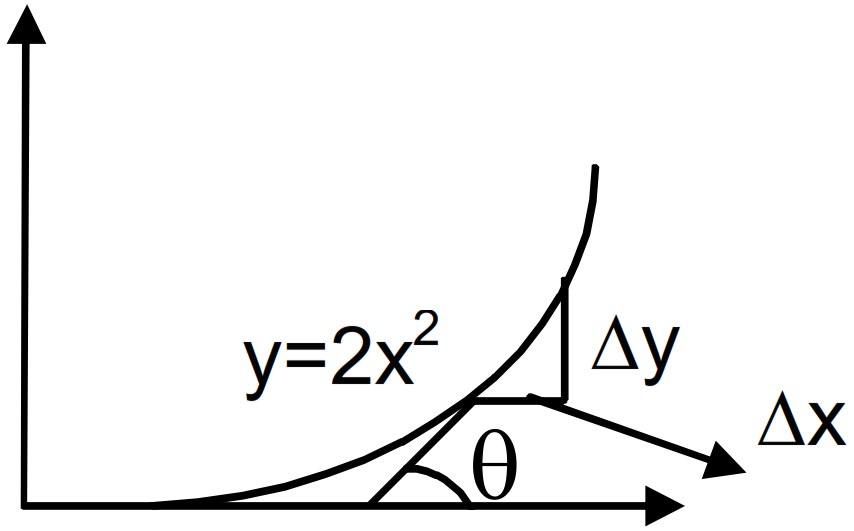
Draw a graph from the following data. Draw tangents at x = 2, 4, 6 and 8. Find the slopes of these tangents. Verify that the curve drawn is $y = 2x^2$ and the slope of dy tangent is $\tan\theta=\frac{\text{dy}}{\text{dx}}=4\text{x}.$
x 1 2 3 4 5 6 7 8 9 10
y 2 8 18 32 50 72 98 128 162 200
Answer
The graph $y = 2x^2$ should be drawn by the student on a graph paper for exact results. To find slope at any point, draw a tangent at the point and extend the line to meet x-axis. Then find $\tan\theta$ as shown in the figure.
It can be checked that,
Slope $=\tan\theta=\frac{\text{dy}}{\text{dx}}=\frac{\text{d}}{\text{dx}}(2\text{x}^2)=4\text{x}$
Where x = the x-coordinate of the point where the slope is to be measured.
View full question & answer
Question 172 Marks
Is it possible to add two vectors of unequal magnitudes and get zero? Is it possible to add three vectors of equal magnitudes and get zero?
Answer
Sum of two vectors can only be zero if they are equal in magnitude and opposite in direction. So no, two vector of unequal magnitude cannot be added to give null vector. Three vectors of equal magnitude and making an angle 120 degrees with each other gives a zero resultant.
View full question & answer
Question 182 Marks
The electric current in a charging R-C circuit is given by $\text{i}=\text{i}_0\text{e}^{-\frac{\text{t}}{\text{RC}}}$ where $\text{i}_0,$ R and C are constant parameters of the circuit and t is time. Find the rate of change of current at
  1. t = 0.
  2. t = RC.
  3. t = 10RC.
Answer
Given that, $\text{i}=\text{i}_0\text{e}^{-\frac{\text{t}}{\text{RC}}}$$\therefore$ Rate of change of current $=\frac{\text{di}}{\text{dt}}=\frac{\text{d}}{\text{dt}}\text{i}_0\text{e}^{-\frac{\text{i}}{\text{RC}}}=\text{i}_0\frac{\text{d}}{\text{dt}}\text{e}^{-\frac{\text{t}}{\text{RC}}}=\frac{-\text{i}_0}{\text{RC}}\times\text{e}^{-\frac{\text{t}}{\text{RC}}}$
  1. When $\text{t}=0,\frac{\text{di}}{\text{dt}}=\frac{-\text{i}}{\text{RC}}$
  2. when $\text{t}=\text{RC},\frac{\text{di}}{\text{dt}}=\frac{-\text{i}}{\text{RCe}}$
  3. when $\text{t}=10\text{RC},\frac{\text{di}}{\text{dt}}=\frac{-\text{i}}{\text{RCe}^{10}}$
View full question & answer
Question 192 Marks
Does the phrase "direction of zero vector" have physical significance? Discuss in terms of velocity, force etc.
Answer
Although the existence of null vector is essential for vector algebra as it acts as the essential additive inverse, there is no physical significance of null vector. Actually its direction is undeterminable.
If a man applies 0 N of force, he is not applying any force so its direction can’t possibly have any physical significance.
View full question & answer
Question 202 Marks
Which of the following two statements is more appropriate?
  1. Two forces are added using triangle rule because force is a vector quantity.
  2. Force is a vector quantity because two forces are added using triangle rule.
Answer
The second statement (b) is more appropriate because The definition of a vector is “A quantity which contains information about both direction and magnitude and obeys laws of vector algebra”. Force will only be defined as a vector quantity if it can be added using triangle rule.
View full question & answer
Question 212 Marks
If $\overrightarrow{\text{A}}\times\overrightarrow{\text{B}}=0,$ can you say that:
  1. $\overrightarrow{\text{A}}=\overrightarrow{\text{B}}$
  2. $\overrightarrow{\text{A}}\neq\overrightarrow{\text{B}}$
Answer
We can’t definitely say either of them is true because the two vectors can have different or same magnitudes but if they are parallel to each other their cross product is always zero.
View full question & answer
Question 222 Marks
Can you add two vectors representing physical quantities having different dimensions? Can you multiply two vectors representing physical quantities having different dimensions?
Answer
Two quantities cannot be added or subtracted if they have different dimensions be it a vector or a scalar quantity. But they can be multiplied or divided, or only multiplied in the case of vectors.
View full question & answer
Question 232 Marks
The electric current in a discharging R-C circuit is given by $\text{i}=\text{i}_0\text{e}^{-\frac{\text{t}}{\text{RC}}}$ where $i_0$, R and C are constant parameters and t is time. Let $\text{i}_0=2.00\text{A},\text{R}=600\times10^5\Omega$ and $\text{C}=0.500\mu\text{F}.$
  1. Find the current at t = 0.3s.
  2. Find the rate of change of current at t = 0.3s.
  3. Find approximately the current at t = 0.31s.
Answer
Equation $\text{i = i}_0\text{e}^{-\frac{\text{t}}{\text{RC}}}$$\text{i}_0=2\text{A, R}=6\times10^{-5}\Omega,\text{C}=0.0500\times10^{-6}\text{F}=5\times10^{-7}\text{F}$
  1. $\text{i}=2\times\text{e}^{\Big(\frac{-0.3}{6\times0^3\times5\times10^{-7}}\Big)}=2\times\text{e}^{\big(\frac{-0.3}{0.3}\big)}=\frac{2}{\text{e}}\text{amp}$
  2. $\frac{\text{di}}{\text{dt}}=\frac{-\text{i}_0}{\text{RC}}\text{e}^{-\frac{\text{t}}{\text{RC}}}$ when t = 0.3
$\sec\Rightarrow\frac{\text{di}}{\text{dt}}=-\frac{2}{0.30}\text{e}^{\big(\frac{-03}{0.3}\big)}=\frac{-20}{3\text{e}}\text{amp/sec}$
  1. At $\text{t}=0.31\text{ sec},\text{i}=2\text{e}^{\big(-\frac{-0.3}{0.3}\big)}=\frac{5.8}{3\text{e}}\text{amp}.$
View full question & answer
Question 242 Marks
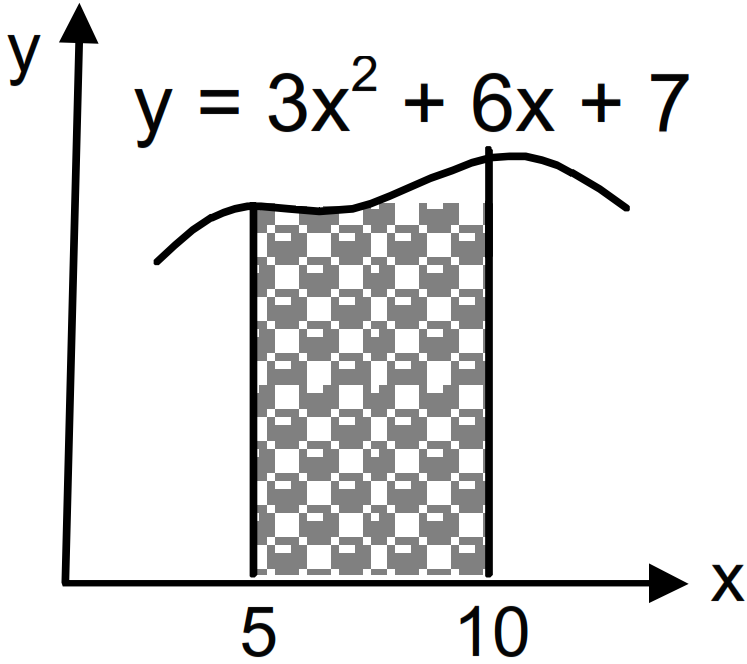
Find the area bounded under the curve $y = 3x^2+ 6x + 7$ and the X-axis with the ordinates at x = 5 and x = 10.
Answer
$y = 3x^2+ 6x + 7$
$\therefore$ Area bounded by the curve, x-axis with coordinates with x = 5 and x = 10 is
given by,$\text{Area}=\int\limits^{\text{y}}_{0}\text{dy}=\int\limits^{10}_5(3\text{x}^2+6\text{x}+7)\text{dx}\\=3\frac{\text{x}^3}{3}\Big]^{10}_5+5\frac{\text{x}^2}{3}\Big]^{10}_5+7\text{x}]^{10}_{5}=1135\text{sq. units}$
View full question & answer
Question 252 Marks
A mosquito net over a 7ft × 4ft bed is 3ft high. The net has a hole at one corner of the bed through which a mosquito enters the net. It flies and sits at the diagonally opposite upper corner of the net.
  1. Find the magnitude of the displacement of the mosquito.
  2. Taking the hole as the origin, the length of the bed as the X-axis, its width as the Y-axis, and vertically up as the Z-axis, write the components of the displacement vector.
Answer
Here the displacement vector $\vec{\text{r}}=7\hat{\text{i}}+4\hat{\text{j}}+3\hat{\text{k}}$
  1. magnitude of displacement $\sqrt{74}\text{ft}$
  2. the components of the displacement vector are 7ft, 4ft and 3ft.
View full question & answer
Question 262 Marks
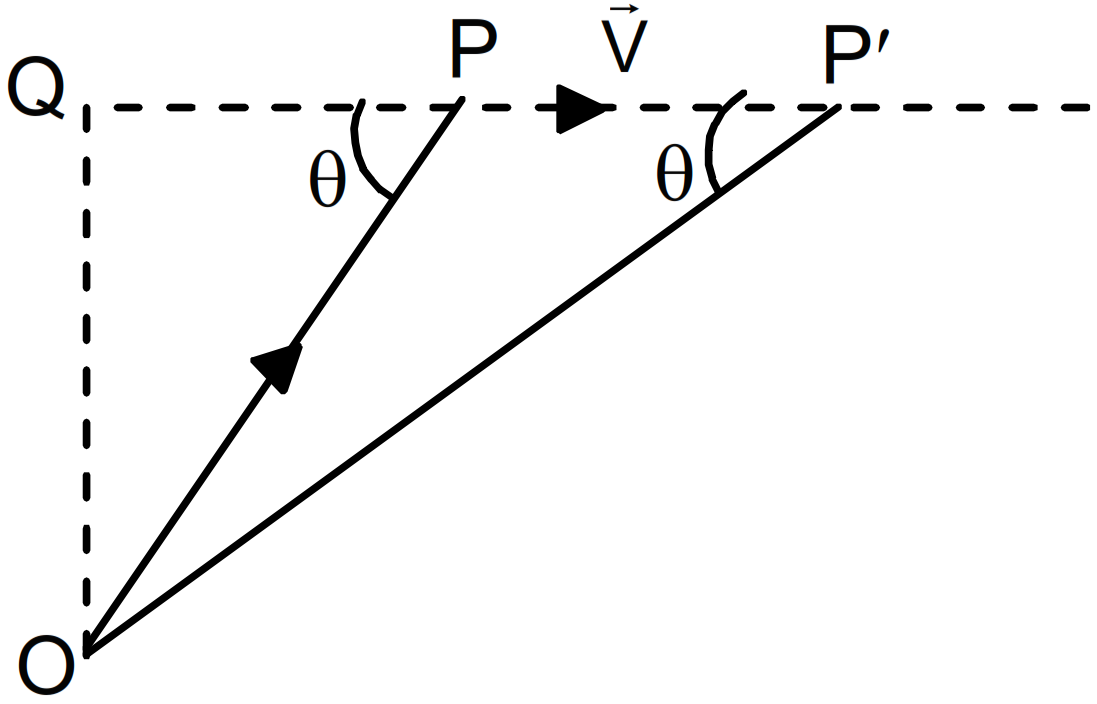
A particle moves on a given straight line with a constant speed v. At a certain time it is at a point P on its straight line path. O is a fixed point. Show that $\overrightarrow{\text{OP}}\times\overrightarrow{\text{v}}$ is independent of the position P.
Answer
The particle moves on the straight line PP’ at speed v. From the figure,$\overrightarrow{\text{OP}}\times\overrightarrow{\text{v}}=(\text{OP})\sin\theta \ \hat{\text{n}}=\text{v(OP)}\sin\theta \ \hat{\text{n}}=\text{v(OQ)} \ \hat{\text{n}}$
It can be seen from the figure, $\text{OQ = OP}\sin\theta=\text{OP}'\sin\theta'$ So, whatever may be the position of the particle, the magnitude and direction of $\overrightarrow{\text{OP}}\times\vec{\text{v}}$ remain constant.$\therefore\overrightarrow{\text{OP}}\times\vec{\text{v}}$ remain constant.
View full question & answer
Question 272 Marks
Is the vector sum of the unit vectors $\vec{\text{i}}$ and $\vec{\text{j}}$ unit vector? If no, can you multiply this sum by a scalar number to get a unit vector?
Answer
No, Their sum has a magnitude of $\sqrt{2},$ so obviously it is not a unit vector. But if we multiply the sum with $\frac{1}{\sqrt{2}}$ it becomes a unit vector.
View full question & answer
Question 282 Marks
Can you add three unit vectors to get a unit vector? Does your answer change if two unit vectors are along the coordinate axes?
Answer
Of course we can add three unit vectors to give a unit vector. An example of this is i, i, -i even If any two unit vectors are along the axes the third vector can so be aligned so that they give a vector of unit magnitude. I will give you an example: i, j, –i.
View full question & answer
Question 292 Marks
Give an example for which $\overrightarrow{\text{A}}.\overrightarrow{\text{B}}=\overrightarrow{\text{C}}.\overrightarrow{\text{B}}$ but $\overrightarrow{\text{A}}\neq\overrightarrow{\text{C}}.$
Answer
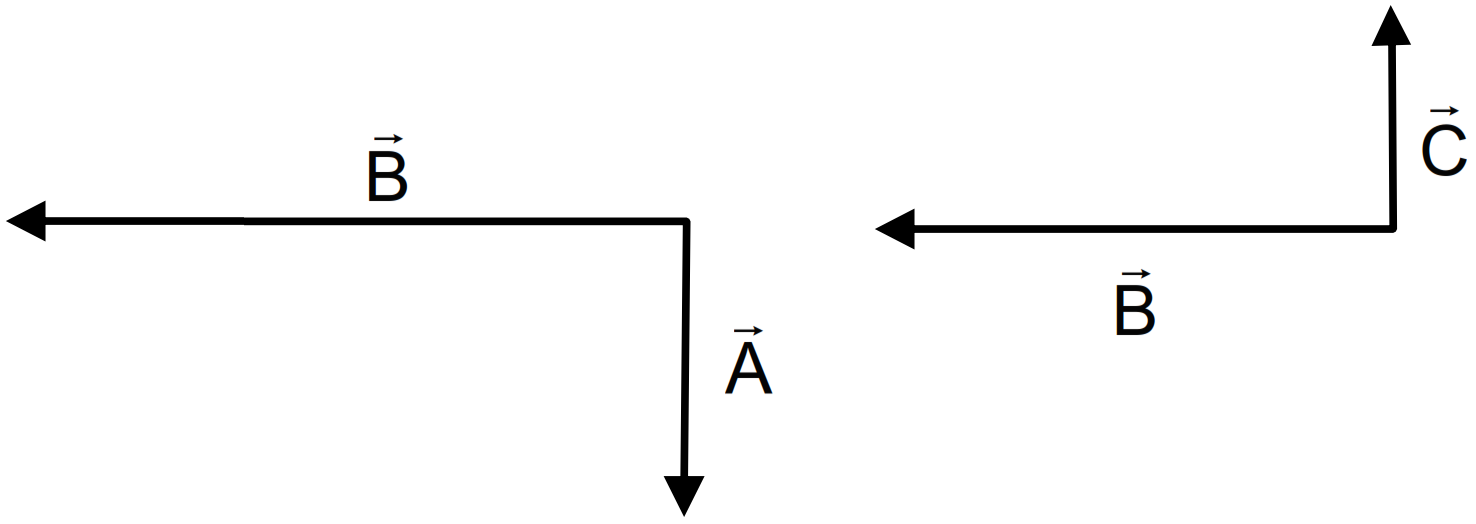
For example, as shown in the figure,$\overrightarrow{\text{A}}\perp\overrightarrow{\text{B}}:\overrightarrow{\text{B}} \ \text{along west}$
$\overrightarrow{\text{B}}\perp\overrightarrow{\text{C}}:\overrightarrow{\text{A}}\text{ along south}$
$\overrightarrow{\text{C}} \text{along north}$
$\overrightarrow{\text{A}}.\overrightarrow{\text{B}}=0$ $\therefore\overrightarrow{\text{A}}.\overrightarrow{\text{B}}=\overrightarrow{\text{B}}.\overrightarrow{\text{C}}$
$\overrightarrow{\text{B}}.\overrightarrow{\text{C}}=0$ But $\overrightarrow{\text{B}}\neq\overrightarrow{\text{C}}$
View full question & answer
Question 302 Marks
Find the area bounded by the curve $y = e^{-x}$, the X-axis and the Y-axis.
Answer
The given function is $y = e^{-x}$ When $x = 0, y = e^{-0}= 1$ x increases, y value deceases and only at $\text{x}=\infty,\text{y} = 0.$ So, the required area can be found out by integrating the function from 0 to $\infty.$ So, $\text{Area}=\int\limits^{\infty}_0\text{e}^{\text{-x}}\text{dx}=-[\text{e}^{-\text{x}}]^{\infty}_0=1.$
View full question & answer
Question 312 Marks
Round the following numbers to 2 significant digits.
  1. 3472
  2. 84.16
  3. 2.55
  4. 28.5
Answer
  1. In the value 3472, after the digit 4, 7 is present. Its value is greater than 5.
So, the next two digits are neglected and the value of 4 is increased by 1.

$\therefore$ value becomes 3500
  1. value = 84.
  2. 2.6.
  3. value is 28.
View full question & answer
Question 322 Marks
Let $\vec{\text{A}}=3\vec{\text{i}}+4\vec{\text{j}}.$ Write four vector $\overrightarrow{\text{B}}$ such that $\overrightarrow{\text{A}}\neq\overrightarrow{\text{B}}$ but A = B.
Answer
This vector A has a magnitude = 5
so take a vector $\overrightarrow{\text{B}}=5\cos\theta\hat{\text{i}}+5\sin\theta\hat{\text{j}}$
Start putting different values of $\theta$ in the above vector you can get as many vector as you want satisfying the condition $\text{A}\neq\text{B}$ but A = B.
View full question & answer
Question 332 Marks
Let $\vec{\text{a}}=4\vec{\text{i}}+3\vec{\text{j}}$ and $\vec{\text{b}}=3\vec{\text{i}}+4\vec{\text{j}}.$ (a) Find the magnitudes of:
  1. $\vec{\text{a}}$
  2. $\vec{\text{b}}$
  3. $\vec{\text{a}}+\vec{\text{b}}$
  4. $\vec{\text{a}}-\vec{\text{b}}$
Answer
$\vec{\text{a}}=4\vec{\text{i}}+3\vec{\text{j}},\vec{\text{b}}=3\vec{\text{i}}+4\vec{\text{j}}$
  1. $|\vec{\text{a}}|=\sqrt{4^2+3^3}=5$
  2. $|\vec{\text{b}}|=\sqrt{9+16}=5$
  3. $|\vec{\text{a}}+\vec{\text{b}}|=|7\vec{\text{i}}+7\vec{\text{j}}|=7\sqrt{2}$
  4. $\vec{\text{a}}-\vec{\text{b}}=(-3+4)\hat{\text{i}}+(-4+3)\hat{\text{j}}=\hat{\text{i}}-\hat{\text{j}}$
$|\vec{\text{a}}-\vec{\text{b}}|=\sqrt{1^2+(-1)^2}=\sqrt{2}.$
View full question & answer