Questions · Page 1 of 8

M.C.Q (1 Marks)

Take a timed test

50 questions · auto-graded multiple-choice test.

MCQ 11 Mark
Assertion : Radio waves can be polarised.
Reason : Sound waves in air are longitudinal in nature.
  • A
     If both assertion and reason are true and the reason is the correct explanation of the assertion.
  •  If both assertion and reason are true but reason is not the correct explanation of the assertion.
  • C
     If assertion is true but reason is false.
  • D
     If the assertion and reason both are false.
Answer
Correct option: B.
 If both assertion and reason are true but reason is not the correct explanation of the assertion.
 If both assertion and reason are true but reason is not the correct explanation of the assertion.
View full question & answer
MCQ 21 Mark
Assertion : Ultraviolet radiation are of higher frequency waves are dangerous to human being.
Reason : Ultraviolet radiation are absorbed by the atmosphere
  • A
     If both assertion and reason are true and the reason is the correct explanation of the assertion.
  •  If both assertion and reason are true but reason is not the correct explanation of the assertion.
  • C
     If assertion is true but reason is false.
  • D
     If the assertion and reason both are false.
Answer
Correct option: B.
 If both assertion and reason are true but reason is not the correct explanation of the assertion.
If both assertion and reason are true but reason is not the correct explanation of the assertion.
View full question & answer
MCQ 31 Mark
A laser beam can be focussed on an area equal to the square of its wavelength A He-Ne laser radiates energy at the rate of 1mW and its wavelength is 632.8 nm. The intensity of focussed beam will be
  • A
     $1.5 \times 10^{13} W / m ^2$
  • $2.5 \times 10^9 W / m ^2$
  • C
     $3.5 \times 10^{17} W / m ^2$
  • D
     None of these
Answer
Correct option: B.
$2.5 \times 10^9 W / m ^2$
 $2.5 \times 10^9 W / m ^2$
View full question & answer
MCQ 41 Mark
Assertion : For cooking in a microwave oven, food is always kept in metal containers.
Reason : The energy of microwave is easily transferred to the food in metal container.
  • A
    If both assertion and reason are true and the reason is the correct explanation of the assertion.
  • B
     If both assertion and reason are true but reason is not the correct explanation of the assertion.
  • C
     If assertion is true but reason is false.
  • If the assertion and reason both are false.
Answer
Correct option: D.
If the assertion and reason both are false.
View full question & answer
MCQ 51 Mark
Assertion : The electrical conductivity of earth’s atmosphere decrease with altitude.
Reason : The high energy particles (i.e. g-rays and cosmic rays) coming from outer space and entering our earth’s atmosphere causes ionisation of the atoms of the gases present there and the pressure of gases decreases with increase in altitude.
  • A
    If both assertion and reason are true and the reason is the correct explanation of the assertion.
  • B
     If both assertion and reason are true but reason is not the correct explanation of the assertion.
  • C
     If assertion is true but reason is false.
  •  If assertion is false but reason is true.
Answer
Correct option: D.
 If assertion is false but reason is true.
 If assertion is false but reason is true.
View full question & answer
MCQ 61 Mark
Assertion : Television signals are received through sky-wave propagation.
Reason : The ionosphere reflects electromagnetic waves of frequencies greater than a certain critical frequency.
  • A
    If both assertion and reason are true and the reason is the correct explanation of the assertion.
  • B
     If both assertion and reason are true but reason is not the correct explanation of the assertion.
  • C
     If assertion is true but reason is false.
  • If the assertion and reason both are false.
Answer
Correct option: D.
If the assertion and reason both are false.
 If the assertion and reason both are false.
View full question & answer
MCQ 71 Mark
Assertion : The cloud in sky generally appear to be whitish.
Reason : Diffraction due to clouds is efficient in equal measure at all wavelengths.
  • A
     If both assertion and reason are true and the reason is the correct explanation of the assertion.
  • B
     If both assertion and reason are true but reason is not the correct explanation of the assertion.
  • If assertion is true but reason is false.
  • D
    If the assertion and reason both are false.
Answer
Correct option: C.
If assertion is true but reason is false.
View full question & answer
MCQ 81 Mark
Assertion : Corpuscular theory fails in explaining the velocities of light in air and water.
Reason : According to corpuscular theory, light should travel faster in denser medium than, in rarer medium.
  •  If both assertion and reason are true and the reason is the correct explanation of the assertion.
  • B
     If both assertion and reason are true but reason is not the correct explanation of the assertion.
  • C
    If assertion is true but reason is false.
  • D
     If the assertion and reason both are false.
Answer
Correct option: A.
 If both assertion and reason are true and the reason is the correct explanation of the assertion.
 If both assertion and reason are true and the reason is the correct explanation of the assertion.
View full question & answer
MCQ 91 Mark
Assertion : Microwave communication is preferred over optical communication.
Reason : Microwaves provide large number of channels and band width compared to optical signals.
  •  If both assertion and reason are true and the reason is the correct explanation of the assertion.
  • B
     If both assertion and reason are true but reason is not the correct explanation of the assertion.
  • C
     If assertion is true but reason is false.
  • D
     If the assertion and reason both are false.
Answer
Correct option: A.
 If both assertion and reason are true and the reason is the correct explanation of the assertion.
If both assertion and reason are true and the reason is the correct explanation of the assertion.
View full question & answer
MCQ 101 Mark
Assertion : Thin films such as soap bubble or a thin layer of oil on water show beautiful colours when illuminated by white light.
Reason : It happens due to the interference of light reflected from the upper surface of the thin film.
  • A
     If both assertion and reason are true and the reason is the correct explanation of the assertion.
  • B
     If both assertion and reason are true but reason is not the correct explanation of the assertion.
  •  If assertion is true but reason is false.
  • D
     If the assertion and reason both are false.
Answer
Correct option: C.
 If assertion is true but reason is false.
 If assertion is true but reason is false.
View full question & answer
MCQ 111 Mark
Assertion : When a tiny circular obstacle is placed in the path of light from some distance, a bright spot is seen at the centre of shadow of the obstacle.
Reason : Destructive interference occurs at the centre of the shadow.
  • A
     If both assertion and reason are true and the reason is the correct explanation of the assertion.
  • B
     If both assertion and reason are true but reason is not the correct explanation of the assertion.
  •  If assertion is true but reason is false.
  • D
     If the assertion and reason both are false.
Answer
Correct option: C.
 If assertion is true but reason is false.
 If assertion is true but reason is false.
View full question & answer
MCQ 121 Mark
Assertion : Coloured spectrum is seen when we look through a muslin cloth.
Reason : It is due to the diffraction of white light on passing through fine slits.
  •  If both assertion and reason are true and the reason is the correct explanation of the assertion.
  • B
     If both assertion and reason are true but reason is not the correct explanation of the assertion.
  • C
     If assertion is true but reason is false.
  • D
     If the assertion and reason both are false.
Answer
Correct option: A.
 If both assertion and reason are true and the reason is the correct explanation of the assertion.
If both assertion and reason are true and the reason is the correct explanation of the assertion.
View full question & answer
MCQ 131 Mark
Assertion : In Young’s experiment, the fringe width for dark fringes is different from that for white fringes.
Reason : In Young’s double slit experiment the fringes are performed with a source of white light, then only black and bright fringes are observed.
  • A
     If both assertion and reason are true and the reason is the correct explanation of the assertion.
  • B
     If both assertion and reason are true but reason is not the correct explanation of the assertion.
  • C
     If assertion is true but reason is false.
  •  If the assertion and reason both are false.
Answer
Correct option: D.
 If the assertion and reason both are false.
 If the assertion and reason both are false.
View full question & answer
MCQ 141 Mark
Assertion : In everyday life the Doppler’s effect is observed readily for sound waves than light waves.
Reason : Velocity of light is greater than that of sound.
  • A
     If both assertion and reason are true and the reason is the correct explanation of the assertion.
  •  If both assertion and reason are true but reason is not the correct explanation of the assertion.
  • C
     If assertion is true but reason is false.
  • D
    If the assertion and reason both are false.
Answer
Correct option: B.
 If both assertion and reason are true but reason is not the correct explanation of the assertion.
If both assertion and reason are true but reason is not the correct explanation of the assertion.
View full question & answer
MCQ 151 Mark
Assertion : The unpolarised light and polarised light can be distinguished from each other by using polaroid.
Reason : A polaroid is capable of producing plane polarised beams of light.
  •  If both assertion and reason are true and the reason is the correct explanation of the assertion.
  • B
     If both assertion and reason are true but reason is not the correct explanation of the assertion.
  • C
    If assertion is true but reason is false.
  • D
    If the assertion and reason both are false.
Answer
Correct option: A.
 If both assertion and reason are true and the reason is the correct explanation of the assertion.
If both assertion and reason are true and the reason is the correct explanation of the assertion.
View full question & answer
MCQ 161 Mark
Assertion : In Young’s double slit experiment, the fringes become indistinct if one of the slits is covered with cellophane paper.
Reason : The cellophane paper decrease the wavelength of light.
  • A
    If both assertion and reason are true and the reason is the correct explanation of the assertion.
  • B
    If both assertion and reason are true but reason is not the correct explanation of the assertion.
  • If assertion is true but reason is false.
  • D
     If the assertion and reason both are false.
Answer
Correct option: C.
If assertion is true but reason is false.
 If assertion is true but reason is false.
View full question & answer
MCQ 171 Mark
Assertion : For best contrast between maxima and minima in the interference pattern of Young’s double slit experiment, the intensity of light emerging out of the two slits should be equal.
Reason : The intensity of interference pattern is proportional to square of amplitude.
  • A
     If both assertion and reason are true and the reason is the correct explanation of the assertion.
  •  If both assertion and reason are true but reason is not the correct explanation of the assertion.
  • C
     If assertion is true but reason is false.
  • D
     If the assertion and reason both are false.
Answer
Correct option: B.
 If both assertion and reason are true but reason is not the correct explanation of the assertion.
 If both assertion and reason are true but reason is not the correct explanation of the assertion.
View full question & answer
MCQ 181 Mark
Assertion : The film which appears bright in reflected system will appear dark in the transmitted light and vice-versa.
Reason : The conditions for film to appear bright or dark in reflected light are just reverse to those in the transmitted light.
  •  If both assertion and reason are true and the reason is the correct explanation of the assertion.
  • B
    If both assertion and reason are true but reason is not the correct explanation of the assertion.
  • C
     If assertion is true but reason is false.
  • D
     If the assertion and reason both are false.
Answer
Correct option: A.
 If both assertion and reason are true and the reason is the correct explanation of the assertion.
If both assertion and reason are true and the reason is the correct explanation of the assertion.
View full question & answer
MCQ 191 Mark
Assertion : Newton’s rings are formed in the reflected system. When the space between the lens and the glass plate is filled with a liquid of refractive index greater than that of glass, the central spot of the pattern is dark.
Reason : The reflection is Newton’s ring cases will be from a denser to a rarer medium and the two interfering rays are reflected under similar conditions.
  • If both assertion and reason are true and the reason is the correct explanation of the assertion.
  • B
    If both assertion and reason are true but reason is not the correct explanation of the assertion.
  • C
    If assertion is true but reason is false.
  • D
     If the assertion and reason both are false.
Answer
Correct option: A.
If both assertion and reason are true and the reason is the correct explanation of the assertion.
 If both assertion and reason are true and the reason is the correct explanation of the assertion.
View full question & answer
MCQ 201 Mark
Assertion : No interference pattern is detected when two coherent sources are infinitely close to each other.
Reason : The fringe width is inversely proportional to the distance between the two slits.
  • A
     If both assertion and reason are true and the reason is the correct explanation of the assertion.
  •  If both assertion and reason are true but reason is not the correct explanation of the assertion.
  • C
    If assertion is true but reason is false.
  • D
     If the assertion and reason both are false.
Answer
Correct option: B.
 If both assertion and reason are true but reason is not the correct explanation of the assertion.
If both assertion and reason are true but reason is not the correct explanation of the assertion.
View full question & answer
MCQ 211 Mark
Assertion : A narrow pulse of light is sent through a medium. The pulse will retain its shape as it travels through the medium.
Reason : A narrow pulse is made of harmonic waves with a large range of wavelengths.
  • A
     If both assertion and reason are true and the reason is the correct explanation of the assertion.
  • B
     If both assertion and reason are true but reason is not the correct explanation of the assertion.
  • C
     If assertion is true but reason is false.
  • If assertion is false but reason is true.
Answer
Correct option: D.
If assertion is false but reason is true.
 If assertion is false but reason is true.
View full question & answer
MCQ 221 Mark
A beam of electron is used in an YDSE experiment. The slit width is d. When the velocity of electron is increased, then
  • A
     No interference is observed
  •  Fringe width increases
  • C
    Fringe width decreases
  • D
    Fringe width remains same
Answer
Correct option: B.
 Fringe width increases
 Fringe width increases
View full question & answer
MCQ 231 Mark
If $I _0$ is the intensity of the principal maximum in the single slit diffraction pattern, then what will be its intensity when the slit width is doubled
  • A
     $I _0$
  • B
     $\frac{ I _0}{2}$
  • C
     $2 I _0$
  •  $4 I _0$
Answer
Correct option: D.
 $4 I _0$
 $4 I _0$
View full question & answer
MCQ 241 Mark
The k line of singly ionised calcium has a wavelength of 393.3 nm as measured on earth. In the spectrum of one of the observed galaxies, this spectral line is located at 401.8 nm. The speed with which the galaxy is moving away from us, will be
  •  6480 km/s
  • B
     3240 km/s
  • C
     4240 km/sec
  • D
     None of these
Answer
Correct option: A.
 6480 km/s
6480 km/s
View full question & answer
MCQ 251 Mark
A beam of natural light falls on a system of 6 polaroids, which are arranged in succession such that each polaroid is turned through 30° with respect to the preceding one. The percentage of incident intensity that passes through the system will be
  • A
    100%
  • B
     50%
  • C
    30%
  • 12%
Answer
Correct option: D.
12%
12%
View full question & answer
MCQ 261 Mark
Assertion : Environmental damage has increased the amount of ozone in the atmosphere.
Reason : Increase of ozone increases the amount of ultraviolet radiation on earth.
  • A
     If both assertion and reason are true and the reason is the correct explanation of the assertion.
  • B
     If both assertion and reason are true but reason is not the correct explanation of the assertion.
  • C
     If assertion is true but reason is false.
  •  If the assertion and reason both are false.
Answer
Correct option: D.
 If the assertion and reason both are false.
If the assertion and reason both are false.
View full question & answer
MCQ 271 Mark
In Young's double slit experiment, if monochromatic light is replaced by white light
  • A
     All bright fringes become white
  • B
     All bright fringes have colours between violet and red
  •  Only the central fringe is white, all other fringes are coloured
  • D
     No fringes are observed
Answer
Correct option: C.
 Only the central fringe is white, all other fringes are coloured
Only the central fringe is white, all other fringes are coloured
View full question & answer
MCQ 281 Mark
Assertion : Short wave bands are used for transmission of ratio waves to a large distance
Reason : Short waves are reflected by ionosphere
  • A
     If both assertion and reason are true and the reason is the correct explanation of the assertion.
  •  If both assertion and reason are true but reason is not the correct explanation of the assertion.
  • C
    If assertion is true but reason is false.
  • D
     If assertion is false but reason is true.
Answer
Correct option: B.
 If both assertion and reason are true but reason is not the correct explanation of the assertion.
If both assertion and reason are true but reason is not the correct explanation of the assertion.
View full question & answer
MCQ 291 Mark
A parallel plate capacitor of plate separation $2$ mm is connected in an electric circuit having source voltage 400 V . if the plate area is $60 cm^2$, then the value of displacement current for $10^{-6} sec$ will be
  • A
     1.062 amp
  •  $1.062 \times 10^{-2} amp$
  • C
     $1.062 \times 10^{-3} amp$
  • D
     $1.062 \times 10^{-4} amp$
Answer
Correct option: B.
 $1.062 \times 10^{-2} amp$
$1.062 \times 10^{-2} amp$
View full question & answer
MCQ 301 Mark
Assertion : In Hertz experiment, the electric vector of radiation produced by the source gap is parallel to the gap.
Reason : Production of sparks between the detector gap is maximum when it is placed perpendicular to the source gap.
  • A
     If both assertion and reason are true and the reason is the correct explanation of the assertion.
  • B
     If both assertion and reason are true but reason is not the correct explanation of the assertion.
  •  If assertion is true but reason is false.
  • D
     If the assertion and reason both are false.
Answer
Correct option: C.
 If assertion is true but reason is false.
 If assertion is true but reason is false.
View full question & answer
MCQ 311 Mark
Assertion : Only microwaves are used in radar.
Reason : Because microwaves have very small wavelength.
  •  If both assertion and reason are true and the reason is the correct explanation of the assertion.
  • B
    If both assertion and reason are true but reason is not the correct explanation of the assertion.
  • C
    If assertion is true but reason is false.
  • D
    If the assertion and reason both are false.
Answer
Correct option: A.
 If both assertion and reason are true and the reason is the correct explanation of the assertion.
 If both assertion and reason are true and the reason is the correct explanation of the assertion.
View full question & answer
MCQ 321 Mark
The ratio of the intensity at the centre of a bright fringe to the intensity at a point one-quarter of the distance between two fringe from the centre is
  •  2
  • B
     1/2
  • C
     4
  • D
     16
Answer
Correct option: A.
 2
2
View full question & answer
MCQ 331 Mark
Among the two interfering monochromatic sources A and B; A is ahead of B in phase by 66°. If the observation be taken from point P, such that PB – PA = l/4. Then the phase difference between the waves from A and B reaching P is
  •  156°
  • B
     140°
  • C
     136°
  • D
     126°
Answer
Correct option: A.
 156°
 156°
View full question & answer
MCQ 341 Mark
White light may be considered to be a mixture of waves with l ranging between 3900 Å and 7800 Å. An oil film of thickness 10,000 Å is examined normally by reflected light. If m = 1.4, then the film appears bright for
  •  4308 Å, 5091 Å, 6222 Å
  • B
     4000 Å, 5091 Å, 5600 Å
  • C
     4667 Å, 6222 Å, 7000 Å
  • D
     4000 Å, 4667 Å, 5600 Å, 7000Å
Answer
Correct option: A.
 4308 Å, 5091 Å, 6222 Å
 4308 Å, 5091 Å, 6222 Å
View full question & answer
MCQ 351 Mark
Assertion : Interference pattern is made by using blue light instead of red light, the fringes becomes narrower.
Reason : In Young’s double slit experiment, fringe width is given by relation $B = \frac{\lambda \mathrm{D}}{\mathrm{d}}$.
  • If both assertion and reason are true and the reason is the correct explanation of the assertion.
  • B
    If both assertion and reason are true but reason is not the correct explanation of the assertion.
  • C
    If assertion is true but reason is false.
  • D
    If the assertion and reason both are false.
Answer
Correct option: A.
If both assertion and reason are true and the reason is the correct explanation of the assertion.
(a) If both assertion and reason are true and the reason is the correct explanation of the assertion.
View full question & answer
MCQ 361 Mark
Light is incident normally on a diffraction grating through which the first order diffraction is seen at $32^\circ$. The second order diffraction will be seen at
  • A
    $ 48^{\circ}$
  • B
    $ 64^{\circ}$
  • C
    $80^{\circ}$
  • There is no second order diffraction in this case
Answer
Correct option: D.
There is no second order diffraction in this case
View full question & answer
MCQ 371 Mark
The ratio of intensities of consecutive maxima in the diffraction pattern due to a single slit is
  • A
     $1: 4: 9$
  • B
     $1: 2: 3$
  •  $1: \frac{4}{9 \pi^2}: \frac{4}{25 \pi^2}$
  • D
     $1: \frac{1}{\pi^2}: \frac{9}{\pi^2}$
Answer
Correct option: C.
 $1: \frac{4}{9 \pi^2}: \frac{4}{25 \pi^2}$
 $1: \frac{4}{9 \pi^2}: \frac{4}{25 \pi^2}$
View full question & answer
MCQ 381 Mark
In a single slit diffraction experiment first minimum for red light (660 nm) coincides with first maximum of some other wavelength l'. The value of l' is
  •  4400 Å
  • B
     6600 Å
  • C
     2000 Å
  • D
     3500 Å
Answer
Correct option: A.
 4400 Å
4400 Å
View full question & answer
MCQ 391 Mark
In a single slit diffraction of light of wavelength I by a slit of width e, the size of the central maximum on a screen at a distance $b$ is
  • A
     $2 b \lambda+e$
  • B
     $\frac{2 b \lambda}{ e }$
  •  $\frac{2 b \lambda}{e}+e$
  • D
     $\frac{2 b \lambda}{e}-e$
Answer
Correct option: C.
 $\frac{2 b \lambda}{e}+e$
$\frac{2 b \lambda}{e}+e$
View full question & answer
MCQ 401 Mark
A circular disc is placed in front of a narrow source. When the point of observation is at a distance of 1 meter from the disc, then the disc covers first HPZ. The intensity at this point is $I _0$. The intensity at a point distance 25 cm from the disc will be
  •  $I _1=0.531 I _0$
  • B
     $I _1=0.053 I _0$
  • C
     $I _1=53 I _0$
  • D
     $I _1=5.03 I _0$
Answer
Correct option: A.
 $I _1=0.531 I _0$
 $I _1=0.531 I _0$
View full question & answer
MCQ 411 Mark
Two coherent sources $S_1$ and $S_2$ are separated by a distance four times the wavelength $l$ of the source. The sources lie along $y$ axis whereas a detector moves along $+ \ x$ axis. Leaving the origin and far off points the number of points where maxima are observed is
  • A
    $2$
  • $3$
  • C
    $4$
  • D
    $5$
Answer
Correct option: B.
$3$
$3$
View full question & answer
MCQ 421 Mark
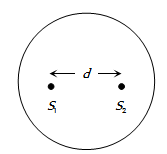
Two coherent sources separated by distance d are radiating in phase having wavelength l. A detector moves in a big circle around the two sources in the plane of the two sources. The angular position of n = 4 interference maxima is given as
  • A
     $\sin ^{-1} \frac{ n \lambda}{ d }$
  •  $\cos ^{-1} \frac{4 \lambda}{d}$
  • C
     $\tan ^{-1} \frac{d}{4 \lambda}$
  • D
     $\cos ^{-1} \frac{\lambda}{4 d}$
Answer
Correct option: B.
 $\cos ^{-1} \frac{4 \lambda}{d}$
$\cos ^{-1} \frac{4 \lambda}{d}$
View full question & answer
MCQ 431 Mark
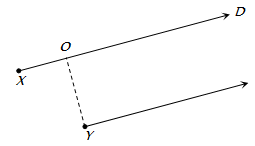
Two point sources X and Y emit waves of same frequency and speed but Y lags in phase behind X by 2pl radian. If there is a maximum in direction D the distance XO using n as an integer is given by
  • A
    $\frac{\lambda}{2}(n-1)$
  • $\lambda(n+1)$
  • C
    $\frac{\lambda}{2}(n+1)$
  • D
    $\lambda(n-1)$
Answer
Correct option: B.
$\lambda(n+1)$
$\lambda(n+1)$
View full question & answer
MCQ 441 Mark
In a double slit arrangement fringes are produced using light of wavelength 4800 Å. One slit is covered by a thin plate of glass of refractive index 1.4 and the other with another glass plate of same thickness but of refractive index 1.7. By doing so the central bright shifts to original fifth bright fringe from centre. Thickness of glass plate is
  • 8 mm
  • B
    6 mm
  • C
     4 mm
  • D
    10 mm
Answer
Correct option: A.
8 mm
8 mm
View full question & answer
MCQ 451 Mark
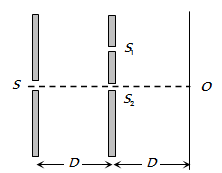
Two ideal slits $\mathrm{S}_1$ and $\mathrm{S}_2$ are at a distance d apart, and illuminated by light of wavelength λ passing through an ideal source slit S placed on the line through $\mathrm{S}_2$​​​​​​​ as shown. The distance between the planes of slits and the source slit is D. A screen is held at a distance D from the plane of the slits. The minimum value of d for which there is darkness at O is
  • A
    $\sqrt{\frac{3 \lambda D }{2}}$
  • B
    $\sqrt{\lambda D}$
  • $\sqrt{\frac{\lambda D }{2}}$
  • D
    $\sqrt{3 \lambda D}$
Answer
Correct option: C.
$\sqrt{\frac{\lambda D }{2}}$
(c) $\sqrt{\frac{\lambda D }{2}}$
View full question & answer
MCQ 461 Mark
In Young's double slit experiment the $y-$ coordinates of central maxima and $10^{th}$ maxima are $2 \ cm$ and $5 \ cm$ respectively. When the $\text{YDSE}$ apparatus is immersed in a liquid of refractive index $1.5$ the corresponding $y-$ coordinates will be
  • A
    $2 \ cm, 7.5 \ cm$
  • B
    $3 \ cm, 6 \ cm$
  • $2 \ cm, 4 \ cm$
  • D
    $4/3 \ cm, 10/3 \ cm$
Answer
Correct option: C.
$2 \ cm, 4 \ cm$
$2 \ cm, 4 \ cm$
View full question & answer
MCQ 471 Mark
In Young’s double slit experiment, the two slits act as coherent sources of equal amplitude A and wavelength l. In another experiment with the same set up the two slits are of equal amplitude A and wavelength l but are incoherent. The ratio of the intensity of light at the mid-point of the screen in the first case to that in the second case is
  • A
     1 : 2
  •  2 : 1
  • C
    4 : 1
  • D
    1 : 1
Answer
Correct option: B.
 2 : 1
 2 : 1
View full question & answer
MCQ 481 Mark
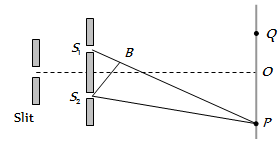
In the figure is shown Young's double slit experiment. Q is the position of the first bright fringe on the right side of O . P is the $11^{\text {th }}$ fringe on the other side, as measured from Q . If the wavelength of the light used is $6000 \times 10^{-10} m$ then $S_1 B$ will be equal to
  •  $6 \times 10^{-6} m$
  • B
     $6.6 \times 10^{-6} m$
  • C
    $3.138 \times 10^{-7} m$
  • D
     $3.144 \times 10^{-7} m$
Answer
Correct option: A.
 $6 \times 10^{-6} m$
$6 \times 10^{-6} m$
View full question & answer
MCQ 491 Mark
The periodic time of rotation of a certain star is $22$ days and its radius is $7 \times 10^8$ metres. If the wavelength of light emitted by its surface be $4320 \mathring A ,$ the Doppler shift will be $(1$ day $= 86400 \sec)$
  • $0.033 \mathring A$
  • B
    $0.33 \mathring A$
  • C
    $3.3 \mathring A$
  • D
    $33 \mathring A$
Answer
Correct option: A.
$0.033 \mathring A$
$0.033 \mathring A$
View full question & answer
MCQ 501 Mark
In hydrogen spectrum the wavelength of $H _\alpha$ line is 656 nm whereas in the spectrum of a distant galaxy, $H _\alpha$ line wavelength is 706 nm . Estimated speed of the galaxy with respect to earth is
  • A
     $2 \times 10^8 m / s$
  •  $2 \times 10^7 m / s$
  • C
     $2 \times 10^6 m / s$
  • D
     $2 \times 10^5 m / s$
Answer
Correct option: B.
 $2 \times 10^7 m / s$
 $2 \times 10^7 m / s$
View full question & answer
M.C.Q (1 Marks) - Physics STD 12 Science Questions - Vidyadip