Question 15 Marks
In $\triangle \text{ABC}, \ \angle \text{B} =60^\circ, \angle \text{C}=40^\circ,\text{AL}\bot \text{BC}$ and $AD$ bisects $\angle \text{A}$ such that $L$ and $D$ lie on side $BC$. Find $\angle \text{LAD}$
Answer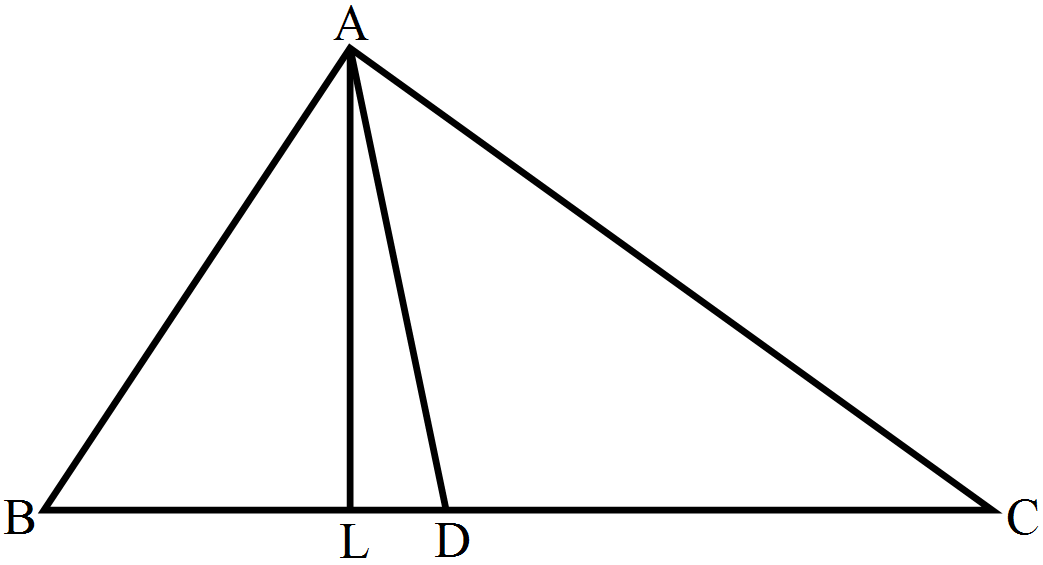
We know that the sum of all angles of a triangle is $180^\circ $
Therefore, for $\triangle \text{ABC},$ we can say that:
$\angle \text{A}+\angle \text{B}+\angle \text{C}=180^\circ$
Or,
$\angle \text{A}+60^\circ+40^\circ=180^\circ$
$\Rightarrow\angle \text{A} =80^\circ$
$\angle \text{DAC}=\frac{\angle \text{A}}{2}$ $(\because $ AD bisects $\angle \text{A})$
$\Rightarrow \angle \text{DAC}=\frac{80^\circ}{2}=40^\circ$
If we use the aboce logic on $\triangle \text{ADC},$ we can say that:
$\angle \text{ADC}+\angle \text{DCA}+\angle \text{DAC}=180^\circ$ $($Sum of all angles of $\triangle \text{ADC})$
$\angle \text{ADC}+40^\circ+40^\circ=180^\circ$
$\angle \text{ADC}=180^\circ-80^\circ=100^\circ$
$\angle \text{ADC}=\angle \text{ALD}+\angle \text{LAD}$ (Exterior angle is equal to the sum of two interior opposite angles)
$100^\circ=90^\circ+\angle \text{LAD}$ (AL perpendicular to $BC)$
$\angle \text{LAD}=90^\circ$ View full question & answer→Question 25 Marks
In Figure, $\triangle \text{ABC}$ is right angled at $A, Q$ and $R$ are points on line $BC$ and $P$ is a point such that $QP$ perpendicular to $AC$ and $RP$ perpendicular to $AB$. Find $\angle \text{P}$
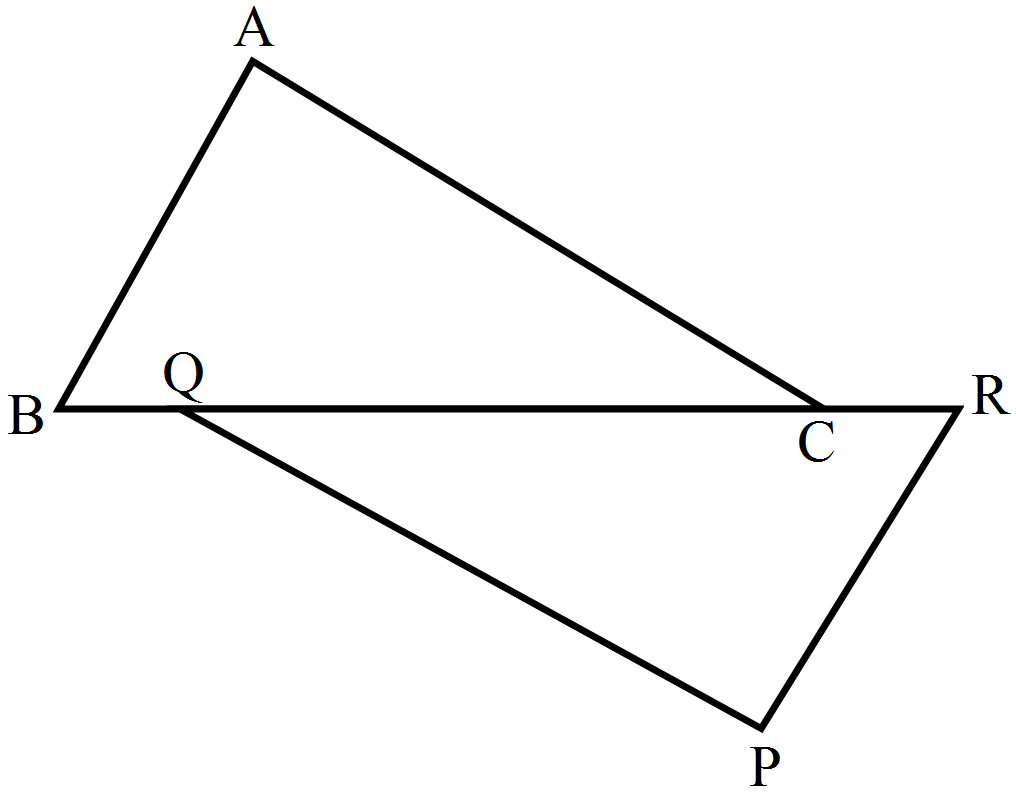
AnswerIn the given triangle, $AC$ parallel to $QP$ and $BR$ cuts $AC$ and $QP$ at $C$ and $Q$, respectively.
$\angle \text{QCA}=\angle \text{CQP}$ (Alternate interior angles)
Because RP parallel to $AB$ and $BR$ cuts $AB$ and $RP$ at $B$ and $R,$
respectively, $\angle \text{ABC}=\angle \text{PRQ}$ (alternate interior angles)
We know that the sum of all three angles of a triangle is $180^\circ $
Hence, for $\triangle \text{ABC},$
we can say that: $\angle \text{ABC}+\angle \text{ACB}+\angle \text{BAC}=180^\circ$
$\angle \text{ABC}+\angle \text{ACB}+90^\circ=180^\circ$ (Right angled at $A)$
$\angle \text{ABC}+\angle \text{ACB}=90^\circ$
Using the same logic for $\triangle \text{PQR},$
we can say that: $\angle \text{PQR}+\angle \text{PRQ}+\angle \text{QPR}=180^\circ$
$\angle \text{ABC}+\angle \text{ACB}+\angle \text{QPR}=180^\circ$
$(\angle \text{ABC}=\angle \text{PRQ} $ and $\angle \text{QCA}=\angle \text{CQP})$
Or, $90^\circ+\angle \text{QPR}=180^\circ$
$(\angle \text{ABC}+\angle \text{ACB}=90^\circ)$
$\angle \text{QPR}=90^\circ$
View full question & answer→Question 35 Marks
Find $x, y, z$ (whichever is required) from the figure given below:
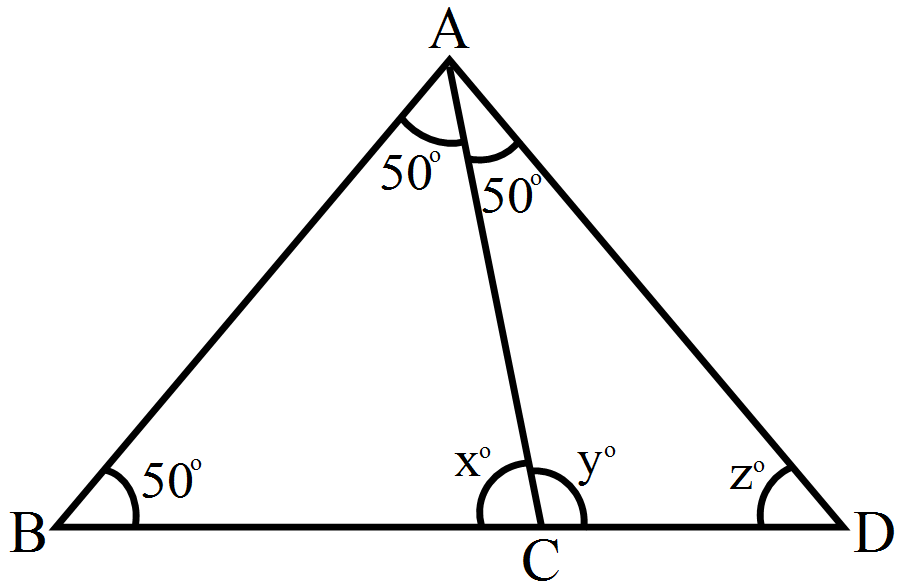
AnswerWe know that the sum of all the angles of a triangle is equal to $180^\circ$
Therefore, for $\triangle \text{ABD}:$
$\angle \text{ABD}+\angle \text{ADB}+\angle \text{BAD}=180^\circ$
$($Sum of the angles of $\triangle \text{ABD})$
$50^\circ + x + 50^\circ = 180^\circ 100^\circ + x = 180^\circ x = 180^\circ - 100^\circ x = 80^\circ $
For $\triangle \text{ABC}:$
$\angle \text{ABC}+\angle \text{ACB}+\angle \text{BAC}=180^\circ$
$($Sum of the angles of $\triangle \text{ABC})$
$50^\circ + z + (50^\circ + 30^\circ ) = 180^\circ 50^\circ + z + 50^\circ + 30^\circ = 180^\circ z = 180^\circ - 130^\circ z = 50^\circ $
Using the same argument for $\triangle \text{ADC}:$
$\angle \text{ADC}+\angle \text{ACD}+\angle \text{DAC}=180^\circ$
$($Sum of the angles of $\triangle \text{ADC})$
$y + z + 30^\circ = 180^\circ y + 50^\circ + 30^\circ = 180^\circ (z = 50^\circ ) y = 180^\circ - 80^\circ y = 100^\circ $
Therefore, we can conclude that the required angles are $80^\circ , 50^\circ $ and $100^\circ $
View full question & answer→Question 45 Marks
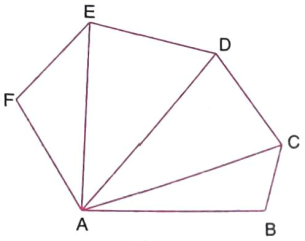
$AC, AD$ and $AE$ are joined. Find. $\angle \text{FAB}+\angle \text{ABC}+\angle \text{BCD}+\angle \text{CDE} +\angle \text{DEF}+\angle \text{EFA}$
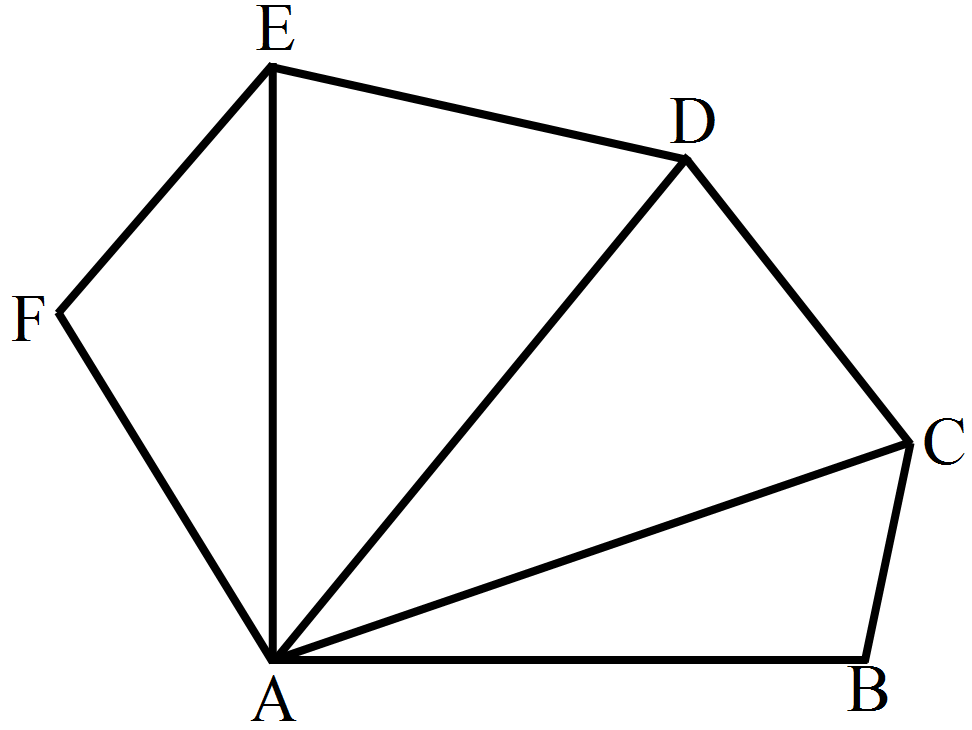
Answer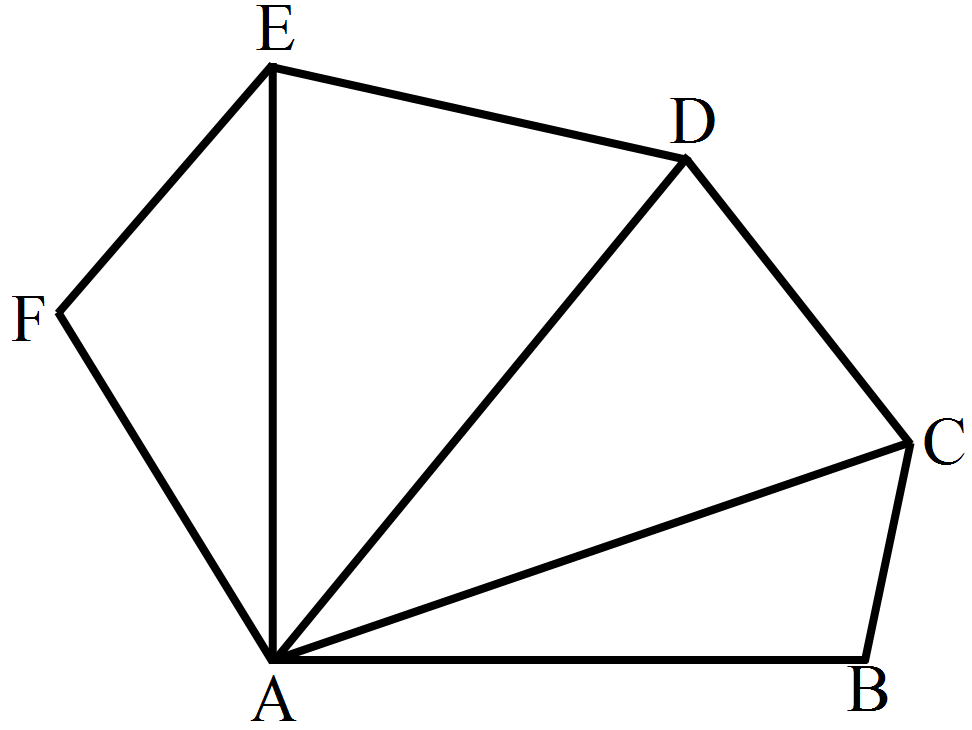
We know that sum of the angles of a triangle is $180^\circ $
Therefore in $\triangle \text{ABC},$ we have $\angle \text{CAB}+\angle \text{ABC}+\angle \text{BCA}=180^\circ...(\text{i})$ In $\triangle \text{ACD},$ we have $\angle \text{DAC}+\angle \text{ACD}+\angle \text{CDA}=180^\circ...(\text{ii})$ In $\triangle \text{ADE},$ we have $\angle \text{EAD}+\angle \text{ADE}+\angle \text{DEA}=180^\circ...(\text{iii})$ In, $\triangle \text{AEF},$ we have $\angle \text{FAE}+\angle \text{AEF}+\angle \text{EFA}=180^\circ...(\text{iv})$ Adding $(i), (ii), (iii), (iv)$
we get $\angle \text{CAB}+\angle \text{ABC}+\angle \text{BCA}+\angle \text{DAC}+\angle \text{ACD}$
$+\angle \text{CDA}+\angle \text{AD}+\angle \text{ADE}+\angle \text{DEA}+\angle \text{FAE}$
$+\angle \text{AEF}+\angle \text{EFA}=720^\circ$ Therefore $\angle \text{FAB}+\angle \text{ABC}+\angle \text{BCD}$
$+\angle \text{CDE}+\angle \text{DEF}+\angle \text{EFA}=720^\circ$ View full question & answer→Question 55 Marks
Find $x, y, z$ (whichever is required) from the figure given below:
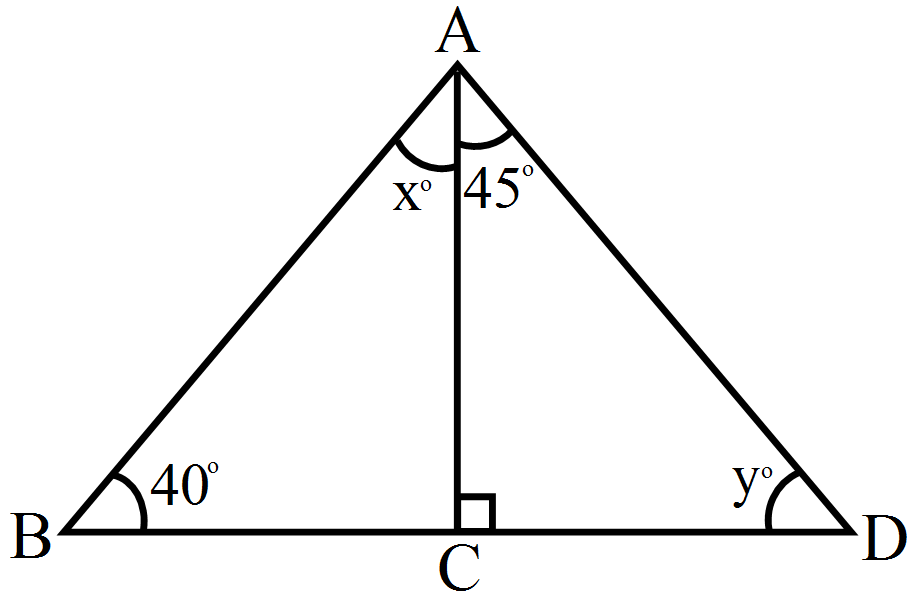
AnswerWe can see that in $\triangle \text{ADC}, \angle \text{ADC}$ is equal to $90^\circ $
$(\triangle \text{ADC}$ is a right triangle$)$
We also know that the sum of all the angles of a triangle is equal to $180^\circ $
Which means: $45^\circ + 90^\circ + y = 180^\circ $
$($Sum of the angles of $\triangle \text{ADC})$
$135^\circ + y = 180^\circ $
$y = 180^\circ - 135^\circ $
$y = 45^\circ $
We can also say that in $\triangle \text{ABC},\angle \text{ABC}+\angle \text{ACB}+\angle \text{BAC}$ is equal to $180^\circ $
$($Sum of the angles of $\triangle \text{ABC})$
$40^\circ + y + (x + 45^\circ ) = 180^\circ $
$40^\circ + 45^\circ + x + 45^\circ = 180^\circ (y = 45^\circ )$
$x = 180^\circ - 130^\circ $
$x = 50^\circ $
Therefore, we can say that the required angles are $45^\circ $ and $50^\circ $
View full question & answer→Question 65 Marks
Explain the concept of interior and exterior angle and in the figures given below. Find x and y. 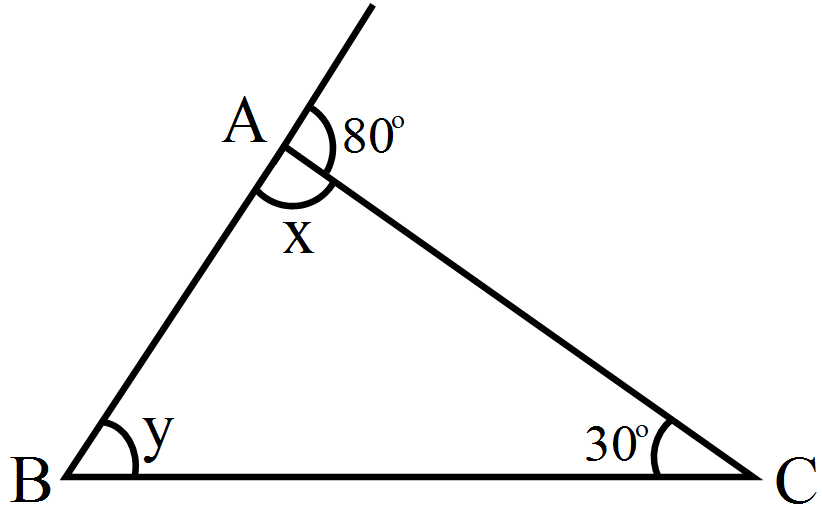
Answer The interior angles of a triangle are the three angle elements inside the triangle.
The exterior angles are formed by extending the sides of a triangle, and if the side of a triangle is produced, the exterior angle so formed is equal to the sum of the two interior opposite angles.
Using these definitions, we will obtain the values of x and y.
x + 80º = 180º (Linear pair)
x = 100º
In $\triangle \text{ABC}:$
x + y+ 30° = 180° (Angle sum property)
100° + 30° + y = 180°
y = 50°
View full question & answer→Question 75 Marks
If each angle of a triangle is less than the sum of the other two, show that the triangle is acute angled.
AnswerLet the three angles of the triangle be $\angle \text{a}, \angle \text{b}$ and $\angle \text{c}$
We know: $\angle \text{a}<\angle \text{b}+\angle \text{c}....(\text{i})$
(Given) Which means: $\angle \text{b}<\angle \text{a}+\angle \text{c}$
Or, $\angle \text{c}<\angle \text{a}+\angle \text{b}$
We also know that the sum of all the angles of a triangle is equal to $180^\circ $
Which means: $\angle \text{a}+\angle \text{b}+\angle \text{c}=180^\circ$
Or, $\angle \text{b}+\angle \text{c}=180^\circ-\angle \text{a}$
Putting the value of $\angle \text{b}+\angle \text{c}$ in equation $(i):$
$\angle \text{a}<180^\circ-\angle \text{a}$
$\Rightarrow 2\angle \text{a}<180^\circ$
$\angle \text{a}<90^\circ$ Similary: $\angle \text{b}<90^\circ$
$\angle \text{c}<90^\circ$
Hence, we can conclude that the given triangle is an acute triangle.
View full question & answer→Question 85 Marks
In $\angle \text{ABC}, \angle \text{A}=60^\circ,\ \angle \text{B}=80^\circ, $ and the bisectors of $\angle \text{B}$ and $\angle \text{C},$ meet at $O$. Find.
$i. \angle \text{C}$
$ii. \angle \text{BOC}$
Answer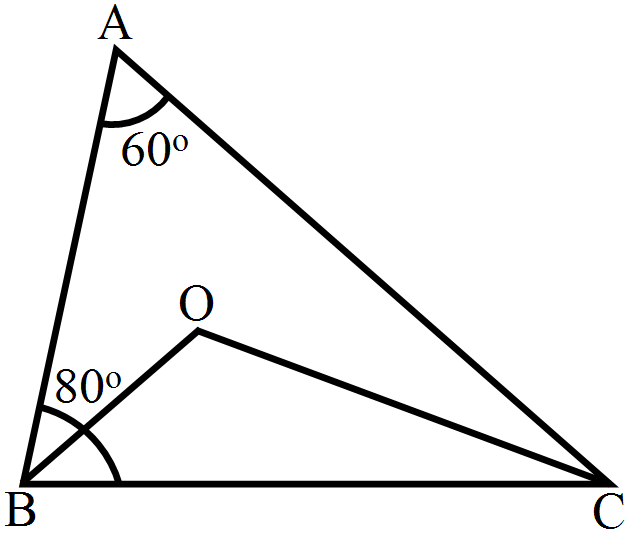
We know that the sum of all three angles of a triangle is $180^\circ $
Hence, for $\triangle \text{ABC},$ we can say that:
$\angle \text{A}+\angle \text{B}+\angle \text{C}=180^\circ ($Sum of angles of $\triangle \text{ABC})$
$60^\circ+80^\circ+\angle \text{C}=180^\circ$
$\angle \text{C}=180^\circ-140^\circ$
$\angle \text{C}=40^\circ$
For $\angle \text{OBC},$
$\angle \text{OBC}=\angle \text{B}2=\frac{80}{2} (OB$ bisects $\angle \text{B})$
$\angle \text{OBC}=40^\circ$
$\angle \text{OCB}=\angle \text{C}2=\frac{40}{2} (OC$ bisects $\angle \text{C})$
$\angle \text{OCB}=20^\circ$
If we apply the above logic to this triangle, we can say that:
$\angle \text{OCB}+\angle \text{OBC}+\angle \text{BOC}=180^\circ$ $($Sum of angles of $\triangle \text{OBC})$
$20^\circ+40^\circ+\angle \text{BOC}=180^\circ$
$\angle \text{BOC}=180^\circ-60^\circ$
$\angle \text{BOC}=120^\circ$ View full question & answer→Question 95 Marks
Find $x, y, z$ (whichever is required) from the figure given below:
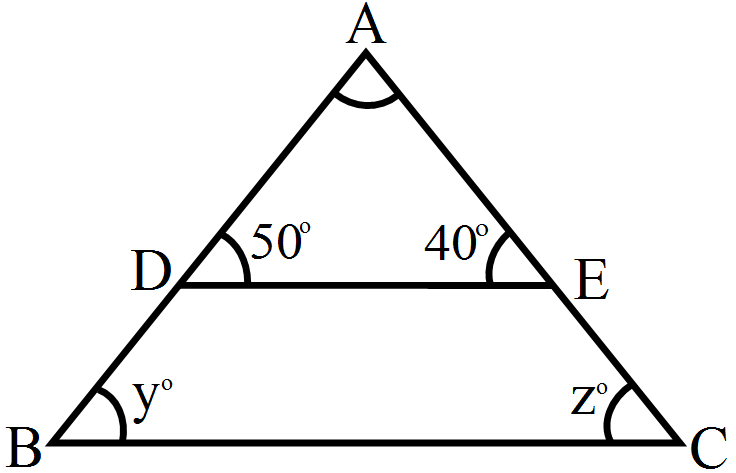
AnswerIn $\triangle \text{ABC}$ and $\triangle \text{ADE}$
we have: $\angle \text{ADE}=\angle \text{ABC}$ (Corresponding angles) $\text{y}=50^\circ$
Also, $\angle \text{AED}=\angle \text{ACB}$ (Corresponding angles) $\text{z}=40^\circ$
We know that the sum of all the three angles of Which means: $x + 50^\circ + 40^\circ = 180^\circ $
Which means: $x + 50^\circ + 40^\circ = 180^\circ $
$($Angles of $\triangle \text{ADE})$
$x = 180^\circ - 90^\circ x = 90^\circ $
Therefore, we can conclude that the required angles are $50^\circ , 40^\circ $ and $90^\circ $
View full question & answer→Question 105 Marks
The side $BC$ of $\triangle \text{ABC}$ is produced to a point $D$. The bisector of $\angle \text{A}$ meets side $BC$ in $L$. If $\angle \text{ABC}= 30^\circ$ and $\angle \text{ACD}=115^\circ,$ find $\angle \text{ALC}$
Answer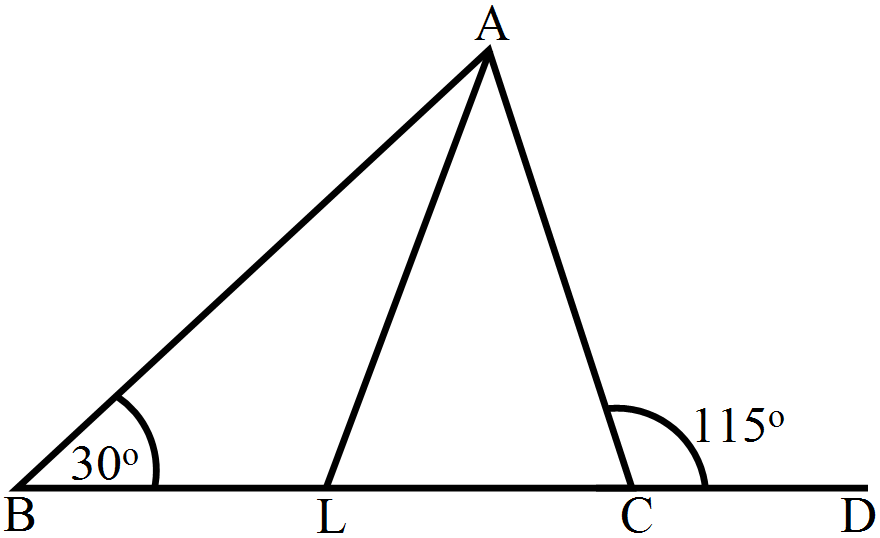
$\angle \text{ACD}$ and $\angle \text{ACL}$ make a linear pair
$\angle \text{ACD}+\angle \text{ACB}=180^\circ$
$115^\circ+\angle \text{ACB}=180^\circ$
$\angle \text{ACB}=180^\circ-115^\circ$
$\angle \text{ACB}=65^\circ$
We know that the sum of all angles of a triangle is 180°
Therefore, for $\triangle \text{ABC}, $ we can say that:
$\angle \text{ABC}+\angle \text{BAC}+\angle \text{ACB}=180^\circ$
$30^\circ+\angle \text{BAC}+65^\circ=180^\circ$
Or,
$\angle \text{BAC}=85^\circ$
$\angle \text{LAC}=\frac{\angle \text{BAC}}{2}=\frac{85}{2}$
Using the above rule for $\triangle \text{ALC},$ we can say that:
$\angle \text{ALC}+\angle \text{LAC}+\angle \text{ACL}=180^\circ$
$\angle \text{ALC}+\frac{82^\circ}{2}+65^\circ=180^\circ$ $(\angle \text{ACL}=\angle \text{ACB})$
Or,
$\angle \text{ALC}=180^\circ-\frac{85^\circ}{2}-65^\circ$
$\angle \text{ALC}=\frac{145^\circ}{2}=72\frac{1}{2}^\circ$ View full question & answer→Question 115 Marks
Find $x, y, z$ (whichever is required) from the figure given below:
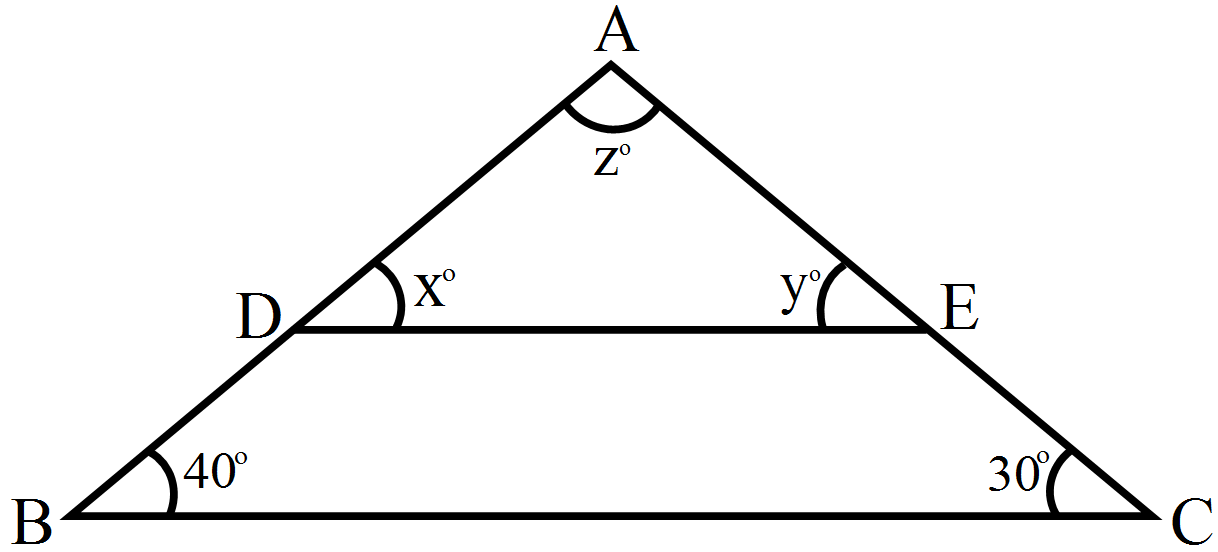
AnswerIn $\triangle \text{ABC}$ and $\triangle \text{ADE}$
we have: $\angle \text{ADE}=\angle \text{ABC}$ (Corresponding angles) $\text{x}=40^\circ$
$\angle \text{AED}=\angle \text{ACB}$ (Corresponding angles) $\text{y}=30^\circ$
We know that the sum of all the three angles of a triangle is equal to $180^\circ x + y + z = 180^\circ $
$($Angles of $\triangle \text{ADE})$
Which means: $40^\circ + 30^\circ + z = 180^\circ z = 180^\circ - 70^\circ z = 110^\circ $
Therefore, we can conclude that the three angles of the given triangle are $40^\circ , 30^\circ $ and $110^\circ $
View full question & answer→Question 125 Marks
The foot of a ladder is $6\ m$ away from a wall and its top reaches a window $8\ m$ above the ground. If the ladder is shifted in such a way that its foot is $8\ m$ away from the wall, to what height does its top reach?
Answer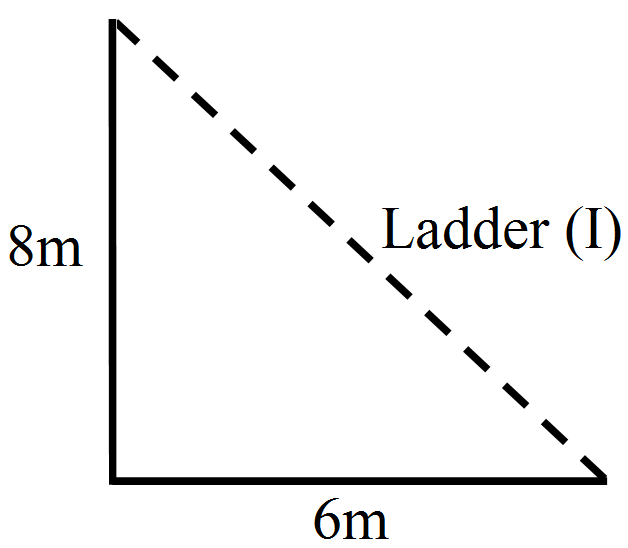
Given Let the length of the ladder be $L m$.
By using the Pythagoras theorem, we can find the length of the ladder.
$6^2+8^2=L^2$
$L^2=36+64=100$
$L=10$
Thus, the length of the ladder is $10 m ..$
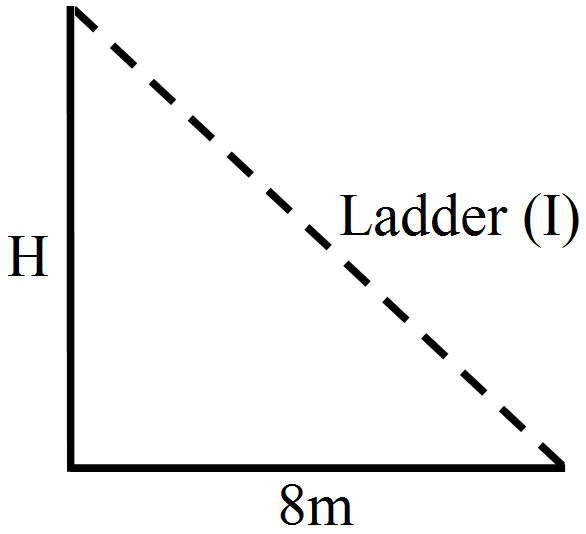
When the ladder is shifted:
Let the height of the ladder after it is shifted be H m .
By using the Pythagoras theorem, we can find the height of the ladder after it is shifted.
$8^2+H^2=10^2$
$H^2=100-64$
$=36$
$H=6$
Thus, the height of the ladder is $6 m .$ View full question & answer→Question 135 Marks
The bisectors of the acute angles of a right triangle meet at $O$. Find the angle at $O$ between the two bisectors.
Answer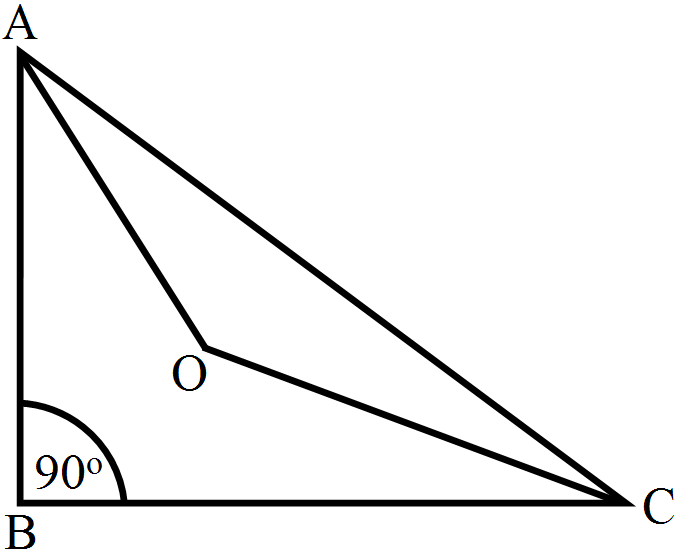
We know that the sum of all three angles of a triangle is $180^\circ $
Hence, for $\triangle \text{ABC},$ we can say that:
$\angle \text{A}+\angle \text{B}+\angle \text{C}=180^\circ$
$\angle \text{A}+90^\circ+\angle \text{C}=180^\circ$
$\angle \text{A}+\angle \text{C}=180^\circ-90^\circ$
$\angle \text{A}+\angle \text{C}=90^\circ$
For $\triangle \text{OAC}:$
$\angle \text{OAC}=\angle \text{A}2$ (OA bisects $LA)$
$\angle \text{OCA}=\angle \text{C}2$ (OC bisects $LC)$
On applying the above logic to $\triangle \text{OAC},$ we get:
$\angle \text{AOC}+\angle \text{OAC}+\angle \text{OCA}=180^\circ$ $($Sum of angles of $\angle \text{AOC})$
$\angle \text{AOC}+\angle \text{A}2+\angle \text{C}2=180^\circ$
$\angle \text{AOC}+\angle \text{A}+\angle \text{C}2=180^\circ$
$\angle \text{AOC}+\frac{90}{2}=180^\circ$
$\angle \text{AOC}=180^\circ-45^\circ$
$\angle \text{AOC}=135^\circ$ View full question & answer→Question 145 Marks
In $\triangle \text{ABC}, \angle \text{ABC}=100^\circ, \angle \text{BAC}=35^\circ$ and $\text{BD}\bot \text{AC}$ meets side $AC$ in $D$. If $BD = 2\ cm$, find $\angle \text{C},$ and length $DC.$
Answer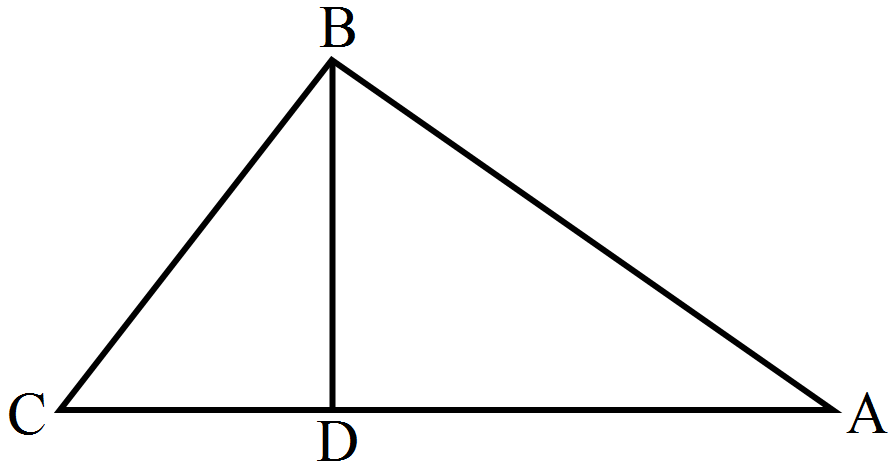
We know that the sum of all angles of a triangle is $180^\circ $
Therefore, for the given $\triangle \text{ABC},$
we can say that: $\angle \text{ABC}+\angle \text{BAC}+\angle \text{ACB}=180^\circ$
$100^\circ+35^\circ+\angle \text{ACB}=180^\circ$
$\angle \text{ACB}=180^\circ-135^\circ$
$\angle \text{ACB}=45^\circ$
$\angle \text{C}=45^\circ$ If we apply the above rule on $\triangle \text{BCD},$
we can say that: $\angle \text{BCD}+\angle \text{BDC}+\angle \text{CBD}=180^\circ$
$45^\circ+90^\circ+\angle \text{CBD}=180^\circ$
$(\angle \text{ACD}=\angle \text{BCD}$ and $BD$ parallel to AC$)$
$\angle \text{CBD}=180^\circ-135^\circ$
$\angle \text{CBD}=45^\circ$
We know that the sides opposite to equal angles have equal length. Thus, $BD = DC DC = 2cm$ View full question & answer→Question 155 Marks
Explain the concept of interior and exterior angle and in the figures given below. Find $x$ and $y.$
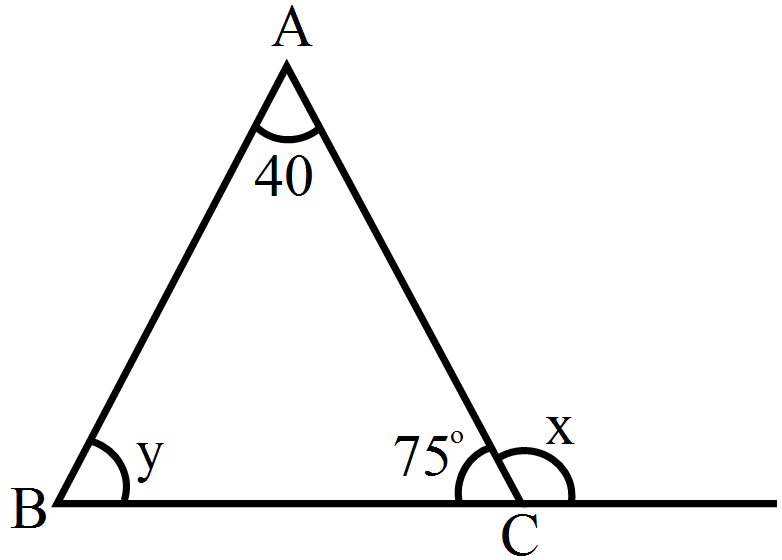
AnswerThe interior angles of a triangle are the three angle elements inside the triangle.
The exterior angles are formed by extending the sides of a triangle, and if the side of a triangle is produced, the exterior angle so formed is equal to the sum of the two interior opposite angles.
Using these definitions, we will obtain the values of $x$ and $y.$
From the given figure, we can see that:
$\angle \text{ACB}+\text{x}=180^\circ$ (Linear pair)'
$75^\circ+\text{x}=180^\circ$
Or,
$\text{x}=105^\circ$
We know that the sum of all angles of a triangle is $180^\circ $
Therefore, for $\triangle \text{ABC},$ we can say that:
$\angle \text{BAC}+\angle \text{ABC}+\angle \text{ACB}=180^\circ$
$40^\circ+\text{y}+75^\circ=180^\circ$
Or,
$\text{y}=65^\circ$
View full question & answer→Question 165 Marks
In a $\triangle \text{ABC},$ AD is the altitude from $A$ such that $AD = 12\ cm. BD = 9\ cm$ and $DC = 16\ cm$. Examine if $\triangle \text{ABC},$ is right angled at $A.$
Answer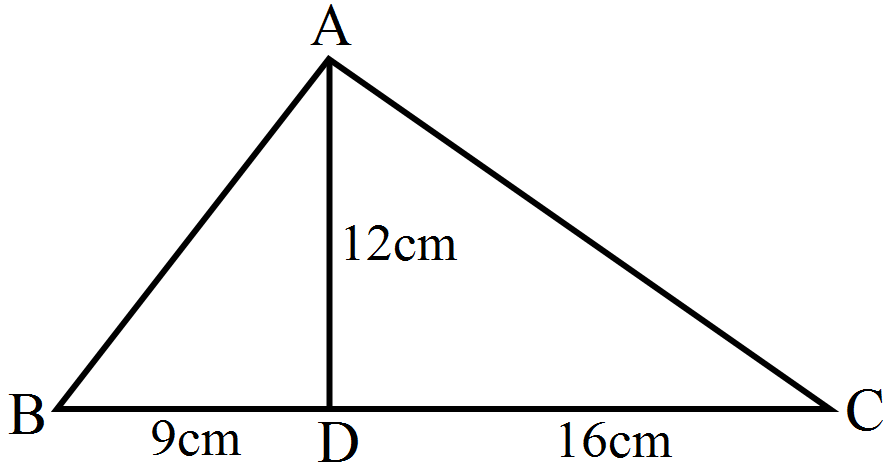
In $\triangle ADC$,
$\angle ADC =90^{\circ}$ ( $AD$ is an altitude on $BC )$
Using the Pythagoras theorem, we get:
$12^2+16^2=A C^2$
$AC^2=144+256$
$=400$
$AC=20 cm$
$\text { In } \triangle ADB$
$\angle ADB=90^{\circ}$
(AD is an altitude on $B C$ )
Using the Pythagoras theorem, we get:
$12^2+9^2=A B^2$
$A B^2=144+81$
$=225$
$A B=15 cm$
In $\triangle ABC$,
$BC^2=25^2=625$
$AB^2+AC^2$
$=15^2+20^2$
$=625$
$A B^2+A C^2=B C^2$
Because it satisfies the Pythagoras theorem, we can say that $\triangle A B C$, is right angled at $A$. View full question & answer→Question 175 Marks
In Figure, measures of some angles are indicated. Find the value of $x.$
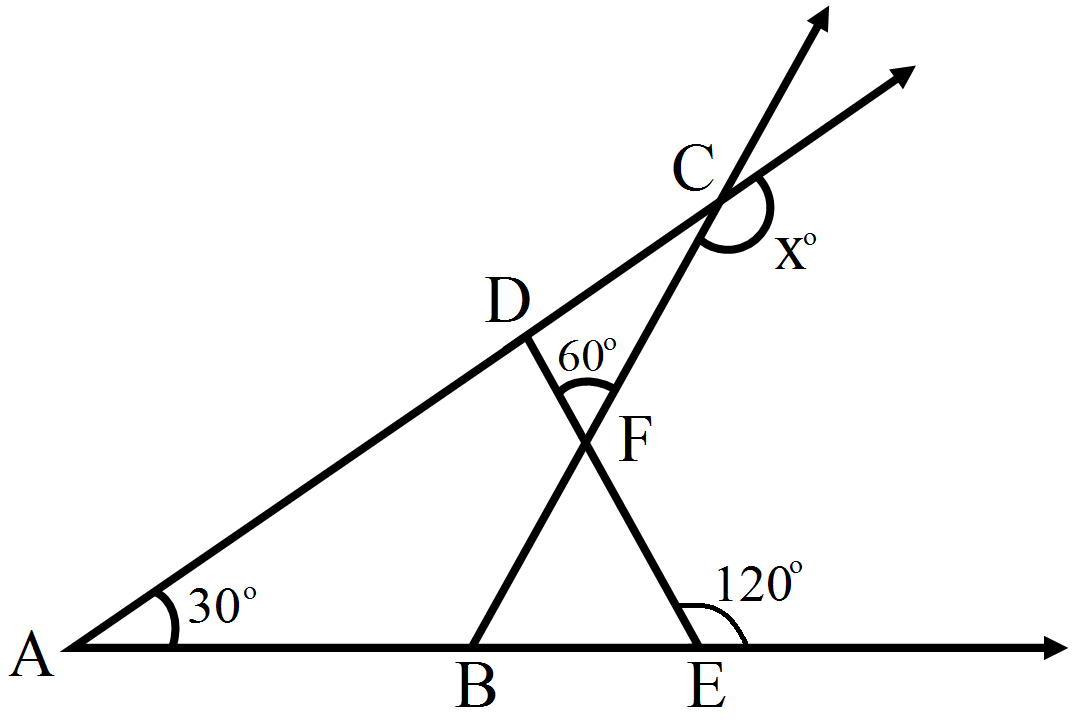
AnswerHere,
$\angle \text{AED}+120^\circ=180^\circ$ (Linear pair)
$\angle \text{AED}=180^\circ-120^\circ$
$=60^\circ$
We know that the sum of all angles of a triangle is $180^\circ $
Therefore, for $\triangle \text{ADE},$ we can say that:
$\angle \text{ADE}+\angle \text{AED}+\angle \text{DAE}=180^\circ$
$60^\circ+\angle \text{ADE}+30^\circ=180^\circ$
Or,
$\angle \text{ADE}=180^\circ-60^\circ-30^\circ$
$=90^\circ$
From the given figure, we can also say that:
$\angle \text{FDC}+90^\circ=180^\circ$ (Linear pair)
$\angle \text{FDC}=180^\circ-90^\circ=90^\circ$
Using the above rule for $\triangle \text{CDF},$ we can say that:
$\angle \text{CDF}+\angle \text{DCF}+\angle \text{DFC}=180^\circ$
$90^\circ+\angle \text{DCF}+60^\circ=180^\circ$
$\angle \text{DCF}=180^\circ-60^\circ-90^\circ$
$=30^\circ$
Also,
$\angle \text{DCF}+\text{x}=180^\circ$ (Linear pair)
$30^\circ+\text{x}=180^\circ$
Or,
$\text{x}=180^\circ-30^\circ$
$=150^\circ$
View full question & answer→Question 185 Marks
Explain the concept of interior and exterior angle and in the figures given below. Find $x$ and $y.$
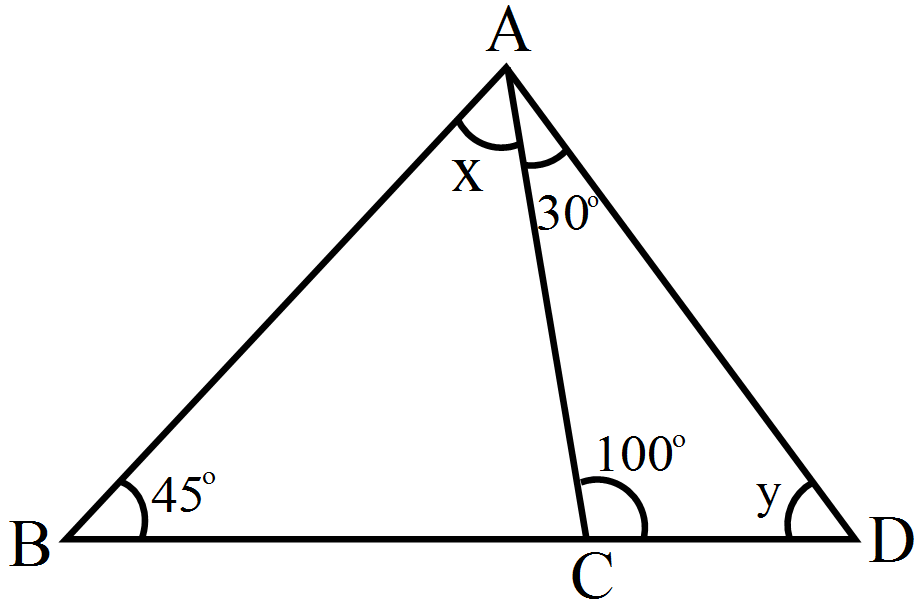
AnswerThe interior angles of a triangle are the three angle elements inside the triangle.
The exterior angles are formed by extending the sides of a triangle, and if the side of a triangle is produced, the exterior angle so formed is equal to the sum of the two interior opposite angles. Using these definitions, we will obtain the values of $x$ and $y.$
We know that the sum of all angles of a triangle is $180^\circ $
Therefore, for $\triangle \text{ACD},$ we can say that: $30^\circ+100^\circ+\text{y}=180^\circ$ Or, $\text{y}= 50^\circ$
$\angle \text{ACB}+100^\circ=180^\circ$
$\angle \text{ACB}=80^\circ...(\text{i})$ Using the above rule for $\triangle \text{ACD},$ we can say that: $x + 45^\circ + 80^\circ = 180^\circ x = 55^\circ $
View full question & answer→Question 195 Marks
Explain the concept of interior and exterior angle and in the figures given below. Find $x$ and $y.$
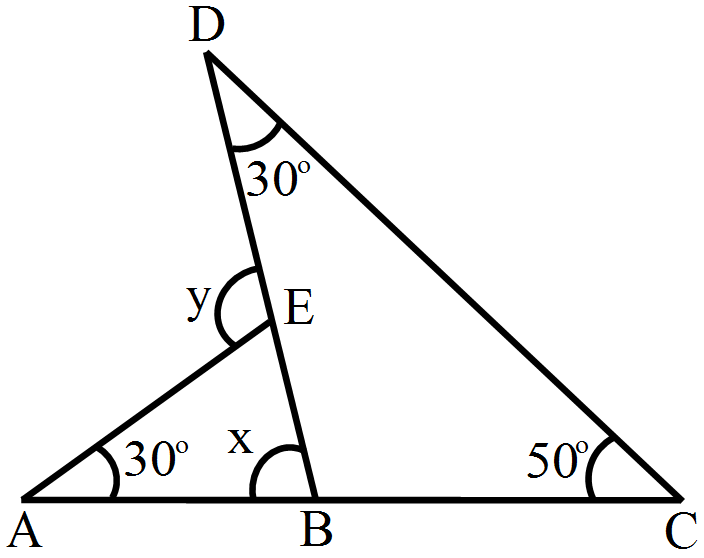
AnswerThe interior angles of a triangle are the three angle elements inside the triangle.
The exterior angles are formed by extending the sides of a triangle, and if the side of a triangle is produced, the exterior angle so formed is equal to the sum of the two interior opposite angles.
Using these definitions, we will obtain the values of $x$ and $y.$
We know that the sum of all angles of a triangle is $180^\circ $
Therefore, for $\triangle \text{DBC},$ we can say that:
$30^\circ+50^\circ+\angle \text{DBC}=180^\circ$
$\angle \text{DBC}=100^\circ$
$\text{x}+\angle \text{DBC}=180^\circ$ (Linear pair)
$\text{x}=80^\circ$
And,
$y = 30^\circ + 80^\circ $ (Exterior angle property)
$= 110^\circ $
View full question & answer→Question 205 Marks
In Figure, $\text{ABC}$ is a right triangle right angled at $A. D$ lies on $BA$ produced and $DE$ perpendicular to $BC$ intersecting $AC$ at $F$. If $\angle \text{AFE}=130^\circ,$ find.
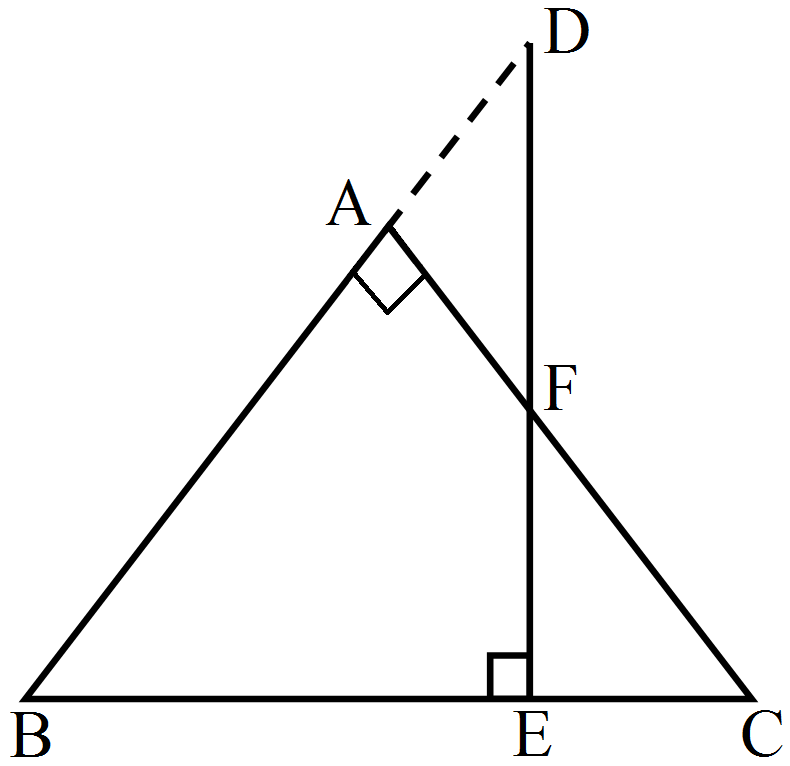
$i. \angle \text{BDE}$
$ii. \angle \text{BCA}$
$iii. \angle \text{ABC}$ Answer$i.$ Here,
$\angle \text{BAF}+\angle \text{FAD}=180^\circ ($Linear pair$)$
$\angle \text{FAD}=180^\circ-\angle \text{BAF}$
$=180^\circ-90^\circ$
$=90^\circ$
Also,
$\angle \text{AFE}=\angle \text{ADF}+\angle \text{FAD} ($Exterior angle property$)$
$\angle \text{ADF}+90^\circ=130^\circ$
$\angle \text{ADF}=130^\circ-90^\circ$
$=40^\circ$
$ii.$ We know that the sum of all the angles of a triangle is $180^\circ $
Therefore, for $\triangle \text{BDE},$ we can say that:
$\angle \text{BDE}+\angle \text{BED}+\angle \text{DBE}=180^\circ$
$\angle \text{DBE}=180^\circ-\angle \text{BDE }\angle \text{BED}$
$=180^\circ-90^\circ-40^\circ$
$=50^\circ...(\text{i})$
Also, $\angle \text{FAD}=\angle \text{ABC}+\angle \text{ACB} ($Exterior angle property$)$
$90^\circ=50^\circ+\angle \text{ACB}$
Or, $\angle \text{ACB}=90^\circ-50^\circ$
$=40^\circ$
$iii. \angle \text{ABC}=\angle \text{DBE}=50^\circ [$From $(i)]$
View full question & answer→Question 215 Marks
In $\triangle \text{ABC}, \angle \text{A}=50^\circ$ and $BC$ is produced to a point $D$. The bisectors of $\angle \text{ABC}$ and $\angle \text{ACD}$ meet at $E$. Find $\angle \text{E}$
Answer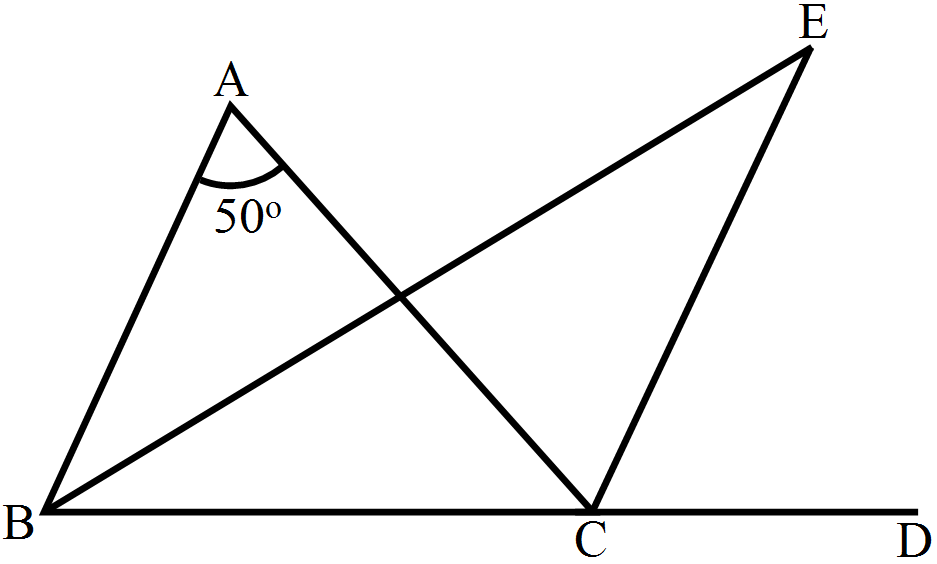 In
In
the given triangle,
$\angle \text{ACD}=\angle \text{A}+\angle \text{B}$ (Exterior angle is equal to the sum of two opposite interior angles.)
We know that the sum of all three angles of a triangle is $180^\circ $
Therefore, for the given triangle, we can say that:
$\angle \text{ABC}+\angle \text{BCA}+\angle \text{CAB}=180^\circ$
$($Sum of all angles of $\angle \text{ABC})$
$\angle \text{A}+\angle \text{B}+\angle \text{BCA}=180^\circ$
$\angle \text{BCA}=180^\circ-(\angle \text{A}+\angle \text{B})$
$\angle \text{ECA}=\frac{\angle \text{ACD}}{2}$
$($EC bisects $\angle \text{ACD})$
$\angle \text{ECA}=\frac{\angle \text{A}+\angle \text{B}}{2}$
$(\angle \text{ACD}=\angle \text{A}+\angle \text{B})$
$\angle \text{EBC}=\frac{\angle \text{ABC}}{2}=\frac{\angle \text{B}}{2}$
$($EB bisects $\angle \text{ABC})$
$\angle \text{ECB}=\angle \text{ECA}+\angle \text{BCA}$
$\angle \text{ECB}=\frac{\angle \text{A}+\angle \text{B}}{2}+180^\circ-(\angle \text{A}+\angle \text{B})$
If we use the same logic for $\angle \text{EBC},$ we can say that:
$\angle \text{EBC}+\angle \text{ECB}+\angle \text{BEC}=180^\circ$
$($Sum of all angles of $\triangle \text{EBC})$
$\frac{\angle \text{B}}{2}+\frac{\angle \text{A}+\angle \text{B}}{2}+180^\circ-(\angle \text{A}+\angle \text{B})+\angle \text{BEC}=180^\circ$
$\angle \text{BEC}=\angle \text{A}+\angle \text{B}-\Big(\frac{\angle \text{A}+\angle \text{B}}{2}-\frac{\angle \text{B}}{2}\Big)$
$\angle \text{BEC}=\frac{\angle \text{A}}{2}$
$\angle \text{BEC}=\frac{50^\circ}{2}$
$=25^\circ$ View full question & answer→Question 225 Marks
$D$ is a point on the side $BC$ of $ \triangle \text{ABC}.$ $A$ line $PDQ$ through $D$, meets side $AC$ in $P$ and $AB$ produced at $Q$. If $\angle \text{A}=80^\circ, \angle \text{ABC}=60^\circ$ and $\angle \text{PDC} = 15^\circ,$ find. $\angle \text{AQD}$ $\angle \text{APD}$
Answer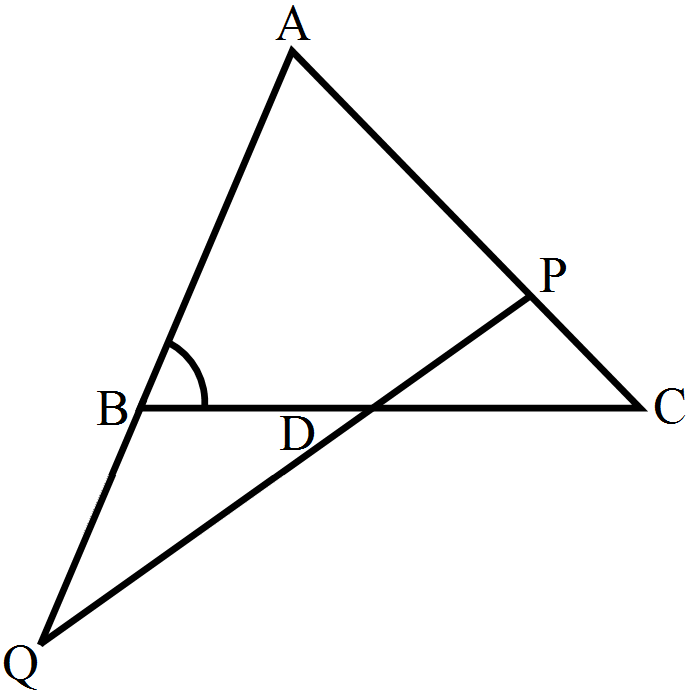
$\angle \text{ABD}$ and $\angle \text{QBD}$ form a linear pair
$\angle \text{ABC}+\angle \text{QBC}=180^\circ$
$=60^\circ+\angle \text{QBC}=180^\circ$
$\angle \text{QBC}=120^\circ$
$\angle \text{PDC}=\angle \text{BDQ}$ (Vertically opposite angles)
$\angle \text{BDQ}=75^\circ$
In $\triangle \text{QBD}:$
$\angle \text{QBD}+\angle \text{QDB}+\angle \text{BDQ}=180^\circ$ $($Sum of angles of $\triangle \text{QBD})$
$120^\circ+15^\circ+\angle \text{BQD}=180^\circ$
$\angle \text{BQD}=180^\circ-135^\circ$
$\angle \text{BQD}=45^\circ$
$\angle \text{AQD}=\angle \text{BQD}=45^\circ$
In $\triangle \text{AQP}:$
$\angle \text{QAP}+\angle \text{AQP}+\angle \text{APQ}=180^\circ$ $($Sum of angles of $\triangle\text{AQP})$
$80^\circ+45^\circ+\angle \text{APQ}=180^\circ$
$\angle \text{APQ}=55^\circ$
$\angle \text{APD}=\angle \text{APQ}$ View full question & answer→Question 235 Marks
In $\triangle \text{ABC}, \angle \text{A}=50^\circ, \angle \text{B}=70^\circ$ and bisector of $\angle \text{C}$ meets $AB$ in $D$. Find the angles of the triangles $ADC$ and $BDC.$
Answer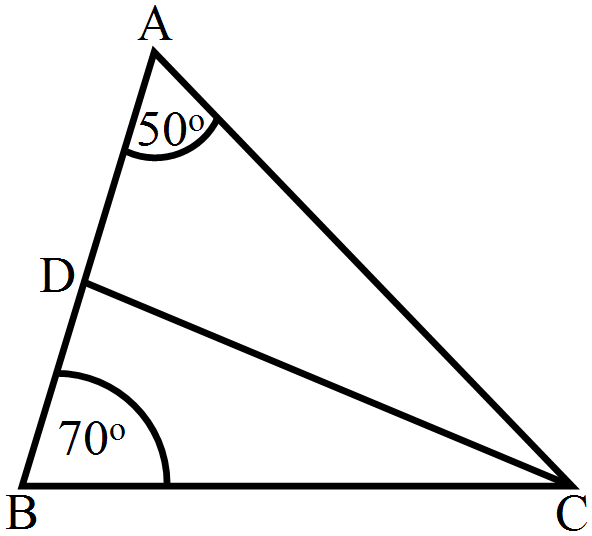
We know that the sum of all three angles of a triangle is equal to $180^\circ $
Therefore, for the given $\triangle \text{ABC},$ we can say that:
$\angle \text{A}+\angle \text{B}+\angle \text{C}=180^\circ$
$($Sum of angles of $\triangle \text{ABC})$
$\Rightarrow 50^\circ+70^\circ+\angle \text{C}=180^\circ$
$\angle \text{C}=180^\circ-120^\circ$
$\angle \text{C}=60^\circ$
$\angle \text{ACD}=\angle \text{BCD}=\frac{\angle \text{C}}{2}$ (CD bisects $\angle \text{C}$ and meets $AB$ is $D.)$
$\Rightarrow \angle \text{ACD}=\angle \text{BCD}=\frac{60^\circ}{2}=30^\circ$
Using the same logic for the given $\triangle \text{ACD},$ we can sat that:
$\angle \text{DAC}+\angle \text{ACD}+\angle \text{ADC}=180^\circ$
$\Rightarrow 50^\circ+30^\circ+\angle \text{ADC}=180^\circ$
$\angle \text{ADC}=180^\circ-80^\circ$
$\angle \text{ADC}=100^\circ$
If we use the same logic for the given $\triangle \text{BCD},$ we can say that:
$\angle \text{DBC}+\angle \text{BCD}+\angle \text{BDC}=180^\circ$
$\Rightarrow 70^\circ+30^\circ+\angle \text{BDC}=180^\circ$
$\angle \text{BDC}=180^\circ-100^\circ$
$\angle \text{BDC}=80^\circ$
Thus,
For $\triangle \text{ADC}:\angle \text{A}=50^\circ, \ \angle \text{D}=100^\circ, \ \angle \text{C}=30^\circ$
For $\triangle \text{BDC}:\angle \text{B}=70^\circ, \ \angle \text{D}=80^\circ, \ \angle \text{C}=30^\circ$ View full question & answer→Question 245 Marks
In $\triangle \text{ABC},$ if $3\angle \text{A}=4\angle \text{B}=6\angle \text{C},$ calculate the angles.
Answercalculate the angles. calculate the angles $3\angle \text{A}=6\angle \text{C}$
$\angle \text{A}=2\angle \text{C} ...(\text{i})$ We also know that for the same triangle, $4\angle \text{B}=6\angle \text{C}$
$\angle \text{B}=\frac{6}{4}\angle \text{C}...(\text{ii})$
We know that the sum of all three angles of a triangle is $180^\circ$
Therefore, we can say that: $\angle \text{A}+\angle \text{B}+\angle \text{C}=180^\circ$
$($Angles of $\triangle \text{ABC})...(\text{iii})$ On putting the values of $\angle \text{A}$ and $\angle \text{B}$ in equation $(iii),$
we get: $2\angle \text{C}+\Big(\frac{6}{4}\Big)\angle \text{C}+\angle \text{C}=180^\circ$
$\Big(\frac{18}{4}\Big)\angle \text{C}=180^\circ$
$\angle \text{C}=40^\circ$ From equation $(i),$
we have: $\angle \text{A}=2\angle \text{C}=2\times 40$
$\angle \text{A}=80^\circ$ From equation $(ii),$
we have: $\angle \text{B}=\Big(\frac{6}{4}\Big)\angle \text{C}=\Big(\frac{6}{4}\Big)\times40^\circ$
$\angle \text{B}=60^\circ$
$\angle \text{A}=80^\circ, \angle \text{B}=60^\circ, \angle \text{C}=40^\circ$ Therefore, the three angles of the given triangle are $80^\circ , 60^\circ $, and $40^\circ $
View full question & answer→Question 255 Marks
In Fig, $P$ is the point on the side $BC$. Complete each of the following statements using symbol $'=\ ’,\ ’ >\ '$ or $‘<\ ‘$ so as to make it true:
$i. AP… AB+ BP$
$ii. AP… AC + PC$
$iii. \text{AP}...\frac{1}{2}(\text{AB}+\text{AC}+\text{BC})$
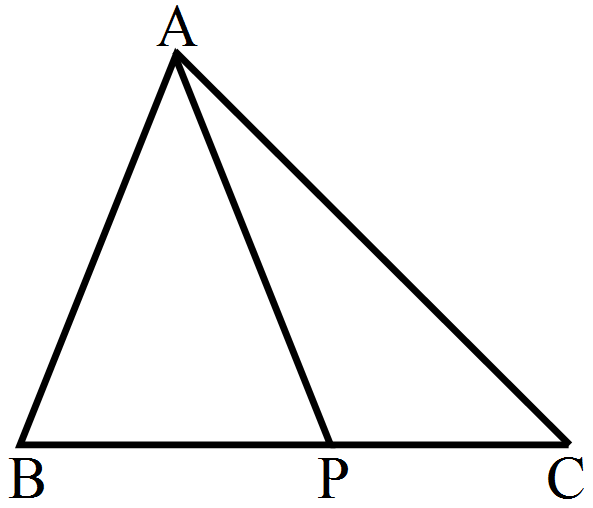
Answer$i.$ In triangle $\text{APB, AP < AB + BP}$ because the sum of any two sides of a triangle is greater than the third side.
$ii.$ In triangle $\text{APC, AP < AC + PC}$ because the sum of any two sides of a triangle is greater than the third side.
$iii. \text{AP < 12(AB + AC + BC)}$ In triangles $\text{ABP}$ and $\text{ACP}$, we can see that:
$\text{AP < AB + BP}…(i) ($Because the sum of any two sides of a triangle is greater than the third side$)$
$\text{AP < AC + PC}…(ii) ($Because the sum of any two sides of a triangle is greater than the third side$)$
On adding $(i)$ and $(ii)$, we have:
$\text{AP + AP < AB + BP + AC + PC}$
$\text{2AP < AB + AC + BC (BC = BP + PC)}$
$\text{AP}<\frac{1}{2}(\text{AB}+\text{AC}+\text{BC})$
View full question & answer→Question 265 Marks
Draw a triangle $A B C$, with $A C=4 cm, B C=3 cm$ and $\angle C =80^{\circ}$. Measure $A B$.
Is $(A B)^2=(A C)^2+(B C)^2$ ? If not, which one of the following is true:
$(A B)^2>(A C)^2+(B C)^2$ or $(A B)^2<(A C)^2+(B C)^2 ?$
AnswerNo, $A B^2< A C^2+B C^2$
View full question & answer→Question 275 Marks
Draw a triangle $A B C$, with $A C=4 cm, B C=3 cm$ and $\angle C =105^{\circ}$. Measure $A B$.
Is $(A B)^2=(A C)^2+(B C)^2$ ? If not, which one of the following is true:
$(A B)^2>(A C)^2+(B C)^2 \text { or }(A B)^2<(A C)^2+(B C)^2 ?$
AnswerNo, $A B^2>\left(A C^2+B C^2\right)$
View full question & answer→Question 285 Marks
In a $\triangle A B C, \angle A B C=100^{\circ}, \angle B A C=35^{\circ}$ and $B D \perp A C$ meets' side $A C$ in $D$. If $B D=2 cm$, find $\angle C$ and length $D C$.
View full question & answer→Question 295 Marks
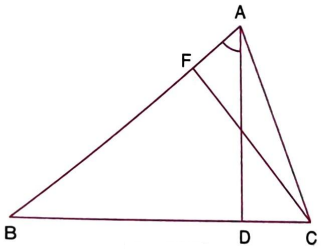
In Fig., $A D$ and $C F$ are respectively perpendiculars to sides $B C$ and $A B$ of $\triangle A B C$. If $\angle F C D=50^{\circ}$, find $\angle B A D$.
View full question & answer→Question 305 Marks
In Fig., the sides $B C, C A$ and $B A$ of a $\triangle A B C$ have been produced to $D, E$ and $F$ respectively. If $\angle A C D=105^{\circ}$ and $\angle E A F=45^{\circ}$; find all the angles of the $\triangle A B C$.
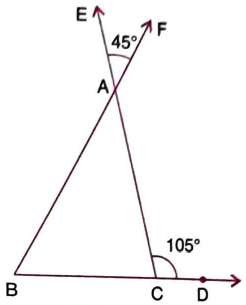
Answer$\angle A=45^{\circ} ; \angle C=75^{\circ} ; \angle B=60^{\circ}$
View full question & answer→Question 315 Marks
In a triangle, an exterior angle at a vertex is $95^{\circ}$ and its one of the interior opposite angles is $55^{\circ}$. Find all the angles of the triangle.
Answer$55^{\circ}, 40^{\circ}, 85^{\circ}$
View full question & answer→Question 325 Marks
Compute the value of $x$ in each of the following figures:
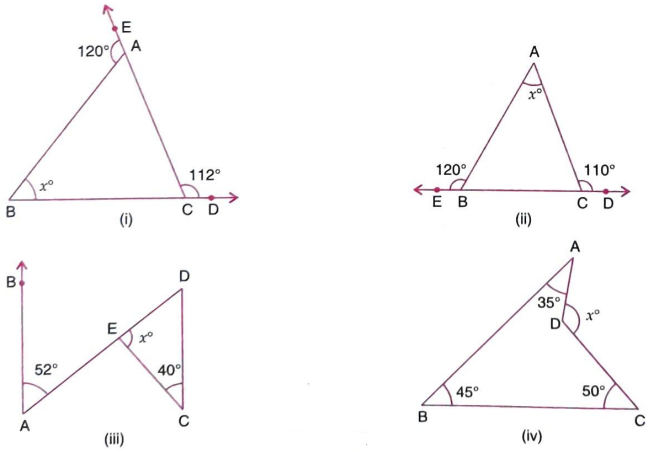
Answer$52^{\circ}, 50^{\circ}, 88^{\circ}, 130^{\circ}$
View full question & answer→Question 335 Marks
Explain the concept of interior and exterior angles and in each of the figures given below, find $x$ and $y$ (Fig.).
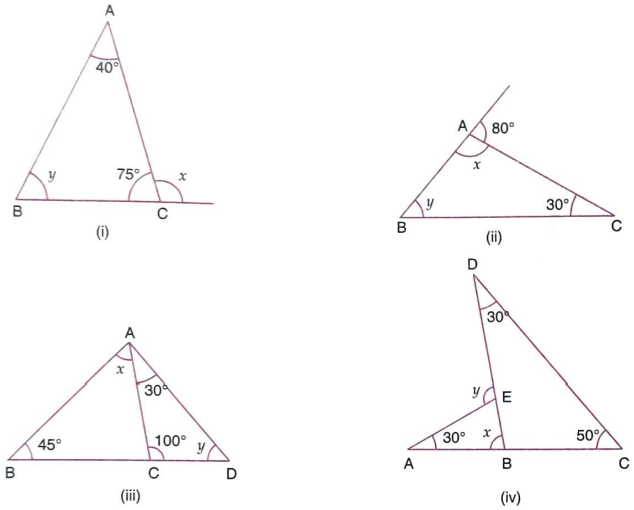
Answer(i) $105^{\circ}, 65^{\circ}$
(ii) $100^{\circ}, 50^{\circ}$
(iii) $55^{\circ}, 50^{\circ}$
(iv) $80^{\circ}, 110^{\circ}$
View full question & answer→Question 345 Marks
$D$ is a point on the side $B C$ of $\triangle A B C$. $A$ line $P D Q$, through $D$, meets side $A C$ in $P$ and $A B$ produced at $Q$. If $\angle A=80^{\circ}, \angle A B C=60^{\circ}$ and $\angle P D C=15^{\circ}$, find (i) $\angle A Q D$ (ii) $\angle A P D$.
Answer(i) $45^{\circ}$
(ii) $55^{\circ}$
View full question & answer→Question 355 Marks
The side $B C$ of $\triangle A B C$ is produced to a point $D$. The bisector of $\angle A$ meets side $B C$ in $L$. If $\angle A B C=30^{\circ}$ and $\angle A C D=115^{\circ}$, find $\angle A L C$.
Answer$72 \frac{1}{2}^{\circ}$
View full question & answer→Question 365 Marks
In Fig., $A B C$ is a right triangle right angled at $A . D$ lies on $B A$ produced and $D E \perp B C$, intersecting $A C$ at $F$. If $\angle A F E=130^{\circ}$, find
(i) $\angle B D E$ $\quad$ (ii) $\angle B C A$ $\quad$ (iii) $\angle A B C$
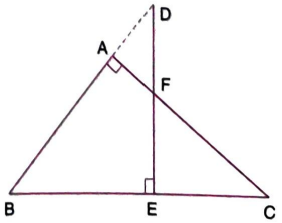
Answer(i) $40^{\circ}$
(ii) $40^{\circ}$
(iii) $50^{\circ}$
View full question & answer→Question 375 Marks
In $\triangle A B C, \angle A=50^{\circ}, \angle B=70^{\circ}$ and bisector of $\angle C$ meets $A B$ in $D$. Find the angles of the triangles $A D C$ and $B D C$.
AnswerFor $\triangle A D C, \angle A=50^{\circ}, \angle D=100^{\circ}, \angle C=30^{\circ}$, For $\triangle B D C, \angle B=70^{\circ}, \angle D=80^{\circ}, \angle C=30^{\circ}$
View full question & answer→Question 385 Marks
Is it possible to have a triangle, in which
(i) two of the angles are right?
(ii) two of the angles are obtuse?
(iii) two of the angles are acute?
(iv) each angle is less than $60^{\circ}$ ?
(v) each angle is greater than $60^{\circ}$ ?
(vi) each angle is equal to $60^{\circ}$ ?
Give reasons in support of your answer in each case.
Answer(i) No
(ii) No
(iii) Yes
(iv) No
(v) No
(vi) Yes
View full question & answer→Question 395 Marks
Find $x, y, z$ (whichever is required) in the Figures given below, if it is given that $D E \| B C$ in Fig. (i) and (iv).
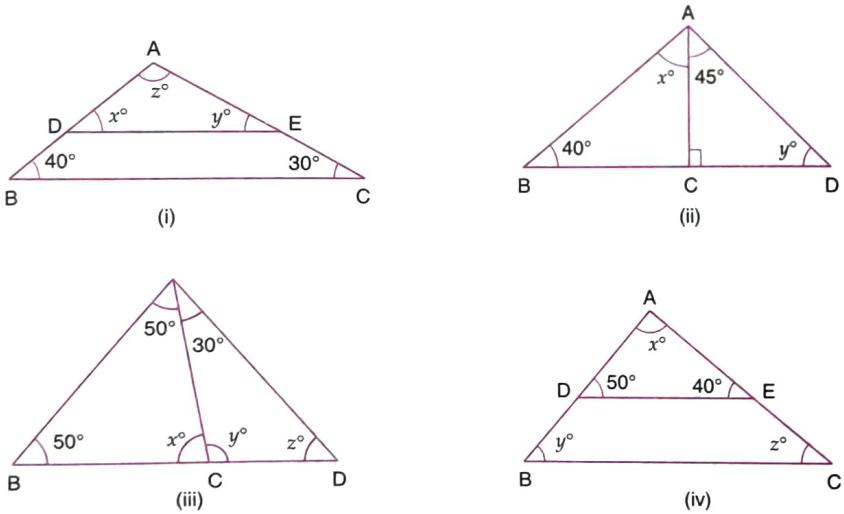
Answer(i) $x=40^{\circ}, y=30^{\circ}, z=110^{\circ}$
(ii) $x=50^{\circ}, y=45^{\circ}$
(iii) $x=80^{\circ}, y=100^{\circ}, z=50^{\circ}$
(iv) $x=90^{\circ}, y=50^{\circ}, z=40^{\circ}$
View full question & answer→Question 405 Marks
In the six cornered figure, $A C, A D$ and $A E$ are joined. Find $\angle F A B+\angle A B C+\angle B C D+\angle C D E+\angle D E F+\angle E F A$.
View full question & answer→Question 415 Marks
In Fig., there are five triangles. The measures of some of their angles have been indicated. State for each triangle whether it is acute, right or obtuse.
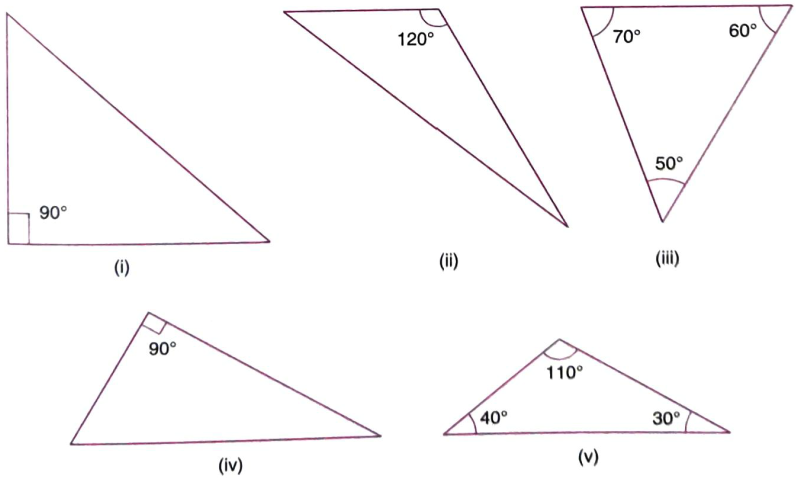
Answer(i) Right triangle, (ii) Obtuse triangle, (iii) Acute triangle, (iv) Right triangle, (v) Obtuse-triangle.
View full question & answer→Question 425 Marks
In Fig., the length (in cm) of each side has been indicated along the side. State for each triangle whether it is scalene, isosceles or equilateral:
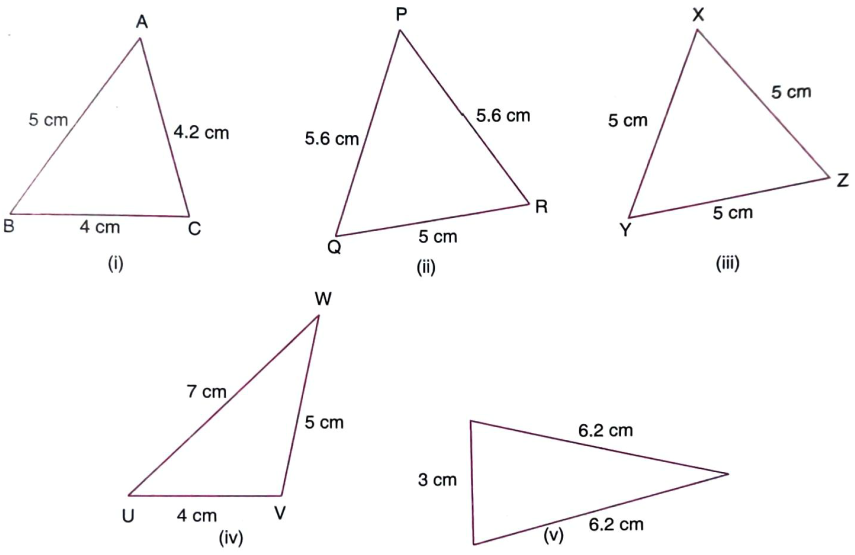
Answer(i) Scalene, (ii) Isosceles, (iii) Equilateral, (iv) Scalene, (v) Isosceles.
View full question & answer→Question 435 Marks
In Fig., A, B, C and D are four points, and no three points are collinear. AC and BD intersect at O. There are eight triangles that you can observe. Name all the triangles.
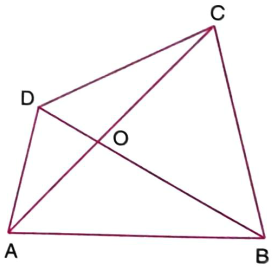
Answer$\triangle A B C, \triangle A B D, \triangle A B O, \triangle B C O, \triangle D C O, \triangle A O D, \triangle A C D, \triangle B C D$
View full question & answer→Question 445 Marks
In Fig., $D$ is a point on side $B C$ of a $\triangle A B C . A D$ is joined. Name all the triangles that you can observe in the figure. How many are they?
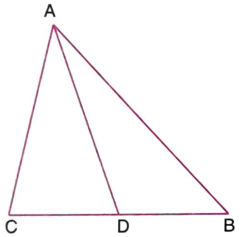
Answer$\triangle A C D, \triangle A D B, \triangle A B C ; 3$
View full question & answer→Question 455 Marks
Take three non-collinear points A, B and C on a page of your notebook. Join AB, BC and CA. What figure do you get? Name the triangle. Also, name
(i) the side opposite to $\angle B$
(ii) the angle opposite to side AB
(iii) the vertex opposite to side BC
(iv) the side opposite to vertex B.
AnswerTriangle, $\triangle A B C$
(i) $A C$
(ii) $\angle A C B$
(iii) $A$
(iv) $A C$
View full question & answer→