Questions

5 Marks Questions

🎯

Test yourself on this topic

11 questions · timed · auto-graded

Question 15 Marks
The odometer of a car reads $57321.0 \ km$ when the clock shows the time $08:30 \ AM$. What is the distance moved by the car, if at $08:50 \ AM$, the odometer reading has changed to $57336.0  \ km$? Calculate the speed of the car in km/min during this time. Express the speed in km/h also.
Answer
Initial reading of the odometer of the car $= 57321.0 \ km$
Final reading of the odometer of the car $= 57336.0 \ km$
Distance covered by the car
= Final reading of the odometer of the car − Initial reading of the odometer of the car
$= 57336.0 − 57321.0 = 15 km$
The given car starts at $8:30$ a.m. and stops at $8:50$ a.m.
Therefore, time taken by the car to cover the distance is $(8:50 − 8:30)$ min $= 20$ min
Distance covered by the car $= 15 km$
Time taken by the car $= 20$ min
$\text { Speed }=\frac{\text { Distanc covered }}{\text { Time taken }}=\frac{15}{20}=0.75 k \frac{ m }{ min }$
Again
$60 \min =1 h$
$20 \min =\frac{1}{60} \times 20=\frac{1}{3} h$
Time taken by the car $=\frac{1}{3} h$
$\text { Speed }=\frac{\text { Distance covered }}{\text { Time Taken }}=\frac{15}{\frac{1}{3}}=45 km / h$
View full question & answer
Question 25 Marks
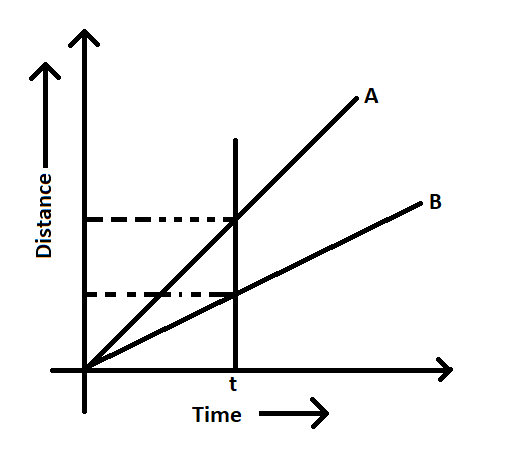
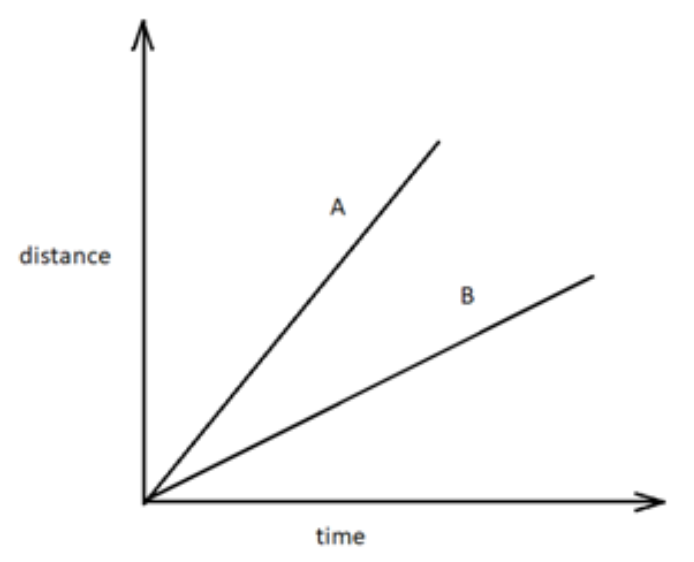
Figure shows the distance-time graph for the motion of two vehicles A and B. Which one of them is moving faster?

Image

Figure: Distance-time graph for the motion of two cars

Answer
Vehicle A is moving faster than vehicle B.

Image

Speed is given by the relation

Speed $=\frac{\text { Distance covered }}{\text { Time taken }}$

This relation shows that speed of a vehicle is greater if it covers maximum distance in a given interval of time. To compare the distance, draw a line perpendicular to the time-axis, as shown in the following distance-time graph

Image

From the graph, it is evident that for a given time t, the distance covered by vehicle A is more than vehicle B. Hence, vehicle A is moving faster than vehicle B.

View full question & answer
Question 35 Marks
The odometer of a car reads $57321.0km$ when the clock shows the time $08:30 AM$. What is the distance moved by the car, if at $08:50 AM$, the odometer reading has changed to $57336.0km?$ Calculate the speed of the car in km/ min during this time. Express the speed in km/ h also.
Answer
Initial reading of car odometer $= 57321.0\ km$
Final reading of car odometer $= 57336.0\ km$
Time at the time of Initial reading $= 08:30 \ AM$
Time at the time of Initial reading $= 08:50 \ AM$
Distance travelled by the car $= 57336.0\ km - 57321.0\ km = 15\ Km$
Time taken by the car to cover distance $= 08:50 \ AM to 08:30 \ AM = 20m$
Speed of the car in Km/m $= 15km/ 20m = 75Km/ m$
Speed of the car in Km/h $= 15km/ 20m × 60 = 45 Km/ h$
View full question & answer
Question 45 Marks
Classify the following as motion along a straight line, circular or oscillatory motion.
  • Motion of our hands while running.
  • Motion of a horse pulling a cart on a straight road.
  • Motion of a kid in a merry-go-round.
  • Motion of a child on a see-saw.
  • Motion of the hammer of an electric bell.
  • Motion of a train on a straight bridge.
Answer
  • Motion of our hands while running: Oscillatory motion.
  • Motion of a horse pulling a cart on a straight road: Straight line motion.
  • Motion of a kid in a merry-go-round: Straight line motion.
  • Motion of a child on a see-saw: Oscillatory motion.
  • Motion of the hammer of an electric bell: Oscillatory motion.
  • Motion of a train on a straight bridge: Straight line motion.
View full question & answer
Question 55 Marks
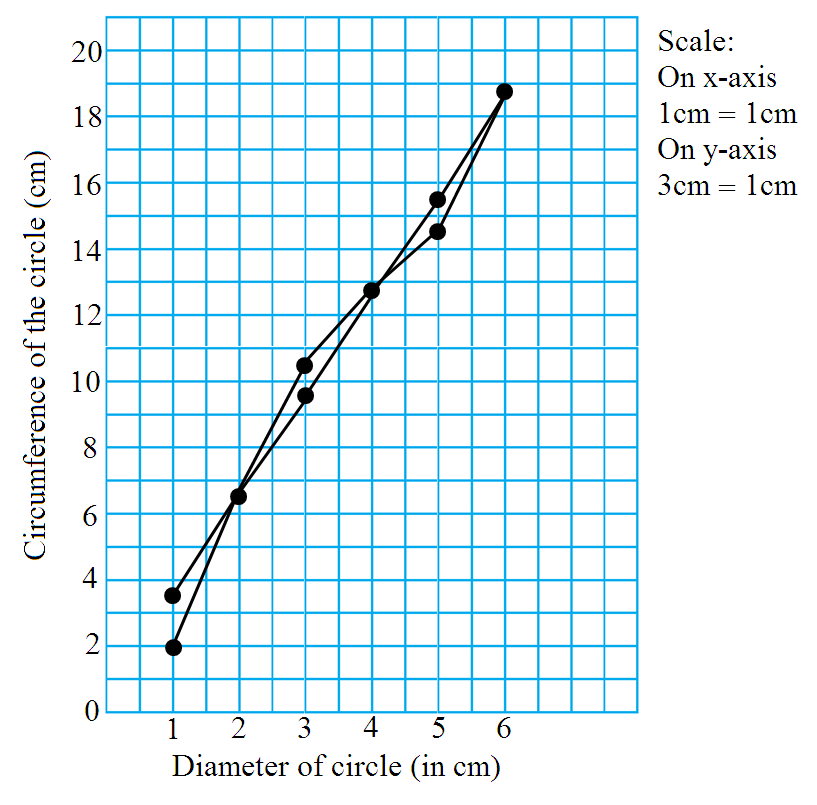
With the help of the data given in the following table, show graphically the relationship between the diameter and circumference of a circle.
Diameter of the circle (cm)
Circumference of the circle (cm)
$1$
$3.2$
$2$
$6.3$
$3$
$9.4$
$4$
$12.6$
$5$
$15.7$
$6$
$18.8$
Answer
With the help of a given data in a tabular form, the graph can be obtained by taking diameter of the circle on the $x-$axis and the circumference on $y-$axis. On $x-$axis, $1cm$ diameter is shown by $1cm$ and on the $y-$axis, $3cm$ of circumference is shown by 1cm.
View full question & answer
Question 65 Marks
Explain by giving example that how can we choose a suitable scale.
Answer

While choosing the most suitable scale for drawing a graph, we should keep the following points in mind.
  1. The difference between the highest and lowest values of each quantity.
  2. The intermediate values of each quantity so that with the scale chosen, it is easy to mark the values on the graph.
  3. To utilise the maximum part of the paper on which the graph is to be drawn, assume that we have a graph paper of size $25cm$ x $25cm$ and we have to accommodate following data:
Time (AM)
Odometer reading
Distance from the starting point
$8:00 AM$
$36540\ km$
$0\ km$
$8:30 AM$
$36560\ km$
$20\ km$
$9:00 AM$
$36580\ km$
$40\ km$
$9:30 AM$
$36600\ km$
$60\ km$
$10:00 AM$
$36620\ km$
$80\ km$

Since, one of the scales will be,

Distance $5km = 1cm$ and Time $6$ min $= 1cm.$

View full question & answer
Question 75 Marks
With the help of an activity, explain how will you measure the time period of a simple pendulum.
Answer
Activity:
  • Suspend a metallic ball (bob) by a long thread from a rigid support. Your simple pendulum is ready.
  • Set the simple pendulum in motion.
  • Note the time in your watch when bob is at an extreme position (say $A).$
  • When the bob again comes to the position A, count $1$ (one). Each time the bob reaches this position $(A)$, increase the count by $1$ (one).
  • Check the time after $25$ such oscillations. Find the time taken in $25$ oscillations.
View full question & answer
Question 85 Marks
State different types of motion?
Answer
Following are different types of motion:
  • Translatory Motion: In Translatory motion the particle moves from one point in space to another. This motion may be along a straight line or along a curved path.
  • Rectilinear motion: Motion along a straight line is called rectilinear motion. Example: A car moving on a straight road.
  • Curvilinear motion: Motion along a curved path is called curvilinear motion. Example: A car negotiating a curve.
  • Rotatory Motion: In rotatory motion, the particles of the body describe concentric circles about the axis of motion.
  • Vibratory Motion: In vibratory motion the particles move to and fro about a fixed point.
View full question & answer
Question 95 Marks
Which of the following are not correct?
  1. The basic unit of time is second.
  2. Every object moves with a constant speed.
  3. Distances between two cities are measured in kilometres.
  4. The time period of a given pendulum is constant.
  5. The speed of a train is expressed in m/h.
Answer
  1. Correct.
  2. Not correct.
  3. Correct.
  4. Not correct.
  5. Not correct.
View full question & answer
Question 105 Marks
The given data regarding the motion of two different objects $C$ and $D$ is in a tabular form. Check them carefully and state whether the motion of the objects is uniform or non-uniform.
Time
Distance travelled by C (in m)
Distance travelled by D (in m)
$9:30:00\ AM$
$10$
$12$
$9:45:00 \ AM$
$20$
$19$
$10:00:00\ AM$
$30$
$23$
$10:15:00 \ AM$
$40$
$35$
$10:30:00\ AM$
$50$
$37$
$10:45:00 \ AM$
$60$
$41$
$11:00:00 \ AM$
$70$
$44$
Answer
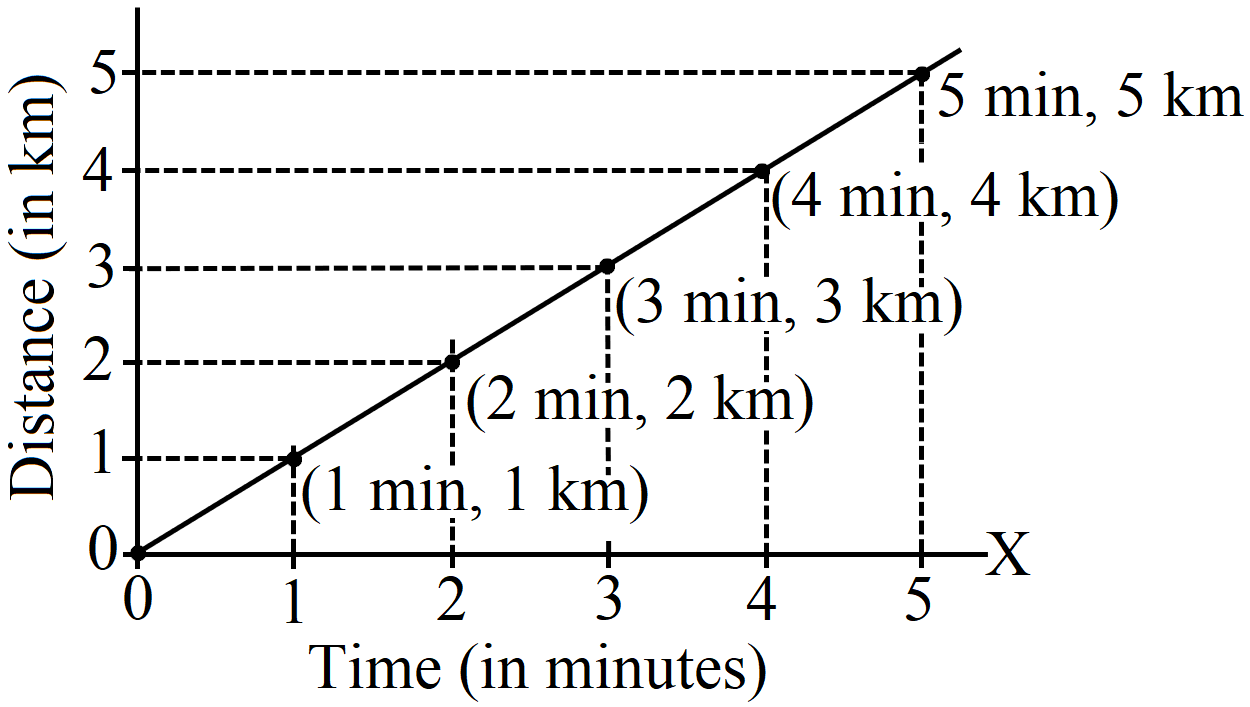
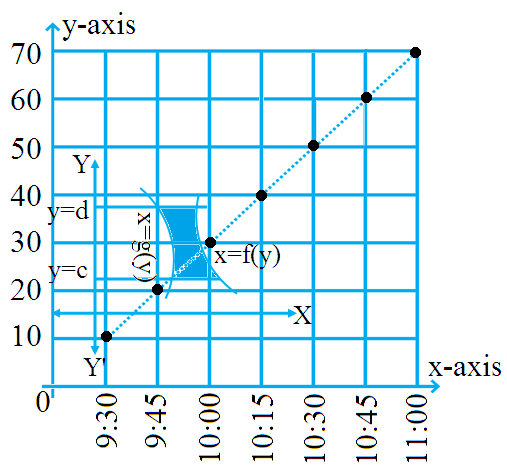
We can check the motion of the objects $C$ and $D$ by plotting the distance-time graph for the two objects.

Graph the object C on $x-$axis
Scale $1cm = 15$ min and on y-axis $1cm = 10m$
Since, the distance-time graph of the object $C$ is a straight line. Therefore, its motion is uniform.
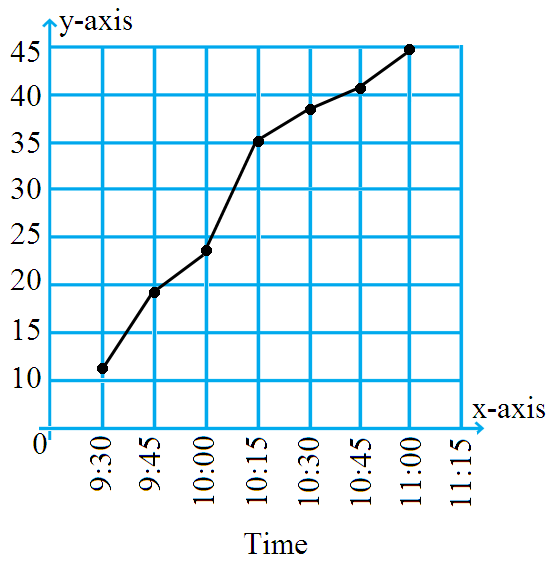
Graph of object $D$
Scale On $x-$axis, $1cm = 15$ min, On $y-$axis $1cm = 5m$

Since, the distance-time graph of the object D is not a straight line, therefore, its motion is non-uniform.
View full question & answer
Question 115 Marks
Match the Column $I$ with Column $II.$
 
Column I
 
Column II
$(a)$
Years
$(i)$
Rotation period of the earth on its axis.
$(b)$
Hour
$(ii)$
Time to complete 100m race.
$(c)$
Minute
$(iii)$
Gestation period in humans.
$(d)$
Days
$(iv)$
Age of a person.
$(e)$
Second
$(v)$
In scientific research.
$(f)$
Month
$(vi)$
Time to reach your school.
$(g)$
Microseconds
$(vii)$
Train reaches from one city to other.
Answer
 
Column I
 
Column II
$(a)$
Years
$(iv)$
Age of a person.
$(b)$
Hour
$(vii)$
Train reaches from one city to other.
$(c)$
Minute
$(vi)$
Time to reach your school.
$(d)$
Days
$(i)$
Rotation period of the earth on its axis.
$(e)$
Second
$(ii)$
Time to complete 100m race.
$(f)$
Month
$(iii)$
Gestation period in humans.
$(g)$
Microseconds
$(v)$
In scientific research.
View full question & answer