MCQ 11 Mark
A point of the form $(a, 0)$ lies on:
- A
Quadrant $IV$
- B
Quadrant $I$
- C
$y-$axis
- ✓
$x-$axis
AnswerCorrect option: D. $x-$axis
The given point of the form $= (a, 0)$
Here, x-co-ordinate $= a$ and y-co-ordinate $= 0$
$\therefore$ The point of the form $(a, 0)$ always lies on x-axis.
Thus, the point of the form $(a, 0)$ always lies on x-axis.
View full question & answer→MCQ 21 Mark
If $a > 0$ and $b > 0$ then the point $(a, b)$ lies in quadrant.
AnswerSince, $x$ co-ordinate is negative and $y$ co-ordinate is positive, the given point lies in Quadrant $II.$
View full question & answer→MCQ 31 Mark
Write the correct answer in the following: If $P (5,1), Q (8,0), R (0,4), S (0,5)$ and $O (0,0)$ are plotted on the graph paper, then the point(s) on the $x$-axis are:
- A
$P$ and $R$
- B
$R$ and $S$
- C
Only $Q$
- ✓
$Q$ and $O$
AnswerCorrect option: D. $Q$ and $O$
We now that, a point lies on $X-$axis, if its $y-$coordinate is zero.So, the points on the axis are $Q(8, 0)$ and $O(0, 0).$
View full question & answer→MCQ 41 Mark
The points $(-5, 2)$ and $(2, -5)$ lie in the:
- ✓
$II$ and $IV$ quadrants, respectively.
- B
- C
$IV$ and $II$ quadrants, respectively.
- D
$II$ and $III$ quadrants, respectively.
AnswerCorrect option: A. $II$ and $IV$ quadrants, respectively.
In point $(-5,2), x$-coordinate is negative and $y$-coordinate is positive, so it lies in $II$ quadrant and in point $(2,-5)$, $x$-coordinate is positive and $y$-coordinate is negative, so it lies in $IV$ quadrant.
View full question & answer→MCQ 51 Mark
If $10 x-4 x^2-3$, then the value of $p(0) + p(1)$ is:
Answer$10 x-4 x^2-3$$p(x)=-4 x^2+10 x-3$
$p(0)+p(1)=\left[-4(0)^2+10(0)-3\right]+\left[-4(1)^2+10(1)-3\right]$
$p(0)+p(1)=[0+0-3]+[-4+10-3]$
$p(0)+p(1)=[-3]+[3]$
$p(0)+p(1)=0$
View full question & answer→MCQ 61 Mark
Which of the following are the signs of abscissa and ordinate of a point in quadrant?
- A
$(-, +)$
- B
$(-, -)$
- ✓
$(+, +)$
- D
$(+, -)$
AnswerCorrect option: C. $(+, +)$
The signs of abscissa and ordinate of a point in quadrant I are both +ve i.e. $(+, +)$
View full question & answer→MCQ 71 Mark
Abscissa of all the points on the y-axis is:
AnswerOn y-axis, x-coordinate i.e. abscissa is$ 0.$
Thus, abscissa of all the points on y-axis is$ 0.$
View full question & answer→MCQ 81 Mark
If $P(3, 9)$ and $Q(-3, -4)$, then (abscissa of $P$) - (ordinate of $Q$) is:
AnswerFrom the given data we have,
The abscissa of $P = 3$ and ordinate of $Q = -4,$
So, according to question,
(abscissa of P) - (ordinate of$ Q)$
$= 3 - (-4)$
$= 7$
View full question & answer→MCQ 91 Mark
The area of the triangle formed by the points $A (2,0), B (6,0)$ and $C (4,6)$ is:
- A
$24$sq. unit
- ✓
$12$sq. unit
- C
$10$sq. unit
- D
AnswerCorrect option: B. $12$sq. unit
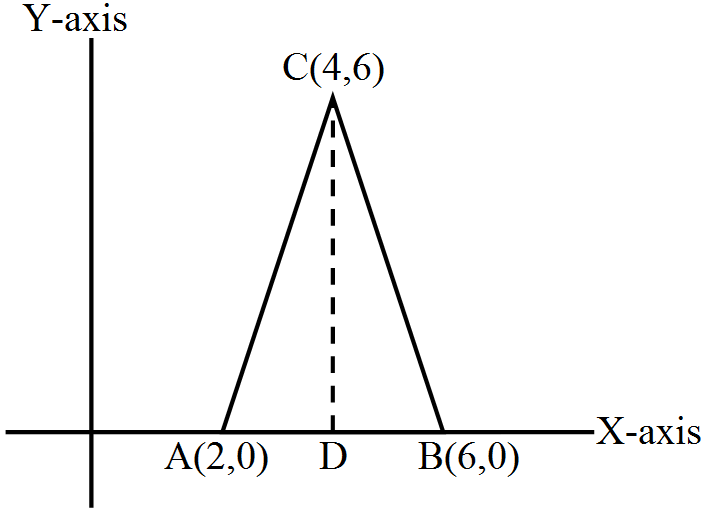
Let $CD$ be perpendicular drawn from $C$ to $AB.$
The length of the perpendicular will be equal to the ordinate of point $C.$
$\Rightarrow CD = 6$ unit
$AB = 4$ unit
Now, area of $\triangle\text{ABC}=\frac{1}{2}\times\text{Base}\times\text{height}$
$\triangle\text{ABC}=\frac{1}{2}\times\text{5}\times\text{6}$
$12\text{sq. units}$ View full question & answer→MCQ 101 Mark
The co-ordinates of two points $A$ and $B$ are $(4, 3)$ and $(-5, 3)$ respectively. The co-ordinates of the point at which the line segment $AB$ meets the y-axis are:
- A
$(0, 4)$
- ✓
$(0, 3)$
- C
$(3, 0)$
- D
$(-5, 0)$
AnswerCorrect option: B. $(0, 3)$
Since it meets at y-axis, so, abscissa will be zero and we have ordinate $= 3$ in common so,point will be $(0, 3)$
View full question & answer→MCQ 111 Mark
Which point does not lie in any quadrant?
- A
$(3, -4)$
- B
$(5, 9)$
- C
$(-3, 6)$
- ✓
$(0, 3)$
AnswerCorrect option: D. $(0, 3)$
Since here value of x-coordinate $= 0$ so point lies on $y-$axis not in any quadrant.
View full question & answer→MCQ 121 Mark
If the perpendicular distance of a point $P$ from the $x-$axis is $5$ units and the foot of the perpendicular lies on the negative direction of $x-$axis, then the point $P$ has.
- ✓
$y$ coordinate $= 5$ or $-5$
- B
$x$ coordinate $= -5$
- C
$y$ coordinate $= 5$ only
- D
$y$ coordinate $= -5$ only
AnswerCorrect option: A. $y$ coordinate $= 5$ or $-5$
We know that, the perpendicular distance of a point from the $X$-axis gives $y$-coordinate of that point. Here, foot of perpendicular lies on the negative direction of $X$ -axis, so perpendicular distance can be measure in $II$ quadrant or $III $ quadrant. Hence, the point $P$ has $y$-coordinate $=5$ or $-5 .$
View full question & answer→MCQ 131 Mark
Write the correct answer in the following: Point $(0, -7)$ lies:
- A
On the $x-$axis.
- B
- C
On the $y-$axis.
- ✓
AnswerIn Point $(0, -7)$ co-ordinate of $x$ axis is zero so it lies on $y$ axis.
View full question & answer→MCQ 141 Mark
The ordinate of every point on the $x-$axis is:
AnswerThe ordinate ($y$ co-ordinate) of every point on the x-axis is $0.$
View full question & answer→MCQ 151 Mark
Points $(2, -3), (4, -5), (5, -9)$ and $(-2, -5).$
- A
- B
- ✓
Does not lie in same quadrant.
- D
AnswerCorrect option: C. Does not lie in same quadrant.
Point $(2,-3),(4,-5),(5,-9)$ lies in 4th quadrant, because sign of abscissa and ordinate in 4th quadrant is $(+,-)$. But point $(-2,-5)$ lies in 3rd quadrant since, sign of abscissa and ordinate in 3rd quadrant is $(-,-)$.
View full question & answer→MCQ 161 Mark
Write the correct answer in the following:
The points $(-5, 2)$ and $(2, -5)$ lie in the:
- A
- B
$II$ and $III$ quadrants, respectively.
- ✓
$II$ and $IV$ quadrants, respectively.
- D
$IV$ and $II$ quadrants, respectively.
AnswerCorrect option: C. $II$ and $IV$ quadrants, respectively.
In point $(-5,2), x$-coordinate is negative and $y$-coordinate is positive, so it lies in $II$ quadrant and in point $(2,-5), x$ coordinate is positive and $y-$coordinate is negative, so it lies in $IV$ quadrant.
View full question & answer→MCQ 171 Mark
Abscissa of all points on the $x-$axis is:
AnswerAbscissa of point in $x$ axis is can be any number but ordinate will always be zero, because for any point to lie on x-axis its $y-$ordinate must be equal to zero.
View full question & answer→MCQ 181 Mark
The point $(0, 9)$ lies:
AnswerCorrect option: D. On the positive direction of $y-$axis
Any point $P$ in co-ordinate plane is written as $P(x, y)$ When the value of $x$-coordinate is equal to zero then the point $P$ lies on $y$ axis
Since, here $x=0$ so, point lies on $y$-axis
And the value of $y$ is positive so,
Points lies in the positive direction of $y$-axis
View full question & answer→MCQ 191 Mark
The area of the triangle formed by the points $A(2,0), B(6,0)$ and $C(4,6)$ is:
- ✓
$12 $sq. units
- B
- C
$10$ sq. units
- D
$24$ sq. units
AnswerCorrect option: A. $12 $sq. units
The correct option is $D12$ sq. units
Point $A$ and $B$ lie on the $x$-axis, therefore, $A B=4$ units i.e. the base of the triangle and the height of the triangle is $6$ units from point $C(4,6)$.
Area of triangle $=\frac{1}{2} \times$ Base $\times$ Height $=\frac{1}{2} \times 4 \times 6=12$ sq. units
View full question & answer→MCQ 201 Mark
The point $O(0, 0)$ lies on:
AnswerCorrect option: C. both $x-$axis and $y-$axis
Point $(0, 0)$ is the co-ordinate of origin and origin is the point of intersection of $x$ and $y-$axis.
So, point $O(0, 0)$ lies on both axis.
View full question & answer→MCQ 211 Mark
A point both of whose coordinates are negative lies in quadrant.
Answer
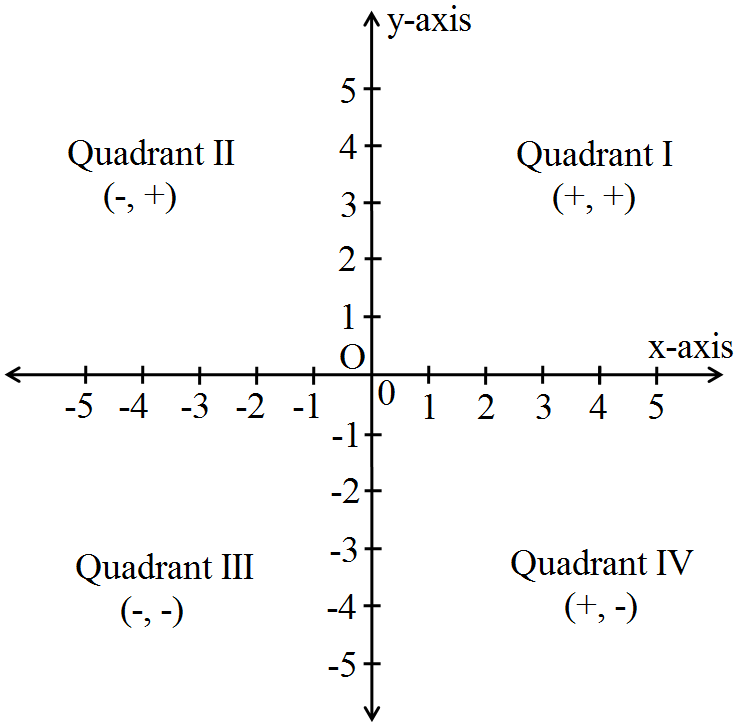
A point both of whose coordinates are negative, that is, of the from $(-, -)$ lies in quadrant $III.$ View full question & answer→MCQ 221 Mark
The points in which the abscissa and the ordinate have different signs will lie in.
- A
Quadrant $II$ only
- B
Quadrant $IV$ only
- ✓
Quadrants $II$ and $IV$
- D
Quadrants $I$ and $III$
AnswerCorrect option: C. Quadrants $II$ and $IV$
In $2nd$ quadrant and 4th quadrant sign of abscissa and ordinate both is opposite i.e, one is negative and the other is positive.
In $2nd$ quadrant sign of co-ordinate are $(-, +).$
And in 4th quadrant sign of co-ordinate are $(+, -).$
View full question & answer→MCQ 231 Mark
Write the correct answer in the following: Which of the points $P (0,3), Q (1,0), R (0,-1), S (-5,0), T (1,2)$ do not lie on the $x$-axis?
- A
$P$ and $R$ only.
- B
$Q$ and $S$ only.
- ✓
$P, R$ and $T$.
- D
$Q, S$ and $T$.
AnswerCorrect option: C. $P, R$ and $T$.
We know that, if a point is of the form ( $x , 0$ ) i.e., its y -coordinate is zero, then it will lie on $X$ -axis otherwise not. Here, $y$-coordinates of points $P(0,3), R(0,-1)$ and $T(1,2)$ are not zero, so these points do not lie on the $X$-axis.
View full question & answer→MCQ 241 Mark
The point $(7, 0)$ lies:
AnswerCorrect option: B. On the positive direction of $x-$axis
Since value of $y$-ordinate is zero so, point lies on $x$-axis.
But value of $x$ is + ve so it lies on + ve direction of $x$-axis.
View full question & answer→MCQ 251 Mark
If $x>0$ and $y<0$, then the point $(x, y)$ lies in:
- ✓
$IV$ Quadrant.
- B
$III$ Quadrant.
- C
$I$ Quadrant.
- D
$II$ Quadrant.
AnswerCorrect option: A. $IV$ Quadrant.
Since, $x>0$ i.e, $x$ is $+v e$,
$y<0$ i.e, $y$ is $-v e$,
Recall that $(+,+)$ lies in $I$ quadrant, $(-,+)$ lies in $II$ quadrant, $(-,-)$ lies in $III$ quadrant, $(+,-)$ lies in $IV$ quadrant.
So, $(x, y)$ lies in $IV$ quadrant.
View full question & answer→MCQ 261 Mark
The zero of the polynomial $(x-2)^2-(x+2)^2$ is:
Answer$(x-2)^2-(x+2)^2$$=(x-2+x+2)(x-2-x-2)[\text { Using identity] }$
$a^2-b^2=(a+b)(a-b)$
$=(2 x)(-4)$
$=-8 x$
Then the zero is,
$-8 x=0$
$\Rightarrow x=0$
View full question & answer→MCQ 271 Mark
The abscissa and ordinate of the point with Co-ordinates $(8, 12)$ is:
- A
Abscissa $12$ and ordinate $8$
- B
Abscissa $4$ and ordinate $20$
- ✓
Abscissa $8$ and ordinate $12$
- D
Abscissa $0$ and ordinate $20$
AnswerCorrect option: C. Abscissa $8$ and ordinate $12$
In the Cartesian plane, any point $P$ is written as $p(x, y)$, where $X$ co-ordinate is called the abscissa of point $p$ and $Y$ coordinate is called ordinate of point $p$.
So, here abscissa will be equal to $8$ and ordinate $=12$
View full question & answer→MCQ 281 Mark
A point whose abscissa is $-3$ and ordinate $2$ lies in:
AnswerIf absciss $= -3$ Intercept on $Y$ axis is $= 2$
$Y > 0$
So, Point is in Second Quadrant.
View full question & answer→MCQ 291 Mark
The area of $\triangle\text{AOB}$ having vertices $A(0, 6), 0(0, 0)$ and $B(6, 0)$ is:
- A
$36$ sq units
- ✓
$18$ sq units
- C
$24$ sq units
- D
$12$ sq units
AnswerCorrect option: B. $18$ sq units
When we plot the given points in the graph paper then,
is the right angle triangle, where
$OB =$ Base $= 6$ units
Height of triangle $= OA = 6$ units
$\therefore$ Area of $\triangle\text{AOB}=\frac{1}{2}\times\text{OA}\times\text{OB}$
$\Rightarrow$ Area of $\triangle\text{AOB}=\frac{1}{2}\times\text{6}\times\text{6}$
$\Rightarrow$ Area of $\triangle\text{AOB}=\frac{1}{2}\times\text{36}$
$\Rightarrow$ Area of $\triangle\text{AOB}=18\text{ square units}$
View full question & answer→MCQ 301 Mark
Write the correct answer in the following: If y coordinate of a point is zero, then this point always lies:
- A
In $I$ quadrant.
- B
In $II$ quadrant
- ✓
On $x-$axis.
- D
On $y-$axis.
AnswerCorrect option: C. On $x-$axis.
We know that if $y-$coordinate of a point, i.e., ordinate is zero, then this point always lies on $x-$axis.
View full question & answer→MCQ 311 Mark
Write the correct answer in the following: The points whose abscissa and ordinate have different signs will lie in:
AnswerCorrect option: D. $II$ and $IV$ quadrants.
The points whose abscissa and ordinate have different sings will be of the from $(-x, y)$ or $(x,-y)$ and these points will lie in $II$ and $IV$ quadrants.
View full question & answer→MCQ 321 Mark
The point $(3, 0)$ lies on:
- A
Negative $x-$axis
- B
Negative $y$ axis
- C
Positive $y$ axis
- ✓
Positive $x-$axis
AnswerCorrect option: D. Positive $x-$axis
Any point in co-ordinate is written as $P ( x , y )$ So, when the value of $y$ becomes zero. i.e, $y=0$ then the point $p$ lies on the $x$-axis.
So, here the point will lie on +ve direction of the $x -$axis.
View full question & answer→MCQ 331 Mark
The name of the horizontal line drawn to determine the position of any point in the Cartesian plane is:
AnswerCorrect option: A. $x-$axis
In co-ordinate, we have two axis, one is a horizontal line called $x-$axis and the other is vertical line called $y-$axis.
Used to determine the position of any point in Cartesian plane.
View full question & answer→MCQ 341 Mark
The point at which the two coordinate axes meet is called the:
AnswerThe point at which the two coordinate axes meet is called the origin.
View full question & answer→MCQ 351 Mark
Abcissa of a point is positive in:
- A
$I$ and $II$ quadrant.
- ✓
$I$ and $IV$ quadrant.
- C
$I$ quadrant only.
- D
$II$ quadrant only.
AnswerCorrect option: B. $I$ and $IV$ quadrant.
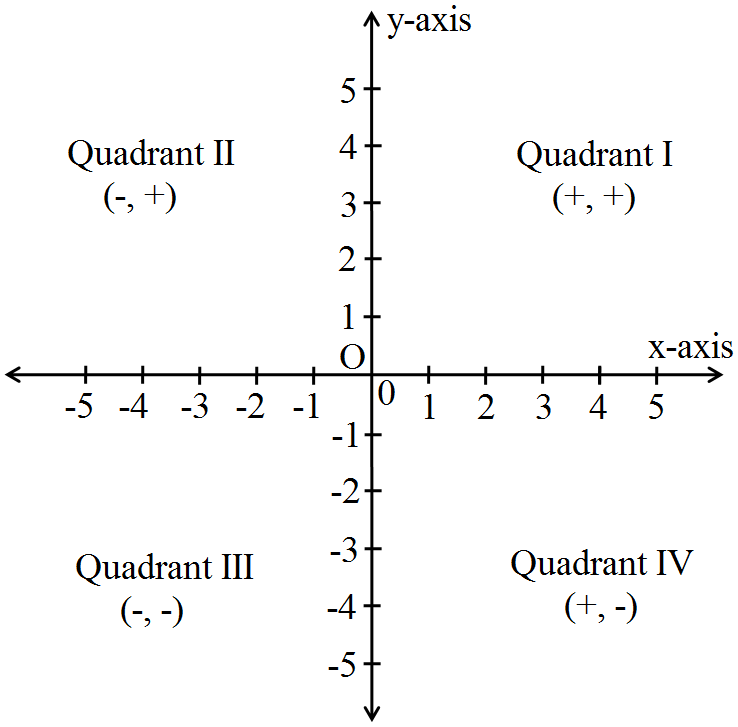
Absissa of a point is positive when the points are of the form $(+, +)$ and $(+, -).$
So, the absissa of the point is positive in quadrant $I$ and $IV.$ View full question & answer→MCQ 361 Mark
The ordinate of every point on the $x-$axis is:
AnswerEvery point on the x-axis is of the form $(a, 0)$. This means abscissa can be any real number but ordinate is always $0.$
View full question & answer→MCQ 371 Mark
Write the correct answer in the following: Ordinate of all points on the $x-$axis is:
AnswerOrdinate of all the points on the x-axis is $0$.Because ordinate (or $y-$coordinate) of a point is perpendicular distance of this point from the $x-$axis measured along the $y–$axis.
View full question & answer→MCQ 381 Mark
If $A(2, 3)$ and $B(-3, 4)$, then (abscissa of $A$) - (abscissa of $B$) is:
AnswerHere we have, the abscissa of $A = 2$ and abscissa of $B = -3.$
So, according to question,
$($abscissa of $A) - ($abscissa of $B)$
$= 2 - (-3)$
$= 5$
View full question & answer→MCQ 391 Mark
Write the correct answer in the following: If the perpendicular distance of a point $P$ from the $x-$axis is $5$ units and the foot of the perpendicular lies on the negative direction of $x-$axis, then the point $P$ has:
- A
$x$ coordinate $= -5$
- B
$y$ coordinate $= 5$ only
- C
$y$ coordinate $= –5$ only
- ✓
$y$ coordinate $= 5$ or $-5$
AnswerCorrect option: D. $y$ coordinate $= 5$ or $-5$
We do know that perpendicular distance of a point from the $X$ -axis $Y$ -coordinate of that point. Here foot of perpendicular lies on the negative direction of $X$ -axis, so perpendicular distance can be measure in $II$ quadrant or $III$ quadrant. Hence, the point $P$ has $y$ coordinate $=5$ or $-5$
View full question & answer→MCQ 401 Mark
The point whose ordinate is $6$ and which point lies on the $y-$axis?
- A
$(6, 0)$
- B
$(6, 6)$
- ✓
$(0, 6)$
- D
AnswerCorrect option: C. $(0, 6)$
Since the ordinate or $y-$coordinate of a point is $6$ and this point lies on $y-$axis.
And the abscissa or $x-$coordinate of a point lying on $y-$axis is $0.$
Therefore, the coordinate of the point is $(0, 6).$
The point whose abscissa is $4$ and this point lies on the $x-$axis is:
View full question & answer→MCQ 411 Mark
If $x^2+k x-3=(x-3)(x+1)$, then the value of $'k'$ is:
Answer$x^2+k x-3=(x-3)(x+1)$$\Rightarrow x^2+k x-3=x^2+(-3+1) x+(-3) x 1$
$\Rightarrow x^2+k x-3=x^2-2 x-3$
On comparing the term, we get $\mathrm{k}=-2$
View full question & answer→MCQ 421 Mark
The point $(-2, 5)$ lies in:
- A
$4$th quadrant
- B
$1$st quadrant
- ✓
$2$nd quadrant
- D
$3$rd quadrant
AnswerCorrect option: C. $2$nd quadrant
For any point to lie in the second quadrant, Abscissa and ordinate must be $(-, +)$. So the given point $(-2, 5)$ lies in $2$nd quadrant.
View full question & answer→MCQ 431 Mark
The distance of the point $(-3, -2)$ from $x-$axis is:
- A
$\sqrt{13}\text{ units}$
- B
$5$ units
- C
$3$ units
- ✓
$2$ units
AnswerCorrect option: D. $2$ units
Distance from $x-$axis is they, co-ordinate of other point So ,here distance $= 2,$
View full question & answer→MCQ 441 Mark
The distance of the point $(-3, -2)$ from $x-$axis is:
- ✓
$2$ units
- B
$3$ units
- C
$5$ units
- D
$13$ units
AnswerCorrect option: A. $2$ units
Distance from the $x$-axis is equal to the $y$-coordinate of a given point $(-3,-2)$, and distance is taken as positive, so the distance from $x$-axis $=2$ units.
View full question & answer→MCQ 451 Mark
Ordinate of a point is negative in:
- A
Quadrant $III$ only
- ✓
Quadrant $III$ and $IV$
- C
Quadrant $I$ and $II$
- D
Quadrant $IV$ only
AnswerCorrect option: B. Quadrant $III$ and $IV$
Since, sign of point in 3rd quadrant is $(-, -)$.And in 4th quadrant, it is $(+, -).$
So, Ordinate of a point is -ve only in 3rd and 4th quadrant.
View full question & answer→MCQ 461 Mark
If $x < 0$ and $y > 0$, then the point $(x, y)$ lies in.
- A
$I$ Quadrant.
- B
$III$ Quadrant.
- ✓
$II$ Quadrant.
- D
$IV$ Quadrant.
AnswerCorrect option: C. $II$ Quadrant.
Here, $x<0$ (i.e -ve) and $y>0$, (i.e, +ve)
So in $2$ nd quadrant value of $(x, y)$ is $(-,+)$.
So the given point will lie in $2$ nd quadrant.
View full question & answer→MCQ 471 Mark
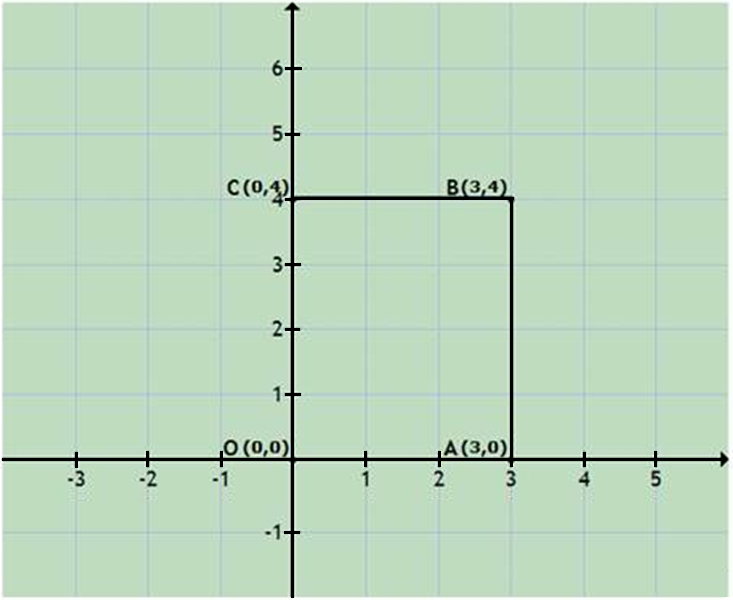
If $O(0, 0), A(3, 0), B(3, 4), C(0, 4)$ are four given points then the figure $OABC$ is a:
AnswerBy plotting the given points, we find that figure $OABC$ is a rectangle.
View full question & answer→MCQ 481 Mark
The point $(-3, 0)$ lies:
AnswerCorrect option: C. On the negative direction of $x$-axis
Since value of $y$-ordinate is zero, so point lies on $x$-axis.
But value of $x$ is -ve so, it lies on negative direction of $x$-axis.
View full question & answer→MCQ 491 Mark
The perpendicular distance of the point $P(-2, -3)$ from the $y$-axis is:
- A
$3$ units
- ✓
$2$ units
- C
$-3$
- D
$-2$
AnswerCorrect option: B. $2$ units
Perpendicular distance of any point from y-axis is the given x-coordinate of point,
So distance $= 2$ units
View full question & answer→MCQ 501 Mark
The perpendicular distance of the point $P(-3, -6)$ from the $x$-axis is:
- A
$3$ units
- B
$-3$
- ✓
$6$ units
- D
$-2$
AnswerCorrect option: C. $6$ units
Perpendicular distance of a point from $x$-axis is $y$-ordinate of the given point is $(-3,-6)$.Distance $=6$ unit
View full question & answer→