MCQ 1511 Mark
Write the correct answer in the following: The edges of a triangular board are $6\ cm, 8\ cm$ and $10\ cm.$ The cost of painting it at the rate of $9$ paise per $cm^2$ is:
- A
$Rs. 2.00$
- ✓
$Rs. 2.16$
- C
$Rs. 2.48$
- D
$Rs. 3.00$
AnswerCorrect option: B. $Rs. 2.16$
Since, the edges of a triangular are $a = 6\ cm, b = 8\ cm$ and $c = 10\ cm$
Now, semi-perimeter of a triangular board.
$\text{s}=\frac{\text{a}+\text{b}+\text{c}}{2}$
$=\frac{6+8+10}{2}=\frac{24}{2}=12\text{cm}$
Now, area of a triangular board $=\sqrt{\text{s}(\text{s}-\text{a})(\text{s}-\text{b})(\text{s}-\text{c})}$
$=\sqrt{12(12-6)(12-8)(12-10)}$
$=\sqrt{12\times6\times4\times2}$
$=\sqrt{(12)^2\times(2)^2}$
$=12\times2=24\text{cm}^2$
Since, the cost of painting for area $1\ cm^2 = Rs. 0.09$
$\therefore$ Cost of paint for area $24\ cm^2 = 0.09 × 24 = Rs. 2.16$
Hence, the cost of a triangular board is $Rs. 2.16$
View full question & answer→MCQ 1521 Mark
Semiperimeter of scalene triangle of side $k, 2k$ and $3k$ is:
AnswerSemiperimeter of scalene triangle of side $k, 2k$ and $3k =\frac{\text{k}+2\text{k}+3\text{k}}{2}=3\text{k}$
View full question & answer→MCQ 1531 Mark
The length of each side of an equilateral triangle having an area of $25\sqrt{3}\text{cm}^2$ is:
- A
$5cm$
- B
$15cm$
- C
$25cm$
- ✓
$10cm$
AnswerCorrect option: D. $10cm$
$\text{Area}=25\sqrt{3}\text{sq}.\text{cm}$
$25\sqrt{3}=\frac{\sqrt{3}}{4}\text{a}^2$
$\text{a}^2=\frac{25\times4\times\sqrt{3}}{\sqrt{3}}=100$
$\text{Side}=\text{10cm}.$
View full question & answer→MCQ 1541 Mark
If the area of an isosceles right triangle is $8\ cm^2$, what is the perimeter of the triangle$?$
AnswerCorrect option: B. $8+4{\sqrt{2}}\text{cm}^2$
Let each of the two equal sides of an isosceles right triangle be $a\ cm.$
Then, third side $=\text{a}\sqrt{2}\text{cm}$
Area of $\triangle=\frac12\times\text{a}\times\text{a}$
$\Rightarrow8=\frac{\text{a}^2}{2}$
$⇒ a^2 = 16$
$⇒ a = 4\ cm$
⇒ Perimeter $\Rightarrow\text{a}+\text{a}+\text{a}\sqrt{2}=4+4+4\sqrt{2}\text{cm}$
Hence, correct option is $(b).$
View full question & answer→MCQ 1551 Mark
If the perimeter of a rhombus is $20\ cm$ and one of the diagonals is $8\ cm$ The area of the rhombus is:
- A
$30\ sq.cm$
- B
$48\ sq.cm$
- ✓
$24\ sq.cm$
- D
$50\ sq.cm$
AnswerCorrect option: C. $24\ sq.cm$
side of rhombus $=\frac{\text{Perimeter}}{4}$
$=\frac{20}{4}=5\text{cm}$
diagonal $=2\sqrt{52-44}=2\sqrt{25-16}=2\times3=6\text{cm}$
Area of rhombus $=\frac{1}{2}\times\text{Product of diagonal}$
$=\frac{1}{2}\times8\times6=24\text{ sq.cm}$
View full question & answer→MCQ 1561 Mark
The sides of a triangular flower bed are $5m, 8m$ and $11m$. the area of the flower bed is:
- A
$21\sqrt{4}\text{m}^2$
- ✓
$4\sqrt{21}\text{m}^2$
- C
$\sqrt{300}\text{m}^2$
- D
$\sqrt{330}\text{m}^2$
AnswerCorrect option: B. $4\sqrt{21}\text{m}^2$
$\text{s}=\frac{5+8+11}{2}=12\text{m}$
Area of triangle $=\sqrt{\text{s}(\text{s}-\text{a})(\text{s}-\text{b})(\text{s}-\text{c})}$
$=\sqrt{12(12-5)(12-8)(12-11)}$
$=\sqrt{12\times7\times4\times1}$
$=4\sqrt{21}\text{m}^2$
View full question & answer→MCQ 1571 Mark
Write the correct answer in the following: An isosceles right triangle has area $8\ cm^2$. The length of its hypotenuse is:
- ✓
$\sqrt{32}\text{cm}$
- B
$\sqrt{16}\text{cm}$
- C
$\sqrt{48}\text{cm}$
- D
$\sqrt{24}\text{cm}$
AnswerCorrect option: A. $\sqrt{32}\text{cm}$
$ABC$ is an isosceles right triangle. We have,
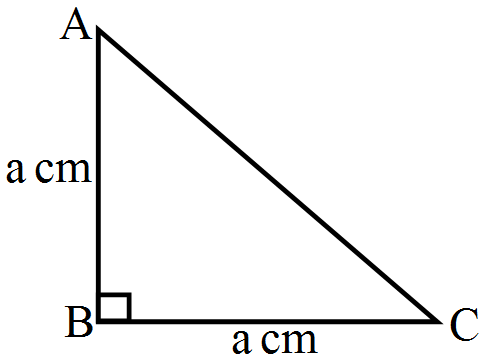
$\text{AB}=\text{BC}=\text{a cm}$
Area of $\triangle=\frac{1}{2}\text{base}\times\text{Height}$
$\Rightarrow\ 8=\frac{1}{2}\times\text{a}\times\text{a}$ $\big[\because\ \text{AB}=\text{BC}=\text{a cm}\big]$
$\Rightarrow\ \text{a}^2=16$ $\therefore\ \text{a}=+\sqrt{16}=4\text{cm}$
Using Pythagoras theorem,
Hypotenuse $\text{AC}=\sqrt{4^2+4^2}$
$=\sqrt{16+16}=\sqrt{32}\text{cm}$
View full question & answer→MCQ 1581 Mark
The side of a triangle is $12\ cm, 16\ cm,$ and $20\ cm.$ Its area is:
- A
$100\ sq.cm$
- ✓
$96\ sq.cm$
- C
$120\ sq.cm$
- D
$90\ sq.cm$
AnswerCorrect option: B. $96\ sq.cm$
$\text{S}=\frac{12+16+20}{2}=\frac{48}{2}=24\text{cm}$
Area of triangle $=\sqrt{\text{s}(\text{s}-\text{a})(\text{s}-\text{b})(\text{s}-\text{c})}$
$=\sqrt{24(24-16)(24-12)(24-20)}$
$=\sqrt{24\times8\times12\times4}$
$=12\times8=96\text{ sq.cm}$
View full question & answer→MCQ 1591 Mark
The sides of a triangle are $11m, 60m$ and $61m$. The altitude to the smallest side is:
AnswerArea of $\triangle=\frac{1}{2}\text{Base}\times\text{Height}$
The smallest side is $11m$
Area $=\frac{1}{2}\times11\times\text{Height}\ ....(\text{i})$
Area by Heron's Formula $=\sqrt{\text{s}(\text{s}-\text{a})(\text{s}-\text{b})(\text{s}-\text{c})}$
$\text{s}=\frac{11+60+61}{2}=66\text{m}$
Area $=\sqrt{66\times55\times6\times5}=330\text{m}^2$
From eq $(i)$
$330=\frac{1}{2}\times11\times\text{height}$
$\text{Height}=\frac{2\times330}{11}=60\text{m}$
View full question & answer→MCQ 1601 Mark
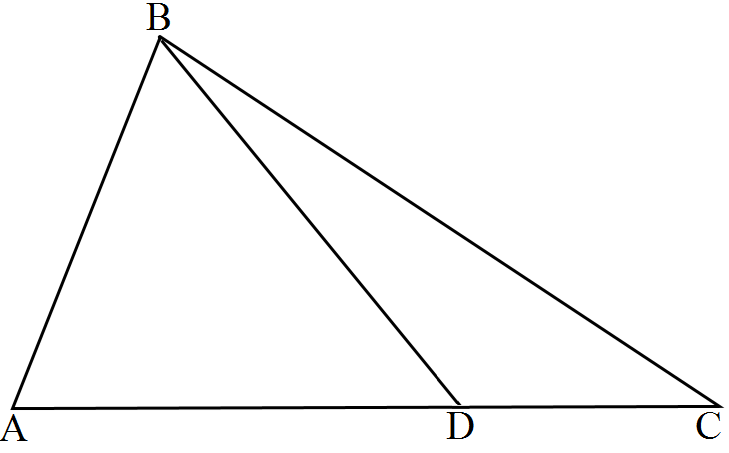
In figure, the ratio of $AD$ to $DC$ is $3$ to $2$. If the area of $\triangle\text{ABC}$ is 40cm$^2$ the area of $\triangle\text{BDC}?$
- ✓
$16\ cm^2$
- B
$36\ cm^2$
- C
$30\ cm^2$
- D
$24\ cm^2$
AnswerCorrect option: A. $16\ cm^2$
$\frac{\text{AD}}{\text{DC}}=\frac{3}{2}$
Let $AD = 3x$ and $DC = 2x$
Area of $\triangle\text{ABC}=\frac{1}{2}\times\text{AC}\times\text{BE} (BE = h)$
$\Rightarrow40=\frac{1}{2}\times5\text{x}\times\text{h}$
$\Rightarrow80=5\times\text{h}$
$\Rightarrow\text{xh}=16\text{cm}^2$
Area of $\triangle\text{ABD}=\frac{1}{2}\times3\text{x}\times\text{h}$
$=3\times\frac{\text{h}}{2}=\frac{3}{2}\times16=24\text{cm}^2$
$\text{Area of }\triangle\text{BDC}=\text{Area of }\triangle\text{ABC}-\text{Area of }\triangle\text{ABD}$
$=40-24=16\text{cm}^2$
View full question & answer→MCQ 1611 Mark
The perimeter and area of a triangle whose sides are of lengths $3\ cm, 4\ cm$ and $5\ cm$ respectively are:
- A
$6\ cm, 12\ cm^2$
- B
$6\ cm, 6\ cm^2$
- ✓
$12\ cm, 6\ cm^2$
- D
$12\ cm, 12\ cm^2$
AnswerCorrect option: C. $12\ cm, 6\ cm^2$
Perimeter of triangle $= 3 + 4 + 5 = 12\ cm$
Now, $\text{s}=\frac{3+4+5}{2}=6\text{cm}$
Area $=\sqrt{\text{s}(\text{s-a})(\text{s-b})(\text{s-c})}$
$=\sqrt{6(6-3)(6-4)(6-5)}$
$=\sqrt{6\times3\times2\times1}$
$=6\text{sq}.\text{cm}.$
View full question & answer→MCQ 1621 Mark
The area of a regular hexagon of side $4\ cm$ is:
- A
$6\sqrt{3}\text{ cm}^2$
- ✓
$24\sqrt{3}\text{ cm}^2$
- C
$4\sqrt{3}\text{ cm}^2$
- D
$16\sqrt{3}\text{ cm}^2$
AnswerCorrect option: B. $24\sqrt{3}\text{ cm}^2$
Area of regular hexagon $=\frac{3\sqrt{3}}{2}($Side$)^2$
$=\frac{3\sqrt{3}}{2}\times4\times4$
$=24\sqrt{3}\text{sq}.\text{cm}.$
View full question & answer→MCQ 1631 Mark
Each of two equal sides of an isoscale right triangle is $10\ cm$ long. Its area is:
- A
$5\sqrt{10}\text{cm}^2$
- ✓
$50\text{cm}^2$
- C
$10\sqrt{3}\text{cm}^2$
- D
$75\text{cm}^2$
AnswerCorrect option: B. $50\text{cm}^2$
Here, the base and height of the triangle are $10\ cm$ and $10\ cm,$ respectively.
Thus, we have:
Area of triangle $=\frac{1}{2}\times\text{Base}\times\text{Height}$
$=\frac{1}{2}\times10\times10$
$=50\text{cm}^2$
View full question & answer→MCQ 1641 Mark
The area of a right-angled triangle if the radius of its circumcircle is $3\ cm$ and altitude drawn to the hypotenuse is $2\ cm$ is:
- A
$4\ cm^2$
- B
$3\ cm^2$
- C
$8\ cm^2$
- ✓
$6\ cm^2$
AnswerCorrect option: D. $6\ cm^2$
Since in a right-angled triangle, the circumcentre is the mid-point of the hypotenuse, then
Hypotenuse $= 2 × 3 = 6\ cm$
Now, Area of right-angled triangle $=\frac{1}{2}\times\text{Base}\times\text{Altitude}$
$=\frac{1}{2}\times6\times2=6\text{sq}.\text{cm}.$
View full question & answer→MCQ 1651 Mark
The area of a quadrilateral whose diagonals measure $48m$ and $32m$ respectively and bisect each other at right angles is:
- A
$742m^2$
- B
$758m^2$
- ✓
$768m^2$
- D
$732m^2$
AnswerCorrect option: C. $768m^2$
According to the question,
Area of given quadrilateral $=\frac{1}{2}\times\text{Product of diagonals}$
$=\frac{1}{2}\times48\times32$
$=768\text{ sq.m}$
View full question & answer→MCQ 1661 Mark
Ength of perpendicular drawn on smallest side of scalene triangle is:
MCQ 1671 Mark
The measure of each side of an equilateral triangle whose area is $\sqrt{3}\text{cm}^2$ is:
- A
$8\ cm$
- ✓
$2\ cm$
- C
$4\ cm$
- D
$16\ cm$
AnswerCorrect option: B. $2\ cm$
Area of equilateral triangle $=\frac{\sqrt{3}\text{a}^2}{4}$ where $a =$ side of the triangle
$\sqrt{3}=\frac{\sqrt{3}\text{a}^2}{4} $
Solving
$a^2 = 4$
$a = 2\ cm$
View full question & answer→MCQ 1681 Mark
Each side of an equilateral triangle measures $8\ cm.$ The area of the triangle is:
- A
$48\text{ cm}^2$
- B
$32\sqrt3\text{ cm}^2$
- ✓
$16\sqrt3\text{ cm}^2$
- D
$8\sqrt3\text{ cm}^2$
AnswerCorrect option: C. $16\sqrt3\text{ cm}^2$
Area of equilateral triangle $=\frac{\sqrt3}{4}\times($Side$)^2$
$=\frac{\sqrt3}{4}\times(8)^2$
$=\frac{\sqrt3}{4}\times64$
$=16\sqrt3\text{ cm}^2$
View full question & answer→MCQ 1691 Mark
The sides of a triangular flower bed are $5m, 8m$ and $11m.$ the area of the flower bed is:
- ✓
$4\sqrt{21}\text{m}^2$
- B
$\sqrt{330}\text{m}^2$
- C
$21\sqrt{4}\text{m}^2$
- D
$\sqrt{300}\text{m}^2$
AnswerCorrect option: A. $4\sqrt{21}\text{m}^2$
$\text{s}=\frac{5+8+11}{2}=12\text{m}$
Area of triangle $=\sqrt{\text{s}(\text{s}-\text{a})(\text{s}-\text{b})(\text{s}-\text{c})}$
$=\sqrt{12(12-5)(12-8)(12-11)}$
$=\sqrt{12\times7\times4\times1}$
$=4\sqrt{21}\text{ sq.m}$
View full question & answer→MCQ 1701 Mark
The area of a parallelogram whose base is $32m$ and the corresponding altitude is $6m$ is:
- A
$164m^3$
- B
$154m^3$
- C
$132m^2$
- ✓
$192m^2$
AnswerCorrect option: D. $192m^2$
Area of parallelogram $=$ Base $×$ Corresponding altitude
$= 32 × 6 = 192\ sq.m$
View full question & answer→MCQ 1711 Mark
If the length of a median of an equilateral triangle is $x\ cm,$ then its area, is:
AnswerCorrect option: B. $\frac{\text{x}^2}{\sqrt{3}}$
Let the side of equilateral $\triangle\text{ABC}$ be $a\ cm$
The median of equilateral triangle is its altitude drawn from $A$ to $BC. ($i.e. the height of $\triangle$ over Base $BC)$
$\Rightarrow\text{AD}=\text{a}\sin60^\circ$
$\Rightarrow\text{x}=\frac{\text{a}\sqrt{3}}{2} [AD = x ($given$)]$
$\Rightarrow\text{a}=\frac{2\text{x}}{\sqrt{3}}$
Area of equilateral $\triangle$ of side $\text{a}=\frac{\sqrt{3}\text{a}^2}{4}$
$=\frac{\sqrt3}{4}\Big(\frac{2\text{x}}{\sqrt3}\Big)^2$
$=\frac{\text{x}^2}{\sqrt3}$
View full question & answer→MCQ 1721 Mark
The sides of a triangle are $35\ cm, 54\ cm$ and $61\ cm$ respectively, and its area is $420\sqrt{5}\text{cm}^2.$ The length of its longest altitude is:
- A
$28\text{cm}$
- B
$10\sqrt{5}\text{cm}$
- C
$21\sqrt{5}\text{cm}$
- ✓
$24\sqrt{5}\text{cm}$
AnswerCorrect option: D. $24\sqrt{5}\text{cm}$
Since longest altitude is drawn opposite to the shortest side in a triangle.
Area of triangle $=\frac{1}{2}\times\text{Base}\times\text{Height}$
$\Rightarrow420\sqrt{5}=\frac{1}{2}\times35\times\text{Height}$
$\Rightarrow\text{Height}=\frac{420\sqrt{5}\times2}{35}=24\sqrt{5}\text{cm}$
View full question & answer→MCQ 1731 Mark
Area of an equilateral triangle of side $2\ cm$ is:
- A
$\sqrt{2}\text{cm}^2$
- ✓
$\sqrt{3}\text{cm}^2$
- C
$\sqrt{5}\text{cm}^2$
- D
$1\text{cm}^2$
AnswerCorrect option: B. $\sqrt{3}\text{cm}^2$
Area of equilateral triangle $=\frac{\sqrt{3}}{4}(\text{Side})^2$
$=\frac{\sqrt{3}}{4}(2)^2$
$=\sqrt{3}\text{ sq.cm}$
View full question & answer→MCQ 1741 Mark
In $\triangle\text{ABC},$ it is given that base $= 12\ cm$ and height $= 5\ cm.$ Its area is:
- A
$60\ cm^2$
- B
$15\sqrt3\text{cm}^2$
- C
$45\ cm^2$
- ✓
$30\ cm^2$
AnswerCorrect option: D. $30\ cm^2$
$30\ cm^2$
Area of triangle $=\frac{1}{2}\times\text{Base}\times\text{Height}$
Are of $\triangle\text{ABC}=\frac{1}{2}\times12\times5$
$= 30\ cm^2$
View full question & answer→MCQ 1751 Mark
The diagonal of a rhombus are $24\ cm$ and $10\ cm.$ Then its perimeter is:
- ✓
$52\ cm$
- B
$68\ cm$
- C
$40\ cm$
- D
$26\ cm$
AnswerCorrect option: A. $52\ cm$
Since diagonals of a rhombus bisect each other at right angle.
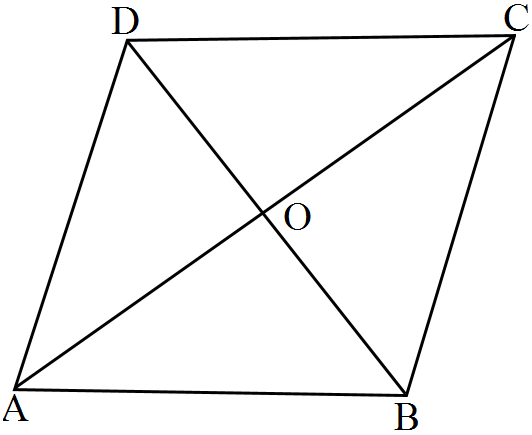
$\text{OB}=\frac{24}{2}=12\text{cm}$ and $\text{OC}=\frac{10}{2}=5\text{cm}$
In triangle $OBC,$
$\text{BC}=\sqrt{12^2+5^2}=\sqrt{144+25}=13\text{cm}$
Perimeter of rhombus $=4\times\text{side}=4\times13=52\text{cm}$ View full question & answer→MCQ 1761 Mark
The sides of a triangle are $5\ cm, 12\ cm$ and $13\ cm.$ then its area is:
- ✓
$0.003m^2$
- B
$0.0015m^2$
- C
$0.0024m^2$
- D
$0.0026m^2$
AnswerCorrect option: A. $0.003m^2$
$\text{s}=\frac{5+12+13}{2}=15\text{cm}$
Area of triangle $=\sqrt{\text{s}(\text{s}-\text{a})(\text{s}-\text{b})(\text{s}-\text{c})}$
$=\sqrt{15(15-5)(15-12)(15-13)}$
$=\sqrt{15\times10\times3\times2}$
$=30\text{ sq. cm}$
$=0.003\text{m}^2$
View full question & answer→MCQ 1771 Mark
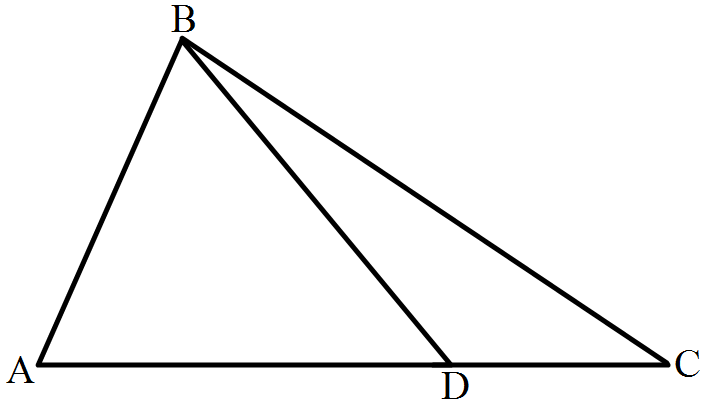
In the given figure, the ratio $AD$ to $DC$ is $3$ to $2.$ If the area of $\triangle\text{ABC}$ is $40\ cm^2$, what is the area of $\triangle\text{BDC}?$
- ✓
$16\ cm^2$
- B
$24\ cm^2$
- C
$30\ cm^2$
- D
$36\ cm^2$
AnswerCorrect option: A. $16\ cm^2$
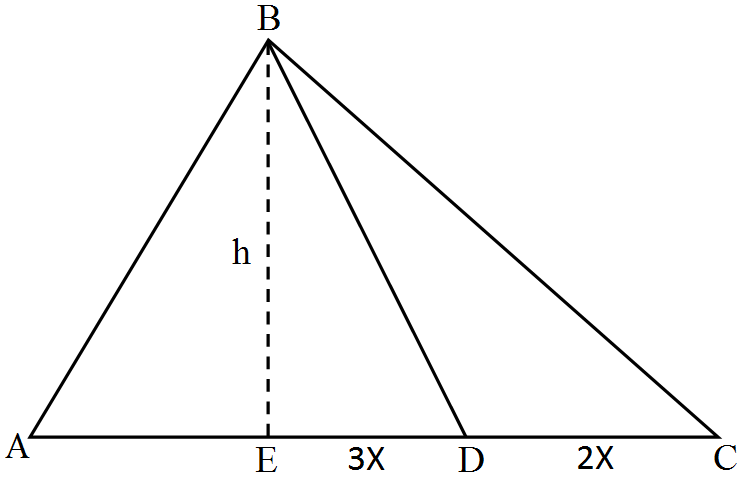
$\frac{\text{AD}}{\text{DC}}=\frac32$
Let $AD = 3x$ and $DC = 2x$
Area of $\triangle\text{ABC}=\frac12\times\text{AC}\times\text{BC} (BE = h)$
$\Rightarrow40=\frac12\times5\text{x}\times\text{h}$
$⇒ 80 = 5xh$
$⇒ xh = 16\ cm^2 ....(1)$
Now, Area of $\triangle\text{ABD}=\frac12\times3\text{x}\times\text{h}=\frac{3\times\text{h}}{2}=\frac{3}{2}\times16=24\text{cm}^2$
Area of $\triangle\text{BDC}=$ Area of $\triangle\text{ABC}-$ Area of $\triangle\text{ABD}=40-24=16\text{cm}^2$
Hence, correct option is $(a).$
View full question & answer→MCQ 1781 Mark
The sides of a triangle are $50\ cm, 78\ cm$ and $112\ cm.$ The smallest altitude is:
- A
$20\ cm$
- ✓
$30\ cm$
- C
$40\ cm$
- D
$50\ cm$
AnswerCorrect option: B. $30\ cm$
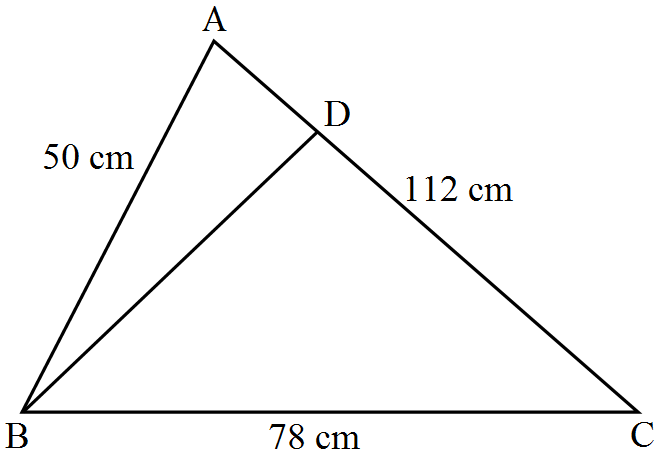
The smallest altitude is $\perp$ drawn to the largest side of a $\triangle$ From opposite point. i. e. $BD$
Area of $\triangle=\frac12\times\text{AC}\times\text{BD}=\frac12\times112\times\text{BD}=56\times\text{BD}$
$\text{s}=\frac{\text{a}+\text{b}+\text{c}}{2}=\frac{50+78+115}{2}=120\text{cm}$
$s - AB = 70\ cm, s - BC = 42\ cm, s - AC = 8\ cm$
Area $=\sqrt{\text{s}(\text{s}-\text{a})(\text{s}-\text{b})(\text{s}-\text{c})}$
$=\sqrt{120\times70\times42\times8}=1680\text{cm}^2$
Now, $56 × BD = 1680\ cm^2$
$\Rightarrow\text{BD}=\frac{1680}{56}=30\text{cm}$
Hence, correct option is $(b).$
View full question & answer→MCQ 1791 Mark
The area of a regular hexagon of side $4\ cm$ is:
- A
$4\sqrt{3}\text{ cm}^2$
- B
$10\sqrt{3}\text{ cm}^2$
- C
$6\sqrt{3}\text{ cm}^2$
- ✓
$24\sqrt{3}\text{ cm}^2$
AnswerCorrect option: D. $24\sqrt{3}\text{ cm}^2$
Area of regular hexagon $=\frac{3\sqrt{3}}{2}($Side$)^2$
$=\frac{3\sqrt{3}}{2}\times4\times4$
$=24\sqrt{3}\text{ cm}^2$
View full question & answer→MCQ 1801 Mark
Write the correct answer in the following: The area of an isosceles triangle having base $2\ cm$ and the length of one of the equal sides $4\ cm,$ is:
AnswerCorrect option: A. $\sqrt{15}\text{cm}^2$
Here, $\text{s}=\frac{4+4+2}{2}=5\text{cm}$
Area of $\triangle=\sqrt{5(5-2)(5-4)(5-4)}$
$=\sqrt{5\times3\times1\times1}=\sqrt{15}\text{cm}^2$
View full question & answer→MCQ 1811 Mark
The base of a right triangle is $48\ cm$ and its hypotenuse is $50\ cm$ long. The area of the triangle is:
- A
$168\ cm^2$
- B
$252\ cm^2$
- ✓
$336\ cm^2$
- D
$504\ cm^2$
AnswerCorrect option: C. $336\ cm^2$
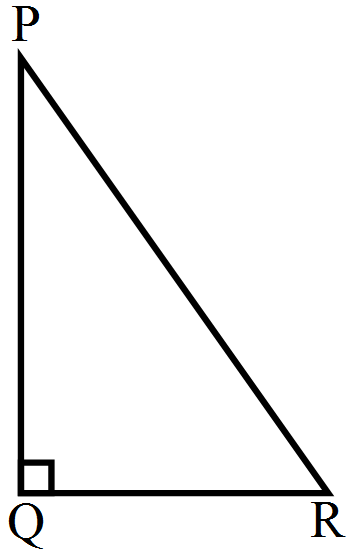
Let $\triangle\text{PQR}$ be a right-angled triangle and $\text{PQ}\bot\text{QR}.$
Now,
$\text{PQ}=\sqrt{\text{PR}^2-\text{QR}^2}$
$=\sqrt{50^2-48^2}$
$=\sqrt{2500-2304}$
$=\sqrt{196}$
$=14\text{cm}$
$\therefore$ Area of triangle $=\frac{1}{2}\times\text{QR}\times\text{PQ}\\=\frac{1}{2}\times48\times14=336\text{cm}^2$
View full question & answer→MCQ 1821 Mark
The base of a right triangle is 8cm and hypotenuse is $10\ cm.$ Its area will be:
- A
$40\ cm^2$
- ✓
$24\ cm^2$
- C
$48\ cm^2$
- D
$80\ cm^2$
AnswerCorrect option: B. $24\ cm^2$
perpendicular $=\sqrt{10^2-8^2}=\sqrt{100-64}=\sqrt{36}=6\text{cm}$
Area of triangle $=\frac{1}{2}\times\text{Base}\times\text{Perpendicular}$
$=\frac{1}{2}\times8\times6$
$=24\text{ sq.cm}$
View full question & answer→MCQ 1831 Mark
Length of perpendicular drawn on longest side of a scale $\triangle$ is:
View full question & answer→MCQ 1841 Mark
Each of the equal sides of an isoscale triangle is $13\ cm$ and its base is $24\ cm$. The area of the triangle is:
- A
$156\ cm^2$
- B
$78\ cm^2$
- ✓
$60\ cm^2$
- D
$120\ cm^2$
AnswerCorrect option: C. $60\ cm^2$
Area of isoscale triangle $=\frac{\text{b}}{4}\sqrt{4\text{a}^2-\text{b}^2}$
Here,
$a = 13\ cm$ and $b = 24\ cm$
Thus, we have:
$=\frac{24}{4}\times\sqrt{4(13)^2-24^2}$
$=6\times\sqrt{676-576}$
$=6\times\sqrt{100}$
$=6\times10$
$=60\text{cm}^2$
View full question & answer→MCQ 1851 Mark
The measure of each side of an equilateral triangle whose area is $\sqrt{3}\text{cm}^2$ is:
- A
$8\ cm$
- B
$4\ cm$
- ✓
$2\ cm$
- D
$16\ cm$
AnswerCorrect option: C. $2\ cm$
Area of equilateral triangle $=\frac{\sqrt{3}\text{a}^2}{4}$ where $a = $side of the triangle
$\sqrt{3}=\frac{\sqrt{3}\text{a}^2}{4}$
Solving
$\text{a}^2=4$
$\text{a}=2\text{cm} $
View full question & answer→MCQ 1861 Mark
If the base and the corresponding altitude of a parallelogram are $60\ cm$ and $24\ cm$ respectively, then the area of the parallelogram is:
- ✓
$1440\ cm^2$
- B
$720\ cm^2$
- C
1$200\ cm^2$
- D
$1400\ cm^2$
AnswerCorrect option: A. $1440\ cm^2$
Area of parallelogram $=$ Base $×$ corresponding height
$= 60 × 24 = 1440\ sq.cm.$
View full question & answer→MCQ 1871 Mark
A square and an equilateral triangle have equal perimeters. If the diagonal of the square is $12\sqrt{2}\text{cm},$ then area of the triangle is:
- ✓
$64\sqrt3\text{cm}^2$
- B
$48\sqrt3\text{cm}^2$
- C
$24\sqrt2\text{cm}^2$
- D
$24\sqrt3\text{cm}^2$
AnswerCorrect option: A. $64\sqrt3\text{cm}^2$
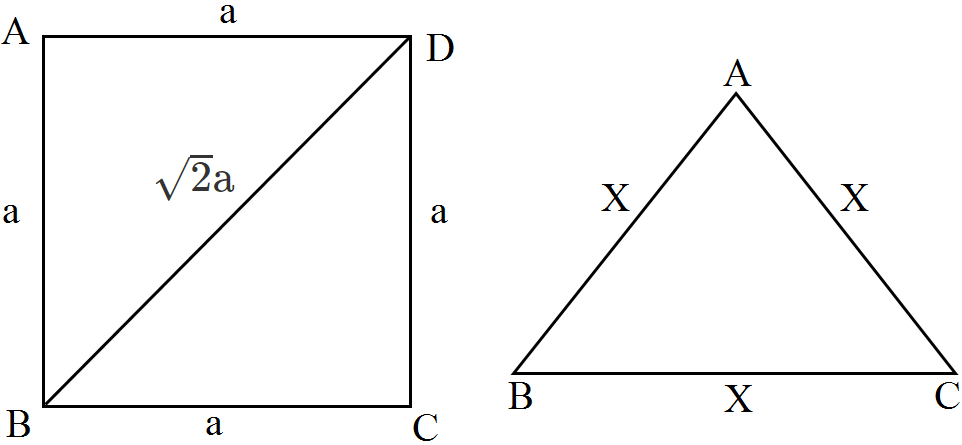
If side of a square is $a\ cm$ then, its diagonal $=\sqrt2\text{ a cm}$
But diagonal $=12\sqrt2\text{cm}$
$\Rightarrow2-\sqrt{\text{a}}=12\sqrt2$
$\Rightarrow\text{a}=12\text{cm}$
$⇒$ Perimeter of a square $= 4a = 4 × 12= 48\ cm$
Now, perimeter of an equilateral triangle with side $x = 3x\ cm$
But, perimeter of equilateral triangle $=$ Perimeter of square
$⇒ 3x = 48$
$⇒ x = 16\ cm$
Now, Area of equilateral $\triangle=\frac{\sqrt3\text{x}^2}{4}=\frac{\sqrt3}{4}\times16\times16=64\sqrt3\text{cm}^2$ View full question & answer→MCQ 1881 Mark
The sides of a triangular field are $325m, 300m$ and $125m.$ Its area is:
- ✓
$18750\ m^2$
- B
$37500\ m^2$
- C
$97500\ m^2$
- D
$48750\ m^2$
AnswerCorrect option: A. $18750\ m^2$
$a = 325m, b = 30m, c = 125m$
$\text{s}=\frac{\text{a}+\text{b}+\text{c}}{2}=\frac{325+300+125}{2}=375\text{m}$
$s - a = 50m, s - b = 75m, s - c = 250m$
Area $=\sqrt{\text{s}(\text{s}-\text{a})(\text{s}-\text{b})(\text{s}-\text{c})}$
$=\sqrt{375\times50\times75\times250}$
$=\sqrt{15\times25\times25\times2\times3\times25\times25\times10}$
$=\sqrt{\underline{25\times25}\times\underline{25\times25}\times\underline{30\times30}}$
$=25\times25\times30$
$= 18750\text{m}^2$
Hence, correct option is $(a).$
View full question & answer→MCQ 1891 Mark
The base of an isosceles triangle is $16\ cm$ and its area is $48\ cm^2$. The perimeter of the triangle is:
- ✓
$36\ cm$
- B
$41\ cm$
- C
$324\ cm$
- D
$48\ cm$
AnswerCorrect option: A. $36\ cm$
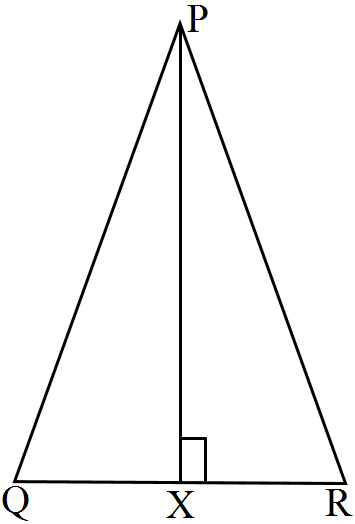
Let $\triangle\text{PQR}$ be an isosceles triangle and $PX \perp QR$
Now,
Area of triangle $= 48\ cm^2$
$\Rightarrow\frac{1}{2}\times\text{QR}\times\text{PX}=48$
$\Rightarrow\text{h}=\frac{96}{16}=6\text{cm}$
Also,
$\text{QX}=\frac{1}{2}\times24=12\text{cm}$ and $PX =12\ cm$
$\text{PQ}=\sqrt{\text{QX}^2+\text{PX}^2}$
$\text{a}=\sqrt{8^2+6^2}=\sqrt{64+36}=\sqrt{100}=10\text{cm}$
$\therefore$ Perimeter $= (10 + 10 + 16)\ cm = 36\ cm$
View full question & answer→MCQ 1901 Mark
The area of an equilateral triangle is $81\sqrt{3}\text{ cm}^2.$ Its height is:
- ✓
$9\sqrt{3}\text{ cm}$
- B
$6\sqrt{3}\text{ cm}$
- C
$18\sqrt{3}\text{ cm}$
- D
$9\text{ cm}$
AnswerCorrect option: A. $9\sqrt{3}\text{ cm}$
Area of quadrilateral triangle $=81\sqrt{3}\text{ cm}^2$
$\Rightarrow\frac{\sqrt{3}}{4}\times($Side$)^2=81\sqrt{3}$
$\Rightarrow($Side$)^2=81\times4$
$\Rightarrow($Side$)^2=324$
$\Rightarrow$ Side$=18\text{ cm}$
Now,
Height$=\frac{\sqrt{3}}{2}\times$ Side$=\frac{\sqrt{3}}{2}=9\sqrt{3}\text{ cm}$
View full question & answer→MCQ 1911 Mark
The perimeter of a rhombus is $20\ cm.$ If one of its diagonals is $6\ cm,$ then its area is:
- A
$28\ cm^2$
- ✓
$24\ cm^2$
- C
$20\ cm^2$
- D
$36\ cm^2$
AnswerCorrect option: B. $24\ cm^2$
$\text{Side}=\frac{20}{4}=5\text{cm}$
$\text{half diagnoal} =\sqrt{5^2 - 3^2} = 4\text{cm }$
$\text{diagnoal} = 4 \times 2 = 8 \text{cm} $
$\text{Area}=\frac{1}{2}\times6\times8=24\text{cm}^2$
View full question & answer→MCQ 1921 Mark
The base of a right triangle is $8\ cm $ and the hypotenuse is $10\ cm.$ Its area will be
- ✓
$24\text{cm}^2$
- B
$40\text{cm}^2$
- C
$48\text{cm}^2$
- D
$80\text{cm}^2$
AnswerCorrect option: A. $24\text{cm}^2$
Given: Base $= 8\ cm$ and Hypotenuse $= 10\ cm$
$\text{Hence,hight}=\sqrt{(10)^2-(8)^2}=\sqrt{36=6\text{cm}}$
$\text{Therefore,area}=(\frac {1}{2})\times\text{b}\times\text{h} =(\frac{1}{2})\times8\times6=24\text{cm}^2$
View full question & answer→MCQ 1931 Mark
The area of an isosceles right angled triangle of equal side $30\ cm,$ is given as:
- A
$225\sqrt{3}\text{cm}^2$
- B
$900\ cm^2$
- ✓
$450\ cm^2$
- D
$45\ cm^2$
AnswerCorrect option: C. $450\ cm^2$
Area of triangle $=\frac{1}{2}\times\text{Base}\times\text{Height}$
$=\frac{1}{2}\times30\times30=450\text{ sq.cm}$
View full question & answer→MCQ 1941 Mark
The area of a right angled triangle is $20m^2$ and one of the sides containing the right triangle is $4\ cm.$ Then the altitude on the hypotenuse is:
AnswerCorrect option: A. $\frac{20}{\sqrt{29}}\text{cm}$
Area of right angle triangle $= 20\ sq.m$
$\Rightarrow\frac{1}{2}\times\text{Base}\times\text{Height}=20$
$\Rightarrow\frac{1}{2}\times\text{Base}\times4=20$
$\Rightarrow\text{Base}=10\text{cm}$
Then, Hypotenuse $=\sqrt{10^2+4^2}=2\sqrt{29}\text{m}$
If the altitude drawn to the hypotenuse of a right angle triangle, then the length of required altitude $=\frac{10\times4}{2\sqrt{29}}=\frac{20}{\sqrt{29}}\text{cm}$
View full question & answer→MCQ 1951 Mark
The perimeter of an isosceles triangle is $32\ cm.$ the ratio of the equal side to its base is $3 : 2$. Then area of the triangle is:
- A
$32\text{cm}^2$
- B
$16\text{cm}^2$
- ✓
$32\sqrt{2}\text{cm}^2$
- D
$16\sqrt{2}\text{cm}^2$
AnswerCorrect option: C. $32\sqrt{2}\text{cm}^2$
Let each of the equal sides of given triangle be $x\ cm.$ Then the third side is $(32 - 2x)cm,$
According to quesiton, $\frac{\text{x}}{32-2\text{x}}=\frac{3}{2}$
According to quesiton, $x 32 - 2x = 32$
$⇒ 2x = 96 - 6x$
$⇒ 8x = 96$
$⇒ x = 12\ cm$
Therefore, the sides are $12\ cm, 12\ cm$ and $8\ cm$
Area $=\sqrt{\text{s}(\text{s}-\text{a})(\text{s}-\text{b})(\text{s}-\text{c})}$
$=\sqrt{16(16-12)(16-12)(16-3)}$
$=\sqrt{16\times4\times4\times8}$
$=32\sqrt{2}\text{sq}.\text{cm.}$
View full question & answer→MCQ 1961 Mark
Area of an isosceles triangle $ABC$ with $AB = a = AC$ and $BC = b$ is:
- A
$\frac{1}{2}\text{b}\sqrt{\text{a}^2-\text{b}^2}$
- B
$\frac{1}{4}\text{b}\sqrt{\text{a}^2-\text{b}^2}$
- C
$\frac{1}{2}\text{b}\sqrt{4\text{a}^2-\text{b}^2}$
- ✓
$\frac{1}{4}\text{b}\sqrt{4\text{a}^2-\text{b}^2}$
AnswerCorrect option: D. $\frac{1}{4}\text{b}\sqrt{4\text{a}^2-\text{b}^2}$
Here, $\text{s}=\frac{\text{a+aab}}{2}=\frac{2\text{a+b}}{2}$
Area of triangle $=\sqrt{\text{s}(\text{s}-\text{a})(\text{s}-\text{b})(\text{s}-\text{c})}$
$=\sqrt{\frac{2\text{a+b}}{2}\Big(\frac{2\text{a+b}}{2}-\text{a}\Big)\Big(\frac{2\text{a+b}}{2}-\text{a}\Big)\Big(\frac{2\text{a+b}}{2}-\text{b}\Big)}$
$\sqrt{\frac{2\text{a+b}}{2}\Big(\frac{\text{b}}{2}\Big)\Big(\frac{\text{b}}{2}\Big)\Big(\frac{\text{2a-b}}{2}\Big)}$
$=\frac{\text{b}}{4}\sqrt{4\text{a}^2-\text{b}^2}.$
View full question & answer→MCQ 1971 Mark
The area of an equilateral triangle having side length equal to $\sqrt\frac{3}{4}\text {cm}$ (using Heron’s formula) is:
- A
a. $\frac{2}{27}\text{sq.cm}$
- B
b. $\frac{2}{15}\text{sq.cm}$
- ✓
c. $3\sqrt\frac{3}{64}\text{sq.cm}$
- D
d.$\frac{3}{14}\text{sq.cm}$
AnswerCorrect option: C. c. $3\sqrt\frac{3}{64}\text{sq.cm}$
c. $3\sqrt\frac{3}{64}\text{sq.cm}$Solution:
$\text{Here, } \text{a}=\text{b}=\text{c}\sqrt{\frac{3}{4}}$
$\text{Semiperimeter}=\frac{(\text{a}+\text{b}+\text{c})}{2} \frac{3\text{a}}{2}=3\sqrt{\frac{3}{8}\text{cm}}$
Using Heron’s formula,
$\text{A}=\sqrt{\text{s}\text(s-a)\text(s-b)\text(s-c)}$
$(\sqrt{3\sqrt{\frac{3}{8}}}) (3\sqrt{\frac{3}{8}}-\sqrt{\frac{3}{4}}) (3\sqrt{\frac{3}{8}}-\sqrt{\frac{3}{4}}) \sqrt{\frac{3}{4}}) $
$=3\sqrt{\frac{3}{64}}\text{s}\text{q}.\text{c}\text{m}$
View full question & answer→MCQ 1981 Mark
If side of a scalene $\triangle$ is doubled then area would be increased by:
- A
$200\%$
- ✓
$300\%$
- C
$25\%$
- D
$50\%$
AnswerCorrect option: B. $300\%$
Area of triangle with sides $a, b, c (A) =\sqrt{\text{s}(\text{s}-\text{a})(\text{s}-\text{b})(\text{s}-\text{c})}$
New sides are $2a, 2b,$ and $2c$
Then $\text{s}'=\frac{2\text{a}+2\text{b}+2\text{c}}{2}=\text{a}+\text{b}+\text{c}$
$\Rightarrow\text{s}'=2\text{s}\ ....(\text{i})$
New area $=\sqrt{\text{s}'(\text{s}'-2\text{a})(\text{s}'-2\text{b})(\text{s}'-2\text{c})}$
$=\sqrt{2\text{s}(2\text{s}-2\text{a})(2\text{s}-2\text{b})(2\text{s}-2\text{c})}$
$=4\sqrt{\text{s}(\text{s}-\text{a})(\text{s}-\text{b})(\text{s}-\text{c})}$
$=4\text{A}$
Increased area $= 4A - A = 3A$
$\%$ of increased area $=\frac{3\text{A}}{\text{A}}\times100=300\%$
View full question & answer→MCQ 1991 Mark
The length of each side of an equilateral triangle having an area of $9\sqrt{3}\text{cm}^2$ is:
- A
$8\ cm$
- B
$36\ cm$
- ✓
$6\ cm$
- D
$4\ cm$
AnswerCorrect option: C. $6\ cm$
Area of equilateral triangle $9\sqrt{3}\text{sq}.\text{cm}$
$\Rightarrow\frac{\sqrt{3}}{4}(\text{Side})^2=9\sqrt{3}$
$⇒ ($Side$)^2 = 36$
$⇒$ Side $= 6\ cm.$
View full question & answer→MCQ 2001 Mark
The perimeter and area of a triangle whose sides are of lengths $3\ cm, 4\ cm$ and $5\ cm$ respectively are:
- ✓
$12\ cm, 6\ cm^2$
- B
$12\ cm, 12\ cm^2$
- C
$6\ cm, 6\ cm^2$
- D
$6\ cm, 12\ cm^2$
AnswerCorrect option: A. $12\ cm, 6\ cm^2$
Perimeter of triangle $= 3 + 4 + 5 = 12\ cm$
Now, $\text{s}=\frac{3+4+5}{2}=\text{6cm}$
Area $=\sqrt{\text{s}(\text{s}-\text{a})(\text{s}-\text{b})(\text{s}-\text{c})}$
$=\sqrt{6(6-3)(6-4)(6-5)}=\sqrt{6\times3\times2\times1}$
$= 6 \text{ sq. cm}$
View full question & answer→