Question
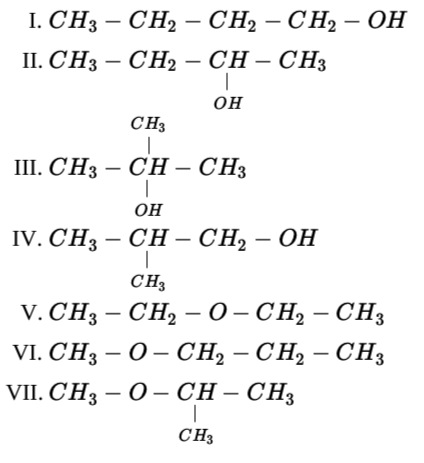
1. Identify the pairs of compounds which are functional group isomers.
Image
2. Explain, how is the electronegativity of carbon atoms related to their state of hybridization in an organic compound.

Answer

1. All the seven compounds given have the same molecular formula, so each alcohol is a functional group isomer of each ether given and visa-versa. Functional group isomers are a type of structural isomers having the same molecular formula but different functional groups. In the given structures, I, II, III, IV represent alcohols and V, VI, VII are ethers. Hence, I and V, I and VI, I and VII, II and V, II and VI, II and VII, III and V, III and VI, etc.
2. If C is sp hybridized then S character is $50 \%$.
If C is $sp ^2$ hybridized then S character is $33 \%$.
If C is $sp ^3$ hybridized then S character is $25 \%$.
Electronegativity of carbon is directly proportional to ' $s$ ' character.
Hence, sp hybridized carbon has strong S character.
We know that, s electrons are more strongly attracted by nucleus than p-electrons as they lie closer to nucleus.. Thus, electronegativity of carbon increases with increase in ' $s$ ' character.

Need a full question paper?

Generate a complete, print-ready paper with questions like this in minutes — across 16+ boards, with answer keys.

Start Generating Free

Similar questions

Explain different types of oxidation reactions of alkenes with example.
Calculate the temperature of 4.0 mol of a gas occupying $5 \mathrm{dm}^3$ at 3.32 bar. $\left(\mathrm{R}=0.083 \mathrm{bar}^{-1} \mathrm{dm}^3 \mathrm{~K}^{-1} \mathrm{~mol}^{-1}\right)$.
  1. Complete the equations for:
  1. $\text{BF}_3+\text{LiH}\rightarrow$
  2. $\text{B}_2\text{H}_6+\text{H}_2\text{O}\rightarrow$
  1. Give reasons:
  1. Conc $HNO_3$ is transported in aluminium container.
  2. Graphite is used as lubricant.
  3. Lead (IV) chloride is highly unstable towards heat.
Why is Wurtz reaction not preferred for the preparation of alkanes containing odd number of carbon atoms? Illustrate your answer by taking one example.
What do you understand by the term “non-stoichiometric hydrides”? Do you expect this type of the hydrides to be formed by alkali metals? Justify your answer.
Explain the applications of Fajan's law.
Explain the half reaction method (ionelectron method) to balance the redox reaction with example.
The ratio of mass percent of C and H of an organic compound $\mathrm{C}_{\mathrm{x}} \mathrm{H}_y \mathrm{O}_z$ is $6: 1$. If one molecule of the above compound $\left(\mathrm{C}_x \mathrm{H}_y \mathrm{O}_z\right)$ contains half much oxygen of required to burn one molecule of compound $\mathrm{C}_x \mathrm{H}_y$ completely to $\mathrm{CO}_2$ and $\mathrm{H}_2 \mathrm{O}$. What is empirical formula of $\mathrm{C}_{\mathrm{x}} \mathrm{H}_y \mathrm{O}_z$ ?
The electron energy in hydrogen atom is given by $\text{E}_{\text{n}}=\frac{ (–2.18 \times 10–18 )}{\text{n}^2}\text{J}.$ Calculate the energy required to remove an electron completely from the n = 2 orbit. What is the longest wavelength of light in cm that can be used to cause this transition?
A colourless liquid ‘A’ contains H and O elements only. It decomposes slowly on exposure to light. It is stabilised by mixing urea to store in the presence of light.
  1. Suggest possible structure of A.
  2. Write chemical equations for its decomposition reaction in light.