Questions

5 Marks Questions

Take a timed test

5 questions · self-marked practice — reveal the answer and mark yourself.

Question 15 Marks
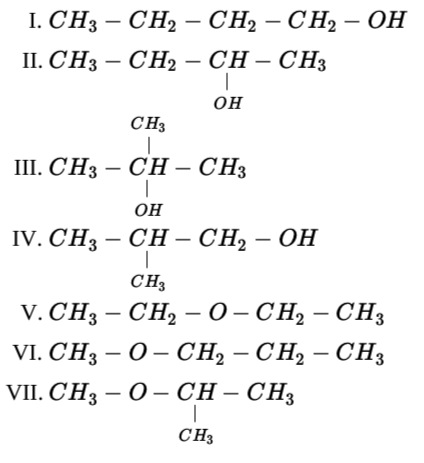
1. Identify the pairs of compounds which are functional group isomers.
Image
2. Explain, how is the electronegativity of carbon atoms related to their state of hybridization in an organic compound.
Answer
1. All the seven compounds given have the same molecular formula, so each alcohol is a functional group isomer of each ether given and visa-versa. Functional group isomers are a type of structural isomers having the same molecular formula but different functional groups. In the given structures, I, II, III, IV represent alcohols and V, VI, VII are ethers. Hence, I and V, I and VI, I and VII, II and V, II and VI, II and VII, III and V, III and VI, etc.
2. If C is sp hybridized then S character is $50 \%$.
If C is $sp ^2$ hybridized then S character is $33 \%$.
If C is $sp ^3$ hybridized then S character is $25 \%$.
Electronegativity of carbon is directly proportional to ' $s$ ' character.
Hence, sp hybridized carbon has strong S character.
We know that, s electrons are more strongly attracted by nucleus than p-electrons as they lie closer to nucleus.. Thus, electronegativity of carbon increases with increase in ' $s$ ' character.
View full question & answer
Question 25 Marks
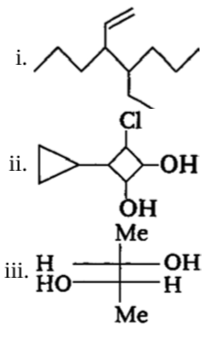
1. Give IUPAC names of the following structures.
Image
2. Benzoic acid is an organic compound. Its crude sample can be purified by crystallization from hot water. What characteristic differences in the properties of benzoic acid and the impurity make this process of purification suitable?
Answer
1. i. 4-ethyl-3-propylhept-1-ene
ii. 3-chloro-4-cyclopropyl-1,2 cyclobutandiol
iii. Butan-2,3-diol
2. Benzoic acid is sparingly soluble in water at room temperature but appreciably soluble at higher temperature. The solution is concentrated to get a nearly saturated solution.
On cooling the solution, pure compound crystallises out.
View full question & answer
Question 35 Marks
1. Describe the effect of
a. addition of $H _2$
b. addition of $CH _3 OH$
c. removal of CO
d. removal of $CH _3 OH$ on the equilibrium of the reaction,
$
2 H_2(g)+CO(g) \rightleftharpoons CH_3 OH(g)
$
2. What happens to an equilibrium in a reversible reaction if a catalyst is added to it?
Answer
1. $2 H _2(g)+ CO ( g ) \rightleftharpoons CH _3 OH ( g )$
According to Le-Chatelier's principle,
a. addition of $H _2$ (increase in concentration of reactants) shifts the equilibrium in forward direction (more product is formed).
b. addition of $CH _3 OH$ (increase in concentration of product) shifts the equilibrium in backward direction.
c. removal of CO also shifts the equilibrium in backward direction.
d. removal of $CH _3 OH$ shifts the equilibrium in forward direction.
2. When catalyst is added, the state of equilibrium is not disturbed but equilibrium is attained quickly. This is because the catalyst increases the rate of forward and backward reaction to the same extent.
View full question & answer
Question 45 Marks
Write the expression for the equilibrium constant, $K _{ C }$ for each of the following reactions:
a. $2 NOCl ( g ) \rightleftharpoons 2 NO ( g )+ Cl _2(g)$
b. $2 Cu \left( NO _3\right)_2(s) \rightleftharpoons 2 CuO ( s )+4 NO _2(g)+ O _2(g)$
c. $CH _3 COOC _2 H _5( aq )+ H _2 O ( l ) \rightleftharpoons CH _3 COOH ( aq )+ C _2 H _5 OH ( aq )$
d. $Fe ^{3+}( aq )+3 OH ^{-}( aq ) \rightleftharpoons Fe ( OH )_3(s)$
e. $I _2(s)+5 F_2 \rightleftharpoons 2 IF _5$
View full question & answer
Question 55 Marks
Attempt any five of the following:
1. What effect does branching of an alkene chain has on its boiling point?
2. What are Arenes?
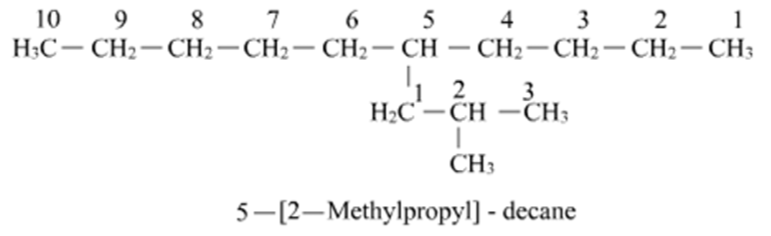
3. Write IUPAC name of the following: $CH _3\left( CH _2\right)_4 CH \left( CH _2\right)_3 CH _3 CH _2- CH \left( CH _3\right)_2$
4. Why are alkanes called paraffins?
5. State Le chatelier's principle.
6. What is decarboxylation? Give an example.
7. Arrange the following: $HCl , HBr , Hl , HF$ in order of decreasing reactivity towards alkenes.
Answer
1. Branching of carbon atom chain decreases the boiling point of alkane.
2. Arenes are aromatic hydrocarbons
3. The IUPAC name of given compound is:

4. Paraffins means little affinity. Alkanes due to strong C-C and C-H bonds are relatively chemically inert.
5. Le chatelier's principle: If a system at equilibrium is subjected to change in the temperature, pressure or concentration of the reactants or the products that govern the equilibrium, then the equilibrium shifts in that direction in which this change is reduced or nullified.
6. The process by which carbon dioxide is removed from sodium acetate (or any sodium salt of acid) with the help of sodalime is called decarboxylation.
Image
7. $HI> HBr > HCl > HF$
View full question & answer