Question
1 litre of an ideal gas $(\gamma=1.5)$ at $300K$ is suddenly compressed to half its original volume.
  1. Find the ratio of the final pressure to the initial pressure.
  2. If the original pressure is $100kPa$, find the work done by the gas in the process.
  3. What is the change in internal energy?
  4. What is the final temperature?
  5. The gas is now cooled to $300K$ keeping its pressure constant. Calculate the work done during the process.
  6. The gas is now expanded isothermally to achieve its original volume of $1$ litre. Calculate the work done by the gas.
  7. Calculate the total work done in the cycle.
Answer

$\gamma=1.5,\ \text{T}=300\text{K},$$\text{V}_1=1\text{L},\ \text{V}_2=\frac{1}{2}\text{L}$
  1. The process is adiabatic as it is sudden,
$\text{P}_1\text{V}_1^\gamma=\text{P}_2\text{V}_2^\gamma$
$\Rightarrow\text{P}_1(\text{V}_0)^\gamma=\text{P}_2\Big(\frac{\text{V}_0}{2}\Big)^\gamma$
$\Rightarrow\text{P}_2=\text{P}_1\bigg(\frac{1}{\frac{1}{2}}\bigg)^{1.5}=\text{P}_1(2)^{1.5}$
$\Rightarrow\frac{\text{P}_2}{\text{P}_1}=2^{1.5}=2\sqrt2$
  1. $\text{P}_1=100\text{KPa}=10^5\text{Pa},\ \text{W}=\frac{\text{nR}}{\gamma-1}[\text{T}_1-\text{T}_2]$
$\text{T}_1\text{V}_1^{\gamma-1}=\text{P}_2\text{V}_2^{\gamma-1}$
$\Rightarrow300\times(1)^{1.5-1}=​​\text{T}_2\times(0.5)^{1.5-1}$
$\Rightarrow300\times1=​​\text{T}_2\sqrt{0.5}$
$\Rightarrow\text{T}_=300\times\sqrt{\frac{1}{0.5}}=300\sqrt2\text{K}$
$\text{P}_1\text{V}_1=\text{nRT}_1$
$\Rightarrow\text{n}=\frac{​​\text{P}_1\text{V}_1}{\text{RT}_1}=\frac{10^5\times10^{-3}}{\text{R}\times300}=\frac{1}{3\text{R}}$ $\big(\text{V in m}^3\big)$
$\text{W}=\frac{\text{nR}}{\gamma-1}[\text{T}_1-\text{T}_2]$
$=\frac{1\text{R}}{3\text{R}(1.5-1)}\big[300-300\sqrt2\big]$
$=\frac{300}{3\times0.5}\big(1-\sqrt2\big)=-82.8\text{J}\approx-82\text{J}$
  1. Internal Energy,
dQ = 0,
⇒ du = - dw = -(-82.8)J
$= 82.8 \text{J}\approx 83 \text{J}$
  1. Final Temp $=300\sqrt2=300\times1.414\times100=424.2\text{K}\approx424\text{K}$
  1. The pressure is kept constant.
The process is isobaric,
Work done = nRdT $=\frac{1}{3\text{R}}\times\text{R}\times(300-300\sqrt2)$
Final Temp = 300K
$\Rightarrow-\frac{1}{3}\times300(0.414)=-41.4\text{J}$
Initial Temp $=300\sqrt2$
  1. Initial volume,
$\Rightarrow\frac{\text{V}_1}{\text{T}_1}=\frac{\text{V}'_1}{\text{T}'_1}=\text{V}'_1=\frac{\text{V}_1}{\text{T}_1}\times\text{T}'_1$
$=\frac{1}{2\times300\times\sqrt2}\times300=\frac{1}{2\sqrt2}\text{L}$
Final volume = 1L
Work done in isothermal $=\text{nRTln}\frac{\text{V}_2}{\text{V}_1}$
$=\frac{1}{3\text{R}}\times\text{R}\times300\text{ln}\bigg(\frac{1}{\frac{1}{2}\sqrt2}\bigg)$
$=100\times\text{ln}\big(2\sqrt2\big)=100\times1.039\approx103$
  1. Net work done = $W_A + W_B + W_C$
= -82 - 41.4 + 103
= -20.4J

Need a full question paper?

Generate a complete, print-ready paper with questions like this in minutes — across 16+ boards, with answer keys.

Start Generating Free

Similar questions

Calculate the heat required to convert 0.6 kg of ice at $-20^{\circ} \mathrm{C}$, kept in a calorimeter to steam at $100^{\circ} \mathrm{C}$ at atmospheric pressure. Given the specific heat capacity of ice $=2100 \mathrm{~J} \mathrm{~kg}^{-1} \mathrm{~K}^{-1}$, specific heat capacity of water is $4186 \mathrm{~J} \mathrm{~kg}^{-1} \mathrm{~K}^{-1}$, latent heat of ice $=3.35 \times 10^5 \mathrm{~J} \mathrm{~kg}^{-1}$, and latent heat of steam $=2.256 \times 106 \mathrm{~J} \mathrm{~kg}^{-1}$.
A brass boiler has a base area of $0.15 \mathrm{~m}^2$ and thickness 1.0 cm . It boils water at the rate of $6.0 \mathrm{~kg} / \mathrm{min}$ when placed on a gas stove. Estimate the temperature of the part of the flame in contact with the boiler. Thermal conductivity of brass $=109 \mathrm{~J} \mathrm{~s}^{-1} \mathrm{~m}^{-1} \mathrm{~K}^{-1}$; Heat of vaporisation of water $=2256 \times 103 \mathrm{~J} \mathrm{~kg}^{-1}$.
The door of an almirah is 6ft high, 1.5ft wide and weighs 8kg. The door is supported by two hinges situated at a distance of 1ft from the ends. If the magnitudes of the forces exerted by the hinges on the door are equal, find this magnitude.
The electrical resistance in ohms of a certain thermometer varies with temperature according to the approximate law: $\text{R}=\text{R}_0[1+\alpha(\text{T}-\text{T}_0)]$ The resistance is $101.6W$ at the triple-point of water $273.16K$, and $165.5W$ at the normal melting point of lead (600.5K). What is the temperature when the resistance is $123.4W$?
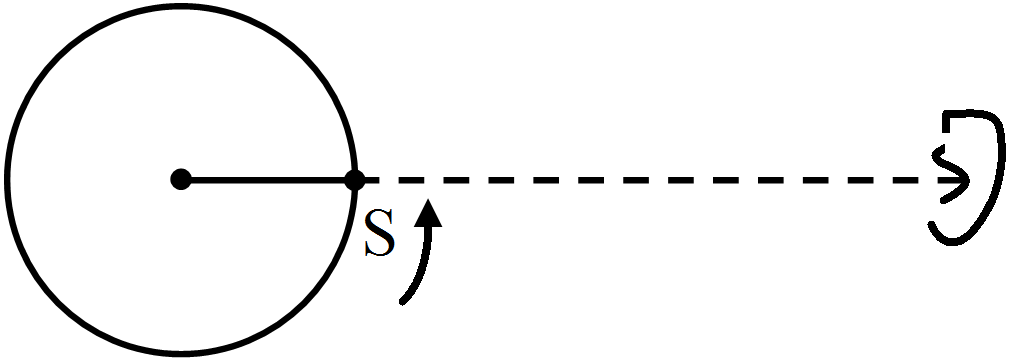
A small source of sound S of frequency 500Hz is attached to the end of a light string and is whirled in a vertical circle of radius 1.6m. The string just remains tight wher the source is at the highest point.
  1. An observer is located in the same vertical plane at a large distance and at the same height as the centre of the circle figure. The speed of sound in air = 330m/s and g = 10m/s 2. Find the maximum frequency heard by the observer.
  2. An observer is situated at a large distance vertically above the centre of the circle. Find the frequencies heard by the observer corresponding to the sound emitted by the source when it is at the same height as the centre.
The escape speed of a projectile on the earth’s surface is $11.2km s^{-1}$. A body is projected out with thrice this speed. What is the speed of the body far away from the earth? Ignore the presence of the sun and other planets.
A transverse harmonic wave on a string is described by
$\text{y}(\text{x, t})=3.0\sin\big(36\text{t}+0.018\text{x}+\frac{\pi}{4}\big)$
where x and y are in cm and t in s. The positive direction of x is from left to right.
Is this a travelling wave or a stationary wave?
If it is travelling, what are the speed and direction of its propagation?
A solid cylinder of mass M and radius R has a light flexible rope wound around it. The rope carries a mass m at its free end. The mass is rest at a height h above the floor. Find the angular velocity of the cylinder at the instant the mass m, after release, strikes the floor. Assume friction to be absent and the cylinder to rotate about its own axis.
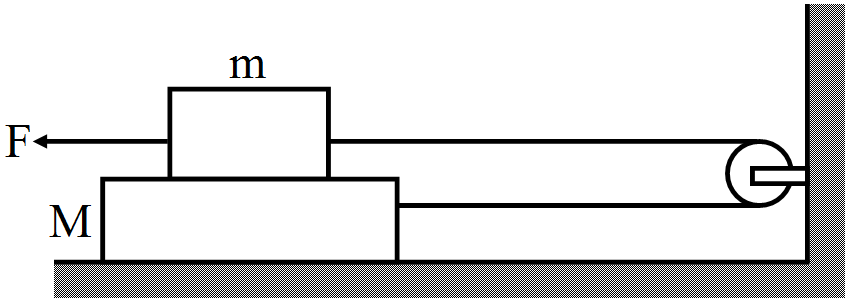
The friction coefficient between the two blocks shown in figure is $\mu$ but the floor is smooth.
  1. What maximum horizontal force F can be applied without disturbing the equilibrium of the system?
  2. Suppose the horizontal force applied is double of that found in part (a). Find the accelerations of the two masses.
The amplitude of a wave disturbed propagating in the positive x direction is given by
$\text{y}=\frac{1}{1+\text{x}^2}$ at t = 0 and $\text{y}=\frac{1}{1+(\text{x}-1)^2}$ at t = 2s
where x and y in metre. The shape of disturbance does not change during the propagation. What is the velocity of the wave?