Question
A small source of sound S of frequency 500Hz is attached to the end of a light string and is whirled in a vertical circle of radius 1.6m. The string just remains tight wher the source is at the highest point.
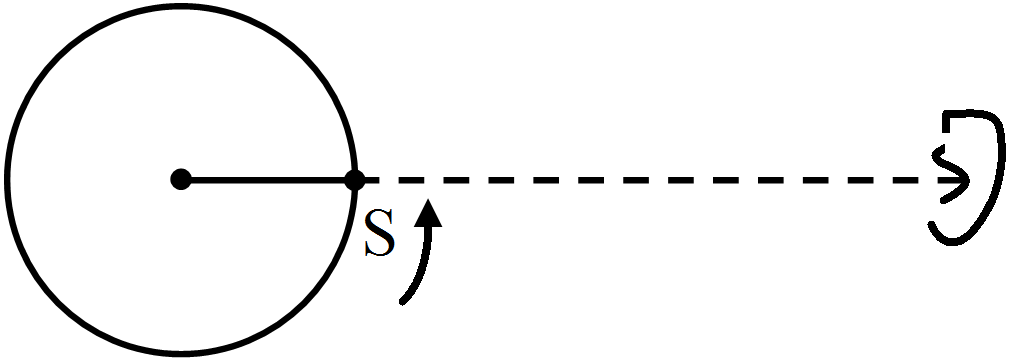
  1. An observer is located in the same vertical plane at a large distance and at the same height as the centre of the circle figure. The speed of sound in air = 330m/s and g = 10m/s 2. Find the maximum frequency heard by the observer.
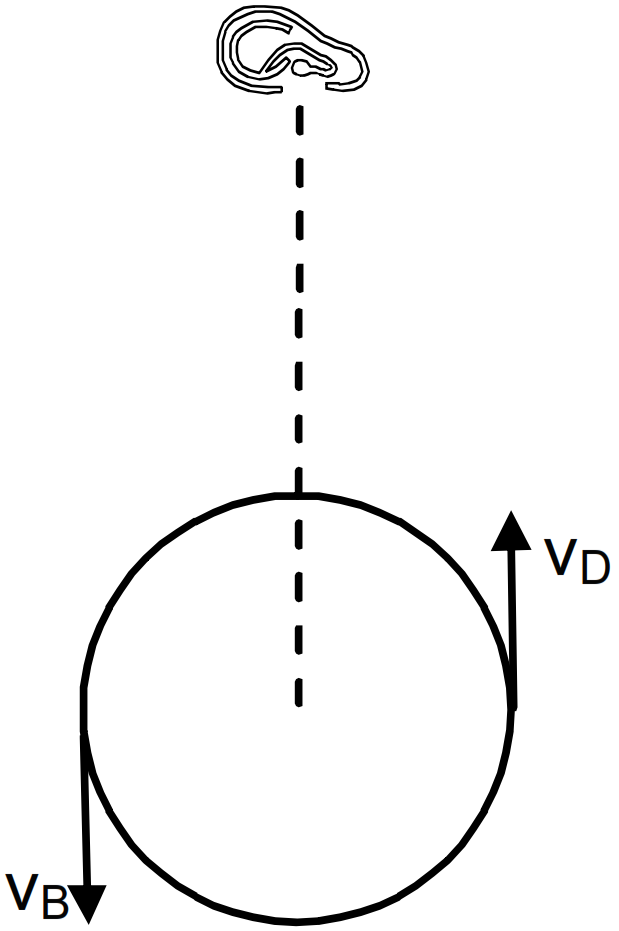
  2. An observer is situated at a large distance vertically above the centre of the circle. Find the frequencies heard by the observer corresponding to the sound emitted by the source when it is at the same height as the centre.
Answer

Given that, r = 1.6m, f = 500Hz, u = 330m/s
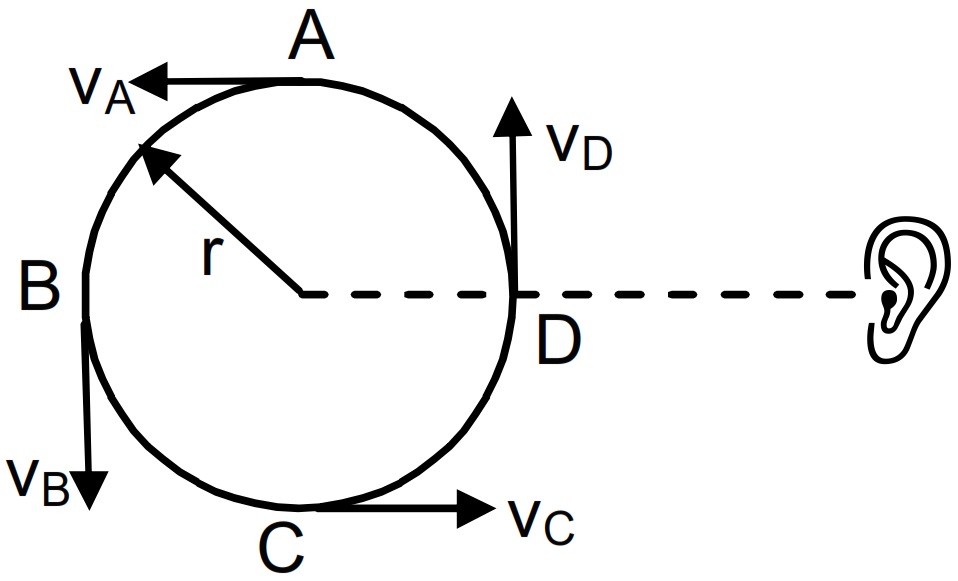
  1. At A, velocity of the particle is given by,
$\text{v}_\text{A}=\sqrt{\text{rg}}=\sqrt{1.6\times10}=4\text{m/s}$
and at C, $\text{v}_\text{A}=\sqrt{\text{rg}}=\sqrt{1.6\times10}=4\text{m/s}$
So, maximum frequency at C,
$\text{f}'_\text{c}=\frac{\text{u}}{\text{u}-\text{v}_\text{s}}\text{f}=\frac{330}{330-8.9}\times500=513.85\text{Hz}.$
Similarly, maximum frequency at A is given by $\text{f}'_\text{A}=\frac{\text{u}}{\text{u}-(-\text{v}_\text{s})}\text{f}=\frac{330}{330+4}(500)=494\text{Hz}.$
  1. Velocity at $\text{B}=\sqrt{3\text{rg}}=\sqrt{3\times1.6\times10}=6.92\text{m/s}$

So, frequency at B is given by, $\text{f}'_\text{B}=\frac{\text{u}}{\text{u}+\text{v}_\text{s}}\times\text{f}=\frac{330}{330+6.92}\times500=490\text{Hz}$
and frequency at D is given by,
$\text{f}_\text{D}=\frac{\text{u}}{\text{u}-\text{v}_\text{s}}\times\text{f}$
$=\frac{330}{330-6.92}\times500$
$=511\text{Hz}$

Need a full question paper?

Generate a complete, print-ready paper with questions like this in minutes — across 16+ boards, with answer keys.

Start Generating Free

Similar questions

Check the accuracy of following formulas:
(i) $F =\frac{m v^2}{r}$
(ii) $T =\frac{\text { hrgd }}{2}$
(iii) $T =2 \pi \sqrt{\frac{l}{g}}$
(iv) $Y =\frac{ MgL }{\pi r^2 l}$ Here, Y is Young's modulus.
(v) $S =u t+\frac{1}{2} a t^2$
(vi) $\frac{1}{2} m v^2=m g h$
(vii) $v^2=u^2+2 a s$ where $v$ and $u$ are final and initial velociteis respectively. a is acceleration and $s$ is the distance covered.
(viii) $n=\frac{1}{2 l} \sqrt{\frac{T}{m}}$, Here $n$ is frequency, T is tension force, $l$ is length and $m$ is mass of unit length.
A ball is thrown vertically upwards with a velocity of $20 m s ^{-1}$ from the top of a multistorey building. The height of the point from where the ball is thrown is $25.0 m$ from the ground. (a) How high will the ball rlse? and (b) how long will it be before the ball hits the ground? Take $g =10 m s ^{-2}$.
A particle slides on the surface of a fixed smooth sphere starting from the topmost point. Find the angle rotated by the radius through the particle, when it leaves contact with the sphere.
Write Hooke's law. On what does the value of co-efficient of elasticity depend? Draw a graph between stress and strain with in the elastic limit.###Write Hooke's law. How to determine the coefficient of elasticity of a material of wire in the laboratory? Explain. Make necessary diagram also Compare the Young's Modulus of elasticity of different material.
Find the expression for time period of motion of a body suspended by two springs connected in parallel and series.
A uniform disc of radius R and mass M is mounted on an axis supported in fixed frictionless bearing. A light chord is wrapped around the rim of the wheel and suppose that we hang a body of mass m from the chord. Find the angular acceleration of the disc and tangential acceleration of point on the rim.
A rigid bar of mass $15kg$ is supported symmetrically by three wires each $2.0m$ long. Those at each end are of copper and the middle one is of iron. Determine the ratios of their diameters if each is to have the same tension.
A square plate of edge d and a circular disc of diameter d are placed touching each other at the midpoint of an edge of the plate as shown in figure. Locate the centre of mass of the combination, assuming same mass per unit area for the two plates.
A turn of radius 20m is banked for the vehicles going at a speed of 36 km/h. If the coefficient of static friction between the road and the tyre is 0.4, what are the possible speeds of a vehicle so that it neither slips down nor skids up?
The distance between the centres of carbon and oxygen atoms in carbon monoxide gas molecules is $=1.13\mathring{\text{A}}.$ Locate the centre of mass of the molecules relative to carbon atom.