A solid cylinder of mass M and radius R has a light flexible rope wound around it. The rope carries a mass m at its free end. The mass is rest at a height h above the floor. Find the angular velocity of the cylinder at the instant the mass m, after release, strikes the floor. Assume friction to be absent and the cylinder to rotate about its own axis.
Download our app for free and get started
As the mass m descends, its initial potential energy gets converted into the kinetic energy of the falling mass M itself and kinetic energy of the cylinder set into rotation. We thus have $\text{mgh}=\frac{1}{2}\text{mv}^2+\frac{1}{2}\text{I}\omega^2$ Now I, the moment of intertia of the cylinder about its own axis is $\frac{1}{2}\text{MR}^2\text{ Also }\omega=\frac{\text{v}}{\text{R}}$ 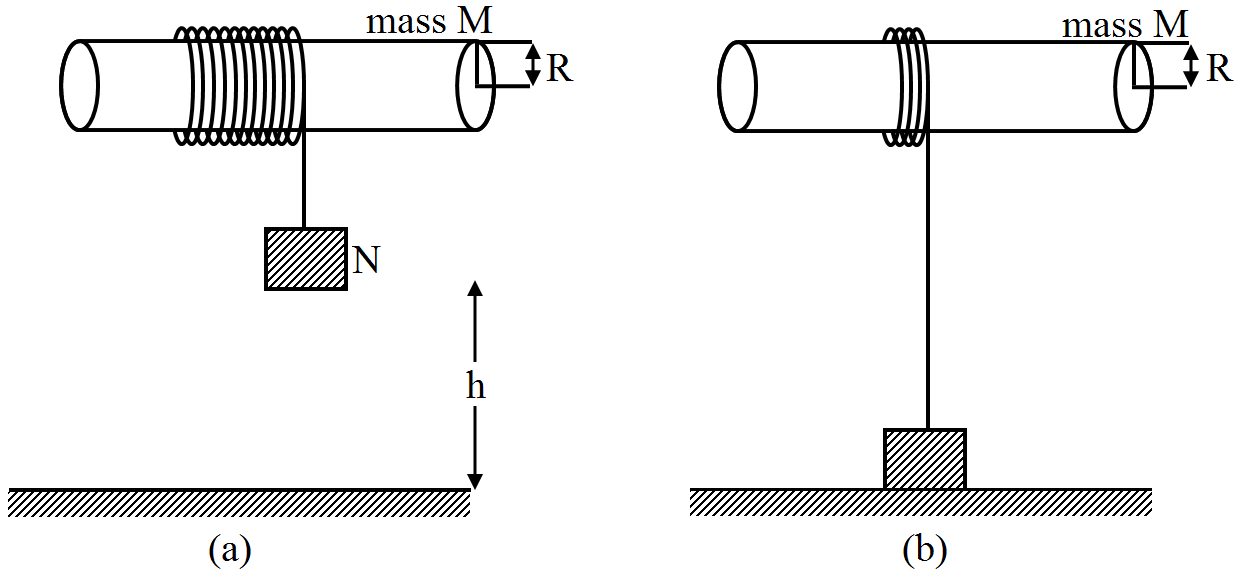 We thus have $\text{mgh}=\frac{1}{2}\text{mv}^2+\frac{1}{4}\text{MR}^2\frac{\text{v}^2}{\text{R}^2}$ $\Rightarrow\text{v}^2=\frac{2\text{mgh}}{\text{m}+\Big(\frac{\text{M}}{2}\Big)}=\Bigg[\frac{2\text{gh}}{1+\Big(\frac{\text{M}}{2\text{m}}\Big)}\Bigg]$ Thus the require angular velocity, $\omega=\frac{\text{v}}{\text{R}}=\frac{1}{\text{R}}\sqrt{\frac{2\text{gh}}{1+\Big(\frac{\text{M}}{2\text{m}}\Big)}}$
We thus have $\text{mgh}=\frac{1}{2}\text{mv}^2+\frac{1}{4}\text{MR}^2\frac{\text{v}^2}{\text{R}^2}$ $\Rightarrow\text{v}^2=\frac{2\text{mgh}}{\text{m}+\Big(\frac{\text{M}}{2}\Big)}=\Bigg[\frac{2\text{gh}}{1+\Big(\frac{\text{M}}{2\text{m}}\Big)}\Bigg]$ Thus the require angular velocity, $\omega=\frac{\text{v}}{\text{R}}=\frac{1}{\text{R}}\sqrt{\frac{2\text{gh}}{1+\Big(\frac{\text{M}}{2\text{m}}\Big)}}$
Download our appand get started for free
Experience the future of education. Simply download our apps or reach out to us for more information. Let's shape the future of learning together!No signup needed.*
Similar Questions
- 1View SolutionA uniform disc of radius R is put over another uniform disc of radius 2R of the same thickness and density. The peripheries of the two discs touch each other. Locate the centre of mass of the system.
- 2A solid disc and a ring, both of radius $10cm$ are placed on a horizontal table simultaneously, with initial angular speed equal to 10 π rad $s^{-1}$. Which of the two will start to roll earlier? The co-efficient of kinetic friction is $\mu_\text{k}=0.2$View Solution
- 3View SolutionA sphere of a radius 10cm weighs 1kg, calculate the moment of inertia.
- About the diameter.
- About the tangent.
- 4View SolutionThree particles of masses 1.0kg, 2.0kg and 3.0kg are placed at the corners A, B and C respectively of an equilateral triangle ABC of edge 1m. Locate the centre of mass of the system.
- 5Two particles of mass $2kg$ and $1kg$ are moving along the same line with speeds $2ms-1$ and $5ms^{-1}$ respectively. What is the speed of the centre of mass of the system if both the particles are moving (a) in same direction (b) in opposite direction?View Solution
- 6$3$ A man stands on a rotating platform, with his arms stretched horizontally holding a $5kg$ weight in each hand. The angular speed of the platform is $30$ revolutions per minute. The man then brings his arms close to his body with the distance of each weight from the axis changing from $90cm$ to $20cm$. The moment of inertia of the man together with the platform may be taken to be constant and equal to $7.6kgm^2$.View Solution
- What is his new angular speed? (Neglect friction).
- Is kinetic energy conserved in the process? If not, from where does the change come about?
- 7A comet revolves around the sun in a highly elliptical orbit having a minimum distance of $7 \times 10^{10}m$ and a maximum distance of $1.4 \times 10^{13}m$. If its speed while nearest to the Sun is $60km s^{-1}$, find its linear speed when situated farthest from the Sun.View Solution
- 8View SolutionA solid sphere rolls down two different inclined planes of the same heights but different angles of inclination.
- Will it reach the bottom with the same speed in each case?
- Will it take longer to roll down one plane than the other?
- If so, which one and why?
- 9View SolutionTorques of equal magnitude are applied to a hollow cylinder and a solid sphere, both having the same mass and radius. The cylinder is free to rotate about its standard axis of symmetry, and the sphere is free to rotate about an axis passing through its centre. Which of the two will acquire a greater angular speed after a given time.
- 10Figure shows a small spherical ball of mass m rolling down the loop track. The ball is released on the linear portion at a vertical height H from the lowest point. The circular part shown has a radius R.View Solution
- Find the kinetic energy of the ball when it is at a point A where the radius makes an angle $\theta$ with the horizontal.
- Find the radial and the tangential accelerations of the centre when the ball is at A.
- Find the normal force and the frictional force acting on the ball if H = 60cm, R = 10cm, $\theta=0 $ and m = 70g.