A small mass $'m'$ rests at the edge of a horizontal disc of radius $'R'$ . The coefficient of static friction between mass and the disc is $\mu $ . The disc is rotated about its axis at an angular velocity such that the mass slides off the disc and lands on the floor $'h'$ meters below. What was its horizontal distance of travel from the point it left the disc?
Difficult
Download our app for free and get started
$\frac{{m{v^2}}}{R} = \mu mg;\,v = \sqrt {\mu Rg} \,\therefore t = \sqrt {\frac{{2h}}{g}} $
Horizontal distance = $vt$ = $\sqrt {2\mu Rh} $

Download our appand get started for free
Experience the future of education. Simply download our apps or reach out to us for more information. Let's shape the future of learning together!No signup needed.*
Similar Questions
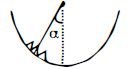
- 1An insect crawls up a hemispherical surface very slowly. The coefficient of friction between the insect and the surface is $1/3$. If the line joining the centre of the hemispherical surface to the insect makes an angle $\alpha $ with the vertical, the maximum possible value of $\alpha $ so that the insect does not slip is given byView Solution
- 2A car of mass $800 \,kg$ moves on a circular track of radius $40\, m$. If the coefficient of friction is $0.5$, then maximum velocity with which the car can move is ......... $m/s$View Solution
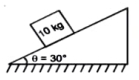
- 3A block of mass $10 \,kg$ is kept on a fixed rough $(\mu=0.8)$ inclined plane of angle of inclination $30^{\circ}$. The frictional force acting on the block is ........... $N$View Solution
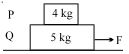
- 4The coefficient of friction between $4kg$ and $5\, kg$ blocks is $0.2$ and between $5kg$ block and ground is $0.1$ respectively. Choose the correct statementsView Solution
- 5View SolutionWhich of the following is a self adjusting force?
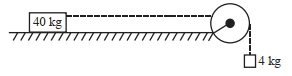
- 6A block of mass $40 \,kg$ slides over a surface, when a mass of $4 \,kg$ is suspended through an inextensible massless string passing over frictionless pulley as shown below. The coefficient of kinetic friction between the surface and block is $0.02$. The acceleration of block is ............ $ms ^{-2}$ (Given $g =10 \,ms ^{-2}$.)View Solution
- 7In the figure, a block of weight $60\, N$ is placed on a rough surface. The coefficient of friction between the block and the surfaces is $0.5$. ........ $N$ should be the maximum weight $W$ such that the block does not slip on the surface .View Solution
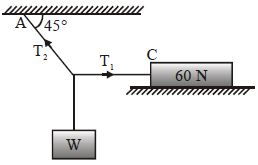
- 8$A$ particle inside the rough surface of $a$ rotating cone about its axis is at rest relative to it at $a$ height of $1m$ above its vertex. Friction coefficient is $\mu = 0.5$, if half angle of cone is $45^o$, the maximum angular velocity of revolution of cone can be :View Solution
- 9Three identical particles are joined together by a thread as shown in figure. All the three particles are moving in a horizontal plane. If the velocity of the outermost particle is $v_0$, then the ratio of tensions in the three sections of the string isView Solution
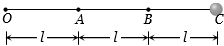
- 10A particle moves in a circular orbit under the action of a central attractive force inversely proportional to the distance $'r'$. The speed of the particle isView Solution