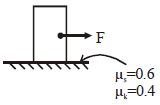
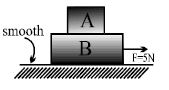
$10\, kg$ block is placed as shown, if $F = 50$ newton find friction force ............ $N$
Medium


Download our appand get started for free
Experience the future of education. Simply download our apps or reach out to us for more information. Let's shape the future of learning together!No signup needed.*
Similar Questions
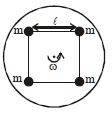
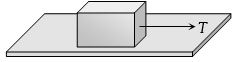
- 1Four identical point masses $'m'$ joined by light string of length $'l'$ arrange such that they form square frame. Centre of table is coincide with centre of arrangment. If arrangement rotate with constant angular velocity $'\omega '$ , find out tension in each stringView Solution
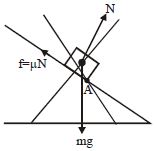
- 2View SolutionWhen a cube is in limiting equilibrium on an inclined plane and it is about to topple. The coefficient of friction between cube and plane is:-
- 3The maximum speed that can be achieved without skidding by a car on a circular unbanked road of radius $R$ and coefficient of static friction $\mu $, isView Solution
- 4In the shown arrangement mass of $A = 1\,\,kg$ mass of $B = 2\,\,kg.$ Coefficient of friction between $A $ and $B = 0.2.$ There is no friction between $B$ and ground. The frictional force exerted by $A$ on $B$ equals toView Solution
- 5A block of mass $1\,kg$ lies on a horizontal surface in a truck. The coefficient of static friction between the block and the surface is $0.6$ . If the acceleration of the truck is $5\,m\,s^{-2}$ . The frictional force acting on the block is ........ $N$View Solution
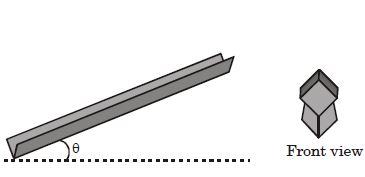
- 6View SolutionChoose the correct statement.
- 7A coin is placed on a disc. The coefficient of friction between the coin and the disc is $\mu$. If the distance of the coin from the center of the disc is $r$, the maximum angular velocity which can be given to the disc, so that the coin does not slip away, is:View Solution
- 8In the figure shown, a block of weight $10 \,N$ resting on a horizontal surface. The coefficient of static friction between the block and the surface ${\mu _s} = 0.4$. A force of $3.5\, N$ will keep the block in uniform motion, once it has been set in motion. A horizontal force of $3 \,N$ is applied to the block, then the block willView Solution
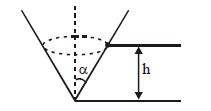
- 9A particle is describing circular motion in a horizontal plane in contact with the smooth inside surface of a fixed right circular cone with its axis vertical and vertex down. The height of the plane of motion above the vertex is $h$ and the semivertical angle of the cone is $\alpha $ . The period of revolution of the particleView Solution
- 10A cube of mass $m$ slides down an inclined right-angle trough. If the coefficient of kinetic friction between the cube and the trough is $\mu _k$ , then the acceleration of the block isView Solution