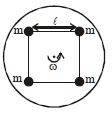
Four identical point masses $'m'$ joined by light string of length $'l'$ arrange such that they form square frame. Centre of table is coincide with centre of arrangment. If arrangement rotate with constant angular velocity $'\omega '$ , find out tension in each string
Medium


Download our appand get started for free
Experience the future of education. Simply download our apps or reach out to us for more information. Let's shape the future of learning together!No signup needed.*
Similar Questions
- 1View SolutionA car sometimes overturns while taking a turn. When it overturns, it is
- 2A lift is moving downwards with an acceleration equal to acceleration due to gravity. $A$ body of mass $M$ kept on the floor of the lift is pulled horizontally. If the coefficient of friction is $\mu $, if the lift is moving upwards with a uniform velocity, then the frictional resistance offered by the body isView Solution
- 3A cyclist goes round a circular path of circumference $34.3\, m$ in $\sqrt {22} $ sec. the angle made by him, with the vertical, will be ....... $^o$View Solution
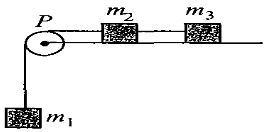
- 4A system consists of three masses $m_1 , m_2$ and $m_3$ connected by a string passing over a pulley $P.$ The mass $m_1$ hangs freely and $m_2$ and $m_3$ are on a rough horizontal table (the coefficient of friction $= \mu ).$ The pulley is frictionless and of negligible mass. The downward acceleration of mass $m_1$ is $(Assume\, m = m_2 = m_3 = m)$View Solution
- 5A wooden block of mass $M$ resting on a rough horizontal surface is pulled with a force $F$ at an angle $\phi $ with the horizontal. If $\mu $ is the coefficient of kinetic friction between the block and the surface, then acceleration of the block isView Solution
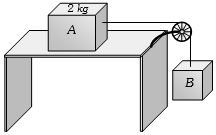
- 6The coefficient of static friction, ${\mu _s},$ between block $A$ of mass $2\, kg$ and the table as shown in the figure is $0.2$. ........ $kg$ would be the maximum mass value of block $B$ so that the two blocks do not move. The string and the pulley are assumed to be smooth and massless. $(g = 10\,m/{s^2})$View Solution
- 7A cyclist riding the bicycle at a speed of $14\sqrt 3 ms^{-1}$takes a turn around a circular road of radius $20\sqrt 3 $ m without skidding. Given $g = 9.8 ms^{-2},$ what is his inclination to the vertical ....... $^o$View Solution
- 8View SolutionA motor cycle driver doubles its velocity when he is having a turn. The force exerted outwardly will be
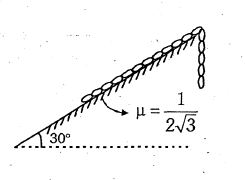
- 9A uniform chain is at rest partially on the incline and partially hanging vertically. Coefficient of friction between chain and incline is $\mu = \frac{1}{{2\sqrt 3 }}$. The ratio of $\frac{{{L_{\max }}}}{{{L_{\min }}}}$ is $(L_{max} =$ maximum length of chain kept on inclined so that chain remains at rest, $L_{min} =$ minimum length of chain kept on incline so that chain remains at rest)View Solution
- 10A child weighing $25$ kg slides down a rope hanging from the branch of a tall tree. If the force of friction acting against him is $2\, N$, ........ $m/s^2$ is the acceleration of the child (Take $g = 9.8\,m/{s^2})$View Solution