The maximum speed that can be achieved without skidding by a car on a circular unbanked road of radius $R$ and coefficient of static friction $\mu $, is
Easy
Download our app for free and get started
(d) In the given condition the required centripetal force is provided by frictional force between the road and tyre.
$\frac{{m{v^2}}}{R} = \mu \,mg$
$\therefore v = \sqrt {\mu \;Rg} $

Download our appand get started for free
Experience the future of education. Simply download our apps or reach out to us for more information. Let's shape the future of learning together!No signup needed.*
Similar Questions
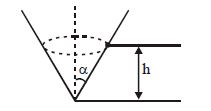
- 1A particle is describing circular motion in a horizontal plane in contact with the smooth inside surface of a fixed right circular cone with its axis vertical and vertex down. The height of the plane of motion above the vertex is $h$ and the semivertical angle of the cone is $\alpha $ . The period of revolution of the particleView Solution
- 2View SolutionWhich one of the following statements is incorrect?
- 3A block of mass $m$ slides down the plane inclined at angle $30^{\circ}$ with an acceleration $\frac{ g }{4}$. The value of coefficient of kinetic friction will be :View Solution
- 4A heavy box is solid across a rough floor with an initial speed of $4 \,m / s$. It stops moving after $8$ seconds. If the average resisting force of friction is $10 \,N$, the mass of the box (in $kg$ ) is .....View Solution
- 5A body takes just twice the time as long to slide down a plane inclined at $30^o$ to the horizontal as if the plane were frictionless. The coefficient of friction between the body and the plane isView Solution
- 6A body of mass $m$ is tied to one end of a spring and whirled round in a horizontal plane with a constant angular velocity. The elongation in the spring is one centimetre. If the angular velocity is doubled, the elongation in the spring is $5\, cm$ . The original length of the spring is ............ $cm$View Solution
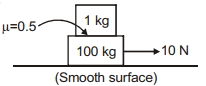
- 7The frictional force acting on $1 \,kg$ block is .................. $N$View Solution
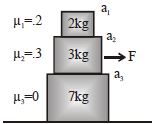
- 8Find the acceleration of $a_1, a_2$ and $a_3$. If $10\,N$ force $F$ is applied on $3\,kg$ block :-View Solution
- 9Determine the maximum acceleration in $m/s^2$ of the train in which a box lying on its floor will remain stationary, given that the co-efficient of static friction between the box and the train’s floor is $0.15.$View Solution
- 10A road is banked at an angle of $30^o$ to the horizontal for negotiating a curve of radius $10\sqrt 3 m$. At what velocity will a car experience no friction while negotiating the curve? ............... $km/hr$View Solution