MCQ
10 wires (same length, same area, same material) are connected in parallel and each has 1 Ω resistance, then the equivalent resistance will be
  • A
    10 Ω
  • B
    1 W
  • 0.1 W
  • D
    0.001 W

Answer

Correct option: C.
0.1 W
(c) 0.1 W

Need a full question paper?

Generate a complete, print-ready paper with questions like this in minutes — across 16+ boards, with answer keys.
Start Generating Free

Similar questions

A cylindrical conductor has uniform cross-section. Resistivity of its material increase linearly from left end to right end. If a constant current is flowing through it and at a section distance x from left end, magnitude of electric field intensity is E, which of the following graphs is correct
Electric field strength due to a point charge of 5μC at a distance of 80 cm from the charge is
In a P-type semi-conductor, germanium is dopped with
The magnetic lines of force inside a bar magnet:
Diffraction of light can be explained by the following:
A closely packed coil having $1000$ turns has an average radius of $62.8\,cm$. If current carried by the wire of the coil is $1\,A$, the value of magnetic field produced at the centre of the coil will be (permeability of free space $=4 \pi \times 10^{-7}\,H / m$ ) nearly
 A cell having an emf $\varepsilon$ and internal resistance $r$ is connected across a variable external resistance $R.$ As the resistance $R$ is increased, the plot of potential difference $V$ across $R$ is given by
A point source of light is placed on the principle axis between $F$ and $2\, F$ of a concave lens. On the other side very far, a screen is placed perpendicular to principal axis. As the screen is brought close towards lens
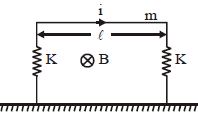
A horizontal metallic rod of mass $'m'$ and length $'l'$ is supported by two vertical identical springs of spring of spring constant $'K'$ each and natural length $l_0.$  A current $'i'$ is flowing in the rod in the direction shown. If the rod is in equilibrium then the length of each spring in this state is :-
Mosley measured the frequency $(f)$ of the characteristic $X-$ rays from many metals of different atomic number $(Z)$ and represented his results by a relation known as Mosley's law. This law is ($a, b$ are constants)