$100$ capacitors each having a capacity of $10\,\mu F$ are connected in parallel and are charged by a potential difference of $100\,kV$. The energy stored in the capacitors and the cost of charging them, if electrical energy costs $108\;paise\;per\;kWh$, will be
Diffcult
Download our app for free and get started
(c) Energy stored in the capacitor $ = \frac{1}{2}C{V^2} \times 100$
$ = \frac{1}{2} \times 10 \times {10^{^{ - 6}}} \times {(100 \times {10^3})^2} \times 100 = 5 \times {10^6}\,J$
Electric energy costs $ = 108\,Paise\,per\,kWH$$ = \frac{{108\,Paise}}{{3.6 \times {{10}^6}\,J}}$
Total cost of charging $ = \frac{{5 \times {{10}^6} \times 108}}{{3.6 \times {{10}^6}}}\, = 150\,Paise$
$ = \frac{1}{2} \times 10 \times {10^{^{ - 6}}} \times {(100 \times {10^3})^2} \times 100 = 5 \times {10^6}\,J$
Electric energy costs $ = 108\,Paise\,per\,kWH$$ = \frac{{108\,Paise}}{{3.6 \times {{10}^6}\,J}}$
Total cost of charging $ = \frac{{5 \times {{10}^6} \times 108}}{{3.6 \times {{10}^6}}}\, = 150\,Paise$

Download our appand get started for free
Experience the future of education. Simply download our apps or reach out to us for more information. Let's shape the future of learning together!No signup needed.*
Similar Questions
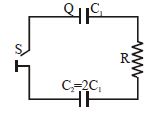
- 1Two capacitors $C_1$ and $C_2 = 2C_1$ are connected in a circuit with a switch between them as shown in the figure. Initially the switch is open and $C_1$ holds charge $Q$. The switch is closed. At steady state, the charge on each capacitor will beView Solution
- 2View SolutionThe potential at a point due to an electric dipole will be maximum and minimum when the angles between the axis of the dipole and the line joining the point to the dipole are respectively
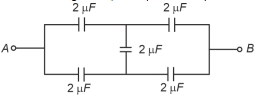
- 3In the following circuit, the equivalent capacitance between terminal $A$and terminal $B$ is :View Solution
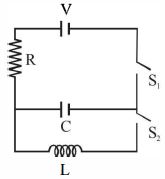
- 4In an $LCR $ circuit as shown below both switches are open initially. Now switch $S_1$ is closed, $S_2$ kept open. ( $q$ is charge on the capacitor and $\tau = RC$ is Capacitive time constant). Which of the following statement is correct?View Solution
- 5$64$ identical drops each charged upto potential of $10\,mV$ are combined to form a bigger dorp. The potential of the bigger drop will be $..........\,mV$View Solution
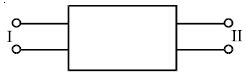
- 6If a battery of voltage $V$ is connected across terminals $I$ of the block box shown in figure, an ideal voltmeter connected to terminals $II$ gives a reading of $V/2$, while if the battery is connected to terminals $II$, a voltmeter across terminals $I$ reads $V$. The black box may containView Solution
- 7The capacity of a spherical conductor in $ MKS$ system isView Solution
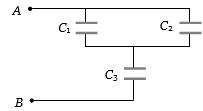
- 8In the given network capacitance, ${C_1} = 10\,\mu \,F,\,{C_2} = 5\,\mu \,F$ and ${C_3} = 4\,\mu \,F$. What is the resultant capacitance between $A$ and $B$.......$\mu \,F$View Solution
- 9A capacitor of $4\, \mu F$ is connected to a $15\, V$ supply through $1$ mega ohm resistance. The time taken by the capacitor to charge upto $63.2\%$ of its final charge will be......$s$View Solution
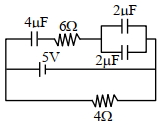
- 10Calculate the amount of charge on capacitor of $4\, \mu\, {F}$. The internal resistance of battery is $1\, \Omega$ : (in $\mu {C}$)View Solution