MCQ
$10.0 \,\mathrm{~mL}$ of $0.05\, \mathrm{M}\, \mathrm{KMnO}_{4}$ solution was consumed in a titration with $10.0\, \mathrm{~mL}$ of given oxalic acid dihydrate solution. The strength of given oxalic acid solution is $.....\,\times 10^{-2} \,\mathrm{~g} / \mathrm{L}$ (Round off to the nearest integer)
  • A
    $1782$
  • B
    $2152$
  • C
    $1203$
  • $1575$

Answer

Correct option: D.
$1575$
d
$\mathrm{n}_{\mathrm{eq}} \mathrm{KMnO}_{4}=\mathrm{n}_{\text {eq }}=\mathrm{H}_{2} \mathrm{C}_{2} \mathrm{O}_{4} \cdot 2 \mathrm{H}_{2} \mathrm{O}$

or, $\frac{10 \times 0.05}{1000} \times 5=\frac{10 \times \mathrm{M}}{1000} \times 2$

$\therefore$ Conc. of oxalic acid solution $=0.125 \,\mathrm{M}$

$=0.125 \times 126\, \mathrm{~g} / \mathrm{L}=15.75 \,\mathrm{~g} / \mathrm{L}$

$=1575 \times 10^{-2}\, \mathrm{~g} / \mathrm{L}$

Need a full question paper?

Generate a complete, print-ready paper with questions like this in minutes — across 16+ boards, with answer keys.

Start Generating Free

Similar questions

Which of the following equations is a balanced one ?
When in any system at equilibrium state pressure, temperature and concentration is changed then the equilibria shifted to such a direction which neutralize the effect of change. This is known as
$PbCl_2$ is dissolved in water to make its saturated solution. What will be the freezing point of this solution.

Given : $K_f (H_2O)$ = $2\ K\ kg\ mole^{-1}$, $K_{sp} (PbCl_2)$ = $4 × 10^{-6}$

(Assume molarity to be equal to molality) .....$^oC$

Electrovalent compounds do not have
A $100\, ml$ solution of $0.1 \,N$ $HCl$ was titrated with $0.2\, N$ $NaOH$ solution. The titration was discontinued after adding $30\, ml $ of $NaOH$ solution. The remaining titration was completed by adding $0.25\, N$ $KOH$ solution. The volume of $KOH$ required for completing the titration is ............ $\mathrm{ml}$
The $pH$ of a buffer solution containing $25\,ml$ of $1\,M\,C{H_3}COONa$ and $25\,\,ml$ of $1\,\,M\,\,C{H_3}COOH$ will be appreciably affected by $5\,\,ml$ of
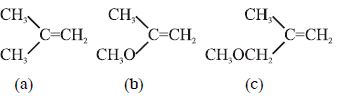
Arrange the above in the decreasing order of reactivity towards $HBr.$
$C{H_3} - C \equiv CH\xrightarrow[{(ii)\,\,{H_2}{O_2}/\mathop O\limits^\Theta  H}]{{(i)\,\,B{H_3} - THF}}\,(P)$

$C{H_3} - C \equiv CH\xrightarrow[{(ii)\,\,NaB{H_4}}]{{(i)\,\,Hg{{(OAC)}_2}/{H_2}O}}\,(Q)$

Choose the correct option

The equilibrium constant for the reaction ${N_2}_{\left( g \right)} + {O_{2\left( g \right)}} \rightleftharpoons 2N{O_{\left( g \right)}}$ is $4\times10^{-4}$ at $200\, K$. In presence of a catalyst, equilibrium is attained ten times faster therefore, the equilibrium constant in presence of the catalyst at $200\, K$ is
For a particular reversible reaction at temperature $T, \Delta H$ and $\Delta S$ were found to be both $+ve.$ If $T_e$ is the temperature at equilibrium, the reaction would be spontaneous when