MCQ 11 Mark
The highest number of helium atoms is in
- A
$4$ u of helium
- B
$4 \mathrm{~g}$ of helium
- C
$2.271098 \mathrm{~L}$ of helium at $STP$
- ✓
$4 \mathrm{~mol}$ of helium
AnswerCorrect option: D. $4 \mathrm{~mol}$ of helium
d
($1$) $4 u$ of $\mathrm{He}=\frac{4 u}{4 u}=1 \mathrm{He}$ atom
($2$) $4 \mathrm{~g}$ of Helium $=\frac{4 \mathrm{~g}}{4 \mathrm{~g}}$ mole $=1 \mathrm{~mole}=\mathrm{NA}_{\mathrm{Ae}}$ atom
($3$) $2.2710982 \text { of He at STP } $$ =\frac{2.271}{22.710982} \text { mole } $
$ =0.1 \mathrm{~mole} $
$ =0.1 \mathrm{~N}_{\mathrm{A}} \mathrm{He} \text { atom }$
($4$) $4 \mathrm{~mol}$ of $\mathrm{He}=4 \mathrm{~N} \mathrm{Ne}$ atoms
View full question & answer→MCQ 21 Mark
A compound $X$ contains $32 \%$ of $A, 20 \%$ of $B$ and remaining percentage of $C$. Then, the empirical formula of $X$ is :
(Given atomic masses of $A=64 ; B=40 ; C=32 u$ )
AnswerCorrect option: A. $\mathrm{ABC}_3$
a
| Element |
Mass percentage $%$ |
No. of moles |
No. of moles/
Smallest number
|
Simplest whole number |
| $A$ |
$32 %$ |
$ \frac{32}{64}=\frac{1}{2} $ |
$\frac{1}{2} \times 2$ |
$=1$ |
| $B$ |
$20 %$ |
$ \frac{20}{40}=\frac{1}{2} $ |
$\frac{1}{2} \times 2$ |
$=1$ |
| $C$ |
$48 %$ |
$ \frac{48}{32}=\frac{3}{2}$ |
$\frac{3}{2} \times 2$ |
$=3$ |
So, empirical formula$*=A=1:B=1:C=3$
$\therefore$ The correct empirical formula of compound $\mathrm{X}$ is $\mathrm{ABC}_3$
View full question & answer→MCQ 31 Mark
$1$ gram of sodium hydroxide was treated with $25 \mathrm{~mL}$ of $0.75 \mathrm{M} \mathrm{HCl}$ solution, the mass of sodium hydroxide left unreacted is equal to
- ✓
$250 \mathrm{mg}$
- B
0 $\mathrm{mg}$
- C
$200 \mathrm{mg}$
- D
$750 \mathrm{mg}$
AnswerCorrect option: A. $250 \mathrm{mg}$
a
$ M=\frac{W \times 1000}{M_2 \times V(\text { in } m L)} $
$ \mathrm{W}=\frac{\mathrm{M} \times \mathrm{M}_2 \times \mathrm{V}(\text { in } \mathrm{mL})}{1000}=\frac{0.75 \times 36.5 \times 25}{1000}$
$ =0.684 \mathrm{~g} \text { (Mass of } \mathrm{HCl}) $
$ \underset{36.5 \mathrm{~g}}{\mathrm{HCl}}+\underset{40 \mathrm{~g}}{\mathrm{NaOH}} \longrightarrow \mathrm{HCl}+\mathrm{NaOH} $
$36.5 \mathrm{~g} \mathrm{HCl}$ reacts with $\mathrm{NaOH}=40 \mathrm{~g}$
$0.684 \mathrm{~g} \mathrm{HCl} \text { reacts with } \mathrm{NaOH}=\frac{40}{36.5} \times 0.684=0.750 \mathrm{~g}$
Amount of $\mathrm{NaOH}$ left $=1 \mathrm{~g}-0.750 \mathrm{~g}=0.250 \mathrm{~g}=250 \mathrm{mg}$
View full question & answer→MCQ 41 Mark
The right option for the mass of $CO _2$ produced by heating $20 g$ of $20 \%$ pure limestone is $........\,g$(Atomic mass of $Ca =40$ )$\left[ CaCO _3 \stackrel{1200 K }{\longrightarrow} CaO + CO _2\right]$
- A
$1.32$
- B
$1.12$
- ✓
$1.76$
- D
$2.64$
AnswerCorrect option: C. $1.76$
c
Weight of impure limestone $=20\, g$
Weight of pure limestone $\left( CaCO _3\right)=20 \%$ of $20\,g$
$=\frac{20}{100} \times 20$
$=4\,g$
$n _{ CaCO _3}=\frac{4}{100}=0.04$
$CaCO _3 \rightarrow CaO + CO _2$
$n =0.04 \quad n =0.04$
$n _{ CO _2}=0.04$
$W _{ CO _2}=0.04 \times 44$
$=1.76\,g$
View full question & answer→MCQ 51 Mark
In one molal solution that contains $0.5$ mole of a solute, there is
- ✓
$500\, g$ of solvent
- B
$100 \,mL$ of solvent
- C
$1000 \,g$ of solvent
- D
$500 \,mL$ of solvent
AnswerCorrect option: A. $500\, g$ of solvent
a
$m =\frac{\text { Moles of solute }}{\text { Weight of solvent }( g )} \times 1000$
$1=\frac{0.5}{\text { Weight of solvent }( g )} \times 1000$
Weight of solvent $( g )=500 \,g$
View full question & answer→MCQ 61 Mark
What mass of $95\, \%$ pure $CaCO _{3}$ will be required to neutralise $50 \,mL$ of $0.5\, M \,HCl$ solution according to the following reaction? (In $g$)
$CaCO _{3( s )}+2 HCl _{( aq )} \rightarrow CaCl _{2( aq )}+ CO _{2( g )}+2 H _{2} O _{( l )}$
[Calculate upto second place of decimal point]
- ✓
$1.32$
- B
$3.65$
- C
$9.50$
- D
$1.25$
AnswerCorrect option: A. $1.32$
a
$CaCO _{3(s)}+2 HCl _{(\text {aq) })} \rightarrow CaCl _{2(a q)}+ CO _{2(q)}+ H _{2} O _{(q)}$
no. of moles of $CaCO _{3}$ (pure) $=\frac{1}{2} \times$ mole of $HCl$
$\quad \text { [Mole }=\text { molarity } \times \text { volume(in Itr. }) \text { ] }$
$=\frac{1}{2} \times 0.5 \times \frac{50}{1000}=0.0125$
weight of $CaCO _{3}$ (pure) $=$ mole $\times$ mol. wt
$=0.0125 \times 100=1.25 \,g$
$\%$ purity $=\frac{\text { wt. of pure substance }}{\text { wt. of impure sample }} \times 100$
$95=\frac{1.25}{\text { wt. of impure sample }} \times 100$
wt. of impure sample $=\frac{1.25 \times 100}{95}=1.32 \,g$
View full question & answer→MCQ 71 Mark
An organic compound contains $78 \,\%$ (by $wt.$) carbon and remaining percentage of hydrogen. The right option for the empirical formula of this compound is : [Atomic wt. of $\mathrm{C}$ is $12, \mathrm{H}$ is 1$]$
- A
$\mathrm{CH}$
- B
$\mathrm{CH}_{2}$
- ✓
$\mathrm{CH}_{3}$
- D
$\mathrm{CH}_{4}$
AnswerCorrect option: C. $\mathrm{CH}_{3}$
c
$C \quad 78 \quad \frac{78}{12}=6.5 \quad \frac{6.5}{6.5}=1$
$H \quad 22 \quad \frac{22}{1}=22 \quad \frac{22}{6.5}=3.38=3$
Emperical formula $=\mathrm{CH}_{3}$
View full question & answer→MCQ 81 Mark
Which one of the following has maximum number of atoms$?$
- ✓
$1 g$ of $Li ( s )$ [Atomic mass of $Li =7]$
- B
$1 g$ of $Ag ( s )$ [Atomic mass of $Ag =108]$
- C
$1 g$ of $Mg ( s )$ [Atomic mass of $Mg =24]$
- D
$1 g$ of $O _{2}( g )$ [Atomic mass of $\left. O =16\right]$
AnswerCorrect option: A. $1 g$ of $Li ( s )$ [Atomic mass of $Li =7]$
a
Number of atoms
$=\frac{w}{\text { molar mass }} \times N _{ A } \times$ atomicity
$(1)$ $\frac{1}{7} \times N _{ A } \times 1$
$(2)$ $\frac{1}{108} \times N _{ A } \times 1$
$(3)$ $\frac{1}{24} \times N _{ A } \times 1$
$(4)$ $\frac{1}{32} \times N _{ A } \times 2$
View full question & answer→MCQ 91 Mark
The density of $2\; \mathrm{M}$ aqueous solution of $\mathrm{NaOH}$ is $1.28 \;\mathrm{g} / \mathrm{cm}^{3} .$ The molality of the solution is.....$m$ [Given that molecular mass of $\mathrm{NaOH}=40 \;\mathrm{g} \mathrm{mol}^{-1}$]
- A
$1.20 $
- B
$1.56$
- ✓
$1.67$
- D
$1.32$
AnswerCorrect option: C. $1.67$
c
$2 \mathrm{M}$ solution of $\mathrm{NaOH}$ means 2 mole $\mathrm{NaOH}$ is present in $1 \mathrm{L}$ solution; density $=1.28 \mathrm{g} / \mathrm{ml}$
mass of solution $=$ volume of solution $\times$ density $=1000 \times 1.28$
$=1280 \mathrm{g}$
mass of solvent $=$ mass of solution $-$ mass of solute $=1280-80$
$=1200 \mathrm{g}$
molality $=\frac{2}{1200} \times 1000=\frac{20}{12}=\frac{10}{6}=\frac{5}{3}=1.67 \mathrm{m}$
View full question & answer→MCQ 101 Mark
A mixture of $2.3\; \mathrm{g}$ formic acid and $4.5 \;\mathrm{g}$ oxallic acid is treated with conc. $\mathrm{H}_{2} \mathrm{SO}_{4}$. The evolved gaseous mixture is passed through KOH pellets. Weight of the remaining product at $STP$ ..........$g$
Answerc
$\mathrm{HCOOH} \xrightarrow[dehydrating Agent]{H_2SO_4} \mathrm{CO}+\mathrm{H}_{2} \mathrm{O}\left(\begin{array}{l}{\mathrm{H}_{2} \mathrm{O}\text { abosrbed }} \\ {\mathrm{by} \mathrm{H}_{2} \mathrm{SO}_{4}}\end{array}\right)$
(moles)$_{1}=\frac{2.3}{46}=\frac{1}{20} \quad \quad 0 \quad \quad \quad 0$
(moles)$_f 0\quad \quad \quad \quad \quad \quad \frac{1}{20}\quad \quad \quad \frac{1}{20}$
$\quad \quad \mathrm{H}_{2} \mathrm{C}_{2} \mathrm{O}_{4} \stackrel{\mathrm{H}_{2} \mathrm{SO}_{4}}{\longrightarrow} \mathrm{CO}+\mathrm{CO}_{2}+\mathrm{H}_{2} \mathrm{O}$
$\left[\mathrm{H}_{2} \mathrm{O} \text { absorbed by } \mathrm{H}_{2} \mathrm{SO}_{4}\right]$
(moles)$_1\quad \frac{4.5}{90}=\frac{1}{20} 0 \quad \quad \quad 0 \quad \quad 0$
(moles)$_f\quad 0\quad \quad \quad \ \frac{1}{20} \quad \quad \frac{1}{20} \quad \quad \frac{1}{20}$
$\mathrm{CO}_{2}$ is absorbed by KOH. So the remaning product is only CO. moles of CO formed from both reactions
$=\frac{1}{20}+\frac{1}{20}=\frac{1}{10}$
Left mass of $\mathrm{CO}=$ moles $\times$ molar mass
$=\frac{1}{10} \times 28$
$={2.8 \mathrm{g}}$
View full question & answer→MCQ 111 Mark
A hydrocarbon contains $85.7\, \% C$. If $42\, mg$ of the compound contains $3.01 \times 10^{20}$ molecules, the molecular formula of the compound will be
- A
$C _{3} H _{6}$
- ✓
$C _{6} H _{12}$
- C
$C _{12} H _{24}$
- D
$C _{2} H _{4}$
AnswerCorrect option: B. $C _{6} H _{12}$
b
$85.7 \%$ carbon $\Rightarrow 100-85.7=14.3 \%$ Hydrogen gram molecular weight $=6.023 \times 10^{23}$
$\Rightarrow 42 mg =3.018 \times 10^{20} $
$\Rightarrow 84 mg =6.02 \times 10^{20}$
$84 g =6.02 \times 10^{23}$
$\therefore 85.7 \%=\frac{85.7}{100} \times 84=72 g $
$1 mole$ of $C =12 g$
6 moles of $C =12 \times 6=72 g$
$\therefore$ There are 6 carbons in each molecule
$84-72=12 g$ of $H =12 H$ atoms in each molecule
$\therefore$ Molecular formula $= C _6 H _{12}$
View full question & answer→MCQ 121 Mark
Suppose the elements $X$ and $Y$ combine to form two compounds $XY_2$ and $X_3Y_2.$ When $0.1$ mole of $XY_2$ weighs $10\ g$ and $0.05$ mole of $X_3Y_2$ weighs $9\ g,$ the atomic weights of $X$ and $Y$ are
- ✓
$40, 30$
- B
$60, 40$
- C
$20, 30$
- D
$30, 20$
AnswerCorrect option: A. $40, 30$
a
For $X Y_{2}$
$\because 0.1 \mathrm{mole}$
$X Y_{2} \equiv 10 g \therefore 1 \mathrm{mole}$
$X Y_{2} \equiv 100 g=X+2 Y=100 \ldots (1)$
For $X_{3} Y_{2}$
$\because 0.05$ mole
$X_{3} Y_{2}$
$\because 9 g$
$\therefore 1$ mole $X_{3} Y_{2} \equiv 180 g$
$3X+2Y=180\dots (2)$
On solving $(1)$ and $(2)$, $X=40$ And $Y=30$
View full question & answer→MCQ 131 Mark
If Avogadro number $N_A,$ is changed from $6.022 \times 10^{23}\ mol^{-1}$ to $6.022 \times 10^{20}\ mol^{-1},$ this would change
- ✓
the mass of one mole of carbon
- B
the ratio of chemical species to each other in a balanced equation
- C
the ratio of elements to each other in a compound
- D
the definition of mass in units of grams.
AnswerCorrect option: A. the mass of one mole of carbon
a
mass of $1 \mathrm{mol}\;(6.022 \times 10^{23} \text { atoms) of carbon }=12 \mathrm{g}$
If Avogadro Number $(NA)$ is changed than mass of $1 mol\;( 6.022 \times 10^{20}$ atom) of carbon. $=\frac{12 \times 6.022 \times 10^{20}}{6.022 \times 10^{23}}=12 \times 10^{-3} g$
Therefore the mass of $1 \;mol$ of carbon is changed
View full question & answer→MCQ 141 Mark
What is the mass of the precipitate formed when $50\ mL$ of $16.9\%$ solution of $AgNO_3$ is mixed with $50\ mL$ of $5.8\%$ $NaCl$ solution $?$ ............. $\mathrm{g}$ $(Ag = 107.8, N = 14, O = 16, Na = 23,Cl = 35.5)$
Answerb
Moles of $AgNO_3 =50 \times 16.9 / 100 \times 169.8$
$=0.05 \mathrm{mole}$
Moles of $\mathrm{NaCl}=50 \times 5.8 / 100 \times 58.5$
$=0.05 \mathrm{mole}$
$\mathrm{AgNO} 3+\mathrm{NaCl} \rightarrow \mathrm{AgCl}+\mathrm{NaNO} 3$
mass of $\mathrm{AgCl}=$ mole $\times$ molar mass
${=0.05 \times 143.5}$
${=7.16 \mathrm{g}}$
View full question & answer→MCQ 151 Mark
The number of water molecules is maximum in
- A
$1.8\ gram$ of water
- B
$18\ gram$ of water
- ✓
$18\ moles$ of water
- D
$18$ molecules of water.
AnswerCorrect option: C. $18\ moles$ of water
c
No of moles of water in $1.8 \mathrm{g}=0.1$ moles
$\ln 18 \;\mathrm{g}=1 \mathrm{moles}$
$1\; mole$ contain $6.022 \times 10^{23}$ molecules of water
so $18\; moles$ contain maximum number of molecules
View full question & answer→MCQ 161 Mark
A mixture of gases contains $H_2$ and $O_2$ gases in the ratio of $1 : 4\ (w/w).$ What is the molar ratio of the two gases in the mixture?
- A
$16 : 1$
- B
$2 : 1$
- C
$1 : 4$
- ✓
$4 : 1$
AnswerCorrect option: D. $4 : 1$
d
Let the mass of $\mathrm{H}_{2}$ gas be $\mathrm{x} \mathrm{g}$ and mass of $\mathrm{O}_{2}$ gas $4 \mathrm{xg}$ Molar
$\quad \quad \mathrm{H}_{2}: \mathrm{O}_{2}$
mass $2: 32$
i.e. $1: 16$
therefore, Molar ratio $=\frac{n_{\mathrm{H}_{12}}}{n_{0_{2}}}=\frac{x / 2}{4 x / 32}=\frac{(x) \times 32}{2 \times 4 x}=\frac{4}{1}=4: 1$
View full question & answer→MCQ 171 Mark
Equal masses of $H_2, O_2$ and methane have been taken in a container of volume $V$ at temperature $27\, ^o C$ in identical conditions. The ratio of the volumes of gases $H_2 : O_2 :$ methane would be
- A
$8 : 16 : 1$
- B
$16 : 8 : 1$
- ✓
$16 : 1 : 2$
- D
$8 : 1 : 2$
AnswerCorrect option: C. $16 : 1 : 2$
c
According to Avogadro's hypothesis, Volume of a gas $(V) \propto$ number of moles $(n)$ Therefore, the ratio of the volumes of gases can be determined in terms of their moles. The ratio of volumes of $\mathrm{H}_{2}: \mathrm{O}_{2}:$ methane $\left(\mathrm{CH}_{4}\right)$ is given by
$v_{H_{2}}: v_{O_{2}}: v_{C H_{2}}=n_{H_{12}}: n_{O_{2}}: n_{C H_{4}}$
$\Rightarrow v_{H_{2}}: v_{O_{2}}: v_{C H_{4}}=\frac{m_{H_{2}}}{M_{H_{2}}}: \frac{m_{O_{2}}}{M_{O_{2}}}: \frac{m_{C H_{4}}}{M_{C H_{4}}}$
But $m_{H_{2}}=m_{O_{2}}=m_{C H_{4}}=m\left[\therefore n=\frac{\text { mass }}{\text { molar massd }}\right]$
Thus, $\quad v_{H_{2}}: v_{O_{2}}: v_{C H_{4}}=\frac{m}{2}=\frac{m}{1}=\frac{m}{16}=16: 1: 2$
View full question & answer→MCQ 181 Mark
When $22.4$ litres of $H_{2(g)}$ is mixed with $11.2$ litres of $Cl_{2(g)}$, each at $S.T.P,$ the moles of $HCl_{(g)} $ formed is equal to
AnswerCorrect option: A. $1\ mol$ of $HCl_{(g)}$
a
The given problem is related to the concept of stoichiometry of chemical equations. Thus, we have to convert the given volumes into their moles and then, identify the limiting reagent [possessing minimum number of moles and gets completely used up in the reaction]. The limiting reagent gives the moles of product formed in the reaction.
$\quad \quad \quad \quad H_{2}(g)+C l_{2}(g) \rightarrow 2 H C l(g)$
Initial vol. $22.4 L \;\;11. 2 L\;\;\;\;\;\;\;\;\;2 m o l$
$\therefore 22.4 \mathrm{L}$ volume at $\mathrm{STP}$ is occupied by
$C l_{2}=1 \text { mole }$
$\therefore 11.2 \mathrm{L}$ volume will be occupled by
$C l_{2}=\frac{1 \times 11.2}{22.4} \mathrm{mol}=0.5 \mathrm{mol}$
$22.4 \mathrm{L}$ volume at $\mathrm{STP}$ is occupied by $H_{2}=1 \mathrm{mol}$
Thus, $H_{2}(g)+C l_{2}(g) \rightarrow 2 H C l(g)$
$\quad \quad 1 \mathrm{mol} \quad \quad 1\mathrm{mol}\quad \quad 0.5 \mathrm{mol}$
since, $C l_{2}$ possesses minimum number of moles,
thus it is the limiting reagent.
As per equation,
$1\; mole$ of $C l_{2}=2$ moles of $\mathrm{HCl}$
$\therefore 0.5$ mole of $C l_{2}=2 \times 0.5$ mole of $\mathrm{HCl}$
$=1.0$ mole of $\mathrm{HCl}$
Hence, $1.0 \;mole$ of $\mathrm{HCl}(\mathrm{g})$ is produced by $0.5\; mole$ of $C l_{2}[\text { or } 11.2 \mathrm{L}]$
View full question & answer→MCQ 191 Mark
$1.0\ g$ of magnesium is burnt with $0.56\ g\ O_2$ in a closed vessel. Which reactant is left in excessand how much? (At. $wt.\ Mg = 24, O = 16$)
- ✓
$Mg,\ 0.16\ g$
- B
$O_2,\ 0.16\ g$
- C
$Mg,\ 0.44\ g$
- D
$O_2,\ 0.28\ g$
AnswerCorrect option: A. $Mg,\ 0.16\ g$
a
The balanced chemical reaction is shown below:
$M g+\frac{1}{2} O_{2} \rightarrow M g O$
Moles: $\frac{1.0}{24} ; \frac{0.56}{32}$
${\frac{0.5}{12} ; \frac{0.07}{4}}$
${\frac{0.5}{12}-x ; \frac{0.07}{4}-\frac{x}{2}}$
Oxygen is limiting reagent so, $\frac{0.07}{4}-\frac{x}{2}=0$
$x=\frac{0.07}{2}$
Excess $M g=\frac{0.5}{12}-\frac{0.07}{2} \;\mathrm{mol}$
Mass of $M g$ is $=1-0.7 \times 12=0.16\; \mathrm{g}$
Thus, when $1.0 \;g$ of magnesium is burnt with $0.56 \;\mathrm{g} O_{2}$ in a closed vessel, $0.16\; \mathrm{g}$ magnesium is left in excess.
View full question & answer→MCQ 201 Mark
$6.02 \times 10^{20}$ molecules of urea are present in $100\ mL$ of its solution. The concentration of solution is.....$M$
- A
$0.001$
- B
$0.1$
- C
$0.02$
- ✓
$0.01$
AnswerCorrect option: D. $0.01$
d
Number of moles $=\frac{\text { number of molocules }}{\mathrm{NA}}$ $=\frac{6.02 \times 10^{20}}{6.02 \times 10^{23}}=10^{-3} \mathrm{mol}$
Molar conc $=\frac{n \times 1000}{V_{\text {solution }(\mathrm{mL})}}=\frac{10^{-3} \times 1000}{100}$
Molar conc. $=0.01 \mathrm{M}$
View full question & answer→MCQ 211 Mark
In an experiment it showed that $10\ mL$ of $ 0.05\ M$ solution of chloride required $10\ mL$ of $0.1\ M$ solution of $AgNO_3,$ which of the following will be the formula of the chloride ($X$ stands for the symbol of the element other than chlorine)
- A
$X_2Cl_2$
- ✓
$XCl_2$
- C
$XCl_4$
- D
$X_2Cl$
AnswerCorrect option: B. $XCl_2$
b
Stoichiometry deals with measurements of reactants and products in a chemical reaction.
$a A(g)+b B(g) \rightarrow c C(g)+d D(g)$
Here, '$a$' moles of $A(g)$ reacts with '$b$' moles of $B(g)$ to give '$c$' mole of $C(g)$ and '$d$' moles of $D(g)$
No. of moles of $\mathrm{AgNO}_{3}=10^{-3} \mathrm{mol}$
No. of moles the chloride $=0.5 \times 10^{-3} \mathrm{mol}$
Suppose the formula for the chloride is $\mathrm{XCl}_{\mathrm{n}}$ then moles of chloride ion $=\mathrm{n} \times 0.5 \times 10^{-3}$
Reaction goes as follows:
$A g^{+}+C l^{-} \rightarrow A g C l$
Then, going by stoichiometry we get
$n \times 0.5 \times 10^{-3}=10^{-3}$
$\Rightarrow n=2$
Therefore, formula is $\mathrm{XCl}_{2}$
View full question & answer→MCQ 221 Mark
Difference in density is the basis of
Answerc
In case of ultrafiltration it is particle size of micron sizes present in liquid or gas are getting filtered.
In molecular sieving, permeability of molecular sieve membranes based on the size and shape of the molecules is employed.
In gravity separation difference in density of particles is employed
In molecular attraction, mainly exchange of cations to anions among given two molecules.
In atomic absorption ,elements are identified based on the absorption of optical radiation by free atoms in gaseous state.
View full question & answer→MCQ 231 Mark
Which of the following elements of matter would best convey that there is life on earth
Answerc
Life on Earth is based on carbon, likely because each carbon atom can form bonds with up to four other atoms simultaneously. This quality makes carbon wellsuited to form the long chains of molecules that serve as the basis for life as we know it, such as proteins and $DNA.$
View full question & answer→MCQ 241 Mark
Which of the following carbon contains only one element
Answerb
Diamond is an allotrope of carbon and is therefore, made up of one element, carbon. Glass, on the other hand, is mainly composed of silica and sodium carbonate. Marble is mainly calcium carbonate and sand is composed of silicon dioxide.
View full question & answer→MCQ 251 Mark
In known elements, the maximum number is of
Answera
If we look at the mordern periodic table, there are about a total of $118$ elements.
Among these elements, metals are in the maximum number. There are $95$ metals and seventeen non-metals. Rest are metalloids such as Silicon, Arsenic, Boron, etc.
View full question & answer→MCQ 261 Mark
Which one of the following is not an element
Answerc
Silicon dioxide is known as silica with molecular formula $= SiO _2$ which is a compound, not an element.
Diamond and graphite are purely made up of carbon i.e $C$, an element.
Ozone is trioxygen molecule i.e $O _3$, an element.
View full question & answer→MCQ 271 Mark
The unit $J \,P{a^{ - 1}}$ is equivalent to
- ✓
${m^3}$
- B
$c{m^3}$
- C
$d{m^3}$
- D
AnswerCorrect option: A. ${m^3}$
a
(a) $J \,P{a^{ - 1}}$; Unit of work is Joule and unit of pressure is Pascal.
Dimension of Joule i.e. work $ = F \times L$ $ = ML{T^{ - 2}} \times L$
$ = \left[ {M{L^2}{T^{ - 2}}} \right]$
$\frac{1}{{Pa}} = \frac{1}{{{\rm{Pressure}}}} = \frac{1}{{\frac{F}{A}}} = \frac{{1 \times A}}{F} = \left[ {ML{T^{ - 1}}} \right]$
So, $J \,P{a^{ - 1}}$ $ = \left[ {M{L^2}{T^2}} \right]$ $ = \left[ {{L^2} \times L} \right]\; = \left[ {{L^3}} \right]$.
View full question & answer→MCQ 281 Mark
From the following masses, the one which is expressed nearest to the milligram is
- A
$16 \,g$
- B
$16.4\, g$
- ✓
$16.428 \,g$
- D
$16.4284\, g$
AnswerCorrect option: C. $16.428 \,g$
c
as we know.
$1 \,g =1000\, mg$
Now, convert all option value in mg
$16 \,g =16000\, mg$
$16.4\, g =16400\, mg$
$16.428\, g =16428\, mg$
$16.4284 \,g =16428.4\, mg$
from above in 16428 all digits are significant and nearest to milligram.
View full question & answer→MCQ 291 Mark
Given $P = 0.0030\,m$, $Q = 2.40\,m$, $R = 3000\,m$, Significant figures in $P,\,Q$ and $R$ are respectively
- A
$2, 3, 4$
- ✓
$2, 3, 1$
- C
$4, 2, 1$
- D
$4, 2, 3$
AnswerCorrect option: B. $2, 3, 1$
b
(b) Given $P = 0.0030\,m$, $Q = 2.40\,m$ & $R = 3000\,m$ In $P(0.0030)$ initial zeros after the decimal point are not significant. Therefore, significant figures in $P(0.0030)$ are $2$. Similarly in $Q(2.40)$ significant figures are $3$ as in this case final zero is significant. In $R = (3000)$ all the zeroes are significant hence, in $R$ significant figures are $4$.
View full question & answer→MCQ 301 Mark
The number of significant figures in $ 60.0001$ is
Answerb
(b) All the zeroes between two non zero digit are significatn. Hence in $60.0001$ significant figures is $6$.
View full question & answer→MCQ 311 Mark
A sample was weighted using two different balances. The result’s were (i) $3.929\, g$ (ii) $4.0\, g$. How would the weight of the sample be reported......$g$
- A
$3.929$
- B
$3 $
- C
$3.9 $
- ✓
$3.93$
AnswerCorrect option: D. $3.93$
d
(d) Round off the digit at $2^{nd}$ position of decimal $3.929= 3.93$.
View full question & answer→MCQ 321 Mark
The percentage of copper and oxygen in samples of $CuO$ obtained by different methods were found to be the same. This illustrates the law of
Answera
The percentage of copper and oxygen in a sample of $CuO$ obtained from different methods were found to be same. This proves the law of Constant proportion as the ratio of $Cu : O$ remains constant
View full question & answer→MCQ 331 Mark
Which of the following units represents the largest amount of energy
Answerd
$\,1 eV =1$ electron-volt energy $=1.6 \times 10^{-19}\, J$
$1$ erg energy $=10^{-7}\, J$
$1$ Joule $=1 \,J$
$1$ Calorie energy $=4.18 \,J$
Hence, answer is option $D$.
View full question & answer→MCQ 341 Mark
If the density of a solution is $3.12\ gm/ml$, the mass of $1 5\ ml$ solution in significant figures is ............ $\mathrm{gm}$
Answera
Density of solution $=3.12 \mathrm{g} \mathrm{mL}^{-1}$
Volume of solution $=1.5 \mathrm{mL}$
Mass of solution = Volume $\times$ Density
$=1.5 \mathrm{mL} \times 3.12 \mathrm{g} \mathrm{mL}^{-1}$
$=4.68 \mathrm{g}=4.7 \mathrm{g}$ (up to $2$ significant figures)
View full question & answer→MCQ 351 Mark
Which of the following pairs of substances illustrate the law of multiple proportions
- ✓
$CO$ and $CO_2$
- B
${H_2}O$ and $ {D_2}O$
- C
$NaCl$ and $NaBr$
- D
$MgO$ and $Mg{(OH)_2}$
AnswerCorrect option: A. $CO$ and $CO_2$
a
Law of multiple proportions, statement that when two elements combine with each other to form more than one compound, the weights of one element that combine with a fixed weight of the other are in a ratio of small whole numbers.
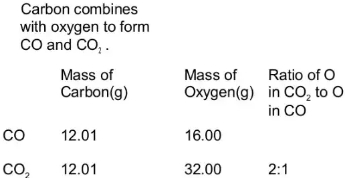
View full question & answer→MCQ 361 Mark
Among the following pairs of compounds, the one that illustrates the law of multiple proportions is
AnswerCorrect option: C. $CuO$ and $ {{\rm{Cu}}_{\rm{2}}}O$
c
According to the concept of law of multiple proportions, if two elements chemically combine to give two or more compounds, then the weight of one element which combines with the fixed weight of the other element in those compound, bear simple multiple ratios to one another.
Hence, $CuO$ and $Cu _2 O$ form two different compounds in a ratio of $1: 2$ with the fixed weight of oxygen.
View full question & answer→MCQ 371 Mark
Different propartions of oxygen in the various oxides of nitrogen prove the
Answerb
As per the law of multiple proportions, when two elements combine to form two or more compounds, the ratios of the masses of two interacting elements in the two compounds are small whole numbers.
Thus, different proportions of oxygen in the various oxides of nitrogen prove the law of multiple proportion.
View full question & answer→MCQ 381 Mark
Carbon and oxygen combine to form two oxides, carbon monoxide and carbon dioxide in which the ratio of the weights of carbon and oxygen is respectively $12 : 16$ and $12 : 32$. These figures illustrate the
- ✓
Law of multiple proportions
- B
Law of reciprocal proportions
- C
Law of conservation of mass
- D
Law of constant proportions
AnswerCorrect option: A. Law of multiple proportions
a
According to the law of multiple proportions, when two elements combine with each other to form two or more than two compounds, the masses of one of the elements which combine with a fixed mass of the other, bear a simple whole number ratio.
For example: In $CO : 12$ parts by mass of carbon combine with $16$ part by mass of oxygen.
In $CO _2, 12$ parts by mass of carbon combine with $32$ parts by mass of oxygen. The ratio of masses of oxygen which combine with a fixed mass of carbon in these compounds is $16: 32$ or $1: 2$, which is a simple whole number ratio.
View full question & answer→MCQ 391 Mark
Which of the following is the best example of law of conservation of mass
- ✓
$12 \,g$ of carbon combines with $32 \,g$ of oxygen to form $44\, g$ of $C{O_2}$
- B
When $12\, g$ of carbon is heated in a vacuum there is no change in mass
- C
A sample of air increases in volume when heated at constant pressure but its mass remains unaltered
- D
The weight of a piece of platinum is the same before and after heating in air
AnswerCorrect option: A. $12 \,g$ of carbon combines with $32 \,g$ of oxygen to form $44\, g$ of $C{O_2}$
a
The correct option is $C\, 12\, g$ of carbon combines with $32\, g$ of oxygen to form $44 \,g$ of carbon dioxide.
$12 \,g +32\, g =44 \,g$
Mass of reactants and products should be equal to each other, in accordance with the law of conservation of mass.
View full question & answer→MCQ 401 Mark
In compound $A$, $1.00 \,g$ nitrogen unites with $0.57 \,g$ oxygen. In compound $B$, $2.00 \,g$ nitrogen combines with $2.24\, g$ oxygen. In compound $C$, $3.00 \,g$ nitrogen combines with $5.11\, g$ oxygen. These results obey the following law
- A
Law of constant proportion
- ✓
Law of multiple proportion
- C
Law of reciprocal proportion
- D
Dalton's law of partial pressure
AnswerCorrect option: B. Law of multiple proportion
b
According to the question,
Compound $A \Rightarrow 1 \,g$ of $N _2+0.57\, g$ of $O _2$
Compound $B \Rightarrow 2 \,g$ of $N _2+2.24 \,g$ of $O _2$
$\therefore 1 \,g$ of $N _2$ will require $\frac{1 \times 2.24}{2}=1.12\, g ^{\text {of }} O _2$
Compound $C \Rightarrow 3\, g$ of $N _2+5.11\, g _2$ of $O _2$
$\therefore 1 \,g$ of $N _2$ will require $\frac{1 \times 5.11}{3}=1.70 \,g$ of $O _2$
The ratio of $O _2$ in $A , B$ and $C =0.57: 1.12: 1.7 \approx 1: 2: 3$
Therefore, the given results obey the law of multiple proportions.
View full question & answer→MCQ 411 Mark
Hydrogen combines with oxygen to form ${H_2}O$ in which $16 \,g$ of oxygen combine with $2 \,g$ of hydrogen. Hydrogen also combines with carbon to form $C{H_4}$ in which $2 \,g$ of hydrogen combine with $6\, g$ of carbon. If carbon and oxygen combine together then they will do show in the ratio of
- ✓
$6 : 16$ or $12 : 32$
- B
$6:18$
- C
$1:2$
- D
$12:24$
AnswerCorrect option: A. $6 : 16$ or $12 : 32$
a
In $H _2 O$, ratio of masses of $O$ and $H =16: 2$
In $CH _4$, ratio of masses of $C$ and $H =6: 2$
According to law of reciprocal proportions,
The ratio of masses of $C$ and $O=6: 16$
View full question & answer→MCQ 421 Mark
Which one of the following pairs of compounds illustrates the law of multiple proportion
- A
${H_2}O,\,N{a_2}O$
- B
$MgO$, $N{a_2}O$
- C
$N{a_2}O,BaO$
- ✓
$SnC{l_2},\,SnC{l_4}$
AnswerCorrect option: D. $SnC{l_2},\,SnC{l_4}$
d
Law of Multiple Proportions - When two elements combine with each other to form more than one compound, the weights of one element that combine with a fixed weight of the other are in a ratio of small whole numbers.
Hence, $SnCl _2$ and $SnCl _4$ illustrates the law of multiple proportions.
View full question & answer→MCQ 431 Mark
Which one of the following pairs of compounds illustrates the law of multiple proportion
- A
$H_2O, Na_2O$
- B
$MgO, Na_2O$
- C
$Na_2O, BaO$
- ✓
$SnCl_2, SnCl_4$
AnswerCorrect option: D. $SnCl_2, SnCl_4$
d
$118.7 \mathrm{g}$ of tin combine with $142 \mathrm{g}$ of chlorine to form one mole of $\mathrm{SnCl}_{4}$
$118.7 \mathrm{g}$ of tin combine with $71 \mathrm{g}$ of chlorine to form one mole of $S n C l_{2} .$
The ratio of the masses of chlorine that combine with same mass of tin is $142$
$71=2: 1$
This is a simple ratio. It indicates the law of multiple proportions.
View full question & answer→MCQ 441 Mark
The following data are obtained when dinitrogen and dioxygen react together to form different compounds
| Mass of dinitrogen |
Mass of dioxygen |
| $14\, g$ |
$16\, g$ |
| $14\, g$ |
$32\, g$ |
| $28\, g$ |
$32\, g$ |
| $28\, g$ |
$80\, g$ |
Which law of chemical combination is obeyed by the above experimental data ?
- A
Law of conservation of mass
- B
Law of definite proportions
- ✓
Law of multiple proportions
- D
AnswerCorrect option: C. Law of multiple proportions
c
Fixing the mass of dinitrogen as $14\,g,$ the mass of dioxygen combined varies as $16,32 .$ The reactants are in the ration $1: 1$ and $1: 2,$ respectively and forms different compounds.
Similarly other ratio of the reactants are $2: 1,2: 5$ in case of fixing mass of $N_{2}$ as $28 \mathrm{g}$ and varing mass of $O_{2}$ as $32 \mathrm{g}$ and $80 \mathrm{g}$ respectively.
Here two elements combine to form more than one compound and the masses of one element that combine with a fixed mass of the other element, are in the ratio of small whole numbers. Thus they follow the law of multiple proportions. thus option $C$ is correct.
View full question & answer→MCQ 451 Mark
Which of the following pairs of substances illustrates the law of multiple proportions?
- ✓
$CO$ and $CO_2$
- B
$NaCl$ and $NaBr$
- C
$H_2O$ and $D_2O$
- D
$MgO$ and $Mg(OH)_2$
AnswerCorrect option: A. $CO$ and $CO_2$
a
In $CO:$ $C$ $O$
$12:$ $16$
In $CO_2$ $12:$ $32$
View full question & answer→MCQ 461 Mark
$1$ mol of $C{H_4}$contains
AnswerCorrect option: B. $4 \,g$ atom of Hydrogen
b
(b) $1$ mole of $C{H_4}$ contains $4$ mole of hydrogen atom i.e. $4\,g$ atom of hydrogen.
View full question & answer→MCQ 471 Mark
Which of the following has least mass
AnswerCorrect option: B. $3 \times {10^{23}}$ atoms of $C$
b
(b) $( a)$ $2\,gm $ atom of nitrogen $= 28\,gm$
$(b)$ $6 \times {10^{23}}$ atoms of $C$ has mass $ = 12\,gm$
$3 \times {10^{23}}$ atoms of $C$ has mass $ = \frac{{12 \times 3 \times {{10}^{23}}}}{{6 \times {{10}^{23}}}} = 6\,gm$
$(c)$ $1$ mole of $S$ has mass $= 32\,gm$
$(d)$ $7.0\,gm$ of $Ag$
So, lowest mass = $6\,gm$ of $C$.
View full question & answer→MCQ 481 Mark
How many mole of helium gas occupy $22.4\;L$ at ${0^o}C$ at $1$ atm. pressure
Answerc
(c) $1$ mole of any gas at $STP$ occupies $22.4\,L$.
View full question & answer→MCQ 491 Mark
Volume of a gas at $STP$ is $1.12 \times {10^{ - 7}}\,cc$. Calculate the number of molecules in it
- A
$3.01 \times {10^{20}}$
- ✓
$3.01 \times {10^{12}}$
- C
$3.01 \times {10^{23}}$
- D
$3.01 \times {10^{24}}$
AnswerCorrect option: B. $3.01 \times {10^{12}}$
b
(b) $22400\,cc$ of gas at $STP$ has $6 \times {10^{23}}$molecules
$\therefore$ $1.12$ $ \times {10^{ - 7}}$ of gas at $STP$ has $\frac{{6 \times {{10}^{23}} \times 1.12 \times {{10}^{ - 7}}}}{{22400}}$ $= .03 \times {10^{14}} = 3 \times {10^{12}}$.
View full question & answer→MCQ 501 Mark
The number of molecules in $4.25 \,g$ of ammonia are
- A
$0.5 \times {10^{23}}$
- ✓
$1.5 \times {10^{23}}$
- C
$3.5 \times {10^{23}}$
- D
$1.8 \times {10^{32}}$
AnswerCorrect option: B. $1.5 \times {10^{23}}$
b
(b) Molecular weight of $N{H_3}$ is $17$
According to the mole concept
$17\,gm$ $N{H_3}$ has molecules $ = 6.02 \times {10^{23}}$
$\therefore \,\,1\,gm$ $N{H_3}$ has molecules $ = \frac{{6.02 \times {{10}^{23}}}}{{17}}$
$\therefore $ $4.25\,gm$ $N{H_3}$ has molecules $ = \frac{{6.02 \times {{10}^{23}} \times 4.25}}{{17}} = 1.5 \times {10^{23}}\,molecule$
View full question & answer→MCQ 511 Mark
Which one of the following pairs of gases contains the same number of molecules
- ✓
$16\,g$ of ${O_2}$ and $14\, g$ of ${N_2}$
- B
$8\, g$ of ${O_2}$and $22\,g $ of $C{O_2}$
- C
$28\,g$ of ${N_2}$ and $22\,g$ of $C{O_2}$
- D
$32\,g$ of ${O_2}$ and $32\,g$ of ${N_2}$
AnswerCorrect option: A. $16\,g$ of ${O_2}$ and $14\, g$ of ${N_2}$
a
(a) $16\,g$ ${O_2}$ has no. of moles $ = \frac{{16}}{{32}} = \frac{1}{2}$
$14\,g$ ${N_2}$ has no. of moles $ = \frac{{14}}{{28}} = \frac{1}{2}$
No. of moles are same, so no. of molecules are same.
View full question & answer→MCQ 521 Mark
The number of molecules in $16\, g$ of methane is
AnswerCorrect option: B. $6.02 \times {10^{23}}$
b
(b) $16\,gm$ of $C{H_4}$= $1$ mole $ = 6.023 \times {10^{23}}$ molecules.
View full question & answer→MCQ 531 Mark
Number of molecules in $100$ $ml$ of each of ${O_2},\,N{H_3}{\rm{ \,and}}\,C{O_2}$ at $STP$ are
- A
In the order $C{O_2} < {O_2} < N{H_3}$
- B
In the order $N{H_3} < {O_2} < C{O_2}$
- ✓
- D
$N{H_3} = C{O_2} < {O_2}$
Answerc
(c)According to avogadro's hypothesis equal volumes of all gases under similar conditions of temperature and pressure contains equal no. of molecules.
View full question & answer→MCQ 541 Mark
The number of electrons in a mole of hydrogen molecule is
AnswerCorrect option: A. $12.046 \times {10^{23}}$
a
$1\, mole$ of $H _2$ contains $6.023 \times 10^{23}$ molecules and each molecule of $H _2$ contains two electrons.
Hence the total no. of electrons in one mole of $H _2$ are $12.046 \times 10^{23}$.
View full question & answer→MCQ 551 Mark
The largest number of molecules is in
- ✓
$34\,g$ of water
- B
$28\,g$ of $C{O_2}$
- C
$46\,g$ of $C{H_3}OH$
- D
$54\,g$ of ${N_2}{O_5}$
AnswerCorrect option: A. $34\,g$ of water
a
$(a)$ $(a)$ $34\,gm$ of water
$18\,gm$ ${H_2}O$ =$6.023 \times {10^{23}}$ molecule $\therefore $ $34\,gm$ ${H_2}O$ = $\frac{{6.023 \times {{10}^{23}}}}{{18}} \times 34$ $ = 11.37 \times {10^{23}}$ mole
$(b)$ $28\,gm$ of $C{O_2}$ $44\,gm$ $C{O_2}$$ = 6 \times {10^{23}}$ molecules
$28\,gm$ $C{O_2}$ $ = \frac{{6 \times {{10}^{23}}}}{{44}} \times 28 = 3.8 \times {10^{23}}$
$(c)$ $46\,gm$ of $C{H_3}OH$ $32\,gm$ $C{H_3}OH\; = 6 \times {10^{23}}$ molecules
$46\,gm$ $C{H_3}OH\; = \frac{{6 \times {{10}^{23}}}}{{32}} \times 46 = 8.625 \times {10^{23}}$
$(d)$ $108\,gm$ of ${N_2}{O_5} = 6 \times {10^{23}}$ molecules
$54\,gm$ of ${N_2}{O_5}\; = \frac{{6 \times {{10}^{23}}}}{{108}} \times 54 = 3 \times {10^{23}}$ molecules.
View full question & answer→MCQ 561 Mark
The number of moles of sodium oxide in $620\,g$ of it is ................ $\mathrm{moles}$
Answerb
(b)Sodium oxide $ \to $ $N{a_2}O$
Molecular weight $= 46 +16 = 62$
$62\,gm$ of $N{a_2}O$ = $1$ $mole$
$620\,gm$ of $N{a_2}O$= $10$ $mole$.
View full question & answer→MCQ 571 Mark
$2\,g$ of oxygen contains number of atoms equal to that in
- A
$0.5\,g$ of hydrogen
- ✓
$4\,g$ of sulphur
- C
$7\,g$ of nitrogen
- D
$2.3\,g$ of sodium
AnswerCorrect option: B. $4\,g$ of sulphur
b
(b) $2\,gm$ of oxygen contains atom $ = \frac{2}{{16}} = \frac{1}{8}$ $mole$
also $4\,g$ of sulphur $ = \frac{4}{{32}} = \frac{1}{8}$ $mole.$
View full question & answer→MCQ 581 Mark
The number of sodium atoms in $2 $ moles of sodium ferrocyanide is
- A
$12 \times {10^{23}}$
- B
$26 \times {10^{23}}$
- C
$34 \times {10^{23}}$
- ✓
$48 \times {10^{23}}$
AnswerCorrect option: D. $48 \times {10^{23}}$
d
(d) As we know that four sodium atom are present in sodium ferrocyanide $[N{a_4}Fe{(CN)_6}]$
Hence, number of $Na$ atoms = No. of moles $ \times $ number of atom $ \times $ Avogadro’s number
$2 \times 4 \times 6.023 \times {10^{23}} = 48 \times {10^{23}}$
View full question & answer→MCQ 591 Mark
Which of the following contains maximum number of atoms
AnswerCorrect option: B. $22.4 \,L$ of $C{O_2}$ at $STP$
b
(a) $6.023 \times {10^{23}}$ molecules of $C{O_2}$
No. of atoms $ = 3 \times 6.023 \times {10^{21}}$=$18.069 \times {10^{21}}$ atoms
(b) $22.4\,L$ of $C{O_2}$
No. of atoms =$6.023 \times {10^{23}} \times 3$$ = 18.069 \times {10^{23}}$ atoms
(c) $0.44\,gm$ of $C{O_2}$
No. of moles $ = \frac{{0.44}}{{44}} = \frac{1}{{100}} \times 6.023 \times {10^{23}}$ moles
$= 6.023 \times {10^{21}}$ moles $ = 3 \times 6.023 \times {10^{21}}$ atoms $18.069 \times {10^{21}}$ atoms
View full question & answer→MCQ 601 Mark
How many $H-$atoms are present in $0.046 \,g $ of ethanol
- A
$6 \times {10^{20}}$
- B
$1.2 \times {10^{21}}$
- C
$3 \times {10^{21}}$
- ✓
$3.6 \times {10^{21}}$
AnswerCorrect option: D. $3.6 \times {10^{21}}$
d
(d) Mol. wt of ${C_2}{H_5}OH = 2 \times 12 + 5 + 16 + 1 = 64$
$\because 48\,g\,{C_2}{H_5}OH$ has $H$ atom $ = 6 \times {N_A}$
$\therefore $ $0.046\,g\,\,{C_2}{H_5}OH$ has $H$ atoms $ = \frac{{6 \times 6.02 \times {{10}^{23}} \times 0.046}}{{46}}$$ = 3.6 \times {10^{21}}$
View full question & answer→MCQ 611 Mark
The largest number of molecules is in
- A
$25g$ of $C{O_2}$
- B
$46g$ of ${C_2}{H_5}OH$
- ✓
$36g$ of ${H_2}O$
- D
$54g$ of ${N_2}{O_5}$
AnswerCorrect option: C. $36g$ of ${H_2}O$
c
Number of molecules present in '$W$' $g$ of a compound $=\frac{W}{M} \times N_A$.
Here, $N_A$ represents Avogadro's number. $M$ represents the molar mass of compound.
Number of molecules present in $36 \,g$ of water $=\frac{36}{18} \times N _{ A }=2\, N _{ A }$
Number of molecules present in $28\, g$ of $CO =\frac{46}{46} \times N _{ A }= N _{ A }$
Number of molecules present in $46 \,g$ of $C _2 H _5 OH =\frac{46}{46} \times N _{ A }= N _{ A }$
Number of molecules present in $54 \,g$ of $N _2 O _5=\frac{54}{108} \times N _{ A }=0.5\, N _{ A }$
View full question & answer→MCQ 621 Mark
$10\ gms$ . each of $CO_2$ , $NH_3$ and $O_2$ were taken in three separate flasks. What is the correct decreasing order of atoms
- A
$CO_2$ , $NH_3$ , $O_2$
- B
$NH_3$ , $O_2$ , $CO_2$
- C
$O_2$ , $NH_3$ , $CO_2$
- ✓
$NH_3$ , $CO_2$ , $O_2$
AnswerCorrect option: D. $NH_3$ , $CO_2$ , $O_2$
View full question & answer→MCQ 631 Mark
Which of the following represents $180\, g$ of water correctly ?
AnswerCorrect option: D. $6.023 \times 10^{24}$ molecules of water
d
$n=\frac{180}{18}=10$
no. of molecule $=10 \times 6.02 \times 10^{23}$
$=6.02 \times 10^{24} $
View full question & answer→MCQ 641 Mark
Find number of electrons present in $34\,g$ of $NH_3(g)$. .....................$N_A$
Answerc
Moles of $\mathrm{NH}_{3}=\frac{34}{17}=2$ moles
no. of $\mathrm{NH}_{3}$ molecules $=2 \times \mathrm{N}_{\mathrm{A}}$
one $\mathrm{NH}_{3}$ molecule contains $10$ electron total no. of electrons $=2 \times \mathrm{N}_{\mathrm{A}} \times 10=20\, \mathrm{N}_{\mathrm{A}}$
View full question & answer→MCQ 651 Mark
The weight of a molecule of the compound $C_{60}H_{122}$ is
- ✓
$1.4 \times 10^{-21} \,g$
- B
$1.09 \times 10^{-21} \,g$
- C
$5.025 \times 10^{23} \,g$
- D
$16.023 \times 10^{23} \,g$
AnswerCorrect option: A. $1.4 \times 10^{-21} \,g$
a
$\mathrm{C}_{60} \mathrm{H}_{122} =60 \times 12+122 $
$=720+122 =842 $
wt of a molecule $=842 \times 1.67 \times 10^{-24}$
$=1.406 \times 10^{-21}\, \mathrm{g}$
View full question & answer→MCQ 661 Mark
Which has the maximum number of molecules among the following ?
- A
$64\, g\, SO_2$
- B
$44\, g \,CO_2$
- C
$48\, g\, O_3$
- ✓
$8\, g\, H_2$
AnswerCorrect option: D. $8\, g\, H_2$
d
Moles $\propto$ molecules
$\frac{64}{64}=1\, \mathrm{mol}\, \mathrm{SO}_{2}$
$\frac{44}{1}=1\, \mathrm{mol}$ of $\mathrm{CO}_{2}$
$\frac{48}{48}=1\, \mathrm{mol}$ of $\mathrm{O}_{3}$
$\frac{8}{2}=4\, \mathrm{mol}$ of $\mathrm{H}_{2}$
View full question & answer→MCQ 671 Mark
Number of atoms present in $224\, dm^3$ of oxygen gas at $STP$ is
- A
$6.0 \times 10^{23}$
- B
$1.2 \times 10^{23}$
- C
$6.0 \times 10^{24}$
- ✓
$1.2 \times 10^{25}$
AnswerCorrect option: D. $1.2 \times 10^{25}$
d
$224\, \mathrm{dm}^{3}$
$=224\, \mathrm{L}$
Moles $=\frac{224}{22.4}=10$
No. of atoms $=10 \times 2 \times 6.02 \times 10^{23}$
$=1.2 \times 10^{25}$
View full question & answer→MCQ 681 Mark
From the following the largest number of atoms are in
- A
$36g\, H_2O$
- B
$28g\, CO$
- ✓
$46g\, C_2H_5OH$
- D
$54g\, N_2O_5$
AnswerCorrect option: C. $46g\, C_2H_5OH$
c
No. of atoms $=$ atomicity $\times$ no. of moles
${{\text{n}}_{{{\text{H}}_2}{\text{O}}}} = \frac{{36}}{{18}} = 2$
$\mathrm{n}_{\mathrm{CO}}=\frac{28}{28}=1$
${n_{{C_2}{H_5}OH}} = \frac{{46}}{{46}} = 1$
${n_{{N_2}{O_5}}} = \frac{{54}}{{108}} = 0.5$
View full question & answer→MCQ 691 Mark
$‘A’$ sample of $[Cu(NH_3)_4]SO_4$ contains $2.4\times10^{24}$ ammonia molecules. The moles of $[Cu(NH_3)_4]SO_4$ in given sample will be
- A
$6\times10^{23}$
- B
$1$
- C
$3$
- ✓
$4$
Answerd
moles of amonia $\frac{{2.4 \times {{10}^{24}}}}{{6 \times {{10}^{23}}}} = 0.40 \times 10 = 4$
View full question & answer→MCQ 701 Mark
The number of atoms in $4.25\, g$ of $NH_3$ is approximately
- A
$1 \times 10^{23}$
- B
$1.5 \times 10^{23}$
- C
$2 \times 10^{23}$
- ✓
$6 \times 10^{23}$
AnswerCorrect option: D. $6 \times 10^{23}$
d
No. of molecules in $4.25 \,\mathrm{g}\, \mathrm{NH}_{3}=\frac{4.25}{17} \times 6 \times 10^{23}$
$ \therefore \text { No. of atoms } =4 \times \frac{4.25}{17} \times 6 \times 10^{23} $
$=6 \times 10^{23}$
View full question & answer→MCQ 711 Mark
Number of atoms in $11.2\, L$ of $CO_2$ at $NTP$ is .............. $N_A$
- ✓
$1.5$
- B
$0.5$
- C
$3$
- D
$\frac{2}{3} $
Answera
$\mathrm{n}=\frac{11.2}{22.4}=\frac{1}{2}$
No. of molecules of $\mathrm{CO}_{2}=\frac{1}{2} \times \mathrm{N}_{\mathrm{A}}$
No. of atoms $=3 \times \frac{1}{2} \times \mathrm{N}_{\mathrm{A}}=1.5 \mathrm{N}_{\mathrm{A}}$
View full question & answer→MCQ 721 Mark
How many protons are present in $1.8\,g \,NH_4^+$ ............. $N_A$
Answerc
No. of protons in one $\mathrm{NH}_{4}^{+}$ ion $=7+4=11$
No. of $\mathrm{NH}_{4}^{+}$ ions in $1.8\, \mathrm{g}=\frac{1.8}{18} \times \mathrm{N}_{\mathrm{A}}=0.1\, \mathrm{N}_{\mathrm{A}}$
$\text { No. of protons in } 1.8\, \mathrm{g} \,\mathrm{NH}_{4}^{+} =11 \times 0.1\, \mathrm{N}_{\mathrm{A}}$
$=1.1 \,\mathrm{N}_{\mathrm{A}}$
View full question & answer→MCQ 731 Mark
$8\,g \,O_2$ has same number of atoms as that in
- A
$14g\, CO$
- ✓
$7g \,CO$
- C
$11g\, CO_2$
- D
$22g\, CO_2$
AnswerCorrect option: B. $7g \,CO$
b
mole $(\mathrm{n})=\frac{\text { weight }(\mathrm{w})}{\text { atomic wt. }}=\frac{\mathrm{No.} \text { of } \operatorname{atom}(\mathrm{N})}{\mathrm{N}_{\mathrm{A}}}$
in $8\, \mathrm{g}\, \mathrm{O}_{2}$ No. of atom
$\frac{8}{16}=\frac{N}{N_{A}} \Rightarrow N=\frac{N_{A}}{2}$
View full question & answer→MCQ 741 Mark
Which of the following has the smallest number of molecules
- A
$22.4 \times 10^3\, mL$ of $CO_2\, gas$ at $STP$
- B
$22\, g$ of $CO_2 \,gas$
- C
$11.2\, L$ of $CO_2 \,gas$ at $STP$
- ✓
$0.1\, mole$ of $CO_2 \,gas$
AnswerCorrect option: D. $0.1\, mole$ of $CO_2 \,gas$
d
At condition $\mathrm{A}=1$ mole
At condition $\mathrm{B}=0.5$ mole
At condition $\mathrm{C}=0.5$ mole
At condition $\mathrm{D}=0.1$ mole
i.e. at condition $D$ we have smallest number of mole so we also have smallest number of molecule in condition $D$.
View full question & answer→MCQ 751 Mark
Calculate the number of atoms of oxygen present in $176\, g$ of $CO_2$
- A
$2.408 \times 10^{26}$
- B
$4.816 \times 10^{23}$
- C
$1.204 \times 10^{22}$
- ✓
$4.816 \times 10^{24}$
AnswerCorrect option: D. $4.816 \times 10^{24}$
d
No. of mole of $\mathrm{CO}_{2}=\frac{176}{44}=4$
$\therefore$ No. of mole of $\mathrm{O}$ atom $=4 \times 2=8$
$ \therefore \text { No. of } \mathrm{O} \text { atom } =8 \times \mathrm{N}_{\mathrm{A}}$
$=8 \times 6.023 \times 10^{23} =48.184 \times 10^{23} $
$=4.8184 \times 10^{24}$
Butane and isobutane have same formula.
View full question & answer→MCQ 761 Mark
Which of the following contain maximum number of carbon atoms?
- A
$15\, gm$ ethane, $C_2H_6$
- B
$40.2\, gm$ sodium oxalate, $Na_2C_2O_4$
- C
$72\, gm$ glucose, $C_6H_{12}O_6$
- ✓
$35\, gm$ pentene, $C_5H_{10}$
AnswerCorrect option: D. $35\, gm$ pentene, $C_5H_{10}$
d
$\mathrm{C}_{2} \mathrm{H}_{6} \Rightarrow \frac{15}{30} \times \mathrm{N}_{\mathrm{A}} \times 2=\mathrm{N}_{\mathrm{A}}\, \mathrm{C}$ -atoms
$\mathrm{Na}_{2} \mathrm{C}_{2} \mathrm{O}_{4} \Rightarrow \frac{40.2}{134} \times \mathrm{N}_{\mathrm{A}} \times 2=0.6\, \mathrm{N}_{\mathrm{A}} \,\mathrm{C}$ -atoms
$\mathrm{C}_{6} \mathrm{H}_{12} \mathrm{O}_{6} \Rightarrow \frac{72}{180} \times \mathrm{N}_{\mathrm{A}} \times 6=2.4\, \mathrm{N}_{\mathrm{A}} \,\mathrm{C}$ -atoms
$\mathrm{C}_{5} \mathrm{H}_{10} \Rightarrow \frac{35}{70} \times \mathrm{N}_{\mathrm{A}} \times 5=2.5\,\mathrm{N}_{\mathrm{A}}\, \mathrm{C}$ -atoms
View full question & answer→MCQ 771 Mark
$10\,g$ of $CaCO_3$ contains
AnswerCorrect option: B. $0.1\,g$ atom of $Ca$
b
Mwt of $\mathrm{CaCO}_{3}=40+12+48=100$
$ \text { Moles of } \mathrm{CaCO}_{3} \text { in } 10 \,\mathrm{g} =\frac{10}{100} $
$=0.1\, \mathrm{mol}=0.1 \,\mathrm{g} \,\text { atom }$
View full question & answer→MCQ 781 Mark
The number of atoms in $0.1\, mol$ of a triatomic gas is $(N_A = 6.02\times10^{23}\, mol^{-1})$
- A
$1.800\times10^{22}$
- B
$6.026\times10^{22}$
- ✓
$1.806\times10^{23}$
- D
$3.600\times10^{23}$
AnswerCorrect option: C. $1.806\times10^{23}$
c
$ \text { No. of atoms } =0.1 \times \mathrm{N}_{\mathrm{A}} \times 3 $
$=0.1 \times 6.02 \times 10^{23} \times 3 $
$=1.806 \times 10^{23}$
View full question & answer→MCQ 791 Mark
Which has highest number of atoms ?
- A
$11.2\, L$ of $CO_2$ gas at $STP$
- B
$2\,g$ of $H_2$
- C
$2\,g-$ atom of $C$
- ✓
$3\,g-$ molecule of $SO_2$
AnswerCorrect option: D. $3\,g-$ molecule of $SO_2$
d
$\mathrm{CO}_{2} \Rightarrow \frac{11.2}{22.4} \times \mathrm{N}_{\mathrm{A}} \times 3=1.5 \mathrm{N}_{\mathrm{A}}$ atoms
$\mathrm{H}_{2} \Rightarrow \frac{2 \mathrm{g}}{2} \times \mathrm{N}_{\mathrm{A}} \times 2=2 \mathrm{N}_{\mathrm{A}}$ atoms
$\mathrm{C} \Rightarrow 2 \times \mathrm{N}_{\mathrm{A}}$ atoms
$\mathrm{SO}_{2} \Rightarrow 3 \times \mathrm{N}_{\mathrm{A}} \times 3=9 \mathrm{N}_{\mathrm{A}}$ atoms
View full question & answer→MCQ 801 Mark
Which sample contains the largest number of atoms ?
- A
$1\, mg$ of $C_4H_{10}$
- B
$1\, mg$ of $N_2$
- C
$1\, mg$ of $Na$
- ✓
$1\, ml$ of $H_2O$
AnswerCorrect option: D. $1\, ml$ of $H_2O$
d
$1 \mathrm{mg}$ of $C_{4} H_{10}=\frac{14 \mathrm{N}}{58} \times 10^{-3} \mathrm{atoms}$
$1 \mathrm{mg}$ of $N_{2}=\frac{2 N \times 10^{-3}}{28}$ atoms
$1 \mathrm{mg}$ of $N a=\frac{N \times 10^{-3}}{23}$ atoms
$1 \mathrm{mL}=1 \mathrm{g} H_{2} O=\frac{3 N}{18}$ atoms
View full question & answer→MCQ 811 Mark
How many moles of $Mg_3[PO_4]_2$ will contain $0.50\, mole$ of oxygen atoms ?
- A
$6.025$
- B
$0.625$
- ✓
$0.0625$
- D
$625$
AnswerCorrect option: C. $0.0625$
c
$1$ mole of $Mg_3(PO_4)_2$ contains $8$ moles of Oxygen Then,
$8$ moles of oxygen is contained by $1$ mole of $Mg_3(PO_4)_2$.
$0.50$ moles of oxygen is contained by $\frac{{0.50 \times 1}}{8}$ $=0.0625$ moles of $Mg_3(PO_4)_2$.
So, your answer is $0.0625$ moles
View full question & answer→MCQ 821 Mark
The number of moles of a gas in $1\, m^3$ of volume at $NTP$ is
- A
$4.46$
- B
$0.446$
- C
$1.46$
- ✓
$44.6$
AnswerCorrect option: D. $44.6$
d
$1\, \mathrm{m}^{3}=1000 \,\mathrm{L}$
Number of moles $=\frac{1000}{22.4}=44.6$
View full question & answer→MCQ 831 Mark
Number of atoms in $24\, g$ of $He$ is ............ $\mathrm{N_A}$
Answerd
No. of mole of $He$ $(n)=\frac{W}{\text { At. wt. }}=\frac{24}{4}=6$
$\text { No. of atom }=\text { Mole } \times \mathrm{N}_{\mathrm{A}}=6\, \mathrm{N}_{\mathrm{A}}$
View full question & answer→MCQ 841 Mark
A sample of ammonium phosphate, $(NH_4)_3PO_4$ , contains $6\,moles$ of hydrogen atoms. The number moles of oxygen atoms in the sample is
Answerb
No. of $H-$atoms $=12$
No. of $O-$atoms $=4$
$\therefore$ so, ratio of no. of atoms $=$ ratio of no. of moles
$\frac{12}{4}=\frac{6}{n_{o}}$
$n_{o}=2$
View full question & answer→MCQ 851 Mark
Which of the following has minimum number of atoms
AnswerCorrect option: D. $2.45\, g$ sulphuric acid
d
$\mathrm{He} \Rightarrow \frac{12}{4}=3\, \mathrm{mol}$ atoms, $\mathrm{H}_{2} \mathrm{O} \Rightarrow \frac{1.8}{18}=0.1 \,\mathrm{mol}$
$0.1 \times 3=0.3\, \mathrm{mol}$ atom
$\mathrm{CO}_{2} \Rightarrow \frac{22}{44}=0.5\, \mathrm{mol}: 0.5 \times 3=1.5\,\mathrm{mol}$ atoms
$\mathrm{H}_{2} \mathrm{SO}_{4} \Rightarrow \frac{2.45}{98}=0.025\, \mathrm{mol}: 0.025 \times 7=0.175 \,\mathrm{mol\,atoms}$
View full question & answer→MCQ 861 Mark
The largest no. of molecules are in
- ✓
$36\,g\,H_2O$
- B
$28\,g\,CO$
- C
$46\,g\,C_2H_5OH$
- D
$54\,g\,N_2O_5$
AnswerCorrect option: A. $36\,g\,H_2O$
a
$H_2O = 2\,mole;\,\,CO = 1\,mole,$
$C_2H_5OH = 1\,mole, N_2O_5 = 1/2\,mole$
View full question & answer→MCQ 871 Mark
Which of the following figures does not represent $1\, mole$ of $O_2$ gas at $NTP$ ?
AnswerCorrect option: D. $16$ grams of $O_2$ gas
d
$16\, g\,O_2 = \frac{1}{2}\, mol$
View full question & answer→MCQ 881 Mark
At $STP$ the moles of oxygen in $2.8\, L$ of $CO_2$ gas is
- A
$1$
- B
$0.5$
- ✓
$0.25$
- D
$0.125$
AnswerCorrect option: C. $0.25$
c
moles of $\mathrm{CO}_{2}=\frac{\text { Volume }}{22.4}=\frac{2.8}{22.4}=0.125\, \mathrm{mol}$
Moles of oxygen $=0.125 \times 2=0.25\, \mathrm{mol}$
View full question & answer→MCQ 891 Mark
‘A’ sample of $[Cu(NH_3)_4]SO_4$ contains $2.4 \times 10^{24}$ ammonia molecules. The moles of $[Cu(NH_3)_4]SO_4$ in given sample will be
- A
$6 \times {10^{23}}$
- B
$4$
- C
$3$
- ✓
$1$
Answerd
$1\; mol$ of $[Cu(NH_3)_4]SO_4$ have $4\;mol$ of $NH_3$
$6.022 \times 10^{23}$ atom have $1 \;mol$ of $NH_3$
then $2.4 \times 10^{24}$ atom have $4\;mol$ of $NH_3$
View full question & answer→MCQ 901 Mark
Sulphur forms the chlorides ${S_2}C{l_2}{\rm{ \,and \,}}SC{l_2}$. The equivalent mass of sulphur in $SC{l_2}$ is......$g/mole$
Answerb
(b)The atomic weight of sulphur = $32$
In $SC{l_2}$ valency of sulphur = $2$
So equivalent mass of sulphur $ = \frac{{32}}{2} = 16$.
View full question & answer→MCQ 911 Mark
In chemical scale, the relative mass of the isotopic mixture of oxygen atoms $({O^{16}},\,{O^{17}},\,{O^{18}})$ is assumed to be equal to
Answerb
The sample contains impurity. The impurity won't contribute to the normality of the solution.
So, we need to take more amount of sample than the theoretical weight so that the theoretical weight of compound equals weight of compound in the sample.
View full question & answer→MCQ 921 Mark
$74.5 \,g$ of a metallic chloride contain $35.5\, g$ of chlorine. The equivalent weight of the metal is
Answerc
(c) wt. of metallic chloride$ = 74.5$
wt. of chlorine = $35.5 $
$\therefore $ wt. of metal $ = 74.5 - 35.5 = 39$
Equivalent weight of metal $ = \frac{{{\rm{weight of metal}}}}{{{\rm{weight of chlorine}}}} \times 35.5$
$ = \frac{{39}}{{35.5}} \times 35.5 = 39$
View full question & answer→MCQ 931 Mark
$7.5$ grams of a gas occupy $5.8$ litres of volume at $STP$ the gas is
- ✓
$NO$
- B
${N_2}O$
- C
$CO$
- D
$C{O_2}$
Answera
(a) $5.8\,L$ of gas has mass $ = 7.5\,gm$
$\therefore $ $22.4\,L$ of gas has mass =$\frac{{7.5}}{{5.8}} \times 22.4 = 28.96$
So molecular weight = $29$
So, molecular formula of compound is $NO$
View full question & answer→MCQ 941 Mark
One litre of a gas at $STP$ weight $1.16\, g$ it can possible be
- ✓
${C_2}{H_2}$
- B
$CO$
- C
${O_2}$
- D
$C{H_4}$
AnswerCorrect option: A. ${C_2}{H_2}$
a
(a) $1\,L$ of gas at $S.T.P$. weight $1.16\,g$
$\therefore $ $22.4\, L$ of gas at $S.T.P$. weight $ = 22.4 \times 1.16$ $ = 25.984 \approx 26$
This molecular weight indicates that given compound is ${C_2}{H_2}$.
View full question & answer→MCQ 951 Mark
The vapour density of a gas is $11.2$. The volume occupied by $11.2\, g$ of the gas at $STP$ will be.....$L$
- ✓
$11.2$
- B
$22.4$
- C
$1$
- D
$44.8$
AnswerCorrect option: A. $11.2$
a
(a) Molecular weight $ = 2 \times V.D$$ = 2 \times 11.2 = 22.4$
$22.4\,gm$ of gas occupies $22.4\,L$ at $S.T.P.$
$\therefore $ $11.2\,gm$ of gas occupies $\frac{{22.4}}{{22.4}} \times 11.2 = 11.2\,L$.
View full question & answer→MCQ 961 Mark
Equivalent weight of crystalline oxalic acid is
Answerb
(b) Equivalent weight $ = \frac{{{\rm{Molecular weight}}}}{{{\rm{Valency}}}}$
Molecular weight of $\begin{array}{*{20}{c}}{COOH}\\{\mathop C\limits^| OOH}\end{array} \cdot 2{H_2}O = \frac{{126}}{2} = 63$.
View full question & answer→MCQ 971 Mark
The equivalent weight of an element is $4$. Its chloride has a $V.D$ $59.25$. Then the valency of the element is
Answerb
(b) Valency of the element $ = \frac{{2 \times V.D}}{{E + 35.5}}$ $ = \frac{{2 \times 59.25}}{{4 + 35.5}}$ $ = \frac{{118.50}}{{39.5}}$$=3$.
View full question & answer→MCQ 981 Mark
What should be the equivalent weight of phosphorous acid, if $P=31; O=16; H=1$
Answerb
(b) The acid is dibasic.
Molecular weight of ${H_3}P{O_3}$$ = 3 + 31 + 48 = 82$
$\therefore $ Equivalent weight $ = \frac{{{\rm{Molecular weight}}}}{{{\rm{Basicity}}}} = \frac{{82}}{2}= 41.$
View full question & answer→MCQ 991 Mark
Caffeine has a molecular weight of $194$. If it contains $28.9\%$ by mass of nitrogen, number of atoms of nitrogen in one molecule of caffeine is
Answera
(a) $100\,gm$ caffeine has $28.9\,gm$ nitrogen
$194\,gm$ caffeine has = $\frac{{28.9}}{{100}} \times 194 = 56.06\,gm$
$\therefore $ No. of atoms in caffeine $ = \frac{{56.06}}{{14}} \approx 4$.
View full question & answer→MCQ 1001 Mark
The element whose a atom has mass of $10.86 \times {10^{ - 26}}$ $kg$ is
Answerd
(d) $1$ atom has mass $ = 10.86 \times {10^{ - 26}}kg$ $ = 10.86 \times {10^{ - 23}}\,gm$
$6.023 \times {10^{23}}$atoms has mass =$10.86 \times {10^{ - 23}} \times 6.023 \times {10^{23}}$ = $65.40\,gm$
This is the atomic weight of $Zn.$
View full question & answer→MCQ 1011 Mark
The number of gram atoms of oxygen present in $0.3$ gram mole of ${(COOH)_2}.2{H_2}O$ is
Answerb
(b) $1\,mole$ ${(COOH)_2}\;.\;2{H_2}O$ has $96\,gm$ oxygen
$\therefore $ $0.3$ mole ${(COOH)_2}\;.\;2{H_2}O$ has $96 \times 0.3 = 28.8\,gm$
$\therefore $ No. of gram atoms of oxygen $ = \frac{{28.8}}{{16}} = 1.8$.
View full question & answer→MCQ 1021 Mark
Vapour density of a metal chloride is $66$. Its oxide contains $53\%$ metal. The atomic weight of the metal is
- A
$21$
- B
$54$
- ✓
$27.06$
- D
$2.086$
AnswerCorrect option: C. $27.06$
c
(c) Let wt. of metal oxide = $100\,gm$
wt. of metal $= 53\,gm$
wt. of oxygen $= 47\,gm$
Equivalent weight of oxygen $ = \frac{{{\rm{wt}}{\rm{. of metal}}}}{{{\rm{wt}}{\rm{. of oxygen}}}} \times 8$ $ = \frac{{53}}{{47}} \times 8 = 9.02$
Valency $ = \frac{{2 \times V.D}}{{E + 35.5}} = \frac{{2 \times 66}}{{9 + 35.5}} = \frac{{132}}{{44.5}} = 2.96 \approx 3$
$\therefore$ Atomic Weight = Equivalent Weight $\times$ Valancy $ = 9.02 \times 3 = 27.06$
View full question & answer→MCQ 1031 Mark
One gram of hydrogen is found to combine with $80\,g$ of bromine one gram of calcium valency $=2$ combines with $4\,g$ of bromine the equivalent weight of calcium is
Answerb
(b) One gram of hydrogen combines with $80\,gm $ of bromine.
So, equivalent weight of bromine $= 80\,gm$
$4\,gm$ of bromine combines with $1\,gm$ of $Ca$
$\therefore $ $80\,gm$ of bromine combines with = $\frac{1}{4} \times 80 = 20$.
View full question & answer→MCQ 1041 Mark
$12\,g$ of $Mg$ (at. mass $24$) on reacting completely with acid gives hydrogen gas, the volume of which at $STP$ would be ............... $\mathrm{L}$
- A
$22.4$
- ✓
$11.2$
- C
$44.8$
- D
$6.1$
AnswerCorrect option: B. $11.2$
b
(b) $Mg + 2HCl \to MgC{l_2} + {H_2}$
$24\,g \,Mg $ evolves $22.4\,L$ ${H_2}$ at $STP$
$\therefore $ $12\,g$ $Mg$ evolves ${H_2}$ at $STP$ $\frac{{22.4}}{{24}} \times 12$ $=11.2\,L$ at $STP.$
View full question & answer→MCQ 1051 Mark
$4.4\;g$ of an unknown gas occupies $2.24\,L$ of volume at standard temperature and pressure. The gas may be
Answera
(a) $2.24\,L$ of gas has mass $= 4.4\,gm$
$\therefore $ $22.4\,L$ of gas has mass $ = \frac{{4.4}}{{2.24}} \times 22.4 = 44$
So given gas is $C{O_2}$ because $C{O_2}$ has molecular mass $=44.$
View full question & answer→MCQ 1061 Mark
The number of molecules in $8.96\;L$ of a gas at ${0\,^o}C$ and $1$ atmosphere pressure is approximately
- A
$6.02 \times {10^{23}}$
- B
$12.04 \times {10^{23}}$
- C
$18.06 \times {10^{23}}$
- ✓
$24.08 \times {10^{22}}$
AnswerCorrect option: D. $24.08 \times {10^{22}}$
d
(d) $22.4\,L$ of a gas at $STP$ has no. of molecules $ = 6.023 \times {10^{23}}$
$\therefore $ $8.96\,L$ of a gas at $STP$ has no. of molecules $ = \frac{{6.02 \times {{10}^{23}} \times 8.96}}{{22.4}}$
$ = 2.408 \times {10^{23}}$$ = 24.08 \times {10^{22}}$.
View full question & answer→MCQ 1071 Mark
The equivalent weight of a metal is $9$ and vapour density of its chloride is $59.25$. The atomic weight of metal is
- ✓
$27.3$
- B
$13.9$
- C
$36.3$
- D
$48.3$
AnswerCorrect option: A. $27.3$
a
(a) Given equivalent weight of metal $= 9$
Vapour density of metal chloride $= 59.25$
$\therefore $ molecular weight of metal chloride
$ = 2 \times V.D = 2 \times 59.25 = 118.5$
$\therefore $ valency of metal $ = \frac{{{\rm{molecular \,weight \,of \,metal \,chloride}}}}{{{\rm{equivalnet\, weight\, of \,metal }} + {\rm{35}}{\rm{.5}}}}$
Valency of metal $ = \frac{{118.5}}{{9 + 35.5}} = \frac{{118.5}}{{44.5}} = 2.66$
Therefore atomic weight of the metal = equivalent weight $ \times $ valency $ = 9 \times 2.66 = 23.9$
View full question & answer→MCQ 1081 Mark
Equivalent weight of a bivalent metal is $37.2$. The molecular weight of its chloride is
- A
$412.2$
- B
$216$
- ✓
$145.4$
- D
$108.2$
AnswerCorrect option: C. $145.4$
c
(c) Equivalent weight of bivalent metal $= 37.2$
$\therefore $ Atomic weight of metal $ = 37.2 \times 2 = 74.4$
$\therefore $ Formula of chloride $ = MC{l_2}$
Hence, molecular weight of chloride
$(MC{l_2}) = 74.4 + 2 \times 35.5 = 145.4$
View full question & answer→MCQ 1091 Mark
The volume occupied by $4.4\, g$ of $C{O_2}$ at $STP$ is ............... $\mathrm{L}$
- A
$22.4$
- ✓
$2.24$
- C
$0.224$
- D
$0.1$
AnswerCorrect option: B. $2.24$
b
(b) $44\,g$ $C{O_2}$ occupies $ 22.4\,L $ at $STP$
$4.4\,g$ $C{O_2}$ occupies $ = \frac{{22.4}}{{44}} \times 4.4$= $2.24\,L$.
View full question & answer→MCQ 1101 Mark
Approximate atomic weight of an element is $26.89$. If its equivalent weight is $8.9$, the exact atomic weight of element would be
- A
$26.89$
- B
$8.9$
- C
$17.8$
- ✓
$26.7$
AnswerCorrect option: D. $26.7$
d
(d) Atomic weight = Equivalent weight $\times$ Valency
$ = 8.9 \times 3 = 26.7$ $\left( {{\rm{Valency}} = \frac{{{\rm{26}}{\rm{.89}}}}{{{\rm{8}}{\rm{.9}}}} \approx 3} \right)$.
View full question & answer→MCQ 1111 Mark
The mass of $112\;c{m^3}$ of $C{H_4}$ gas at $STP$ is ............. $\mathrm{g}$
- A
$0.16$
- B
$0.8$
- ✓
$0.08$
- D
$1.6$
AnswerCorrect option: C. $0.08$
c
(c) $n = \frac{W}{M} = \frac{V}{{22400}}$; $\frac{W}{{16}} = \frac{{112}}{{22400}}$; $W = 0.08\,gm$.
View full question & answer→MCQ 1121 Mark
In the following reaction, which choice has value twice that of the equivalent mass of the oxidising agent
Answerb
(b)$\mathop {S{O_2}}\limits_{ + 4} + 2{H_2}O \to \mathop S\limits_0 + 2{H_2}{O_2}$$EW = \frac{M}{4} = \frac{{64}}{4} = 16$;
Twice $16 \times 2 = 32$
View full question & answer→MCQ 1131 Mark
$M$ is the molecular weight of $KMn{O_4}$. The equivalent weight of $KMn{O_4}$ when it is converted into ${K_2}Mn{O_4}$ is
Answera
(a) $\mathop {KMn{O_4}}\limits^{ + 7} \to \mathop {{K_2}Mn{O_4}}\limits^{ + 6} $
Change in $0.5$ per atom $ = 7 - 6 = 1$
$\therefore $ Equivalent weight of $KMn{O_4}$ $ = \frac{{{\text{Molecular weight of }}KMn{O_4}}}{{{\text{Change of 0}}{\text{.5 per atom}}}}$$ = \frac{M}{1} = M$.
View full question & answer→MCQ 1141 Mark
Which of the following has maximum mass
AnswerCorrect option: D. $1120\ ml$ of $CO_2$ at $1\ atm, 273\ K$
d
Volume $(ml)$ = Mass $(g)$
$22400 = 44$
$1120 = \frac {1120}{22400} \times 44 = 2.2\ g$
View full question & answer→MCQ 1151 Mark
Naturally occuring boron has $20\%\, _5B^{10}$ and $80\%\, _5B^{11}$. The atomic weight of boron is :-
- A
$10.50$
- B
$11.0$
- ✓
$10.80$
- D
$10.20$
AnswerCorrect option: C. $10.80$
c
$A =\frac{A_{1} X_{1}+A_{2} X_{2}}{X_{1}+X_{2}} $
$=\frac{10 \times 0.2+11 \times 0.8}{0.2+0.8}=10.8$
View full question & answer→MCQ 1161 Mark
A gaseous mixture contains $CH_4$ and $C_2H_6$ in equimolecular propotion. The weight of $2.24\, litres$ of this mixture at $S.T.P$ is :- .............. $\mathrm{g}$
Answerc
$2.24$ lit mixture $=\frac{2.24}{22.4}=0.1\, \mathrm{mol}$
since mixture is equi-molecular,
$0.1 \,\mathrm{mol}$ $0.05\,{\text{mol}}\,{\text{C}}{{\text{H}}_4}\xrightarrow{{ \times 16}}0.8\,{\mkern 1mu} {\text{gm}}$
${\text{0}}{\text{.1}}\,{\text{mol}}\,0.05\,{\text{mol}}\,{{\text{C}}_2}{{\text{H}}_6}\xrightarrow{{ \times 30}}1.5\,{\mkern 1mu} {\text{gm}}$
$\therefore $ Mass of mixture $=2.3\, \mathrm{gm}$
View full question & answer→MCQ 1171 Mark
If the mass table of atomic weights were established with oxygen atom assigned a value of $100,$ the atomic weight of carbon would be
Answerc
In the current system carbon is exactly 12 and oxygen is approximately $16 .$ So, if oxygen is assigned a value of 100 , then the mass of carbon can be calculated by following:
$12 / 16=X / 100$
$X=75$
So, the correct option is $C$
View full question & answer→MCQ 1181 Mark
Isotope Relative abundance $(\%)$ Atomic mass $(u)$
$12_C$ $ 98.8$ $ 12$
$13_C$ $ 1.18$ $ 13.1$
$14_C$ $ 0.02$ $ 14.1$
From above data what is the molecular mass of $CH_4$ containing all isotopes of carbon but hydrogen on ${}_1^1 H$ ................ $\mathrm{u}$ (Given that atomic mass of hydrogen $= 1.008$)
- ✓
$16.004$
- B
$16.21$
- C
$16.125$
- D
$16.42$
AnswerCorrect option: A. $16.004$
a
Average atomic mass of carbon
$=0.988 \times 12+0.0118 \times 13+0.0002 \times 14$
$=12.0122$
View full question & answer→MCQ 1191 Mark
Rearrange the following $(I\ to\ IV)$ in the order of increasing masses:
$(I) 0.5\ mole$ of $O_3$ $(II) 0.5\ gm$ atom of oxygen $(III) 3.011 \times 10^{23}$ molecules of $O_2$ $(IV) 5.6\ litre$ of $CO_2$ at $STP$
- ✓
$II < IV < III < I$
- B
$II < I < IV < III$
- C
$IV < II < III < I$
- D
$I < II < III < IV$
AnswerCorrect option: A. $II < IV < III < I$
a
$(a)$ $( I)$ $0.5$ mole $\mathrm{O}_{3}=24 \,\mathrm{g} \,\mathrm{O}_{3}$
$(II) $ $0.5\, \mathrm{g}$ atom of oxygen $=8\, \mathrm{g}$
$(III)$ $\frac{3.011 \times 10^{23}}{6.022 \times 10^{23}} \times 32=16 \,\mathrm{g}\, \mathrm{O}_{2}$
$(IV)$ $\frac{5.6}{22.4} \times 44\, \mathrm{g} \,\mathrm{CO}_{2}=11 \,\mathrm{g}\, \mathrm{CO}_{2}$
View full question & answer→MCQ 1201 Mark
Equivalent weights of $X_2Y$ and $X_2Y_3$ are $38$ and $18$ respectively. Find the atomic masses of $X$ and $Y$:-
- A
$30, 8$
- ✓
$30, 16$
- C
$10, 16$
- D
AnswerCorrect option: B. $30, 16$
b
$\mathrm{E}_{\mathrm{X}_{2} \mathrm{Y}}=\frac{\mathrm{X}}{1}+\frac{\mathrm{Y}}{2}=38,2 \mathrm{X}+\mathrm{Y}=76$
$\mathrm{E}_{\mathrm{x}_{2} \mathrm{y}_{3}}=\frac{\mathrm{x}}{3}+\frac{\mathrm{Y}}{2}=18,2 \mathrm{X}+3 \mathrm{Y}=108$
On solving,
$\mathrm{X}=30, \mathrm{Y}=16$
View full question & answer→MCQ 1211 Mark
Suppose two elements $X$ and $Y$ combine to form two compounds $XY_2$ and $X_2Y_3$. If $0.05$ mole of $XY_2$ weighs $5\, g$ while $3.011 \times 10^{23}$ molecules of $X_2Y_3$ weighs $85\, g$, then atomic masses of $X$ and $Y$ are respectively :
- A
$20, 30$
- B
$30, 40$
- ✓
$40, 30$
- D
$80, 60$
AnswerCorrect option: C. $40, 30$
c
$0.05 \,\mathrm{mol} \,\mathrm{XY}_{2}=5\, \mathrm{gm}$
$1$ $mol$ $\mathrm{XY}_{2}=\frac{5}{0.05}=100$
$\mathrm{X}+2 \mathrm{Y}=100$
$3.01 \times 10^{23}$ molecule $\mathrm{X}_{2} \mathrm{Y}_{3}=85\, \mathrm{gm}$
$1\, \mathrm{mol}\, \mathrm{X}_{2} \mathrm{Y}_{3}=\mathrm{N}_{\mathrm{A}}$ molecule $=170\, \mathrm{gm}$
$2 \mathrm{X}+3 \mathrm{Y}=170.........(ii)$
On solving.
$\mathrm{X}=40 . \mathrm{Y}=30$
View full question & answer→MCQ 1221 Mark
At $NTP, 5.6\, litre$ of a gas weight $8\, gram$. The vapour density of gas is :-
Answerc
mol of gas $=\frac{\text { mass }}{m 01-\text { mass }}=\frac{V_{s. T. P}}{22.4}$
$\frac{8}{m}=\frac{5.6}{22.4}$
$\therefore $ $\mathrm{m}=32 ; \text { vapour density }=16$
View full question & answer→MCQ 1231 Mark
The precentage of $Se$ in peroxidase enzyme is $0.5\%$ by mass (atomic mass of $Se$ $= 78.4\, amu)$. Then, the minimum moleuclar mass of enzyme which contains not more than one $Se$ atom is
- ✓
$1.568 \times 10^4 \,amu$
- B
$1.568 \times 10^7 \,amu$
- C
$1.568 \times 10^3 \,amu$
- D
$1.568 \times 10^6 \,amu$
AnswerCorrect option: A. $1.568 \times 10^4 \,amu$
a
Minimum molecular mass $=\frac{\text { at. mass } \times 100}{\% \text { of element }}$
$=\frac{78.4 \times 100}{0.5}$
$=1.568 \times 10^{4}$
View full question & answer→MCQ 1241 Mark
The equivalent weight of $H_3PO_4$ in following reaction is
$H_3PO_4 + Ca(OH)_2 \to CaHPO_4 + 2H_2O$
Answerb
The reaction is
$H_3PO_4 + Ca(OH)_2 \to CaHPO_4 + 2H_2O$
In this reaction
$H_{3} P O_{4} \rightarrow H P O_{4}^{2-}+2 H^{+}$
Orthophosphoric acid leaves $2$ hydrogen ions.
Hence, its valency factor is $=2$
Equivalent weight $=\frac{\text { Molecular Weight }}{2}$
Molecular weight $=1 \cdot 3+31+4 \cdot 16=98$
Therefore,
The equivalent weight is $=\frac{98}{2}=49$
View full question & answer→MCQ 1251 Mark
Assuming chlorine element has two isotopes as $Cl^{35}$ and $Cl^{37}$ with their percentage abundance as $25\%$ and $75\%$ respectively. Find the average atomic weight
- A
$35.5$
- B
$40$
- ✓
$36.5$
- D
$38.5$
AnswerCorrect option: C. $36.5$
c
Avg. atomic mass $= \frac {m_1x_1\,\,+\,\,m_2x_2}{x_1\,\,+\,\,x_2}$
$=\frac {35\times 25 +37\times 75}{25+75}$
View full question & answer→MCQ 1261 Mark
The equivalent weight of $H_3PO_4$ in following reaction is $H_3PO_4 + Ca(OH)_2 \to CaHPO_4 + 2H_2O$
Answerb
The reaction is
$H_3PO_4 + Ca(OH)_2 \to CaHPO_4 + 2H_2O$
In this reaction
$H_{3} P O_{4} \rightarrow H P O_{4}^{2-}+2 H^{+}$
Orthophosphoric acid leaves $2$ hydrogen ions.
Hence, its valency factor is $=2$
Equivalent weight $=\frac{\text { Molecular Weight }}{2}$
Molecular weight $=1 \cdot 3+31+4 \cdot 16=98$
Therefore,
The equivalent weight is $=\frac{98}{2}=49$
View full question & answer→MCQ 1271 Mark
$74.5\, g$ of a metallic chloride contains $35.5\, g$ of chlorine. The equivalent mass of metal is
- A
$19.5$
- B
$35.5$
- ✓
$39$
- D
$74.5$
Answerc
equivalent weight of metal
$=\frac{\text { weight of metal }}{\text { weight of chlorine }} \times$ eq. wt. of $\mathrm{Cl}$
$\mathrm{E}_{\mathrm{M}}=\frac{(74.5-35.5)}{35.5} \times 35.5=39.0$
View full question & answer→MCQ 1281 Mark
$N_2H_4 + IO_3^ -+ 2H^+ + Cl^-\to ICl + N_2 + 3H_2O$
The equivalent masses of $N_2H_4$ and $KIO_3$ respectively are
- A
$8$ and $35.6$
- B
$8$ and $87$
- ✓
$8$ and $53.5$
- D
$16$ and $53.5$
AnswerCorrect option: C. $8$ and $53.5$
c
Eq. wt. of $\mathrm{N}_{2} \mathrm{H}_{4}=\frac{32}{4}=8$
Eq. wt. of $\mathrm{KIO}_{3}=\frac{214}{4}=53.5$
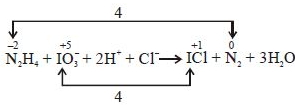
View full question & answer→MCQ 1291 Mark
What is the equivalent weight of $H_3PO_3$ in the following dispropornation reaction
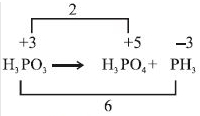
$H_3PO_3 \to H_3PO_4 + PH_3$
- A
$\frac {M}{6}$
- B
$\frac {M}{2}$
- ✓
$\frac {2M}{3}$
- D
$\frac {M}{3}$
AnswerCorrect option: C. $\frac {2M}{3}$
c
$\mathrm{nf}=\frac{6 \times 2}{6+2}=\frac{12}{8}=\frac{3}{2}$
$\mathrm{Ew}=\frac{\mathrm{M}}{3 / 2}=\frac{2 \mathrm{M}}{3}$
View full question & answer→MCQ 1301 Mark
The equivalent weight of $H_3PO_4$ in the reaction
$Ca(OH)_2 + H_3PO_4\to CaHPO_4 + 2H_2O$ is
Answerb
The reaction is
$\mathrm{Ca}(\mathrm{OH})_{2}+\mathrm{H}_{3} \mathrm{PO}_{4} \rightarrow \mathrm{CaHPO}_{4}+2 \mathrm{H}_{2} \mathrm{O}$
In this reaction
$H_{3} P O_{4} \rightarrow H P O_{4}^{-2}+2 H^{+}$
Orthophosphoric acid leaves $2$ hydrogen ions.
Hence, its valency factor is $=2$
Equivalent weight $=\frac{\text { Molecular Weight }}{2}$
Molecular weight $=1 \cdot 3+31+4 \cdot 16=98$
Therefore,
The equivalent weight is $=\frac{98}{2}=49$
View full question & answer→MCQ 1311 Mark
The mass of carbon present in $0.5\, mole$ of $K_4[Fe(CN)_6]$ is .............. $\mathrm{g}$
Answerd
$1\, mole$ of $K_4[Fe(CN)_6]$ contains $6\, mole$ carbon i.e. $72\, g$
View full question & answer→MCQ 1321 Mark
Rearrange the following ( $I$ to $IV$ ) in the order of increasing masses
$(I)\,0.5$ mole of $O_3$
$(II)\,0.5\,gm$ atoms of oxygen
$(III)\,3.011 \times 10^{23}$ molecules of $O_2$
$(IV)\,5.6$ litre of $CO_2$ at $STP$
- ✓
$II < IV < III < I$
- B
$II < I < IV < III$
- C
$IV < II < III < I$
- D
$I < II < III < IV$
AnswerCorrect option: A. $II < IV < III < I$
a
$(I)$ $0.5$ mole $\mathrm{O}_{3}=24\, \mathrm{g} \,\mathrm{O}_{3}$
$(II)$ $0.5$ $g$ atoms of oxygen $=8\, \mathrm{g}$
$(III)$ $\frac{3.011 \times 10^{23}}{6.022 \times 10^{23}} \times 32=16 \,\mathrm{g}\, \mathrm{O}_{2}$
$(IV)$ $\frac{5.6}{22.4} \times 44\, \mathrm{g} \,\mathrm{CO}_{2}=11 \,\mathrm{g}\, \mathrm{CO}_{2}$
View full question & answer→MCQ 1331 Mark
$510$ milli $gm$ of a liquid on vapourisation in Victor Mayer's apparatus displaces $510\, C.C.$ of dry air (at $NTP)$. The molecular weight of liquid is
- A
$0.224$
- B
$2.24$
- C
$224$
- ✓
$22.4$
AnswerCorrect option: D. $22.4$
d
$\frac{{510 \times {{10}^{ - 3}}\,g}}{{{M_W}}} = \frac{{510\,c{m^3}}}{{22400\,c{m^3}}}$
View full question & answer→MCQ 1341 Mark
A $400\, mg$ iron capsule contains $100\, mg$ of ferrous fumarate, ${(CHCOO)_2}Fe$. The percentage of iron pasent in it is approximately ........... $\%$
Answerd
(d) Molecular weight of ${(CHCOO)_2}Fe = 170$
$Fe$ present in $100\,mg$ of ${(CHCOO)_2}Fe$
$ = \frac{{56}}{{170}} \times 100\,mg = 32.9\,mg$
This is present in $400\,mg$ of capsule
$\%$ of $Fe$ in capsule $ = \frac{{32.9}}{{400}} \times 100 = 8.2$.
View full question & answer→MCQ 1351 Mark
The percentage of oxygen in $NaOH$ is
Answera
(a) $40\,gm$ $NaOH$ contains $16\,gm$ of oxygen
$\therefore $ $100\,gm$ of $NaOH$ contains $\frac{{16}}{{40}} \times 100$ = $40\%$ oxygen.
View full question & answer→MCQ 1361 Mark
The percentage of nitrogen in urea is about
Answera
(a) Urea- $N{H_2} - CO - N{H_2}$
$60\,gm$ of urea contains $28\,gm$ of nitrogen
$\therefore $ $100\,gm$ of urea contains $\frac{{28}}{{60}} \times 100 = 46.66$.
View full question & answer→MCQ 1371 Mark
If two compounds have the same empirical formula but different molecular formula, they must have
- A
Different percentage composition
- ✓
Different molecular weights
- C
- D
AnswerCorrect option: B. Different molecular weights
b
If two compounds have the same empirical formula but different molecular formula, they must have different molecular weights.
For example, $CH _2 O$ and $C _6 H _{12} O _6$ have the same empirical formula but different molecular formula, they have different molecular weights.
View full question & answer→MCQ 1381 Mark
A compound ($60 \,g$) on analysis gave $C = 24\, g$, $H = 4 \,g$, $O = 32\, g$. Its empirical formula is
- A
${C_2}{H_2}{O_2}$
- B
${C_2}{H_2}O$
- C
$C{H_2}{O_2}$
- ✓
$C{H_2}O$
AnswerCorrect option: D. $C{H_2}O$
d
(d) $C = 24\,gm$, $H = 4\,gm$, $O = 32\,gm$
So, Molecular formula $ = {C_2}{H_4}{O_2}$
So, Empirical formula $ = C{H_2}O$ (Simplest formula).
View full question & answer→MCQ 1391 Mark
In which of the following pairs of compounds the ratio of $C, H$ and $O$ is same
- A
Acetic acid and methyl alcohol
- ✓
- C
- D
Answerb
(b) Glucose - ${C_6}{H_{12}}{O_6}$
Ratio of $C, H$ and $O$ $ = 1:2:1$
In acetic acid $\mathop {C{H_3} - \mathop {{\text{ }}C}\limits_{||} - O - H}\limits_{O\,\,\,{\kern 1pt} {\kern 1pt} } $
Ratio of $C, H$ and $O$ $1:2:1$.
View full question & answer→MCQ 1401 Mark
The percentage of ${P_2}{O_5}$ in diammonium hydrogen phosphate ${(N{H_4})_2}HP{O_4}$ is
- A
$23.48$
- B
$46.96$
- ✓
$53.78$
- D
$714$
AnswerCorrect option: C. $53.78$
c
(c) $\mathop {2{{(N{H_4})}_2}HP{O_4}}\limits_{2(36 + 1 + 31 + 64) = 264} \equiv \mathop {{P_2}{O_5}}\limits_{62 + 80 = 142} $
$\%$ of ${P_2}{O_5} = \frac{{{\rm{wt}}{\rm{. of }}{P_2}{O_5}}}{{{\rm{wt \,of \,salt}}}} \times 100$ $ = \frac{{142}}{{264}} \times 100 = 53.78\% $.
View full question & answer→MCQ 1411 Mark
What is the $\%$ of ${H_2}O$ in $Fe{(CNS)_3}.3{H_2}O$
Answerc
(c) In $Fe{(CNS)_3}.\;3{H_2}O$
$\%$ of ${H_2}O = \frac{{3 \times 18}}{{284}} \times 100 = 19\% $.
View full question & answer→MCQ 1421 Mark
A hydrocarbon contains $86\%$ carbon, $488\,ml$ of the hydrocarbon weight $1.68\, g$ at $STP$. Then the hydrocarbon is an
Answerb
(b)
|
Element
|
At.wt.
|
Mole
|
Ratio
|
Empirical
formula
|
|
$C =86\%$
|
$12$
|
$7.1$
|
$1$
|
$CH_2$
|
|
$H =14\%$
|
$1$
|
$14$
|
$2$
|
Beleongs to alkene ${C_n}{H_{2n}}$
|
View full question & answer→MCQ 1431 Mark
The simplest formula of a compound containing $50\%$ of element $X$ (atomic mass $10$) and $50\%$ of element $Y$ (atomic mass $20$) is
- A
$XY$
- ✓
${X_2}Y$
- C
$X{Y_3}$
- D
${X_2}{Y_3}$
AnswerCorrect option: B. ${X_2}Y$
b
(b)
|
Element
|
$\%(a)$
|
At.wt.$(b)$
|
$a/b$
|
Ratio
|
|
$X$
|
$50$
|
$10$
|
$5$
|
$2$
|
|
$Y$
|
$50$
|
$20$
|
$2.5$
|
$1$
|
simplest formula = $X_2Y$
View full question & answer→MCQ 1441 Mark
$3.0$ molal $NaOH$ solution has a density of $1.110$ $g/ml$. The molarity of the solution is :-
- ✓
$2.94$
- B
$3.25$
- C
$3.64$
- D
$1.25$
AnswerCorrect option: A. $2.94$
a
$\mathrm{m}=\frac{1000\, \mathrm{M}}{1000 \mathrm{d}-\mathrm{MM}_{\mathrm{A}}}$
$3=\frac{1000 \,\mathrm{M}}{1000 \times 1.1-\mathrm{M} \times 40}$
View full question & answer→MCQ 1451 Mark
A compound contains $69.5\%$ oxygen and $30.5\%$ nitrogen and its molecular weight is $92$ . The formula of that compound is
- A
$N_2O$
- B
$NO_2$
- ✓
$N_2O_4$
- D
$N_2O_5$
AnswerCorrect option: C. $N_2O_4$
c
moles of oxygen $=69.5 / 16$
$=4.34$
moles of nitrogen $=30.5 / 14$
$=2.18$
ratio of moles of nitrogen and oxygen $=2.18: 4.34$
$=1: 2$
empirical formula $ = NO_2$
molecular formula $=(\mathrm{NO}_ 2) \mathrm{n}$
where $\mathrm{n}=$ molecular mass/ empirical mass
$=92 / 46$
$=2$
therefore the formula of the compound is $\mathrm{N}_ 2 \mathrm{O} _4 .$
View full question & answer→MCQ 1461 Mark
Determine the empirical formula of Kelvar, used in making bullet proof vests, is $70.6\%\,C, 4.2\%\,H, 11.8\%\, N$ and $13.4\%\, O$
- A
$C_7H_5NO_2$
- B
$C_7H_5N_2O$
- C
$C_7H_9NO$
- ✓
$C_7H_5NO$
AnswerCorrect option: D. $C_7H_5NO$
d
Let the mass of compound be $100 \mathrm{g}$
$C=70.6 g=\frac{70.6}{12}$ moles $=5.88$ moles
$H=4.2 g=\frac{4.2}{1}$ moles $=4.2$ moles
$N=11.8 g=\frac{11.8}{14}$ moles $=0.84$ moles
$O=13.4 g=\frac{13.4}{16}$ moles $=0.84$ moles
$C: H: N: O=5.88: 4.2: 0.84: 0.84$
$C: H: N: O=7: 5: 1: 1$
Therefore, empirical formula of Kelvar is $C_{7} H_{5} N O$
View full question & answer→MCQ 1471 Mark
A sample of pure compound contains $1.15\,g$ of sodium, $3.01 \times 10^{22}$ atoms of carbon and $0.1$ mol of oxygen atom. Its empirical formula is
- A
$Na_2CO_3$
- ✓
$NaCO_2$
- C
$Na_2CO$
- D
$NaC_2O$
AnswerCorrect option: B. $NaCO_2$
b
$n_{Na}$ : $n_C$ : $n_{O}$
$ = \frac{{1.15}}{{23}}$ : $\frac{{3.01 \times {{10}^{22}}}}{{6.02 \times {{10}^{23}}}}$ : $0.1$
$=$ $0.05$ : $0.05$ : $0.1$
$=$ $1$ : $1$ : $2$
$E.F.=NaCO_2$
View full question & answer→MCQ 1481 Mark
A gas is found to contain $2.8\,g$ nitrogen and $3.2\,g$ oxygen, simplest formula of the compound is
- A
$N_2O$
- ✓
$NO$
- C
$N_2O_3$
- D
$NO_2$
Answerb
Element Mass Moles Simple ratio
$N$ $2.8$ $\frac {2.8}{14}=0.2=1$
$O$ $3.2\,g$ $\frac {3.2}{16}=0.2=1$
Simplest formula of the compound $=NO$
View full question & answer→MCQ 1491 Mark
In a compound the ratio of masses of $H,C,O$ and $N$ is $1:3:4:7$. The empirical formula is
- A
$HC_3O_4N_7$
- ✓
$H_4CON_2$
- C
$HC_4O_2N_2$
- D
AnswerCorrect option: B. $H_4CON_2$
b
$\mathrm{H}=1 / 1=1=4 \quad \therefore \mathrm{H}_{4} \mathrm{CON}_{2}$
$C=3 / 12=\frac{1}{4}=1$
$\mathrm{O}=4 / 16=\frac{1}{4}=1$
$\mathrm{N}=7 / 14=\frac{1}{2}=2$
View full question & answer→MCQ 1501 Mark
A compound contains $69.5\%$ oxygen and $30.5\%$ nitrogen and its molecular weight is $92.$ The molecular formula of the compound is
- A
$N_2O$
- B
$NO_2$
- ✓
$N_2O_4$
- D
$N_2O_5$
AnswerCorrect option: C. $N_2O_4$
c
| Element |
$\%$ |
At.wt |
Atomic ratio |
Simplest ratio |
| $N$ |
$30.5$ |
$14$ |
$\frac {30.5}{14}=2.18$ |
$\frac {2.18}{2.18}=1$ |
| $O$ |
$69.5$ |
$16$ |
$\frac {69.5}{16}=4.35$ |
$\frac {4.34}{2.18}=2$ |
Empirical formula $=$ $NO_2$ and molecular formula $=N_2O_4$
View full question & answer→MCQ 1511 Mark
Determine the empirical formula of Kelvar, used in making bullet proof vests, is $70.6\%\,C,\,\,4.2\%\,H,\,\,11.8\%\,N$ and $13.4\%\,O$
- A
$C_7H_5NO_2$
- B
$C_7H_5N_2O$
- C
$C_7H_9NO$
- ✓
$C_7H_5NO$
AnswerCorrect option: D. $C_7H_5NO$
d
Let the mass of compound be $100 \mathrm{g}$
$C=70.6 g=\frac{70.6}{12}$ moles $=5.88$ moles
$H=4.2 g=\frac{4.2}{1}$ moles $=4.2$ moles
$N=11.8 g=\frac{11.8}{14}$ moles $=0.84$ moles
$O=13.4 g=\frac{13.4}{16}$ moles $=0.84$ moles
$C: H: N: O=5.88: 4.2: 0.84: 0.84$
$C: H: N: O=7: 5: 1: 1$
Therefore, empirical formula of Kelvar is $C_{7} H_{5} N O$
View full question & answer→MCQ 1521 Mark
The empirical formula of a compound is $CH$. Its molecular weight is $78$. The molecular formula of the compound will be
- A
$C_2H_2$
- B
$C_3H_3$
- C
$C_4H_4$
- ✓
$C_6H_6$
AnswerCorrect option: D. $C_6H_6$
d
Molecular formula $=$ (empirical formula)$_n$
$\therefore n = \frac{{78}}{{13}} = 6$
View full question & answer→MCQ 1531 Mark
In a compound $C, H, N$ atoms are present in $9 : 1 : 3.5$ by weight. Molecular weight of compound is $108$ . Its molecular formula is
- A
$C_2H_6N_2$
- B
$C_3H_4N$
- ✓
$C_6H_8N_2$
- D
$C_9H_{12}N_3$
AnswerCorrect option: C. $C_6H_8N_2$
c
$9+1+3.5=13.5$
$13.5 \,\mathrm{g} \text { contains } \frac{9}{12} \,\mathrm{mole}$
$108 \,\mathrm{g}$ contains $\frac{9 \times 108}{12 \times 13.5}=6$ mole carbon
i.e., $\mathrm{C}_{6} \mathrm{H}_{8} \mathrm{N}_{2}$
View full question & answer→MCQ 1541 Mark
Mass percentage of $C, H$ and $O$ in a compound are $60\%$, $13.33\%$ and $26.67\%$ respectively. Molecular weight of the compound is $60$. The molecular formula of the compound is
- A
$CH_3OH$
- B
$C_2H_6O_2$
- C
$C_2H_6O$
- ✓
$C_3H_8O$
AnswerCorrect option: D. $C_3H_8O$
d
$\begin{array}{*{20}{l}}
{{\text{ Empirical formula }} \Rightarrow }&{{C_{\frac{{60}}{{12}}}}{H_{\frac{{13.33}}{1}}}{O_{\frac{{26.67}}{{16}}}}} \\
{ \Rightarrow {{\text{C}}_5}{{\text{H}}_{13.33}}{{\text{O}}_{1.67}}}&{{\text{EF}} = {{\text{C}}_3}{{\text{H}}_8}{\text{O}}} \\
{{\text{n}} = \frac{{60}}{{60}} = 1}&{{\text{MF}} = {{\text{C}}_3}{{\text{H}}_8}{\text{O}}}
\end{array}$
View full question & answer→MCQ 1551 Mark
For preparing $0.1\, N$ solution of a compound from its impure sample of which the percentage purity is known, the weight of the substance required will be
- ✓
More than the theoretical weight
- B
Less than the theoretical weight
- C
Same as the theoretical weight
- D
AnswerCorrect option: A. More than the theoretical weight
View full question & answer→MCQ 1561 Mark
$100\;mL$ of $P{H_3}$ on decomposition produced phosphorus and hydrogen. The change in volume is ............... $\mathrm{mL}$ increase
Answera
(a) $\mathop {\mathop {2P{H_3}}\limits_{2\,ml} }\limits_{100\,ml} \to \mathop {2P}\limits_{{\rm{(solid)}}} + \mathop {\mathop {3{H_2}}\limits_{3\,ml} }\limits_{150\,ml} $
Increase in volume $ = 150\,ml - 100\,ml = 50\,ml$ increase.
View full question & answer→MCQ 1571 Mark
$2.76 \,g$ of silver carbonate on being strongly heated yield a residue weighing ........... $\mathrm{g}$
- ✓
$2.16$
- B
$2.48$
- C
$2.64$
- D
$2.32$
AnswerCorrect option: A. $2.16$
a
(a)
$2A{g_2}C{O_3}\xrightarrow{\Delta }4Ag + 2C{O_2} + {O_2}$
$2 \times 276\,gm$ of $A{g_2}C{O_3}$ gives $4 \times 108\,gm$
$\therefore $ $1\,gm$ of $A{g_2}C{O_3}$ gives $ = \frac{{4 \times 108}}{{2 \times 276}}$
$\therefore $ $2.76\,gm$ of $2A{g_2}C{O_3}$ gives $\frac{{4 \times 108 \times 2.76}}{{2 \times 276}} = 2.16\,gm$
View full question & answer→MCQ 1581 Mark
If $1\frac{1}{2}$ moles of oxygen combine with $ Al$ to form $A{l_2}{O_3}$ the weight of $Al$ used in the reaction is ............. $\mathrm{g}$ $(Al=27)$
Answerb
(b) $2Al + \frac{3}{2}{O_2} \to A{l_2}{O_3}$
According to equation $\frac{3}{2}$ mole of ${O_2}$ combines with $2$ mole $Al$.
$2$ mole $Al$ $= 54\,gm$
View full question & answer→MCQ 1591 Mark
${H_2}$ evolved at $STP$ on complete reaction of $27\, g$ of Aluminium with excess of aqueous $NaOH$ would be ............ $\mathrm{L}$
- A
$22.4$
- B
$44.8$
- C
$67.2$
- ✓
$33.6$
AnswerCorrect option: D. $33.6$
d
(d) ${H_2}O + \mathop {Al}\limits_{27\,gm} + NaOH \to NaAl{O_2} + \mathop {\frac{3}{2}{H_2}\;\;\;\;}\limits_{\frac{3}{2} \times 22.4 = 33.6\,L} $
View full question & answer→MCQ 1601 Mark
$Ca{(OH)_2} + {H_3}P{O_4} \to CaHP{O_4} + 2{H_2}O$ the equivalent weight of ${H_3}P{O_4}$ in the above reaction is
Answerd
(d) The equivalent weight of ${H_3}P{O_4} = \frac{{{\rm{molecular \,weight}}}}{2}$
mole wt of ${H_3}P{O_4}= 3 + 31 + 64 = 98$
$\frac{{98}}{2} = 49$
View full question & answer→MCQ 1611 Mark
The mass of $BaC{O_3}$ produced when excess $C{O_2}$ is bubbled through a solution of $0.205$ mol $Ba{(OH)_2}$ is ............ $\mathrm{gm}$
- A
$81$
- ✓
$40.5$
- C
$20.25$
- D
$162 $
AnswerCorrect option: B. $40.5$
b
(b) $Ba{(OH)_2} + C{O_2} \to BaC{O_3} + {H_2}O$
Atomic wt. of $BaC{O_3}$ =$137 + 12 + 16 \times 3= 197$
No. of mole $ = \frac{{{\rm{wt}}{\rm{.\, of \,substance}}}}{{{\rm{mol wt}}{\rm{.}}}}$
$1$ mole of $Ba{(OH)_2}$ gives $1$ mole of $BaC{O_3}$
$\therefore $ $205$ mole of $Ba{(OH)_2}$ will give $0 .205$ mole of $BaC{O_3}$
$\therefore $ wt. of $0.205$ mole of $BaC{O_3}$ will be $.205 \times 197 = 40.385\,gm \approx \,40.5\,gm$
View full question & answer→MCQ 1621 Mark
The ratio of amounts of ${H_2}S$ needed to precipitate all the metal ions from $100\, ml$ of $1\, M$ $AgN{O_3}$ and $100\, ml$ of $1 \,M$ $CuS{O_4}$ will be
Answerb
(b) $AgN{O_3} \equiv 2A{g^ + } + \mathop {{S^{2 - }}}\limits_{({H_2}S)} \to A{g_2}S$
$2$ mole $ \to $ $1$ mole [$100 \times 1 =100$ millimole]
$\therefore $ $100$ miliimole $ \to $ $50$ millimole ${H_2}S$ required
$CuS{O_4} \equiv C{u^{ + 2}} + \mathop {{S^{2 - }}}\limits_{({H_2}S)} \to CuS$
$1$ mole $ \to $ $1$ mole [$100 \times 1 =100$ millimole]
$\therefore $ $100$ millimole $ \to $ $100$ millimole ${H_2}S$ required
Ratio $\frac{{50}}{{100}} = \frac{1}{2}$.
View full question & answer→MCQ 1631 Mark
$12\,g$ of $Mg$ (at. mass $24$) will react completely with acid to give
AnswerCorrect option: B. $1/2$ mole of ${H_2}$
b
(b) $M{g^{ + 2}} \equiv {H_2}$
$n = \frac{{12\,gm}}{{24\,gm}} = \frac{1}{2}$ mole of ${H_2}$
View full question & answer→MCQ 1641 Mark
$1.5$ mol of ${O_2}$ combine with $Mg$ to form oxide $MgO$. The mass of $Mg$ (at. mass $24$) that has combined is .............$\mathrm{g}$
Answera
(a) $\mathop {Mg}\limits_{1{\rm{mole}}} + \mathop {\frac{1}{2}{O_2}}\limits_{0.5{\rm{mole}}} \to MgO$
$0.5$ mole of oxygen react with $1$ mole of $Mg$
$1.5$ mole of oxygen react with $\frac{{1.5}}{{0.5}} = 3$
mole $24 \times 3 = 72\,gm$.
View full question & answer→MCQ 1651 Mark
$100 \,g$ $CaCO_3$ reacts with $1$ litre $1 \,N$ $HCl$. On completion of reaction how much weight of $C{O_2}$ will be obtain ........... $\mathrm{g}$
Answerc
(c) $\mathop {CaC{O_3}}\limits_{100\,g} + \mathop {2HCl}\limits_{2\,N} \to CaC{l_2} + \mathop {C{O_2}}\limits_{44\;g} + {H_2}O$
$100\, g$ $CaC{O_3}$ with $2 \,N\, HCl$ gives $44\, g$ $C{O_2}$
$100\, g$ $CaC{O_3}$ with $1\,N \,HCl$ gives $22\, g$ $C{O_2}$
View full question & answer→MCQ 1661 Mark
$56 \,g$ of nitrogen and $8 \,g$ hydrogen gas are heated in a closed vessel. At equilibrium $34\, g$ of ammonia are present. The equilibrium number of moles of nitrogen, hydrogen and ammonia are respectively
- A
$1,2,2$
- B
$2,2,1$
- ✓
$1,1,2$
- D
$2,1,2$
AnswerCorrect option: C. $1,1,2$
c
(c) ${N_2} + 3{H_2}$ $ \rightleftharpoons $ $2N{H_3}$….. $(i)$
at $t = 0$ $56\,gm$ $8\,gm$ $0\,gm$
$=$ $2\,mole$ $4\,mole$ $0\,mole$
at equilibrium $2 - 1$ $4 - 3$ $34\,gm$
$=$ $1\,mole$ $=$ $1\,mole$ $=$ $2\,mole$
According to eq. $(i)$ $2$ $mole$ of ammonia are present $\&$ to produce $2$ $mole$ of $N{H_3}$, we need $1$ mole of ${N_2}$ and $3$ $mole$ of ${H_2}$ hence $2 - 1 = 1$ $mole$ of ${N_2}$ and $4 - 3 = 1$ mole of ${H_2}$ are present at equilibrium in vessel.
View full question & answer→MCQ 1671 Mark
How many litres of $C{O_2}$ at $STP $ will be formed when $100\,ml$ of $0.1\,M\,{H_2}S{O_4}$ reacts with excess of $N{a_2}S{O_3}$
- A
$22.4$
- B
$2.24$
- ✓
$0.22$
- D
$5.6$
AnswerCorrect option: C. $0.22$
c
(c)$\mathop {N{a_2}C{O_3}}\limits_{} \,\, + \mathop {{H_2}S{O_4}}\limits_{98\,gm\,(2mole)} \to \mathop {N{a_2}S{O_4}}\limits_{1\,mole} + \mathop {C{O_2}HO}\limits_{1\,mole} $
$0.02 = \frac{{0.02 \times 22.4}}{2} = 0.224$.
View full question & answer→MCQ 1681 Mark
In acidic medium potassium dichromate acts as an oxidant according to the equation, $C{r_2}O_7^{2 - } + 14{H^ + } + 6{e^ - } \to 2C{r^{3 + }} + 7{H_2}O$. What is the equivalent weight of ${K_2}C{r_2}{O_7}$ ? (mol. Wt. $ = M$)
Answerd
(d)Since it accept $6{e^ - }$ its
Equivalent weight $=\frac{M}{6}$.
View full question & answer→MCQ 1691 Mark
In alkaline condition $KMn{O_4},$ reacts as follows :
$2KMn{O_4} + 2KOH \to 2{K_2}Mn{O_4} + {H_2}O + O$
Therefore its equivalent weight will be
- A
$31.5$
- B
$52.7$
- C
$72.0$
- ✓
$158.0$
AnswerCorrect option: D. $158.0$
d
Equivalent mass of $KMnO _4=\frac{\text { Molecular weight }}{\text { No. of electrons gained by } MnO _4}$
$MnO _4^{-}+ e ^{-} \rightarrow MnO _4^{2-}$
The number of electrons gained per molecule of $KMnO _4$ is $1$.
So, the equivalent mass is $158$.
View full question & answer→MCQ 1701 Mark
Equivalent weight of $KMn{O_4}$ acting as an oxidant in acidic medium is equal to
- A
Molecular weight of $KMn{O_4}$
- B
$\frac{1}{2}×$ Molecular weight of $KMn{O_4}$
- C
$\frac{1}{3}×$ Molecular weight of $KMn{O_4}$
- ✓
$\frac{1}{5}×$ Molecular weight of $KMn{O_4}$
AnswerCorrect option: D. $\frac{1}{5}×$ Molecular weight of $KMn{O_4}$
d
(d)$\frac{1}{5} \times {\rm{ molecular }}\,\,{\rm{weigth of }}KMn{O_4}$
as transfer of $5{e^ - }$ takes place when $KMn{O_4}$ acts as oxidant in acidic medium.
$2KMn{O_4} + 3{H_2}S{O_4} \to {K_2}S{O_4} + 2MnS{O_4} + 3{H_2}O$$ + 5O$
View full question & answer→MCQ 1711 Mark
The equivalent weight of potassium permanganate for acid solution is
- A
$158$
- ✓
$31.6$
- C
$52.16$
- D
$79$
AnswerCorrect option: B. $31.6$
b
(b)Equivalent weight of $KMn{O_4}$ in acidic medium is $M/5$
Equivalent weight $= \frac{{158}}{5}$ $= 31.6$
View full question & answer→MCQ 1721 Mark
The equivalent weight of ${K_2}C{r_2}{O_7}$ in acidic medium
Answerc
(c) ${K_2}C{r_2}{O_7} + 3{H_2}S{O_4}\, \to {K_2}S{O_4} + C{r_2}{(S{O_4})_3} + 3\,(O) + 3{H_2}$
No. of electrons lossed $= 12 -6 = 6$
Equivalent weight $=\frac{M}{6} = \frac{{294}}{6} = 49$ .
View full question & answer→MCQ 1731 Mark
Which of the following statements is correct about equivalent weight of $KMn{O_4}$
- ✓
It is one third of its molecular weight in alkaline medium
- B
It is one fifth of its molecular weight in alkaline medium
- C
It is equal to its molecular weight in acidic medium
- D
It is one third of its molecular weight in acidic medium
AnswerCorrect option: A. It is one third of its molecular weight in alkaline medium
a
(a)It is one third of its molecular weight in alkaline medium because it gives $3 $ nascent oxygen in alkaline medium.
$2KMn{O_4} + {H_2}O\,\xrightarrow{{ + 3{e^ - }}}\,2KOH + 2Mn{O_2} + 3[O]$
Equivalent weight = $\frac{M}{3}$
View full question & answer→MCQ 1741 Mark
If $M$ is the molecular weight of $KMn{O_4}$, its equivalent weight will be when it is converted into ${K_2}Mn{O_4}$
Answera
(a)${\rm{Equivalent }}\,{\rm{wt}}{\rm{. }} = {\rm{ }}\frac{{{\rm{molecular}}\,\,{\rm{wt}}{\rm{.}}}}{{{\rm{total no}}{\rm{. of }}{e^--}\,{\rm{gained or lost}}}}$$ = \frac{M}{1} = M$
View full question & answer→MCQ 1751 Mark
Percentage loss in mass on heating mixture of $Na_2CO_3$ & $CaCO_3$ containing equal mass of the two components will be ............. $\%$
Answerb
Assume total mass $\ =\ 200\ gm$
$\therefore $ Mass of $CaCO_3\ =\ 100\ gm$
Then loss in mass $\ =\ 44\ gm$
$\therefore $ Percentage loss $\ =\ 22\%$
View full question & answer→MCQ 1761 Mark
Phosphine $[PH_3(g)]$ decomposes to produce vapours of phosphorus $(P_4)$ and $H_2$ gas. What will be the change in volume when $100\ mL$ of phosphine is decomposed ? .......... $mL$
- A
$+50$
- B
$500$
- ✓
$+75$
- D
$-500$
Answerc
$\begin{array}{*{20}{c}}
{P{H_3}\, \to }&{\frac{1}{4}{P_4}\,\,\, + }&{\frac{3}{2}{H_2}} \\
{100\,\,ml}&{\frac{{100}}{4}\,ml}&{\frac{3}{2}\, \times \,100\,ml} \\
&{25\,\,ml}&{150\,ml}
\end{array}$
change in vol. $=+75\, \mathrm{mL}$
View full question & answer→MCQ 1771 Mark
$0.01$ mole of iodoform $(CHI_3)$ reacts with $Ag$ to produce a gas whose volume at $NTP$ is ............. $\mathrm{mL}$
$2CHI_3 + 6Ag \to 6AgI(s) + C_2H_2(g)$
Answerb
mol of $\mathrm{C}_{2} \mathrm{H}_{2}=\frac{1}{2} \times \mathrm{mol}$ of $\mathrm{CHI}_{3}$
$=\frac{1}{2} \times 0.01=0.005$
$ \text { vol. at } \,\mathrm{N} \cdot \mathrm{T} \cdot \mathrm{P} =0.005 \times 22400 $
$=112\, \mathrm{ml}$
View full question & answer→MCQ 1781 Mark
Phosphoric acid is prepared comercially from phosphoate ore as following :............... $\mathrm{kg}$
$Ca_3(PO_4)_2 + SiO_2 + C + O_2 + H_2O \to CaSiO_3 + CO_2 + H_3PO_4$
If $1.0\ kg$ each of calcium phosphate and silica are used with excess of $C$ , $O_2$ and $H_2O$ , what is maximum quantity of phosphoric acid that can be produced. $(Ca = 40, P = 31, Si = 28)$
- A
$1.1$
- ✓
$0.63$
- C
$0.31$
- D
$1.5$
AnswerCorrect option: B. $0.63$
b
$Ca_3(PO_4)_2 + 3SiO_2 + 5C + 5O_2 + 3H_2O \to 3CaSiO_3 + 5CO_2 + 2H_3PO_4$
View full question & answer→MCQ 1791 Mark
If $0.5 \,mol$ of $CaBr_2$ is mixed with $0.2\, mol$ of $K_3PO_4$ then the maximum number of moles of $Ca_3(PO_4)_2$ obtained will be :-
Answerd
$\mathop {3{\text{CaB}}{{\text{r}}_2}}\limits_{0.5} + \mathop {2{{\text{K}}_3}{\text{P}}{{\text{O}}_4}}\limits_{0.2} \to \mathop {{\text{C}}{{\text{a}}_3}{{\left( {{\text{P}}{{\text{O}}_4}} \right)}_2}}\limits_0 + 6{\text{KBr}}$
Acc. to $L.R.$ $0.1$
View full question & answer→MCQ 1801 Mark
When $22.4$ $litres$ of $H_2(g)$ is mixed with $11.2$ $litres$ of $Cl_2(g)$, each at $S.T.P.$, the moles of $HCl(g)$ formed is equal to
- ✓
$1$ $mol$ of $HCl\, (g)$
- B
$2$ $mol$ of $HCl\, (g)$
- C
$0.5$ $mol$ of $HCl\, (g)$
- D
$1.5$ $mol$ of $HCl\, (g)$
AnswerCorrect option: A. $1$ $mol$ of $HCl\, (g)$
a
$\mathrm{n}_{\mathrm{H}_{2}}=\frac{\mathrm{V}(\mathrm{L})}{22.4 \mathrm{L}}=\frac{22.4}{22.4}=1$
$\mathrm{n}_{\mathrm{Cl}_{2}}=\frac{11.2}{22.4}=0.5\, \mathrm{mole}$
${H_{2(g)}} + C{l_{2(g)}} \to 2HC{l_{(g)}}$
initially $1$ mol $0.5$ mole $0$
after reaction $(1-0.5)$ $0.5 \times 2$
$=0.5$ mole $0$ $=1$ mole
View full question & answer→MCQ 1811 Mark
What volume of dioxygen is required for complete combustion of $2\, volumes$ of acetylene gas at $NTP$ ? ................. $\mathrm{Volumes}$
Answerb
$\mathrm{C}_{2} \mathrm{H}_{2}+\frac{5}{2} \mathrm{O}_{2} \rightarrow 2 \mathrm{CO}_{2}+\mathrm{H}_{2} \mathrm{O}$
$1$ $vol.$ $\mathrm{C}_{2} \mathrm{H}_{2}=\frac{5}{2}\, \mathrm{vol} .$ of $\mathrm{O}_{2}$
$2 \,\mathrm{vol} . \mathrm{C}_{2} \mathrm{H}_{2}=5 \,\mathrm{vol}$ of $\mathrm{O}_{2}$
View full question & answer→MCQ 1821 Mark
Which of the following statements is correct about the given reaction
$4F{e_{(s)}} + 3{O_{2(g)}} \to 2F{e_2}{O_{3(s)}}$
- ✓
Total mass of iron and oxygen used in reaction $=$ total mass of ferric oxide in product; therefore, it follows law of conservation of mass.
- B
Total mass of reactants used in the reaction $=$ total mass of product; therefore, law of multiple proportions is followed
- C
Amount of $Fe_2O_3$ can be increased by taking any one of the reactants (iron or oxygen) in excess.
- D
Amount of $Fe_2O_3$ produced will decrease if the amount of any one of the reactants (iron or oxygen) is taken in excess
AnswerCorrect option: A. Total mass of iron and oxygen used in reaction $=$ total mass of ferric oxide in product; therefore, it follows law of conservation of mass.
View full question & answer→MCQ 1831 Mark
Volume of air required to completely burn $10$ litres of $C_2H_4$ is ................ $\mathrm{L}$ (assume all volumes are measure at same temperature and pressure)
Answerb
$\mathrm{C}_{2} \mathrm{H}_{4}+3 \mathrm{O}_{2} \rightarrow 2 \mathrm{CO}_{2}+2 \mathrm{H}_{2} \mathrm{O}$
$1\, \mathrm{L} \quad 3 \,\mathrm{L}$
$10\, \mathrm{L} \quad 30 \,\mathrm{L}$
$\mathrm{V}_{\mathrm{air}}=\frac{30 \times 100}{20}=150\, \mathrm{L}$
View full question & answer→MCQ 1841 Mark
The mass of $Mg_3N_2$ produced if $48\, gm$ of $Mg$ metal is reacted with $34\, gm\, NH_3$ gas is
$Mg + NH_3 \to Mg_3N_2 + H_2$
- ✓
$\frac{200}{3} \,gm$
- B
$\frac{100}{3} \,gm$
- C
$\frac{400}{3} \,gm$
- D
$\frac{150}{3} \,gm$
AnswerCorrect option: A. $\frac{200}{3} \,gm$
a
$\mathop {\mathop {3{\text{Mg}}}\limits_{3\,{\text{mol}}} }\limits_{(72\,g)} + \mathop {\mathop {2{\text{N}}{{\text{H}}_3}}\limits_{2\,mol} }\limits_{(34\,g)} \to \mathop {\mathop {{\text{M}}{{\text{g}}_3}{{\text{N}}_2}}\limits_{1\,mol} }\limits_{(100\,g)} + 3{{\text{H}}_2}$
$(L. R.)$
$72 \,g\, Mg$ will produce $\mathrm{Mg}_{3} \mathrm{N}_{2}=100 \,\mathrm{g}$
$48\, \mathrm{g} \,\mathrm{Mg} \text { will produce } \mathrm{Mg}_{3} \mathrm{N}_{2} =\frac{100}{72} \times 48 $
$=\frac{200}{3} \,\mathrm{g} $
View full question & answer→MCQ 1851 Mark
In the reaction $H_2 + O_2 \to H_2O$. If $6\,g$ of $H_2$ combines with $64\,g$ of $O_2$. Find mass of Excess reagent Left ? ............. $\mathrm{g}$
Answerc
$\mathop {\mathop {2{{\text{H}}_2}}\limits_{6\,g} }\limits_{(3\,mol)} + \mathop {\mathop {{{\text{O}}_2}}\limits_{64\,g} }\limits_{(2\,mol)} \to 2{{\text{H}}_2}{\text{O}}$
$[\mathrm{L} \cdot \mathrm{R.}]$
$2 \,\mathrm{mol}\, \mathrm{H}_{2}$ reacts with $\mathrm{O}_{2}=1\, \mathrm{mol}$
$\therefore $ $3\, \mathrm{mol}\, \mathrm{H}_{2}$ will react with $\mathrm{O}_{2}=\frac{1}{2} \times 3=1.5 \,\mathrm{mol}$
remaining amount of $\mathrm{O}_{2}=0.5\, \mathrm{mol}=16\, \mathrm{g}$
View full question & answer→MCQ 1861 Mark
$3O_2 + 2N_2 \to 2N_2O_3$
$9\, mol$ $O_2$ and $14\, mol$ $N_2$ here allowed to react. When $3\, mol$ $O_2$ remains unreacted, till then how many moles of $N_2O_3$ would have been produced?
Answerc
reaction between oxygen and nitrogen is given by,
$2 N_{2}+3 O_{2} \rightarrow 2 N_{2} O_{3}$
here we see that $2$ moles of $\mathrm{N} _2$ combine with $3$ moles of oxygen and give $2$ moles of $\mathrm{N} _2 \mathrm{O}_ 3$
$a/c$ to question,
$9$ mol of $O_2$ and $14$ mol of $n 2$ here allowed to react.
when $3 \mathrm{mol}$ of $O_2$ remain unreacted till then we have to find moles of $N_2O_3$ is formed.
at initial time, mole of $\mathrm{N}_ 2 \mathrm{O}_ 3=0$
mole of $\mathrm{O} _2=9$
mole of $\mathrm{N}_ 2=14$
after some time,
mole of $\mathrm{O} _2=9-3 x$
mole of $\mathrm{N}_ 2=14-2 \mathrm{x}$
mole of $\mathrm{N} _2 \mathrm{O}_ 3=2 \mathrm{x}$
$a/c$ to question, $9-3 x=3$
or, $x=2$
then, number of mole of $\mathrm{N} _2 \mathrm{O}_ 3$ is formed $=2 \times 2=4 \mathrm{mol} .$
View full question & answer→MCQ 1871 Mark
Which statement is false for the balanced equation given below ?
$CS_2 + 3O_2 \,\,\to \,\, 2SO_2 + CO_2$
- A
One mole of $CS_2$ will produce one mole of $CO_2$
- B
The reaction of $16\,g$ of oxygen produces $7.33\,g$ of $CO_2$
- C
The reaction of one mole of $O_2$ will produce $2/3\,mole$ of $SO_2$
- ✓
Six molecules of oxygen requires three molecules of $CS_2$
AnswerCorrect option: D. Six molecules of oxygen requires three molecules of $CS_2$
View full question & answer→MCQ 1881 Mark
The mass of $N_2F_4$ produced by the reaction of $2.0\,\,mole$ of $NH_3$ and $8.0\,\, mole$ of $F_2$ is $0.5\,\,mole.$ What is the per cent yield ?
$2NH_3 + 5F_2\,\,\to \,\, N_2F_4 + 6HF$
- A
$79.0$
- B
$71.2$
- C
$84.6$
- ✓
$50$
View full question & answer→MCQ 1891 Mark
In the complete combustion of $C_4H_{10}$ the number of oxygen moles required is
- A
$\frac{{17}}{2}{O_2}$
- B
$6O_2$
- ✓
$\frac{{13}}{2}{O_2}$
- D
$\frac{{5}}{2}{O_2}$
AnswerCorrect option: C. $\frac{{13}}{2}{O_2}$
c
${C_n}{H_{2n + 2}} + \left( {\frac{{3n + 1}}{2}} \right){O_2} \to nC{O_2} + \left( {n + 1} \right){H_2}O$
View full question & answer→MCQ 1901 Mark
If isobutane and $n-$ butane are present in a gas, then how much oxygen should be required for complete combusition of $10\,kg$ of this gas ........... $\mathrm{kg}$
AnswerCorrect option: A. $35.862$
a
Isobutane and $n$ -Butane have same chemical formula $\left(C_{4} H_{10}\right)$ and give same combustion reaction.
$2 C_{4} H_{10}+13 O_{2} \rightarrow 8 C O_{2}+10 H_{2} O$
This means $2$ moles of this mixture requires $13$ moles of oxygen.
Molecular mass of butane $=58 g / m o l$
Molecular mass of oxygen $=32 g / m o l$
Moles of butane in $10 k g=\frac{10 \times 1000}{58}=\frac{10000\times 13}{58\times 2}$ moles of $O_{2}=\frac{130000\times 32}{116} g$
$O_{2}=\frac{130 \times 32}{116}\, k g\, O_{2}$
Therefore, $35.862 \,\mathrm{kg}$ oxygen is used.
View full question & answer→MCQ 1911 Mark
What will be the volume of $O_2$ gas at $STP$ for complete combustion of $7.8\, g$ acetylene? ............ $\mathrm{L}$
- A
$11.2$
- B
$5.6$
- C
$22.4$
- ✓
$16.8$
AnswerCorrect option: D. $16.8$
d
$\mathrm{C}_{2} \mathrm{H}_{2}+\frac{5}{2} \mathrm{O}_{2} \rightarrow 2 \mathrm{CO}_{2}+\mathrm{H}_{2} \mathrm{O}$
$\mathrm{nC}_{2} \mathrm{H}_{2}=\frac{7.8}{26}=0.3, \mathrm{nO}_{2}\, \mathrm{req}=0.3 \times \frac{5}{2}=0.75$
$\mathrm{V}_{\mathrm{O}_{2}}=0.75 \times 22.4=16.8\,\mathrm{L}$
View full question & answer→MCQ 1921 Mark
For the reaction $2Al + 3MnO\xrightarrow{\Delta }A{l_2}{O_3} + Mn;$ If $108\,g$ of $Al$ and $213\,g$ of $MnO$ are heated then which of the following is incorrect?
- A
$Al$ is present in excess
- B
$MnO$ is present as limiting reagent
- C
$54\,g$ of $Al$ is required
- ✓
$159\,g$ of $MnO$ is required
AnswerCorrect option: D. $159\,g$ of $MnO$ is required
d
$\mathop {\mathop {2Al}\limits_{108\,g} }\limits_{4\,mol} + \mathop {\mathop {3MnO}\limits_{213\,g} }\limits_{3\,mol} \xrightarrow{\Delta }A{l_2}{O_3} + 3Mn$
$(L.R.)$
View full question & answer→MCQ 1931 Mark
Combustion of $50\,mL$ methane is carried out with $150\,mL$ of air containing $21\%$ of oxygen. What will be the total volume of gaseous mixture after reaction ? ............ $\mathrm{mL}$
$C{H_{4(g)}} + 2{O_{2(g)}} \to C{O_{2(g)}} + 2{H_2}{O_{(g)}}$
- ✓
$200$
- B
$110$
- C
$113$
- D
$144.5$
Answera
$\mathop {\mathop {C{H_4}}\limits_{50\,mL} }\limits_{50 - 15.75} + \mathop {\mathop {2{O_2}}\limits_{31.5\,mL} }\limits_ - \to \mathop {\mathop {C{O_2}}\limits_ - }\limits_{15.75} + \mathop {\mathop {2{H_2}O}\limits_ - }\limits_{2 \times 15.75} $
and left air $=150 \times \frac {79}{100}$
View full question & answer→MCQ 1941 Mark
What will be the weight of lime $(CaO)$ obtained by heating $300\, kg$ of $90\%$ pure limestone $(CaCO_3)$. ............. $\mathrm{kg}$
- A
$1512$
- B
$15.2$
- C
$1.512$
- ✓
$151.2$
AnswerCorrect option: D. $151.2$
d
$ \text { pure mass of } \mathrm{CaCO}_{3} =300 \times 1000 \times \frac{90}{100} $
$=270,000\, \mathrm{g} $
moles of $\mathrm{CaCO}_{3}=\frac{270,000}{100}=2700\, \mathrm{mol}$
$\mathrm{CaCO}_{3} \longrightarrow \mathrm{CaO}+\mathrm{CO}_{2}$
$1$ mole $1$ mole $1$ mole
$2700$ mole $=2700$ mole $\mathrm{CaO}$
$\text { weight of } \mathrm{CaO} =\text { mole } \times \mathrm{M}_{\mathrm{w}} $
$=2700 \times \frac{56}{1000} \,\mathrm{kg}=151.2 \,\mathrm{kg} $
View full question & answer→MCQ 1951 Mark
Amount of oxygen required for combustion of $1\, kg$ of a mixture of butane and isobutane is ............. $\mathrm{kg}$
- A
$1.8$
- B
$2.7$
- C
$4.5$
- ✓
$3.58$
AnswerCorrect option: D. $3.58$
d
Butane and isobutane have same molecular formula, thus
$C_4H_{10} + 6.5 O_2 \to 4 CO_2 + 5 H_2O$
$58 \,\mathrm{g}\, \mathrm{C}_{4} \,\mathrm{H}_{10}$ requires $\mathrm{O}_{2}=6.5 \times 32\, \mathrm{g}$
$1000 \,\mathrm{g} \,\mathrm{C}_{4} \mathrm{H}_{10} \text { requires } \mathrm{O}_{2} =\frac{6.5 \times 32 \times 1000}{58}$
$=3.586\, \mathrm{kg}$
View full question & answer→MCQ 1961 Mark
The mass of $CO_2$ that will be obtained by heating $10\, kg$ of $80\%$ pure lime stone $(CaCO_3)$ is ............... $\mathrm{kg}$
- A
$4.4$
- B
$6.6$
- ✓
$3.52$
- D
$8.8$
AnswerCorrect option: C. $3.52$
c
$\mathrm{CaCO}_{3}(\mathrm{s}) \stackrel{\Delta}{\longrightarrow} \mathrm{CO}_{2}(\mathrm{g})+\mathrm{CaO}(\mathrm{s})$
$100\, \mathrm{kg} \longrightarrow 44\,\mathrm{kg}$
$\frac{80}{100} \times 10\, \mathrm{kg} \longrightarrow \frac{44}{100} \times \frac{80}{100} \times 10=3.52 \,\mathrm{kg}$
View full question & answer→MCQ 1971 Mark
When $3\, g$ of $C_2H_6$ is completely burnt then find out produced volume of $CO_2$ at $STP$ ............. $\mathrm{L}$
- A
$0.448$
- ✓
$4.48$
- C
$44.8$
- D
$6$
AnswerCorrect option: B. $4.48$
b
$\mathop {{{\text{C}}_2}{{\text{H}}_6}}\limits_ \downarrow + \frac{7}{2}{{\text{O}}_2} \longrightarrow \mathop {2{\text{C}}{{\text{O}}_2}}\limits_ \downarrow + 3{{\text{H}}_2}{\text{O}}$
$1$ mole $\longrightarrow $ $2$ mole
$30 \,\mathrm{g} \quad \longrightarrow 2 \times 22.4\, \mathrm{L}$ at $STP$
$3\, \mathrm{g} \quad \longrightarrow \frac{2 \times 22.4}{30} \times 3=4.48 \,\mathrm{L}$
View full question & answer→MCQ 1981 Mark
Which statement is false for the balanced equation given below
$CS_2 + 3O_2 \to 2SO_2 + CO_2$
- A
One mole of $CS_2$ will produce one mole of $CO_2$
- B
The reaction of $16\,g$ of oxygen produces $7.33\,g$ of $CO_2$
- C
The reaction of one mole of $O_2$ will produce $2/3$ mole of $SO_2$
- ✓
Six molecules of oxygen requires three molecules of $CS_2$
AnswerCorrect option: D. Six molecules of oxygen requires three molecules of $CS_2$
d
Here for $3$ molecules of Oxygen , we need $1$ molecule $CS _2$
Hence for $6$ molecules of Oxygen, we need $2$ molecules $CS _2$
Hence option $D$ is the answer.
View full question & answer→MCQ 1991 Mark
Consider the following data
| Element |
Atomic mass |
| $A$ |
$12.01$ |
| $B$ |
$35.5$ |
$A$ and $B$ combine to form new substance $X$ . If $4\,moles$ of $B$ combine with $1\,mole$ of $A$ to give $1\,mole$ of $X,$ then weight of one mole of $X$ is ........... $\mathrm{g}$
Answera
$4 B+A \rightarrow X$
$X$ is $A B_{4}$
weight of $1$ mol of $X$ is weight of $1$ mol of $AB$ $_{4}$
weight of $1 \mathrm{mol}$ of $\mathrm{AB}_{4}=1 \times 12.01+4(35.5)$
$=154 \mathrm{g}$
weight of $1$ mol $\mathrm{X}=154 \mathrm{g}$
View full question & answer→MCQ 2001 Mark
How many mole of electrons are needed to convert one mole of nitrate ion to hydrazine ?
Answerb
$\mathrm{NO}_{3}^{-} \longrightarrow \mathrm{NH}_{2} \mathrm{NH}_{2}$
$2 \mathrm{N}^{5+}+14 \mathrm{e}^{-} \longrightarrow 2 \mathrm{N}^{2-}$
$\mathrm{N}^{5+}+7 \mathrm{e} \longrightarrow \frac{1}{2}\left[\mathrm{N}_{2} \mathrm{H}_{4}\right]$
View full question & answer→MCQ 2011 Mark
At $400\,K, 1\, mol$ of a hydrocarbon completely burned. It gives $132\, g$ of a gas along with $72\, g$ of water vapour then hydrocarbon may be
- A
$CH_4$
- ✓
$C_3H_8$
- C
$C_2H_4$
- D
$C_4H_{10}$
AnswerCorrect option: B. $C_3H_8$
b
$\mathop {\mathop {{{\text{C}}_3}{{\text{H}}_8}({\text{g}})}\limits_{1{\mkern 1mu} {\text{mol}}} }\limits_{44\,g} + \mathop {5{{\text{O}}_2}({\text{g}})}\limits_{5{\mkern 1mu} {\text{mol}}\quad } \to \mathop {\mathop {3{\text{C}}{{\text{O}}_2}({\text{g}})}\limits_3 }\limits_{ = 132\,g} + \mathop {\mathop {4{{\text{H}}_2}{\text{O}}({\text{g}})}\limits_4 }\limits_{ = 72\,g} $
View full question & answer→MCQ 2021 Mark
What will be the volume of $O_2$ gas at $STP$ which is obtained by thermal decomposition of $30.62\,g$ $KClO_3$, with $80\%$ purity ........... $\mathrm{L}$
- A
$3.36$
- ✓
$6.72$
- C
$10.11$
- D
$1.68$
AnswerCorrect option: B. $6.72$
b
$\mathop {2{\text{KCl}}{{\text{O}}_3}}\limits_{2\,{\mkern 1mu} {\text{mol}}} \xrightarrow{\Delta }2{\text{KCl}} + \mathop {3{{\text{O}}_2}}\limits_{3\,mol} $
$\mathrm{KClO}_{3} \Rightarrow 30.62 \times \frac{80}{100}=24.5\, \mathrm{g}$
no. of moles $=\frac{24.5}{122.5}=0.2\, \mathrm{mol}$
$2\, \mathrm{mol}\, \mathrm{KClO}_{3}$ produces $\mathrm{O}_{2}=3\, \mathrm{mol}$
$0.2\, \mathrm{mol} \,\mathrm{KClO}_{3}$ will produce $\mathrm{O}_{2}=\frac{3}{2} \times 0.2$
${=0.3 \,\mathrm{mol}}$
${=0.3 \times 22.4=6.72\, \mathrm{L}}$
View full question & answer→MCQ 2031 Mark
The conversion of oxygen to ozone occurs to the extent of $15\%$ only. The mass of ozone that can be prepared from $67.2\, L$ of oxygen at $1\, atm$ and $273\, K$ will be ............ $\mathrm{gm}$
AnswerCorrect option: A. $14.4$
a
Mole of $\mathrm{O}_{2}=\frac{67.2}{22.4}=3\, \mathrm{mole}$
$3 \mathrm{O}_{2} \rightarrow 2 \mathrm{O}_{3}$
$\therefore \text { Mole of Ozone formed } =\frac{2}{3} \times \frac{15}{100} \times 3$
$=0.3\, \mathrm{mole}$
$\therefore $ Mass of ozone formed $=0.3 \times 48\, \mathrm{g}=14.4\, \mathrm{g}$
View full question & answer→MCQ 2041 Mark
What is the concentration of nitrate ions if equal volumes of $0.1$ $M\,AgN{O_3}$ and $0.1$ $M\,NaCl$ are mixed together.....$M$
- A
$0.1$
- B
$0.2$
- ✓
$0.05$
- D
$0.25$
AnswerCorrect option: C. $0.05$
c
(c) $0.1\,M$ $AgN{O_3}$ will react with $0.10\,M \,NaCl$ to form $0.1\,M\,NaN{O_3}$. But as the volume doubled, conc. of
$NO_3^ - = \frac{{0.1}}{2} = 0.05\,M$.
View full question & answer→MCQ 2051 Mark
$1.25 \,g$ of a solid dibasic acid is completely neutralised by $25\, ml$ of $0.25$ molar $Ba{(OH)_2}$ solution. Molecular mass of the acid is
Answerd
(d) Molarity $ = \frac{{W(gm) \times 1000}}{{V(ml) \times {\rm{molecular weight}}}}$
$0.25 = \frac{{1.25 \times 1000}}{{25 \times {\rm{molecular weight}}}}$
$\therefore $ Molecular weight $ = \frac{{1.25 \times 1000}}{{0.25 \times 25}} = 200$.
View full question & answer→MCQ 2061 Mark
What volume of $N{H_3}$ gas at $STP$ would be needed to prepare $100\,ml$ of $2.5$ molal ($2.5\,m$) ammonium hydroxide solution ............. $\mathrm{litres}$
- A
$0.056$
- B
$0.56$
- ✓
$5.6$
- D
$11.2$
Answerc
(c) $2.5$ molal $N{H_4}OH$ means $2.5$ moles of $N{H_3}$ in $1000\,g$ ${H_2}O$ ($1000\,cc$ of solution)
Hence, $100\,cc$ solution of $N{H_3}$ requires $= 0.25$ mole
$ = 0.25 \times 22.4\,L = 5.6\,L$.
View full question & answer→MCQ 2071 Mark
$250\, ml$ of a sodium carbonate solution contains $2.65 $grams of $N{a_2}C{O_3}$. If $10 \,ml $ of this solution is diluted to one litre, what is the concentration of the resultant solution (mol. wt. of $N{a_2}C{O_3}=106$)
- A
$0.1 \,M$
- ✓
$0.001\, M$
- C
$0.01\, M$
- D
${10^{ - 4}}\,$ $M$
AnswerCorrect option: B. $0.001\, M$
b
(b) Molarity $ = \frac{{W(gm) \times 1000}}{{{\rm{\,molecular\, wt}}{\rm{.}} \times {\rm{V(}}ml.{\rm{)}}}}$
$ = \frac{{2.65 \times 1000}}{{106 \times 250}} = 0.1\,M$
$10\,ml$ of this solution is diluted to 1000ml ${N_1}{V_1} = {N_2}{V_2}$
$10 \times 0.1 = 1000 \times x$
$x = \frac{{0.1 \times 10}}{{1000}} = 0.001\,M$.
View full question & answer→MCQ 2081 Mark
The solution of sulphuric acid contains $80\%$ by weight ${H_2}S{O_4}$. Specific gravity of this solution is $1.71$. Its normality is about
AnswerCorrect option: B. $27.9$
b
(b)$N = \frac{{10 \times {\rm{sp}}{\rm{. gr}}{\rm{. of the solution}} \times {\rm{wt}}{\rm{. \% of solute}} \times {\rm{Mol}}{\rm{. wt}}{\rm{.}}}}{{{\rm{Molecular wt}}{\rm{. of solute}} \times {\rm{Eq}}{\rm{. wt}}{\rm{.}}}}$
$N = \frac{{10 \times 1.71 \times 80 \times 98}}{{98 \times 49}} = 27.9$
View full question & answer→MCQ 2091 Mark
$0.16\, g$ of dibasic acid required $25 \,ml$ of decinormal $NaOH$ solution for complete neutralisation. The molecular weight of the acid will be
Answerc
(c) Dibasic acid $NaOH$; ${N_1}{V_1} = {N_2}{V_2}$
$\frac{W}{E} \times 1000 = \frac{1}{{10}} \times 25$; $\frac{{0.16}}{E} \times 1000 = \frac{{25}}{{10}}$
$M = 2 \times E = 2 \times 64 = 128$
View full question & answer→MCQ 2101 Mark
Hydrochloric acid solutions $A$ and $ B$ have concentration of $0.5 \,N$ and $0.1 \,N$ respectively. The volume of solutions $A$ and $B$ required to make $2$ litres of $0.2\, N$ hydrochloric are
- ✓
$0.5\, l$ of $A$ $+ 1.5\, l$ of $B$
- B
$1.5 \,l$ of $A$ $+ 0.5\, l$ of $B$
- C
$1.0\, l$ of $A$ $+ 1.0\, l$ of $B$
- D
$0.75\, l$ of $A$ $+ 1.25 \,l$ of $B$
AnswerCorrect option: A. $0.5\, l$ of $A$ $+ 1.5\, l$ of $B$
a
(a) $NV = {N_1}{V_1} + {N_2}{V_2}$
$0.2 \times 2 = 0.5x + 0.1(2 - x)$
$0.4 = 0.5x + 0.2 - 0.1x$
$0.2 = 0.4x$
$x = \frac{1}{2}L = 0.5\,L$
View full question & answer→MCQ 2111 Mark
What is the concentration of nitrate ions if equal volumes of $0.1\, M$ $AgN{O_3}$ and $0.1\, M $ $NaCl$ are mixed together
- A
$0.1\, N$
- B
$0.2\, M$
- ✓
$0.05\, M$
- D
$0.25\, M$
AnswerCorrect option: C. $0.05\, M$
c
(c) $0.1\, M$ $AgN{O_3}$ will react with $0.1\, M$ $NaCl $ to form $0.1\, M$ $NaN{O_3}$.
But as the volume is doubled, conc. of $NO_3^ - = \frac{{0.1}}{2} = 0.05\,M$
View full question & answer→MCQ 2121 Mark
The amount of water that should be added to $500\, ml$ of $0.5\, N$ solution of $NaOH$ to give a concentration of $10\, mg$ per $ml$ is
Answerd
(d) ${N_1} = 0.5\,N \to 10mg\;{\rm{per}}\;mL$
${N_2} = \frac{{10 \times {{10}^{ - 3}}gm}}{{40 \times 1}} \times 1000$ $=0.25\,N$
${V_1} = 500\,ml$, ${V_2} = ?$
${N_1}{V_1} = {N_2}{V_2}$;
$0.5 \times 500 = 0.25 \times {V_2}$
${V_2} = 1000\,mL$ final volume water added $= 1000 -500$ $= 500\,mL.$
View full question & answer→MCQ 2131 Mark
How many .................. $\mathrm{gm}$ $\mathrm{KOH}$ grams of caustic potash required to completely neutralise $12.6\, gm$ $HN{O_3}$
- A
$22.4 $
- B
$1.01$
- C
$6.02$
- ✓
$11.2$
AnswerCorrect option: D. $11.2$
d
(d) $HN{O_3} + KOH \to KN{O_3} + {H_2}O$
$\frac{{12.6}}{{63}} = 0.2$ mole; $HN{O_3} \equiv KOH$
$0.2$ mole $ \equiv $ $0.2$ mole
$0.2 \times 56 = 11.2\,gm$.
View full question & answer→MCQ 2141 Mark
A solution of $10\, ml$ $\frac{M}{{10}}FeS{O_4}$was titrated with $KMn{O_4}$ solution in acidic medium. The amount of $KMn{O_4}$ used will be
- A
$5\, ml $ of $0.1\, M$
- B
$10\, ml$ of $ 1.1\, M$
- C
$10\, ml $ of $0.5\, M$
- ✓
$10\, ml$ of $0.02\, M$
AnswerCorrect option: D. $10\, ml$ of $0.02\, M$
d
(d) $KMn{O_4}$ $FeS{O_4}$
$\frac{{{M_1}{V_1}}}{{{n_1}}}$ = $\frac{{{M_2}{V_2}}}{{{n_2}}}$;
${M_1}{V_1} = \frac{{{n_1}}}{{{n_2}}}{M_2}{V_2}$
$ = \frac{2}{{10}} \times 10 \times \frac{1}{{10}} = \frac{1}{5} = 0.2$
For (d), ${M_1}{V_1} = 0.02 \times 10 = \frac{1}{5}$
View full question & answer→MCQ 2151 Mark
The ratio of the molar amounts of ${H_2}S$ needed to precipitate the metal ions from $20\,mL$ each of $1\,M\;Cd{(N{O_3})_2}$ and $0.5\,M\;CuS{O_4}$ is
- A
$1:1$
- ✓
$2:1$
- C
$1:2$
- D
$Indefinite$
Answerb
(b) $C{d^{ + 2}}\;\; + \;\;\;\;{S^{2 - }} \to CdS$
$20 \times 1= 20$
$C{u^{ + 2}} + {S^{2 - }} \to CuS$
$20 \times 0.5 =10$
Ratio = $2:1$
View full question & answer→MCQ 2161 Mark
Volume of $0.6\,\, M\,\, NaOH$ required to neutralize $30\,c{m^3}$ of $0.4\,\, M\,\, HCl$ is ............. $\mathrm{cm}^{3}$
Answerb
(b) $NaOH$ $HCl$
${N_1}{V_1}\; = \;{N_2}{V_2}$; $0.6 \times {V_1} = 0.4 \times 30$; ${V_1} = 20\,ml$.
View full question & answer→MCQ 2171 Mark
$60\ ml$ $NaOH$ solution is required for complete neutralisation of $0.98\ gm$ orthophosphoric acid. The concentration of $NaOH$ solution is ............. $\mathrm{M}$
- ✓
$0.5$
- B
$0.167$
- C
$1.5$
- D
$0.33$
View full question & answer→MCQ 2181 Mark
$1\, gram$ equivalent of substance present in
- A
$1\,L$ of $0.5\, M \,H_2SO_4$
- B
$49\, gm$ of $H_2SO_4$
- C
$0.5\, mol$ of $H_2\, gas$
- ✓
View full question & answer→MCQ 2191 Mark
The volumes of two $HCl$ solutions $A(0.5\, M)$ and $B(0.1\, M) $ to be mixed for preparing $2\,L$ of $0.2\, M \,HCl$ are
- ✓
$0.5 \,L$ of $A + 1.5\, L$ of $B$
- B
$1.5\, L$ of $A + 0.5\, L$ of $B$
- C
$1\, L$ of $A + 1\, L$ of $B$
- D
$0.75\, L$ of $A + 1.25\, L$ of $B$
AnswerCorrect option: A. $0.5 \,L$ of $A + 1.5\, L$ of $B$
a
$\mathrm{M}_{1} \times \mathrm{V}_{1}+\mathrm{M}_{2} \mathrm{V}_{2}=\mathrm{M}_{3} \mathrm{V}_{3}$
$0.5 \times V_{1}+0.1\left(2-V_{1}\right)=0.2 \times 2$
$0.4\, \mathrm{V}_{1}=0.4-2$
${\mathrm{V}_{1}=\frac{0.2}{0.4}=0.5 \,\mathrm{L}}$
${\mathrm{V}_{2}=1.5\, \mathrm{L}}$
View full question & answer→MCQ 2201 Mark
Which is the correct option for $0.1\,M,\, 500\,ml$ of $AgCl$ ?
- A
$0.05\,mole$ of $AgCl$
- B
$0.1\,mole$ of total ions
- C
$0.05\,N_A$ number of $Cl^-$ ions
- ✓
Answerd
${{\text{n}}_{{\text{AgCl}}}} = {\text{M}} \times {\text{V}}({\text{ litre }})$
${{\text{n}}_{{\text{AgCl}}}} = {\text{M}} \times {\text{V}}({\text{ litre }})$
${\text{AgCl}} \to {\text{A}}{{\text{g}}^ + } + {\text{C}}{{\text{l}}^ - }$
moles $0.05$ $0$ $0$
mole $-$ $0.05$ $0.05$
${{\text{n}}_{{\text{Total ions }}}} = 0.05 + 0.05 = 0.1$
number of $\mathrm{Cl}^{-}$ ion $=0.05 \times \mathrm{N}_{\mathrm{A}}$
View full question & answer→MCQ 2211 Mark
You are given $500\, mL$ of $2\,N\, HCl$ and $500\, mL$ of $5\,N\, HCl$. What will be the maximum volume of $3\, M\, HCl$ that you can make from these two sotutions ? .............. $\mathrm{mL}$
- A
$250$
- ✓
$750$
- C
$500$
- D
$1000$
Answerb
$3=\frac{500 \times 2+5 \times v}{500+v}$
$v=250$
maximum volume $=500+250=750\, \mathrm{ml}$
View full question & answer→MCQ 2221 Mark
How much volume of water is to be added to dilute $10\,ml$ of $10\,N\,HCl$ to make it decinormal? .............. $\mathrm{ml}$
- ✓
$990$
- B
$1010$
- C
$100$
- D
$1000$
Answera
$\mathrm{M}_{\mathrm{eq}}$ of conc. $\mathrm{HCl}=\mathrm{M}_{\infty}$ of dil. $HCl$
$10 \times 10=V \times \frac{1}{10}$
$V=1000\, \mathrm{ml}$
Thus, $990\, \mathrm{ml}$ of water should be added to $10 \,\mathrm{ml}$ of conc. $HCl$ to get decinormal solution.
View full question & answer→MCQ 2231 Mark
The molality of $1\,M$ solution of $NaCl$ (specific gravity $1.0585\,g/ml$ ) is
- A
$1.0585$
- ✓
$1$
- C
$0.10$
- D
$0.0585$
Answerb
$\mathrm{m}=\frac{\text { mole of } \mathrm{NaCl}}{\text { Weight of solvent in kg. }}=\frac{1}{1}=1$
weight of solvent $=$ weight of solution $-$ weight of $\mathrm{NaCl}$
${=1.0585 \times 1000-58.5}$
${=1058.5-58.5=1000 \,g=1 \,\mathrm{kg}}$
View full question & answer→MCQ 2241 Mark
A solution containing $0.03659\,g/ml$ of $HCl$ and a solution containing $0.04509 \,g/ml$ of acetic acid then
- ✓
$N_{HCl}$ is more
- B
$N_{CH_3COOH}$ is more
- C
- D
AnswerCorrect option: A. $N_{HCl}$ is more
a
${{\text{N}}_{{\text{HCl}}}} = \frac{{0.03659 \times 1000}}{{36.5}} = 1.002\,{\text{N}}$
${{\text{N}}_{C{H_3}COOH}} = \frac{{0.04509 \times 1000}}{{60}} = 0.7515{\mkern 1mu} \,{\text{N}}$
View full question & answer→MCQ 2251 Mark
An aqueous solution of glucose is $10\%$ in strength. The volume in which $1\,g-mole$ of it is dissolved will be ............. $\mathrm{L}$
Answerd
$10 \,\mathrm{g}$ glucose $\rightarrow 100 \,\mathrm{ml}$
$180 \,\mathrm{g}$ glucose $\rightarrow \frac{100}{10} \times 180=1800 \,\mathrm{mL}=1.8\, \mathrm{L}$
View full question & answer→MCQ 2261 Mark
The number of ions present in $2\,L$ of a solution of $1.6\, M\, K_4[Fe(CN)_6]$ is
- A
$4.8\times10^{22}$
- B
$4.8\times10^{23}$
- ✓
$9.6\times10^{24}$
- D
$9.6\times10^{22}$
AnswerCorrect option: C. $9.6\times10^{24}$
c
No. of molecules of $\mathrm{K}_{4}\left[\mathrm{Fe}(\mathrm{CN})_{6}\right]$
$=1.6 \times 2 \times 6 \times 10^{23}$
$\text { No. of ions }=5 \times 1.6 \times 2 \times 6 \times 10^{23}$
$=9.6 \times 10^{24}$
View full question & answer→MCQ 2271 Mark
How much volume of $5\,M$ $HNO_3$ is required to oxidise $16\, g$ $Fe^{+2}$ if $HNO_3$ is converting into $NO$ .............. $\mathrm{ml}$
- A
$16$
- ✓
$19.05$
- C
$38.1$
- D
$32$
AnswerCorrect option: B. $19.05$
b
$5 \times 3 \times V = \frac{{16}}{{56}} \times 1 \times 1000$
$V = 19.05\,mL$
View full question & answer→MCQ 2281 Mark
The normality of $4\%$ $(w/V)$ $NaOH$ is
Answerb
$N = \frac{{4 \times 1000}}{{40 \times 100}} = 1.0$
View full question & answer→MCQ 2291 Mark
$50\, ml$ of an aqueous solution of glucose contains $6.02 \times 10^{22}$ molecules. The concentration of solution is? ........... $\mathrm{M}$
Answerd
Mole of Glucose $=\frac{6.02 \times 10^{22}}{6.02 \times 10^{23}}=0.1$
$\mathrm{M}_{\text {glucose }}=\frac{0.1 \times 1000}{50}=2$
View full question & answer→MCQ 2301 Mark
When $17\,g$ of $H_2A$ (dibasic acid) completely neutralised with $100\,mL,\,\,1\,M\,BOH$ (monoacidic base) then molecular weight of acid is
Answerb
Gram equivalents of acid $=$ Gram equivalent of base
${\frac{17}{\mathrm{E}_{\mathrm{w}}}=1 \times 1}$
${\mathrm{E}_{\mathrm{w}}=170}$
${\mathrm{M}_{\mathrm{w}}=2 \times 170=340}$
View full question & answer→MCQ 2311 Mark
$CaCO_3 + 2HCl \to CaCl_2 + CO_2 + H_2O$ ; In this chemical reaction what will be the amount of calcium chloride when $10\,g$ calcium carbonate and $400\, mL\, 0.25\, M\, HCl$ is used .............. $\mathrm{g}$
- A
$4.05$
- ✓
$5.55$
- C
$11.1$
- D
$16.65$
AnswerCorrect option: B. $5.55$
View full question & answer→MCQ 2321 Mark
$100\, mL$ of a mixture of $NaOH$ and $Na_2SO_4$ is neutralised by $10\, mL$ of $0.5\, M$ $H_2SO_4$. Hence $NaOH$ in $100\, mL$ solution is ........... $\mathrm{g}$
Answerb
Meq. of $\mathrm{NaOH}=10 \times 0.5 \times 2=10$
$\therefore \quad \frac{\mathrm{w}}{40} \times 1000=10$
$\therefore \quad \mathrm{w}=0.4\, \mathrm{g}$
View full question & answer→MCQ 2331 Mark
Choose the Incorrect Statement about Dalton's Atomic Theory
- ✓
Compounds are formed when atoms of different elements combine in any ratio
- B
All the atoms of a given element have identical properties including identical mass
- C
Matter consists of indivisible atoms
- D
Chemical reactions involve recorganization of atoms
AnswerCorrect option: A. Compounds are formed when atoms of different elements combine in any ratio
a
In compound atoms of different elements combine in fixed ratio by mass.
View full question & answer→MCQ 2341 Mark
Number of moles of methane required to produce $22 \mathrm{~g} \mathrm{CO}_{2(\mathrm{~g})}$ after combustion is $\mathrm{x} \times 10^{-2}$ moles. The value of $\mathrm{x}$ is
Answerc
$\mathrm{CH}_{4(\mathrm{~g})}+2 \mathrm{O}_{2(\mathrm{~g})} \rightarrow \mathrm{CO}_{2(\mathrm{~g})}+2 \mathrm{H}_2 \mathrm{O}_{(\ell)}$
$\mathrm{n}_{\mathrm{CO}_2}=\frac{22}{44}=0.5 \mathrm{moles}$
So moles of $\mathrm{CH}_4$ required $=0.5$ moles i.e. $50 \times 10^{-2} \mathrm{~mole}$
x=$50$
View full question & answer→MCQ 2351 Mark
$10 \mathrm{~mL}$ of gaseous hydrocarbon on combustion gives $40 \mathrm{~mL}$ of $\mathrm{CO}_2(\mathrm{~g})$ and $50 \mathrm{~mL}$ of water vapour. Total number of carbon and hydrogen atoms in the hydrocarbon is........................
Answerb
$\mathrm{CxHy}$ $(10 \mathrm{ml})$$+\mathrm{O}_2 \rightarrow \mathrm{CO}_2+\mathrm{H}_2 \mathrm{O}$
$\mathrm{CxHy}+\left(\mathrm{x}+\frac{\mathrm{y}}{4}\right) \mathrm{O}_2 \rightarrow \mathrm{xCO}_2+\frac{\mathrm{y}}{2} \mathrm{H}_2 \mathrm{O}$
$\text { 10x } 5 \mathrm{y}$
$10 x=40$
$\mathrm{x}=4$
$5 y=50$
$\mathrm{y}=10$
$\mathrm{C}_4 \mathrm{H}_{10}$
View full question & answer→MCQ 2361 Mark
The number of moles of methane required to produce $11 \mathrm{~g} \mathrm{CO}_2(\mathrm{~g})$ after complete combustion is:
(Given molar mass of methane in $\mathrm{g} \mathrm{mol}^{-1}: 16$ )
- A
$0.75$
- ✓
$0.25$
- C
$0.35$
- D
$0.5$
AnswerCorrect option: B. $0.25$
b
$\mathrm{C}_{\mathrm{n}} \mathrm{H}_{2 \mathrm{an} 2}+\frac{3 \mathrm{n}+1}{2} \mathrm{O}_2 \longrightarrow \mathrm{nCO}_2+(\mathrm{n}+1) \mathrm{H}_2 \mathrm{O}$
$\underset{4 \mathrm{gm}}{\mathrm{CH}_4+2 \mathrm{O}_2} \longrightarrow \underset{11 \mathrm{gm}}{\mathrm{CO}_2+2 \mathrm{H}_2 \mathrm{O}}$
$0.25 \text { mole } \quad 0.25 \text { mole }$
$\left.0.25 \text { mole } \mathrm{CH}_4 \text { gives } 0.25 \text { mole (or } 11 \mathrm{gm}\right) \mathrm{CO}_2$
View full question & answer→MCQ 2371 Mark
Combustion of glucose $\left(\mathrm{C}_6 \mathrm{H}_{12} \mathrm{O}_6\right)$ produces $\mathrm{CO}_2$ and water. The amount of oxygen (in $\mathrm{g}$ ) required for the complete combustion of $900 \mathrm{~g}$ of glucose is:
[Molar mass of glucose in $\mathrm{g} \mathrm{mol}^{-1}=180$ ]
Answerb
$\mathrm{C}_6 \mathrm{H}_{12} \mathrm{O}_{6(\mathrm{~s})}+6 \mathrm{O}_{2(\mathrm{~g})} \longrightarrow 6 \mathrm{CO}_{2(\mathrm{~g})}+6 \mathrm{H}_2 \mathrm{O}_{(\ell)}$
$\frac{900}{180} $
$=5 \mathrm{~mol} \quad 30 \mathrm{~mol}$
$\text { Mass of } \mathrm{O}_2 \text { required }=30 \times 32=960 \mathrm{gm}$
View full question & answer→MCQ 2381 Mark
The quantity which changes with temperature is:
Answera
$\text { Molarity }=\frac{\text { Moles of solute }}{\text { Volume of solution }}$
Since volume depends on temperature, molarity will change upon change in temperature.
View full question & answer→MCQ 2391 Mark
Volume of $3 \ \mathrm{M} \ \mathrm{NaOH}$ (formula weight $40 \mathrm{~g} \mathrm{~mol}^{-1}$ ) which can be prepared from $84 \mathrm{~g}$ of$\mathrm{NaOH}$ is_____________ $\times 10^{-1} \ \mathrm{dm}^3$.
Answerb
$\mathrm{M}=\frac{\mathrm{n}_{\mathrm{NaOH}}}{\mathrm{V}_{\mathrm{sol}}(\text { in } \mathrm{L})} \Rightarrow 3=\frac{(84 / 40)}{\mathrm{V}} \Rightarrow \mathrm{V}=0.7 \mathrm{~L}=7 \times 10^{-1} \mathrm{~L}$
View full question & answer→MCQ 2401 Mark
A solution of $\mathrm{H}_2 \mathrm{SO}_4$ is $31.4 \% \mathrm{H}_2 \mathrm{SO}_4$ by mass and has a density of $1.25 \mathrm{~g} / \mathrm{mL}$. The molarity of the $\mathrm{H}_2 \mathrm{SO}_4$ solution is _____________$\quad \mathrm{M}$ (nearest integer)[Given molar mass of $\mathrm{H}_2 \mathrm{SO}_4=98 \mathrm{~g} \mathrm{~mol}^{-1}$ ]
Answera
$ \mathrm{M}=\frac{\mathrm{n}_{\text {solute }}}{\mathrm{V}} \times 1000 $
$ =\frac{\left(\frac{31.4}{98}\right)}{\left(\frac{100}{1.25}\right)} \times 1000 $
$ =4.005 \approx 4$
View full question & answer→MCQ 2411 Mark
Molality of $0.8 \ \mathrm{M} \mathrm{H}_2 \mathrm{SO}_4$ solution (density $1.06 \mathrm{~g} \mathrm{~cm}^{-3}$ ) is________ $\times 10^{-3} m$.
Answerd
$ \mathrm{m}=\frac{\mathrm{M} \times 1000}{\mathrm{~d}_{\text {sol }} \times 1000-\mathrm{M} \times \mathrm{Molar}^2 \text { mass }_{\text {solute }}} $
$ 815 \times 10^{-3} \mathrm{~m} $
View full question & answer→MCQ 2421 Mark
The mass of sodium acetate $\left(\mathrm{CH}_3 \mathrm{COONa}\right)$ required to prepare $250 \mathrm{~mL}$ of $0.35\ \mathrm{M}$ aqueous solution is ____$g$. (Molar mass of $\mathrm{CH}_3 \mathrm{COONa}$ is $82.02 \mathrm{~g} \mathrm{~mol}^{-1}$ )
Answerb
$\text { Moles }=\text { Molarity } \times \text { Volume in litres }$
$=0.35 \times 0.25$
$\text { Mass }=\text { moles } \times \text { molar mass }$
$=0.35 \times 0.25 \times 82.02=7.18 \mathrm{~g}$
Ans. 7
View full question & answer→MCQ 2431 Mark
The molarity of $1 \mathrm{~L}$ orthophosphoric acid $\left(\mathrm{H}_3 \mathrm{PO}_4\right)$ having $70 \%$ purity by weight (specific gravity $\left.1.54 \mathrm{~g} \mathrm{~cm}^{-3}\right)$ is_____$\quad \mathrm{M}$.
(Molar mass of $\mathrm{H}_3 \mathrm{PO}_4=98 \mathrm{~g} \mathrm{~mol}^{-1}$ )
Answerc
Specific gravity (density) $=1.54 \mathrm{~g} / \mathrm{cc}$.
Volume $=1 \mathrm{~L}=1000 \mathrm{ml}$
Mass of solution $=1.54 \times 1000$
$=1540 \mathrm{~g}$
$\%$ purity of $\mathrm{H}_2 \mathrm{SO}_4$ is $70 \%$
So weight of $\mathrm{H}_3 \mathrm{PO}_4=0.7 \times 1540=1078 \mathrm{~g}$
Mole of $\mathrm{H}_3 \mathrm{PO}_4=\frac{1078}{98}=11$
Molarity $=\frac{11}{1 \mathrm{~L}}=11$
View full question & answer→MCQ 2441 Mark
The Molarity $(M)$ of an aqueous solution containing $5.85 \mathrm{~g}$ of $\mathrm{NaCl}$ in $500 \mathrm{~mL}$ water is :
(Given : Molar Mass $\mathrm{Na}: 23$ and $\mathrm{Cl}: 35.5 \mathrm{gmol}^{-1}$ )
Answerb
$\mathrm{M}=\frac{\mathrm{n}_{\mathrm{NaCl}}}{\mathrm{V}_{\mathrm{sol}}(\text { in } \mathrm{L})}$
$\mathrm{M}=\frac{\frac{5.85}{58.5}}{0.5}=0.2 \mathrm{M}$
View full question & answer→MCQ 2451 Mark
The density of ' $x$ ' $\mathrm{M}$ solution (' $\mathrm{x}$ ' molar) of $\mathrm{NaOH}$ is $1.12 \mathrm{~g} \mathrm{~mL}^{-1}$. while in molality, the concentration of the solution is $3 \mathrm{~m}$ ( $3 \mathrm{molal})$. Then $\mathrm{x}$ is
(Given : Molar mass of $\mathrm{NaOH}$ is $40 \mathrm{~g} / \mathrm{mol}$ )
Answerb
$\text { Molality }=\frac{1000 \times \mathrm{M}}{1000 \times \mathrm{d}-\mathrm{M} \times(\mathrm{Mw})_{\text {solute }}}$
$3=\frac{1000 \times \mathrm{x}}{1000 \times 1.12-(\mathrm{x} \times 40)}$
$\mathrm{x}=3$
View full question & answer→MCQ 2461 Mark
Molality (m) of $3 \mathrm{M}$ aqueous solution of $\mathrm{NaCl}$ is:
(Given : Density of solution $=1.25 \mathrm{~g} \mathrm{~mL}^{-1}$, Molar mass in $\left.\mathrm{g} \mathrm{mol}^{-1}: \mathrm{Na}-23, \mathrm{Cl}-35.5\right)$
- A
$2.90 \mathrm{~m}$
- ✓
$2.79 \mathrm{~m}$
- C
$1.90 \mathrm{~m}$
- D
$3.85 \mathrm{~m}$
AnswerCorrect option: B. $2.79 \mathrm{~m}$
b
$3$ moles are present in $1$ litre solution
$\text { molality }=\frac{3 \times 1000}{1.25 \times 1000-[3 \times 58.5]}=2.79 \mathrm{~m}$
View full question & answer→MCQ 2471 Mark
Molality of an aqueous solution of urea is $4.44 \mathrm{~m}$. Mole fraction of urea in solution is $x \times 10^{-5}$. Value of $x$ is. . . . . . (integer answer)
Answerc
Molality of urea is $4.44 \mathrm{~m}$, that means $4.44$ moles of urea present in $1000 \mathrm{gm}$ of water.
$\therefore \mathrm{X}_{\text {urea }}=\frac{4.44}{4.44+\frac{1000}{18}}$
$=0.0740$
$74 \times 10^{-3}$
$\mathrm{X}=74$
View full question & answer→MCQ 2481 Mark
A solution is prepared by adding 1 mole ethyl alcohol in $9$ mole water. The mass percent of solute in the solution is. . . . . . . (Integer Answer)
(Given : Molar mass in $\mathrm{g} \mathrm{mol}^{-1}$ Ethyl alcohol : $46$,
water : $18$)
Answerb
$\text { Mass percent of Alcohol }$
$=\frac{\text { Mass of ethyl alcohol }}{\text { Total mass of solution }} \times 100$
$=\frac{1 \times 46}{1 \times 46+9 \times 18} \times 100=\frac{4600}{208}$
$=22.11 \text { Or } 22$
View full question & answer→MCQ 2491 Mark
Molarity $(M)$ of an aqueous solution containing $\mathrm{x} g$ of anhyd. $\mathrm{CuSO}_4$ in $500 \mathrm{~mL}$ solution at $32^{\circ} \mathrm{C}$ is $2 \times 10^{-1} \mathrm{M}$. Its molality will be. . . . . .$\times 10^{-3} \mathrm{~m}$ (nearest integer). [Given density of the solution $=1.25 \mathrm{~g} / \mathrm{mL}$.]
Answerb
$\mathrm{M}_{\mathrm{rol}^{\mathrm{n}}}=\mathrm{v}_{\mathrm{sol}^{\mathrm{n}}} \times \mathrm{d}_{\mathrm{sol}^{\mathrm{n}}}$
$=500 \times 1.25=625 \mathrm{~g}$
$\text { Mass of solute }(x)=0.2 \times 0.5 \times 159.5$
$=15.95$
$\mathrm{n}_{\text {solute }}=0.1 \text {, }$
$\text { Mass of solvent }=\text { Mass of solution }- \text { Mass of solute }$
$=625-15.95$
$=609.05$
$\mathrm{~m}=\frac{0.1}{\frac{609.05}{1000}}$
$\mathrm{~m}=0.164=164 \times 10^{-3}$
View full question & answer→MCQ 2501 Mark
Consider the following reaction:
$3 \mathrm{PbCl}_2+2\left(\mathrm{NH}_4\right)_3 \mathrm{PO}_4 \rightarrow \mathrm{Pb}_3\left(\mathrm{PO}_4\right)_2+6 \mathrm{NH}_4 \mathrm{Cl}$
If $72 \mathrm{mmol}$ of $\mathrm{PbCl}_2$ is mixed with $50 \mathrm{mmol}$ of$\left(\mathrm{NH}_4\right)_3 \mathrm{PO}_4$, then amount of $\mathrm{Pb}_3\left(\mathrm{PO}_4\right)_2$ formed is......... mmol. (nearest integer)
Answera
Limiting Reagent is $\mathrm{PbCl}_2$ $\mathrm{mmol}$ of $\mathrm{Pb}_5\left(\mathrm{PO}_4\right)_2$ formed
$=\frac{\mathrm{mmol} \text { of } \mathrm{PbCl}_2 \text { reacted }}{3}$
$=24 \mathrm{mmol}$
View full question & answer→MCQ 2511 Mark
If a substance ' $A$ ' dissolves in solution of a mixture of ' $\mathrm{B}$ ' and ' $\mathrm{C}$ ' with their respective number of moles as $n_A, n_B$ and $n_C$, mole fraction of $C$ in the solution is:
- A
$\frac{n_C}{n_A \times n_B \times n_C}$
- ✓
$\frac{n_C}{n_A+n_B+n_C}$
- C
$\frac{n_C}{n_A-n_B-n_C}$
- D
$\frac{n_B}{n_A+n_B}$
AnswerCorrect option: B. $\frac{n_C}{n_A+n_B+n_C}$
b
Mole fraction of $C=\frac{n_C}{n_A+n_B+n_C}$
View full question & answer→MCQ 2521 Mark
The incorrect postulates of the Dalton's atomic theory are :
$(A)$ Atoms of different elements differ in mass.
$(B)$ Matter consists of divisible atoms.
$(C)$ Compounds are formed when atoms of different element combine in a fixed ratio.
$(D)$ All the atoms of given element have different properties including mass.
$(E)$ Chemical reactions involve reorganisation of atoms.
Choose the correct answer from the options given below :
- A
$(B), (D), (E)$ only
- B
$(A), (B), (D$) only
- C
$(C), (D), (E)$ only
- ✓
$(B), (D)$ only
AnswerCorrect option: D. $(B), (D)$ only
d
$B,D$
View full question & answer→MCQ 2531 Mark
Ail organic compound has $42.1 \%$ carbon, $6.4 \%$ hydrogen and remainder is oxygen. If its molecular weight is $342$ , then its molecular formula is:
- A
$\mathrm{C}_{11} \mathrm{H}_{18} \mathrm{O}_{12}$
- B
$\mathrm{C}_{12} \mathrm{H}_{20} \mathrm{O}_{12}$
- C
$\mathrm{C}_{14} \mathrm{H}_{20} \mathrm{O}_{10}$
- ✓
$\mathrm{C}_{12} \mathrm{H}_{22} \mathrm{O}_{11}$
AnswerCorrect option: D. $\mathrm{C}_{12} \mathrm{H}_{22} \mathrm{O}_{11}$
d
only $\mathrm{C}_{12} \mathrm{H}_{22} \mathrm{O}_{11}$ has $42.1 \%$ carbon, $6.4 \%$ hydrogen & $51.5$ percent oxygen.
View full question & answer→MCQ 2541 Mark
Mass of methane required to produce $22 \mathrm{~g}$ of $\mathrm{CO}_2$ after complete combustion is ___________$g.$ (Given Molar mass in $g$ mol-1 $\mathrm{C}=12.0$ $ \mathrm{H}=1.0 $ $ \mathrm{O}=16.0)$
Answerc
$\mathrm{CH}_4+2 \mathrm{O}_2 \rightarrow \mathrm{CO}_2+2 \mathrm{H}_2 \mathrm{O}$
Moles of $\mathrm{CO}_2=\frac{22}{44}=0.5$
So, required moles of $\mathrm{CH}_4=0.5$
$\text { Mass }=0.5 \times 16=8 \mathrm{gm}$
View full question & answer→MCQ 2551 Mark
A sample of $\mathrm{CaCO}_3$ and $\mathrm{MgCO}_3$ weighed $2.21 \mathrm{~g}$ is ignited to constant weight of $1.152 \mathrm{~g}$. The composition of mix ture is :
(Given molar mass in $\mathrm{g} \mathrm{mol}^{-1}{CaCO}_3: 100, \mathrm{MgCO}_3: 84)$
- ✓
$1.187 \mathrm{~g} \mathrm{CaCO}_3+1.023 \mathrm{~g} \mathrm{MgCO}_3$
- B
$1.023 \mathrm{~g} \mathrm{CaCO}_3+1.023 \mathrm{~g} \mathrm{MgCO}_3$
- C
$1.187 \mathrm{~g} \mathrm{CaCO}_3+1.187 \mathrm{~g} \mathrm{MgCO}_3$
- D
$1.023 \mathrm{~g} \mathrm{CaCO}_3+1.187 \mathrm{~g} \mathrm{MgCO}_3$
AnswerCorrect option: A. $1.187 \mathrm{~g} \mathrm{CaCO}_3+1.023 \mathrm{~g} \mathrm{MgCO}_3$
a
$\mathrm{CaCO}_3(\mathrm{~s}) \xrightarrow{\Delta} \mathrm{CaO}(\mathrm{s})+\mathrm{CO}_2(\mathrm{~g})$
$\mathrm{MgCO}_3(\mathrm{~s}) \xrightarrow{\Delta} \mathrm{MgO}(\mathrm{s})+\mathrm{CO}_2(\mathrm{~g})$
Let the weight of $\mathrm{CaCO}_3$ be $\mathrm{x} \mathrm{gm}$
$\therefore$weight of $\mathrm{MgCO}_3=(2.21-\mathrm{x}) \mathrm{gm}$
Moles of $\mathrm{CaCO}_3$ decomposed $=$ moles of $\mathrm{CaO}$ formed
$\frac{\mathrm{x}}{100}=$ moles of $\mathrm{CaO}$ formed
$\therefore$ weight of $\mathrm{CaO}$ formed $=\frac{\mathrm{x}}{100} \times 56$
Moles of $\mathrm{MgCO}_3$ decomposed $=$ moles of $\mathrm{MgO}$ formed
$\frac{(2.21-x)}{84}=\text { moles of } \mathrm{MgO} \text { formed }$
$\therefore \text { weight of } \mathrm{MgO} \text { formed }=\frac{2.21-\mathrm{x}}{84} \times 40$
$\Rightarrow \frac{2.21-\mathrm{x}}{84} \times 40+\frac{\mathrm{x}}{100} \times 56=1.152$
$\therefore \mathrm{x}=1.1886 \mathrm{~g}=\text { weight of } \mathrm{CaCO}_3$
& weight of $\mathrm{MgCO}_3=1.0214 \mathrm{~g}$
View full question & answer→MCQ 2561 Mark
Uracil is base present in $RNA$ with the following structure. $\%$ of $N$ in uracil is $............$.
Given :
Molar mass $N =14\,g\,mol ^{-1} ; O =16\,g\,mol ^{-1} ; C =12\,g\,mol ^{-1} ; H =1\,g\,mol ^{-1}$;
Answerc
Mol. Wt of $C _4 N _2 H _4 O _2=112$
$\% N =\frac{28}{112} \times 100=25 \%$
View full question & answer→MCQ 2571 Mark
Assume carbon burns according to following equation :
$2 C _{( s )}+ O _{2( g )} \rightarrow 2 CO ( g )$
When $12\,g$ carbon is burnt in $48\,g$ of oxygen, the volume of carbon monoxide produced is $......\times 10^{-1}\,L$ at STP [nearest integer]
[Given : Assume $CO$ as ideal gas, Mass of $C$ is $12\,g\,mol ^{-1}$, Mass of $O$ is $16\,g\,mol ^{-1}$ and molar volume of an ideal gas at STP is $22.7\,L\, mol ^{-1}$ ]
Answerc
$2 C ( s )+ O _2( g ) \rightarrow 2 CO ( g )$
$1\,mol \qquad 1.5\,mol$
Limiting reagent is carbon. One mole carbon produces one mole CO. Hence, volume at STP is $227 \times 10^{-1}$ litre
View full question & answer→MCQ 2581 Mark
If $5$ moles of $BaCl _2$ is mixed with $2$ moles of $Na _3 PO _4$, the maximum number of moles of $Ba _3\left( PO _4\right)_2$ formed is $............$(Nearest integer)
Answerd
$3 BaCl _2+2 Na _3 PO _4 \rightarrow Ba _3\left( PO _4\right)_2+6 NaCl$
$Na _3 PO _4$ is limiting reagent.
$2$ mole $Na _3 PO _4$ gives $1$ mole of $Ba _3\left( PO _4\right)_2$
View full question & answer→MCQ 2591 Mark
$1\,g$ of a carbonate $\left( M _2 CO _3\right)$ on treatment with excess $HCl$ produces $0.01 mol$ of $CO _2$ The molar mass of $M _2 CO _3$ is $..........\,g\,mol ^{-1}$. (Nearest integer)
Answerd
$\underset{1\,gm }{ M _2 CO _3}+\underset{\text { Excess }}{2 HCl } \rightarrow \underset{0.02 \text { mole }}{2 MCl }+ H _2 O +\underset{0.01 \text { mole }}{ CO _2}$
From principle of atomic conservation of carbon atom,
Mole of $M _2 CO _3 \times 1=$ Mole of $CO _2 \times 1$
$\frac{1 gm }{\text { molar mass of } M _2 CO _3}=0.01 \times 1$
$\text { Molar mass of } M _2 CO _3=100\,gm / mole$
View full question & answer→MCQ 2601 Mark
Which of the following have same number of significant figures?
(A) $0.00253$ (B) $1.0003$ (C) $15.0$ (D) $163$
Choose the correct answer from the options given below
- A
$A, B$ and $C$ only
- B
$C$ and $D$ only
- ✓
$A, C$ and $D$ only
- D
$B$ and $C$ only
AnswerCorrect option: C. $A, C$ and $D$ only
c
All non zero digits are significant.
$0.00253$
$\text { Significant figures }=3(2,5,3)$
$1.0003$
Zeros between non-zero digit are significant.
Thus,$1.0003$ has $5$ significant figures.
$15.0$
Significant number $=3$
$163$
Significant number $=3$
Options (3) - $A,C$ and $D$
View full question & answer→MCQ 2611 Mark
A $300\,mL$ bottle of soft drink has $0.2\,M CO _2$ dissolved in it. Assuming $CO _2$ behaves as an ideal gas, the volume of the dissolved $CO _2$ at $STP$ is $......mL$. (Nearest integer) Given: At $STP$, molar volume of an ideal gas is $22.7\,L\,mol ^{-1}$
- A
$1361$
- ✓
$1362$
- C
$1360$
- D
$1368$
AnswerCorrect option: B. $1362$
b
Mole of $CO _2=0.2\,M \times\left(300 \times 10^{-3}\right)\,L$
$=0.06 Mole$
Volume of $0.06$ mole $CO _2$ at S.T.P
$=0.06 \times 22.7$
$=1.362\,L$
View full question & answer→MCQ 2621 Mark
Zinc reacts with hydrochloric acid to give hydrogen and zinc chloride. The volume of hydrogen gas produced at $STP$ from the reaction of $11.5\,g$ of zinc with excess $HCl$ is $..........L$ (Nearest integer) (Given : Molar mass of $Zn$ is $65.4\,g\,mol ^{-1}$ and Molar volume of $H _2$ at $STP =22.7\,L$ )
Answerd
$Zn +2 HCl \rightarrow ZnCl _2+ H _2 \uparrow$
Moles of $Zn$ used $=\frac{11.5}{65.4}=$ Moles of $H _2$ evolved
Volume of $H _2=\frac{11.5}{65.4} \times 22.7\,L =3.99\, L$
View full question & answer→MCQ 2631 Mark
The number of molecules and moles in $2.8375$ litres of $O _2$ at STP are respectively
- A
$7.527 \times 10^{22}$ and $0.250\,mol$
- B
$1.505 \times 10^{23}$ and $0.250\,mol$
- C
$7.527 \times 10^{23}$ and $0.125\,mol$
- ✓
$7.527 \times 10^{22}$ and $0.125\,mol$
AnswerCorrect option: D. $7.527 \times 10^{22}$ and $0.125\,mol$
d
Number of moles of $O _2=\frac{2.8375}{22.7}=0.125$
Number of molecules $=0.125\,N _{ A }$
$=7.525 \times 10^{22}$
View full question & answer→MCQ 2641 Mark
Match List$-I$ with List$-II$.
| List$-I$ |
List$-II$ |
| $A$ $16\,g \text { of } CH _{4( g )}$ |
$I$ Weighs $28\,g$ |
| $B$ $1\,g \text { of } H _{2( g )}$ |
$II$ $60.2 \times 10^{23}$ electrons |
| $C$ $1\,mole \text { of } N _{2( g )}$ |
$III$ Weighs $32\,g$ |
| $D$ $0.5\,mol$ of $SO _{2( g )}$ |
$IV$ Occupies $11.4\,L$ volume at STP |
Choose the correct answer from the options given below:
- A
$A-I, B-III, C-II, D-IV$
- B
$A-II, B-III, C-IV, D-I$
- C
$A-II, B-IV, C-III, D-I$
- ✓
$A-II, B-IV, C-I, D-III$
AnswerCorrect option: D. $A-II, B-IV, C-I, D-III$
d
$16\,g\,CH _4=1$ mole $CH _4$ contains $10 \times 6.02 \times 10^{23}$ electrons
$=60.2 \times 10^{23}$
$1\,g\,H _2=0.5$ mole $H _2$ gas occupy $11.35$ litre volume at STP
$1 \text { mole of } N _2=28\,g$
$0.5 \text { mole of } SO _2=32\,g$
View full question & answer→MCQ 2651 Mark
When $0.01\,mol$ of an organic compound containing $60\,\%$ carbon was burnt completely, $4.4\,g$ of $CO _2$ was produced. The molar mass of compound is $.........g\,mol ^{-1}$ (Nearest integer)
Answerc
Let $M$ is the molar mass of the compound $( g / mol )$ mass of compound $=0.01\,M\,gm$
$\text { mass of carbon }=0.01 M \times \frac{60}{100}$
$\text { moles of carbon }=\frac{0.01 M }{12} \times \frac{60}{100}$
moles of $CO _2$ from combustion $=\frac{4.4}{44}=$ moles of carbon
$\frac{0.01\,M }{12} \times \frac{60}{100}=\frac{4.4}{44}$
$M =\frac{4.4}{44} \times \frac{100}{60} \times \frac{12}{0.01}=200\, gm / mol$
View full question & answer→MCQ 2661 Mark
A metal chloride contains $55.0 \%$ of chlorine by weight.$100\,mL$ vapours of the metal chloride at $STP$ weigh $0.57\,g$. The molecular formula of the metal chloride is $...$.(Given : Atomic mass of chlorine is $35.5\,u$ )
- ✓
$MCl _2$
- B
$MCl _4$
- C
$MCl _3$
- D
$MCl$
AnswerCorrect option: A. $MCl _2$
a
Molecular. weight of metal chloride
$=\frac{0.57}{100} \times 22700$
$=129.39$
weight of $Cl =129.39 \times 0.55$
$=71.1645$
$\therefore$ Mole of $Cl =\frac{71.1645}{35.5} \cong 2$
Hence $MCl _2$
View full question & answer→MCQ 2671 Mark
The volume of $HCl$, containing $73\,g\,L ^{-1}$, required to completely neutralise $NaOH$ obtained by reacting $0.69\,g$ of metallic sodium with water, is $........mL$. (Nearest Integer) (Given : molar Masses of $Na , Cl , O , H$ are $23$, $35.5,16$ and $1\,g\,mol ^{-1}$ respectively)
Answerc
Mole of $Na =\frac{0.69}{23}=3 \times 10^{-2}$
$Na + H _2 O \longrightarrow NaOH +\frac{1}{2} H _2$
By using $POAC$
Moles of $NaOH =3 \times 10^{-2}$
$NaOH$ reacts with $HCl$
No. of equivalent of $NaOH = No$. of equivalent of $HCl$
$3 \times 10^{-2} \times 1=\frac{73}{36.5} \times V (\text { in L }) \times 1$
$V =1.5 \times 10^{-2}\,L$
Volume of $HCl =15\,ml$.
View full question & answer→MCQ 2681 Mark
When a hydrocarbon A undergoes complete combustion it requires $11$ equivalents of oxygen and produces $4$ equivalents of water. What is the molecular formula of $A$ ?
- ✓
$C _9 H _8$
- B
$C _{11} H _4$
- C
$C _5 H _8$
- D
$C _{11} H _8$
AnswerCorrect option: A. $C _9 H _8$
a
$C _{ x } H _{ y }+\left( x +\frac{ y }{4}\right) O _2 \rightarrow xCO _2+\frac{ y }{2} H _2 O$
$\frac{ y }{2}=4 \therefore y =8$
$x +\frac{8}{4}=11$
$\therefore x =9$
$\therefore \text { Hydrocarbon will be }= C _9 H _8$
View full question & answer→MCQ 2691 Mark
In the following reactions, the total number of oxygen atoms in $X$ and $Y$ is $........$.
$Na _2 O + H _2 O \rightarrow 2 X$
$Cl _2 O _7+ H _2 O \rightarrow 2 Y$
Answerb
$Na _2 O + H _2 O \rightarrow 2 NaOH$
$Cl _2 O _7+ H _2 O \rightarrow 2 HClO _4$
$1+4=5$
View full question & answer→MCQ 2701 Mark
An organic compound gives $0.220 g$ of $CO _2$ and $0.126 g$ of $H _2 O$ on complete combustion. If the $\%$ of carbon is 24 then the $\%$ hydrogen is $......\times 10^{-1} \cdot($ Nearest integer $)$
Answerc
Moles of $CO _2=\frac{0.22}{44}=\frac{1}{200}$
$\therefore$ Moles of carbon
$=\left(\text { Moles of } CO _2\right) \times 1$
$=\frac{1}{200}$
$\therefore$ wt. of $C =\frac{1}{200} \times 12=0.06$
$\text { \% of } C =\frac{0.06}{ W } \times 100=24$
$( W = Wt \text {. of Organic Compound })$
$W =0.25$
Moles of $H _2 O =\frac{0.126}{18}=0.007$
$\therefore \text { Moles of } H \text { atom }=2 \times 0.007=0.014$
$\%$ of Hydrogen $=\frac{0.014 \times 1}{ W } \times 100$
$=\frac{0.014 \times 1}{0.25} \times 100$
$=5.6$
$=56 \times 10^{-1}$
View full question & answer→MCQ 2711 Mark
$5\,g$ of $NaOH$ was dissolved in deionized water to prepare a $450\,mL$ stock solution. What volume (in $mL$ ) of this solution would be required to prepare $500\,mL$ of $0.1\,M$ solution?
Given : Molar Mass of $Na$, $O$ and $H$ is $23,16$ and $1\,g\,mol ^{-1}$ respectively
Answerc
$M =\frac{5}{40} \times \frac{1000}{450}$
$M _1 V _1= M _2 V _2$
$\left(\frac{5}{40} \times \frac{1000}{450}\right) \times V _1=0.1 \times 500$
$V _1=180$
View full question & answer→MCQ 2721 Mark
The density of a monobasic strong acid (Molar mass $24.2\,g\,mol )$ is $1.21\,kg\,L$. The volume of its solution required for the complete neutralization of $25\,mL$ of $0.24\,M\,NaOH$ is $..............\times 10^{-2}\,mL$ (Nearest integer)
Answerb
millimole of $NaOH =0.24 \times 25$
$\therefore \quad \text { millimole of acid }=0.24 \times 25$
$\Rightarrow \quad \text { mass of acid }=0.24 \times 25 \times 24.2\,mg$
$\text { for pure acid, }$
$\qquad V =\frac{ w }{ d } ;( d =1.21\,kg / L =1.21\,g / ml )$
$\therefore V =\frac{0.24 \times 25 \times 24.2}{1.12} \times 10^{-3}$
$=120 \times 10^{-3}\,ml$
$=12 \times 10^{-2}\,ml$
View full question & answer→MCQ 2731 Mark
What is the mass ratio of ethylene glycol $\left( C _2 H _6 O _2\right.$, molar mass $=62\,g / mol$ ) required for making $500\,g$ of $0.25\,molal$ aqueous solution and $250\,mL$ of $0.25\,molar$ aqueous solution ?
- A
$1: 1$
- B
$3: 1$
- ✓
$2: 1$
- D
$1: 2$
AnswerCorrect option: C. $2: 1$
c
Assume : Mass of solvent $\approx$ Mass of solution
Case $I:-$
$0.25=\frac{ W _1}{62} \times \frac{1000}{500}$
Case $II:-$
$0.25=\frac{ W _2}{62} \times \frac{1000}{250}$
$\frac{ W _1}{ W _2}=\frac{2}{1}$
View full question & answer→MCQ 2741 Mark
The molality of a $10 \%( v / v )$ solution of di-bromine solution in $CCl _4$ (carbon tetrachloride) is $x$. $x=$ $......\times 10^{-2}\,M$. (Nearest integer)
[Given : molar mass of $Br _2=160\,g\,mol ^{-1}$
atomic mass of $C =12\,g\,mol ^{-1}$
atomic mass of $Cl =35.5\,g\,mol ^{-1}$
density of dibromine $=3.2\,g\,cm ^{-3}$
density of $\left.CCl _4=1.6\,g\,cm ^{-3}\right]$
Answerb
$(10\,ml$ solute in $90\,ml$ solvent
$\text { mass of solute }=10 \times 3.2=32\,g$
$\text { mass of solvent }=90 \times 1.6\,g$
$m =\frac{32 \times 1000}{160 \times 90 \times 1.6}=1.388$
$m =138.8 \times 10^{-2}=139$
View full question & answer→MCQ 2751 Mark
$20\,mL$ of calcium hydroxide was consumed when it was reacted with $10\,mL$ of unknown solution of $H _2 SO _4$. Also $20 mL$ standard solution of $0.5\,M$ $HCl$ containing $2$ drops of phenolphthalein was titrated with calcium hydroxide the mixture showed pink colour when burette displayed the value of $35.5\,mL$ whereas the burette showed $25.5\,mL$ initially. The concentration of $H _2 SO _4$ is $..........M$ (Nearest integer)
Answerc
Reaction with $HCl$
$Ca ( OH )_2+2 HCl \rightarrow CaCl _2+2 H _2 O$
Volume of $Ca ( OH )_2=10 ml$
Volume of $HCl =20 ml$
Concentration of $HCl =0.5 M$.
No. of milli moles of $HCl =10$
No. of milli moles of $Ca ( OH )_2=5$.
$\text { i.e. }M _{ Ca ( OH )_2}=\frac{\text { no. of milli moles }}{ V ( ml )}=\frac{5}{10}$
$=0.5\,M.$
Reaction with $H _2 SO _4$
$Ca ( OH )_2+ H _2 SO _4 \rightarrow CaSO _4+2 H _2 O$
No. of milli moles of $Ca ( OH )_2=20 \times 0.5$
$=10$
i.e. no. of milli moles of $H _2 SO _4=10$
$\Rightarrow M _{ H _2 so }=\frac{\text { no. of mil lim oles }}{ V ( ml )}$
$=\frac{10}{10}$
$=1\,M$
View full question & answer→MCQ 2761 Mark
The volume (in $mL$ ) of $0.1\,M\,AgNO _3$ required for complete precipitation of chloride ions present in $20\,mL$ of $0.01\,M$ solution of $\left[ Cr \left( H _2 O \right)_5 Cl \right] Cl _2$ as silver chloride is $..........$.
Answera
$\left[ Cr \left( H _2 O \right)_5 Cl \right] Cl _2+2 AgNO _3 \rightarrow$
$\begin{array}{ll}0.01\,M , 20\, mL & 0.1\, M \\ \text { For } 0.2 \text { milimole } & AgNO _3 \text { required }\end{array}$
$0.4=0.1 \times V ( ml )$
$V =4\,mL$
View full question & answer→MCQ 2771 Mark
$56.0\,L$ of nitrogen gas is mixed with excess of hydrogen gas and it is found that $20\,L$ of ammonia gas is produced. The volume of unused nitrogen gas is found to be $L$.
Answerc
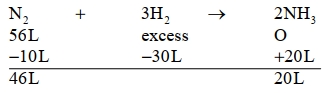
View full question & answer→MCQ 2781 Mark
In the given reaction,$X + Y +3 Z \rightleftarrows XYZ _{3}$
if one mole of each of $X$ and $Y$ with $0.05 mol$ of $Z$ gives compound $XYZ _{3}$. (Given : Atomic masses of $X , Y$ and $Z$ are 10,20 and $30 amu$, respectively). The yield of $XYZ _{3}$ is $.........g$.(Nearest integer)
Answerd
$\underset{1 mol }{ X }+\underset{1 mol }{ Y }+\underset{0.05 mol }{3 Z } \rightleftharpoons X Y Z _{ 3 }$
$Z$ is L.R.
$\frac{0.05}{3}=1\,mole$ of $XYZ _{3}$
Mass of $XYZ _{3}=\frac{0.05}{3} \times(10+20+30 \times 3)$
$=2\,g$
View full question & answer→MCQ 2791 Mark
The neutralization occurs when $10\, mL$ of $0.1 \,M$ acid $'A'$ is allowed to react with $30 \,mL$ of $0.05\, M$ base $M ( OH )_{2}$. The basicity of the acid $'A'$ is $...$ $[ M$ is a metal $]$
Answerd
Acid $\quad+$ Base $\longrightarrow$ Salt $+ H _{2} O$
$0.1 \,M \quad \,M ( OH )_{2}$
$10\, ml\,\quad 0.05\, M$
$\quad\quad\quad\quad30 \,ml$
at equivalence point
equivalent of acid $=$ equivalent of base
$0.1 \times 10 \times n =30 \times 0.05 \times 2$
$n =3$
View full question & answer→MCQ 2801 Mark
$0.01\, M\, KMnO _{4}$ solution was added to $20.0\, mL$ of $0.05\, M$ Mohr's salt solution through a burette. The initial reading of $50\, mL$ burette is zero. The volume of $KMnO _{4}$ solution left in the burette after the end point is $.....\,mL$. (nearest integer)
Answera
$N _{1} V _{1}= N _{2} V _{2}$
$0.01 \times 5 \times V _{1}=0.05 \times 1 \times 20$
$V_{1}=20 \,ml$ used
Volume left $=50-20=30\, ml$
View full question & answer→MCQ 2811 Mark
Using the rules for significant figures, the correct answer for the expression $\frac{0.02858 \times 0.112}{0.5702}$ will be .... .
- A
$0.005613$
- ✓
$0.00561$
- C
$0.0056$
- D
$0.006$
AnswerCorrect option: B. $0.00561$
b
Reported answer should not be more precise than least precise term in calculations, so there should be three significant figures in reported answer.
View full question & answer→MCQ 2821 Mark
The number of $N$ atoms is $681 \,g$ of $C _{7} H _{5} N _{3} O _{6}$ is $x \times 10^{21}$. The value of $x$ is $.....$ $\left( N _{ A }=6.02 \times\right.$ $10^{23}\, mol ^{-1}$ ) (Nearest Integer)
- A
$6418$
- ✓
$5418$
- C
$5118$
- D
$5948$
AnswerCorrect option: B. $5418$
b
M.M. of $C _{7} H _{5} N _{3} O _{6}$ is $84+5+42+96=227$
$n _{ C _{7} H _{5} N _{3} O _{6}}=\frac{681}{227}=3$
$n _{ N }=\frac{681}{227} \times 3=9 mol$
no. of $N$ atoms $=9 \times 6.02 \times 10^{23}$
$=5418 \times 10^{21}$
$\therefore$ The answer is $5418 .$
View full question & answer→MCQ 2831 Mark
$1\, L$ aqueous solution of $H _{2} SO _{4}$ contains $0.02\, m$ mol $H _{2} SO _{4} .50\, \%$ of this solution is diluted with deionized water to give $1\, L$ solution $(A).$ In solution $(A)$, $0.01\, m \,mol$ of $H _{2} SO _{4}$ are added. Total $m$ $mols$ of $H _{2} SO _{4}$ in the final solution is $......\times 10^{3}\, m\, mols.$
Answerd
$n _{ H _{2} SO _{4}}$ in $Sol ^{ n } A =50 \%$ of original solution
$=0.01\, m \,mol$.
$n _{ H _{2} SO _{4}}$ in Final solution $=0.01+0.01$
$=0.02 \,m\,mol$
$=0.00002 \times 10^{3} \,m\,mol$
View full question & answer→MCQ 2841 Mark
Number of grams of bromine that will completely react with $5.0\, g$ of pent$-1-$ene is $......10^{-2} \,g$. (Atomic mass of $Br =80\, g / mol$ ) [Nearest Integer)
- ✓
$1143$
- B
$1500$
- C
$951$
- D
$442$
AnswerCorrect option: A. $1143$
a
moles of $Br _{2}=$ moles of $C _{5} H _{10}$
$\Rightarrow \frac{ w }{160}=\frac{5}{70}$
$\Rightarrow w =\frac{5 \times 160}{70}\, g$
$=11.428 \,g$
$=1142.8 \times 10^{-2}\, g$
$\approx 1143 \times 10^{-2}\, g$
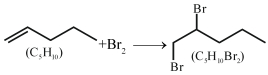
View full question & answer→MCQ 2851 Mark
Hemoglobin contains $0.34 \%$ of iron by mass. The number of $Fe$ atoms in $3.3 g$ of hemoglobin is.(Given : Atomic mass of $Fe$ is $56\,u , N _{ A }$ in $6.022$ $\left.\times 10^{23} mol ^{-1}\right)$
- A
$1.21 \times 10^{5}$
- B
$12.0 \times 10^{16}$
- ✓
$1.21 \times 10^{20}$
- D
$3.4 \times 10^{22}$
AnswerCorrect option: C. $1.21 \times 10^{20}$
c
No. of Fe atoms $=\frac{0.34}{100} \times \frac{3.3}{56} \times 6.022 \times 10^{23}$ $=1.206 \times 10^{20}$
View full question & answer→MCQ 2861 Mark
Chlorophyll extracted from the crushed green leaves was dissolved in water to make $2\,L$ solution of $Mg$ of concentration $48\,ppm$. The number of atoms of $Mg$ in this solution is $x \times 10^{20}$ atoms. The value of $x$ is (Nearest Integer) (Given : Atomic mass of $Mg$ is $24\,g\,mol ^{-1}$, $N _{ A }=6.02 \times 10^{23}\,mol ^{-1}$ )
Answerb
$ppm =\frac{ W _{ Mg }}{ V _{ soln }} \times 10^{6}=48$
$W _{ Mg }=\frac{48 \times 2 \times 1000}{10^{6}}$
$=48 \times 2 \times 10^{-3} g$
$n _{ Mg }=\frac{ W _{ Mg }}{24}=\frac{48 \times 2 \times 10^{-3}}{24}$
$=4 \times 10^{-3}$
Number of $Mg$ atoms $=4 \times 10^{-3} \times 6.02 \times 10^{23}$
$=4 \times 6.02 \times 10^{20}$
$=24.08 \times 10^{20}$
$\therefore \quad x =24.08$
View full question & answer→MCQ 2871 Mark
A protein $'A'$ contains $0.30\, \%$ of glycine (molecular weight $75).$ The minimum molar mass of the protein $'A'$ is $.......\,\times 10^{3} \,g\, mol ^{-1}$ [nearest integer]
Answera
$0.30 \,\%$ glycine is equal to $75$
$1\, \% \longrightarrow \frac{75}{0.30}$
$100\, \% \longrightarrow \frac{75}{0.30} \times 100$
$=25000 \,g$
View full question & answer→MCQ 2881 Mark
$120$ of an organic compound that contains only carbon and hydrogen gives $330\, g$ of $CO _{2}$ and $270\, g$ of water on complete combustion. The percentage of carbon and hydrogen, respectively are ...... .
- A
$25$ and $75$
- B
$40$ and $60$
- C
$60$ and $40$
- ✓
$75$ and $25$
AnswerCorrect option: D. $75$ and $25$
d
Given mass of organic compound $=120$
mass of $CO _{2}( g )=330\, g$
mass of $H _{2} O (\ell)=270\, g$
mass of carbon $= n _{ CO _{2}} \times 12$
$=\frac{330}{44} \times 12=90 \,g$
$\,\%$ of carbon $=\frac{90}{120} \times 100=75 \,\%$
mass of hydrogen $= n _{ H _{2} O } \times 2$
$=\frac{270}{18} \times 2=30 \,g$
$\,\%$ of hydrogen $=\frac{30}{120} \times 100=25 \,\%$
View full question & answer→MCQ 2891 Mark
$116\, g$ of a substance upon dissociation reaction, yields $7.5 \,g$ of hydrogen, $60 \,g$ of oxygen and $48.5\, g$ of carbon. Given that the atomic masses of $H , O$ and $C$ are $1,16$ and $12$ respectively. The data agrees with how many formulae of the following?
$(A)$ $CH _{3} COOH$
$(B)$ $HCHO$
$(C)$ $CH _{3} OOCH _{3}$
$(D)$ $CH _{3} CHO$
Answerc
$\% H =\frac{7.5}{116} \times 100=6.5$
$\% O =\frac{60}{116} \times 100=51.7$
$\% C =\frac{48.5}{116} \times 100=41.8$
Relative atomicities $=$
$H \Rightarrow 6.5$
$O \Rightarrow \frac{51.7}{16}=3.25$
$C \Rightarrow \frac{41.8}{12}=3.5$
Emperically formula is approx. $CH _{2} O$
$(A)$ $C _{2} H _{4} O _{2}$ $(B)$ $CH _{2} O$ relate to this formula.
View full question & answer→MCQ 2901 Mark
Compound $A$ contains $8.7\, \%$ Hydrogen, $74\, \%$ Carbon and $17.3\,\%$ Nitrogen. The molecular formula of the compound is ....
Given : Atomic masses of $C , H$ and $N$ are $12,1$ and $14\, amu$ respectively.
The molar mass of the compound $A$ is $162\, g\, mol ^{-1}$.
- A
$C _{4} H _{6} N _{2}$
- B
$C _{2} H _{3} N$
- C
$C _{5} H _{7} N$
- ✓
$C _{10} H _{14} N _{2}$
AnswerCorrect option: D. $C _{10} H _{14} N _{2}$
d
| $C$ |
$74 \,\%$ |
$\frac{74}{12}=6.16$ |
$\frac{6.16}{1.23}=5$ |
| $N$ |
$17.3\, \%$ |
$\frac{17.3}{14}=1.23$ |
$\frac{1.23}{1.23}=1$ |
| $H$ |
$8.7 \,\%$ |
$\frac{8.7}{1}=8.7$ |
$\frac{8.7}{1.23}=7$ |
Emperical formula $= C _{5} NH _{7}$
Emperical weight $=81$
Multiplying factor $=\frac{162}{81}=2$
Molecular formula $= C _{10} N _{2} H _{14}$
View full question & answer→MCQ 2911 Mark
If a rocket runs on a fuel $\left( C _{15} H _{30}\right)$ and liquid oxygen, the weight of oxygen required and $CO _{2}$ released for every litre of fuel respectively are: (Given: density of the fuel is $0.756\, g / mL$ )
- A
$1188 \,g$ and $1296 \,g$
- B
$2376 \,g$ and $2592 \,g$
- ✓
$2592\, g$ and $2376 \,g$
- D
$3429\, g$ and $3142 \,g$
AnswerCorrect option: C. $2592\, g$ and $2376 \,g$
c
$C _{15} H _{30}+\frac{45}{2} O _{2} \rightarrow 15 CO _{2}+15 H _{2} O$
Mass of fuel $=0.756 \times 1000 \,g$
No. of moles of fuel $=\frac{0.756 \times 1000}{210}$
Wt. of oxygen $=\frac{0.756 \times 1000}{210} \times \frac{45}{2} \times 32=2592 \,g$
Wt of $CO _{2}=\frac{0.756 \times 1000}{210} \times 15 \times 44=2376 \,g$
View full question & answer→MCQ 2921 Mark
$CNG$ is an important transportation fuel. When $100 \,g$ $CNG$ is mixed with $208$ oxygen in vehicles, it leads to the formation of $CO _{2}$ and $H _{2} O$ and produces large quantity of heat during this combustion, then the amount of carbon dioxide, produced in grams is ...... [nearest integer] [Assume CNG to be methane]
Answera
$CH _{4}+2 O _{2} \rightarrow CO _{2}+2 H _{2} O$
Mole $\frac{100}{16} \quad \frac{208}{32}$
$= 6.25\quad=6.5$
$\frac{\text { Mole }}{\text { Stoi. Coeff. }} \frac{6.25}{1} \quad \frac{6.5}{2}=3.25$
So, $O _{2}$ is limiting reagent
Mole-Mole analysis
$\frac{ n _{ O _{2}}}{2}=\frac{ n _{ co _{2}}}{1}$
$\frac{6.5}{2}= n _{ co _{2}}$
Mass of $CO _{2}=\frac{6.5}{2} \times 44=143\, gm$
View full question & answer→MCQ 2931 Mark
The moles of methane required to produce $81 \,g$ of water after complete combustion is $....\,\times 10^{-2}\, mol.$ [nearest integer]
Answerb
$CH _{4}+2 O _{2} \rightarrow CO _{2}+2 H _{2} O$
POAC on $H$ atom
$n _{ CH_4} \times 4= n _{ H_2 O } \times 2$
$n _{ CH _{4}}=\frac{81}{18} \times 2 \times \frac{1}{4}=\frac{81}{36}$
$n _{ CH _{4}}=2.25$
$=225 \times 10^{-2}$
Nearest Integers $=225$
View full question & answer→MCQ 2941 Mark
Production of iron in blast furnace follows the following equation
$Fe _{3} O _{4}( s )+4 CO ( g ) \rightarrow 3 Fe ( l )+4 CO _{2}( g )$
when $4.640 \,kg$ of $Fe _{3} O _{4}$ and $2.520 \,kg$ of $CO$ are allowed to react then the amount of iron (in $g$ ) produced is $....$
[Given : Molar Atomic mass $\left( g\, mol ^{-1}\right): Fe =56$
Molar Atomic mass $\left( g \,mol ^{-1}\right): 0=16$
Molar Atomic mass $\left( g\, mol ^{-1}\right):= C =12$
- A
$1400$
- B
$2200$
- ✓
$3360$
- D
$4200$
AnswerCorrect option: C. $3360$
c
Moles of $Fe _{3} O _{4}=\frac{4.640 \times 10^{3}}{232}=20$
Moles of $CO =\frac{2.52 \times 10^{3}}{28}=90$
So limiting Reagent $= Fe _{3} O _{4}$
So moles of $Fe$ formed $=60$
Weight of $Fe =60 \times 56=3360\, gms$
View full question & answer→MCQ 2951 Mark
A sample of $4.5\,mg$ of an unknown monohydric alcohol, $R - OH$ was added to methylmagnesium iodide. A gas is evolved and is collected and its volume measured to be $3.1\,mL$. The molecular weight of the unknown alcohol is $g / mol$. [Nearest integer]
Answera
$ROH + CH _{3} MgI \rightarrow ROMgI + CH _{4}( g )$
moles of $CH _{4}=$ moles of $ROH$
$\frac{ V }{22400}=\frac{ m }{ M \cdot M }$ (Assuming NTP Condition)
$\frac{3.1}{22400}=\frac{4.5 \times 10^{-3}}{ M.M }$
$MM =32.51$
Nearest Integer $=33$
View full question & answer→MCQ 2961 Mark
$SO _{2} Cl _{2}$ on reaction with excess of water results into acidic mixture
$SO _{2} Cl _{2}+2 H _{2} O \rightarrow H _{2} SO _{4}+2 HCl$ $16\,moles$ of $NaOH$ is required for the complete neutralisation of the resultant acidic mixture. The number of moles of $SO _{2} Cl _{2}$ used is.
Answerc
Let $n\left( SO _{2} Cl _{2}\right)= x$ moles
$\therefore n \left( H _{2} SO _{4}\right)= x , n ( HCl )=2 x$
$n \left( H ^{+}\right)=4\,x$
For Neutralisation
$n \left( H ^{+}\right)= n \left( OH ^{-}\right)$
$4 x =16$
$x =4$
View full question & answer→MCQ 2971 Mark
In the above reaction, $5\,g$ of toluene is converted into benzaldehyde with $92 \%$ yield. The amount of benzaldehyde produced is $....\times 10^{-2}\,g$. (Nearest integer)
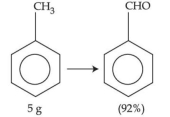
Answerd
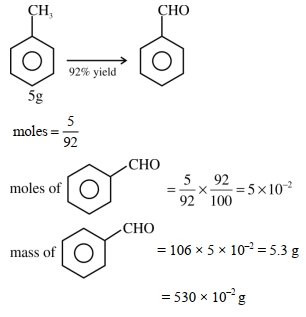
View full question & answer→MCQ 2981 Mark
$N _{2( g )}+3 H _{2( g )} \rightleftharpoons 2 NH _{3( g )}$
$20 \;g \;\;\;\;5 \;g$
Consider the above reaction, the limiting reagent of the reaction and number of moles of $NH _{3}$ formed respectively are
- A
$H _{2}, 1.42 \;moles$
- B
$H _{2}, 0.71\; moles$
- ✓
$N _{2}, 1.42\; moles$
- D
$N _{2}, 0.71\; moles$
AnswerCorrect option: C. $N _{2}, 1.42\; moles$
c
$N _{2}( g )+3 H _{2}( g ) \rightleftharpoons 2 NH _{3}( g )$
$W _{2}=20 g \quad 5 g$
$n =\frac{20}{28} \quad \frac{5}{2}$
Stoichiometric Amount
$N _{2} \rightarrow \frac{20 / 28}{1}=\frac{20}{28} \quad H _{2} \rightarrow \frac{5 / 2}{3}=\frac{5}{6}$
$\therefore N _{2}$ is the Limiting Reagent.
$\therefore \quad n \left( NH _{3}\right) =2 \times n \left( N _{2}\right)=2 \times \frac{20}{28}$
$=1.42$
View full question & answer→MCQ 2991 Mark
Consider the reaction
$4 HNO _{3}(l)+3 KCl ( s ) \rightarrow Cl _{2}( g )+ NOCl ( g )+ 2 H _{2} O ( g )+3 KNO _{3}( s )$
The amount of $HNO _{3}$ required to produce $110.0 \;g$ of $KNO _{3}$ is $...... \;g$
(Given : Atomic masses of $H , O , N$ and $K$ are $1 , 16,14$ and $39$ respectively.)
- A
$32.2$
- B
$69.4$
- ✓
$91.5$
- D
$162.5$
AnswerCorrect option: C. $91.5$
c
$4 HNO _{3}(\ell)+3 KCl ( s ) \rightarrow Cl _{2}( g )+ NOCl ( g )+2 H _{2} O ( g )+3 KNO _{3}( g )$
$x \;g m \quad \quad 110\; gm$
$\frac{ x }{63} \quad \quad Mole =\frac{110}{101}$
$4 \rightarrow 3$
$1 \rightarrow \frac{3}{4}$
$\frac{x}{63} \rightarrow \frac{3}{4} \times \frac{x}{63}=\frac{110}{101}$
$x =\frac{110 \times 63 \times 4}{101 \times 3}=91.5 \;gm$
View full question & answer→MCQ 3001 Mark
When $200 \,mL$ of $0.2\, M$ acetic acid is shaken with $0.6\, g$ of wood charcoal, the final concentration of acetic after adsorption is $0.1 \,M$. The mass of acetic acid adsorbed per garm of carbon is $......\,g.$
Answerc
weight of wood charcoal $=0.6\, g$
Mass of acetic acid adsorbed $=\frac{ M _{1} V _{1}- M _{2} V _{2}}{1000} \times 60$
$=\frac{0.2 \times 200-0.1 \times 200}{1000} \times 60$
$=1.2 \,g$
Mass of acetic acid adsorbed per gram of carbon $=\frac{1.2}{0.6}=2$
View full question & answer→MCQ 3011 Mark
A commercially sold conc. $HCl$ is $35 \% HCl$ by mass. If the density of this commercial acid is $1.46$ $g / mL$, the molarity of this solution is ....$M$
(Atomic mass : $Cl =35.5 \,amu , H =1\, amu$ )
- A
$10.2$
- B
$12.5$
- ✓
$14.0$
- D
$18.2$
AnswerCorrect option: C. $14.0$
c
Let total volume $=1000 \,mL =1 \,L$
total mass of solution $=1460 \,g$
mass of $HCl =\frac{35}{100} \times 1460$
moles of $HCl =\frac{35 \times 1460}{100 \times 36.5}$
So molarity $=\frac{35 \times 1460}{100 \times 36.5}=14 \,M$
View full question & answer→MCQ 3021 Mark
Given below are two statements: one is labelled as Assertion $(A)$ and the other is labelled as Reason $(R)$
Assertion $(A) :$ At $10^{\circ} C$, the density of a $5\, M$ solution of $KCl$ [atomic masses of $K$ and $Cl$ are $39$ and $35.5\, g \,mol ^{-1}$ ]. The solution is cooled to $-21^{\circ} C$. The molality of the solution will remain unchanged.
Reason $(R):$ The molality of a solution does not change with temperature as mass remains unaffected with temperature.
In the light of the above statements, choose the correct answer from the options given below
- ✓
Both $(A)$ and $(R)$ are true and $(R)$ is the correct explanation of $(A)$
- B
Both $(A)$ and $(R)$ are true but $(R)$ is not the correct explanation of $(A)$
- C
$(A)$ is true but $( R )$ is false
- D
$(A)$ is false but $(R)$ is true
AnswerCorrect option: A. Both $(A)$ and $(R)$ are true and $(R)$ is the correct explanation of $(A)$
a
Molality is independent of temperature and hence both assertion and reason are true.
View full question & answer→MCQ 3031 Mark
When $800\,mL$ of $0.5\,M$ nitric acid is heated in a beaker, its volume is reduced to half and $11.5\,g$ of nitric acid is evaporated. The molarity of the remaining nitric acid solution is $x \times 10^{-2}\,M$.(Nearest Integer)(Molar mass of nitric acid is $63\,g\,mol ^{-1}$ )
Answerd
$n _{ HNO _{3}}=0.5 \times 0.8$
$=0.4 mole$
$\left( n _{ HNO _{3}}\right)_{\text {remains }}=0.4$
$=0.4-0.1825$
$=0.2175$
$Molarity$ $=\frac{0.2175}{400} \times 1000$
$=\frac{0.2175}{0.4}$
$=0.5437\,mole / lit$
$\simeq 0.54 mole / lit$
$=54 \times 10^{-2} mol / lit$
View full question & answer→MCQ 3041 Mark
$250\,g$ solution of $D-glucose$ in water contains $10.8 \%$ of carbon by weight. The molality of the solution is nearest to(Given: Atomic Weights are $H , 1\,u ; C , 12\,u ; O , 16\,u$)
- A
$1.03$
- ✓
$2.06$
- C
$3.09$
- D
$5.40$
AnswerCorrect option: B. $2.06$
b
$C _{6} H _{12} O _{6} \rightarrow$ Glucose
We know: $\frac{\text { mass of } C }{\text { mass of glucose }}=\frac{72}{180}$
Given: $\% C =10.8=\frac{\text { mass of } C }{\text { mass of solution }} \times 100$
$\frac{10.8 \times 250}{100}=$ mass of $C \Rightarrow$ Mass of $C =27\,gm$
$\therefore$ mass of glucose $=67.5\,gm$
$\therefore$ moles of glucose $=0.375\,moles$
Mass of solvent $=250-67.5\,gm =182.5\,gm$
$\therefore$ Molality $=\frac{0.375}{0.1825}=2.055 \approx 2.06$
View full question & answer→MCQ 3051 Mark
$2\,L$ of $0.2\,M H _{2} SO _{4}$ is reacted with $2\,L$ of $0.1\,M$ $NaOH$ solution, the molarity of the resulting product $Na _{2} SO _{4}$ in the solution is millimolar. (Nearest integer).
Answerd
$H _{2} SO _{4}+2 NaOH \rightarrow Na _{2} SO _{4}+2 H _{2} O$
$0.4\,mol \quad 0.2 mol \quad-$
$0.3\,mol \quad-\quad\quad\quad\quad\quad 0.1 mol$
Molarity of $Na _{2} SO _{4}$ is $\frac{0.1}{4}=0.025\,M$ $=25\,mM$.
View full question & answer→MCQ 3061 Mark
The number of significant figures in $50000.020 \times 10^{-3}$ is ..... .
Answerb
$\underline{50000.020} \times 10^{-3}$
View full question & answer→MCQ 3071 Mark
Complete combustion of $1.80 \,g$ of an oxygen containing compound $\left( C _{ x } H _{ y } O _{2}\right)$ gave $2.64\, g$ of $CO _{2}$ and $1.08\, g$ of $H _{2} O .$ The percentage of oxygen in the organic compound is
- A
$51.63$
- B
$63.53$
- ✓
$53.33$
- D
$50.33$
AnswerCorrect option: C. $53.33$
c
$n _{ c }= n _{ co _{2}}=\frac{2.64}{44}=0.06$
$n _{ H }=2 \times n _{ H _{2} O }=\frac{1.08}{18} \times 2=0.12$
$m _{0}=1.80-12 \times \frac{2.64}{44}-\frac{1.08}{18} \times 2$
$=1.80-0.72-0.12=0.96 gm$
$\% 0=\frac{0.96}{1.80} \times 100=53.33 \%$
View full question & answer→MCQ 3081 Mark
Methylation of $10\, \mathrm{~g}$ of benzene gave $9.2\, \mathrm{~g}$ of toluene. Calculate the percentage yield of toluene $......$. (Nearest integer)
Answerb
Moles of $\mathrm{C}_{6} \mathrm{H}_{6}=10 / 78$
moles of toluene $=10 / 78$
$\mathrm{w}_{\mathrm{t}}$ of toluene should be $=10 / 78 \times 92$
$\%$ yield $=\frac{9.2}{\frac{10}{78} \times 92} \times 100=78\, \%$
View full question & answer→MCQ 3091 Mark
Consider the complete combustion of butane, the amount of butane utilized to produce $72.0\, \mathrm{~g}$ of water is $....\,\times 10^{-1}\, \mathrm{~g} .$ (in nearest integer)
Answerd
$\mathrm{C}_{4} \mathrm{H}_{10}+\frac{13}{2} \mathrm{O}_{2} \longrightarrow 4 \mathrm{CO}_{2}+5 \mathrm{H}_{2} \mathrm{O}$
Moles of $\mathrm{H}_{2} \mathrm{O}=\frac{72}{18}=4$
Moles of $\mathrm{C}_{4} \mathrm{H}_{10}$ used $=\frac{1}{5} \times 4$
Weight of $\mathrm{C}_{4} \mathrm{H}_{10}$ used $=\frac{4}{5} \times 58$
$=46.4\, \mathrm{gm} \Rightarrow 464 \times 10^{-1}\, \mathrm{gm}$
View full question & answer→MCQ 3101 Mark
A $6.50$ molal solution of $KOH$ $(aq.)$ has a density of $1.89\, g\, cm ^{-3}$. The molarity of the solution is .......... $mol\, dm ^{-3} .$
(Round off to the Nearest Integer).
[Atomic masses: $K : 39.0\, u ; O : 16.0 \,u ; H : 1.0\, u ]$
Answerc
$6.5$ molal $KOH =1000\, gm$ solvent has $6.5$ moles $KOH$
so wt of solute $=6.5 \times 56$
$=364\, gm$
wt of solution $=1000+364=1364$
Volume of solution $=\frac{1364}{1.89} m \ell$
Molarity $=\frac{\text { mole of solute }}{ V _{\text {solution }} \text { in Litre }}$
$=\frac{6.5 \times 1.89 \times 1000}{1364}$
$=9.00$
View full question & answer→MCQ 3111 Mark
$4.5 \,g$ of compound $A ( MW =90)$ was used to make $250\, mL$ of its aqueous solution. The molarity of the solution in $M$ is $x \times 10^{-1}$. The value of $x$ is ............ (Rounded off to the nearest integer)
Answerb
$M =\frac{4.5 / 90}{250 / 1000}=0.2$
$=2 \times 10^{-1}$
View full question & answer→MCQ 3121 Mark
Consider titration of $NaOH$ solution versus $1.25\, M$ oxalic acid solution. At the end point following burette readings were obtained.
$(i)$ $4.5\, mL$ $\quad (ii)$ $4.5\, mL$ $\quad (iii)$ $4.4\, mL$
$(iv)$ $4.4\, mL$ $\quad (v)$ $4.4\, mL$
If the volume of oxalic acid taken was $10.0 \,mL$ then the molarity of the $NaOH$ solution is .... $M.$ (Rounded-off to the nearest integer)
Answera
$V _{ NaOH }=4.4\, ml$
eq. of $NaOH =$ eq. of $H _{2} C _{2} O _{4}$
or, $M \times 4.4 \times 1=1.25 \times 10 \times 2$
or, $M =5.68\, M$
$\therefore$ Nearest integer answer is $6.$
View full question & answer→MCQ 3131 Mark
An aqueous $\mathrm{KCl}$ solution of density $1.20 \mathrm{~g} \mathrm{~mL}^{-1}$ has a molality of $3.30 \mathrm{~mol} \mathrm{~kg}^{-1}$. The molarity of the solution in $\mathrm{mol} \mathrm{L}^{-1}$ is ..... . (Nearest integer)
[Molar mass of $\mathrm{KCl}=74.5$ ]
Answera
$1000\, \mathrm{~kg}$ solvent has $3.3$ $moles$ of $\mathrm{KCl}$
$1000\, \mathrm{~kg} \text { solvent } \longrightarrow 3.3 \times 74.5\, \mathrm{gm} \mathrm{KCl}$
$\quad\quad\quad\quad\quad\quad\quad \longrightarrow 245.85$
Weight of solution $=1245.85\, \mathrm{gm}$
Volume of solution $=\frac{1245.85}{1.2}\, \mathrm{ml}$
So molarity $=\frac{3.3 \times 1.2}{1245.85} \times 1000=3.17$
View full question & answer→MCQ 3141 Mark
$100\, \mathrm{~mL}$ of $\mathrm{Na}_{3} \mathrm{PO}_{4}$ solution contains $3.45\, \mathrm{~g}$ of sodium. The molarity of the solution is $.....\times 10^{-2}$ $\operatorname{mol} \,\mathrm{L}^{-1} \cdot($ Nearest integer $)$
[Atomic Masses - $\mathrm{Na}: 23.0\, \mathrm{u}, \mathrm{O}: 16.0\, \mathrm{u}, \mathrm{P}: 31.0 \,\mathrm{u}]$
Answerb
$\mathrm{Na}_{3} \mathrm{PO}_{4} \longrightarrow \quad3 \mathrm{Na}$
$\frac{1}{3} \times \frac{3.45}{23} \mathrm{~mol} \quad$ $3.45 \mathrm{~g}$
$\quad\quad\quad\quad\quad\quad\quad\frac{3.45}{23} \mathrm{~mol}$
therefore molarity of $\mathrm{Na}_{3} \mathrm{PO}_{4}$ Solution =
$\frac{\mathrm{n}_{\mathrm{Na}_{3} \mathrm{PO}_{4}}}{\text { volume of solution in } \mathrm{L}}$
$=\frac{\frac{1}{3} \times \frac{3.45}{23}\, \mathrm{~mol}}{0.1\, \mathrm{~L}}$
$=0.5=50\, \times 10^{-2}$
View full question & answer→MCQ 3151 Mark
When $10 \mathrm{~mL}$ of an aqueous solution of $\mathrm{Fe}^{2+}$ ions was titrated in the presence of dil $\mathrm{H}_{2} \mathrm{SO}_{4}$ using diphenylamine indicator, $15 \mathrm{~mL}$ of $0.02 \mathrm{M}$ solution of $\mathrm{K}_{2} \mathrm{Cr}_{2} \mathrm{O}_{7}$ was required to get the end point. The molarity of the solution containing $\mathrm{Fe}^{2+}$ ions is $\mathrm{X} \times 10^{-2} \mathrm{M}$. The value of $\mathrm{x}$ is $....$ (Nearest integer)
Answerb
$\mathrm{Fe}^{+2}+\mathrm{Cr}_{2} \mathrm{O}_{7}^{-2} \rightarrow \mathrm{Fe}^{+3}+\mathrm{Cr}^{+3}$
Milli-equivalents of $\mathrm{Fe}^{2+}=$ milli-equivalents of $\mathrm{K}_{2} \mathrm{Cr}_{2} \mathrm{O}_{7}$
$\mathrm{M} \times 10 \times 1=0.02 \times 15 \times 6$
$\mathrm{M}=0.18=18 \times 10^{-2} \,\mathrm{M}$
View full question & answer→MCQ 3161 Mark
The density of $\mathrm{NaOH}$ solution is $1.2 \mathrm{gcm}^{-3} .$ The molality of this solution is $....\,m$
(Round off to the NearestInteger)
[Use:Atomicmasses:$Na:23.0\,u \mathrm{O}: 16.0 \,\mathrm{u} \quad \mathrm{H}: 1.0 \,\mathrm{u}$, Density of $\mathrm{H}_{2} \mathrm{O}: 1.0 \,\mathrm{~g} \,\mathrm{~cm}^{-3}$ ]
Answerb
Consider $1\, \ell$ solution
mass of solution $=(1.2 \times 1000)\, \mathrm{g}$
$=1200\, \mathrm{gm}$
Neglecting volume of $\mathrm{NaOH}$
Mass of water $=1000\, \mathrm{gm}$
$\Rightarrow$ Mass of $\mathrm{NaOH}=(1200-1000)\, \mathrm{gm}$
$=200\, \mathrm{gm}$
$\Rightarrow$ Moles of $\mathrm{NaOH}=\frac{200\, \mathrm{~g}}{50\, \mathrm{~g} / \mathrm{mol}}=5\, \mathrm{~mol}$
$\Rightarrow$ molality $=\frac{5 \,\mathrm{~mol}}{1\, \mathrm{~kg}}=5\, \mathrm{~m}$
View full question & answer→MCQ 3171 Mark
$10.0 \,\mathrm{~mL}$ of $0.05\, \mathrm{M}\, \mathrm{KMnO}_{4}$ solution was consumed in a titration with $10.0\, \mathrm{~mL}$ of given oxalic acid dihydrate solution. The strength of given oxalic acid solution is $.....\,\times 10^{-2} \,\mathrm{~g} / \mathrm{L}$ (Round off to the nearest integer)
- A
$1782$
- B
$2152$
- C
$1203$
- ✓
$1575$
AnswerCorrect option: D. $1575$
d
$\mathrm{n}_{\mathrm{eq}} \mathrm{KMnO}_{4}=\mathrm{n}_{\text {eq }}=\mathrm{H}_{2} \mathrm{C}_{2} \mathrm{O}_{4} \cdot 2 \mathrm{H}_{2} \mathrm{O}$
or, $\frac{10 \times 0.05}{1000} \times 5=\frac{10 \times \mathrm{M}}{1000} \times 2$
$\therefore$ Conc. of oxalic acid solution $=0.125 \,\mathrm{M}$
$=0.125 \times 126\, \mathrm{~g} / \mathrm{L}=15.75 \,\mathrm{~g} / \mathrm{L}$
$=1575 \times 10^{-2}\, \mathrm{~g} / \mathrm{L}$
View full question & answer→MCQ 3181 Mark
The unit of the van der Waals gas equation parameter $'a'$ in $\left(\mathrm{P}+\frac{\mathrm{an}^{2}}{\mathrm{~V}^{2}}\right)(\mathrm{V}-\mathrm{nb})=\mathrm{n} \mathrm{RT}$ is :
- A
$\mathrm{kg} \,\mathrm{m} \,\mathrm{s}^{-2}$
- B
$\mathrm{dm}^{3}\, \mathrm{~mol}^{-1}$
- C
$\mathrm{kg} \,\mathrm{m}\, \mathrm{s}^{-1}$
- ✓
$\mathrm{atm} \,\mathrm{dm}^{6} \,\mathrm{~mol}^{-2}$
AnswerCorrect option: D. $\mathrm{atm} \,\mathrm{dm}^{6} \,\mathrm{~mol}^{-2}$
d
$\frac{\mathrm{an}^{2}}{\mathrm{~V}^{2}}=\mathrm{atm} \Rightarrow \mathrm{a}=\mathrm{atm} \times \frac{\mathrm{d} \mathrm{m}^{6}}{\mathrm{~mol}^{2}}$
View full question & answer→MCQ 3191 Mark
The $NaNO _{3}$ weighed out to make $50\, mL$ of an aqueous solution containing $70.0 \,mg \,Na ^{+}$ per $mL$ is $...... \,g$.
(Rounded off to the nearest integer) [Given : Atomic weight in $g\, mol ^{-1}- Na : 23$; $N : 14 ; O : 16]$
Answerb
$Na ^{+}$ present in $50\, ml$
$=\frac{70\, mg }{1\, ml } \times 50\, ml =3500 mg =3.5\, gm$
moles of $Na ^{+}=\frac{3.5}{23}=$ moles of $NaNO _{3}$
weight of $NaNO _{3}=\frac{3.5}{23} \times 85=12.993\, gm$
View full question & answer→MCQ 3201 Mark
If the concentration of glucose $\left(\mathrm{C}_{6} \mathrm{H}_{12} \mathrm{O}_{6}\right)$ in blood is $0.72\, \mathrm{~g} \,\mathrm{~L}^{-1}$, the molarity of glucose in blood is $.....\,\times 10^{-3} \mathrm{M}$. (Nearest integer)
(Given: Atomic mass of $\mathrm{C}=12, \mathrm{H}=1, \mathrm{O}=16 \mathrm{u}$ )
Answera
molarty $=$ moles/volume
$=\frac{0.72}{180}=4 \times 10^{-3}=\mathrm{M}$
View full question & answer→MCQ 3211 Mark
The ratio of number of water molecules in Mohr's salt and potash alum is $....\,\times 10^{-1}$
Answera
Mohr's salt : $\left(\mathrm{NH}_{4}\right)_{2} \mathrm{Fe}\left(\mathrm{SO}_{4}\right)_{2} \cdot 6 \mathrm{H}_{2} \mathrm{O}$
The number of water molecules in Mohr's salt $=6$
Potash alum : $\mathrm{KAl}\left(\mathrm{SO}_{4}\right)_{2} \cdot 12 \mathrm{H}_{2} \mathrm{O}$
The number of water molecules in potash alum $=12$
So ratio of number of water molecules in Mohr's salt and potash alum $=\frac{6}{12}$
$=\frac{1}{2}$
$=0.5$
$=5 \times 10^{-1}$
View full question & answer→MCQ 3221 Mark
The number of atoms in $8\, \mathrm{~g}$ of sodium is $\mathrm{x} \times 10^{23}.$ The value of $\mathrm{x}$ is ...... .(Nearest integer)
$\left[\right.$ Given $: \mathrm{N}_{\mathrm{A}}=6.02 \times 10^{23}\, \mathrm{~mol}^{-1}$, Atomic mass of $\mathrm{Na}=23.0\, \mathrm{u}]$
Answerc
$\text { No. of atoms }=\frac{8}{23} \times 6.02 \times 10^{23}= 2.09 \times 10^{23}$
$\quad\quad\quad\quad\quad\quad\quad\quad\quad\quad\quad\quad\quad\quad\simeq 2 \times 10^{23}$
$\quad\quad\quad\quad\quad\quad\quad\quad\quad\quad\quad\quad\quad\quad=\mathrm{x} \times 10^{23}$
$\mathrm{x}=2$
View full question & answer→MCQ 3231 Mark
Complete combustion of $3\, g$ of ethane gives $x \times 10^{22}$ molecules of water. The value of $x$ is ......... (Round off to the Nearest Integer). [Use: $N _{ A }=6.023 \times 10^{23} ;$ Atomic masses in $u$ $C : 12.0 ; O : 16.0 ; H : 1.0]$
Answerd
moles of ethane $=\frac{3 \mathrm{~g}}{30 \mathrm{~g} / \mathrm{mol}}=0.1 \mathrm{~mol} $
$\mathrm{C}_2 \mathrm{H}_6+3.5 \mathrm{O}_2 \rightarrow 2 \mathrm{CO}_2+3 \mathrm{H}_2 \mathrm{O}$
$1 \mathrm{~mol}$ of ethane gives $3 \mathrm{~mol}$ of water
$0.1 \mathrm{~mol}$ ethane gives $0.3 \mathrm{~mol}$ of water
Number of molecules in $0.3 \mathrm{~mol}$ water
$=0.3 \times 6 \times 10^{23}=18 \times 10^{22}$ molecules
value of $x$ is 18
View full question & answer→MCQ 3241 Mark
The formula of a gaseous hydrocarbon which requires $6$ times of its own volume of $O _{2}$ for complete oxidation and produces $4$ times its own volume of $CO _{2}$ is $C _{ x } H _{ y }$. The value of $y$ is ...... .
Answerc
Combustion $rx ^{ n }:$
$C _{ x } H _{ y ( g )}+\left( x +\frac{ y }{4}\right) O _{2}( g ) \rightarrow x CO _{2}( g )+\frac{ y }{2} H _{2} O (\ell)$
$V\,\quad\quad\quad\quad\quad6V\quad\quad\quad\quad\quad\quad-$
$-\,\quad\quad\quad\quad\quad-\quad\quad\quad\quad\quad Vx=4V$
$\Rightarrow x=4$
Sinc: $(I)$ $Vo _{2}=6 \times V _{ c _{ x } H _{y}}$
$\Rightarrow V \left( x +\frac{ y }{4}\right)=6 V$
$\left.\Rightarrow\left( x +\frac{ y }{4}\right)=6\right] \Rightarrow 4+\frac{ y }{4}=6$
$\Rightarrow y =8$
View full question & answer→MCQ 3251 Mark
The mole fraction of a solute in a $100$ molal aqueous solution .......... $\times 10^{-2}$
(Round off to the Nearest Integer).
[Given : Atomic masses : $H : 1.0 \,u , O : 16.0\, u ]$
Answera
$100$ molal aqueous solution means there is $100$ mole solute in $1 kg =1000 gm$ water. Now,
mole-fraction of solute $=\frac{ n _{\text {solute }}}{ n _{\text {solute }}+ n _{\text {solvent }}}$
$=\frac{100}{100+\frac{1000}{18}}=\frac{1800}{2800}=0.6428$
$=64.28 \times 10^{-2}$
View full question & answer→MCQ 3261 Mark
$15\, mL$ of aqueous solution of $Fe ^{2+}$ in acidic medium completely reacted with $20\, mL$ of $0.03\, M$ aqueous $Cr _{2} O _{7}^{2-}$ The molarity of the $Fe ^{2+}$ solution is ........... $\times 10^{-2} M$ (Round off to the Nearest Integer).
Answerc
$n _{ eq } Fe ^{2+}= n _{ eq } Cr _{2} O _{7}^{2-}$
or, $\left(\frac{15 \times M _{ Fe ^{2+}}}{1000}\right) \times 1=\left(\frac{20 \times 0.03}{1000}\right) \times 6$
$\therefore M _{ Fe ^{2+}}=0.24 M =24 \times 10^{-2} M$
View full question & answer→MCQ 3271 Mark
The exact volumes of $1\, M\, NaOH$ solution required to neutralise $50 \,mL$ of $1 \,M \,H _{3} PO _{3}$ solution and $100\, mL$ of $2 \,M\, H _{3} PO _{2}$ solution, respectively, are :
- A
$100 \,mL$ and $100\, mL$
- B
$100 \,mL$ and $50\, mL$
- ✓
$100\, mL$ and $200 \,mL$
- D
$50\, mL$ and $50 \,mL$
AnswerCorrect option: C. $100\, mL$ and $200 \,mL$
c
$H _{3} PO _{3}+2 NaOH \rightarrow Na _{2} HPO _{3}+2 H _{2} O$
$\begin{array}{ll}50\, ml & 1\, M \\ 1\, M & V =?\end{array}$
$\Rightarrow \frac{ n _{ NaoH }}{ n _{ H _{3} PO _{3}}}=\frac{2}{1}$
$\Rightarrow \frac{1 \times V }{50 \times 1}=\frac{2}{1} \Rightarrow{ V _{ NaOH }=100\, ml }$
$H _{3} PO _{2}+2 NaOH \rightarrow NaH _{2} PO _{3}+ H _{2} O$
$\begin{array}{lc}100\, ml & 1\, M \\ 2\, M & V =?\end{array}$
$\Rightarrow \frac{ n _{ NaoH }}{ n _{ H _{3} PO _{3}}}=\frac{1}{1} \Rightarrow \frac{1 \times V }{2 \times 100}=\frac{1}{1} \Rightarrow V _{ NaOH }=200\, ml$
View full question & answer→MCQ 3281 Mark
When $35\, mL$ of $0.15\, M$ lead nitrate solution is mixed with $20 \,mL$ of $0.12\, M$ chromic sulphate solution, ....... $\times 10^{-5}$ moles of lead sulphate precipitate out. (Round off to the Nearest Integer).
Answerb
$3 Pb \left( NO _{3}\right)_{2}+ Cr _{2}\left( SO _{4}\right)_{3} \rightarrow 3 PbSO _{4}+2 Cr \left( NO _{3}\right)_{3}$
$35\, ml \quad 20\, ml$
$0.15\, M \quad 0.12\, M$
$5.25\, m \cdot mol =2.4\, m \cdot mol \quad 5.25 \,m \cdot mol$
$=5.25 \times 10^{-3} \,mol$
therefore moles of $PbSO _{4}$ formed $=5.25 \times 10^{-3}$ $=525 \times 10^{-5}$
View full question & answer→MCQ 3291 Mark
$100\, \mathrm{~g}$ of propane is completely reacted with $1000\, \mathrm{~g}$ of oxygen. The mole fraction of carbon dioxide in the resulting mixture is $\mathrm{x} \times 10^{-2}$. The value of $\mathrm{x}$ is ..... .
(Nearest integer)
[Atomic weight : $\mathrm{H}=1.008 ; \mathrm{C}=12.00 ; \mathrm{O}=16.00$ ]
Answera
$\mathrm{C}_{3} \mathrm{H}_{8(\mathrm{~s})}+5 \mathrm{O}_{2(\mathrm{~g})} \longrightarrow 3 \mathrm{CO}_{2(\mathrm{~g})}+4 \mathrm{H}_{2} \mathrm{O}_{(b)}$
$\mathrm{t}=0\quad 2.27\, \mathrm{~mole} \quad 31.25\, \mathrm{~mol}$
$\mathrm{t}=\infty \quad 0 \quad\quad\quad\quad 19.9 \,\mathrm{~mol} \quad 6.81\, \mathrm{~mol} \quad 9.08\, \mathrm{~mol}$
mole fraction of $\mathrm{CO}_{2}$ in the final reaction mixture (heterogenous)
$\mathrm{X}_{\mathrm{CO}_{2}}=\frac{6.81}{19.9+6.81+9.08}$
$=0.1902=19.02 \times 10^{-2}$
$\Rightarrow 19$
View full question & answer→MCQ 3301 Mark
The molarity of the solution prepared by dissolving $6.3\, \mathrm{~g}$ of oxalic acid $\left(\mathrm{H}_{2} \mathrm{C}_{2} \mathrm{O}_{4} \cdot 2 \mathrm{H}_{2} \mathrm{O}\right)$ in $250\, \mathrm{~mL}$ of water in $\operatorname{mol} \mathrm{L}^{-1}$ is $\mathrm{x} \times 10^{-2} .$ The value of $\mathrm{x}$ is ..... . (Nearest integer)
[Atomic mass : $\mathrm{H}: 1.0, \mathrm{C}: 12.0, \mathrm{O}: 16.0]$
Answerd
${\left[\mathrm{H}_{2} \mathrm{C}_{2} \mathrm{O}_{4} \cdot 2 \mathrm{H}_{2} \mathrm{O}\right]=\frac{\text { weight } / \mathrm{M}_{\mathrm{w}}}{\mathrm{V}(\mathrm{L})}}$
$\Rightarrow \mathrm{x} \times 10^{-2}=\frac{6.3 / 126}{250 / 1000}$
$\mathrm{x}=20$
View full question & answer→MCQ 3311 Mark
Sodium oxide reacts with water to produce sodium hydroxide. $20.0\, \mathrm{~g}$ of sodium oxide is dissolved in $500\, \mathrm{~mL}$ of water. Neglecting the change in volume, the concentration of the resulting $\mathrm{NaOH}$ solution is $........\times \quad 10^{-1} \quad$ $M.$ (Nearest integer)
[Atomic mass $: \mathrm{Na}=23.0, \mathrm{O}=16.0, \mathrm{H}=1.0]$
Answerb
$\mathrm{Na}_{2} \mathrm{O}+\mathrm{H}_{2} \mathrm{O} \rightarrow 2 \mathrm{NaOH}$
$\frac{20}{62} \mathrm{moles}$
Moles of $\mathrm{NaOH}$ formed $=\frac{20}{62} \times 2$
$[\mathrm{NaOH}]=\frac{\frac{40}{62}}{\frac{500}{1000}}=1.29\, \mathrm{M}=13 \times 10^{-1} \,\mathrm{M}$
(Nearest integer)
View full question & answer→MCQ 3321 Mark
$250\, \mathrm{~mL}$ of $0.5\, \mathrm{M}\, \mathrm{NaOH}$ was added to $500\, \mathrm{~mL}$ of $1\, \mathrm{M}\, \mathrm{HCl}$ The number of unreacted $\mathrm{HCl}$ molecules in the solution after complete reaction is $......\,\times 10^{21}$. (Nearest integer) $\left(\mathrm{N}_{\mathrm{A}}=6.022 \times 10^{23}\right)$
Answera
We known that no. of moles $=\text { Vlitre } \times \text { Molarity and No. of millimoles }=V_{m l} \times \text { Molarity }$
$\text { so millimoles of } \mathrm{NaOH}=250 \times 0.5=125$
$\text { Millimoles of } \mathrm{HCl}=500 \times 1=500$
$\text { Now reaction is }$
$\mathrm{NaOH}+\mathrm{HCL} \rightarrow \mathrm{NaCl}+\mathrm{H}_{2} \mathrm{O}$
$\mathrm{t}=0 \quad 125\quad 500 \quad 0 \quad 0$
$\mathrm{t}=0 \quad 0 375 \quad 125 \quad 125$
$\text { so millimoles of } \mathrm{HCl} \text { left }=375$
$\text { Moles of } \mathrm{HCl}=375 \times 10^{-3}$
$\text { No. of } \mathrm{HCl} \text { molecules }=6.022 \times 10^{23} \times 375 \times 10^{-3}$
$=225.8 \times 10^{21}$
$\approx 226 \times 10^{21}=226$
View full question & answer→MCQ 3331 Mark
The mass of ammonia in grams produced when $2.8\, kg$ of dinitrogen quantitatively reacts with $1\, kg$ of dihydrogen is.............
- ✓
$3400$
- B
$3425$
- C
$3390$
- D
$3000$
AnswerCorrect option: A. $3400$
a
| $N _{2} \quad+$ |
$3 H _{2} \rightarrow$ |
$2 NH _{3}$ |
| $\frac{2.8}{28} K mol$ |
$\frac{1}{2} K mol$ |
|
| $=0.1 K mol$ |
$0.5 K mol$ |
$-$ |
| $0$ |
$0.2 K mol$ |
$0.2 K mol$ |
mass $\left( NH _{3}\right)=0.2 \times 17 Kg$
$=3.4 Kg$
$=3400 gm$
View full question & answer→MCQ 3341 Mark
$6.023 \times 10^{22}$ molecules are present in $10 \,g$ of a substance $'x'.$ The molarity of a solution containing $5\, g$ of substance ${ }^{\prime} x ^{\prime}$ in $2\, L$ solution is.......... $\times 10^{-3}$
Answerb
moles $=\frac{\text { number of molecules }}{6 \times 10^{23}}=\frac{\text { given mass }}{\text { molar mass }}$
$\Rightarrow$ molar mas $=\frac{10 \times 6.023 \times 10^{23}}{6.023 \times 10^{22}}=100 g / mol$
$\Rightarrow$ molarity $=\frac{\text { moles of solute }}{\text { volume of } \operatorname{sol}^{n}(\ell)}=\frac{(5 / 100)}{2}$
$=0.025$
View full question & answer→MCQ 3351 Mark
A solution of two components containing $n_{1}$ moles of the $1^{\text {st }}$ component and $n_{2}$ moles of the $2^{\text {nd }}$ component is prepared. $M _{1}$ and $M _{2}$ are the molecular weights of component $1$ and $2$ respectively. If $d$ is the density of the solution in $g\, mL ^{-1}, C _{2}$ is the molarity and $x _{2}$ is the mole fraction of the $2^{\text {nd }}$ component, then $C_{2}$ can be expressed as
- A
$C _{2}=\frac{1000 x _{2}}{ M _{1}+ x _{2}\left( M _{2}- M _{1}\right)}$
- B
$C _{2}=\frac{ d x _{2}}{ M _{2}+ x _{2}\left( M _{2}- M _{1}\right)}$
- C
$C _{2}=\frac{ d x _{1}}{ M _{2}+ x _{2}\left( M _{2}- M _{1}\right)}$
- ✓
$C _{2}=\frac{1000 dx _{2}}{ M _{1}+ x _{2}\left( M _{2}- M _{1}\right)}$
AnswerCorrect option: D. $C _{2}=\frac{1000 dx _{2}}{ M _{1}+ x _{2}\left( M _{2}- M _{1}\right)}$
d
$C_{2}=\frac{x_{2}}{\left[x_{2} M_{2}+\left(1-x_{2}\right) M_{2}\right] / C l} \times 1000$
$C_{2}=\frac{1000 d x_{2}}{M_{1}+\left(M_{2}-M_{1}\right) x_{2}}$
View full question & answer→MCQ 3361 Mark
The average molar mass of chlorine is $35.5\, g$ $mol ^{-1}$. The ratio of $35\, Cl$ to $37 \,Cl$ in naturally occurring chlorine is close to :
Answerd
$\quad \quad{ }^{35} Cl \quad{ }^{37} Cl \quad$ Av. molar
let $\quad x \quad: \quad 1 \quad$ mass $=35.5$
mole ratio
Av. molar mass $=\frac{ n _{1} M _{1}+ n _{2} M _{2}}{\left( n _{1}+ n _{2}\right)}$
$35.5=\frac{x \times 35+1 \times 37}{x+1}$
$x=3$
View full question & answer→MCQ 3371 Mark
The mass percentage of nitrogen in histamine is
- ✓
$37.84$
- B
$42.67$
- C
$33.33$
- D
$62.16$
AnswerCorrect option: A. $37.84$
a
M.F. of Histamine is $\mathrm{C}_{5} \mathrm{H}_{9} \mathrm{N}_{3}$
Molecular mass of Histamine is 111
Now, mass $\%$ of nitrogen $=\left(\frac{42}{111}\right) \times 100$
$=37.84 \%$
View full question & answer→MCQ 3381 Mark
The ratio of the mass percentages of $'C$ $\&$ $H'$ and $'C$ $\&$ $O'$ of a saturated acyclic organic compound$'X'$ are $4 : 1$ and $3 : 4$ respectively. Then, the moles of oxygen gas required for complete combustion of two moles of organic compound $'X$' is
Answerd
$C : H =4: 1$
$C: O=3: 4$
Mass ratio
$C : H : O =12: 3: 16$
Mole ratio
$C : H : O =1: 3: 1$
Empirical formula $= CH _{3} O$
Molecular formula $= C _{2} H _{6} O _{2}$
(saturated acyclic organic compound)
$C _{2} H _{6} O _{2}+\frac{5}{2} O _{2} \longrightarrow 2 CO _{2}+3 H _{2} O$
$2\, mole$ $5 \,mol$
Moles of $O _{2}$ required $=5$ moles
View full question & answer→MCQ 3391 Mark
The molarity of $\mathrm{HNO}_{3}$ in a sample which has density $1.4 \;\mathrm{g} / \mathrm{mL}$ and mass percentage of $63 \%$ is ______ $\mathrm{M}$ થશે.
(Molecular Weight of $\mathrm{HNO}_{3}=63$ )
Answerd
$100\, \mathrm{gm}$ soln $\rightarrow 63\, \mathrm{gm} \mathrm{HNO}_{3}$
$\frac{100}{1.4} \mathrm{mL} \rightarrow 1$ mole $\mathrm{HNO}_{3}$
Molarity $=\frac{1}{\frac{100}{1.4} \times \frac{1}{1000}}=14 \;\mathrm{M}$
View full question & answer→MCQ 3401 Mark
The volume (in $mL$ ) of $0.1\, N$ $NaOH$ required to neutralise $10\, mL$ of $0.1\, N$ phosphinic acid is........
Answerc
$H _{3} PO _{2}+ NaOH \rightarrow NaH _{2} PO _{2}+ H _{2} O$
$\frac{ n _{ H_3 PO _{2}} \text { reacted }}{1}=\frac{ n _{ NaOH } \text { reacted }}{1}$
$\Rightarrow \frac{0.1 \times 10}{1}=0.1 \times V _{ NaOH }$
$\Rightarrow V _{ NaOH }=10 ml$
View full question & answer→MCQ 3411 Mark
A $20.0 \,mL$ solution containing $0.2 \,g$ impure $H _{2} O _{2}$ reacts completely with $0.316 \,g$ of $KMnO _{4}$ in acid solution. The purity of $H _{2} O _{2}($ in $\%)$ is........... (mol. wt. of $H _{2} O _{2}=34 ;$ mol. wt. of $\left. KMnO _{4}=158\right)$
Answerc
$Eq$ of $H _{2} O _{2}= Eq$ of $KMnO _{4}$
$x \times 2=\frac{0.316}{158} \times 5$
$x=5 \times 10^{-3} mol$
$m _{ H _{2} O _{2}}=5 \times 10^{-3} \times 34=0.17 gm$
$\% H _{2} O _{2}=\frac{0.17}{0.2} \times 100=85$
View full question & answer→MCQ 3421 Mark
The first and second ionisation enthalpies of a metal are $496$ and $4560 \;\mathrm{kJ} \mathrm{mol}^{-1},$ respectively. How many moles of $\mathrm{HCl}$ and $\mathrm{H}_{2} \mathrm{SO}_{4}$ respectively, will be needed to react completely with $1$ mole of the metal hydroxide?
- ✓
$1$ and $0.5$
- B
$2$ and $0.5$
- C
$1$ and $1$
- D
$1$ and $2$
AnswerCorrect option: A. $1$ and $0.5$
a
IE values indicate, that the metal belongs to Ist group since second IE is very high ( only one valence electron) Metal hydroxide will be of type, $MOH$. $\mathrm{MOH}+\mathrm{HCl} \rightarrow \mathrm{MCl}+\mathrm{H}_{2} \mathrm{O}$
$(1mol)$ $(1 \mathrm{mol})$
$\mathrm{MOH}+\frac{1}{2} \mathrm{H}_{2} \mathrm{SO}_{4} \rightarrow \frac{1}{2} \mathrm{M}_{2} \mathrm{SO}_{4}+\mathrm{H}_{2} \mathrm{O}$
$(1mol) $$\left(\frac{1}{2} \mathrm{mol}\right)$
So one mole of HCl required to react with one mole $MOH.$
So $\frac{1}{2}$ mole of $\mathrm{H}_{2} \mathrm{SO}_{4}$ required to react with one mole $MOH.$
View full question & answer→MCQ 3431 Mark
The volume $(\text { in } \mathrm{mL})$ of $0.125\; \mathrm{M}\; \mathrm{AgNO}_{3}$ required to quantitatively precipitate chloride ions in $0.3\; \mathrm{g}$ of $\left[\mathrm{Co}\left(\mathrm{NH}_{3}\right)_{6}\right] \mathrm{Cl}_{3}$ is $^{\mathrm{M}}\left[\mathrm{Co}\left(\mathrm{NH}_{3}\right)_{6}\right] \mathrm{Cl}_{3}=267.46 \;\mathrm{g} / \mathrm{mol}$ $\mathrm{M}_{\mathrm{AgNO}_{3}}=169.87 \;\mathrm{g} / \mathrm{mol}$
- A
$32.06$
- B
$38.25$
- ✓
$26.92$
- D
$24.34$
AnswerCorrect option: C. $26.92$
c
Number of moles of $\mathrm{Cl}^{-}$ precipitated in $\left[\mathrm{Co}\left(\mathrm{NH}_{3}\right)_{6}\right] \mathrm{Cl}_{3}$ is equal to number of moles of $\mathrm{AgNO}_{3}$ used.
$\frac{0.3}{267.46} \times 3=\frac{0.125 \times \mathrm{V}}{1000}$
where $\left.\mathrm{V} \text { is volume of } \mathrm{AgNO}_{3} \text { (in } \mathrm{mL}\right)$ $\mathrm{V}=26.92 \mathrm{mL}$
View full question & answer→MCQ 3441 Mark
The percentage composition of carbon by mole in methane is ........... $\%$
Answerb
In $CH_4$
Mole of carbon $n_C = 1$
Mole of hydrogen $= n_H = 4$
$\%$ of $n_C$ $ = \frac{{{n_C}}}{{{n_C} + {n_H}}} \times 100 = \frac{1}{5} \times 100 = 20\% $
View full question & answer→MCQ 3451 Mark
$5\, moles$ of $AB_2$ weight $125 \times 10^{-3}\, kg$ and $10\, moles$ of $A_2B_2$ weight $300 \times 10^{-3}\, kg$. The molar mass of $A(M_A)$ and molar mass of $B(M_B)$ in $kg\, mol^{-1}$ are
- A
${M_A} = 50 \times {10^{ - 3}}$ and ${M_B} = 25 \times {10^{ - 3}}$
- B
${M_A} = 10 \times {10^{ - 3}}$ and ${M_B} = 5 \times {10^{ - 3}}$
- ✓
${M_A} = 5 \times {10^{ - 3}}$ and ${M_B} = 10 \times {10^{ - 3}}$
- D
${M_A} = 25 \times {10^{ - 3}}$ and ${M_B} = 50 \times {10^{ - 3}}$
AnswerCorrect option: C. ${M_A} = 5 \times {10^{ - 3}}$ and ${M_B} = 10 \times {10^{ - 3}}$
c
Mol. wt is of $1\, mol$
$AB_2$ $A + 2B = 25$
$A_2B_2$ $2A + 2B = 30$
View full question & answer→MCQ 3461 Mark
For the following reaction the mass of water produced from $445\,g$ of $C_{57}H_{110}O_6$ is .............. $\mathrm{g}$
$2{C_{57}}{H_{110}}{O_6}(s)\, + \,163\,{O_2}(g)\, \to \,114\,C{O_2}(g)\, + \,110\,{H_2}O(l)$
Answerc
$2{C_{57}}{H_{110}}{O_6}(s) + 163{O_2}(g) \to $ $114C{O_2}(g) + 110{H_2}O(l)$
$\frac{{Moles\,of\,{C_{57}}{H_{110}}{O_6}}}{2} = \frac{{Moles\,of\,{H_2}O}}{{110}}$
$\frac{{\frac{{445}}{{890}}}}{2} = \frac{{\frac{{Mass\,of\,{H_2}O}}{{18}}}}{{110}}$
Mass of $H_2O = 495\,g$
View full question & answer→MCQ 3471 Mark
A $10\,g$ effervescent tablet containing sodium bicarbonate and oxalic acid releases $0.25\,ml$ of $CO_2$ at $T = 298.15\,K$ and $p = 1\,bar$. If molar volume of $CO_2$ is $25.0\,L$ under such condition, what is the percentage of sodium bicarbonate in each tablet? [Molar mass of $NaHCO_3 = 84\,g\,mol^{-1}$ ]
- ✓
$0.84$
- B
$33.6$
- C
$16.8$
- D
$8.4$
AnswerCorrect option: A. $0.84$
a
Let $NaHCO_3 = x\,gm$
Then, $H_2C_2O_4 = (10-x)\,gm$
$\therefore \,{n_{NaHC{O_3}}} = \frac{x}{{84}}$
$2NaHC{O_3} \to N{a_2}C{O_3} + {H_2}O + C{O_2}$
$\therefore {n_{C{O_2}}} = \frac{x}{{168}}$
Total $C{O_2} = \frac{x}{{168}} + \frac{{10 - x}}{{90}} = \frac{{0.25}}{{25}}$
On solving $'x'$
$\% = \frac{x}{{10}} \times 100 = 10\,x$
${n_{{H_2}{C_2}{O_4}}} = \left( {\frac{{10 - x}}{{90}}} \right)$
${H_2}{C_2}{O_4} \to {H_2}O + C{O_2} + CO$
$\therefore {n_{C{O_2}}} = \left( {\frac{{10 - x}}{{90}}} \right)$
View full question & answer→MCQ 3481 Mark
At $300\, K$ and $1$ atmospheric pressure, $10\, mL$ of a hydrocarbon required $55\, mL$ of $O_2$ for complete combustion, and $40\, mL$ of $CO_2$ is formed. The formula of the hydrocarbon is
- A
$C_4H_{10}$
- ✓
$C_4H_6$
- C
$C_4H_7Cl$
- D
$C_4H_8$
AnswerCorrect option: B. $C_4H_6$
b
$\mathop {{C_x}{H_y}}\limits_{10} + \mathop {\left( {x + \frac{y}{4}} \right){O_2}}\limits_{10\left( {x + \frac{y}{4}} \right)} \to \mathop {xC{O_2}}\limits_{10x} + \frac{y}{2}{H_2}O$
By given data, $10\left( {x + \frac{y}{4}} \right) = 55....(1)$
$10x = 40....(2)$
$\therefore x = 4,\,y = 6 \Rightarrow {C_4}{H_6}$
View full question & answer→MCQ 3491 Mark
The minimum amount of $O_2\,(g)$ consumed per gram of reactant is for the reaction : (Given atomic mass : $Fe = 56,\,\,O = 16,\,\,Mg = 24,\,\,P = 31,\,\,C = 12,\,\,H = 1$ )
- A
$C_3H_8(g) + 5O_2(g) \to 3CO_2(g) + 4H_2O(l)$
- B
$P_4(s) + 5O_2(g) \to P_4O_{10}(s)$
- ✓
$4Fe(s) + 3O_2(g) \to 2Fe_2O_3(s)$
- D
$2Mg(s) + O_2(g) \to 2MgO(s)$
AnswerCorrect option: C. $4Fe(s) + 3O_2(g) \to 2Fe_2O_3(s)$
c
$4\,mol$ of $Fe$ require $3 \times 32\,gram$
$\frac {1}{56}\,mol$ of $Fe$ require $=\frac {3\times 32}{4}\,\times \frac {1}{56}\,=\,0.428\,g$
View full question & answer→MCQ 3501 Mark
A solution of sodium sulphate contains $92\, g$ of $Na^+$ ions per kilogram of water. The Molality of $Na^+$ ions in that solution in $mol\, kg^{-1}$ is
Answerc
Molality of $N{a^ + } = \left( {\frac{w}{M} \times \frac{{1000}}{w}} \right) \times 2$ ($Na_2SO_4$ contains two $Na^+$ ions) $ = \left[ {\left( {\frac{{92}}{{23}} \times \frac{{1000}}{{1000}}} \right)} \right] \times 2 = 8$
View full question & answer→MCQ 3511 Mark
The amount of sugar $(C_{12}H_{22}O_{11})$ required to prepare $2\, L$ of its $0.1\, M$ aqueous solution is ............... $\mathrm{g}$
- A
$136.8$
- B
$17.1$
- ✓
$68.4$
- D
$34.2$
AnswerCorrect option: C. $68.4$
c
$0.1 = \frac{{{n_{{C_{12}} + {H_{22}} + {O_{11}}}}}}{2}$
${n_{{C_{12}} + {H_{22}} + {O_{11}}}} = 0.2$
$W{t_{{C_{12}} + {H_{22}} + {O_{11}}}} = 0.2 \times 342 = 68.4$
View full question & answer→MCQ 3521 Mark
$25\, mL$ of the given $HCl$ solution requires $30\, mL$ of $0.1\, M$ sodium carbonate solution. What is the volume of this $HCl$ solution required to titrate $30\, mL$ of $0.2\, M$ aqueous $NaOH$ solution? .............. $\mathrm{mL}$
Answera
Apply law of equivalence :
$25 \times N = 30 \times 0.1 \times 2$
${N_{HCl}} = \frac{{30 \times 0.2}}{{25}} = \frac{6}{5} \times 0.2 = \frac{{1.2}}{5}$
For the $2^{nd}$ titration
$\frac{{1.2}}{5} \times {V_{HCl}} = 30 \times 0.2$
${V_{HCl}} = \frac{{6 \times 5}}{{1.2}} = \frac{{30}}{{1.2}} = 25\,ml$
View full question & answer→MCQ 3531 Mark
$50\, mL$ of $0.5\, M$ oxalic acid is needed to neutralize $25\, ml$ of sodium hydroxide solution. The amount ....... gram of $NaOH$ in $50\, mL$ of the given sodium hydroxide solution is
Answerd
Eq. of $(COOH)_2$ $=$ Eq. of $NaOH$
$50 \times 0.5 \times 2 = 25 \times M \times 1$
Mass of $NaOH$ in $50\, mL$ $ = \frac{{50 \times 2}}{{1000}} \times 40 = 4\,g$
View full question & answer→MCQ 3541 Mark
$10\, mL$ of $1\,mM$ surfactant solution forms a monolayer covering $0.24\, cm^2$ on a polar substrate. If the polar head is approximated as cube, what is its edge length ?
- ✓
$2.0\,pm$
- B
$2.0\,nm$
- C
$1.0\,pm$
- D
$0.1\,nm$
AnswerCorrect option: A. $2.0\,pm$
a
$Moles = \frac{{MV\,ml}}{{1000}} = \frac{{{{10}^{ - 3}} \times 10}}{{1000}} = {10^{ - 5}}\,mole$
$10^{-5}$ $N_A$ molecules covering area $= 0.24\,cm^2$
$1$ molecules covering area $ = \frac{{0.24}}{{{{10}^{ - 5}}\,{N_A}}}$
$\frac{{0.24}}{{{{10}^{ - 5}}\, \times 6 \times {{10}^{23}}}} = {a^2}$
$a^2 = 4 \times 10^{-20}\,cm^2$
$a = 2 \times 10^{-10}\,cm$
$a = 2 \times 10^{-12}\,cm$
$a = 2\,pm$
View full question & answer→MCQ 3551 Mark
What would be the molality of $20\%$ (mass/mass) aqueous solution of $KI$ ? (molar mass of $KI = 166\, g\, mol^{-1}$)
- A
$1.08$
- B
$1.48$
- ✓
$1.51$
- D
$1.35$
AnswerCorrect option: C. $1.51$
c
$20\%\,w/w\,KI$
Mass of solute $(KI) = 20\,g$
Mass of solvent $= 100-20 = 80\,g$
Molar mass of $KI = 38+128 = 166$
Molality $ = \frac{{gm\,(solute)}}{{mw\, \times Kg\,(solvent)}} = \frac{{20 \times 1000}}{{166 \times 80}} = 1.506 = 1.51$
View full question & answer→MCQ 3561 Mark
For per gram of reactant, the maximwn quantity of $N_2$ gas is produced in which of the following thermal decomposition reactions? (Given: Atomic wt. : $Cr\, = 52\, u, Ba\, = 137\, u$).
- A
$Ba(N_3)_2(s)\to Ba(C) + 3N_2(g)$
- B
$(NH_4)_2Cr_2O_7(s) \to N_2(g) + 4H_2O(g) + Cr_2O_3(s)$
- ✓
$2NH_3(g)\to N_2(g) + 3H_2(g)$
- D
$2NH_4NO_3(s) \to 2N_2(g) + 4H_2O(g) + O_2(g)$
AnswerCorrect option: C. $2NH_3(g)\to N_2(g) + 3H_2(g)$
c
$(a)$ Molar mass of $Ba(N_3)_2(s) = 221\,g/mol$
$1$ mole of $Ba(N_3)_2(s)$ will give $3$ moles of $N_2$
hence $\frac{{1\,g}}{{221\,g/mol}}$ moles of $Ba(N_3)_2(s)$ will give $3 \times \frac{1}{{221}} = 0.014$ moles of $N_2$
$(b)$ Molar mass of ${(N{H_4})_2}C{r_2}{O_7} = 252\,g/mol.\,$
$1$ mole of ${(N{H_4})_2}C{r_2}{O_7}$ will give $1$ mole of $N_2$
hence $\frac{{1\,g}}{{252\,g/mol}}$ moles of ${(N{H_4})_2}C{r_2}{O_7}$ will give $1 \times \frac{1}{{252}} = 0.0039$ moles of $N_2$
$(c)$ Molar mass of $NH_3 = 17\,g/mol.$
$2$ mole of $NH_3$ will give $1$ mole of $N_2$
hence $\frac{{1\,g}}{{17\,g/mol}}$ moles of $NH_3$ will give $\frac{1}{{2 \times 17}} = 0.0297$ moles of $N_2.$
$(d)$ Molar mass of $NH_4NO_3 = 80\,g/mol.$
$1$ mole of $NH_4NO_3$ will give $1$ mole of $N_2$
hence $\frac{{1\,g}}{{80\,g/mol}}$ moles $NH_4NO_3$ will give $1 \times \frac{1}{{80}} = 0.0125$ moles of $N_2$
Hence Thermal decomposition of $NH_3$ will produce maximum amount of $N_2$
View full question & answer→MCQ 3571 Mark
An unknown chlorohydrocarbon has $3.55\%$ of chlorine. If each molecule of the hydrocarbon has one chlorine atom only, chlorine atoms present in $1\,g$ of chlorohydrocarbon are (Atomic wt. of $Cl = 35.5\,u;$ Avogadro constant $= 6.023 \times 10^{23}\,mol^{- 1}$ )
- A
$6.023 \times {10^9}$
- B
$6.023 \times {10^{23}}$
- C
$6.023 \times {10^{21}}$
- ✓
$6.023 \times {10^{20}}$
AnswerCorrect option: D. $6.023 \times {10^{20}}$
d
Given percentage of chlorine in an hydrocarbon $= 3.55\%$ i,e.,
$100\,g$ of chlorohydrocarbon has $3.55\,g$ of chlorine.
$1\,g$ of chlorohydrocarbon will have $\frac{{3.55}}{{100}} = 0.0355\,g$ of chlorine.
Atomic wt. of $Cl = 35.5\,g/mol$
Number of moles of $Cl$ $ = \frac{{0.0355\,g}}{{35.5\,g/mol}} = 0.001$ $mole$
Number of atoms of $Cl = 0.001\,mole$ $\times 6.023 \times 10^{23}\,mol^{-1}$
$= 6.023 \times 10^{20}$
View full question & answer→MCQ 3581 Mark
A sample of $NaClO_3$ is converted by heat to $NaCl$ with a loss of $0.16\, g$ of oxygen. The residue is dissolved in water and precipitated as $AgCl$. The mass of $AgCl$ (in $g$) obtained will be (Given: Molar mass of $AgCl = 143.5\, g\,mol^{-1}$ )
- A
$0.35$
- B
$0.54$
- C
$0.41$
- ✓
$0.48$
AnswerCorrect option: D. $0.48$
d
No of moles of oxygen in $0.16\,g$ of oxygen molecule
$ = \frac{{0.16\,g}}{{32\,g/mol}} = 0.005\,mole$
$2NaCl{O_3}\xrightarrow{\Delta }2NaCl + 3{O_2}$
According to the reaction,
$3$ moles of $O_2$ $=$ $2$ moles of $NaCl$ $=$ $2$ moles of $AgCl$
Molar mass of $AgCl = 143.5\,g/mol$
$0.005$ moles of $O_2$ will ppt. $ = 0.005 \times \frac{2}{3}$ moles $AgCl$
$= 0.0033$ moles of $AgCl$
$\therefore $ Mass of $AgCl$ (in $g$) obtained will be
$= 143.5\,g/mol \times 0.0033$ $moles$ $= 0.48\,g$
View full question & answer→MCQ 3591 Mark
$1\, gram$ of a carbonate $(M_2CO_3)$ on treatment with excess $HCl$ produces $0.01186\, mole$ of $CO_2.$ The molar mass of $M_2CO_3$ in $g\, mol^{-1}$ is :
- A
$1186$
- ✓
$84.3$
- C
$118.6$
- D
$11.86$
AnswerCorrect option: B. $84.3$
b
$\mathrm{M}_{2} \mathrm{CO}_{3}+2 \mathrm{HCl} \rightarrow 2 \mathrm{MCl}+\mathrm{H}_{2} \mathrm{O}+\mathrm{CO}_{2}$
$n=\frac{\text { Mass given }}{\text { Molar mass }}$
$0.01186=\frac{1}{M} \Rightarrow M=84.3\, \mathrm{g\,mol}^{-1}$
View full question & answer→MCQ 3601 Mark
Excess of $NaOH\, (aq)$ was added to $100\, mL$ of $FeCl_3\, (aq)$ resulting into $2.14\, g$ of $Fe(OH)_3$ .The molarity of $FeCl_3\, (aq)$ is (Given molar mass of $Fe=56\, g\, mol^{-1}$ and molar mass of .............. $\mathrm{M}$ ($Cl=35.5\, g\, mol^{-1}$)
Answera
$\underset{\begin{smallmatrix}
\lim iting \\
reagent
\end{smallmatrix}}{\mathop{FeC{{l}_{3}}(aq.)}}\,+\underset{\begin{smallmatrix}
(Excess\,amount) \\
not\,behave\,as
\\
\lim iting\,reagent
\end{smallmatrix}}{\mathop{3NaOH(aq.)}}\,\to $ $Fe{(OH)_3}(s) + 3NaCl(aq.)$
Moles of $Fe(OH)_3$ $ = \frac{{weight\,in\,g}}{{M.\,weight\,of\,Fe{{(OH)}_3}}}$
$ = \frac{{2.14\,g}}{{107\,g/mol}} = 0.02\,mol.$
$1.0$ mole of $Fe(OH)_3$ is obtained from $= 1.0$ mole of $FeCl_3$
$0.02$ mole of $Fe(OH)_3$ is obtained from $0.02$ mole of $FeCl_3$
Molarity
$ = \frac{{No.\,of\,moles}}{{Volume\,in\,L}} = \frac{{0.02\,mole}}{{0.1\,L}} = 0.2\,M$
View full question & answer→MCQ 3611 Mark
The amount of arsenic pentasulphide that can be obtained when $35.5\,g$ arsenic acid is treated with excess $H_2S$ in the presence of cone. $HCl$ (assuming $100\%$ conversion) is $....\,\,mol$
- A
$0.25$
- B
$0.50$
- C
$0.333$
- ✓
$0.125$
AnswerCorrect option: D. $0.125$
d
$\underset{1\,moles}{\mathop{\underset{2\,moles\,}{\mathop{2{{H}_{3}}As{{O}_{4}}}}\,}}\,+5{{H}_{2}}S\xrightarrow{Conc.HCl}\underset{1/2\,moles}{\mathop{\underset{1\,mole}{\mathop{A{{s}_{2}}{{S}_{5}}}}\,}}\,+8{{H}_{2}}O$
$\therefore $ number of moles of $H_3AsO_4$
$=\frac{35.5}{142}=0.25$
$\therefore $ number of moles of $As_2S_5$
$=\frac{0.25}{2}=0.125\,mol.$
View full question & answer→MCQ 3621 Mark
The volume of $0.1\, N$ dibasic acid sufficient to neutralize $1\, g$ of a base that furnishes $0.04\, mole$ of $OH^-$ in aqueous solution is ............ $\mathrm{mL}$
Answera
Applying law of equivalence
Equivalence of acid = Equivalence of base
$0.1 \times v = 0.04 \times 1$
$v = 0.4\,L = 0.4 \times 1000 = 400\,ml$
View full question & answer→MCQ 3631 Mark
A sample of a hydrate of barium chloride weighing $61\,g$ was heated until all the water of hydration is removed. The dried sample weight is $52\,g.$ The formula of the hydrated salt is : ( atomic mass, $Ba = 137\,amu,\,\,Cl = 35.5\,amu$ )
- A
$BaC{l_2}.4{H_2}O$
- B
$BaC{l_2}.3{H_2}O$
- C
$BaC{l_2}.{H_2}O$
- ✓
$BaC{l_2}.2{H_2}O$
AnswerCorrect option: D. $BaC{l_2}.2{H_2}O$
d
Weight of hydrated $BaCl_2 = 61\,g$
Weight of anhydrous $BaCl_2 = 52\,g$
Loss in mass $= 9\,g$
Assuming $BaCl_2.xH_2O$ as hydrate mass of $H_2O = 9\,g$
Moles of ${{H}_{2}}O=\frac{9}{18}=0.5$
Grass molecular let of $BaCl_2 = 208$
$\%$ of $H_2O$ in this hydrated $BaC{{l}_{2}}=\frac{9}{61}\times 100$
$=14.75\%$
$=\frac{18x}{208+18x}\times 100$ on solving $x = 2$
This percentage is present in $BaCl_2.2H_2O$
View full question & answer→MCQ 3641 Mark
$A + 2B + 3C \rightleftharpoons A{B_2}{C_3}$ Reaction of $6.0\, g$ of $A$, $6.0\times10^{23}$ atoms of $B$, and $0.036\, mol$ of $C$ yields $4.8\, g$ of compound $AB_2C_3$ . If the atomic mass of $A$ and $C$ are $60$ and $80\, amu$, respectively, the atomic mass of $B$ is .............. $\mathrm{amu}$ (Avogadro no . $= 6 \times10^{23}$)
Answera
$A+3B+3C\rightleftharpoons A{{B}_{2}}{{C}_{3}}.....(1)$
No. of moles of $A=\frac{6.0\,g}{60\,g/mol}=0.1\,mol$
No. of moles of $B=\frac{6.00\times {{10}^{23}}}{6.000\times {{10}^{23}}}=1\,mol$
No. of moles of $C = 0.036$
$AB_2C_3$ formed accordingly to $C$ which is a limiting reagent.
Since $3$ moles of $C$ are used in $(1)$
So it gives $1$ mole of $AB_2C_3$
$n_{A{{B}_{2}}{{C}_{3}}}=\frac{0.036}{3}=0.012$
$=\frac{Given\,mass\,(4.8)}{Molecular\,mass\,(M.M)}$
Mol.mass $=\frac{4.8}{0.012}=400$
$\Rightarrow 400=60+(2\times x)+(80\times 3)$
$\Rightarrow x=50$
View full question & answer→MCQ 3651 Mark
The amount of oxygen in $3.6\, moles$ of water is ............ $\mathrm{g}$
- A
$115.2$
- ✓
$57.6$
- C
$28.8$
- D
$18.4$
AnswerCorrect option: B. $57.6$
b
$1\, mole$ of water contains $= 16\, gm$ of $O_2$
$\therefore $ $3 .6\, mole$ of water contains
$=16\times 3.6=57.6\,g$
View full question & answer→MCQ 3661 Mark
A gaseous compound of nitrogen and hydrogen contains $12.5\%$ (by mass) of hydrogen. The density of the compound relative to hydrogen is $16$ .The molecular formula of the compound is
- A
$NH_2$
- B
$N_3H$
- C
$NH_3$
- ✓
$N_2H_4$
AnswerCorrect option: D. $N_2H_4$
d
In an unknown compounds containing $N$ and $H$
given $\%$ of $H$ $= 12.5\%$
$\therefore $ $\%$ of $N$ $= 100-12.5 = 87.5\%$
| Element |
Percentage |
Atomic ratio |
Simple ratio |
| $H$ |
$12.5\%$ |
$\frac{12.5}{1}=12.5$ |
$\frac{12.5}{6.25}=2$ |
| $N$ |
$87.5\%$ |
$\frac{87.5}{14}=6.25$ |
$\frac{6.25}{6.25}=1$ |
$2 \times$ vapour density $=$ Mol. wt $= 16 \times 2 = 32.$
Molecular formula $= n \times$ empirical formula mass
$n = \frac{{32}}{{16}} = 2$
$\therefore $ Molecular formula of the compound will be $= (NH_2)_2$
$= N_2H_4$
View full question & answer→MCQ 3671 Mark
The amount of $BaSO_4$ formed upon mixing $100\,mL$ of $20.8\%$ $BaCl_2$ solution with $50\,mL$ of $9.8\%$ $H_2SO_4$ solution will be ............. $\mathrm{g}$
( $Ba = 137,\,\,Cl = 35.5,\,\,S = 32,\,\,H = 1$ and $O = 16$ )
- ✓
$11.65$
- B
$23.3$
- C
$30.6$
- D
$33.2$
AnswerCorrect option: A. $11.65$
a
$\mathop {\mathop {BaC{l_2}}\limits_{208\,g} }\limits_{20.8\,g} + \mathop {\mathop {{H_2}S{O_4}}\limits_{98\,g} }\limits_{9.8\,g} \to \mathop {\mathop {BaS{O_4}}\limits_{233\,g} }\limits_{23.3\,g} + \mathop {\mathop {2HCl}\limits_{73\,g} }\limits_{7.3\,g} $
View full question & answer→MCQ 3681 Mark
$10\, mL$ of $2\,(M)\, NaOH$ solution is added to $200\, mL$ of $0.5\, (M)$ of $NaOH$ solution. What is the final concentration ?............. $\mathrm{M}$
- ✓
$0.57$
- B
$5.7$
- C
$11.4$
- D
$1.14$
AnswerCorrect option: A. $0.57$
a
From molarity equation
${M_1}{V_1} + {M_2}{V_2} = M{V_{(total)}}$
$2 \times \frac{{10}}{{1000}} + 0.5 \times \frac{{200}}{{1000}} = M \times \frac{{210}}{{1000}}$
$120 = M \times 210$
$M = \frac{{120}}{{210}} = 0.57\,M$
View full question & answer→MCQ 3691 Mark
Number of atoms in the following samples of substances is largest in
- ✓
$4.0\, g$ of hydrogen
- B
$71.0\, g$ of chlorine
- C
$127.0\, g$ of iodine
- D
$48.0\, g$ of magnesium
AnswerCorrect option: A. $4.0\, g$ of hydrogen
a
$4\,g$ of hydrogen $= 4$ mole of hydrogen
$= 4 \times 6.023 \times 10^{23}$ atoms
$71.0\,gm$ of chlorine $ = \frac{{71.0}}{{71.0}} = 1$ moles of chlorine
$= 6.023 \times 10^{23}$ atoms
$127\,gm$ of iodine $ = \frac{1}{2}$ mole of $I_2$
$ = \frac{{127}}{{254}} = 6.023 \times {10^{23}} \times \frac{1}{2}$ atoms
$48.0\,gm$ of magnesium
$ = \frac{{48.0}}{{24.0}} = 2 \times 6.023 \times {10^{23}}$ atoms
$\therefore $ $4.0\,gm\,H_2$ has largest number of atoms
View full question & answer→MCQ 3701 Mark
A gaseous hydrocarbon gives upon combustion $0.72\, g$ of water and $3.08\, g$ of $CO_2.$ The empirical formula of the hydrocarbon is :
- A
$C_2H_4$
- B
$C_3H_4$
- C
$C_6H_5$
- ✓
$C_7H_8$
AnswerCorrect option: D. $C_7H_8$
d
$18 \mathrm{g} \mathrm{H}_{2} \mathrm{O}$ contain $2 \mathrm{g} \mathrm{H}$
$\therefore 0.72 \mathrm{g} \mathrm{H}_{2} \mathrm{O}$ contain $0.08 \mathrm{g} \mathrm{H}$
$44 \mathrm{g} \mathrm{CO}_{2}$ contain $12 \mathrm{g} \mathrm{C}$
$\therefore 3.08 \mathrm{g} \mathrm{CO}_{2}$ contain $0.84 \mathrm{g} \mathrm{C}$
$C: H=\frac{0.84}{12}: \frac{0.08}{1}=0.07: 0.08=7: 8$
$\therefore$ Empirical formula $=\mathrm{C}_{7} \mathrm{H}_{8}$
View full question & answer→MCQ 3711 Mark
$6\, litres$ of an alkene require $27\, litres$ of oxygen at constant temperature and pressure for complete combustion. The alkene is.....
- A
- B
$2-$ Butene
- C
$1-$ Butene
- ✓
View full question & answer→MCQ 3721 Mark
The treatment of an aqueous solution of $3.74 g$ of $Cu \left( NO _3\right)_2$ with excess $KI$ results in a brown solution along with the formation of a precipitate. Passing $H _2 S$ through this brown solution gives another precipitate $X$. The amount of $X$ (in g) is. . . . . [Given : Atomic mass of $H =1, N =14, O =16, S =32, K =39, Cu =63, I =127$ ]
- A
$0.20$
- B
$0.25$
- C
$0.30$
- ✓
$0.32$
AnswerCorrect option: D. $0.32$
d
$\begin{array}{l}\underset{0.02}{2 Cu \left( NO _3\right)_2}+5 KI \longrightarrow Cu _2 I _2+ KI _3+4 KNO _3 \\ KI _3+ H _2 S \longrightarrow S \downarrow+ KI +2 HI \\ 0.01 \\ n _{ S }=0.01 \text { mole } \\ \text { weight of sulphur }=32 \times 0.01=0.32 gm \end{array}$
View full question & answer→MCQ 3731 Mark
To check the principle of multiple proportions, a series of pure binary compounds $\left(P_m Q_n\right)$ were analyzed and their composition is tabulated below. The correct option($s$) is(are)
| Compound |
Weight $\%$ of $P$ |
Weight $\%$ of $Q$ |
| $1$ |
$50$ |
$50$ |
| $2$ |
$44.4$ |
$55.6$ |
| $3$ |
$40$ |
$60$ |
$(A)$ If empirical formula of compound $3$ is $P_3 Q_4$, then the empirical formula of compound $2$ is $P_3 Q_5$.
$(B)$ If empirical formula of compound $3$ is $P _3 Q _2$ and atomic weight of element $P$ is $20$ , then the atomic weight of $Q$ is $45$ .
$(C)$ If empirical formula of compound $2$ is $PQ$, then the empirical formula of the compound $1$ is $P _5 Q _4$.
$(D)$ If atomic weight of $P$ and $Q$ are $70$ and $35$ , respectively, then the empirical formula of compound $1$ is $P _2 Q$.
Answerd
| Compound |
Weight $\%$ of $P$ |
Weight $\%$ of $Q$ |
| $1$ |
$50$ |
$50$ |
| $2$ |
$44.4$ |
$55.6$ |
| $3$ |
$40$ |
$60$ |
For option $(A)$
Let atomic mass of $P$ be $M _p$ and atomic mass of $Q$ be $M_Q$ Molar ratio of atoms $P$ : $Q$ in compound $3$ is
$\frac{40}{M_p}: \frac{60}{M_Q}=3: 4$
$\frac{2 M_Q}{3 M_p}=\frac{3}{4} \Rightarrow 9 M_p=8 M_Q$
Molar ratio of atoms $P$ : $Q$ in compound $2$ is
$\frac{44.4}{ M _{ p }}: \frac{55.6}{ M _Q}$
$=44.4 M _{ Q }: 55.6 M _{ P }$
$=44.4 M _{ Q }: 55.6 \times \frac{8 M _Q}{9}$
$=44.4: 55.6 \times \frac{8}{9}$
$=9: 10$
$\Rightarrow$ Empirical formula of compound $2$ is therefore $P _9 Q _{10}$ Option ($A$) in incorrect
For option $(B)$
Molar Ratio of atoms $P : Q$ in compound $3$ is $\frac{40}{ M _{ P }}: \frac{60}{ M _Q}=3: 2$
$\frac{2 M_Q}{3 M_p}=\frac{3}{2} \Rightarrow 9 M_p=4 M_Q$
$\text { If } M_P=20 \quad \Rightarrow M_Q=\frac{9 \times 20}{4}=45$
Option $(B)$ is correct
For option $(C)$
Molar ratio of atoms $P$ : $Q$ in compound $2$ is
$\frac{44.4}{ M _{ p }}: \frac{55.6}{ M _{ Q }}=44.4 M _{ Q }: 55.6 M _{ p }=1: 1$
$\Rightarrow \frac{ M _{ p }}{ M _{ Q }}=\frac{44.4}{55.6}$
Molar ratio of atoms $P$ : $Q$ in compound $1$ is
$\frac{50}{M_p} : \frac{50}{M_Q}=M_Q: M_p$
$=55.6: 44.4$
$\simeq 5: 4$
Hence, empirical formula of compound $1$ is $P _5 Q _4$
Hence, option $(C)$ is correct
For option $(D)$
Molar ratio of atoms $P$ : $Q$ in compound $1$ is
$\frac{50}{ M _{ p }}: \frac{50}{ M _Q} = M _{ Q }: M _{ p }$
$=35: 70=1: 2$
Hence, empirical formula of compound $1$ is $PQ _2$ Hence, option $(D)$ is incorrect
View full question & answer→MCQ 3741 Mark
Aluminium reacts with sulfuric acid to form aluminium sulfate and hydrogen. What is the volume of hydrogen gas in liters ($L$) produced at $300 K$ and $1.0 atm$ pressure, when $5.4 g$ of aluminium and $50.0 mL$ of $5.0 M$ sulfuric acid are combined for the reaction?
(Use molar mass of aluminium as $27.0 g mol ^{-1}, R =0.082 atm L mol { }^{-1} K ^{-1}$ )
- A
$6.10$
- ✓
$6.15$
- C
$6.20$
- D
$6.25$
AnswerCorrect option: B. $6.15$
b
$2 Al +3 H _2 SO _4 \longrightarrow Al _2\left( SO _4\right)_3+3 H _2$
Moles of A$1$ takes $=\frac{5.4}{27}=0.2$
moles of $H _2 SO _4$ taken $=\frac{50 \times 5.0}{1000}=0.25$
As $\frac{0.2}{2}>\frac{0.25}{3}, H _2 SO _4$ is limiting reagent
Now, moles of $H _2$ formed $=\frac{3}{3} \times 0.25=0.25$
$\therefore \quad \text { Volume of } H _2 \text { gas formed }=\frac{ nRT }{ P }$
$=\frac{0.25 \times 0.082 \times 300}{1}=6.15 L$
View full question & answer→MCQ 3751 Mark
The mole fraction of urea in an aqueous urea solution containing $900 g$ of water is $0.05$ . If the density of the solution is $1.2 g cm ^{-3}$, the molarity of urea solution is. . . . . (Given data : Molar masses of urea and water are $60 g mol ^{-1}$ and $18 g mol ^{-1}$, respectively)
- A
$2.50$
- B
$2.55$
- C
$2.60$
- ✓
$2.98$
AnswerCorrect option: D. $2.98$
d
$\begin{array}{l} X _{\text {ure2 }}=0.05=\frac{ n }{ n +50} \\ 19 n =50 \\ n =2.6315 \\ V _{ sol }=\frac{(2.6315 \times 60+900)}{1.2}=881.5789 ml \\ \text { Molarity }=\frac{2.6315 \times 1000}{881.5789}=2.9849 \\ \text { Molarity }=2.98 M \\\end{array}$
View full question & answer→MCQ 3761 Mark
The mole fraction of a solute in a solution is $0.1$ . At $298 \mathrm{~K}$, molarity of t is solution is the same as its molality. Density of this solution at $298 \mathrm{~K}$ is $2.0 \mathrm{~g} \mathrm{~cm}^{-3}$. The ratio of the molecular weights of the solute and solvent, $\left(\frac{M W_{\text {solute }}}{M W_{\text {solvent }}}\right)$, is
Answerb
$\text { molecular weight of solute be }= M _1$
$\text { and molecular weight of solvent be } M _2$
$\text { fraction of solute }=0.1$
$\text { Let solution be litre }$
$\text { mass of solution } 1 \text { litre }$
$\text { mass of solution }=2000 g$
$\text { mass of solute }= x \text { man of solvent }=2000- x . g$
$\text { Molarity }=\frac{ x }{ M _1} / 1 \text { litre }=\frac{ x }{ M _1}$
$\text { Molarity }=\frac{ x }{ M _1} /(2000- x ) \times 10^{-3}$
$=\frac{1000 x }{(2000- x ) M _1}$
$\text { Molarity }=\text { Molarity }$
$\frac{ x }{ M _1}=\frac{1000 x }{(2000- x ) M _1}$
$2000- x =1000$
$x =1000 M$
$\text { number of mole of solute }=\frac{1000}{ M _1}$
$\text { number of mole of solvent }=\frac{1000}{ M _2}$
$\frac{\frac{1000}{ M _1}}{\frac{1000}{ M _1}+\frac{1000}{ M _2}} \Rightarrow \frac{ M _2}{ M _1+ M _2}=0.1$
$M _2=0.1 M _1+0.1 M _2$
$0.9 M _2=0.1 M _1 \Rightarrow \frac{ M _1}{ M _2}=9$
View full question & answer→MCQ 3771 Mark
In neutral or faintly alkaline solution, $8$ moles of permanganate anion quantitatively oxidize thiosulphate anions to produce $X$ moles of a sulphur containing product. The magnitude of $X$ is
Answerb
$8 MnO _4^{-}+3 S_2 O _3^{-2}+ H _2 O \rightarrow 8 MnO _2+6 SO _4^{-2}+2 OH ^{-}$
$\therefore$ Mole of $SO _4^{2-}$ formed from $8$ moles of $MnO _4^{-}=6$
View full question & answer→MCQ 3781 Mark
$29.2 \%(w / w) HCl ^2$ stock solution has a density of $1.25 \ g mL ^{-1}$. The molecular weight of $HCl$ is $36.5 \ g mol ^{-1}$. The volume $( mL )$ of stock solution required to prepare a $200 \ mL$ solution of $0.4 \ M HCl$ is :
Answerd
$29.2 \%( w / w ) HCl$ has density $=1.25 g / ml$
Now, mole of $HCl$ required in $0.4 M HCl$
$=0.4 \times 0.2 \text { mole }=0.08 \text { mole }$
if $v$ mol of orginal $HCl$ solution is taken
then mass of solution $=1.25 V$
mass of $HCl =(1.25 v \times 0.292)$
mole of $HCl =\frac{1.25 v \times 0.292}{36.5}=0.08$
so, $v=\frac{36.5 \times 0.08}{0.29 \times 1.25} mol =8 mL$
View full question & answer→MCQ 3791 Mark
A student performs a titration with different burettes and finds titre values of $25.2 \mathrm{~mL}, 25.25 \mathrm{~mL}$ and $25.0$ $\mathrm{mL}$. The number of significant figures in the average titre value is
Answera
We have $25.20,25.25$ and $25.00$ ml .
$\text { Average }=\frac{25.20+25.25+25.00}{3}$
$=\frac{75.45}{3}$
$=25.15=25.1$
In case of division, the final answer will contain as many significant figures as there are in an number with least significant numbers.
So, the significant number is $3$ .
View full question & answer→MCQ 3801 Mark
Given that the abundances of isotopes ${ }^{54} \mathrm{Fe},{ }^{56} \mathrm{Fe}$ and ${ }^{57} \mathrm{Fe}$ are $5 \%, 90 \%$ and $5 \%$, respectively, the atomic mass of $\mathrm{Fe}$ is
- A
$55.85$
- ✓
$55.95$
- C
$55.75$
- D
$56.05$
AnswerCorrect option: B. $55.95$
b
Avergae atomic mass of Fe $=$ $\sigma$ abundance $\times$ atomic mass of isotope
$=\frac {5 \times 54 + 90 \times 56 + 5 \times 57} {100} =55.95 \ u$
View full question & answer→MCQ 3811 Mark
An aqueous solution of $6.3$ $g$ of oxalic acid dihydrate is made up of to $250\,\, ml$. The volume of $0.1$ $N\,NaOH$ required to completely neutralise $10\,\, ml$ of this solution is ............. $\mathrm{ml}$
Answera
(a) Oxalic acid $NaOH$
${N_1}{V_1} = {N_2}{V_2}$
$\left[ {\frac{W}{E} \times \frac{{1000}}{V}} \right] \times {V_1} = {N_2}{V_2}$
$\frac{{6.3}}{{63}} \times \frac{{1000}}{{250}} \times 10 = 0.1 \times V$
$V= 40\,ml.$
View full question & answer→MCQ 3821 Mark
$1.12\, ml$ of a gas is produced at $STP$ by the action of $4.12\, mg$ of alcohol, with methyl magnesium iodide. The molecular mass of alcohol is
- A
$16$
- B
$41.2$
- ✓
$82.4$
- D
$156$
AnswerCorrect option: C. $82.4$
c
(c) $1.12 \,mL$ is obtained from $4.12\, mg$
$\therefore$ $22400\, mL$ will be obtained from
$\frac{{4.12}}{{1.12}} \times 22400\,mg = 84.2\,g$
$\underset{1\,mol.}{\mathop{ROH}}\,+C{{H}_{3}}MgI\to \underset{1\,mol=22400\,cc}{\mathop{C{{H}_{4}}+Mg<_{I}^{OR}}}\,$
View full question & answer→MCQ 3831 Mark
The law of multiple proportions was proposed by
Answerb
(b) Law of multiple proportions was proposed by Dalton and verified by Berzelius.
View full question & answer→MCQ 3841 Mark
The weight of $1 \times {10^{22}}$molecules of $CuS{O_4}.5{H_2}O$ is ........... $\mathrm{g}$
- A
$41.59$
- B
$415.9$
- ✓
$4.159$
- D
AnswerCorrect option: C. $4.159$
c
(c) [ Molecular weight of $CuS{O_4}.5{H_2}O$ $ = 63.5 + 32 + 64 + 90$$ = 249.5$]
$6 \times {10^{23}}$molecules has weight $ = 249.5\,gm$
$1 \times {10^{22}}$ molecules has weight $ = \frac{{249.5 \times 1 \times {{10}^{22}}}}{{6 \times {{10}^{23}}}}$
$ = 41.58 \times {10^{ - 1}}$ $ = 4.158$
View full question & answer→MCQ 3851 Mark
The sulphate of a metal $M$ contains $9.87\%$ of $M$. This sulphate is isomorphous with $ZnS{O_4}.7{H_2}O$. The atomic weight of $M$ is
- A
$40.3$
- B
$36.3$
- ✓
$24.3$
- D
$11.3$
AnswerCorrect option: C. $24.3$
c
(c) As the given sulphate is isomorphous with $ZnS{O_4}.7{H_2}O$ its formula would be $MS{O_4}.7{H_2}O\,m$ is the atomic weight of $M$, molecular weight of $MS{O_4}.7{H_2}O$
$ = m + 32 + 64 + 126$ $ = m + 222$
Hence $\%$ of $M = \frac{m}{{m + 222}} \times 100$
$ = 9.87$(given) or $100\,m = 9.87\,m + 222 \times 9.87$ or $90.13\,m = 222 \times 9.87$
or $m = \frac{{222 \times 9.87}}{{90.13}} = 24.3$.
View full question & answer→MCQ 3861 Mark
The equivalent weight of $MnS{O_4}$ is half its molecular weight when it is converted to
- A
$M{n_2}{O_3}$
- ✓
$Mn{O_2}$
- C
$Mn{O_4}$
- D
$MnO_4^{2 - }$
AnswerCorrect option: B. $Mn{O_2}$
b
(b) $\mathop {Mn}\limits^{ + 2} S{O_4} \to \mathop {Mn}\limits^{ + 4} {O_2}$
Change of valency $ = 4 - 2 = 2$
$\therefore $ Equivalent weight $ = \frac{M}{2}$.
View full question & answer→MCQ 3871 Mark
A molar solution is one that contains one mole of a solute in
AnswerCorrect option: C. One litre of the solution
c
(c) According to definition of molar solution$ \to $A molar solution is one that contains one mole of a solute in one litre of the solution.
View full question & answer→MCQ 3881 Mark
If ${10^{21}}$ molecules are removed from $200\,mg $ of $C{O_2}$, then the number of moles of $C{O_2}$ left are ..........$\times {10^{ - 3}}$
- ✓
$2.85$
- B
$28.8$
- C
$0.288$
- D
$16.8$
AnswerCorrect option: A. $2.85$
a
(a) $200\,mg$ of $C{O_2}$ = $200 \times {10^{ - 3}} = 0.2\,gm$
$44\,gm$ of $C{O_2}$ = $6 \times {10^{23}}$ molecules
$0.2\,gm$ of $C{O_2}$ = $\frac{{6 \times {{10}^{23}}}}{{44}} \times 0.2 = 0.0272 \times {10^{23}}$ $ = 2.72 \times {10^{21}}$ molecule
Now ${10^{21}}$ molecule are removed.
So remaining molecules $ = 2.72 \times {10^{21}} - {10^{21}}$ $ = {10^{21}}(2.72 - 1)$ =$1.72 \times {10^{21}}$ molecules
Now, $6.023 \times {10^{23}}$molecules = $1$ $mole$
$1.72 \times {10^{21}}$ molecules $ = \frac{{1 \times 1.72 \times {{10}^{21}}}}{{6.023 \times {{10}^{23}}}} = 0.285 \times {10^{ - 2}}$
$ = 2.85 \times {10^{ - 3}}$.
View full question & answer→MCQ 3891 Mark
One fermi is $...$
- ✓
${10^{ - 13}} \,cm$
- B
${10^{ - 15}}\, cm$
- C
${10^{ - 10}}\, cm$
- D
${10^{ - 12}}\, cm$
AnswerCorrect option: A. ${10^{ - 13}} \,cm$
a
one fermi $=\frac{10^{-15}}{100}=10^{-13} \,cm$
View full question & answer→MCQ 3901 Mark
A picometre is written as
- A
${10^{ - 9}}\,m$
- B
${10^{ - 10}}\,m$
- C
${10^{ - 11}}\,m$
- ✓
${10^{ - 12}}\,m$
AnswerCorrect option: D. ${10^{ - 12}}\,m$
d
A picometre is a unit of length in the metric system, equal to $1 \times 10^{-12}\,m$, or one trillionth $(11000000000000)$ of a metre, which is the $SI$ base unit of length.
View full question & answer→MCQ 3911 Mark
One atmosphere is equal to
- ✓
$101.325\, K pa$
- B
$1013.25 \,K pa$
- C
${10^5}\,Nm$
- D
AnswerCorrect option: A. $101.325\, K pa$
a
One Pascal is the pressure exerted by a force of one newton, normally on an area of one square meter.
Atmospheric pressure is the force per unit area by the weight of air on a point. One atmospheric pressure is related with the Pascal as: $1 \,atm =101325 \,Pa$
View full question & answer→MCQ 3921 Mark
The prefix ${10^{18}}$ is
Answerd
The prefix $10^{18}$ is Exa. Its symbol is $E$.
Giga $(G)$ represents $10^9$.
Nano $(n)$ represents $10^{-9}$.
Kilo represents $1000$. Thus, $1 \,kg =1,000\, g$
View full question & answer→MCQ 3931 Mark
Significant figures in $0.00051$ are
Answerc
In the given number $0.00051$, the zeros to the left of the non-zero digit are not considered as significant figures.
Thus, the given number has only $2$ significant figures.
View full question & answer→MCQ 3941 Mark
$81.4\, g$ sample of ethyl alcohol contains $0.002\, g$ of water. The amount of pure ethyl alcohol to the proper number of significant figures is
- ✓
$81.4\, g$
- B
$71.40 \,g$
- C
$81.398 \,g$
- D
$81 \,g$
AnswerCorrect option: A. $81.4\, g$
a
(a) Pure ethyl alcohol $ = 81.4 - 0.002 = 81.398$.
according to significant number it is $= 81.4$.
View full question & answer→MCQ 3951 Mark
The number of significant figures in $6.02 \times {10^{23}}$ is
Answerb
When numbers are written in scientific notation, then the number of digits between $1$ and $10$ gives the number of significant figures.
Thus, the number $6.02 \times 10^{23}$ contains $3$ significant figures.
All the three digits $(6,0$ and $2)$ are significant.
View full question & answer→MCQ 3961 Mark
The prefix zepto stands for
- A
${10^9}$
- B
${10^{ - 12}}$
- C
${10^{ - 15}}$
- ✓
${10^{ - 21}}$
AnswerCorrect option: D. ${10^{ - 21}}$
d
Zepto is a unit prefix in the metric system denoting a factor of $10^{-21}$.
$1$ zepto $ = {10^{ - 21}}$
View full question & answer→MCQ 3971 Mark
The significant figures in $3400$ are
Answera
(a) As we know that all non zero unit are significant number. Therefore significant figure is $ 2$.
View full question & answer→MCQ 3981 Mark
The number of significant figures in $6.0023$ are
Answera
(a) Number of significant figures in $6.0023$ are $5$ because all the zeroes stand between two non zero digit are counted towards significant figures.
View full question & answer→MCQ 3991 Mark
Which phrase would be incorrect to use
- A
A molecular of a compound
- ✓
- C
- D
Answerb
(b) A molecule of an element is a incorrect statement. The correct statement is “an element of a molecule”.
View full question & answer→MCQ 4001 Mark
- A
$0.4184 $ $Joule$
- ✓
$4.184$ $Joule$
- C
$41.84 $ $Joule$
- D
$418.4$ $Joule$
AnswerCorrect option: B. $4.184$ $Joule$
b
We need to find $1$ calorie is equal to how many joules.
A calorie is the amount of energy that is supplied in the nutrients that make up food. Because it is a form of energy, calories can be converted to joules through a measurement of heat.
$1$ calorie $=4.186$ joules. is the required answer.
View full question & answer→MCQ 4011 Mark
Energy equivalent to one erg, one joule and one calorie is in the order
- A
$1\,erg\, > \,1\,joule\, > \,1\,calorie$
- B
$1\,erg\, > \,1\,calorie\, > \,1\,joule$
- ✓
$1\,calorie\, > \,1\,joule\, > \,1\,erg$
- D
$1\,joule\, > \,1\,calorie\, > \,1\,erg$
AnswerCorrect option: C. $1\,calorie\, > \,1\,joule\, > \,1\,erg$
View full question & answer→MCQ 4021 Mark
Which of the following unit represents largest amount of energy
Answera
(a)$1\,cal = 4.18\,J = 4.18 \times {10^7}\,erg = \frac{{4.18}}{{1.602}} \times {10^{19}}\,eV$.
View full question & answer→MCQ 4031 Mark
Chemical equation is balanced according to the law of
Answerc
When we balance an equation, we determine the ratio of reactants to products which allows for the total number of atoms of reactants to match the number of atoms of the products.
Since the type of atoms does not change and the number of atoms stays that same, the total mass that goes into the chemical change will match the mass that comes out after the change.
So, law of conservation of mass is the correct answer.
View full question & answer→MCQ 4041 Mark
$ng$ of substance $X$ reacts with $mg$ of substance $Y$ to form $pg$ of substance $R$ and $qg$ of substance $S$. This reaction can be represented as, $X + Y \rightarrow R + S$. The relation which can be established in the amounts of the reactants and the products will be
- A
$n - m = p - q$
- ✓
$n + m = p + q$
- C
$n = m$
- D
$p = q$
AnswerCorrect option: B. $n + m = p + q$
b
(b)$\mathop X\limits_{ng} + \mathop Y\limits_{mg} $⇌ $\mathop R\limits_{pg} + \mathop S\limits_{qg} $$n + m = p + q$ by low of conservation of mass.
View full question & answer→MCQ 4051 Mark
The law of multiple proportions is illustrated by the two compounds
- A
Sodium chloride and sodium bromide
- B
Ordinary water and heavy water
- C
Caustic soda and caustic potash
- ✓
Sulphur dioxide and sulphur trioxide
AnswerCorrect option: D. Sulphur dioxide and sulphur trioxide
View full question & answer→MCQ 4061 Mark
After a chemical reaction, the total mass of reactants and products
Answerc
After a chemical reaction, the total mass of reactants and products do not change as law of conservation of mass states Mass is never lost or gained in chemical reactions. We say that mass is always conserved.
View full question & answer→MCQ 4071 Mark
AnswerCorrect option: C. Number of molecules present in one gram molecular mass of a substance
c
The Avogadro constant is defined as the number of constituent particles per mole of a given substance.
It is equal to $6.022 \times 10^{23}$.
View full question & answer→MCQ 4081 Mark
Total number of atoms represented by the compound $CuSO_4.5H_2O$ is
Answerb
Total number of atoms in $CuSO _4 \cdot 5 H _2 O =1+1+4+5 \times 3=21$
View full question & answer→MCQ 4091 Mark
The numbers of moles of $BaC{O_3}$ which contain $1.5$ moles of oxygen atoms is
- ✓
$0.5$
- B
$1$
- C
$3$
- D
$6.02 \times {10^{23}}$
Answera
(a) $3$ moles of oxygen is that in $1 $ mole of $BaC{O_3}$
$\therefore $ $1.5$ moles of oxygen is that in mole of $BaC{O_3}$ $ = \frac{1}{3} \times 1.5$$ = \frac{1}{2} = 0.5$
View full question & answer→MCQ 4101 Mark
How many atoms are contained in one mole of sucrose $({C_{12}}{H_{22}}{O_{11}})$
- ✓
$45 \times 6.02 \times {10^{23}}$ atoms/mole
- B
$5 \times 6.62 \times {10^{23}}$ atoms/mole
- C
$5 \times 6.02 \times {10^{23}}$ atoms/mole
- D
AnswerCorrect option: A. $45 \times 6.02 \times {10^{23}}$ atoms/mole
a
(a) $1$ mole of sucrose contains $6.023 \times {10^{23}}$molecules
$1$ molecule of sucrose has $45$ atoms
$\therefore $ $6.023 \times {10^{23}}$molecule of sucrose has $45 \times 6.023 \times {10^{23}}$ atoms/mole
View full question & answer→MCQ 4111 Mark
The number of molecules of $CO_2$ present in $44\,g$ of $CO_2$ is
- ✓
$6.0 \times {10^{23}}$
- B
$3 \times {10^{23}}$
- C
$12 \times {10^{23}}$
- D
$3 \times {10^{10}}$
AnswerCorrect option: A. $6.0 \times {10^{23}}$
a
(a) wt of $C{O_2} = 44$
mol wt of $C{O_2} = 44$
No. of molecule $ = \frac{{{\rm{wt}}{\rm{. of }}C{O_2}}}{{mol\,wt\,of\,C{O_2}}} \times 6.02 \times {10^{23}}$
$ = \frac{{44}}{{44}} \times 6.02 \times {10^{23}}$$ = 6.02 \times {10^{23}}$
View full question & answer→MCQ 4121 Mark
A sample of phosphorus trichloride $(PC{l_3})$ contains $1.4$ moles of the substance. How many atoms are there in the sample
- A
$4$
- B
$5.6$
- ✓
$3.372 \times {10^{24}}$
- D
$8.431 \times {10^{23}}$
AnswerCorrect option: C. $3.372 \times {10^{24}}$
c
$1 \text { Molecule of } \mathrm{PCl}_3 \text { contains } 4 \text { atoms } $
no. of atoms $=4 \times\left(\text { moles of } \mathrm{PCl}_3\right) \times 6.02 \times 10^{23} $
$=4 \times 1.4 \times 6.02 \times 10^{23} $
$=3.372 \times 10^{24}$
View full question & answer→MCQ 4131 Mark
The number of gram molecules of a substance present in unit volume is termed as
MCQ 4141 Mark
The number of molecules in $16\,gm$ of methane is
AnswerCorrect option: B. $6.02 \times {10^{23}}$
b
Given $16 \,g$ Methane $\left( CH _4\right)$
molar mass $=16$
Moles of $CH _4=\frac{16}{16}=1$
$1$ moles $=6.02 \times 10^{23}$ molecules
View full question & answer→MCQ 4151 Mark
If molecular weight of compound is increased then sensitivity is decreased in which of the following methods
- A
Elevation in boiling point
- B
- C
- ✓
Answerd
(d)According to the dialysis process molecular weight increases but sensitivity decreases.
View full question & answer→MCQ 4161 Mark
The number of atoms in $0.004$ $g$ of magnesium are
- A
$4 \times {10^{20}}$
- B
$8 \times {10^{20}}$
- ✓
${10^{20}}$
- D
$6.02 \times {10^{20}}$
AnswerCorrect option: C. ${10^{20}}$
c
(c) No. of atoms in magnesium =$\frac{{0.004}}{{24}} \times 6.023 \times {10^{23}}$ $=10^{20}$
View full question & answer→MCQ 4171 Mark
Which of the following pairs of gases contains the same number of molecules
- ✓
$16\,g$ of $O_2$ and $14\,g$ of $N_2$
- B
$8\,g$ of $O_2$ and $22\,g$ of $CO_2$
- C
$28\,g$ of $N_2$ and $22\,g$ of $CO_2$
- D
$32\,g$ of $O_2$ and $32\,g$ of $N_2$
AnswerCorrect option: A. $16\,g$ of $O_2$ and $14\,g$ of $N_2$
a
Mole $(n)=\frac{\text { Weight }}{\text { Molecular weight }}$
$=\frac{\text { No. of molecules }}{N_{A}}$
View full question & answer→MCQ 4181 Mark
Which property of an element is always a whole number
Answerc
Atomic weight is the mass of a single atom of an element. It may be fractional. Atomic radius (distance from an atom's nucleus to the outermost orbital of electrons) and atomic volume (average volume of one atom of an element) can be fractional as well.
Atomic number is the number of protons or electrons in an atom. Since this is countable, it's always a whole number. So, atomic number is the correct answer.
View full question & answer→MCQ 4191 Mark
Which one of the following properties of an element is not variable
Answerb
Atomic weight is specific for a particular element and does not change under any circumstances.
View full question & answer→MCQ 4201 Mark
The modern atomic weight scale is based on
- ✓
${C^{12}}$
- B
${O^{16}}$
- C
${H^1}$
- D
${C^{13}}$
AnswerCorrect option: A. ${C^{12}}$
a
Modern atomic weight scale is based on $C ^{12}$. The standard unit for expressing the mass of atom is $amu$ (atomic mass unit).
It is equal to $1 / 12$ of the mass of an atom of carbon-$12 .$
View full question & answer→MCQ 4211 Mark
$1 \,amu$ is equal to
- ✓
$\frac{1}{{12}}{\rm{\,of \,}}C - 12$
- B
$\frac{1}{{14}}{\rm{\,of \, O - 16}}$
- C
$1\,g\,{\rm{ \,of \,}}{H_2}$
- D
$1.66 \times {10^{ - 23}}\,kg$
AnswerCorrect option: A. $\frac{1}{{12}}{\rm{\,of \,}}C - 12$
a
because $amu$ is a unit crreated eith refernce to $1 / 12$ to that of carbon
View full question & answer→MCQ 4221 Mark
Vapour density of a gas is $22$. What is its molecular mass
Answerc
(c)$MW = 2 \times V.D.$$ = 2 \times 22 = 44$.
View full question & answer→MCQ 4231 Mark
$10$ $d{m^3}$of ${N_2}$ gas and $10$ $d{m^3}$ of gas $X$ at the same temperature contain the same number of molecules. The gas $X$ is
- ✓
$CO$
- B
$C{O_2}$
- C
${H_2}$
- D
$NO$
Answera
(a) If same volume is occupied by the gas, the no. of molecules are same, so no. of moles are same.
$1$ mole of ${N_2}$ gas $ = 2 \times 14 = 28\,gm$
$1$ mole of $CO$ gas $ = 12 + 16 = 28\,gm$
View full question & answer→MCQ 4241 Mark
The present atomic weight scale is based on
- ✓
${C^{12}}$
- B
${O^{16}}$
- C
${H^1}$
- D
${C^{13}}$
AnswerCorrect option: A. ${C^{12}}$
a
The atomic mass refers to the actual physical mass of an atom.
The atomic mass is very small in the numerical values that's why it is calculated on the basis of comparison with the mass of carbon-$12$ isotope.
View full question & answer→MCQ 4251 Mark
The unit of atomic weight is
- A
$gram$
- B
$kg$
- ✓
$gram$ per mole
- D
$cm^3$
AnswerCorrect option: C. $gram$ per mole
View full question & answer→MCQ 4261 Mark
Atomic weight of an element is $x.$ The actual mass of one atom of that element is
- A
$x\, gram$
- ✓
$x \,amu$
- C
$x \times 6.023 \times 10^{23} \, amu$
- D
$\frac{x}{6.023\times 10^{23}} \, amu$
AnswerCorrect option: B. $x \,amu$
View full question & answer→MCQ 4271 Mark
A hydrocarbon contian $80\%\,C$. The vapour density of compound in $30$. Molecular formula of compound is :-
- A
$CH_3$
- B
$C_2H_6$
- ✓
$C_4H_{12}$
- D
AnswerCorrect option: C. $C_4H_{12}$
c
mol. mass $= 2 \times$ vapour density
$= 2 \times 30 = 60$
View full question & answer→MCQ 4281 Mark
What weight of $S{O_2}$ can be made by burning sulphur in $5.0$ moles of oxygen .......... $\mathrm{gm}$
Answerd
(d) $5S + 5{O_2} \to 5S{O_2}$; $5\;{O_2} \equiv 5\;S{O_2}$; $5 \times 64 = 320\,gm$.
View full question & answer→MCQ 4291 Mark
For a gaseous reaction $Cl_2(g) + PCl_3(g) \to PCl_5(g)$ If $10\, mL$ of $Cl_2$ completely react with $PCl_3$ then find out produced volume of $PCl_5$. .............. $\mathrm{mL}$
Answera
$C{l_{2(g)}} + PC{l_{3(g)}} \to PC{l_{5(g)}}$
$1\,L$ $1\,L$ $1\,L$
$\therefore $ $10\,mL$ $Cl_2$ gas will produce $10\,ML\,PCl_{5(g)}$
View full question & answer→MCQ 4301 Mark
What volume of ammonia is required to react with $250\,mL$ of oxygen by following the reaction at same conditions ............. $\mathrm{mL}$
$4NH_3 + 5O_2 \to 4NO + 6H_2O$
- A
$312.5$
- B
$250$
- C
$180$
- ✓
$200$
View full question & answer→MCQ 4311 Mark
$24\, g\, Mg$ metal reacts with water, then how many moles of $H_2$ will be liberated ............. $\mathrm{mol}$
Answerd
$1\, Mg + 2H_2O \to Mg(OH)_2 + 1H_2$
$\therefore$ $1\, mole\, Mg$ produce $1\, mol\, H_2$
View full question & answer→MCQ 4321 Mark
How many moles of potassium chlorate to be heated to produce $5.6\, litre$ oxygen at $STP$ ?
- ✓
$\frac{1}{6}\, mol$
- B
$6\, mol$
- C
$18\, mol$
- D
$\frac{1}{18}\, mol$
AnswerCorrect option: A. $\frac{1}{6}\, mol$
a
$2 \mathrm{KClO}_{3} \longrightarrow 2 \mathrm{KCl}+3 \mathrm{O}_{2}$
$\therefore 3 \times 22.4\, \mathrm{L\,\,\,\,\,O}_{2}$ is formed by $2\, \mathrm{mol}\, \mathrm{KClO}_{3}$
$5.6\, \mathrm{L\,\,\,\,\,O}_{2}$ is formed by $\frac{2 \times 5.6}{3 \times 22.4}=\frac{1}{6} \,\mathrm{mol}\, \mathrm{KClO}_{3}$
View full question & answer→MCQ 4331 Mark
What will be the amount of $MgCl_2$ when $17\,g$ $HCl$ is reacted with excess of $MgO$ in following reaction ............. $\mathrm{g}$
$MgO + 2HCl \longrightarrow MgCl_2 + H_2O$
- A
$19.33$
- ✓
$22.12$
- C
$44.24$
- D
$22.75$
AnswerCorrect option: B. $22.12$
b
$\mathop {MgO}\limits_{1\,mol} + \mathop {\mathop {2HCl}\limits_{2\,mol} }\limits_{(73\,g)} \to \mathop {\mathop {MgC{l_2}}\limits_{1\,mol} }\limits_{(95\,g)} + {H_2}O$
$73\, \mathrm{g}\, \mathrm{HCl}$ is used to produce $\mathrm{MgCl}_{2}=95\, \mathrm{g}$
$ 17\, \mathrm{g} \,\mathrm{HCl} \text { will be producing } \mathrm{MgCl}_{2} =\frac{95}{73} \times 17 $
$=22.12\, \mathrm{g} $
View full question & answer→MCQ 4341 Mark
On reaction of $38.1\, g$ iodine and $28.4\, g$ chlorine, mixture of $ICl$ and $ICl_3$ is obtained then total number of moles after reaction will be
- A
$0.45$
- ✓
$0.40$
- C
$0.30$
- D
$0.25$
AnswerCorrect option: B. $0.40$
b
$\mathrm{I}_{2}+2 \mathrm{Cl}_{2} \rightarrow \mathrm{ICl}+\mathrm{ICl}_{3}$
Initially $\left(\frac{38.1}{254}=0.15\, \mathrm{mol}\right)\left(\frac{28.4}{71}=0.4\, \mathrm{mol}\right) 0\,\,\,\,0$
$\downarrow$
$L.R.$
Remaining $0.15-0.25$ $0.4-0.3$ $0+0.15$
Moles $=0$ $=0.15\,mol$ $=0.15\,mol$
$\text { Total moles after reaction } =0.1+0.15+0.15$
$=0.40 \,\mathrm{moles}$
View full question & answer→MCQ 4351 Mark
How much amount of $Al_2O_3$ will be formed when $5.4\, gm$ of $Al$ reacts with $10\, gm$ of $O_2$ ? .......... $\mathrm{gm}$
- ✓
$10.2$
- B
$20.4$
- C
$5.1$
- D
$9.6$
AnswerCorrect option: A. $10.2$
a
Since $Al$ is limiting reagent.
View full question & answer→MCQ 4361 Mark
$20\,cc$ of $CO_2$ are passed over red hot coke. The volume of $CO$ evolved is ............ $\mathrm{cc}$
Answerd
$CO_2(g) + C(g) \to 2CO$
$1\, cc\,\, CO_2$ given $= 2 \,cc\,\, CO$
$20 \,cc\,\, CO_2$ given $= 40\, cc \,\,CO$
View full question & answer→MCQ 4371 Mark
The molecular weight of hydrogen peroxide is $34$. What is the unit of molecular weight
- A
$g$
- B
$mol$
- ✓
$g\,mo{l^{ - 1}}$
- D
$mol\,{g^{ - 1}}$
AnswerCorrect option: C. $g\,mo{l^{ - 1}}$
c
The molecular weight of hydrogen peroxide is $34$. The unit of gram molecular weight is $g / mol$.
View full question & answer→MCQ 4381 Mark
How much water should be added to $200 \,c.c$ of semi normal solution of $NaOH$ to make it exactly deci normal ............ $\mathrm{cc}$
Answerc
(c) ${N_1}{V_1} = {N_2}{V_2}$; $\frac{1}{2} \times 200 = \frac{1}{{10}} \times {V_2}$; ${V_2} = 1000\,ml$
Volume of water added $ = 1000 - 200 = 800\,ml$.
View full question & answer→MCQ 4391 Mark
To neutralise $20\, ml $ of $M/10$ sodium hydroxide, the volume of $M/20$ hydrochloric acid required is .............. $\mathrm{ml}$
Answerd
(d) $NaOH$ $HCl$
${N_1}{V_1}\;\; = \;\;{N_2}{V_2}$;
$20 \times \frac{1}{{10}} = \frac{1}{{20}} \times V$;
$V = 40\,ml$.
View full question & answer→MCQ 4401 Mark
$5 \,ml$ of $N$ $HCl$, $20 \,ml$ of $N/2\,\,{H_2}S{O_4}$ and $30\, ml$ of $N/3\,\,HN{O_3}$ are mixed together and volume made to one litre. The normality of the resulting solution is
- A
$N/5$
- B
$N/10$
- C
$N/20$
- ✓
$N/40$
AnswerCorrect option: D. $N/40$
d
(d) $NV = {N_1}{V_1} + {N_2}{V_2} + {N_3}{V_3}$
$N \times 1000 = 1 \times 5 + \frac{1}{2} \times 20 + \frac{1}{3} \times 30$
$= 5 + 10 + 10 = 25$
$N = 0.025 = \frac{N}{{40}}$.
View full question & answer→MCQ 4411 Mark
$30\, ml$ of acid solution is neutralized by $15\, ml$ of a $0.2 \,N$ base. The strength of acid solution is .............. $\mathrm{N}$
- ✓
$0.1 $
- B
$0.15$
- C
$0.3$
- D
$0.4$
AnswerCorrect option: A. $0.1 $
a
(a) Acid base
${N_1}{V_1}$ = ${N_2}{V_2}$ ;
${N_1} \times 30 = 0.2 \times 15$;
${N_1} = 0.1\,N$
View full question & answer→MCQ 4421 Mark
How many $ml$ of $1 \,(M)$ ${H_2}S{O_4}$ is required to neutralise $10\, ml$ of $1 \,(M) $ $NaOH$ solution
Answerb
(b) $({H_2}S{O_4})\frac{{{M_1}{V_1}}}{{{n_1}}} = \frac{{{M_2}{V_2}}}{{{n_2}}}(NaOH)$
$\frac{{1 \times {V_1}}}{1} = \frac{{1 \times 10}}{2}$; ${V_1} = 5\,ml$
View full question & answer→MCQ 4431 Mark
$KMn{O_4}$ reacts with ferrous ammonium sulphate according to the equation
$MnO_4^ - + 5F{e^{2 + }} + 8{H^ + } \to M{n^{2 + }} + 5F{e^{3 + }} + 4{H_2}O$,
here $10\, ml$ of $0.1\, M$ $KMn{O_4}$ is equivalent to
- A
$20\, ml$ of $ 0.1\, M$ $FeS{O_4}$
- B
$30\, ml$ of $0.1 \,M$ $FeS{O_4}$
- C
$40\, ml$ of $0.1\, M$ $FeS{O_4}$
- ✓
$50\, ml$ of $0.1\, M$ $FeS{O_4}$
AnswerCorrect option: D. $50\, ml$ of $0.1\, M$ $FeS{O_4}$
d
(d) $KMn{O_4} = $ Mohr salt
$\frac{{{M_1}{V_1}}}{{{n_1}}} = \frac{{{M_2}{V_2}}}{{{n_2}}}$;
$\frac{{0.1 \times 10}}{1} = \frac{{{M_2}{V_2}}}{5}$;
${M_2}{V_2} = 5$
View full question & answer→MCQ 4441 Mark
The compound which is added to table salt for maintaining proper health is
- A
$KCl$
- B
$KBr$
- ✓
$NaI$
- D
$MgB{r_2}$
View full question & answer→MCQ 4451 Mark
Calculate the reported result and number of significant figure of $(41.6325 -41.612)$
- A
$0.0205, 4$
- B
$0.020, 3$
- ✓
$0.020, 2$
- D
$0.0205, 3$
AnswerCorrect option: C. $0.020, 2$
c
$41.6325 -41.612 = 0.0205$
$S. f. = 2$
View full question & answer→MCQ 4461 Mark
$1.0\, g$ of an oxide of $A$ contained $0.5\, g$ of $A$. $4.0\,g$ of another oxide of $A$ contained $1.6 \,g$ of $ A$. The data indicate the law of
Answerd
According to the law of multiple proportion, when two elements combine with each other to form more than one compound, the weights of one element that combines with fixed weight of the other are in the ratio of small whole numbers.
View full question & answer→MCQ 4471 Mark
Two samples of lead oxide were separately reduced to metallic lead by heating in a current of hydrogen. The weight of lead from one oxide was half the weight of lead obtained from the other oxide. The data illustrates
- A
Law of reciprocal proportions
- B
Law of constant proportions
- ✓
Law of multiple proportions
- D
Law of equivalent proportions
AnswerCorrect option: C. Law of multiple proportions
c
The data shows that the weights of lead combining with fixed weight of oxygen are in the ratio $1 / 2: 1$ or $1: 2$ which is in accordance with law of multiple proportions.
View full question & answer→MCQ 4481 Mark
Two elements $X$ and $Y$ have atomic weights of $14$ and $16$. They form a series of compounds $A, B, C, D$ and $E$ in which the same amount of element $X$, $Y $ is present in the ratio $1 : 2 : 3 : 4 : 5$. If the compound $A$ has $28$ parts by weight of $X $ and $16$ parts by weight of $Y$, then the compound of $C$ will have $28$ parts weight of $X$ and
- A
$32$ parts by weight of $Y$
- ✓
$48$ parts by weight of $Y$
- C
$64$ parts by weight of $Y$
- D
$80$ parts by weight of $Y$
AnswerCorrect option: B. $48$ parts by weight of $Y$
b
The law of multiple proportions states that if two elements form more than one compound between them, then the ratios of the masses of the second element which combines with fixed masses of the first element will always be a ratio of a small whole number.
If compound $A$ has $28$ parts by weight of $X$ and $16$ parts by weight of $Y$, then fixing $X$, compound $C$ would have $3$ times as much $Y$ as compound $A=16 \times 3=48$ parts.
View full question & answer→MCQ 4491 Mark
A sample of calcium carbonate $(CaC{O_3})$ has the following percentage composition : $Ca = 40\%$; $C = 12\%$; $O = 48\%$ If the law of constant proportions is true, then the weight of calcium in $4 \,g$ of a sample of calcium carbonate obtained from another source will be.....$g$
- A
$0.016$
- B
$0.16$
- ✓
$1.6$
- D
$16$
Answerc
In $100 \,g\, CaCO _3, 40 \,g\,Ca$ is present.
In $4 \,g\, CaCO _3$, Let $x \,g\,Ca$ be present
$\frac{ x }{4}=\frac{40}{100}$
$\Rightarrow x =1.6 \,g$
View full question & answer→MCQ 4501 Mark
$2\, g$ of hydrogen combine with $16\, g$ of oxygen to form water and with $6\, g$ of carbon to form methane. In carbon dioxide $12\, g$ of carbon are combined with $32 \,g$ of oxygen. These figures illustrate the law of
Answerc
The law of reciprocal proportions states that "If two different elements combine separately with a fixed mass of a third element, the ratio of the masses in which they do so are either the same as or a simple multiple of the ratio of the masses in which they combine with each other."
View full question & answer→MCQ 4511 Mark
An element forms two oxides containing respectively $53.33$ and $36.36$ percent of oxygen. These figures illustrate the law of
Answerd
Ratio of masses of oxygen in two oxides $=\frac{53.33}{36.36} \approx \frac{3}{2}$
The oxygen atoms in two oxides bears a simple ratio by mass(i.e $3:2$)
Hence it illustrates the Law of multiple proportions
View full question & answer→MCQ 4521 Mark
The law of definite proportions is not applicable to nitrogen oxide because
- A
Nitrogen atomic weight is not constant
- B
Nitrogen molecular weight is variable
- ✓
Nitrogen equivalent weight is variable
- D
Oxygen atomic weight is variable
AnswerCorrect option: C. Nitrogen equivalent weight is variable
c
Nitrogen forms multiple compounds with oxygen. Hence, we cannot apply the law of definite proportion to nitrogen oxide.
View full question & answer→MCQ 4531 Mark
Irrespective of the source, pure sample of water always yields $88.89\%$ mass of oxygen and $11.11\%$ mass of hydrogen. This is explained by the law of
Answerb
(b) ${H_2}O$ contains $H$ and $O$ in a fixed ratio by mass. It illustrates the law of constant composition.
View full question & answer→MCQ 4541 Mark
$1\,\, L$ of ${N_2}$ combines with $3\,\, L$ of ${H_2}$ to form $2\,\,L$ of $N{H_3}$ under the same conditions. This illustrates the
- A
Law of constant composition
- B
Law of multiple proportions
- C
Law of reciprocal proportions
- ✓
Gay-Lussac’s law of gaseous volumes
AnswerCorrect option: D. Gay-Lussac’s law of gaseous volumes
d
(d) Gay- Lussac's law : The volumes of the reacting gases and those of the gaseous products bear the simple ratio (also called the law of gaseous volumes).
View full question & answer→MCQ 4551 Mark
One sample of atmospheric air is found to have $0.03\%$ of carbon dioxide and another sample $0.04\%$. This is evidence that
- A
The law of constant composition is not always true
- B
The law of multiple proportions is true
- C
- ✓
Answerd
Yes, this illustrates that air is a mixture because air is a composition of many types of gas.
A mixture contains a combination of several elements or compounds. For a mixture, the ratio of constituent elements or compounds is not fixed and it can vary.
View full question & answer→MCQ 4561 Mark
One part of an element $A$ combines with two parts of another $B$ . Six parts of the element $C$ combine with four parts of the element $B$ . if $A$ and $C$ combine together the ratio of their weights will be governed by
- A
Law of definite proportion
- B
Law of multiple proportion
- ✓
Law of reciprocal proportion
- D
Law of conservation of mass
AnswerCorrect option: C. Law of reciprocal proportion
c
(c) The weights of two elements combining with a fixed amount of the third element will bear the same ratio(or simple multiple of it) in which they themselves react.
View full question & answer→MCQ 4571 Mark
The atomic weights of two elements $A$ and $B$ are $40$ and $80$ respectively. If $x$ $g$ of $A$ contains $y$ atoms, how many atoms are present in $2x\, g$ of $B$
- A
$\frac{y}{2}$
- B
$\frac{y}{4}$
- ✓
$y$
- D
$2y$
Answerc
(c) Number of moles of $A = \frac{x}{{40}}$
Number of atoms of $A = \frac{x}{{40}} \times {\rm{Avogadro}}\;{\rm{no}}{\rm{.}} = y$(say)
Or $x = \frac{{40y}}{{{\rm{Avogadro \,no}}{\rm{.}}}}$
Number of moles of $B = \frac{{2x}}{{80}}$
Number of atoms of $B = \frac{{2x}}{{80}} \times {\rm{Av}}{\rm{. no}}{\rm{.}} = \frac{2}{{80}} \times \frac{{40y}}{{{\rm{Av}}{\rm{. no}}{\rm{.}}}} \times {\rm{Av}}{\rm{. no}}{\rm{.}} = {\rm{y}}$
View full question & answer→MCQ 4581 Mark
If ${N_A}$ is Avogadro’s number then number of valence electrons in $4.2\, g$ of nitride ions $({N^{3 - }})$ ................... ${N_A}$
Answera
(a) $14 \,gm $ ${N^{3 - }}$ions have $ = 8\,{N_A}$ valence electrons
$4.2\,gm$ of ${N^{3 - }}$ ions have $ = \frac{{8{N_A} \times 4.2}}{{14}} = 2.4\,{N_A}$
View full question & answer→MCQ 4591 Mark
Rearrange the following ($I $ to $IV $) in the order of increasing masses and choose the correct answer (Atomic mass: $N=14, O=16, Cu=63$).
$I.$ $1$ molecule of oxygen
$II.$ $1$ atom of nitrogen
$III.$ $1 \times {10^{ - 10}}$ $g$ molecular weight of oxygen
$IV.$ $1 \times {10^{ - 10}}$ $g$ atomic weight of copper
- ✓
$II < I < III < IV$
- B
$IV < III < II < I$
- C
$II < III < I < IV$
- D
$III < IV < I < II$
AnswerCorrect option: A. $II < I < III < IV$
a
(a) $(I) $ $1$ molecule of oxygen
$6 \times {10^{23}}$ molecule has mass $ = 32\,gm$
$\therefore $ $1$ molecule of ${O_2}$ has mass $ = \frac{{32}}{{6 \times {{10}^{23}}}}$ $ = 5.3 \times {10^{ - 23}} \,gm$
$(II)$ $1$ atom of nitrogen $2 \times 6 \times {10^{23}}$ atoms of ${N_2}$ has mass = $28\,gm$
$\therefore $ $1$ atom of ${N_2}$ has mass $ = \frac{{28}}{{2 \times 6 \times {{10}^{23}}}}$ $ = 2.3 \times {10^{ - 23}}\,gm$
$(III)$ $1 \times {10^{ - 10}}\,g$ molecular weight of oxygen
$g$ atomic weight $ = 2 \times 1 \times {10^{ - 10}} = 2 \times {10^{ - 10}}\,g$
$(IV) $ $1 \times {10^{ - 10}}\,g$ atomic weight of copper
So, order of increasing masses ${\rm{II}} < {\rm{I}} < {\rm{III}} < {\rm{IV}}$.
View full question & answer→MCQ 4601 Mark
Number of $gm$ of oxygen in $32.2\,g$ $N{a_2}S{O_4}.10{H_2}O$ is
- A
$20.8$
- ✓
$22.4$
- C
$2.24$
- D
$2.08$
AnswerCorrect option: B. $22.4$
b
(b) $N{a_2}S{O_4}\;.\;10{H_2}O$ $ = 2 \times 23 + 32 + 4 \times 16 + 10 \times 18$ $= 46 + 32 + 64 + 180 = 322\,gm$
$322\,gm$ $N{a_2}S{O_4}.10{H_2}O$ contains = $224 \,gm$ oxygen
$32.2\,gm$ $N{a_2}S{O_4}.10{H_2}O$ contains = $\frac{{32.2 \times 224}}{{322}} = 22.4\,gm$
View full question & answer→MCQ 4611 Mark
The number of water molecules present in a drop of water (volume $0.0018$ $ml$) at room temperature is
- ✓
$6.023 \times {10^{19}}$
- B
$1.084 \times {10^{18}}$
- C
$4.84 \times {10^{17}}$
- D
$6.023 \times {10^{23}}$
AnswerCorrect option: A. $6.023 \times {10^{19}}$
a
(a) Density$ = \frac{{{\rm{Mass}}}}{{{\rm{Volume}}}}$; $1 = \frac{g}{{ml}}$ or $g = ml$
$0.0018\,ml = 0.0018\,gm$
No. of moles $ = \frac{{{\rm{weight}}}}{{{\rm{Molecular weight }}}} = \frac{{0.0018}}{{18}} = 1 \times {10^{ - 4}}$
$\therefore $ No. of water molecules =$6.023 \times {10^{23}} \times 1 \times {10^{ - 4}}$ $ =$ $6.023 \times {10^{19}}$.
View full question & answer→MCQ 4621 Mark
$19.7\, kg$ of gold was recovered from a smuggler. How many atoms of gold were recovered ($Au =197$)
- A
$100$
- B
$6.02 \times {10^{23}}$
- C
$6.02 \times {10^{24}}$
- ✓
$6.02 \times {10^{25}}$
AnswerCorrect option: D. $6.02 \times {10^{25}}$
d
(d) Amount of gold $ = 19.7\,kg$ $ = $$19.7$$ \times 1000\,gm$ = $19700\,gm$
No. of moles $ = \frac{{19700}}{{197}} = 100$
$\therefore $ No. of atoms $ = 100 \times$ $6.023 \times {10^{23}}$
$ = 6.023 \times {10^{25}}$ atoms.
View full question & answer→MCQ 4631 Mark
The total number of protons in $10\, g$ of calcium carbonate is (${N_0} = 6.023 \times {10^{23}}$)
- A
$1.5057 \times {10^{24}}$
- B
$2.0478 \times {10^{24}}$
- ✓
$3.0115 \times {10^{24}}$
- D
$4.0956 \times {10^{24}}$
AnswerCorrect option: C. $3.0115 \times {10^{24}}$
c
(c) $100\,gm$ $CaC{O_3}\; = 6.023 \times {10^{23}}$ molecules
$\therefore $ $10\,gm$ $CaC{O_3}$=$\frac{{6.023 \times {{10}^{23}}}}{{100}} \times 10$ $ = 6.023 \times {10^{22}}$ molecule
$1$ molecule of $CaC{O_3}$$=50$ Protons $\times 6.023 \times {10^{22}}$ molecule of $CaC{O_3}$$ = 50 \times 6.023 \times {10^{22}}$
$ = 3.0115 \times {10^{24}}$
View full question & answer→MCQ 4641 Mark
The number of water molecules in $1$ litre of water is
- A
$18$
- B
$18 \times 1000$
- C
${N_A}$
- ✓
$55.55\,{N_A}$
AnswerCorrect option: D. $55.55\,{N_A}$
d
(d) $d = \frac{M}{V}$($d$ = density, $M$= mass,$ V$ =volume)
Since $ d$ $= 1$
So, $M = V$
$18\,gm = 18\,ml$
$18\,ml$ = $N_A$ molecules ($N_A $= avogadro's no.)
$1000\,ml$ $ = \frac{{{NA}}}{{18}} \times 1000$ = $55.555 \,N_A$.
View full question & answer→MCQ 4651 Mark
The total number of gm-molecules of $S{O_2}C{l_2}$ in $13.5\,g$ of sulphuryl chloride is
Answera
(a) Molecular weight of $S{O_2}C{l_2}$
$ = 32 + 32 + 2 \times 35.5$= $135\,gm$
$135\, gm$ of $S{O_2}C{l_2}$ $=1\,gm$ molecule
$\therefore $ $13.5\,gm$ of $S{O_2}C{l_2}$ $ = \frac{1}{{135}} \times 13.5 = 0.1$.
View full question & answer→MCQ 4661 Mark
Zinc sulphate contains $22.65\%$ of zinc and $43.9\%$ of water of crystallization. If the law of constant proportions is true, then the weight of zinc required to produce $20\, g$ of the crystals will be ............. $\mathrm{g}$
- A
$45.3$
- ✓
$4.53$
- C
$0.453 $
- D
$453$
AnswerCorrect option: B. $4.53$
b
(b) $100\, g$ of $ZnSO_4$ crystals are obtained from $= 22.65 \,g \,Zn$
$1\,g$ of $ZnSO_4$ crystals will be obtained from $ = \frac{{22.65}}{{100}}\,g \,Zn$
$20\, g$ of $ZnSO_4$ crystals obtained from $ = \frac{{22.65}}{{100}} \times 20 = 4.53\;g$
View full question & answer→MCQ 4671 Mark
In a mole of water vapour at $STP$, the volume actually occupied or taken by the molecules (i.e., Avogadro’s No. $ \times $ Volume of one molecule) is
- A
- ✓
Less than $1\%$ of $22.4$ litres
- C
About $10\%$ of the volume of container
- D
$1\%$ to $2\%$ of $22.4$ litres
AnswerCorrect option: B. Less than $1\%$ of $22.4$ litres
b
As density of water is $1 \,g / cc$, so $1\, mol$ of water i.e., $18\, g$ water should have actually occ phase. But in vapour phase it's volume is $22400 \,cc$., out of which it's actual volume of $r$
So percentage of volume actually occupied by the molecules is $=\frac{18}{22400} \times 100$
Thus, option $(B)$ Less than $1\, \%$ of $22.4$ litres is correct.
View full question & answer→MCQ 4681 Mark
Calculate the total number of atoms in $5.6\ L$ of $SO_2$ gas at $NTP$
- A
$\frac{3}{4}\,{N_A}$
- ✓
$\frac{{{N_A}}}{4}$
- C
$N_A$
- D
$\frac{3}{4}$
AnswerCorrect option: B. $\frac{{{N_A}}}{4}$
b
$\frac{{{N_A}}}{{22.4}} \times V$
View full question & answer→MCQ 4691 Mark
The number of neutrons in $5\ g$ of $D_2O (D\ is\ _1^2H )$ are ................ $N_A$
Answerb
$10\ g$ of $D_2O \equiv (2 + 8) N_A$ neutrons
View full question & answer→MCQ 4701 Mark
The number of oxygen atoms in $0.2$ mole of sodium carbonate decahydrate is :-
- ✓
$1.56 \times 10^{24}$
- B
$1.56 \times 10^{23}$
- C
$1.56 \times 10^{25}$
- D
$3.12 \times 10^{24}$
AnswerCorrect option: A. $1.56 \times 10^{24}$
a
$1$ $mole$ of $\mathrm{Na}_{2} \mathrm{CO}_{3} \cdot 10 \mathrm{H}_{2} \mathrm{O}$ has $\mathrm{O}$ atoms $=13 \times \mathrm{N}_{\mathrm{A}}$
$0.2\, \mathrm{mol}$ of $\mathrm{Na}_{2} \mathrm{CO}_{3} \cdot 10 \mathrm{H}_{2} \mathrm{O}$ has $\mathrm{O}$ atoms
$=0.2 \times 13 \times 6.02 \times 10^{23}=1.56 \times 10^{24}$
View full question & answer→MCQ 4711 Mark
The number of oxygen atoms in $4.4\ gm$ of $CO_2$ is approx.
- ✓
$1.2 \times 10^{23}$
- B
$6 \times 10^{22}$
- C
$6 \times 10^{23}$
- D
$12 \times 10^{23}$
AnswerCorrect option: A. $1.2 \times 10^{23}$
a
Moles of $C O_{2}=\frac{4.4}{44}=0.1$ moles
$\therefore$ Number of molecules of $C O_{2}=0.1 \times 6.022 \times 10^{23}$
$=6.022 \times 10^{22}$ molecules
But $1$ molecule of $\mathrm{CO}_{2}$ contains $2$ oxygen atoms.
$\therefore$ Number of oxygen atoms $=2 \times 6.022 \times 10^{22}$
$=12.044 \times 10^{22}$ atoms
$=1.2 \times 10^{23}$ atoms
View full question & answer→MCQ 4721 Mark
Which of the following has greatest number of atoms :-
- ✓
$1\, g$ of butane $(C_4H_{10})$
- B
$1\, g$ of Nitrogen $(N_2)$
- C
$1\, g$ of Silver $(Ag)$
- D
$1\, g$ of $H_2O$
AnswerCorrect option: A. $1\, g$ of butane $(C_4H_{10})$
a
Mass of $C_4H_{10}$, $w=1\,g$
Each molecule contain $14$ atom
Number of moles, $n$ $ = \frac{w}{{{M_{{c_4}{H_{10}}}}}} = \frac{{1\,g}}{{58\,g/mol}}$
$ = \frac{1}{{58}}\,mol$
$\therefore $ number of atoms $N=14 \times n \times N_A$
$ = 14 \times \frac{1}{{58}} \times 6.022 \times {10^{23}}$
$ = 1.453 \times {10^{23}}\,atoms$
View full question & answer→MCQ 4731 Mark
Numbers of gram atoms of oxygen present in $0.8\,mol$ of $C_4H_6O_6$ would be
Answerc
$\because \,1$ mole $\mathrm{C}_{4} \mathrm{H}_{6} \mathrm{O}_{6}$ contains $6$ mole $\mathrm{O}$
$\therefore\, 0.8$ mole $\mathrm{C}_{4} \mathrm{H}_{6} \mathrm{O}_{8}$ cotains $6 \times 0.8=4.8\, \mathrm{mole}$ $O$ atoms.
View full question & answer→MCQ 4741 Mark
One atom of an element weights $3.32 \times 10^{-23}\,g$. How many number of gram atoms are there in $20 \,kg$ of the element ?
- A
$2000$
- B
$20$
- C
$200$
- ✓
$1000$
AnswerCorrect option: D. $1000$
d
No. of atoms $=\frac{20 \times 10^{3}}{3.32 \times 10^{-23}}$
moles of atoms
$=\frac{20 \times 10^{3}}{3.32 \times 10^{-23} \times 6.62 \times 10^{23}}=10^{3}$
View full question & answer→MCQ 4751 Mark
From $392\,mg$ of $H_2SO_4,\, 1.204 \times 10^{21}$ molecules are removed. How many moles of $H_2SO_4$ are left?
- ✓
$2.0 \times 10^{-3}$
- B
$1.2 \times 10^{-3}$
- C
$4.0 \times 10^{-3}$
- D
$1.5 \times 10^{-3}$
AnswerCorrect option: A. $2.0 \times 10^{-3}$
a
${{\text{n}}_{{{\text{H}}_2}{\text{s}}{{\text{o}}_4}}}{\text{ left }} = {{\text{n}}_{{{\text{H}}_2}{\text{s}}{{\text{o}}_4}}}{\text{ total }} - {{\text{n}}_{{{\text{H}}_2}{\text{S}}{{\text{O}}_4}}}{\text{ removed }}$
$=\frac{392 \times 10^{-3}}{98}-\frac{1.204 \times 10^{21}}{6.02 \times 10^{23}} $
$=4 \times 10^{-3}-0.2 \times 10^{-2} $
$=0.2 \times 10^{-2}=2.0 \times 10^{-3}$
View full question & answer→MCQ 4761 Mark
$1.4\, moles$ of phosphorus trichloride are present in a sample. How many atoms are there in the sample?
- A
$5.6$
- B
$34$
- C
$2.4 \times {10^{23}}$
- ✓
$3.372 \times {10^{24}}$
AnswerCorrect option: D. $3.372 \times {10^{24}}$
d
$1\, \mathrm{mol} \,\mathrm{PCl}_{3}=4 \,\mathrm{mol}$ atoms
$1.4 \,\mathrm{mol}\, \mathrm{PCl}_{3} =1.4 \times 4 \times 6.02 \times 10^{23} $
$=3.3712 \times 10^{24}$
View full question & answer→MCQ 4771 Mark
The number of hydrogen atoms in $0.9\,g$ glucose $(C_6H_{12}O_6)$ $(M_w = 180\,g/mol)$ is same as
- A
Hydrogen atoms in $0.032\,g$ hydrazine, $N_2H_4\, (M_w = 32\, g/mol)$
- B
Hydrogen atoms in $0.17\,g$ ammonia $(NH_3)$
- ✓
Hydrogen atoms in $0.30\,g$ ethane $(C_2H_6)\,(M_w = 30\,g/mol)$
- D
Hydrogen atoms in $0.03\,g$ hydrogen, $(H_2)$
AnswerCorrect option: C. Hydrogen atoms in $0.30\,g$ ethane $(C_2H_6)\,(M_w = 30\,g/mol)$
c
$\mathrm{N}_{\mathrm{H}}$ in $\mathrm{C}_{6} \mathrm{H}_{12} \mathrm{O}_{6}=\frac{0.9}{180} \times 12 \times \mathrm{N}_{\mathrm{A}}=0.06\, \mathrm{N}_{\mathrm{A}}$
$\mathrm{N}_{\mathrm{H}}$ in $\mathrm{C}_{2} \mathrm{H}_{6}=\frac{0.3}{30} \times 6 \times \mathrm{N}_{\mathrm{A}}=0.06 \,\mathrm{N}_{\mathrm{A}}$
View full question & answer→MCQ 4781 Mark
How many electrons are present in $2\times10^{-3}$ $mol$ of ${}_8^{18}{O^{ - 2}}$ ?
- A
$1.2\times10^{21}$
- B
$9.6\times10^{21}$
- ✓
$1.2\times10^{22}$
- D
$9.6\times10^{22}$
AnswerCorrect option: C. $1.2\times10^{22}$
c
$10\times2\times10^{-3}\times\,N_A$
View full question & answer→MCQ 4791 Mark
The density of a liquid is $1.5\, g/mL$. There are $50\, drops$ in $5\, mL$. The number of molecules in $1\, drop$ is (molecular weight of liquid is $100$)
- A
$1.5 \times 10^{-3}$
- B
$1.5 \times 10^{23}$
- ✓
$9 \times 10^{20}$
- D
$9 \times 10^{26}$
AnswerCorrect option: C. $9 \times 10^{20}$
c
Volume of $\operatorname{drop}=\frac{5}{50} \,\mathrm{mL}$
No. of moles in one $\operatorname{drop}=\frac{\mathrm{d} \times \mathrm{V}}{\mathrm{mol} . \mathrm{wt} .}=\frac{5 \times 1.5}{50 \times 100}$
$=1.5 \times 10^{-3}$
Number of molecules in one drop
${=1.5 \times 10^{-3} \times \mathrm{N}_{\mathrm{A}}}$
${=1.5 \times 10^{-3} \times 6 \times 10^{23}}$
${=9.0 \times 10^{20}}$
View full question & answer→MCQ 4801 Mark
The number of molecules present in $1\, cm^3$ of water is
- A
$2.7 \times 10^{19}$
- ✓
$3.3 \times 10^{22}$
- C
$6.02 \times 10^{20}$
- D
$1000$
AnswerCorrect option: B. $3.3 \times 10^{22}$
b
density of water $=1\, \mathrm{g} / \mathrm{mL}$
$\therefore $ mass of $1\, \mathrm{cm}^{3}$ water $=$ density $\times$ volume
${=1 \times 1}$
${=1\, \mathrm{g}}$
$\therefore $ No. of mole of water molecule in $1 \,\mathrm{cm}^{3}=\frac{1}{18}$
$\therefore $ No. of molecule of $\mathrm{H}_{2} \mathrm{O}$ in $1\, \mathrm{cm}^{3}=\frac{1}{18} \times \mathrm{N}_{\mathrm{A}}$
${=\frac{1}{18} \times 6 \times 10^{23}}$
${=3.3 \times 10^{22}}$
View full question & answer→MCQ 4811 Mark
Which of the following relation is incorrect
- A
$1\, mol\, N^{-3} \,ions$ have $10\, mol$ electrons
- ✓
$1 \,mol\, O^{-2}\, ions$ have $6.023 \times 10^{22}$ electrons
- C
$1\, mole\, CH_4$ has $10\, mol$ protons
- D
$1 \,mole$ water has $10\, mol$ protons
AnswerCorrect option: B. $1 \,mol\, O^{-2}\, ions$ have $6.023 \times 10^{22}$ electrons
b
$1\, \mathrm{mol} \,\mathrm{N}^{-3}$ ion $\rightarrow 1 \times 10\, \mathrm{mol} \,\mathrm{e}^{-}$
$1 \,\mathrm{mol}\, \mathrm{O}^{-2}$ ion $\rightarrow 1 \times 10\, \mathrm{mol}\, \mathrm{e}^{-}=6.023 \times 10^{24} \,\mathrm{e}^{-}$
$1\, \mathrm{mol}\, \mathrm{CH}_{4} \Rightarrow 1 \times 10 \,\mathrm{mol}$ protons
$1 \,\mathrm{mol} \,\mathrm{H}_{2} \mathrm{O} \Rightarrow 1 \times 10\, \mathrm{mol}$ protons
View full question & answer→MCQ 4821 Mark
The total number of electrons present in $18\,ml$ water (density $= 1\,g/ml$) is
- A
$6.023 \times 10^{23}$
- ✓
$6.023 \times 10^{24}$
- C
$6.023 \times 10^{25}$
- D
$6.023 \times 10^{21}$
AnswerCorrect option: B. $6.023 \times 10^{24}$
b
The total number of electrons present in $18 \mathrm{ml}$ of water is $6.023 \times 10^{24}$.
Number of electron in one molecule of $H_{2} O$ is $2+8=10$.
Density $=1 g / m l$
$\therefore 18 \mathrm{ml}$ means $18 \mathrm{g}$
Moles $=\frac{18}{18}=1$
Molecules $=6.023 \times 10^{23}$
Electrons $=6.023 \times 10^{23} \times 10=6.023 \times 10^{24}$
View full question & answer→MCQ 4831 Mark
The volume of a drop of water is $0.0018\,\,mL$ then the number of water molecules present in two drop of water at room temperature is
- ✓
${\rm{12}}{\rm{.046 }} \times \,{10^{19}}$
- B
${\rm{1}}{\rm{.084 }} \times \,{10^{18}}$
- C
${\rm{4.84 }} \times \,{10^{17}}$
- D
$6.023\,\,\times \,\,10^{23}$
AnswerCorrect option: A. ${\rm{12}}{\rm{.046 }} \times \,{10^{19}}$
a
$V=0.0018\,ml$
$\int { = 1\,gm/ml} $ $\int { = \frac{m}{v}} $
Mass of a drop of water $=0.0018 \times 1$
$=0.0018\,gm$
Mole of water $=\frac {0.0018}{18}=10^{-4}\,$ mole
$1$ mole $=N_A=6.023\times10^{23}$
No. of water molecules in one drop $=10^{-4} \times N_A$
two drop $=2\times6.023\times10^{23}\times10^{-4}$
$=12.046\times10^{19}$
View full question & answer→MCQ 4841 Mark
How many moles of ferric-alum $(NH_4)_2SO_4.Fe_2(SO_4)_3.24H_2O $ can be made from the sample of $Fe$ containing $0.0056\,g$ of it ?
AnswerCorrect option: B. $0.5\times 10^{-4}\,mol$
b
Moles of $\mathrm{Fe}=\frac{0.0056}{56}=10^{-4} \,\mathrm{mol}$
$1\, \mathrm{mol}$ of $\mathrm{alum}=2\, \mathrm{mol}$ of $\mathrm{Fe}$
$2\, \mathrm{mol}$ of $\mathrm{Fe}=1\, \mathrm{mol}$ of alum
$10^{-4} \,\mathrm{mol}$ of $\mathrm{Fe}=\frac{1}{2} \times 10^{-4}\, \mathrm{mol}$
$=0.5 \times 10^{-4}\, \mathrm{mol}$
View full question & answer→MCQ 4851 Mark
A quantity of aluminium has a mass of $54.0\,g$. What is the mass of the same number of magnesium atoms?........... $\mathrm{g}$
- A
$12.1$
- B
$24.3$
- ✓
$48$
- D
$97.2$
Answerc
Mole of $Al=$ given weight of $Al/$ molar weight of $Al$
$=54 / 27=2 \mathrm{mole}$
now,
mole of $Mg=$ weight of $Mg/$ molar weight of $Mg$
$2=$ weight of $\mathrm{Mg} / 24 \mathrm{g}$
weight of $\mathrm{Mg}=48 \mathrm{g}$
View full question & answer→MCQ 4861 Mark
Which one of the following statement is incorrect?
- A
Number of atoms in $27\, g\, Al$ is equal to Avogadro's number.
- ✓
$1\, mole$ atoms are present in $27\, g-atom$ of $Al$.
- C
Actual mass of $Al$ atom is $45.09\times10^{-24}\, g$.
- D
AnswerCorrect option: B. $1\, mole$ atoms are present in $27\, g-atom$ of $Al$.
View full question & answer→MCQ 4871 Mark
Which has minimum number of atoms of oxygen?
AnswerCorrect option: D. $12.04\times10^{22}$ molecules of $CO_2$
d
$1$ molecule of $\mathrm{CO}_{2}$ contains $2$ atoms $12.04 \times 10^{22}$ molecule contain
${=12.04 \times 10^{22} \times 2} $
${=24.08 \times 10^{22} \text { atoms of oxygen }}$
View full question & answer→MCQ 4881 Mark
The number of $Cl^-$ ion in $333\, g$ anhydrous $CaCl_2$ will be ................ $\mathrm{N_A}$
Answera
mole of $\mathrm{CaCl}_{2}=\frac{\mathrm{W}(\mathrm{g})}{\mathrm{M}_{\mathrm{w}}}=\frac{333}{111}=3$ mole
Molecule $=$ mole $\times \mathrm{N}_{\mathrm{A}}$
$=3 \times 6.02 \times 10^{23}=18.06 \times 10^{23}$
$1$ molecule $\mathrm{CaCl}_{2}$ give $=2 \mathrm{Cl}^{-}$ ion
$18.06 \times 10^{23}\left(3 \mathrm{N}_{\mathrm{A}}\right) \ldots \ldots . =2 \times 3 \times \mathrm{N}_{\mathrm{A}} \mathrm{Cl}^{-} \text {ion } $
$=6 \mathrm{N}_{\mathrm{A}} \text { ion }$
View full question & answer→MCQ 4891 Mark
Which of the following has the highest mass
- A
$1\,g-$ atom of phosphorous
- B
$2\,moles$ of water
- ✓
$22.4\,L$ of $CO_2$ gas at $NTP$
- D
$6.02 \times 10^{23}$ atoms of sulphur
AnswerCorrect option: C. $22.4\,L$ of $CO_2$ gas at $NTP$
c
$2\,moles$ of water $= 36\;g$
$22.4\,L$ of $CO_2$ gas at $NTP\;=44\;g$
$6.02 \times 10^{23}$ atoms of sulphur $=32\;g$
View full question & answer→MCQ 4901 Mark
The oxide of a metal has $32\%$ oxygen. Its equivalent weight would be
Answerc
(c) Let weight of metal oxide = $100\,gm$
Weight of oxygen = $32\,gm$
$\therefore $ weight of metal $ = 100 - 32 = 68\,gm$
Equivalent weight of oxide $ = \frac{{{\rm{wt}}{\rm{. of metal}}}}{{{\rm{wt}}{\rm{. of oxygen}}}} \times 8$ $ = \frac{{68}}{{32}} \times 8 = 17$.
View full question & answer→MCQ 4911 Mark
$1.520\, g$ of the hydroxide of a metal on ignition gave $0.995\, gm$ of oxide. The equivalent weight of metal is
- A
$1.52$
- B
$0.995$
- C
$19$
- ✓
$94$
Answerd
(d) $\frac{{{\rm{wt}}{\rm{. of metal hydroxide }}}}{{{\rm{wt}}{\rm{. of metal oxide}}}} = \frac{{EM + EO{H^ - }}}{{EM + E{O^ - }}}$
$ = \frac{{1.520}}{{0.995}} = \frac{{x + 17}}{{x + 8}}$ $ = 1.520x + 1.520 \times 8$
$ = 0.995x + 0.995 \times 17$$1.520x + 12.160 = 0.995x + 16.915$
or $0.525x = 4.755$
$x = \frac{{4.755}}{{0.525}} = 9$.
View full question & answer→MCQ 4921 Mark
The number of molecule at $NTP$ in $1\, ml$ of an ideal gas will be
- A
$6 \times {10^{23}}$
- ✓
$2.69 \times {10^{19}}$
- C
$2.69 \times {10^{23}}$
- D
AnswerCorrect option: B. $2.69 \times {10^{19}}$
b
(b) $22400\, ml$ at $ NTP$ has $6.023 \times {10^{23}}$ molecule
$\therefore $ $1\, ml$ at $NTP$ has =$\frac{{6.023 \times {{10}^{23}}}}{{22400}}$
$=0.0002688 \times {10^{23}}$$ = 2.69 \times {10^{19}}$.
View full question & answer→MCQ 4931 Mark
The specific heat of a metal is $ 0.16$ its approximate atomic weight would be
Answerc
(c) Sp. heat $\times$ atomic wt.$= 6.4$
$0.16 \times$ atomic wt.$= 6.4$
Atomic wt. $ = \frac{{6.4}}{{0.16}} = 40$.
View full question & answer→MCQ 4941 Mark
A gaseous mixture contains $C{H_4}$ and ${C_2}{H_6} $ in equimolecular proportion. The weight of $2.24$ litres of this mixture at $NTP$ is ............ $\mathrm{g}$
Answerc
(c) Equimolecular proportion means both gases occupied equal volume
$ = \frac{{2.24}}{2} = 1.12\,L$
For $C{H_4}$:
$22.4\,L$ $C{H_4}$ has mass $ = 16\,gm$
$1.12\,L$ $C{H_4}$ has mass $ = \frac{{16}}{{22.4}} \times 1.12 = 0.8\,gm$.
${C_2}{H_6}$ $22.4\,L$ ${C_2}{H_6} $ has mass = $30\,gm$
$1.12\,L$ ${C_2}{H_6}$ has mass $ = \frac{{30}}{{22.4}} \times 1.12$$ = \frac{{3.0}}{2}\,gm = 1.5\,gm$
Total mass $ = 1.5\,gm + 0.8\,gm = 2.3\,gm$.
View full question & answer→MCQ 4951 Mark
The molecular weight of a gas is $45$. Its density at $STP$ is
Answerd
(d) The density of gas $ = \frac{{{\rm{molecular \,wt}}{\rm{. \,of \,metal}}}}{{{\rm{volume}}}}$ $ = \frac{{45}}{{22.4}} = 2\,gm\,litr{e^{ - 1}}$
View full question & answer→MCQ 4961 Mark
On reduction with hydrogen, $3.6 \,g$ of an oxide of metal left $3.2 \,g$ of metal. If the vapour density of metal is $32$, the simplest formula of the oxide would be
- A
$MO$
- B
${M_2}{O_3}$
- ✓
${M_2}O$
- D
${M_2}{O_5}$
AnswerCorrect option: C. ${M_2}O$
c
(c) As we know that
Equivalent weight $ = \frac{{{\rm{weight \,of \,metal}}}}{{{\rm{weight \,of \,oxygen}}}} \times 8$ $ = \frac{{32}}{{0.4}} \times 8 = 64$
Vapour density $ = \frac{{{\rm{mol}}{\rm{. \,wt}}}}{{\rm{2}}}$
Mol. wt $ = 2 \times V.D = 2 \times 32 = 64$
As we know that $n = \frac{{{\rm{mol\,}}{\rm{.}}\,{\rm{wt}}}}{{{\rm{\,eq}}{\rm{. wt}}}} = \frac{{64}}{{64}} = 1$
Suppose, the formula of metal oxide be ${M_2}{O_n}$. Hence the formula of metal oxide $ = {M_2}O$.
View full question & answer→MCQ 4971 Mark
Hydrazine reacts with $KIO_3$ in presence of $HCl$ as;
$N_2H_4 + IO_3^-+ 2H^+ + Cl^- \rightarrow ICl + N_2 + 3H_2O$
The equivalent masses of $N_2H_4$ and $KIO_3$ respectively are :-
- A
$8,87$
- B
$8,35.6$
- C
$16,53.5$
- ✓
$8,53.5$
AnswerCorrect option: D. $8,53.5$
d
Oxidation and reduction half reactions are:
$N_{2} H_{4} \rightarrow N_{2}+4 H^{+}+4 e^{-}$
$I O_{3}^{-}+6 H^{+}+5 e^{-} \rightarrow I C l+3 H_{2} O$
Equivalent mass is molecular mass divided by number of electrons gained or lost.
Equivalent mass of $N_{2} H_{4}$ is $\frac{32}{4}=8$
Equivalent mass of $K I O_{3}$ is $\frac{214}{4}=53.5$
View full question & answer→MCQ 4981 Mark
Three substances $A, B$ and $C$ can react to form $E$ and $D$ as shown $2A + 3B + C \rightarrow 4D + 2E$ If molar masses of $A,B,C$ and $D$ are $40, 30, 20$ and $15$ respectively and $570\ gm$ of mixture of $A, B$ & $C$ is reacted then maximum mass of $E$ which can be obtained will be ............ $\mathrm{gm}$
Answerc
$\begin{gathered}
2{\text{A}} + 3{\text{B}} + {\text{C}} \to 4{\text{D}} + 2{\text{E}} \hfill \\
80\quad 90\quad 20\quad \,\,60\quad 2 \times M \hfill \\
\end{gathered} $
$2x$ $3x$ $x$
$80+90+20=60+2 \times M$
Mixture $\longrightarrow 570\, \mathrm{gm}$
$2 x \times 40+3 x \times 30+x \times 20=570$
$x=3$
Mole of $\mathrm{E}$ produce $=2 \mathrm{x}$ $=6$ mole
Weight of $E$ produce $=390$
View full question & answer→MCQ 4991 Mark
The total mass of a mixture containing $5.6\ L$ of $H_2O$ and $1\ g$ atoms of $Zn$ is ............... $\mathrm{g}$ $[H = 1,\ O = 16,\ Zn = 65.5]$
- A
$70$
- B
$71.1$
- C
$74.5$
- ✓
$5665.5$
AnswerCorrect option: D. $5665.5$
d
$H_2O$ is not a gas at $NTP$ .
Use density of $H_2O = 1\ g\ ml^{-1}$
View full question & answer→MCQ 5001 Mark
If $M_1$ and $M_2$ are $mol. wt.$ of $Al(OH)_3$ and $H_3PO_3$, find their equivalent wt. in following reaction :
$Al{(OH)_3} + 2{H_3}P{O_3} \to Al(OH){({H_2}P{O_3})_2} + 2{H_2}O$
- A
$\frac{M_1}{3},\frac{M_2}{3}$
- B
$\frac{M_1}{3},\frac{M_2}{2}$
- ✓
$\frac{M_1}{2},\frac{M_2}{1}$
- D
$\frac{M_1}{2},\frac{M_2}{2}$
AnswerCorrect option: C. $\frac{M_1}{2},\frac{M_2}{1}$
c
$2\,'{\text{OH'}}$ replaced; Acidity $=2$
$\mathrm{E}_{\mathrm{Al}(\mathrm{OF})_{3}}=\frac{\mathrm{M}_{1}}{2}$
$1\,'{\text{OH'}}$ replaced, Basicity $=1$
$\mathrm{E}_{\mathrm{H_3} \mathrm{PO}_{3}}=\frac{\mathrm{M}_{2}}{1}$

View full question & answer→