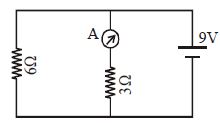
$1.6\, mA$ current is flowing in conducting wire then the number of electrons flowing per second is
Easy


Download our appand get started for free
Experience the future of education. Simply download our apps or reach out to us for more information. Let's shape the future of learning together!No signup needed.*
Similar Questions
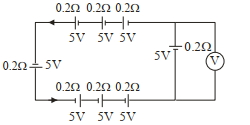
- 1The reading in the ideal voltmeter $(V)$ shown in the given circuit diagram is :View Solution
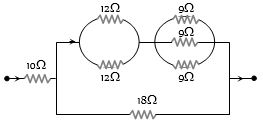
- 2In the following circuit, $18\,\Omega $ resistor develops $2\,J/sec$ due to current flowing through it. The power developed across $10\,\Omega $ resistance is .............. $W$View Solution
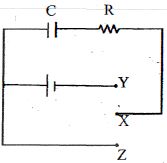
- 3The capacitor $C$ is initially without charge.$X$ is now j oined to $Y$ for a long time, during which $H_1$ heat is produced in the resistance $R$. $X-Y$ connection is removed and $X$ is now joined to $Z$ for a long time, during which heat $H_2$ is produced in $R$.View Solution
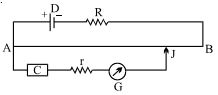
- 4In the given potentiometer circuit, the resistance of the potentiometer wire $AB$ is $R_0$. $C$ is a cell of internal resistance $r$. The galvanometer $G$ does not give zero deflection for any position of the jockey $J$. Which of the following cannot be a reason for this?View Solution
- 5Three resistances of one ohm each are connected in parallel. Such connection is again connected with $\frac{2}{3}\,\Omega $ resistor in series. The resultant resistance will be ........... $\Omega$View Solution
- 6The resistance of an electrical toaster has a temperature dependence given by $R\left( T \right) = {R_0}\left[ {1 + \alpha \left( {T - {T_0}} \right)} \right]$ in its range of operation. At ${T_0} = 300\,K,R = 100\,\Omega $ and at $T = 500\,K,\,R = 120\,\Omega $. The toaster is connected to a voltage source at $200\, V$ and its temperature is raised at a constant rate from $300$ to $500\, K$ in $30\, s$. The total work done in raising the temperature isView Solution
- 7If two wires having resistance $R$ and $2R$. Both joined in series and in parallel then ratio of heat generated in this situation, applying the same voltage,View Solution
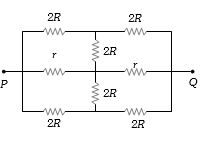
- 8The effective resistance between points $P$ and $Q$ of the electrical circuit shown in the figure isView Solution
- 9If you are provided three resistances $2 \,\Omega$, $3 \,\Omega$ and $6 \,\Omega$. How will you connect them so as to obtain the equivalent resistance of $4 \,\Omega$View Solution
- 10In the figure shown, if the internal resistance of the battery is $1\, ohm$, the reading of the ammeter will be ............... $A$View Solution