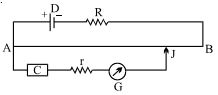
In the given potentiometer circuit, the resistance of the potentiometer wire $AB$ is $R_0$. $C$ is a cell of internal resistance $r$. The galvanometer $G$ does not give zero deflection for any position of the jockey $J$. Which of the following cannot be a reason for this?
Medium


Download our appand get started for free
Experience the future of education. Simply download our apps or reach out to us for more information. Let's shape the future of learning together!No signup needed.*
Similar Questions
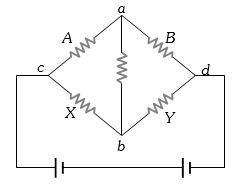
- 1In the Wheatstone's bridge (shown in figure) $X = Y$ and $A > B$. The direction of the current between ab will beView Solution
- 2Consider a block of conducting material ofresistivity '$\rho$' shown in the figure. Current '$I$' enters at '$A$' and leaves from '$D$'. We apply superp osition principle to find voltage '$\Delta V$ ' developed between '$B$' and '$C$'. The calculation is done in the following steps:View Solution
$(i)$ Take current '$I$' entering from '$A$' and assume it to spread over a hemispherical surface in the block.
$(ii)$ Calculatefield $E(r)$ at distance '$r$' from $A$ by using Ohm's law $E = \rho j$, where j is the current per unit area at '$r$'.
$(iii)$ From the '$r$' dependence of $E(r)$, obtain the potential $V(r)$ at $r$.
$(iv)$ Repeat $(i), (ii)$ and $(iii)$ for current '$I$' leaving '$D$' and superpose results for '$A$' and '$D$'.For current entering at $A$, the electric field at a distance '$r$'
from $A$ is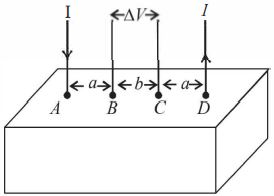
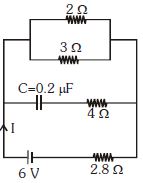
- 3In the given figure the steady state current $I$ is ................. $\mathrm{A}$View Solution
- 4A piece of wire of resistance $4\, ohms$ is bent through $180^o$ at its mid point and the two halves are twisted together, then the resistance is ............ $ohms$View Solution
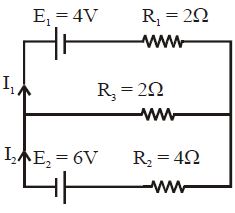
- 5In the circuit shown : $E_1 = 4.0\ V, R_1 = 2 \ \Omega,$$ E_2 = 6.0\ V, R_2 = 4\ \Omega$ and $R_3 = 2\ \Omega.$ The current $I_1$ is : ................ $A$View Solution
- 6By what percentage will the illumination of the lamp decrease if the current drops by $20 \%$ ?View Solution
- 7View SolutionAssertion : Free electrons always keep on moving in a conductor even then no magnetic force act on them in magnetic field unless a current is passed through it.
Reason : The average velocity of free electron is zero.
- 8Two metal wires of identical dimensions are connected in series. If $\sigma _1$ and $\sigma _2$ are the conductivities of the metal wires respectively, the effective conductivity of the combination isView Solution
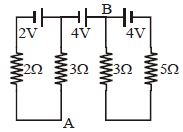
- 9In the given circuit calculate potential difference between $A$ and $B$ ............... $\mathrm{V}$View Solution
- 10A potentiometer is used for the comparison of $e.m.f.$ of two cells ${E_1}$ and ${E_2}$. For cell ${E_1}$ the no deflection point is obtained at $20\,cm$ and for ${E_2}$ the no deflection point is obtained at $30\,cm$. The ratio of their $e.m.f.$'s will beView Solution