MCQ
$2-$ Bromobutane on heating with alcoholic $KOH$ forms
  • A
    $\alpha-$ Butylene only
  • B
    $\beta-$ Butylene only
  • C
    $20\%$ of $\beta-$ Butylene $+\, 80\%$ of $\alpha-$ Butylene
  • $80\% \,\beta-$ Butylene $+ 20\%\, \alpha-$ Butylene

Answer

Correct option: D.
$80\% \,\beta-$ Butylene $+ 20\%\, \alpha-$ Butylene
d

Need a full question paper?

Generate a complete, print-ready paper with questions like this in minutes — across 16+ boards, with answer keys.

Start Generating Free

Similar questions

Statement -I: Rate of reaction for end endothermic reaction increases with increases in temperature.
Statement-II: Rate of reaction for exothermic reaction decreases with increase in temperature.
In the light of above statements, choose the most appropriate answer from the options given below.
In the dichlorination reaction of propane, mixture of products are obtained. How many isomers, the mixture contains
A nanopeptide contains …….. peptide linkages
The compound that can work both as oxidising and reducing agent is
According to law of mass action rate of a chemical reaction is proportional to
The rate constant for the first order decomposition of a certain reaction is described by the equation $\ln k\left(s^{-1}\right)=14.34-\frac{1.25 \times 10^{4} K}{T}$. The energy of activation for this reaction is
$20 \%$ of acetic acid is dissociated when its $5\,g$ is added to $500\,mL$ of water. The depression in freezing point of such water is $.....\times 10^{-3} \;{ }^{\circ} C$. Atomic mass of $C , H$ and $O$ are $12,1$ and $16\,a.m.u.$ respectively.

[Given : Molal depression constant and density of water are $1.86\, K\, kg\, mol^{-1}$ and $1\, g\, cm^{-3}$ respectively.]
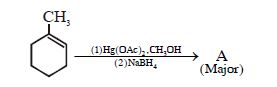
The product $(A)$ of given oxymercuration demercuration is
Calculate the half life of the first-order reaction $C_2H_4O(g) \to CH_4(g) + CO(g)$ If the initial pressure of $C_2H_4O(g)$ is $80\, mm$ and total pressure at the end of $20$ $minutes$ is $120\, mm$ .......... $\min$
Which of the following molecule contains one pair of non-bonding electrons