A particle is moving with velocity $\overrightarrow{ v }=\hat{ i }+3 \hat{ j }$ and it produces an electric field at a point given by $\overrightarrow{ E }=2 \hat{ k }$. It will produce magnetic field at that point equal to (all quantities are in SI units)
Medium
Download our app for free and get started
(a)
$\overrightarrow{ B }=\frac{\mu_0}{4 \pi} q \frac{\overrightarrow{ v } \times \overrightarrow{ r }}{ r ^3}$ and $\overrightarrow{ E }=\frac{1}{4 \pi \epsilon_0} \frac{ q \overrightarrow{ r }}{ r ^3}$
$\mu_0 \in_0(\overrightarrow{ v } \times \overrightarrow{ E })=\frac{\overrightarrow{ v } \times \overrightarrow{ E }}{ c ^2}=\frac{(\hat{ i }+3 \hat{ j }) \times 2 \hat{ k }}{ c ^2}$
$=\frac{-2 \hat{ j }+6 \hat{ i }}{ c ^2}=\frac{6 \hat{ i }-2 \hat{ j }}{ c ^2}$
$\left[c=\frac{1}{\sqrt{\mu_0 \epsilon_0}} \Rightarrow \mu_0 \in_0=\frac{1}{c^2}\right]$

Download our appand get started for free
Experience the future of education. Simply download our apps or reach out to us for more information. Let's shape the future of learning together!No signup needed.*
Similar Questions
- 1Two infinite length wires carries currents $8A$ and $6A$ respectively and placed along $X$ and $Y$-axis. Magnetic field at a point $P\,(0,\,0,\,d)\,m$ will beView Solution
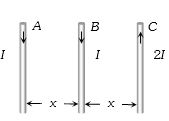
- 2$A, B$ and $C$ are parallel conductors of equal length carrying currents $I, I$ and $2I$ respectively. Distance between $A$ and $B$ is $x$. Distance between $B$ and $C$ is also $x$. ${F_1}$ is the force exerted by $B$ on $A$ and $F_2$ is the force exerted by $B$ on $A$ choose the correct answerView Solution
- 3The cyclotron frequency of an electron grating in a magnetic field of $1\, T$ is approximatelyView Solution
- 4View SolutionTwo parallel beams of electrons moving in the same direction produce a mutual force
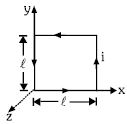
- 5The magnetic field existing in a region is given by $\vec B\, = \,{B_0}\,\left( {5 + \frac{x}{l}} \right)\,\hat K$ A square loop of edge $l$ and carrying a current $i$ is placed with its edges parallel to $x-y$ axes. Find the magnitude of the net magnetic force experienced by the loopView Solution
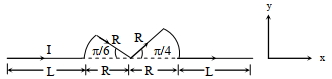
- 6A conductor (shown in the figure) carrying constant current $I$ is kept in the $x-y$ plane in a uniform magnetic field $\vec{B}$. If $F$ is the magnitude of the total magnetic force acting on the conductor, then the correct statement$(s)$ is(are) $Image$View Solution
$(A)$ If $\vec{B}$ is along $\hat{z}, F \propto(L+R)$
$(B)$ If $\overrightarrow{ B }$ is along $\hat{ x }, F =0$
$(C)$ If $\vec{B}$ is along $\hat{y}, F \propto(L+R)$
$(D)$ If $\overrightarrow{ B }$ is along $\hat{ z }, F =0$
- 7The cyclotron frequency of an electron gyrating in a magnetic field of $1\, T$ is approximatelyView Solution
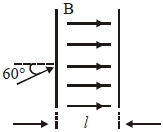
- 8The figure shows a region of length $'l'$ with a uniform magnetic field of $0.3\, T$ in it and a proton entering the region with velocity $4 \times 10^{5}\, ms ^{-1}$ making an angle $60^{\circ}$ with the field. If the proton completes $10$ revolution by the time it cross the region shown, $l$ is close to....... $m$View Solution
(mass of proton $=1.67 \times 10^{-27} \,kg ,$ charge of the proton $\left.=1.6 \times 10^{-19}\, C \right)$
- 9A closely wound flat circular coil of $25$ $turns$ of wire has diameter of $10\, cm$ and carries a current of $4\, ampere$. Determine the flux density at the centre of a coilView Solution
- 10An ammeter whose resistance is $180\,\Omega $ gives full scale deflection when current is $2\, mA$. The shunt required to convert it into an ammeter reading $20\, mA$ (in $ohms$) isView Solution