Question
$\frac{2}{3}(\text{x}-5)-\frac{1}{4}(\text{x}-2)-\frac{9}{2}$

Answer

$\frac{2}{3}(\text{x}-5)-\frac{1}{4}(\text{x}-2)-\frac{9}{2}$
$\Rightarrow\frac{2}{3}\text{x}-\frac{10}{3}-\frac{1}{4}\text{x}+\frac{1}{2}=\frac{9}{2}$
$\Rightarrow\frac{2}{3}\text{x}-\frac{1}{4}\text{x}-\frac{10}{3}+\frac{1}{2}=\frac{9}{2}$
$\frac{8\text{x} - 3\text{x}-40+6=54}{12}=\frac{9}{2}$
$(L.C.M.$ of $3, 4, 2 = 12)$$5\text{x}=-34=\frac{9\times12}{2}=9\times6=54$
$5\text{x}-34=54$ (Adding $34$ to both sides)
$5\text{x}-34+34=54+34$
$\Rightarrow5\text{x}=88$
$\Rightarrow\text{x}=\frac{88}{5}$
Verification:
$\text{L.H.S.}=\frac{2}{3}(\text{x}-5)-\frac{1}{4}(\text{x}-2)$
$=\frac{2}{3}\Big(\frac{88}{5}-5\Big)-\frac{1}{4}\Big(\frac{88}{5}-2\Big)$
$=\frac{2}{3}\Big(\frac{88 - 25}{5}\Big)-\frac{1}{4}\Big(\frac{88-10}{5}\Big)$
$=\frac{2}{3}\times\frac{63}{5}-\frac{1}{4}\times\frac{78}{5}$
$=\frac{42}{5}-\frac{39}{10}$
$=\frac{84-39}{10}=\frac{45}{10}=\frac{9}{2}=\text{R.H.S.}$

Need a full question paper?

Generate a complete, print-ready paper with questions like this in minutes — across 16+ boards, with answer keys.

Start Generating Free

Similar questions

Construct a quadrilateral $ABCD$, given that $AB = 8\ cm, BC = 8\ cm, CD = 10\ cm, AD = 10 \ cm$ and $\angle\text{A}=45^\circ.$
The following table shows the number of illiterate persons in the age group ($10–58$ years) in a town. Represent the given data by means of a histogram.
Age group (in years) $10-18$ $18-26$
$26-34$
$34-42$
$42-50$
$50-58$
Number of illiterate persons $175$ $325$
$100$
$150$
$250$
$525$
Hint. Take $1$ small division $= 5$ persons.
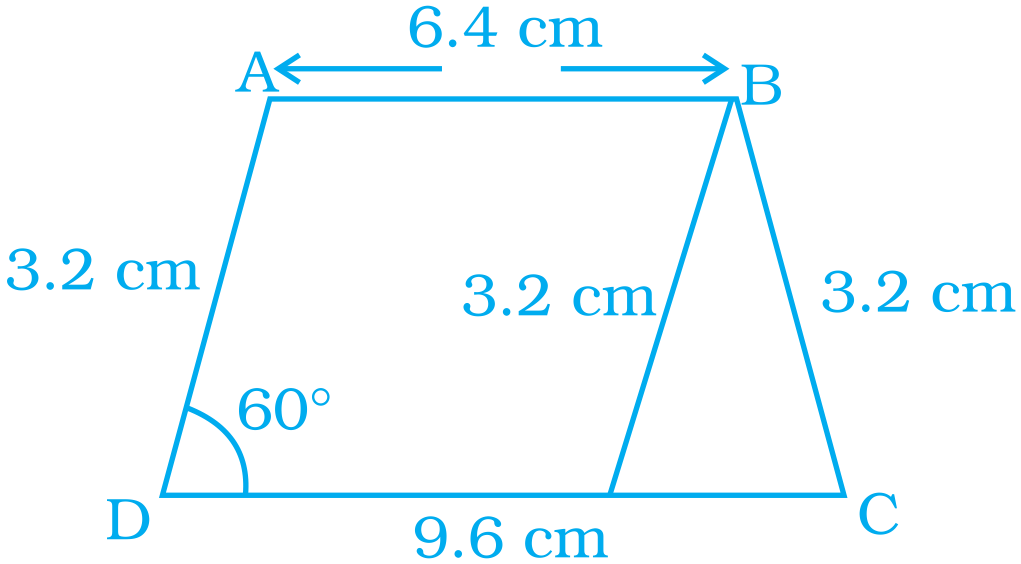
Construct a trapezium $\text{ABCD}$ where $\ce{AB \| CD, AD = BC = 3.2\ cm, AB = 6.4\ cm}$ and $\ce{CD = 9.6\ cm}$.
Measure $\angle\text{B}\ \text{and}\ \angle\text{A}.$

$[$Hint: Difference of two parallel sides gives an equilateral triangle.$]$
Construct a quadrilateral $ABCD$ given $BC = 6.6\ cm, CD = 4.4\ cm, AD = 5.6\ cm$ and $\angle\text{C}=100^\circ$ and $\angle\text{C}=95^\circ.$
Work out the following multiplication.
$\underline{\ \ \ \ \ 12345679\\\ \ \ \ \ \ \ \ \ \times\ \ \ \ \ 9 }\\\underline{\ \ \ \ \ \ \ \ \ \ \ \ \ \ \ \ \ \ \ \ \ \ }$
Use the result to answer the following questions.​​​​​​
$a.$ What will be $12345679 \times 45$?
$b.$ What will be $12345679 \times 63$?
$c.$ By what number should $12345679$ be multiplied to get $888888888$?
$d.$ By what number should $12345679$ be multiplied to get $999999999$?
Verify the division algorithm i.e., Dividend = Divisor $\times $ Quotient + Remainder, in the following. Also write the quotient and remainder.
Dividend: $6y^5+ 4y^4+ 4y^3+ 7y^2+ 27y + 6$
Divisor: $2y^3+ 1$
Draw a rhombus $\text{ABCD}$, if $\text{AB} = 6\ cm$ and $\text{AC} = 5\ cm$.
Solve the following equation and verify your answer: $\frac{7\text{x}-2}{5\text{x}-1}=\frac{7\text{x}+3}{5\text{x}+4}$
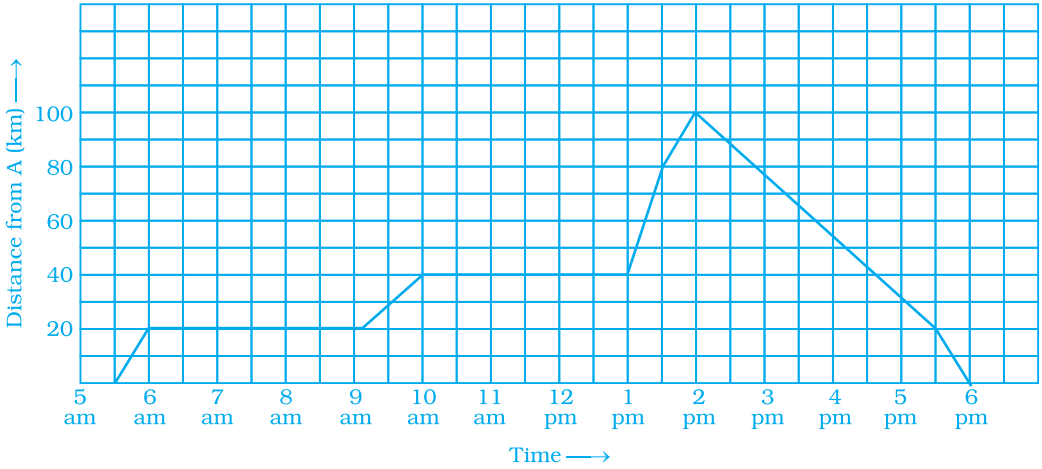
A man started his journey on his car from location $A$ and came back. The given graph shows his position at different times during the whole journey.

$a.$ At what time did he start and end his journey?
$b.$ What was the total duration of journey?
$c.$ Which journey, forward or return, was of longer duration?
$d.$ For how many hours did he not move?
$e.$ At what time did he have the fastest speed?
Verify the following: $\Big(\frac{-9}{5}\times\frac{-10}{3}\Big)\times\frac{21}{-4}=\frac{-9}{5}\times\Big(\frac{-10}{3}\times\frac{21}{-4}\Big)$