Question
Verify the division algorithm i.e., Dividend = Divisor $\times $ Quotient + Remainder, in the following. Also write the quotient and remainder.
Dividend: $6y^5+ 4y^4+ 4y^3+ 7y^2+ 27y + 6$
Divisor: $2y^3+ 1$
Answer


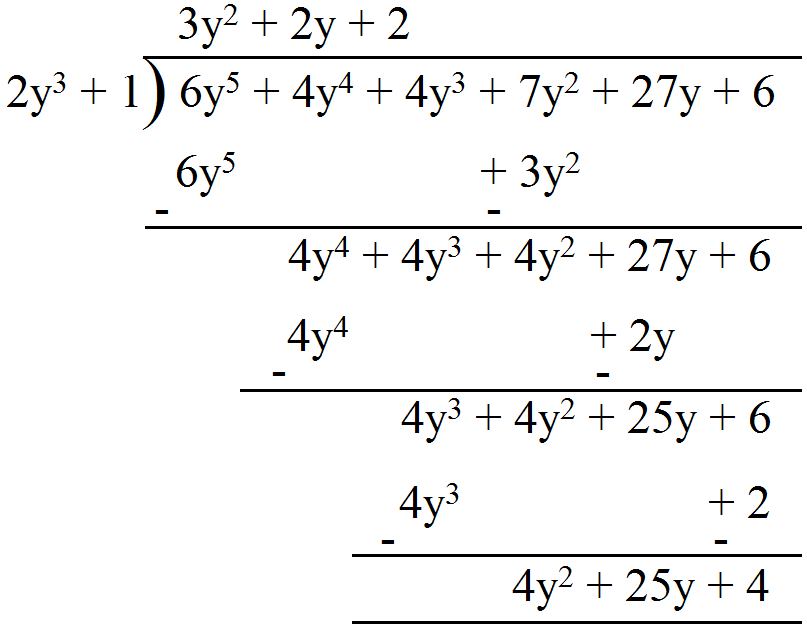
Quotient $= 3y^2+ 2y + 2$
Remainder $= 4y^2+ 25y + 4$
Divisor $= 2y^3+ 1$
Divisor $\times $ Quotient + Remainder $= (2y^2+ 1)(3y^2+ 2y + 2) + 4y^2+ 25y + 4$
$ =6 y^5+4 y^4+4 y^3+3 y^2+2 y+2+4 y^2+25 y+4 $
$ =6 y^5+4 y^4+4 y^3+7 y^2+27 y+6 $
= Dividend
Divisor $\times $ Quotient + Remainder = Dividend
Hence verified.

Need a full question paper?

Generate a complete, print-ready paper with questions like this in minutes — across 16+ boards, with answer keys.

Start Generating Free

Similar questions

Verify the division algorithm i.e., Dividend = Divisor $\times $ Quotient + Remainder, in the following. Also write the quotient and remainder.
Dividend: $6y^5- 28y^2+ 30y - 9$
Divisor: $2y^2- 6$
Solve the following equation and also check your result in case: $\frac{3\text{a}-2}{3}=\frac{2\text{a}+3}{2}=\text{a}+\frac{7}{6}$
Find the amount and the compound interest on $Rs. 3000$ for $2$ years at $10\%$ per annum.
Draw a circle of radius $3\ cm$ and draw its diameter and label it as $\text{AC}$. Construct its perpendicular bisector and let it intersect the circle at $B$ and $D$. What type of quadrilateral is $\text{ABCD}$? Justify your answer.
In the figure, suppose it is known that $DE = DF$. Then is $\triangle\text{ABC}$isosceles? Why or why not?
The table given below shows the distances, in kilometres, between four villages of a state. To find the distance between two villages, locate the square where the row for one village and the column for the other village intersect.
$a.$ Compare the distance between Himgaon and Rawalpur to Sonapur and Ramgarh?
$b.$ If you drove from Himgaon to Sonapur and then from Sonapur to Rawalpur, how far would you drive?
Perform the following divisions.
(i) $\left(3 p q r-6 p^2 q^2 r^2\right)÷ 3 p q$
(ii) $\left(a x^3-b x^2+c x\right)÷ (-d x)$
(iii) $\left(x^3 y^3+x^2 y^3-x y^4 + x y\right)÷x y$
(iv) $(-q r x y+p r y z-n y z)÷ (-x y z)$
Simplify: $ (2.5 p-1.5 q)^2-(1.5 p-2.5 q)^2 $
Construct a quadrilateral $PQRS$ in which $PQ = 5.4\ cm, QR = 4.6\ cm, RS = 4.3\ cm, SP = 3.5\ cm$ and diagonal $PR = 4\ cm.$
Construct a quadrilateral $ABCD$, where $AB = 4.2\ cm, BC = 3.6\ cm, CD = 4.8\ cm$, $\angle\text{B}=30^\circ$ and $\angle\text{C}=150^\circ.$