A galvanometer of resistance $100\,\Omega $ has $50\, divisions$ on its scale and has sensitivity of $20\,\mu A / division$. It is to be converted to a voltmeter with three ranges, of $0-2\, V$, $0-10\, V$ and $0-20\, V$. The appropriate circuit to do so is
JEE MAIN 2019, Diffcult
Download our app for free and get started
$20 \times 50 \times 10^{-6}=10^{-3}\, \mathrm{Amp}$
$\mathrm{v}_{1}=\frac{2}{10^{-3}}=100+\mathrm{R}_{1}$
$1900=\mathrm{R}_{1}$
$\mathrm{V}_{2}=\frac{10}{10^{-3}}=\left(2000+\mathrm{R}_{2}\right)$
$\mathrm{R}_{2}=8000$
$\mathrm{V}_{3}=\frac{20}{10^{-3}}=10 \times 10^{3}+\mathrm{R}_{3}=10 \times 10^{3} \mathrm{R}_{3}$

Download our appand get started for free
Experience the future of education. Simply download our apps or reach out to us for more information. Let's shape the future of learning together!No signup needed.*
Similar Questions
- 1A circular coil of $500$ turns encloses an area of $0.04 \,m^2.$ A uniform magnetic field of induction $0.25\, Wb/m^2$ is applied perpendicular to the plane of the coil. The coil is rotated by $90^o$ in $0.1$ second at a constant angular velocity about one of its diameters. A galvanometer of resistance $25\Omega$ was connected in series with the the coil. The total charge that will pass through the galvanometer is.......$C$View Solution
- 2A galvanometer of resistance $G$ is converted into a voltmeter of range $0-1\, V$ by connecting a resistance $R _{1}$ in series with it. The additional resistance that should be connected in series with $R _{1}$ to increase the range of the voltmeter to $0-2\, V$ will beView Solution
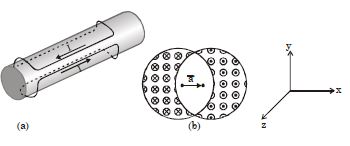
- 3To produce a uniform magnetic field directed parallel to a diameter of a cylindrical region, one can use the saddle coils illustrated in figure. The loops are wrapped over a somewhat flattened tube. Assume the straight sections of wire are very long. The end view of the tube shows how the windings are applied. The overall current distribution is the superposition of two overlapping,circular cylinders of uniformly distributed current, one toward you and one away from you. The current density $J$ is the same for each cylinder. The position of the axis of one cylinder is described by a position vector a relative to the other cylinder. The magnetic field inside the hollow tube is.View Solution
- 4The maximum velocity to which a proton can be accelerated in a cyclotron of $10\, MHz$ frequency and radius $50\, cm$ isView Solution
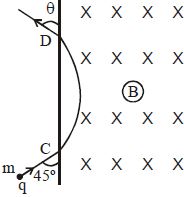
- 5A particle of mass $m = 1.67 \times 10^{-27}\, kg$ and charge $q = 1.6 \times 10^{-19} \, C$ enters a region of uniform magnetic field of strength $1$ $tesla$ along the direction shown in the figure. The speed of the particle is $10^7\, m/s.$ The magnetic field is directed along the inward normal to the plane of the paper. The particle enters the field at $C$ and leaves at $D.$ Then the angle $\theta$ must be :-.........$^o$View Solution
- 6The magnetic moment of an electron $(e)$ revolving in an orbit around nucleus with an orbital angular momentum is given by :View Solution
- 7View SolutionDue to the flow of current in a circular loop of radius $R$, the magnetic field produced at the centre of the loop is $B$. The magnetic moment of the loop is :-
- 8A long straight wire along the $z-$ axis carries a current $I$ in the negative $z$ direction. The magnetic field vector $\vec B$ at a point having coordinates $(x, y)$ in the $z = 0$ plane isView Solution
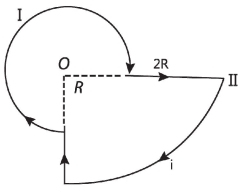
- 9Consider the circular loop having current $i$ and with central point $O$. The magnetic field at the central point $O$ isView Solution
- 10View SolutionConsider the magnetic field produced by a finitely long current carrying wire.