Question
$4.0g$ of helium occupies $22400cm^3$ at STP. The specific heat capacity of helium at constant pressure is $5.0cal-K^{-1}mol^{-1}$. Calculate the speed of sound in helium at STP.

Answer

$\mu=4\text{g}=4\times10^{-3}\text{kg},V = 22400cm^3 = 22400 \times 10^{-6}m^3$
$C_P = 5cal/mol-ki = 5 \times 4.2J/mol-k = 21J/mol-k$
$\text{C}_\text{P}=\frac{\gamma\text{R}}{\gamma-1}=\frac{\gamma\times8.3}{\gamma-1}$
$\Rightarrow21(\gamma-1)=\gamma(8.30$
$\Rightarrow21\gamma-21=8.3\gamma$
$\Rightarrow\gamma=\frac{21}{12.7}$
Since the condition is STP, $P = 1atm = 10^5pa$
$\text{V}=\sqrt{\frac{\gamma\text{f}}{\text{f}}}$
$=\sqrt{\frac{\frac{21}{12.7}\times10^5}{\frac{4\times10^{-3}}{22400\times10^{-6}}}}$
$=\sqrt{\frac{21\times10^5\times22400\times10^{-6}}{12.7\times4\times10^{-3}}}=962.28\text{m/s}$

Need a full question paper?

Generate a complete, print-ready paper with questions like this in minutes — across 16+ boards, with answer keys.
Start Generating Free

Similar questions

An optical instrument used for angular magnification has a $25D$ objective and a $20D$ eyepiece. The tube length is $25cm$ when the eye is least strained.
  1. Whether it is a microscope or a telescope?
  2. What is the angular magnification produced?
A train, standing in a station-yard, blows a whistle of frequency $400Hz$ in still air. The wind starts blowing in the direction from the yard to the station with a speed of $10m s^{–1}$. What are the frequency, wavelength, and speed of sound for an observer standing on the station’s platform? Is the situation exactly identical to the case when the air is still and the observer runs towards the yard at a speed of $10m s^{–1}$? The speed of sound in still air can be taken as $340m s^{–1}$.
A block of mass m slips on a rough horizontal table under the action of a horizontal force applied to it. The coefficient of friction between the block and the table is $\mu.$ The table does not move on the floor. Find the total frictional force applied by the floor on the legs of the table. Do you need the friction coefficient between the table and the floor or the mass of the table?
Find the expression for kinetic energy, potential energy and total energy of a particle executing SHM.
Define conservative and non-conservative forces and also describe their examples.
Two masses of 90kg and 160kg are at a distance 5m apart. Compute the magnitude of intensity of the gravitational field at a point distance 3m from the 90kg and 4m from the 160kg mass. $G = 6.67 \times 10^{-11}Nm^2kg^{-2}$.
An air bubble of radius $2.0mm$ is formed at the bottom of a $3.3m$ deep river. Calculate the radius of the bubble as it comes to the surface. Atmospheric pressure = $1.0 \times 10^5 Pa$ and density of water = $1000kg/m^{-3}$.
A train, standing at the outer signal of a railway station blows a whistle of frequency $400Hz$ in still air.
  1. What is the frequency of the whistle for a platform observer when the train (a) approaches the platform with a speed of $10m s^{–1}$, (b) recedes from the platform with a speed of $10m s^{–1}$?
  2. What is the speed of sound in each case? The speed of sound in still air can be taken as $340m s^{–1}$.
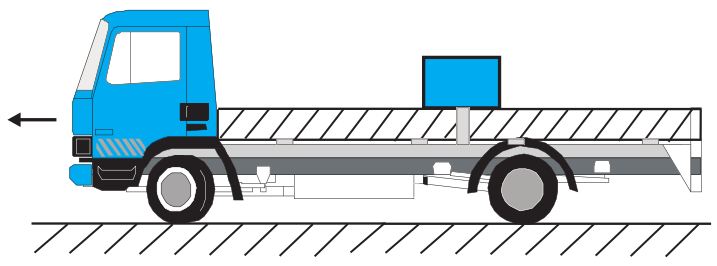
The rear side of a truck is open and a box of $40kg$ mass is placed 5m away from the open end as shown in Fig. The coefficient of friction between the box and the surface below it is $0.15$. On a straight road, the truck starts from rest and accelerates with $2ms^{-2}$. At what distance from the starting point does the box fall off the truck? (Ignore the size of the box).
A proton projected in a magnetic field of $0.020T$ travels along a helical path of radius $5.0cm$ and pitch $20cm$. Find the components of the velocity of the proton along and perpendicular to the magnetic field. Take the mass of the proton = $1.6 \times 10^{-27}kg$