Question
Define conservative and non-conservative forces and also describe their examples.

Answer

self

Need a full question paper?

Generate a complete, print-ready paper with questions like this in minutes — across 16+ boards, with answer keys.
Start Generating Free

Similar questions

A circular loop of string rotates about its axis on a frictionless horizontal plane at a uniform rate so that the tangential speed of any particle of the string is v. If a small transverse disturbance is produced at. a point of the loop, with what speed (relative to the string) will this disturbance travel on the string?
Two discs of moments of inertia $I_1$ and $I_2$ about their respective axes (normal to the disc and passing through the centre), and rotating with angular speed $\omega_1$ and $\omega_2$ are brought into contact face to face with their axes of rotation coincident.
  1. Does the law of conservation of angular momentum apply to the situation? why?
  2. Find the angular speed of the two-disc system.
  3. Calculate the loss in kinetic energy of the system in the process.
  4. Account for this loss.
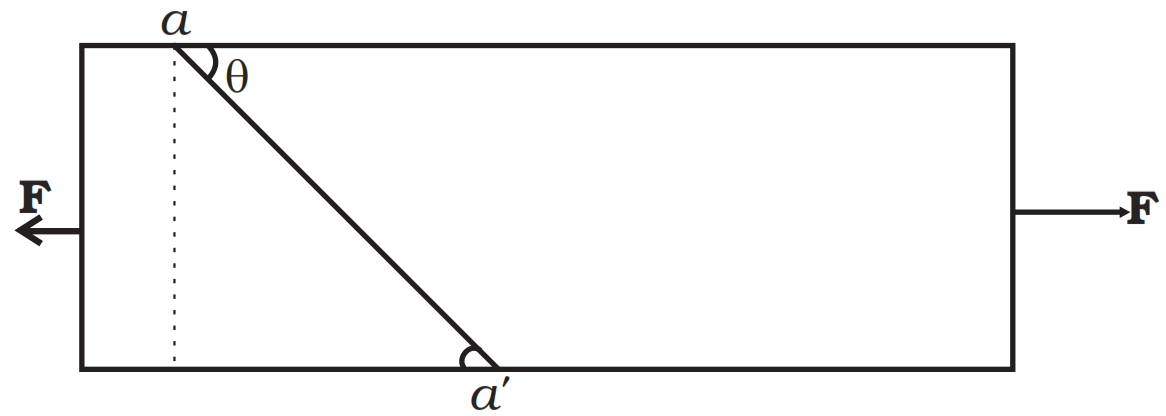
Consider a long steel bar under a tensile stress due to forces F acting at the edges along the length of the bar. Consider a plane making an angle $\Delta$ with the length. What are the tensile and shearing stresses on this plane?
  1. For what angle is the tensile stress a maximum?
  2. For what angle is the shearing stress a maximum?
A copper calorimeter of mass $100$ g contains $200$ g of a mixture of ice and water. Steam at $100^{\circ} \mathrm{C}$ under normal pressure is passed into the calorimeter and the temperature of the mixture is allowed to rise to $50^{\circ} \mathrm{C}$. If the mass of the calorimeter and its contents is now $330$ g , what was the ratio of ice and water in the beginning? Neglect heat losses. Given. Specific heat capacity of copper $0.42 \times 10^3 \mathrm{~J} / \mathrm{kg}^{-1} \mathrm{~K}^{-1}$ Specific heat capacity of water $=4.2 \times 10^3 \mathrm{~J} / \mathrm{kg}^{-}$ ${ }^1 \mathrm{~K}^{-1}$ Latent heat of fusion of ice $=3.36 \times 10^5 \mathrm{~J} / \mathrm{kg}^{-1}$ Latent heat of condensation of steam $=22.5 \times 10^5 \mathrm{~J} / \mathrm{kg}^{-1}$
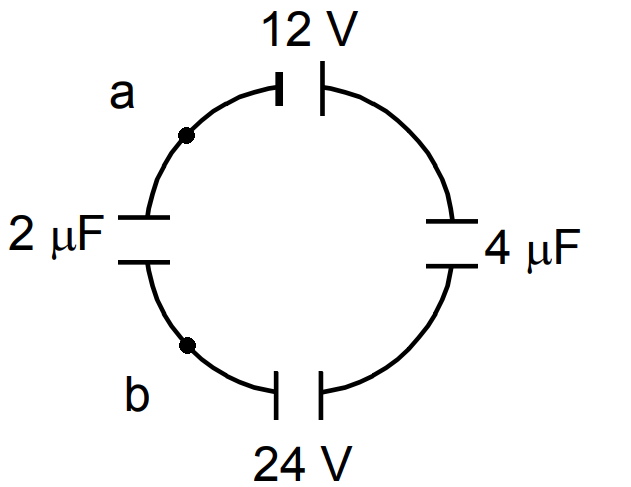
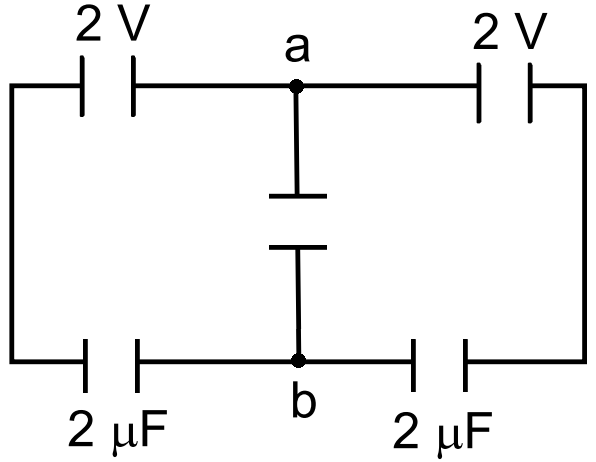
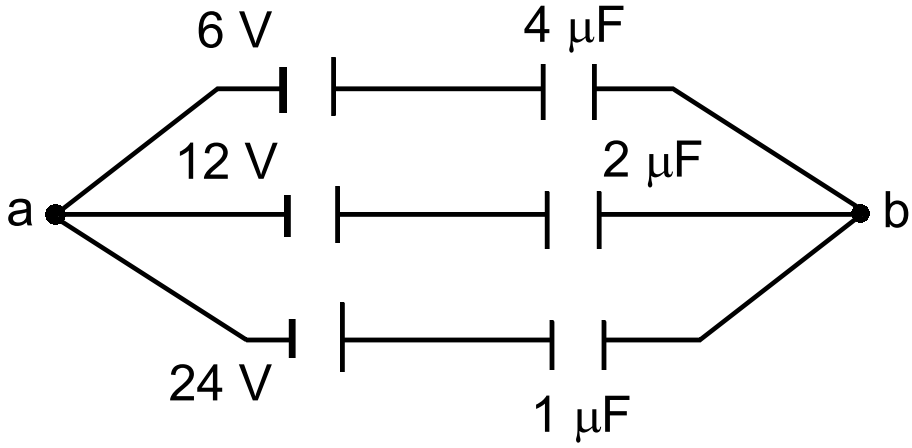
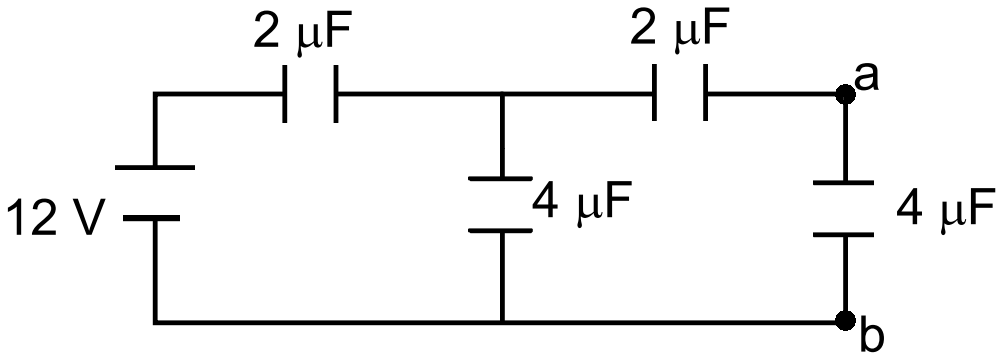
Find the potential difference $V_a - V_b$ between the points a and b shown in each part of the figure.


  1. Define critical velocity of liquid flow and state the factors affecting the critical velocity of liquid.
  2. Define terminal velocity. Establish an expression for it for a spherical body falling through a viscous medium.
A Carnot engine is working between ice point and steam point. It is desired to increase its efficiency by $20\%$ (a) by changing temperature of hot reservoir alone, (b) by changing temperature of colder reservoir only. Calculate the change in temperature in each case.
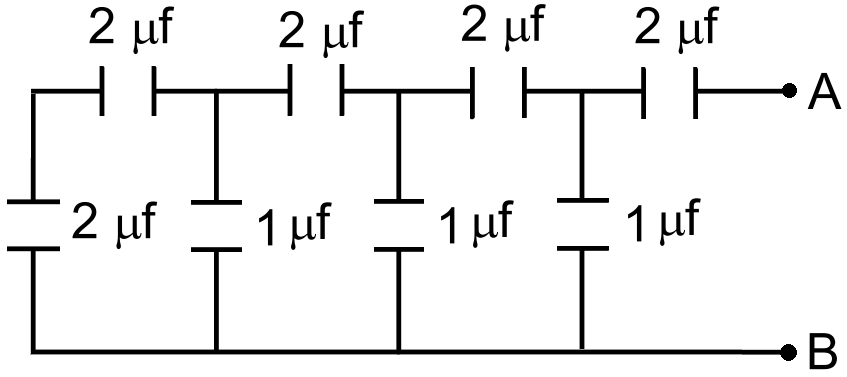
Find the capacitance of the combination shown in figure between A and B.
Derive the following equations of motion for uniformly accelerated motion from velocity$-$time graph $($symbols have their usual meaning$)$ :
  1. $\text{v}=\text{u}+\text{at}$
  2. $\text{s}=\text{ut}+\frac{1}{2}\text{at}^2$
  3. $\text{v}^2-\text{u}^2=2\text{as}$
A proton goes undeflected in a crossed electric and magnetic field (the fields are perpendicular to each other) at a speed of $2.0 \times 10^5ms^{-1}$. The velocity is perpendicular to both the fields. When the electric field is switched off, the proton moves along a circle of radius $4.0cm$. Find the magnitudes of the electric and magnetic fields. Take the mass of the proton = $1.6 \times 10^{-27}kg$