$62.5 \times {10^{18}}$ electrons per second are flowing through a wire of area of cross-section $0.1\,{m^2}$, the value of current flowing will be ............ $A$
Easy


Download our appand get started for free
Experience the future of education. Simply download our apps or reach out to us for more information. Let's shape the future of learning together!No signup needed.*
Similar Questions
- 1A copper wire of resistance $R$ is cut into ten parts of equal length. Two pieces each are joined in series and then five such combinations are joined in parallel. The new combination will have a resistanceView Solution
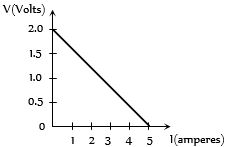
- 2For a cell, the graph between the potential difference $(V) $ across the terminals of the cell and the current $(I)$ drawn from the cell is shown in the figure. The $e.m.f.$ and the internal resistance of the cell areView Solution
- 3Two bulbs consume same power when operated at $200\, V$ and $300\, V$ respectively. When these bulbs are connected in series across a $D.C$. source of $500\, V$, thenView Solution
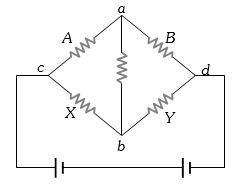
- 4In the Wheatstone's bridge (shown in figure) $X = Y$ and $A > B$. The direction of the current between ab will beView Solution
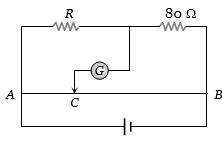
- 5$AB$ is a wire of uniform resistance. The galvanometer $G$ shows no current when the length $AC = 20\,cm$ and $CB = 80\, cm$. The resistance $R$ is equal to .............. $\Omega $View Solution
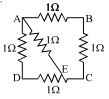
- 6$ABCD$ is a square where each side is a uniform wire of resistance $1\,\Omega$ . $A$ point $E$ lies on $CD$ such that if a uniform wire of resistance $1\,\Omega$ is connected across $AE$ and constant potential difference is applied across $A$ and $C$ then $B$ and $E$ are equipotential.View Solution
- 7View SolutionThe lead wires should have
- 8Two electric bulbs whose resistances are in the ratio of $1 : 2$ are connected in parallel to a constant voltage source. The powers dissipated in them have the ratioView Solution
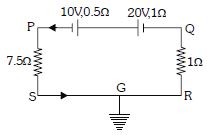
- 9View SolutionIn the circuit shown in the figure below, which of the following statement is incorrect ?
- 10Coefficient of linear expansion of material of resistor is $\alpha$. Its temperature coefficient of resistivity and resistance are $\alpha_\rho$ and $\alpha_R$ respectively, then correct relation isView Solution