$64$ drops of mercury each charged to a potential of $10\,V$. They are combined to form one bigger drop. The potential of this drop will be.......$V$ (Assume all the drops to be spherical)
Easy


Download our appand get started for free
Experience the future of education. Simply download our apps or reach out to us for more information. Let's shape the future of learning together!No signup needed.*
Similar Questions
- 1The work done to take an electron from rest where potential is $-60\, V$ to another point where potential is $-20\, V$ is given by.....$eV$View Solution
- 2Four metal conductors having different shapesView Solution
$1.$ A sphere $2.$ Cylindrical
$3.$ Pear $4.$ Lightning conductor
are mounted on insulating stands and charged. The one which is best suited to retain the charges for a longer time is
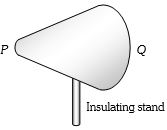
- 3Figure shows a charged conductor resting on an insulating stand. If at the point $P$ the charge density is $\sigma $, the potential is $V$ and the electric field strength is $E$, what are the values of these quantities at point $Q$View Solution
Charge density potential Electric intensity
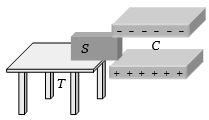
- 4A frictionless dielectric plate $S$ is kept on a frictionless table $T$. A charged parallel plate capacitance $C$ (of which the plates are frictionless) is kept near it. The plate $S$ is between the plates. When the plate $S$ is left between the platesView Solution
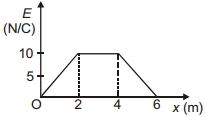
- 5Figure shows the variation of electric field intensity $E$ versus distance $x$. What is the potential difference between the points at $x=2 \,m$ and at $x=6 \,m$ from $O$ is ............. $V$View Solution
- 6View SolutionIf two conducting spheres are separately charged and then brought in contact
- 7Combination of two identical capacitors, a resistor $R$ and a $DC$ voltage source of voltage $6\; V$ is used in an experiment on $C-R$ circuit. It is found that for a parallel combination of the capacitor the time in which the voltage of the fully charged combination reduces to half its original voltage is $10\; s$. For series combination the time needed for reducing the voltage of the fully charged series combination by half isView Solution
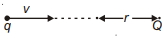
- 8The charge $q$ is fired towards another charged particle $Q$ which is fixed, with a speed $v$. It approaches $Q$ upto a closest distance $r$ and then returns. If $q$ were given a speed $2 v$, the closest distance of approach would beView Solution
- 9A charge $( - q)$ and another charge $( + Q)$ are kept at two points $A$ and $B$ respectively. Keeping the charge $( + Q)$ fixed at $B$, the charge $( - q)$ at $A$ is moved to another point $C$ such that $ABC$ forms an equilateral triangle of side $l$. The net work done in moving the charge $( - q)$ isView Solution
- 10The escape speed of an electron launched from the surface of a glass sphere of diameter $1\ cm$ that has been charged to $10\ nC$ is $x \times 10^7\ m/sec$ . The value of $x$ isView Solution