Figure shows a charged conductor resting on an insulating stand. If at the point $P$ the charge density is $\sigma $, the potential is $V$ and the electric field strength is $E$, what are the values of these quantities at point $Q$
Charge density potential Electric intensity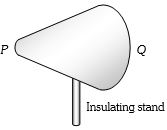
Medium
Download our app for free and get started
(d) The surface of the conductor is an equipotential surface since there is free flow of electrons within the conductor. Thus potential at $Q$ is the same as that at $ P$. That is ${V_P} = {V_Q} = V.$ The electric field $E$ at a point on the equipotential surface of the conductor is inversely proportional to the square of the radius of curvature $r$ at that point. That is $E \propto {r^{ - 2}}$
Since point $Q$ has a larger radius of curvature than that at point $P$, the electric field at $Q$ is less than that at $P$. That is ${E_Q} < {E_P} = E$
Since point $Q$ has a larger radius of curvature than that at point $P$, the electric field at $Q$ is less than that at $P$. That is ${E_Q} < {E_P} = E$

Download our appand get started for free
Experience the future of education. Simply download our apps or reach out to us for more information. Let's shape the future of learning together!No signup needed.*
Similar Questions
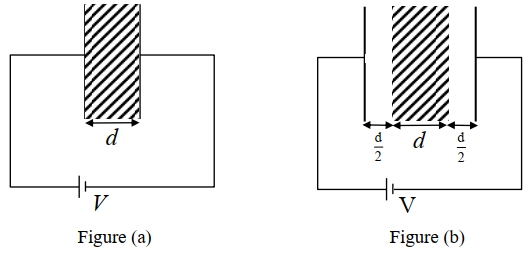
- 1A medium having dielectric constant $K>1$ fills the space between the plates of a parallel plate capacitor. The plates have large area, and the distance between them is $d$. The capacitor is connected to a battery of voltage $V$. as shown in Figure ($a$). Now, both the plates are moved by a distance of $\frac{d}{2}$ from their original positions, as shown in Figure ($b$).View Solution
In the process of going from the configuration depicted in Figure ($a$) to that in Figure ($b$), which of the following statement($s$) is(are) correct?
- 2View SolutionAdielectric slab is inserted between the plates of an isolated charged capacitor. Which of the following quantities will remain the same?
- 3View SolutionThree identical capacitors are combined differently. For the same voltage to each combination, the one that stores the greatest energy is
- 4A uniform electric field pointing in positive $x$-direction exists in a region. Let $A$ be the origin, $B$ be the point on the $x$-axis at $x = + 1$ $cm$ and $C$ be the point on the $y$-axis at $y = + 1\,cm$. Then the potentials at the points $A$, $B$ and $C$ satisfyView Solution
- 5$0.2\,F$ capacitor is charged to $600\,V$ by a battery. On removing the battery, it is connected with another parallel plate condenser of $1\,F$. The potential decreases to.........$volts$View Solution
- 6During charging a capacitor variation of potential $V$ of the capacitor with time $t$ is shown asView Solution
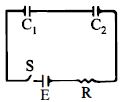
- 7In the following circuit, the switch $S$ is closed at $t = 0.$ The charge on the capacitor $C_1$ as a function of time will be given by $\left( {{C_{eq}}\, = {\kern 1pt} \,\frac{{{C_1}{C_2}}}{{{C_1} + {C_2}}}} \right).$View Solution
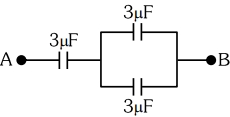
- 8The equivalent capacitance of the system shown in the following circuit is $...........\mu F$View Solution
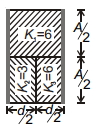
- 9View SolutionThree different dielectrics are filled in a parallel plate capacitor as shown. What should be the dielectric constant of a material, which when fully filled between the plates produces same capacitance?
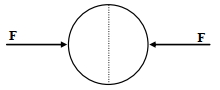
- 10A uniformly charged thin spherical shell of radius $\mathrm{R}$ carries uniform surface charge density of $\sigma$ per unit area. It is made of two hemispherical shells, held together by pressing them with force $\mathrm{F}$ (see figure). $\mathrm{F}$ is proportional toView Solution