The escape speed of an electron launched from the surface of a glass sphere of diameter $1\ cm$ that has been charged to $10\ nC$ is $x \times 10^7\ m/sec$ . The value of $x$ is
Medium


Download our appand get started for free
Experience the future of education. Simply download our apps or reach out to us for more information. Let's shape the future of learning together!No signup needed.*
Similar Questions
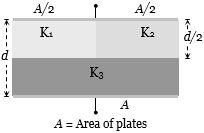
- 1A parallel plate capacitor of area $A$, plate separation $d$ and capacitance $C$ is filled with three different dielectric materials having dielectric constants ${k_1},{k_2}$ and ${k_3}$ as shown. If a single dielectric material is to be used to have the same capacitance $C$ in this capacitor, then its dielectric constant $k$ is given byView Solution
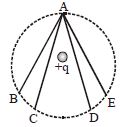
- 2In the electric field of a point charge $q$, a certain charge is carried from point $A$ to $B, C, D$ and $E$. Then the work doneView Solution
- 3The capacitance of a parallel plate capacitor with air as medium is $6\, \mu F$. With the introduction of a dielectric medium, the capacitance becomes $30\, \mu F$. The permittivity of the medium is..........$C ^{2} N ^{-1} m ^{-2}$View Solution
$\left(\varepsilon_{0}=8.85 \times 10^{-12} C ^{2} N ^{-1} m ^{-2}\right)$
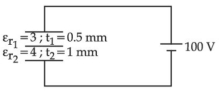
- 4A composite parallel plate capacitor is made up of two different dielectric materials with different thickness $\left(t_{1}\right.$ and $\left.t_{2}\right)$ as shown in figure. The two different dielectric material are separated by a conducting foil $F$. The voltage of the conducting foil is $.....V$View Solution
- 5View SolutionConsider a finite insulated, uncharged conductor placed near a finite positively charged conductor. The uncharged body must have a potential
- 6View SolutionIf a charge is shifted from a low potential region to high potential region, the electric potential energy
- 7The electric potential at a point in free space due to charge $Q$ coulomb is $V=Q$$ \times {10^{11}}\,V$ . The electric field at that point isView Solution
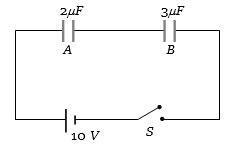
- 8Two capacitors $A$ and $B$ are connected in series with a battery as shown in the figure. When the switch $S$ is closed and the two capacitors get charged fully, thenView Solution
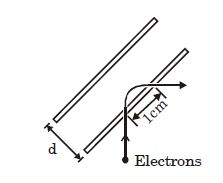
- 9A problem of practical interest is to make a beam of electrons turn at $90^o$ corner. This can be done with the electric field present between the parallel plates as shown in the figure. An electron with kinetic energy $8.0 × 10^{-17}\ J$ enters through a small hole in the bottom plate. The strength of electric field that is needed if the electron is to emerge from an exit hole $1.0\ cm$ away from the entrance hole, traveling at right angles to its original direction is $y × 10^5\ N/C$ . The value of $y$ isView Solution
- 10Two capacitances of capacity ${C_1}$ and ${C_2}$ are connected in series and potential difference $V$ is applied across it. Then the potential difference across ${C_1}$ will beView Solution