Question

Image

Answer

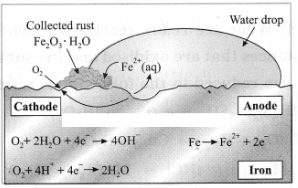
The rusting of iron is an oxidation process. The rust on iron does not form by a simple reaction between oxygen and iron surface. The rust is formed by an electrochemical reaction. Fe oxidises to $Fe _2 O _3 . H _2 O$ on one part of iron surface while oxygen gets reduced to $H _2 O$ on another part or surface, Different regions on the surface of iron become anode and cathode.
(1) $Fe$ is oxidised to $Fe ^{2+}$ in the anode region.
$
Fe _{( s )} \rightarrow Fe ^{2+}{ }_{( aq )}+2 e ^{-}
$
(2) $O _2$ is reduced to form water in the cathode region.
$
O _{2(g)}+4 H ^{+}( aq )+4 e -\rightarrow 2 H _2 O _{(1)}
$
When $Fe ^{2+}$ ions migrate from the anode region they react with water and futher get oxidised to form $Fe ^{3+}$ ions.
A reddish coloured hydrated oxide is formed from $Fe ^{3+}$ ions. It is called rust. It collects on the
surface.
$2 Fe ^{3+}( aq )+4 H _2 O _{( l )} \rightarrow Fe _2 O _3 \cdot H _2 O _{( s )}+6 H ^{+}( aq ) \cdots$
Because of various components in the atmosphere, oxidation of metals takes place, consequently resulting in their damage. This is called 'corrosion'. Iron rusts and a reddish coloured layer is formed on it. This is corrosion of iron.

Need a full question paper?

Generate a complete, print-ready paper with questions like this in minutes — across 16+ boards, with answer keys.
Start Generating Free

Similar questions

How do we decide that a given material is a good conductor of electricity or is an insulator?
Name the following diagram and explain the concept behind them.

Image
Mock Drill is useful.
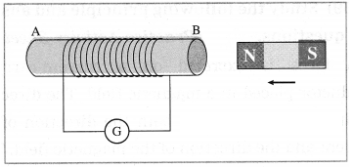
Take a coil AB having 10-15 turns. Connect the two ends of the coil to the galvanometer as shown in Figure. Take a strong bar magnet. (1) Move the north pole of the magnet towards the end B of the coil.
Image

Observe the deflection of the pointer in the galvanometer. Note the direction of the deflection (i.e. right or left). (2) Now repeat this with the south pole of the magnet towards the end B of the coil. Again observe the deflection. Note its direction. (3) What will happen if instead of the magnet, the coil is moved? (4) If both the coil and the magnet are kept stationary, do you observe any deflection? (5) Compare the direction of the deflection when the north pole of the magnet is moved towards the end B of the coil with that when the end B of the coil is moved away from the north pole of the magnet. (6) What conclusions do you draw from the observations?
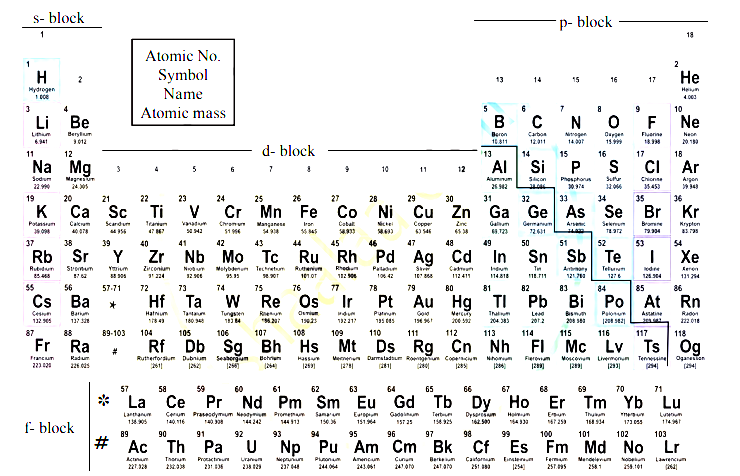
Observe the periodic table given below and write the answers of the questions.

  1. Write the name and valencies of the elements in 3rd row.
  2. Classify the elements in this row as metal, nonmetal and metalloids.
  3. Which block does nonmetals belong to?
  4. Write name of any two metalloid elements.
Describe the human male reproductive system.
what is the periodic trend in the variation of valency while going from left to right within a period? Explain your answer with reference to period 2 and period 3.
On the basis of structure of disaster - management authority, form the same for your school.
Write short note: Cybercrimes.
Source Microbe Amino acid Use
Sugar and beet molasses, ammonia salt ___________________ ___________________ Production of monosodium glutamate (Ajinomoto).
___________________ Aspergillus niger ___________________ Drinks, toffees, chocolate production.
Glucose, corn steep liquor ___________________ Gluconic acid ___________________
Molasses, corn steep liquor Lactobacillus delbrueckii ___________________ ___________________
___________________ Aspergillus itaconius Itaconic acid ___________________