MCQ
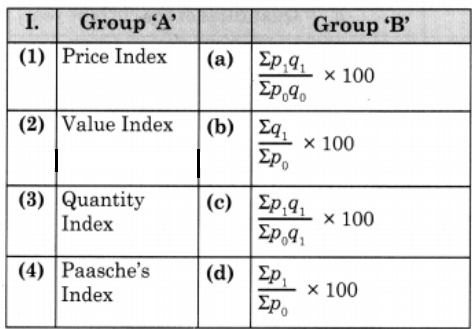
- A(1) – d, (2) – c, (3) – a, (4) – b
- ✓(1) – d, (2) – a, (3) – b, (4) – c
- C(1) – b, (2) – c, (3) – d, (4) – a
- D(1) – c, (2) – d, (3) – a, (4) – b
Generate a complete, print-ready paper with questions like this in minutes — across 16+ boards, with answer keys.
| Group ‘A’ | Group ‘B’ |
| Expenditure Method | Inventory method |
| GDP | C + I + G + (X-M) + (R-P) |
| National income | Micro economic concept |
| Unpaid services | Services of housewife |
| Group ‘A’ | Group ‘B’ |
| (1) Joint Demand | (a) Luxury car |
| (2) Demand and price | (b) Exception to the law of demand |
| (3) Giffen’s goods | (c) Inverse relationship |
| (4) Prestige goods | (d) Several commodities |
| (e) Vegetables |
| Group ‘A’ | Group ‘B’ |
| 1. Individual supply | Potential supply |
| 2. Determinants of law of supply | Infrastructural facilities |
| 3. Assumption of the law of supply | Change in government policy |
| Group ‘A’ | Group ‘B’ |
| 1. Ordinal measurement | (a)Maximum TU |
| 2. Principles of Economics | (b) $M U_X>P_X$ |
| 3. Point of satiety | (c) Prof. Alfred Marshall |
| 4. Consumer’s equilibrium | (d) Grading of utility |
| (e) $M U_X>P_X$ |
| Group ‘A’ | Group ‘B’ |
| Three sector economy | Households, business firms, foreign sector |
| National income | Money value of final goods and services |
| Output method | Income method |
| NNP | GDP – Depreciation |
| Group ‘A’ | Group ‘B’ |
| 1. $MC_n$ | $TC_n – TC_{n-1}$ |
| 2. TR | Q/P |
| 3. AR | TR x TQ |
| Group ‘A’ | Group ‘B’ |
| (1) Factors of production | (a) Change in price alone |
| (2) Inferior goods | (b) Change in other factors |
| (3) Pen and Pencil | (c) Substitute goods |
| (4) Change in Demand | (d) Giffen’s goods |
| (e) Indirect demand |
| Group ‘A’ | Group ‘B’ |
| (1)Macro | (a) Slicing method |
| (2) Micro | (b) Classical economist |
| (3) Adam Smith | (c) Neo-classical economist |
| (4) Prof. Marshall | (d) Inflation |
| (e)Lumping method |
| Group ‘A’ | Group ‘B’ |
| National Income Committee | 1956 |
| Financial year | 1st April to 31st March |
| Income Method | NI = Rent + Wages + Interest + Profit + MI + (X-M) |
| Expenditure Method | NI + C + I + G + (X – M) |