Question

Image
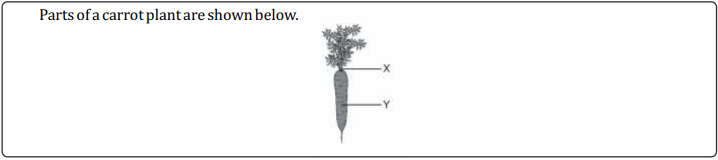
$8.$ Label the parts $‘X’$ and $‘Y’$

Answer

$8.$ Mentions $‘X’$ as stem and $‘Y’$ as root.
● $X –$ Stem
● $Y –$ Root


Need a full question paper?

Generate a complete, print-ready paper with questions like this in minutes — across 16+ boards, with answer keys.
Start Generating Free

Similar questions


Image
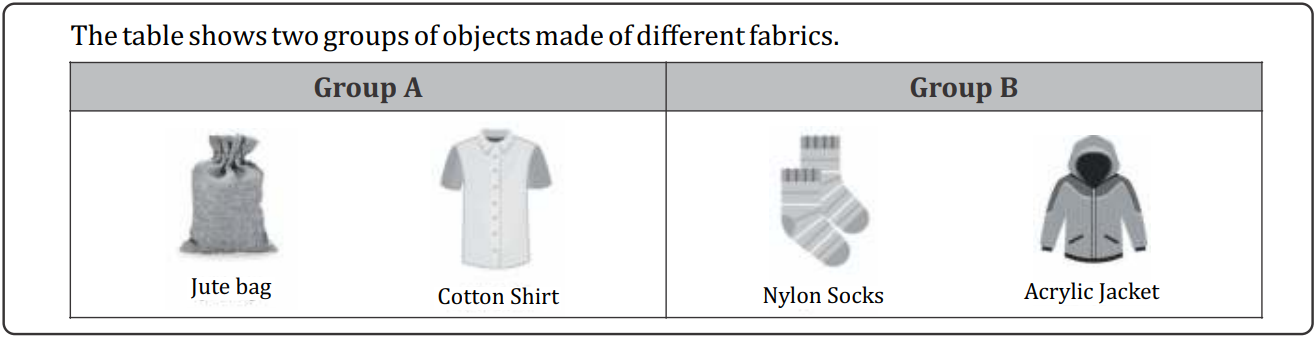
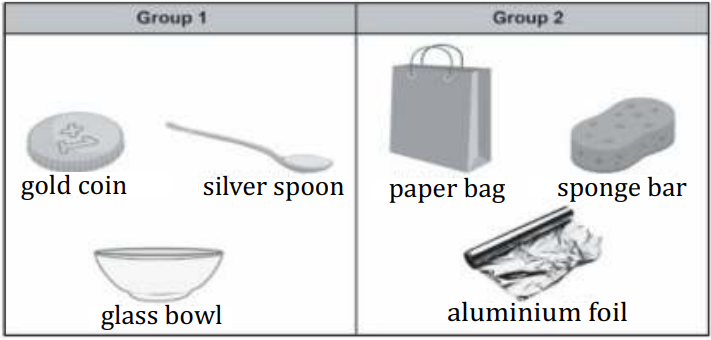
$1.$ Which property was used to sort the objects in two groups?
He pours one spoon of dye on each fabric.
He then washes the fabrics with the same detergent.
Atul has four different fabrics.
The table shows what he inds after the wash.
Silk Acrylic Nylon Cotton
Light stain No stain No stain Light stain
$10.$ Which question can be answered through Atul’s activity?

Image
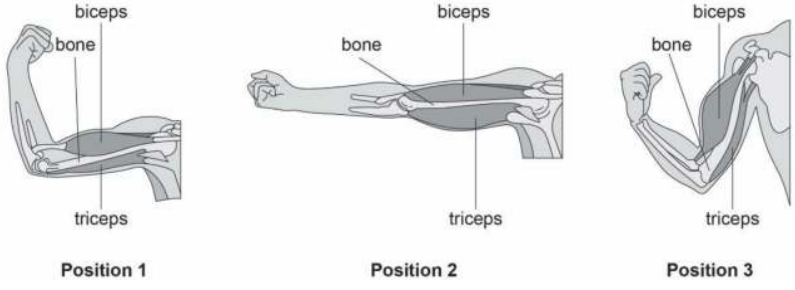
$7.$ In which position are the biceps most contracted?
$8.$ Which of these statements is true?
$A.$ The largest muscles of the human body are located in the arms.
$B.$ Bending of arms is controlled by muscles only.
$C.$ The muscles located in the arm have a ixed shape.
$D.$ Bending of arms involves the contraction and relaxation of a pair of muscles.
Idhant wanted to ind out which type of food his rabbit likes the most.
He offered different kinds of food to his rabbit for ive days.
Idhant noted the food item that his rabbit chose to eat every day.
Day Food given to the rabbit Food item chosen by the rabbit
Day $1$ Spinach and carrot Carrot
Day $2$ Grass and carrot Grass
Day $3$ Carrot and pineapple Carrot
Day $4$ Grass and carrot Grass
Day $5$ Pineapple and strawberry Pineapple
$10$.Which food item did the rabbit like the most?
Which ibre comes from an animal?
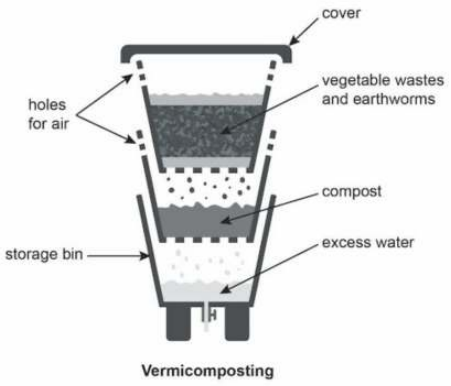
Vermicomposting is a process of recycling degradable waste.
Earthworms breakdown the waste into compost that can be use as manure.
The diagram shows the details of the process.
Image
$8.$ Which of these statements is true about vermicomposting?
$A.$ It breaks down waste naturally.
$B.$ It produces harmful substances.
$C.$ It requires the presence of light.
$D.$ It takes place in the absence of oxygen
$9.$ Why does vermicomposting require moist condition and moderate temperatures?
__________________________________________________________________________________________________________________________________________________________
$10.$ Which of these is true for the excess water obtained from vermicomposting?
$A.$ It contains earthworms.
$B.$ It is rich in mineral nutrients.
$C.$ It contains vegetable waste.
$D.$ It does not contain microorganisms.
Vitamin $D$ helps our body to use calcium for bones and teeth.
Human body produces vitamin $D$ when exposed to both sunlight and high temperatures.
$10.$Which type of climate is most likely to cause vitamin $D$ deiciency in humans?
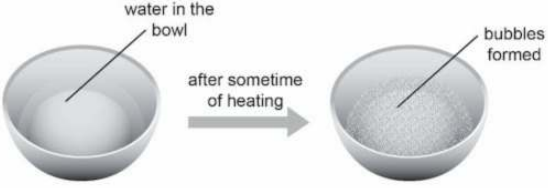
Ravi ills a steel vessel with water and starts heating it on an oven.
He notices small bubbles at the bottom of the vessel after some time.Image
$5.$ Where do the bubbles come from?
Image
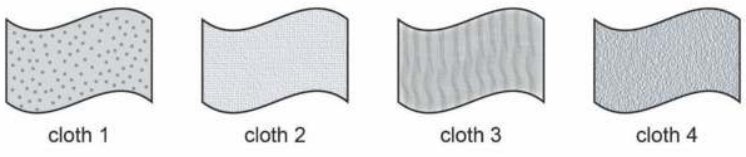
$3.$Which feature was used to group the fabrics?
$A.$ Shiny/Dull
$B.$ Rough/Smooth
$C.$ Natural/Synthetic
$D.$ Animal ibre/Plant ibre
$4.$What is the correct sequence for making cotton shirt from cotton balls?
$A.$ Fabric spun into fibres $\rightarrow $Fibres woven into yarn
$B.$ Fibres spun into yarn $\rightarrow $Yarn woven into fabric
$C.$ Yarn woven into fabric $\rightarrow $ Fabric spun into fibres
$D.$ Yarn knitted into fibres$ \rightarrow $ Fibres woven into fabric
$5.$Which part of a cotton plant is used to obtain cotton balls?
$A.$ Fruit
$B.$ Stem
$D.$ Leaves
$C.$ Flowers
Shilpa wanted to ind out which dye creates a permanent stain on clothes.Image

She poured one drop each of four different dyes on separate pieces of cloth.
Shilpa then washes each piece of cloth with a detergent.
The table below shows what happened after the clothes were washed.
Dye Was the stain removed after washing?
Dye $1$ yes
Dye $2$ no
Dye $3$ yes
Dye $4$ yes
$9.$ Which dye produced a permanent stain on the cloth?
$A.$ Dye$ 1$
$B.$ Dye $2$
$C.$ Dye $3$
$D.$ Dye $4$
$10.$ What must Shilpa keep the same for all the four clothes in her activity?