MCQ
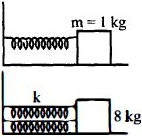
A $1 \,kg$ block attached to a spring vibrates with a frequency of $1\, Hz$ on a frictionless horizontal table. Two springs identical to the original spring are attached in parallel to an $8\, kg$ block placed on the same table. So, the frequency of vibration of the $8\, kg$ block is ..... $Hz$
  • A
    $0.25$
  • B
    $0.35$
  • $0.5$
  • D
    $2$

Answer

Correct option: C.
$0.5$
c
Frequency of spring $(f)=\frac{1}{2 \pi} \sqrt{\frac{k}{m}}=1 \mathrm{Hz}$

$\Rightarrow 4 \pi^{2}=\frac{\mathrm{k}}{\mathrm{m}}$

If block of mass $\mathrm{m}=1 \mathrm{kg}$ is attached then, $k=4 \pi^{2}$

Now, identical springs are attached in parallel with mass

$\mathrm{m}=8 \mathrm{kg}$, Hence, $k_{e q}=2 k$

$f^{\prime}=\frac{1}{2 \pi} \sqrt{\frac{\mathrm{k} \times 2}{8}}=\frac{1}{2} \mathrm{Hz}$

Need a full question paper?

Generate a complete, print-ready paper with questions like this in minutes — across 16+ boards, with answer keys.

Start Generating Free

Similar questions

In which one of the following cases will the liquid flow in a pipe be most streamlined
A planet of mass $'m'$ is moving in an elliptical orbit about the sun with time period $'T'$. If $'A'$ be the area of orbit, then its angular momentum would be
A dielectric slab is inserted between the plates of an isolated capacitor. The force between the plates will:
When an oscillator completes $100$ oscillations its amplitude reduced to $\frac{1}{3}$ of initial value. What will be its amplitude, when it completes $200$ oscillations?
If $I = 50\,kg-m^2$ , then ......... $N-m$ torque will be applied to stop it in $10\,sec$ . Its initial angular speed is $20\,rad/sec$ 
Water of volume $2$ litre in a container is heated with a coil of $1\ kW$ at $27^\circ C.$ The lid of the container is open and energy dissipates at the rate of $160 Js$ In how much time temperature will rise from $27^\circ C$ to $77^\circ C? [$Given specific heat of water $= \text{4.2kJ/kg]}$
A man of mass $m$ starts falling towards a planet of mass $M$ and radius $R.$ As he reaches near to the surface, he realizes that he will pass through a small hole in the planet. As he enters the hole, he sees that the planet is really made of two pieces a spherical shell of negligible thickness of mass $\frac{2M}{3}$ and a point  mass $\frac{M}{3}$ at the centre. Change in the force of gravity experienced by the man is
Venus looks brighter than other planets because
A particle moves for $8\, seconds$. It first accelerates from rest and then retards to rest. If the retardation be $3\, times$ the acceleration, then time for which it accelerates will be 
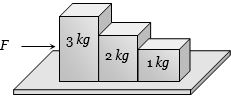
Consider the following statements about the blocks shown in the diagram that are being pushed by a constant force on a frictionless table

$A.$All blocks move with the same acceleration

$B.$The net force on each block is the same

Which of these statements are/is correct