A $10\ \mu F$ capacitor is charged to a potential difference of $1000\ V$. The terminals of the charged capacitor are disconnected from the power supply and connected to the terminals of an uncharged $6\ \mu F$ capacitor. What is the final potential difference across each capacitor.....$V$
Medium
Download our app for free and get started
(c) After charging, total charge on the capacitor $Q = CV$
$= 10 \times 10^{-6} \,F \times 1000 V = 10^{-2} \,C.$
Common potential $V = \frac{{{C_1}{V_1}}}{{{C_1} + {C_2}}}$$ = \frac{{{{10}^{ - 2}}}}{{16 \times {{10}^{ - 6}}}}= 625\,V.$
$= 10 \times 10^{-6} \,F \times 1000 V = 10^{-2} \,C.$
Common potential $V = \frac{{{C_1}{V_1}}}{{{C_1} + {C_2}}}$$ = \frac{{{{10}^{ - 2}}}}{{16 \times {{10}^{ - 6}}}}= 625\,V.$

Download our appand get started for free
Experience the future of education. Simply download our apps or reach out to us for more information. Let's shape the future of learning together!No signup needed.*
Similar Questions
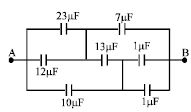
- 1Find the equivalent capacitance across $A$ and $B$......$\mu F$View Solution
- 2A spherical drop of mercury having a potential of $2.5\, V$ is obtained as a result of merging $125$ droplets. The potential of constituent droplets would be........$V$View Solution
- 3The distance between the plates of a parallel plate condenser is $\,4mm$ and potential difference is $60\;volts$. If the distance between the plates is increased to $12\,mm$, thenView Solution
- 4Consider a spherical shell of radius $R$ with a total charge $+ Q$ uniformly spread on its surface (centre of the shell lies at the origin $x=0$ ). Two point charges $+q$ and $-q$ are brought, one after the other from far away and placed at $x=-a / 2$ and $x=+a / 2( < R)$, respectively. Magnitude of the work done in this process isView Solution
- 5View SolutionThe true statement is, on increasing the distance between the plates of a parallel plate condenser
- 6The capacitance of an air filled parallel plate capacitor is $10\,p F$. The separation between the plates is doubled and the space between the plates is then filled with wax giving the capacitance a new value of $40 \times {10^{ - 12}}farads$. The dielectric constant of wax isView Solution
- 7A capacitor of capacitance $C_1 = 1\ \mu F$ can with stand maximum voltage $V_1= 6\ kV$ (kilo-volt) and another capacitor of capacitance $ C_2 = 3\ \mu F$ can withstand maximum voltage $V_2 = 4\ kV$. When the two capacitors are connected in series, the combined system can withstand a maximum voltage of......$kV$View Solution
- 8Assertion : If the distance between parallel plates of a capacitor is halved and dielectric constant is three times, then the capacitance becomes $6\,times$.View Solution
Reason : Capacity of the capacitor does not depend upon the nature of the material.
- 9A capacitor has capacitance $5 \mu F$ when it's parallel plates are separated by air medium of thickness $d$. A slab of material of dielectric constant $1.5$ having area equal to that of plates but thickness $\frac{ d }{2}$ is inserted between the plates. Capacitance of the capacitor in the presence of slab will be $..........\mu F$View Solution
- 10$512$ identical drops of mercury are charged to a potential of $2\, V$ each. The drops are joined to form a single drop. The potential of this drop is ......... $V.$View Solution