$512$ identical drops of mercury are charged to a potential of $2\, V$ each. The drops are joined to form a single drop. The potential of this drop is ......... $V.$
JEE MAIN 2021, Diffcult
Download our app for free and get started
$Q =512 q$
Volume $_{i}=$ Volume $_{f}$
$512 \times \frac{4}{3} \pi r^{3}=\frac{4}{3} \pi R^{3}$
$2^{9} r ^{3}= R ^{3}$
$R =8 r$
$2=\frac{ kq }{ r }$
$V =\frac{ kQ }{ R }=\frac{ k 512 q }{8 r }$
$V =128$

Download our appand get started for free
Experience the future of education. Simply download our apps or reach out to us for more information. Let's shape the future of learning together!No signup needed.*
Similar Questions
- 1View SolutionA parallel plate capacitor is charged by connecting it to a battery. The battery is disconnected and the plates of the capacitor are pulled apart to make the separation between the plates twice. Again the capacitor is connected to the battery (with same polarity) then
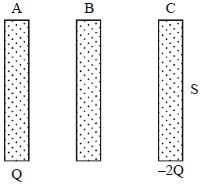
- 2Three identical metal plates with large surface areas are kept parallel to each other as shown in figure. The left most plates is given a charge $Q$ and the right most plate $C$ is given a charge $-2Q.$ The middle plate $B$ is neutral. Then the charge appearing on the outer surface $S$ of the plate $C$ is :-View Solution
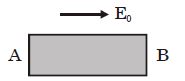
- 3View SolutionA metallic rod is placed in a uniform electric field. Select the correct option.
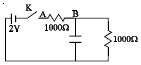
- 4In the circuit shown, when the key $k $ is pressed at time $t = 0$, which of the following statements about current $I$ in the resistor $AB $ is trueView Solution
- 5Within a spherical charge distribution of charge density $\rho \left( r \right)$, $N$ equipotential surfaces of potential ${V_0},{V_0} + \Delta V,{V_0} + 2\Delta V,$$.....{V_0} + N\Delta V\left( {\Delta V > 0} \right),$ are drawn and have increasing radii $r_0, r_1, r_2,......r_N$, respectively. If the difference in the radii of the surfaces is constant for all values of $V_0$ and $\Delta V$ thenView Solution
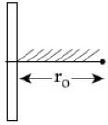
- 6A positive point charge is released from rest at a distance $r_0$ from a positive line charge with uniform density. The speed $(v)$ of the point charge, as a function of instantaneous distance $r$ from line charge, is proportional toView Solution
- 7Two capacitors of $10\,\mu \,F$ and $20\,\mu \,F$ are connected in series with a $30\,V$ battery. The charge on the capacitors will be, respectivelyView Solution
- 8The mean free path of electrons in a metal is $4 \times 10^{-8} \;m$. The electric field which can give on an average $2 \;eV$ energy to an electron in the metal will be in units of $V / m$View Solution
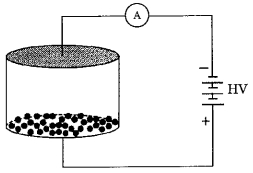
- 9Consider an evacuated cylindrical chamber of height $h$ having rigid conducting plates at the ends and an insulating curved surface as shown in the figure. A number of spherical balls made of a light weight and soft material and coated with a conducting material are placed on the bottom plate. The balls have a radius $r \ll h$. Now a high voltage source ($HV$) is connected across the conducting plates such that the bottom plate is at $+V_0$ and the top plate at $-V_0$. Due to their conducting surface, the balls will get charged, will become equipotential with the plate and are repelled by it. The balls will eventually collide with the top plate, where the coefficient of restitution can be taken to be zero due to the soft nature of the material of the balls. The electric field in the chamber can be considered to be that of a parallel plate capacitor. Assume that there are no collisions between the balls and the interaction between them is negligible. (Ignore gravity)View Solution
(image)
($1$) Which one of the following statements is correct?
($A$) The balls will stick to the top plate and remain there
($B$) The balls will bounce back to the bottom plate carrying the same charge they went up with
($C$) The balls will bounce back to the bottom plate carrying the opposite charge they went up with
($D$) The balls will execute simple harmonic motion between the two plates
($2$) The average current in the steady state registered by the ammeter in the circuit will be
($A$) zero
($B$) proportional to the potential $V_0$
($C$) proportional to $V_0^{1 / 2}$
($D$) proportional to $V_0^2$
Give the answer quetion ($1$) and ($2$)
- 10View SolutionIn the circuit shown in figure