A $1.00 \times {10^{ - 20}}kg$ particle is vibrating with simple harmonic motion with a period of $1.00 \times {10^{ - 5}}sec$ and a maximum speed of $1.00 \times {10^3}m/s$. The maximum displacement of the particle is
Medium


Download our appand get started for free
Experience the future of education. Simply download our apps or reach out to us for more information. Let's shape the future of learning together!No signup needed.*
Similar Questions
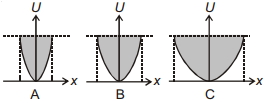
- 1The variations of potential energy $(U)$ with position $x$ for three simple harmonic oscillators $A, B$ and $C$ are shown in figure. The oscillators have same mass. The time period of oscillation is greatest forView Solution
- 2A mass $m$ is suspended from the two coupled springs connected in series. The force constant for springs are ${K_1}$ and ${K_2}$. The time period of the suspended mass will beView Solution
- 3A simple pendulum oscillating in air has period $T.$ The bob of the pendulum is completely immersed in a non-viscous liquid. The density of the liquid is $\frac {1}{16}$ of the material of the bob. If the bob is inside liquid all the time, its period of oscillation in this liquid isView Solution
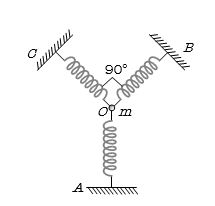
- 4A particle of mass $m$ is attached to three identical springs $A, B$ and $C$ each of force constant $ k$ a shown in figure. If the particle of mass $m$ is pushed slightly against the spring $A$ and released then the time period of oscillations isView Solution
- 5In an angular $SHM$ angular amplitude of oscillation is $\pi $ $rad$ and time period is $0.4\,sec$ then calculate its angular velocity at angular displacement $ \pi/2 \,rad$. ..... $rad/sec$View Solution
- 6A particle of mass $m$ undergoes oscillations about $x=0$ in a potential given by $V(x)-\frac{1}{2} k x^2-V_0 \cos \left(\frac{x}{a}\right)$, where $V_0, k, a$ are constants. If the amplitude of oscillation is much smaller than $a$, the time period is given byView Solution
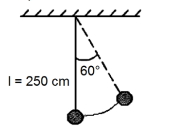
- 7A pendulum is suspended by a string of length $250\,cm$. The mass of the bob of the pendulum is $200\,g$. The bob is pulled aside until the string is at $60^{\circ}$ with vertical as shown in the figure. After releasing the bob. the maximum velocity attained by the bob will be________ $ms ^{-1}$. (if $g=10\,m / s ^{2}$ )View Solution
- 8View SolutionA flat horizontal board moves up and down in $SHM$ of amplitude $\alpha$. Then the shortest permissible time period of the vibration such that an object placed on the board may not lose contact with the board is
- 9The average speed of the bob of a simple pendulum oscillating with a small amplitude $A$ and time period $T$ isView Solution
- 10Three simple harmonic motions of equal amplitudes $A$ and equal time periods in the same direction combine. The phase of the second motion is $60^o$ ahead of the first and the phase of the third motion is $60^o$ ahead of the second. Find the amplitude of the resultant motionView Solution