Question
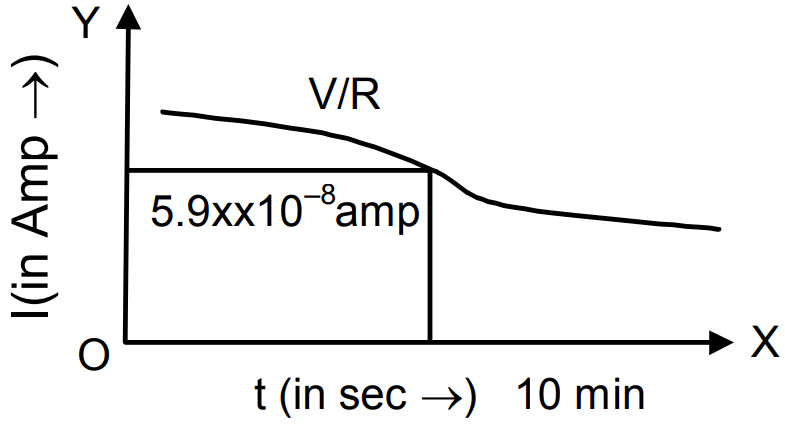
A $100\mu\text{F}$ capacitor is joined to a 24V battery through a $1.0\text{M}\Omega$ resistor. Plot qualitative graphs (a) between current and time for the first 10 minutes and (b) between charge and time for the same period.
Answer

Time constant $\text{RC} = 1 \times 10^6 \times 100 \times 10^6 = 100 \text{sec}$

  1. $\text{q}=\text{VC}\Big(1-\text{e}^{\frac{-\text{t}}{\text{CR}}}\Big)$

I = Current $=\frac{\text{dq}}{\text{dt}}=\text{VC}.(-)\text{e}^{\frac{-\text{t}}{\text{RC}}},\frac{-1}{\text{RC}}$

$=\frac{\text{V}}{\text{R}}\text{e}^{\frac{-\text{t}}{\text{RC}}}=\frac{\text{V}}{\text{R}\cdot\text{e}^{\frac{\text{t}}{\text{RC}}}}=\frac{24}{10^6}\times\frac{1}{\text{e}^{\frac{\text{t}}{100}}}$

$=24\times10^{-6}\frac{1}{\text{e}^{\frac{\text{t}}{100}}}$

$\text{t}=10\text{min},600\text{sec}.$
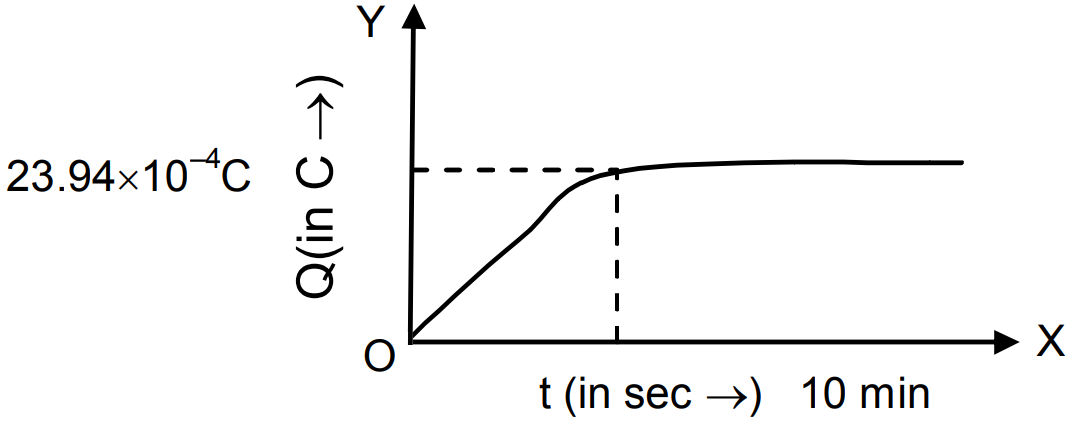
$\text{Q}=24\times10+-4\times\big(1-\text{e}^{-6}\big)=23.99\times10^{-4}$

$\text{I}=\frac{24}{10^6}\times\frac{1}{\text{e}^6}=5.9\times10^{-8}\text{Amp}.$

  1. $\text{q}=\text{VC}\Big(1-\text{e}^\frac{-\text{t}}{\text{CR}}\Big)$

Need a full question paper?

Generate a complete, print-ready paper with questions like this in minutes — across 16+ boards, with answer keys.
Start Generating Free

Similar questions

The radius of a gold nucleus (Z = 79) is about 7.0 × 10⁻¹⁵m. Assume that the positive charge is distributed uniformly throughout the nuclear volume. Find the strength of the electric field at:
  1. The surface of the nucleus.
  2. At the middle point of a radius. Remembering that gold is a conductor, is it justified to assume that the positive charge is uniformly distributed over the entire volume of the nucleus and does not come to the outer surface?
Neglect the effect of rotation of the earth. Suppose the earth suddenly stops attracting objects placed near its surface. A person standing on the surface of the earth will:
  1. Fly up.
  2. Slip along the surface.
  3. Fly along a tangent to the earth's surface.
  4. Remain standing.
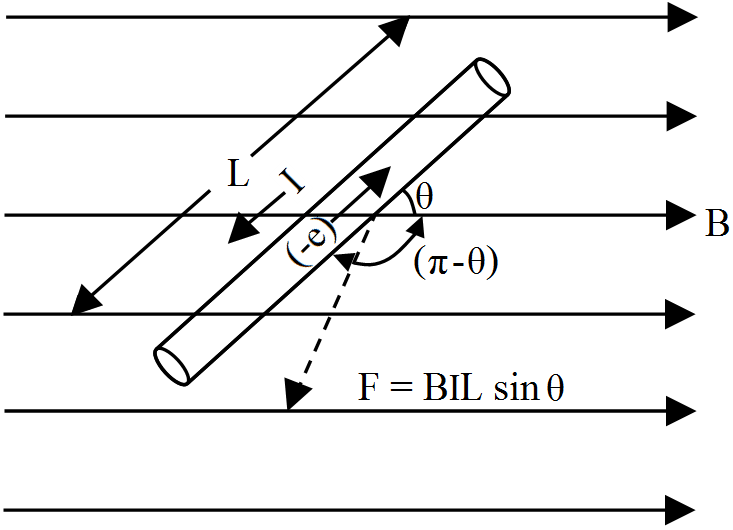
Derive an expression for the force experienced by a current carrying straight conductor placed in a magnetic field. Under what condition is this force maximum?

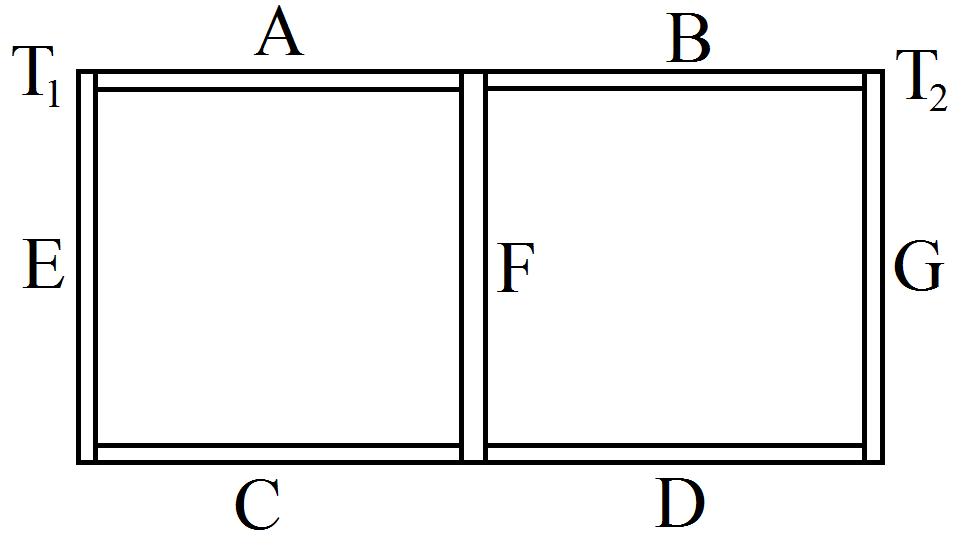
Seven rods A, B, C, D, E, F and G are joined as shown in figure. All the rods have equal cross-sectional area A and length l. The thermal conductivities of the rods are KA = Kc = K0, KB = KD = 2K0, K= 3K0, KF = 4K0, and KG = 5K0. The rod E is kept at a constant temperature T2 and the rod G is kept at a constant temperature T2(T2 > T1).

  1. Show that the rod F has a uniform temperature $\text{T}=\frac{(\text{T}_1+2\text{T}_2)}{3}.$
  2. Find the rate of heat flowing from the source which maintains the temperature T2.

When a circuit element ‘X’ is connected across an a.c. source, a current of $\sqrt{2}\text{A}$ flows through it and this current is in phase with the applied voltage. When another element ‘Y’ is connected across the same a.c. source, the same current flows in the circuit but it leads the voltage by $\frac{\pi}{2}$ radians.
  1. Name the circuit element X and Y.
  2. Find the current that flows in the circuit when the series combination of X and Y is connected across the same a.c. voltage.
  3. Net impedance.
A current of 1.0A is established in a tightly wound solenoid of radius 2cm having 1000 turns/ metre. Find the magnetic energy stored in each metre of the solenoid.
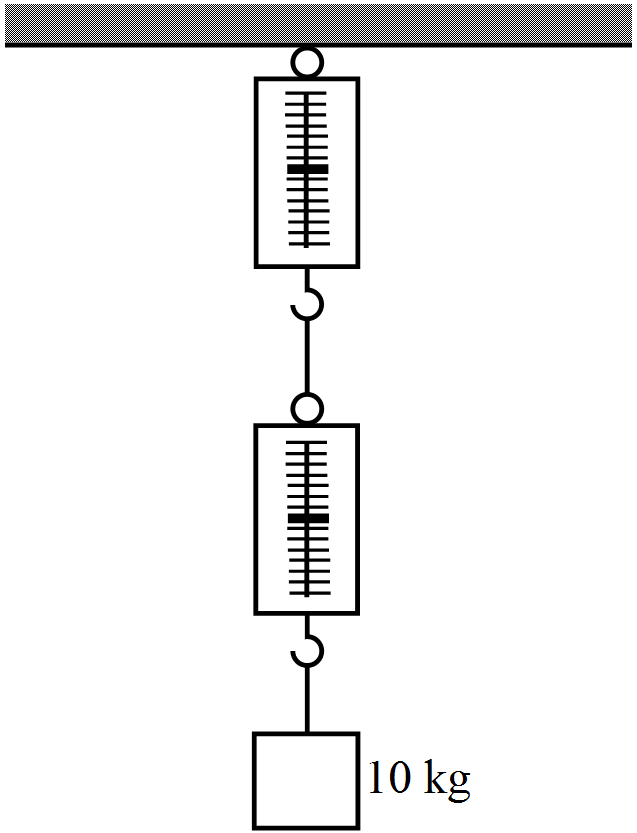
A block of mass 10kg is suspended through two light spring balances as shown in figure:

  1. Both the scales will read 10kg.
  2. Both the scales will read 5kg.
  3. The upper scale will read 10kg and the lower zero.
  4. The readings may be anything but their sum will he 10kg.
Assuming an electron is confined to a 1nm wide region , find the uncertainty in momentum using Heisenberg Uncertainty principle (Ref Eq 11.12 of NCERT Textbook). You can assume the uncertainty in position $\Delta\text{x}$ as 1nm. Assuming $\text{p}\Box\Delta\text{p}$, find the energy of the electron in electron volts.
  1. Compare the individual dipole moment and the specimen dipole moment for H2O molecule and O2 molecule when placed in:
  1. Absence of external electric field.
  2. Presence of external eclectic field. Justify your answer.
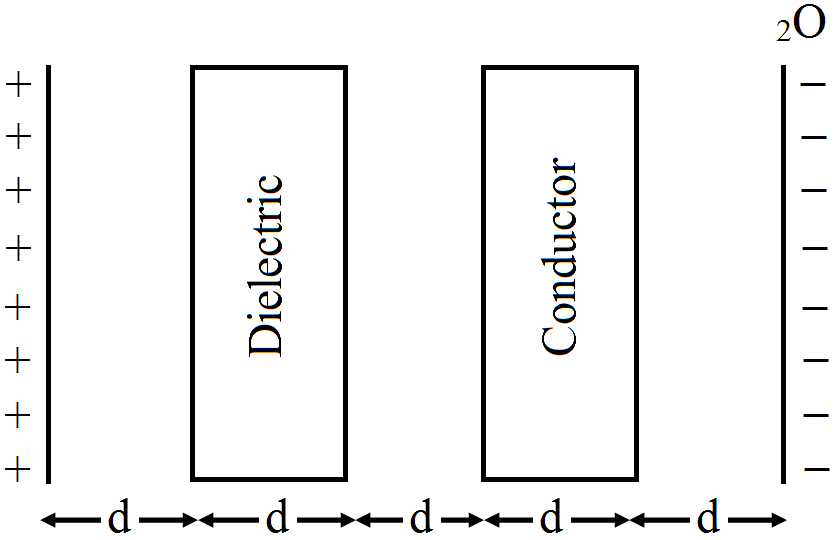
  1. Given two parallel conducting plates of area A and charge densities $+\sigma$ and $-\sigma.$ A dielectric slab of constant K and a conducting slab of thickness d each are inserted in between them as shown.

  1. Find the potential difference between the plates.
  2. Plot E versus x graph, taking x = 0 at positive plate and x = 5d at negative plate.
A $5.0\mu\text{F}$ capacitor is charged to 12V. The positive plate of this capacitor is now connected to the negative terminal of a 12V battery and vice versa. Calculate the heat developed in the connecting wires.