Question
When slow neutrons are incident on a target containing  $\frac{235}{92}\text{U},$ a possible fission reaction is $\frac{235}{92}\text{U}+_0^1\text{n}\rightarrow\frac{141}{56}\text{Ba}+\frac{92}{36}\text{Kr}+3_0\text{n}^1$
Estimate the amount of energy released using following data :
$\text{M}\Big(\frac{235}{92}\text{U}\Big)=235.04\text{amu}$
$\Big(\text{M}\frac{92}{36}\text{Kr}\Big)=91.926\text{amu}$
$\text{M}\Big(\frac{141}{56}\text{Ba}\Big)=140.91\text{amu}$
$\text{M}=1.0087\text{ amu}$
Answer

$\text{Mass of }[_{92}\text{U}^{235}+_0\text{n}^1]={236.0487}\text{ amu}$
$\text{Mass of}[{_{56}\text{Ba}^{141}}+_{36}\text{Kr}^{92}+3_0\text{n}^1]={235.8621}\text{ amu}$
Difference in mass $={0.1866}\text{amu}$
Energy released $={(0.1866)}\times{931}={173.7}\text{MeV}$

Need a full question paper?

Generate a complete, print-ready paper with questions like this in minutes — across 16+ boards, with answer keys.

Start Generating Free

Similar questions

Show that work done by a stretching force to produce certain extension in the wire is given by $\text{w}=\frac{1}{2}$ stretching force × extension. A wire that obeys Hooke's law is of length l1 when it is in equilibrium under a tension F1. Its length becomes l2 when the tension is increased to F2. Calculate the energy stored in the wire during this process.
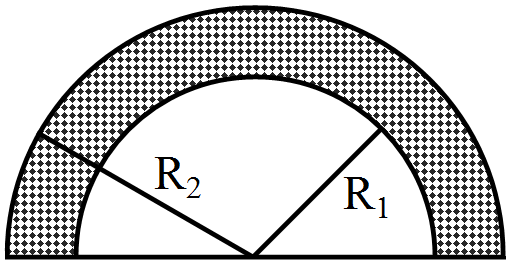
Find the centre of mass of a uniform plate having semicircular inner and outer boundaries of radii R1 and R2.

A voltmeter coil has resistance $50.0\Omega$ and a resistor of $1.15\text{k}\Omega$ is connected in series. It can read potential differences up to 12 volts. If this same coil is used to construct an ammeter that can measure currents up to 2.0A, what should be the resistance of the shunt used?
Suppose the entire system of the previous question is kept inside an elevator which is coming down with an acceleration a < g. Repeat parts (a) and (b).
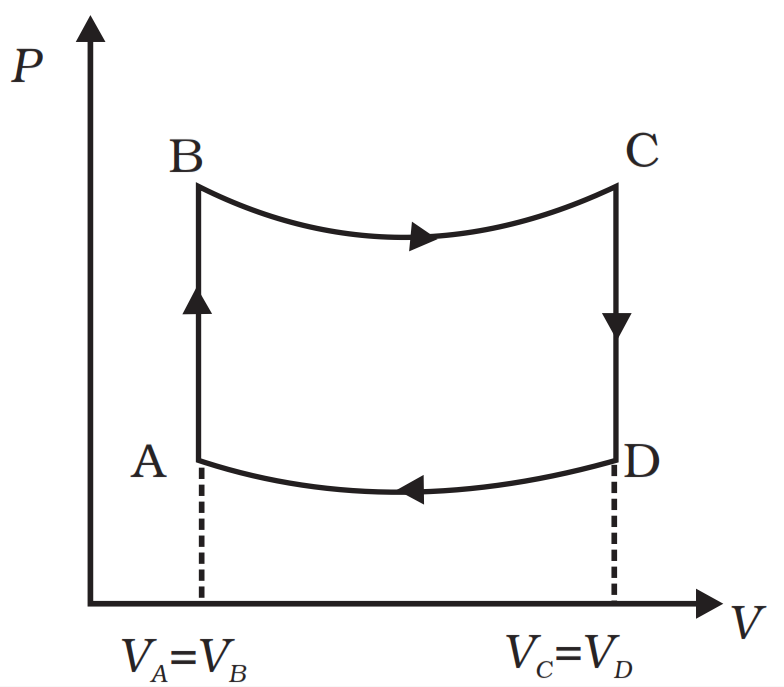
A cycle followed by an engine (made of one mole of perfect gas in a cylinder with a piston) is shown in Fig.

A to B : volume constant

B to C : adiabatic

C to D : volume constant

D to A : adiabatic

V= V= 2V= 2VB

  1. In which part of the cycle heat is supplied to the engine from outside?
  2. In which part of the cycle heat is being given to the surrounding by the engine?
  3. What is the work done by the engine in one cycle? Write your answer in term of PA, PB, VA.
  4. What is the efficiency of the engine?[$\gamma=\frac{5}{3}$ for the gas], $\big(\text{C}_\text{v}=\frac{3}{2}\text{R for one mole}\big)$
The electrical resistance in ohms of a certain thermometer varies with temperature according to the approximate law:
$\text{R}=\text{R}_0[1+\alpha(\text{T}-\text{T}_0)]$
The resistance is 101.6W at the triple-point of water 273.16K, and 165.5W at the normal melting point of lead (600.5K). What is the temperature when the resistance is 123.4W?
Two bodies with masses 10kg and 12kg are connected by a light inextensible string passing over a smooth fixed pulley. Find:
  1. the velocity at the end of 3s,
  2. the distance covered in 3s,
  3. if, at the end of 3 s the string is cut, find the distance moved by the bodies in the next 6s.
A small plane area is rotated in an electric field. In which orientation of the area is the flux of electric field through the area maximum? In which orientation is it zero?
The temperatures of equal masses of three different liquids A, B and C are 12°C, 19°C and 28°C respectively. The temperature when A and B are mixed is 16°C, and when B and C are mixed, it is 23°C. What will be the temperature when A and C are mixed?
Define conservative and non-conservative forces and also describe their examples.