$AB , A _2$ and $B _2$ are diatomic molecule. If the bond enthalpies of $A _2, B _2$ and $AB$ are in the ratio $1: 0.5: 1$, then the bond enthalpy of $A_2$ is $......\,kJ\,mol ^{-1}$ (Nearest integer)
- A$600$
- B$200$
- ✓$800$
- D$500$
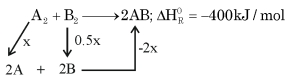
$AB , A _2$ and $B _2$ are diatomic molecule. If the bond enthalpies of $A _2, B _2$ and $AB$ are in the ratio $1: 0.5: 1$, then the bond enthalpy of $A_2$ is $......\,kJ\,mol ^{-1}$ (Nearest integer)
$\Rightarrow \Delta H _{ p }^0( AB )=-200\,kJ\,mol\,m ^{-1}$
$\therefore \Delta H _{ R }^0$ for reaction $A _2+ B _2 \rightarrow 2 AB$ is $-400\,kJ\,mol ^{-1}$
Given: Bond Enthalpy of $A _2, B _2$ and $AB$ is $1: 0.5: 1$
Assuming bond enthalpy of $A _2$ be $x\, kJ\, mol { }^{-1}$
$\therefore$ Bond enthalpy $B _2=0.5 \times kJ\, mol ^{-1}$
$\therefore$ Bond enthalpy $AB =( x ) kJ\, mol\, m ^{-1}$
$-400= x +0.5 x -2 x$
$-400=-0.5 x$
$\therefore x =800\,kJ / mol$
Generate a complete, print-ready paper with questions like this in minutes — across 16+ boards, with answer keys.
(Nearest integer)
$\left(\mathrm{h}=6.63 \times 10^{-34}\, \mathrm{Js}, \mathrm{c}=3.00 \times 10^{8} \,\mathrm{~ms}^{-1}\right)$
(Given atomic masses of $A=64 ; B=40 ; C=32 u$ )