A $25\, watt$, $220\, volt$ bulb and a $100\, watt$, $220\, volt$ bulb are connected in series across a $220\, volt$ lines. Which electric bulb will glow more brightly
Medium


Download our appand get started for free
Experience the future of education. Simply download our apps or reach out to us for more information. Let's shape the future of learning together!No signup needed.*
Similar Questions
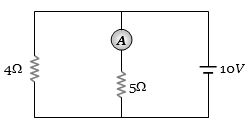
- 1if the internal resistance of the battery is $1\, ohm$, then what is the reading of ammeterView Solution
- 2In a meter bridge, the balancing length from the left end (standard resistance of $1 \,ohm$ is in the right gap) is found to be $20\, cm$. The value of the unknown resistance is ............... $\Omega$View Solution
- 3A uniform wire of resistance $9$ $\Omega$ is cut into $3$ equal parts. They are connected in the form of equilateral triangle $ABC$. A cell of $e.m.f.$ $2\,V$ and negligible internal resistance is connected across $B$ and $C$. Potential difference across $AB$ is ............... $V$View Solution
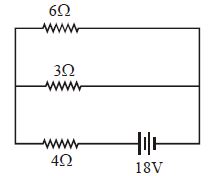
- 4The total power dissipated in watts in the circuit shown is ............. $W$View Solution
- 5A conducting wire of length $ l$ area of cross-section $A$ and electric resistivity $\rho$ is connected between the terminals of a battery. $A$ potential difference $V$ is developed between its ends, causing an electric current.If the length of the wire of the same material is doubled and the area of cross-section is halved, the resultant current would beView Solution
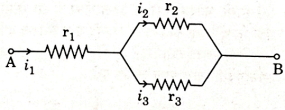
- 6Three resistors having resistances $\mathrm{r}_{1}, \mathrm{r}_{2}$ and $\mathrm{r}_{3}$ are connected as shown in the given circuit. The ratio $\frac{i_{3}}{i_{1}}$ of currents in terms of resistances used in the circuit is :View Solution
- 7Two electric bulbs whose resistance are in the ratio of $1: 2$, are connected in parallel to a constant voltage source. The power dissipated in them has the ratioView Solution
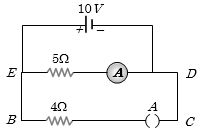
- 8In the given figure, when key $A$ is opened, the reading of the ammeter $A$ will be ........... $A$View Solution
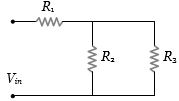
- 9For ensuring dissipation of same energy in all three resistors $({R_1},\,{R_2},\,{R_3})$ connected as shown in figure, their values must be related asView Solution
- 10A wire of resistance $R$ is divided in $10$ equal parts. These parts are connected in parallel, the equivalent resistance of such connection will beView Solution